I see buyers lose money when “authentic” means different things. One vague answer can stop customs[^1] or hurt reviews. I ask for proof before any deposit.
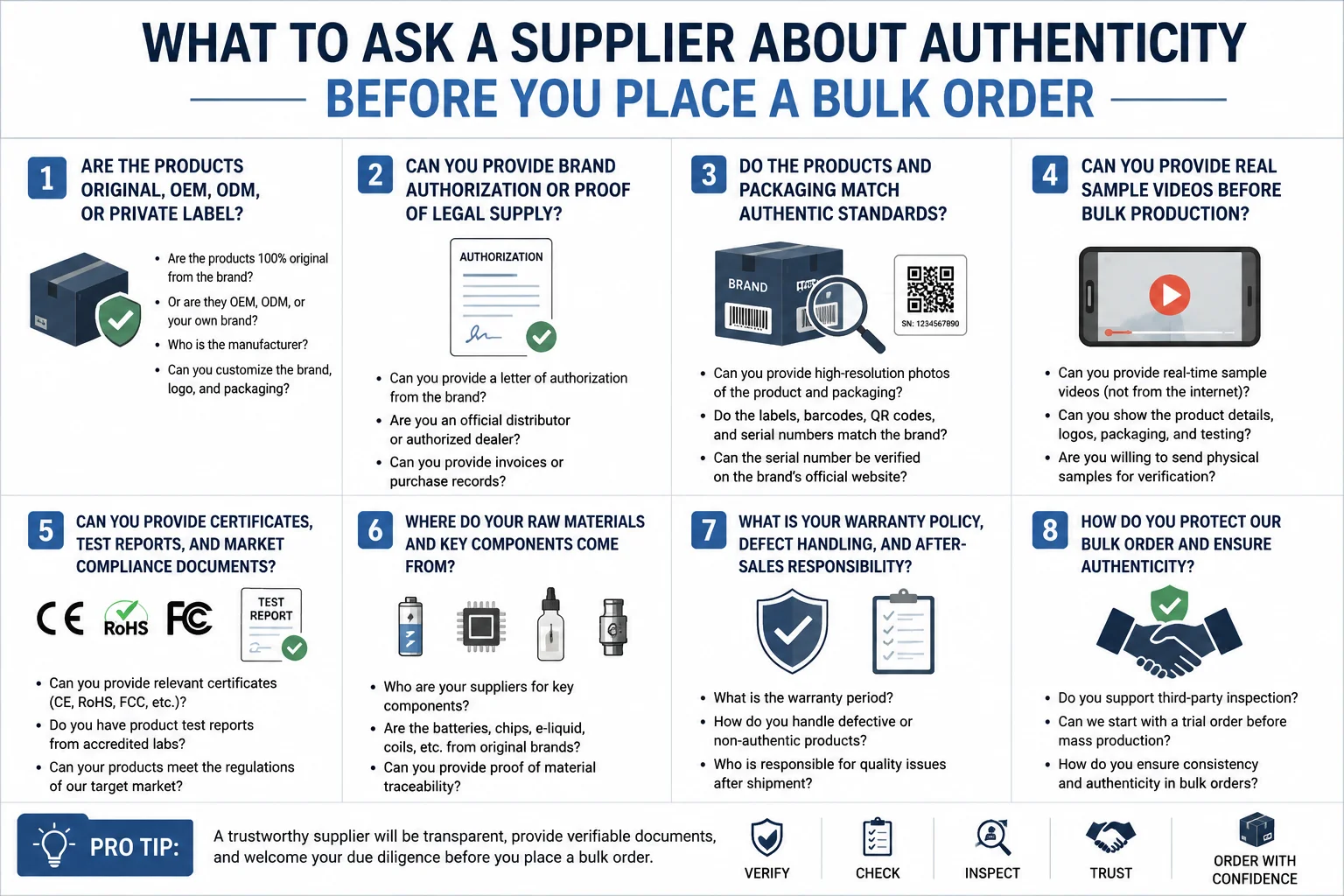
Before a bulk order, I ask a supplier to prove authenticity through product type, legal supply, real photos, samples, certifications, component sources, warranty terms, and written controls. I do not rely on words like “original” or “high copy.” I ask for documents, videos, and clear responsibility.
I have worked with overseas buyers for many years from Shenzhen. I have seen the same problem many times. A buyer asks, “Is this product authentic?” The supplier says, “Yes, of course.” Then both sides think the answer is clear. It is not clear at all.
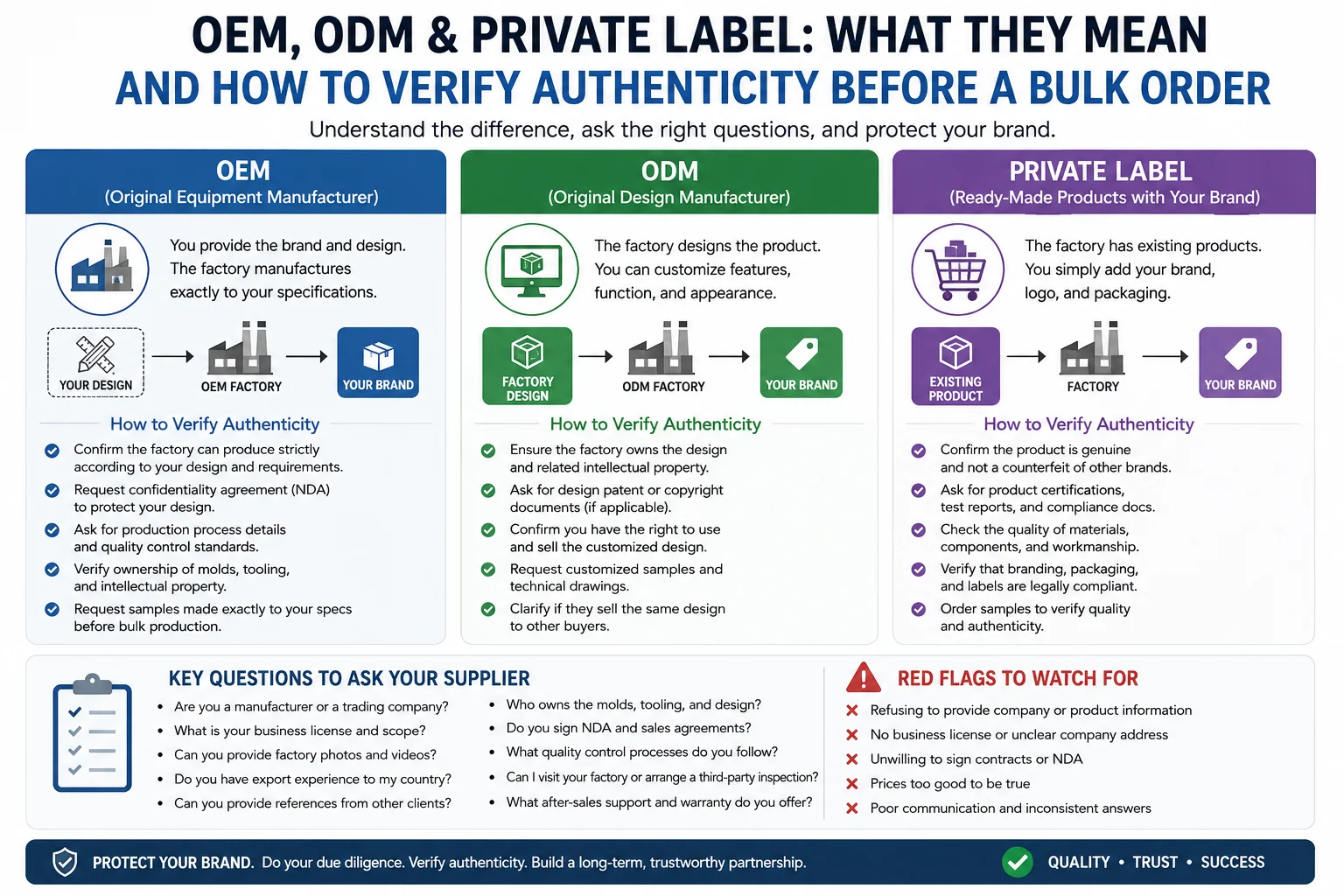
In 3C sourcing, authenticity is not one simple word. It can mean original brand goods. It can mean OEM production. It can mean ODM design with your logo. It can mean private label goods from an open market model. It can also mean a legal generic product that looks similar to a trend product but does not break brand rights. Each case has a different risk.
When a client asks me for the “best option,” I first ask about their sales channel. A retail chain has one kind of risk. An Amazon seller has another.[^2] A wholesale importer has another. The right question is not only “Is it real?” The better question is, “Can I prove what I am selling, and can I defend it if a platform, customs officer, or customer asks?” The questions below are the ones I use before money moves.
Ask Whether the Products Are Original, OEM, ODM, or Private Label?
I see buyers confuse sourcing models. That small mistake can create big claims later. I first make the supplier name the model in writing.
Ask the supplier to state whether the goods are original brand products, OEM, ODM, private label, or wholesale generic goods[^3]. Each model gives you different control, speed, MOQ, price, and legal risk. Do not let the supplier use only casual words like “same quality” or “factory version.”
How I read the answer
A common question I get from first-time importers is, “Can I buy original smartwatches at factory price?” I usually slow the talk down at that point. Some buyers use “original” when they mean “good quality.” Some suppliers use “original” when they mean “same shape.” These two meanings are not the same.
I ask the supplier to write the product model clearly in the quotation. I also ask them to avoid mixed words. If it is ODM, they should say ODM. If it is private label, they should say private label. If it is original brand stock, they should show legal proof. This protects both sides.
| Sourcing model | What I gain | What I give up | Main authenticity question |
|---|---|---|---|
| Wholesale generic | Fast delivery and low MOQ | Less brand control | Is it legal and stable? |
| Private label | My logo and packaging | More marketing work | Can I use this design safely? |
| ODM | Tested design with some changes | Limited deep control | Who owns the design rights? |
| OEM | More control over product | Higher cost and longer time | Who owns the tooling and IP?[^4] |
| Original brand goods | Brand demand | High legal proof needed | Is the supply chain authorized? |
Wholesale is not only the cheap option. I see it as the market-testing option. If a buyer wants to test a smartwatch category or TWS earphone line, fast stock can be better than deep customization. Private label is not only logo printing. It also needs packaging, product story, photos, and support. OEM is not total freedom. It needs technical staff, tooling budget, testing, and time. This is why I ask buyers to match the model to the risk they can afford.
Request Brand Authorization or Proof of Legal Supply?
I have seen buyers trust a low price too fast. The order looked profitable. Then the brand claim made the whole shipment dangerous.
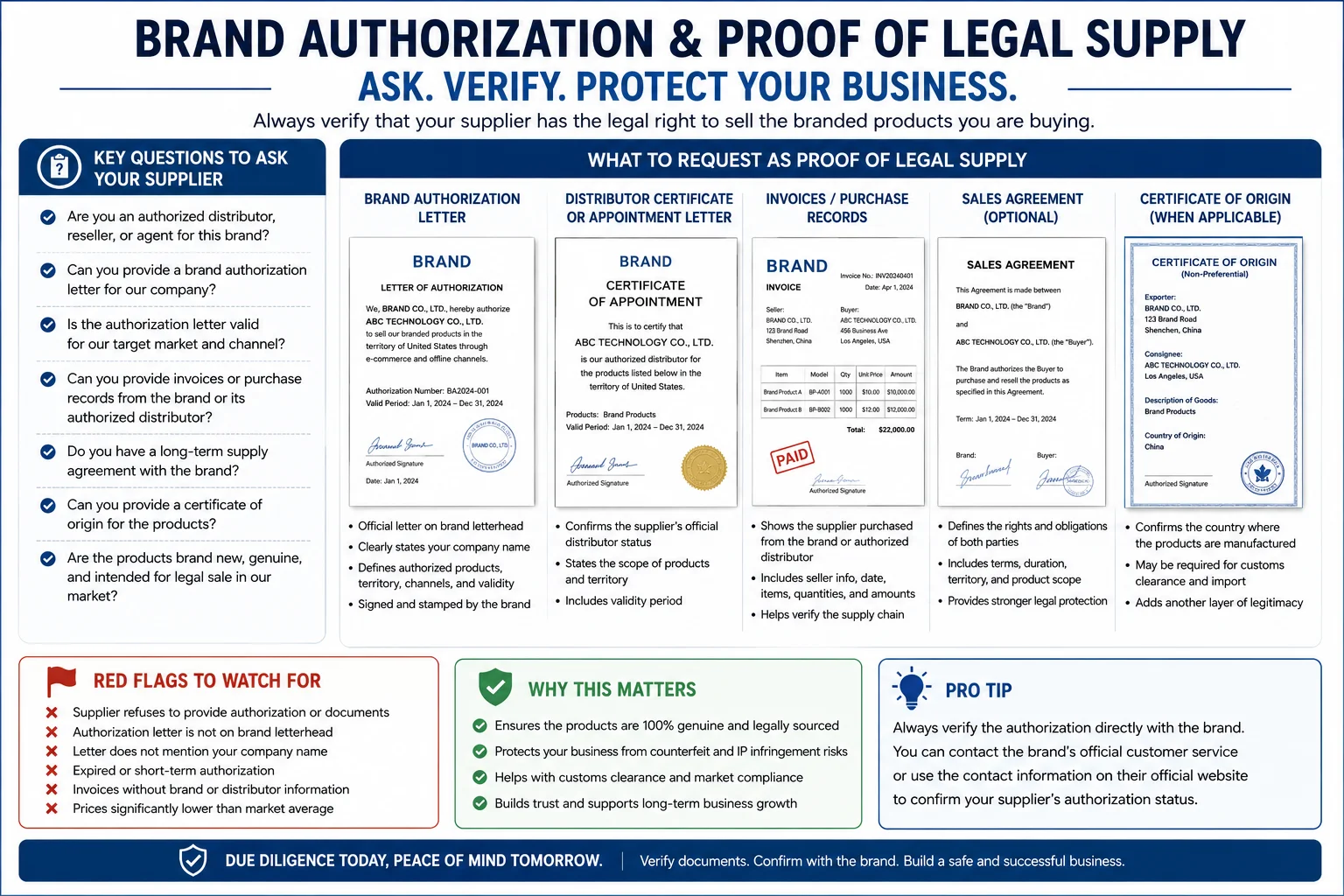
If a product carries a known brand name, ask for brand authorization, distributor proof, invoices, or other legal supply documents.[^5] If the supplier cannot prove legal supply, treat the goods as high risk, even when the price looks attractive.
What I ask for before I trust the offer
When I deal with branded products, I do not accept only screenshots or verbal claims. I ask for a document chain. I want to know who has the right to sell the goods, where the stock came from, and whether my buyer can sell it in their target market. This is very important for Europe and the United States. Marketplaces and customs teams can ask questions after the goods arrive. At that time, it is too late to ask the supplier for proof.
| Document or proof | Why I ask for it | Warning sign |
|---|---|---|
| Brand authorization letter | It shows selling rights | The brand name is blurred |
| Distributor certificate | It shows supply path | The company name does not match |
| Purchase invoice | It supports stock source | The invoice is from an unknown party |
| Product SKU list | It links proof to the product | The model number is missing |
| Territory permission | It shows market rights | It excludes your country |
I also ask if the proof covers the exact item. Some suppliers show one certificate for one category and then offer another model. That does not work for me. A charger, cable, smartwatch, or earbud must match the document by model, brand, and market. If the supplier says, “Do not worry, many clients buy it,” I still worry. My buyer is the one who faces the platform notice, not the supplier.
Check Product Photos, Packaging, Labels, and Serial Numbers?
I have seen beautiful catalog photos hide many problems. One wrong label can fail customs, platform review, or customer trust.
Ask for real photos of the product, packaging, labels, barcodes, manuals, plugs, warnings, and serial numbers. Match those details against the quotation, certification, and target market rules before confirming the order.
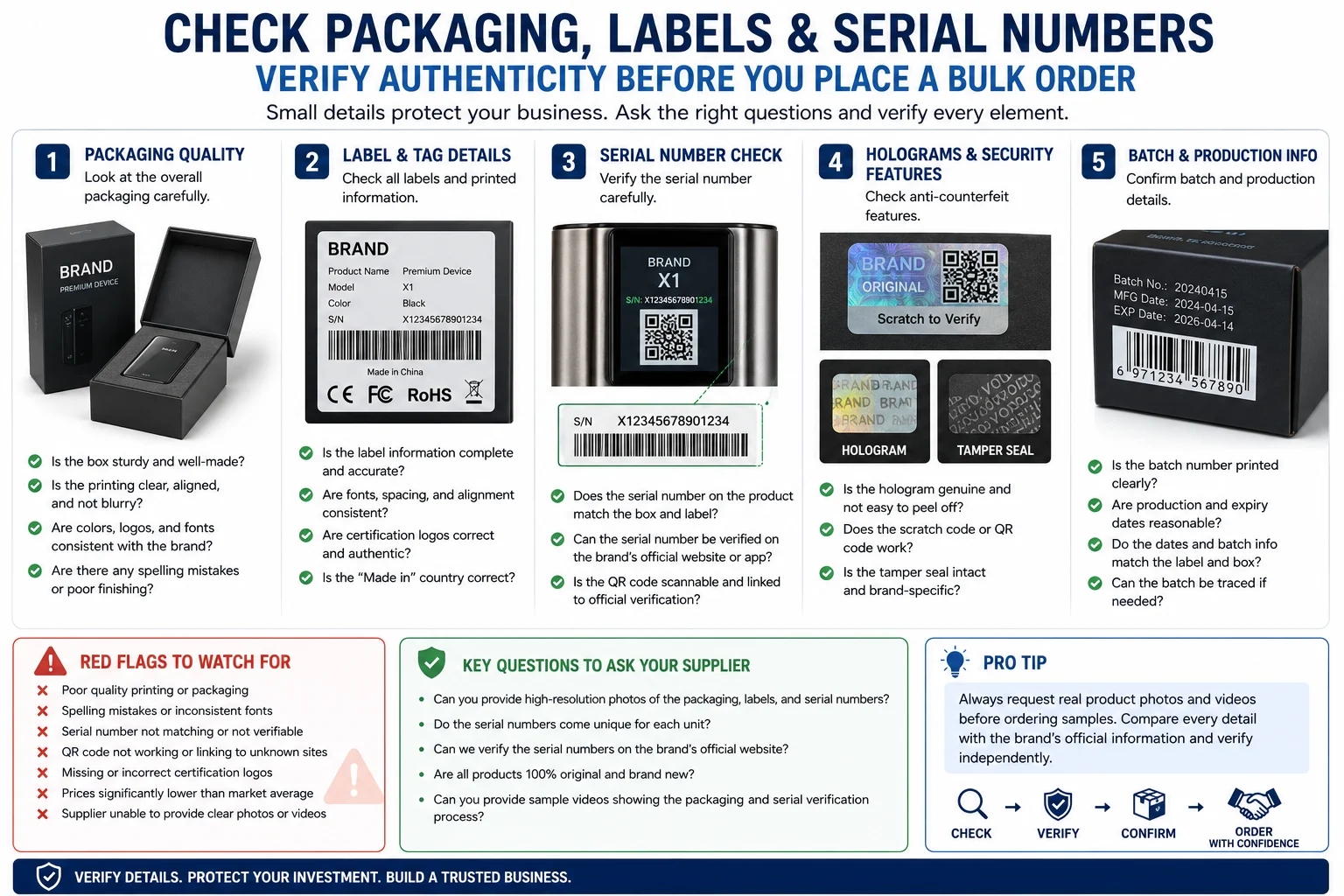
How I compare the details
I do not treat photos as decoration. I treat them as evidence. I ask the supplier to send real photos from the warehouse or sample room. I prefer photos taken on the same day with my company name or buyer name on a paper card beside the product. It sounds simple, but it prevents many misunderstandings.
| Item to check | What I look for | Why it matters |
|---|---|---|
| Front product photo | Shape, color, buttons, ports | It confirms the exact model |
| Back label | Input, output, model, origin | It affects compliance |
| Retail box | Brand, claims, language | It affects shelf sale |
| Barcode | SKU and market match | It affects warehouse systems |
| Manual | Safety language and warranty | It affects buyer support |
| Serial number | Traceability | It helps defect tracking |
For chargers and GAN adapters, I check input and output data very carefully. A small error can become a safety issue. For USB cables, I check connector type, length, material, and claimed fast charge rating. For smartwatches, I check app name, Bluetooth name, sensor claims, and packaging language. For TWS earbuds[^6], I check chip claims, charging case label, and battery information.
I also ask if the supplier can keep the same packaging for bulk production. Some samples look good, but bulk packaging uses different text or cheaper materials. That can cause buyer complaints. I prefer to lock photos and label files before production. Then inspection can compare real goods against the approved version.
Ask for Real Sample Videos Before Bulk Production?
I know photos can be staged. A short video often shows problems that pictures hide. I ask for video before I approve any sample.
Ask the supplier to send real sample videos showing the product, packaging, functions, accessories, label, and basic testing. For smartwatches, ask for pairing, charging, screen touch, app connection, and menu language. For chargers, ask for plug, output test, and label close-up.
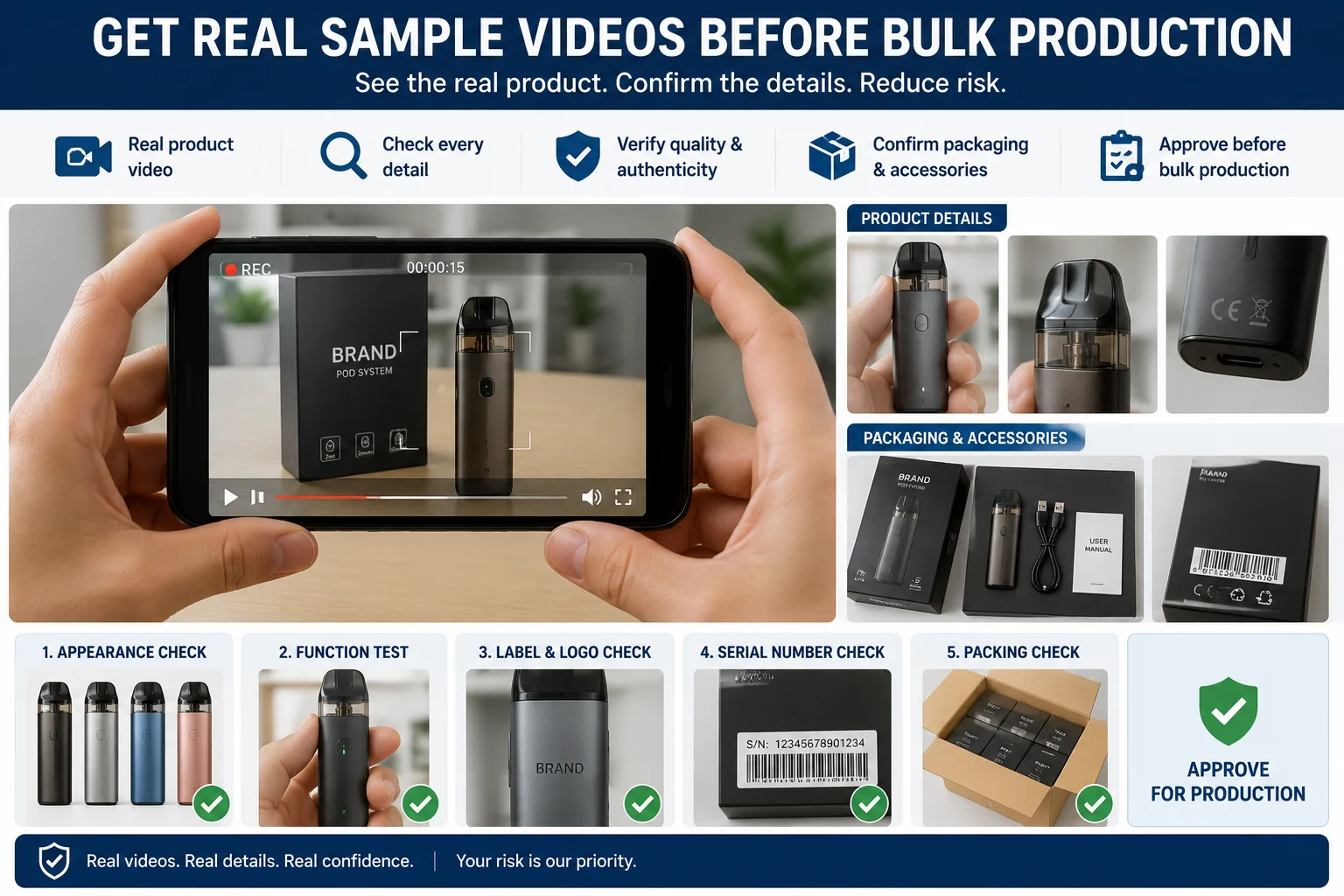
What I want to see in the video
I like sample videos because they save time. They do not replace physical samples, but they help me screen suppliers fast. I ask the supplier to record the product from opening the box to basic function testing. I do not need a perfect marketing video. I need a real working video.
| Product | Video action I ask for | Risk I reduce |
|---|---|---|
| Smartwatch | Pair with app and show language | Fake function claims |
| TWS earbuds | Connect to phone and test touch | Poor user experience |
| GAN charger[^7] | Show plug and output test | Wrong power rating |
| USB cable | Show length and fast charge test | Wrong specification |
| Power bank | Show capacity label and charging | Misleading capacity |
Here is a scenario I often discuss with e-commerce sellers. They want to move fast because a trend is hot. They see one smartwatch online and ask for bulk price. I ask them to request a video first. The video may show that the app is not the same as the listing claims. It may show that the screen border is wider than the photo. It may also show that the watch menu has poor translation. These are small things before production. They become expensive things after delivery.
I also ask the supplier to show the sample ID or model number in the video. If the video is too general, it has little value. I need proof that the product in the video is the same product in the quotation.
Verify Certifications, Test Reports, and Market Compliance?
I have seen buyers think one certificate covers everything. It does not. Wrong compliance can block sales even when the product works.
Ask for certificates and test reports that match the exact product model, brand name, factory, and target market. For Europe, check CE, RoHS, REACH, and related rules.[^8] For the United States, check FCC, UL-related needs, and platform requirements.[^9]
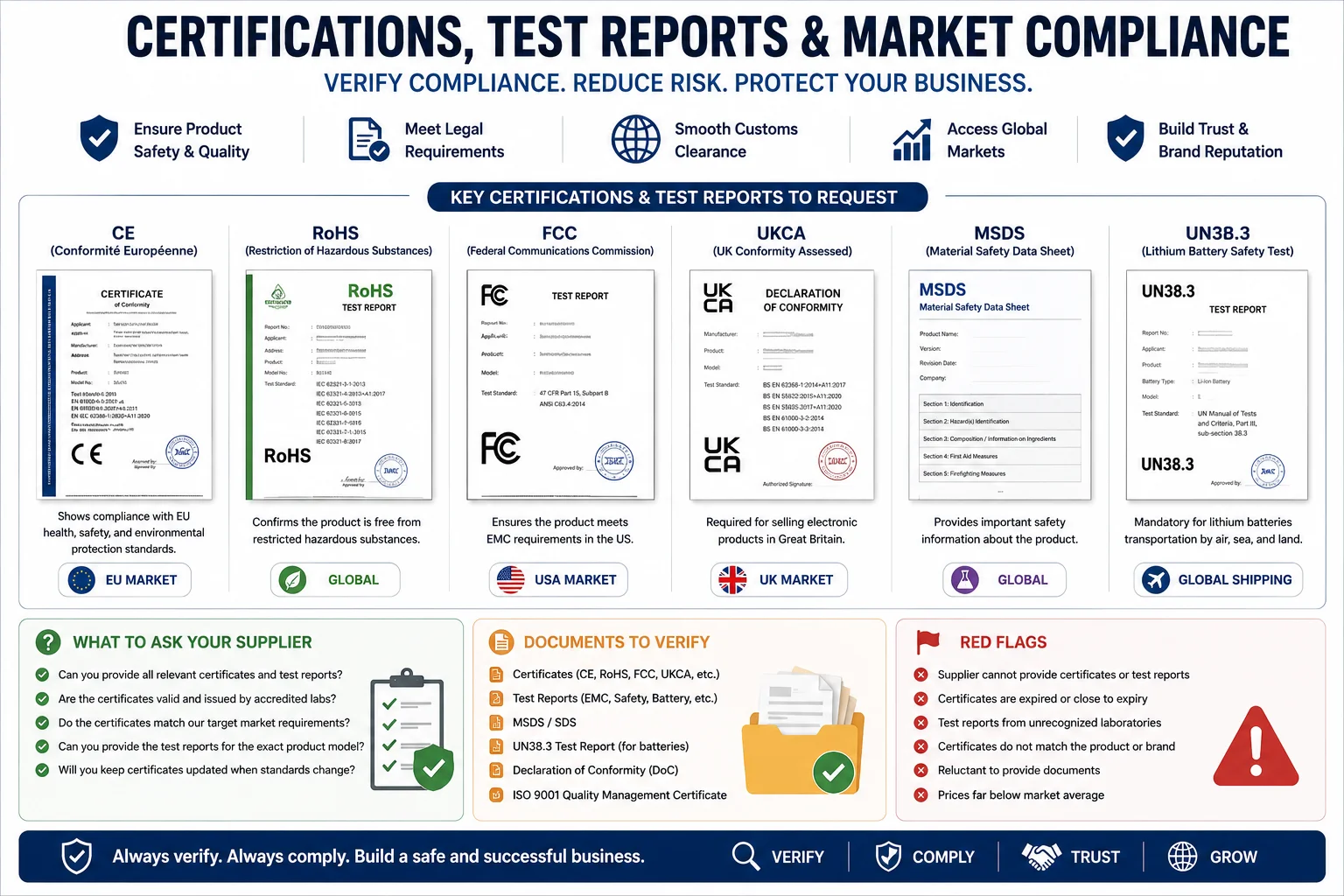
How I check documents in a practical way
I am not a lab engineer. I am an export person, so I look at compliance from the buyer’s risk side. I ask three simple questions. Is the certificate for this product? Is it for this market? Is it still valid enough for my buyer’s channel?
| Document detail | What I compare | Common issue |
|---|---|---|
| Product name | Quotation and sample | Name is too general |
| Model number | Label and packaging | Model does not match |
| Applicant | Supplier or factory | Unknown company |
| Test standard | Market requirement | Wrong standard used |
| Date | Current selling period | Old report |
| Photos in report | Real product | Different appearance |
For chargers, safety and electromagnetic testing matter a lot. For TWS earbuds and smartwatches, wireless compliance matters. For materials, RoHS and REACH can matter for Europe. For marketplaces, the platform may ask for documents even when customs does not. This is why I ask buyers where they will sell first. A retail chain, Amazon store, and local distributor may need different proof.
I also ask the supplier whether the report can be verified with the lab. Some labs offer online verification. Some suppliers only send a PDF. A PDF can be useful, but I still check the details. If the supplier avoids document questions or says, “Other buyers never ask,” I see that as a risk signal. Serious suppliers are used to compliance questions.
Confirm the Source of Key Components and Materials?
I have seen product quality change when one small component changes. The buyer ordered the same model. The customer received a different experience.
Ask the supplier which key components and materials are used, and ask whether they will stay the same in bulk production. For 3C products, check chips, batteries, cables, connectors, screens, sensors, shells, and charging parts.
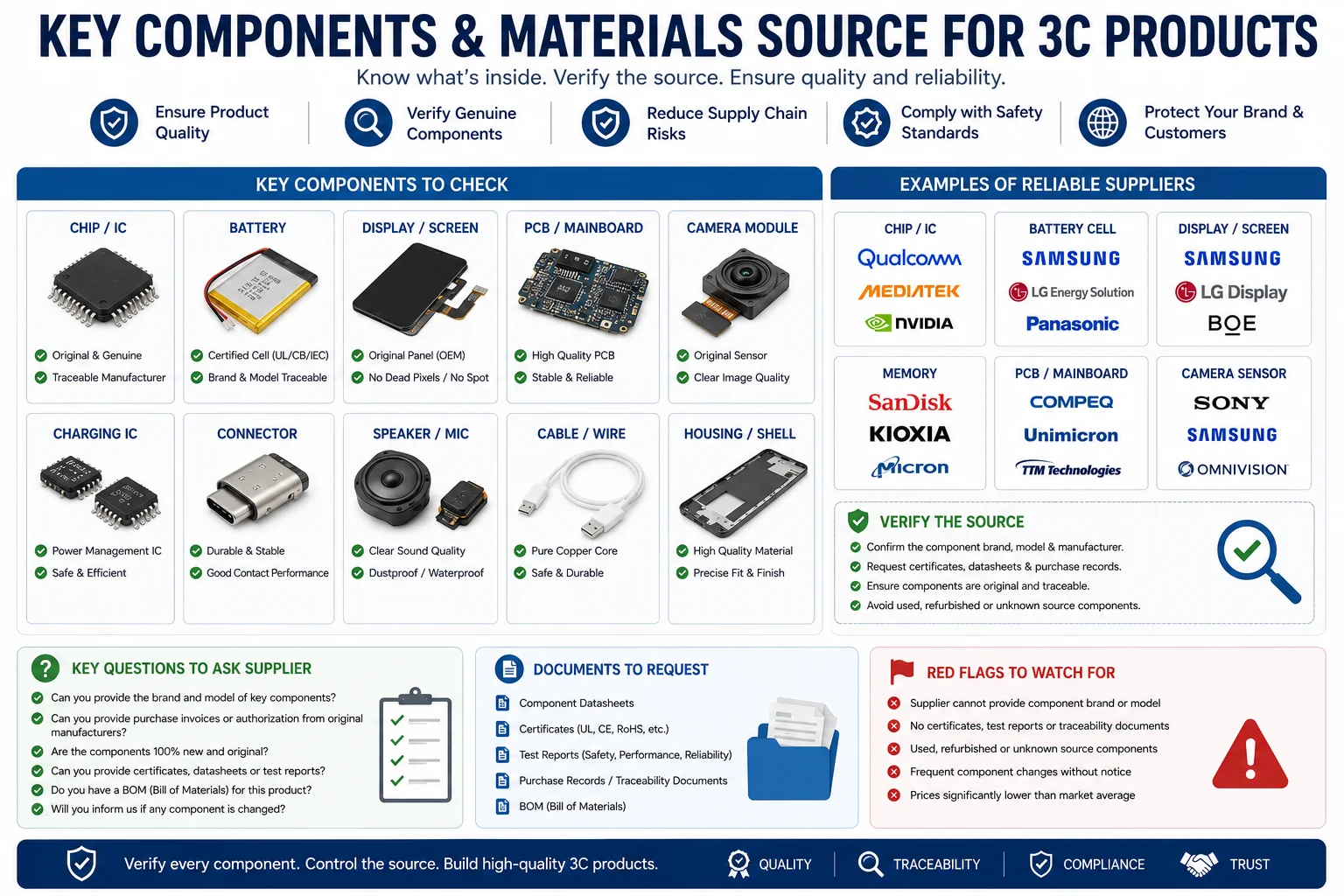
Why component source affects authenticity
Authenticity is not only about brand names. It is also about whether the supplier can deliver the same product that you approved. In Shenzhen, many 3C products have flexible supply chains. This can be good for speed and cost. It can also create risk if the supplier changes parts without telling you.[^10]
| Product | Key component to confirm | Why I care |
|---|---|---|
| Smartwatch | Chip, screen, battery, sensor | It affects speed and accuracy |
| TWS earbuds | Chip, battery, speaker, mic | It affects sound and connection |
| GAN charger | GAN chip, transformer, shell | It affects heat and safety |
| USB cable | Copper core, connector, jacket | It affects charging and life |
| Power bank | Battery cell, PCB, shell | It affects capacity and safety |
When a client asks for the best option, I always ask about their sales channel and return risk. If they sell low-cost wholesale goods, they may accept a normal open-market component plan. If they sell under their own brand, they should control more details. If they want OEM, they need to be ready for deeper work. OEM means shared technical and financial responsibility. It is not only a logo and a nice box.
I also ask the supplier to list key components in the contract or proforma invoice[^11] when the order is important. I may not need every tiny part, but I need the main ones. If the supplier must change a component, I want them to inform me before production. This keeps the order honest.
Clarify Warranty, Defect Handling, and After-Sales Responsibility?
I have seen buyers focus only on unit price. Then defects appear, and no one agrees on who should pay.
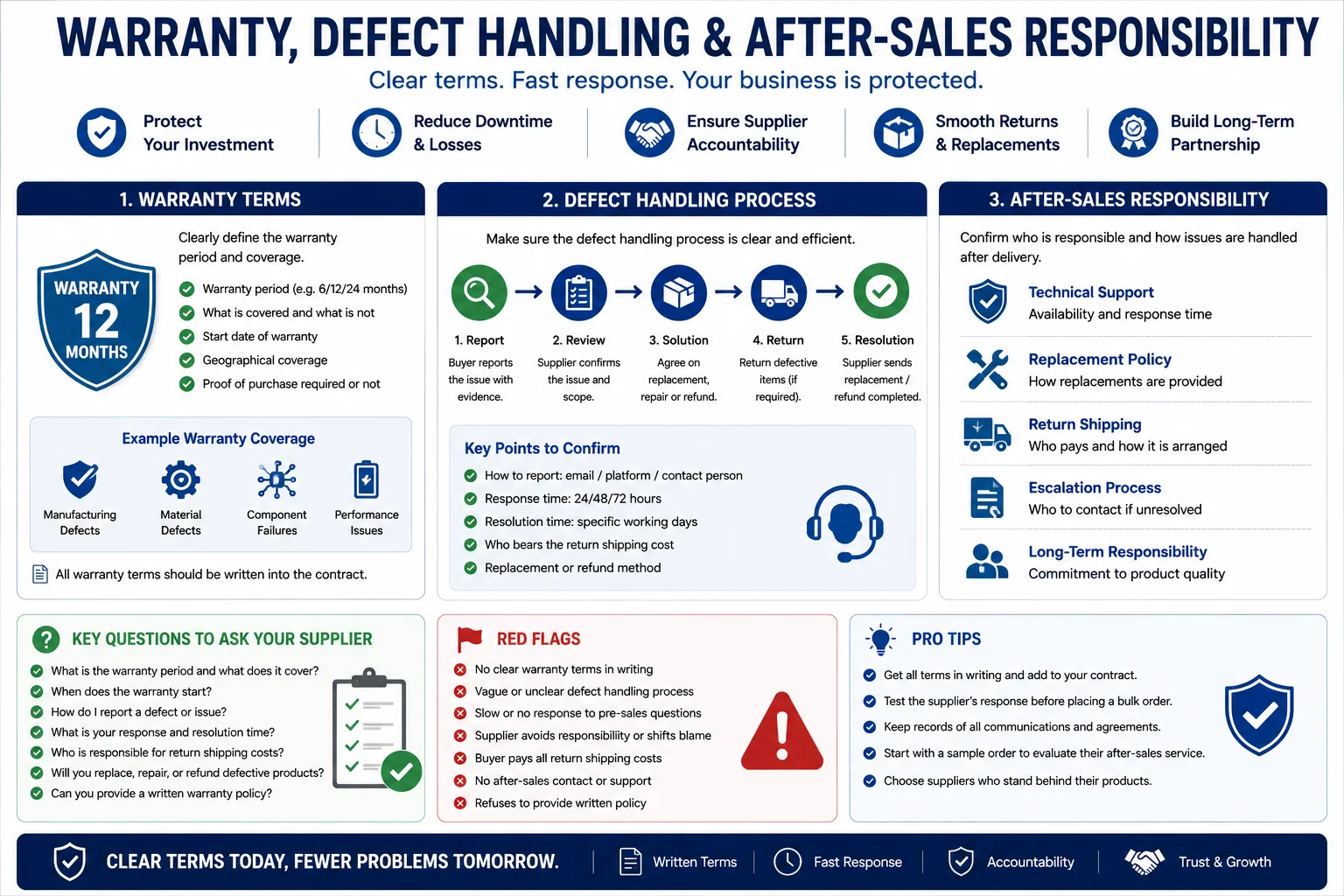
Ask the supplier to confirm warranty time, defect rate standard, proof needed for claims, compensation method, replacement plan, and who pays shipping or credit. Put these terms in writing before production starts.
What I put in writing
Warranty terms show how serious a supplier is. I do not only ask, “Do you offer warranty?” Most suppliers will say yes. I ask how the warranty works in real life. I ask what counts as a defect, what proof they need, and how they solve it.
| Warranty point | Question I ask | Better answer |
|---|---|---|
| Warranty period | How many months? | Clear time by product type |
| Defect proof | What proof do you need? | Photos, videos, list, samples |
| Defect rate | What rate is acceptable? | Written standard |
| Compensation | How do you compensate? | Credit, replacement, spare parts |
| Shipping cost | Who pays freight? | Clear rule |
| Batch issue | What if many units fail? | Investigation and action plan |
For smartwatches, after-sales issues often involve app connection, battery life, charging, screen touch, or language settings. For TWS earbuds, issues often involve pairing, one-side failure, sound quality, or charging case problems. For chargers, the situation can be more serious because safety matters. I ask for clear handling before bulk production because emotions are high after defects appear.
I also advise buyers to think about their own support ability. Private label needs more than logo printing. If you sell under your brand, your customer will blame you first. You need product manuals, FAQ, spare parts, and response rules. A supplier can support you, but they cannot run your brand service alone. This is the trade-off of building your own name in the market.
Protect Your Bulk Order with Samples, Contracts, and Inspection?
I have seen good talks fail because nothing was locked. A bulk order needs proof, not memory.
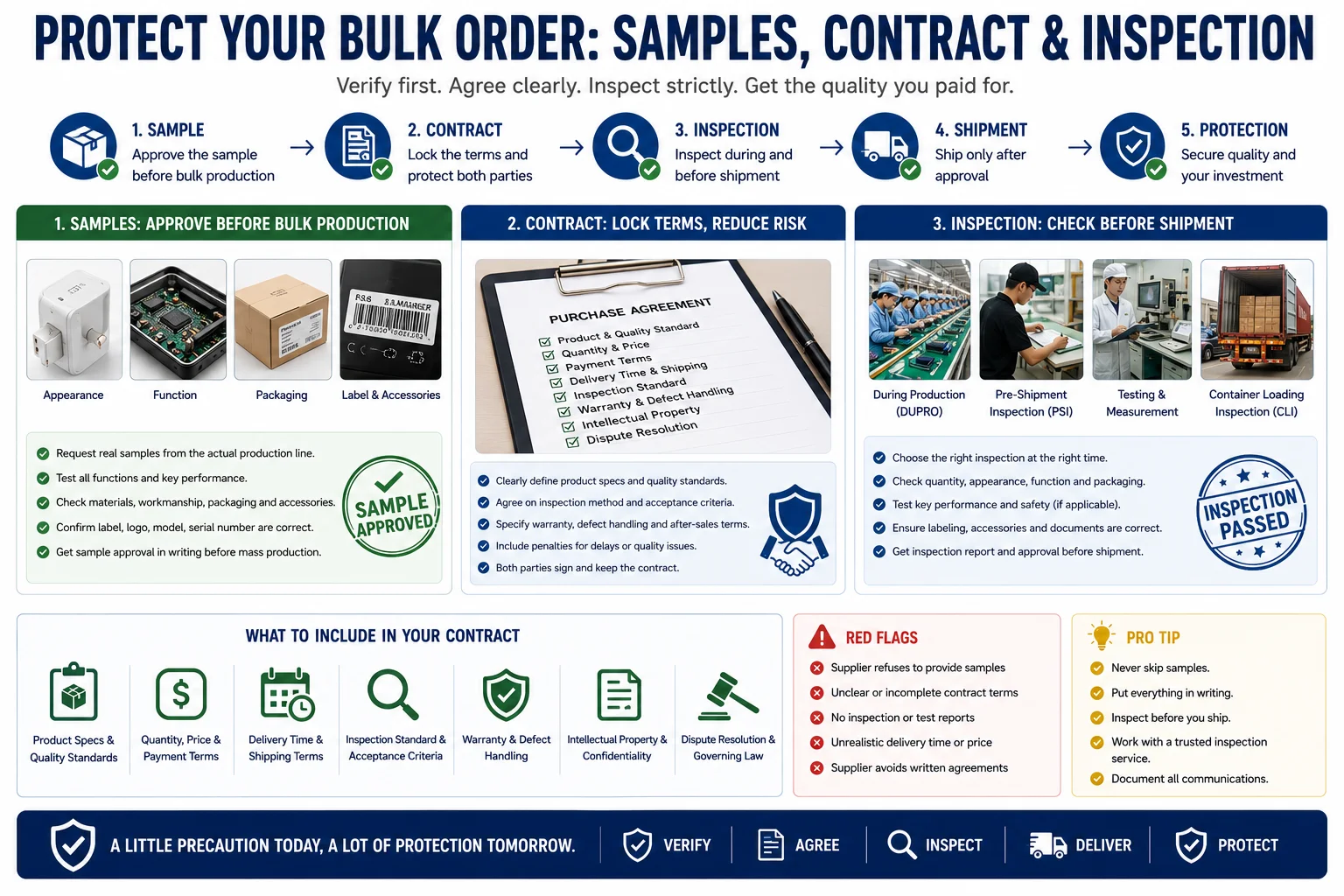
Protect your order by approving samples, writing key terms in the contract, and arranging inspection before shipment[^12]. The sample should become the standard. The contract should record model, packaging, certification, warranty, delivery time, and inspection rules.
My practical control process
I like a simple control process because it is easy for both sides to follow. First, I confirm the product model and sourcing type. Second, I check documents and photos. Third, I approve a sample. Fourth, I lock the order details in writing. Fifth, I inspect before shipment. This process is not fancy. It saves money.
| Step | What I do | What it prevents |
|---|---|---|
| Sample approval | I test and keep a reference sample | Wrong bulk quality |
| Written quotation | I lock model and specs | Price and spec confusion |
| Packaging approval | I confirm box, manual, label | Market and branding errors |
| Contract terms | I write warranty and delivery rules | Disputes after payment |
| Pre-shipment inspection | I check goods before balance payment | Late discovery of defects |
I tell buyers not to skip samples when the order has brand risk, custom packaging, new functions, or a new supplier. A sample is not only a product. It is a decision tool. It helps the buyer see whether the supplier understands details. It also helps the supplier know the buyer’s standard.
Inspection is also important. Some buyers think inspection means distrust. I do not see it that way. I see inspection as a shared checklist. It protects the buyer, and it also protects the supplier from unclear claims later. For first orders, I suggest inspection before the balance payment. For repeat orders, I still suggest random checks, especially if the product, packaging, or component source changes.
The right sourcing model depends on the risk your business can carry. If you need fast market testing, wholesale may fit. If you want a brand with low technical burden, private label may fit. If you need unique hardware and have budget, OEM may fit. In all cases, authenticity must be proven before the bulk order.
Conclusion
I ask for proof before I trust a bulk order. Clear documents, samples, videos, contracts, and inspection reduce risk before money, goods, and reputation are exposed.
Avoid Counterfeit and Supply Risk
For bulk vape orders, supplier verification protects your business from counterfeits and quality issues. Reach out to our team for factory audits and QC.
Related reading: How to Reduce First-Order Risk When Working with a New Vape Supplier
[^1]: "Intellectual Property Rights (IPR) - U.S. Customs and Border Protection", https://www.cbp.gov/trade/priority-issues/ipr. Government sources, such as U.S. Customs and Border Protection (CBP), outline the legal framework for enforcing Intellectual Property Rights (IPR) at the border, which includes the authority to seize counterfeit goods. Evidence role: mechanism; source type: government. Supports: The source should explain the legal authority and procedures that customs agencies use to inspect, detain, and seize imported goods that are suspected of infringing on trademarks or copyrights.. [^2]: "Amazon Anti-Counterfeiting policy", https://sellercentral.amazon.com/help/hub/reference/external/G201165970?locale=en-US. Amazon's seller-facing policy pages detail its strict rules on anti-counterfeiting and intellectual property, outlining a specific set of risks for sellers on the platform, including suspension and loss of funds. Evidence role: case_reference; source type: other. Supports: The source should detail Amazon's specific policies regarding product authenticity, intellectual property, and the potential penalties for sellers, such as account suspension or inventory seizure.. Scope note: The source is specific to the Amazon marketplace and may not represent risks on other e-commerce platforms. [^3]: "White label, private label, ODM, OEM: which is best for you? - KKAMI", https://www.kkami.nl/white-label-private-label-odm-oem-what-is-the-difference-and-which-is-best-for-you/. A source can provide standard industry definitions for sourcing models like OEM, ODM, and private label, clarifying the differences in design ownership, manufacturing control, and branding. Evidence role: definition; source type: education. Supports: The source should define the different manufacturing and sourcing models, such as Original Equipment Manufacturer (OEM), Original Design Manufacturer (ODM), and private label, as they are used in global supply chains.. [^4]: "project agreement - SEC.gov", https://www.sec.gov/Archives/edgar/data/797542/000129534515000294/exh10_16.htm. Legal and business resources on contract manufacturing explain that OEM agreements must explicitly define ownership of tooling and intellectual property to prevent future disputes over who controls the manufacturing process and the resulting product rights. Evidence role: mechanism; source type: education. Supports: The source should explain how ownership of physical tooling (molds, dies) and intellectual property (designs, patents) is typically negotiated and legally defined in Original Equipment Manufacturer (OEM) contracts.. [^5]: "1854. Copyright Infringement -- First Sale Doctrine", https://www.justice.gov/archives/jm/criminal-resource-manual-1854-copyright-infringement-first-sale-doctrine. Legal scholarship on trademark law explains that while the 'first sale doctrine' permits the resale of genuine goods, importers may still need to provide proof of an authorized supply chain to platforms and customs to defend against claims of counterfeit or gray market goods. Evidence role: historical_context; source type: paper. Supports: The source should explain legal principles governing the resale of trademarked goods, such as the first sale doctrine, and why documentation like authorization letters is crucial to prove goods are not counterfeit and can be legally sold in a specific market.. Scope note: The application of these legal principles can vary significantly by jurisdiction. [^6]: "What does TWS mean? - JBL Support", https://support.jbl.com/gb/en/howto/general-tws-faq-true-wireless-stereo-emea/000041038.html. A technology publication or encyclopedia can define True Wireless Stereo (TWS) as a technology that allows two separate audio devices, like earbuds, to connect to each other and a source device wirelessly via Bluetooth. Evidence role: definition; source type: encyclopedia. Supports: The source should define the term 'True Wireless Stereo' (TWS) and explain that it refers to earbuds that have no physical wire connecting the two earpieces or connecting to the audio source.. [^7]: "Trouble understanding GaN charger benefits : r/UsbCHardware", https://www.reddit.com/r/UsbCHardware/comments/zx1ht7/trouble_understanding_gan_charger_benefits/. A technical or consumer electronics source can explain that Gallium Nitride (GaN) is a semiconductor material that has replaced silicon in some power adapters, allowing for higher efficiency, reduced heat, and a smaller physical size for the charger. Evidence role: definition; source type: encyclopedia. Supports: The source should explain what Gallium Nitride (GaN) is and how its properties allow for the creation of smaller, more energy-efficient, and cooler-operating power adapters compared to traditional silicon-based technology.. [^8]: "CE marking - Wikipedia", https://en.wikipedia.org/wiki/CE_marking. The European Commission's official websites explain that CE marking indicates conformity with health, safety, and environmental protection standards, while the RoHS directive restricts specific hazardous materials, and the REACH regulation addresses the production and use of chemical substances, all of which can apply to electronic goods. Evidence role: definition; source type: government. Supports: The source should be an official European Union body that defines the CE marking, the Restriction of Hazardous Substances (RoHS) directive, and the Registration, Evaluation, Authorisation and Restriction of Chemicals (REACH) regulation.. [^9]: "Equipment Authorization – RF Device | Federal Communications ...", https://www.fcc.gov/oet/ea/rfdevice. The Federal Communications Commission (FCC) regulates radio frequency devices to prevent interference, while safety organizations like UL develop standards and provide testing and certification for product safety; compliance with one or both is often necessary for market access in the U.S. Evidence role: definition; source type: institution. Supports: The source should explain the roles of the Federal Communications Commission (FCC) regarding electronic emissions and Underwriters Laboratories (UL) regarding safety standards for products sold in the U.S.. Scope note: While FCC rules are often mandatory for specific devices, UL certification is a voluntary safety standard, though often required by retailers and distributors. [^10]: "What Are the Various Risks in Supply Chain Management?", https://www.apu.apus.edu/area-of-study/business-and-management/resources/what-are-the-various-risks-in-supply-chain-management/. Research and industry reports on supply chain integrity document the risks of unauthorized component substitution, which can lead to performance degradation, higher failure rates, and safety hazards in electronic products. Evidence role: general_support; source type: research. Supports: The source should discuss the problem of component substitution, quality fade, or the introduction of counterfeit parts into the electronics supply chain and the resulting impact on product reliability and safety.. [^11]: "Understanding the difference: pro forma vs commercial invoice - DHL", https://www.dhl.com/discover/en-my/logistics-advice/essential-guides/proforma-invoice-vs-commercial-invoice. International trade resources define a proforma invoice as a preliminary bill of sale sent to buyers in advance of a shipment or delivery of goods. While it contains key details and is often used to arrange financing, its legal enforceability as a contract can be limited compared to a purchase order or sales agreement. Evidence role: definition; source type: institution. Supports: The source should define a proforma invoice and explain its function in international trade, distinguishing it from a commercial invoice or a formal sales contract.. [^12]: "Pre-shipment inspection - Wikipedia", https://en.wikipedia.org/wiki/Pre-shipment_inspection. Supply chain management guides describe pre-shipment inspection (PSI) as a common practice where goods are checked for conformity to specifications at the factory before they are dispatched, helping to mitigate risks of receiving defective or incorrect products. Evidence role: definition; source type: education. Supports: The source should define pre-shipment inspection (PSI) and explain its role as a standard quality control procedure in global sourcing to verify product specifications and quality before final payment and shipment..