
Tired of seeing insane puff count claims? Worried you're buying a number, not a product? You are not alone in feeling this way.
The best way to judge a puff count is to ignore the big number on the box and focus on the e-liquid volume. A general rule is 1ml of liquid equals about 200 puffs.[^1] So, a device with 20ml of liquid has a real-world puff count closer to 4,000, not 20,000.
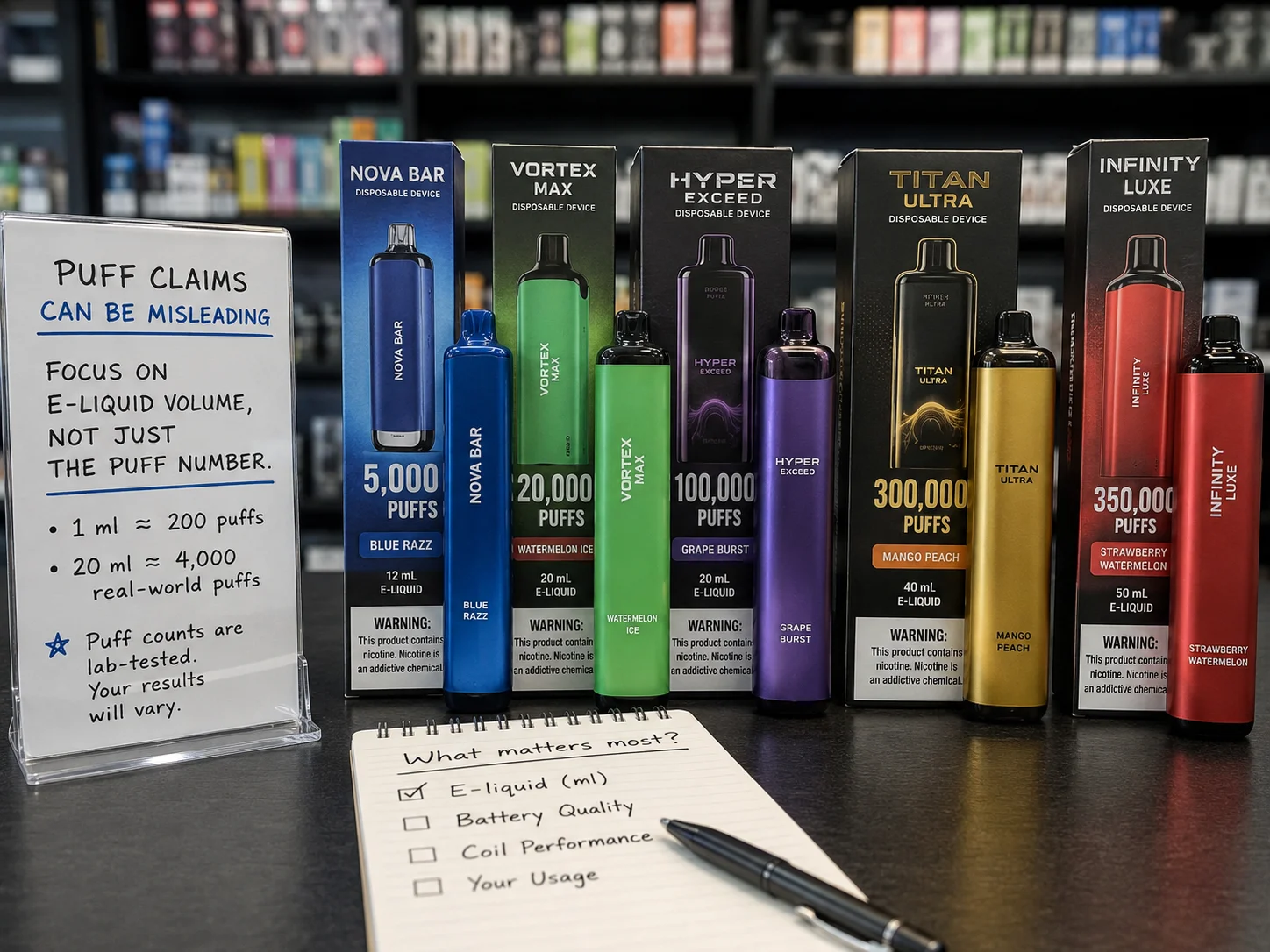
I've been in this business since 2011, and the puff count "arms race" is one of the biggest challenges for wholesalers. It's easy to get misled if you don't know what to look for. The truth is, the number on the package has become more about marketing than reality. We need to look deeper to understand what we're actually buying and selling. Let's break down why this happens and how you can protect your business and your reputation from these inflated claims.
Why Is the Puff Count Mostly a Marketing Number?
See a vape claiming 300,000 puffs? Wondering if it's real or just a crazy gimmick? It's a marketing race to the top.
Puff count is a marketing tool driven by competition.[^2] As brands fight for shelf space and customer attention, they inflate numbers to look better than their rivals. It's a numbers game where the packaging gets more extreme, but the product inside often can't deliver on the promise.
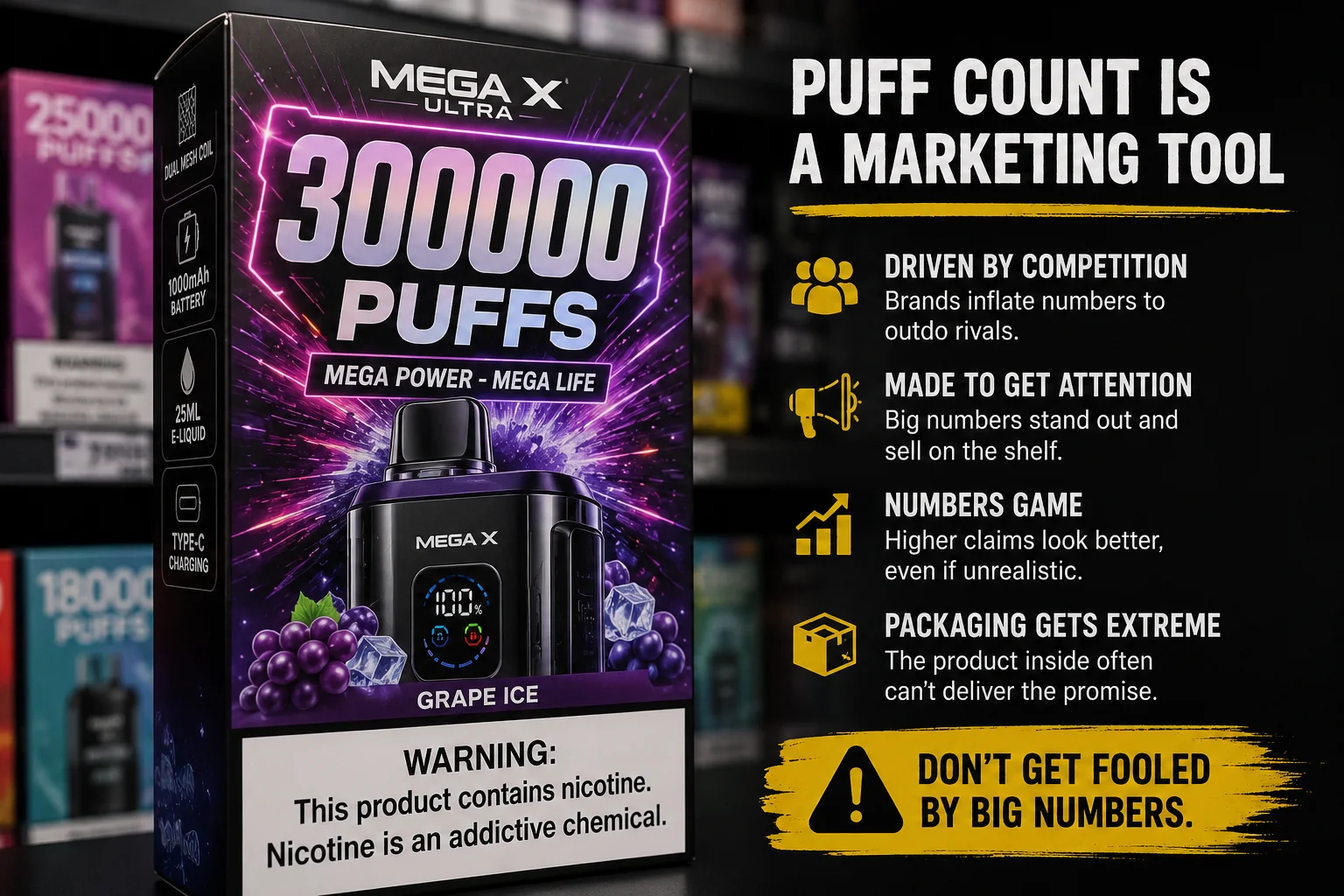
When I first started, a disposable with 600 puffs was standard. Then it became 1,500, then 5,000. Now, we see numbers like 50,000, 100,000, and I've even seen claims of 350,000.[^3] It's gotten out of hand. Why? Because manufacturers know that many buyers, especially those new to the market, will just compare the numbers. A bigger number looks like a better deal. So, to compete, everyone feels the pressure to put a bigger number on their box. But a disposable vape is a small, handheld device. Its physical size puts a hard limit on how much battery and e-liquid it can hold. It’s not a magic box. It's just a simple device, and we have to treat it like one. The numbers have become a fantasy, and as a business owner, you can't build a sustainable business on fantasy.
What Actually Determines Real Usage Time?
Are your customers complaining their 20,000-puff vape died in a week? Frustrated by the gap between promise and reality? The puff count isn't the real story.
Real usage is determined by three things: e-liquid volume, battery capacity, and coil lifespan.[^4] The device will fail as soon as the weakest of these three gives out. A huge tank of e-liquid is useless if the coil burns out first or the battery dies.
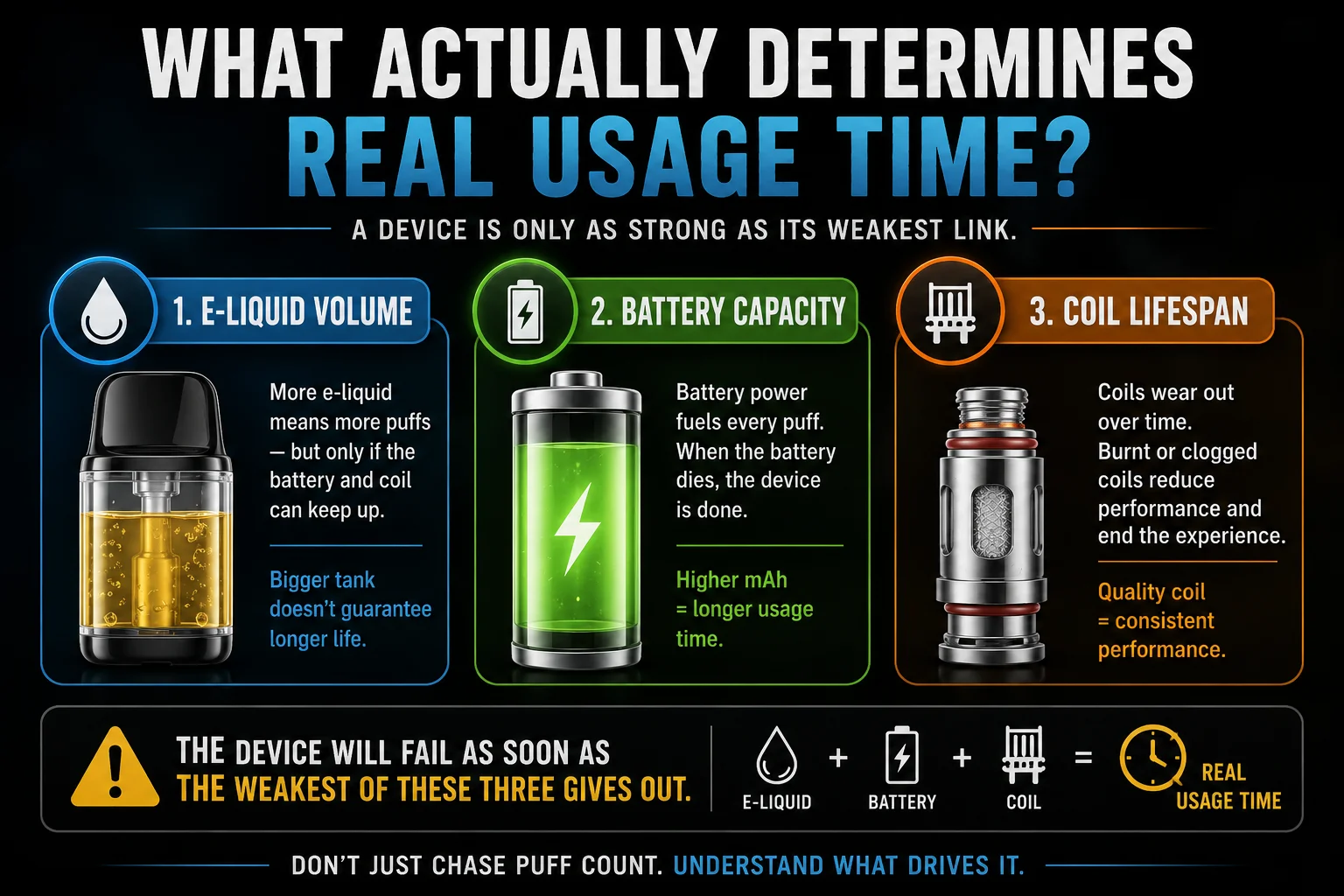
Let's dive deeper into the three real factors that matter. Forget the number on the box for a minute and think about the physical components inside.
1. E-Liquid Volume (ml)
This is the most straightforward factor. You can't puff vapor if there's no liquid to vaporize. The industry-standard estimate is that 1ml of e-liquid provides around 200 puffs. Of course, this can change based on how long each puff is, but it's a solid baseline. So if a device claims 15,000 puffs but only contains 18ml of liquid, the math doesn't add up. It should be closer to 3,600 puffs. Always check the e-liquid volume.
2. Battery Capacity (mAh)
The battery has to be powerful enough to vaporize all the e-liquid. If a device has 25ml of liquid but a tiny battery, you'll be recharging it constantly, and it might not even last long enough to use all the liquid. This is where quality matters. Good brands use stable lithium batteries. Cheap knock-offs often use low-grade manganese batteries that die quickly, perform terribly in the cold, and have a very short overall lifespan.[^5]
3. Coil Lifespan
This is the hidden killer of disposable vapes. The coil is the small wire that heats up to create vapor. With every puff, it degrades slightly. After thousands of puffs, it will start to get gunked up and "caramelized." This leads to a horrible, burnt taste. Even if you have plenty of e-liquid and battery left, a burnt coil means the vape is finished. No single coil can survive 50,000 or 100,000 puffs. It's just not physically possible.
| Component | What it Does | Why it Limits Puffs |
|---|---|---|
| E-Liquid | Creates the vapor and flavor. | Once it's gone, there's nothing to puff. |
| Battery | Powers the coil to heat the liquid. | If it dies, the device won't work. |
| Coil | Heats the e-liquid into vapor. | It wears out and gives a burnt taste. |
The true puff count is limited by whichever of these three runs out first.
Why Do 100K, 300K, and 350K Puff Claims Need Extra Caution?
See a vape claiming 350,000 puffs and think you've found a goldmine? Worried it's too good to be true? You are absolutely right to be skeptical.
These massive numbers are physically impossible for a handheld disposable device.[^6] A 350,000 puff claim would require about 1,750ml of e-liquid—that's nearly two large soda bottles. These are purely marketing gimmicks designed to mislead buyers who only look at the number.
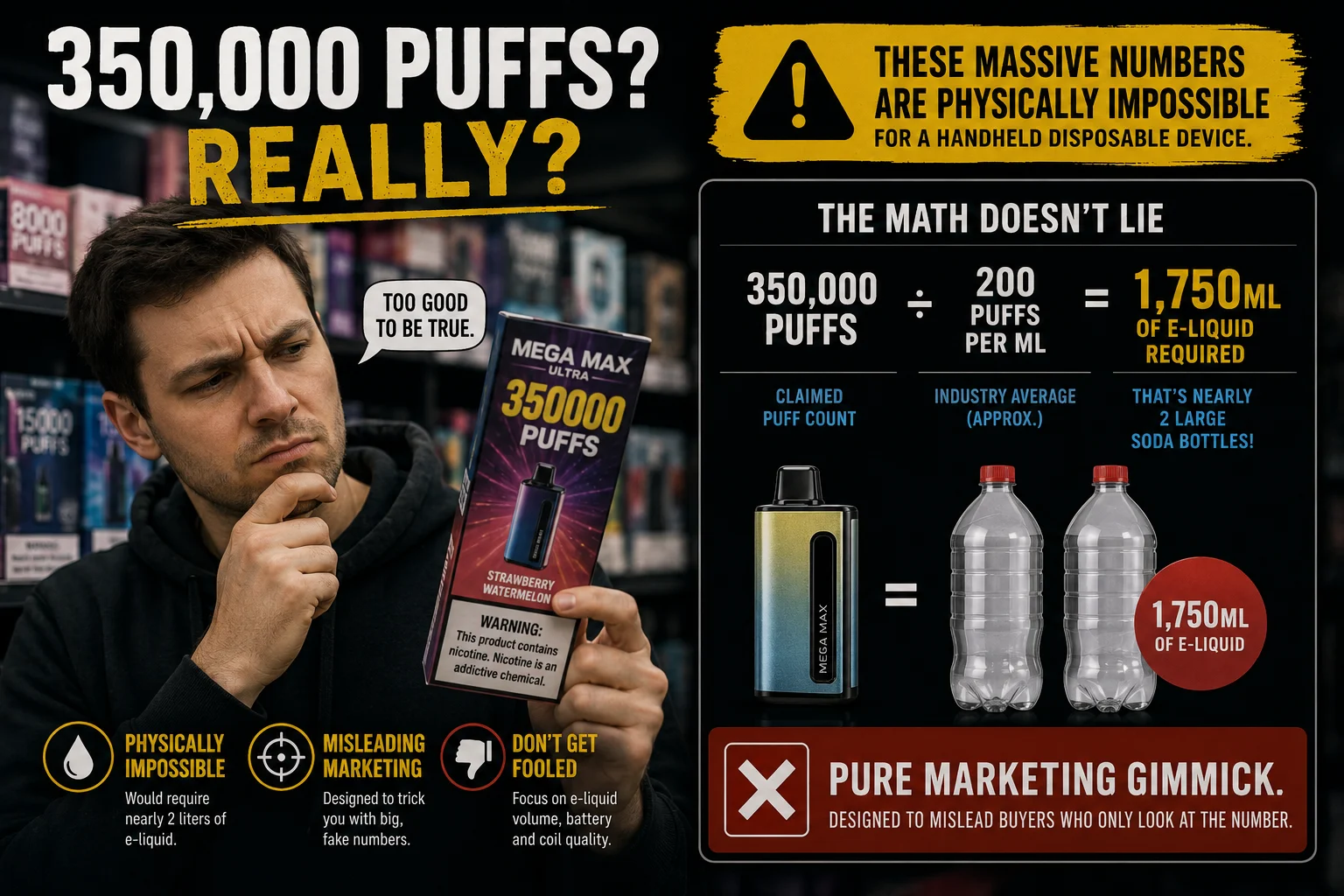
Let's do some simple math. Using our rule of 1ml for every 200 puffs:
- 100,000 Puffs: Would require 500ml of e-liquid. That's the size of a standard water bottle.
- 350,000 Puffs: Would require 1,750ml of e-liquid. That's almost half a gallon.
Can you imagine trying to carry a half-gallon vape in your pocket? It's absurd. These products prey on wholesalers and retailers who are new to the market and don't understand the technical limitations. I had a client last month who was excited because he found a supplier for a "200K puff" vape at a very low price. I had to walk him through this basic math. He thought he was getting a revolutionary product, but he was about to spend thousands of dollars on a lie. He would have been stuck with a warehouse full of products that would lead to nothing but customer complaints. These devices might have a big battery and a switch to change "modes," but it's all smoke and mirrors. The core limitations—e-liquid volume and coil life—are still there.
How Do Battery, E-Liquid, and Coil Quality Limit Real Performance?
Ever bought cheap vapes only to deal with endless returns? Wonder why some devices die fast while others last? The quality of the components inside is everything.
Low-quality parts destroy performance. Cheap manganese batteries fail in the cold and lose their charge quickly. Bad e-liquid tastes harsh and inconsistent. Poorly made coils burn out fast, giving a nasty taste long before the e-liquid is even gone.
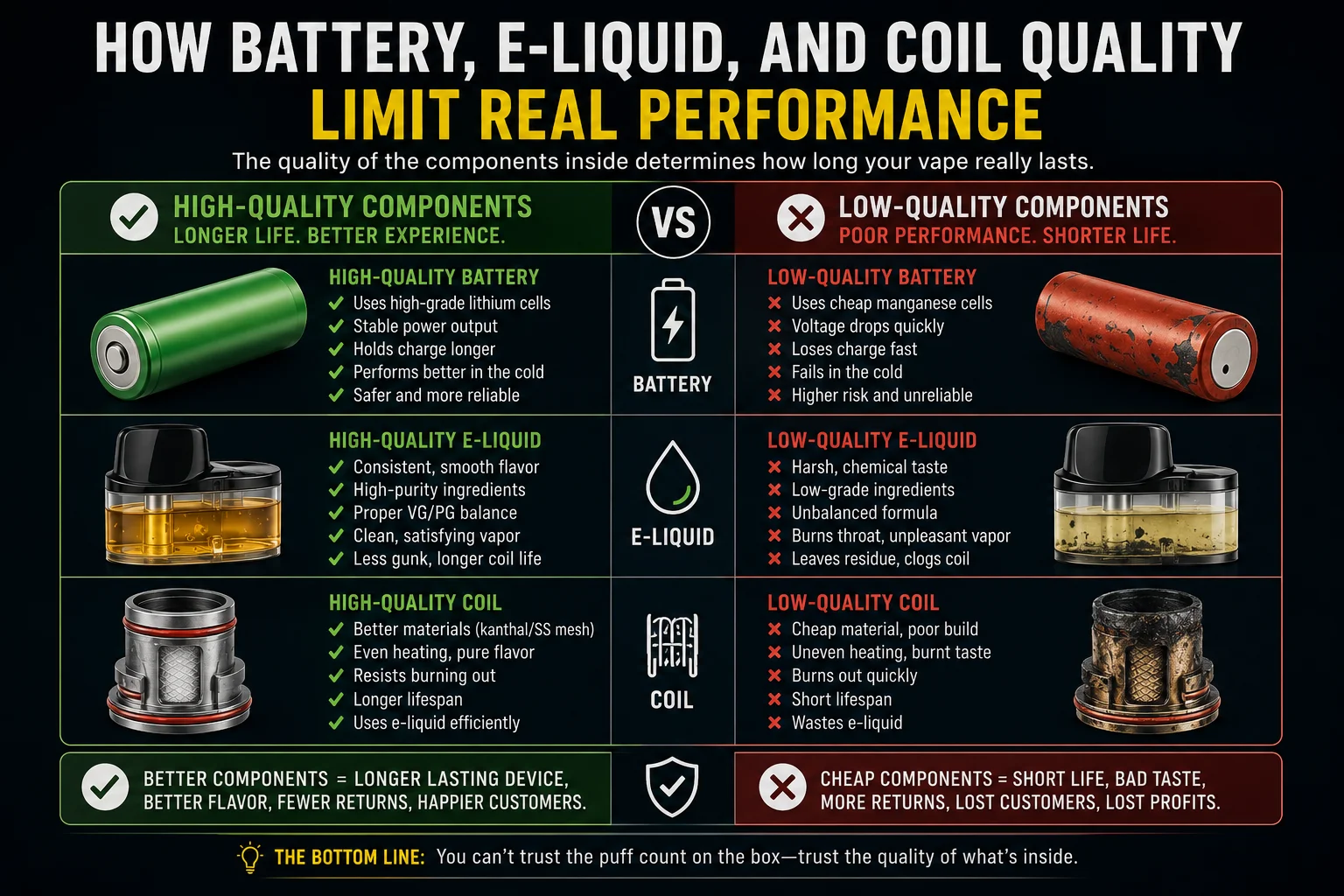
When a supplier offers you a product at a price that seems too good to be true, it's because they've cut corners on the most important parts. The two biggest costs in a disposable vape are the battery and the e-liquid.
-
The Battery Difference: Reputable brands like Elf Bar or Vozol use high-quality, rechargeable lithium batteries from major manufacturers. These are stable, hold a charge well, and work reliably. The cheap fakes? They use pure cobalt or even manganese cells. I've seen these fail completely in cold weather. A customer takes it out of their pocket in winter, and it just doesn't work. Or they charge it for hours, and it dies after just a few puffs. A good battery gives your customer a reliable experience. A bad one just causes frustration.
-
The E-Liquid Difference: This is a health and safety issue. Good brands use food-grade ingredients and operate in clean facilities. Their flavors are consistent. The cheap stuff is often mixed in unregulated, dirty workshops with unknown ingredients.[^7] The flavor is harsh, and you have no idea what your customer is actually inhaling.
-
The Coil Difference: A well-made mesh coil provides a consistent, clean flavor from the first puff to the last.[^8] A poorly made coil will develop hot spots and burn the cotton, creating that awful burnt taste that kills the experience. This is one of the top reasons for customer complaints.
You might think you're saving money by buying the cheaper option, but you're actually buying future problems. You're buying customer service headaches, negative reviews, and a damaged reputation.
Why Don't Bigger Puff Numbers Always Mean Better Sales?
Think a higher puff count will automatically fly off your shelves? Worried about stocking a product that promises the world but delivers nothing? Bigger isn't always better.
Customers are getting smarter. One bad experience with an over-hyped product leads to lost trust, negative reviews, and zero repeat business.[^9] Selling a reliable 8,000-puff vape from a good brand is far more profitable than selling a fake 50,000-puff one that generates complaints.
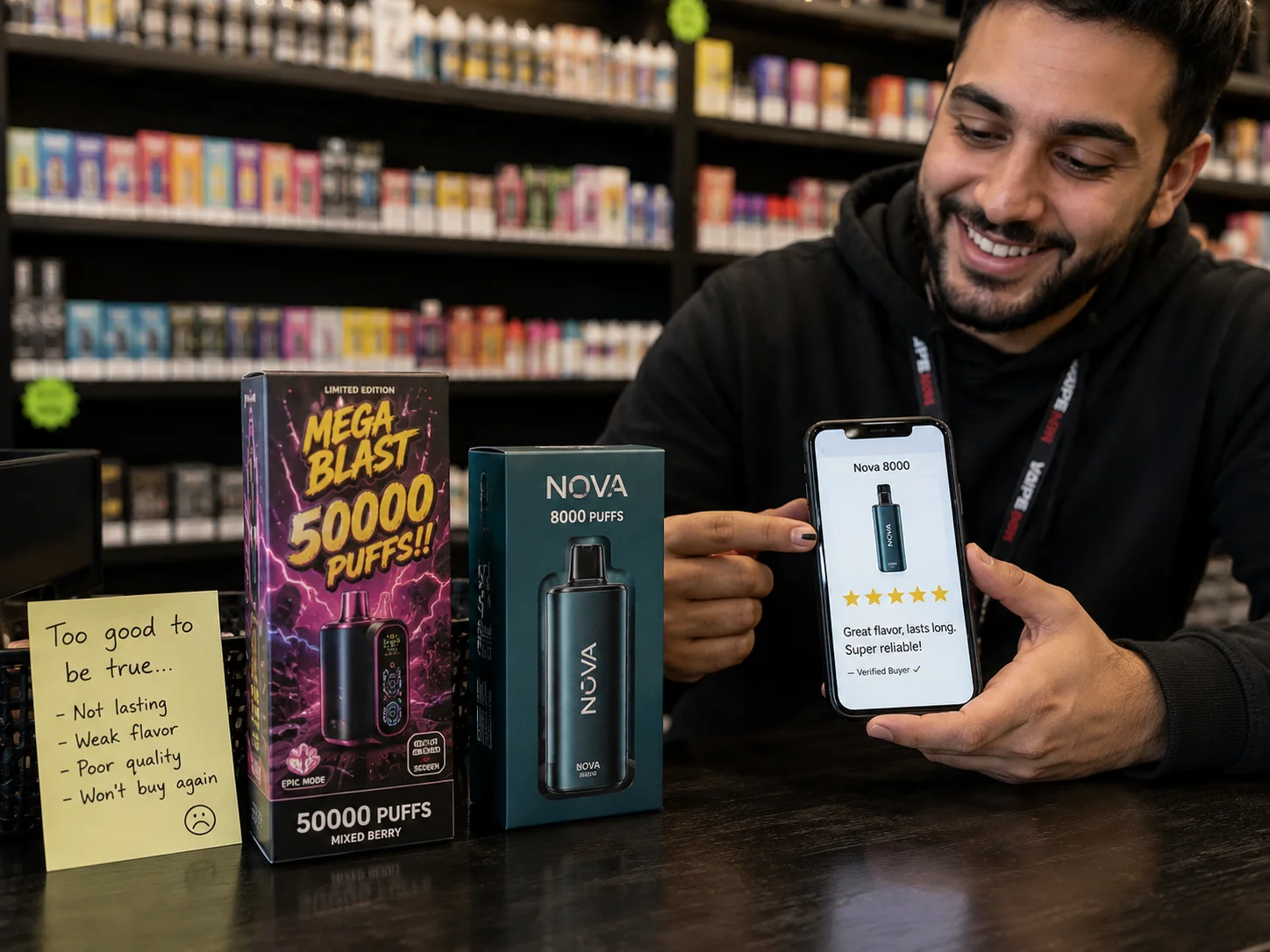
The biggest mistake a new wholesaler can make is thinking that the cheapest product with the biggest numbers is the easiest to sell. The opposite is true. If the cheapest things were the most profitable, we would all be selling rubber bands. The essence of a successful wholesale business is not a high margin on one sale; it's the speed of your capital turnover.
Think about it this way:
- Scenario A: You sell a reliable vape from a trusted brand. You make a 20% margin, and because it works well, you sell your whole stock in one week.
- Scenario B: You sell a cheap, high-puff-count vape. You have a theoretical margin of 50%. But half the units are returned, customers complain, and it takes you three months to get rid of the stock.
Which business is healthier? Scenario A, without a doubt. In one month, you've turned your money over four times, earning 20% each time. In Scenario B, your money is tied up in bad inventory. I'd rather sell a Fumot or Razz Bar that I know works and have the customer come back happy next week, than sell a no-name 100K puff vape and spend my next week handling angry emails. Your reputation is built on reliability, not hype.
How Can You Test Puff Count Claims Before a Bulk Order?
Afraid of getting stuck with thousands of bad units? Want to verify a supplier's claims before you commit your money? There is a smart way to test.
Always start with a small test order. Get physical samples and use them yourself for several days. Check the official brand website for authentication codes. Ask the supplier for recent, verifiable shipping records and customer feedback. A real supplier will be transparent.
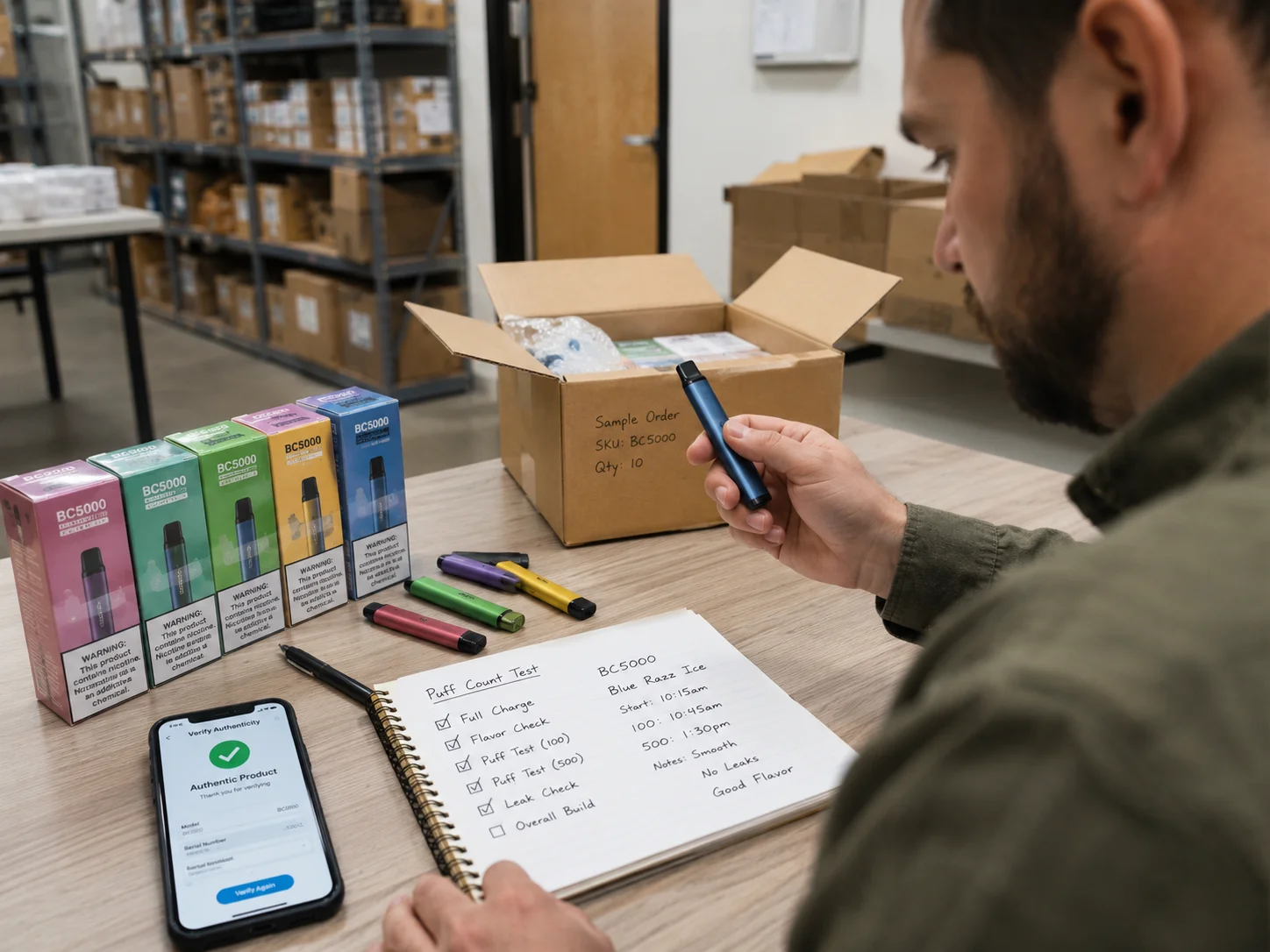
Never place a large order based on pictures and promises alone. Here is a simple checklist to protect yourself:
- Get Samples: Order a small quantity first. This is why we offer very low MOQs from our overseas warehouses, sometimes as low as 50 units. It allows our clients to test the market with minimal risk.
- Verify Authenticity: Almost all major brands have a security code on the package. Do not just scan the QR code. Scammers can create fake websites that the QR code links to. Instead, go to the brand's official website (e.g., elfbar.com, vozol.com) yourself and manually type in the code to verify it.
- Use It Like a Customer: Don't just take one puff. Use the device for a few days. Does it hold a charge? Does the flavor stay consistent, or does it start to taste burnt? Does it leak?
- Vet Your Supplier: A reliable supplier will not be afraid to show you proof. Ask for recent tracking numbers for shipments to your region. Ask for a video of their warehouse stock with your name written on a piece of paper in the shot. A supplier who is desperate for your payment and refuses to provide any proof is a huge red flag.
Final Advice: Should You Sell Real Experience or Just Big Numbers?
Tired of the puff count arms race? Want to build a business that lasts beyond the next marketing trend? The secret is to focus on what customers actually want.
Focus on selling a great, consistent vaping experience. This comes from quality brands, realistic specs, and good flavor. Your customers will remember the great taste and reliability, not an inflated number on a box they threw away.

In the long run, your business is built on trust. Position yourself as an expert who guides customers to the right products, not just a reseller pushing whatever has the biggest number on the box. It is better to educate your customer and explain why a true 10,000-puff vape from a top brand is a better purchase than a fake 100,000-puff device.
This is the core of our business philosophy. We take on the risks. We invest huge capital to buy in bulk directly from top brands like Elf Bar and Vozol. We handle the international shipping, the customs, and the warehousing. We do this so our clients in Europe and the US can order small, testable quantities, get them delivered in days, and focus on the most important thing: selling a product they can stand behind. You sell the experience, build your customer base, and we'll handle the difficult logistics in the background. That's how we can grow together.
Conclusion
Stop chasing inflated puff counts. Focus on real-world factors like e-liquid volume, coil quality, and brand reputation to build a profitable, long-lasting wholesale business your customers can trust.
[^1]: "How to Calculate How Many Puffs in E-Liquid - Vape Boyz", https://vapeboyz.co.uk/blogs/news/how-to-calculate-how-many-puffs-in-e-liquid. A source could provide a technical basis for estimating puff count from e-liquid volume, noting that actual puff count varies significantly based on factors like puff duration, device power, and coil resistance. While no universal standard exists, many industry analyses use a range of 100-300 puffs per ml as a general guideline. Evidence role: general_support; source type: research. Supports: The claim that 1ml of e-liquid generally yields a certain number of puffs, with the understanding that this is an estimate.. Scope note: The source would likely confirm this is a rough estimate and not a precise conversion, as puffing behavior is highly variable. [^2]: "Puffing Topography: A Tool to Evaluate Vaping Behavior and ... - PMC", https://pmc.ncbi.nlm.nih.gov/articles/PMC12958158/. A market analysis or industry report could confirm that escalating puff counts on disposable vapes are a recognized competitive marketing strategy, often referred to as a 'puff count war,' where brands vie for consumer attention through increasingly large numbers. Evidence role: expert_consensus; source type: other. Supports: The claim that escalating puff counts are a known marketing tactic in the competitive disposable vape market.. [^3]: "Products - Data Briefs - Number 524 - January 2025 - CDC", https://www.cdc.gov/nchs/products/databriefs/db524.htm. Industry analyses and market trend reports on vaping products could document the evolution of disposable e-cigarettes, showing a clear trend of escalating advertised puff counts from a few hundred in early models to tens of thousands or more in recent years. Evidence role: historical_context; source type: other. Supports: The claim that advertised puff counts for disposable vapes have seen a dramatic and rapid increase over the past several years.. [^4]: "Appeal and Use of Customizable E-cigarette Product Features in ...", https://pmc.ncbi.nlm.nih.gov/articles/PMC7643857/. A technical review of disposable e-cigarette design could confirm that the device's functional lifespan is determined by the point of failure of one of its three critical, consumable components: the depletion of the e-liquid, the exhaustion of the battery's charge cycles, or the degradation of the coil to the point of producing an unacceptable flavor. Evidence role: mechanism; source type: research. Supports: The claim that a disposable vape's lifespan is a system-level property limited by its key components.. [^5]: "Disposable E-Cigarettes More Toxic Than Traditional ... - UC Davis", https://www.ucdavis.edu/news/disposable-e-cigarettes-more-toxic-traditional-cigarettes. Educational resources on battery chemistry could explain that while Lithium Manganese Oxide (LMO) batteries offer good safety and low cost, they typically have lower energy density and a shorter cycle life compared to Lithium Cobalt Oxide (LCO) batteries. LMO batteries can also exhibit a more significant voltage drop in cold temperatures, affecting device performance. Evidence role: mechanism; source type: education. Supports: The claim that manganese-based battery chemistries have performance disadvantages compared to lithium-cobalt chemistries, particularly regarding energy density and performance in cold temperatures.. Scope note: The source would describe general battery characteristics, not specifically confirm their use in 'cheap knock-off' vapes, which would require product teardowns. [^6]: "Electronic Cigarettes and Vaping Devices - TSA", https://www.tsa.gov/travel/security-screening/whatcanibring/items/electronic-cigarettes-and-vaping-devices. A technical analysis could support this by calculating the required volume for e-liquid and the necessary battery mass/volume to vaporize it for such high puff counts, concluding that the resulting device size would far exceed that of a typical handheld disposable vape. Evidence role: general_support; source type: research. Supports: The claim that the volume required for the e-liquid and the battery capacity needed to vaporize it make puff counts of 100,000+ unfeasible in a typical handheld device.. Scope note: The source would be providing a theoretical calculation rather than a direct statement about a specific commercial product. [^7]: "Adolescents' Perceptions, Experiences, and Reactions to “Fake ...", https://pmc.ncbi.nlm.nih.gov/articles/PMC11812520/. Reports from public health agencies, such as the U.S. Centers for Disease Control and Prevention (CDC), have documented the health risks associated with unregulated vaping products. Investigations into illicit cartridges have found contaminants and undisclosed substances, highlighting the dangers of products made outside of regulatory oversight. Evidence role: case_reference; source type: government. Supports: The claim that unregulated vaping products can contain unknown and potentially harmful ingredients and may be produced in unsanitary conditions.. [^8]: "RDA mesh vs standard coils : r/electronic_cigarette - Reddit", https://www.reddit.com/r/electronic_cigarette/comments/yd3he4/rda_mesh_vs_standard_coils/. Technical articles or vape industry resources could explain that mesh coils, due to their larger surface area and more even heat distribution compared to traditional wire coils, can vaporize e-liquid more efficiently. This often results in a more consistent flavor profile and can reduce the likelihood of 'hot spots' that cause a burnt taste. Evidence role: mechanism; source type: other. Supports: The claim that mesh coils offer advantages in flavor consistency and quality.. [^9]: "What Is Brand Trust and Why It's Your Most Valuable Asset", https://imcprofessional.medill.northwestern.edu/blog/what-is-brand-trust. Market research or studies in consumer behavior could support the principle that brand trust is heavily influenced by product performance meeting or exceeding expectations. A significant gap between advertised claims and actual experience is a common driver of negative reviews and a primary reason for customers not to make repeat purchases. Evidence role: general_support; source type: research. Supports: The claim that product performance relative to marketing claims is a key driver of customer satisfaction, trust, and repeat business.. Scope note: The source would likely discuss general consumer behavior rather than focusing specifically on vape puff counts.