
A cheap price looks safe. Then stock runs out. Your store stops selling, your customers leave, and your margin disappears fast.
Stock depth matters more than a flashy price list because stable inventory protects sales, cash flow, promotions, and buyer trust. A low unit price helps only once. Deep stock helps every week, every reorder, and every customer promise.
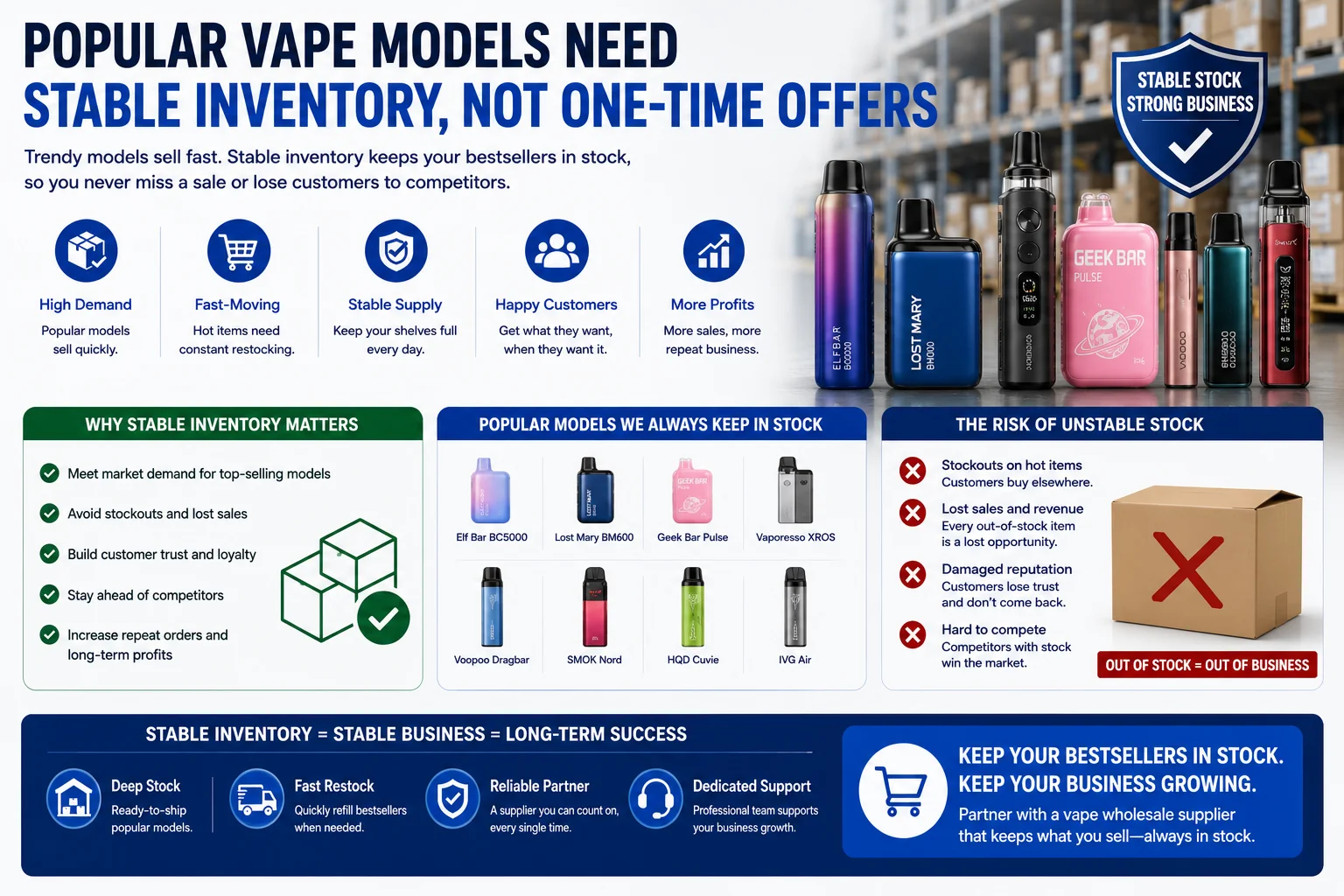
I have seen many buyers focus on the lowest quote first. I understand why. Price is clear, fast, and easy to compare. But in real wholesale work, I always ask one more question: can the supplier keep this product available after the first order? That answer often decides the real profit.
1. Why Does a Low Price Mean Nothing If the Product Is Out of Stock?
A low quote feels good at first. Then the best-selling SKU disappears. Your shelf is empty, and your customer buys from someone else.[^1]
A low price means little if the product cannot be supplied again on time. In vape wholesale, availability is part of the real cost[^2]. If stock breaks, you lose sales, repeat buyers, and market momentum.
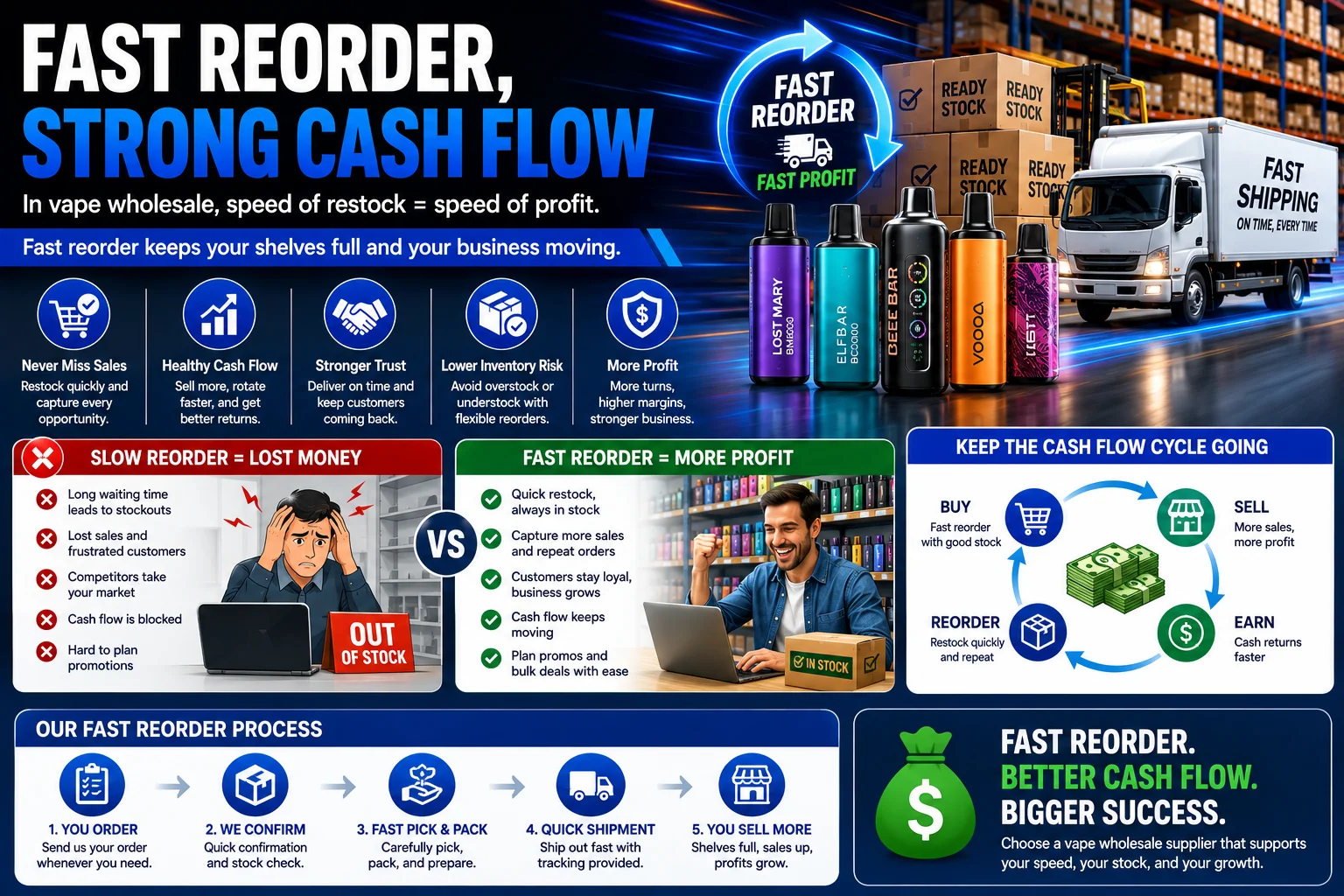
Price Is Only One Line in the Real Cost
I often speak with buyers who compare vape suppliers by price sheet only. They send me five quotes and ask which one is better. My first answer is not about price. I ask about stock level, reorder time, and how long the supplier can support the same models.
A cheap price can hide a weak supply chain.[^3] A supplier may offer a low price because the stock is old, limited, or only available for one batch. That may be fine for clearance sales. It is dangerous for regular retail.
| What buyers see first | What I check next | Why it matters |
|---|---|---|
| Unit price | Available stock | It decides if you can sell now |
| Discount | Reorder ability | It decides if you can sell again |
| Hot model | Stock history | It shows if the model is stable |
| Low MOQ | Next shipment date | It protects your next sales cycle |
I do not say price is not important. Price is very important. But price without stock depth is like a good menu in a closed restaurant. It looks useful, but it cannot serve your customer.
2. How Does Stock Depth Help You Keep Selling Without Interruptions?
Sales stop when stock stops. Your ads may still run, your staff may still answer messages, but the order cannot be filled.
Stock depth helps you keep selling because it gives you enough inventory behind each order.[^4] It supports regular replenishment, fewer empty shelves, and smoother customer service[^5] across retail, wholesale, and online channels.
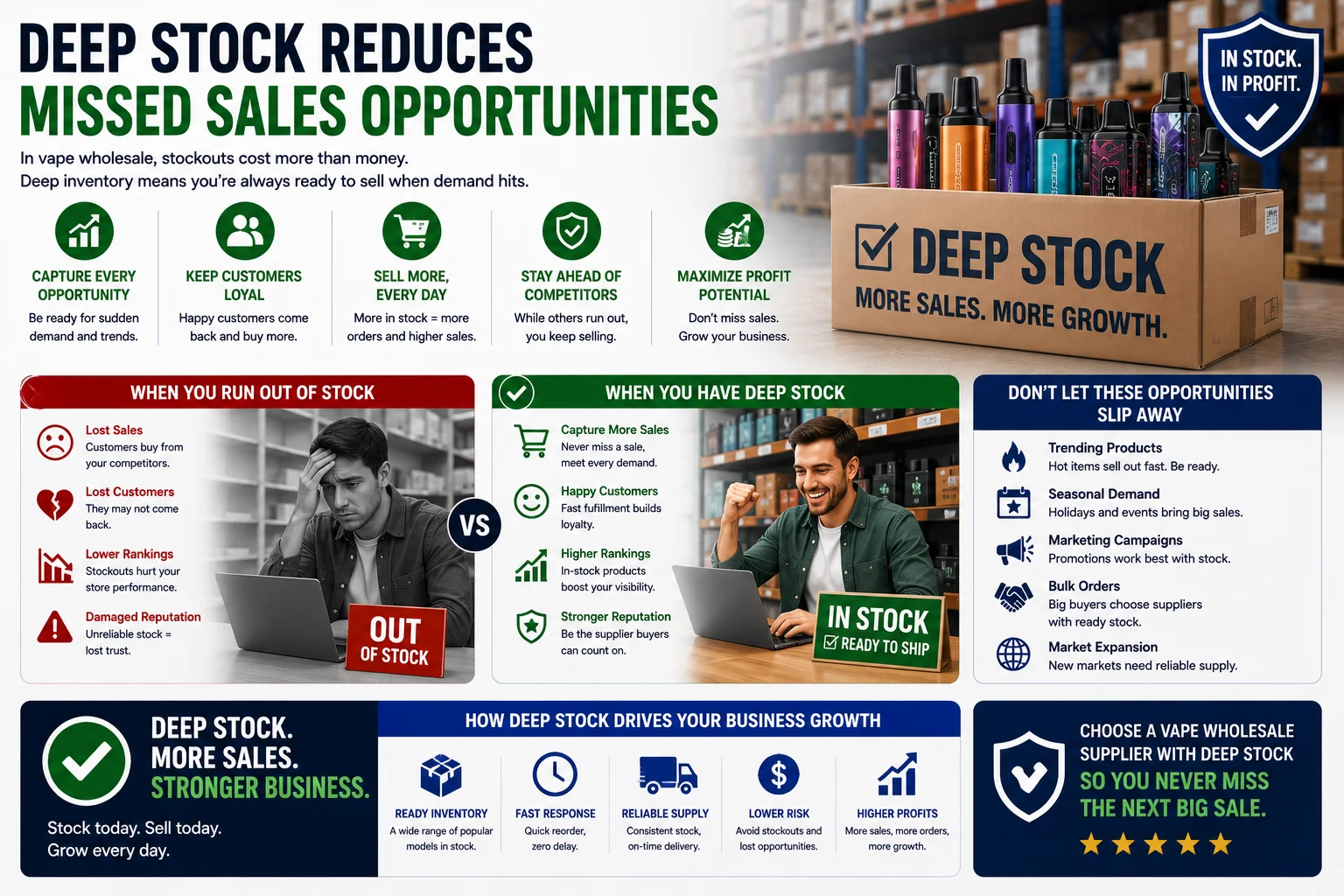
Continuous Sales Need Continuous Supply
I once discussed stock planning with an online seller who had strong weekend sales. His problem was not traffic. His problem was refill timing. He bought small lots from suppliers with no real backup stock. Every time one flavor or model became popular, it sold out before the next shipment.
That is where stock depth changes the game. Deep stock gives you room to keep selling while you plan the next order. It also gives your team more confidence when you accept repeat customer orders.
| Sales situation | With weak stock | With deep stock |
|---|---|---|
| Weekend sales spike | Fast sellout | More stable supply |
| Repeat customer order | Delayed reply | Faster confirmation |
| Retail shelf refill | Missing SKU | Same SKU available |
| Online listing | Listing paused | Listing stays active |
For many buyers, the real goal is not to buy once at the lowest cost. The real goal is to sell every day without panic. If the supplier has enough depth, you can plan by sales speed instead of chasing emergency stock every week.
3. Why Do Popular Vape Models Need Stable Inventory, Not One-Time Offers?
A hot model attracts buyers fast. But if it is only a one-time offer, it can hurt your store after the first sales wave.
Popular vape models need stable inventory because customers return for the same experience[^6]. If the model, flavor, color, or specification keeps changing, you lose repeat sales and make customer support harder.
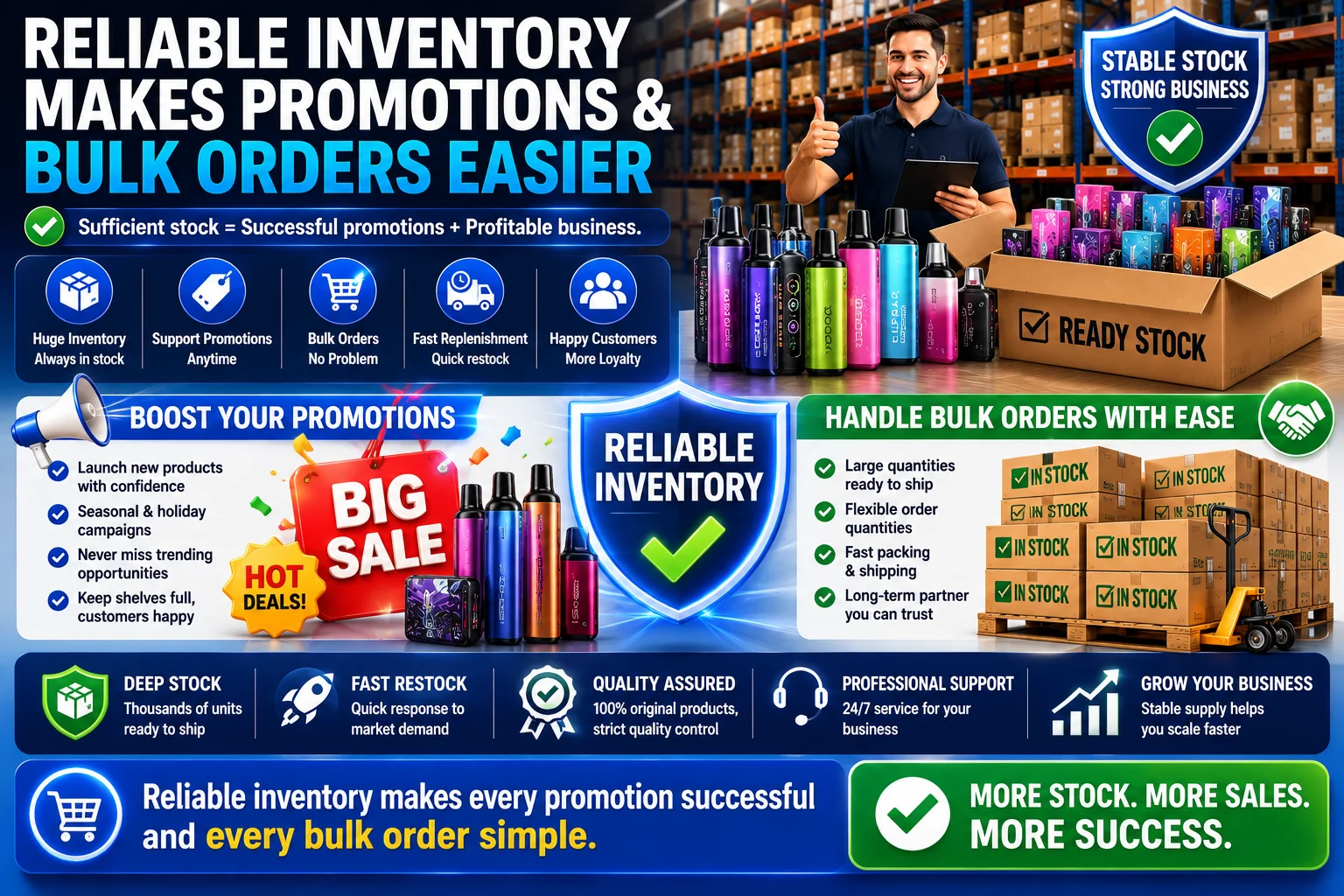
Hot Products Need a Longer Supply Window
A common question I get from wholesale buyers is simple: “Which model is selling best now?” I can answer that. But I also ask a second question: “Can you keep selling it for the next two or three months?” A trending model is useful only if the stock can support the trend.
One-time offers can work for testing. They can help you move fast. They can also help you check customer interest. But they are not enough for a growing wholesale plan. If customers like the product and you cannot restock it, your early success becomes a problem.
| Product type | Best use | Main risk |
|---|---|---|
| One-time offer | Market testing | No repeat supply |
| Limited clearance | Short promotion | SKU disappears |
| Stable popular model | Regular sales | Needs planning |
| New arrival with stock depth | Growth campaign | Needs supplier support |
I prefer to look at popular models in two ways. First, I check if buyers want them now. Second, I check if the supplier can support them later. A product is not really “hot” for a wholesaler unless it can stay available long enough to turn attention into repeat revenue.
4. How Do Fast Reorders Protect Your Cash Flow and Customer Trust?
Slow restocking traps your money. You wait for goods, customers wait for answers, and your cash cannot turn quickly.
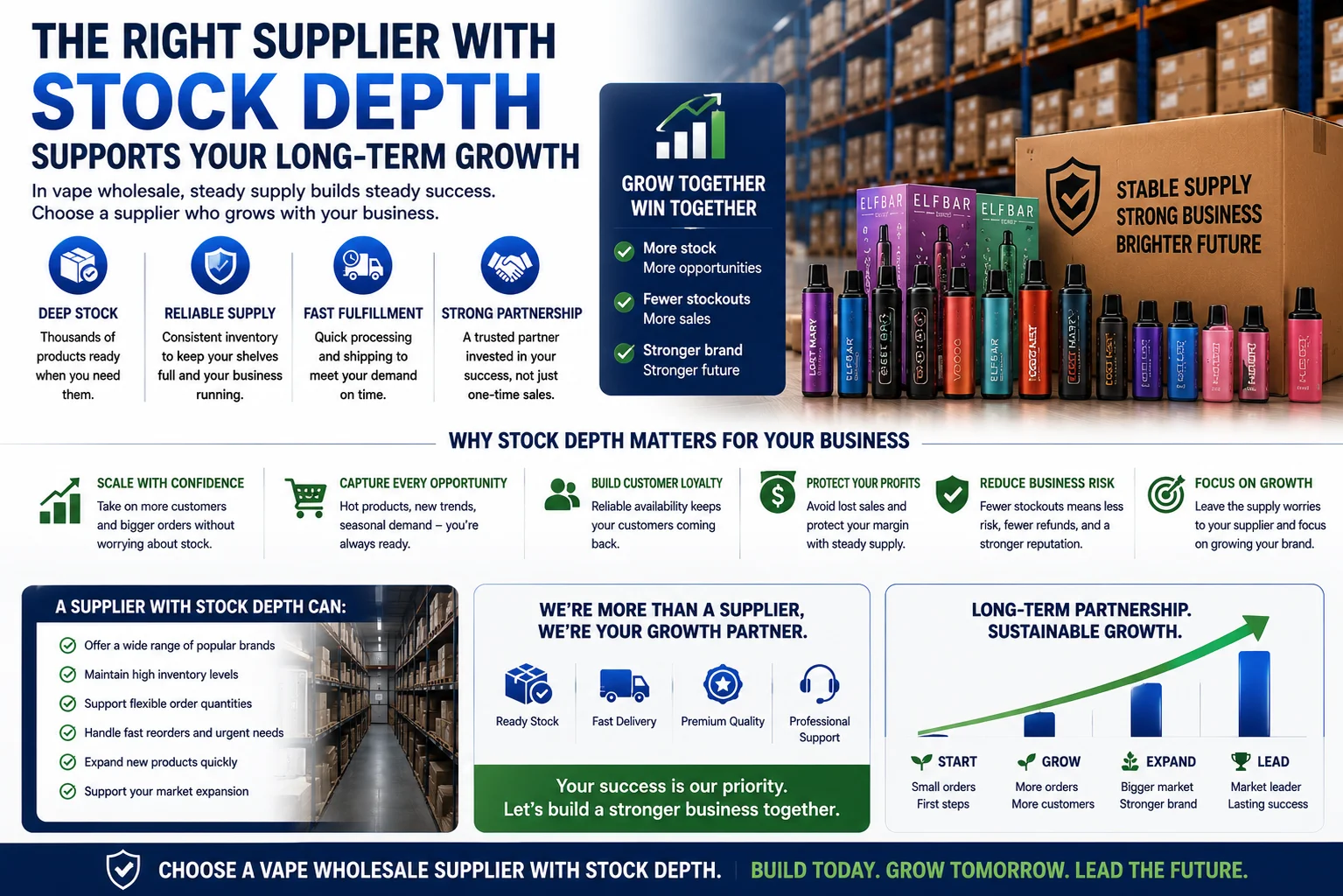
Fast reorders protect cash flow because they shorten the time between selling and restocking.[^7] They also protect trust because you can give customers clear answers instead of uncertain promises.
Reorder Speed Is a Cash Flow Tool
In wholesale, cash flow is not only about profit margin. It is also about stock movement. If you sell fast but restock slowly, you may still feel stuck. You have demand, but you cannot ship. You have customers, but you cannot invoice. You have a good SKU, but you cannot grow it.
I often tell buyers to measure reorder speed before they chase a lower price. A supplier with ready stock can help you move money faster. A supplier with no depth may give a nice quote, but the waiting time can eat the benefit.
| Reorder factor | Why I care | Buyer result |
|---|---|---|
| Ready stock level | It reduces waiting | Faster shipment |
| Packing speed | It affects dispatch | Earlier delivery |
| Stable SKU list | It avoids confusion | Fewer mistakes |
| Clear lead time[^8] | It supports planning | Better cash control |
Customer trust also depends on reorder speed. If your buyer asks, “Can I get the same item again next week?” you need a clear answer. If you say “maybe,” your buyer may find another source. Fast reorders help you look reliable, even when the market moves quickly.
5. How Does Deep Stock Reduce the Risk of Missed Sales Opportunities?
Demand does not wait politely. A buyer may need stock today. If you cannot respond, the order goes somewhere else.
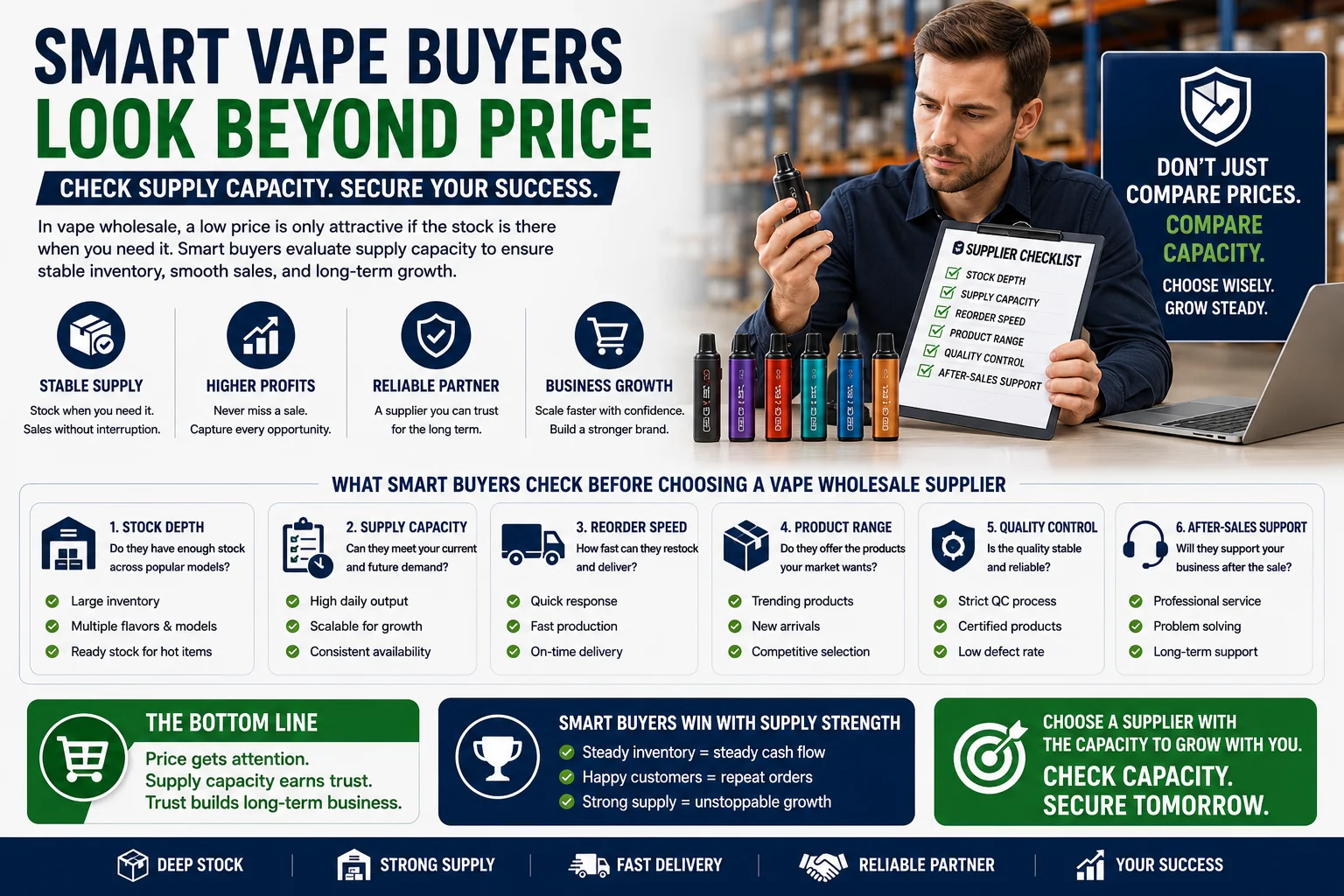
Deep stock reduces missed sales because it lets you act when demand appears.[^9] It helps you accept urgent orders, support seasonal peaks[^10], and respond to sudden market changes with less delay.
Opportunity Often Comes Without Warning
Here is a scenario I often discuss with importers and e-commerce sellers. A product starts moving well after a small test order. The buyer wants to double the next order. The retail customer also asks for more colors or flavors. This is the moment when profit can grow. But if the supplier has no stock, the chance may pass.
Deep stock does not remove all risk. No supplier can promise endless supply for every SKU. But deeper stock gives you more options. You can ship partial orders. You can reserve stock. You can build a faster plan for the next shipment.
| Sales opportunity | Without deep stock | With deep stock |
|---|---|---|
| Urgent buyer request | Order rejected | Order accepted |
| Seasonal demand | Late shipment | Faster delivery |
| Competitor shortage | No response | Quick market entry |
| Larger second order | Long wait | Better conversion |
I have learned that missed sales are often invisible in accounting. You do not always see the money you failed to earn. But you feel it when customers stop asking. A supplier with deep stock helps you catch demand while it is still warm.
6. Why Does Reliable Inventory Make Promotions and Bulk Orders Easier?
A promotion can fail if stock is weak. You create demand, then you cannot deliver. That makes marketing feel risky.
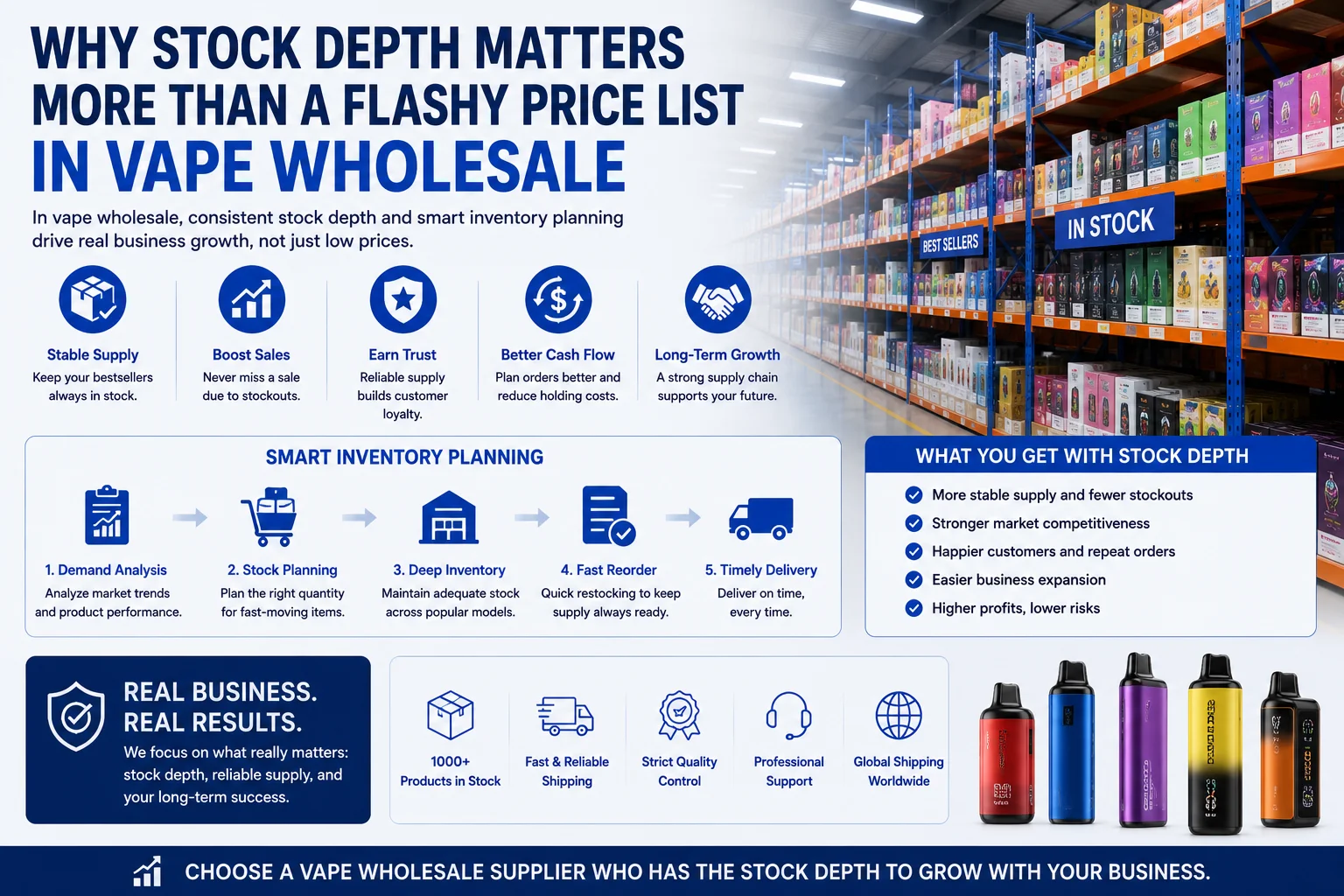
Reliable inventory makes promotions and bulk orders easier because you can plan quantity, delivery, and customer promises before the campaign starts. It lowers the chance of overselling and delayed fulfillment.[^11]
Promotion Needs Supply Behind It
Many buyers think promotions are only about price. I see it differently. A promotion is a promise. If you push a model to your retail clients or online customers, you must have stock behind that promise. If the item sells out too early, the promotion can damage trust instead of building sales.
Bulk orders also need reliable inventory. A chain store, wholesaler, or large reseller may ask for a bigger quantity with fixed delivery dates. They may also need the same packaging, same SKU code, and same product version. If inventory is unstable, the order becomes hard to manage.
| Business action | Inventory need | Risk if stock is weak |
|---|---|---|
| Flash sale | Reserved stock | Overselling |
| Retail promotion | Same SKU supply | Customer complaints |
| Bulk order | Confirmed quantity | Late delivery |
| New store launch | Full assortment | Empty shelves |
I always suggest that buyers check stock before they start a campaign. Do not ask only, “What discount can I get?” Ask, “How many units can you really support during this promotion?” That question sounds simple, but it can save the whole campaign.
7. How Can a Supplier with Stock Depth Support Long-Term Growth?
Growth becomes harder when supply is random. You spend more time fixing shortages than building customers.
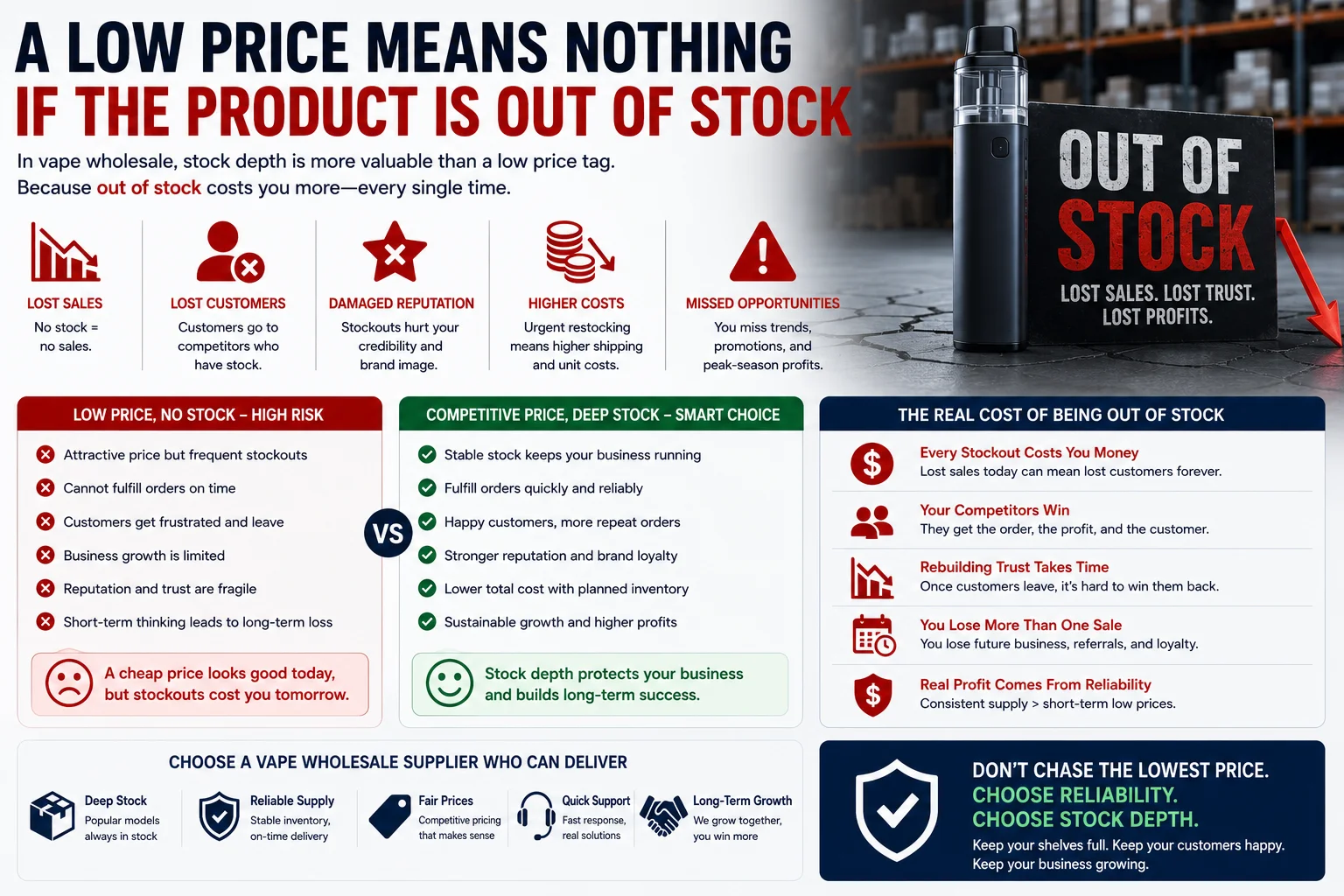
A supplier with stock depth supports long-term growth by giving you stable replenishment, better planning, and more confidence to expand channels, add customers, and scale repeat orders[^12].
Growth Needs a Supply Partner, Not Only a Quote
When a client asks me for the “best option,” my first question is always about their sales channel. A small online seller, a regional wholesaler, and a chain retailer do not have the same inventory pressure. But they all need supply that can grow with them.
A supplier with stock depth can help you move from testing to regular selling. At the start, you may buy smaller quantities. Later, you may need weekly or monthly replenishment. After that, you may need mixed cartons, reserved stock, or more stable delivery windows. These needs are hard to support if the supplier only works from random leftover stock.
| Growth stage | Buyer focus | Supplier support needed |
|---|---|---|
| Market test | Low MOQ | Small ready stock |
| Early repeat sales | Fast reorder | Stable SKU supply |
| Channel expansion | More quantity | Stock reservation |
| Large account support | Delivery promise | Deeper inventory planning |
Long-term growth is not built from one cheap order. It is built from many repeat orders that arrive on time. I see stronger buyers ask better questions. They ask about stock cycles, replacement models, and reorder plans. These questions show that they think beyond today’s price list.
8. Why Do Smart Vape Buyers Look Beyond Price and Check Supply Capacity?
A price sheet can look perfect. But it does not show whether the supplier can support your real selling plan.
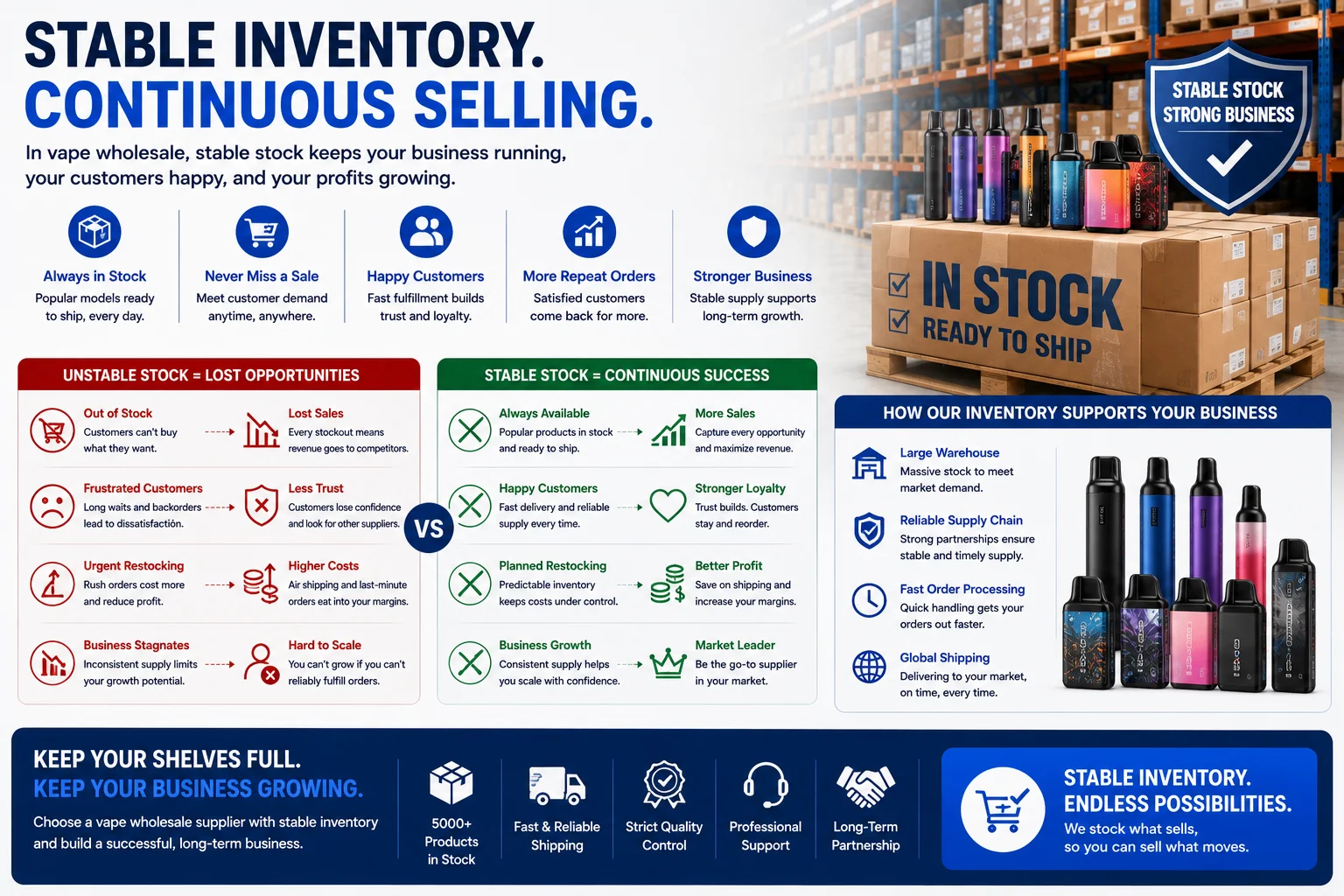
Smart vape buyers look beyond price because supply capacity decides if the deal can continue. They check stock depth, reorder speed, SKU stability, and delivery ability before they commit to larger orders.
The Better Question Is About Risk
I do not believe there is one best supplier for every buyer. I believe there is a better fit for each business model. Some buyers need low MOQ and fast testing. Some buyers need stable models for retail shelves. Some buyers need large stock support for bulk clients. The right choice depends on which risk the buyer can afford.
A very low price may carry supply risk. A supplier with deeper stock may not always be the cheapest on paper. But that supplier may reduce delays, missed sales, and customer complaints. That saving is harder to see, but it is very real.
| Buyer question | Better version of the question |
|---|---|
| What is your lowest price? | How much stock can you support now? |
| Can I order 100 units? | Can I reorder the same SKU next week? |
| Is this model popular? | Is this model stable for repeat supply? |
| Can you ship fast? | Can you ship fast after the second order too? |
I like buyers who ask these deeper questions. It shows they are not only buying products. They are building a sales system. In vape wholesale, price opens the door. Stock depth keeps the business moving after the door is open.
Conclusion
I trust deep stock more than a flashy price list because stable supply protects sales, cash flow, promotions, and long-term customer trust.
[^1]: "Stock running low? Study shows consumers want to know", https://www.bc.edu/bc-web/bcnews/nation-world-society/business-and-management/low-stock-announcements.html. Retail stockout research documents that product unavailability can lead to lost sales, purchase substitution, or store switching, supporting the claim that an empty shelf may send customers to another seller. Evidence role: general_support; source type: paper. Supports: Stockouts can cause lost sales and customer switching in retail contexts.. Scope note: The evidence is contextual because most studies examine general retail categories rather than vape wholesale specifically. [^2]: "[PDF] Inventory Management", https://ocw.mit.edu/courses/esd-260j-logistics-systems-fall-2006/8b53c45fd26ffff706d815131e8d177e_lect11.pdf. Inventory-management literature treats stockout costs and service-level effects as components of inventory decision-making, supporting the view that availability contributes to the effective cost of supply. Evidence role: mechanism; source type: education. Supports: Inventory costs include more than purchase price, including stockout costs and service-level consequences.. Scope note: The support is drawn from general inventory theory and does not calculate vape-specific cost impacts. [^3]: "[PDF] Zelda B. Zabinsky and Lei Li Industrial Engineering University of ...", http://courses.washington.edu/inde59x/SeminarAutumn2009/SupplierSelection_12-01-2009.pdf. Procurement research on supplier selection identifies delivery reliability, supply risk, and total cost of ownership as decision factors beyond quoted price, supporting the claim that a low price can conceal supply-chain weakness. Evidence role: expert_consensus; source type: paper. Supports: Supplier selection and procurement research considers reliability, delivery performance, and total cost in addition to purchase price.. Scope note: The evidence is contextual because it addresses supplier evaluation broadly rather than vape suppliers specifically. [^4]: "Service level - Wikipedia", https://en.wikipedia.org/wiki/Service_level. Standard inventory-management references define safety stock as extra inventory held to reduce the risk of stockouts, supporting the claim that additional stock depth helps maintain order fulfillment. Evidence role: definition; source type: encyclopedia. Supports: Safety stock and related inventory concepts are used to reduce the risk of stockouts during demand or replenishment uncertainty.. Scope note: The source supports the general inventory mechanism rather than the article’s specific vape wholesale examples. [^5]: "[PDF] The Impact of Supplier Inventory Service Level on Retailer Demand", https://www.hbs.edu/ris/download.aspx?name=11-034.pdf. Operations-management materials describe replenishment policies and service levels as tools for maintaining product availability and reducing stockouts, supporting the link between inventory depth, fewer empty shelves, and customer service continuity. Evidence role: mechanism; source type: education. Supports: Replenishment planning and inventory service levels are designed to reduce stockouts and maintain product availability for customers.. Scope note: The support is theoretical and general, not based on measured outcomes in vape retail. [^6]: "[PDF] Driving Customer Satisfaction and Stimulating Repurchase Intention", https://www.aaup.edu/sites/default/files/2024-06/RMR20_1_79-98.pdf. Consumer-behavior research links satisfaction and perceived product quality to repeat purchase intention, supporting the claim that returning customers often seek a consistent product experience. Evidence role: general_support; source type: paper. Supports: Customer satisfaction and perceived product quality are associated with repeat purchase intentions and loyalty.. Scope note: The evidence supports the general customer-loyalty mechanism and does not directly test vape flavors, models, or specifications. [^7]: "A closer look at cash conversion cycles | MBA Learnings | Kellogg ...", https://www.kellogg.northwestern.edu/news/blog/2016/03/04/a-closer-look-into-cash-conversion-cycles-mba-learnings/. Working-capital and operations-management references explain that faster inventory turnover can shorten the cash conversion cycle, supporting the claim that quicker reordering and restocking can affect cash-flow timing. Evidence role: mechanism; source type: education. Supports: Inventory turnover and the cash conversion cycle connect inventory speed with working-capital and cash-flow outcomes.. Scope note: The source supports the financial mechanism generally and does not quantify the effect for vape wholesale transactions. [^8]: "[PDF] The Effect of Lead Time Uncertainty On Safety Stocks.", https://www.kellogg.northwestern.edu/faculty/chopra/htm/research/lead-timejuly31-2003.pdf. Inventory research shows that lead-time variability influences replenishment planning and safety-stock requirements, supporting the article’s connection between clear lead times and better inventory control. Evidence role: mechanism; source type: paper. Supports: Lead-time uncertainty affects inventory planning and can increase the need for buffer stock.. Scope note: The evidence is about inventory systems generally rather than the vape wholesale supply chain. [^9]: "[PDF] An Asymptotic Analysis of Inventory Planning with Censored Demand", http://faculty.marshall.usc.edu/Paat-Rusmevichientong/psfiles/data-lost-sales.pdf. Inventory and retail stockout studies identify product unavailability as a cause of lost sales, supporting the claim that deeper available stock can reduce missed sales opportunities when demand arises. Evidence role: mechanism; source type: paper. Supports: Inventory availability reduces the likelihood of lost sales when demand occurs before replenishment arrives.. Scope note: The support is contextual because it addresses lost-sales mechanisms in general inventory settings, not vape-specific demand. [^10]: "[PDF] Seasonal Adjustment of Inventory Demand Series: A Case Study", https://www.bauer.uh.edu/egardner/4365%20Forecasting/Readings/1%20Seasonal%20adjustment.pdf. Inventory-management sources describe seasonal demand as a planning condition that often requires adjusted forecasts and inventory buffers, supporting the claim that deeper stock can help serve seasonal peaks. Evidence role: mechanism; source type: education. Supports: Seasonal demand patterns require forecasting, capacity, and inventory planning to maintain availability during peak periods.. Scope note: The source supports seasonal inventory planning generally and does not establish that vape products follow the same seasonal pattern. [^11]: "Order Management - Rice University", https://dev-housing.rice.edu/tutorials/order-management-8951734. Retail operations research shows that inaccurate or insufficient inventory records can contribute to stockouts and fulfillment failures, supporting the claim that reliable inventory lowers overselling and delayed-fulfillment risk. Evidence role: general_support; source type: paper. Supports: Inventory accuracy and availability are associated with better fulfillment performance and fewer stockout-related service failures.. Scope note: The evidence is mostly from general retail and e-commerce operations rather than vape wholesale promotions. [^12]: "Want to Improve Your Supply Chain Performance? Start with Your ...", https://scm.ncsu.edu/scm-articles/article/want-to-improve-your-supply-chain-performance-start-with-your-suppliers. Supply-chain management research links supplier reliability and replenishment performance with operational performance and customer-service outcomes, supporting the claim that stable supply can help a business scale repeat orders and channels. Evidence role: expert_consensus; source type: paper. Supports: Reliable supply and supplier performance are associated with operational performance, customer service, and the ability to scale activity.. Scope note: The support is contextual and does not prove that stock depth alone causes long-term growth in the vape wholesale market.