
Regulated vape markets make many buyers nervous. I see profit plans fail when content sells only hype and hides real purchase risk.
I believe the best vape content angles now are decision-support angles. I focus on product fit, inventory risk, after-sales responsibility, channel needs, and local rule awareness. I do not use content to push blind demand. I use it to help importers and wholesalers make safer buying decisions.
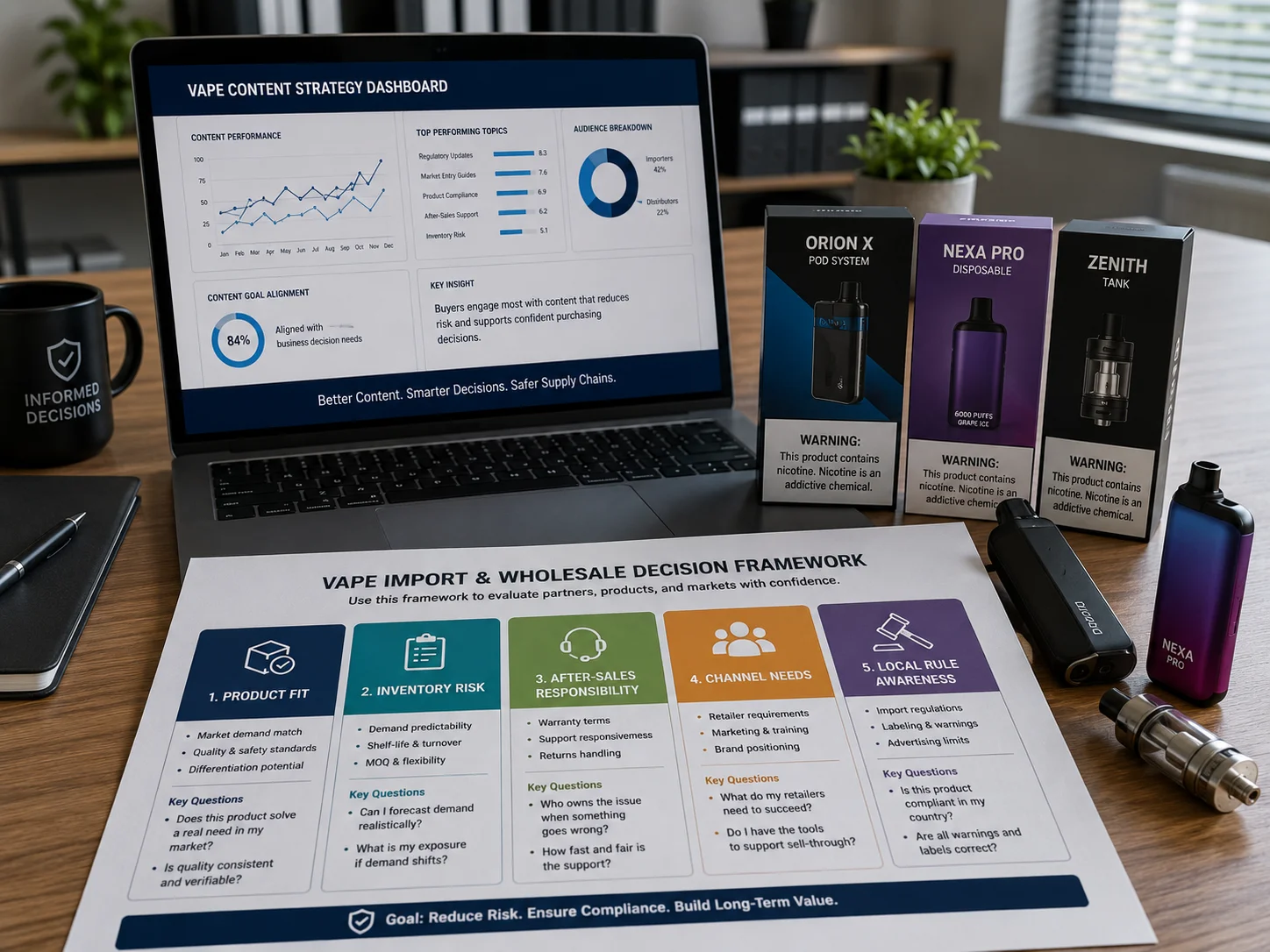
I have worked with vape importers and wholesalers for many years from Shenzhen. I see the same question again and again. Buyers still want fast-moving products and good margins. They also want fewer complaints, fewer customs problems, and less dead stock[^1]. So I do not treat content as a simple sales tool now. I treat content as a filter. It should help the buyer know what to ask, what to avoid, and what to verify before placing an order.
1. Why Content Strategy Must Change in More Regulated Vape Markets?
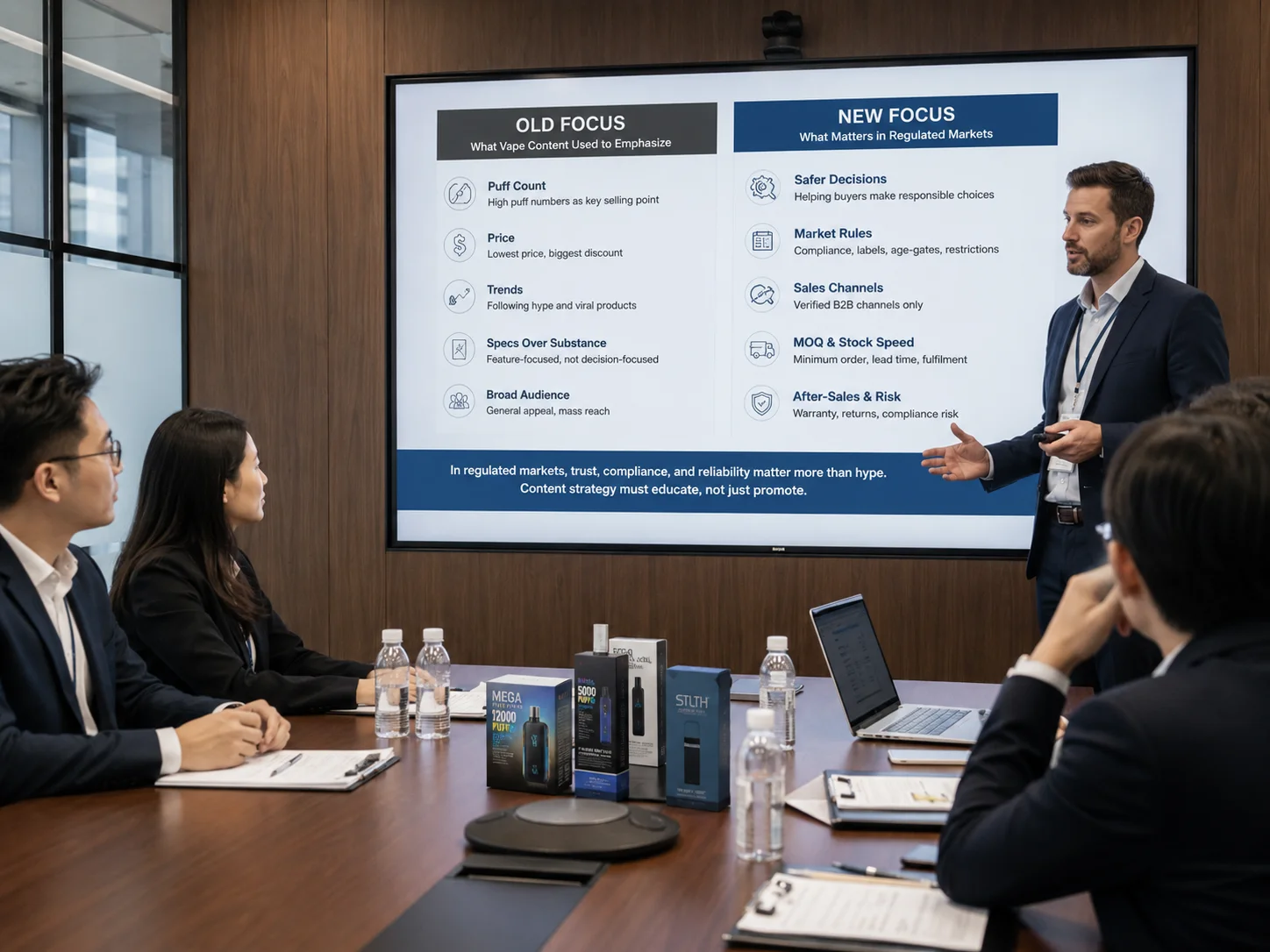
Old vape content can create new problems. I see buyers get attracted by puff count, price, and trends, then face complaints later.
I change content strategy because regulated markets need safer decisions, not louder promotion[^2]. I write content that helps buyers match products with market rules, sales channels, MOQ, stock speed, and after-sales risk.
Content must support buying decisions, not only attention
I see many B2B vape buyers work under more pressure now. A wholesaler may supply vape shops, smoke shops, gas stations, and convenience stores. Each channel has a different risk level. A product that sells well in one shop may move slowly in another shop. A strong online claim may also create trouble in a stricter market.
I write content with this reality in mind. I do not only ask, “Will this product get clicks?” I ask, “Will this content help the buyer avoid a bad order?” This is a very different job. It makes the content more useful for importers and distributors.
| Old content angle I avoid | Better content angle I use | Buyer risk it helps reduce |
|---|---|---|
| “Hot-selling disposable vape” | “How to judge if a disposable vape fits your channel” | Slow inventory |
| “High profit vape product” | “What hidden costs can reduce real profit” | Bad margin planning |
| “Best puff count” | “How puff count affects user expectation and complaints[^3]” | After-sales disputes |
| “Order now” | “Questions to ask before placing a wholesale order” | Wrong product selection |
I also keep my role clear. I speak from supplier and procurement experience. I am not a lawyer. I do not tell buyers what is legal in their country. I remind them to verify local rules with qualified people before they import, sell, or promote any product.
2. What Has Changed in Global Vape Regulation and Buyer Expectations?
Many markets are no longer relaxed.[^4] I see buyers ask more careful questions before they risk money on new vape inventory.
Buyer expectations have changed because regulation, customs checks[^5], product claims, and local sales rules can affect profit. I see buyers now care more about stability, documents, supplier responsibility, delivery risk, and after-sales support.

Buyers now judge profit with more caution
In the past, many buyers asked me one simple question first. They asked, “What is hot now?” That question still exists. But it is no longer enough. Today, many buyers also ask if the product is suitable for their country, their customer type, their warehouse model, and their cash flow.
A European buyer may prefer faster turnover and lower MOQ from a local warehouse. A larger importer may still buy from China in bigger volume because price matters. An American wholesaler may care about customer reputation and repeat orders. These buyers have different plans, but they all need content that explains risk.
| Buyer concern I hear often | What useful content should explain | Why it matters |
|---|---|---|
| Local market rules | What buyers should verify locally | It reduces blind import risk |
| Product stability | What quality points affect complaints | It protects reputation |
| Inventory size | How MOQ affects cash flow[^6] | It reduces dead stock |
| Delivery model | China shipment or overseas warehouse | It affects speed and risk |
| After-sales support | Who handles bad units | It reduces disputes |
I also see buyers become more careful with claims. They do not only want attractive words. They want clear product information, realistic use cases, and stable support. Good content should respect this change.
3. Why Product Education Is Safer Than Sales-Forward Vape Content?
Hard selling can bring fast clicks. I see it also bring wrong orders, false expectations, and angry customers when products do not match the channel.
Product education is safer because it explains how a vape product should be selected, used, stocked, and supported. It helps buyers understand fit before they place an order.

Education lowers the gap between promise and reality
I prefer product education because it creates more honest expectations. If I only promote a disposable vape as “high profit,” the buyer may not see the full picture. The buyer also needs to know if the flavor list fits local demand, if the packaging suits the channel, if the device has stable performance, and if the MOQ creates cash pressure.
Education does not make content boring. It makes content useful. A good importer or wholesaler does not want empty praise. The buyer wants a framework. The buyer wants to know how to compare options.
| Education topic I use | What the buyer learns | Risk it helps reduce |
|---|---|---|
| Battery and puff expectation | How users may judge value | Complaint risk |
| Flavor mix planning[^7] | How to avoid slow-moving SKUs | Inventory risk |
| Channel fit | What suits vape shops or gas stations | Wrong placement |
| MOQ planning | How to test before scaling | Cash flow pressure |
| After-sales process | How bad units are handled | Dispute risk |
I also use education to explain trade-offs. A very low price may look attractive. But if the product has unstable quality, unclear after-sales terms, or poor customer feedback, the real cost becomes higher. I want buyers to see that before money leaves their account.
4. Market-Specific Vape Content Angles That Still Build Trust?
Generic content feels easy. I see it fail when a buyer needs answers for one country, one channel, or one sales model.
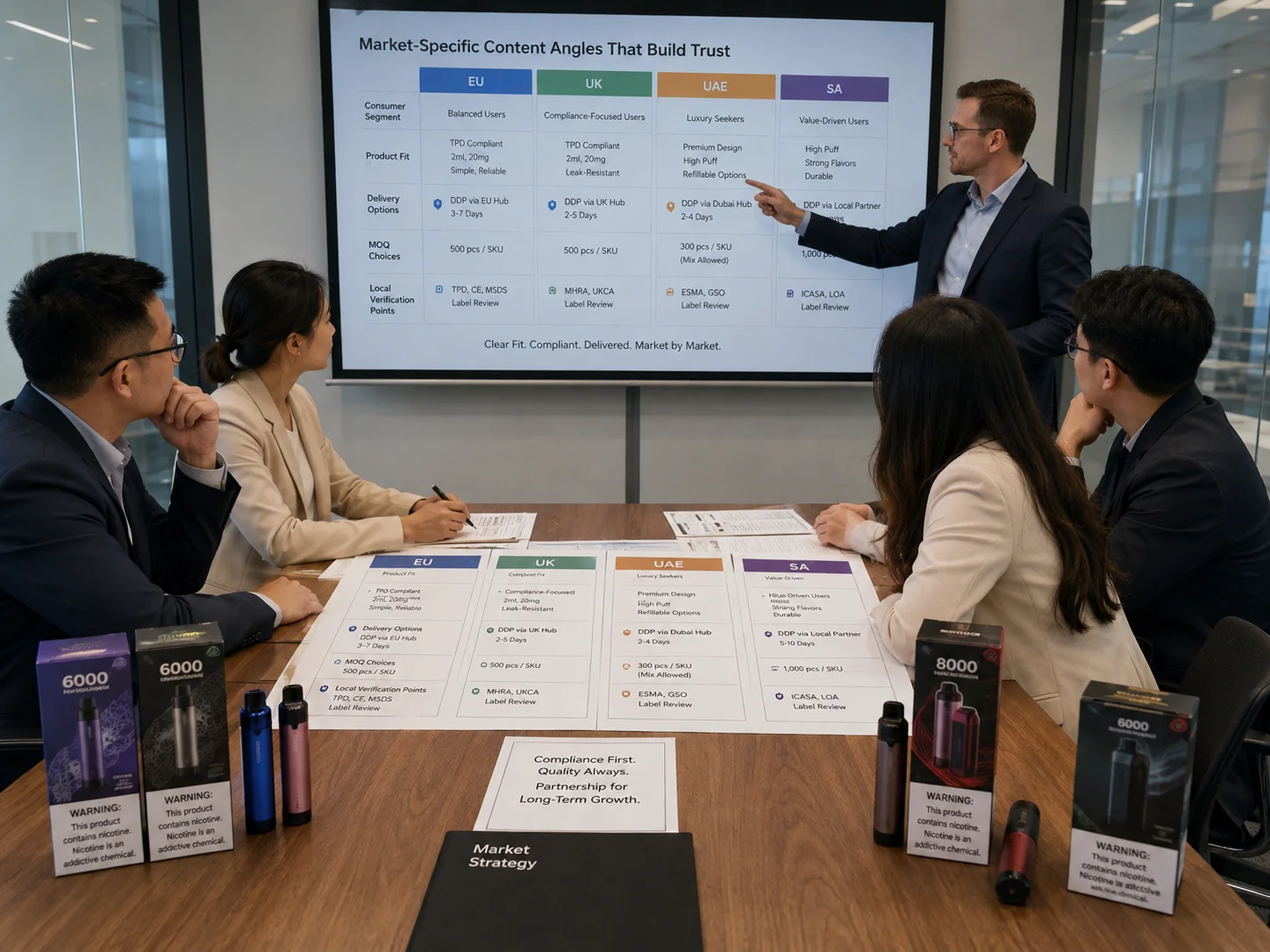
Market-specific vape content builds trust when it explains product fit, delivery options, MOQ choices, and local verification points. I keep it practical and cautious. I do not claim legal certainty.
I write for the way buyers really sell
I do not think one vape content angle fits every market. A Spanish beach town wholesaler may supply tourist shops. That buyer may need fast-moving products and small batch testing. A U.S. regional wholesaler may supply smoke shops, vape shops, convenience stores, and gas stations. That buyer may care more about stable supply, brand repeatability, and after-sales handling.
So I write content around market situations. I avoid saying, “This product is good for everyone.” I ask what the buyer needs to achieve. I also ask what can go wrong.
| Market or channel situation | Content angle that makes sense | Buyer risk it helps reduce |
|---|---|---|
| Small EU wholesaler | Low MOQ and fast EU warehouse delivery | Cash pressure and customs delay |
| Large importer | China bulk supply and OEM/ODM planning | High unit cost and weak differentiation |
| Vape shop supplier | Product education and flavor planning | Customer complaints |
| Gas station supplier | Simple SKU mix and stable reorder plan | Slow shelf movement |
| Brand builder | OEM/ODM process and quality control points | Weak brand reputation |
I have European warehouse options in different areas. This can help smaller buyers test products with lower MOQ and faster delivery. I also support larger buyers from Shenzhen with bulk supply and OEM/ODM. Content should explain these choices clearly, so the buyer can select the right model.
5. What Vape Wholesalers Should Avoid Saying on Regulated Market Pages?
Careless words can hurt trust. I see some pages promise too much, and buyers may treat those promises as a risk signal.
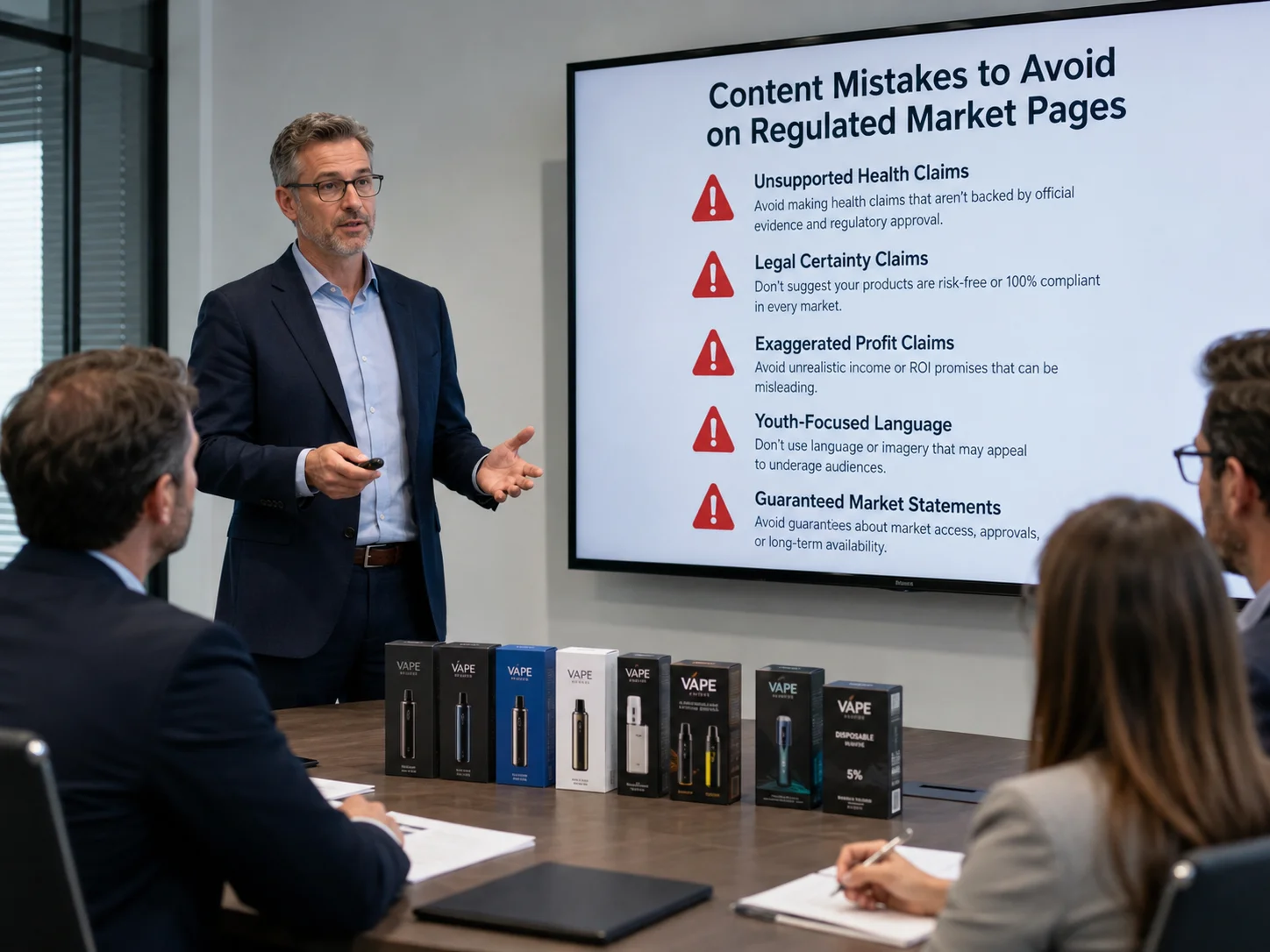
Vape wholesalers should avoid unsupported health claims[^8], legal certainty claims, exaggerated profit claims, youth-focused language[^9], and “guaranteed market” statements. I use careful wording and ask buyers to verify local rules.
Careful language protects both sides
I believe regulated market pages should be useful and controlled. I do not want content that sounds like a shortcut around rules. I also do not want content that promises a buyer will make money. A supplier can support better decisions. A supplier cannot control every local law, retail channel, customs process, or end-user behavior.
This is why I avoid aggressive claims. I explain product features, procurement logic, and service process. I also tell buyers to check local requirements before they import or promote a product.
| Phrase I avoid | Safer direction I use | Why I avoid it |
|---|---|---|
| “100% legal everywhere” | “Please verify local rules before purchase” | I am not a legal authority |
| “Guaranteed best profit” | “Compare real profit after freight, tax, and after-sales” | Profit depends on many factors |
| “No risk product” | “Check channel fit and stock plan first” | Every order has risk |
| “Healthier choice” | “Review allowed product claims locally” | Health claims need caution |
| “Everyone wants this” | “Test demand before large inventory” | Demand is not the same everywhere |
I also avoid content that pushes buyers to overstock. A product may be popular this month. It may slow down next month. A careful wholesaler needs enough stock to sell, but not so much that cash becomes trapped. Content should help buyers balance speed, MOQ, and risk.
6. How Compliance Education Creates Better Long-Tail SEO Opportunities?
Short keywords attract broad traffic. I see better buyers come from detailed questions about sourcing, risk, and channel fit.
Compliance education creates better long-tail SEO because serious buyers search for specific procurement problems. I write around questions about documents, packaging, local verification, delivery risk, MOQ, and after-sales responsibility.
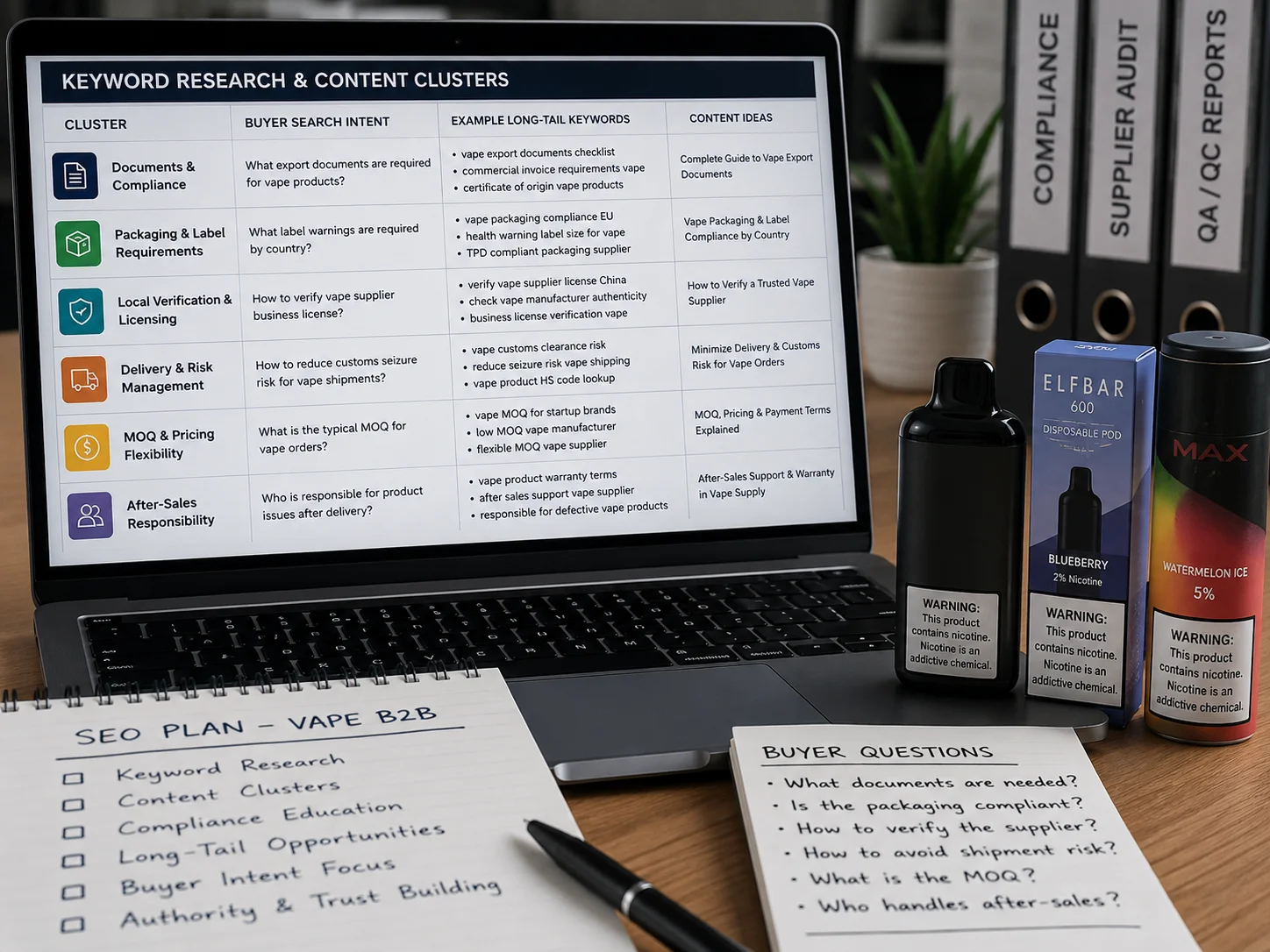
Long-tail content matches real buyer questions[^10]
I do not see SEO as only ranking for “vape wholesale” or “disposable vape supplier.” Those keywords are too broad. A serious buyer often searches with a problem. The buyer may ask how to choose products for a regulated market. The buyer may ask what to check before importing. The buyer may ask how to reduce dead stock when testing a new vape brand.
These questions are better content angles because they show purchase intent.[^11] They also let me explain useful details without making legal claims.
| Long-tail question I can write about | What the content should cover | Buyer value |
|---|---|---|
| How to choose vape products for stricter markets | Channel fit, MOQ, product stability, local checks | Better first order |
| What to ask a vape supplier before bulk order | Stock, QC, after-sales, delivery plan | Lower supplier risk |
| How to reduce dead stock in vape wholesale | SKU testing, reorder pace, warehouse options | Better cash flow |
| China shipment vs EU warehouse vape supply | Cost, speed, MOQ, customs exposure | Better delivery choice |
| How to plan OEM vape products | Positioning, sample test, packaging, support | Stronger brand plan |
I keep compliance education practical. I do not write legal advice. I write buyer checklists and decision frameworks. This helps content rank for useful searches, and it also helps buyers trust the supplier behind the content.
7. How to Write Useful Content for Importers, Distributors, and Retailers?
Many articles speak to everyone. I see better results when content speaks to the buyer’s daily money and service problems.
I write useful B2B vape content by focusing on procurement decisions. I explain product selection, inventory planning, delivery choices, after-sales responsibility, and customer reputation. I avoid empty product praise.
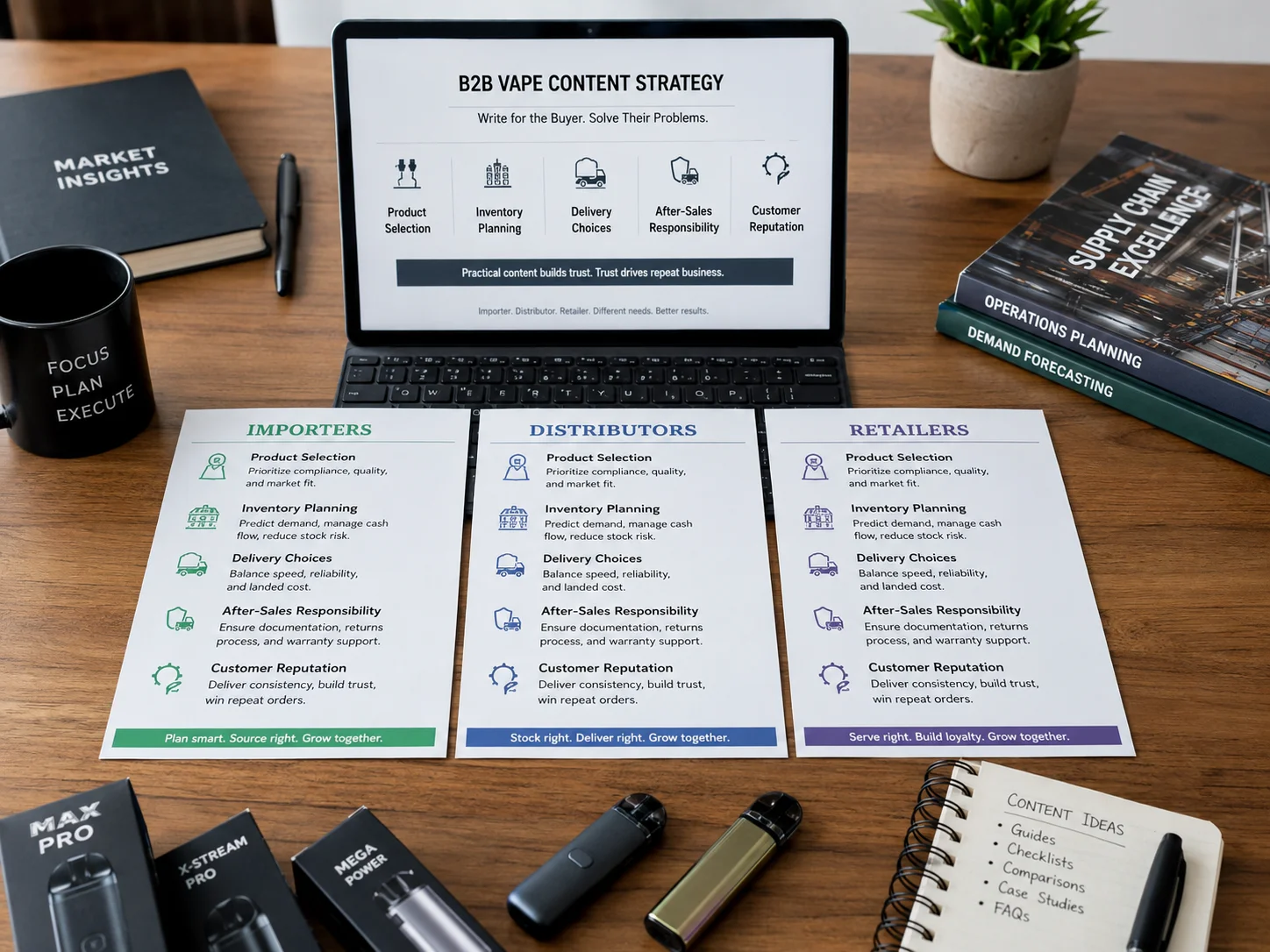
I write to the person who carries the inventory risk
An importer or wholesaler does not only buy a product. The buyer carries the risk after the goods arrive. If the product does not move, money is stuck. If the defect rate is high, the shop complains. If the delivery is late, the sales window may pass. If the product claim is wrong for the market, the buyer may face more serious problems.
So I write content from the buyer’s daily work. I make the article answer practical questions.
| Buyer type | Content they need | Why it helps |
|---|---|---|
| Importer | Bulk pricing, stable supply, OEM/ODM options | It supports long-term planning |
| Regional wholesaler | Fast-moving SKU mix and reorder plan | It protects cash flow |
| Vape shop supplier | Product education and user complaint points | It protects shop relationships |
| Convenience store supplier | Simple display choices and stable items | It helps shelf movement |
| New distributor | Low MOQ testing and supplier questions | It lowers first-order risk |
I also write in a way that respects how buyers think. They want profit, but they do not want trouble. They want hot products, but they also want reliable products. They want speed, but they still need stable service. Useful content should show both sides clearly.
8. How Vape Suppliers Can Adapt Content More Carefully for Different Markets?
One message cannot serve every country. I see trust grow when I explain choices instead of forcing one answer.
Vape suppliers can adapt content by separating market education, product selection, delivery models, and buyer types. I keep claims careful. I help buyers compare options without pretending to decide local legality.

Careful adaptation makes content more trusted
I use different content angles for different buyer situations. For small and medium European buyers, I may explain overseas warehouse stock, low MOQ, and 1 to 5 working day delivery in many cases through common carriers. This helps buyers reduce large upfront investment and test products faster. For larger importers and distributors, I may explain China-based bulk supply, stronger price advantage, one-stop multi-brand sourcing, and OEM/ODM development.
I also explain service structure. Many buyers do not want to contact many factories for after-sales. They want one responsible supplier. This matters because after-sales work takes time and affects trust with local shops.
| Buyer situation | Content focus I choose | Service value I explain |
|---|---|---|
| Small EU wholesaler | Overseas warehouse and low MOQ | Faster test and less cash pressure |
| Large EU importer | Bulk China shipment and brand planning | Better cost and stronger supply |
| U.S. wholesaler | Product range and after-sales handling | Easier one-stop procurement |
| OEM/ODM buyer | Factory capacity and sample process | Better brand control |
| Trend buyer | Market testing and risk control | Faster reaction with less blind stock |
I have my own factory background and also a one-stop supply model. I can support private label projects, new product selection, multi-brand procurement, and after-sales coordination. Content should show how these points reduce buyer workload. It should not only say the supplier is strong. It should show how that strength helps the buyer buy with less pressure.
Conclusion
I believe regulated vape content should help buyers reduce wrong orders, protect cash flow, and build trust before it tries to sell anything.
[^1]: "Excess and Obsolete Inventory: You're All Responsible for It!", https://scm.ncsu.edu/scm-articles/article/excess-and-obsolete-inventory-youre-all-responsible-for-it. Inventory-management literature describes excess stock as a source of carrying costs, obsolescence risk, and working-capital lock-up; this supports the article's use of dead stock as a wholesale risk, although it does not quantify dead-stock rates in the vape sector. Evidence role: mechanism; source type: education. Supports: An inventory-management source should support that excess inventory creates carrying costs, obsolescence risk, and capital lock-up.. Scope note: Contextual; the source would support the inventory principle rather than provide vape-specific statistics. [^2]: "[PDF] Premarket Tobacco Product Applications for Electronic Nicotine ...", https://www.fda.gov/media/127853/download. Government guidance on electronic nicotine delivery systems, such as FDA premarket review requirements or EU Tobacco Products Directive rules, shows that vape products and related claims operate within formal regulatory frameworks; this supports the need for decision-support content, although it does not establish that such content always improves buyer outcomes. Evidence role: general_support; source type: government. Supports: A government source should show that e-cigarette products and claims are regulated, making compliance-oriented purchasing and communication relevant for market participants.. Scope note: Contextual; regulatory requirements support the rationale but do not directly measure content effectiveness. [^3]: "Puffing Topography: A Tool to Evaluate Vaping Behavior and ... - PMC", https://pmc.ncbi.nlm.nih.gov/articles/PMC12958158/. Peer-reviewed studies of e-cigarette puffing topography show that puff duration, frequency, and intensity can affect aerosol output and liquid consumption; this supports the article's point that puff-count claims may create expectations that differ from real-world use, although such studies do not directly measure wholesale complaint rates. Evidence role: mechanism; source type: paper. Supports: A peer-reviewed study should show that vaping topography, such as puff duration, frequency, and intensity, affects liquid consumption, aerosol yield, or device performance, making advertised puff counts variable in real use.. Scope note: Contextual; technical variability supports the expectation gap but does not prove complaints for a particular product. [^4]: "Tobacco: E-cigarettes - World Health Organization (WHO)", https://www.who.int/news-room/questions-and-answers/item/tobacco-e-cigarettes. World Health Organization and global tobacco-control policy sources document that many jurisdictions regulate electronic nicotine delivery systems through sales, advertising, product, or import controls; this supports the article's general premise that vape markets are no longer broadly permissive, although it does not verify the author's specific market observations. Evidence role: general_support; source type: institution. Supports: A global public-health or policy source should show that many countries regulate e-cigarettes or electronic nicotine delivery systems through product, sales, import, age, advertising, or use restrictions.. Scope note: Contextual support only; the source would not prove conditions in every market or the author's direct buyer experience. [^5]: "$81.5 Million in Unapproved Electronic Nicotine Delivery Systems ...", https://www.cbp.gov/newsroom/local-media-release/815-million-unapproved-electronic-nicotine-delivery-systems-seized. Customs and trade-agency guidance on electronic nicotine delivery systems indicates that imported vape products may be subject to admissibility checks, documentation requirements, duties, or enforcement actions; this supports the article's point that customs checks can affect delivery and profit planning, although the specific risk depends on the destination jurisdiction and shipment facts. Evidence role: general_support; source type: government. Supports: A customs or trade authority source should show that e-cigarette imports may be subject to inspection, documentation, detention, seizure, taxes, or regulatory admissibility checks.. Scope note: Contextual; customs procedures vary by country, product classification, and shipment documentation. [^6]: "Economic Order Quantity (EOQ) | www.waru.edu", https://www.waru.edu/acquipedia-article/economic-order-quantity-eoq. Operations-management texts on inventory control explain that order quantity influences inventory investment, holding costs, and working-capital needs; this supports the article's statement that MOQ can affect cash flow, although the financial impact depends on demand, margins, and payment terms. Evidence role: mechanism; source type: education. Supports: An operations-management or inventory-finance source should explain that larger order quantities increase inventory investment and holding costs, affecting working capital and cash flow.. Scope note: Contextual; the mechanism is general inventory theory, not vape-specific evidence. [^7]: "A systematic review of consumer preference for e-cigarette ...", https://pmc.ncbi.nlm.nih.gov/articles/PMC5854347/. Peer-reviewed studies of e-cigarette users report that flavor availability and preference are associated with product appeal and use patterns; this supports the article's claim that flavor mix planning matters for wholesale SKU selection, although it does not identify the best flavor mix for a specific local market. Evidence role: general_support; source type: paper. Supports: A peer-reviewed consumer or public-health study should show that flavors are associated with e-cigarette product preference, appeal, or use patterns.. Scope note: Contextual; consumer preference evidence does not directly predict a wholesaler's SKU turnover. [^8]: "Effects of Modified Risk Tobacco Product Claims on Consumer ...", https://pmc.ncbi.nlm.nih.gov/articles/PMC10959159/. Regulatory guidance on tobacco and nicotine products states that health, therapeutic, or reduced-risk claims require substantiation and, in some jurisdictions, prior authorization; this supports the article's warning against unsupported health claims on vape wholesale pages. Evidence role: expert_consensus; source type: government. Supports: A regulatory or public-health source should support that health or reduced-risk claims for vaping products require caution, evidence, or authorization.. [^9]: "FDA's Youth Tobacco Prevention Plan", https://www.fda.gov/tobacco-products/youth-and-tobacco/fdas-youth-tobacco-prevention-plan. Public-health agencies identify youth exposure to e-cigarette advertising and youth-oriented promotion as a regulatory and health concern; this supports the article's recommendation to avoid youth-focused language, although it does not assess the wording of any specific wholesale page. Evidence role: expert_consensus; source type: government. Supports: A government or public-health source should show that youth exposure to e-cigarette advertising and youth-oriented promotion are regulated or recognized as public-health concerns.. Scope note: Contextual; the source supports the risk category rather than judging the article's exact examples. [^10]: "Long-Tail Keywords: The Ultimate Guide for 2025 - Semrush", https://www.semrush.com/blog/how-to-choose-long-tail-keywords/. Research on web-search behavior indicates that more specific search queries often express narrower information needs and clearer user intent than broad head terms; this supports the article's claim that long-tail content can match practical buyer questions, although it does not prove ranking or conversion results for vape-related pages. Evidence role: general_support; source type: research. Supports: A search-behavior study or search-engine documentation should show that longer or more specific queries can reveal user intent and information needs more clearly than short, broad queries.. Scope note: Contextual; search-behavior evidence does not directly establish performance for this industry. [^11]: "[PDF] Determining the informational, navigational, and transactional intent ...", https://faculty.ist.psu.edu/jjansen/academic/pubs/jansen_user_intent.pdf. Studies of search intent and online buyer behavior associate query specificity with more defined information needs and, in some contexts, stronger commercial or transactional intent; this supports the article's claim that detailed procurement questions may be better content angles, although it does not prove intent for every searcher. Evidence role: general_support; source type: research. Supports: A research source should support the relationship between query specificity, transactional or commercial intent, and buyer-stage information needs.. Scope note: Contextual; intent must be inferred and varies by query, market, and user.