Many smaller vape brands lose money before production starts. They ask only for price. Then the product, timing, and market plan do not match.
I believe the first OEM vape manufacturing conversation should be a calibration meeting. I use it to turn a market idea into a product plan with clear specifications, realistic MOQ, sampling time, production lead time, cost range, and risk boundaries.
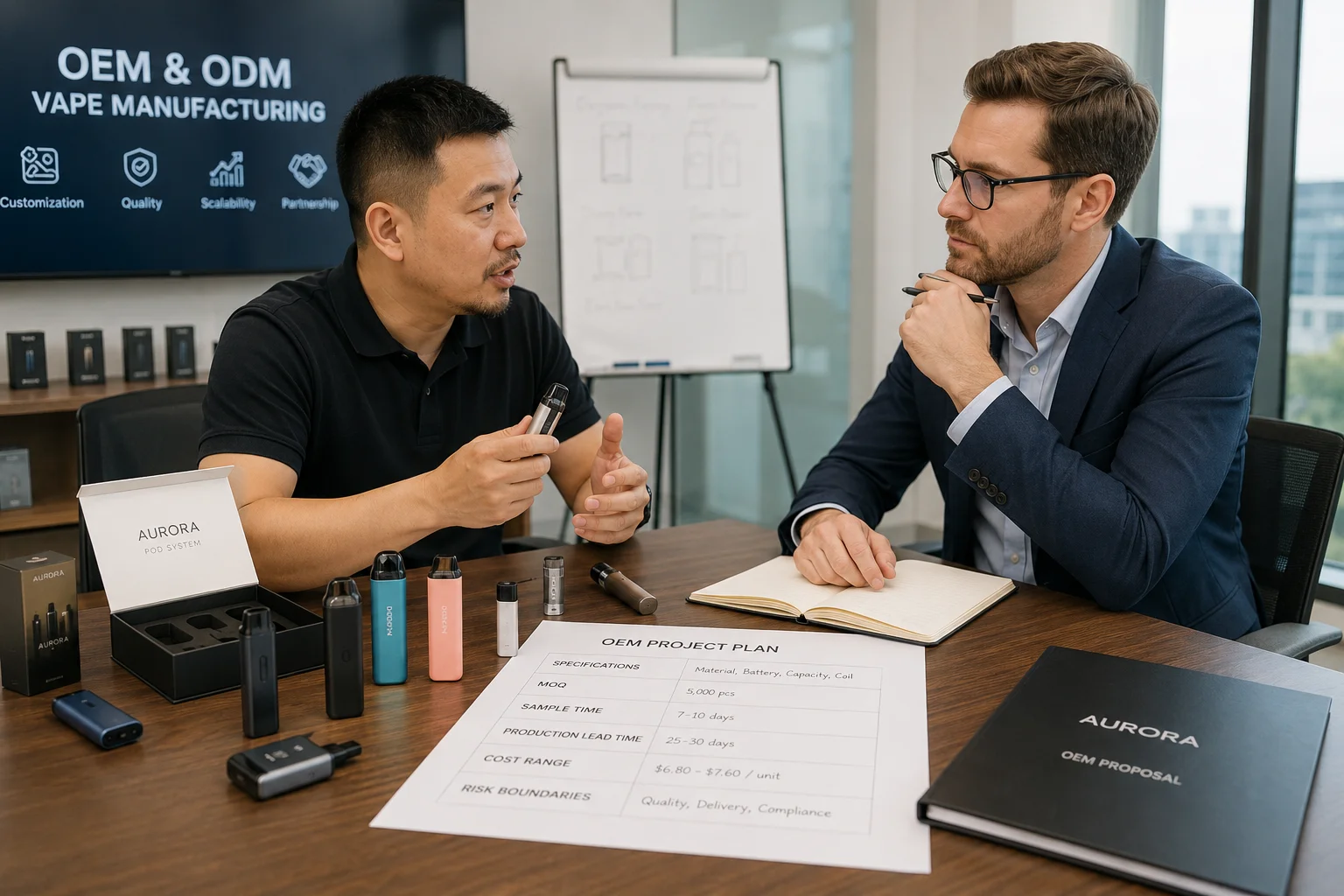
I work from Shenzhen, where the vape supply chain is very concentrated[^1]. I see many buyers with good market sense, real customers, and strong sales channels. Still, the first OEM talk can go wrong when the buyer and factory only discuss the lowest price. I think the better first question is simple: what product can be made, delivered, and sold without putting too much pressure on cash flow, timing, and after-sales?
1. What Does OEM Vape Manufacturing Really Mean for Smaller Brands?
Many first-time buyers think OEM means putting a logo on any device. That is too simple. It can create a weak product plan.
The real meaning behind OEM
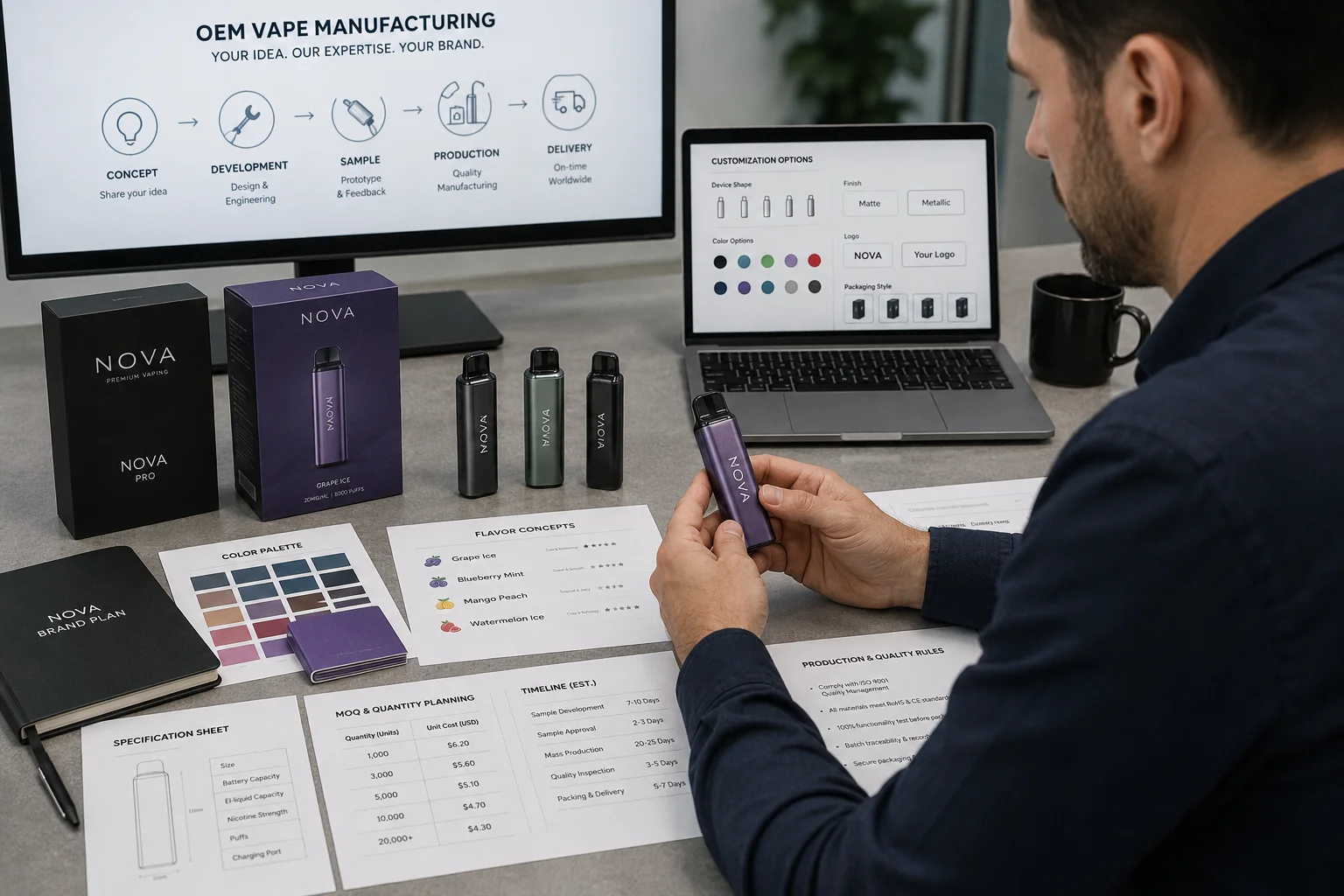
In my daily work, I treat OEM as a product-building process, not only a logo-printing job. A smaller brand may already know its local customers very well. It may know which flavor sells, which price level moves fast, and which design looks popular in shops. My job on the factory and supply-chain side is different. I need to check if that idea can become a stable product. I need to ask about capacity, battery, puff positioning, oil volume, mouth feel, package style, and target retail channel. I also need to understand whether the buyer wants a fast test order or a long-term brand line.
| Topic I clarify | Why it matters to a smaller brand |
|---|---|
| Target market | I need to avoid a product that does not fit local demand |
| Sales channel | A vape shop, smoke shop, gas station, and wholesaler may need different styles |
| Custom scope | Logo only, package, flavor, shell color, and structure all change the project |
| Test quantity | I need to match MOQ with real cash flow |
| Reference product | I can understand the buyer’s expectation faster |
Why “private label” is not always enough
I often see buyers say, “I just need my logo.” I understand this request. It is simple and fast. But a logo alone does not make a sellable brand.[^3] A customer in a store sees the device, package, flavor name, price, and trust signal together. If these parts do not match, the logo cannot carry the product. So I prefer to discuss brand positioning early, even for a small test run.
2. When Does OEM Make Sense Compared with ODM, Private Label, or Branded Wholesale?
Many buyers choose OEM too early. They want control, but they may need speed first. This mistake can block cash flow.
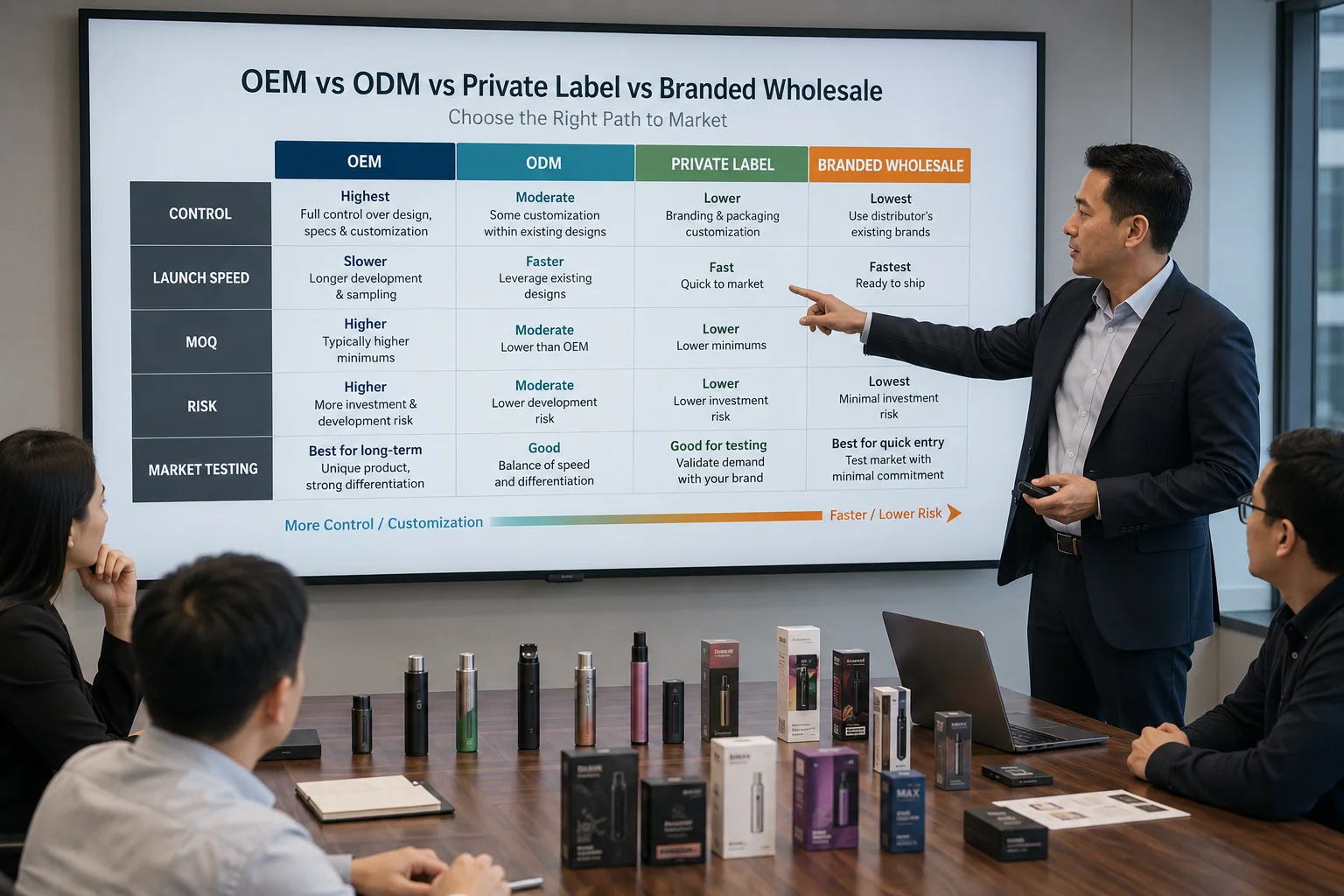
OEM makes sense when I need more product control and brand difference. ODM, private label, or branded wholesale may make more sense when I need faster launch, lower MOQ, lower risk, or market testing.[^4]
I compare the paths before I quote
When a smaller buyer asks me for OEM, I do not only think about whether the factory can make it. I also think about whether OEM is the best business move at that stage. Some buyers already have steady shop customers and clear repeat demand. They may need OEM because they want their own look, flavor line, and stronger margin. Some buyers are still testing what sells in their city or country. They may be better with branded wholesale or private label first. That lets them move faster and use less cash.
| Supply model | Best fit | Main benefit | Main limit |
|---|---|---|---|
| Branded wholesale | Fast resale | Ready stock and quick market test | Low brand control |
| Private label | Small brand start | Logo and package can be faster | Limited deep difference |
| ODM | Product with existing design base | Faster than full development | Design may not be exclusive |
| OEM | Clear brand plan | More control and stronger brand fit | Higher planning pressure |
I look at stage, not only ambition
I respect small brands because many strong brands started small. But I also know cash flow is real. If a buyer has a limited budget and needs quick turnover, I may suggest a faster route first. If a buyer has a loyal local customer base and knows what it wants, OEM can be a good next step. The right model should match the buyer’s stage, not only the buyer’s dream.
3. What Should Smaller Vape Buyers Clarify Before the First Supplier Conversation?
Many buyers enter the first conversation with only one question: “What is your MOQ?” That is not enough to build a safe plan.

I need a clear starting picture
I do not need a perfect business plan from a smaller brand. But I do need a clear starting picture. If a buyer tells me the target market is Spain, Germany, the United States, or another country, I can ask better questions. If the buyer tells me it sells to vape shops, smoke shops, gas stations, or convenience stores, I can think about price level and package style. If the buyer shares a reference product, I can understand the shape, function, and user feeling faster. I also need to know the buyer’s test quantity and budget range. This does not mean I want to push the highest price. It means I can avoid wasting time on a plan that cannot be produced within the buyer’s real budget.
| Question I ask | What I learn |
|---|---|
| Where will the product be sold? | Market habit and product type |
| Who buys from you? | Retail channel and sales pressure |
| What product do you like now? | Reference for design and performance |
| How many units do you want to test? | MOQ and production planning |
| What is your budget range? | Realistic specification level |
| When do you need goods? | Sampling and delivery rhythm |
I prefer honest limits early
A smaller buyer may worry that sharing budget or quantity makes the supplier quote higher. I understand that concern. But a serious OEM talk needs real limits. If I know the buyer wants a small test first, I can suggest a practical customization scope. If I know the buyer has a selling season, I can check whether sampling and production can catch it. Clear information helps both sides reduce mistakes.
4. MOQ, Lead Time, Customization, and Cost: What Usually Changes in OEM Projects?
Many buyers push MOQ and price down at the same time. Then they are surprised when sampling, quality, or timing becomes harder.
In OEM vape projects, MOQ, unit price, sampling time, production lead time, customization depth, and delivery rhythm are connected. If I change one part, the other parts usually change too.
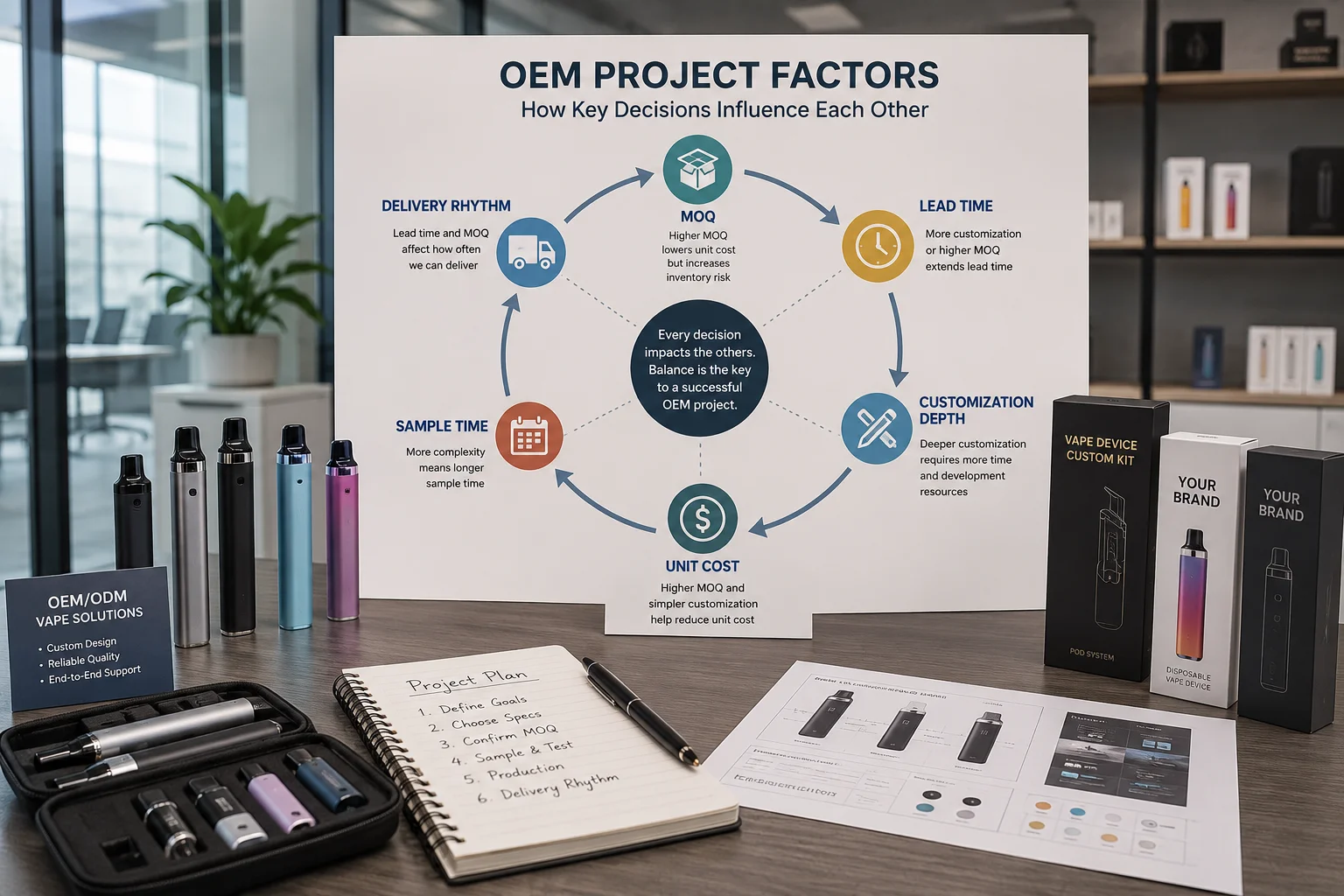
I do not treat MOQ as a single number
MOQ is not only a factory rule.[^6] It is connected to materials, packaging, flavor preparation, logo process, shell color, and production setup. If a buyer wants a standard device with simple logo printing, the MOQ may be easier to control. If the buyer wants special mold, special color, special package, special flavor, and special configuration, the MOQ and lead time usually rise.[^7] The same logic applies to cost. A low unit price may look good on the invoice. But if it causes weak parts, unstable quality, or too many after-sales cases, the real cost becomes higher.[^8]
| Project part | If the buyer asks for more customization | What usually changes |
|---|---|---|
| Logo | Easier if standard position is used | Small effect on time |
| Packaging | Custom box needs artwork and printing | More sample checks |
| Flavor | Custom taste needs testing | Longer sample stage |
| Device shell | Custom color or finish needs material planning | Higher MOQ risk |
| Structure | New mold or deep change | More time and cost |
| Delivery rhythm | Split shipment or urgent launch | More planning needed |
I connect cost with selling window
Smaller brands often live by speed. If they miss a hot selling window, the product may become slow stock.[^9] So I always look at cost with timing. A cheaper plan that delays launch by several weeks may not be cheaper in real business. A stable plan with a realistic MOQ may protect cash flow better. I do not suggest overbuying only for a lower unit price if the buyer cannot sell the goods fast. I prefer a plan where production quantity, delivery time, and market testing match each other.
5. Product Control vs Speed to Market: What Main Trade-Off Must Smaller Brands Understand?
Many buyers want a unique product and instant delivery. In real production, these two goals often fight each other.
Smaller brands must understand that more product control usually means slower development and higher planning demand.[^10] Faster launch usually means using existing designs, proven parts, or ready stock.
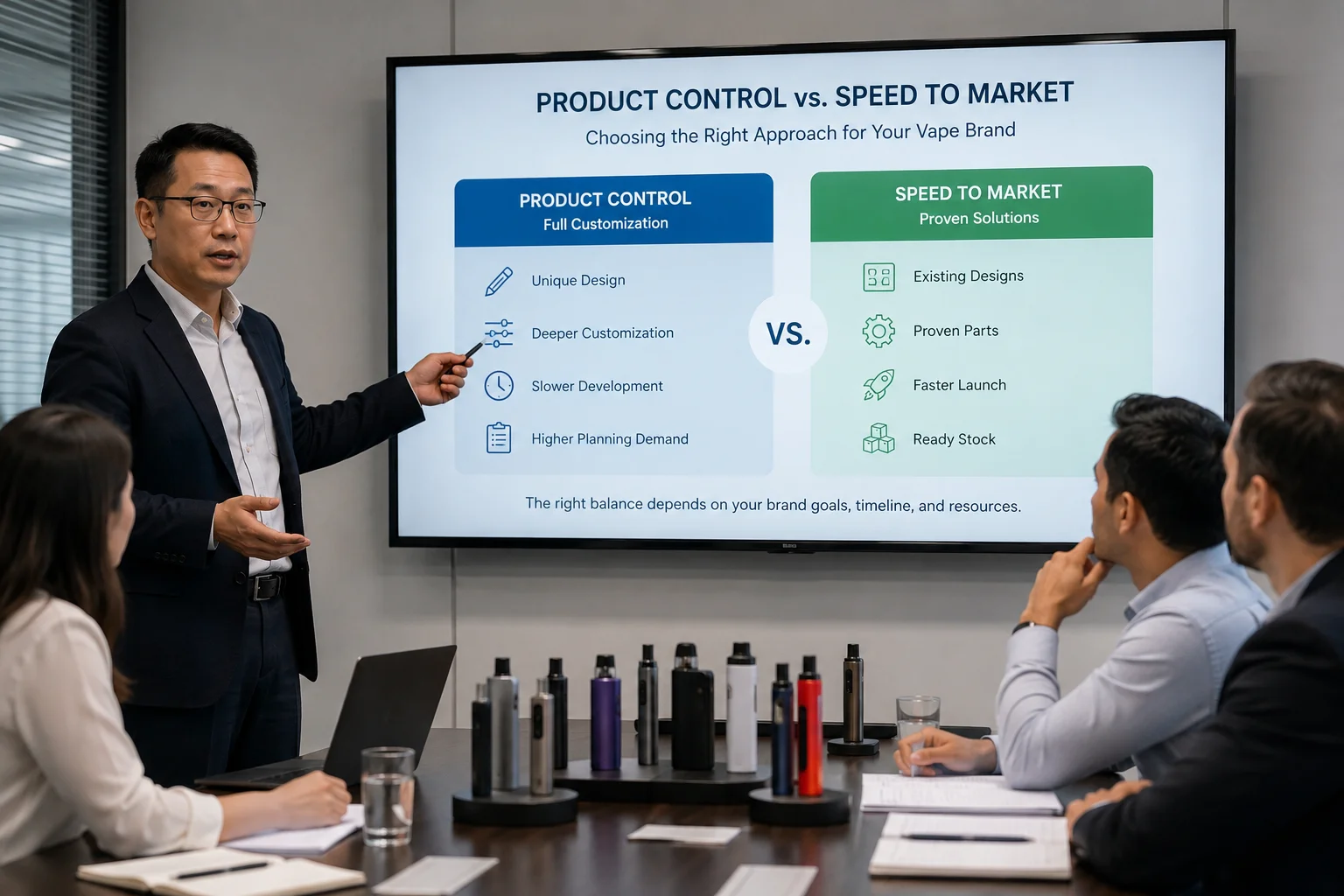
I help buyers choose the right balance
I often compare OEM decisions with driving a car. If I want full control, I need more preparation before I start. If I need to move fast, I use a road that already exists. A smaller brand may want a custom device shape, new flavor system, special package, and unique market position. That can be useful if the brand has strong channels and enough time. But if the buyer needs to catch a local trend next month, a ready design with controlled customization may be better. The key is not which choice sounds more professional. The key is which choice fits the buyer’s current risk level.
| Buyer goal | Better direction | Reason |
|---|---|---|
| Fast market test | Branded stock or private label | Lower time pressure |
| Better brand image | Private label or ODM | More control than stock |
| Clear long-term brand | OEM | Stronger product fit |
| Special product idea | OEM or new development | Needs more testing |
| Limited cash flow | Smaller test plan | Reduces stock pressure |
I do not see speed as a small issue
Speed affects money. It affects warehouse space. It affects customer trust. It affects repeat orders. If a buyer has a small team and fast-moving sales cycle, a delayed OEM project can hurt more than expected. At the same time, a fast but weak product can also damage the buyer’s name. So I like to ask one direct question: do you need to be first, or do you need to be different? The answer changes the whole plan.
6. What Common Mistakes and Unrealistic Expectations Appear in First-Time OEM Vape Projects?
Many first-time OEM projects fail because the buyer and supplier never make the unclear parts clear. The problems appear later.
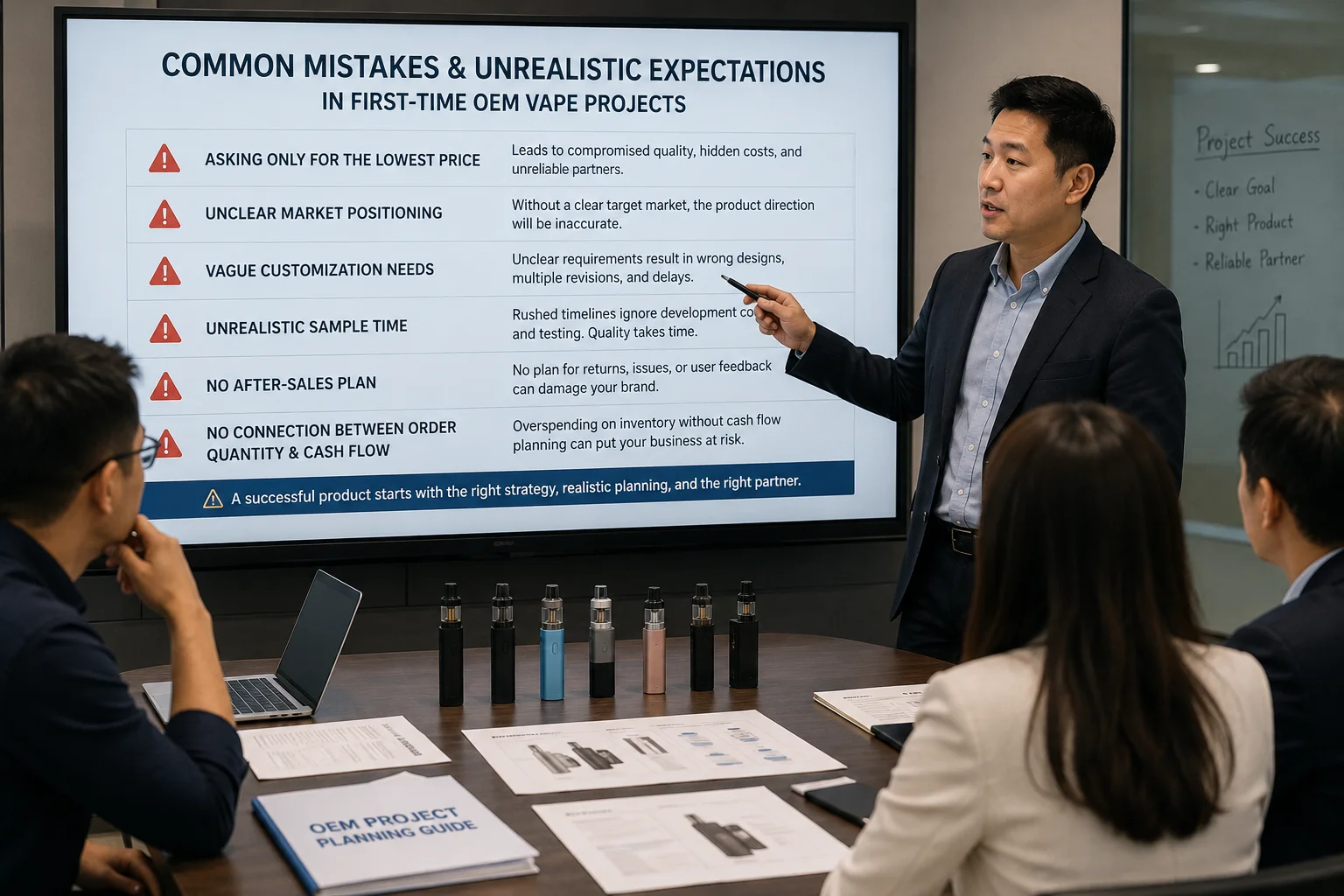
I see the same problems repeat
In my factory-side and supply-chain work, I see several patterns. A buyer may send a photo and ask for the same product, lower price, custom logo, and very fast delivery. But the buyer may not explain target customer, sales channel, taste preference, or legal requirements in its own market. I cannot responsibly turn that into a strong plan with only a photo. Another common issue is changing the product many times after sampling starts. Every change may look small. But it can affect package artwork, material purchase, production schedule, and final cost. A third issue is thinking the cheapest product has the best margin. In many markets, margin depends on stable sell-through, low return rate, and fast repeat orders.
| Mistake | What may happen |
|---|---|
| Asking only for lowest price | Quality and after-sales pressure may rise |
| No clear target market | Product style may not match buyers |
| Vague custom request | Sample revisions may repeat |
| Unrealistic delivery date | Selling window may be missed |
| No test plan | Cash may be tied in slow stock |
| No after-sales rule | Disputes may appear later |
I prefer to slow down before going fast
This may sound strange, but a slower first conversation can make the whole project faster. If I ask more questions at the beginning, I can avoid wrong samples, wrong package files, wrong product positioning, and wrong production timing. I do not want a buyer to spend money only to learn basic lessons after goods arrive. I want the buyer to know what is fixed, what can change, what costs more, and what timeline is realistic before the order starts.
7. Agency, Own Brand, Private Label, or Branded Stock: Which Path Fits Your Stage?
Many buyers want their own brand because it sounds stronger. But the best path depends on sales stage, budget, and market confidence.
I choose between agency, own brand, private label, and branded stock by looking at the buyer’s channel strength, cash flow, speed need, brand goal, and product knowledge.
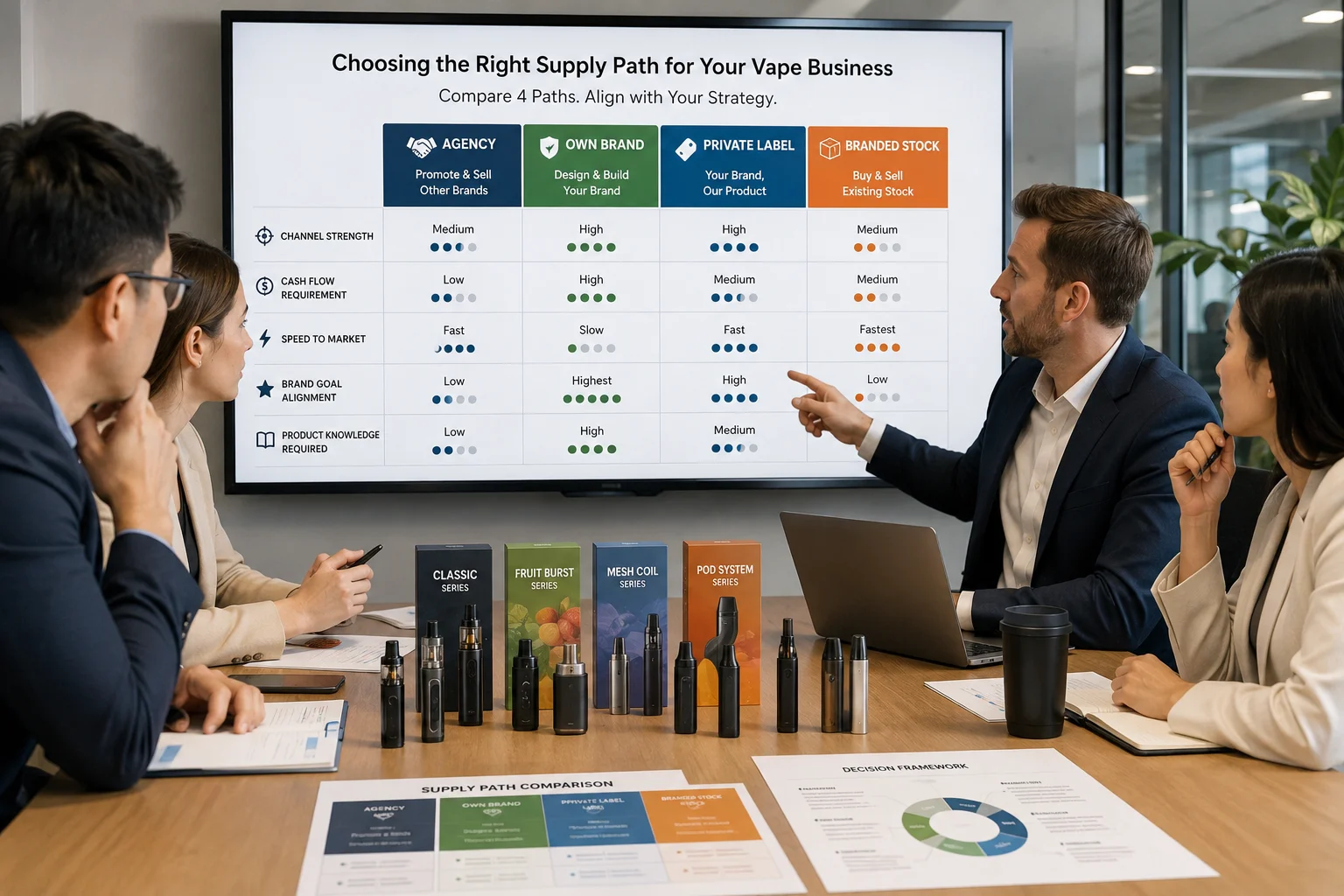
I match the model to the buyer’s real situation
Some buyers are strong distributors. They already serve many vape shops, smoke shops, convenience stores, and gas stations. They can move volume and may need agency or branded wholesale with stable supply. Some buyers have local trust and want better profit. They may start with private label. Some buyers know exactly what their customers want and want to build long-term value. They may move into OEM. Some buyers are still learning the category. They may be safer with ready stock, small batches, or mixed-brand supply. In Europe, a low-MOQ overseas warehouse model can also help small and medium buyers test faster with less early investment, when available and suitable for their market. From China, larger buyers may get stronger price options and more OEM/ODM choices, but they must plan shipping and timing more carefully.
| Business stage | Practical path | Main benefit |
|---|---|---|
| New market test | Branded stock | Fast learning |
| Small local channel | Private label | Lower brand entry cost |
| Growing distributor | Agency or mixed supply | More product coverage |
| Clear brand builder | OEM | Stronger control |
| Advanced product plan | ODM or new development | More difference |
I also consider service load
A buyer should not only ask, “Can I sell it?” The buyer should also ask, “Can I support it?” If the product has many after-sales questions, the buyer’s team must handle them. If the product is too new for local users, the buyer may need more explanation to stores. If the buyer imports many brands from many suppliers, after-sales can become messy. A one-stop supply model can reduce that work, but it still needs clear order records, product checks, and support rules.[^12] The right path should make sales easier, not only make the catalog bigger.
8. How Do I Choose the Most Practical Vape Supply Model for Your Brand Goals?
Many buyers search for the best factory first. I think they should define the best supply model first.
I choose the most practical vape supply model by matching brand goal, budget, selling window, customization need, order size, delivery plan, and risk tolerance before discussing final price.
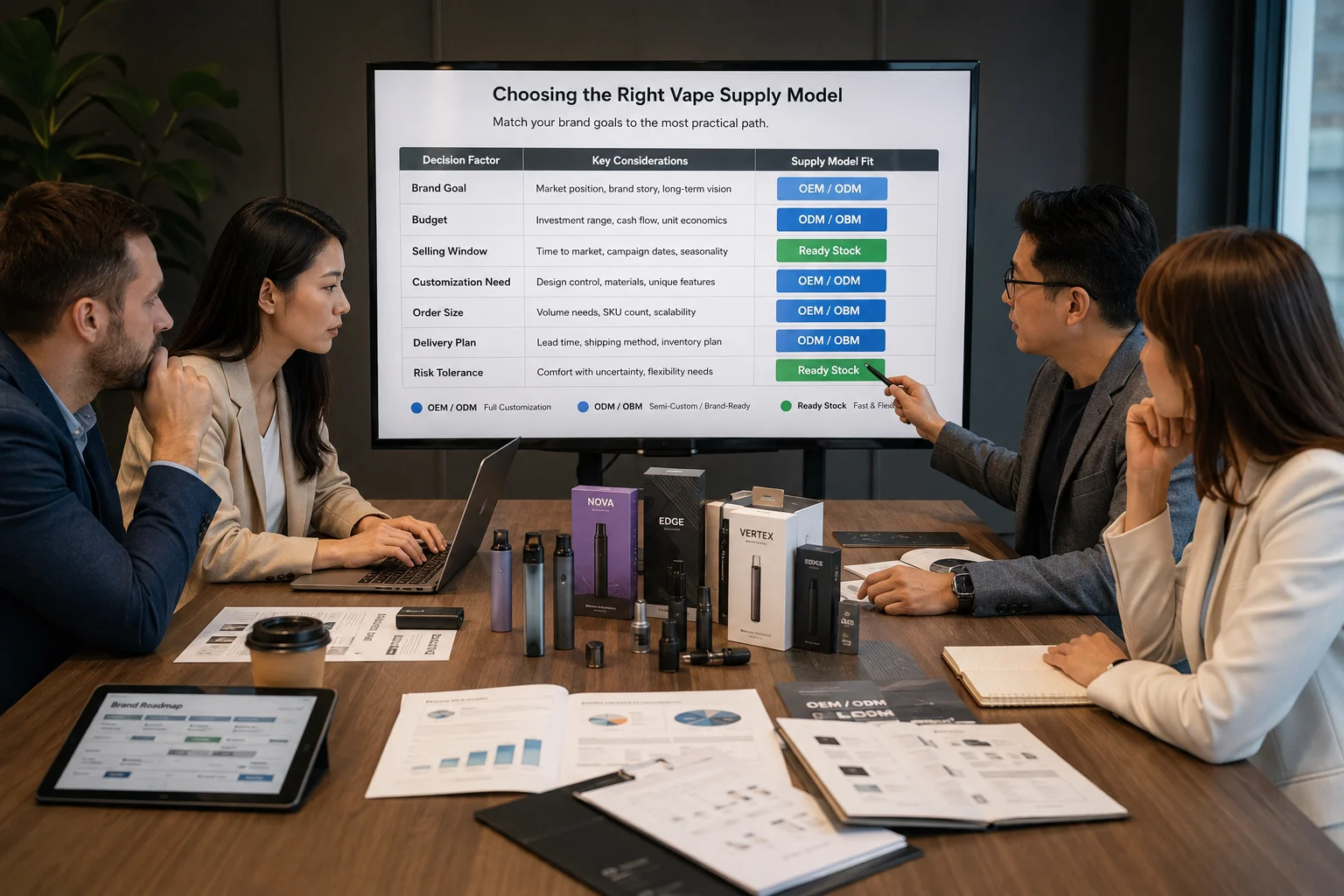
I use a simple decision frame
When I speak with a smaller brand, I try to move from idea to plan. I first ask what the buyer wants to achieve in the next one to three orders. If the goal is quick cash turnover, I look at ready products, overseas stock where possible, or simple private label. If the goal is brand building, I look at product line planning, package language, flavor structure, and repeat order rhythm. If the goal is long-term difference, I look at OEM or ODM. I do not promise that every customs, compliance, or sales issue will be easy in every country. That would not be honest. I can help with supply-chain planning and practical production choices, but the buyer must also understand its local rules and selling conditions.
| Goal | Supply model I may consider | Main question |
|---|---|---|
| Sell fast | Branded stock | Can you move it quickly? |
| Test brand name | Private label | Is the product already proven? |
| Build margin | OEM | Can the market support your difference? |
| Reduce cash pressure | Smaller batch or overseas stock | Can you reorder fast enough? |
| Build long-term line | OEM/ODM | Can you plan beyond one hot item? |
I turn the first talk into a working plan
A useful first conversation should end with clear next steps. I want both sides to know the likely product direction, customization scope, sample plan, MOQ range, lead time range, and delivery route. I also want to know what the buyer must confirm internally. That may include artwork, budget, market launch time, local requirements, and sales forecast. If these parts are not clear, a quote alone has little value. A cheap quote can still lead to wrong goods. A practical plan gives the buyer a better chance to test, sell, reorder, and protect cash flow.
Conclusion
I treat the first OEM conversation as planning work, because a clear plan protects money, time, product quality, and future brand value.
[^1]: "[PDF] December 2, 2024 Shenzhen HanQingDa Technology Co. Ltd. 12th ...", https://democrats-selectcommitteeontheccp.house.gov/sites/evo-subsites/democrats-selectcommitteeontheccp.house.gov/files/evo-media-document/Letter%20to%20Shenzhen%20HanQingDa.pdf. A neutral industry or institutional source documents Shenzhen/Guangdong as a major center for e-cigarette manufacturing and supplier networks, supporting the article’s geographic context. Evidence role: historical_context; source type: institution. Supports: A neutral industry, government, or research source should document Shenzhen or Guangdong as a major center of e-cigarette manufacturing and related supply chains.. Scope note: This would support the regional concentration generally, not the author’s personal experience or the concentration level of any specific supplier network. [^2]: "Original equipment manufacturer - Wikipedia", https://en.wikipedia.org/wiki/Original_equipment_manufacturer. A standard definition of original equipment manufacturing describes production by one company for incorporation into, or sale under, another company’s branded offering, supporting the article’s use of OEM as specification-based branded production. Evidence role: definition; source type: encyclopedia. Supports: A general reference source should define OEM or contract manufacturing as production by one firm for sale under another firm’s brand or specifications.. Scope note: The definition is general and not specific to vape devices, flavors, packaging, or production rules. [^3]: "The Impact of Visual Elements of Packaging Design on Purchase ...", https://pmc.ncbi.nlm.nih.gov/articles/PMC11851823/. Consumer-behavior research indicates that packaging design and brand cues can influence perceived quality and purchase intention, supporting the point that logo placement alone is insufficient to create a sellable brand. Evidence role: mechanism; source type: paper. Supports: A peer-reviewed marketing or consumer-behavior study should show that packaging, brand cues, and product presentation influence perceived value or purchase intention.. Scope note: Such evidence supports the general branding mechanism and may not directly study vape products or small OEM brands. [^4]: "The relationship between mass customization and sustainable ...", https://pmc.ncbi.nlm.nih.gov/articles/PMC10950661/. Operations and product-development literature commonly links greater customization with additional coordination and development effort, while standardized offerings can reduce launch time and facilitate market testing. Evidence role: general_support; source type: paper. Supports: A product-development or operations-management source should explain that customization increases coordination, development time, or uncertainty, while standardized or existing products can support faster market testing.. Scope note: This would provide contextual support for the trade-off and may not directly compare OEM, ODM, private label, and branded wholesale in the vape sector. [^5]: "[PDF] Role of Requirements Engineering in Software Project's Success", https://digitalcommons.odu.edu/cgi/viewcontent.cgi?article=1020&context=emse_etds. Product-development and requirements-engineering research emphasizes that early clarification of requirements, user needs, constraints, and supplier expectations improves project coordination and reduces later rework. Evidence role: expert_consensus; source type: paper. Supports: A procurement or product-development source should support the importance of early requirements definition, market information, and supplier communication for project success.. Scope note: The evidence would support the planning principle generally, not prove that every listed item is required in every vape OEM project. [^6]: "Economic order quantity - Wikipedia", https://en.wikipedia.org/wiki/Economic_order_quantity. Operations-management sources explain that minimum order quantities and batch sizes often reflect setup costs, purchasing constraints, and production-efficiency considerations rather than a purely arbitrary factory rule. Evidence role: mechanism; source type: education. Supports: An operations-management source should explain that minimum batch sizes and order quantities are affected by setup costs, procurement constraints, and production efficiency.. Scope note: This supports the economic logic of MOQ generally and may not identify the exact MOQ drivers for vape-device factories. [^7]: "Why Focusing on Lead Time—Not Just Efficiency—Drives Success", https://interpro.wisc.edu/lead-time-drives-manufacturing-success/. Manufacturing research links customization, tooling, and changeover requirements with additional setup effort and longer lead times, supporting the claim that special molds, colors, packaging, or configurations can increase MOQ and schedule pressure. Evidence role: mechanism; source type: paper. Supports: A manufacturing or operations source should show that customization, tooling, and special materials add setup work and can increase lead time or minimum economic batch size.. Scope note: The evidence would support the mechanism broadly and may not quantify the increase for specific vape products. [^8]: "Beyond Price: Why Total Cost of Ownership Should Anchor Every ...", https://purchasing.collegebuys.org/beyond-price-why-total-cost-of-ownership-should-anchor-every-strategic-sourcing-agreement/. Total-cost-of-ownership and cost-of-quality literature shows that purchase price is only one component of cost, and that defects, returns, warranty service, and after-sales support can raise the buyer’s real cost. Evidence role: mechanism; source type: paper. Supports: A purchasing or quality-management source should show that total cost includes quality failures, warranty, returns, and service costs, not only unit purchase price.. Scope note: This evidence supports the procurement principle generally rather than demonstrating a specific defect rate in vape OEM orders. [^9]: "Single-period ordering and pricing policies with markdown ...", https://www.sciencedirect.com/science/article/abs/pii/S0360835218304212. Inventory-management research on seasonal and short-life-cycle products shows that delayed market entry can reduce sell-through and increase the risk of obsolete or slow-moving stock. Evidence role: mechanism; source type: paper. Supports: A supply-chain or inventory-management source should show that products with short life cycles or seasonal demand face higher obsolescence, markdown, or slow-moving inventory risk when timing is missed.. Scope note: The evidence would be contextual and may not specifically analyze vape-product demand cycles. [^10]: "The relationship between mass customization and sustainable ...", https://pmc.ncbi.nlm.nih.gov/articles/PMC10950661/. Product-development literature associates increased customization and product complexity with greater coordination requirements and longer development cycles, supporting the article’s trade-off between control and speed. Evidence role: mechanism; source type: paper. Supports: A product-development source should support the relationship between customization, product complexity, coordination needs, and development lead time.. Scope note: This supports the general mechanism and does not establish a precise timeline for any particular OEM vape project. [^11]: "Navigating new product development: Uncovering factors and ...", https://pmc.ncbi.nlm.nih.gov/articles/PMC10788447/. Procurement and project-management research identifies unclear requirements, unrealistic schedules, and price-focused supplier selection as recurring sources of quality, delivery, and coordination problems. Evidence role: expert_consensus; source type: paper. Supports: A project-management, procurement, or new-product-development source should show that unclear requirements, excessive focus on price, unrealistic schedules, and poor risk planning contribute to project problems.. Scope note: The source would validate the risk categories generally, not prove that these are the most common mistakes in first-time vape OEM projects. [^12]: "Avoiding the Cost of Inefficiency: Coordination and Collaboration in ...", https://knowledge.wharton.upenn.edu/article/avoiding-the-cost-of-inefficiency-coordination-and-collaboration-in-supply-chain-management/. Supply-chain management research notes that supplier consolidation can reduce coordination and transaction burdens, but effective governance still requires performance monitoring, documentation, and quality controls. Evidence role: general_support; source type: paper. Supports: A supply-chain management source should explain that supplier consolidation can reduce transaction or coordination costs while still requiring governance, quality control, and performance monitoring.. Scope note: This supports the general supply-chain principle and does not evaluate any specific one-stop vape supplier model.