Quick Answer
Vape Recycling and Battery Take-Back Compliance can become a serious procurement problem when importers treat disposable vapes as ordinary fast-moving goods. I regularly hear buyers ask about batteries, recycling, documentation, and local responsibility. I believe the safest answer is not a simple certificate, but a clear pre-purchase process that connects product data, supplier support, and destination-market verification.
For importers in 2026, vape recycling and battery take-back compliance should be checked before ordering, not after products arrive. Buyers should confirm their own obligations in the destination market, identify whether disposable vapes and batteries are covered, and ask suppliers for accurate product, battery, packaging, labeling, and shipment information. Supplier documents can support compliance, but they do not automatically transfer the importer’s legal responsibility.
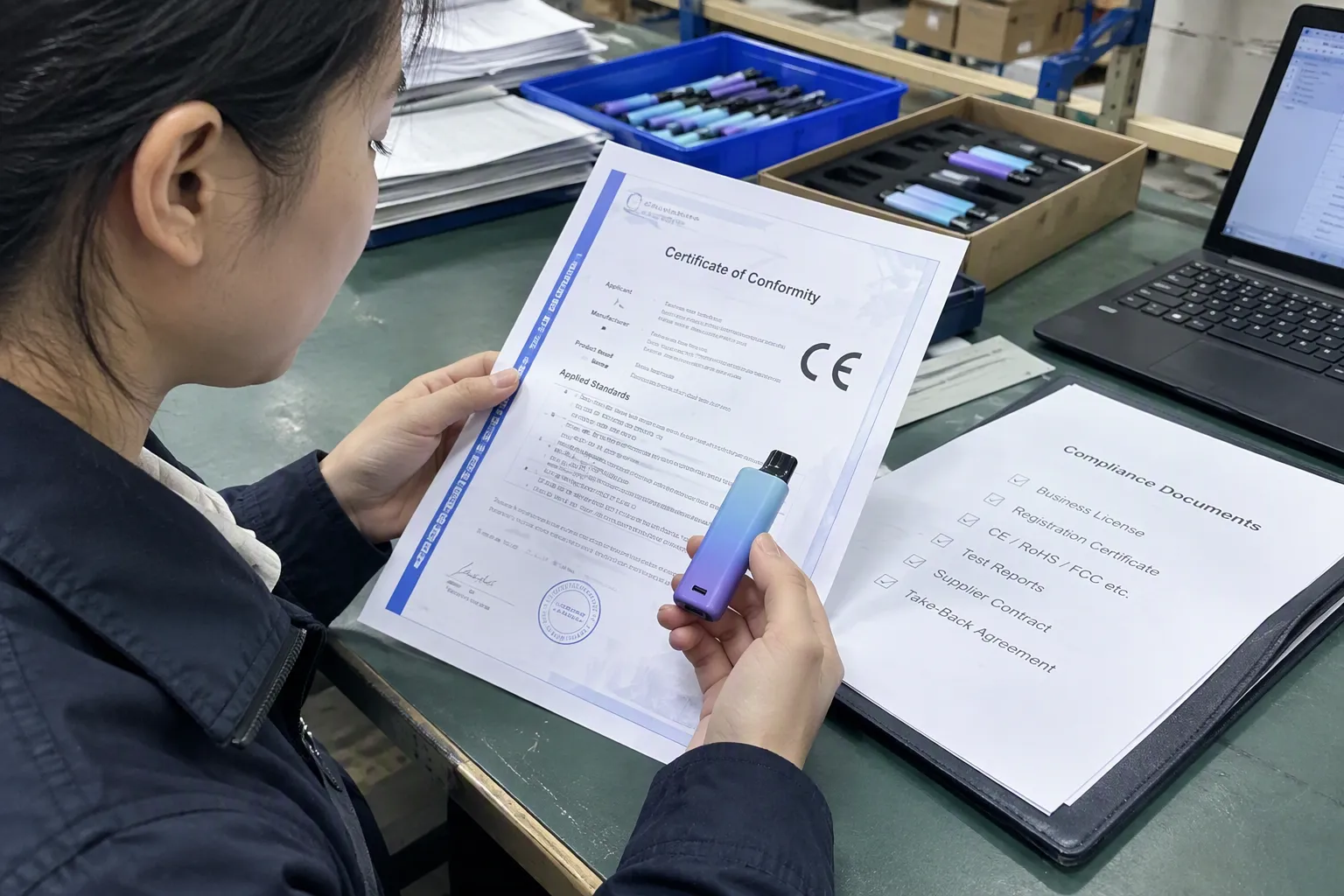
I work with electronic-cigarette exporters, importers, wholesalers, and product factories in Shenzhen. In real purchasing discussions, customers usually focus first on price, stock, delivery time, and product trends. However, recycling and battery take-back questions can affect the total cost and risk of an order. I will explain how I would evaluate a supplier before placing a purchase order.
Vape Recycling Battery Take-Back Compliance 2026: What Should Importers Check
Many buyers want a fast answer: “Can the supplier provide a certificate that solves the recycling issue?” That question is understandable, especially when a buyer needs a low-MOQ shipment or a quick restock. The problem is that product documents and local importer duties are not always the same thing.
I would begin by separating four issues: the product’s battery and waste characteristics, the importer’s obligations in the destination market, the supplier’s available documentation, and the practical arrangements for collection or disposal. I would verify any 2026 registration, reporting, labeling, threshold, or producer-responsibility requirement with the relevant local authority or a qualified compliance adviser before making a legal decision.
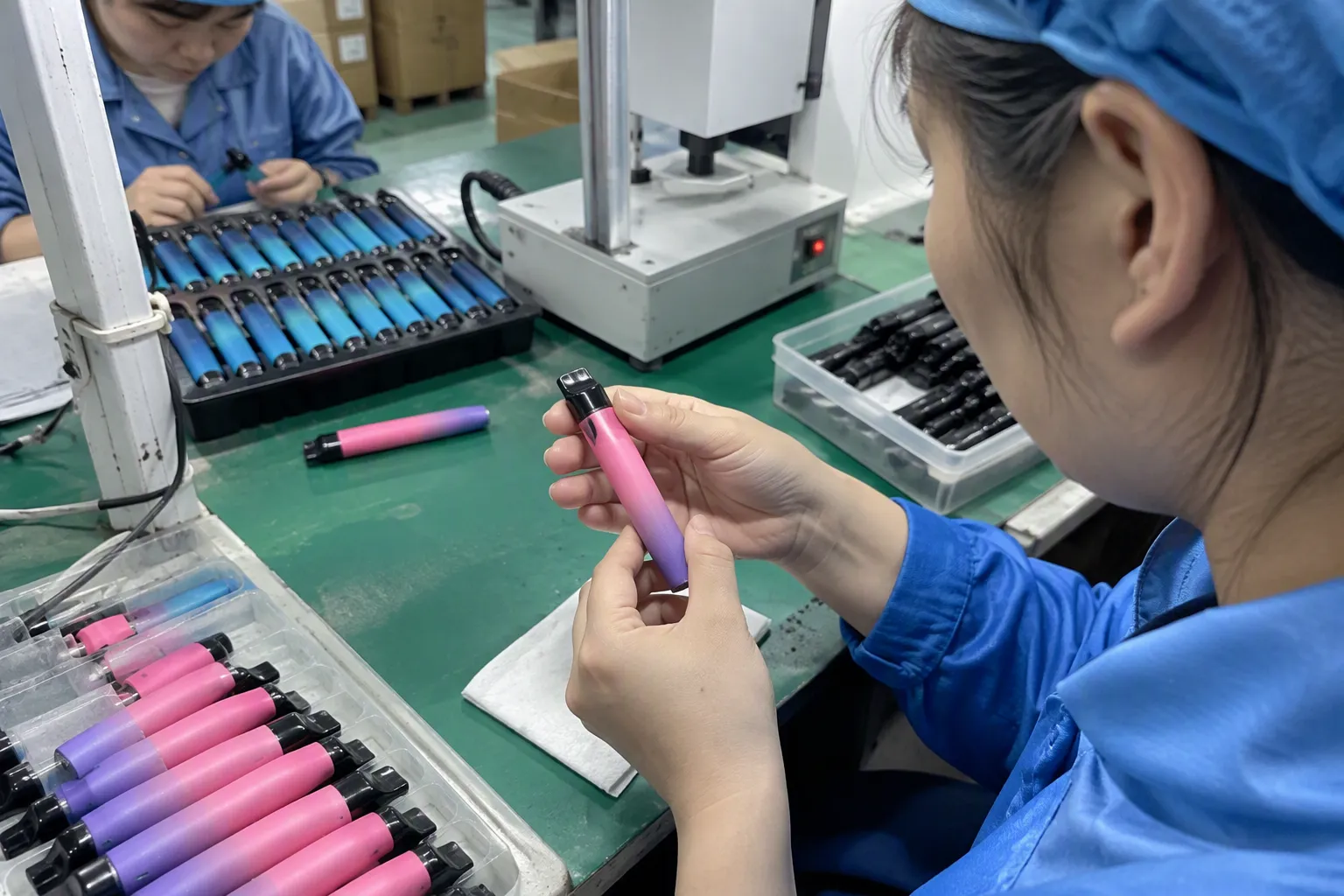
When I speak with European and U.S. wholesalers, vape shops, smoke shops, convenience retailers, and distributors, their concerns are usually commercial as much as legal:
- They do not want products to become unsellable because required information is missing.
- They want to avoid unexpected recycling, collection, or waste-management costs.
- They need stable documents for customs, marketplace, retailer, or internal procurement reviews.
- They want to reduce the chance that damaged batteries create a handling problem.[7]
- They need a supplier that can answer questions quickly when local advisers request product information.
- They want to protect their reputation with downstream retail customers.
These concerns apply to several buyer types. A small Spanish wholesaler serving tourist-area shops may need quick replenishment, a low minimum order, and simple delivery. A U.S. regional distributor with multiple warehouses may need consistent product data across several imported models. A larger importer may also want private-label production, packaging control, and a defined document package for each SKU.
What does “compliance” actually include?
I do not use “compliance” as a single certificate or a general quality claim. I treat it as a set of questions that must be answered for a particular product, shipment, and market.
| Procurement question | Why I would check it | Who should verify the final requirement? |
|---|---|---|
| Does the product contain a battery? | It affects waste handling and product classification questions. | Importer with a qualified local adviser or authority |
| What battery and product data are available? | Buyers may need accurate information for internal and regulatory reviews. | Supplier provides data; importer verifies use |
| What packaging and labels are supplied? | Missing or inconsistent information can create sales and documentation problems.[8] | Supplier and importer, according to local rules |
| Who has the local producer or importer duty? | A factory or warehouse does not automatically assume the buyer’s legal role. | Importer and local compliance adviser |
| How will damaged or end-of-life units be handled? | Disposable vapes may create a practical battery and electronic-waste issue. | Importer’s approved waste arrangement |
| Can the supplier update documents by SKU? | Model changes can make old files unreliable. | Supplier and buyer before each order |
| Is the item shipped from China or an overseas warehouse? | The route changes logistics, but not automatically the legal responsibility. | Importer and local adviser |
Why disposable vapes need a different procurement discussion
A disposable vape is not only a sales unit. It can contain a battery, electronic components, a heating element, a liquid reservoir, packaging, and other materials.[1] When the unit reaches the end of its useful life, the buyer must consider how the product is collected, stored, transported, and processed under the applicable local system.[2]
I am not presenting myself as an environmental regulator, laboratory engineer, lawyer, or country-specific compliance provider. My role is practical supplier coordination. I can help buyers ask better questions, collect available product information, coordinate with factories, and clarify what is included in an order. A qualified professional must decide whether a particular product or business model meets local legal requirements.
What should an importer request before ordering?
I would ask the supplier for a product-specific information package rather than accepting a general statement. The package may include, where available and relevant:
-
Product identification
- Exact model name and SKU
- Product photographs
- Manufacturer information
- Packaging configuration
- Private-label or original-brand status
-
Battery information
- Battery type and stated capacity
- Battery-related technical information available from the factory
- Whether the battery is integrated or removable
- Relevant transport documentation, where applicable
- Information for identifying the battery-containing product
-
Product and packaging information
- Materials information available from the manufacturer
- Packaging dimensions and weights
- Label artwork and language versions
- Warnings and user information supplied with the product
- Carton and pallet details
-
Quality and shipment records
- Production batch identification
- Pre-shipment inspection arrangements
- Quantity and packing list
- Commercial invoice information
- Photos or video verification when agreed before shipment
-
Responsibility allocation
- Which documents the supplier provides
- Which registrations or local arrangements remain with the importer
- Who handles customer-service communication
- What happens when goods are defective or damaged
- How the buyer should report a product issue
The exact documents will vary by product and destination. I would not copy a document from one market into another without checking whether it is accepted there.
How should buyers evaluate a supplier’s answers?
I look for specific, traceable answers. A supplier that says “all compliant” without identifying the model, document date, issuing party, market, and scope gives the buyer little practical protection.
I would ask:
- Is this document for the exact SKU?
- Does it cover the current battery and packaging configuration?
- Is the document still current?
- Who issued it?
- Does it apply to the destination market?
- Can the supplier provide the original file or a verifiable copy?
- Does the document describe the product actually being shipped?
- Will the supplier notify the buyer if the battery, liquid, packaging, or design changes?
I would also compare the documents with the physical goods. If the label shows one model but the packing list shows another, the buyer should stop and clarify the discrepancy. A low price does not compensate for uncertain product identity.
What is the difference between supplier support and importer responsibility?
This distinction is central to Vape Recycling and Battery Take-Back Compliance. A supplier may provide technical information, product files, packaging details, declarations, or other supporting documents.[3] The supplier may also help coordinate production, labeling, testing, and logistics.
However, the importer may still have responsibilities in the destination market.[4] Those responsibilities can depend on the importer’s business model, local law, product category, sales channel, packaging, customer location, and role in placing the product on the market.[5] I would never tell a buyer that a factory document automatically transfers those duties.
A useful internal document is a responsibility matrix:
| Task | Supplier support | Importer action |
|---|---|---|
| Confirm product construction | Provide accurate factory information | Review it for the destination market |
| Provide battery details | Supply available technical data | Ask an adviser whether more information is needed |
| Prepare packaging artwork | Create or adjust artwork by agreement | Approve local language and required markings |
| Confirm waste obligations | Explain what information the factory can provide | Determine local registration, reporting, or collection duties |
| Arrange shipping | Prepare agreed export documents | Confirm the route and destination requirements |
| Handle defective goods | Provide replacement, refund, or agreed after-sales support | Keep records and report claims correctly |
| Manage end-of-life products | Cooperate with information requests | Use the buyer’s approved local process |
This approach protects both sides from assumptions. It also makes supplier comparison easier.
Does an overseas warehouse remove take-back obligations?
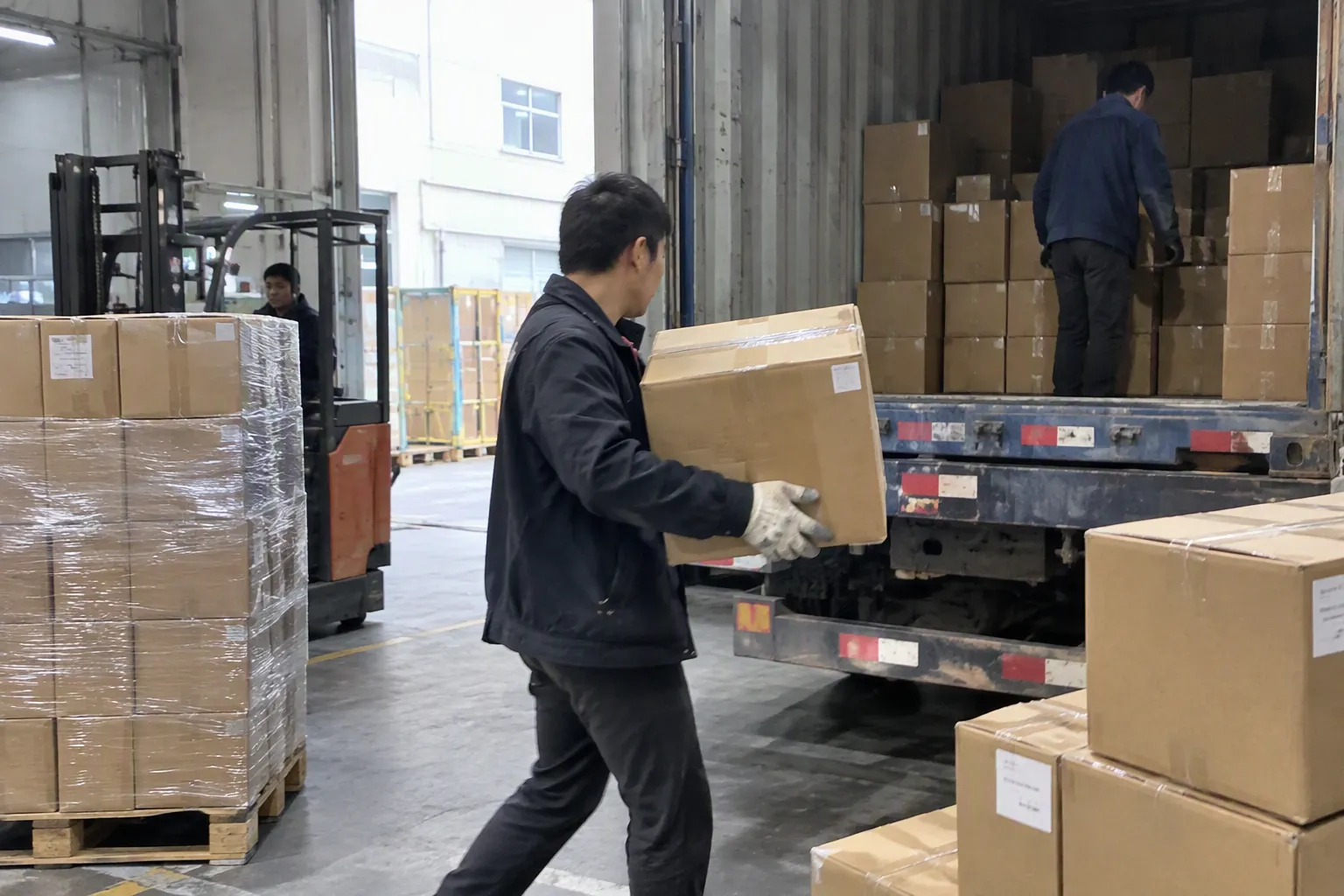
Our company has overseas warehouse inventory in Europe, including locations in Germany, Austria, Poland, and Belgium. We use logistics providers such as DHL, DPD, UPS, and FedEx for European delivery, and typical delivery may be approximately one to five working days depending on the order and destination. We also offer low minimum quantities for selected stocked products, with some items available from 50 units.
These services can help a small or medium-sized customer manage cash flow. The customer can order closer to the time of sale instead of making a large China import before demand is proven. The customer may also reduce waiting time during busy shipping periods. However, I would still ask the buyer and local adviser to confirm who is responsible for the products in the relevant market.
The same principle applies to direct China imports. Large importers, distributors, and wholesalers may obtain better unit economics through container or larger-volume purchasing. They may also choose OEM or ODM production with their own branding. Those benefits do not replace a compliance review.
How can procurement teams reduce unexpected cost?
I recommend treating compliance as a cost-control exercise, not only a legal exercise. Buyers should estimate the complete landed and post-sale cost before choosing the cheapest quotation.
The calculation may include:
- Product purchase price
- Packaging and labeling changes
- Testing or document review
- Freight and insurance
- Customs and import charges
- Local registration or producer-responsibility costs, if applicable
- Collection, storage, and waste-management costs
- Returns and defective-product handling
- Retailer or marketplace documentation requests
- Rework cost if the packaging is incorrect
- Inventory cost if a product cannot be sold immediately
A supplier with a slightly higher product price may create better value if the supplier provides stable SKU records, responds quickly, supports packaging changes, and offers clear after-sales coordination. I would still verify every cost instead of assuming that a service is free.
What should small and large buyers ask for?
I separate procurement paths according to operating scale.
For small and medium-sized wholesalers
A smaller buyer may value:
- Low MOQ
- Fast warehouse delivery
- Ready stock
- Clear product identification
- Basic document availability
- Simple after-sales communication
- A practical process for damaged or defective products
- The ability to test market demand before a larger order
Our European warehouse model can support this type of purchasing because selected products can be dispatched closer to the customer. The buyer still needs to check local obligations, but the buyer may reduce capital exposure and avoid committing to a large shipment before sales are known.
For larger importers and distributors
A larger buyer may need:
- Stable monthly supply
- SKU-level technical files
- Consistent battery and packaging specifications
- Batch and shipment traceability
- OEM or ODM control
- Private-label packaging review
- Production inspection
- Agreed change-notification procedures
- A defined after-sales and claims process
- Coordination with the buyer’s compliance team
Our Shenzhen factory has approximately 5,000 square meters and stated maximum production capacity of up to 5 million units per month. We maintain a regular new-product development program of approximately five to ten new products per month, and we have OEM/ODM experience. I present these facts as manufacturing and sourcing capabilities, not as proof that a particular product satisfies a buyer’s local legal requirements.
How does supplier selection affect reputation?
A wholesaler’s reputation often depends on what happens after the sale. If a retail customer receives inconsistent packaging, unclear instructions, damaged units, or products that cannot be handled through the expected local process, the wholesaler may face complaints even when the original purchase price was attractive.
I have seen buyers focus strongly on trend speed because fast-moving products can improve stock turnover. That commercial pressure is real. At the same time, a buyer should not allow a new product to move from quotation to mass purchase without checking its product information and responsibility allocation.
I would use a staged order process:
- Select a product and identify the exact SKU.
- Request the available product and battery information.
- Ask a local adviser to identify any destination-market questions.
- Confirm packaging, labels, and private-label artwork.
- Order a sample or small quantity where appropriate.
- Check the physical goods against the documents.
- Agree on inspection and after-sales procedures.
- Place a larger order only after unresolved issues are documented.
This process does not guarantee legal compliance. It does reduce avoidable surprises.
How can Kingfuji support the buyer without overstating responsibility?
I position Shenzhen Kingfuji Tech. Co., Ltd. as a supply-chain and manufacturing partner, not as a replacement for the buyer’s local legal adviser. We were established in Shenzhen in 2011, and Shenzhen provides access to a broad electronic-cigarette, vape-accessory, battery, packaging, and logistics supply chain.
Our business supports buyers in several ways:
- We manufacture and supply electronic cigarettes, disposable vapes, atomizers, 510 batteries, CBD batteries, vaporizers, grinders, glass pipes, and related products.
- We operate as a factory and trading-integrated company with our own brand and manufacturing capability.
- We represent a wide range of vape and smoking-accessory brands as an integrated purchasing source.
- We can help identify products that are not currently in a buyer’s catalogue.
- We can support new-product development and mold development where the buyer’s conditions are suitable.
- We coordinate order delivery to the buyer’s door or to the buyer’s chosen freight forwarder.
- We provide after-sales coordination for products purchased through us.
- We can arrange video verification when agreed.
- We offer agreed support for defective goods and shipment problems, subject to the order terms.
- We provide European warehouse options for selected stocked products.
- We support OEM and ODM projects for importers and distributors.
The buyer should still ask which documents are available for each specific product. I would rather identify a missing document before payment than make a broad promise that creates risk for the buyer.
Frequently Asked Questions
Does a vape supplier’s certificate prove that my business meets local recycling requirements?
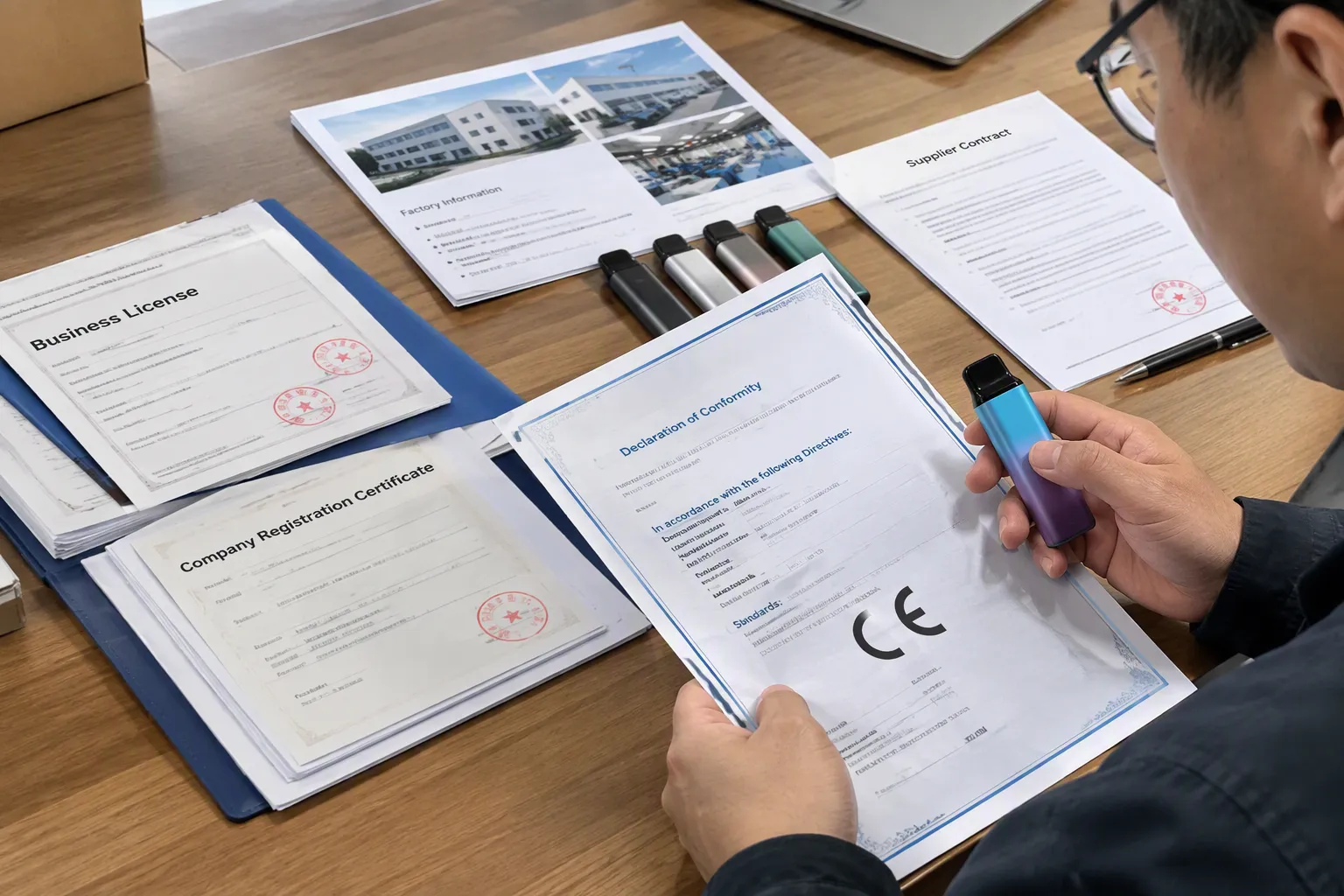
No. A supplier certificate or declaration may support a buyer’s review, but it does not automatically transfer local importer, producer-responsibility, battery, packaging, or waste obligations. I recommend checking the exact product and destination market with a qualified local adviser or authority.
Are disposable vapes treated differently from products without batteries?
They may raise additional battery and electronic-waste questions because they contain batteries and electronic components. I would not assume a classification without verification. I would ask the supplier for accurate product information and ask a qualified adviser how the destination market treats the product.
Can an overseas warehouse handle my battery take-back duty?
An overseas warehouse can provide inventory and delivery services, but it does not automatically assume the importer’s legal responsibility. I would confirm the commercial role of each party, the sales destination, and the applicable local requirements before relying on a warehouse arrangement.
What documents should I request before buying disposable vapes?
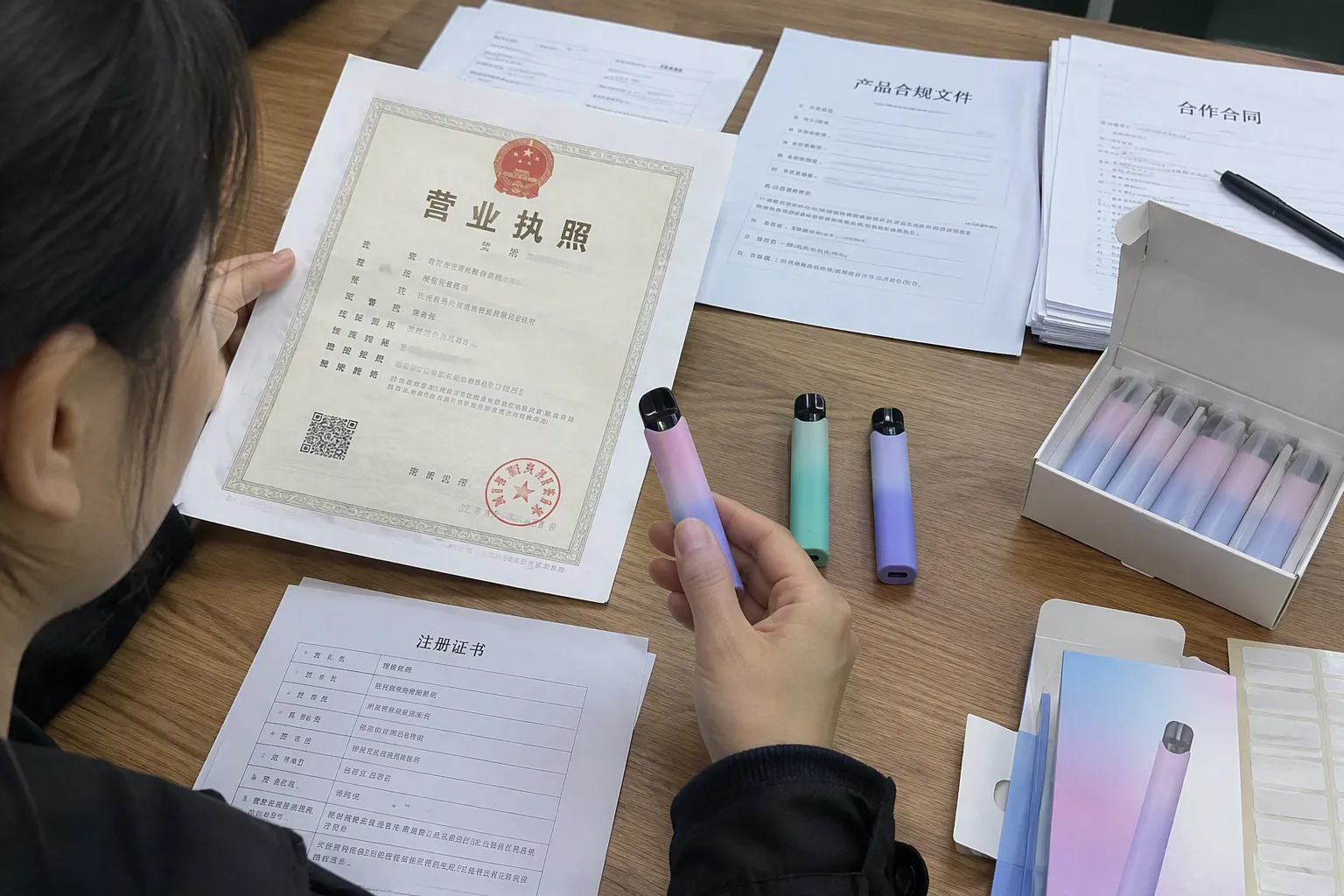
I would request the exact SKU information, battery details available from the factory, packaging and label files, manufacturer information, shipment documents, batch information, and any relevant declarations or test documents. I would also ask whether the documents match the current product configuration.
Can Kingfuji advise me on country-specific legal compliance?
I can help buyers collect supplier information, coordinate with the factory, compare procurement options, and clarify what support we can provide. I am not a local regulator or lawyer. I recommend that buyers obtain qualified country-specific advice whenever a legal conclusion, registration decision, or producer-responsibility assessment is required.
Conclusion
Vape Recycling and Battery Take-Back Compliance should become part of supplier selection in 2026. I recommend that importers identify the exact product, understand its battery and packaging information, separate supplier support from their own local responsibility, and verify current requirements before ordering. Fast delivery, low MOQ, China-direct pricing, OEM/ODM production, and overseas warehouse service can improve purchasing efficiency, but none automatically replaces local compliance work. At Shenzhen Kingfuji Tech. Co., Ltd., I help importers coordinate products, documents, manufacturing, logistics, and after-sales support. Contact King at info@kingvapecig.com or +86 13928420527 to discuss your product and sourcing requirements.
Sources
- Electronic cigarettes: product characterisation and design ... - PubMed", A technical review of disposable electronic cigarettes describes these products as integrated devices containing a battery, electrical components, a heating element, and an e-liquid reservoir, supporting their treatment as battery-containing electronic products
- How to Safely Dispose of E-Cigarettes - Hazardous Waste", Official waste-management guidance treats battery-containing electronic products as materials requiring controlled collection, handling, transport, and treatment rather than disposal through ordinary household-waste channels
- Button Cell and Coin Battery Business Guidance", Product-compliance frameworks commonly require manufacturers and supply-chain parties to maintain or exchange technical documentation, declarations, labeling information, and product-identification records relevant to market access
- WEEE Compliance for Importers: What UK Importers ... - WERCS", Official product-compliance guidance generally assigns importers independent duties to verify product conformity, documentation, identification, and corrective-action arrangements when goods originate outside the regulatory market
- Extended Producer Responsibility: Basic Facts and Key ...", Extended-producer-responsibility frameworks determine obligations through factors such as the product placed on a market, the economic operator’s role, and the applicable product and jurisdictional rules
- Extended Battery Producer Responsibility (EPR) Framework", Market-responsibility rules generally assess the economic operator’s role in supplying or placing products on the market rather than treating warehouse location alone as dispositive of take-back duties
- Risks and response strategies for lithium-ion battery fires", Fire-safety and transport guidance identifies damaged lithium batteries as capable of internal short circuits, thermal runaway, fire, or other hazardous events, warranting segregated and controlled handling
- Import Resources", Market-surveillance and customs guidance treats accurate product identification, labeling, and accompanying documentation as necessary for verification and may require corrective action when those elements are incomplete or inconsistent