Getting into the U.S. vape market seems exciting, but the complex rules are scary. A wrong move could mean seized goods and lost money, making compliance your first step to success.
To sell vapes legally in the United States, importers must navigate FDA regulations, primarily the Premarket Tobacco Product Application (PMTA) process[^1]. This means you should source from manufacturers who have received marketing granted orders (MGOs). Failing to do so can result in enforcement actions and big financial losses.
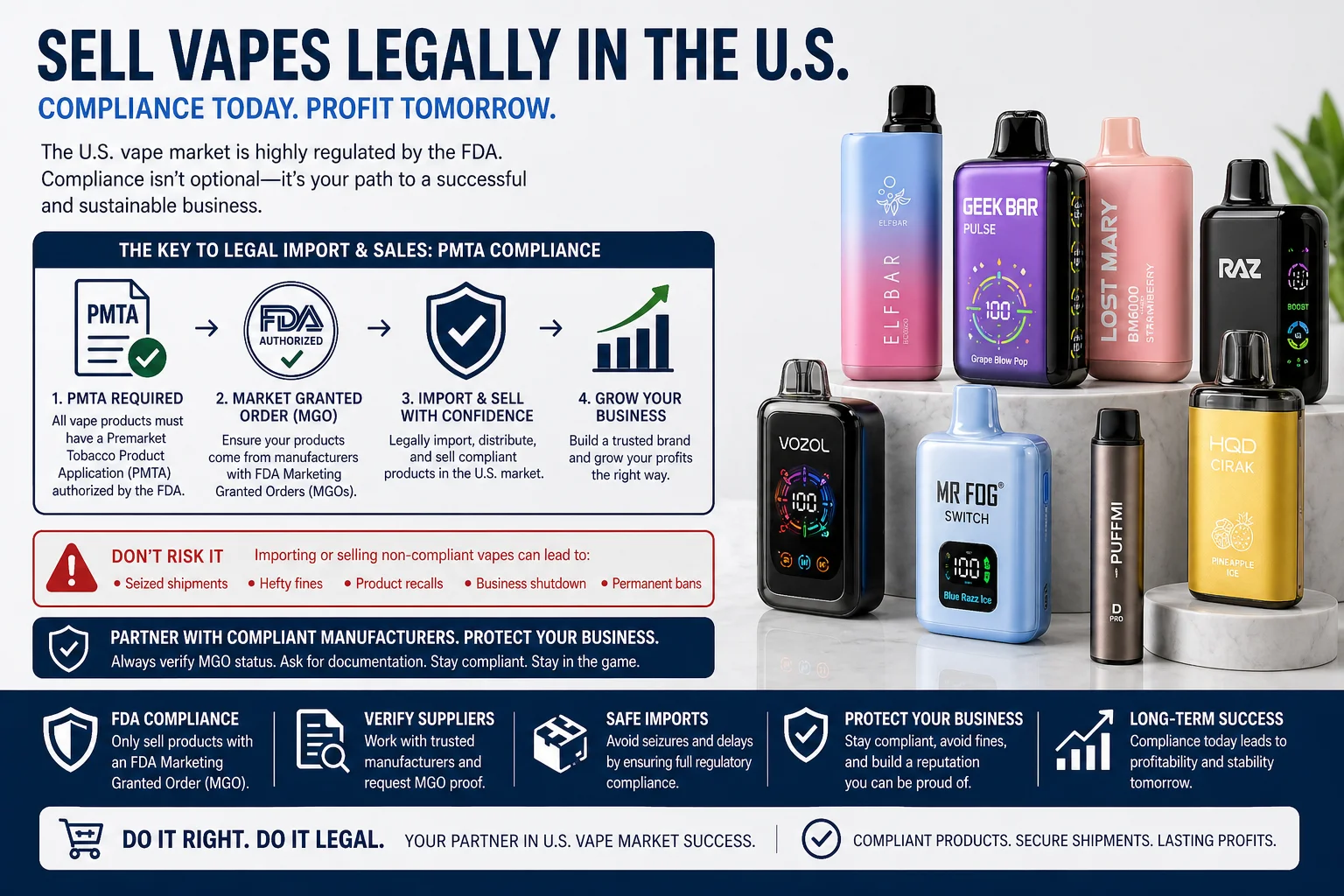
The U.S. vape market is huge, but it's not a free-for-all. I've been in this business for over 15 years, and I've seen many importers stumble. Let’s break down what you really need to know to navigate this landscape safely and build a profitable business. This is about protecting your investment and creating a business that lasts.
What Changed in the U.S. Vape Market and Why Does It Matter?
The FDA has cracked down hard on vapes, and many products you see online are not technically allowed. This uncertainty makes it risky for importers who are looking for reliable, long-term inventory.
The biggest change is the FDA's strict enforcement of the Premarket Tobacco Product Application (PMTA) requirement. Products that do not have an FDA marketing granted order (MGO)[^2] are considered illegal. This matters because it dramatically narrows the field of legally marketable products and increases your risk.
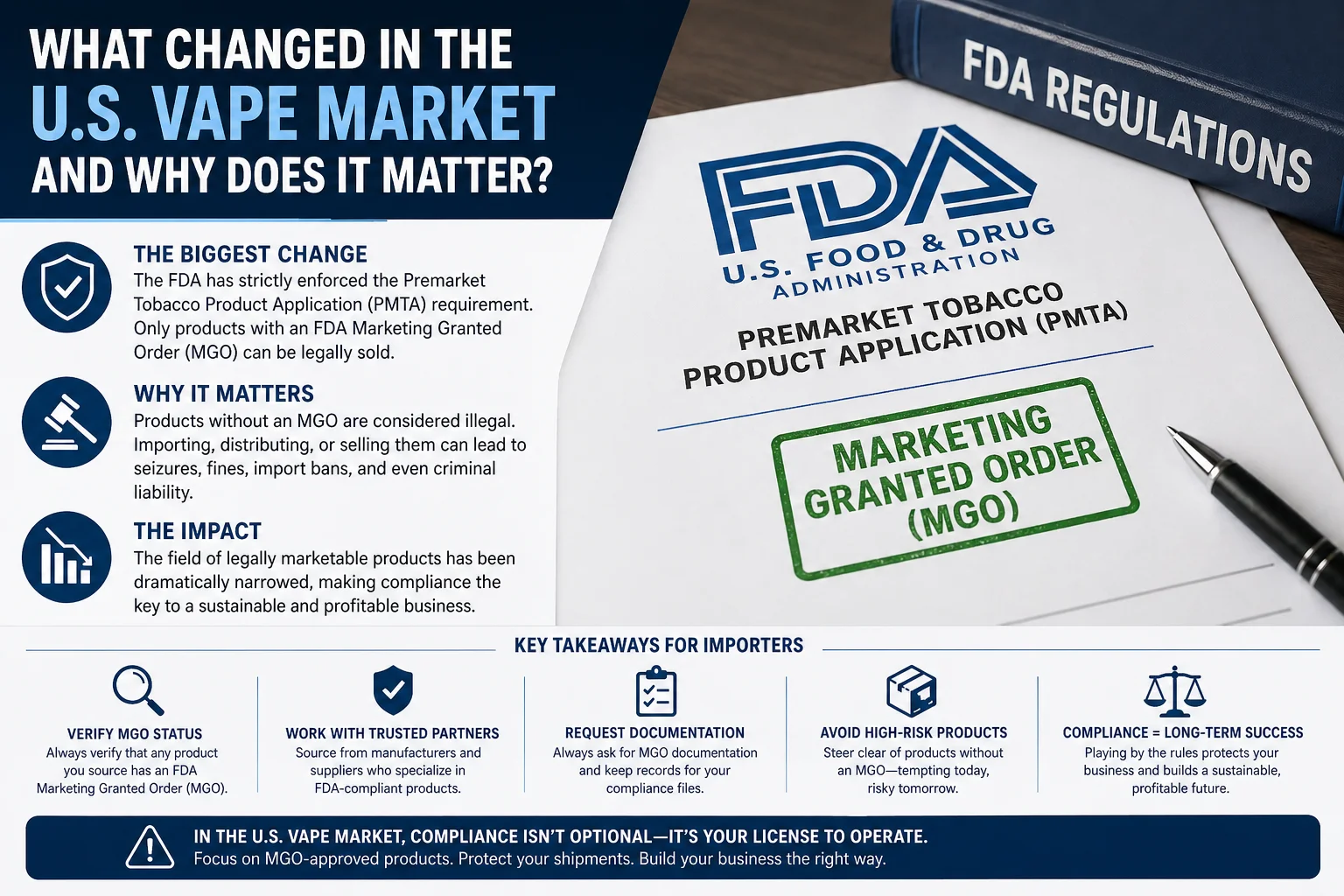
The PMTA is a process where a manufacturer must prove to the FDA that its product is "appropriate for the protection of public health[^3]." This is a very expensive and difficult process. As a result, very few companies have successfully received an MGO[^4]. Most of the flavored disposable vapes that are popular on social media do not have this approval. For you as an importer, this is critical. Selling unapproved products puts you at risk. The FDA can issue warning letters to sellers, and more importantly, U.S. Customs can seize your shipments[^5]. This isn't just a small risk; it happens all the time. From my experience since 2011, I've seen the market change from a wild west to a place where compliance is everything. If you want a sustainable business, you have to play by the rules. We've adapted by guiding our clients through this maze and being honest about the compliance status of every product.
What Is the Key Rule Buyers Should Understand First?
You see popular brands everywhere, but are they legal to sell in the U.S.? You might be confused about what's allowed. This confusion can easily lead to you making very costly purchasing mistakes.
The single most important rule is to verify a product's FDA marketing status. Only products with a Marketing Granted Order (MGO) from the FDA are legally marketable. For everything else, you are operating in a gray area with a significant risk of product seizure and other penalties.
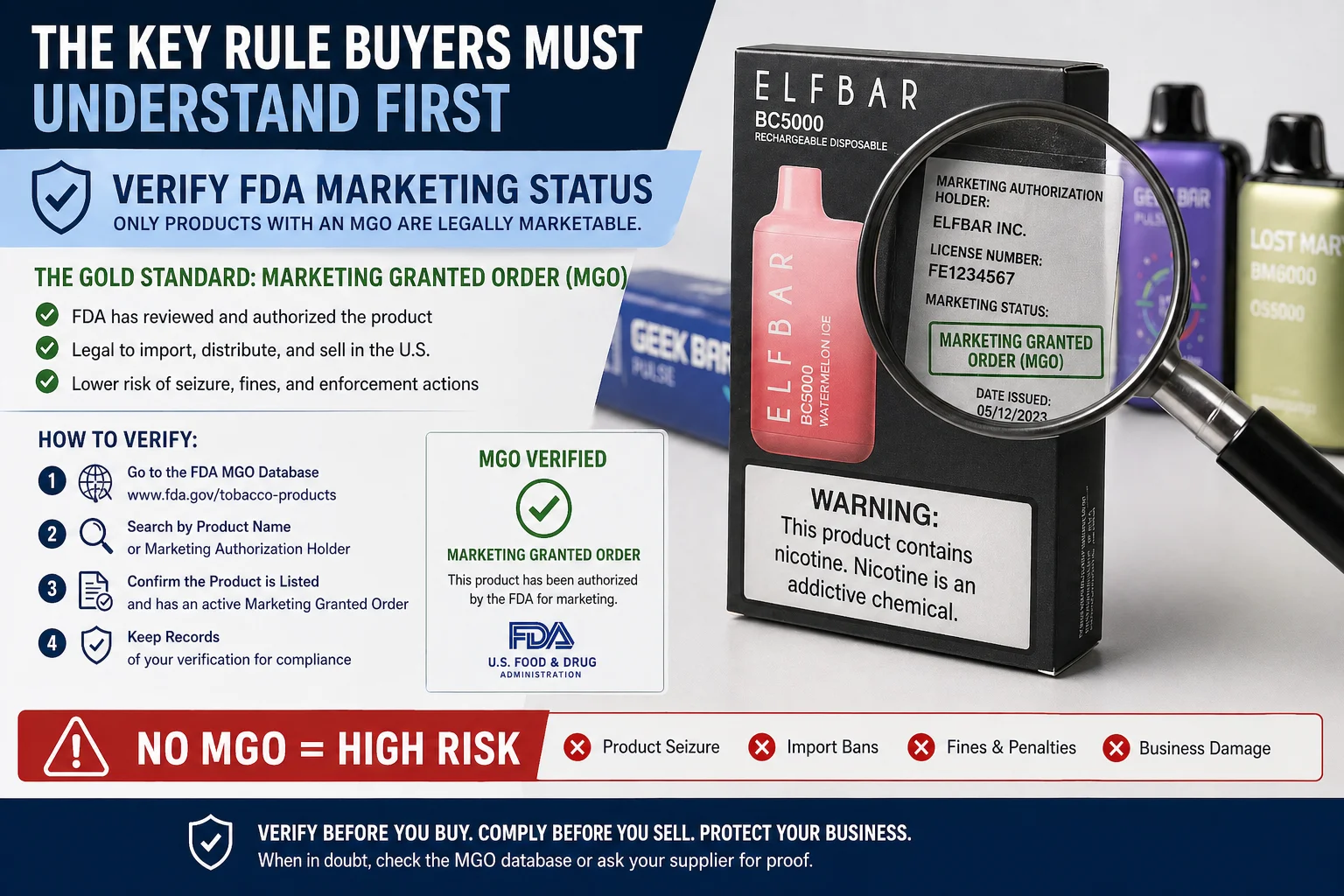
Let's dive deeper into what this means. An MGO is the FDA's official green light. It shows that the company submitted a huge amount of scientific data, and the FDA agreed the product is suitable for the American market. So why do you see so many products for sale that don't have an MGO? This is the "gray market[^6]." Enforcement isn't everywhere at once, so some sellers operate under the radar, especially online or through private channels. This can give you a false sense of security. I always tell my clients this: just because you can buy something from a supplier in China does not mean you can legally sell it in the U.S. A good supplier should be your guide in these matters, not just an order-taker. We've seen this in other countries for years. For example, some EU nations have very tough customs[^7]. A new seller might ship there directly and lose everything. We advise them to ship to a safer country nearby, like Germany, and then arrange local transport. The principle is the same. You must understand the real rules.
How Does This Affect Your Product Selection and Content Strategy?
You want to sell the hottest, most popular vapes that everyone is asking for. But what if those exact products are the riskiest? Choosing the wrong inventory can wipe out your investment before you make a single sale.
Your product selection must prioritize compliance over trends. Your marketing content should be truthful and avoid making any health claims. Promoting non-compliant products openly on major websites can attract unwanted attention from regulators, leading to penalties or having your accounts suspended.
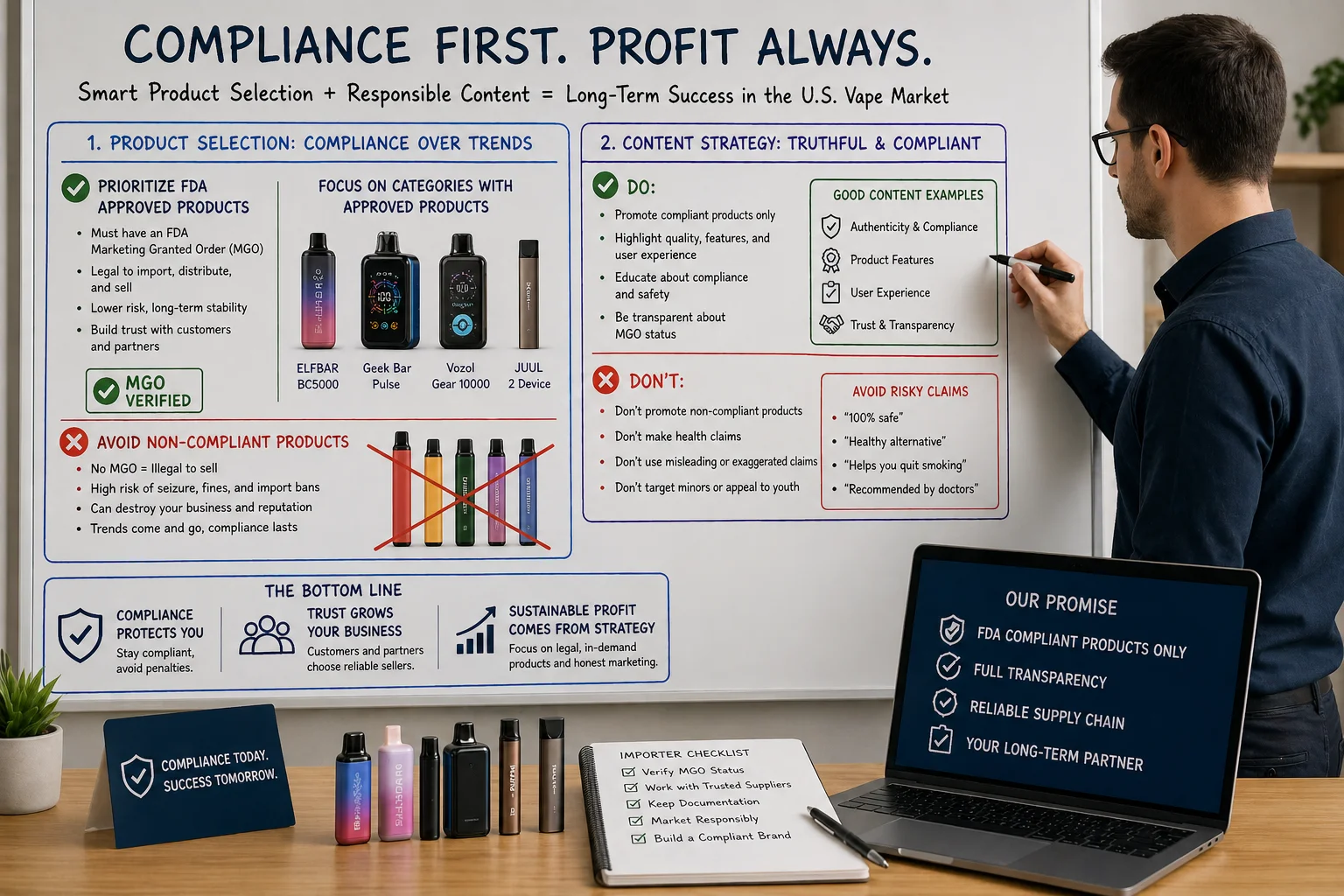
Instead of just chasing trendy products like high-puff-count disposables, you need a smarter approach to your inventory.
| Product Tier | Description | Risk Level |
|---|---|---|
| Tier 1 (Safest) | Products with official FDA Marketing Granted Orders (MGOs). | Low |
| Tier 2 (Gray Market) | Popular brands (e.g., Elf Bar) with huge demand but no MGO. | High |
This is where our U.S. warehouse strategy becomes your advantage. We take on the big risk by importing massive volumes of these popular Tier 2 products ourselves. For you, the buyer, it changes the whole game. You can order small quantities—as low as 50 units—directly from our U.S. location. This means no customs risk for you, a very low startup cost, and fast domestic shipping. You can test the market and see what sells without risking a huge amount of money. Your content strategy should also be smart. Don't advertise these products on a big, public website. Use more private channels like social media groups, direct messages, and local networks.
What Common Mistakes Should Wholesalers Avoid?
You found a supplier online with unbelievably low prices. It seems too good to be true. Chasing the lowest price is a dangerous trap that has cost many new importers their entire starting capital.
The biggest mistake is prioritizing a low price over authenticity and supplier reliability. Buying cheap fakes leads to financial loss from scams, poor quality products that are impossible to sell, and permanent damage to your business's reputation. A reliable partner is always more valuable than a cheap deal.
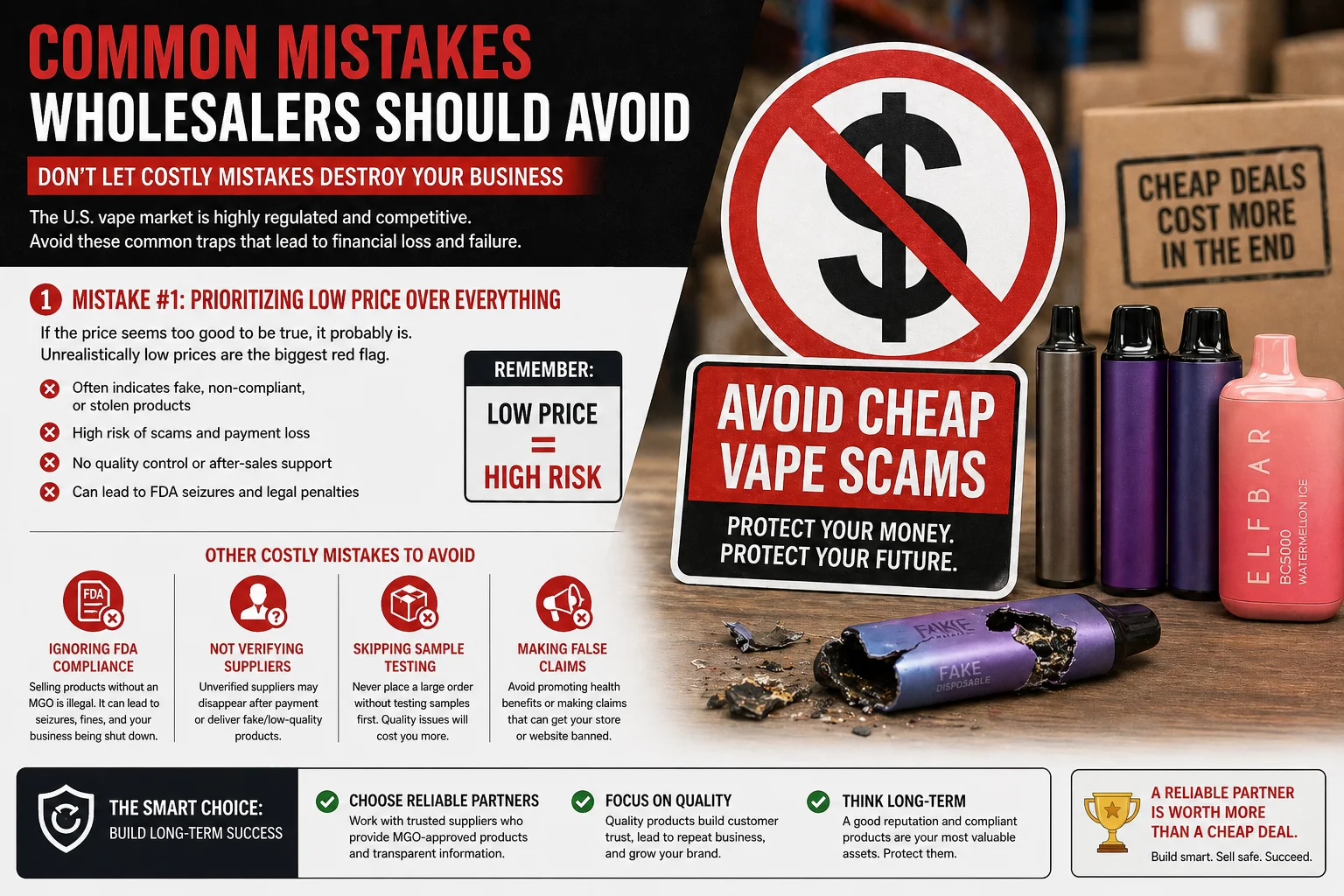
I see this happen constantly in our industry groups. A buyer gets offered a top-brand vape for a price that's less than half the real factory cost. They get excited, wire a few thousand dollars, and the supplier disappears. Or, they receive a box of complete junk. You must learn to spot a fake or a scam. First, if the price is too good to be true, it is. Ask multiple suppliers to learn the real market price. Second, scammers create urgency and pressure you to pay now. A real partner wants to build a long-term relationship. They advise you. They don't just push for a sale. Third, check the paperwork. If their invoice has a generic "Made-in-China.com[^8]" logo or the bank account is a personal name, run away. The hidden cost of fakes is huge. You could lose your money. The products themselves are often dangerous, with bad batteries and unknown chemicals[^9]. And most importantly, your reputation is destroyed. We have been in this business since 2011 because we only deal with genuine products. It's the only way to build a business that lasts.
How Should You Adapt Your Market Plan?
The market is complex, so you need a smart plan. Simply buying from a random supplier in China and hoping for the best is not a strategy. It's a gamble you will almost certainly lose.
You need to adapt by choosing a strategy that fits your business scale. New or small-scale sellers should use a U.S.-based warehouse for low risk and fast turnover. Larger, experienced wholesalers can import from China for better pricing, but they must use a supplier who offers full customs seizure insurance[^10].
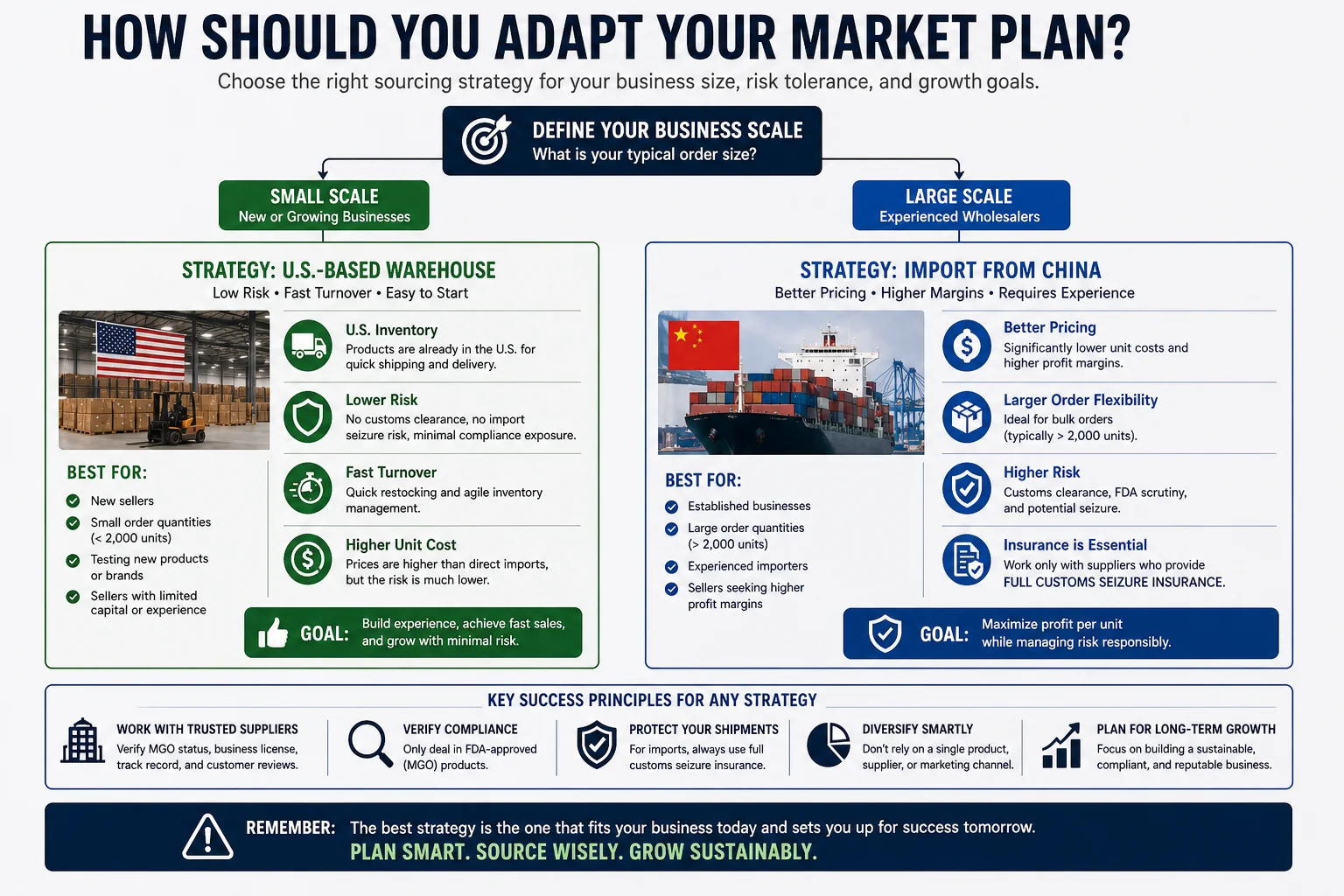
Here are two clear paths forward, based on your situation.
Strategy 1: The Small-Scale or New Importer
If your orders are less than 2,000 units, your best bet is to use our U.S. overseas warehouse. You can start with a very small investment, often under $400. You get your products delivered in just a few days. There is zero customs risk for you. This allows you to turn your money over quickly. The secret to making money is not just margin; it's the speed of your cash flow. Turning over a small investment multiple times a month is far more profitable than waiting months for one large shipment from China.
Strategy 2: The Large-Scale or Experienced Wholesaler
If you are ordering more than 2,000 units at a time, ordering directly from China makes sense for better pricing. But you must manage the risk. Insist on full customs seizure insurance[^11]. This is the golden rule. It costs a little more, but it's essential protection. If your high-value shipment gets seized by customs, a supplier with this insurance will reship a brand-new batch to you at no extra cost. Any supplier who won't offer this is not a partner you can trust with a large order.
Conclusion
Success in the U.S. vape market requires a trustworthy partner and a smart strategy. Focus on compliance, authenticity, and a plan that fits your scale to build a profitable, long-term business.
[^1]: "Premarket Tobacco Product Applications - FDA", https://www.fda.gov/tobacco-products/market-and-distribute-tobacco-product/premarket-tobacco-product-applications. The PMTA process is a regulatory pathway established by the FDA to ensure that tobacco products, including vapes, meet public health standards before entering the U.S. market. Evidence role: definition; source type: government. Supports: Importers must navigate FDA regulations, primarily the Premarket Tobacco Product Application (PMTA) process, to sell vapes legally in the United States.. [^2]: "Premarket Tobacco Product Marketing Granted Orders - FDA", https://www.fda.gov/tobacco-products/premarket-tobacco-product-applications/premarket-tobacco-product-marketing-granted-orders. An FDA Marketing Granted Order (MGO) signifies that a product has undergone rigorous scientific review and is deemed appropriate for public health protection. Evidence role: definition; source type: government. Supports: Only products with a Marketing Granted Order (MGO) from the FDA are legally marketable in the U.S.. [^3]: "Tobacco Product Standards - FDA", https://www.fda.gov/tobacco-products/products-guidance-regulations/tobacco-product-standards. The FDA evaluates whether tobacco products are appropriate for the protection of public health based on scientific evidence, including their impact on non-users and youth. Evidence role: definition; source type: government. Supports: The PMTA process requires manufacturers to prove their product is appropriate for the protection of public health.. [^4]: "Premarket Tobacco Product Marketing Granted Orders - FDA", https://www.fda.gov/tobacco-products/premarket-tobacco-product-applications/premarket-tobacco-product-marketing-granted-orders. As of recent FDA reports, only a limited number of companies have successfully obtained Marketing Granted Orders due to the stringent requirements of the PMTA process. Evidence role: statistic; source type: government. Supports: Very few companies have successfully received an MGO due to the expensive and difficult PMTA process.. Scope note: The number of companies with MGOs may change over time as more applications are reviewed. [^5]: "CBP and FDA seize nearly $34 million of illegal E-Cigarettes during ...", https://www.cbp.gov/newsroom/local-media-release/cbp-and-fda-seize-nearly-34-million-illegal-e-cigarettes-during-joint. U.S. Customs has the authority to seize shipments of products that do not comply with FDA regulations, including those lacking PMTA approval. Evidence role: mechanism; source type: government. Supports: Selling unapproved products puts importers at risk of U.S. Customs seizing their shipments.. [^6]: "Grey market - Wikipedia", https://en.wikipedia.org/wiki/Grey_market. The term 'gray market' refers to the trade of goods through unofficial channels, often bypassing regulatory compliance, which is common in industries with strict import rules. Evidence role: definition; source type: encyclopedia. Supports: Many vape products sold online operate in a gray market, bypassing FDA approval requirements.. [^7]: "Information exchange of law enforcement agencies within the EU in ...", https://pmc.ncbi.nlm.nih.gov/articles/PMC9691449/. Several EU nations enforce strict customs regulations on imported goods, including tobacco products, to ensure compliance with local laws. Evidence role: historical_context; source type: government. Supports: Some EU nations have very tough customs, making direct shipping risky for new sellers.. Scope note: Customs enforcement levels may vary between EU member states. [^8]: "International Shipping - Research Compliance and Integrity", https://rci.ucmerced.edu/export-controls/international-shipping. Invoices with generic logos like 'Made-in-China.com' are often associated with unreliable suppliers and potential scams in international trade. Evidence role: case_reference; source type: institution. Supports: Invoices with generic 'Made-in-China.com' logos are a red flag for unreliable suppliers and scams.. Scope note: This observation is anecdotal and may not apply universally to all suppliers using such logos. [^9]: "Adolescents' Perceptions, Experiences, and Reactions to “Fake ...", https://pmc.ncbi.nlm.nih.gov/articles/PMC11812520/. Counterfeit vape products often contain substandard batteries and unregulated chemicals, posing safety risks to users. Evidence role: mechanism; source type: research. Supports: Buying cheap fakes leads to financial loss and dangerous products with bad batteries and unknown chemicals.. Scope note: Specific examples of counterfeit products may vary by region and supplier. [^10]: "[PDF] A Travel Protection Plan designed for groups of 10 or more...", https://www.erskine.edu/wp-content/uploads/2024/02/2024-Insurance.pdf. Customs seizure insurance is a specialized policy that covers financial losses if imported goods are confiscated by customs authorities due to regulatory non-compliance. Evidence role: definition; source type: institution. Supports: Larger wholesalers importing from China should insist on customs seizure insurance to mitigate risks.. Scope note: The availability and terms of customs seizure insurance may vary by provider and region. [^11]: "[PDF] Custom Law - Search, Seizure, Confiscation of Goods, Offences and ...", https://www.icsi.edu/webmodules/Customs%20Laws/2016-ATLP-7.pdf. Full customs seizure insurance ensures that importers receive replacement shipments at no extra cost if their goods are confiscated by customs. Evidence role: mechanism; source type: institution. Supports: Full customs seizure insurance is essential protection for large-scale importers of vape products.. Scope note: The effectiveness of such insurance depends on the terms and conditions set by the provider.