
Struggling to balance low costs from China with fast delivery for your customers? You’re losing sales while waiting for shipments and missing key market opportunities.
A smart wholesale strategy uses China for bulk, low-cost orders and EU/U.S. warehouses for fast-moving items and urgent refills. This mix optimizes your cash flow, reduces delivery times, and minimizes stockout risks, giving you the best of both worlds.
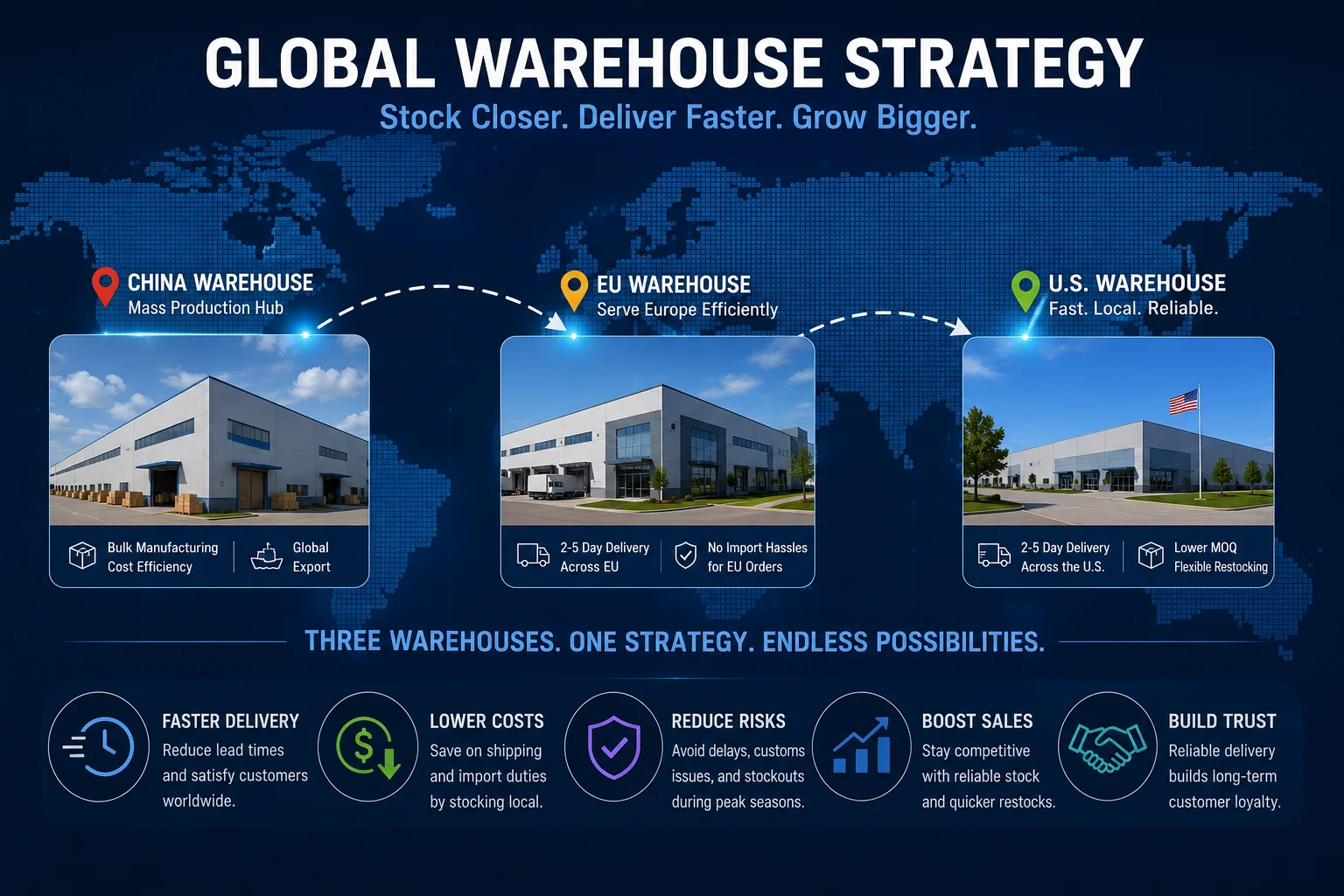
This sounds simple on paper, but getting it right is the difference between growing your business and just spinning your wheels. I've been exporting 3C electronics from Shenzhen for 15 years, and I see buyers make the same costly mistakes over and over. They get stuck. They either wait forever for cheap stock or pay too much for fast shipping. There is a better way. Let's break down how to build a powerful multi-warehouse strategy that actually works and helps you make more money.
Why Should Wholesalers Use Multiple Warehouse Locations?
Are you tired of losing customers to competitors with faster shipping? Relying only on a single warehouse in China creates long lead times and leads to missed sales[^1].
Using multiple warehouses in China, the EU, and the U.S. allows you to offer both competitive pricing and fast delivery. You can store bulk inventory cheaply in China and keep popular items locally for quick shipping, satisfying all types of customer demands.
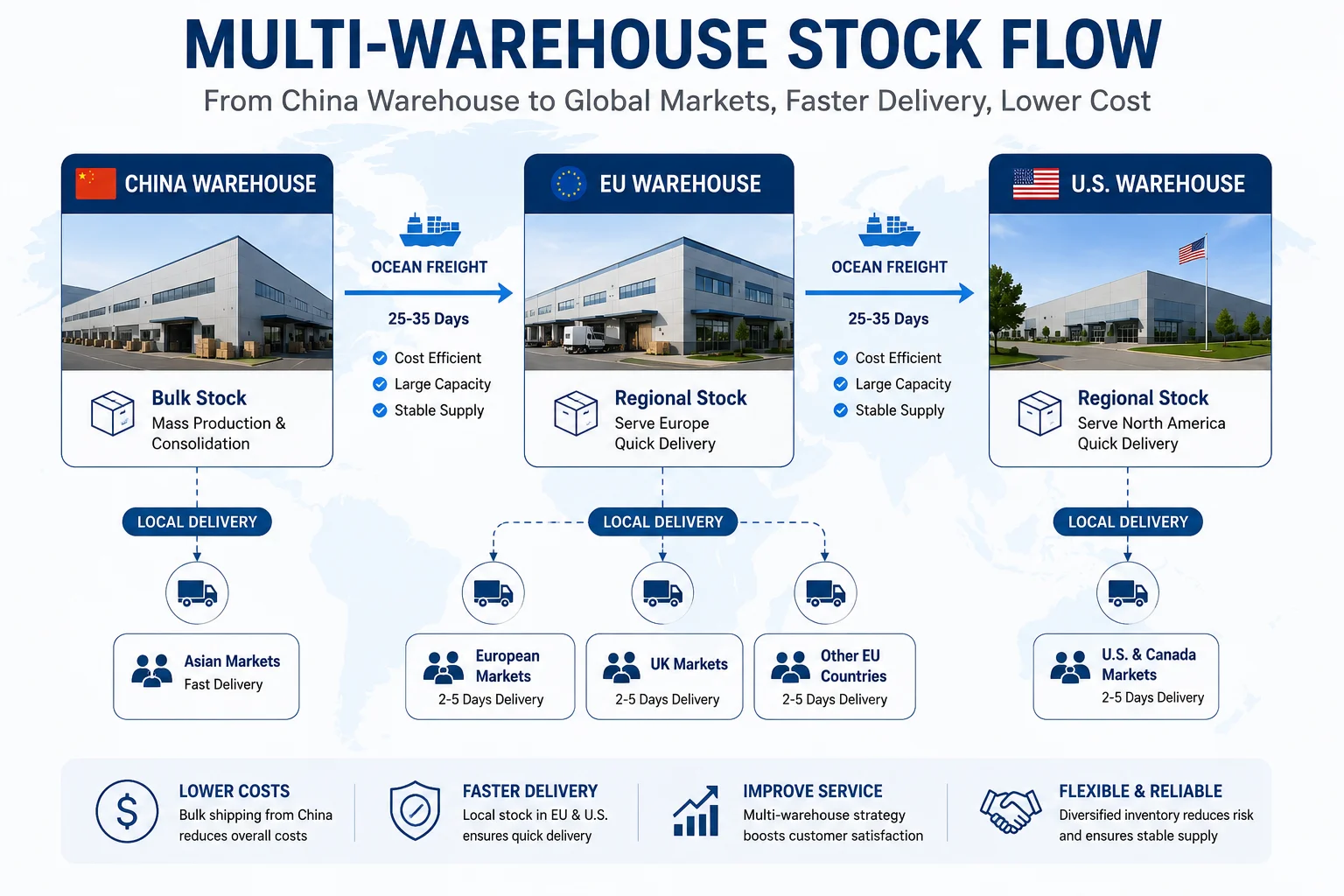
For over a decade, I've watched international buyers wrestle with one core problem: the trade-off between cost and speed. You want the low prices that come from manufacturing in China, but your customers in Europe and America want their products now, not in a month. Relying on a single supply chain from China means you are always slow. A multi-warehouse strategy solves this.
Think of it as having different tools for different jobs. Your China warehouse is your heavy-duty sledgehammer for smashing costs on big, planned orders. Your local EU and U.S. warehouses are like speed drills, perfect for quick, precise jobs like fulfilling an urgent order or restocking a bestseller that just sold out. By having both, you become more flexible and powerful than competitors who only have one. This isn't just about logistics; it's about business strategy. It allows you to control your cash flow, respond to market changes instantly, and build a more resilient business.
Here's a simple breakdown:
| Feature | Single Warehouse (China Only) | Multiple Warehouses (China + EU/US) |
|---|---|---|
| Unit Cost | Lowest | Higher for local stock |
| Delivery Speed | Slow (3-6 weeks)[^2] | Fast (1-5 days locally) |
| Cash Flow | Large capital tied up in transit[^3] | More flexible, faster turnover |
| Risk | High (Customs, shipping delays) | Low (Supplier handles import risk) |
| Flexibility | Low (Hard to react to demand) | High (Can ship from best location) |
What Role Should China Warehouse Stock Play?
Want the absolute best unit price for your products? Sourcing directly from a China warehouse seems like the obvious answer, but it comes with hidden risks and requirements.
Your China warehouse stock is your cost-saving engine. It’s ideal for large-volume orders, typically over 2,000 units, where you can get the best possible price and a wider selection of products. This option is best for experienced buyers who can manage longer lead times.
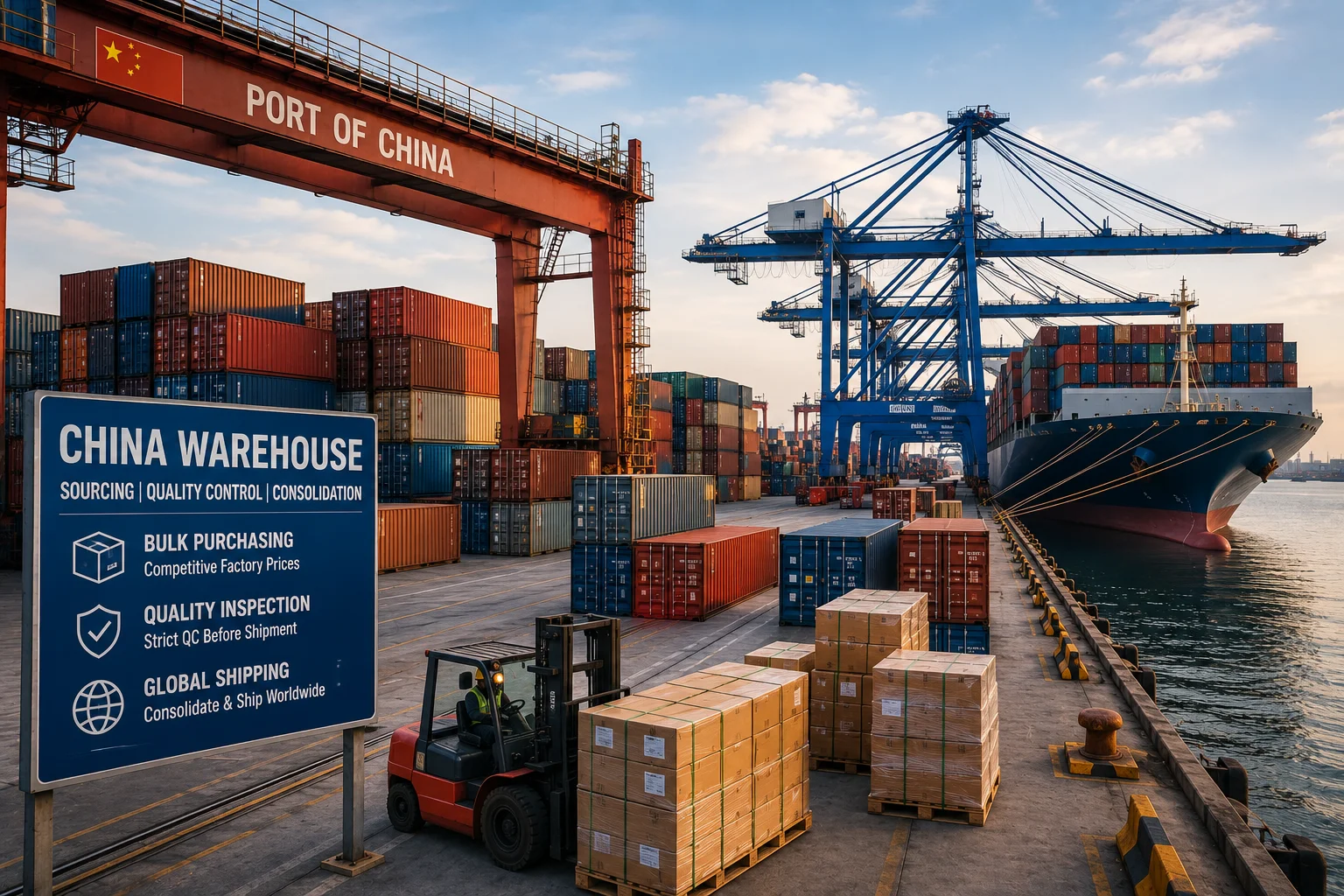
From my experience talking to hundreds of buyers, the China-direct option is perfect when you are confident in a product and ready to scale up. If you're a medium-to-large wholesaler and you know a certain product will sell, ordering 2,000, 5,000, or even more units directly from us in Shenzhen makes perfect sense. This volume allows us to give you a rock-bottom price, which gives you the margin you need to be competitive. You also get access to a much wider catalog of products, including newer models that haven't been shipped to the overseas warehouses yet.
However, this path is not for beginners. Here's what you need to be prepared for:
The Realities of China Direct Sourcing
- Lead Times: You have to plan ahead. Production can take 3-4 weeks, and sea or air freight adds another 3-4 weeks.[^4] Your cash is tied up for this entire period.
- Minimum Order Quantities (MOQs): To get the best price, you need to commit to a larger volume. This isn't for testing a product with 50 units.
- Customs Risk: This is the big one. Your shipment has to clear customs in your country. If it gets inspected or seized, you could face delays or even a total loss.[^5]
A common question I get is about customs. My advice is always the same: if you are shipping a high-value order from China, you must insist that your supplier or shipping agent purchases full-coverage customs seizure insurance. It will make your shipping cost a bit higher per kilogram, but it's critical. If your shipment is unfortunately seized, this insurance means we can send you a brand-new shipment at no extra cost to you. Without it, you could lose your entire investment. This is a non-negotiable for smart importers.
When Should You Use EU Warehouse Stock?
Worried about high MOQs and the risk of customs seizures? Starting a new business with a huge upfront investment from China can be a recipe for disaster.
Use EU warehouse stock when you are a new seller, testing the market, or need to fulfill an urgent order fast. With low MOQs, sometimes as low as 50 units, and 1-5 day delivery across the EU[^6], you can start your business with less than €400.
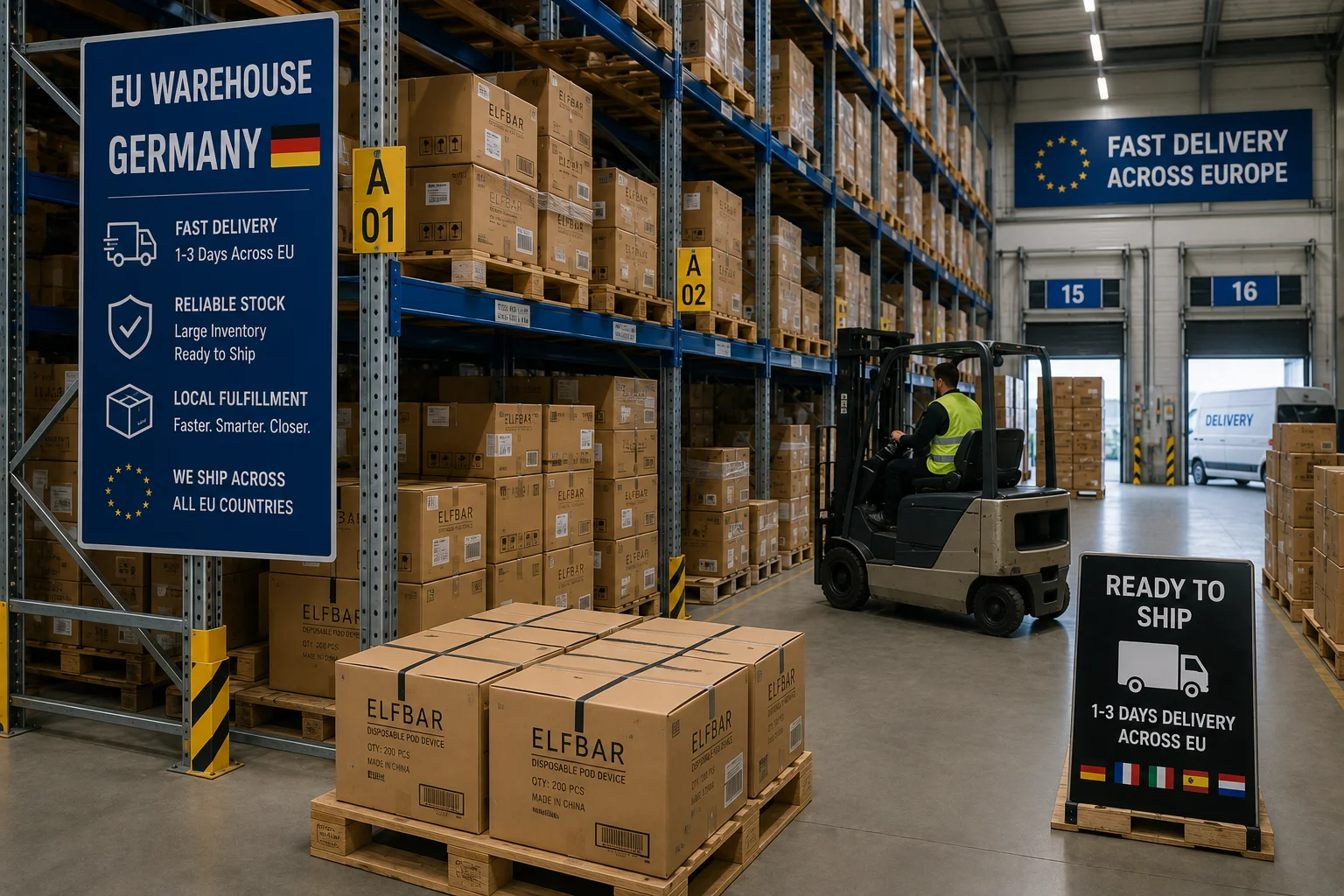
Let me be honest with you. Setting up an overseas warehouse is a difficult and thankless job for a supplier like us. We have to invest huge amounts of our own money, often ordering 200,000 units at a time to get the best price and lower the shipping cost per unit. Then we ship it all to our warehouse in Germany. We are taking on all the upfront costs and risks. The risk of customs seizure, the cost of transport, the cost of storage—we pay for all of it before you even place an order.
So, why do we do it? Because it makes it incredibly easy for you, our customer, to succeed. For you, the process is simple. You focus on selling. Once you get an order, you just tell us, and we ship it directly from our German warehouse. It gets delivered door-to-door via DHL in 1-2 days within Germany, and 3-5 business days to the rest of the EU. We even set up a German bank account to make payments easy for you. We took on all the hard, risky parts so you can focus on the most important part: making sales. This is perfect for new sellers, individuals selling on social media, or even small shops who want to test products with minimal risk. Your startup cost is low, and your risk is almost zero.
When Is U.S. Warehouse Stock the Best Choice?
Serving the American market but frustrated by 30-day shipping times from Asia? Your U.S. customers expect fast delivery, and slow shipping means you're losing to local competitors.
U.S. warehouse stock is essential for serving American customers effectively. It provides fast, reliable domestic shipping, avoids international customs delays for your customer, and allows you to compete on speed. It's perfect for quick refills and market testing.
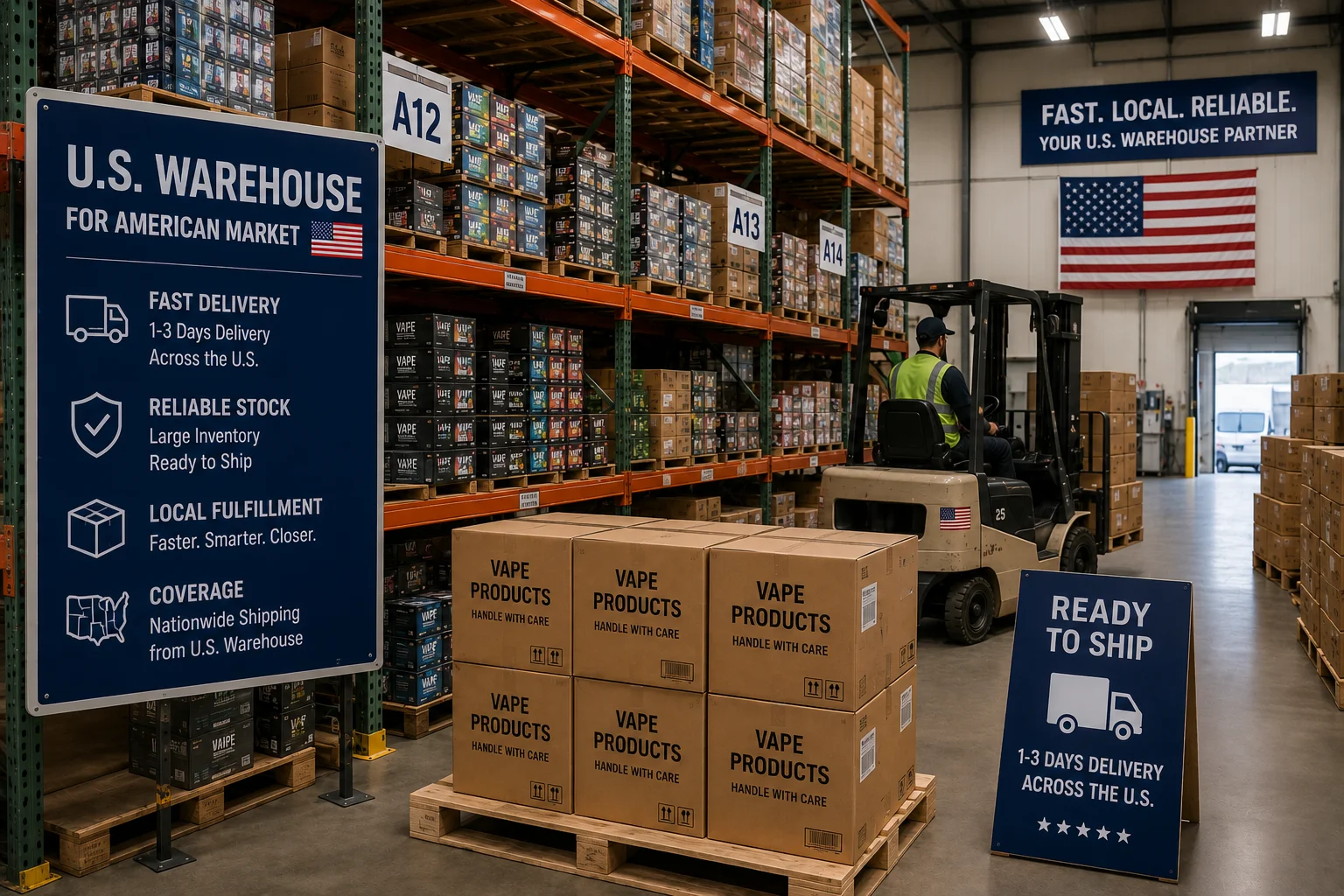
The logic for our U.S. warehouse is the same as our one in the EU: we take on the risk to make your life easier. The American market is huge, but it's also incredibly competitive. Customers are used to Amazon Prime-level speed[^7]. If you tell them a product will take three weeks to arrive from China, they'll just buy it from someone else.
By using our U.S. warehouse, you can operate like a local business. We pre-stock popular items, handling the import and customs headaches. When you get a sale, we ship it from within the U.S., and your customer gets it in a few days. This is a game-changer. It lets you:
- Compete on Speed: Match or beat the delivery times of established U.S. distributors.
- Reduce Risk: You don't have to worry about a large shipment getting stuck at U.S. customs. We've already handled that.
- Test the Market: Launch new products in the U.S. market with a small initial order. See what sells before committing to a massive import.
- Simplify Operations: Just like in the EU, we have a local U.S. bank account, making payments simple and avoiding international wire transfer issues.
For anyone serious about selling 3C electronics or other goods in the United States, having a local inventory partner is not a luxury; it's a necessity. It turns you from a slow, distant international seller into a fast, reliable domestic player.
How Can You Split Inventory by Product Type?
Unsure which products to stock locally and which to order from China? A bad inventory mix can lead to dead stock, tied-up cash, and missed opportunities for growth.
Keep your best-sellers and high-demand products in local EU/U.S. warehouses for fast turnover. Use your China warehouse for a wider variety of items, products with lower demand, or for customized OEM orders that require longer production lead times.
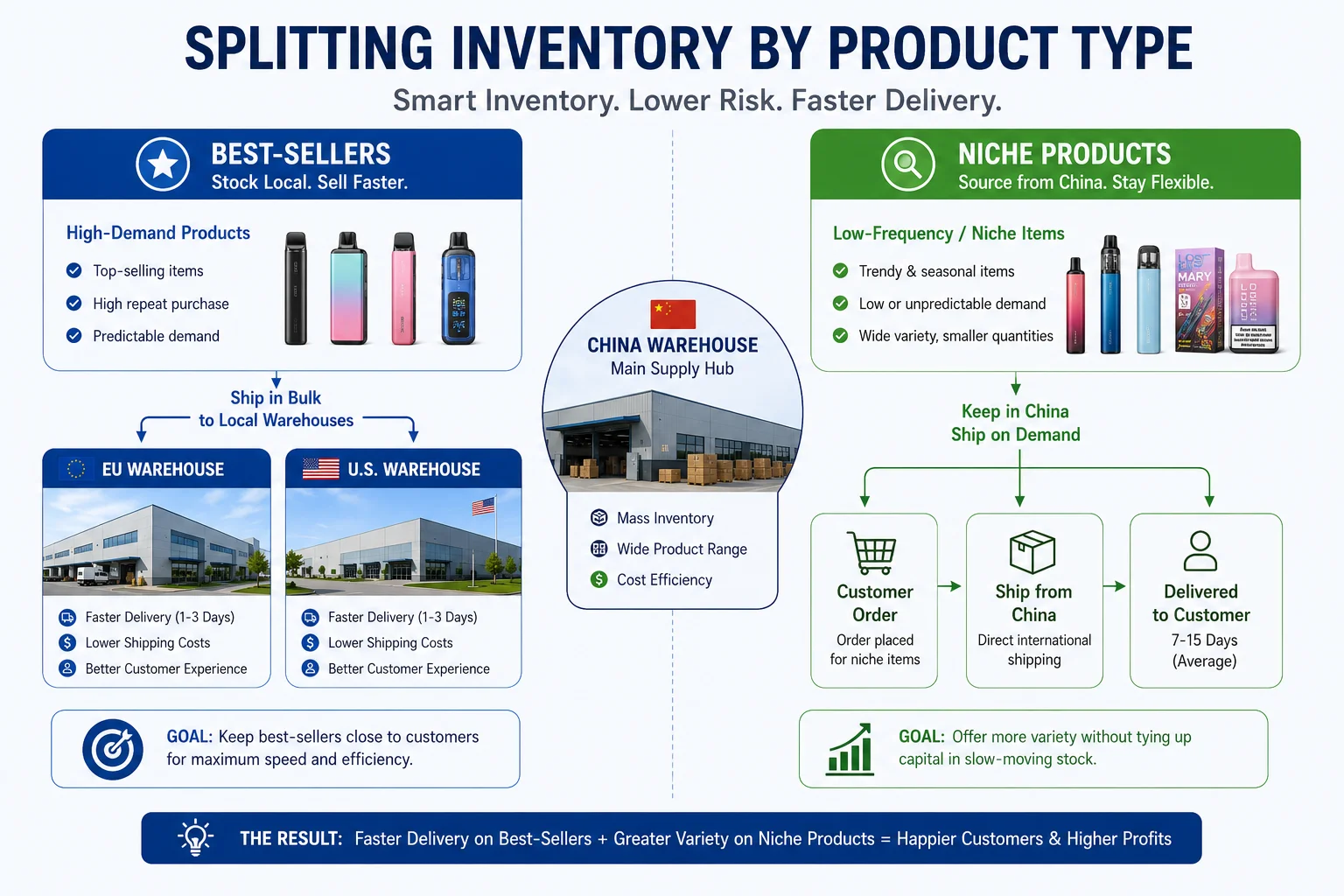
This is a strategic decision that directly impacts your cash flow. You can't afford to have all your money tied up in slow-moving products sitting in an expensive local warehouse. At the same time, you can't afford to be out of stock of your most popular item. The key is to apply the 80/20 rule to your inventory[^8]. In my experience, about 20% of your products will generate 80% of your sales. That 20% is what you need to keep in your local warehouses.
Here’s a simple framework I discuss with my clients:
Your Inventory Split Strategy
| Product Category | Ideal Warehouse Location | Why It Makes Sense |
|---|---|---|
| Top 20% Bestsellers | EU / U.S. Warehouse | These products sell fast. You need them close to your customers for quick shipping and restocking. Fast turnover on these items is your main profit engine. |
| Niche or Test Products | Start with EU / U.S. Warehouse | For new products, use the low MOQ of local warehouses to test demand. If it sells well, it can become a bestseller. If not, you haven't risked much capital. |
| Wide Variety / Slow Movers | China Warehouse (Order on Demand) | For products that sell occasionally, it doesn't make sense to pay for local storage. Order them from China when a customer requests them, and be transparent about the longer lead time. |
| OEM / Custom Orders | China Warehouse (Production) | Customized products require development and production time. These orders are always initiated and shipped from China, as they are made specifically for you. |
By splitting your inventory this way, you get the best of both worlds. You satisfy demand for your most popular products instantly, while still offering a wide variety without sinking all your capital into slow-moving stock.
How Do You Balance Fast Delivery and Lower Cost?
Are you constantly chasing the lowest price, thinking it's the key to profit? I've seen this mindset trap so many new entrepreneurs. It slows your business to a crawl.
The key to profit isn't the lowest cost; it's the fastest capital turnover[^9]. A product sold quickly for a 20% profit is much better than a cheap product sitting in a warehouse for months. Use local warehouses for speed, and China for planned bulk buys.
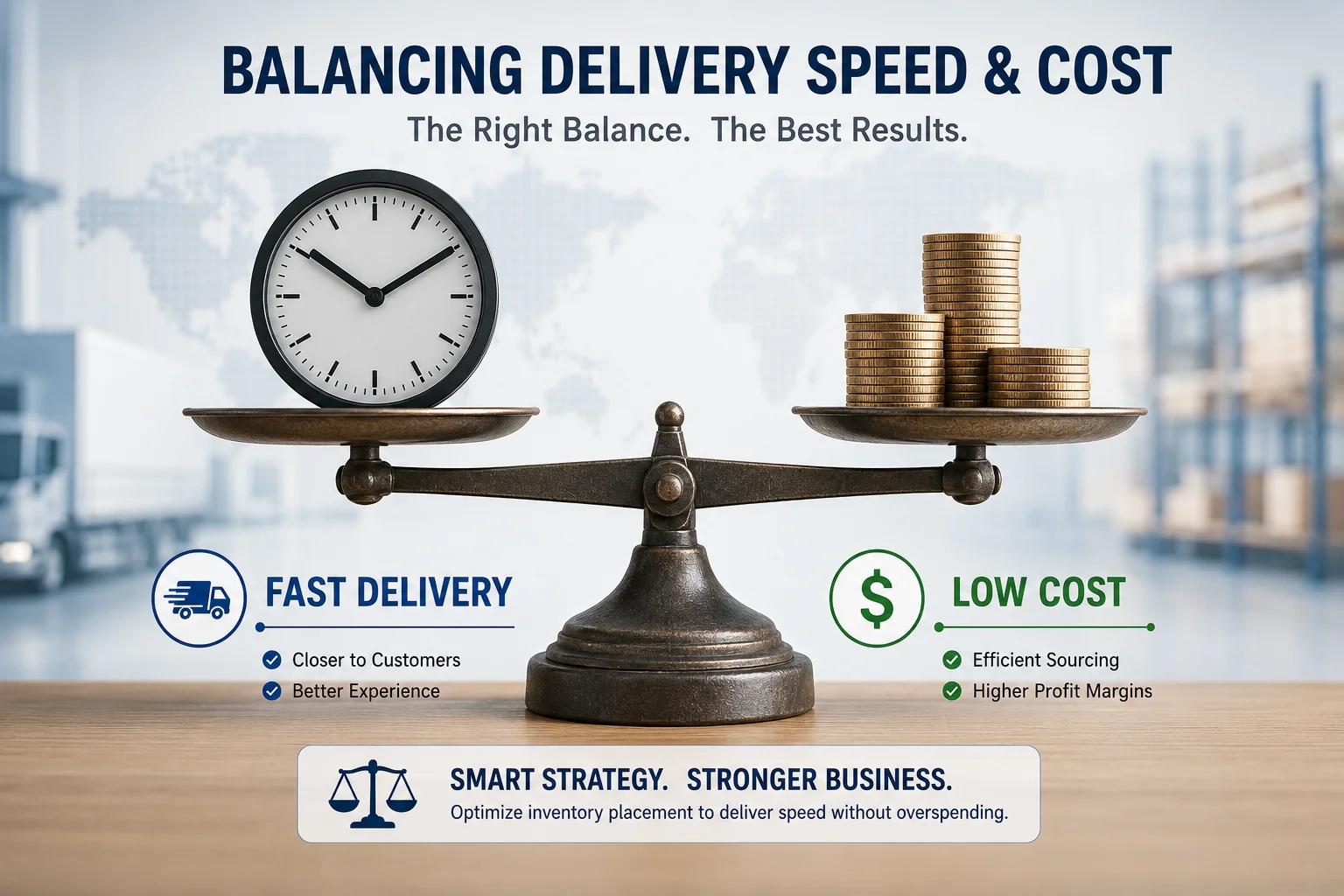
Let me tell you a secret that many new business owners miss: the essence of business is the speed at which your money works for you. It’s not just about the profit margin on a single sale. It's about how many times you can make that profit in a year.
The Myth of "Lowest Price Wins"
If the cheapest thing was always the most profitable, then the best businesses would be selling plastic bags or rubber bands. But we know that's not true. People pay a premium for Apple products, even when cheaper phones exist. Why? Because it's about demand and value, not just price. A cheap product that nobody wants is a 100% loss. A desirable product that you can sell quickly is a win, even if the purchase price is higher.
Understanding Capital Turnover: The Real Money Maker
Think about it with simple math.
- Scenario A (Slow & Cheap): You find a "cheap" supplier from China. You save 40% on cost, but it takes 2 months to find them and 2 months for sea shipping. You make a 50% profit margin, but you can only do this maybe 2-3 times a year. Your annual return on that capital is about 100-150%.
- Scenario B (Fast & Smart): You use our German warehouse. You get the goods in 3-5 days. Your margin is smaller, say 20%. But because you get the stock so quickly, you can sell out and re-order multiple times a month. Let's say you turn your capital over twice a month. That’s 24 times a year. Your annual return is 20% x 24 = 480%.[^10]
Which business is more successful? It's not even close. Scenario B is making far more money with the same initial investment. This is why using local warehouses for fast-moving goods is so powerful. It accelerates your capital, which is the true engine of growth.
What Mistakes Should Buyers Avoid When Managing Multi-Warehouse Stock?
Think you found an amazing deal from a new supplier in China? Be very careful. I see this happen every week. That "cheap" price could be a trap that costs you everything.
The biggest mistake is ordering from China based on a super-low price without verifying the supplier and product. This often leads to receiving counterfeit goods, junk quality products, or losing your money entirely to a scam. Always use local stock for new or unverified products.

In my 15 years, I've seen buyers lose their entire life savings this way. When you manage stock from different locations, you also manage different levels of risk. The biggest risks are almost always tied to chasing unbelievably low prices from China.
Mistake #1: Falling for the "Too Good to Be True" Price
I get calls from buyers all the time, asking if I can match a price that is 50% below the market rate. For example, they'll say they found a popular vape brand for €2 in France, when the real factory price isn't even below €4. That €2 price is not a deal; it's a scam or a counterfeit. Here’s the risk: you pay the money, and the supplier disappears. Or worse, their illegal workshop gets shut down by the police the day after you pay, and your money is gone forever. Don't let greed blind you.
Mistake #2: Ignoring Secondary Customs Clearance
This is a specific, painful mistake for EU buyers. Some countries (like Denmark, Sweden, Finland, Estonia, Romania, and others) have "secondary customs[^11]." Even after your goods clear customs into the EU (e.g., in Germany), they can be inspected and seized again when they cross the border into these countries. Customs insurance does not cover this second seizure. A reliable supplier will warn you about this. The solution is often to ship to a nearby "safe" country like Germany and arrange for a friend or a private courier to transport it across the border. It's a risk, but it's a calculated one. A bad supplier will just take your money, ship it directly, and say "not my problem" when it gets seized.
Mistake #3: Not Understanding Product Quality
A cheap price from China always comes from cutting corners. With electronics, this usually means two things: the battery and the core components (like the e-liquid in vapes or the chipset in a charger). Fake products use cheap manganese batteries that die in cold weather or can't hold a charge.[^12] A genuine product uses a quality lithium battery that is reliable. For something you sell to a customer, this difference is everything. Selling junk will destroy your reputation, and the cost of returns and angry customers will eat up any money you thought you saved.
How Can One Supplier Help Coordinate China, EU and U.S. Stock?
Juggling multiple suppliers for different regions is a logistical nightmare. It wastes time, complicates payments, and creates communication breakdowns that hurt your business and your profits.
A reliable partner with established warehouses in China, the EU, and the U.S. simplifies everything. We manage the bulk shipping, the customs, and the risks. This allows you to order from a single point of contact and get the right stock, to the right place, at the right time.
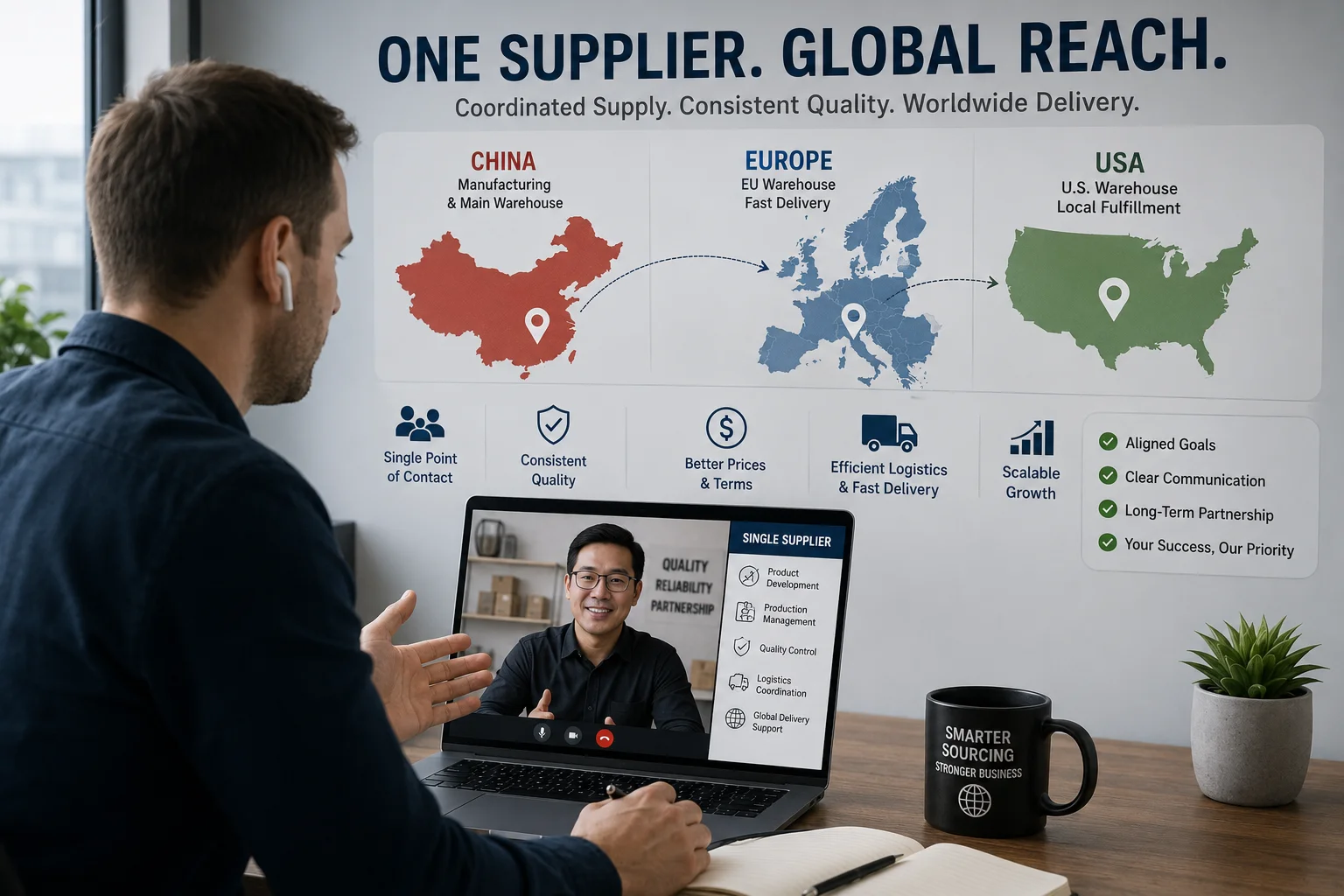
Think of us as more than just a supplier; we are your strategic logistics partner. Our entire business model is built on helping you succeed. When you grow, we grow. It's that simple. We are a high-volume business, and we need our clients to sell a lot of products. That's why we've invested so much into making it easy for you.
How We Make Your Life Easier
- One Point of Contact: Whether you need a small, fast order in Germany or a massive bulk order from China, you talk to the same team. We know your business and can give you the right advice.
- Flexibility is Standard: Need to test the market? Order 50 units from our U.S. warehouse. Ready to scale up? We'll arrange a 5,000-unit shipment from Shenzhen. You get the flexibility to match your strategy without having to find new suppliers.
- We Handle the Hard Parts: We invest the capital. We handle the international shipping. We deal with the primary customs clearance. We manage the warehouses. You get to focus on what you do best: marketing and selling to your customers.
- Simple Finances: With local bank accounts in the EU and U.S., you avoid the hassle and fees of international wire transfers. You pay locally, just as if you were buying from a domestic company.
Choosing a supplier who can offer this integrated strategy is one of the most powerful decisions you can make. It removes complexity, reduces risk, and allows you to be more agile than your competitors.
Conclusion
Smart inventory isn't about one location. Combine China's low costs with local EU/U.S. speed to maximize profit, minimize risk, and outpace your competition.
[^1]: "[PDF] Consumer impatience in the e-commerce home delivery context", https://dr.lib.iastate.edu/bitstreams/495cc6cb-2027-4871-9495-5cb9e18bbbef/download. A study on consumer behavior could show that delivery speed is a significant factor in purchasing decisions, with longer wait times leading to higher rates of cart abandonment and lost sales. Evidence role: statistic; source type: research. Supports: The claim that long delivery times negatively impact sales.. Scope note: The exact impact can vary by product category, market, and customer demographic. [^2]: "A Breakdown of China to USA Shipping Time - Dimerco", https://dimerco.com/blog-post/a-breakdown-of-china-to-usa-shipping-time/. Logistics industry data can confirm that standard sea freight transit times from major Chinese ports to ports in Europe and the United States typically range from 20 to 45 days, not including time for customs clearance or inland transport. Evidence role: statistic; source type: institution. Supports: The claim that standard shipping from China to Western markets takes several weeks.. Scope note: Actual shipping times can vary significantly based on the carrier, route, port congestion, and time of year. [^3]: "Understanding How Inventory Factors Into Working Capital", https://www.investopedia.com/ask/answers/100515/does-working-capital-include-inventory.asp. Business and finance resources explain that inventory, including goods in transit, is a component of working capital. A longer supply chain increases the time that cash is tied up in inventory that cannot be sold, negatively affecting the cash conversion cycle. Evidence role: definition; source type: education. Supports: The claim that inventory in transit represents tied-up capital.. [^4]: "Latest Supply Chain and Freight Indicators", https://www.bts.gov/freight-indicators. Industry analyses of global supply chains show that typical manufacturing lead times for electronics in China can range from two to six weeks, while sea freight adds an additional three to six weeks, confirming that total lead times of over two months are common. Evidence role: statistic; source type: research. Supports: The claim that combined production and shipping lead times from China can total several weeks or months.. Scope note: Lead times are highly variable and depend on the product's complexity, factory capacity, shipping method (air vs. sea), and port conditions. [^5]: "CBP Search Authority | U.S. Customs and Border Protection", https://www.cbp.gov/travel/cbp-search-authority. Official publications from government bodies like the U.S. Customs and Border Protection (CBP) or the European Commission's Taxation and Customs Union detail the legal authority of customs officers to inspect, detain, and seize imported goods that violate regulations, such as those concerning intellectual property rights, product safety, or import duties. Evidence role: general_support; source type: government. Supports: The claim that customs agencies have the authority to seize shipments, leading to potential losses for the importer.. Scope note: These sources explain the legal framework for seizures but do not provide statistics on the frequency of such events for specific product categories. [^6]: "Shipping From the U.S. to Europe - DHL - United States of America", https://www.dhl.com/us-en/home/ship/shipping-to-europe.html. Major logistics carriers operating in Europe, such as DHL or DPD, publish standard delivery timelines showing that cross-border shipments between most EU countries are typically completed within 1 to 5 business days using their standard road networks. Evidence role: statistic; source type: other. Supports: The claim that cross-border shipping within the EU can be completed within a few business days.. Scope note: Delivery times can be longer for remote or peripheral regions and are subject to carrier-specific service levels and potential delays. [^7]: "The Amazon Effect? Many Consumers Now Expect ...", https://www.voxware.com/consumer-expectations-for-standard-shipping-rise/. Market research and business analyses describe the 'Amazon Effect,' a phenomenon where the fast, free shipping offered by Amazon has raised consumer expectations across the retail industry, making delivery speed a critical competitive factor for all online sellers. Evidence role: expert_consensus; source type: research. Supports: The claim that consumer expectations for delivery speed have been significantly influenced by large e-commerce platforms.. [^8]: "ABC analysis - Wikipedia", https://en.wikipedia.org/wiki/ABC_analysis. The Pareto principle, or 80/20 rule, is a widely recognized concept in business and economics. When applied to inventory management, often as part of ABC analysis, it suggests that a small percentage of inventory items (A-items) typically accounts for the largest portion of consumption value or sales. Evidence role: definition; source type: encyclopedia. Supports: The claim that the 80/20 rule is a valid framework for categorizing inventory.. [^9]: "Capital Turnover | Formula + Calculator - Wall Street Prep", https://www.wallstreetprep.com/knowledge/capital-turnover/. Financial and business textbooks define capital turnover (or asset turnover) as a key efficiency ratio that measures how effectively a company uses its assets to generate sales. A higher turnover rate allows a company to generate more profit from the same amount of capital, often being more important to overall profitability than profit margin alone. Evidence role: definition; source type: education. Supports: The claim that the speed of capital turnover is a critical driver of profitability.. [^10]: "Annual Return | Investor.gov", https://www.investor.gov/introduction-investing/investing-basics/glossary/annual-return. Financial education sources explain that the return on capital invested in inventory can be calculated by multiplying the profit margin per turn by the number of inventory turns per year. This demonstrates how increasing the velocity of sales can dramatically increase the annual return on the same initial investment. Evidence role: mechanism; source type: education. Supports: The claim that annual return is a function of both profit margin and the number of times capital is turned over.. Scope note: The article's calculation is a simplified illustration and does not account for other operating costs or taxes that would affect the final net return. [^11]: "European single market - Wikipedia", https://en.wikipedia.org/wiki/European_single_market. While the EU operates as a single market with free movement of goods, official EU and national government sources clarify that specific controls can still apply. National authorities may perform checks and seizures related to public security, health, or the collection of excise duties (e.g., on tobacco and alcohol) on goods moving between member states. Evidence role: mechanism; source type: government. Supports: The claim that goods can be inspected and seized within the EU even after initial customs clearance.. Scope note: These controls are exceptions to the general rule of free movement and do not constitute a full 'secondary customs' border for all goods, as the term might imply. [^12]: "[PDF] Effective Battery Energy Capacity as a Function of Temperature and ...", https://courses.grainger.illinois.edu/phys398dlp/sp2020/documents/2_report.pdf. Technical articles and battery research demonstrate that lithium batteries offer higher energy density, better voltage stability, and a significantly wider operating temperature range compared to zinc-manganese dioxide (alkaline) batteries. The latter are known to suffer from poor performance and reduced capacity in cold conditions. Evidence role: mechanism; source type: education. Supports: The claim that manganese-based batteries have significant performance disadvantages compared to lithium-based batteries.. Scope note: This supports the technical difference between battery types but does not provide statistics on how frequently counterfeit products use one type versus the other.