
You want to educate U.S. customers, but you're terrified of the FDA's complex rules. One wrong move and you could face legal trouble. I'll show you how to share helpful information safely.
To create compliant educational vape pages for the U.S. market, you must separate educational content from sales. Focus only on neutral, verifiable facts about the product, avoid all health or cessation claims, use the required nicotine warnings correctly, and ensure the content does not appeal to youth.
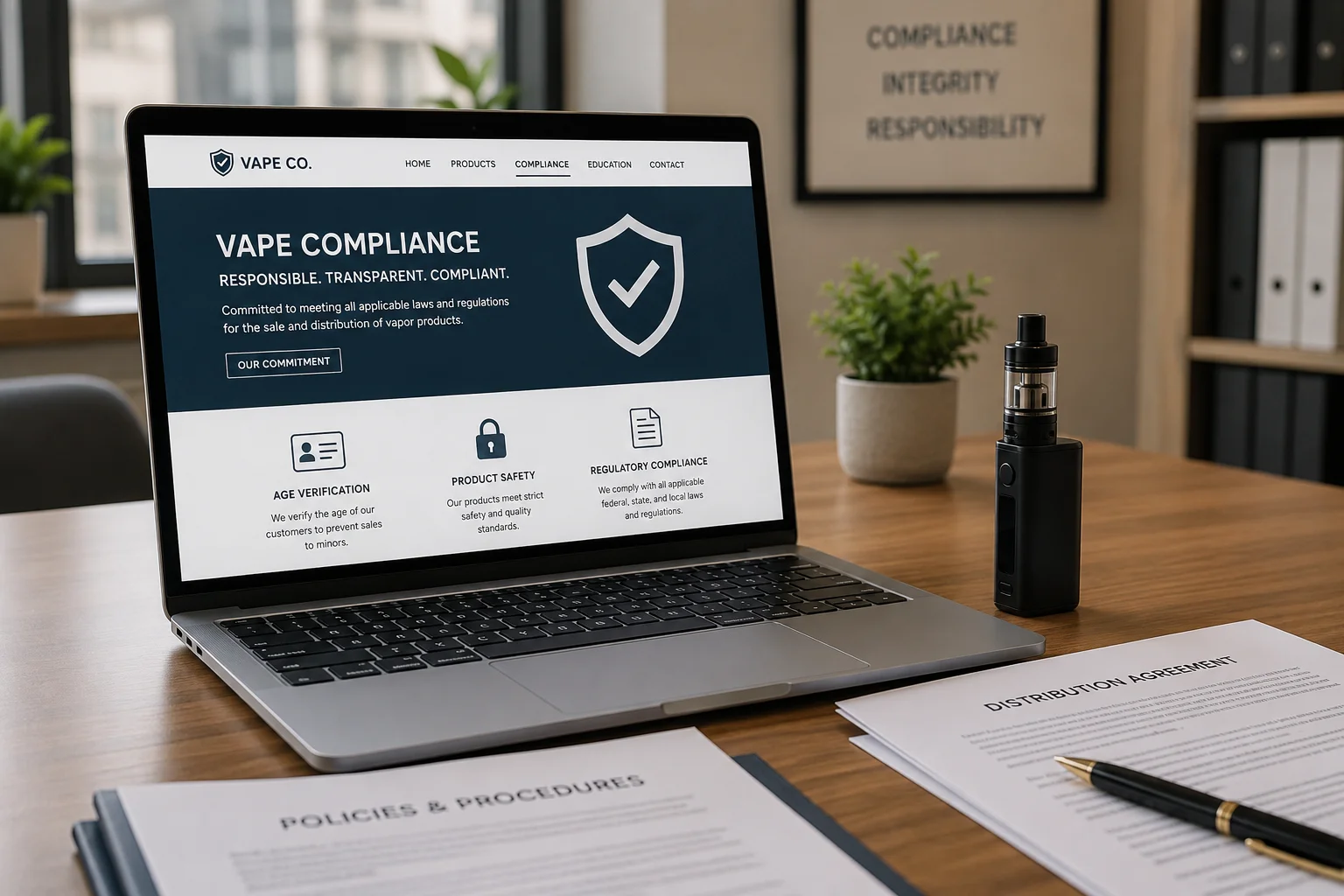
Navigating the rules for vape content in the U.S. feels like walking through a minefield. I get it. I’ve been in this business since 2011, and I’ve seen how quickly things can go wrong if you’re not careful. But you can't just stay silent; you need to inform your customers. The trick is to be smart about it. It’s not as hard as it seems if you break it down into simple steps. Let's go through the key areas you need to watch so you can build your pages with confidence and stay out of trouble.
When Does an Educational Vape Page Become Advertising?
You think you're just creating a helpful guide for your customers. But if you link to a product or even mention flavors, the FDA might see it as illegal advertising[^1]. Let’s clarify that line.
A page becomes advertising if it links directly to products, uses promotional language about brand names or flavors, offers discounts, or has a clear "buy now" call to action. To reduce risk, you must keep purely educational content completely separate from your sales pages.

Look, I've seen people try to get clever with this. They write a whole article about a product's great taste and then put "For Educational Purposes Only" at the bottom. The regulators aren't stupid. They don’t care about that little disclaimer; they care about what the page actually does. If your "guide" is pushing someone to buy something, it's an ad. It's that simple. We’ve learned to be very clear about this. If we want to teach customers about battery safety, that's one page. If we want to sell them a vape, that's a completely different page. Don't mix them. Think about it like this:
| This Looks Like Education (Safer) | This Looks Like Advertising (Riskier) |
|---|---|
| Explaining what an ENDS product is. | Linking the explanation directly to a product page. |
| Describing how a component works. | Using a specific brand name and its product images. |
| Giving battery safety instructions. | Highlighting a new flavor or offering a discount code. |
| No links to purchase, no pricing. | Including a "Request a Quote" or "Add to Cart" button. |
| Neutral, factual tone. | Emphasizing "amazing taste" or "best performance." |
| Separate from e-commerce functions. | Combining how-to guides with "You may also like" product suggestions. |
Don't try to find loopholes. Just keep your sales talk on your sales pages and your helpful facts on your education pages. It will save you a lot of headaches.
Should You Verify U.S. Marketing Authorization Before Mentioning a Product?
You want to feature a hot-selling vape on your site. But if that product doesn't have an FDA marketing order, or if you describe it with the wrong words, you're asking for serious trouble.
Before you post anything about a specific vape, you must confirm its FDA marketing-order status. Never, ever use phrases like "FDA approved." The correct, and much safer, term is "FDA-authorized for marketing in the United States," and you should clarify this is not a safety endorsement.
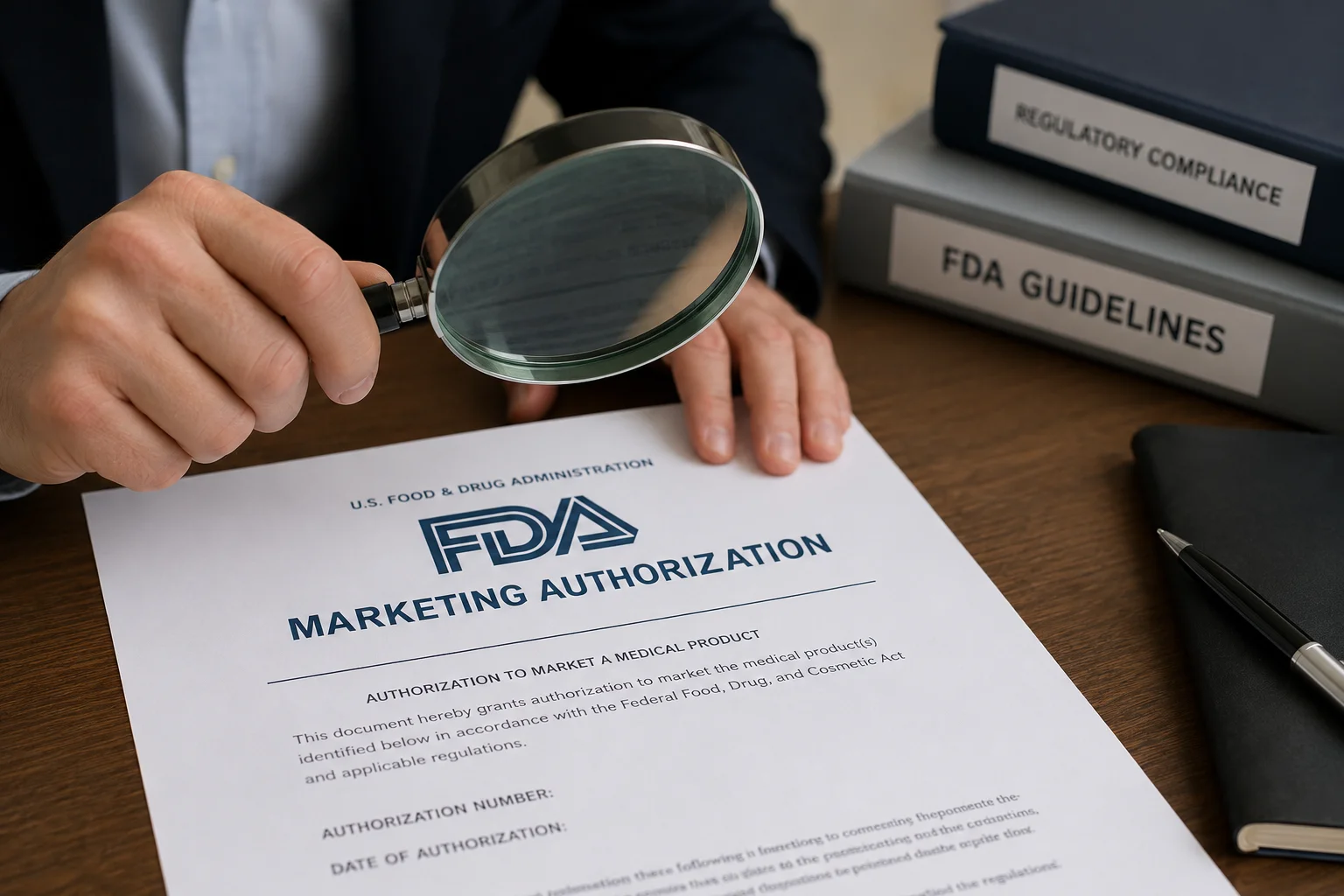
This is a huge mistake I see people make all the time. They think because a product is legally for sale, it's "FDA approved." It's not. The FDA does not "approve" vapes like they approve medicines.[^2] For a vape product, the best you can get is a "marketing granted order,"[^3] which just means the FDA has allowed it to be sold in the U.S. It does not mean the FDA thinks it's "safe" or "healthy." Using the wrong term can get you a warning letter fast.[^4] So, before you even think about writing about a product, you have to do your homework. We have a strict internal checklist for this.
What to Verify:
- What is the exact brand and product name authorized?
- Does the authorization cover a specific device and pod combination?
- What is the exact nicotine concentration that was authorized?
- Which specific flavor or variant got the marketing order?
- Does the SKU you're marketing match the authorized SKU exactly?
- Is the marketing order still current and not revoked?
Language to Use (and Avoid):
| Don't Say This (High Risk) | Say This Instead (Lower Risk) |
|---|---|
| FDA approved vape | "This product has received a marketing granted order from FDA" |
| FDA-certified e-cigarette | "FDA-authorized for marketing in the United States" |
| Government-approved vaping product | Stick to the facts of the marketing order |
| Fully FDA compliant | Avoid broad compliance statements |
| Pending PMTA means it's legal | Do not mention PMTA status as a justification for sale |
And always add a disclaimer that a marketing order doesn't mean the product is safe or endorsed by the FDA. Being precise and honest here is not just about following the rules; it's about building trust.
How Can You Focus on Neutral, Verifiable Product Information?
You need some content for your page, but you're worried every sentence is a potential legal claim. The solution is simple: stick to the boring facts. It's the safest and most helpful thing you can do.
Your educational content should focus on neutral, verifiable information. This includes things like the device's components, battery specifications, ingredients, and proper disposal. Avoid turning a technical feature into an unproven health or performance benefit.
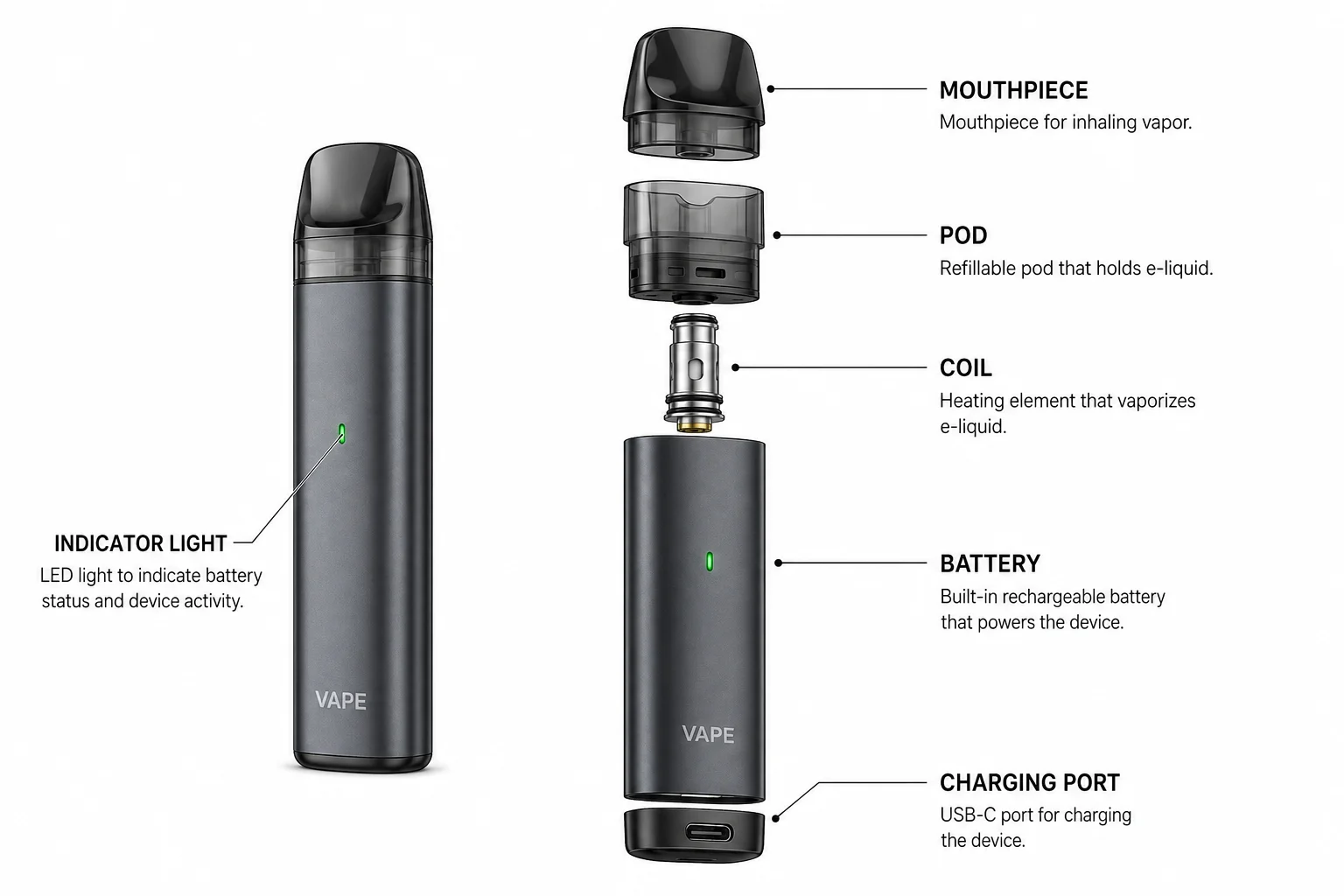
This is our golden rule for content. Can we prove it with a spec sheet or a user manual? If yes, we can write about it. If it's a subjective opinion or a marketing claim, we leave it out of our educational articles. For example, you can state that a device uses a "mesh coil." That is a verifiable fact about its construction. But you cannot take the next step and say, "This mesh coil delivers cleaner, healthier vapor." How do you know? Did you conduct a million-dollar clinical study to prove that? If not, you can't say it. That's the difference between a fact and a claim. Stick to facts.
Safe Topics for Educational Pages:
- What an Electronic Nicotine Delivery System (ENDS) is
- The names of the device components (battery, atomizer, cartridge)
- Battery and charging specifications (e.g., "500mAh battery," "USB-C charging port")
- Pod or cartridge format
- Nicotine concentration (e.g., "Contains 5% nicotine by weight")
- Ingredient and packaging information (as listed by the manufacturer)
- Proper storage instructions
- Battery handling and safety tips
- Guidance on preventing leaks
- Information on responsible disposal
- Product traceability information (if available)
- Manufacturer and distributor details
Think of it like you're writing a technical manual, not a sales brochure. It might feel dry, but it keeps you safe and is genuinely useful for a customer who wants to understand the product they are buying.
Should You Avoid Health, Safety, Cessation and Reduced-Risk Claims?
Everyone in the industry talks about how vaping is a better alternative to smoking. But saying that on your U.S.-facing website is one of the fastest ways to get into legal trouble unless you have specific authorization.
Unless a specific product has been granted a "modified risk" or "cessation" order from the FDA[^5] for that exact claim, you must not state or imply that it is safer than smoking, healthy, or helps you quit. This includes using suggestive images or wording.
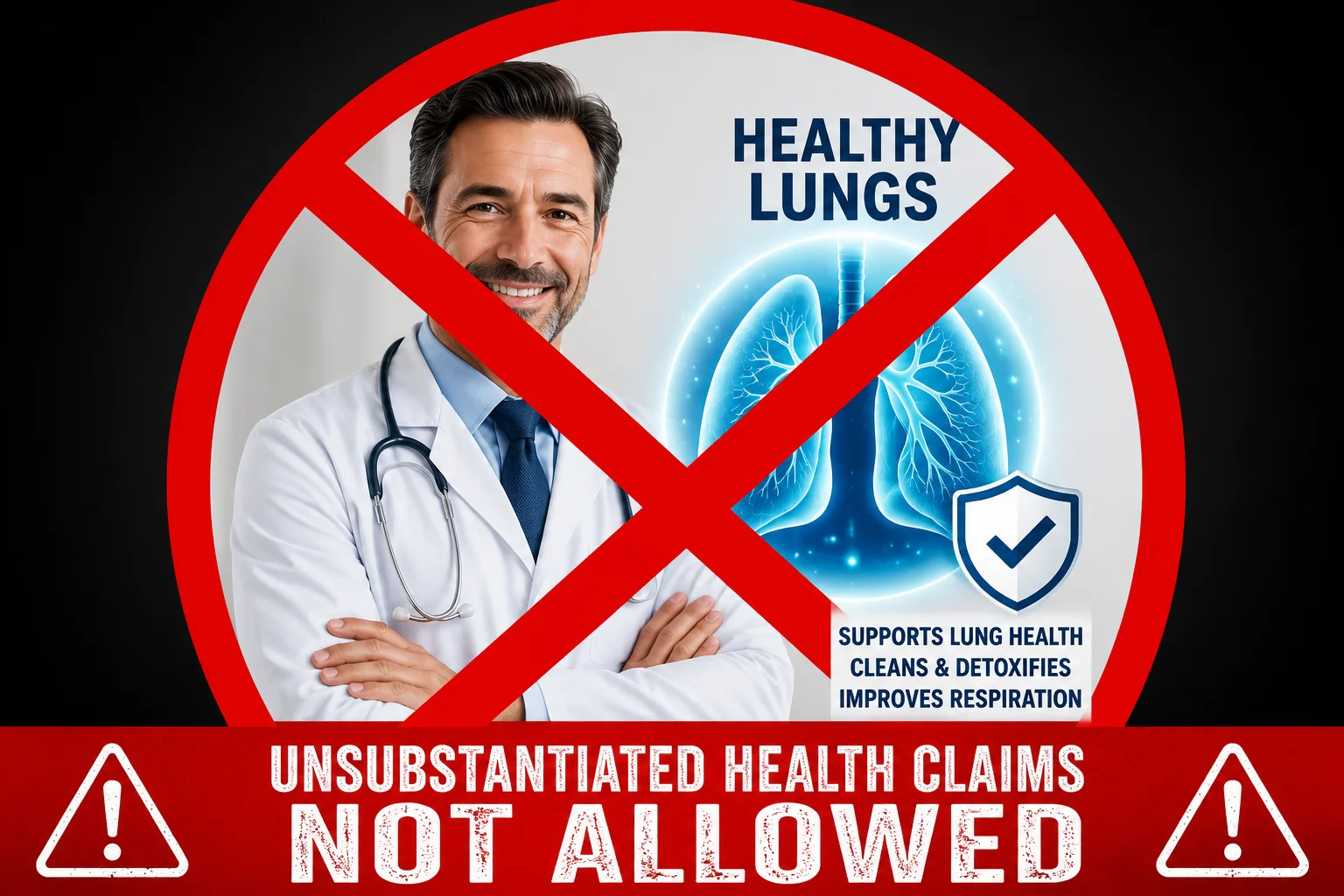
This is the biggest red line of all. The FDA will come down on you like a ton of bricks if you cross it. You cannot, and I repeat, cannot make health claims. The list of forbidden phrases is long, and you need to burn it into your brain.
Direct Claims You Absolutely Must Avoid:
- Safer than smoking
- Harmless vapor
- Healthy alternative
- Helps you quit smoking
- Reduces nicotine addiction
- Doctor-recommended
- Better for your lungs
- Reduced exposure to harmful chemicals
But it's not just about the words you write. It's also about what you imply. This is where many businesses get caught. They think they are being clever, but the regulators see right through it.
Implied Claims to Watch Out For:
- Using images of doctors, nurses, or scientists in white coats.
- Showing icons of healthy lungs.
- Using words like "clean," "pure," or "wellness" to describe the product.
- Showing a side-by-side image of black cigarette smoke next to clean-looking vapor.
- Featuring a user testimonial that says, "I quit smoking thanks to this product!" without any context or disclaimers.
Unless the FDA has given you a green light for that specific product and that specific claim, just don't go there. It's not worth the risk.
How Do You Use the Required Nicotine Warning Correctly?
You know you need to put a nicotine warning on the page. But did you know that getting the size, placement, or color contrast wrong is also a compliance failure? The details matter.
For any page featuring a nicotine-containing product, you must display the exact warning: "WARNING: This product contains nicotine. Nicotine is an addictive chemical."[^6] You must also ensure it's clearly visible, correctly formatted, and not obscured on any device.
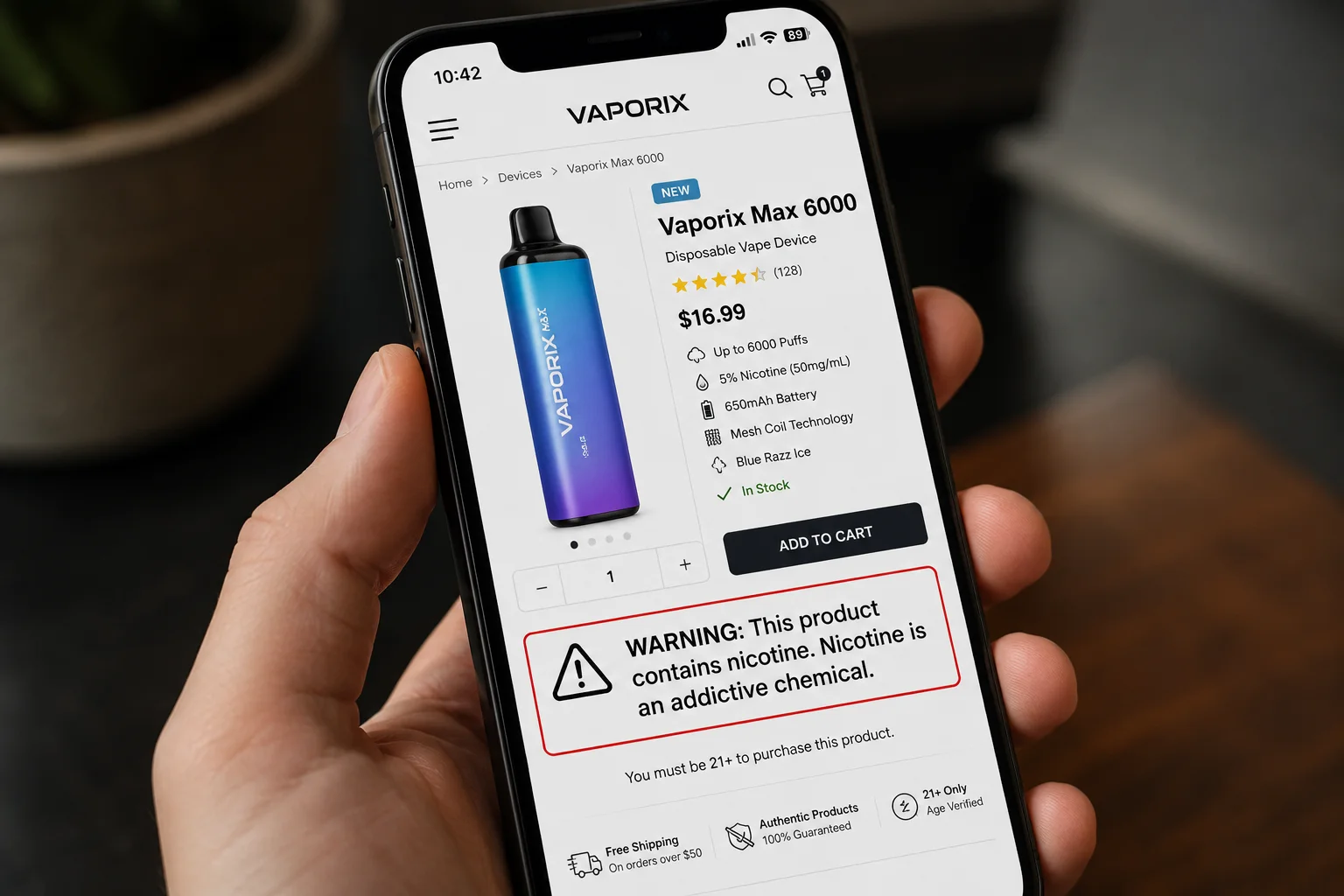
Don't get creative with this. The rules are extremely specific for a reason. You can't paraphrase it, you can't abbreviate it, and you can't make it tiny and hide it in the footer. We treat this as a non-negotiable part of our web design. Every single time, we run through a checklist to make sure we've got it right.
Your Nicotine Warning Checklist:
- Wording: Is it the exact required text?
- Placement: Is it located in a conspicuous and prominent place on the page, before the user can buy?
- Size: Does the warning occupy at least 20% of the advertisement area?[^7] (Check the latest regulations on this).
- Font and Contrast: Is the text legible, in a bold font, and does it contrast with the background?
- Mobile Visibility: Have you checked it on a phone? Is it readable and not cut off?
- Pop-ups: Do any cookie banners, age gates, or promotional pop-ups cover the warning?
- Downloads: If you have downloadable PDF catalogs, does the warning appear on the relevant pages?
- Images & Videos: Do your product images or embedded videos also require the warning?
Just copy the text, follow the formatting rules, and place it where everyone can see it. It's one of the easiest rules to follow, and one of the most obvious red flags if you get it wrong.
How Do You Keep Content Adult-Directed and Avoid Youth Appeal?
You want your brand to look cool and modern. But if "cool" starts to look like it's designed for kids, you're crossing a major red line and putting your entire business at risk.
All of your content must be clearly directed at legal-age adults. You must actively avoid any imagery, language, or themes that could appeal to minors[^8], such as cartoons, candy-like packaging, school-related themes, or youth-oriented slang.
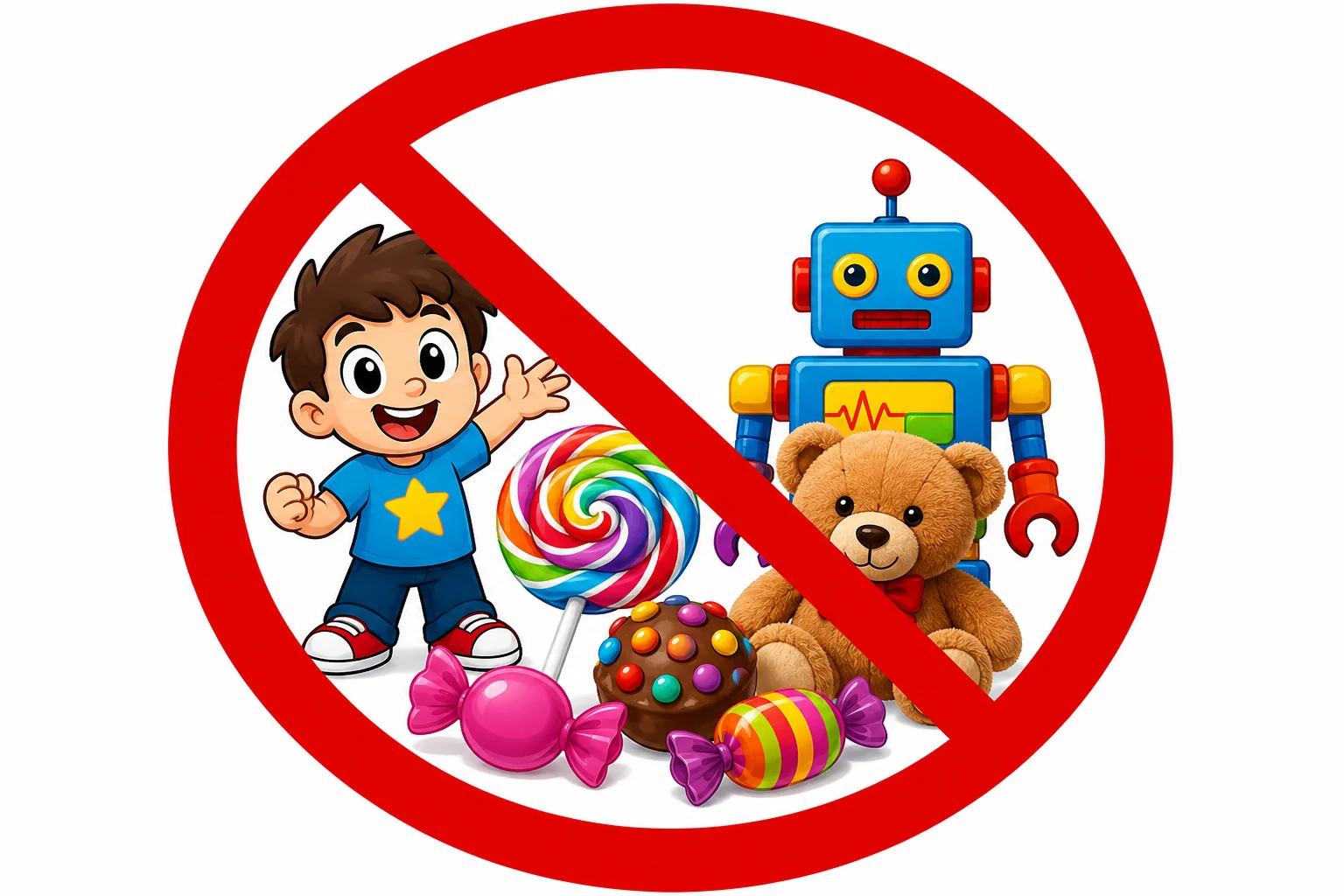
This should be common sense, but you would be surprised what we see in the market. If your vape looks like a juice box, a toy, or a highlighter pen, you are asking for trouble. It's not just about the product itself, but how you present it online. And don't think a simple "Are you 21?" pop-up is a magic shield that protects you. The regulators look at the entire message your page is sending. If the colors, fonts, and images scream "for teens," an age gate won't save you from a compliance action.
Content to Avoid at All Costs:
- Cartoon characters or childlike illustrations.
- Designs that mimic toys, video games, or popular snacks and candies.
- Photos set in schools, on playgrounds, or at parties that look like they're for young people.
- Using phrases like "Perfect for students," "Collect every color," or "TikTok-famous flavor."
- Hiring young-looking influencers who appeal to a teen audience.
- Creating content that shows how to hide or conceal the product.
Your target customer should be an existing adult nicotine user. Frame all your content for that audience. Think of it this way: would a 40-year-old professional be your customer based on this page, or would a 16-year-old high school student? If there's any doubt, change the content.
How Can You Substantiate Puff Counts, Comparisons, and Other Claims?
You want to tell customers your vape has a 20,000 puff count and lasts longer than the competition. But if you can't back up those statements with solid proof, you're making misleading claims.
Any objective claim you make—from puff count and battery life to environmental benefits—must be substantiated with traceable evidence before you publish it.[^9] You can't just say "Guaranteed 20,000 puffs"; you must be able to explain the methodology and conditions of that test.

Let's be real about puff counts. It has gotten completely out of control. We're seeing products advertised with 50,000, 100,000, even 300,000 puffs. Come on. We are in the business; we know that's just a numbers game. A disposable vape is only so big. It can only hold so much battery and so much e-liquid. The realistic maximum puff count for even the largest devices is around 10,000.[^10] Anything more is just marketing fantasy.
"Substantiation" means you have proof. If you claim "8,000 puffs," you should have a document ready that says, "This was tested on a machine taking 1.5-second puffs every 30 seconds until performance dropped." You need to be able to back it up if challenged.
Claims That Require Proof:
- Puff count: You need a documented test methodology.
- Battery duration / Charging time: How was it tested?
- Performance comparisons: Compared to what? Under what conditions?
- "Leak-resistant": To what degree? What's your proof?
- Environmental claims ("recyclable," "reduced waste"): This is a huge area of scrutiny. You need solid proof.
And be careful with user reviews. You can't use a customer testimonial to make a claim that you are not allowed to make yourself.[^11] If a customer writes, "This is the safest vape I've ever used," you cannot feature that review. It becomes a safety claim made by you.
What is the Pre-Publication Checklist for U.S.-Facing Vape Education Pages?
You've spent hours creating a great educational page. You think it's ready. But hitting "publish" too soon without a final check could undo all your hard work and land you in hot water.
Before any page goes live, run it through a final, rigorous checklist. This ensures you've covered all your bases, from product authorization and claim verification to proper warnings and legal review. This is a non-negotiable final step.
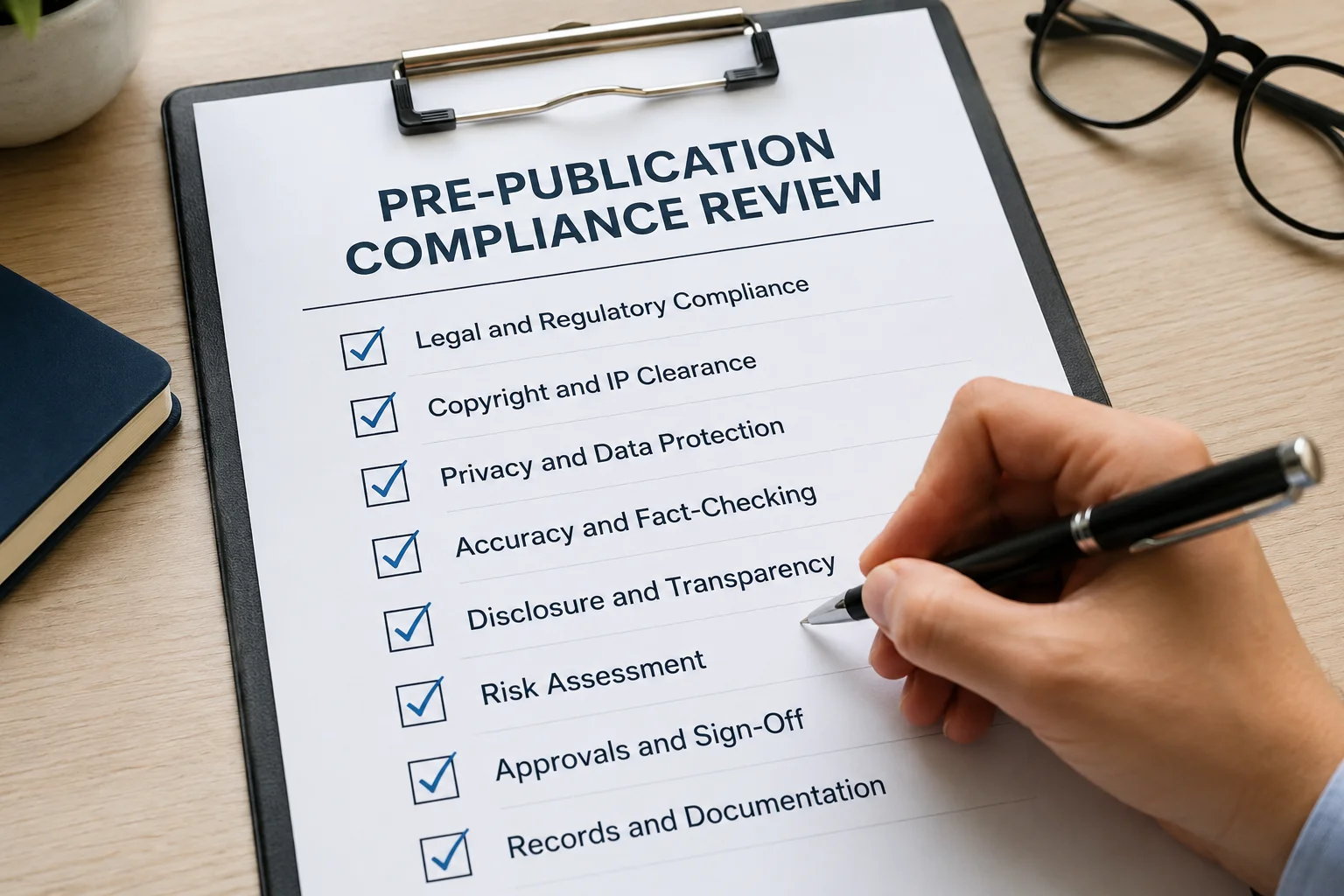
I treat this like a pilot's pre-flight checklist. It might feel slow, but it's a lot faster and cheaper than dealing with a warning letter from the FDA or a lawsuit. We go through every single one of these points, every single time.
The Final Go-Live Checklist:
- [ ] Does the featured product have a valid U.S. marketing authorization?
- [ ] Does the exact SKU on the page match the authorized product?
- [ ] Have all uses of "FDA approved" or similar language been removed?
- [ ] Have all health, safety, and cessation claims been removed (or cleared by a lawyer)?
- [ ] Have you checked for implied reduced-risk claims (e.g., in images or testimonials)?
- [ ] Is the required nicotine warning present and correctly formatted?
- [ ] Do you have supporting documents for all technical specifications (puff count, etc.)?
- [ ] Do testimonials or reviews avoid making unsubstantiated claims?
- [ ] Do all images and graphics avoid appealing to youth?
- [ ] Is the page's target audience clearly adults?
- [ ] Do links, buttons, and even metadata (like page titles) avoid making stronger claims than the article?
- [ ] Have you checked for any specific requirements in the states you target?
- [ ] Have sources and compliance review dates been recorded internally?
- [ ] Has the page been reviewed by qualified U.S. regulatory counsel?[^12]
That last one is the most important. I'm sharing my business experience here, but I am not your lawyer. The laws change all the time. Spend the money to have an expert lawyer review your content. It is the best insurance you can possibly buy for your business.
Conclusion
Creating compliant vape pages for the U.S. market isn't about being silent; it's about being smart and precise. Stick to the facts, avoid the hype, and always get a final legal review.
[^1]: "The Real Cost Campaign - FDA", https://www.fda.gov/tobacco-products/public-health-education-campaigns/real-cost-campaign. The U.S. Food and Drug Administration (FDA) provides guidance and regulations defining what constitutes labeling and advertising for tobacco products, which can include materials that are not explicit advertisements but are used to promote a sale. Evidence role: definition; source type: government. Supports: The source should provide the FDA's official definition of what constitutes advertising and promotion for tobacco products, helping to clarify the line between educational content and marketing.. [^2]: "Premarket Tobacco Product Marketing Granted Orders - FDA", https://www.fda.gov/tobacco-products/premarket-tobacco-product-applications/premarket-tobacco-product-marketing-granted-orders. The U.S. Food and Drug Administration clarifies that tobacco products are regulated differently from medical drugs; they may receive a 'marketing granted order' if it is found to be 'appropriate for the protection of the public health,' which is a distinct process from the 'approval' standard for therapeutic drugs. Evidence role: definition; source type: government. Supports: The source should explain the distinction between the FDA's drug approval process and the process for granting a marketing order for a tobacco product.. [^3]: "Tobacco Products Marketing Orders - FDA", https://www.fda.gov/tobacco-products/market-and-distribute-tobacco-product/tobacco-products-marketing-orders. According to the FDA, a 'marketing granted order' permits a new tobacco product to be legally marketed in the United States after the agency evaluates its potential public health impact. Evidence role: definition; source type: government. Supports: The source should define what a Marketing Granted Order (MGO) is in the context of the Premarket Tobacco Product Application (PMTA) pathway.. [^4]: "E-Cigarettes Authorized by the FDA", https://www.fda.gov/tobacco-products/market-and-distribute-tobacco-product/e-cigarettes-vapes-and-other-electronic-nicotine-delivery-systems-ends-authorized-fda. The FDA has issued warning letters to firms for misbranding tobacco products, including for making unauthorized claims that imply FDA approval where no such approval was granted. Evidence role: case_reference; source type: government. Supports: The source should be an example of an FDA warning letter issued to a company for making unauthorized claims, such as using the term 'FDA approved' for a tobacco product.. Scope note: A single warning letter shows that the FDA has taken this action before, but does not indicate the frequency or current priority of such enforcement. [^5]: "Modified Risk Granted Orders - FDA", https://www.fda.gov/tobacco-products/advertising-and-promotion/modified-risk-granted-orders. Under the Family Smoking Prevention and Tobacco Control Act, a company must receive a specific order from the FDA through the Modified Risk Tobacco Product (MRTP) pathway before it can legally market a product with claims that it is less harmful or helps users quit smoking. Evidence role: historical_context; source type: government. Supports: The source should describe the FDA's Modified Risk Tobacco Product (MRTP) application pathway, which is required for any product seeking to make claims of reduced risk or reduced exposure compared to other tobacco products.. [^6]: "21 CFR § 1143.3 - Required warning statement regarding ...", https://www.law.cornell.edu/cfr/text/21/1143.3. The U.S. Code of Federal Regulations, specifically 21 C.F.R. § 1143.3(a)(1), mandates the use of the exact text: 'WARNING: This product contains nicotine. Nicotine is an addictive chemical.' for advertisements of covered tobacco products. Evidence role: definition; source type: government. Supports: The source should provide the exact text of the required nicotine warning as specified in federal law.. [^7]: "Labeling and Warning Statements for Tobacco Products - FDA", https://www.fda.gov/tobacco-products/products-guidance-regulations/labeling-and-warning-statements-tobacco-products. As stipulated in 21 C.F.R. § 1143.3(b), the required warning statement must comprise at least 20 percent of the area of an advertisement in a conspicuous and prominent manner. Evidence role: statistic; source type: government. Supports: The source should specify the formatting requirements for the nicotine warning, including the rule about it occupying 20% of the advertisement area.. [^8]: "Retailers Warned to Stop Selling Illegal Youth-Appealing E-Cigarettes", https://www.fda.gov/tobacco-products/ctp-newsroom/fda-warns-retailers-stop-selling-illegal-youth-appealing-e-cigarettes-disguised-everyday-items. The FDA has repeatedly stated that preventing youth access to and use of tobacco products is a top priority, and the agency has taken enforcement actions against products with labeling or advertising that uses imagery and themes known to appeal to minors, such as cartoons or candy. Evidence role: general_support; source type: government. Supports: The source should detail the FDA's position and enforcement priorities regarding marketing and product features that are considered appealing to youth.. [^9]: "FTC Policy Statement Regarding Advertising Substantiation", https://www.ftc.gov/legal-library/browse/ftc-policy-statement-regarding-advertising-substantiation. The Federal Trade Commission requires that advertisers have a reasonable basis for all express and implied objective claims, which means they must have competent and reliable evidence to back up their claims before they are made public. Evidence role: definition; source type: government. Supports: The source should explain the Federal Trade Commission's (FTC) requirement that advertisers must have a 'reasonable basis' for all objective product claims before they are disseminated.. [^10]: "Puffing Topography: A Tool to Evaluate Vaping Behavior and ...", https://pmc.ncbi.nlm.nih.gov/articles/PMC12958158/. Technical analyses of disposable vape devices show that puff count is directly limited by the volume of e-liquid and the battery's capacity (in mAh), with calculations suggesting that current form factors make claims of tens of thousands of puffs highly improbable under typical use conditions. Evidence role: mechanism; source type: research. Supports: The source should provide a technical breakdown of how puff count is related to a device's e-liquid capacity and battery life, demonstrating the physical limitations on this number.. Scope note: This support is based on engineering principles and calculations rather than a specific regulatory standard for measuring puff count. [^11]: "[PDF] Guides Concerning the Use of Endorsements and Testimonials in ...", https://www.ftc.gov/sites/default/files/attachments/press-releases/ftc-publishes-final-guides-governing-endorsements-testimonials/091005revisedendorsementguides.pdf. According to the Federal Trade Commission's Endorsement Guides, endorsements must reflect the honest opinions of the endorser and cannot convey any express or implied representation that would be deceptive if made directly by the advertiser. Evidence role: general_support; source type: government. Supports: The source should be the FTC's guidance on endorsements, which clarifies that advertisers are liable for the claims made by their endorsers.. [^12]: "Tobacco Products - FDA", https://www.fda.gov/tobacco-products. The regulation of tobacco products in the United States involves a complex framework under the Federal Food, Drug, and Cosmetic Act, as well as a patchwork of state and local laws, which are subject to frequent changes and legal challenges, underscoring the need for specialized legal guidance. Evidence role: general_support; source type: government. Supports: The source should describe the complex, multi-layered legal framework (including federal, state, and local laws) governing tobacco products in the U.S..