
Most new vape shops fill their first order with popular online products. That single decision often kills cash flow before the shop’s second month.[^1] The real question isn’t what’s selling—it’s who’s buying.
A new vape shop should choose its first product range by first understanding its walk-in customers, not by copying market best-sellers. Start with two strong product categories that match your location and price point, and avoid spreading your budget across too many SKUs.
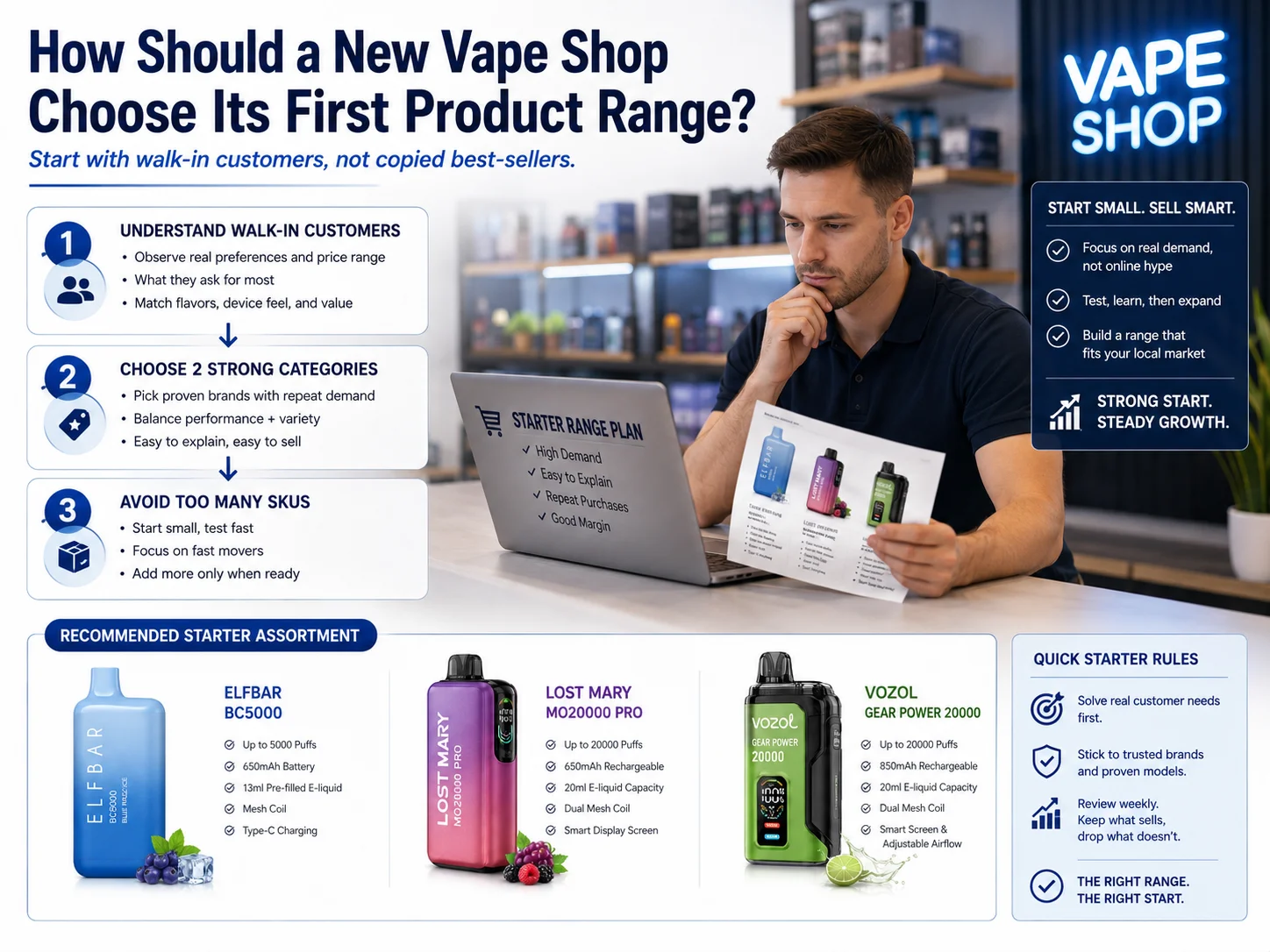
I have seen this mistake repeat from a beach town in Spain to a downtown shop in Ohio. A new owner calls me excited about their grand opening. Then they describe a product list that looks like a warehouse clearance. Every category, every brand, every flavor. Before I offer any advice, I always ask one question: “Who is walking through your door?” That question changes everything.
Quick Answer: How Should a New Vape Shop Choose Its First Product Range?
Most new owners think product selection is about guessing what’s hot. That wrong assumption leads to a cart full of slow movers. The real first step is locking in the customer profile.
Choose your first product range by identifying the one or two customer types your shop will actually serve. A tourist-area shop and a commuter-area shop need completely different starter carts.[^2] Match the product to the person, not the trend.
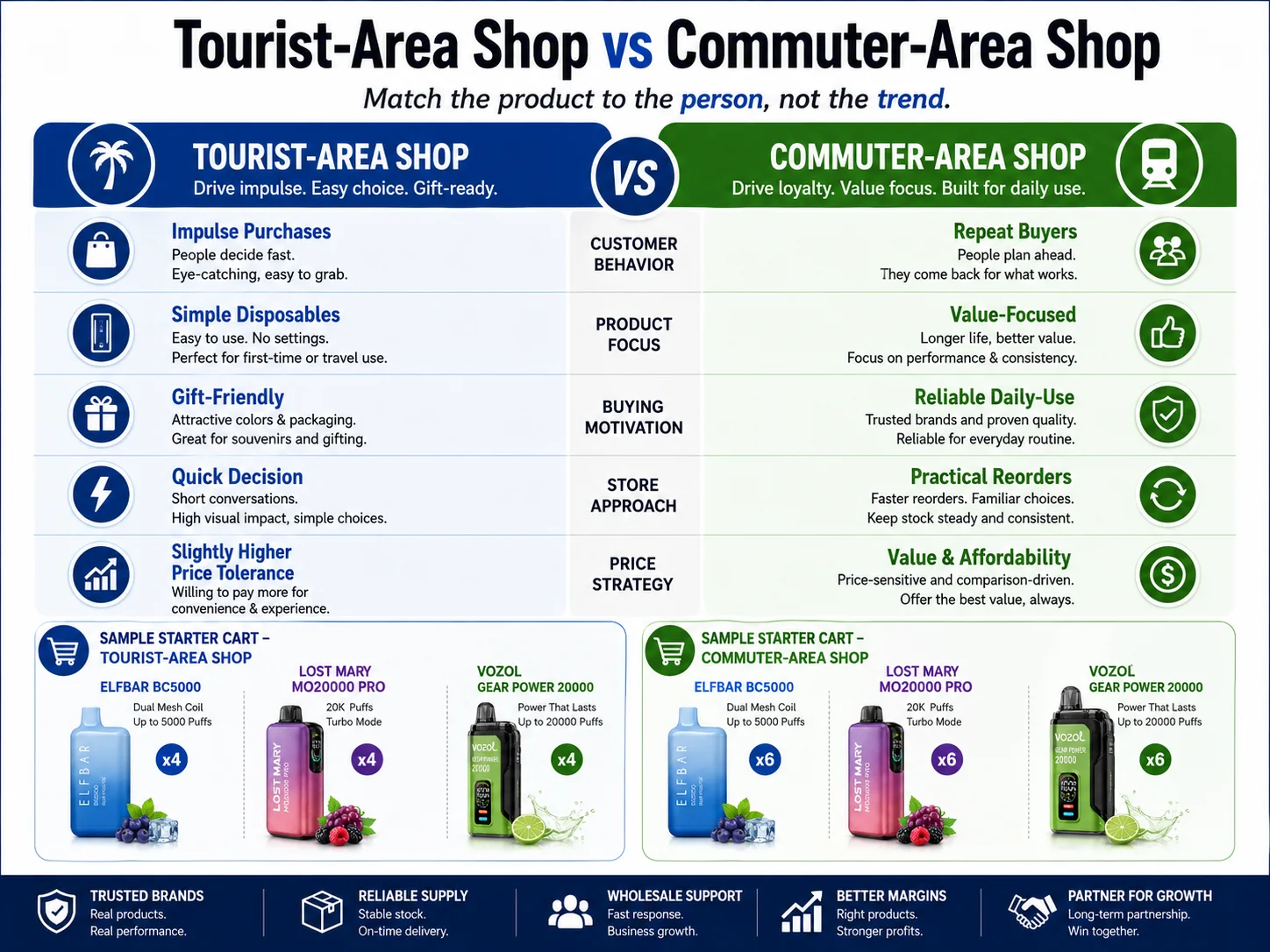
I remember a shop owner in Torrevieja, Spain. His store sits near a beach promenade. He wanted to stock the same mods and rebuildable kits that a forum loved. I asked him, “How many tourists walk in looking for a coil-building kit?” He paused. We restructured his first order around disposables and simple pod systems with clean, easy-to-explain options. His first month’s turnover was steady. The mistake he almost made is common: he picked products for himself, not for the person who walks in sandals and wants something that works instantly. The fastest way to lose money is to stock for an imaginary expert.[^3] The fastest way to make money is to stock for the person who already knows what they want: a simple, satisfying experience. Your first order must reflect that reality. You can always widen the range later, but only if your first cart generates enough cash to fund the next round.
What Do New Vape Shops Usually Care About When Buying Wholesale?
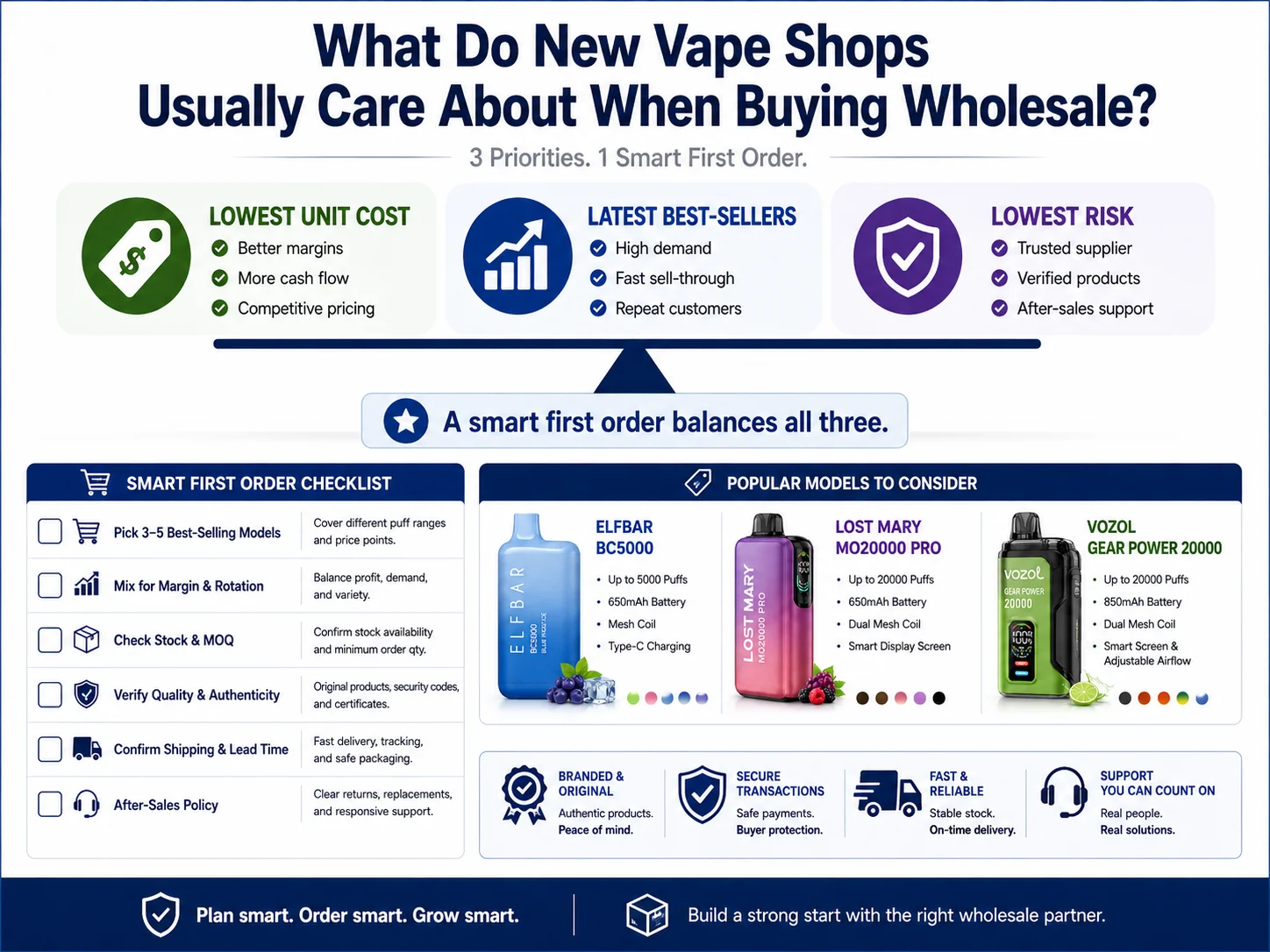
Most new buyers tell me three things: they want the lowest price, they want the hottest products, and they want zero risk. These three demands often fight each other in a single purchase order.
New vape shop owners care most about getting the lowest unit cost, stocking the latest best-sellers, and avoiding any quality or shipping problems. A smart first order balances these three things instead of chasing just one.
I had a customer in the Midwest who ordered a batch of cheap disposables from an unknown supplier. The price was half of what I offered. He was proud of the deal. Two weeks after the product hit his shelves, customers returned almost half of them. Leaking, dead batteries, no flavor after ten puffs. He lost shop reputation, and the money he saved on unit price disappeared in refunds and wasted time. The real cost of a cheap batch is not the unit price—it’s the returns, the refunds, and the customer who never comes back. New owners consistently underestimate how fast bad quality erodes a shop’s reputation in a local market.[^4] When you are buying wholesale for the first time, you care about margin, but you actually need to care about reliability. A product that works well every time builds repeat customers. That repeat customer is what keeps your lights on. So care about price, yes, but care about quality and problem-free shipping more. The lowest price becomes a problem if it means you spend your first month handling complaints instead of selling.
What Should a New Vape Shop Know When Comparing Disposables, Rechargeable Vapes, Pods, Branded Stock, and Accessories?
Many first-time buyers fill a spreadsheet with every category and then order a little of everything. That approach guarantees inventory that doesn’t turn and customers who can’t find what they really want.
When comparing product types, know that disposable users, pod system users, open-system users, and mod enthusiasts rarely overlap in one shop.[^5] Pick one or two categories where your target customer’s behavior is strongest, and go deep there.
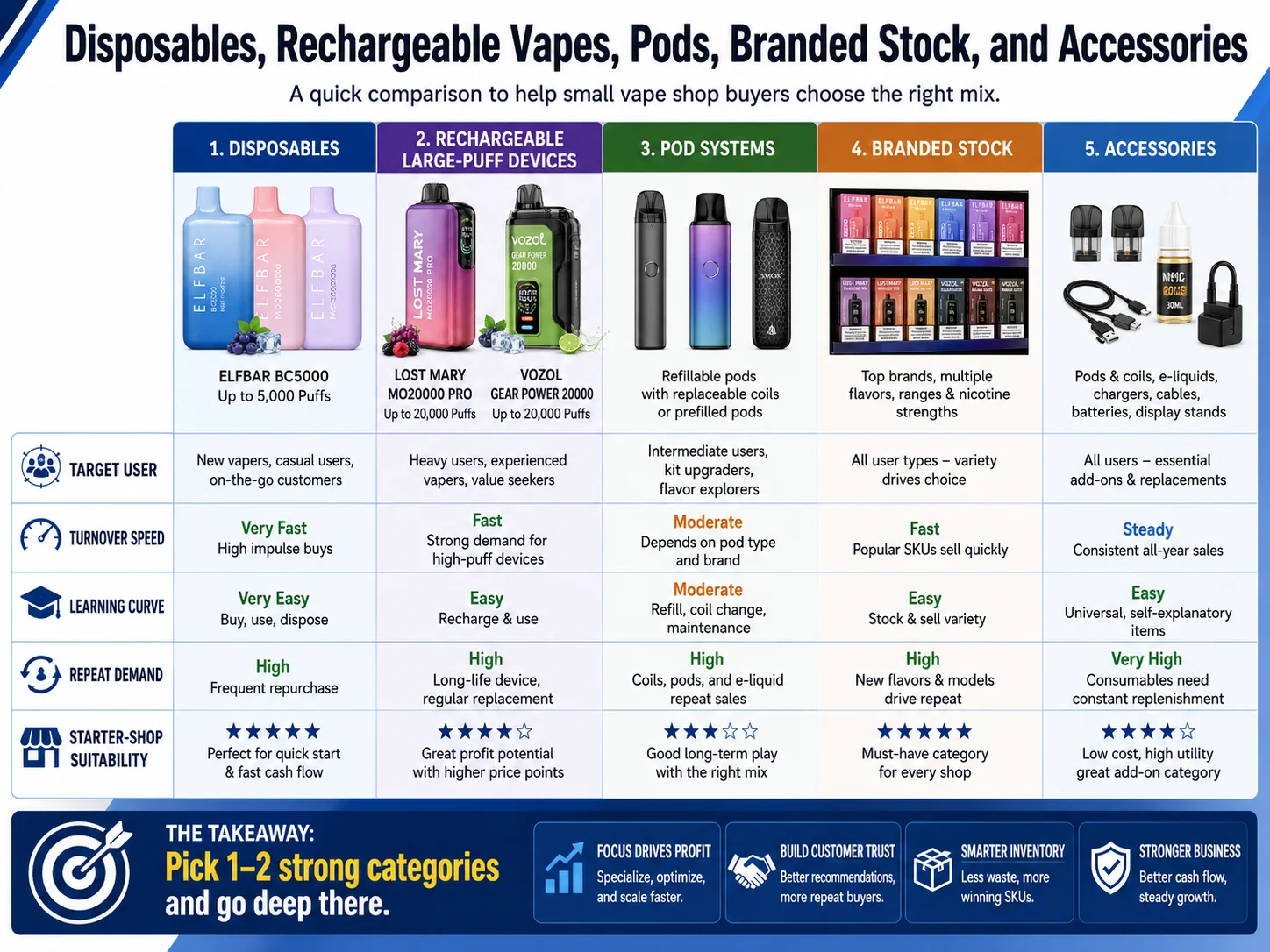
A practical way to think about this is to look at the customer’s daily habit. The tourist who vapes for a weekend wants a small, ready-to-use disposable that costs less than a beach cocktail. The worker who vapes on every break wants a rechargeable pod system with a consistent flavor and a battery that lasts a shift. The hobbyist who builds his own coils and chases clouds is a different person entirely. In my experience, a new shop in a commuter area serves the rechargeable and pod customer best. A shop near nightlife or tourist zones serves the disposable customer best. Branded stock from known manufacturers usually carries less purchase risk for a first-time shop because the customer already trusts the brand name. Accessories like chargers, batteries, and drip tips are add-on items, not the reason someone walks into your store. If you spend your first budget on too many accessories, you tie up cash in products that sit. I’ve seen a shop in a student area stock dozens of glass pipes and grinder sets, but the daily student customer just wanted a reliable refillable pod and a pack of coils. His first month was slow until he shifted the range. Choose the category that matches the daily rhythm of your customer, and build your first order around that core.
Why New Vape Shops Should Avoid Too Many SKUs at the Beginning?
New owners often overcompensate with SKU width when they lack confidence. They stock everything “just in case,” but this fragments capital across products that don’t turn.
Too many SKUs in a first order spreads your budget thin across products that don’t sell.[^6] The products your actual customers want end up understocked, and the slow movers sit on shelves, eating cash flow.
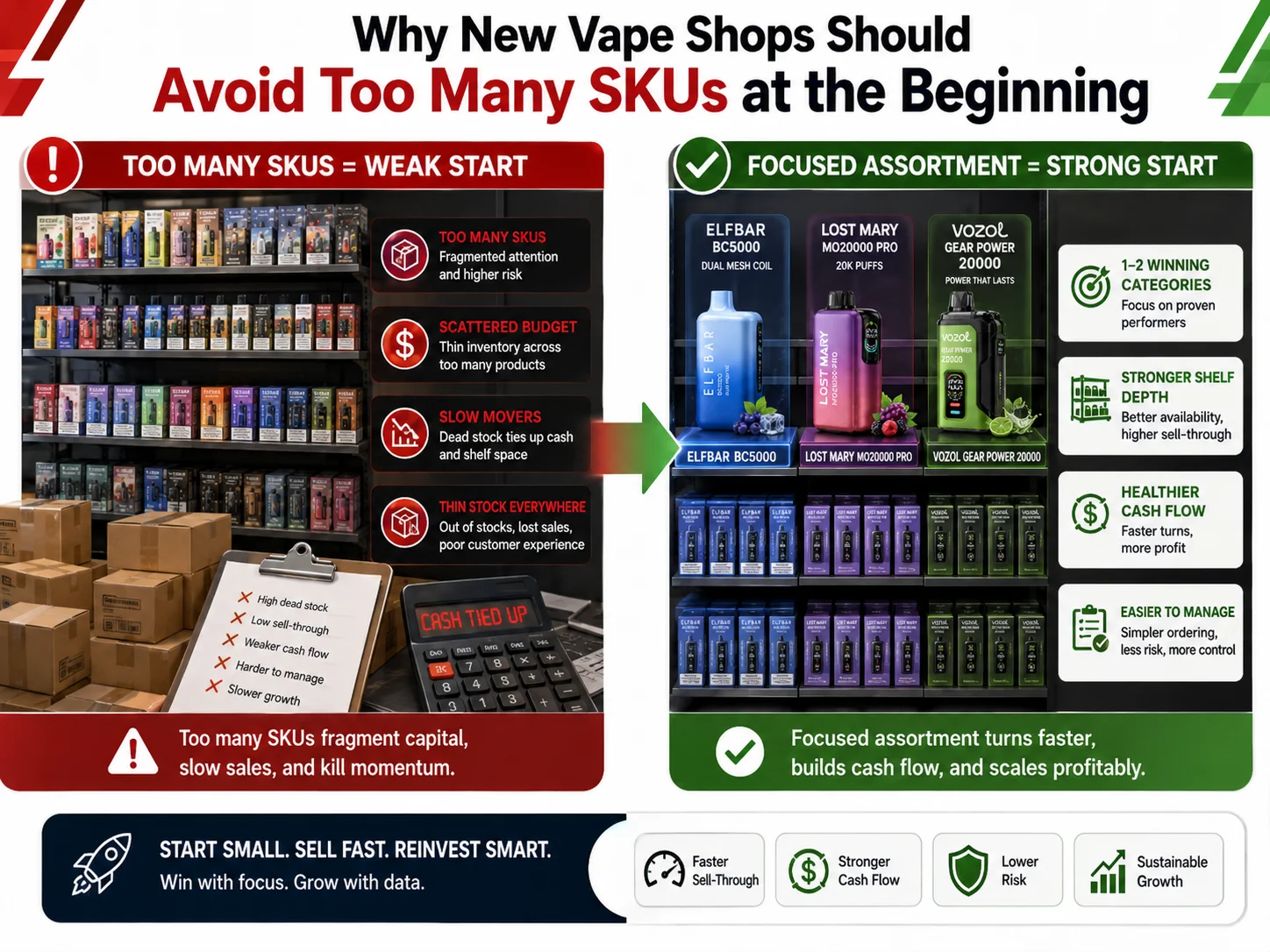
I remember a new shop owner in a small Spanish tourist town. He ordered 40 different disposable flavors, five pod brands, two mod lines, and a full range of accessories. His first cart cost him 8000 euros. By the end of month one, only eight flavors and one pod brand were selling. The rest collected dust. He couldn’t reorder the fast sellers because his money was stuck in the slow ones. That is the trap of “just in case” ordering. A first order is not a complete catalog; it is a test of who your customer really is. Focus on a narrow, deep selection. Order fewer SKUs but more units of each. That way, when a customer finds what they like, you have enough stock to keep them coming back. The goal is not to offer every possible choice. The goal is to have the right choice in stock every time someone reaches for it. Start with maybe ten to fifteen strong SKUs that cover two clear customer types. Watch what sells. Then reorder based on real data, not guesswork. This approach protects your cash and builds a reputation as a shop that always has the good stuff.
How to Match Product Range with Local Customers, Price Points, and Repeat Demand?
A product range only works when it fits the local customer’s wallet, daily habit, and willingness to return. A mismatch here makes even a popular product fail.
Match your first product range to your local customer by looking at the average spend they can afford, how often they will buy, and what they already know. A high-priced kit in a low-income area kills repeat demand instantly.[^7]
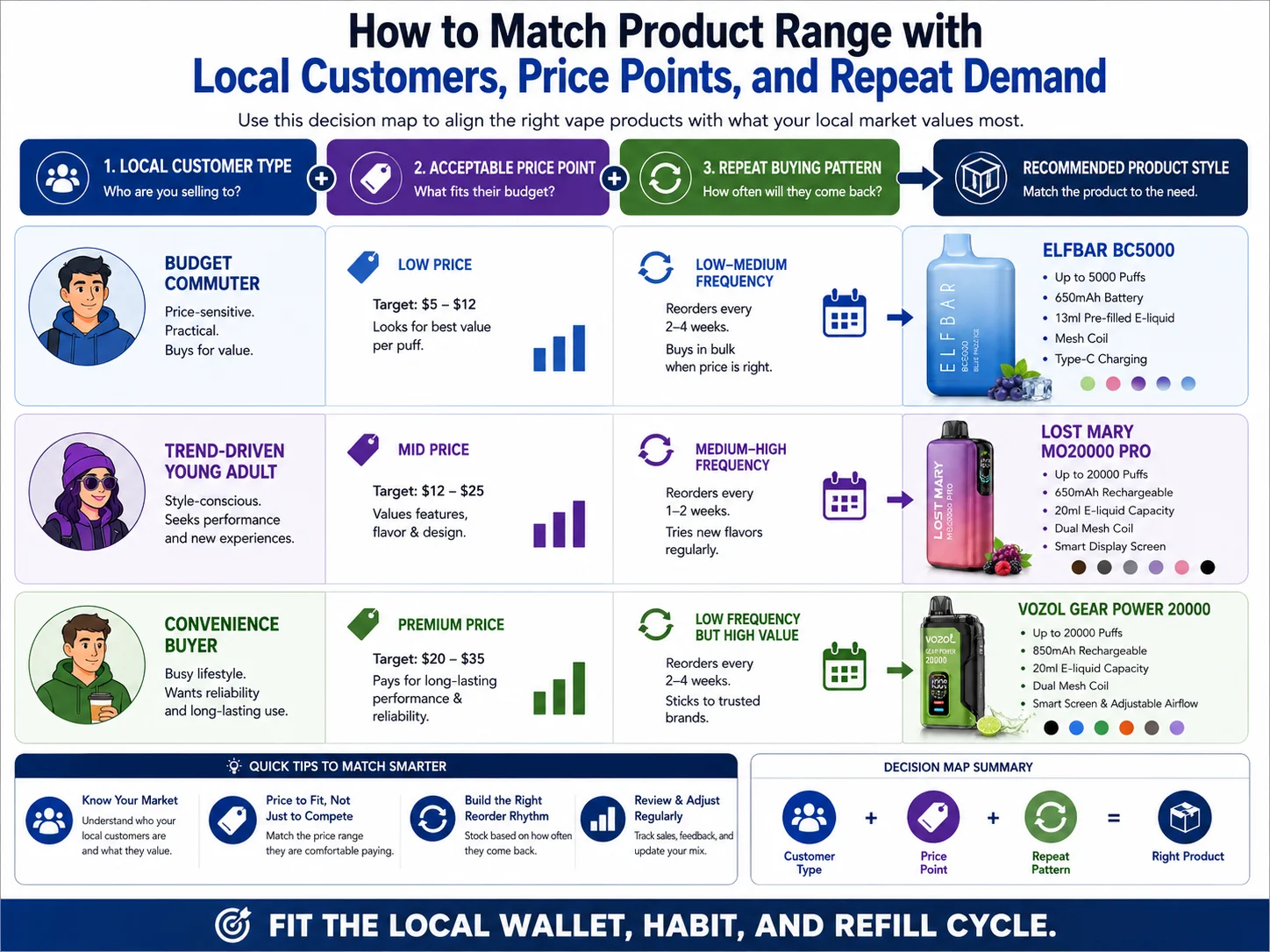
I work with a shop owner in a working-class neighborhood in the United States. His customers want a vape that works all day and costs less than a pack of cigarettes per week. He tried to introduce a premium pod system with a 40-dollar starter kit. Sales were nearly zero. When we switched to a simple rechargeable disposable with a 10-dollar price point and a 5-dollar refill, his repeat customers jumped. The lesson: price point must match the local wallet. Repeat demand comes from a product that the customer can afford to buy again and again, not just once. So when you plan your first range, sit in your shop’s area for a few days. Watch what people carry. Notice what the local convenience store sells at what price. Then ask yourself: will my target customer spend this much every week? If the answer is no, pick a lower entry point. You can always add a premium line later once you have built trust and traffic. Your first range must feel like a natural fit for the neighborhood, not an attempt to change how people spend.
Why Branded Stock Can Be Safer Than Private Label for First-Time Vape Shops?
A new shop owner often dreams of their own brand. But private label demands volume, marketing effort, and a customer base that trusts you. That trust doesn’t exist on day one.
Branded stock from known manufacturers is safer for a first-time shop because the customer already recognizes and trusts the product.[^8] Private label works only after you have a loyal customer base and cash flow to support the minimum order quantity.[^9]
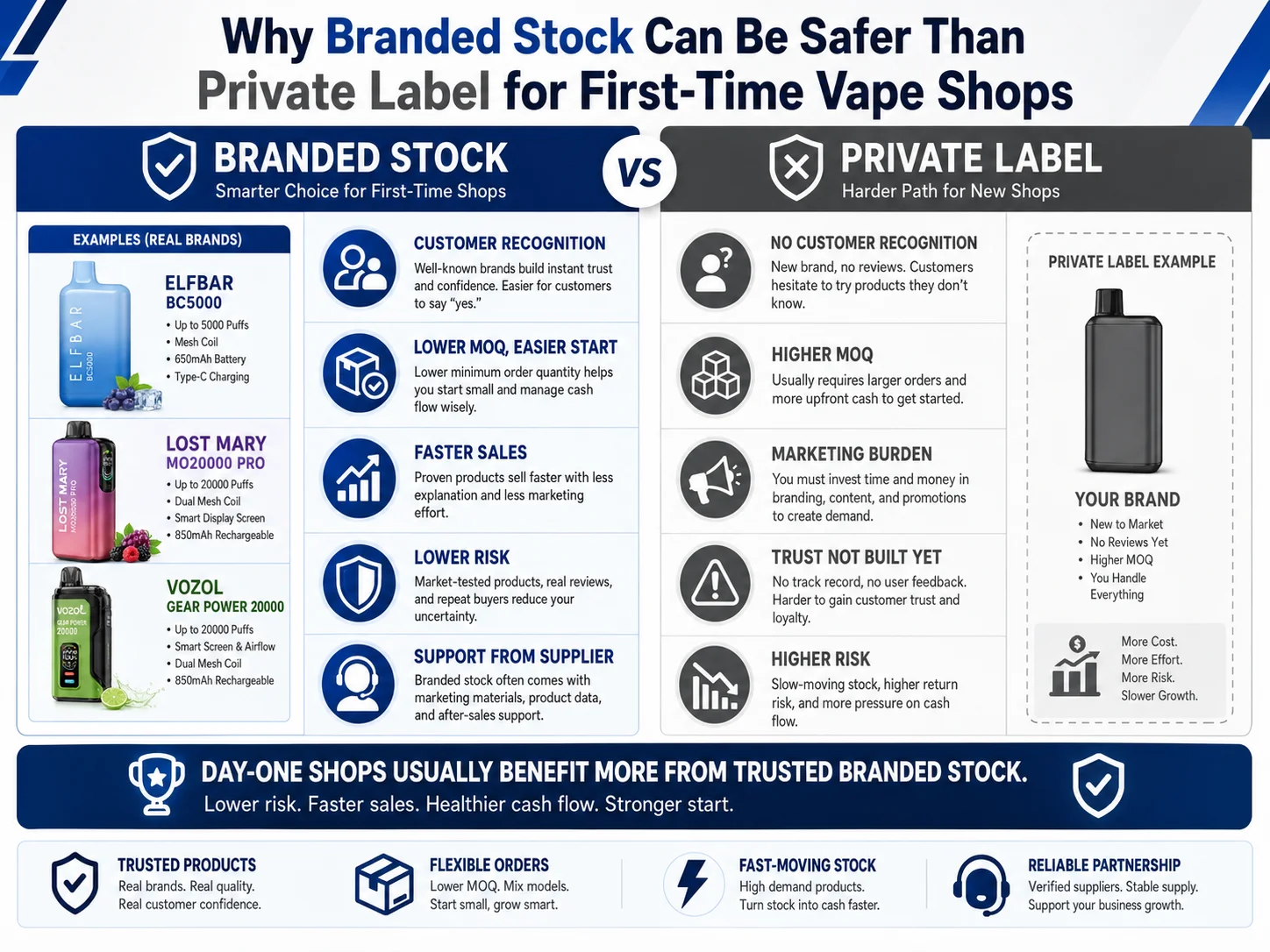
I have seen a new shop owner invest in a private label line for vape juice before he even opened his doors. He had a nice logo and a story. But customers didn’t know him. They walked past his juice and bought the brand they recognized from their last shop. He ended up selling those bottles at cost, months later. Branded stock carries immediate recognition. A customer who used a certain brand’s disposable at a gas station will look for it in your shop. That familiarity builds trust faster than any label you can design. Branded products also come with existing quality control and packaging that customers expect. Starting with a mix of two or three trusted brands in your chosen category gives you a safe foundation. Once you have consistent traffic and know your customer’s preference, you can test a private label SKU. But the first order is not the time for that experiment. Use branded stock to build your reputation first. Then let your private label ambitions grow from profit, not from debt.
What Trust Signals Help New Vape Shops Choose a Wholesale Supplier?
Without a reliable supplier, even the best product range fails. New owners often pick a supplier based on the lowest price or the fastest chat reply. Neither guarantees a safe shipment.
Look for trust signals like a real factory address, video verification of stock, a clear policy on customs seizures and defective products[^10], and the ability to ship from a local warehouse. These signals protect your money and your schedule.
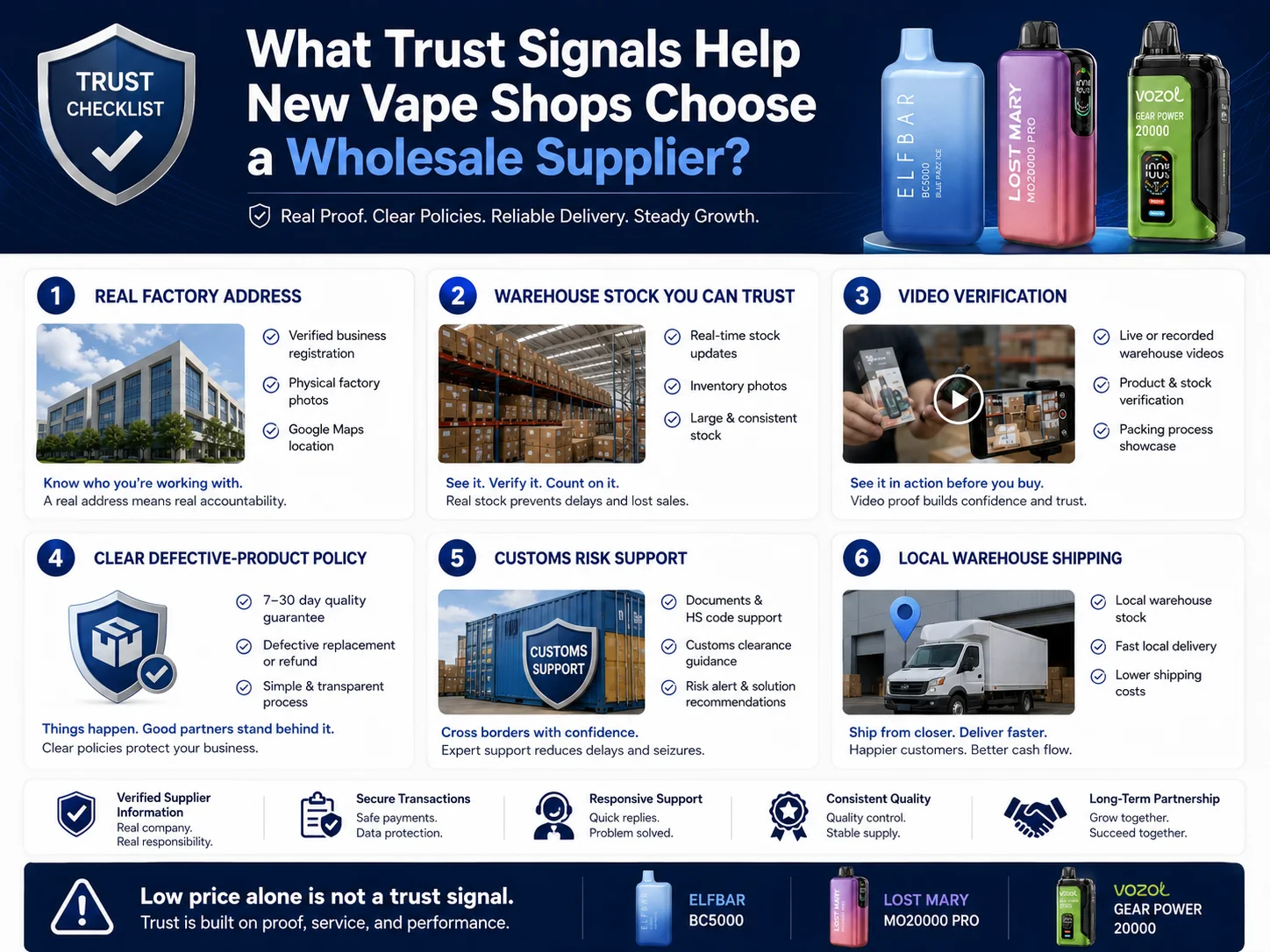
A shop owner I helped in the UK once ordered from a supplier who was very responsive on WhatsApp. The price was great. The first shipment got seized by customs. The supplier stopped replying. The owner lost his stock and his first investment. After that, he started asking for simple things: a video of the products in a real warehouse with today’s date, a written statement about covering customs losses, and the exact address of the factory. When a supplier refuses to provide these, walk away. A trustworthy supplier also offers clear terms: if customs seizes the goods, they reship or refund. If a product has a defect, they replace it. They don’t disappear. I also recommend new shops start with a supplier who has a European or local warehouse if possible. That reduces shipping time and customs risk. A small order from a local warehouse can be in your hands in a few days, not weeks. That quick turnaround is a life-saver when you are testing your first range. Use these trust signals as your checklist before you wire any money. A supplier who values your business will show you proof, not just promises.
Common Product Selection Mistakes That Slow Down First Orders?
The biggest mistake is not the product itself but the process. New owners rush, guess, and overspend. Then they wait too long for the wrong stock to arrive.
Common mistakes include ordering based on online hype, ignoring local demographics, buying too many SKUs, choosing the cheapest option, and not having a backup plan for customs. Each mistake delays the moment your shelves start earning.
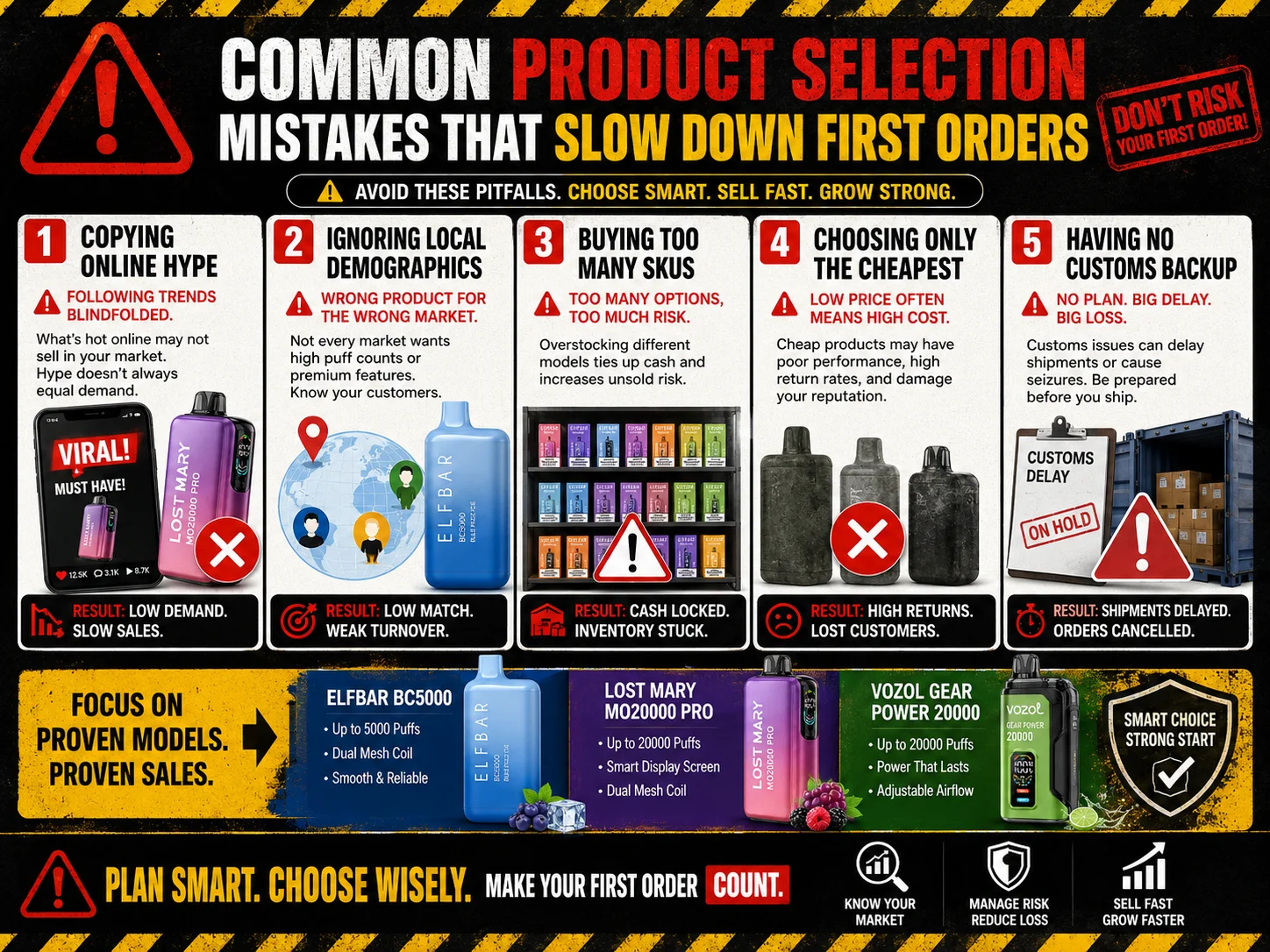
I remember a shop owner in a German city who ordered 2000 units of a new disposable that was trending on TikTok. By the time the shipment arrived six weeks later, the trend was over. His local customers didn’t even know the product. He had to sell at break-even just to free up space. That mistake combined trend-chasing with slow logistics. Another common mistake is ordering a product that requires too much explanation. A new shop owner in a tourist area stocked a complex mod kit that needed battery safety lectures. His staff didn’t have the time or knowledge. Customers walked away confused. The result was zero sales. The first order should include only products that are easy to understand and easy to use.[^11] A customer should be able to pick it up, pay, and use it without help. The more steps between purchase and satisfaction, the more likely you lose that sale. So avoid products that require long tutorials. Avoid flavors that are too niche. Avoid the temptation to be the “everything” shop on day one. Instead, be the shop that has the reliable, simple, repeat-purchase product that brings people back.
What Is a More Practical Wholesale Approach for New Vape Shops and Smaller Buyers?
The traditional wholesale model asks a new shop to order large quantities and wait weeks for delivery. That model is broken for a small buyer testing a new market.
A practical approach for new vape shops is to start with a local warehouse supplier that offers low minimum order quantities and fast delivery. This allows you to test products without huge upfront risk and avoid customs delays.
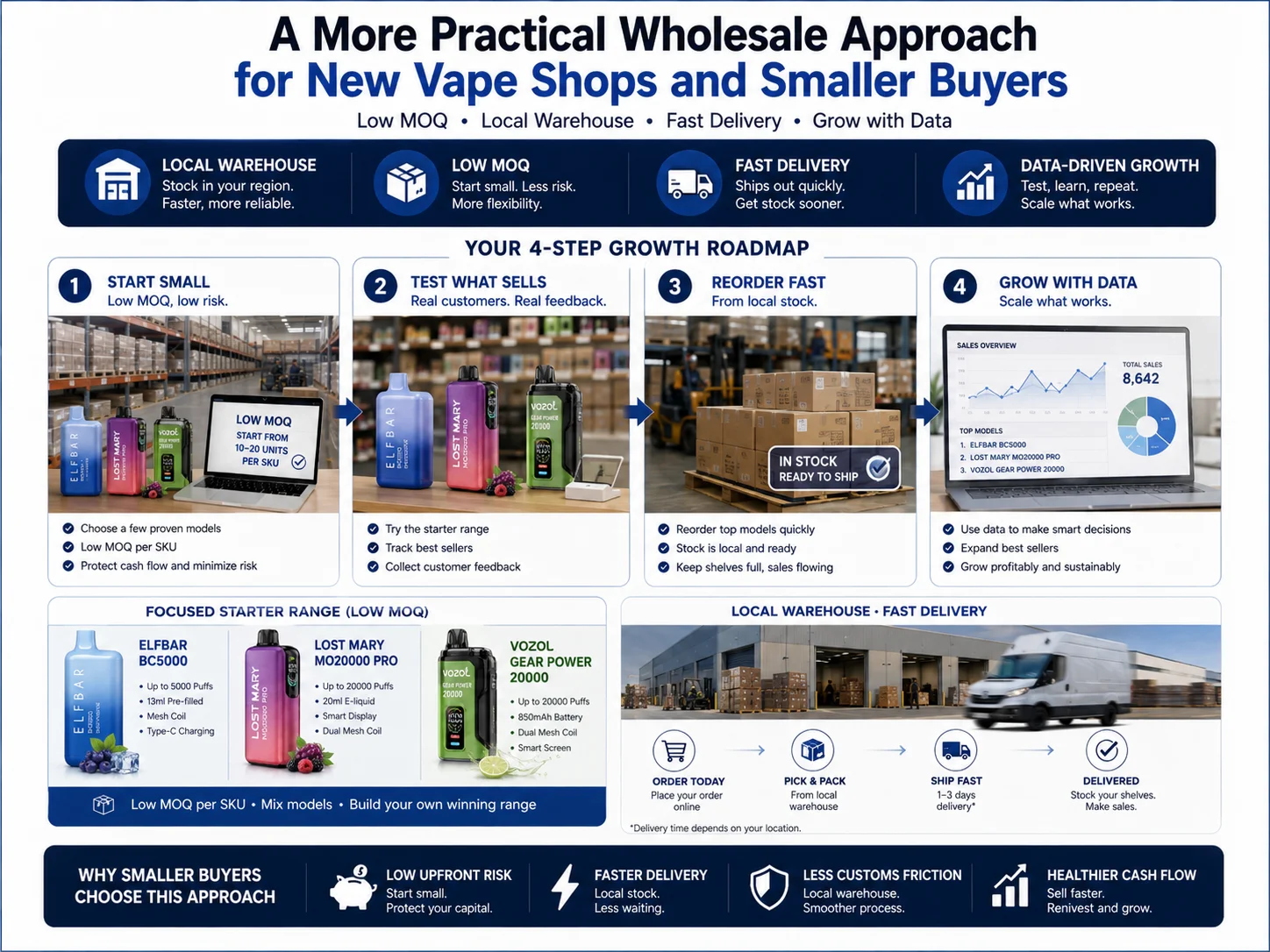
Many small shop owners I work with in Europe now use a simple method. They order 50 to 100 units of a few SKUs from a warehouse in Germany or Poland. The order arrives in two to three business days. They test the product in their shop for a week. If it sells, they reorder more, still from the local warehouse. This approach eliminates the risk of a 10,000-euro shipment stuck in customs. It also keeps their cash flow healthy. They can react to what their customers want in real time. Once a product proves itself, they can then place a larger order from China for long-term margin. But the first order doesn’t need to be a container. The internet has changed what a first order should look like. A small, fast, safe first order is better than a big, slow, risky one. Use the local warehouse model to learn your market. Then scale with confidence.
How KingVape Helps New Vape Shops Choose a Better First Product Range?
I built my factory support around the same mistakes I watched new shop owners make year after year. The solution is not a product list. It’s a decision framework that protects the owner’s first investment.
KingVape helps new vape shops by offering a one-stop supply with local warehouse stock, low minimums, and honest advice based on real customer types. We don’t push a catalog; we help you pick the right two categories for your first cart.
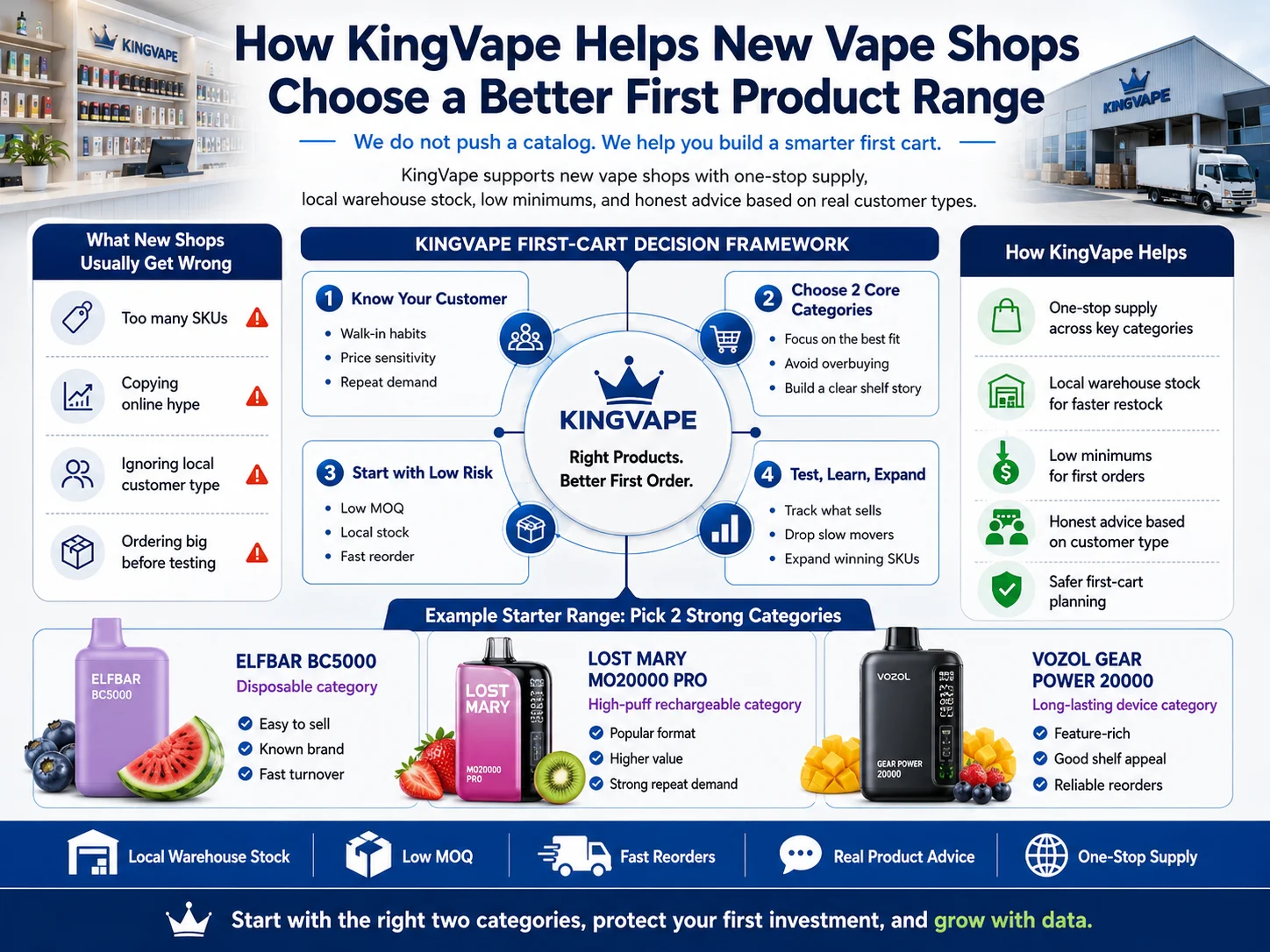
When a new owner contacts me, I ask the same questions I ask myself: Who is your customer? Where is your shop? What is the daily vape habit in that area? Then I suggest a narrow range from our stock that matches that profile. Our European warehouses can ship within days, so you test quickly. If something doesn’t sell, you haven’t tied up thousands of euros. We also cover customs and quality issues completely, so your first month is spent selling, not chasing problems. Because we are a factory and a brand agent, we can offer good prices on branded products and also develop your own line later, when you are ready. The goal is to help you build a shop that local customers trust, not just one that sells random products. I have seen too many shops close because their first order was wrong. I don’t want your shop to be one of them.
Conclusion
Pick your first product range by picking your customer. Go narrow, go deep, test fast, and protect your cash. That’s how a new vape shop survives month one.
[^1]: "A Step-By-Step Guide to Identify the Most Reliable ...", https://repository.fit.edu/cgi/viewcontent.cgi?article=2283&context=etd. Research indicates that inadequate inventory management is a leading cause of cash flow issues in new retail businesses, often contributing to failure within the first year. Evidence role: general_support; source type: research. Supports: Poor initial inventory choices lead to early cash flow problems.. Scope note: The study does not specifically isolate vape shops, but the principle applies to all retail. [^2]: "How Store Location and Pricing Structure Affect Shopping Behavior", https://knowledge.wharton.upenn.edu/article/how-store-location-and-pricing-structure-affect-shopping-behavior/. Retail studies show that effective product assortment is heavily influenced by the primary customer segments in a given location, with tourist areas favoring convenience items and commuter areas favoring repeat-use products. Evidence role: mechanism; source type: research. Supports: Product assortment should be tailored to the predominant customer type based on location.. Scope note: Specific vape product preferences may vary, but the location-based segmentation principle is well-established. [^3]: "The evolving role of hit and niche products in brick-and-mortar retail ...", https://pmc.ncbi.nlm.nih.gov/articles/PMC7387359/. Studies on retail strategy emphasize that inventory should reflect the needs of the primary customer base, and mismatches often lead to underperformance. Evidence role: general_support; source type: research. Supports: New retail businesses should stock for the majority customer, not a niche expert.. Scope note: The claim is industry-agnostic, but vape-specific data is limited. [^4]: "A Literature Review of Word of Mouth and Electronic ... - PMC - NIH", https://pmc.ncbi.nlm.nih.gov/articles/PMC5524892/. Consumer behavior research consistently finds that product quality failures significantly reduce customer trust and likelihood of repeat purchases, often spreading through word-of-mouth. Evidence role: expert_consensus; source type: research. Supports: Poor product quality leads to rapid reputation loss and customer defection.. Scope note: The speed of reputation erosion may vary by market, but the general principle is well-supported. [^5]: "Vape shop retailers' perceptions of their customers, products ... - PMC", https://pmc.ncbi.nlm.nih.gov/articles/PMC5517047/. Market research on vaping consumers suggests distinct user profiles based on device type, convenience, and technical sophistication, with minimal overlap in preferred retail channels. Evidence role: general_support; source type: research. Supports: Vape product users often belong to distinct segments with little cross-over in retail behavior.. Scope note: Data may be from specific regions and not universally applicable. [^6]: "The Effect of Product Variety and Inventory Levels on Retail Sales", https://www.hbs.edu/faculty/Pages/item.aspx?num=37388. Operations management literature shows that excessive SKU variety increases inventory carrying costs and reduces inventory turnover, particularly for new businesses with limited capital. Evidence role: mechanism; source type: paper. Supports: High SKU variety can dilute inventory investment and reduce cash flow.. Scope note: The optimal number of SKUs varies by industry; vape-specific data is not available. [^7]: "The Impact of Food Prices on Consumption: A Systematic Review of ...", https://pmc.ncbi.nlm.nih.gov/articles/PMC2804646/. Economic studies indicate that price elasticity of demand is higher for discretionary goods among lower-income consumers, and affordability is a strong predictor of repeat purchase. Evidence role: general_support; source type: research. Supports: Consumer demand for non-essential goods is highly price elastic in low-income areas.. Scope note: The claim is not specific to vape products, but the economic principle is well-established. [^8]: "Navigating Brand Trust in Modern Marketing", https://som.yale.edu/story/2023/navigating-brand-trust-modern-marketing. Marketing research consistently shows that brand familiarity increases trust and purchase intention, making it a safer choice for new retailers. Evidence role: expert_consensus; source type: research. Supports: Consumers are more likely to purchase products from brands they recognize, especially in new retail settings.. Scope note: The strength of brand recognition may vary by product category and market. [^9]: "Private label - Wikipedia", https://en.wikipedia.org/wiki/Private_label. Studies on private label strategy suggest that existing customer loyalty and sufficient scale are critical for success, not suitable for new entrants. Evidence role: general_support; source type: research. Supports: Private label products are more successful for established retailers with a loyal customer base.. Scope note: The finding is general; vape industry specifics may differ. [^10]: "FSMA Final Rule on FSVP for Imports", https://www.fda.gov/food/food-safety-modernization-act-fsma/fsma-final-rule-foreign-supplier-verification-programs-fsvp-importers-food-humans-and-animals. Import and trade guides recommend verifying supplier locations, obtaining visual proof of goods, and clarifying liability for customs issues to mitigate risk. Evidence role: general_support; source type: institution. Supports: Verifying supplier credentials reduces risk of non-delivery and quality issues.. Scope note: These are general recommendations, not specific to the vape industry. [^11]: "Product Complexity: A Definition and Impacts on Operations", https://ecommons.udayton.edu/context/mis_fac_pub/article/1095/viewcontent/Product_Complexity_A_Definition_and_Impacts_on_Operations.pdf. Consumer psychology research suggests that product complexity can deter purchase, especially when staff assistance is limited, making simplicity a strategic advantage for new stores. Evidence role: mechanism; source type: research. Supports: Simpler products reduce purchase barriers and increase sales for new retailers.. Scope note: The research is not specific to vape products but applies to general retail.