
Starting a vape wholesale business is confusing. Picking too many or too few products can kill your cash flow and leave you with dead stock before you even begin.
A small wholesaler should start with a focused inventory of 15-25 SKUs[^1]. This means choosing 3 to 5 top-selling models from one or two reputable brands, and stocking their 5 to 8 most popular flavors. This approach minimizes financial risk and helps you learn your market fast.
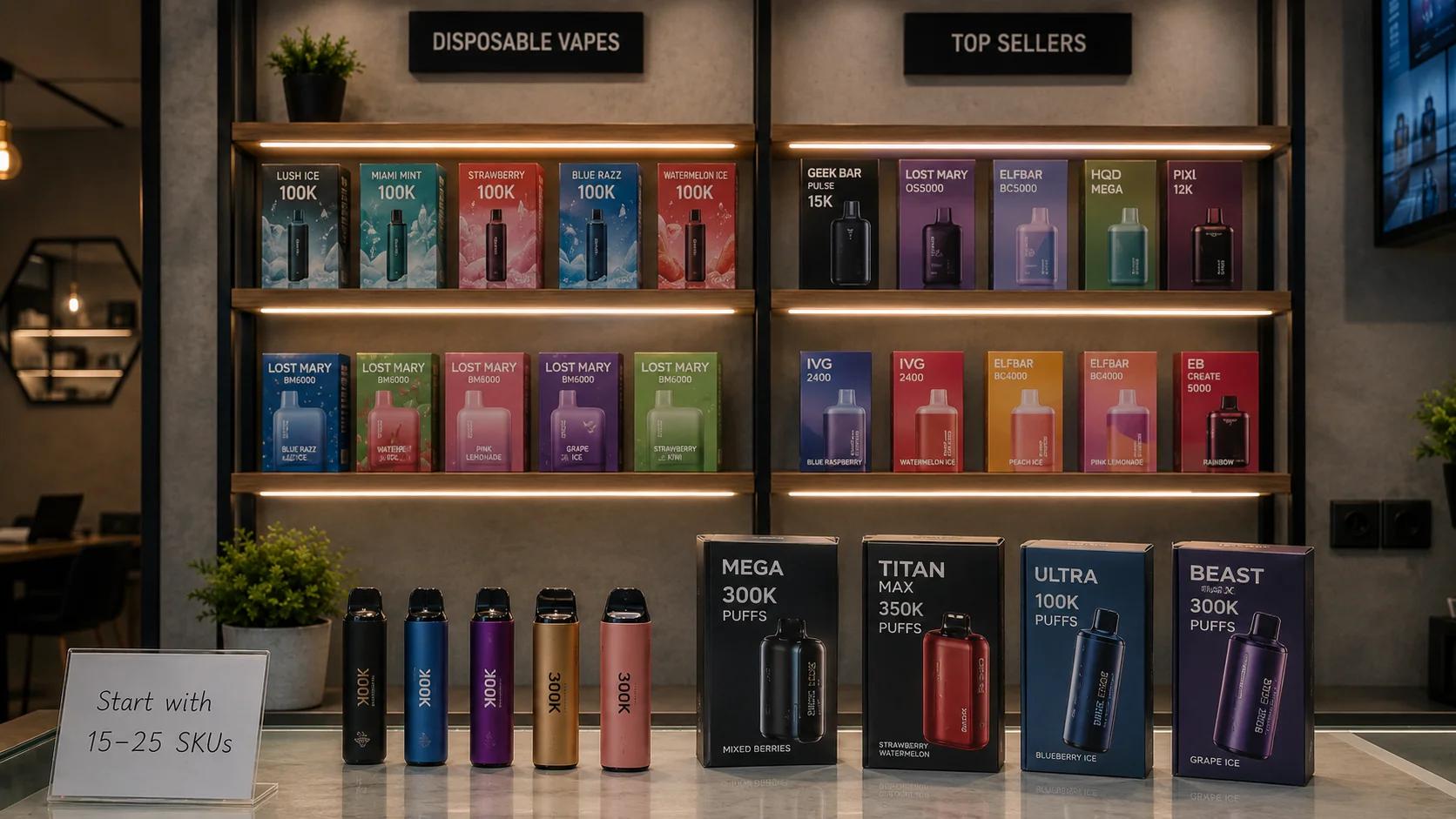
This number might seem small, but it's a strategic starting point. Your goal isn't to have every product imaginable. Your goal is to have products that sell quickly, so you can reinvest your money and grow. Having too much variety sounds good, but it often leads to disaster for new businesses. But how do you pick those first few winning SKUs? It’s not about guessing. Let's break down the process to help you make smart choices from day one.
Why is Finding the Right SKU Count so Critical for New Wholesalers?
You're ready to invest, but you fear making a costly mistake. Stocking the wrong vape products means your money is trapped, gathering dust on a shelf. This can stop your business cold.
It's all about cash flow. The right number of SKUs ensures your money is working for you, not just sitting there. A focused inventory lets you learn what sells, restock the winners quickly, and grow your capital instead of managing a graveyard of unsold products.
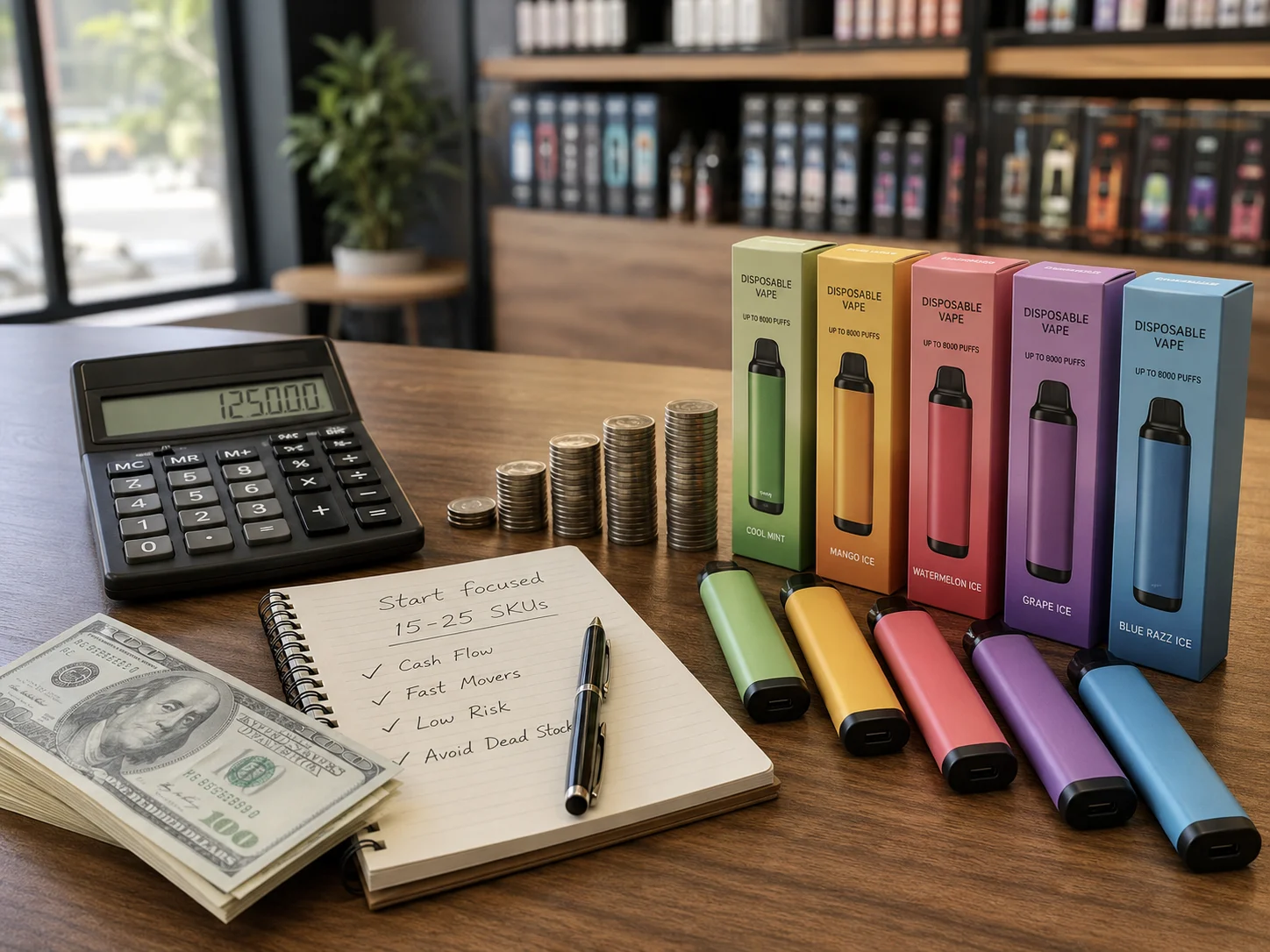
When you first start a business, your money is your most important tool. Every euro or dollar has a job to do. If it's tied up in products that aren't selling, it can't do its job. This is the biggest reason why many small wholesale businesses fail[^2]. They buy too wide, and their cash gets stuck.
The real secret to making money in wholesale isn't just the profit margin on a single item. It's the speed at which you can sell your inventory and reinvest the money. We call this capital turnover[^3].
Think about it this way:
- Scenario A: You sell a product with a 40% profit margin, but it takes you six months to sell your stock. You make a profit twice a year.
- Scenario B: You sell a product with a 20% profit margin, but you sell out your stock every month. You make a profit twelve times a year.
Which business is more successful? Scenario B, by a long shot. The business turning over its capital faster is the one that will grow. A smaller, more focused SKU count is the key to achieving this. You can quickly identify your bestsellers, double down on them, and keep your money moving. I remember one client who was just starting out. He was excited and bought small quantities of 50 different cheap models. A year later, he told me he still had 40 of those models sitting in his garage. He had run out of cash to restock the 10 models that actually sold well. He learned the hard way that "variety" doesn't pay the bills. Selling does.
Here is how these two strategies compare over a year with a starting capital of €5,000:
| Metric | High SKU / Slow Turnover Strategy | Focused SKU / Fast Turnover Strategy |
|---|---|---|
| Initial SKUs | 50 different models | 15 SKUs (3 models, 5 flavors each) |
| Profit Margin | 40% (on cheaper, slower items) | 20% (on popular, authentic items) |
| Turnover Speed | Every 6 Months | Every 1 Month |
| Annual Turnovers | 2 | 12 |
| Annual Profit | €5,000 x 40% x 2 = €4,000 | €5,000 x 20% x 12 = €12,000 |
| End Result | Less profit, lots of dead stock | Much higher profit, clean inventory |
This is why we always tell new wholesalers to start small and smart. Focus on a few proven winners. Learn your market, then expand. Don't let your startup capital become a museum of unsold vapes.
What Really Separates a Good Vape from a Bad One?
You see two similar-looking vapes, but one is half the price. It's so tempting to go for the cheaper one to maximize your profit. But this is the most dangerous trap in this business.
Look beyond the price tag. You must check the authenticity, the quality of the materials inside, and the reliability of the supplier. A genuine, quality vape uses a good lithium battery and tested e-liquid. A fake one uses the cheapest materials possible, leading to a terrible user experience and safety risks[^4].
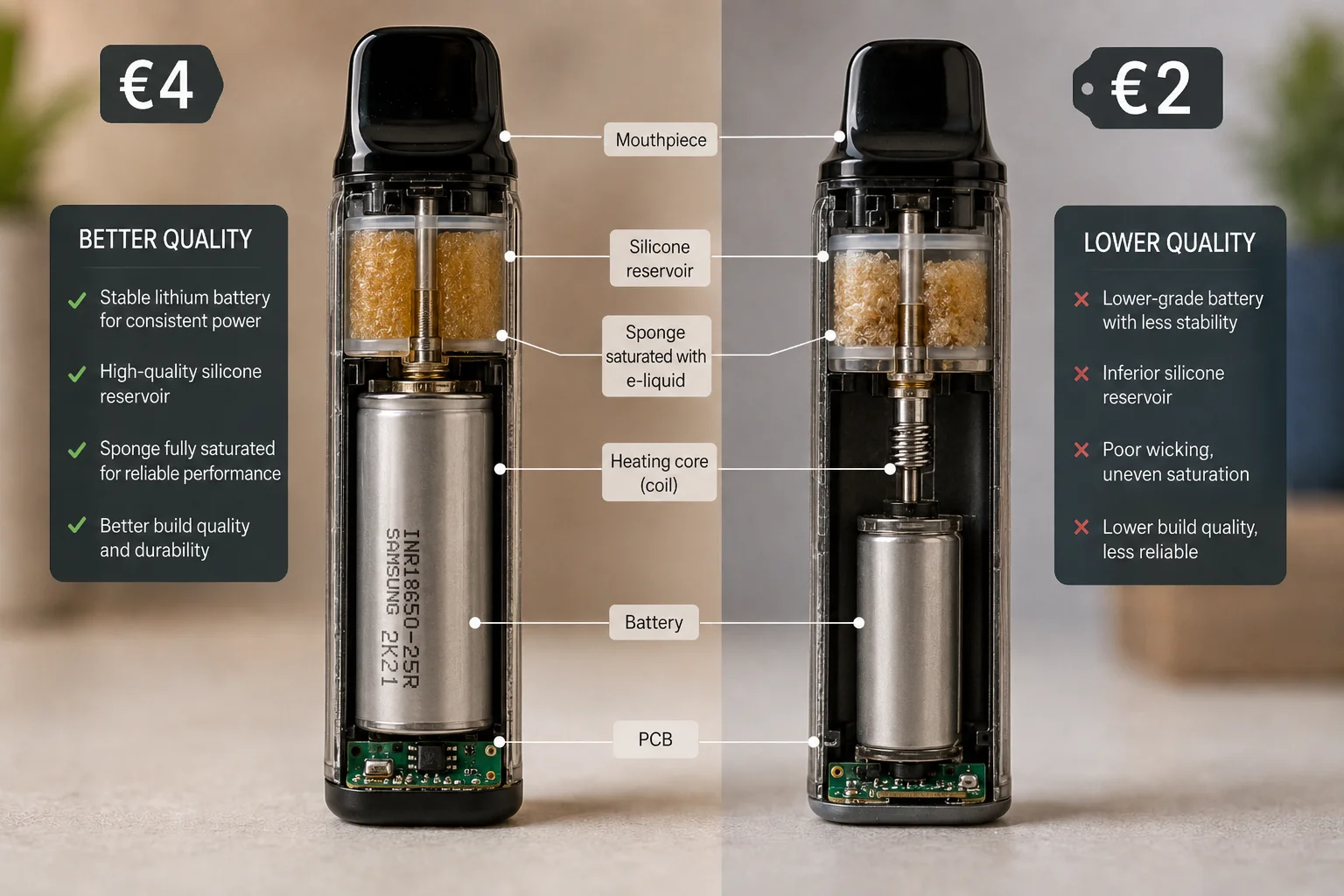
When we started in this industry back in 2011, we decided we would only sell 100% original, authentic products. We want to build long-term businesses with our clients, not make a quick euro on a single bad deal. Over the years, we've seen exactly what goes into a cheap counterfeit vape, and it's not pretty. The price difference between a real product and a fake isn't magic; it comes from cutting corners on things that matter.
Here's what you're actually paying for with a quality product:
-
The E-liquid: This is the most important part. It's what your customers inhale into their bodies. Reputable brands use food-grade ingredients and have strict quality control to ensure the flavor is consistent and the nicotine level is accurate. Fake products use mystery oils from dirty, unregulated workshops. The taste is harsh, inconsistent, and you have no idea what chemicals are in it. You think you save 2 euros, but you risk your customer's health and your reputation.
-
The Battery: This is the biggest cost difference. Good brands use stable, rechargeable lithium batteries, similar to what's in your phone. They hold a charge, deliver consistent power, and work in the cold. Cheap fakes use manganese batteries[^5]. These are terrible. They die quickly, you might spend hours charging them for only a few minutes of use, and they often fail completely in cold weather. There is nothing worse for a customer than their vape dying right when they need it. A good battery ensures a good experience from the first puff to the last.
-
The Build Quality and Coil: Good products are designed to prevent leaking and the dreaded "burnt taste." The atomizer coil is made to last for the entire life of the e-liquid. Fakes often use poorly designed coils that burn out quickly, making the last half of the vape taste like burnt cotton. They also leak, creating a mess for your customer.
The easiest first check? Just hold it. A genuine product with a good battery and quality components has some weight to it. A fake feels light and cheap, like a plastic toy.
| Feature | Authentic Brand Product | Cheap Counterfeit Product |
|---|---|---|
| E-Liquid | Food-grade, lab-tested, consistent flavor | Unknown source, harsh taste, health risk |
| Battery | A-grade Lithium, stable, long-lasting | Manganese or low-grade, dies fast, fails in cold |
| Coil/Atomizer | Designed for longevity, consistent taste | Burns out quickly, causes "burnt taste" |
| Build Feel | Solid, has some weight, good finish | Light, feels cheap and hollow, poor finish |
| Safety Risk | Low, with built-in protections | High, risk of failure or even worse |
| Business Impact | Happy, repeat customers, strong reputation | Customer complaints, returns, lost reputation |
So when you see that 2-euro price tag, don't think "what a great deal." Ask yourself, "what did they remove to get it that cheap?" The answer is always quality, safety, and reliability.
What are the Biggest Money-Losing Traps for New Vape Wholesalers?
Excitement can make new sellers blind to obvious dangers. Many people jump in chasing what looks like easy profit, only to find themselves losing their entire investment. Are you about to make these mistakes?
The biggest traps are chasing the absolute lowest price and getting obsessed with huge puff counts. These two things almost always lead you to buying junk, getting scammed, or stocking products that give your customers a terrible experience, destroying your business before it starts.
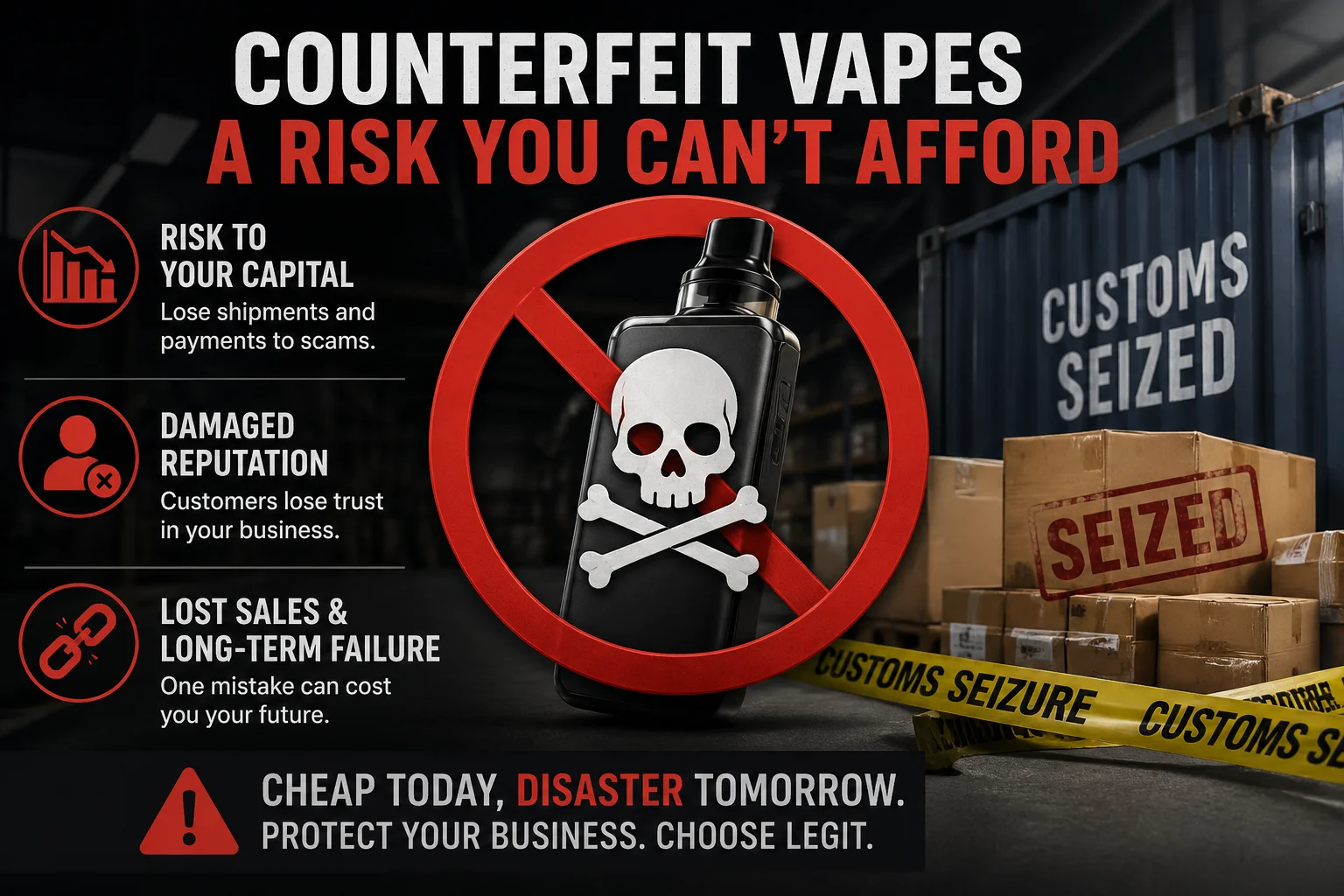
Let's talk about these traps in detail, because we see people fall into them every single week.
Trap 1: The "Too Good to Be True" Price The market for fakes is huge[^6], especially for popular brands like JNR in France. We get inquiries all the time from new buyers saying, "I found a supplier selling JNR for 2 euros!" We have to tell them the hard truth: the factory price for an original JNR is over 4 euros. It is impossible to buy a real one for 2 euros. So what is it? It's either a very poor-quality counterfeit or an outright scam.
Here’s how the scam works: A "supplier" offers you an unbelievable price. You get excited, thinking you've found a secret source. They pressure you to pay quickly before the "deal" is gone. You send a bank transfer for a few thousand euros. Then, the supplier disappears. Their phone number is disconnected. Their chat account is deleted. Your money is gone forever.
Even worse, these sellers of fakes are operating illegally. They don't have licenses. They can be arrested and shut down at any moment. Imagine you pay for an order, and the next day their workshop gets raided by the police. You will never see your goods or your money again. We get heartbreaking messages from people asking us to help them contact a Chinese number to get their money back. But it's impossible. Once you fall for the scam, the money is lost. Don't let greed blind you. If a price is illogical, it's a trap.
Trap 2: The Puff Count Madness This is a more recent trend that is just as silly. The market is in a crazy race for bigger numbers. We've seen vapes advertised with 50,000, 100,000, even 300,000 puffs. This is just a marketing game. It's not real.
Think about the basic physics. A disposable vape is a small, handheld device. Its size limits how much e-liquid and what size battery it can hold. From years of experience, we know that 1ml of e-liquid gives you about 200-300 puffs[^7]. The largest, most practical disposable vapes might hold 20-25ml of liquid. So, the maximum realistic puff count is around 5,000 to 7,500. Anything you see advertised above 20,000 puffs is almost certainly a made-up number[^8].
Professionals don't look at the puff count on the box. They look at the milliliters (ml) of e-liquid inside. That is the true measure of a vape's lifespan. Furthermore, the atomizer coil—the part that heats the liquid—has a limited life. It will start to taste burnt long before you can smoke 50,000 puffs, even if there was enough liquid.
Don't be the rookie who gets fooled by big numbers. Be the smart professional who understands what really matters. When you stock your shop, focus on products from honest brands with realistic specs. You'll give your customers a better experience and build a more credible business.
How Do I Start Selling Vapes Without Betting My Life Savings?
You want to get into this business, but you're terrified of ordering thousands of units of the wrong product. What if you spend 10,000 euros and nobody buys it? There is a much safer, smarter way to begin.
Start with a small, local test order from an overseas warehouse. We offer a Minimum Order Quantity (MOQ) of just 50 assorted units from our German warehouse. This lets you test your market for under 400 euros, with fast delivery in 1-5 days across the EU.
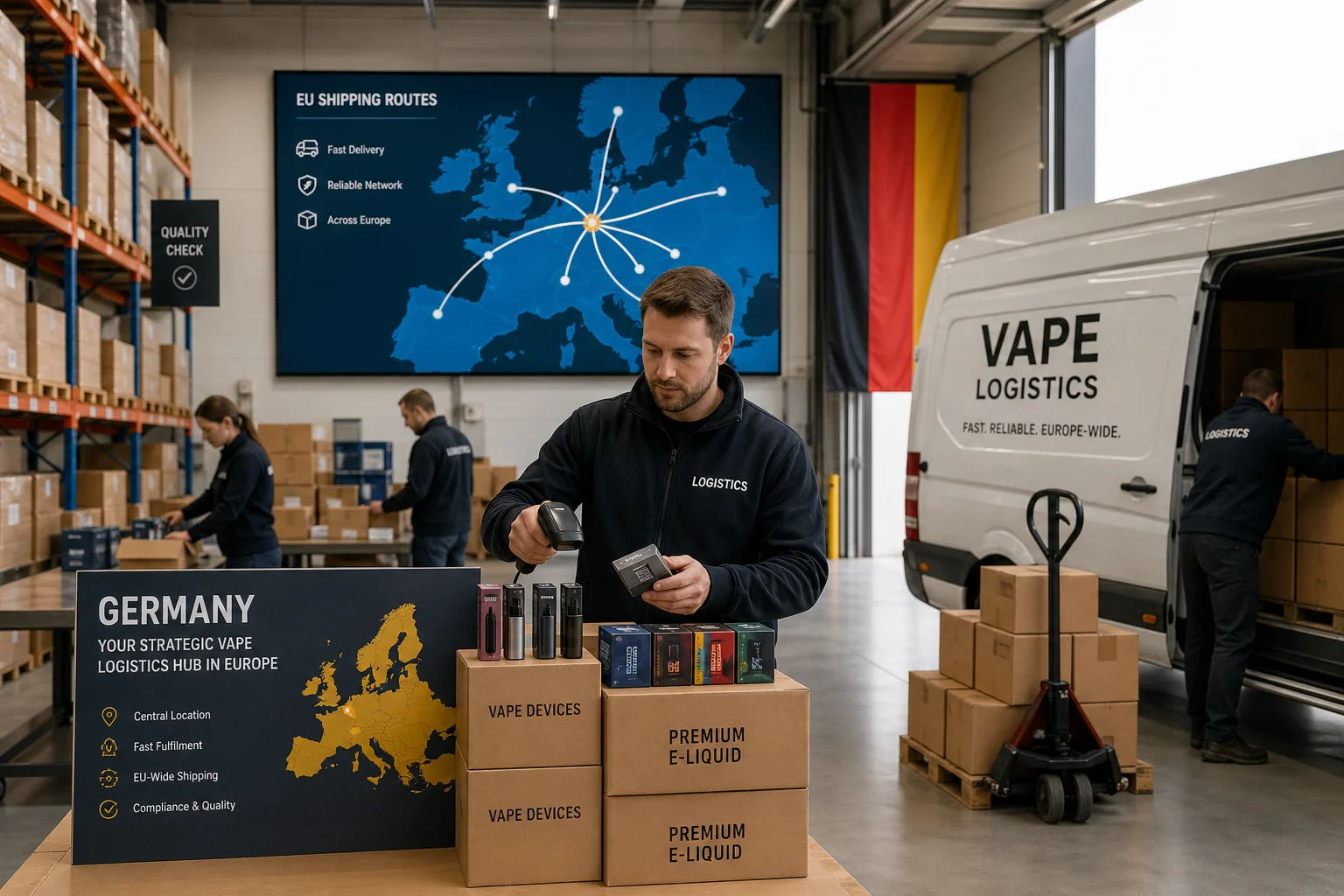
We set up our overseas warehouses in Germany and the US for this exact reason. As a 15-year veteran in exporting, we saw too many new entrepreneurs get hurt by taking huge risks. So, we decided to take on the risk for them. We use our capital to order massive quantities from the factories—often over 200,000 units at a time—to get the best possible price. We handle the complex shipping, the customs clearance, and the warehousing risks.
This allows you, the new wholesaler, to start in the safest way possible. You don't need a huge budget. You don't have to worry about your shipment being seized by customs. You can get your products in just a few days and start selling immediately. This lets you test different brands and flavors, see what your local customers actually want, and use your profits to grow. We did the hard part so you can focus on the most important thing: making sales.
Here are the two paths for sourcing, based on your business size:
| Sourcing Path | The Smart Start (New / Small Wholesalers) | Scaling Up (Experienced / Large Wholesalers) |
|---|---|---|
| Best For | Orders under 2,000 units. | Orders over 2,000 units. |
| Source | Our Germany Warehouse (or US) | Directly from China |
| MOQ | 50 units (under €400) | 2,000+ units |
| Delivery Time | 1-5 days (within EU) | 2-4 weeks (or more) |
| Customs Risk | Zero. We handled it. | Your responsibility. |
| Pros | Low risk, small investment, fast delivery, test the market safely. | Best price, more selection, higher profit margin. |
| Cons | Slightly higher unit price. | High risk, large investment, long wait, customs issues. |
For larger, experienced wholesalers ordering from China, there's one rule you must follow: always purchase full customs seizure insurance[^9]. It will make your shipping cost a bit higher per kilogram, but it is essential. These products operate in a legal gray area in many places[^10]. If your shipment gets seized and you don't have insurance, your entire investment is gone. With full insurance, the shipping agent or supplier will resend a whole new shipment at no extra cost to you.
A crucial warning: Insurance does NOT work for secondary customs clearance. Some EU countries like Denmark, Sweden, Finland, and Estonia will inspect packages again even after they have already cleared customs[^11] in another EU country (like Germany or the Netherlands). If a shipment is seized during this second check, insurance will not cover it. For these countries, the safest method is to ship to a nearby safe country (like Germany) and arrange for you or a friend to transport it across the border. Yes, there is still risk, but it's much lower.
Business is about balancing risk and reward. If this business were easy with zero risk, there would be no profit in it. The barriers are what create the opportunity[^12]. We are here to help you navigate those barriers intelligently.
Conclusion
Start smart, not big. Focus on authentic, in-demand products and place a low-risk trial order. Your goal is fast capital turnover, not the cheapest price. That is how you build a real, lasting business.
[^1]: "How many SKU's are 'too much' for a small business to manage?", https://www.reddit.com/r/InventoryManagement/comments/1hj9apd/how_many_skus_are_too_much_for_a_small_business/. Sources on retail and inventory management often advise new businesses to start with a limited, curated selection of stock-keeping units (SKUs) to optimize cash flow, reduce the risk of dead stock, and accelerate market learning. Evidence role: general_support; source type: education. Supports: The claim that a focused, limited SKU count is a strategic approach for new businesses to manage cash flow and reduce risk.. Scope note: The source will likely provide general principles for retail startups rather than specific numbers for the vape wholesale industry. [^2]: "Why Do Businesses Close? - SBA Office of Advocacy", https://advocacy.sba.gov/2018/05/01/why-do-businesses-close/. Studies on business failures, such as those conducted by the U.S. Small Business Administration or various academic institutions, consistently identify poor cash flow management as one of the primary reasons for business failure, often ranking higher than lack of profitability. Evidence role: statistic; source type: government. Supports: The claim that poor cash flow management is a leading cause of business failure.. Scope note: The source will likely list cash flow issues as a top reason among several, not necessarily 'the biggest' reason in isolation for all wholesale businesses. [^3]: "Capital Turnover | Formula + Calculator - Wall Street Prep", https://www.wallstreetprep.com/knowledge/capital-turnover/. Financial and business resources define capital turnover as a financial ratio that measures a company's efficiency at using its capital to generate sales revenue. A higher ratio indicates that the company is using its investment capital more effectively. Evidence role: definition; source type: encyclopedia. Supports: The definition of capital turnover and its importance as a measure of a company's efficiency in using its capital to generate sales.. [^4]: "FDA Warns Firms Illegally Selling E-Cigarettes Resembling ...", https://www.fda.gov/tobacco-products/ctp-newsroom/fda-warns-firms-illegally-selling-e-cigarettes-resembling-products-smart-technology-including-phones. Research and public health advisories have identified significant safety risks associated with counterfeit vaping products, including the presence of harmful contaminants in e-liquids and the use of low-quality batteries that may fail or malfunction. Evidence role: general_support; source type: research. Supports: The claim that counterfeit vapes pose safety risks due to unregulated materials and manufacturing.. [^5]: "[PDF] The Distribution and Detection Issues of Counterfeit Lithium-Ion ...", https://drum.lib.umd.edu/bitstreams/c9df9ecc-4e1d-4674-985a-54aa29b49238/download. Technical comparisons of battery chemistries show that while inexpensive, primary (non-rechargeable) manganese-based batteries typically offer lower energy density and poorer performance in cold temperatures compared to the lithium-ion cells used in most modern rechargeable electronics. Evidence role: mechanism; source type: paper. Supports: The claim that manganese batteries have different performance characteristics (e.g., lower energy density, different discharge profile) compared to lithium-based batteries commonly used in quality consumer electronics.. Scope note: The source will describe general battery characteristics, not necessarily confirm their specific use in counterfeit vapes, which would require a product teardown analysis. [^6]: "Than Two Million Illicit Vaping Products Seized in Nationwide Sweep", https://www.justice.gov/opa/pr/more-two-million-illicit-vaping-products-seized-nationwide-sweep. Reports from organizations such as the Organisation for Economic Co-operation and Development (OECD) and various national customs agencies document the substantial global trade in counterfeit goods, with electronics and other consumer products being frequently targeted. Evidence role: statistic; source type: institution. Supports: The claim that the market for counterfeit goods, including e-cigarettes, is a significant global problem.. Scope note: Sources may provide data on counterfeit goods in general or electronics broadly, and may not have specific, up-to-date figures solely for the vape market. [^7]: "E-cigarette use behaviors and device characteristics of daily ... - PMC", https://pmc.ncbi.nlm.nih.gov/articles/PMC7668279/. While puff count can vary based on user behavior and device settings, industry analysis and product testing generally estimate that 1ml of e-liquid yields between 200 and 300 puffs, depending on the duration and intensity of the inhalation. Evidence role: statistic; source type: research. Supports: The claim that there is a generally accepted range for the number of puffs that can be obtained from 1ml of e-liquid.. [^8]: "Market survey of disposable e-cigarette nicotine content and e-liquid ...", https://pmc.ncbi.nlm.nih.gov/articles/PMC9482302/. Technical analyses and consumer reports note that the puff counts advertised on many disposable vapes are often inflated for marketing purposes and may not be achievable given the physical limitations of the device's e-liquid capacity and battery life. Evidence role: general_support; source type: other. Supports: The claim that extremely high puff counts advertised on disposable vapes are physically implausible.. Scope note: The source will likely be an industry publication or tech review rather than a formal academic paper. [^9]: "Penalties Program - U.S. Customs and Border Protection", https://www.cbp.gov/trade/programs-administration/penalties. International trade and logistics resources explain that customs seizure insurance is a specialized policy offered by some freight forwarders or third-party insurers to protect shippers against the financial loss of goods confiscated by customs authorities. Evidence role: definition; source type: other. Supports: The claim that a specific type of insurance exists to cover losses from customs seizures.. Scope note: The source will define the insurance product but is unlikely to state that it is 'essential' for all vape shipments, as that is a business risk assessment. [^10]: "E-Cigarette Ban & Regulation: Global Status as of February 2021", https://extranet.who.int/fctcapps/fctcapps/fctc/kh/TIInterference/e-cigarette-ban-regulation-global-status-february-2021. Global public health organizations, such as the World Health Organization, and tobacco control research groups maintain resources that document the wide-ranging and evolving regulatory approaches to e-cigarettes worldwide, which span from complete bans to regulated consumer markets. Evidence role: historical_context; source type: institution. Supports: The claim that the legal and regulatory status of e-cigarettes is inconsistent and varies widely between jurisdictions.. [^11]: "European single market - Wikipedia", https://en.wikipedia.org/wiki/European_single_market. While the EU single market ensures the free movement of goods, European Commission and national customs guidance clarifies that member states may still carry out specific controls to enforce national rules on prohibited or restricted goods, such as those related to public health, particularly for products like tobacco and e-cigarettes. Evidence role: mechanism; source type: government. Supports: The claim that member states can perform additional checks on goods moving within the EU, especially for regulated products.. [^12]: "Barriers to entry - Wikipedia", https://en.wikipedia.org/wiki/Barriers_to_entry. In economics, the concept of 'barriers to entry' describes obstacles that make it difficult for new competitors to enter a market. These barriers can protect incumbent firms from competition, allowing them to sustain higher profitability. Evidence role: definition; source type: encyclopedia. Supports: The claim that barriers in a market are linked to profit opportunities..