
You see a popular vape online for half the price. It feels like a golden opportunity, but it could be a trap that costs you everything. Learning to spot fakes is the only way to protect your money and your business.
To spot a fake vape, look for three red flags: an unbelievably low price, a supplier who only pushes for payment, and a QR code that doesn't lead to the brand's official website. A real supplier wants to be your partner for the long run, not just make a quick sale.

You want to build a real business, right? Not just make a quick buck and disappear. That's what we want too. We've been in this business since 2011, and we've seen too many people get burned by deals that were too good to be true. Let’s break down how you can avoid these traps and build something that lasts.
Why Is a Super-Cheap Vape the Most Expensive Mistake?
A vape for 2 euros looks like an easy win. But what if the supplier vanishes after you pay? Or you get a box of junk that nobody wants? Understanding the hidden costs of "cheap" is your first step to success.
A cheap vape carries huge risks. You could lose your whole payment if the supplier is a scammer or gets arrested. Even if you get the goods, poor quality leads to customer complaints and a lost reputation, costing you more than buying genuine products ever would.
I get calls all the time from buyers who got scammed. Just last week, a guy from France asked if I could help him contact a Chinese number. He told me, "I paid this guy 2,000 euros for 1,000 JNR vapes. Now he's blocked me." The price was 2 euros a piece. We know the real factory price for a genuine JNR isn't even close to that, maybe double. He fell for the cheap price, and now his money is gone. This happens every day.
The Real Risks of "Cheap"
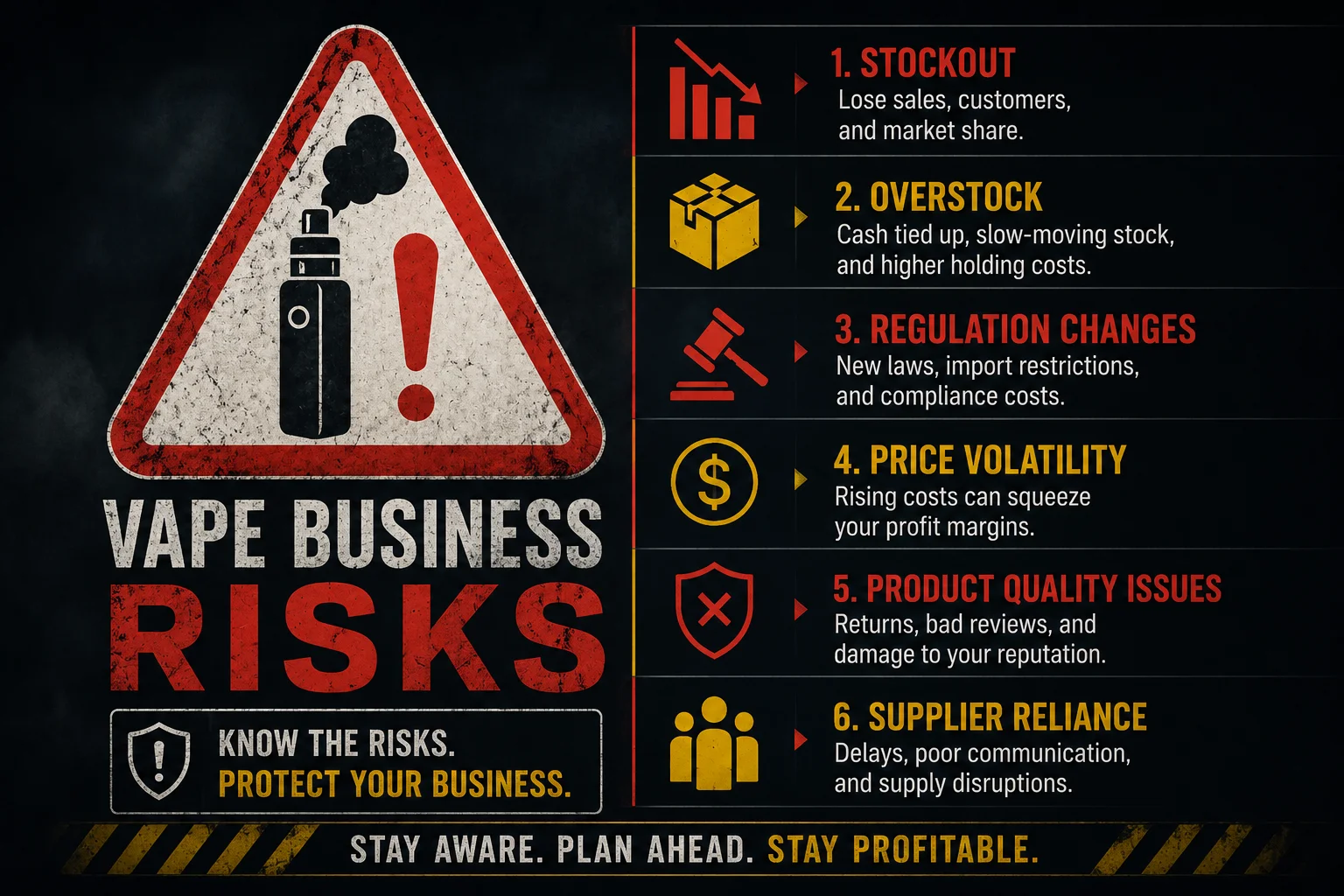
When you buy fakes, you are not saving money. You are buying risk. There are three big risks you take on.
-
Financial Risk: Money Gone, Goods Gone Fake vape operations are illegal.[^1] They don't have business licenses or tobacco permits. They are always at risk of being shut down by the police[^2]. Imagine you pay your supplier, and the next day their workshop gets raided. The person you paid is now in jail. Your money is gone, and your products are never coming. You are left with nothing. This is the biggest and most common disaster for people who chase low prices.
-
Quality Risk: The Cost of Junk Okay, let's say you get lucky and the goods arrive. What did you actually buy? To make a product that cheap, corners must be cut.
- The E-liquid: We're talking about something people inhale. Health and safety should be number one. But for fakes, profit is number one. They use the cheapest e-liquid from unknown sources. The taste is bad, it's harsh on the throat, and you have no idea what chemicals are in it[^3].
- The Battery: A good vape uses a quality lithium battery. It holds a charge, works in the cold, and is stable. Fakes use the worst manganese batteries.[^4] You might charge it for hours and it dies after five minutes. In cold weather, it might not work at all.[^5] It's a terrible experience for your customer.
-
Reputation Risk: The Price of Lost Trust When a customer buys a bad vape, they don't blame the fake brand. They blame you. All the money you might make from a cheap batch can be wiped out by returns and complaints. Worse, you lose your reputation. In business, especially a long-term one, trust is your most valuable asset. Once it's gone, it's almost impossible to get back.
How Can You Tell a Real Supplier from a Scammer?
Online, everyone claims to be a direct factory. So how do you know who to trust with your money and your business? You need to judge them by their actions and their questions, not by their prices.
A real supplier acts like a business partner. They ask about your market, advise on customs risks, and want a long-term relationship. A scammer just creates false urgency, pushes for a quick payment, and avoids detailed questions. Their only goal is to get your money.

When a new client comes to us, especially someone from a country with tricky customs like Denmark or Sweden, my first job isn't to sell them something. My first job is to warn them. I tell them, "Your country has a high risk of customs seizure on the second clearance.[^6] It's safer to ship to a neighboring country like Germany and arrange transport from there." A scammer would never do that. They'd just say, "No problem!" take the money, ship it, and when it gets seized, it's your problem. We want you to get your goods, sell them, make money, and come back for more. That's a real business cycle. A scammer just wants to make a one-time score.
The Real vs. Scammer Checklist
Here’s how to tell the difference when you're talking to a potential supplier.
| What a Real Supplier Does | What a Scammer Does |
|---|---|
| Asks about your business and market. | Only asks, "How many pieces?" |
| Explains potential risks (like customs). | Says, "Don't worry, 100% safe." |
| Wants to build a long-term relationship. | Pushes you to pay immediately. |
| Can provide real, recent tracking numbers. | Gives excuses or fake documents. |
| Can show you a live video of the stock. | Only sends you generic pictures. |
| Has matching company names on PI & bank account. | Uses different names or personal accounts. |
Another trick we see is fake documents. Some scammers put the "Made-in-China.com" logo on their Proforma Invoice (PI). A new buyer might think they are dealing with the official platform, but Made-in-China.com is just a B2B platform, not a trading company. Or, the company name on the PI is a real vape company, but the bank account you're told to pay is a personal account or a completely different company. Always check that the company name on the invoice matches the beneficiary name on the bank account.
How Do You Verify if a Vape is Actually Genuine?
So the package has a QR code on it. That means it's real, right? Not so fast. Scammers have gotten good at faking everything, including the verification process. You have to be smarter than them.
Don't just scan the QR code and trust the website that pops up. Find the brand's official website yourself through a search engine. Then, manually type the verification code from the package into the official site's verification page. This is the only way to be sure.
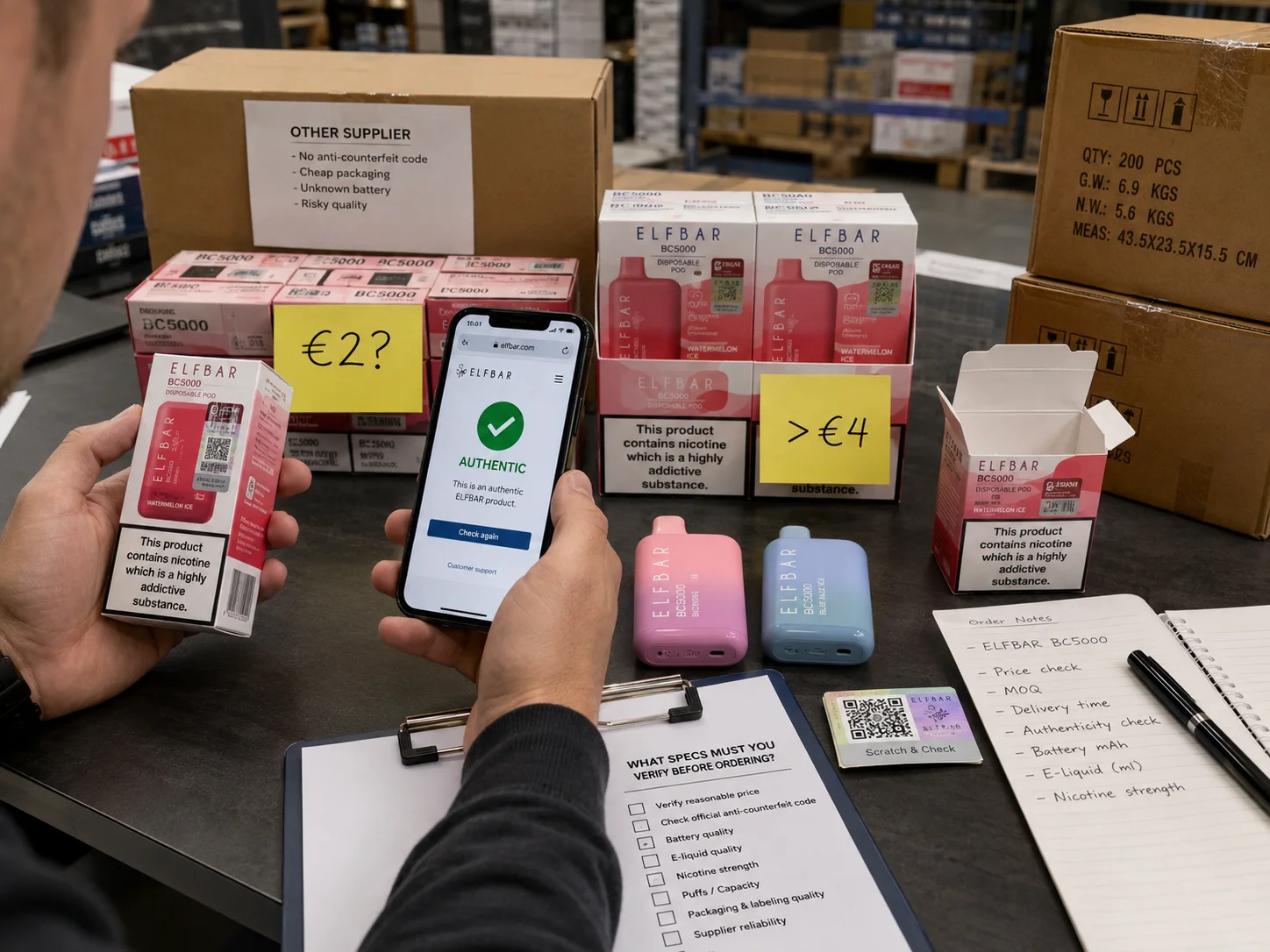
The most common QR code trick is simple: the scammer creates a fake website that looks like the real one[^7]. When you scan their QR code, it takes you to their fake site. You enter the code, and a message pops up: "Congratulations, your product is genuine!" It's a complete lie. The only way to beat this is to bypass their QR link. For example, if you're checking an Elfbar, you need to go to elfbar.com yourself, find the verification page, and type in the code. Don't trust any link the QR code gives you.
Your Physical Inspection Checklist
Beyond the QR code, use your senses. A genuine product and a fake one feel different.
- Check the Packaging: Real brands have high-quality printing. Look for blurry text, spelling mistakes, or colors that look off. Fake boxes often feel flimsy and cheap.
- Check the Product Itself:
- Weight: This is a big one. Fakes use cheap, light materials. A genuine product will have a solid, substantial feel to it. A fake feels light and hollow.[^8]
- Build Quality: Look at the seams. Are they clean? Is the charging port straight? Does it feel solid or does it rattle?
- Test the Performance: If you get a sample, don't just take one puff.
- Does it taste burnt (we call this
糊味, orhú wèi) after a few puffs?[^9] A bad atomizer coil is a dead giveaway. - Does the battery die very quickly after a full charge?
- Is the flavor consistent, or does it fade fast?
- Does it taste burnt (we call this
A genuine product is built for a good experience from the first puff to the last. A fake is built to look good enough to sell, but that's it.
Why is "Puff Count" the Biggest Lie in the Vape Industry?
You see vapes advertised with 30,000, 50,000, even 300,000 puffs. You feel pressured to stock them to compete, but it just sounds impossible. That's because it is.
Puff count is mostly a marketing game.[^10] A disposable vape's physical size limits its battery and e-liquid capacity. The real metric is the e-liquid volume in milliliters (ml). A good rule of thumb is 1ml provides about 200 puffs[^11]. Any number beyond that is just for show.
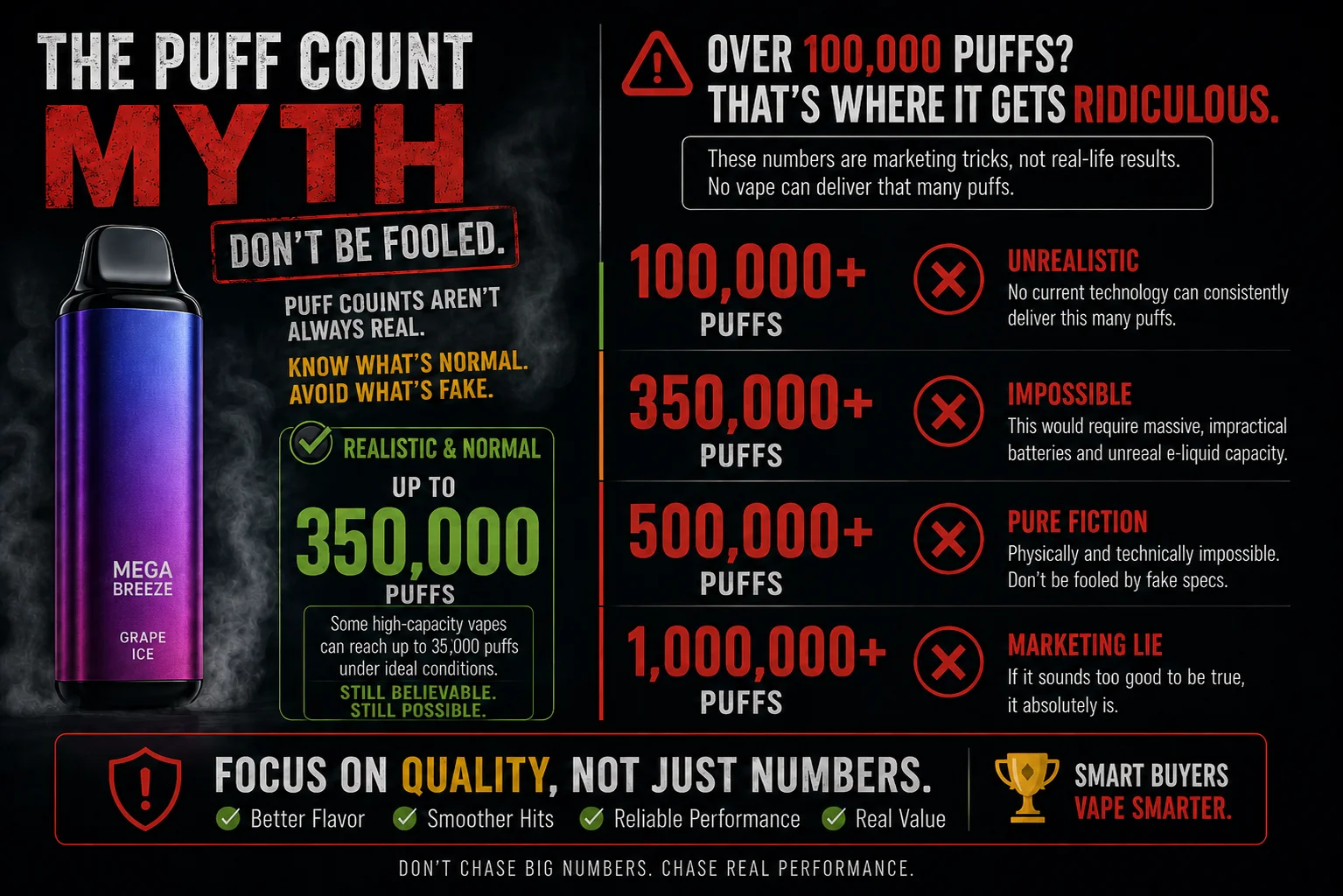
This whole thing has become a numbers game, and it’s getting crazy. Think about it. A disposable vape has to fit in your hand. There is a physical limit to how much e-liquid and how big a battery you can put inside. The real math is simple: 1 ml of e-liquid gives you around 200 puffs. So even a very large disposable vape that holds 20ml of liquid will give you, realistically, about 4,000 puffs. Some of the biggest ones that go on top of a hookah might hold 50ml, which is 10,000 puffs. That is the realistic maximum.
So where do numbers like 100,000 puffs come from? They are just numbers printed on a box. It's pure marketing to trick uninformed buyers.
Look for Milliliters (ml), Not Puffs
Even if a vape could hold enough liquid for 50,000 puffs, the atomizer coil inside it can't last that long. The coil is what heats the liquid, and it wears out. After a few thousand puffs, it starts to get carbonized and burnt.[^12] The vape will start to taste terrible long before the liquid runs out.
So, as a professional buyer, you need to stop looking at puff counts. It's a fool's game. Start asking your suppliers one simple question: "What is the real e-liquid volume in milliliters?" Even if they lie about that, it's a much more realistic number to judge by than the fantasy puff count. Don't be the rookie who is still chasing 300,000 puff vapes. Smart people know it's a lie.
Conclusion
Building a real, long-term vape business isn't about finding the cheapest price. It's about finding reliable partners, selling quality products, and keeping your customers happy so they come back.
[^1]: "An overview of the China National Tobacco Corporation and ...", https://pmc.ncbi.nlm.nih.gov/articles/PMC3541807/. For example, in China, the production and sale of e-cigarettes are regulated by the State Tobacco Monopoly Administration, which requires manufacturers to obtain specific licenses, making unlicensed operations illegal. Evidence role: general_support; source type: government. Supports: That vape manufacturing and sales are regulated industries requiring specific licenses, making unlicensed operations illegal.. [^2]: "FDA and CBP Seize Nearly $34 Million Worth of Illegal E-Cigarettes ...", https://www.fda.gov/news-events/press-announcements/fda-and-cbp-seize-nearly-34-million-worth-illegal-e-cigarettes-during-joint-operation. News reports from various regions confirm that law enforcement agencies periodically conduct raids on and shut down illegal e-cigarette manufacturing and distribution operations. Evidence role: case_reference; source type: other. Supports: That law enforcement agencies conduct raids and shut down illegal vape manufacturing facilities.. Scope note: While reports show raids occur, they do not establish the precise frequency or statistical risk of a given operation being shut down. [^3]: "Chemical Constituents Involved in E-Cigarette, or Vaping Product ...", https://pmc.ncbi.nlm.nih.gov/articles/PMC7355865/. Laboratory analyses of counterfeit e-cigarette products have identified the presence of undeclared substances, contaminants, and incorrect nicotine concentrations, posing potential health risks to users. Evidence role: statistic; source type: paper. Supports: That counterfeit e-liquids have been found to contain unlisted, unauthorized, or harmful chemicals.. [^4]: "Lithium-ion Battery (LFP and NMC) | PNNL", https://www.pnnl.gov/projects/esgc-cost-performance/lithium-ion-battery. Manganese (alkaline) batteries generally have a lower energy density, shorter cycle life, and poorer performance compared to the lithium-ion batteries commonly used in genuine rechargeable electronics, making them a cheaper but less reliable component. Evidence role: mechanism; source type: education. Supports: That manganese batteries are a cheaper, lower-performance alternative to the lithium-ion batteries typically used in quality electronics.. Scope note: This describes the general properties of the batteries; a source would be needed to confirm their specific prevalence in counterfeit vapes. [^5]: "Lithium-Ion Batteries under Low-Temperature Environment - PMC", https://pmc.ncbi.nlm.nih.gov/articles/PMC9698970/. The electrochemical reactions in alkaline batteries, such as those using manganese dioxide, are temperature-dependent and slow down significantly in cold conditions, which can lead to a voltage drop sufficient to prevent a device from functioning. Evidence role: mechanism; source type: paper. Supports: That the chemical reactions in manganese/alkaline batteries slow down significantly in cold temperatures, leading to a drop in voltage and inability to power a device.. [^6]: "Regulation of electronic cigarettes - Wikipedia", https://en.wikipedia.org/wiki/Regulation_of_electronic_cigarettes. EU member states, such as Denmark and Sweden, enforce national laws in addition to the EU Tobacco Products Directive (TPD), including specific rules on cross-border sales, taxation, and product registration that can result in the seizure of non-compliant imports. Evidence role: general_support; source type: government. Supports: That countries like Denmark and Sweden have stringent regulations on the import of e-cigarettes and nicotine products, which can lead to a higher risk of seizure for non-compliant shipments.. [^7]: "Innovative QR Code System for Tamper-Proof Generation and Fraud ...", https://pmc.ncbi.nlm.nih.gov/articles/PMC12252379/. Consumer protection agencies and cybersecurity experts warn of 'quishing' (QR code phishing), where malicious QR codes on counterfeit products lead to spoofed websites designed to deceive consumers or steal information. Evidence role: case_reference; source type: other. Supports: That counterfeiters use fraudulent QR codes that direct users to convincing but fake websites to falsely 'verify' a product's authenticity.. [^8]: "Guide to Brand Protection for Small and Medium Sized Enterprises ...", https://a-capp.msu.edu/guide-to-brand-protection-for-small-and-medium-sized-enterprises-section1/. Brand protection specialists and customs agencies often cite physical inspection, including checking for discrepancies in weight, materials, and build quality, as a key method for identifying counterfeit goods. Evidence role: general_support; source type: institution. Supports: That a noticeable difference in weight is a common indicator of a counterfeit product, as fakes are often made with cheaper, less dense materials to cut costs.. [^9]: "My brand new disposable vape tastes burnt/off is there a way I can ...", https://www.quora.com/My-brand-new-disposable-vape-tastes-burnt-off-is-there-a-way-I-can-solve-this. A burnt taste from a vape, known as a 'dry hit,' occurs when the atomizer's coil heats up without sufficient e-liquid, burning the wick material. This can be caused by poor wicking design or a defective coil, which are potential issues in low-quality or counterfeit devices. Evidence role: mechanism; source type: education. Supports: That a burnt taste in a vape is typically caused by the overheating of a dry or poorly-made wick and coil assembly (the atomizer).. [^10]: "E-Cigarette Marketing and Communication - PMC - NIH", https://pmc.ncbi.nlm.nih.gov/articles/PMC6610165/. Industry commentators and consumer advocates have noted that the puff counts advertised on disposable vapes are often inflated for marketing purposes and are not a reliable measure of the product's longevity, which is more accurately determined by e-liquid volume and battery capacity. Evidence role: expert_consensus; source type: other. Supports: That the puff counts advertised on many disposable vapes are considered to be highly exaggerated for marketing purposes and do not reflect real-world usage.. [^11]: "E-cigarette use behaviors and device characteristics of daily ... - PMC", https://pmc.ncbi.nlm.nih.gov/articles/PMC7668279/. While puff count can vary based on device power and user inhalation style, industry publications and reviewers commonly estimate that 1ml of e-liquid yields between 100 and 300 puffs, making '200 puffs/ml' a widely used rule of thumb. Evidence role: statistic; source type: other. Supports: That the number of puffs from 1ml of e-liquid is estimated to be in a certain range, with 200 being a common approximation.. Scope note: This is an estimation, as the actual number of puffs depends on factors like puff duration, device wattage, and coil resistance. [^12]: "How long does a coil last you? : r/electronic_cigarette", https://www.reddit.com/r/electronic_cigarette/comments/uv1w5c/how_long_does_a_coil_last_you/. The heating coil in a vape atomizer degrades over time due to the repeated heating of e-liquid, which can leave residue that carbonizes on the coil and wick, typically after the equivalent of 5-15ml of liquid has been vaporized, resulting in a burnt taste. Evidence role: mechanism; source type: education. Supports: That vape coils have a limited lifespan and degrade through use, leading to a burnt taste.. Scope note: The exact lifespan of a coil varies significantly based on e-liquid composition (especially sweeteners), power settings, and frequency of use.