
What buyers misunderstand about puff count and product quality is that a bigger number on the box does not automatically create a better product, faster sell-through, or safer cash flow. Many wholesalers buy high-puff products expecting easy profit, then face slow-moving stock, complaints, or a retail price that does not fit their channel. I help buyers compare the full picture before they commit.
A higher advertised puff count does not automatically mean better vape quality. Puff count is usually an estimate based on specific test conditions[^1], while real use varies with puff duration, power mode, airflow, e-liquid capacity, battery performance, coil efficiency, and user habits[^2]. Wholesale buyers should verify the basis of the puff claim and assess consistency, flavour stability, leakage control, battery reliability, and local market fit before placing a larger order.
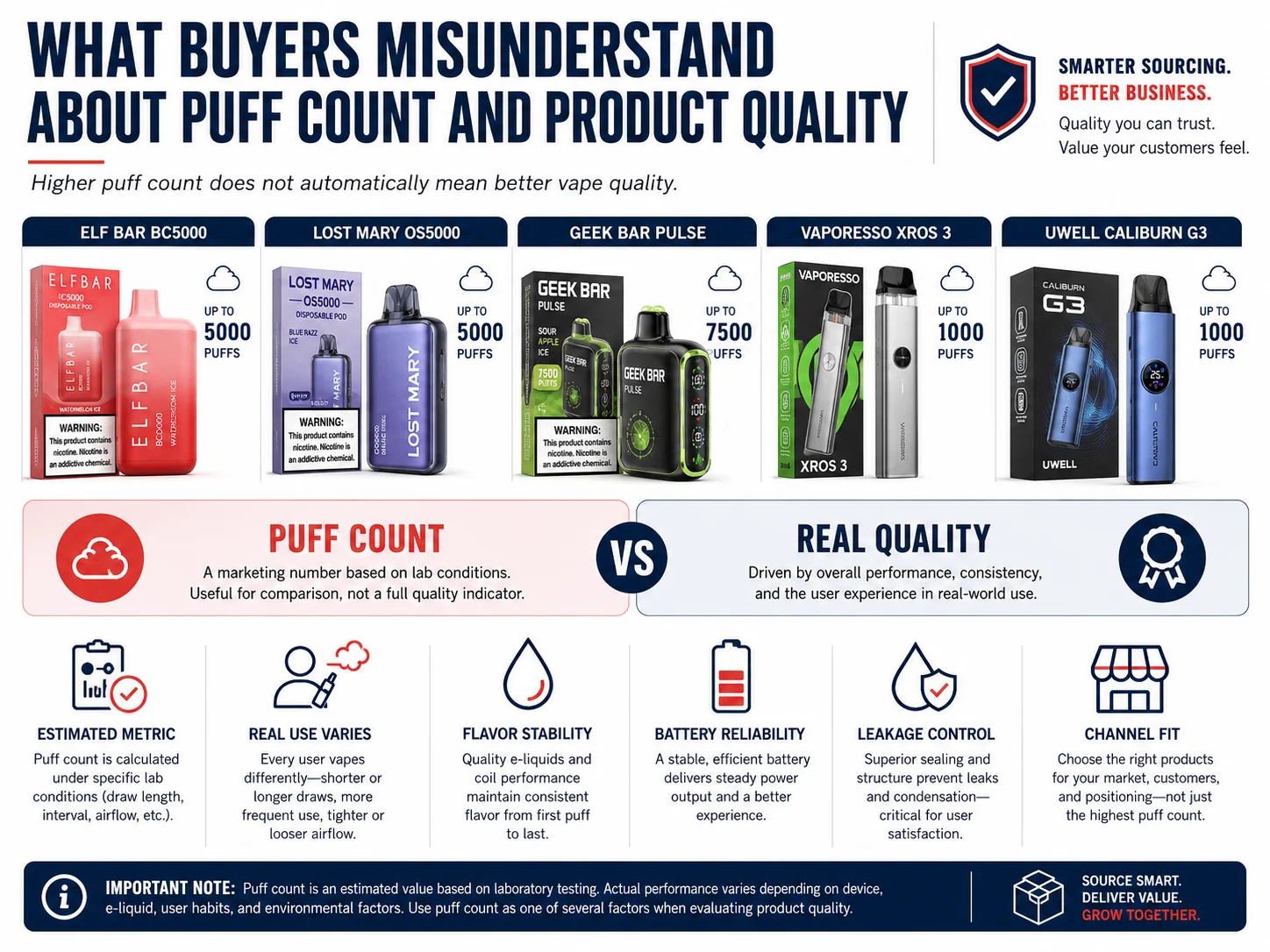
I have seen this question many times in buyer conversations: “Which model has the highest puff count?” It is a reasonable starting question, but it should never be the final purchasing decision. The better question is: Which product gives my customers the right value at the right retail price, with manageable after-sales risk and reliable replenishment?
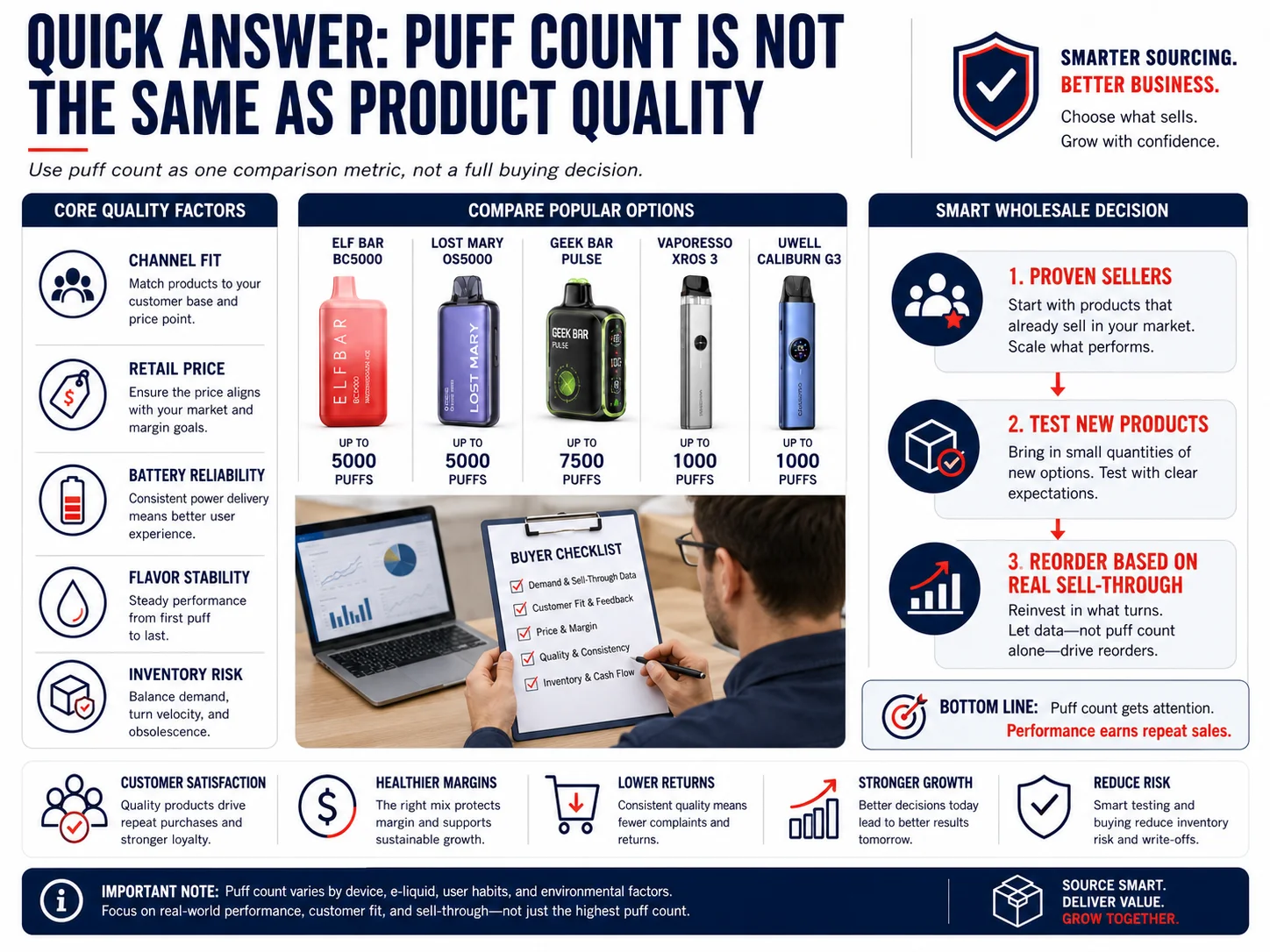
Quick Answer: What Buyers Misunderstand About Puff Count and Product Quality?
Many wholesale buyers feel pressure to choose the highest puff-count device because competitors use large numbers in their marketing. That pressure can lead to stock decisions based on one specification instead of real channel needs, consumer expectations, and product reliability.
What buyers misunderstand about puff count and product quality is simple: puff count is an estimated usage metric, not a complete quality score[^3]. I recommend comparing it with e-liquid capacity, battery capacity, output settings, coil performance, leakage resistance, flavour consistency, device failure risk, retail price, and the speed at which your market can replenish stock.
Why one number cannot tell the whole story
A puff-count label can be useful when buyers compare products in the same category under similar conditions. However, it does not tell you everything about the user experience.
For example, two devices may both display a similar puff number, but they may use different:
- E-liquid capacities
- Battery capacities
- Coil structures
- Output power levels
- Airflow systems
- Single-mode or dual-mode settings
- Display functions and internal components
A device designed for stronger output may produce larger vapour volume per puff. In real use, that can affect how long the liquid and battery last. A device designed with lower output may show a larger estimated puff count, but some consumers may prefer the stronger flavour or vapour of another model.
I always advise buyers to think about the retail experience, not just the carton specification. A convenience-store customer may want a simple, compact, affordable product. A vape-shop customer may care more about adjustable airflow, screen features, flavour options, or a specific device style. The highest number is only valuable when customers understand and accept the value behind it.
What Does Advertised Puff Count Actually Mean?
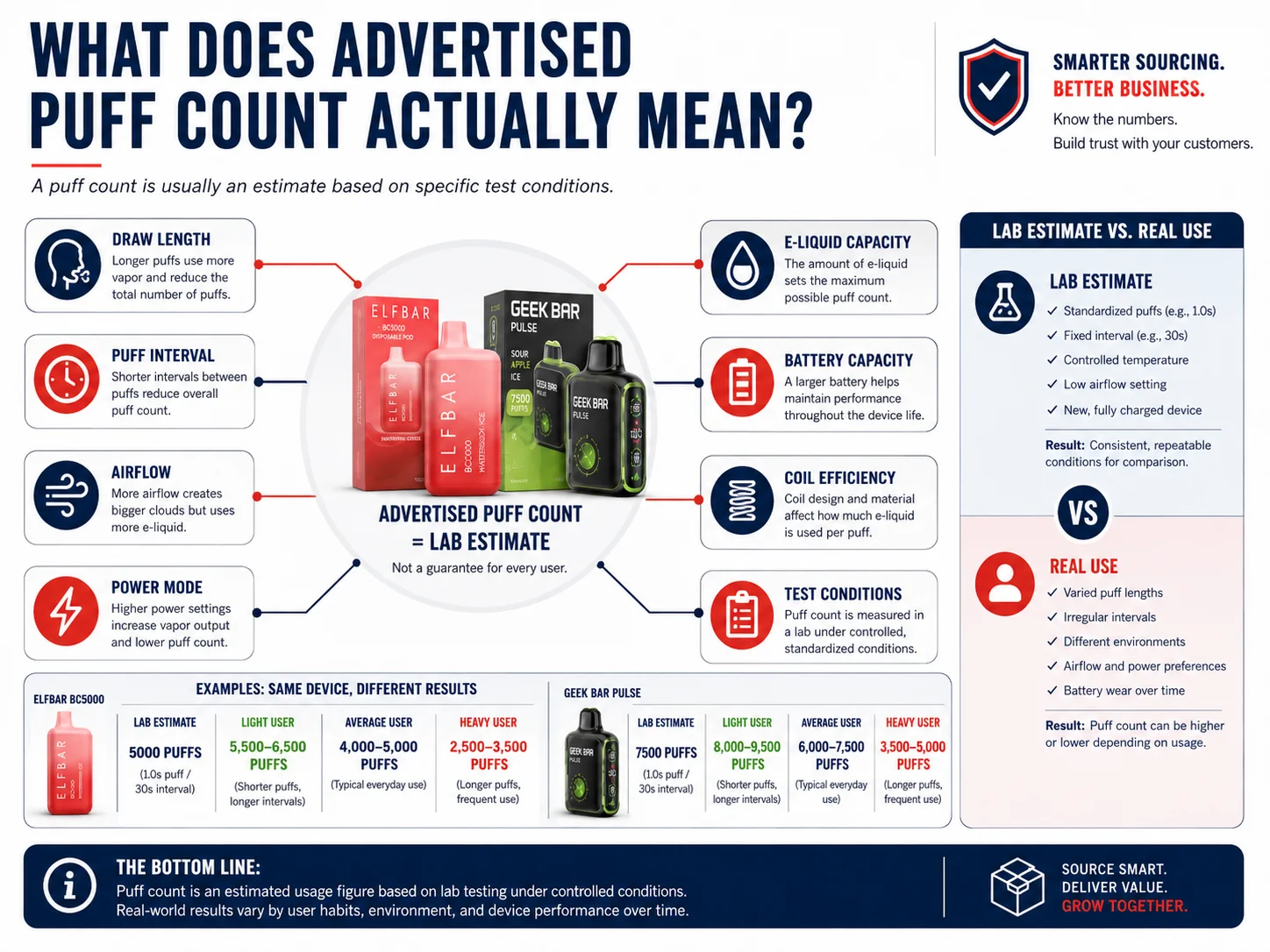
Buyers often assume a labeled puff count is a fixed promise that every end user will receive[^4]. In practice, it is usually an estimated figure calculated under specific usage assumptions. Different user behaviour can create very different real-world results.
Advertised vape puff count normally represents an estimated number of inhalations under defined test conditions. It is not a guaranteed number for every consumer because puff length, inhalation strength, power mode, airflow, battery condition, temperature, and device design all influence actual use.
The conditions behind vape puff count accuracy
The word “puff” sounds simple, but it is not a universal unit.[^5] One user may take a short, light draw. Another may take longer and deeper draws. Those two users can consume e-liquid and battery power at very different speeds.
When I review a new product with a buyer, I encourage them to ask:
-
What is the e-liquid capacity?
E-liquid capacity is one practical part of the usage equation. It should be considered alongside output and coil efficiency. -
What battery capacity does the device use?
A rechargeable device may continue operating after charging, but its practical experience still depends on the full system. -
Does the device have different modes?
Boost mode, dual mode, or high-output mode can change consumption. A product may provide different estimated results depending on the selected setting. -
What airflow style does it use?
Open airflow can create a different vaping experience from tighter airflow. It can also influence consumption patterns. -
What testing basis supports the stated number?
Buyers should ask suppliers for the available specification details rather than assuming every brand calculates puffs in the same way.
This does not mean puff-count information has no value. It means buyers should use it carefully. The label is a comparison point, not a complete guarantee or a substitute for product evaluation.
How Do Puff Count Claims Compare With Real Product Quality?
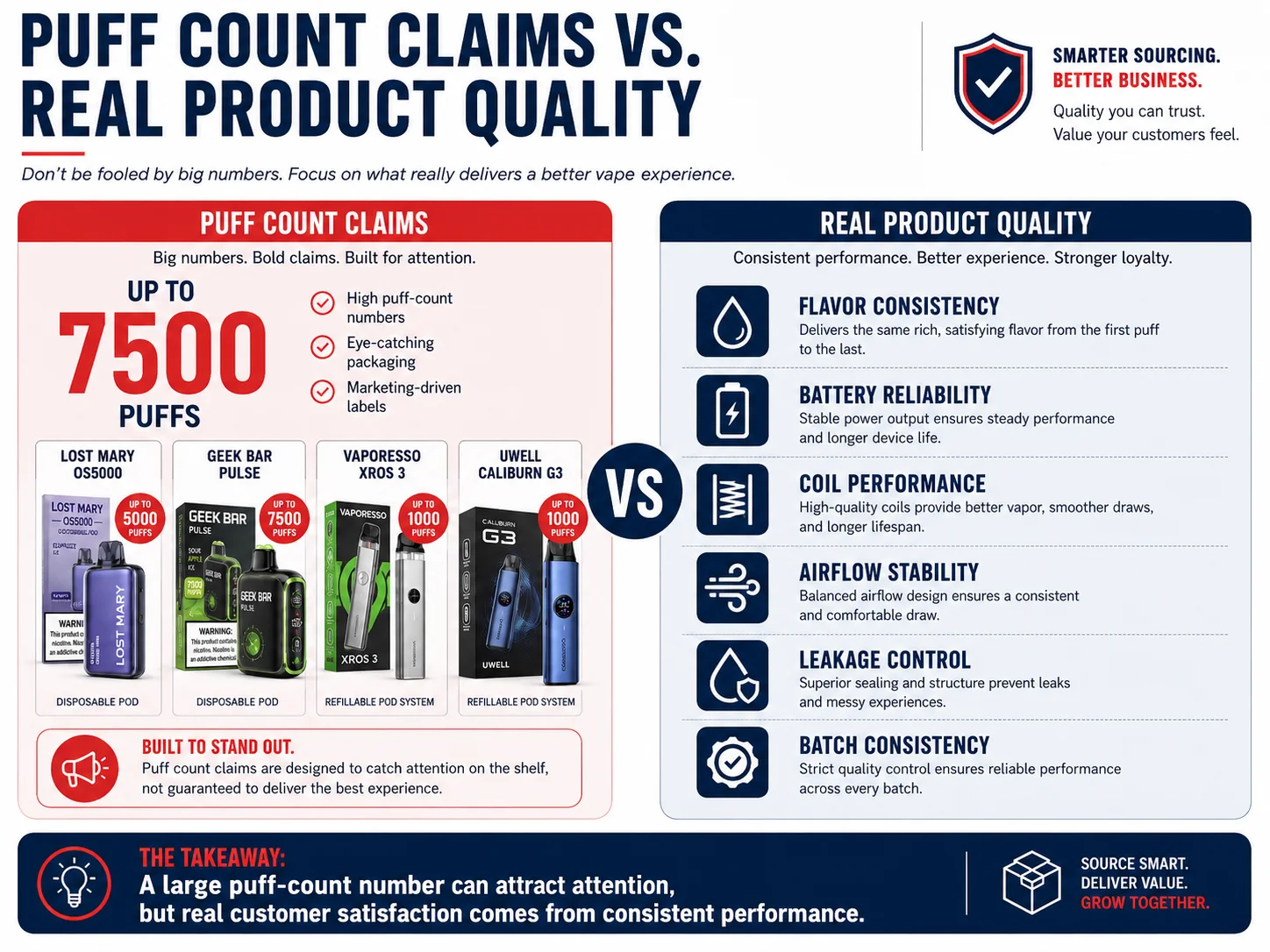
A high puff-count claim can attract attention, but quality is experienced through day-to-day use. If flavour changes too early, airflow becomes unstable, a device leaks, or batches vary too much, the large number on the package will not protect your reputation with retail customers.
Vape wholesale product evaluation should compare puff-count claims with the product factors that affect real customer satisfaction: e-liquid capacity, battery reliability, coil performance, output mode, flavour consistency, leakage control, airflow stability, and batch consistency.
| Evaluation Factor | What the Claim Shows | What Buyers Should Verify | Wholesale Risk |
|---|---|---|---|
| Advertised puff count | Estimated usage position | Test basis, power mode, practical sample use | Customer expectations may not match real use |
| E-liquid capacity | Available liquid volume | Label accuracy, formulation suitability, local requirements | Incorrect comparisons between products |
| Battery capacity | Energy storage | Recharge behaviour, consistency, device design | Complaints if battery performance is unstable |
| Output mode | Performance options | Whether modes affect consumption and retail explanation | Retail staff may explain the product incorrectly |
| Coil performance | Part of vapour and flavour delivery | Flavour consistency through normal use | Repeat orders may suffer if experience changes |
| Leakage control | Device construction quality | Sample inspection and transport handling | Returns, damaged packaging, retailer complaints |
| Airflow system | Draw style and user experience | Adjustment stability and target-user preference | Product may not fit the intended customer group |
| Batch consistency | Manufacturing control | Sample-to-order consistency and after-sales process | Larger risk when buying deeper inventory |
Quality is a system, not a single feature
I often describe disposable vape quality indicators as a chain. If one part of the chain is weak, the overall experience can suffer.
For wholesale buyers, the most important question is not “Does this product have a high number?” It is:
“Can I sell this product at a price my customers accept, explain it clearly, replenish it reliably, and handle any after-sales issues without damaging my cash flow?”
This approach is especially important for importers supplying vape shops, smoke shops, gas stations, convenience stores, and local distributors. Each channel has different buying habits. A high-capacity product may work well in one channel and sit too long in another.
Why Does Higher Puff Count Not Always Mean Better Quality?
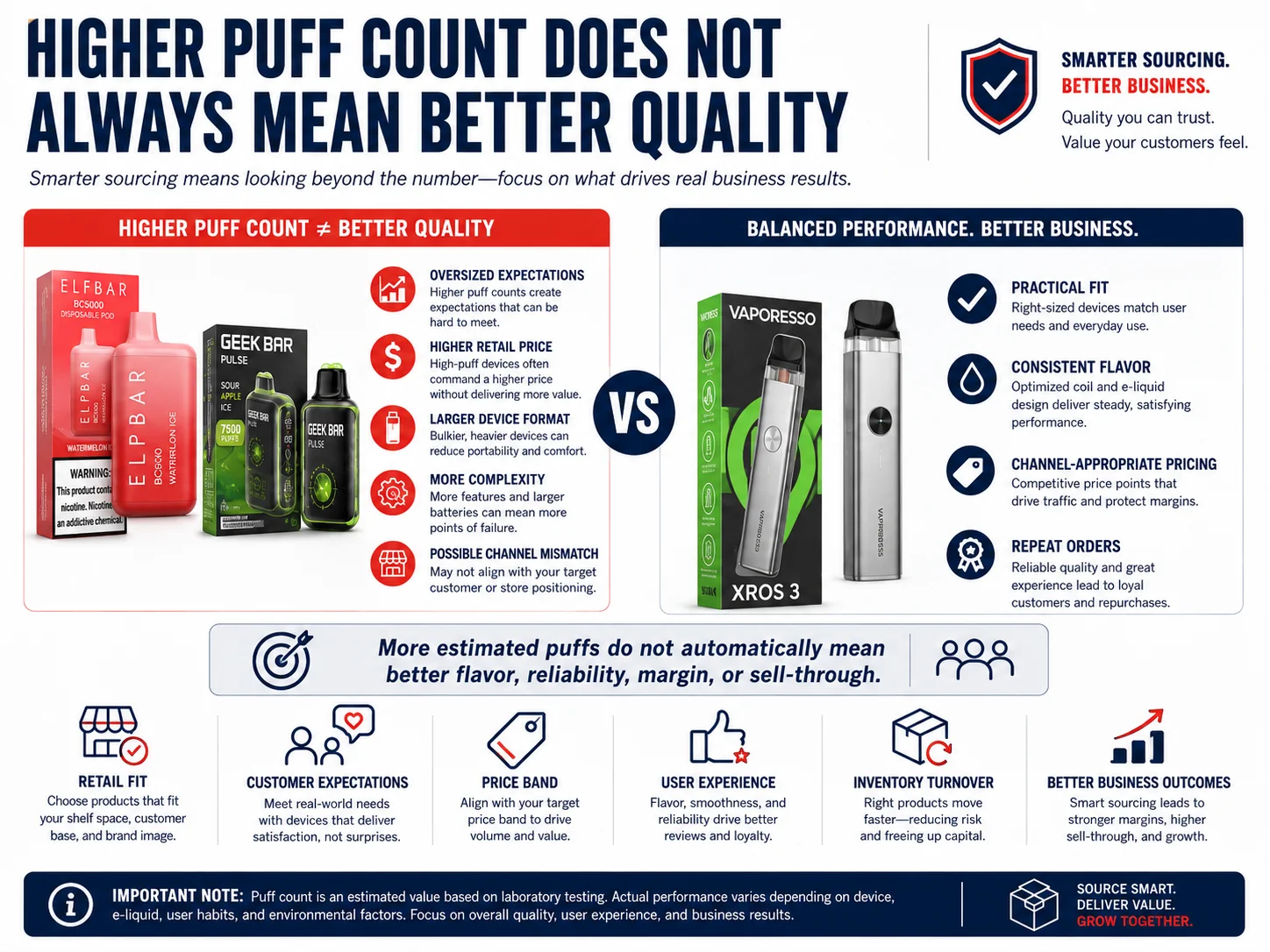
Higher puff count can be valuable when it matches the target market, product size, price band, and consumer demand. However, a larger claim may also come with a larger device, more complex structure, different output settings, or greater need for consistent production control.
What buyers misunderstand about puff count and product quality is that more estimated puffs do not automatically mean better flavour, better reliability, higher profit, or faster stock turnover. A higher-puff device is only a better choice when its total value matches your retail channel and customer expectations.
Consider the commercial side before ordering
A product with a higher puff count may carry a higher purchase cost and require a higher retail price. That can be perfectly acceptable in a vape shop with customers looking for premium features. It may be less suitable for a price-sensitive convenience-store channel where customers make quick purchase decisions.
I recommend that buyers compare these commercial questions before they place an order:
- What retail price range moves fastest in my area?
- Does my customer understand why this device costs more?
- Does the product size fit my display space?
- Will the product’s design and features appeal to my usual buyers?
- Can I start with a controlled quantity before ordering deeply?
- How quickly can I replenish the winning flavours or models?
For smaller and mid-sized customers in Europe, our overseas warehouse model can help reduce the pressure of making a large first commitment. Eligible stocked products can be shipped within Europe with low starting quantities, often from 50 pieces per model, depending on availability. This can help buyers test product-market fit without tying up as much capital in unfamiliar items.
For larger importers and distributors, direct supply from China may offer stronger scale advantages, broader product selection, and OEM/ODM options. In both cases, the goal should be the same: buy inventory that can turn, not inventory that only looks impressive on paper.
Which Factors Change the Real Number of Puffs?
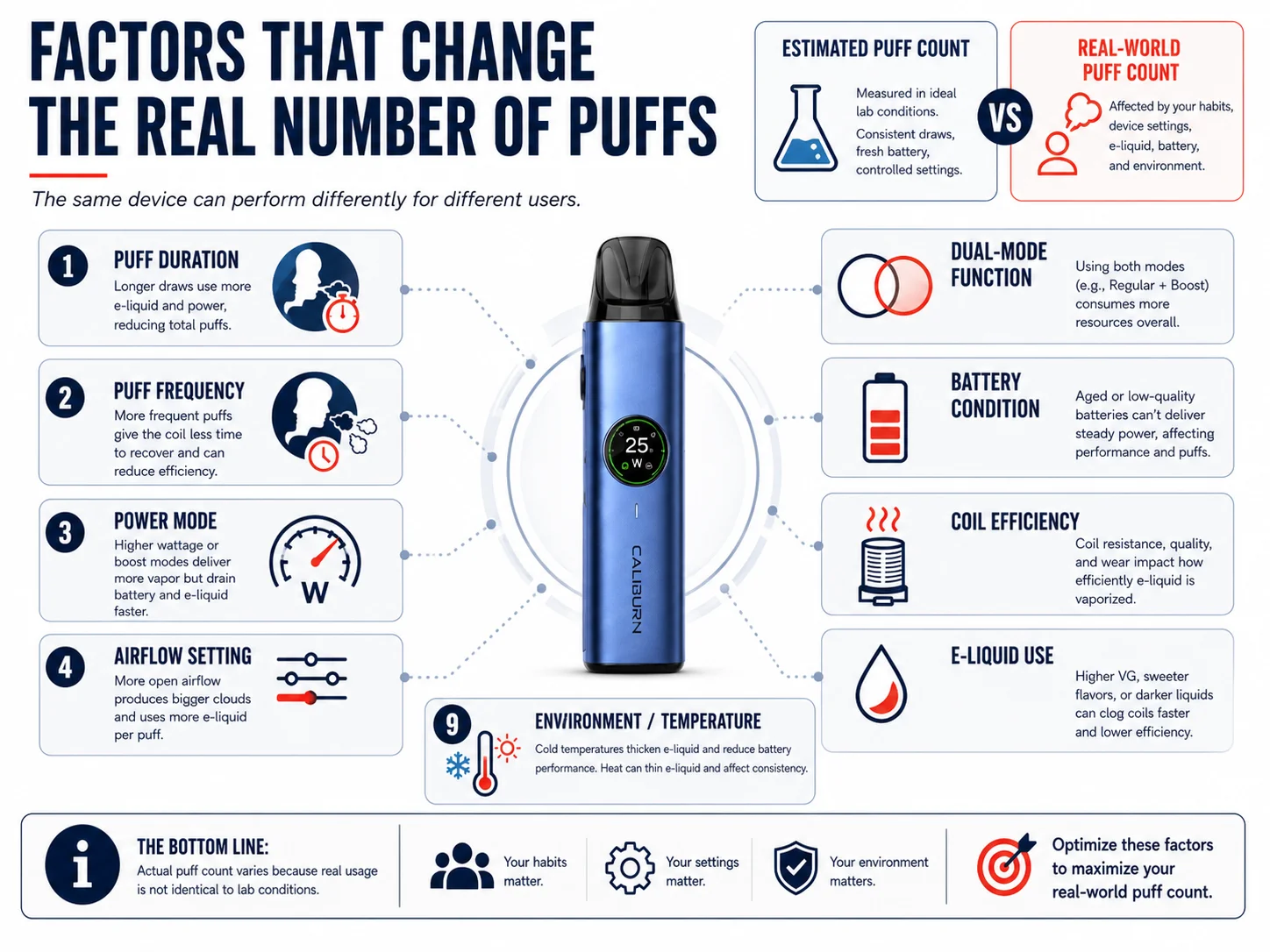
A customer may use the same product differently from another customer. That is why a puff-count figure should be presented as an estimate, not a universal real-world outcome. Retailers who understand this can explain products more clearly and avoid unnecessary disputes.
Real vape puff count can change because of puff duration, puff frequency, output power, airflow settings, dual-mode functions, battery condition, coil efficiency, e-liquid use, and environmental conditions. The same device may therefore perform differently for different users.
The main variables buyers should understand
Puff duration and inhalation style
Longer draws generally use more energy and e-liquid than shorter draws.[^6] A user who takes frequent, deep draws may reach the end of the product sooner than a user who takes lighter draws.
Power mode and dual-mode functions
Some devices offer more than one output setting. Higher-output modes can change vapour volume and flavour intensity[^7], but they may also affect the practical rate of consumption. Buyers should ensure that product packaging, sales staff, and end customers understand these functions.
Airflow setting
Adjustable airflow can change the draw style. A more open setting can create a different vapour experience than a restricted setting. This is one reason why direct puff-count comparisons between two different designs can be misleading.
Battery and temperature conditions
Battery behaviour can be affected by use patterns and surrounding conditions. Very cold or very hot environments may affect how users experience electronic products in general.[^8] Buyers should avoid making absolute promises that ignore normal real-world variation.
I also suggest that wholesalers train their sales teams with a simple message: puff count is estimated, while actual use depends on how the product is used. Clear communication supports fewer misunderstandings at the retail counter.
What Quality Indicators Matter More Than Puff Count?
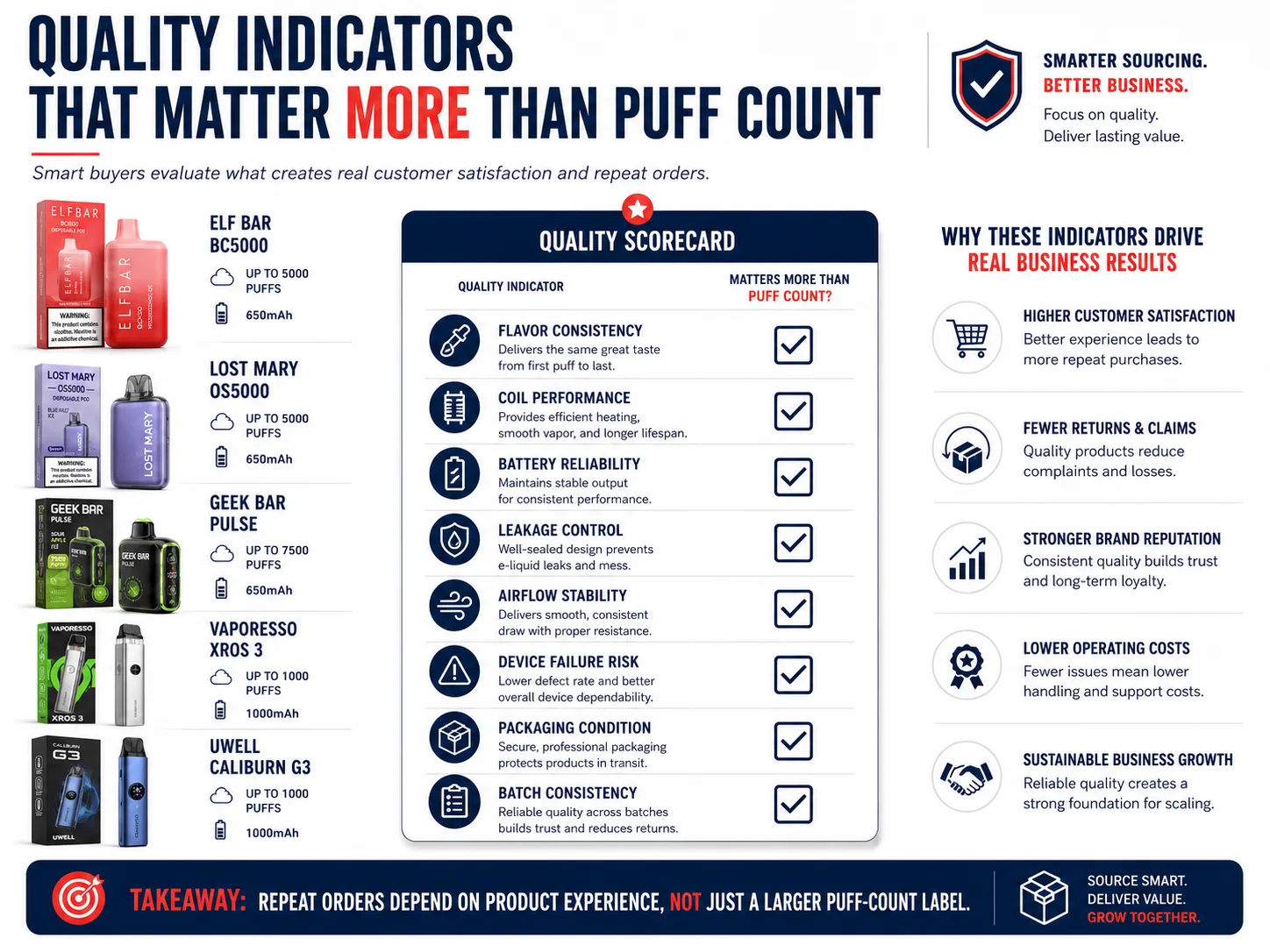
When I discuss new vape categories with wholesale customers, I focus first on the factors that can influence repeat orders and after-sales workload. A product may have an attractive puff count, but customers usually remember whether it tasted consistent, worked properly, and felt worth the money.
Disposable vape quality indicators that often matter more than puff count include flavour consistency, coil performance, battery reliability, leakage control, airflow stability, device failure risk, packaging condition, and consistency from one production batch to the next[^9].
A practical quality checklist for buyers
Use the following checklist when comparing products:
- Flavour consistency: Does the flavour remain acceptable through normal sample use?
- Coil performance: Does the device maintain a stable experience, or does the flavour change unexpectedly?
- Battery reliability: Does the product operate as expected during sample evaluation?
- Leakage control: Is there visible leakage, condensation concern, or packaging damage?
- Airflow stability: Does the draw feel consistent and match the product’s intended positioning?
- Physical finish: Are the device body, mouthpiece, labels, and packaging presented consistently?
- Batch consistency: Can the supplier explain how the order will match the approved sample?
- After-sales handling: Is there a clear path if a verified product issue occurs?
At KingVape, I work from Shenzhen, where the vape manufacturing and supply chain ecosystem is highly concentrated[^10]. My team combines factory capability with integrated sourcing. This gives buyers a practical advantage when they need to compare categories, brands, accessories, and related smoking products without contacting many separate suppliers.
However, I never suggest that buyers skip their own verification. Samples, controlled first orders, and real local feedback remain important. A supplier can support the process, but the buyer still knows the local customer best.
What Are Common Puff Count Misunderstandings in Vape Wholesale?
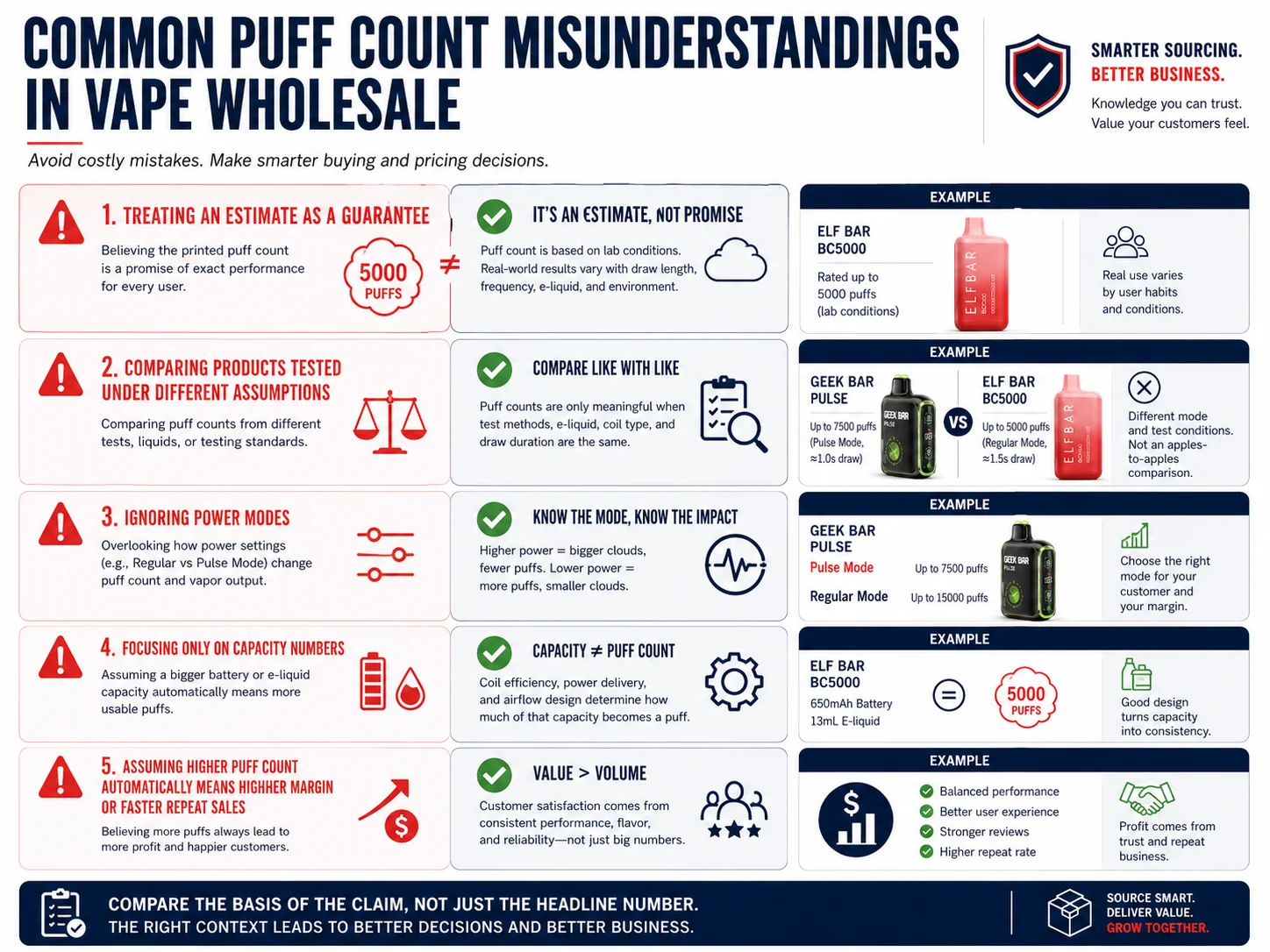
Wholesale mistakes often happen when buyers compare labels without comparing the conditions behind those labels. This can lead to a product selection that looks competitive online but does not fit the buyer’s actual market, retail price band, or customer preference.
Common puff-count misunderstandings in vape wholesale include treating an estimate as a guarantee, comparing products tested under different assumptions, ignoring power modes, focusing only on capacity numbers, and assuming higher puff count automatically creates higher margin or repeat sales.
Avoid these purchasing shortcuts
“The highest puff number will sell best.”
Not always. Some customers want compact products, lower retail prices, or a familiar format. The right product depends on your channel and local demand.
“Two products with the same puff count are equal.”
They may have very different batteries, coils, modes, airflow designs, flavours, and physical quality. The label alone cannot show the whole experience.
“A larger capacity always means a better deal.”
Capacity should be viewed with output, device format, retail price, and end-user expectations. A larger device may not suit every display, store type, or customer.
“A high-puff product guarantees higher profit.[^11]”
Profit depends on your buying cost, local competition, retail price, turnover speed, damage risk, and replenishment timing. A lower-priced, faster-moving item can sometimes support healthier cash flow than a slower premium item.
I have noticed that experienced buyers usually become more selective over time. They stop asking only for “the newest” or “the highest.” Instead, they ask for products that are easier to sell, easier to replenish, and less likely to create unnecessary after-sales work.
How Should Puff Count Claims Affect Wholesale Product Selection?
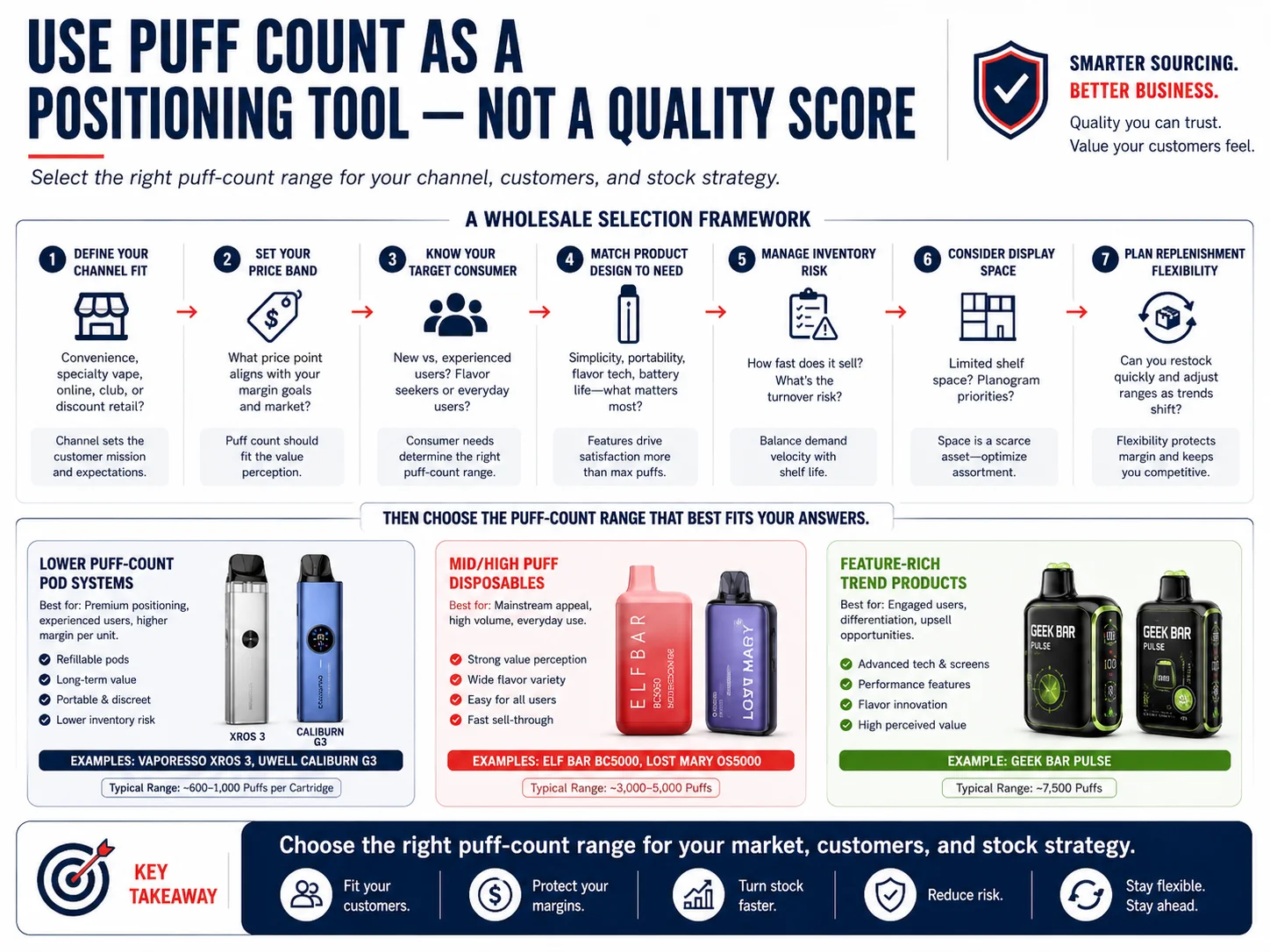
Puff count should affect your selection, but it should not control it. I see it as one useful filter within a wider sourcing framework: channel fit, price band, target consumer, product design, inventory risk, and replenishment flexibility.
For vape wholesale product selection, buyers should use puff count as a positioning tool rather than a quality score[^12]. Choose a puff-count range that suits your channel, expected retail price, customer habits, display space, stock-turn goals, and ability to test and replenish inventory.
Match the product to the channel
| Sales Channel | Typical Buyer Priority | Useful Product Approach |
|---|---|---|
| Vape shops | Features, flavour choice, product differentiation | Compare modes, design, consistency, and price positioning |
| Smoke shops | Variety, margin, reliable supply | Build a balanced mix of popular formats and price points |
| Convenience stores | Simplicity, quick decisions, compact displays | Focus on understandable products and accessible pricing |
| Local wholesalers | Turnover, replenishment, fewer complaints | Test smaller quantities, then deepen winning stock |
| Larger importers | Scale, pricing, brand strategy | Consider direct China import, OEM/ODM, and inventory planning |
For a new trend or unfamiliar model, I recommend a controlled approach:
- Start with a manageable test quantity.
- Choose several flavours or variants based on your channel.
- Collect feedback from real retailers and repeat customers.
- Review sell-through, questions, and any after-sales patterns.
- Reorder the winners with more confidence.
This process is more practical than placing a large order based only on a puff-count claim or a viral product photo.
How Can Buyers Verify Vape Specifications Before a Wholesale Order?
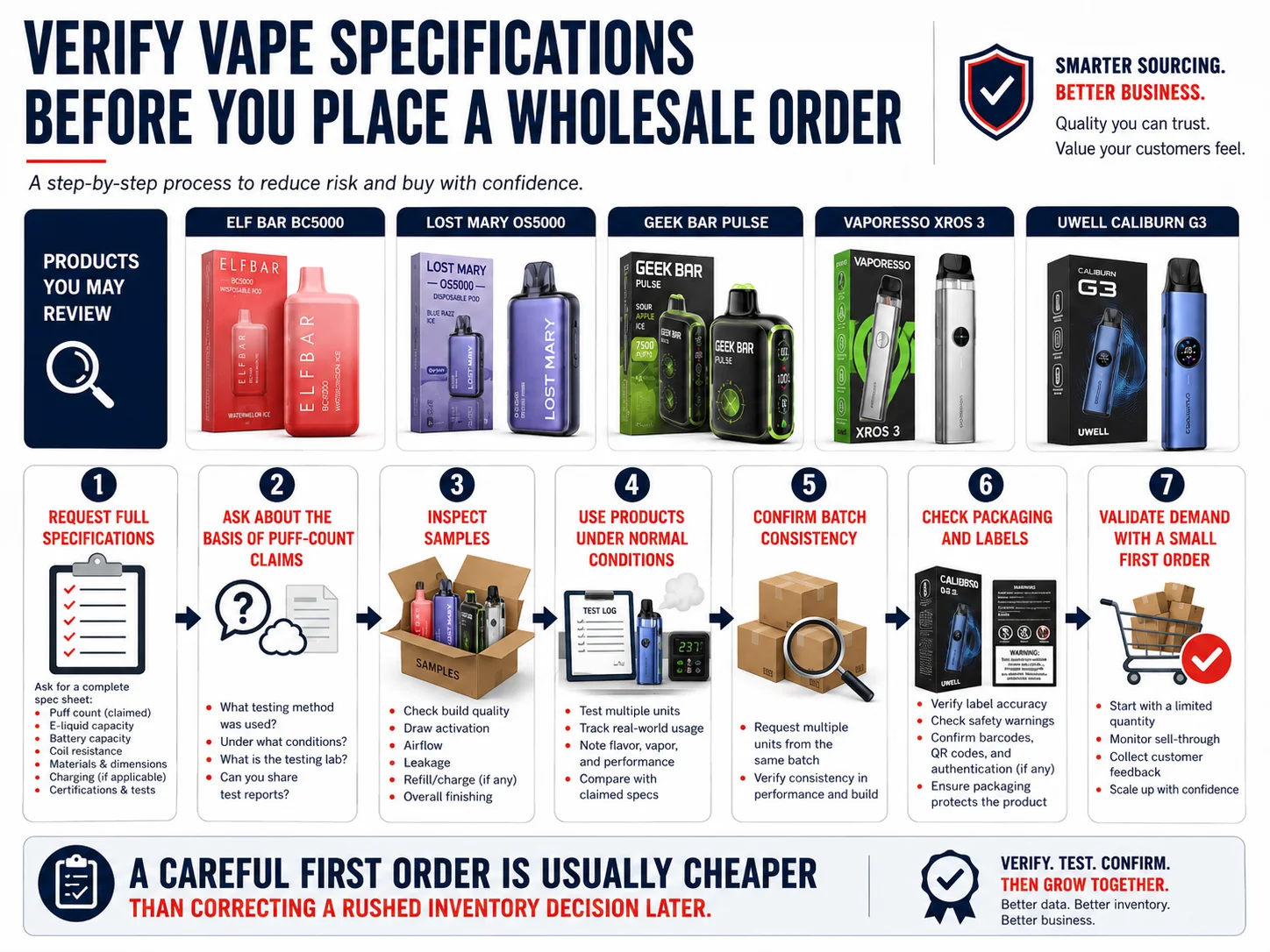
Specification verification protects buyers from misunderstandings before stock arrives. It also gives retail teams clearer information to share with their customers. I believe a careful first order is usually cheaper than correcting a rushed inventory decision later.
What buyers misunderstand about puff count and product quality can be reduced through a simple verification process: request full specifications, ask about the basis of claims, inspect samples, use products under normal conditions, confirm batch consistency, and validate demand through a smaller first order when possible.
A practical sourcing path
1. Request complete specifications
Ask for available details on e-liquid capacity, battery capacity, charging type where applicable, output modes, airflow features, dimensions, packaging, flavours, and stated puff-count range.
2. Ask how product claims should be understood
You do not need to demand promises that no supplier can honestly make. Instead, ask what conditions or product configuration relate to the advertised figure.
3. Review samples carefully
Check physical appearance, packaging, flavour experience, airflow, charging function where relevant, and any visible leakage concerns. Use samples in a way that reflects how your end customers will use them.
4. Confirm the order matches the approved sample
Before mass purchasing, confirm the product version, colours, flavours, packaging language, and other agreed details. This step is especially important for OEM and private-label projects.
5. Start with a market-appropriate quantity
A smaller trial order can help buyers measure actual local demand. This is particularly useful for a new flavour trend, a new format, or a product at a higher retail price.
6. Plan after-sales handling before you sell
Your customers will remember how you handle an issue. I recommend choosing a supplier that can communicate clearly and support a defined after-sales process rather than leaving you to contact multiple factories and brands alone.
Explore Verified Vape Wholesale Categories?
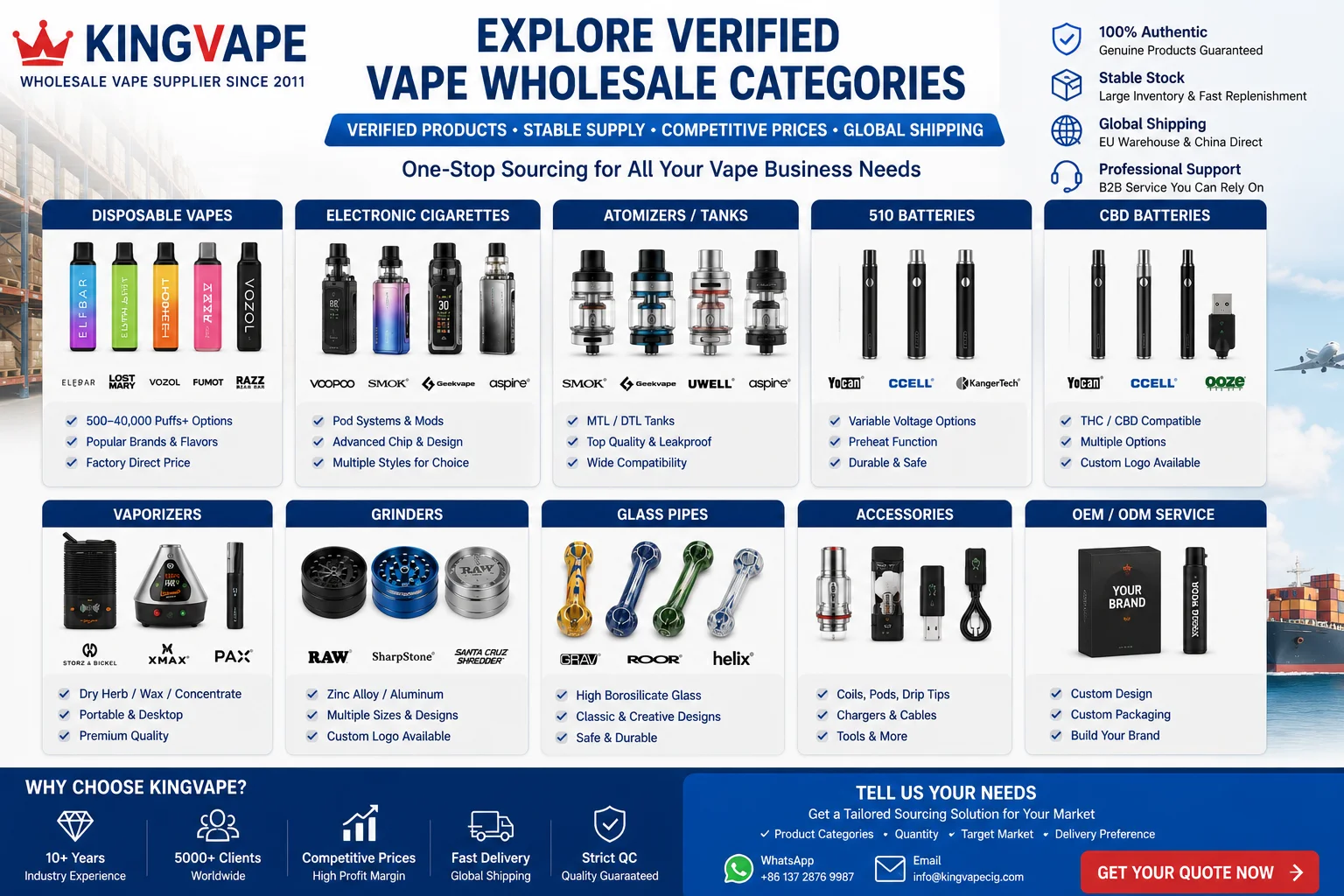
Finding the right category should feel simpler than chasing the biggest number on a product box. I support buyers who need disposable vapes, electronic cigarettes, atomizers, 510 batteries, CBD batteries, vaporizers, grinders, glass pipes, and related smoking accessories through one sourcing relationship.
I encourage buyers to compare disposable vape wholesale options based on practical quality factors, channel fit, verified specifications, and replenishment needs—not puff count alone. The best product is the one that fits your customers, price range, stock strategy, and service expectations.
A supply model built around buyer flexibility
For smaller and medium-sized buyers serving European markets, available overseas warehouse stock can support faster delivery across the EU through carriers such as DHL, DPD, UPS, and FedEx. This model can suit customers who want to test products, protect cash flow, and avoid waiting for a large direct-import order.
For medium and larger importers, wholesalers, and distributors, I can support direct China sourcing from Shenzhen. My company, Shenzhen Kingfuji Tech. Co., Ltd., has operated since 2011 as a factory and integrated trading supplier. We have our own brand, a 5,000-square-metre factory, OEM/ODM experience, and production capacity of up to 5 million units per month.
I also help buyers source products outside an existing catalogue when there is a clear requirement. If a buyer has the right conditions for a new project, my team can discuss product development and mould-related options. The key is to begin with a practical market need, not just a high-puff-count idea.
Send KingVape your destination market, sales channel, preferred puff-count range, product type, and estimated quantity. I will help you compare product specifications, practical quality factors, and a more workable wholesale stock strategy.
Frequently Asked Questions
Does higher puff count mean better vape quality?
No. A higher puff count is an estimated usage figure, not a complete measure of quality. I recommend checking flavour consistency, coil performance, battery reliability, leakage control, airflow stability, and batch consistency alongside the stated puff count.
Is vape puff count accuracy guaranteed for every user?
No. Real usage varies by puff duration, frequency, output mode, airflow setting, inhalation style, and other conditions. Buyers should treat puff count as an estimate and avoid presenting it as an identical result for every consumer.
What should wholesale buyers test before ordering disposable vapes?
Buyers should inspect samples for packaging quality, flavour consistency, airflow, physical finish, leakage concerns, battery behaviour, and ease of use. I also recommend confirming full specifications and starting with a controlled quantity for unfamiliar products.
Should small wholesalers buy from a European warehouse or import from China?
It depends on order size and business goals. European warehouse stock can suit smaller test orders and faster replenishment. Direct import from China may suit larger buyers seeking broader selection, stronger scale pricing, or OEM/ODM opportunities.
How can I choose the right puff-count range for my market?
Start with your channel, local retail price range, customer habits, and display space. Vape shops, smoke shops, convenience stores, and distributors may need different product mixes. I recommend testing demand before committing to deep inventory.
Conclusion
What buyers misunderstand about puff count and product quality is that a large number cannot replace a complete wholesale evaluation. Puff count can help position a product, but real success depends on specification verification, flavour and coil consistency, battery reliability, leakage control, channel fit, retail price, and inventory turnover. I recommend testing unfamiliar products with controlled quantities, reviewing real replenishment feedback, and scaling only after you see market fit. Contact KingVape through www.kingvapecig.com, email info@kingvapecig.com, or WhatsApp +86 13928420527 to discuss your next wholesale sourcing plan.
[^1]: "Puffing Topography: A Tool to Evaluate Vaping Behavior ... - PMC", https://pmc.ncbi.nlm.nih.gov/articles/PMC12958158/. Technical aerosol-measurement literature describes e-cigarette use and emissions in relation to specified puffing protocols, supporting the interpretation of a stated puff count as protocol-dependent rather than a universal user outcome. Evidence role: definition; source type: research. Supports: A technical or regulatory source should explain that e-cigarette puff counts depend on defined puffing protocols or assumptions.. Scope note: The source may address laboratory measurement rather than the particular manufacturer’s labeling method. [^2]: "Puffing Topography: A Tool to Evaluate Vaping Behavior ... - PMC", https://pmc.ncbi.nlm.nih.gov/articles/PMC12958158/. Experimental studies of electronic cigarettes report that puffing topography and operating settings can alter aerosol generation and liquid consumption, which supports variability in real-world use. Evidence role: mechanism; source type: paper. Supports: Experimental research should show that puffing topography and device power or airflow settings affect e-cigarette aerosol generation and e-liquid consumption.. Scope note: Findings for a tested device, liquid, and protocol may not quantify variation for every disposable-vape model. [^3]: "Research gaps related to the environmental impacts of electronic ...", https://pmc.ncbi.nlm.nih.gov/articles/PMC3995274/. Electronic-cigarette regulatory frameworks assess products through multiple safety, composition, emissions, and notification requirements, indicating that a single use-duration claim is not a comprehensive quality measure. Evidence role: general_support; source type: government. Supports: Regulatory product requirements should show that product assessment encompasses matters beyond a labeled puff count, such as emissions, ingredients, notifications, and safety.. Scope note: Regulatory criteria establish compliance requirements and do not by themselves rank consumer-perceived quality. [^4]: "Puffing Topography: A Tool to Evaluate Vaping Behavior ... - PMC", https://pmc.ncbi.nlm.nih.gov/articles/PMC12958158/. Studies of e-cigarette puffing topography report substantial variation between users in puff duration, volume, and frequency, supporting the view that an advertised count cannot assure the same result for every individual. Evidence role: general_support; source type: research. Supports: Research should document between-user variation in puff duration, volume, and frequency that makes identical use counts unlikely.. Scope note: Variation in puffing behavior does not establish whether any particular product label is accurate under its stated conditions. [^5]: "Puffing Topography: A Tool to Evaluate Vaping Behavior ... - PMC", https://pmc.ncbi.nlm.nih.gov/articles/PMC12958158/. Electronic-cigarette testing protocols specify puff duration, volume, and interval parameters, demonstrating that a “puff” is an operational measurement defined by a regimen rather than a universally invariant unit. Evidence role: definition; source type: institution. Supports: Standards or reviews should show that e-cigarette testing uses defined puffing regimens and that user topography differs from such regimens.. Scope note: A standardized laboratory regimen can improve comparability but does not represent every user’s behavior. [^6]: "Associated Changes in E-cigarette Puff Duration and ... - PMC - NIH", https://pmc.ncbi.nlm.nih.gov/articles/PMC8135414/. Controlled electronic-cigarette experiments find that longer activation or puff durations increase energy delivery and aerosolized liquid under tested conditions, supporting the stated directional relationship. Evidence role: mechanism; source type: paper. Supports: Controlled studies should report that increased puff duration raises coil activation time, electrical energy delivered, and/or e-liquid aerosolized.. Scope note: The magnitude of the effect depends on device resistance, power control, liquid properties, and the test protocol. [^7]: "Understanding the influence of atomizing power on electronic ...", https://pmc.ncbi.nlm.nih.gov/articles/PMC10665025/. Laboratory studies show that e-cigarette power settings can change aerosol production and constituent delivery, providing a mechanistic basis for differences users may perceive in vapor output and flavor intensity. Evidence role: mechanism; source type: paper. Supports: Research should establish that electrical power affects aerosol mass or constituent delivery and, where measured, users' sensory responses.. Scope note: Subjective flavor intensity is influenced by liquid formulation and user perception and is not established solely by aerosol-output measurements. [^8]: "Batteries for Electric Vehicles - Alternative Fuels Data Center", https://afdc.energy.gov/vehicles/electric-batteries. Battery research and public technical guidance document that ambient temperature affects lithium-ion battery capacity, internal resistance, and operating performance, supporting the general statement about temperature-related user experience. Evidence role: mechanism; source type: government. Supports: An authoritative source should explain that temperature affects lithium-ion battery capacity, resistance, charging, or performance.. Scope note: This general battery evidence does not establish the performance of a specific vape device or account for its electronics and liquid behavior. [^9]: "Electronic cigarette device-related hazards: a call for immediate FDA ...", https://pmc.ncbi.nlm.nih.gov/articles/PMC6718197/. Electronic-cigarette standards and regulatory guidance address multiple product characteristics—including construction, electrical safety, emissions, labeling, and packaging—supporting evaluation beyond a puff-count claim. Evidence role: general_support; source type: institution. Supports: Standards or regulatory documents should identify safety, construction, emissions, packaging, and quality-control factors relevant to electronic-cigarette products.. Scope note: Such documents may not directly measure subjective attributes such as flavor consistency or preferred airflow. [^10]: "The Impact of New Regulations on Prevention and Control of ...", https://pmc.ncbi.nlm.nih.gov/articles/PMC11018711/. Independent accounts of the e-cigarette industry identify Shenzhen as a major manufacturing cluster, with dense networks of device producers and component suppliers that provide context for the stated supply-chain concentration. Evidence role: historical_context; source type: research. Supports: Independent research or official industry reporting should document Shenzhen's role as a major cluster for e-cigarette manufacturing and associated supply chains.. Scope note: Cluster-level evidence does not verify the capabilities, quality controls, or sourcing performance of any individual supplier. [^11]: "The Impact of Gross Profit Margin on Inventory Turnover", https://research.library.fordham.edu/gabelli_thesis/178/. Business finance guidance treats profitability and cash flow as functions of revenue, cost, inventory turnover, and working capital, supporting the conclusion that one product specification cannot guarantee profit. Evidence role: general_support; source type: education. Supports: Business or accounting guidance should show that profit and cash flow depend on sales price, costs, inventory turnover, and working-capital management.. Scope note: General inventory-finance evidence does not predict margins or sell-through for a particular vape product or market. [^12]: "Principles of Marketing - Open Textbook Library", https://open.umn.edu/opentextbooks/textbooks/50. Marketing frameworks describe product attributes as inputs to positioning for a defined target segment, price level, and channel, supporting the use of puff count as one positioning attribute rather than a standalone quality score. Evidence role: general_support; source type: education. Supports: Marketing education sources should explain that product attributes are interpreted in relation to target segments, price positioning, and distribution channels.. Scope note: General positioning theory does not demonstrate demand for any particular puff-count range in a local vape market.