
How to balance trend products and stable sellers in vape wholesale is a common problem for importers and distributors who need fast-moving products without tying up too much cash in stock. If you only buy familiar products, you may miss new demand. If you chase every hot item, you may face slow-moving inventory, pressure on cash flow, and more after-sales work[^1]. I recommend giving every SKU a clear job.
To balance trend products and stable sellers in vape wholesale, I recommend using proven core products to support regular sales and repeat orders, while using smaller trial orders to test new demand. The right product mix depends on your sales channel, local market, budget, replenishment speed, customer feedback, and compliance requirements. A trend product should earn larger reorder quantities through real sell-through and repeat demand—not social-media attention alone.
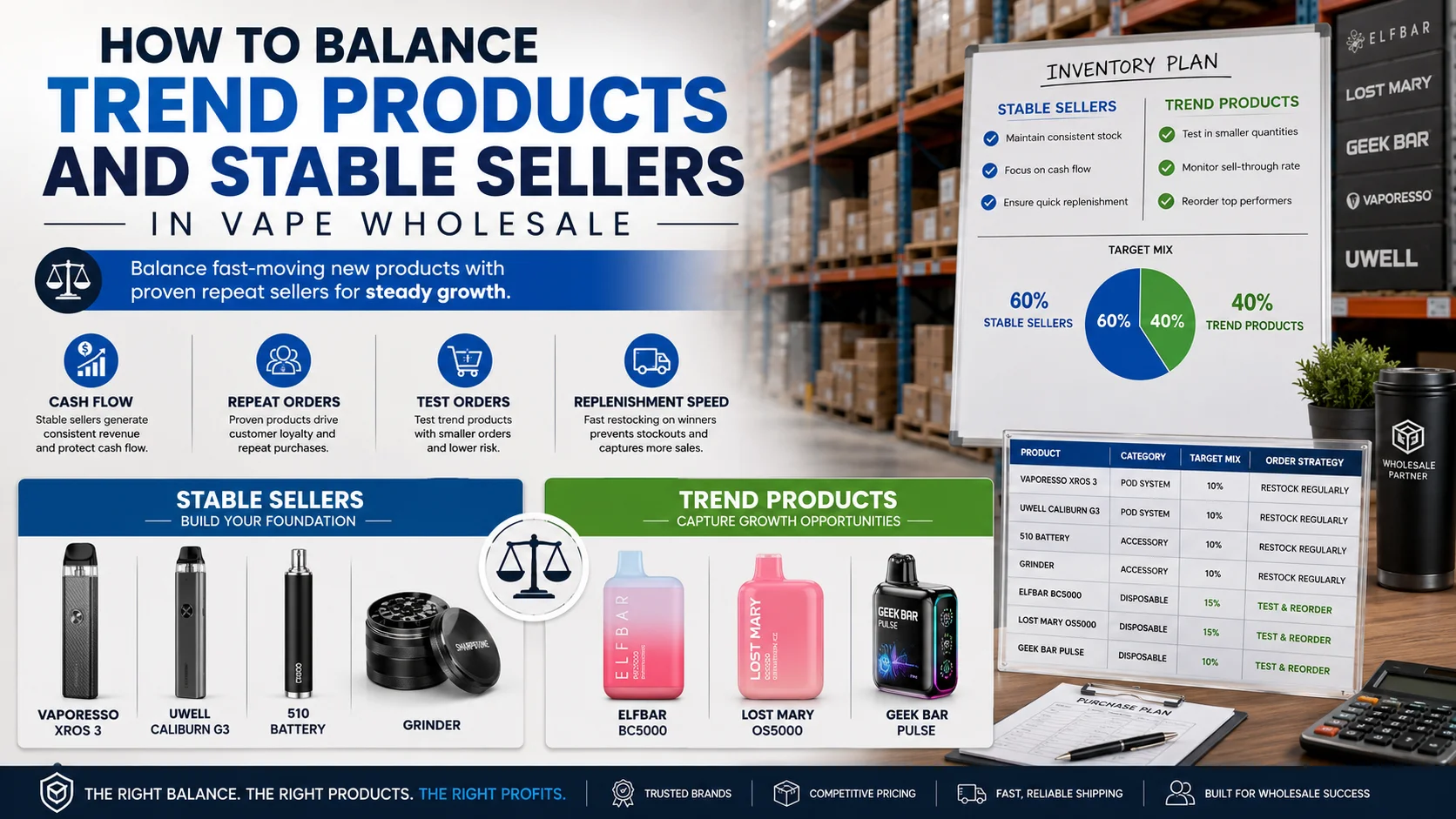
I have spoken with many wholesalers, smoke shop suppliers, and importers who face this exact decision. They want the next hot product before competitors do, but they also need reliable products that keep their regular customers supplied every week. The goal is not to find one perfect ratio. The goal is to reduce uncertainty while keeping your assortment competitive.
Quick Answer: How to Balance Trend Products and Stable Sellers in Vape Wholesale?
Many wholesalers feel pressure to order the newest disposable vape, atomizer, 510 battery, or smoking accessory as soon as customers start asking about it. That pressure can lead to rushed buying decisions, especially when a product appears everywhere online.
I suggest treating stable sellers as your commercial foundation and trend products as controlled market tests. Your core range should protect repeat revenue. Your new-product range should help you discover fresh demand before you commit too much working capital.
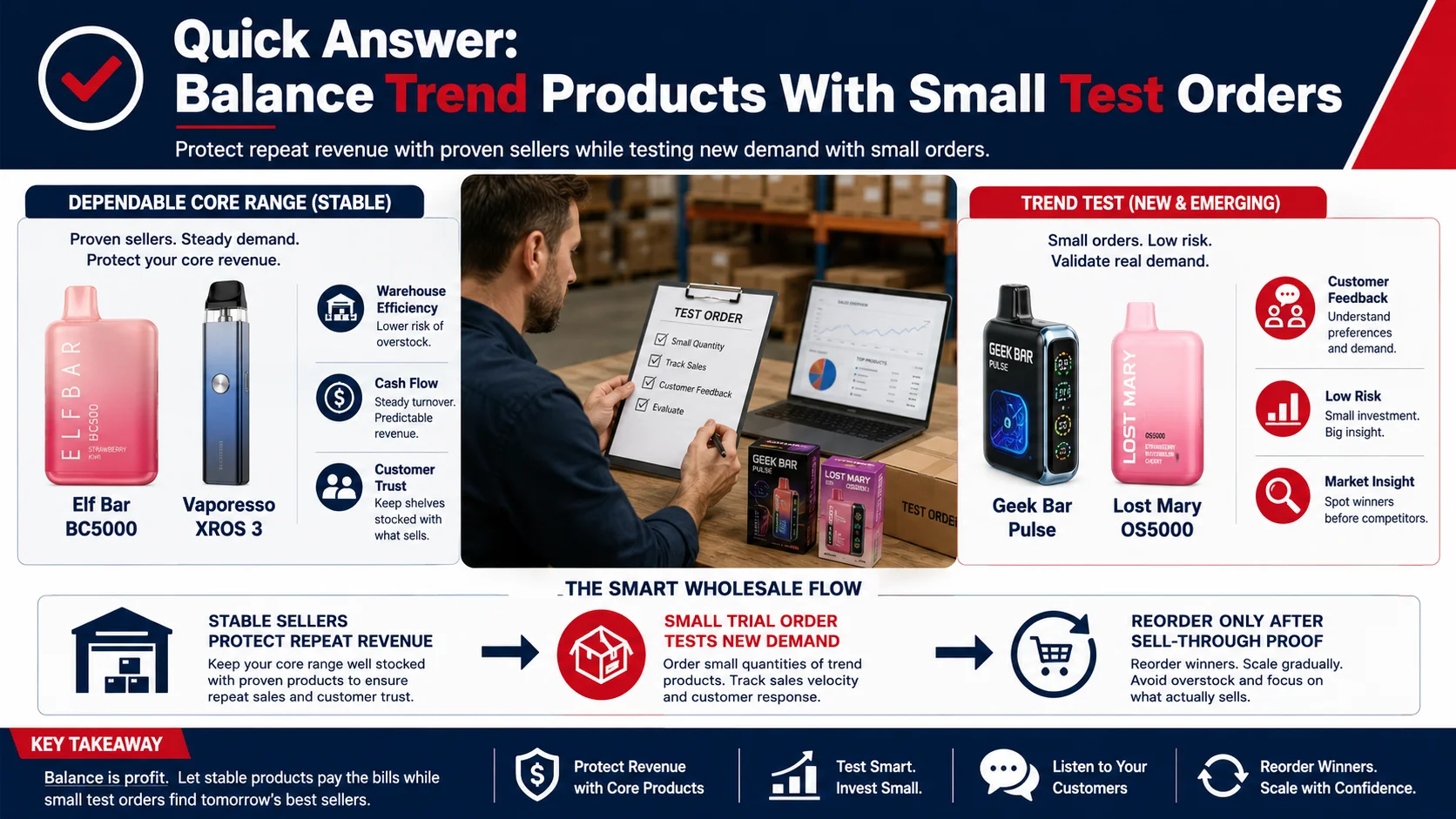
A practical vape inventory strategy starts with one question: What job does this product perform in my business? A product can do one or more of the following:
- Keep existing customers coming back for routine replenishment
- Give vape shops or smoke shops a new reason to buy from you
- Help you enter a new price range or product category
- Increase average order value
- Test a new flavor direction, device format, or brand position
- Support an OEM or private-label opportunity
I do not advise customers to use a universal percentage split, because a small importer in Spain, a regional distributor in the United States, and a multi-store wholesaler in Germany will have different cash-flow needs and replenishment options.
Instead, I recommend separating your stock into three groups:
- Core SKUs: Products with regular reorder history and a clear customer base.
- Test SKUs: New or trending vape products bought in manageable quantities.
- Opportunity SKUs: Seasonal, local, promotional, or customer-requested items that need closer monitoring.
This structure helps you avoid two costly extremes. The first is buying only old, safe products and losing market attention. The second is filling your warehouse with unproven products that looked exciting for one month but did not generate repeat orders.
I have seen buyers overstock because a product looked popular in another market. I have also seen buyers miss profitable opportunities because they refused to test anything new. The better approach is controlled testing supported by reliable stock.
What Is the Difference Between Trend Products and Stable Sellers in Vape Wholesale?
A trend product and a stable seller may look similar on a purchase order, but they create very different inventory risks. If you treat both product types the same way, you can create unnecessary stock pressure or miss a useful sales opportunity.
I define trend products as products with rising attention, new features, fresh branding, changing flavor preferences, or short-term channel excitement. I define stable sellers as products that have shown consistent reorder demand over time in your own sales channel.
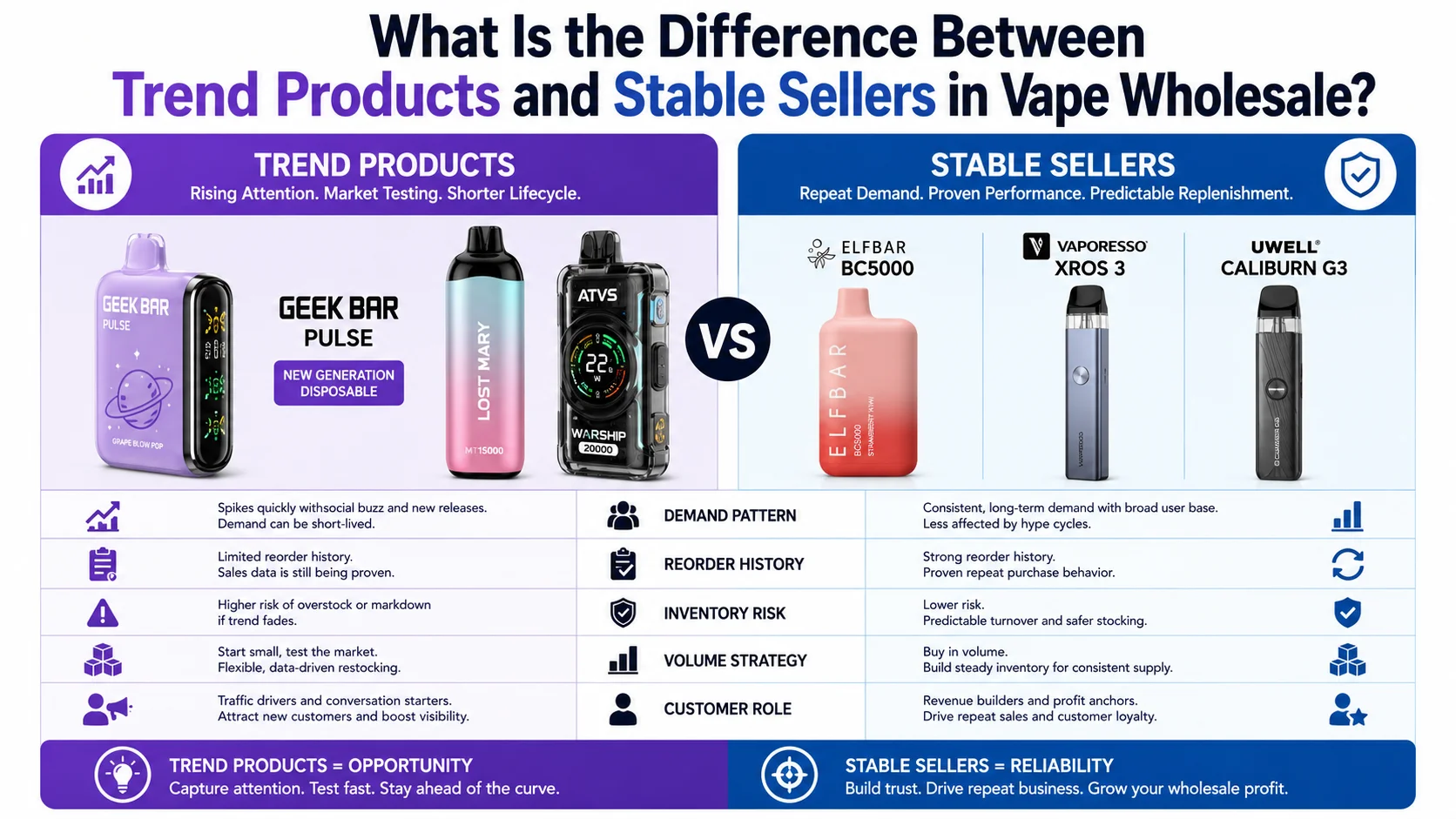
Trend products often have a strong sales story. They may introduce a new device shape, a different puff range, improved display packaging, a popular flavor profile, or an accessory that customers have not seen before. However, a new product is not automatically a long-term winner.
Stable sellers are not “boring stock.” They are the products that often keep your warehouse moving when a trend slows down. They can include established disposable vape formats, common replacement items, reliable batteries, standard atomizers, grinders, glass pipes, or familiar smoking accessories that fit your usual customers and price points.
How the buying decision changes
When I look at a stable item, I focus on:
- Repeat order frequency
- Supply consistency
- Customer familiarity
- Suitable price range
- After-sales experience
- Risk of running out of stock
When I look at a trending item, I focus on:
- Real customer inquiries
- Store-owner feedback
- Whether buyers ask for reorders
- Local retail price acceptance
- Product differentiation
- Whether the product fits local sales habits
- Applicable market and compliance checks
A trend may become a core SKU, but it has to prove itself. I usually see that proof through continued downstream demand, not through one enthusiastic first order.
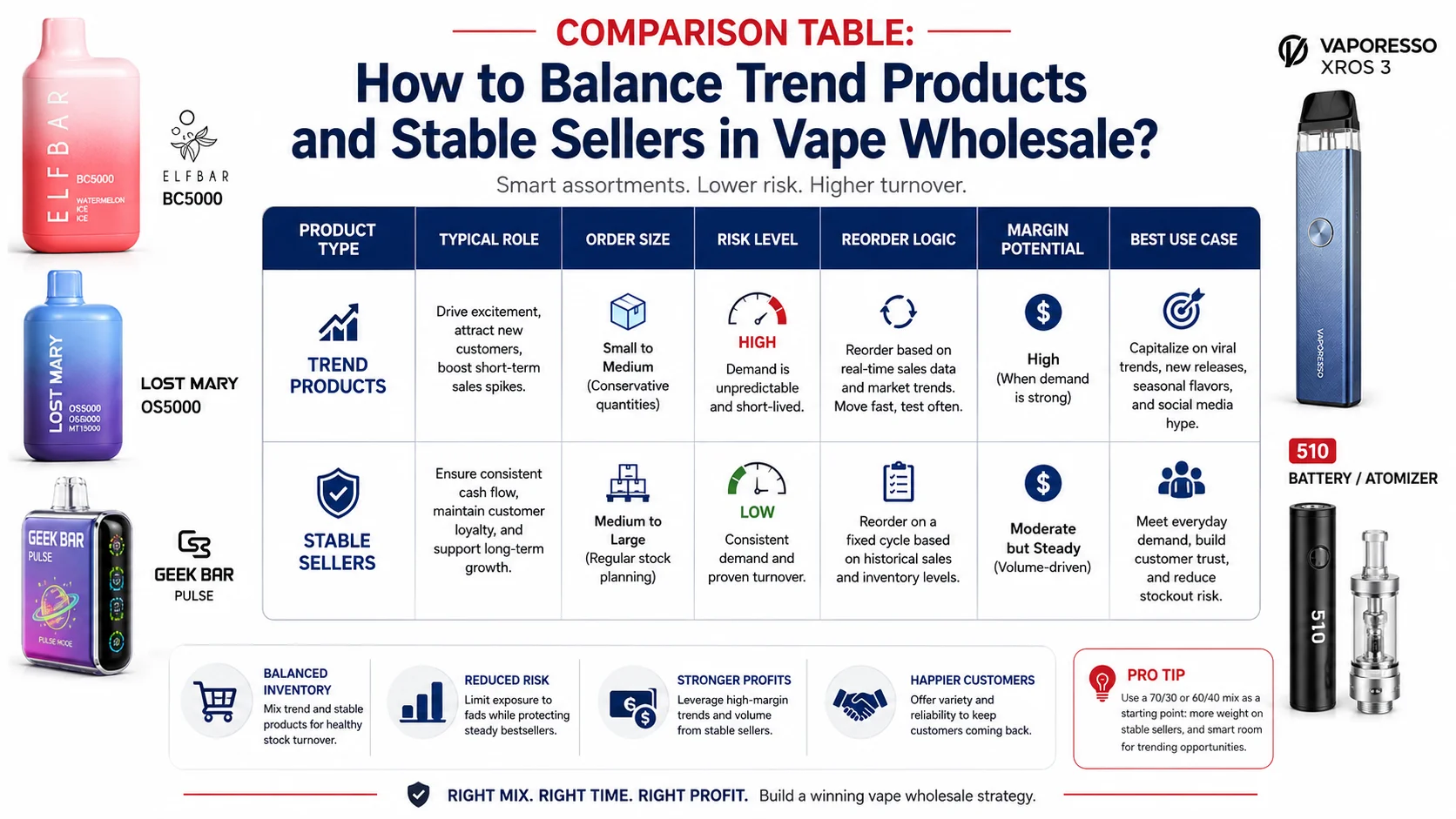
Comparison Table: How to Balance Trend Products and Stable Sellers in Vape Wholesale?
The main problem is not choosing between new and proven products. The real challenge is understanding the different risk profile of each. A clear comparison helps wholesalers make product decisions based on total inventory risk, not only unit price or headline margin.
I use the table below as a discussion tool when I help customers review a vape wholesale product mix. It does not replace local market research, but it helps make purchasing decisions more structured.
| Factor | Trend Products | Stable Sellers | Wholesale Impact |
|---|---|---|---|
| Growth potential | Can rise quickly | Usually grows steadily | Trend items can attract attention; stable items support continuity |
| Demand stability | Often uncertain at first | Usually supported by reorder history | Stable products are easier to plan around[^2] |
| First order | Best handled as a test | Can justify routine replenishment | New items need tighter quantity control |
| Margin potential | May be attractive early | Often more predictable | Margin must be considered with sell-through risk |
| Replenishment need | Depends on demand speed | Usually easier to forecast | Fast replenishment can reduce initial trial size[^3] |
| Stock risk | Higher if demand fades | Lower when backed by repeat orders | Dead stock can hurt cash flow |
| Flavor or variant risk | Often high | Usually narrower and proven | Too many variants can split demand[^4] |
| Suitable channel | Trend-led vape shops, online sellers | Convenience stores, repeat wholesale accounts, broad retail | Channel fit matters more than hype |
Do not compare products only by margin
A product with a higher margin can still be less profitable if it stays in the warehouse for too long. I encourage buyers to assess the full cost of carrying inventory:
- Capital tied up in slow stock
- Warehouse space and handling
- Discounting required to clear old products
- Lost opportunities to buy proven products
- Potential after-sales workload
- Product version or packaging changes
- Local compliance and market-entry requirements
A lower-margin core seller with frequent reorders may contribute more to a healthy business than a high-margin product that does not move.[^5] This is why vape stock planning should always consider turnover, not just gross margin.
Why Do Vape Wholesalers Need Both Trend Products and Stable Sellers?
Wholesalers who rely only on trend products can face irregular sales and difficult forecasting. Wholesalers who rely only on stable sellers may keep current buyers but give new customers fewer reasons to pay attention. Both product types have a role.
I see stable sellers as the products that help you protect your existing customer relationships. I see trend products as a way to test demand, refresh your catalog, and start conversations with buyers who are looking for something different.
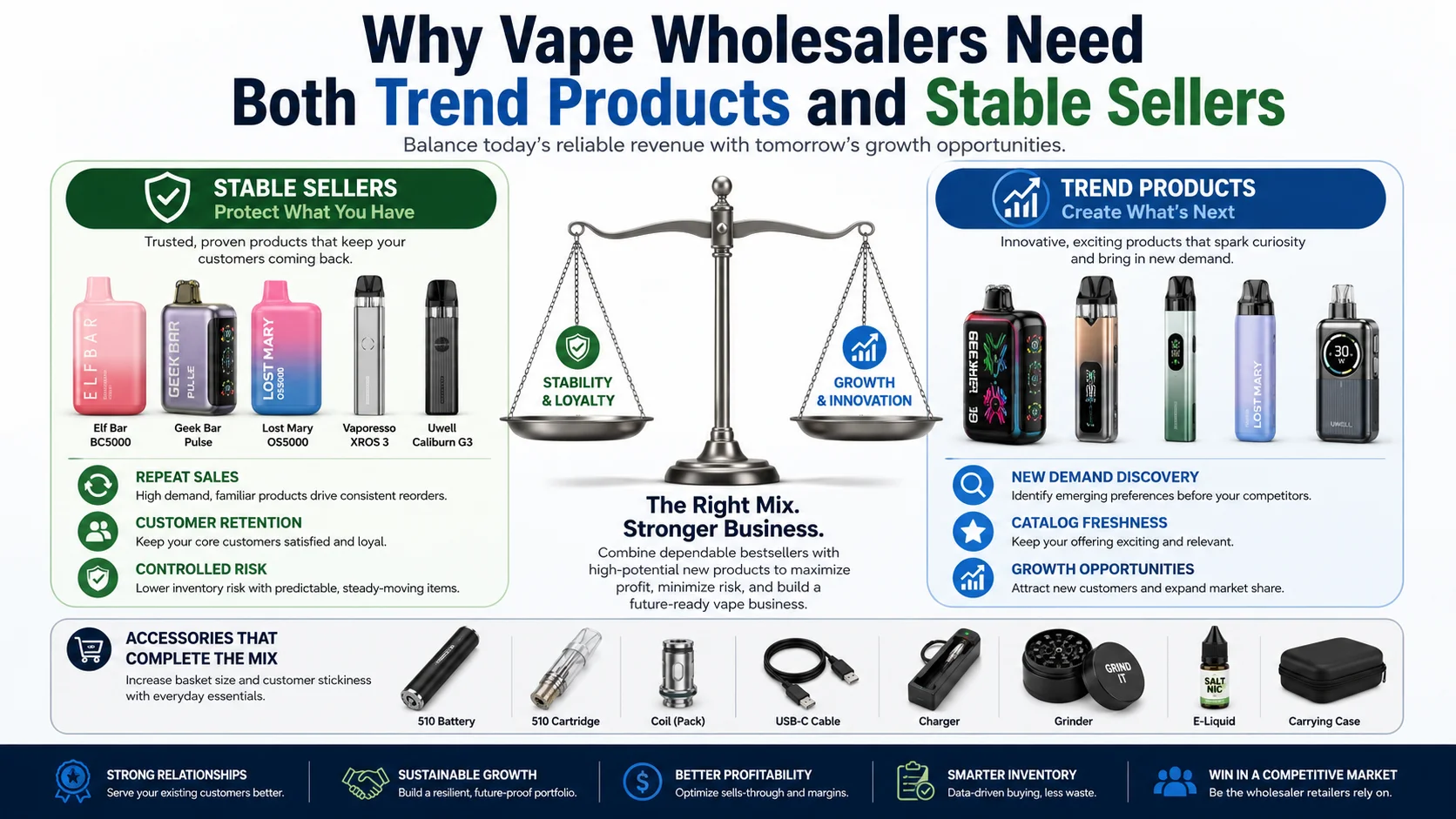
Stable products help your business in practical ways. A vape shop owner may need regular supply of the same familiar items because their end users already know what they want. A convenience-store buyer may prefer simple, proven choices that staff can sell easily. A regional distributor may need dependable SKUs that can be replenished without constantly changing displays and sales training.
At the same time, new products can create commercial momentum. A fresh product can help a wholesaler:
- Reconnect with inactive buyers
- Give sales representatives something new to present
- Test a different price band
- Create bundles with stable accessories
- Learn what local stores are asking for
- Identify a possible private-label or OEM direction
A practical example from supplier conversations
I have had conversations with customers who placed very large orders after seeing a product become popular online. Some of those products sold well at first, but the buyers later found that local stores wanted different flavors, different packaging, or a more familiar price point.
I have also worked with customers who began with smaller trial quantities, watched store feedback, then increased orders only after they saw real reorders. I cannot promise that this approach creates a bestseller. However, I have found that it gives buyers a clearer basis for deciding what deserves more capital.
How Do Sales Channels Change the Right Vape Wholesale Product Mix?
A product mix that works for one channel may not work for another. Buyers often make mistakes when they copy a competitor’s range without asking whether that competitor serves the same type of customer, price level, and sales environment.
I recommend building your assortment around your actual route to market: vape shops, smoke shops, convenience stores, online retailers, regional distributors, or local cash-and-carry buyers.
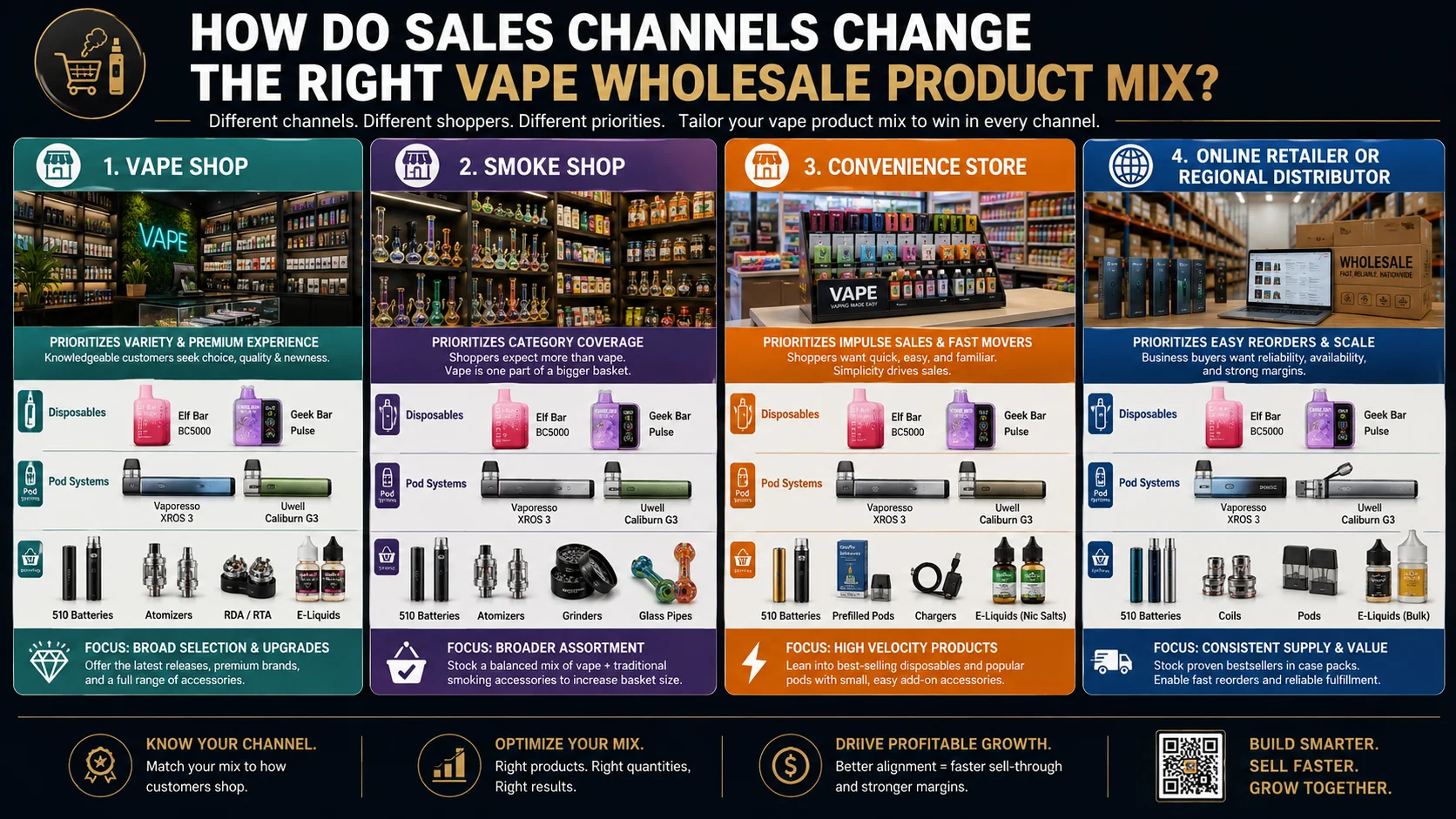
Vape shops and smoke shops
These customers often want a combination of familiar products and visible newness. They may ask for new flavors, newly launched devices, popular accessories, or attractive packaging. However, they also need products that their regular customers recognize and reorder.
For this channel, I suggest keeping your stable range available while rotating a controlled number of new test items.
Convenience stores and gas stations
These channels often value simple selection, recognizable formats, dependable supply, and easy staff selling. A very broad flavor range or complicated product line can create confusion. Stable sellers may carry more importance here, while new products should be introduced carefully.
Online retailers
Online sellers can react quickly to search demand, reviews, and new launches. They may test more new items, but they also face fast competition and pricing pressure. I recommend that online sellers watch actual conversion and reorder data rather than page views alone.[^6]
Small importers and regional distributors
Small and mid-sized importers need to protect cash flow. For customers in Europe, our available European warehouse stock can support smaller-batch fulfillment where applicable, with low starting quantities for many items and faster local dispatch options. This can reduce the size of an initial test order.
For larger importers, buying from China in larger quantities may offer stronger pricing and more OEM/ODM flexibility. However, faster dispatch or warehouse availability does not remove demand, logistics, customs, or compliance risk[^7]. Buyers should verify local requirements before placing an order.[^8]
How Can You Tell Whether a Vape Trend Matters in Your Market?
A trend becomes useful only when it connects with real buyers in your own market. Social-media visibility, competitor listings, and supplier launches can provide clues, but they are not proof that your customers will reorder.[^9]
I recommend looking for repeated commercial signals before increasing a purchase quantity. The strongest signals usually come from your downstream customers, not from a viral post.[^10]
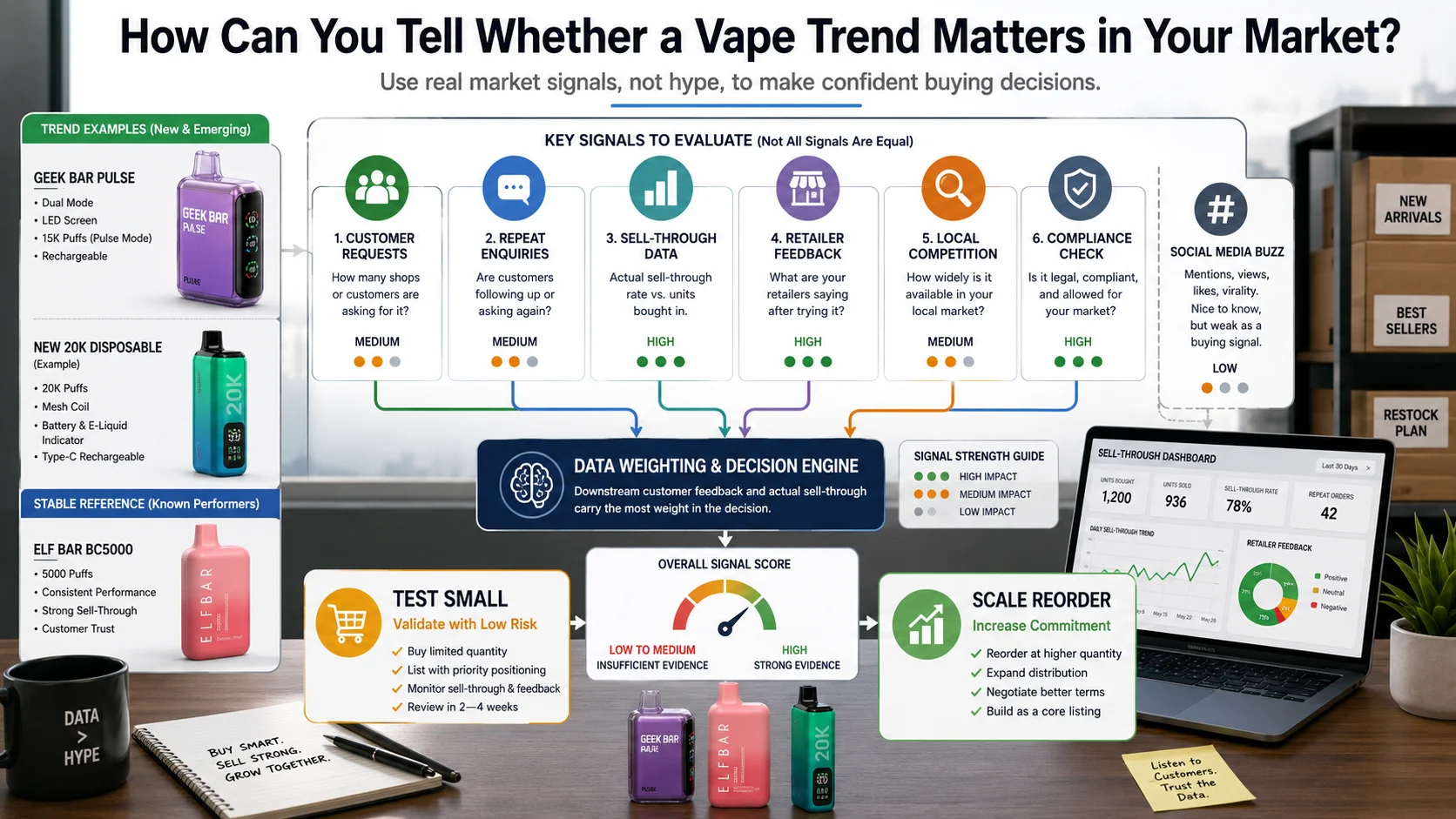
Signals worth tracking
I suggest monitoring the following points for each test SKU:
-
Direct customer inquiries
Are vape shops, smoke shops, or retailers asking for the product by name or category? -
Repeat orders
Does the same buyer come back for more after the first delivery? -
Sell-through speed
Are stores selling the item within their normal buying cycle, or is it sitting on shelves? -
Requested variants
Do customers ask for more flavors, colors, capacities, or similar product formats? -
Retail price acceptance
Can your customers sell it at a price their end users accept? -
Channel fit
Does the product suit your customers’ type of retail store and their typical shopper? -
Local requirements
Have you checked the product’s relevant labeling, product, tax, import, and sales requirements for your destination market?
I encourage customers to keep simple notes after each launch. You do not need a complicated software system at the beginning. A spreadsheet with SKU, order date, customer feedback, sell-through comments, reorder date, and next action can reveal patterns quickly.
How to Build a More Practical Vape Wholesale Product Mix?
Poor inventory decisions often start with good intentions. A buyer wants to be first with a hot product, so they buy too many flavors, too many variants, or too much volume before the local market gives clear feedback. Another buyer avoids all new products and slowly loses relevance.
I recommend a step-by-step system for how to balance trend products and stable sellers in vape wholesale. This approach gives your established products and your new-product tests separate rules.
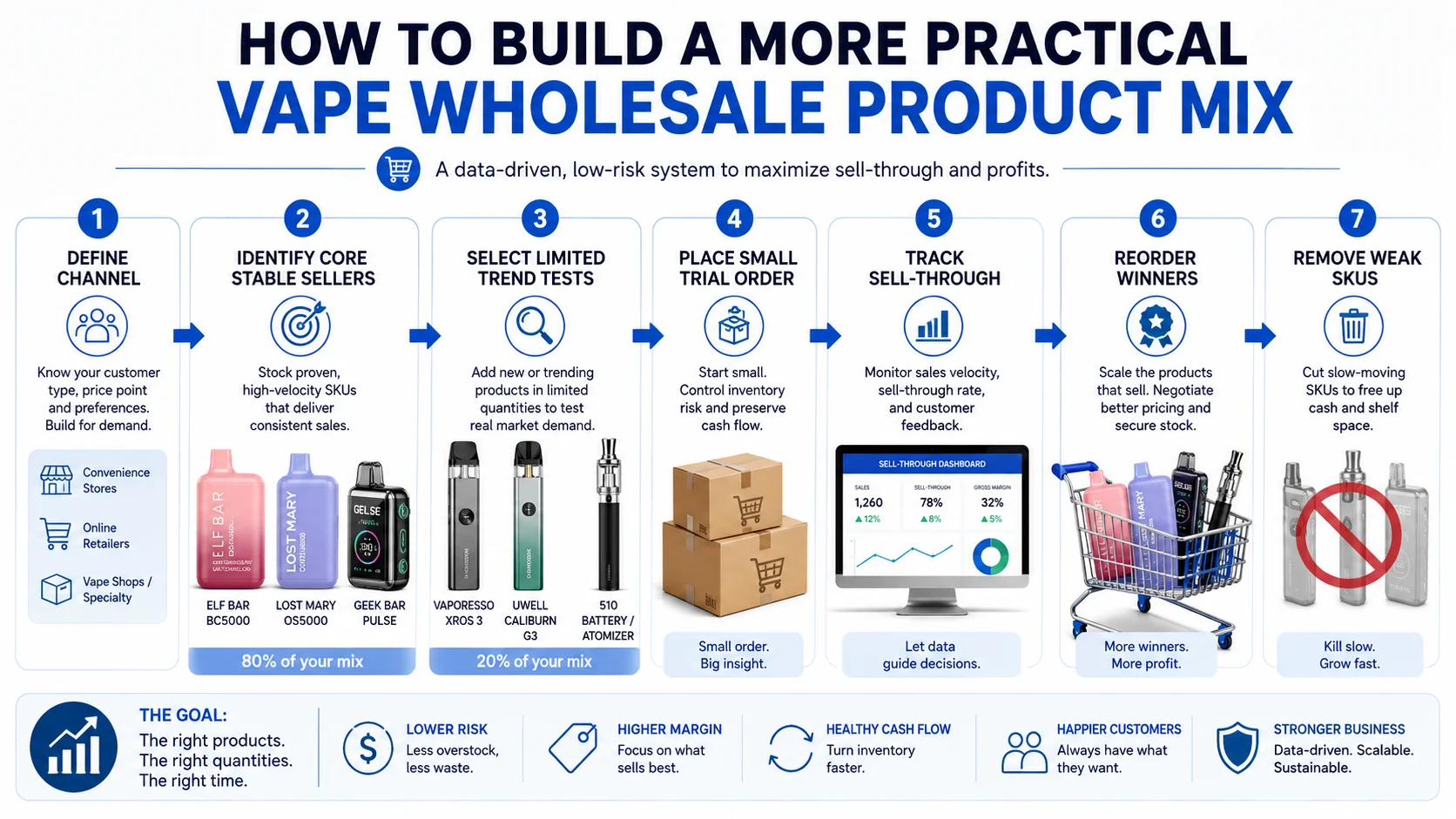
Step 1: Identify your true core SKUs
Start with products that have shown actual repeat demand. Look at your own invoices, not just your memory. Identify which products customers reorder, which price bands move consistently, and which items generate the fewest avoidable questions.
Step 2: Reserve room for controlled tests
Add a limited number of trending vape products that match your channel. I do not recommend adding every new flavor or every new device. Choose products with a clear reason to test: customer inquiry, market gap, attractive format, or a credible brand request.
Step 3: Buy the first order as a test
A first order should answer a question: Will my customers buy this again?[^11] It should not be treated as proof of long-term demand. Smaller trial quantities can help you learn without creating unnecessary dead-stock exposure.
Step 4: Track reorder behavior
Watch what happens after the first sale. Do stores ask for more? Do they request other variants? Do they say the product is slow? I place more value on reorder behavior than on early curiosity.
Step 5: Expand winners gradually
When a product shows sustained demand, you can add quantity, variants, or related accessories. When it does not perform, reduce exposure rather than repeatedly adding stock in the hope that demand will appear.
Step 6: Remove weak SKUs
A broad catalog is not always a strong catalog. Slow products make purchasing, warehousing, and sales work harder. I recommend regularly reviewing products that have no clear purpose, no reorder signal, and no strategic customer request.
Explore Vape Wholesale Categories for Your Market?
Choosing the right categories is easier when your supplier understands your destination market, sales channel, order size, and customer type. A product range for a European tourist-area smoke shop may be different from a U.S. regional wholesaler’s range or an online retailer’s catalog.
I can help you compare core products, new arrivals, multi-brand options, accessories, and OEM/ODM opportunities based on the way you sell—not simply on what is newly available.
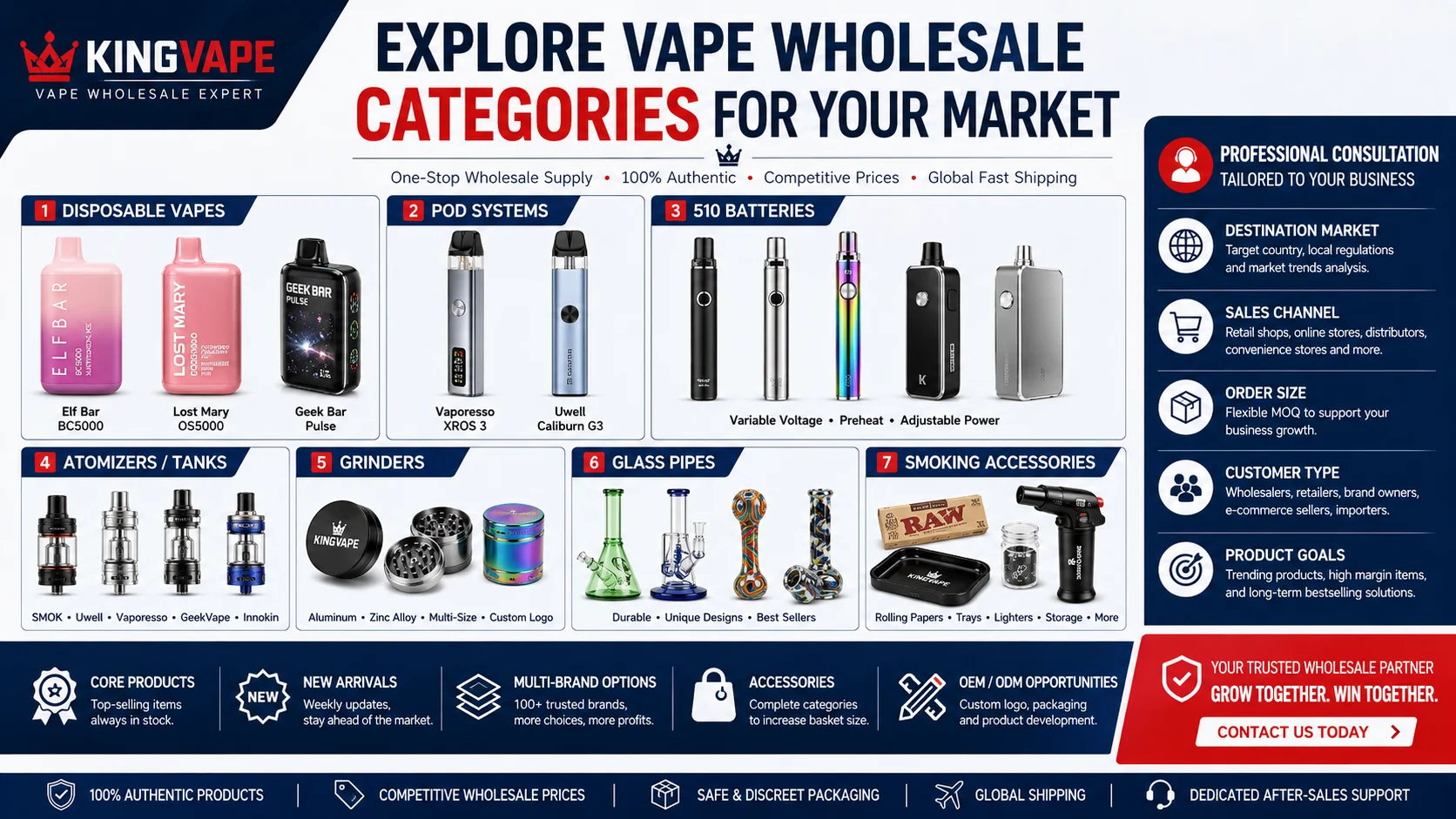
At Shenzhen Kingfuji Tech. Co., Ltd., I work with customers who want a more practical one-stop sourcing process. We are a Shenzhen-based factory and trading company established in 2011. Our own factory covers 5,000 square meters and has a maximum monthly capacity of up to 5 million units. We also support multi-brand, multi-category sourcing for electronic cigarettes, disposable vapes, atomizers, 510 batteries, CBD batteries, vaporizers, grinders, glass pipes, and related smoking accessories.
For smaller and medium-sized buyers, available European warehouse stock can support faster fulfillment in applicable cases. For larger importers and distributors, China-based bulk purchasing can provide stronger pricing options, product development support, and OEM/ODM possibilities.
Send KingVape your destination market, sales channel, current best sellers, preferred product categories, and estimated order quantity. I will help you build a more workable balance between trend products and stable sellers.
Before ordering, I always recommend that buyers independently confirm all relevant local product, import, labeling, tax, and sales requirements.
Frequently Asked Questions
Should I buy a large quantity when a new vape product becomes popular?
I do not recommend treating early popularity as proof of long-term demand. I suggest starting with a manageable test order, gathering feedback from downstream stores, and watching whether customers place repeat orders. Larger purchases should follow sustained sell-through, not initial excitement alone.
What are stable vape sellers?
Stable vape sellers are products that show consistent demand and repeat ordering in your own market. They may include familiar disposable vape formats, batteries, atomizers, and smoking accessories. These products often support predictable replenishment, customer loyalty, and healthier working-capital planning.
Can a trending vape product become a core SKU?
Yes, a trend product can become a core SKU when it shows continued demand over time. I look for repeat wholesale orders, steady end-user sell-through, customer requests for more variants, and a product position that fits the local channel and price range.
How can a European warehouse help with vape inventory planning?
Where stock is available and the destination is eligible, a European warehouse can allow smaller trial purchases and faster local delivery. However, it does not guarantee sales, remove compliance responsibilities, or eliminate shipping and market risk. Buyers should still test demand carefully.
What information should I send a vape wholesale supplier before ordering?
I recommend sharing your destination market, sales channel, customer type, current best-selling products, target price range, preferred categories, and estimated quantity. This information helps me suggest a more useful product mix instead of sending a generic catalog.
Conclusion
Knowing how to balance trend products and stable sellers in vape wholesale is really about protecting your cash flow while staying relevant to your customers. Stable SKUs create the base for repeat business, dependable replenishment, and regular turnover. Trend products help you test changing demand and open new sales opportunities. I recommend using small tests, real reorder feedback, and regular SKU reviews before expanding a new product. Contact KingVape with your market and sourcing needs, and I will help you build a practical wholesale range for your channel.
[^1]: "Carrying cost", https://en.wikipedia.org/wiki/Carrying_cost. Inventory-management literature describes slow-moving and excess stock as capital tied up in inventory, with associated holding, obsolescence, and liquidity costs. Evidence role: mechanism; source type: research. Supports: Inventory-management research explaining that excess or slow-moving inventory ties up capital and creates carrying or obsolescence costs.. [^2]: "Stochastic demand forecast and inventory management of ...", https://repository.lsu.edu/cgi/viewcontent.cgi?article=3715&context=gradschool_dissertations. Demand-forecasting research generally finds that historical demand patterns and lower variability provide a more reliable basis for replenishment planning than newly introduced items with little sales history. Evidence role: mechanism; source type: research. Supports: Forecasting research showing that demand history and lower demand variability can improve planning and replenishment decisions.. Scope note: Past reorder history does not guarantee future demand, particularly when consumer preferences, regulation, or product availability changes. [^3]: "The Effect of Lead Time Uncertainty on Safety Stocks", https://www.kellogg.northwestern.edu/faculty/chopra/htm/research/Effect%20of%20Lead%20Time%20Uncertainty.pdf. Inventory-control theory indicates that shorter, more reliable replenishment lead times can reduce the stock buffer needed to manage demand uncertainty and therefore permit smaller initial inventory commitments. Evidence role: mechanism; source type: education. Supports: Inventory-control principles explaining how shorter and more reliable lead times can reduce inventory buffers and commitment requirements.. Scope note: Reduced lead time does not itself establish demand or eliminate minimum-order, freight, customs, and stock-availability constraints. [^4]: "THE IMPACT OF PRODUCT VARIETY ON RETAILER ... - UMD DRUM", https://drum.lib.umd.edu/bitstreams/01fae0dd-5a33-4fee-bdba-1d69531feac6/download. Operations research on product proliferation finds that expanding assortment variety can fragment demand across individual SKUs and increase forecasting and inventory-management complexity. Evidence role: mechanism; source type: paper. Supports: Research addressing how increased product variety can fragment demand among SKUs and raise inventory-management complexity.. Scope note: Additional variants may still be commercially justified when they attract distinct customer segments or materially increase total demand. [^5]: "Exploring Inventory Management's Effects on a Company's ...", https://dc.etsu.edu/cgi/viewcontent.cgi?article=1887&context=honors. Studies of inventory productivity show that gross margin must be evaluated alongside inventory turnover and holding costs, because a high-margin item can yield a weaker return when it remains unsold for long periods. Evidence role: mechanism; source type: paper. Supports: Research on the relationship among gross margin, inventory turnover, carrying costs, and return on inventory investment.. Scope note: The relative profitability of particular vape SKUs still depends on their purchase cost, selling price, financing cost, and realized demand. [^6]: "Types of Analytics for the Web and Their Uses", https://businessdegrees.uab.edu/blog/what-are-the-different-types-of-web-analytics-and-their-uses/. Web-analytics research treats page views as an exposure measure, whereas conversion and repeat-purchase measures more directly record completed transactions and subsequent customer behavior. Evidence role: mechanism; source type: research. Supports: Web-analytics evidence distinguishing exposure metrics such as page views from transactional outcomes such as conversion and repeat purchase.. Scope note: Conversion and reorder data should be interpreted with traffic source, price changes, stock availability, and customer-acquisition costs. [^7]: "E-Cigarettes, Vapes, and other Electronic Nicotine Delivery ...", https://www.fda.gov/tobacco-products/products-ingredients-components/e-cigarettes-vapes-and-other-electronic-nicotine-delivery-systems-ends. Regulatory guidance on electronic nicotine-delivery products shows that market access may remain subject to product, labeling, notification, tax, import, and sales rules regardless of the location from which stock is dispatched. Evidence role: general_support; source type: institution. Supports: Authoritative information that product availability and delivery arrangements do not replace import, labeling, product-safety, tax, and sales compliance obligations.. Scope note: Applicable obligations differ by jurisdiction, product characteristics, nicotine content, and the role of the importer, distributor, or retailer. [^8]: "Importing Tobacco Products", https://www.fda.gov/industry/importing-fda-regulated-products/importing-tobacco-products. Official regulatory frameworks for electronic cigarettes commonly impose jurisdiction-specific requirements concerning product authorization, labeling, importation, marketing, taxation, and retail sale. Evidence role: historical_context; source type: government. Supports: Official regulatory information showing that electronic-cigarette requirements can cover product authorization, labeling, marketing, importation, taxation, and sales restrictions.. Scope note: This evidence does not provide legal advice; buyers must confirm the current rules applicable to their specific product and destination market. [^9]: "Purchase intention and purchase behavior online: A cross-cultural ...", https://pmc.ncbi.nlm.nih.gov/articles/PMC7322128/. Consumer-behavior research distinguishes online attention and purchase intention from observed purchasing behavior, indicating that social-media visibility alone is not direct evidence of sustained repeat demand. Evidence role: general_support; source type: paper. Supports: Evidence that social-media engagement or stated interest can differ from actual purchasing and repeat-purchase behavior.. Scope note: The strength of this relationship varies by platform, product category, audience, price, and local market conditions. [^10]: "Experience sampling self-reports of social media use have comparable ...", https://pmc.ncbi.nlm.nih.gov/articles/PMC9084269/. Market-orientation research identifies direct customer intelligence and observed customer behavior as important inputs to demand assessment, while public attention measures do not by themselves establish purchase demand. Evidence role: general_support; source type: paper. Supports: Research indicating that direct customer intelligence and transactional data are valuable inputs to market sensing and demand assessment.. Scope note: Customer feedback can be biased or unrepresentative and should be assessed alongside sales, reorder, pricing, and channel data. [^11]: "Test Markets", https://media.acc.qcc.cuny.edu/faculty/volchok/causalMR/CausalMR8.html. New-product and consumer-choice research distinguishes initial trial from repeat purchasing, with repeat behavior providing a more relevant indicator of whether demand may persist beyond a launch effect. Evidence role: mechanism; source type: paper. Supports: New-product research showing that trial purchase and repeat purchase are distinct indicators and that repeat behavior is relevant to assessing sustained demand.. Scope note: Repeat purchase is only one indicator of sustained wholesale demand and may be affected by stockouts, promotions, seasonality, and retailer assortment decisions.