
How to judge if a product line fits your market is one of the most important decisions a vape importer or wholesaler can make. A product may look popular online, offer an attractive unit price, or come from a known brand, yet still become slow-moving inventory in your local market. I help buyers reduce this risk by evaluating demand, channels, price expectations, compliance, and replenishment before they commit too much cash.
To judge if a product line fits your market, I recommend checking local regulations, your sales channel, end-user preferences, target retail price, product specifications, brand recognition, replenishment speed, and real sales data. A vape line has strong market fit when it is legal to sell, easy for your customers to understand, priced correctly for the channel, reliable enough for repeat business, and available for restocking without creating excessive inventory risk.
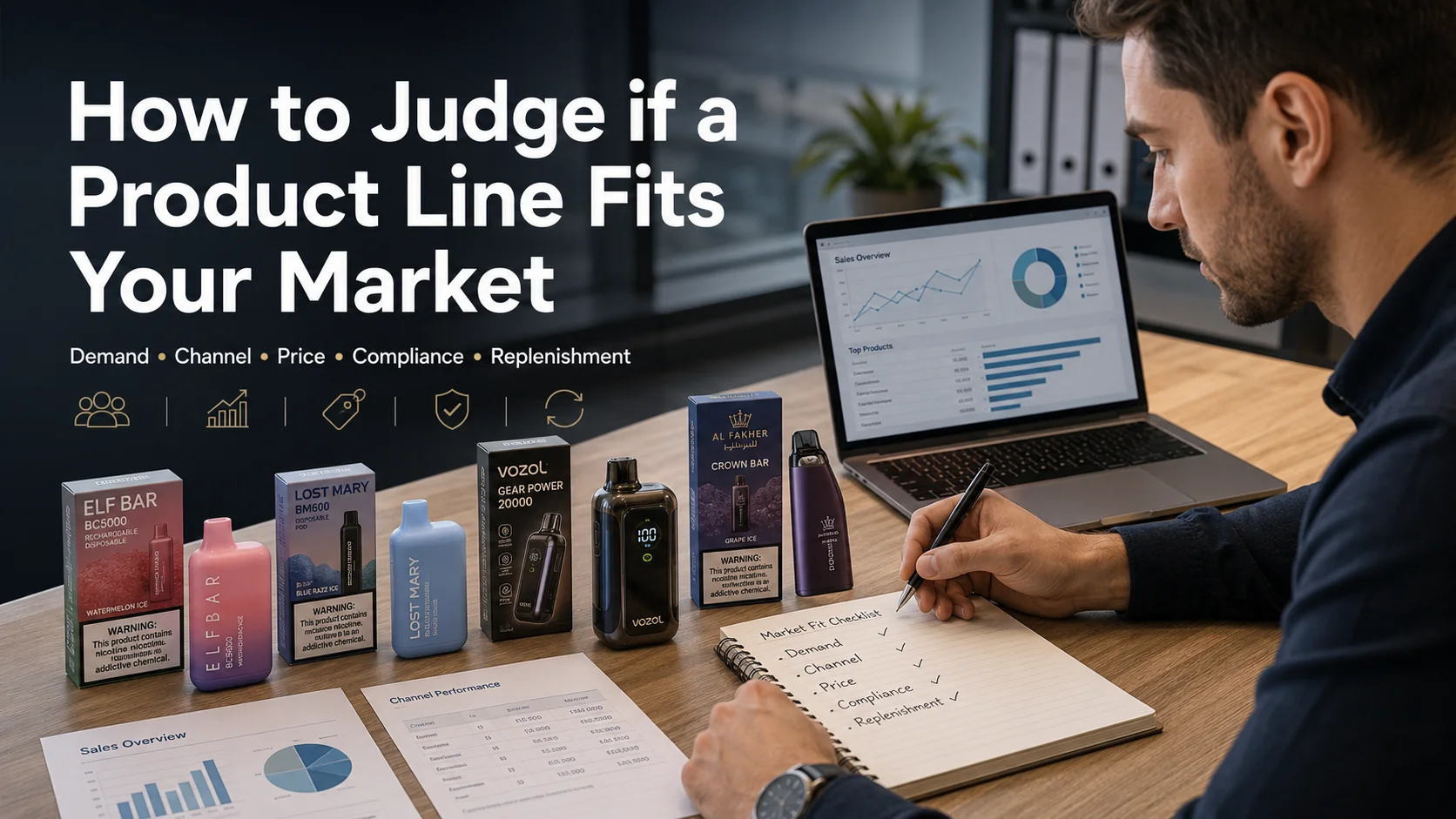
A good vape product line is not simply the newest product from Shenzhen or the lowest-priced item in a supplier catalogue. I believe the right question is: Can this product move steadily through your specific channel without creating quality, cash-flow, or after-sales pressure? That is the practical standard I use when discussing product selection with importers, wholesalers, vape shops, smoke shops, convenience stores, and regional distributors.
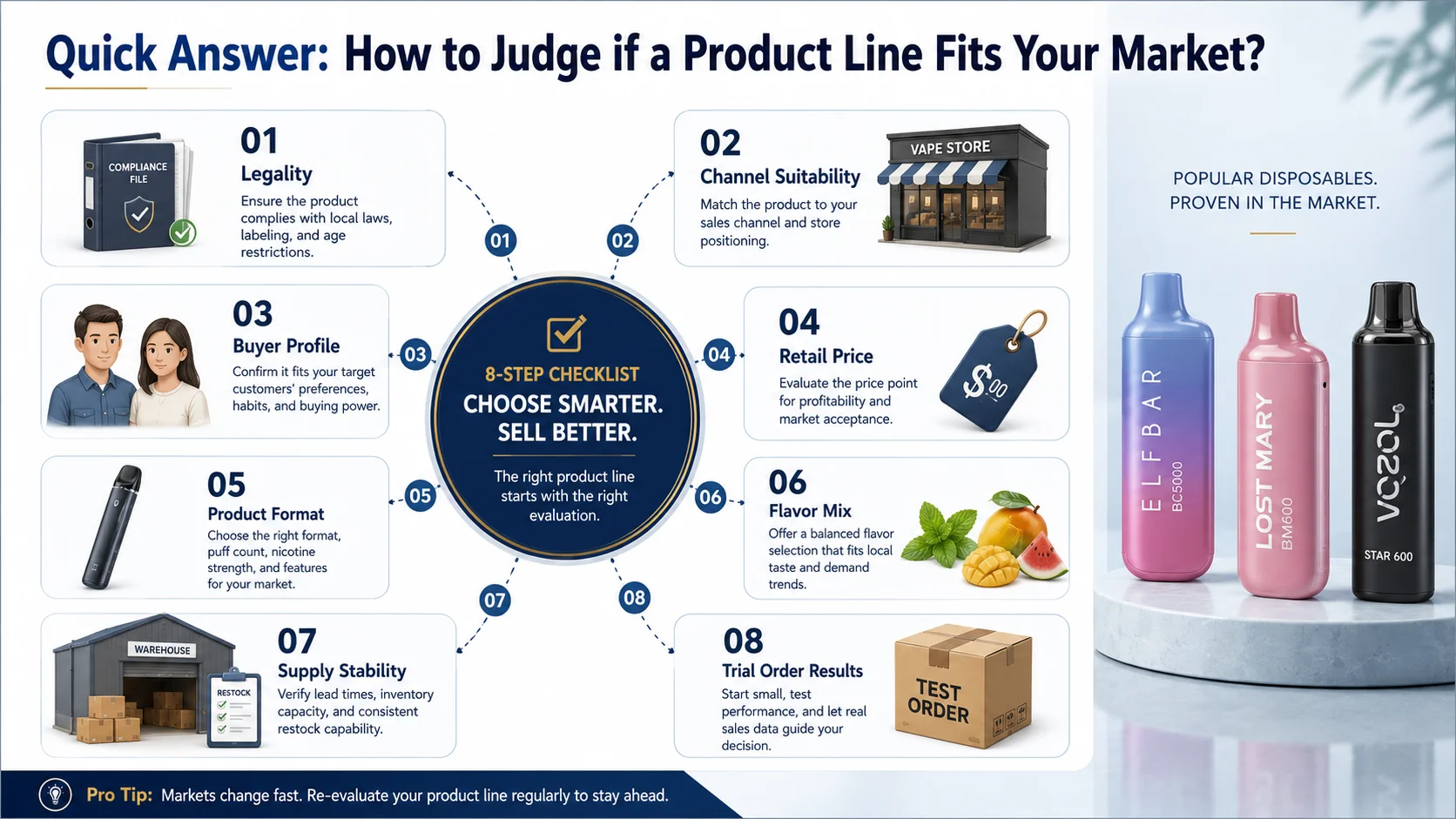
Quick Answer: How to Judge if a Product Line Fits Your Market?
Many buyers face the same problem: they must choose products before they have complete certainty about local demand. If they choose too broadly, cash gets trapped in slow stock[^1]. If they choose too conservatively, they may miss a good opportunity.
When I judge if a product line fits your market, I look at eight areas: legality, channel suitability, buyer profile, retail price, product format, flavors, supply stability, and trial-order results. A product should be tested in a small and manageable assortment before a large import order.[^2]
Start With the Market You Actually Serve
I always ask buyers to define their market more precisely. “Europe,” “the United States,” or “the Middle East” is not a complete market definition. A gas station in one city, a tourist smoke shop, and an established vape retailer can all serve very different buyers.
For example, I have seen buyers focus on a product that is popular in another country, only to find that their own customers do not understand the format, do not accept the retail price, or prefer another flavor profile. The product itself may not be bad. It simply does not fit the local buying situation.
Before ordering, I suggest answering these questions:
-
Who will sell the product?
Is it a vape shop, smoke shop, convenience store, gas station, online store, or local wholesaler? -
Who will use it?
Are the end users price-sensitive, brand-focused, experienced, or mainly looking for easy and convenient products? -
What retail price can the channel support?
A product with a high margin on paper may still move slowly if the final shelf price is too high. -
How quickly must stock turn?
A small importer often needs fast replenishment and lower risk. A large distributor may have more capacity for broader inventory planning. -
What happens if the product fails?
Consider capital tied up in stock, replacement requests, damaged reputation, and missed opportunities to buy faster-moving items.
What Does Vape Product Market Fit Mean in Wholesale?
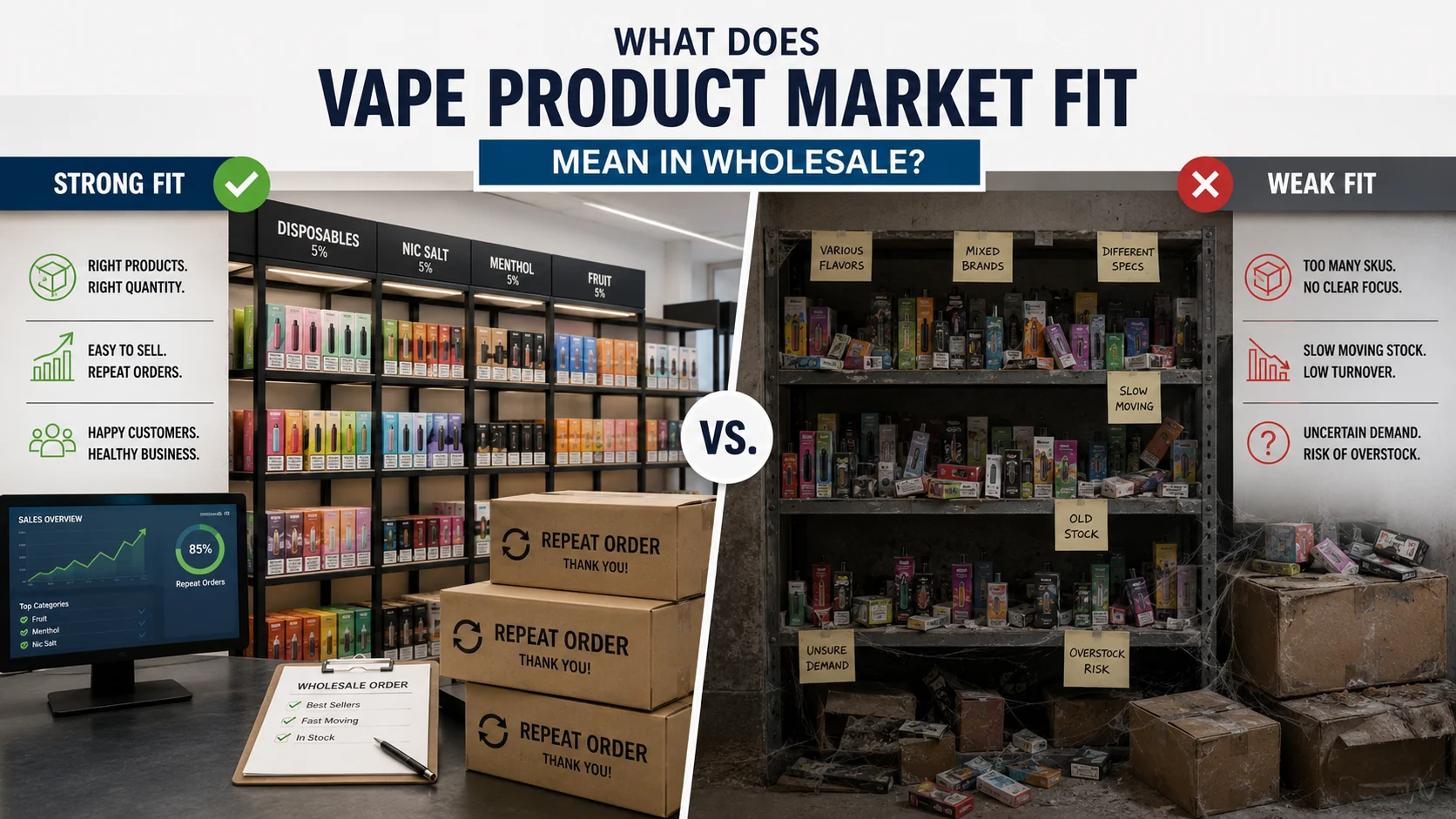
Some wholesalers think market fit only means that a product can be sold. I take a broader view because a product that sells once but creates complaints, confusion, or difficult replenishment is not a strong long-term wholesale product.
Vape product market fit means a vape line matches local rules, channel needs, buyer expectations, price tolerance, product usability, and repeat-order potential. It should be easy to explain, practical to display, stable to replenish, and realistic for the buyer’s inventory capacity.
A Product Line Must Work Operationally, Not Only Commercially
When I discuss vape wholesale product selection with customers, I look beyond the product photo and factory quotation. A strong product line should support the buyer’s daily business operations.
That includes:
- Clear product positioning: Staff should understand who the item is for and how to present it.
- Reasonable SKU structure: Too many similar flavors, colors, or specifications can confuse both staff and consumers.[^3]
- Reliable replenishment: A good first order can lose value if the buyer cannot restock when demand appears.
- Acceptable after-sales exposure: Quality problems can damage relationships with retail customers.[^4]
- Packaging practicality: The product should fit shelf space, warehouse space, and local labeling needs.
- Cash-flow compatibility: The order size should match the buyer’s ability to sell through stock.
At Shenzhen Kingfuji Tech. Co., Ltd., I work with buyers who have very different business models. Some buyers want small quantities from our European warehouse so they can test products with less capital pressure. Others are established importers and wholesalers who prefer direct China shipments, larger quantities, stronger unit-price advantages, or OEM/ODM development.
Neither model is automatically better. The correct choice depends on the buyer’s market, risk tolerance, and replenishment plan.
How to Judge if a Product Line Fits Your Market: Strong vs. Weak Signals?
A buyer can avoid many expensive mistakes by comparing strong market-fit signals with warning signs before placing an order. The goal is not to predict every sale perfectly. The goal is to make a more controlled decision.
A strong vape product-market fit appears when regulations, price, product format, channel demand, and replenishment all align. A weak fit appears when buyers rely mainly on supplier claims, social-media trends, low unit cost, or another country’s sales data without local validation.
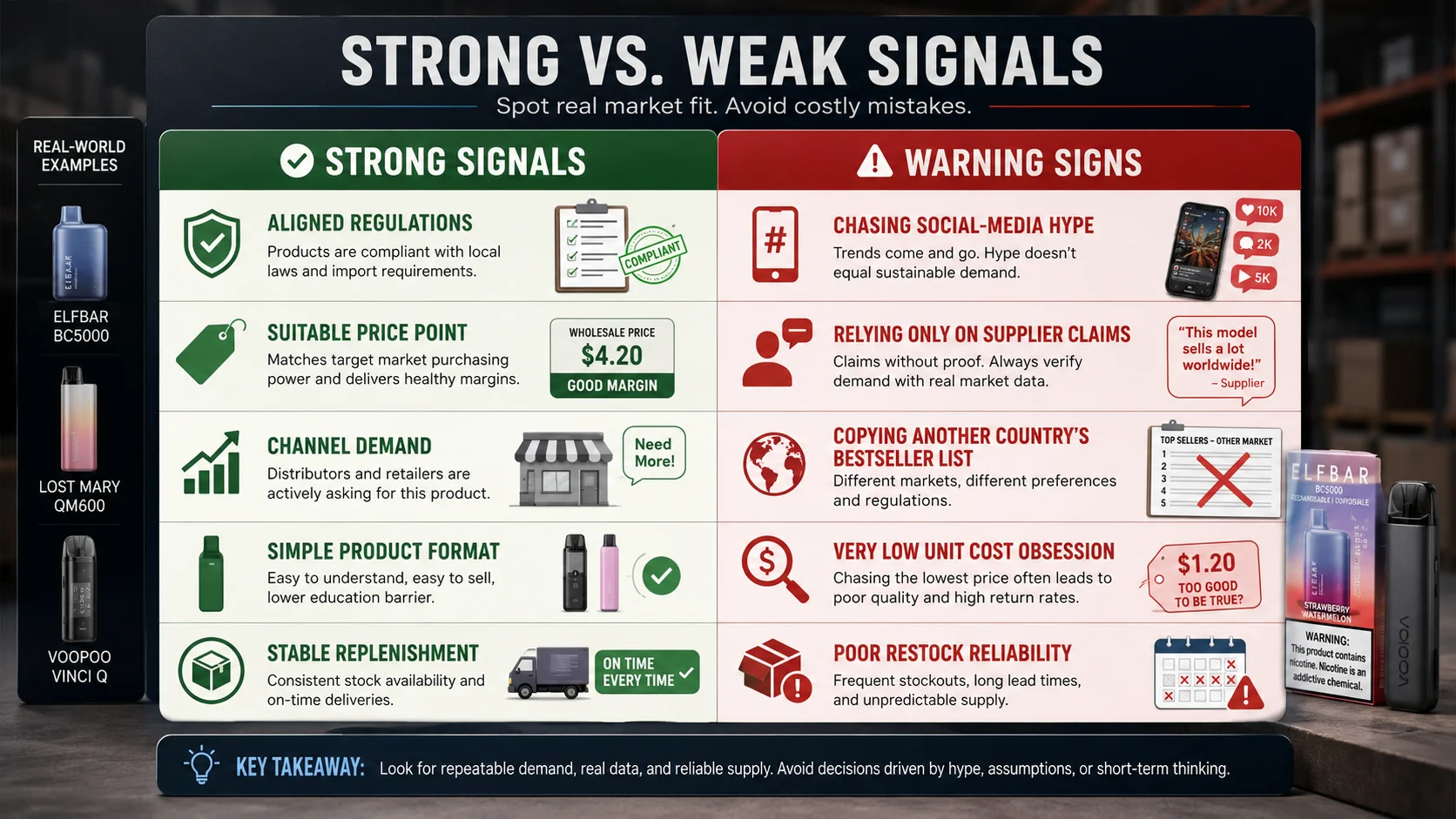
| Evaluation Factor | Strong Market Fit | Weak Market Fit | Wholesale Impact |
|---|---|---|---|
| Local regulations | Product requirements are independently checked | Buyer assumes the product is acceptable | Risk of unsellable inventory |
| Product type | Matches channel and end-user habits | Chosen only because it is trending elsewhere | Slow sell-through |
| Retail price | Fits the local price band | Final price is unclear or too high | Retail resistance |
| Flavor structure | Focused on proven local preferences | Too many untested flavors | Excess stock |
| Product specifications | Capacity, charging, packaging, and format fit local needs | Specifications are copied from another market | Customer confusion |
| Channel suitability | Store staff can explain and display it easily | Product requires education the channel cannot provide | Lower conversion |
| Replenishment | Buyer can restock practical SKUs quickly | Supply is uncertain or MOQ is too high | Missed sales windows |
| Inventory exposure | Trial order is manageable | Large order is placed before testing | Cash-flow pressure |
Use the Table as a Decision Tool
I do not recommend treating this table as a guarantee. Market demand changes, regulations change, and consumer preferences change. Still, it helps buyers move from emotional purchasing to a structured decision.
A simple scoring method can help. I suggest scoring each factor from 1 to 5:
- 1–2: Major uncertainty or weak alignment
- 3: Needs more checking or a small test
- 4–5: Strong evidence that the line suits the channel
If a product scores poorly on compliance, price, or replenishment, I would not solve that problem by increasing the order quantity. A lower unit cost does not fix weak demand. In many cases, it makes the inventory risk larger.
How Do Local Regulations Affect Vape Product Selection?
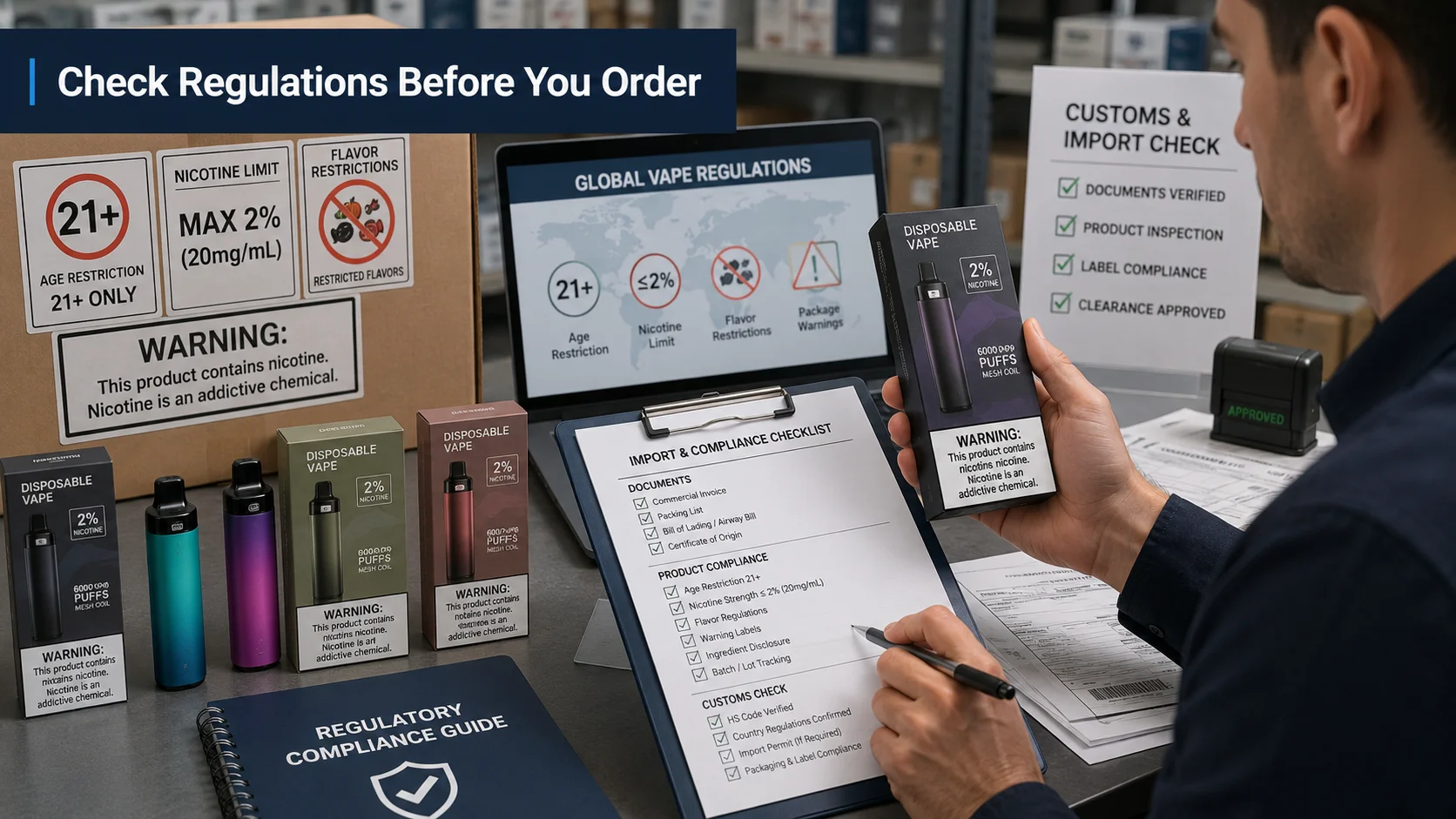
Importers often discover too late that a product format, nicotine level, packaging detail, flavor category, or sales method does not match current local requirements. That can turn a seemingly attractive order into a serious business problem.
Local regulations affect vape product selection because they may control nicotine strength, liquid capacity, product registration, packaging labels, warnings, ingredients, flavors, age restrictions, import procedures, and retail sales conditions.[^5] Buyers should verify current rules independently before ordering.
Compliance Comes Before Trend Analysis
I always encourage customers to check legal and commercial eligibility before they compare designs, flavors, or quotations. A product cannot have real vape product market fit if it cannot be sold through the intended channel.
I am a manufacturer and integrated supplier based in Shenzhen, China. Shenzhen is a major global production and supply center for vaping products and related accessories.[^6] However, I do not present supplier availability as legal approval for every destination. Each buyer must independently confirm the latest requirements in their country, state, region, or city.
Buyers should review areas such as:
- Product capacity and format restrictions
- Nicotine requirements and limits
- Packaging language and warning rules
- Product registration or notification obligations
- Ingredient, flavor, or labeling restrictions
- Import documentation and customs procedures
- Age-verification and retail-sale restrictions
- Requirements for batteries, chargers, and transport
I recommend that buyers speak with qualified local compliance professionals, customs specialists, or legal advisers before placing an order. Regulations can change, and local enforcement can vary.
This step protects more than the shipment. It protects the buyer’s reputation, customer relationships, and future purchasing capacity.
How Do Buyer Type and Sales Channel Change Product Fit?
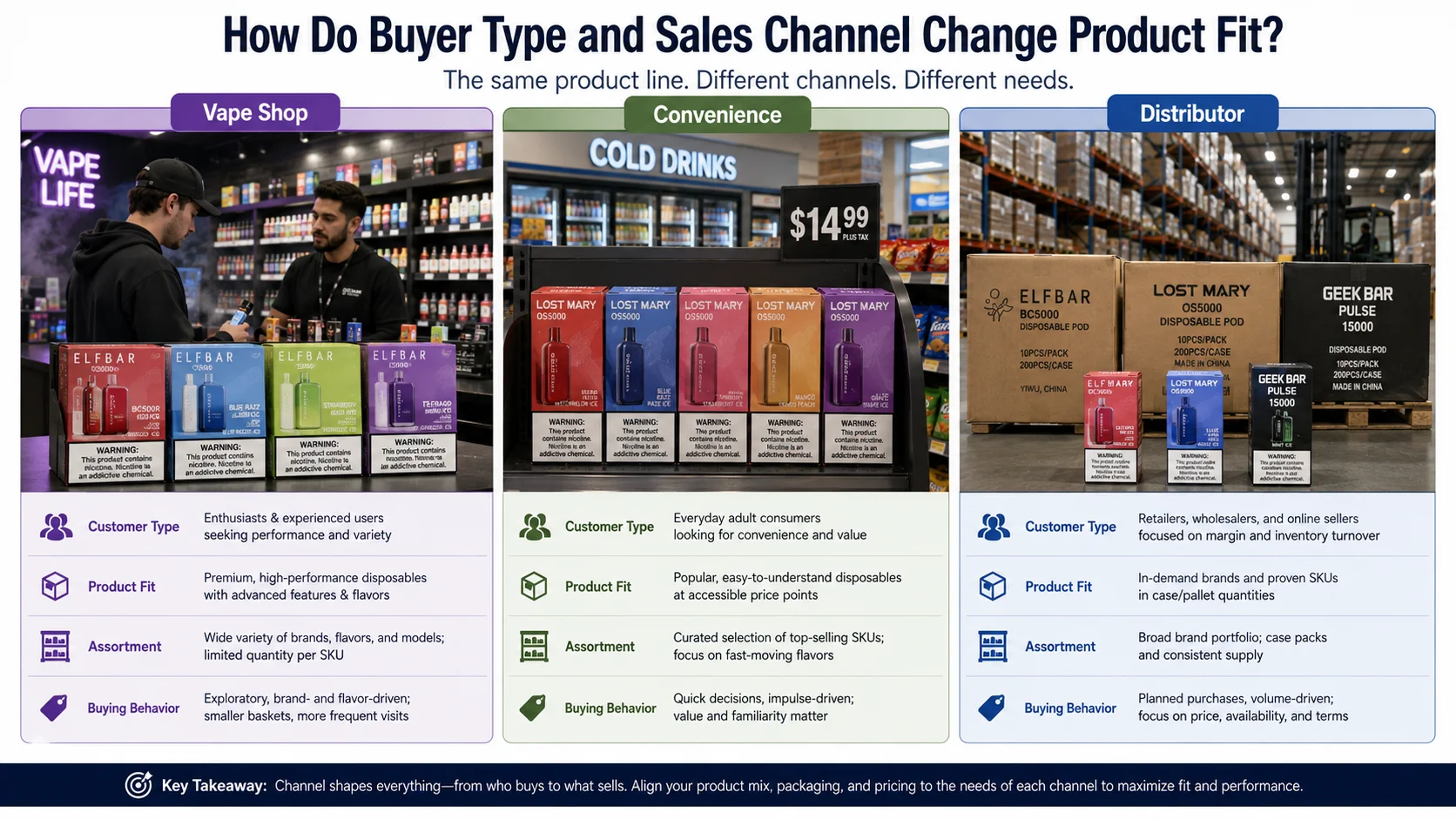
A product that works well in a specialist vape shop may not work in a gas station. A fast-moving item for a tourist smoke shop may not suit a regional distributor that needs stable, repeatable demand across many stores.
Vape wholesale product selection should change based on who sells the product and who buys it. Vape shops may support more product education, while convenience stores often need simple, recognizable, easy-to-sell formats with clear price points.[^7]
Different Channels Need Different Product Strategies
I often see buyers make the mistake of using one product list for every channel. That approach can create unnecessary slow stock.
| Sales Channel | Typical Product-Fit Priority | Common Inventory Risk |
|---|---|---|
| Vape shops | Variety, specifications, brand recognition, repeat customers | Too many similar SKUs |
| Smoke shops | Broad accessory mix, visible packaging, impulse opportunities | Weak staff knowledge |
| Convenience stores | Easy selection, simple pricing, compact display | Products that need too much explanation |
| Gas stations | Fast turnover, familiar formats, reliable replenishment | Price points that do not suit impulse purchases |
| Online retailers | Clear listings, product details, delivery compatibility | Returns and compliance complexity |
| Regional wholesalers | Stable supply, scalable pricing, broad channel appeal | Overcommitting before downstream demand is confirmed |
For smaller buyers, I can often suggest a more controlled starting structure. Our European warehouses carry selected stock in Europe, and the minimum quantity can be as low as 50 units per model for suitable warehouse products[^8]. This can help buyers test a category without waiting for a full China import cycle.
For larger importers, distributors, and established wholesalers, direct purchasing from China may offer better pricing, larger-scale planning, and OEM/ODM opportunities. Our factory has 5,000 square meters of production space, with maximum monthly capacity of up to 5 million units[^9], and I maintain regular new-product development.
Which Product Features Matter Most in Your Market?
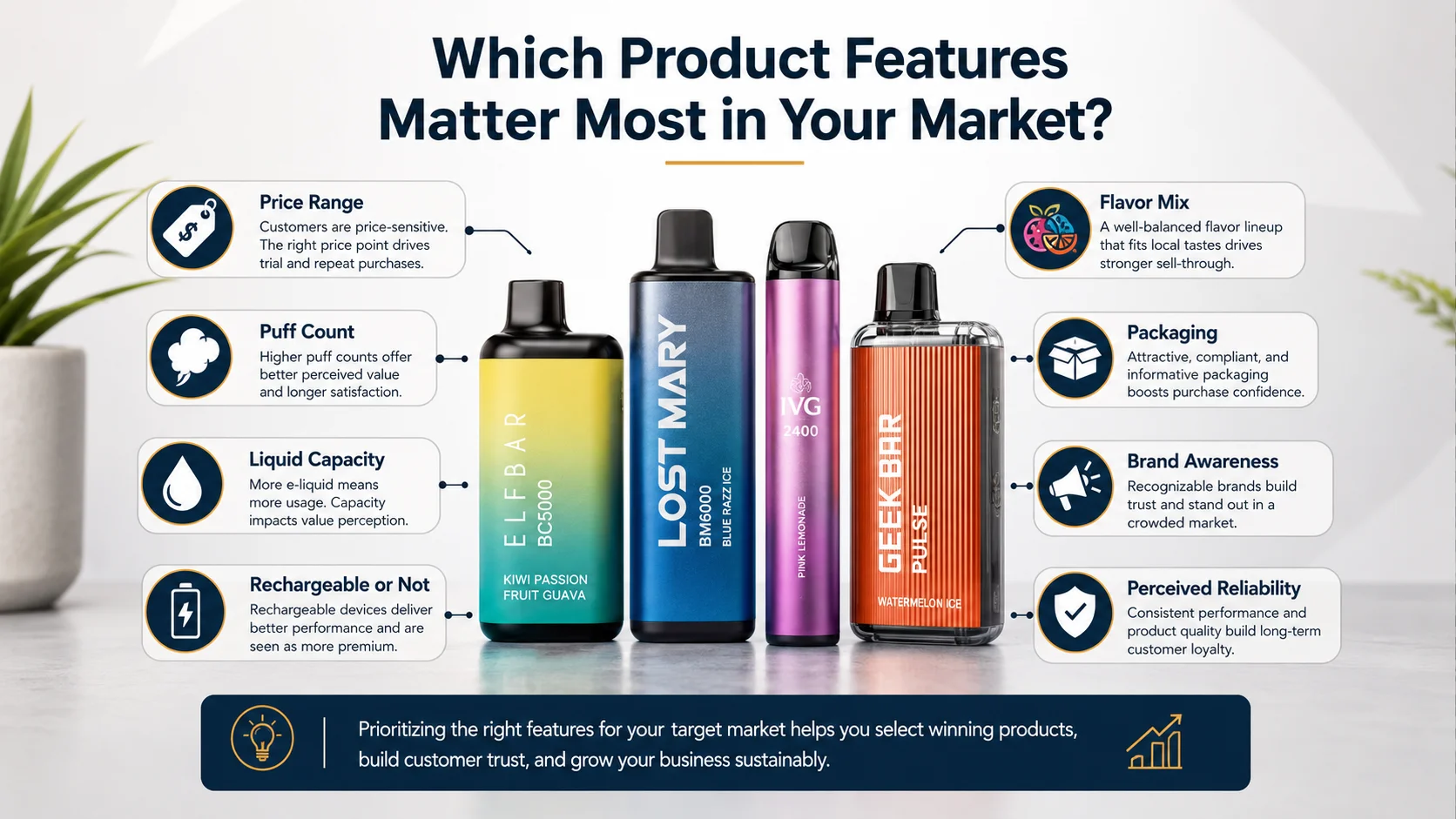
Buyers can become distracted by one feature, such as puff count, appearance, or unit price. In reality, product fit usually comes from the combination of several features that match a channel’s actual customer behavior.
The most important vape product features are the ones your buyers understand and accept: product type, price range, liquid capacity, charging method, flavor mix, packaging size, convenience, brand awareness, and perceived reliability.
Build a Focused Product Line Instead of a Random Catalogue
When I help buyers think about a vape product line strategy, I suggest starting with a limited number of core SKUs. This gives them a clearer picture of what is truly selling.
A practical starter selection may include:
- A few core product formats suited to the channel
- A controlled group of flavors, not every available option
- One or two price levels for different customer budgets
- Related items such as 510 batteries, atomizers, grinders, glass pipes, or vaporizers when the channel already sells these categories
- A clear replenishment list for the products that prove themselves
The best flavor selection is not necessarily the largest selection. The best price is not always the lowest purchase cost. A product with a slightly higher cost may be more valuable if it has stable quality, fewer after-sales issues, better customer acceptance, and easier restocking.
I have learned from many selection conversations that product lines become difficult when every item is chosen for a different reason. One is chosen because it is cheap, another because it is viral, and another because a competitor has it. A stronger line has a clear role for each SKU.
What Mistakes Should You Avoid When Judging Vape Market Demand?
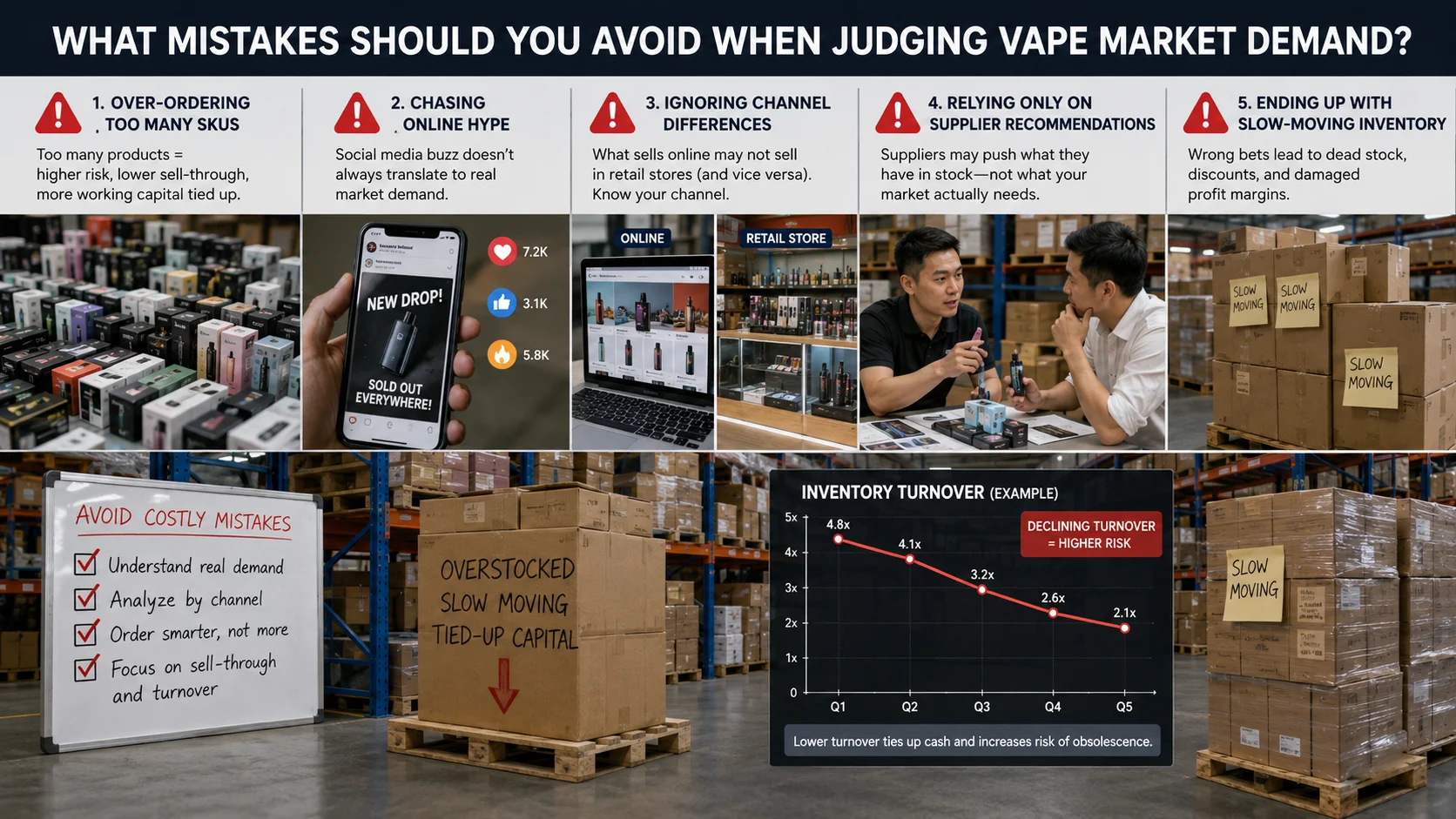
The biggest risk in vape market demand analysis is confusing attention with repeat demand.[^10] A product can receive online discussion or supplier-side interest without becoming a reliable seller in your local stores.
Common mistakes include copying another country’s bestseller list, relying only on supplier recommendations, ordering too many SKUs, ignoring channel differences, and treating social-media popularity as proof of stable local demand.
Watch for These Warning Signs
I suggest that buyers slow down when they hear statements such as “everyone is buying it” or “this will definitely be a bestseller.” No supplier, including me, should guarantee local sales or profit.
The most common mistakes are:
-
Copying another market without checking local buyers
A hot product in one country may not match your price band, regulations, or retail culture. -
Buying too many SKUs on the first order
More options can feel safer, but they often create scattered inventory and unclear sales data. -
Ignoring after-sales exposure
A low-cost product can become expensive if complaints, replacements, and lost customer trust increase.[^11] -
Focusing only on gross margin
Real profitability includes sales speed, cash tied up, shipping timing, restocking ability, and support costs. -
Assuming a trend will last
Trends can justify a test. They do not justify a large commitment without evidence. -
Not asking retail customers for feedback
Store owners and staff often know why an item is not moving. Their feedback is valuable market data.
How Can You Test Market Fit Before Placing a Large Order?
A small test order cannot remove all risk, but it can give you real evidence before you commit to a container-level order or a large inventory position. This is especially important for buyers who need quick turnover and careful cash-flow management.
To test how to judge if a product line fits your market, verify compliance first, review your channel, select core SKUs, obtain samples where appropriate, place a manageable trial order, track sell-through and feedback, then expand only after repeat demand appears[^12].
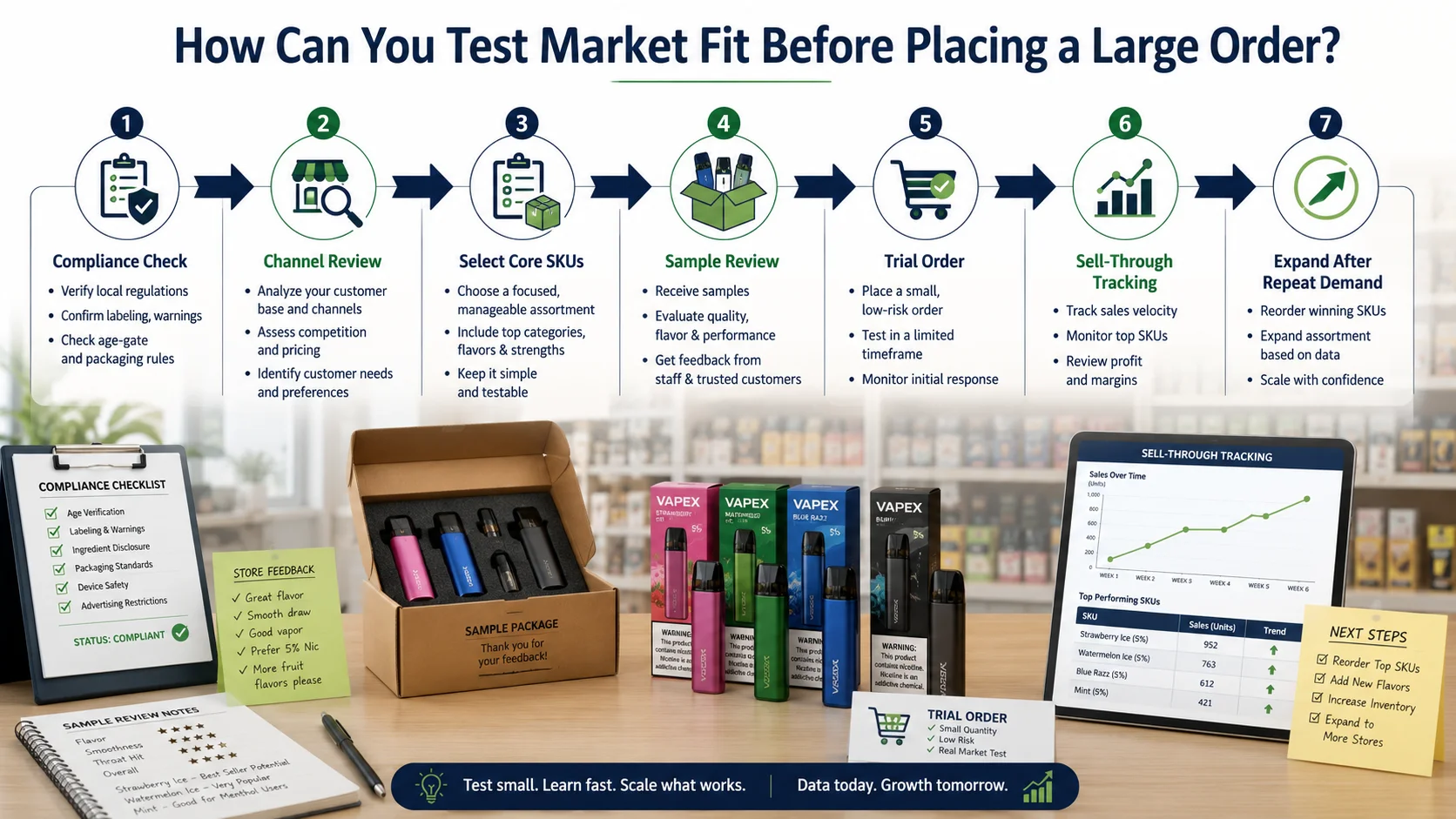
A Practical Six-Step Testing Process
-
Confirm local requirements
Check current local rules before you commit to the product format. -
Define your channel and target customer
Be specific about where the product will be sold and at what retail price. -
Choose a narrow core assortment
Start with products that have a clear purpose. Avoid testing every flavor and every model at once. -
Set success criteria before ordering
Decide what sell-through rate, customer feedback, reorder timing, and complaint level would count as a successful test. -
Track sales and operational feedback
Record which SKUs sell, which flavors are requested, what staff say, and whether customers report quality concerns. -
Expand based on repeat evidence
Increase quantities only when you see repeat sales, stable feedback, and a workable restocking model.
For smaller European customers, warehouse stock can support a faster trial process where suitable products are available. For buyers importing directly from China, I can help compare product categories, order structures, and OEM/ODM options based on volume and business goals.
Explore Vape Wholesale Categories for Your Market?
Choosing the right supplier is not only about receiving a catalogue. You need a partner who understands that your money is tied to inventory, delivery timing, product reliability, and your own customers’ trust.
When you need to judge if a product line fits your market, I can help you compare vape categories based on destination, channel, target price, order quantity, and replenishment needs. The final decision should always be supported by your own local compliance checks and sales evidence.
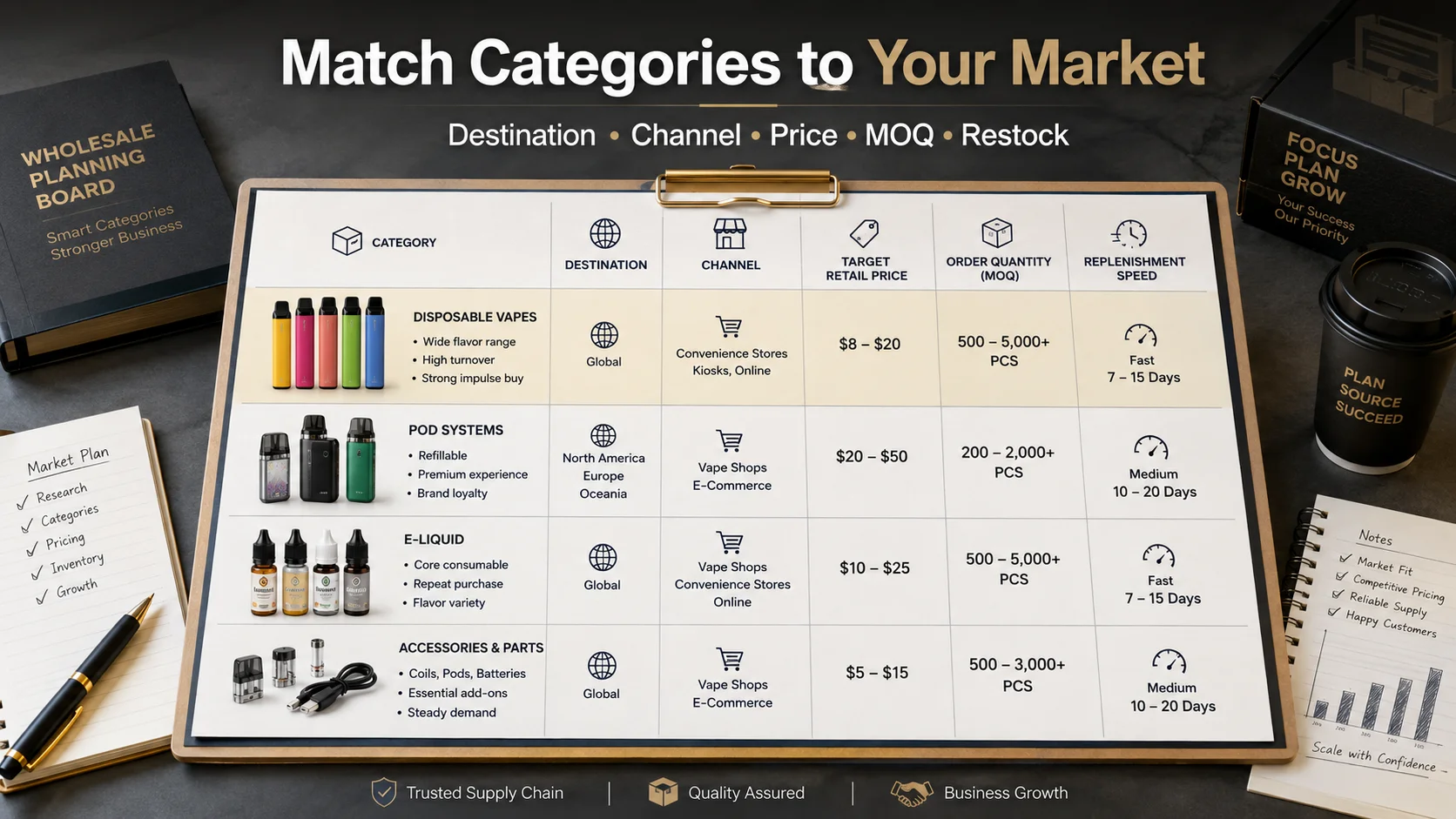
How I Support Different Buyer Models
At KingVape, I combine factory production with integrated trading and sourcing support. I can help customers source electronic cigarettes, disposable vapes, atomizers, 510 batteries, CBD batteries, vaporizers, grinders, glass pipes, and related smoking accessories through one supply relationship.
For buyers who need products beyond the current catalogue, I can help identify suitable options. For qualified projects, I can also support new-product development, mold development, and OEM/ODM cooperation.
I focus on helping customers reduce unnecessary sourcing work:
- One-stop sourcing across vape and smoking-accessory categories
- Support for regular stock and multi-brand purchasing needs
- Video verification when needed
- Centralized after-sales communication
- Delivery options to the buyer’s forwarder or door-to-door arrangements where available
- European warehouse options for selected products and lower-MOQ testing
- Direct China supply for larger import plans and OEM/ODM projects
Send KingVape your destination country, sales channel, preferred product type, target price range, and estimated order quantity. I will help you compare suitable vape categories and build a more workable wholesale stock strategy.
Frequently Asked Questions
How many vape SKUs should I test in my first order?
I suggest starting with a manageable assortment rather than a full catalogue. The right number depends on your channel and budget, but each SKU should have a clear purpose. A smaller test makes it easier to identify genuine demand and avoid slow-moving inventory.
Is a low unit price enough to prove vape product market fit?
No. A low unit price may improve gross margin, but it does not guarantee sales. You should also consider the final retail price, sales velocity, after-sales risk, inventory exposure, product reliability, and the ability to replenish successful items quickly.
Can I use European warehouse stock to test demand?
For selected available products, European warehouse stock can help smaller buyers test categories with lower minimum quantities and faster delivery within the EU. You should still confirm local regulations, product suitability, and customer demand before placing any order.
Should I follow vape trends from social media?
I treat social-media trends as a possible signal, not proof of market demand. A trend may justify a small trial, but I recommend making larger purchasing decisions only after you see local sales, repeat orders, and feedback from your own channels.
What information should I send before asking for product recommendations?
Send your destination country, customer type, sales channel, target retail price, preferred category, expected order quantity, and preferred delivery method. This information helps me suggest a more practical product line and inventory approach.
Conclusion
Knowing how to judge if a product line fits your market helps you protect cash flow, reduce slow inventory, and build stronger relationships with your retail customers. I recommend starting with regulations, channel needs, realistic retail pricing, focused SKUs, and a measurable trial order. Do not rely only on trends, low prices, or another market’s bestseller list. Contact KingVape with your market details, and I will help you explore suitable vape wholesale categories, small-order testing options, direct-import plans, and OEM/ODM opportunities.
[^1]: "On the Nature of Working Capital: Understanding its Mysteries ...", https://som.yale.edu/sites/default/files/2025-04/On%20the%20Nature%20of%20Working%20Capital%20Understanding%20its%20Mysteries%20and%20Complexities.pdf. Inventory-management research describes excess and slow-moving stock as capital tied up in inventory, with associated carrying costs and reduced working-capital flexibility. Evidence role: mechanism; source type: research. Supports: Evidence that excess or slow-moving inventory ties up working capital and can create carrying-cost or liquidity pressure.. [^2]: "An Empirical Examination of the Decision to Invest in Fulfillment ...", https://faculty.wharton.upenn.edu/wp-content/uploads/2012/04/RandallNetessineRudi.pdf. Studies of demand learning and inventory decisions support using limited initial tests to update demand estimates before making larger stocking commitments. Evidence role: general_support; source type: paper. Supports: Research supporting pilot tests or limited initial assortments as a way to learn about uncertain demand before scaling inventory commitments.. Scope note: Such studies generally address inventory decisions across product categories and do not establish a vape-specific trial-order threshold. [^3]: "Evidence Against Choice Overload in E-Commerce", https://wildlab.cs.washington.edu/Publications_files/Moser_CHI2017.pdf. Research on choice overload finds that extensive or complex assortments can increase decision difficulty and, in some settings, reduce purchase motivation or choice satisfaction. Evidence role: mechanism; source type: paper. Supports: Evidence on choice overload showing that very large or complex assortments can make consumer choice more difficult under some conditions.. Scope note: The size and direction of choice-overload effects depend on context, product familiarity, and how alternatives are presented. [^4]: "Recover From Failure: Examining the Impact of Service Recovery Stages ...", https://pmc.ncbi.nlm.nih.gov/articles/PMC9014211/. Service- and relationship-marketing research links product or service failures and poorly resolved complaints with lower customer satisfaction, trust, and loyalty intentions. Evidence role: mechanism; source type: paper. Supports: Evidence that product or service failures and complaint experiences can undermine trust, satisfaction, and relationship continuity.. Scope note: The evidence is typically measured in consumer or business-service contexts rather than specifically among vape wholesalers and retailers. [^5]: "E-Cigarettes, Vapes, and other Electronic Nicotine Delivery ...", https://www.fda.gov/tobacco-products/products-ingredients-components/e-cigarettes-vapes-and-other-electronic-nicotine-delivery-systems-ends. Public-health and regulatory authorities document that electronic nicotine-delivery products may be subject to controls on product composition, nicotine concentration, packaging and warnings, notification or authorization, age-restricted sales, and importation. Evidence role: general_support; source type: government. Supports: Authoritative regulatory requirements for electronic nicotine-delivery products, including product, labeling, notification, age, and sales controls in the relevant jurisdiction.. Scope note: The applicable requirements, including flavor and capacity rules, differ by country and may also differ within subnational jurisdictions. [^6]: "Asymmetric amplification: New lens for China's e-cigarette policies on ...", https://pmc.ncbi.nlm.nih.gov/articles/PMC12209876/. Research on the electronic-cigarette industry identifies Shenzhen and the Pearl River Delta as a major manufacturing and supply-chain hub for e-cigarette hardware and related components. Evidence role: historical_context; source type: research. Supports: Evidence that Shenzhen and its surrounding manufacturing ecosystem have played a major role in the production and supply chain of electronic-cigarette products.. Scope note: Descriptions of industrial concentration do not verify the capabilities, compliance status, or product quality of any individual supplier. [^7]: "Factors Affecting Impulse Buying Behavior of Consumers - PMC - NIH", https://pmc.ncbi.nlm.nih.gov/articles/PMC8206473/. Retail-format research generally distinguishes specialty stores, which emphasize assortment depth and salesperson assistance, from convenience formats, which emphasize quick purchases, accessibility, and simplified selection. Evidence role: general_support; source type: research. Supports: Research comparing specialist and convenience retail formats with respect to service intensity, assortment depth, shopping missions, and information provision.. Scope note: These format-level findings are contextual and do not prove that every vape shop or convenience store will perform in the same way. [^8]: "Vape Wholesale MOQ Europe | 1 Box, 10 Pcs & 50 Pcs Explained", https://vaporeur.com/vape-wholesale-moq-europe/. The supplier’s current warehouse terms should document whether selected European-stock products are available with a minimum order quantity of 50 units per model and specify the applicable conditions. Evidence role: case_reference; source type: other. Supports: Current primary documentation stating the warehouse eligibility conditions and minimum order quantity for the named supplier's products.. Scope note: Warehouse inventory, eligible models, pricing, and minimum-order terms are operational details that may change and require direct confirmation at the time of purchase. [^9]: "Kingfujitech: Shenzhen 3C Electronics Accessories ...", https://kingfujitech.com/. A current factory audit, facility record, or independent inspection should substantiate the stated 5,000-square-metre production area and the conditions under which maximum monthly output can reach 5 million units. Evidence role: case_reference; source type: other. Supports: Auditable company documentation or an independent inspection confirming the stated production area and maximum monthly output capacity.. Scope note: Maximum capacity may depend on product mix, staffing, component availability, production yields, and the period assessed. [^10]: "How to Catch Customers' Attention? A Study on the Effectiveness of Brand ...", https://pmc.ncbi.nlm.nih.gov/articles/PMC8714787/. Research on online word of mouth and social-media metrics finds that attention measures may correlate with sales in some settings but are not equivalent to sustained purchasing or repeat-demand evidence. Evidence role: mechanism; source type: paper. Supports: Evidence that online attention can be an imperfect or context-dependent indicator of sales and repeat-purchase demand.. Scope note: Predictive performance varies by platform, product category, time period, and the quality of the underlying sales data. [^11]: "The True Cost of Poor Customer Service to Your Business", https://www.midlandstech.edu/news/true-cost-poor-customer-service-your-business. Quality-management literature treats the cost of poor quality as including internal and external failure costs, such as replacements, warranty or complaint handling, and potential losses in customer satisfaction and loyalty. Evidence role: mechanism; source type: research. Supports: Evidence that the total cost of poor quality includes failure, warranty, replacement, complaint-handling, and customer-relationship costs beyond the initial purchase price.. Scope note: The actual total-cost effect depends on defect rates, contract terms, remedy practices, and the value of the affected customer relationships. [^12]: "product variety, across-market demand heteroegeneity", https://www.stern.nyu.edu/sites/default/files/assets/documents/PRODUCT%20VARIETY,%20ACROSS-MARKET%20DEMAND%20HETEROEGENEITY,%20AND%20THE%20VALUE%20OF%20ONLINE%20RETAIL.pdf. Demand-learning and test-market research supports using observed sales and repeat-purchase information to refine forecasts before increasing inventory commitments. Evidence role: general_support; source type: paper. Supports: Research supporting the use of observed sales and repeat-purchase signals to update demand estimates before scaling inventory.. Scope note: Repeat demand is one useful signal rather than a universal prerequisite; seasonal products, new launches, and long repurchase cycles may require additional evidence.