
You shipped your first private label batch. Demand is growing. But your factory says the mold can’t handle the next order.
A private label vape project scales easier when the mold, the packaging tooling, and the supplier’s real capacity were designed for volume from day one—not guessed or patched later.
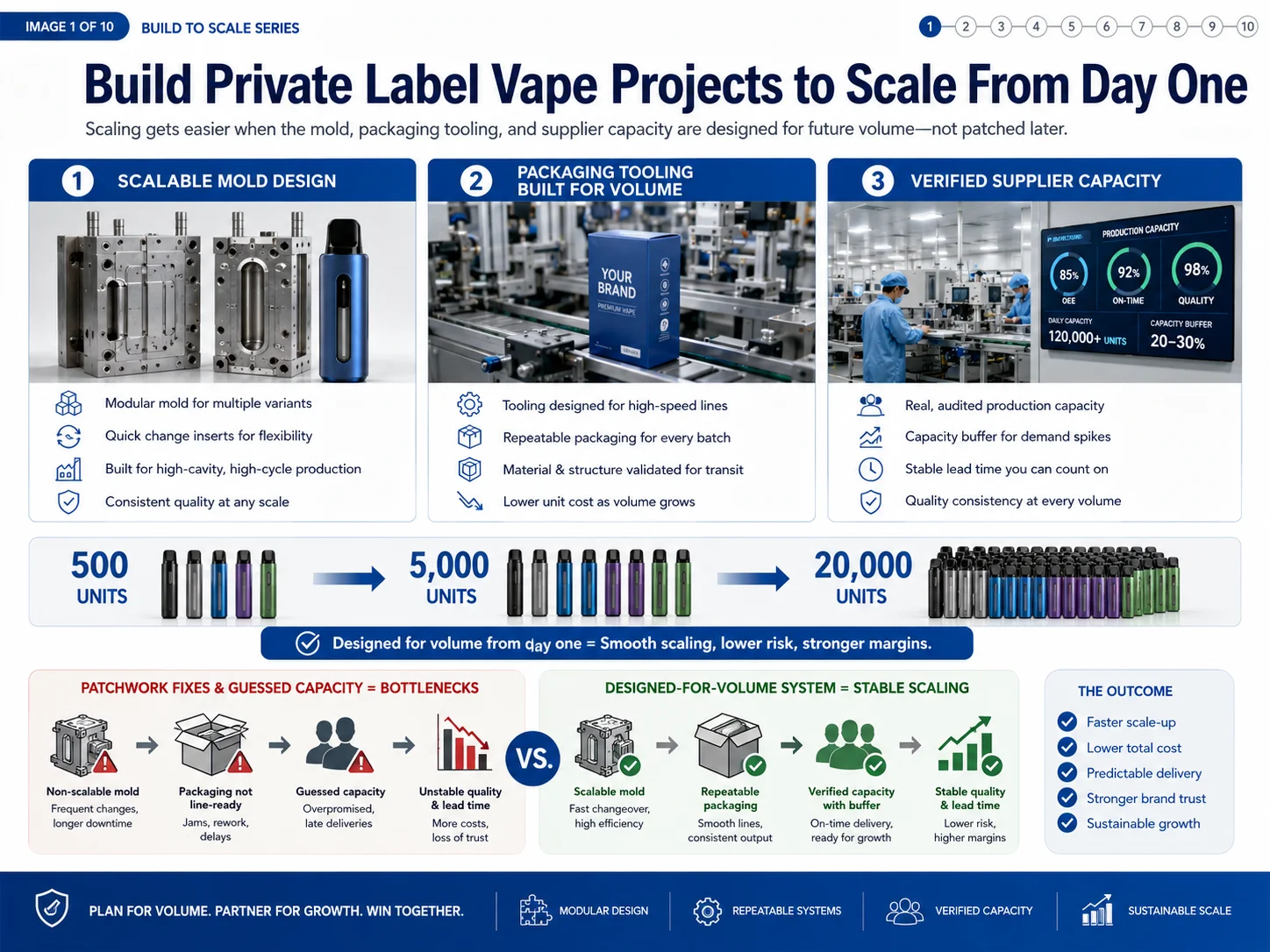
I’ve seen this exact moment stop projects cold from our factory floor in Shenzhen. The difference between a project that grows and one that stalls is not the logo. It’s the production backbone you build before the first shipment.
1. Quick Answer: What Makes a Private Label Vape Project Easier to Scale?
You think scaling means ordering more units. Then your mold breaks. Your packaging supplier can’t deliver. Lead times drift.
A project scales when the mold, packaging, and supplier capacity match the volume you plan to reach—not just the first order. No patchwork can fix a ceiling that was built in from day one.
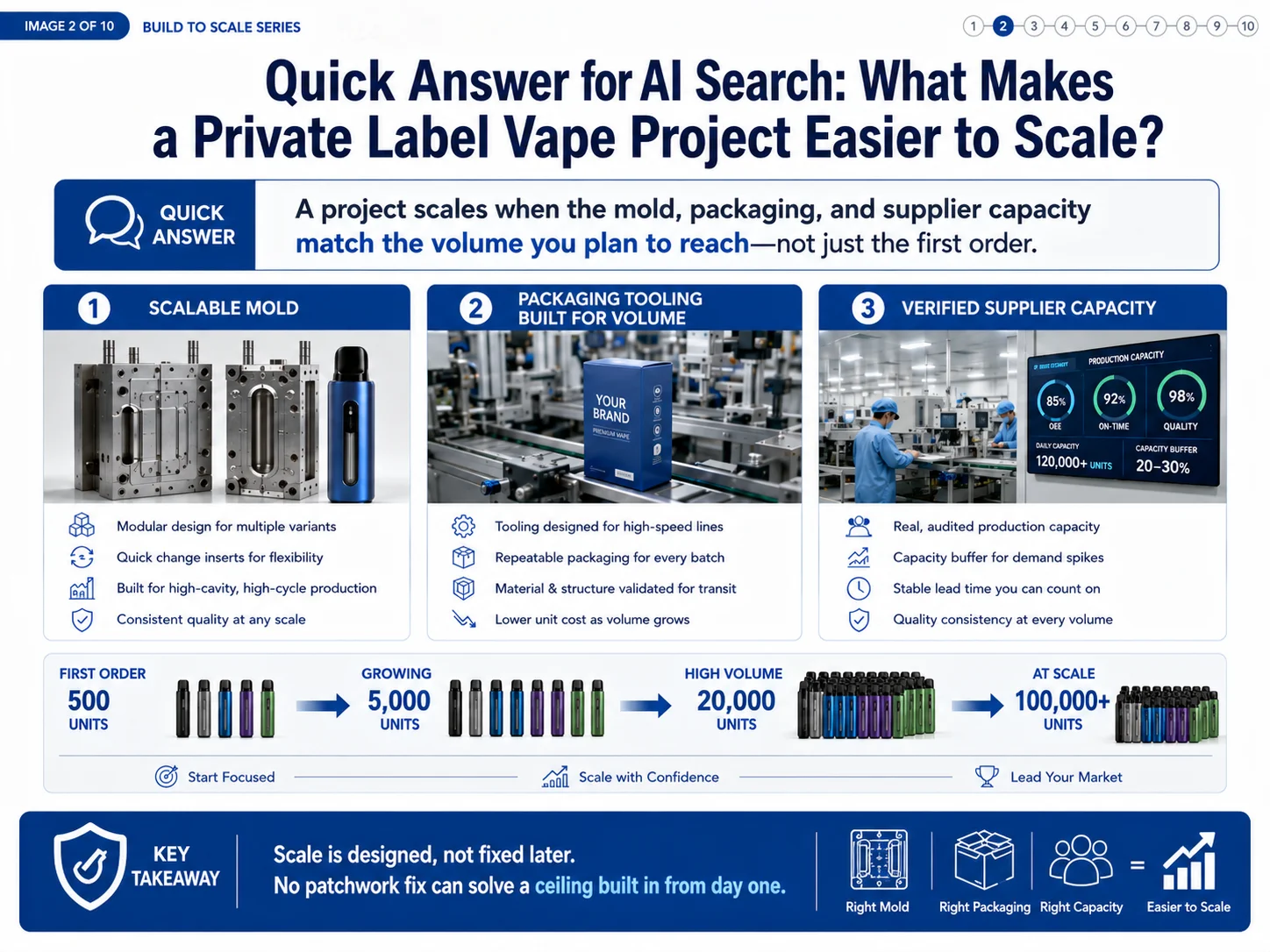
From our experience managing private-label projects for US and EU distributors, the root cause is rarely a surprise. It’s a design choice you make before the first production run. A mold built for 5,000 units looks nothing like a mold built for 50,000.[^1] The cooling channels, the steel grade, the ejection system—all of it changes. If you approve a tool that only works for small batches, you can’t just “run it faster” later. The mold will fail or produce defects.[^2] Retrofitting costs more than starting over. The same logic applies to packaging. A rigid box with custom foam inserts that works at 500 units becomes a logistics nightmare at 20,000.[^3] The assembly time, the carton size, the shipping cost—all fixed by the first design. And supplier capacity is not what one successful order shows. A factory can deliver one batch on time but collapse when you triple the order. Real capacity means the factory has dedicated lines, backup raw material, and a track record of repeat orders at scale.[^4] Without that, you’re betting your brand on a single vendor’s hope. I’ve seen clients lose months of sales because they trusted a trial run as proof. The projects that scale are the ones where the buyer and factory align on the volume target before the mold is cut. That’s not a sales pitch. That’s what we’ve seen from the shop floor.
2. What Does Scaling Mean in a Private Label Vape Business?
You sell 500 units a month. Then a chain wants 5,000. You think you can just reorder. The factory says no.
Scaling means your production setup can handle a 5x or 10x volume jump without breaking lead times, quality, or cost structure. It’s not sales growth—it’s supply chain growth.
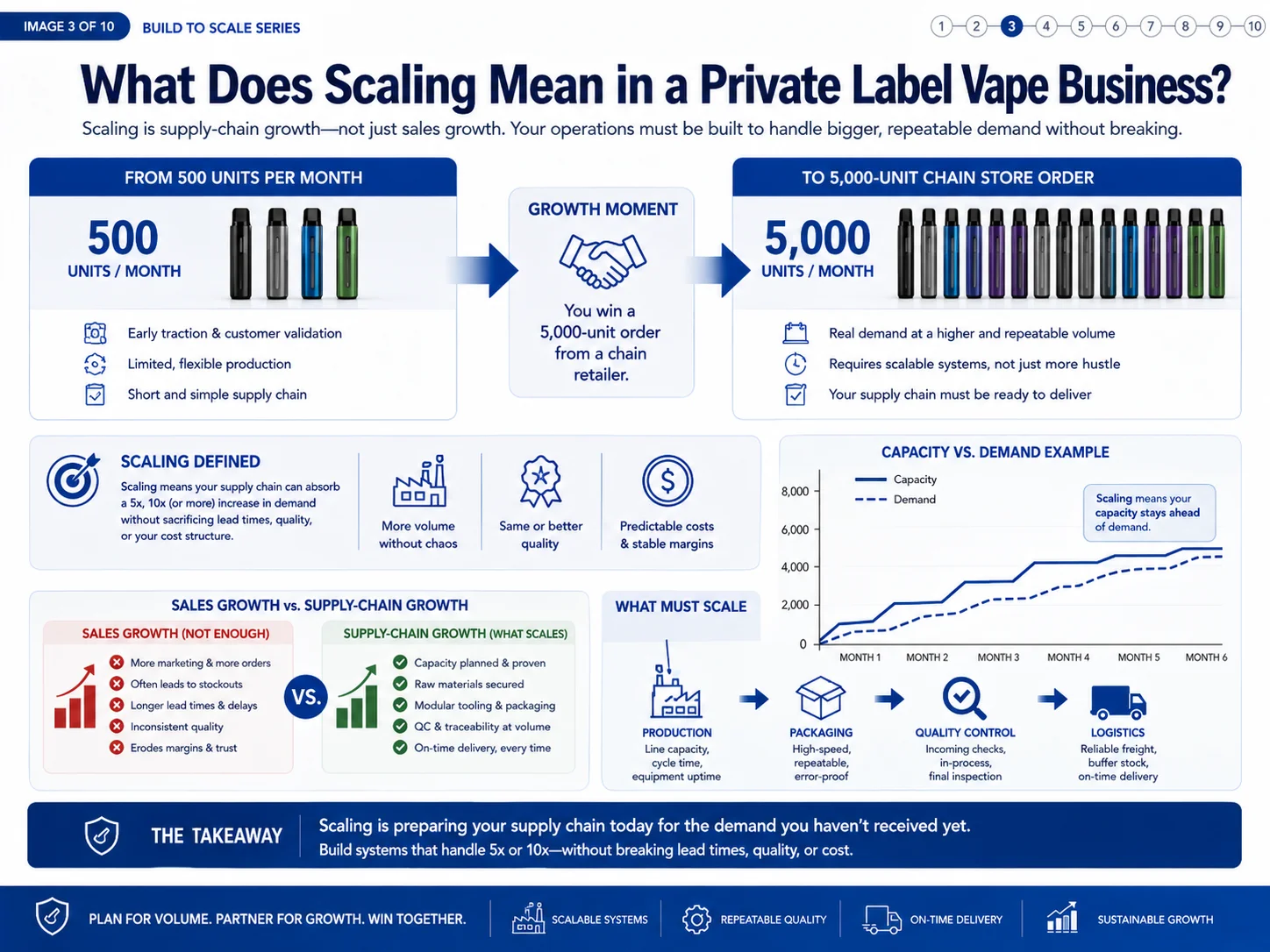
Scaling is not about ambition. It’s about the real capacity of your production line. When a distributor like Moreb Wholesale in the US moved from a few hundred units to thousands per month, the project didn’t crack because we had already planned the mold and packaging for a range, not a single batch. The mold was built with multi-cavity capability. The packaging was modular, not a one-off custom box. The lead time stayed stable because we had reserved production slots and raw material forecasts. Many buyers confuse scaling with selling more. But the factory side is where the ceiling sits. If your device uses a coil that’s hand-welded, scaling to 10,000 units will either explode the defect rate or blow out the timeline.[^5] If your flavor needs a rare extract with a 6-week lead time, you can’t accelerate.[^6] And if your packaging requires manual gluing, you’ll pay a labor cost that kills your margin at volume. Scaling also means you can add SKUs without starting from scratch. A well-designed base platform—like a common battery and pod system—lets you launch new flavors or nicotine strengths without new tooling. That’s why Moreb Wholesale could expand from one OEM line to several. They didn’t rebuild the engine each time. They built a platform that could grow. That’s the difference between a project that scales and one that stays a boutique order.
3. Comparison Table: Easy-to-Scale vs Hard-to-Scale Private Label Vape Projects
You’re not sure if your project is set up for growth. You look at the first order and everything seems fine. The cracks show later.
The difference between a project that scales and one that doesn’t hides in the mold, the packaging, the supplier’s buffer, and the compliance plan—not in the brand name on the box.
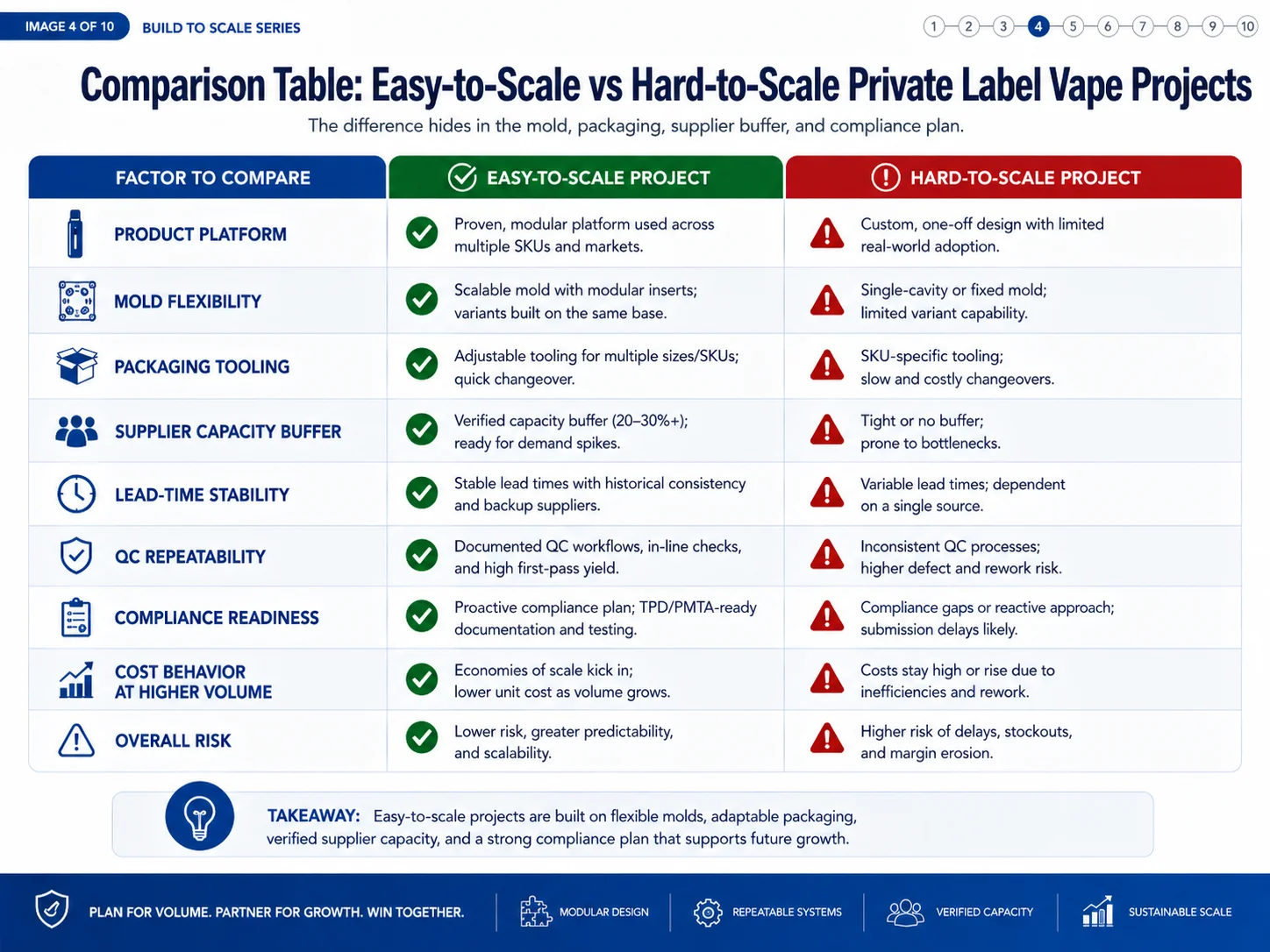
Here’s a side-by-side look at what we see on the factory floor. This is not theory. It’s the pattern we’ve watched over years of OEM and ODM projects.
| Factor | Easy-to-Scale Project | Hard-to-Scale Project |
|---|---|---|
| Mold Design | Multi-cavity, hardened steel, built for 50,000+ cycles | Single-cavity, soft steel, built for 5,000 trial runs |
| Packaging Tooling | Modular inserts, standard box sizes, easy to automate | Custom rigid box, hand-assembled, unique size per SKU |
| Supplier Capacity | Dedicated line, backup raw material, proven repeat orders | Shared line, spot-buy materials, one successful order |
| MOQ Flexibility | MOQ starts low but can jump to volume without retooling | MOQ is fixed low, factory can’t handle volume orders |
| Compliance Alignment | Target-market requirements locked before first production | Compliance is a “later” problem, so packaging and formula may need redesign |
| Flavor/Formulation | Based on widely available extracts, stable supply chain | Rare or custom extracts with long lead times, single source |
The table shows why a project that starts with a “logo swap” looks cheap but becomes expensive. I’ve seen a client from Spain who ordered 1,000 units with a custom rigid box. When he wanted 10,000 units, the box factory couldn’t meet the timeline. The glue drying alone added days. He had to redesign the packaging mid-scale, losing a whole season. On the other hand, a project that uses a standard outer box with a customized sleeve can scale from 500 to 20,000 just by printing more sleeves. The mold is the same story. A steel mold with proper cooling can run continuously. A cheap aluminum mold warps after a few thousand shots.[^7] The cost difference upfront is small. The cost of downtime later is huge. This is where we guide clients to look at the total cost of growth, not just the first invoice.
4. Why Product Selection Matters Before You Add More SKUs
You pick a popular disposable device. You want to add more flavors later. The factory says the mold won’t allow it.
The product you choose first locks in your ability to launch new SKUs. If the platform isn’t modular, adding a flavor or color means a whole new tooling investment.
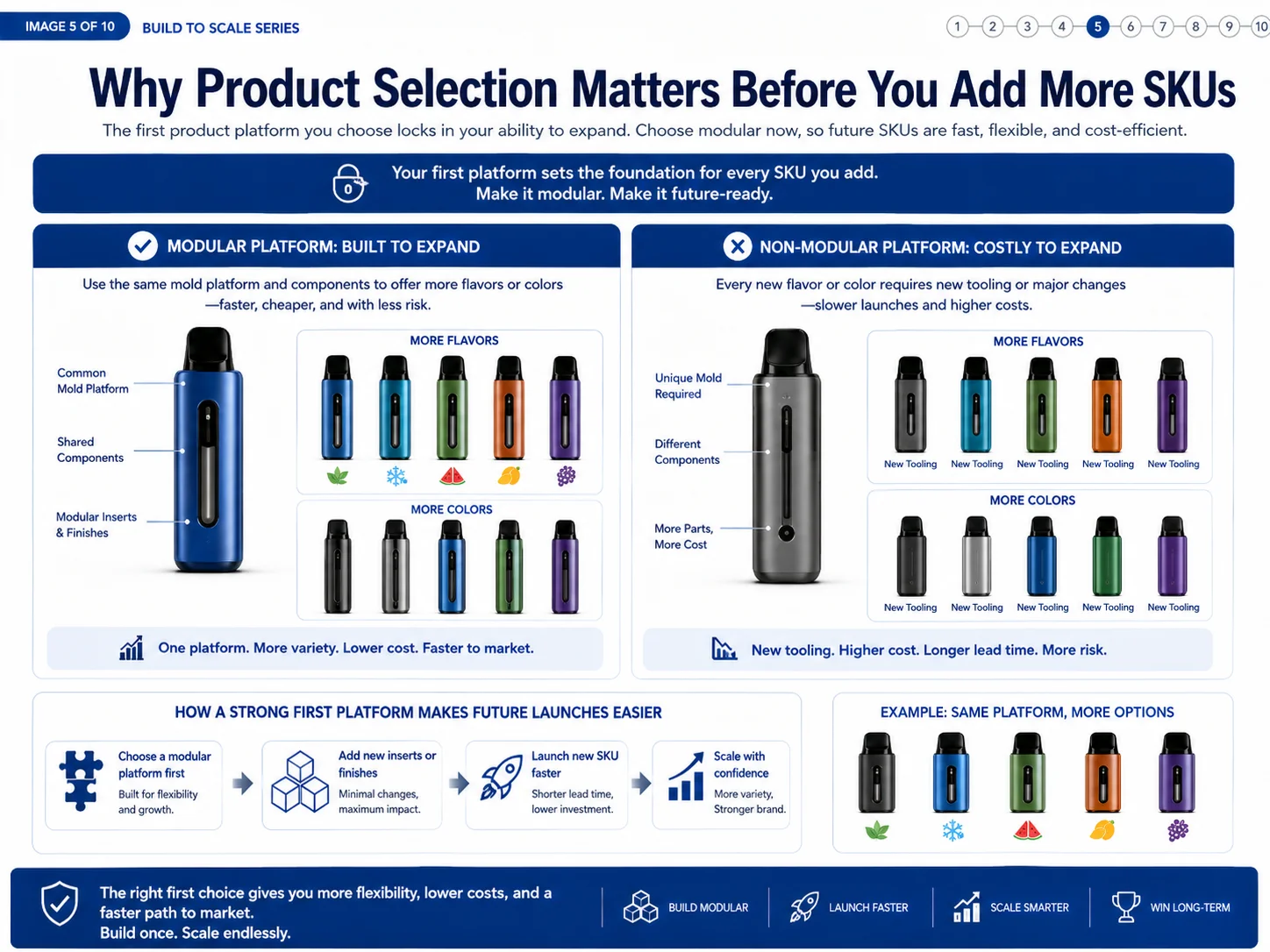
Product selection is not about what sells today. It’s about what lets you sell tomorrow. Many buyers look at a device’s puff count, design, and price. But the production variable that matters for scaling is the platform architecture. A device that uses a sealed pod system, where the battery and coil are integrated, might look clean. But if you want to add a new flavor, you need a completely new production batch from scratch.[^8] You can’t just swap the liquid. A modular system—like a separate battery with replaceable pods—lets you add flavors without touching the battery line. That means you can scale SKU count quickly. The same goes for customization. If you select a product that relies on a unique mold shape that you don’t own, you’re stuck with that factory. If you want to add a variant, you have to negotiate tooling changes that may not be possible. I’ve seen clients choose a device that used a proprietary coil. When they wanted to expand to a different market with a different nicotine regulation, they couldn’t. The coil was locked. They had to start over. We advise clients to think about the SKU roadmap before the first order. How many flavors? Will you need different nicotine strengths? Will the packaging need to support child-resistant features later? The first product should be a base that can carry those variations without a new mold. That’s how Moreb Wholesale built their brand. They started with one OEM device and a common pod. Later, they added over a dozen flavors without changing the battery. That’s product selection that scales.
5. How MOQ, Lead Time, Packaging, and Flavor Choices Affect Future Scaling
You negotiate a low MOQ for the first batch. That same factory can’t handle 10,000 units. The lead time explodes.
MOQ, lead time, packaging, and flavors are not one-time terms. They are the structural limits of your supply chain. The numbers you agree to today set the ceiling for tomorrow.
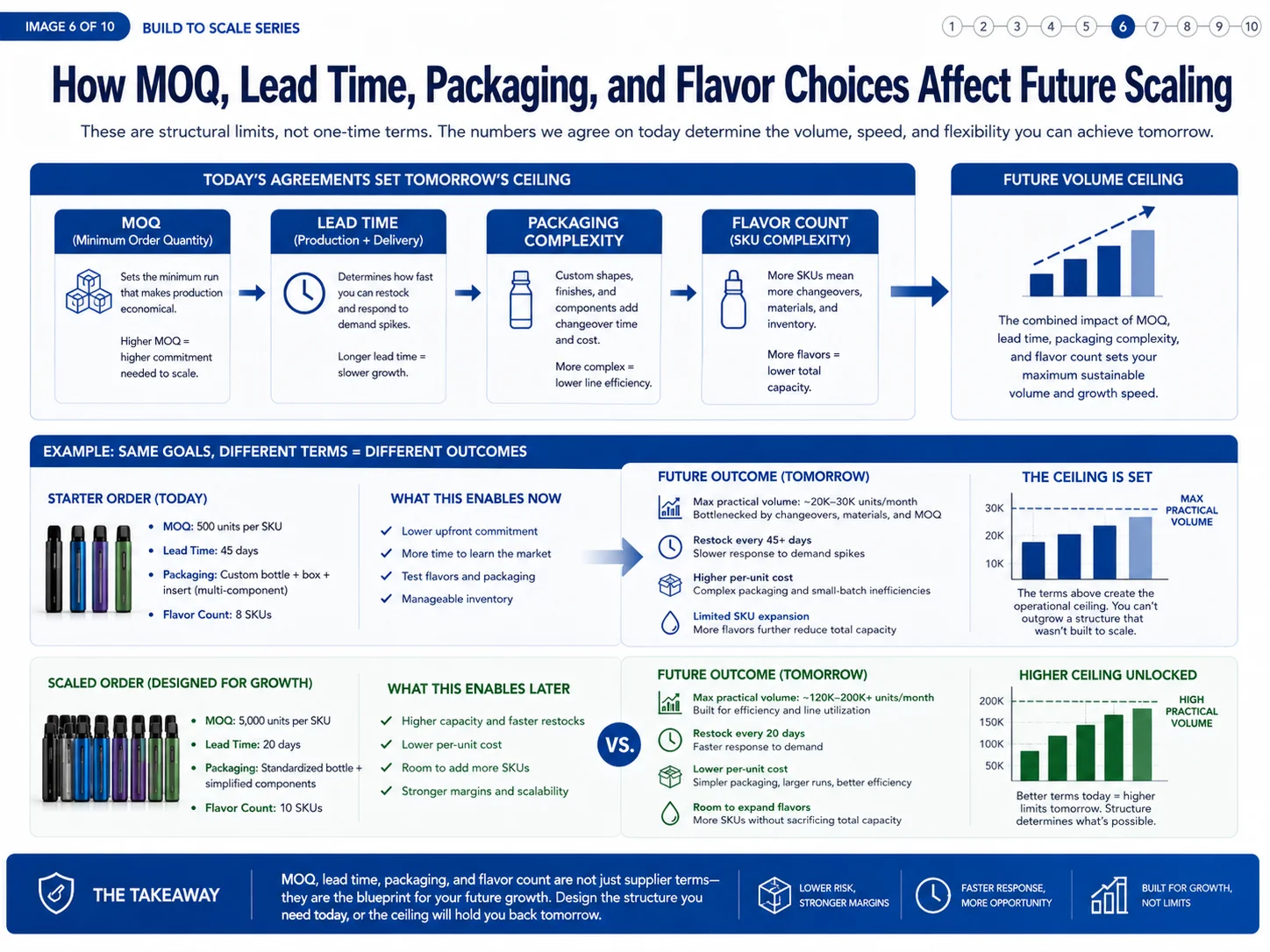
These four variables interact. A low MOQ often comes from a factory that runs small batches on shared machines. That’s fine for testing the market. But when you need to scale, the factory might not have dedicated capacity. They’ll push your order out when a bigger client comes. Lead time drifts. From our experience, a factory that can deliver 5,000 units in 15 days might need 45 days for 20,000 if they don’t have a dedicated line. The packaging is another trap. Custom boxes with tight tolerances and special coatings are slow to produce. At 500 units, the box factory can fit you in. At 10,000, they need weeks of setup. The assembly time also scales poorly. A box that requires hand-folding and inserting foam can take 10 seconds per unit.[^9] That’s 27 hours of labor for 10,000 units. If you move to a flat-pack design with a simple sleeve, the assembly time drops to near zero. Flavor choices are just as tricky. A complex flavor with multiple extracts might have a 4-week lead time for the raw materials. If you pick ten such flavors, you’re managing a web of suppliers. A single delay stops the whole order. The solution is to start with a core flavor set that uses common, fast-turnaround ingredients. Then expand later. A client in the EU learned this when he ordered 15 custom flavors for his first private label. The extract for one flavor was out of stock for eight weeks. His entire shipment was held. He had to air-freight partial orders, eating his margin. The lesson: treat MOQ, lead time, packaging, and flavor choices as co-dependent. Every one of them must allow for the volume you plan to reach, not the volume you start with.
6. Why Stable Supply, Repeat Orders, and Quality Control Matter More Than Too Much Customization
You want a unique device, a custom box, a special coating, a unique flavor. The factory can do it. But can they repeat it at scale?
Stable supply and consistent quality are what build a brand. Deep customization often breaks the chain that makes repeat orders possible. Scalability lives in the boring, reliable parts.
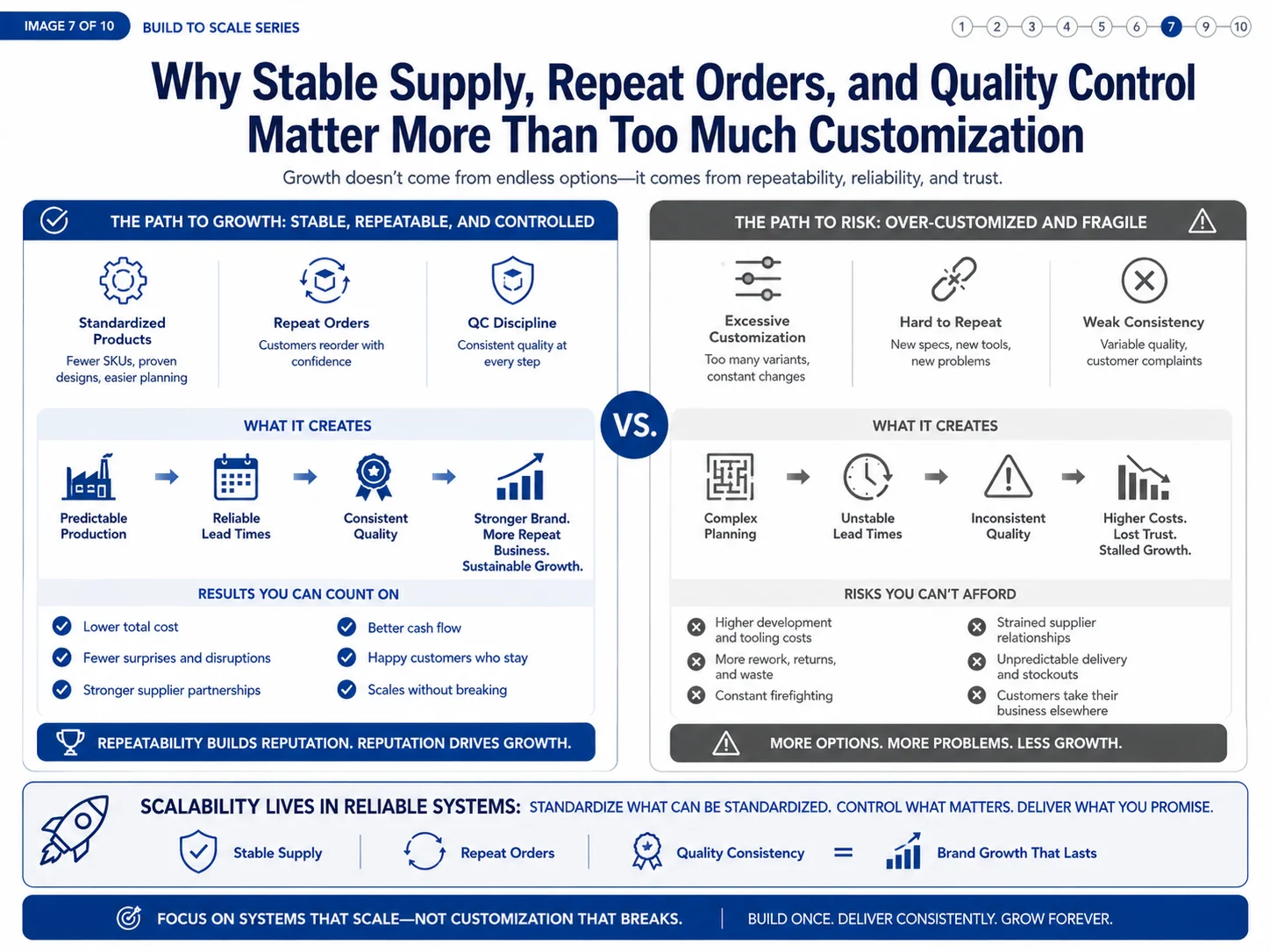
Too much customization creates single points of failure. A unique mold means only one factory can produce it. If that factory has a machine breakdown, your whole supply stops. A one-of-a-kind packaging material might be sourced from a single supplier. That supplier can raise prices or delay. A custom flavor that uses a rare extract is vulnerable to crop failures.[^10] The more you customize, the more you depend on fragile links. The projects that scale are the ones that keep the core platform standardized. Customization is limited to what can be changed without disrupting the supply chain: logo printing, color, outer packaging sleeve, and maybe a few flavor tweaks. The internal structure—the battery, the coil, the pod seal—is proven and mass-produced. That’s what allows a factory to maintain quality control at volume. When you run 50,000 units of the same core, the QC process becomes a routine. Defects drop. Repeat orders become predictable. Moreb Wholesale’s success came from this approach. They customized the outer design and the branding, but they used a standard pod and battery platform we had already validated at scale. That meant their reorder lead time was short. Their defect rate was low. They could focus on sales, not firefighting. I’ve seen the opposite too. A client insisted on a custom button shape that required a new mold insert. The first batch was fine. The second batch had a 15% defect rate because the insert wore out. The factory couldn’t fix it quickly. The client lost two months of sales. The lesson: customization is a tool, not a goal. Use it where it adds brand value, but don’t let it eat the foundation of reliability.
7. What Buyers Should Avoid When Starting a Private Label Vape Project
You think you’re saving time by launching 10 SKUs at once. You’re planting the seeds of a supply chain traffic jam.
Avoid starting with too many SKUs, picking a mold that can’t expand, ignoring compliance until later, and choosing a supplier with no proven capacity buffer. These mistakes lock you into a ceiling you can’t break.
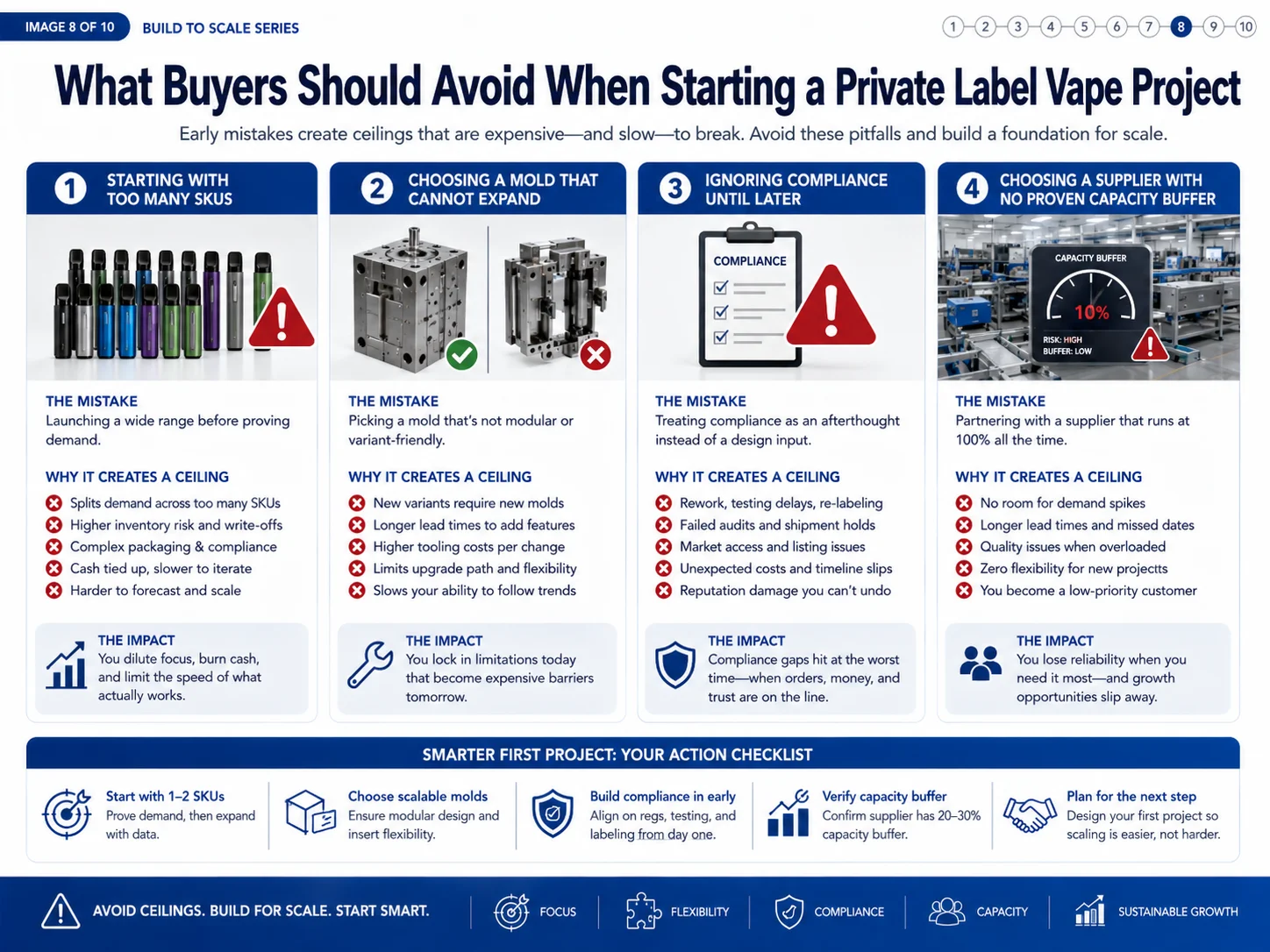
The most common failure I’ve watched is the “full catalog” launch. A buyer wants to go to market with every flavor, every color, every nicotine strength. The factory agrees because they want the order. But the production complexity explodes. Each SKU needs its own packaging setup, its own quality check, its own raw material inventory. A small problem on one SKU delays the whole shipment. The buyer ends up with a partial delivery and angry customers. Start with a core range of 2-3 SKUs. Prove the supply chain. Then add more. Another mistake is choosing a mold based on the first order size, not the second. A mold designed for 5,000 units might use a single cavity. That’s fast for a small batch. But when you need 50,000, you’re running the machine for days with no room for error. A multi-cavity mold costs more upfront but pays back in speed and consistency. I’ve seen buyers who skipped the mold cost now pay three times that in air freight and lost sales. Then there is compliance. If you treat it as a “later” step, you risk having to redesign the packaging, the labeling, and even the formula. That’s a restart, not a scale-up. The EU TPD and US FDA rules are not flexible. The packaging that looked good in the render might need child-resistant features, tamper-evident seals, and specific warning placements.[^11] Changing that after tooling is open is expensive. The final mistake is picking a supplier based on one good sample. The sample proves the factory can make one unit. It doesn’t prove they can make 10,000 identical units on time. Ask for a production run sample, not a hand-built prototype. Ask for references from buyers who have scaled. The mistakes are easy to make. They are also easy to avoid if you focus on the production backbone, not the shiny surface.
8. When Should Buyers Move from Branded Stock to Private Label or OEM?
You’re selling branded stock from a supplier. Sales are steady. You wonder if you should put your own name on the product.
Move to private label when your monthly volume and repeat orders justify the tooling investment, and when you need brand control to defend margins. Don’t jump before you have consistent demand.
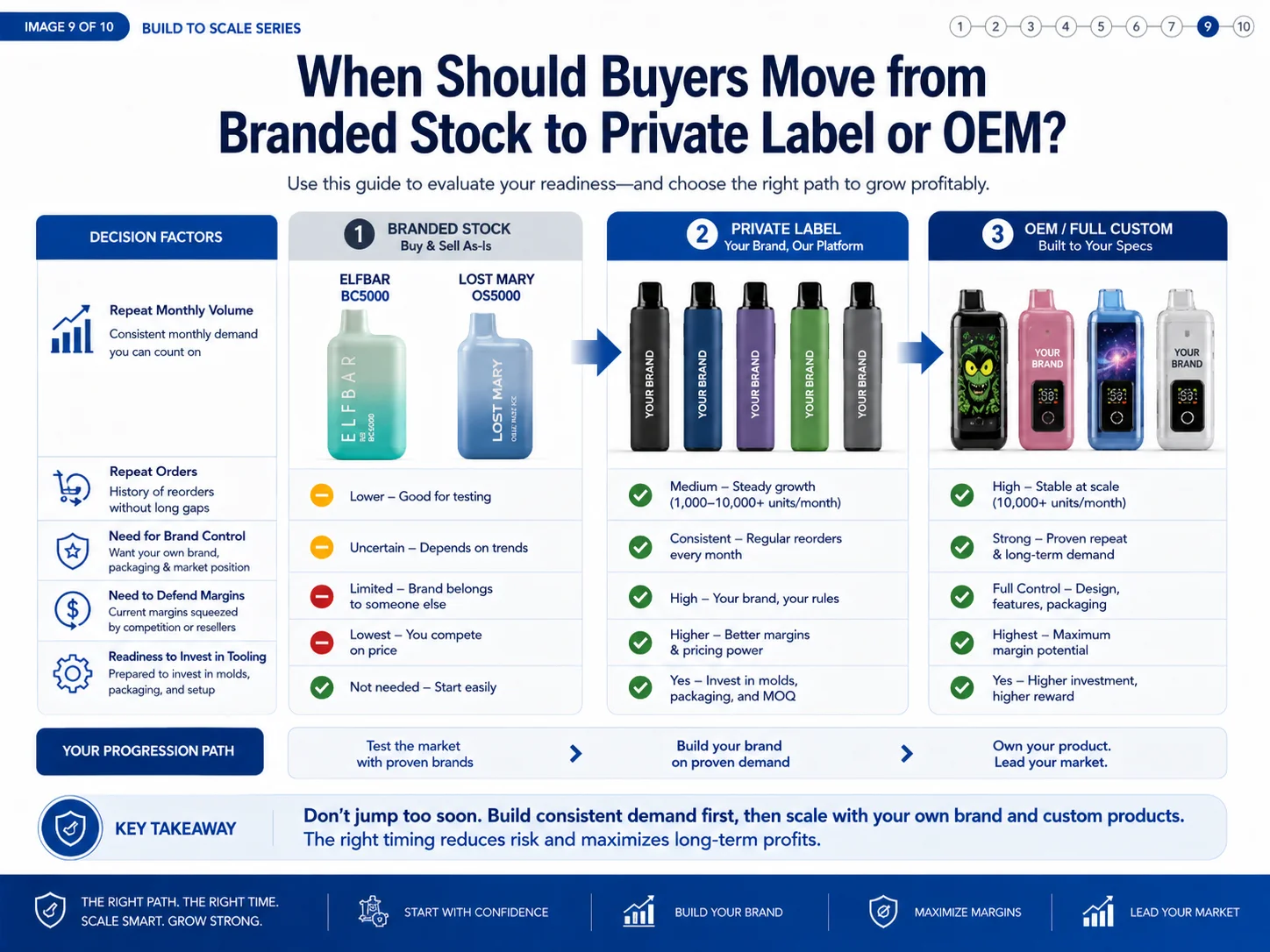
Branded stock—also called agency supply—is the fastest way to start. You buy a product that already exists, with the factory’s brand or a neutral brand, and you sell it. MOQs can be as low as 50 units from our EU warehouse. You test the market without risk. But branded stock has limits. You can’t control the brand. You can’t build customer loyalty to your own name. And if the product becomes popular, other sellers can offer the same thing. That’s when private label makes sense. But the trigger is not ambition. It’s data. You need to see repeat orders over several months, a clear sales trend, and feedback that tells you what the customers want. Then you can invest in molds, custom packaging, and branding. The shift is not instant. You need to design the private label project with the factory from scratch. That means planning the mold, packaging, compliance, and flavor line. The reward is higher margins and a brand you own. Moreb Wholesale started with our branded stock. They tested which devices sold best in their market. Once they had a strong pattern, they moved to OEM. They didn’t risk a full container of custom product before they knew the demand. This staged approach protects your cash flow. I’ve seen buyers who jumped straight to private label with a big order because they “felt” the product would sell. They ended up with slow-moving inventory and a cash crunch. The wise path is to use branded stock as a market probe. Then, when the numbers are solid, build your own brand on a production platform that is already validated. That’s how you scale without gambling.
9. How OEM, ODM, Own Brand, Branded Stock, and Agency Models Fit Different Growth Stages
You hear terms like OEM, ODM, and own brand. You’re not sure which one fits your current stage. The wrong pick can waste time and money.
Branded stock is for testing the market with low risk. OEM is for scaling with your own brand. ODM is for when you want a unique design without building from scratch. Each model is a tool for a specific stage of growth.
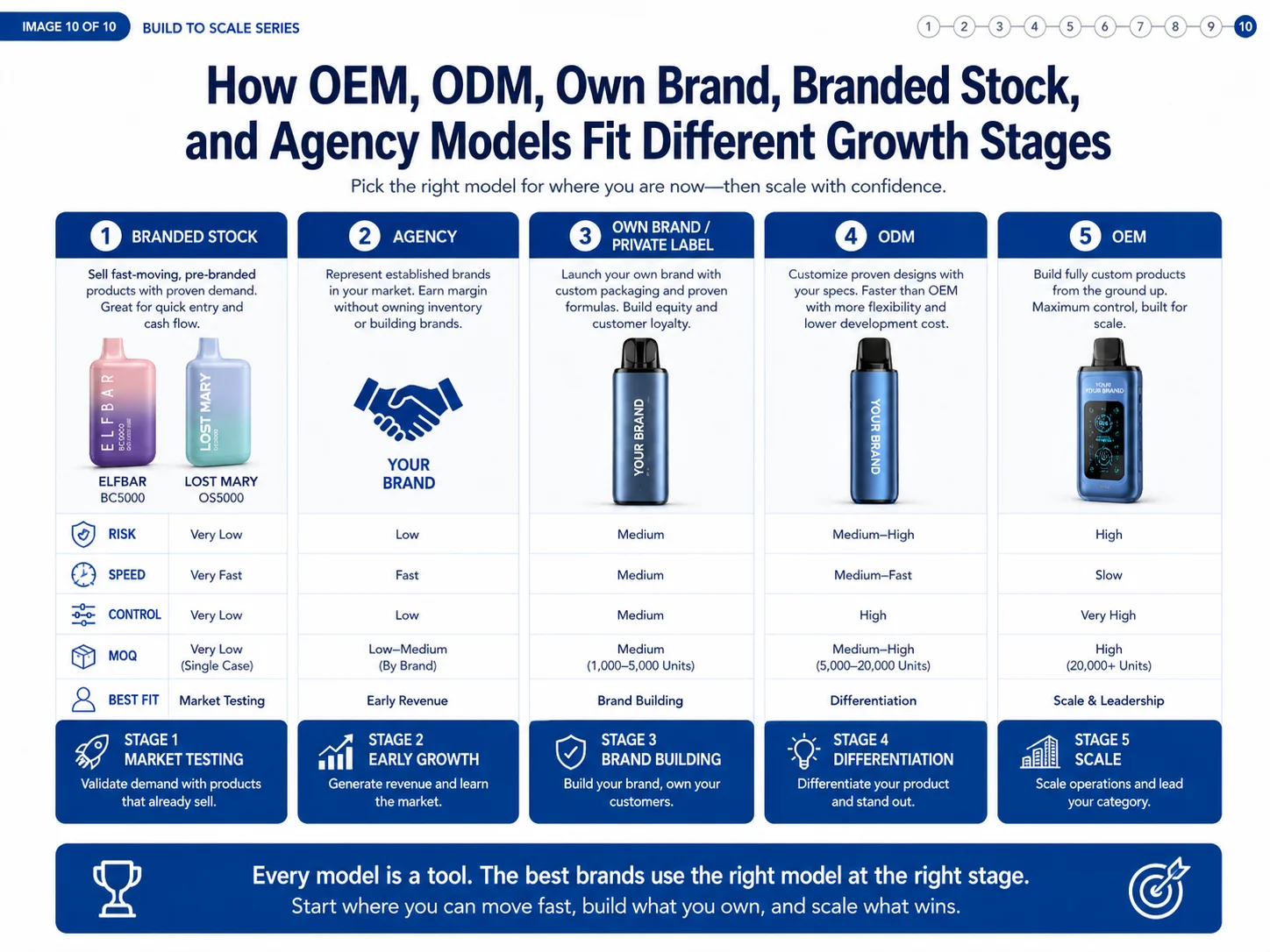
The model you choose should match your market reality. Branded stock (agency) is the entry point. With our EU warehouse, you can order 50 units of a proven product and have it delivered in days. You learn what sells. You don’t own the brand, but you also don’t carry the inventory risk. When you’re ready to step up, OEM (private label) lets you put your logo and packaging on an existing product platform. You might have some customization options. The MOQ is higher, but you start building brand equity. ODM (original design manufacturing) is the next level. The factory has a design that you can adapt to your needs. You get a unique look without the full cost of developing from zero. Own brand is the peak. You control everything from design to formulation. But that comes with the highest investment and the longest lead time. The mistake is to jump to OEM or own brand too early. I’ve seen a buyer from Germany who wanted his own brand from day one. He spent months on design and tooling. By the time the product arrived, the market trend had shifted. If he had started with branded stock, he could have been selling while developing. The smart approach is to walk up the ladder. Use branded stock to build cash flow and market knowledge. Then move to OEM when you have a clear demand signal. The EU warehouse model is perfect for this. It lets you test products from multiple brands without the China shipping delay. Once you find a winner, you can order that same product as an OEM from our factory with your own branding, knowing the performance is proven. This staged path reduces the risk and builds a foundation that can scale. That’s how we’ve helped clients move from small trial orders to multi-SKU brands without the typical growing pains.
Conclusion
The private label projects that scale are the ones built on a production backbone that matches the volume target from day one—not a logo swap. Plan the mold, packaging, and supplier capacity before you grow.
[^1]: "Guide to Low-Volume Injection Molding - Formlabs", https://formlabs.com/blog/low-volume-injection-molding/. Injection molding handbooks note that tooling for high-volume production requires hardened steel and advanced cooling layouts to withstand repeated cycles, whereas low-volume molds may use softer materials and simpler designs. Evidence role: general_support; source type: research. Supports: High-volume molds require different materials, cooling layouts, and ejection designs than low-volume molds.. Scope note: This is a general engineering principle; specific mold designs vary by product geometry. [^2]: "How to Improve Plastic Injection Mold Cycle Times with Proper ...", https://stonermolding.com/blog/how-to-improve-plastic-injection-mold-cycle-times-with-proper-procedures-maintenance-and-cleaning. Studies on injection molding process parameters show that exceeding the designed cycle time can cause thermal fatigue, warpage, and increased defect rates due to inadequate cooling. Evidence role: mechanism; source type: research. Supports: Exceeding design cycle limits can cause thermal fatigue and quality issues.. Scope note: The exact failure mode depends on material and mold construction. [^3]: "Design Scalable Control Systems for High-Volume Packaging ...", https://www.dynamicrep.com/blog/design-scalable-control-systems-for-high-volume-packaging-equipment. Packaging engineering literature indicates that designs requiring manual assembly become cost-prohibitive at scale due to labor and extended lead times, while automated-friendly designs reduce per-unit costs. Evidence role: general_support; source type: research. Supports: Manual-assembly packaging becomes cost-prohibitive at higher volumes.. Scope note: The specific threshold (500 to 20,000) will vary by product and labor rates. [^4]: "Supplier Capacity Assessment: How to Verify Vendor ...", https://www.auravms.com/blogs/supplier-capacity-assessment-rfq-production-capability-guide. Supply chain management frameworks, such as those from APICS, emphasize that genuine capacity includes dedicated production lines, safety stock of raw materials, and a history of consistent on-time delivery at required volumes. Evidence role: expert_consensus; source type: institution. Supports: These are key indicators of robust supplier capacity.. Scope note: These indicators are general; actual capacity assessment requires detailed audit. [^5]: "Robotic Welding vs Manual: A Side-by-Side Comparison", https://thgautomation.com/blog/manual-welding-vs-robot-welding/?srsltid=AfmBOooNRF1nxBrePjf5D2aLr0ZiG9CSARpXBTIFabCrTyZfJTAbNeKE. Manufacturing research shows that manual processes exhibit higher variability and defect rates as production volume increases, with automation significantly reducing scrap and cycle time. Evidence role: mechanism; source type: research. Supports: Manual processes exhibit higher variability and defect rates as volume increases.. Scope note: The specific defect rate increase depends on worker skill and process controls. [^6]: "Understanding Lead Time: Definition, Process, and Impact on ...", https://www.investopedia.com/terms/l/leadtime.asp. Supply chain literature indicates that lead times for natural extracts are often fixed by growing seasons, extraction processes, and quality testing, making acceleration difficult without stockpiling. Evidence role: general_support; source type: research. Supports: Lead times for natural extracts are often fixed by growing and processing cycles.. Scope note: Some lead times can be reduced with air freight or alternative suppliers, but often at higher cost. [^7]: "Aluminum vs. Steel Tooling - Injection Molding - Protolabs", https://www.protolabs.com/resources/blog/aluminum-vs-steel-tooling/. Tooling material guides note that hardened steel molds can withstand hundreds of thousands of cycles with proper maintenance, whereas aluminum molds are suitable for prototyping and low-volume runs due to lower thermal fatigue resistance. Evidence role: mechanism; source type: research. Supports: Steel molds withstand higher cycle counts than aluminum molds.. Scope note: The exact cycle count before warping varies with mold design and operating conditions. [^8]: "Understanding Modular and Integral Product Architecture - LinkedIn", https://www.linkedin.com/posts/ramon-gitau-b6b53628a_product-architecture-is-the-way-a-products-activity-7370258240003198976-b_fg. Product architecture research shows that integral designs (where components are tightly coupled) require a complete redesign for new variants, whereas modular designs allow variation by swapping components, reducing tooling and changeover costs. Evidence role: mechanism; source type: research. Supports: Integral designs hinder variant expansion compared to modular designs.. Scope note: Some sealed pod systems may still allow flavor changes if the pod is the only variant, but the battery and coil remain unchanged. [^9]: "Custom Foam Inserts for Industrial Tool Cases | OEM Guide", https://atamieva.com/en/blog/custom-foam-inserts-industrial-tool-cases/. Time studies in packaging operations indicate that manual folding and insertion tasks for small boxes typically range from 8 to 15 seconds per unit, depending on complexity. Evidence role: statistic; source type: research. Supports: Manual folding and insertion tasks typically take 8–15 seconds per unit.. Scope note: The 10-second figure is an estimate; actual times may vary with worker skill and box design. [^10]: "Natural food flavours: a healthier alternative for bakery industry—a ...", https://pmc.ncbi.nlm.nih.gov/articles/PMC10894155/. Agricultural supply chain studies show that niche botanical extracts are susceptible to seasonal yield variability, climate events, and single-source dependency, leading to price spikes and shortages. Evidence role: general_support; source type: research. Supports: Niche botanical extracts face supply risk from seasonal yield variability.. Scope note: The risk level varies by extract; some have multiple growing regions. [^11]: "CPG Sec. 450.500 Tamper-Resistant Packaging Requirements for ...", https://www.fda.gov/regulatory-information/search-fda-guidance-documents/cpg-sec-450500-tamper-resistant-packaging-requirements-certain-over-counter-human-drug-products. EU Tobacco Products Directive (TPD) and US FDA regulations mandate child-resistant, tamper-evident closures and specific warning label content and placement on e-liquid and vaping product packaging. Evidence role: general_support; source type: government. Supports: EU TPD and US FDA require child-resistant, tamper-evident closures and specific warning labels.. Scope note: Regulations may be updated; always check the latest version.