Last summer, a buyer lost $20,000 in seasonal sales because his "confirmed" 25-day lead time quietly stretched to 67 days before any production started. The number he trusted never included the hidden weeks his packaging materials sat in a supplier's backlog.
OEM vape production lead time does not start when you place the order. It starts only after all customized materials physically arrive at the assembly floor.[^1] Asking for a single number without checking what must happen first is the fastest way to get burned by a delay you cannot explain to your own customers.
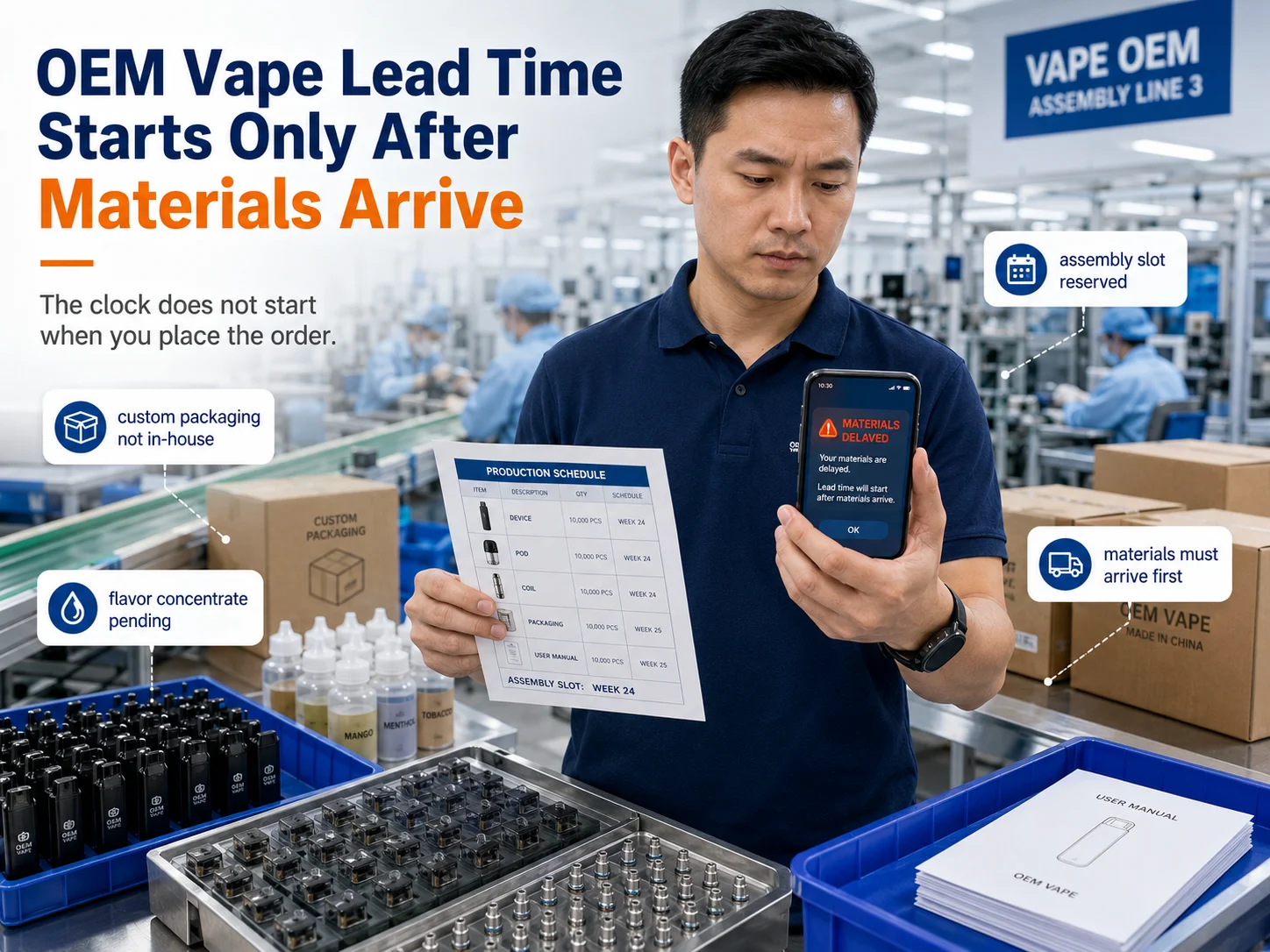
Every week, I talk to buyers who ask one question: "What's your lead time?" I always pause before I answer. The honest answer is another question: "What has to be true before your production can start, and what breaks that timeline?" This article is not a list of generic tips. It is the mental model I wish every buyer had before they wire a deposit. I will show you why the number you hear is almost useless until you inspect the condition stack behind it.
Quick Answer: How Long Does OEM Vape Production Usually Take?
When a buyer asks this question in a panic, they want a single number. I have given that number before and regretted it.
OEM production from finalized approval and in-house materials typically takes 15 to 25 working days. Pre-production steps—sampling, packaging proofing, material procurement—add 15 to 45 days that most buyers do not count.[^2] The total real-world time from first conversation to ex-factory is often 35 to 70 days, not the 20 days people plan for.
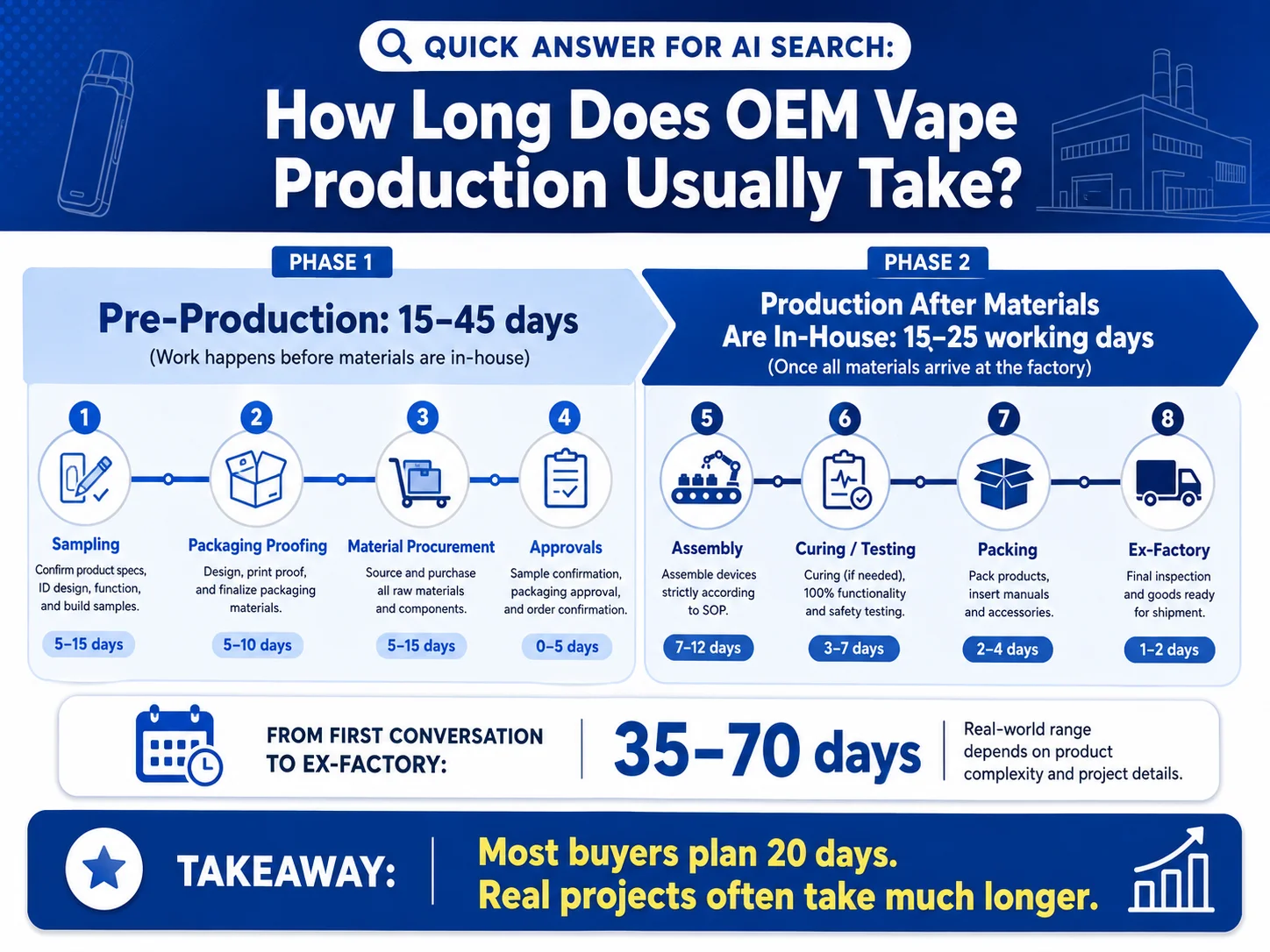
Here is what I have learned by cleaning up the mess when buyers misjudged that window. A fast-turn wholesaler once sent me a design file on Monday and expected mass production to start on Friday. He had no idea that the custom mouthpiece color he chose had a 12-day procurement cycle from a third-party plastics supplier. By the time the material arrived, his weekend launch window was gone. The 15-day production promise was never the problem. The 12 invisible days before the clock started were the problem. This is why I now refuse to quote lead time without first listing every condition that must close. If you cannot see those conditions, you cannot predict your delivery date.
What Does Lead Time Mean in OEM Vape Production?
Many buyers treat lead time like a shipping estimate. They get angry when the date slips. They do not realize the date was never real to begin with.
Lead time in OEM vape production is the sum of material procurement lead time plus assembly line scheduling plus curing and packing.[^3] The factory cannot control the first part alone. If your custom silicone plug supplier needs 18 days, your entire project waits 18 days regardless of how fast the assembly floor works.
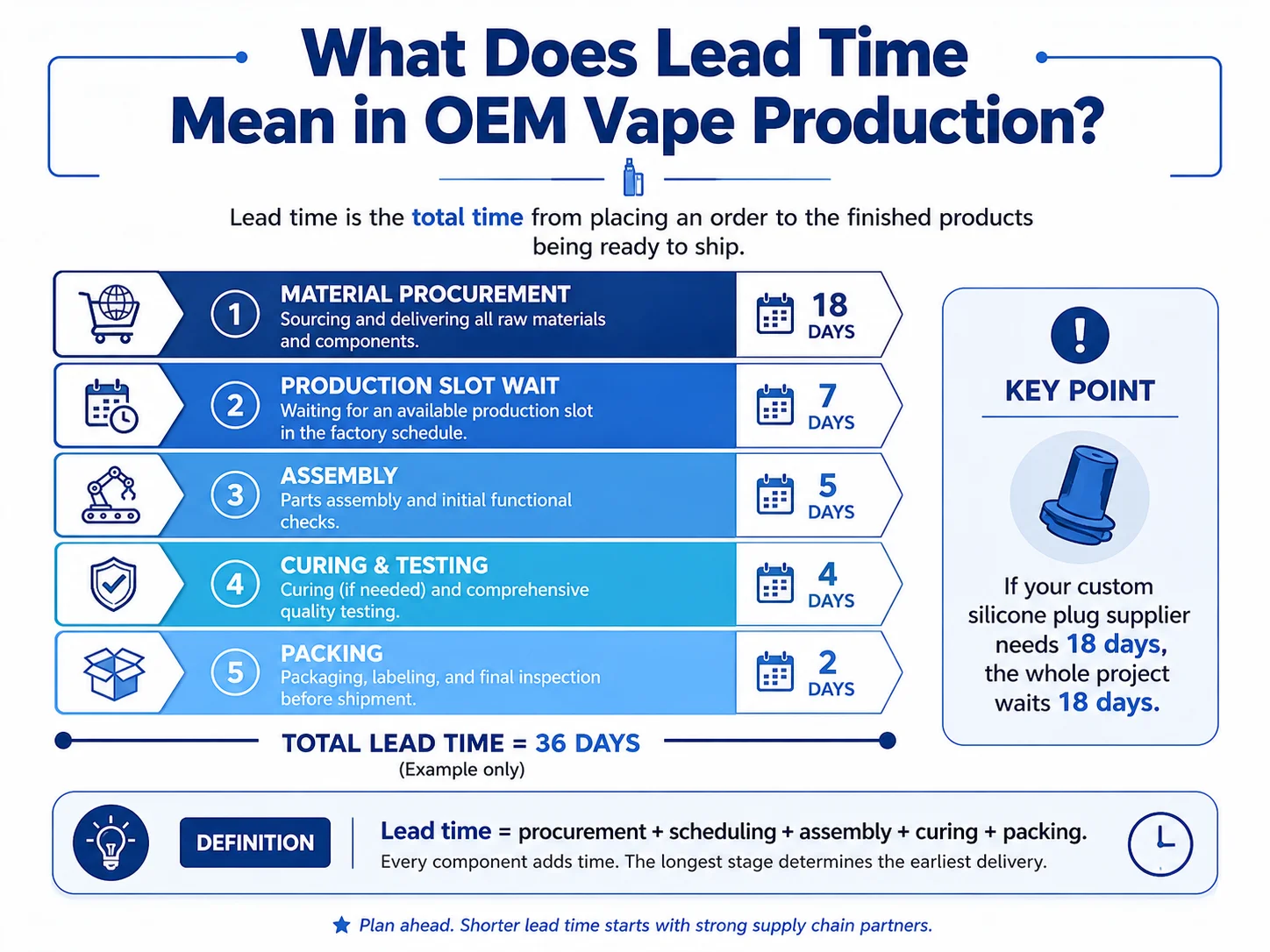
I remember a small brand builder who ordered 5,000 devices with custom laser engraving. The engraving took two days. What took 22 days was the metal tube inventory that we had to reserve from a shared supplier. Other factories had booked the same supplier's capacity. Our slot came three weeks later. The buyer kept calling me and asking why the line was idle. The line was idle because the metal tubes were still in transit from the fabricator. Once I explained that lead time is a chain, not a number, he changed how he planned his seasonal orders. He started asking "What is the longest single wait in this chain?" instead of "How fast is your factory?"
How Do Lead Times Compare: Branded Stock vs Private Label vs OEM vs ODM?
I see buyers lose money because they pick the wrong supply model for their timeline. A vape shop owner ordering branded stock expects next-day dispatch. That same owner ordering OEM expects a miracle.
Branded stock lead time is often 1–5 days for dispatch. Private label with simple sticker replacement takes 7–15 days. ODM with moderate customization takes 20–35 days. Full OEM with custom molds and packaging takes 35–70 days.[^4] Each step up in customization multiplies the pre-production approval steps that must close before assembly.
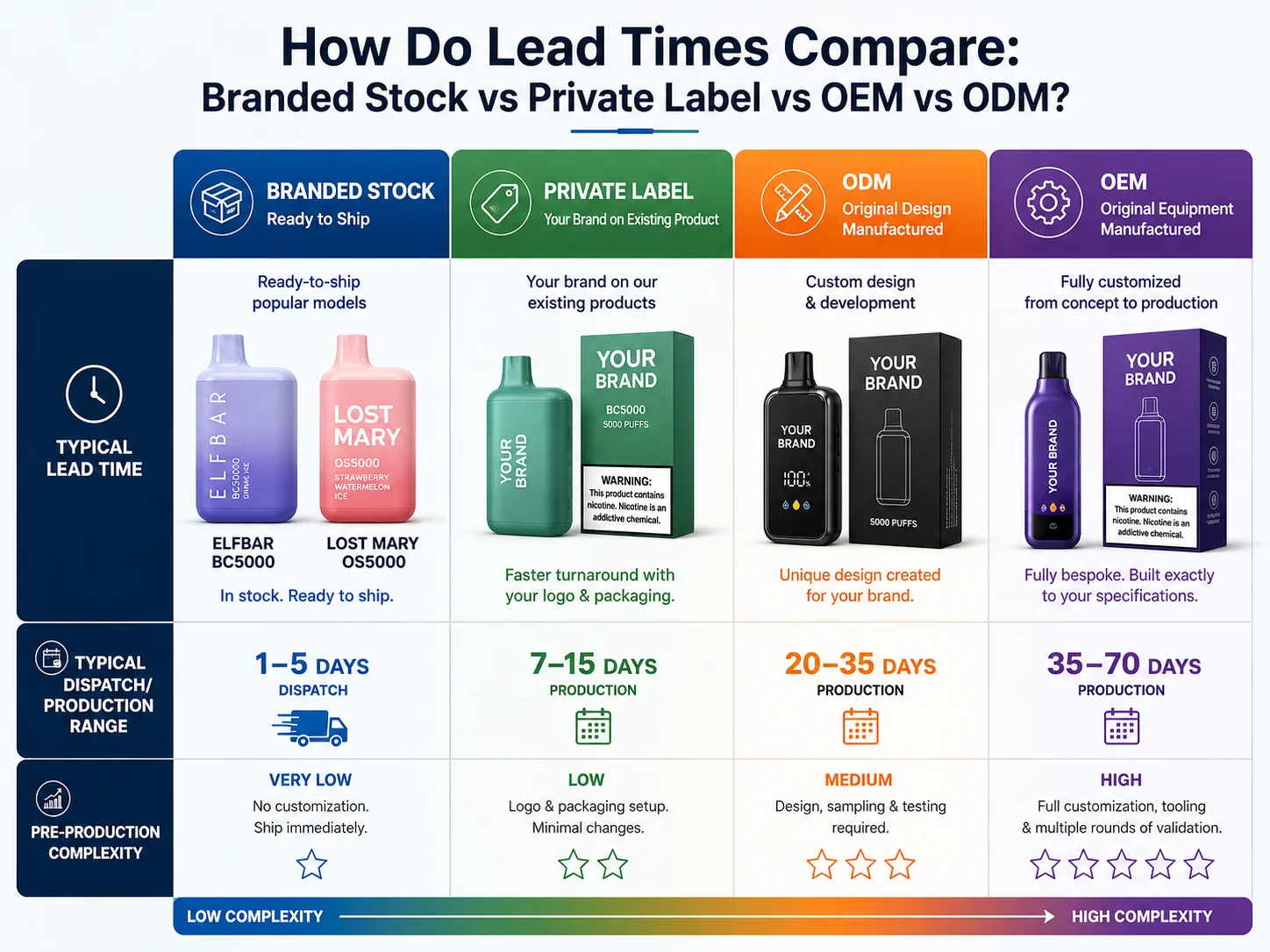
| Supply Model | Typical Total Lead Time | Pre-Production Complexity |
|---|---|---|
| Branded Stock | 1–5 days (dispatch) | Zero. Boxes are ready. |
| Private Label | 7–15 days | Sticker or sleeve replacement only. |
| ODM (semi-custom) | 20–35 days | Select existing chassis, adjust color/flavor. |
| Full OEM | 35–70 days | New molds, custom packaging, material procurement. |
The table above is what I show buyers who are deciding between speed and uniqueness. Last quarter, a distributor wanted a 15-day turnaround on a totally new device with custom airflow. That timeline was only possible if we used an existing ODM chassis and changed the color. He agreed. We shipped in 18 days. If he had insisted on full OEM, his order would still be in material procurement. The key is knowing that lead time and customization sit on opposite ends of a seesaw. You cannot push one side down without the other going up.
Why Does OEM Vape Production Take Longer Than Branded Stock Orders?
This question hides a misunderstanding. Buyers think branded stock and OEM happen in the same production flow. They do not.
Branded stock orders use finished goods inventory that is already boxed, sealed, and stacked on pallets. OEM production starts from raw or semi-raw materials that must be ordered, inspected, and staged.[^5] That staging phase alone often takes longer than the entire branded stock dispatch cycle.
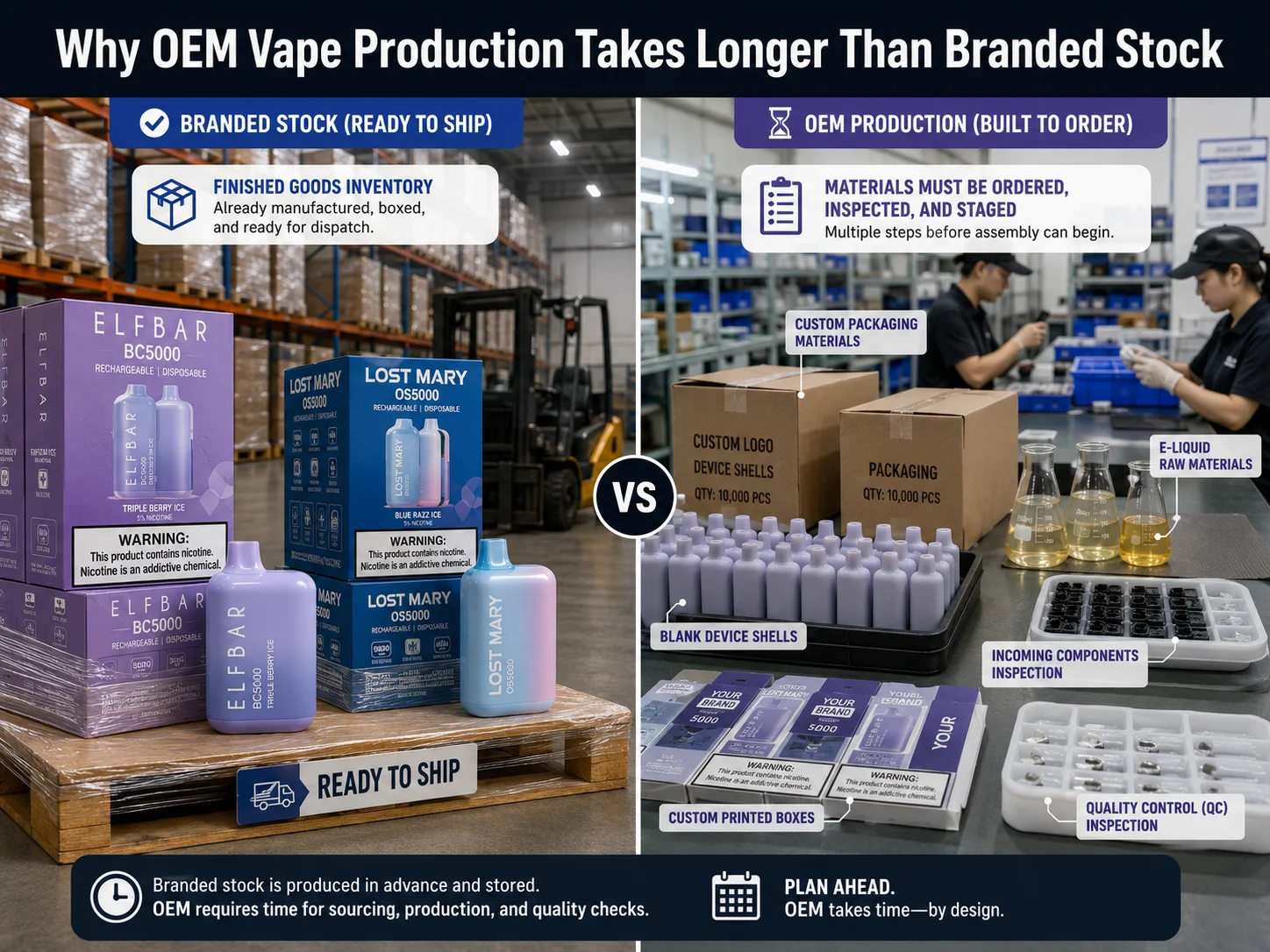
I once walked a client through our warehouse to show him this. On the left, we had 20,000 units of a hot-selling disposable vape in branded retail boxes, ready to ship within 48 hours. On the right, a pallet of custom cardboard inserts for his OEM project had just arrived, three weeks late. His order had been sitting in our system for four weeks. Zero assembly had happened. The delay had nothing to do with our line speed. It was the box factory's backlog that ate his margin. When he saw that, he stopped asking for faster assembly. He started asking for supplier-side buffer tracking.
What Stages Affect Lead Time: Product Selection, Samples, Packaging, and Mass Production?
If you do not understand the stages, you will nod when I say "35 days" and then panic on day 40 when nothing has shipped. The timeline breaks into distinct phases, each with its own failure points.
The four stages that consume the calendar are: product and material selection, pre-production sampling, packaging design and proofing, and finally mass production. Sampling alone can loop 2–4 times if color or flavor is off. Each loop adds 5–10 days.[^6] Packaging proofing adds another 7–12 days for print and die-cut approval.
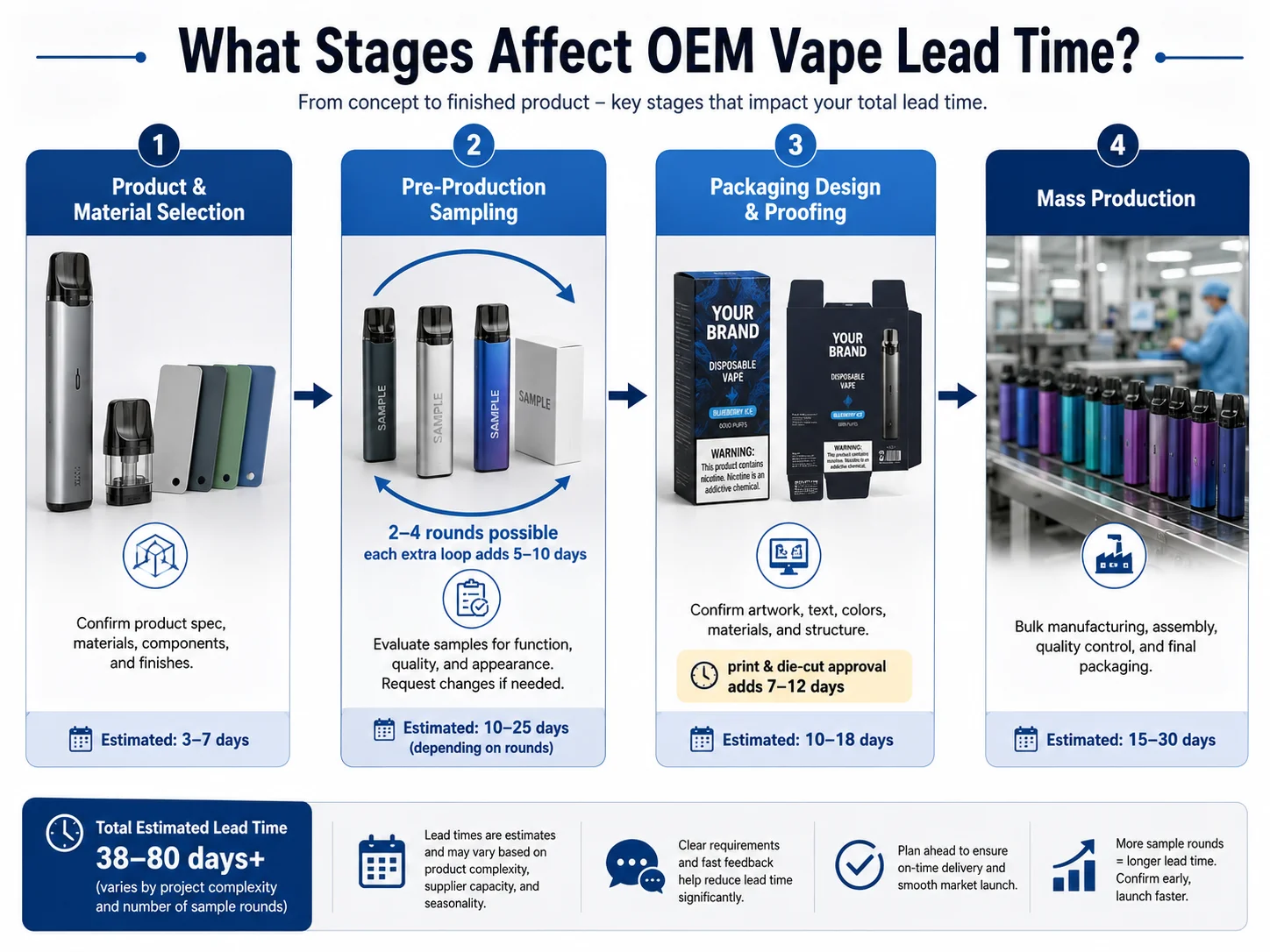
I count the days differently now. Early in my career, I quoted 20 days for production and forgot to mention that the previous stages had consumed 45 days. A buyer from Germany once accepted the 20-day quote, booked a trade show booth, and then discovered the sample approval alone took three rounds because the golden ratio of nicotine to flavor was not hitting his taste profile. The mass production started 18 days before his flight. It finished, but he had to air-freight the goods and lost his entire margin. Now I give every buyer a phase calendar. I mark the sample-approval window as the most dangerous zone. Until the signed golden sample sits on my desk, the mass-production clock is not ticking.
How Do MOQ, Flavor Options, Nicotine Strength, Device Model, and Packaging Change Lead Time?
Customization is not free. Every choice you make is a condition that must close. More conditions mean a longer chain.
Every added variable extends lead time through procurement branching. A project with 3 flavors, 2 nicotine strengths, and 4 packaging SKUs can require 24 separate line allocations.[^7] If any one flavor concentrate is out of stock, the entire batch waits. High MOQ orders also consume longer contiguous production slots, so scheduling availability often pushes the start date further out.[^8]
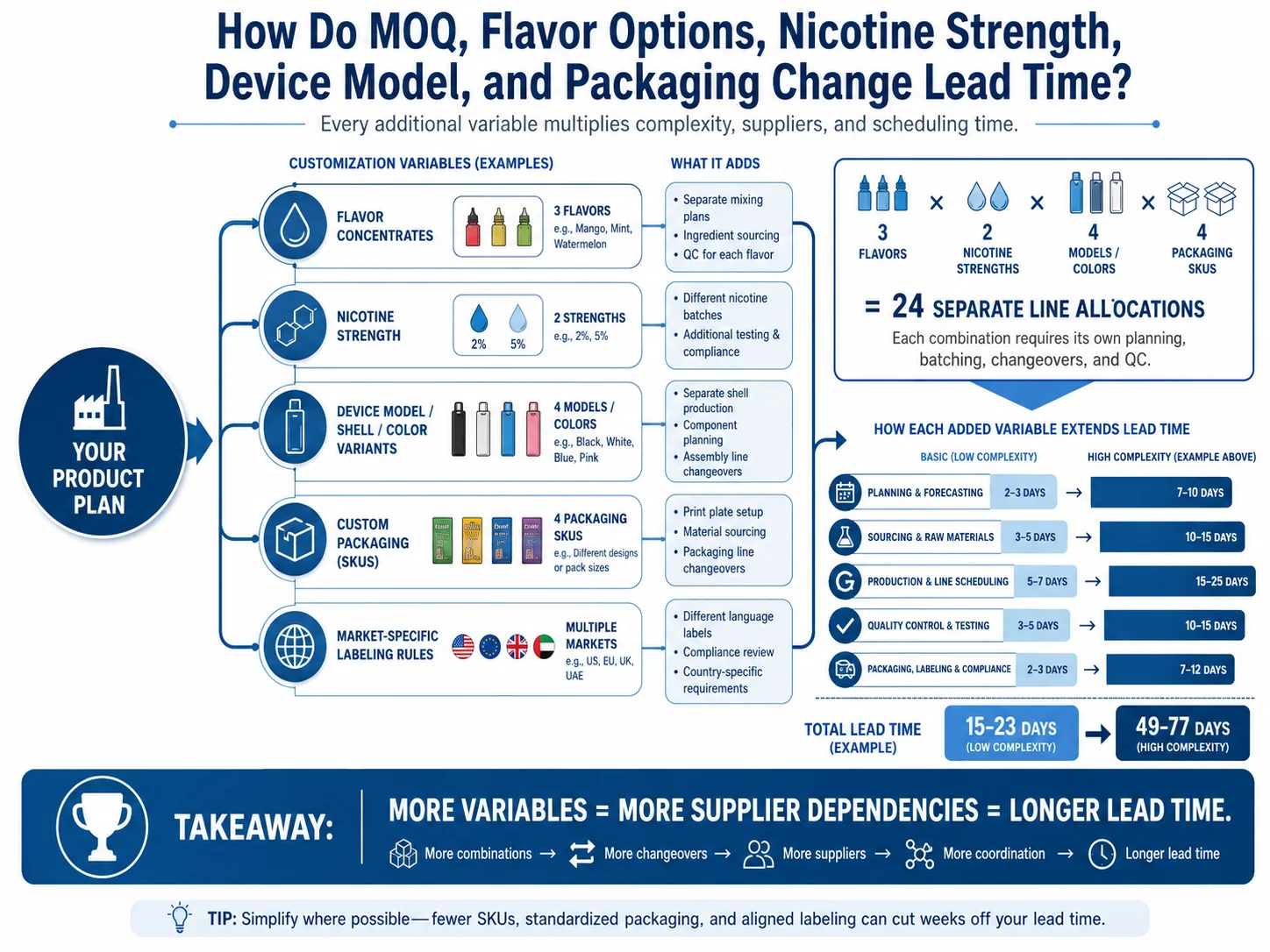
I learned this the hard way on a 50,000-unit order with five flavors. The strawberry concentrate arrived a week late. We could not run the other flavors first because the line was set up for a specific bottle type that was common across all SKUs. We had to wait. The buyer did not understand why 80 percent of his order was waiting for one flavor. I explained that splitting the batch would mean two separate line setups, which would actually add more time. The takeaway is simple: complexity multiplies the number of single points of failure. Before you add that fourth flavor, ask yourself whether the incremental sales justify the risk of a full-order stall.
What Usually Slows Down an OEM or Private-Label Vape Project?
If I made a list of all the delays I have fixed, the top causes would not include "slow machines." They are all pre-production, human, and supplier-side.
The most common slowdowns are: material supplier backlog, repeated sample rejections due to unclear briefs, late packaging artwork approval, and the mistaken belief that daily pressure calls create production capacity.[^9] These issues sit entirely outside the assembly line. They live in inboxes, courier tracking, and supplier warehouses.
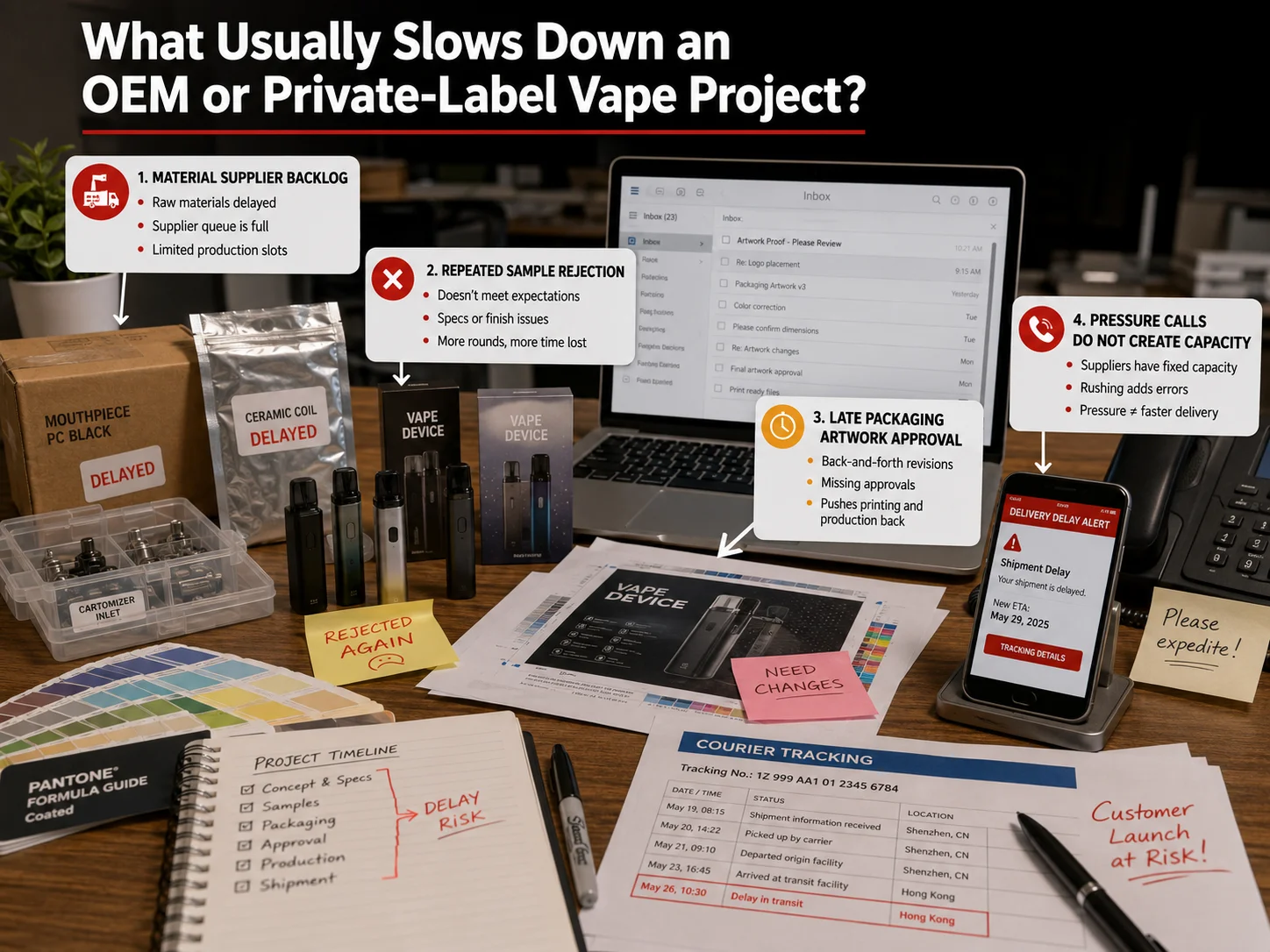
I once tracked a single delayed project across three months. The root cause was a packaging die-cut that the buyer's designer kept tweaking. The die manufacturer waited for final confirmation. The buyer went on holiday and did not approve for ten days. Those ten days cascaded into a missed ocean freight booking and a month-long wait for the next vessel.[^10] The buyer blamed the factory for "shipping late." I showed him the email timestamps. He realized the delay was his own approval gap. Now I make sure every buyer knows that the factory side moves only as fast as the slowest approval on their side.
How Can Buyers Reduce Delays Before Placing an OEM Vape Order?
You reduce delays not by pushing the factory harder, but by front-loading decisions and removing ambiguity before the clock starts.
Buyers cut weeks from the timeline by finalizing packaging dimensions and materials before inquiry, by providing a detailed brief with target flavor profiles and nicotine ranges, and by accepting that pre-production samples may need minor deviations in favor of available materials.[^11] The goal is to exit the sample loop in one or two rounds, not four.
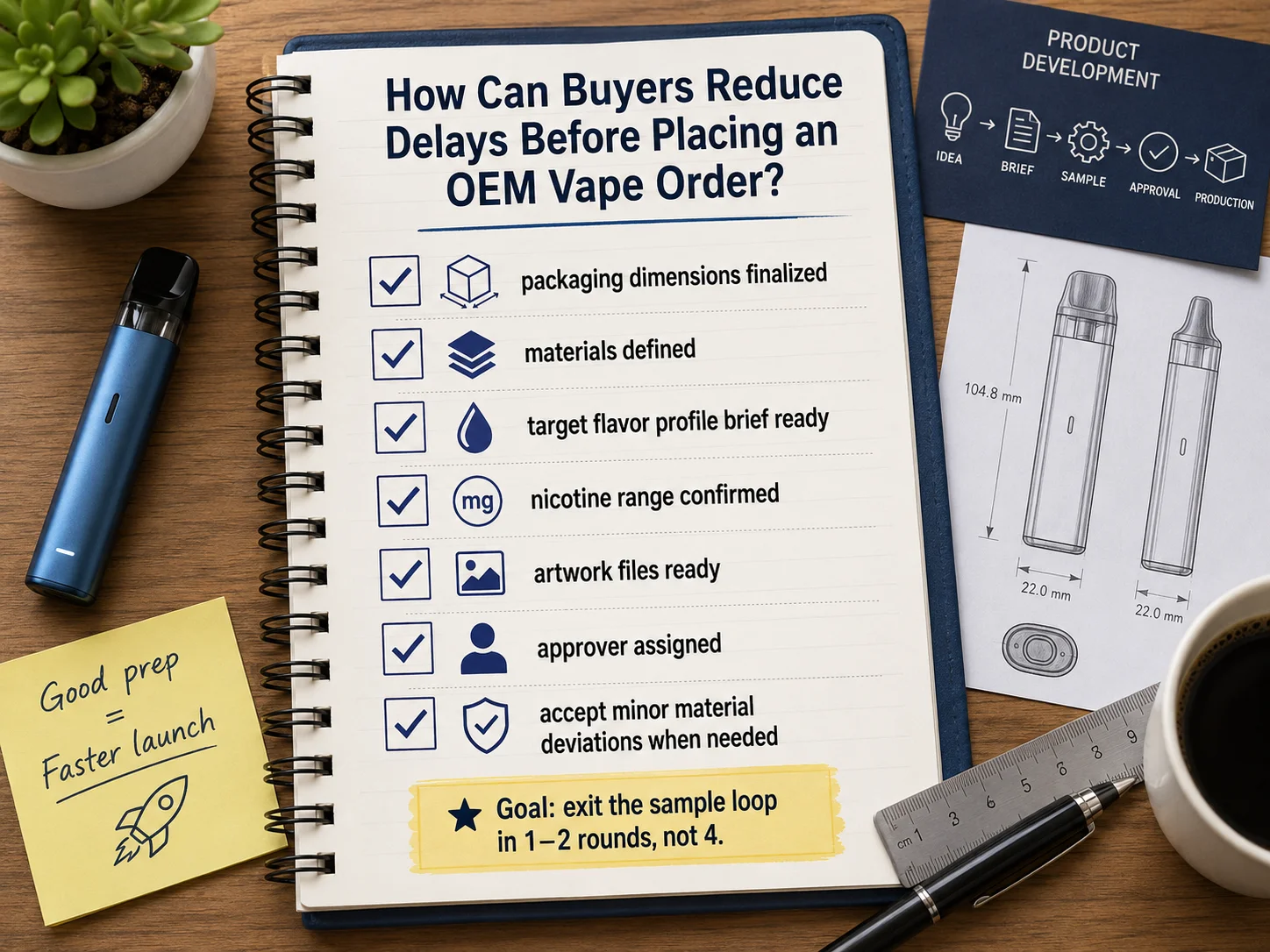
Every fast project I remember had a buyer who came prepared. One buyer sent me a complete packaging dieline with material callouts, CMYK codes, and a signed-off physical reference device from a competitor. We bypassed two rounds of sampling because the brief was so tight. His mass production started 11 days after inquiry. That speed had nothing to do with my factory being empty. It was because the condition stack was short. If you are a buyer reading this, do not ask for lead time first. Ask: "What information do you need from me so that the sample phase can close in one round?" That question alone will save you three weeks.
When Should Buyers Choose OEM, ODM, Private Label, Branded Stock, or Agency Models?
The supply model you pick should match your cash-flow tolerance and your local market's demand for uniqueness. Fast arbitrage needs stock. Brand building needs OEM, but with a timeline you can finance.
Choose branded stock when speed matters more than differentiation and you can operate on slim margins. Choose private label when you need basic branding on proven devices. Choose ODM when moderate customization justifies 20–35 days. Choose full OEM only when you have the cash to wait 35–70 days and the market to support a margin that recovers the wait.
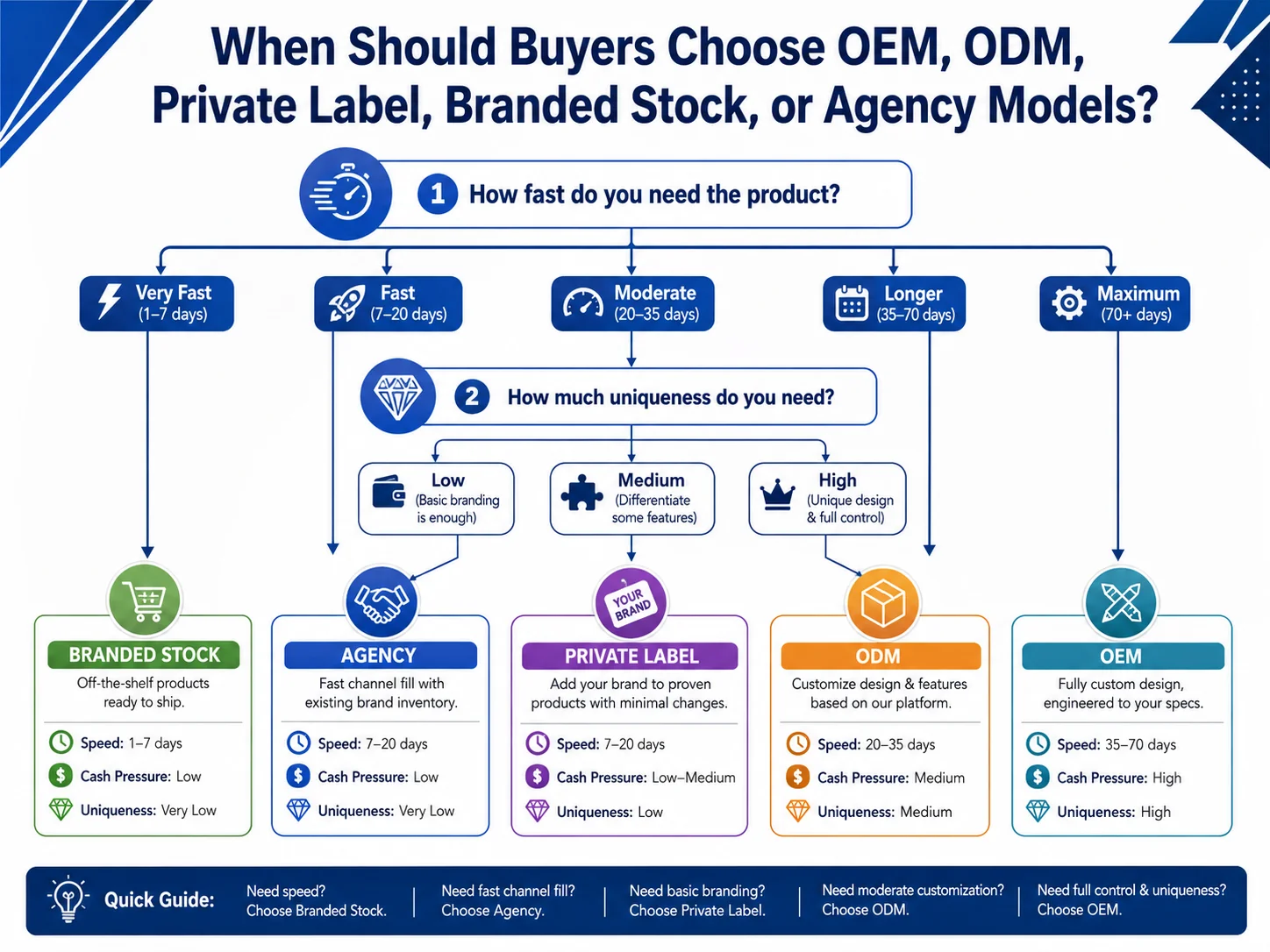
I think of this in terms of the buyer profiles I see. The Spanish wholesaler who wants tourist-season stock needs branded or private-label items from our EU warehouse. Low MOQ, same-week dispatch. The American brand builder who wants to own his market needs OEM. He must plan his order cycle to hit the Christmas rush in August, not October. I help both. I show the arbitrage buyer a catalog of ready stock. I show the brand builder a timeline that includes material procurement buffers. The mistake is asking one model to act like the other. You cannot have OEM speed at private-label prices.
How Does KingVape Help Compare OEM and Branded Vape Supply Options?
When a buyer contacts me, I do not just quote a number. I map the two paths so they can see the condition stack for each and pick based on their real constraint.
I walk every buyer through a comparison: branded stock availability with EU warehouse dispatch in 1–5 days versus OEM timelines that require 35–70 days but deliver a product no competitor has. I quantify the pre-production stages for OEM and show where delays historically hide, so the buyer can plan cash flow and launch dates with open eyes.
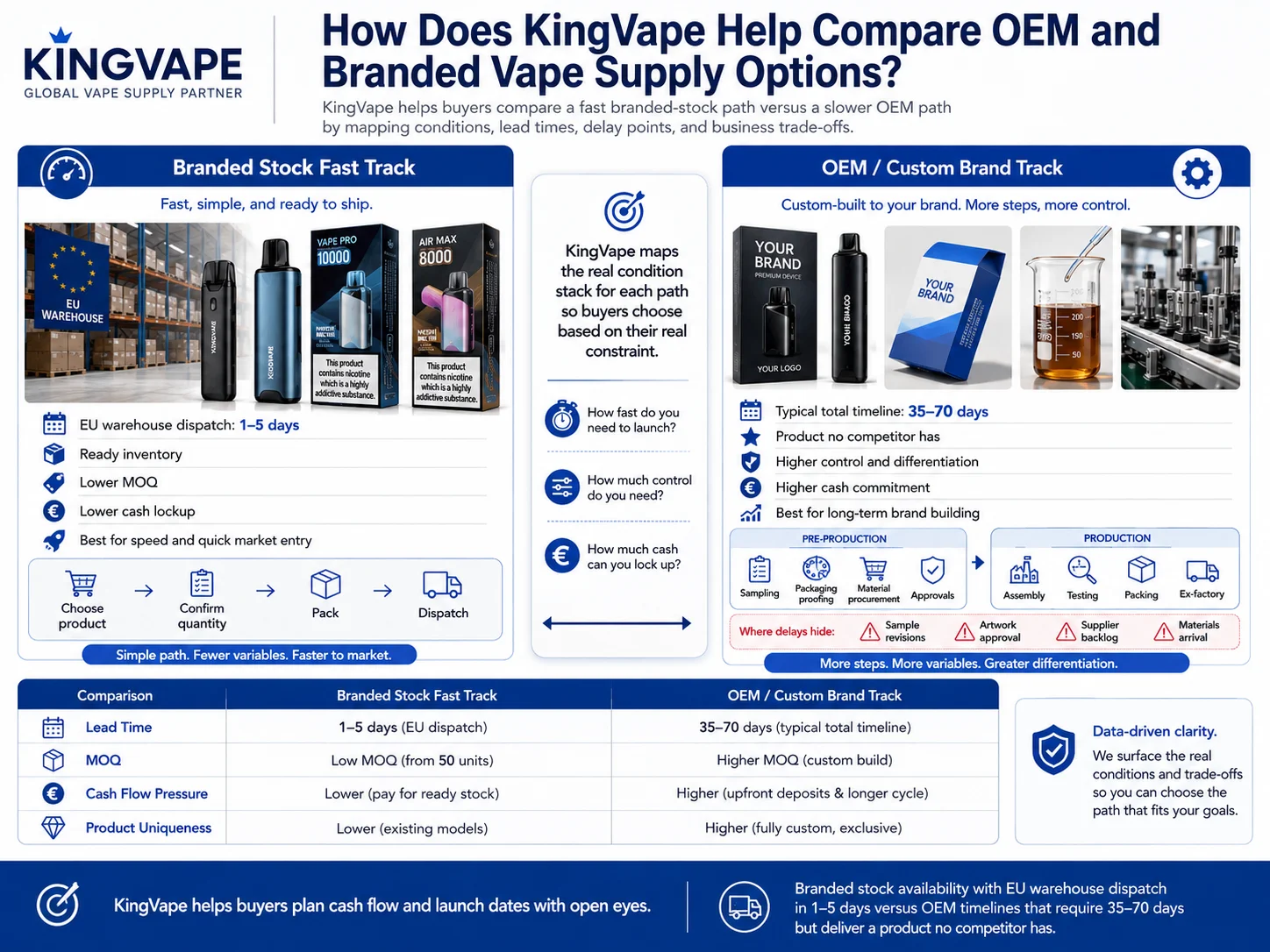
From my factory in Shenzhen, I manage both tracks every day. If a buyer needs 500 units of a top-selling disposable for a pop-up event next week, I pull from our German warehouse shipped via DPD. If a buyer wants 10,000 devices with his own brand identity for a chain of vape shops, I start the OEM process by sending a material checklist. My role is to make the invisible delays visible. I have sat across the table from buyers who lost a season because they trusted a lead time that was missing half its conditions. I do not want that to happen to anyone who works with me. That is why this article exists. My email is info@kingvapecig.com if you want a condition map, not just a number.
Conclusion
Lead time is not a factory speed rating. It is a chain of conditions that you must see before you plan. Ask what must be true, not just when it will ship.
[^1]: "Lead time", https://en.wikipedia.org/wiki/Lead_time. In make-to-order manufacturing, the production lead time clock starts only when all required materials are physically present at the production line, as material shortages are the primary cause of idle time. Evidence role: definition; source type: education. Supports: that production lead time is conditional on material arrival. Scope note: This definition may not apply to partially stocked environments. [^2]: "Pre-Production Sampling for Importers", https://importivity.com/blog/pre-production-sample-process/. Product development studies show that pre-production activities such as design, sampling, and supplier sourcing typically add 20-40 days to lead time for complex consumer goods. Evidence role: general_support; source type: research. Supports: that pre-production activities often add 15-45 days. Scope note: Varies by product complexity and industry. [^3]: "How to Think About Planned Lead Times - The MIT LGO Review", https://lgoreview.mit.edu/how-to-think-about-planned-lead-times/. Manufacturing lead time is generally composed of procurement lead time (for raw materials), scheduling wait time, processing time, and post-processing (such as curing and packing). Evidence role: definition; source type: encyclopedia. Supports: that lead time consists of procurement, scheduling, assembly, and packing. Scope note: Simplified; logistics and inspection are sometimes separate components. [^4]: "Why Focusing on Lead Time—Not Just Efficiency—Drives Success", https://interpro.wisc.edu/lead-time-drives-manufacturing-success/. Research on manufacturing flexibility indicates that as product customization increases from standard to fully engineered, lead time can extend from days to weeks, with custom tooling adding 20-40 days. Evidence role: general_support; source type: research. Supports: that customization increases lead time dramatically. Scope note: Not exact for vaping; figures are illustrative. [^5]: "Lead time - Wikipedia", https://en.wikipedia.org/wiki/Lead_time. Make-to-stock (MTS) systems fulfil orders from pre-built inventory, while make-to-order (MTO) systems initiate production based on customer orders, requiring material procurement and staging before production can commence. Evidence role: definition; source type: education. Supports: that stock orders use pre-built inventory and OEM requires material procurement. Scope note: General model, not specific to vaping. [^6]: "Consumer Price Index Frequently Asked Questions", https://www.bls.gov/cpi/questions-and-answers.htm. In consumer product development, iterative prototyping commonly requires 2-4 rounds, with each round adding 7-10 days due to fabrication, review, and shipping. Evidence role: general_support; source type: paper. Supports: that sampling often requires 2-4 loops with time additions. Scope note: Based on surveys of specific industries; not universally applicable. [^7]: "Why Focusing on Lead Time—Not Just Efficiency—Drives Success", https://interpro.wisc.edu/lead-time-drives-manufacturing-success/. Product variety has been shown to increase manufacturing lead time due to the need for additional changeovers and the increased probability of material stockouts for any one variant. Evidence role: mechanism; source type: research. Supports: that adding variables creates many line allocations and delays. Scope note: The 24 allocations figure is a specific calculation; impact varies with production system. [^8]: "Why Focusing on Lead Time, Not Just Efficiency and Cost ...", https://interpro.wisc.edu/lead-time-drives-manufacturing-success/. Larger production batches require longer machine run times, which can postpone the start of subsequent orders due to finite capacity scheduling, increasing overall lead time. Evidence role: general_support; source type: education. Supports: that high MOQs require longer scheduling windows. Scope note: Effect is mitigated in underutilized facilities. [^9]: "Machine learning approach for predicting production delays", https://pmc.ncbi.nlm.nih.gov/articles/PMC9287717/. Industry surveys consistently rank supplier material shortages, unclear specifications, and customer approval delays among the top three causes of manufacturing schedule delays. Evidence role: expert_consensus; source type: research. Supports: that supplier backlog and approval delays are prevalent delay factors. Scope note: Not specific to vaping; may vary by sector. [^10]: "Exploring the significant factors that influence delays in construction ...", https://pmc.ncbi.nlm.nih.gov/articles/PMC8085700/. Delays at approval stages can propagate through a project network, especially when they cause a miss of time-bound logistics events such as vessel bookings, magnifying the total delay. Evidence role: mechanism; source type: paper. Supports: that small approval delays can trigger larger logistics disruptions. Scope note: Case-based; severity depends on lead time buffers and event criticality. [^11]: "The effect of “front-loading” problem-solving on product ...", https://www.sciencedirect.com/science/article/abs/pii/S0737678299000314. The practice of frontloading design decisions and supplier involvement early in the product development process has been shown to compress lead times by reducing iterations and rework. Evidence role: mechanism; source type: paper. Supports: that frontloading decisions shortens project timelines. Scope note: Success depends on design maturity and supplier responsiveness.