I have watched a customer wire $18,000 for a project that collapsed in six weeks. The reason was not the product. The reason was a mismatch between what they thought they were buying and what they were actually getting. This article is built from those exact conversations—the ones where I had to say no, explain why, and sometimes lose an order because the truth was not what they wanted to hear.
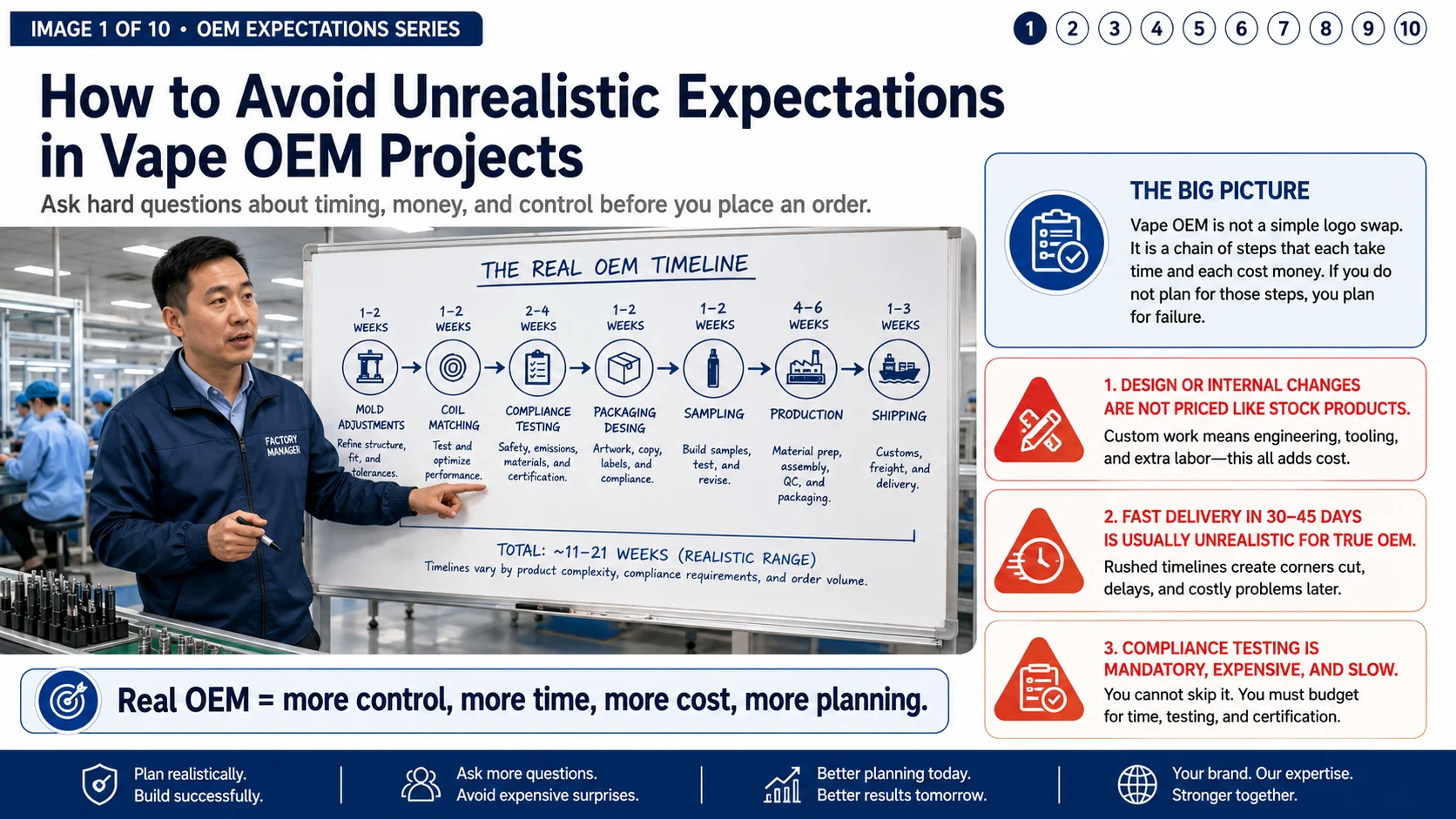
The key to avoiding unrealistic expectations in vape OEM is asking hard questions about timing, money, and control before you place an order. An OEM project is not a logo swap. It is a chain of steps—mold adjustments, coil matching, compliance testing, packaging design—that each take weeks and each cost money. If you do not plan for those steps, you will plan for failure.
This pattern plays out the same way every time. A buyer sends a message asking for a vape with their logo, a specific color, and a delivery date 30 days out. I reply with questions about coil resistance, airflow design, TPD registration, and artwork files. Silence. Then, a few days later, they ask again for the price of a “simple OEM” as if my questions were optional. That is when I know we need to pause and talk about what OEM actually means. Because if we skip that conversation, the project will break later, and it will break hard.
Quick Answer: What Are the Most Unrealistic Expectations in Vape OEM Projects?
Most people walk into an OEM vape project expecting a cheap, fast logo swap. The truth hits them later when they learn the mold does not fit, the coil tastes burned, or the lab test results will not come back for eight more weeks.
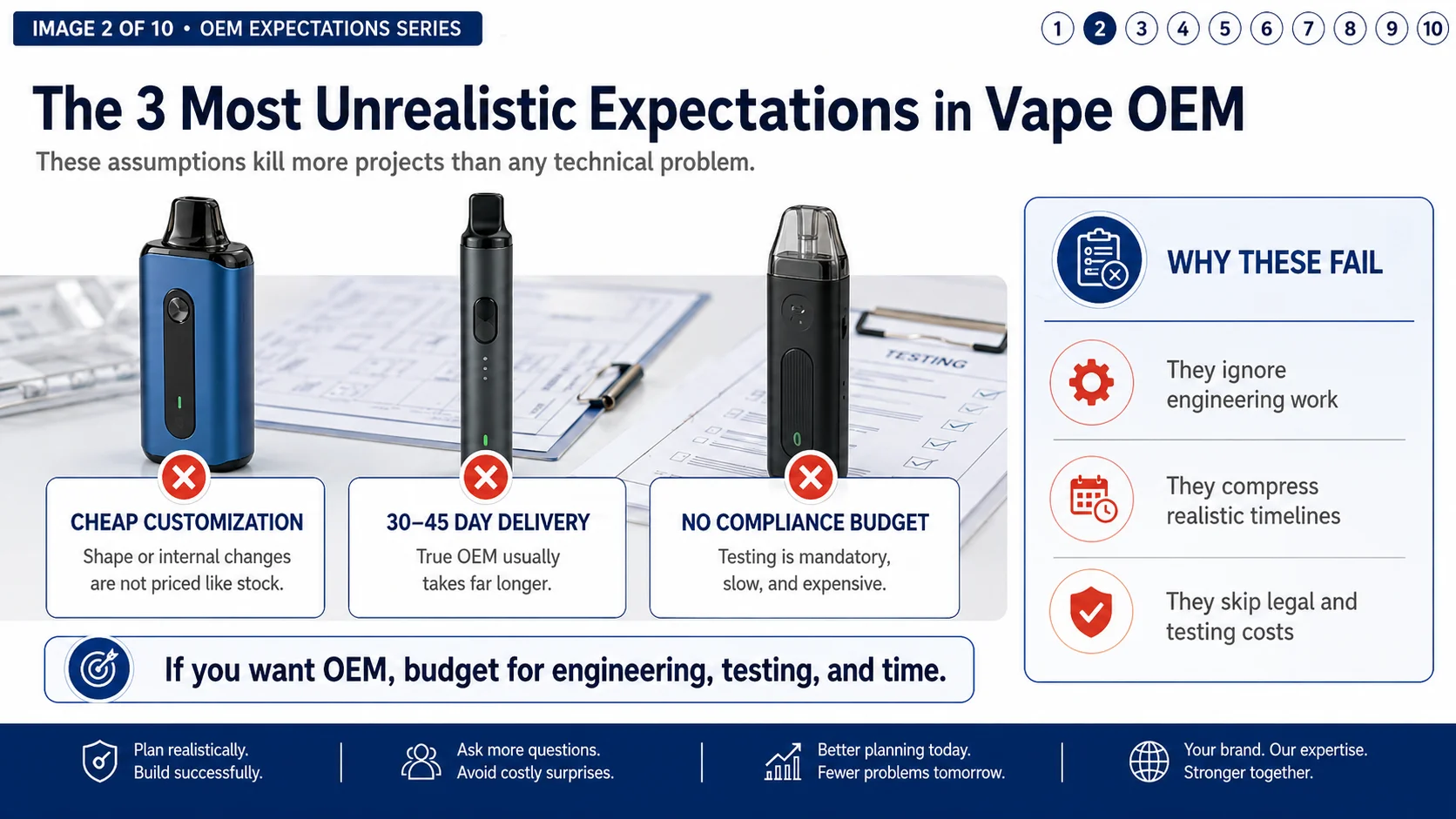
The three most unrealistic expectations I see are: 1) believing you can change the shape or internals for the same price as stock, 2) expecting delivery in 30–45 days, and 3) ignoring that compliance testing is mandatory, takes months, and costs thousands of dollars. These three kill more projects than any technical problem ever could.
I remember a buyer who came to us after a failed attempt with another factory. He had paid for 2,000 units of an OEM device, and the factory had promised the moon—custom airflow, a new mouthpiece shape, TPD registration included, all for $7.50 a unit and delivery in 40 days. What he received were stock devices with a poorly printed logo, no TPD documents, and a coil that tasted dry after 50 puffs. The total loss was over $15,000. He told me later, “I thought I did my homework. I just did not know what questions to ask.” That statement is the reason I am writing this now.
What Does a Vape OEM Project Really Include?
It is easy to say “OEM” and think about a finished product with your name on the box. In reality, an OEM project is a sequence of small, interconnected jobs that each need time and money. None of them are optional if you want a device that works safely and legally in your market.
A vape OEM project normally includes industrial design tweaks (not just logo), coil-resistance and wicking material selection, airflow calibration, battery and chipset matching, child-resistant packaging design, and regulatory lab testing.[^1] If you skip any of these, you are not doing OEM—you are gambling. And sometimes you can gamble and win, but usually you lose.
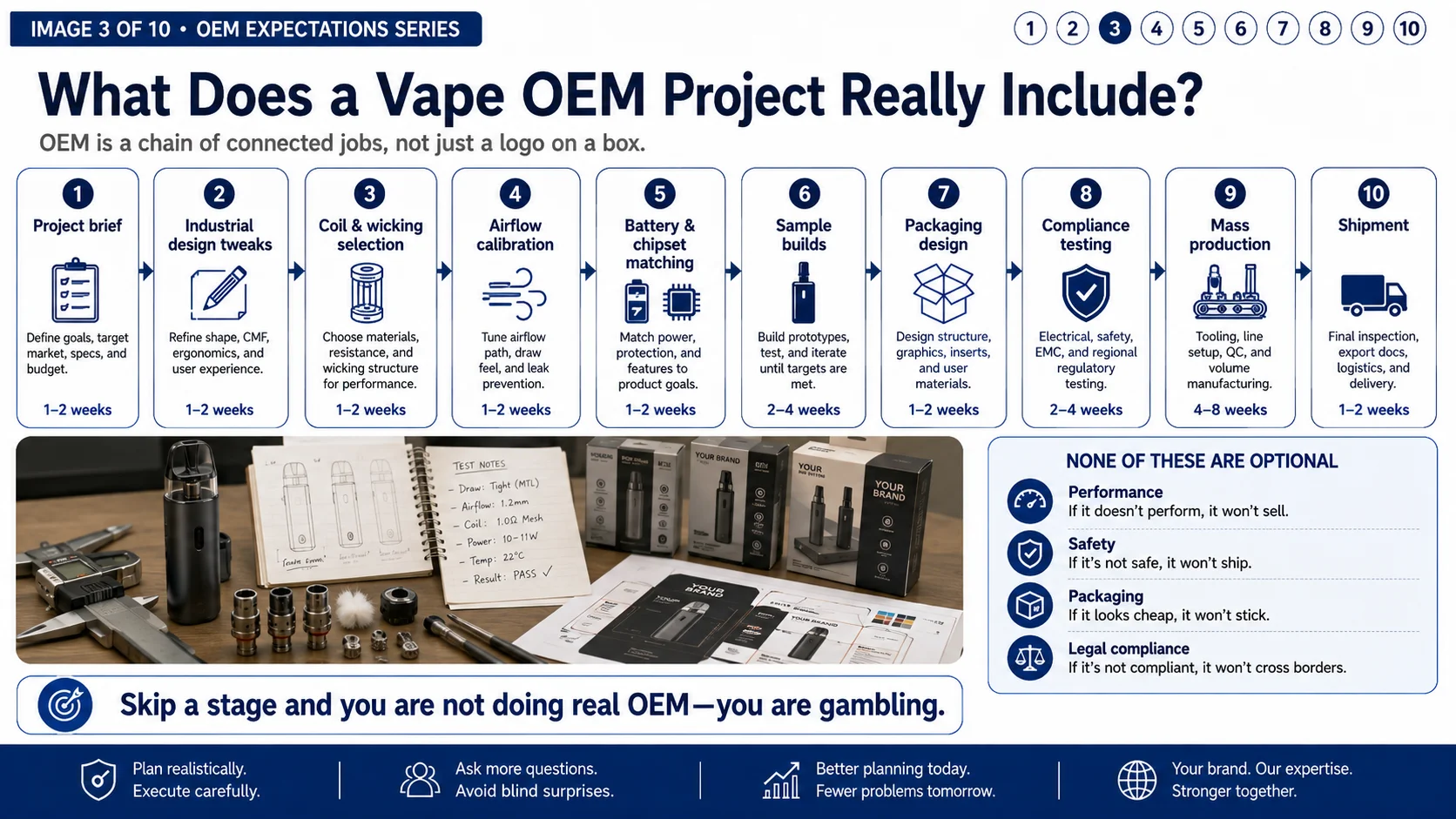
Let me walk through a real case—anonymized, but the numbers are true. A distributor from Germany wanted a refillable pod system under his own brand. He chose a base model from our catalog and asked to change the shape of the mouthpiece, adjust the airflow from loose MTL to a tighter draw, use a specific coil from a third-party manufacturer, and print his own packaging with a QR code for age verification. Sounds like a reasonable project. But here is what that actually took: two weeks just to modify the mouthpiece CAD file and get his approval, another three weeks to produce a prototype sample with the new airflow channel, one week of back-and-forth because the draw felt “not quite right,” four weeks to source and test the third-party coil in our pod (three iterations because the wicking was inconsistent), two weeks to refine the packaging die-cut for the QR code insert, and then ten weeks for TPD lab testing and notification. Total time from agreement to shipment-ready: 18 weeks. The total cost, including molds, sampling, and lab fees, crossed $12,000 before we manufactured a single saleable unit. The buyer told me he had originally budgeted $4,000 and 8 weeks. If I had said yes to his original timeline and price, the project would have died or delivered a product that could not be sold. That is what a real OEM project includes.
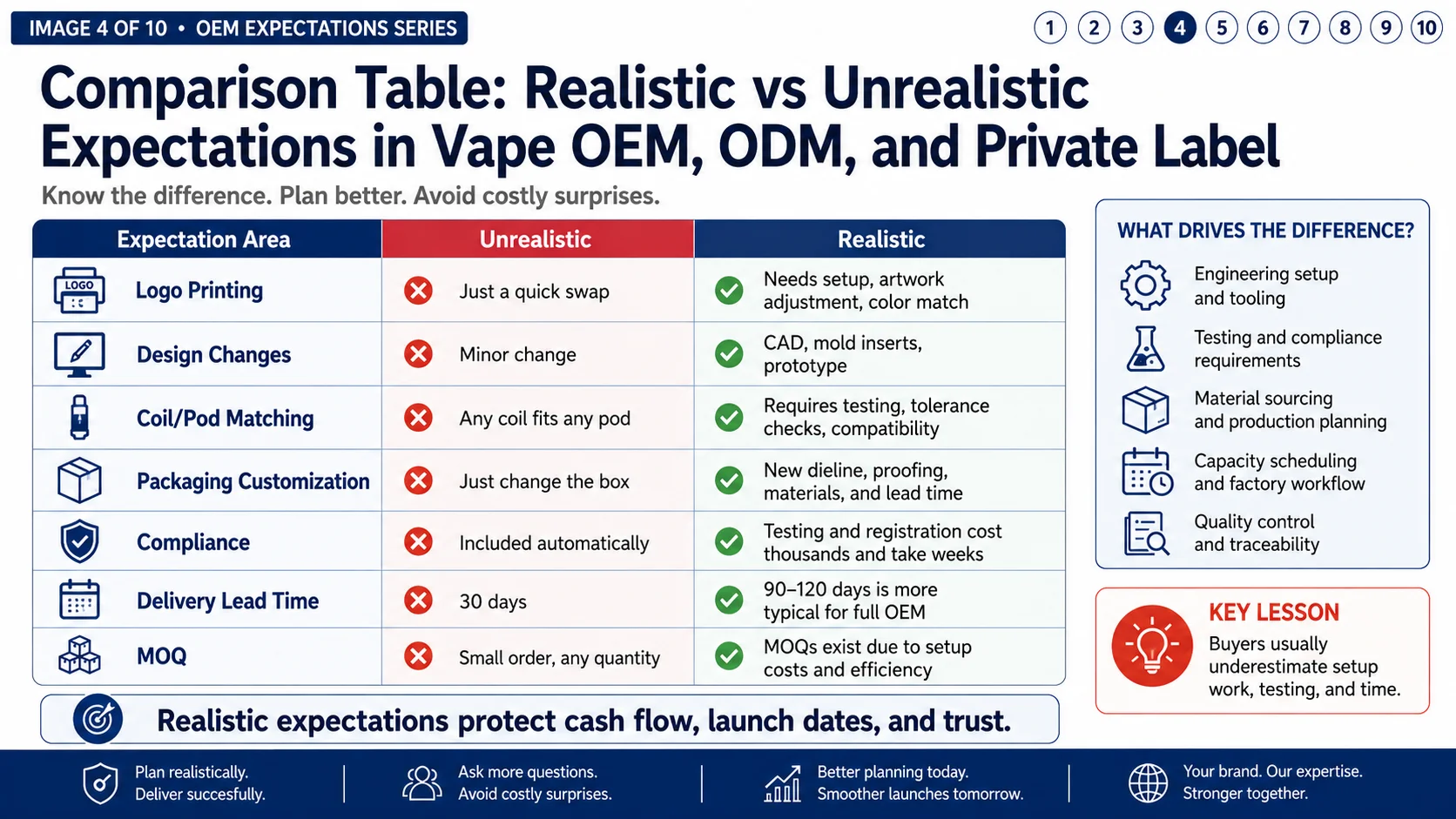
Comparison Table: Realistic vs Unrealistic Expectations in Vape OEM, ODM, and Private Label
| Expectation Area | Unrealistic (What Many Buyers Assume) | Realistic (What I Have Learned the Hard Way) |
|---|---|---|
| Logo Printing | Just a quick swap, no extra cost. | Requires new silk screens or laser setup, artwork adjustment, color matching. Adds 1-2 weeks and a setup fee. |
| Design Changes | Changing the shape, airflow, or pod connection is minor. | Even a small shape change means new mold inserts, CAD work, prototyping. Adds 2-4 weeks and mold cost. |
| Coil/Pod Matching | Any coil works; the factory can adjust easily. | Coil resistance, wicking, and pod air seal must be tested together. Expect 3-5 sample iterations, adding 4-6 weeks. |
| Packaging Customization | Print my logo on the stock box. | Custom box structure, inserts, foil stamping, QR codes, language-specific warnings—needs die-cut, printing, assembly. Adds 3-4 weeks. |
| Compliance (TPD, FDA) | The factory handles it; it is included in the unit price. | Lab testing, toxicology reports, emissions testing, and registration cost thousands and take 8-14 weeks.[^2] Not included unless explicitly agreed. |
| Delivery Lead Time | 30 days because the factory has stock parts. | 90-120 days from confirmed sample approval to shipment. Components, production, testing, and ocean freight all eat time. |
| MOQ | 500-1,000 units at the same per-unit cost as 10,000. | Setup costs hit small runs hard. Per-unit price below 3,000 units is usually 20-50% higher. MOQ is a cost reflection, not a penalty. |
Why OEM Vape Projects Usually Need Higher MOQ Than Branded Stock
Someone once told me, “I only need 500 pieces. The price you quoted is robbery. The same device without my logo is $4 cheaper.” That statement makes sense if you have never seen the inside of a factory before. OEM setup costs do not shrink just because the order quantity is small.[^3]
OEM projects need higher MOQ because the fixed costs—mold adjustments, printing plates, lab testing, compliance registration—are the same for 500 units or 5,000 units.[^4] The factory must spread those costs over the total order. At 500 units, each piece carries a huge setup burden. At 5,000, that burden almost disappears.
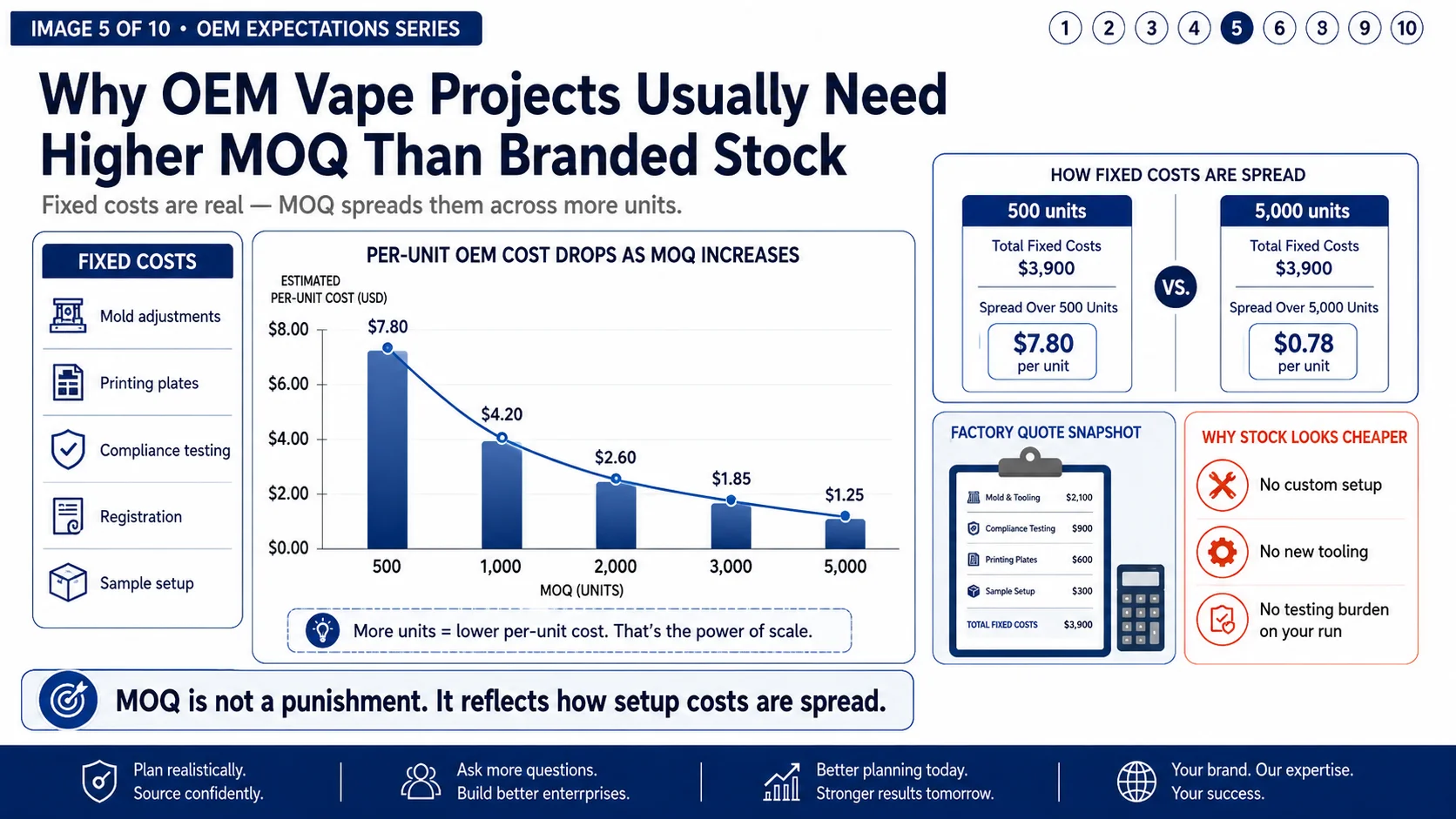
Let me put numbers behind this. Suppose a project has $6,000 in total fixed setup costs. If you order 500 pieces, that is $12 per unit just to cover setup, before any material or labor. If you order 5,000, that drops to $1.20 per unit. The factory’s manufacturing cost for the device might be $5.[^5] So the realistic per-unit price at 500 pieces is around $17 plus factory margin. At 5,000 pieces, it can be closer to $7-8. The buyer who compared to a $9 stock device was not being cheated; he was comparing apples to airplanes. Stock devices spread their development cost over tens of thousands of units and many customers. The OEM buyer carries that cost alone. I have had to walk away from orders where the budget did not match the math, not because I did not want the business, but because accepting would mean delivering a substandard product or losing money. A broken relationship is worse than no relationship.
Why Samples, Packaging, Flavor Approval, and Compliance Can Extend Lead Time
Every week I get a message like, “Can you speed this up? I promised my customers the product would be in stock next month.” I understand the pressure, but there are parts of an OEM vape project that cannot be rushed without breaking something.
Samples take time because each revision needs production, testing, and shipping. Packaging design requires multiple rounds of proofing and physical samples. Flavor approval for e-liquid OEMs involves subjective taste testing that cannot be done in a hurry.[^6] Compliance testing follows a fixed laboratory schedule.[^7] These are not padding—they are the minimum required to not ship a product that gets rejected or recalled.
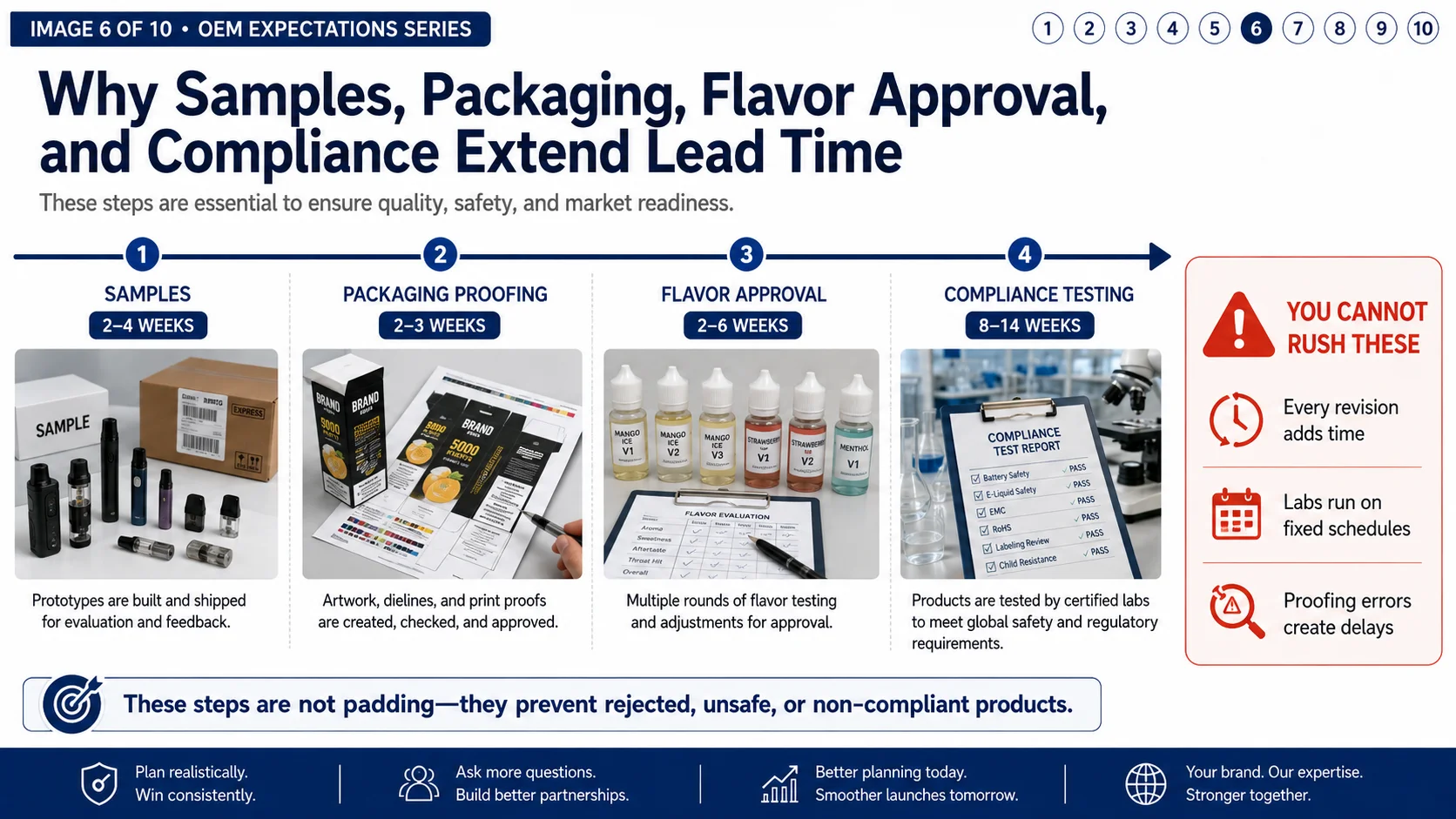
One painful example taught me to never compress a timeline for a first-time project. A client in Spain ordered a disposable vape with a custom flavor profile—mango-ice with a specific sweetness level. We rushed the flavor approval because the buyer said he trusted our judgment. We sent one sample, he said “tastes fine,” and we went into production. Two thousand units later, he opened a box and realized the sweetness was stronger than what his customers wanted. He had not compared it side-by-side with the reference he originally sent. We ended up having to re-run the batch at a loss. That single mistake swallowed all the margin and then some. Now, my rule is firm: flavor approval needs at least two separate tasting sessions, with a clear reference sample, and a signed-off document. The same discipline applies to packaging—artwork errors caught too late can mean scrapping thousands of printed boxes.[^8] The time you save by rushing these steps, you will pay back tenfold in rework, refunds, or legal trouble.
What Buyers Should Understand About Product Control, Cost, and Customization Limits
A factory can give you a device with your logo. But the moment you ask for a different coil or a tighter airflow, the factory loses some control. The device becomes a hybrid—part their proven platform, part your unproven changes. The risk shifts onto you.
Customization limits exist because the base device went through validation testing with its original components. Changing the heating element or airflow path can affect temperature, flavor delivery, and safety.[^9] Buyers should expect to pay for new validation tests for any change that touches the internals. They should also expect that some changes are simply not possible without designing a new device from scratch.
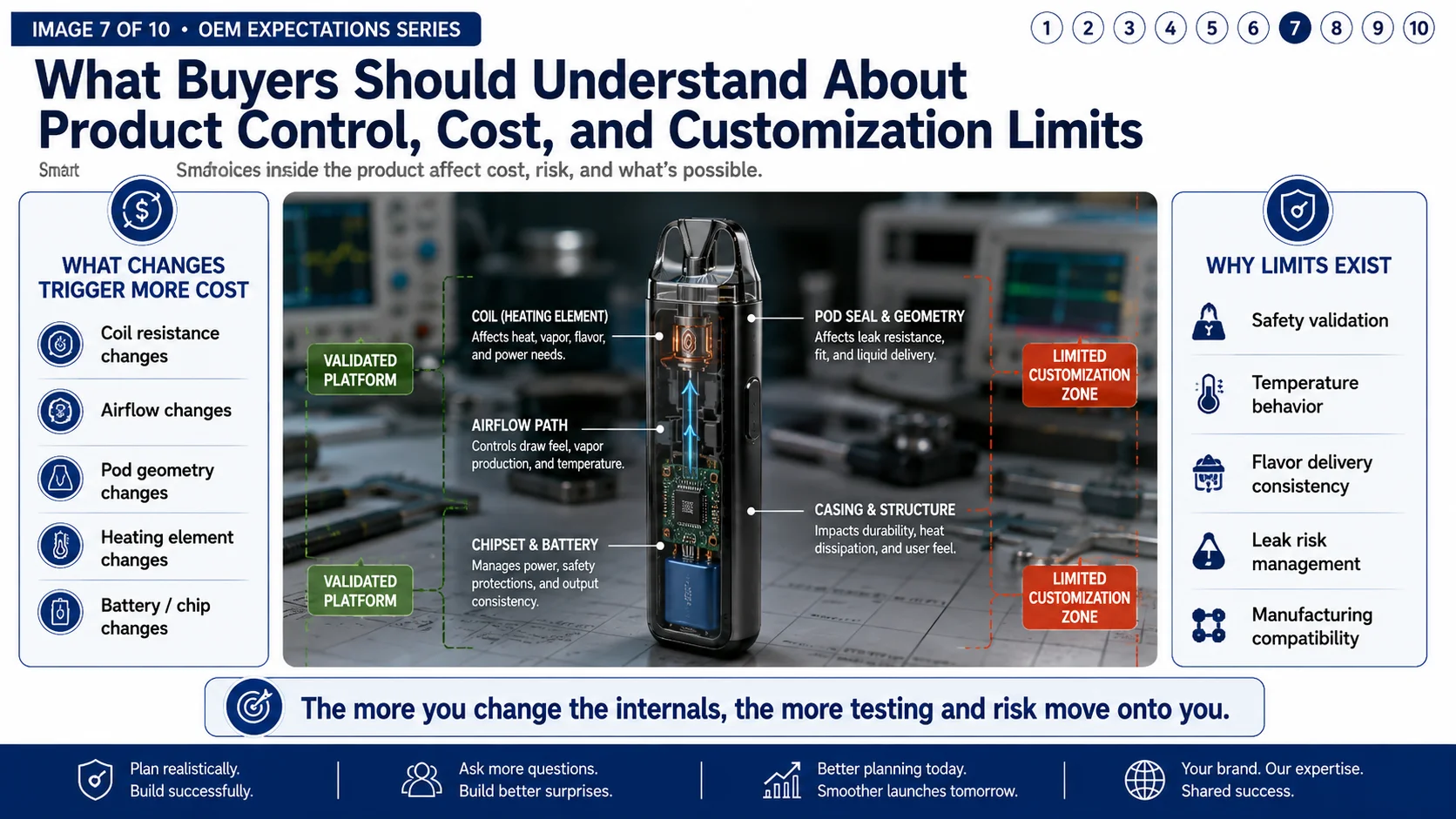
I worked with a US distributor who insisted on using a specific ceramic coil from a supplier he knew, inside our standard pod system. The coil was slightly taller than ours, so the pod did not close properly. We tried to modify the pod base mold, but that created a air seal leak. We then tried to shorten the coil’s positive pin by 0.3mm—that worked mechanically but changed the resistance and led to inconsistent heating. After four prototypes and eight weeks of testing, we abandoned the project. The buyer was frustrated, but I could not in good conscience ship a device that would have produced dry hits and potential overheating complaints. He lost money on samples. We lost engineering time. The root cause was not poor engineering; it was the assumption that you can mix and match components like Lego bricks. Every internal change introduces variables that must be tested, and not all tests pass.
Common Mistakes Smaller Buyers Make Before Starting a Vape OEM Project
The most dangerous buyer is not the one who asks too many questions. It is the one who asks too few, assumes everything is included, and equates “OEM” with “cheaper per unit if I order enough.”
Common mistakes include: not budgeting for lab tests and registration, treating MOQ as a flexible number, expecting the factory to be responsible for local market compliance, underestimating the time for artwork proofing, and not having a clear design specification document before requesting a quote. These mistakes turn a promising project into a cash-burning machine.
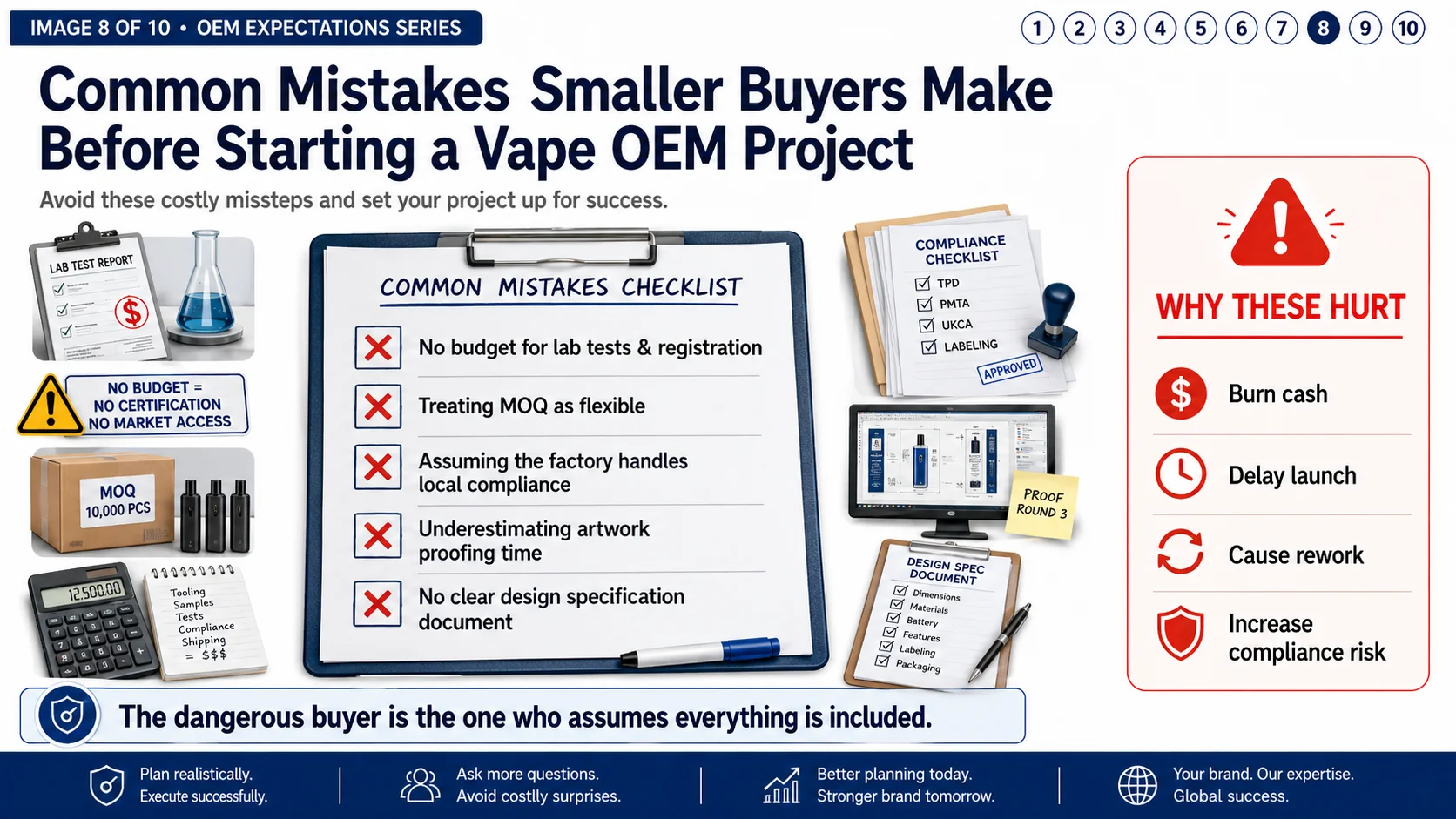
I once dealt with a small chain of vape shops in the UK who wanted 1,000 units of a custom-branded disposable. They provided a rough sketch of the logo placement and asked for a “full OEM package quote.” When I sent them a detailed breakdown that included TPD notification fees, child-resistant packaging testing[^10], and a one-time mold fee, they accused me of hiding costs. They had budgeted only for the unit price and did not understand that they, as the brand owner, were legally responsible for the product’s compliance on the UK market.[^11] I could facilitate the testing, but they had to pay for it and wait for it. They eventually backed out, and I heard later they bought stock devices and slapped their logo on via a local sticker printer. That might work for a month, but the moment a trading standards officer checks, the business is exposed. The mistake here was skipping the education phase. I now make it a point to send every new OEM inquiry a one-page “Project Reality Checklist” before we even discuss pricing. It has saved both sides a lot of grief.
How to Set Clear Requirements Before Talking to a Vape OEM Supplier
The best OEM projects start with a document, not a chat message. A document forces you to think through details you might have ignored. It also allows the supplier to give you an honest quote instead of a guess.
Clear requirements mean specifying the target market (and thus the compliance standard), desired puff count, nicotine strength, flavor profile with reference samples, battery capacity, approximate dimensions, packaging style, and any special features like child-lock or airflow control. Without these, no supplier can give you a reliable timeline or price.
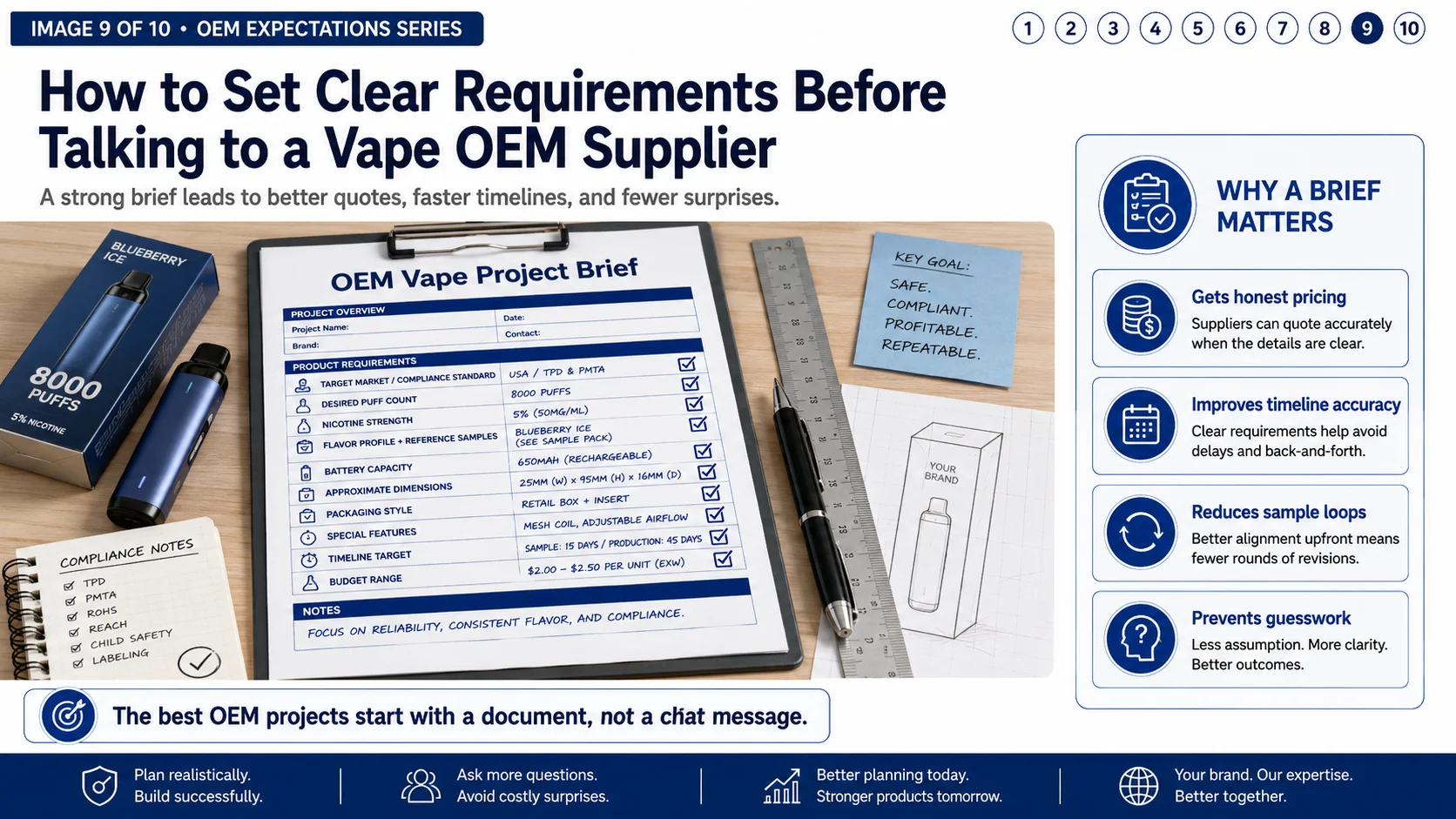
I tell buyers to answer five questions in writing before they contact me: 1) What regulation must the product meet? (TPD, FDA, GB, none). 2) What is the target retail price in your market? (This determines feasible factory cost.) 3) What are the three must-have selling points? (Puff count, flavor, design? Pick three and rank them.) 4) Do you have a reference sample or a competitor product you want to imitate? (Send a photo and ideally a unit). 5) What is your absolute drop-dead date to have the product in your warehouse? (Not a soft target—the real one). With these answers, I can look at my production schedule, our existing mold library, and our compliance partners, and tell you whether your project is a green light or a yellow light. Without them, I am just guessing, and guessing leads to disappointment. I learned this after too many projects started with “I want a good vape” and ended with “this is not what I expected.”
When Should Buyers Choose Branded Stock, Private Label, ODM, OEM, or Agency Instead?
I meet two types of buyers: those who need OEM and do not know it, and those who think they need OEM but only need stock. Picking the wrong path wastes money and time.
Choose branded stock when you need to test a market or want the fastest possible delivery. Choose private label when you want your logo on a proven device with no design changes. Choose ODM when the factory has an existing custom design that needs only minor tweaks. Choose full OEM when you need unique internals or externals. And choose an agency model (like our one-stop supply) when you want to mix brands and categories with low risk.
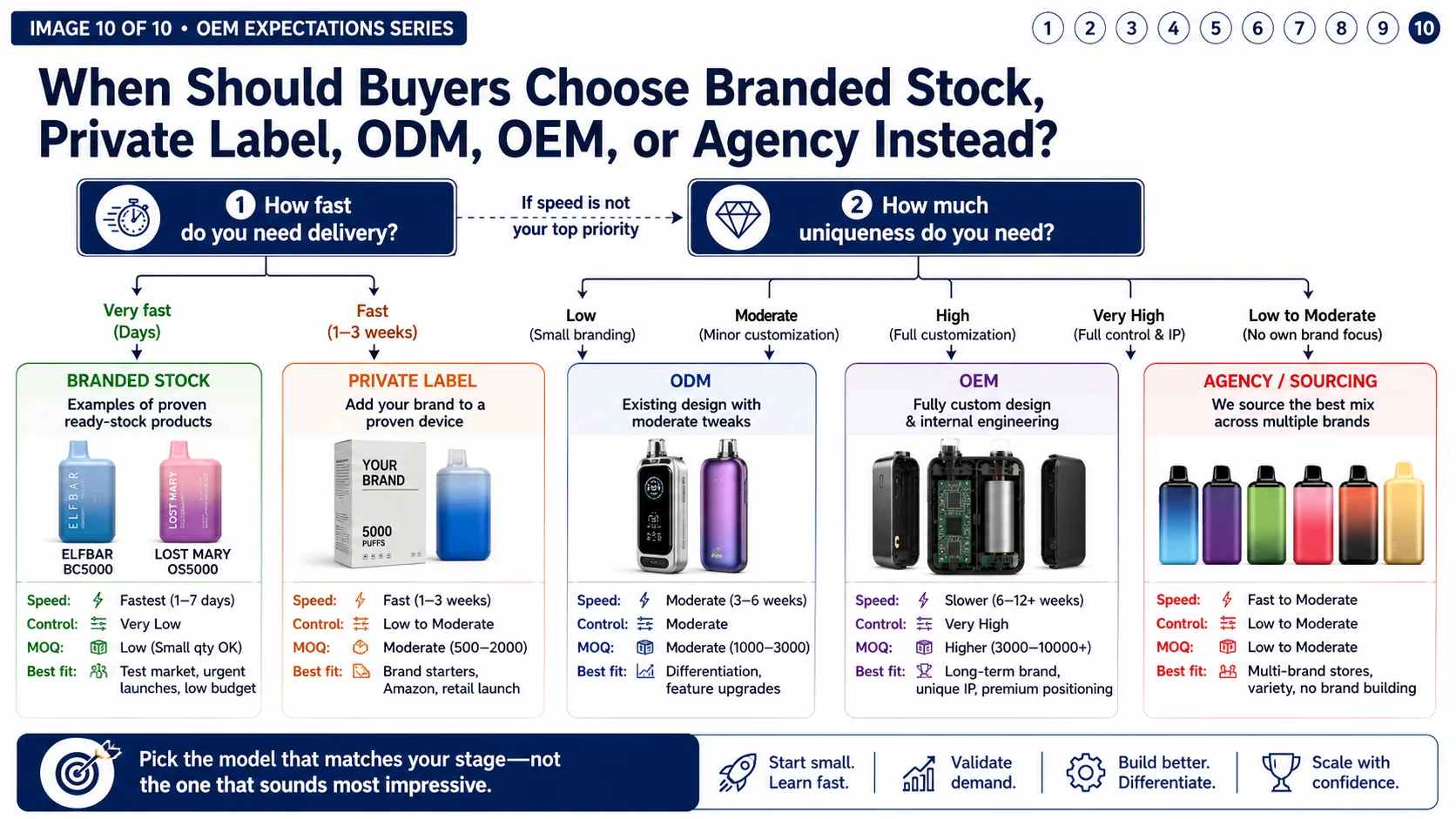
This decision tree became clear to me after working with a client in Poland who was stuck. He wanted to launch his own brand but had only $5,000 to invest. OEM was impossible. I suggested he start with a private-label deal on our best-selling 600-puff disposable. We printed his logo, registered the notification under his name (with our assistance), and shipped 2,000 units from our European warehouse within 10 days. He sold out in two weeks. That gave him the cash and confidence to later fund a proper OEM project with a custom-designed pod system. If he had started with OEM, he would have burned his entire budget on samples and testing and never had a product to sell. For larger importers with stable channels, ODM or OEM makes sense because they can protect their margin with a unique product. For a startup or a shop chain testing a new category, stock or private label is the smarter play. I never push a buyer up the complexity ladder just to make a bigger sale. I push them toward what fits their stage, because my long-term interest is a client who succeeds and comes back for more.
How KingVape Helps Compare OEM and Branded Vape Supply Options for Your Stage
I am not a consultant who charges for a report. I am a factory owner who has spent 14 years watching projects fail and succeed. When you send me a message, my job is not to sell you the most expensive option. My job is to give you the honest map.
At KingVape, I compare your requirements against our factory OEM capability, our private-label catalog, and our European warehouse stock. I then present two or three realistic paths with transparent timing and cost. You choose based on your budget and your risk appetite. There is no pressure, only math and experience.
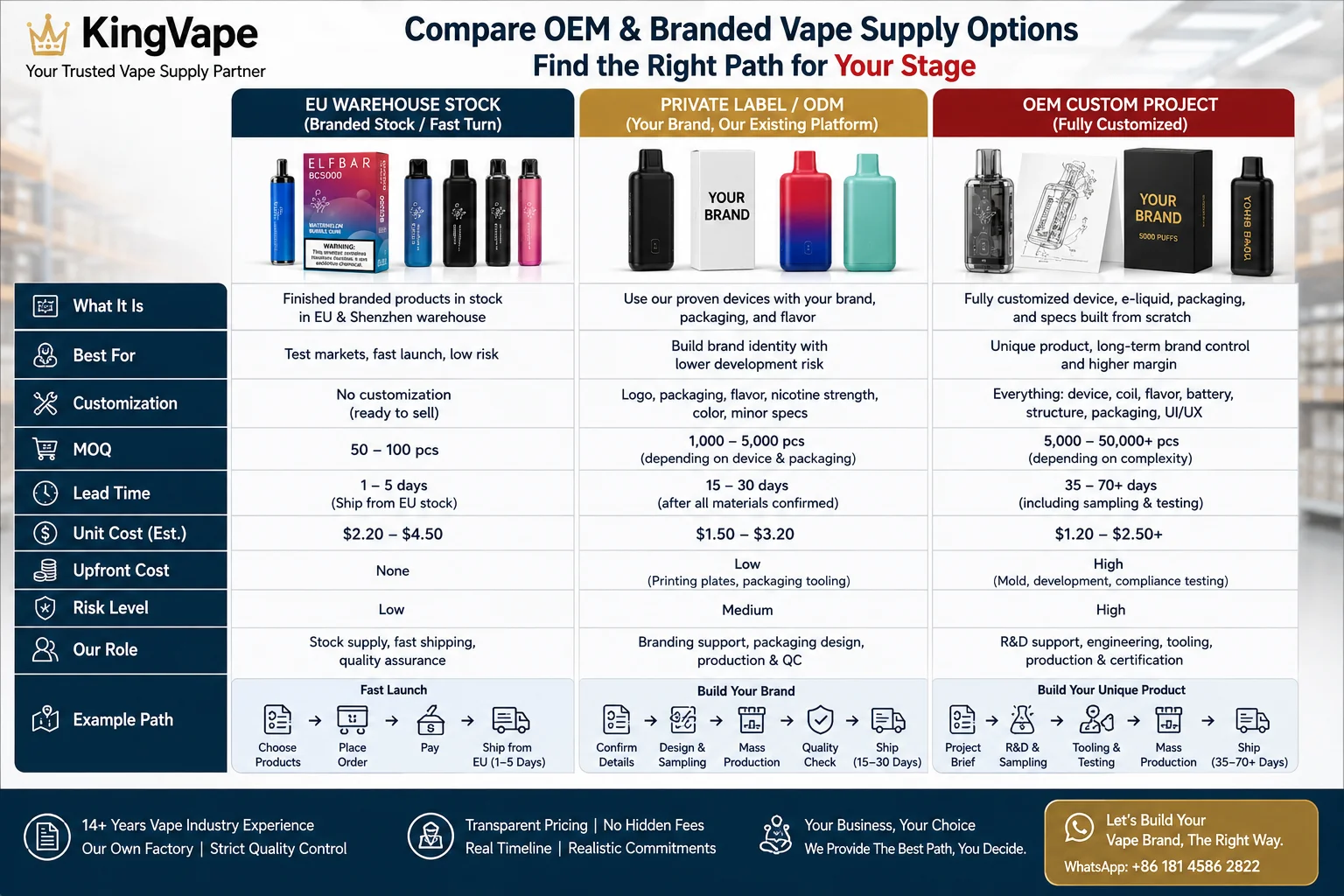
A typical conversation looks like this. A buyer from the US sends an inquiry for “a custom rechargeable disposable for my brand.” I ask the five questions I mentioned earlier. Based on the answers, I might reply: “Option A is full OEM. You get full control but need around $12,000 and 14 weeks. Option B is a private-label version of our existing model X. Your logo, your packaging, no design changes. $6,000, 6 weeks, 2,000 units. Option C is agency supply from our catalog—pick 10 SKUs, mix and match, from our EU or US warehouse (by 2026), fast delivery, low MOQ, no setup. Which one sounds closer to where you are today?” Nine times out of ten, the buyer says they did not realize option B existed, and that is the one they take. That is fine by me. I did not win an OEM order, but I won a relationship built on trust. And when that buyer grows large enough for OEM, they come back to me first. That is the only way I do business.
Conclusion
Avoid unrealistic expectations by asking what the project really costs in money, time, and responsibility—then pick the supply model that fits your stage, not your dreams.
[^1]: "A simple, cost-effective, method for creating electronic cigarette ...", https://pmc.ncbi.nlm.nih.gov/articles/PMC12341675/. Industry analyses of electronic cigarette manufacturing indicate that original equipment manufacturing typically encompasses industrial design modifications, component selection (such as coils and batteries), and regulatory compliance testing as integral phases of product development. Evidence role: general_support; source type: research. Supports: Typical stages in an electronic cigarette OEM project include design, component matching, and compliance testing.. Scope note: The specific scope of OEM projects can vary significantly between manufacturers and is not formally standardized across the industry. [^2]: "[PDF] Premarket Tobacco Product Applications for Electronic Nicotine ...", https://www.fda.gov/media/127853/download. Regulatory frameworks such as the EU Tobacco Products Directive and the US FDA Premarket Tobacco Product Application process require extensive laboratory testing, including toxicological and emissions analyses, with industry reports indicating costs often exceeding several thousand dollars and timelines extending beyond eight weeks. Evidence role: statistic; source type: government. Supports: Regulatory compliance testing for vaping products can cost several thousand dollars and take multiple months.. Scope note: Actual costs and timelines are case-dependent and influenced by the specific regulatory market, product complexity, and chosen laboratory. [^3]: "Fixed vs Variable Costs (with Industry Examples) - Bench Accounting", https://www.bench.co/blog/accounting/fixed-vs-variable-costs. In managerial accounting, setup costs are categorized as batch-level fixed costs; they are incurred once per production run regardless of the batch size, meaning the total setup expenditure remains constant whether producing 500 or 5,000 units. Evidence role: definition; source type: education. Supports: Setup costs in manufacturing are classified as fixed costs that do not vary with the number of units produced in a batch.. Scope note: While setup costs are fixed per batch, some components like printing plates may have volume-based pricing from suppliers, though the internal factory setup time remains constant. [^4]: "Economic order quantity", https://en.wikipedia.org/wiki/Economic_order_quantity. Standard manufacturing cost accounting demonstrates that fixed costs, such as tooling and setup, are invariant with production volume; consequently, the per-unit cost burden decreases as order quantity increases, which economically necessitates higher minimum order quantities for customized products. Evidence role: mechanism; source type: education. Supports: In manufacturing, fixed setup costs are amortized over production volume, making small orders disproportionately expensive per unit.. Scope note: This is a general manufacturing principle; the specific cost structure for vape OEM can vary by factory and project complexity. [^5]: "Cost Comparison and Spending on Tobacco Products - PubMed - NIH", https://pubmed.ncbi.nlm.nih.gov/39450424/. Tear-down analyses and industry cost modeling for basic electronic cigarette devices suggest that the combined bill of materials and direct manufacturing labor can fall within a range of $3 to $7 per unit, depending on component complexity and production location. Evidence role: statistic; source type: research. Supports: The bill of materials and manufacturing cost for basic vaping devices can be in the range of several dollars per unit.. Scope note: This is an illustrative estimate; actual manufacturing costs are proprietary and vary significantly based on device specifications, component sourcing, and production efficiency. [^6]: "Reliability of a common solution-based taste perception test - PMC", https://pmc.ncbi.nlm.nih.gov/articles/PMC3244673/. Sensory science literature indicates that reliable flavor profiling requires controlled, repeated tasting sessions to mitigate panelist fatigue, adaptation, and carry-over effects, making rapid, single-session approvals methodologically unsound for subjective taste attributes. Evidence role: mechanism; source type: paper. Supports: Sensory evaluation for flavor approval requires multiple sessions to account for palate fatigue and ensure reliable subjective assessment.. Scope note: The minimum necessary time for flavor approval can vary based on the complexity of the flavor and the experience of the tasting panel. [^7]: "Chapter 62-297 Stationary Sources—Emissions Monitoring", https://19january2021snapshot.epa.gov/sites/static/files/2017-12/documents/chapter-62-297-2017.pdf. Accredited testing laboratories operate under standardized protocols, such as ISO/IEC 17025, which require defined procedures and quality controls that establish minimum turnaround times; these schedules are generally inelastic due to sample queuing and methodologically required incubation or observation periods. Evidence role: general_support; source type: institution. Supports: Accredited laboratories operate on fixed schedules and standard operating procedures that dictate minimum testing durations.. Scope note: While schedules are typically fixed, expedited services may be available at additional cost from some laboratories, though this does not circumvent all procedural time requirements. [^8]: "Prepress proofing - Wikipedia", https://en.wikipedia.org/wiki/Prepress_proofing. In print production management, the proofing stage is critical; artwork errors that proceed to the full print run typically result in the entire batch being scrapped, as post-print corrections are generally not feasible, leading to substantial material and financial waste. Evidence role: general_support; source type: education. Supports: Errors in packaging artwork that are identified after printing can lead to significant material waste and financial loss.. Scope note: The scale of scrappage depends on the print run size and the nature of the error; some errors may be correctable with over-labeling, though this is not always acceptable for branded packaging. [^9]: "Carbonyls and Carbon Monoxide Emissions from Electronic ...", https://pmc.ncbi.nlm.nih.gov/articles/PMC7215697/. Research on electronic cigarette aerosol dynamics indicates that coil resistance and airflow path geometry are critical determinants of heating temperature, aerosol particle size distribution, and the potential generation of harmful carbonyl compounds, thereby directly influencing both flavor delivery and user safety. Evidence role: mechanism; source type: paper. Supports: Alterations to heating elements and airflow geometry in electronic cigarettes can significantly change aerosol properties and device safety profiles.. Scope note: The specific safety outcomes depend on the magnitude and nature of the design change and the base device characteristics. [^10]: "Child-Resistant Packaging for E-Liquid: A Review of US State ... - PMC", https://pmc.ncbi.nlm.nih.gov/articles/PMC4815607/. Regulations in multiple jurisdictions, including the EU Tobacco Products Directive and the US Poison Prevention Packaging Act, mandate child-resistant packaging for e-liquids and vaping devices, with compliance typically demonstrated through testing standards such as ISO 8317. Evidence role: expert_consensus; source type: government. Supports: Many jurisdictions require child-resistant packaging for vaping products, necessitating specific testing protocols.. Scope note: The specific requirement for child-resistant packaging testing depends on the target market's legislation and the product classification. [^11]: "What is TPD compliance and how can we help? - Xyfil Ltd", https://xyfil.com/what-is-tpd-compliance-and-how-can-we-help/. The UK Tobacco and Related Products Regulations 2016 designate the 'producer' or 'importer' who places a product on the market as the responsible person for ensuring compliance with notification, safety, and quality requirements, a role typically fulfilled by the brand owner rather than the contract manufacturer. Evidence role: definition; source type: government. Supports: Under UK regulations, the brand owner or importer placing a vaping product on the market bears legal responsibility for its compliance.. Scope note: Legal responsibility can be contractually allocated between parties, but ultimate liability to regulators generally rests with the entity placing the product on the market.