
A wrong vape supplier can take your deposit, delay your order, or ship goods that cannot pass customs[^1]. That risk feels small until money leaves.
Before you pay a vape supplier, ask for business documents, real stock proof, actual batch photos, market certifications, battery and component test reports, clear pricing, packaging confirmation, and a written shipping and after-sales plan. These proofs reduce fraud, compliance risk, and quality surprises.
I have worked with international buyers for many years from Shenzhen. I have seen careful buyers avoid bad orders with one simple habit. They ask for proof before payment. They do not only ask for a low price. They ask, “Can this supplier really ship what I need, to my market, under my rules?”
A common question I get from first-time importers is simple. “Can I trust this supplier?” My answer is also simple. Trust is not a feeling. Trust is a file, a video, a test report, a clear quotation, and a written plan. If a supplier gets angry when you ask for basic proof, that is already useful information.
1. Business License and Export Qualification?
A fake seller can use a real product photo and a nice WhatsApp profile.[^2] You may feel safe, but the company may not exist.
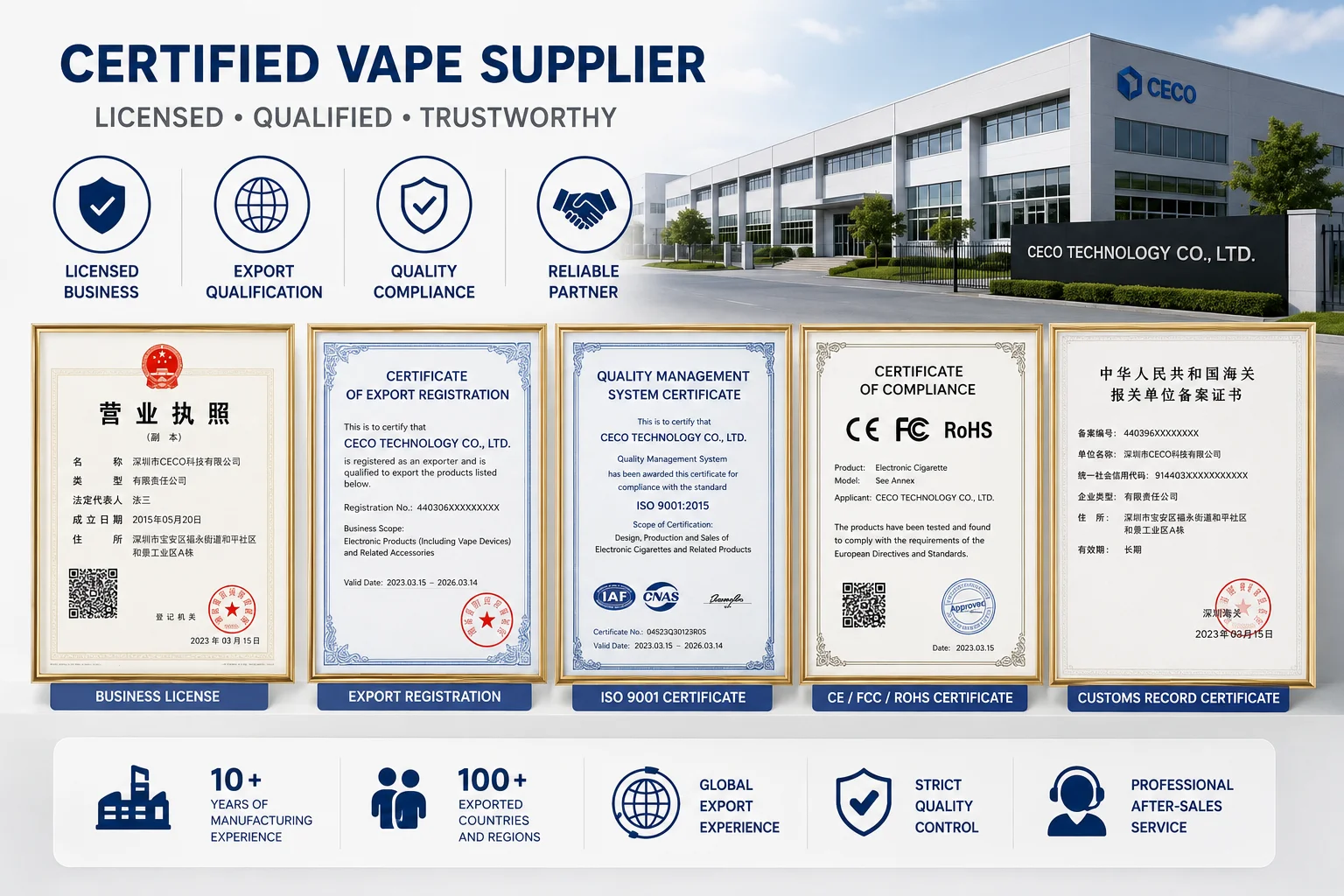
A vape supplier should show a valid business license, company name, registered address, export ability, and matching bank account details before you send payment. The company information should be consistent across documents, invoices, emails, and payment instructions.
What I check first
I always start with the company identity. I do this before I talk about price, colors, flavors, or shipping. A real company should not be afraid to show basic registration documents. The business license should show the legal company name, registration number, address, and business scope. The export qualification can be shown through export records, customs registration, or a trading company structure that has clear export ability.
I also compare the company name on the license with the name on the proforma invoice. I compare it with the bank account name. If the seller asks me to pay a personal account, I slow down. Sometimes small suppliers use third-party payment channels, but they must explain it clearly. I do not treat silence as normal.
| Proof to ask for | What I look for | Red flag |
|---|---|---|
| Business license | Same company name and address | Blurry image or cropped file |
| Export qualification | Ability to export under company name | Seller says it is “not needed” |
| Bank details | Account name matches supplier | Personal account with no reason |
| Invoice | Same name as contract | Different company names |
I also ask for a company email, not only a free email or chat app. A chat app is useful, but it is not enough for a paid order.
2. Real Factory or Warehouse Videos?
A supplier may show a perfect catalog, but the catalog may belong to someone else. You need to know where your goods come from.
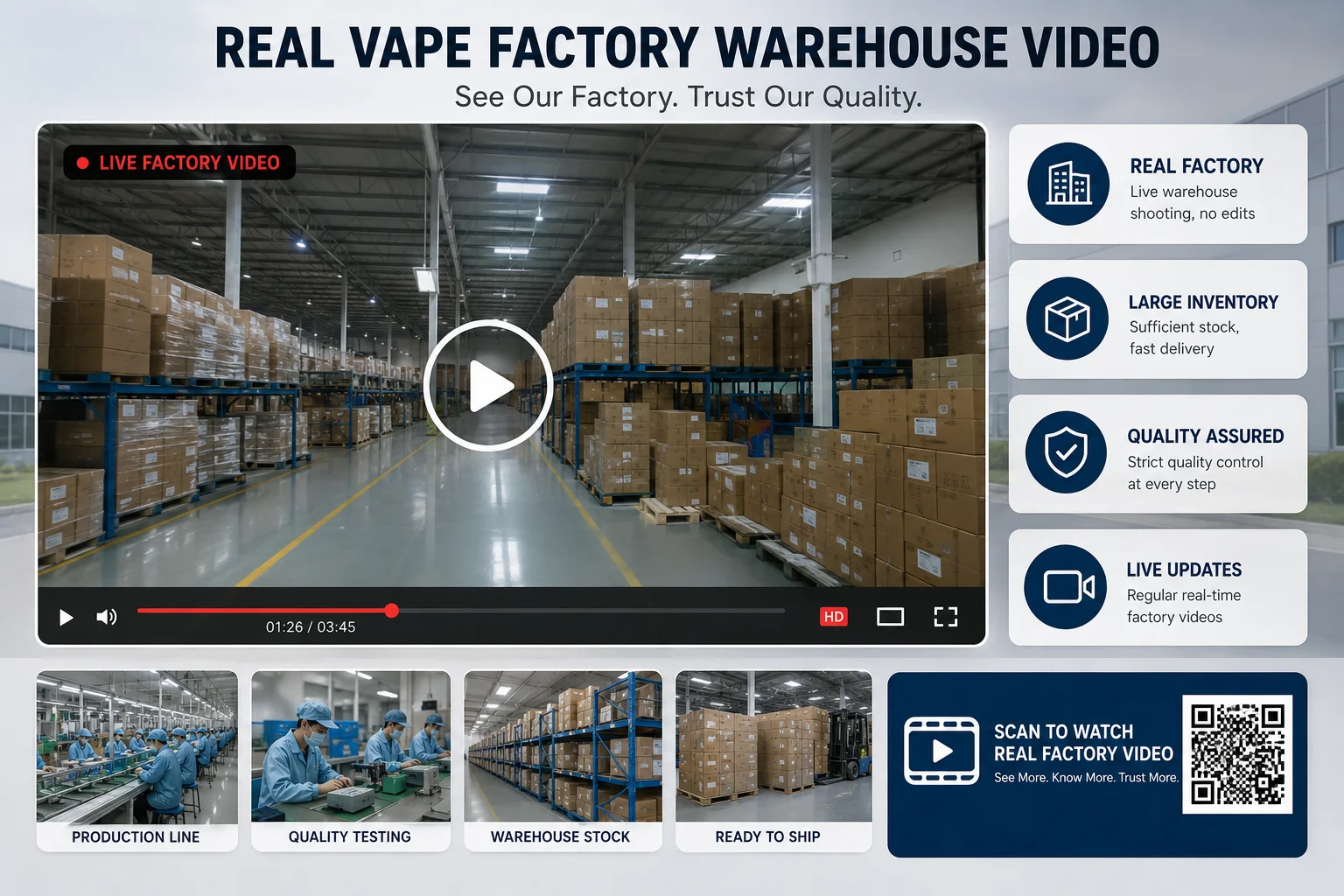
A vape supplier should provide recent factory or warehouse videos with your company name, date, product model, cartons, and packing area shown in one continuous video. This helps prove that the supplier has real stock or real production access.
How I ask for video proof
I usually ask for a short video before I approve a deposit. The video does not need to look professional. In fact, a simple phone video is often better. I ask the supplier to write my company name, the date, and the model name on a piece of paper. Then I ask them to show the entrance, warehouse shelf, product cartons, and packing area in one continuous shot.
This request is not rude. It is normal B2B risk control. Good suppliers understand this. A trader may not own the factory, and that is not always a problem. Many strong export companies work with partner factories. The key is that they must be honest about their role. If they say they are a factory, but they cannot show any production or warehouse proof, I ask more questions.
| Video detail | Why it matters |
|---|---|
| Date and buyer name | It proves the video is not old stock footage |
| Model name | It connects the video to your order |
| Carton labels | It helps check quantity and batch |
| Packing area | It shows real handling ability |
| Continuous shot | It reduces edited proof risk |
I also check the background. I look for workers, storage condition, cartons, labels, and safety handling. Vape products involve batteries and e-liquid, so poor storage is a real concern.[^3]
3. Product Photos From the Actual Batch?
A nice sample photo can hide a bad bulk order. The first batch may look good, but your paid batch may look different.
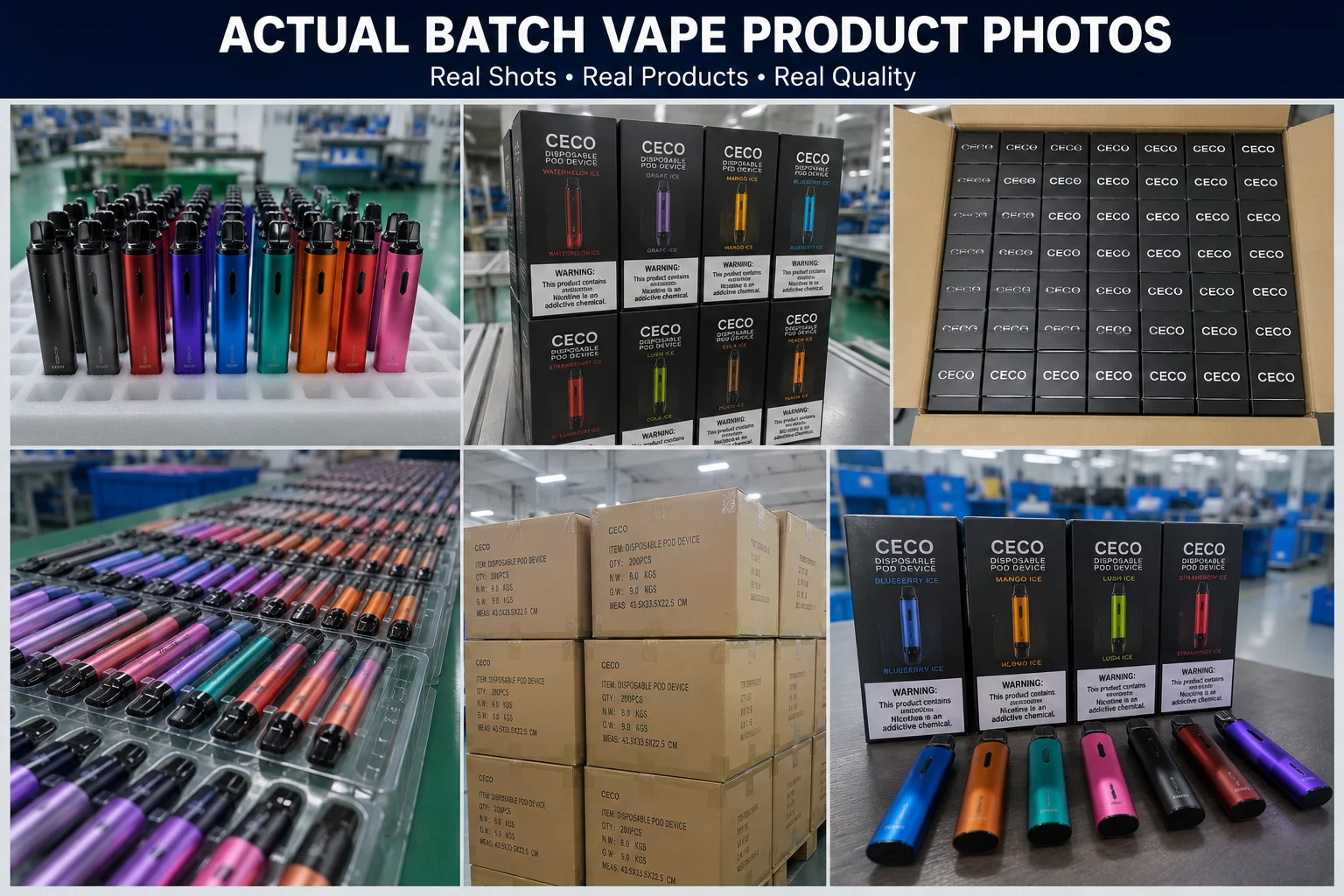
A vape supplier should send clear photos and videos from the actual batch before shipment. The proof should show device appearance, logo, flavor marking, warning label, carton label, quantity, and random unit checks from production or stock.
Why actual batch proof matters
I never rely only on catalog photos. Catalog photos are marketing materials. They show the best angle. They may show a different batch, a different shell finish, or a different market version. Before payment balance, I ask for actual batch photos. I want to see the real color, real printing, real packaging, and real carton.
For vape products, small details matter. The flavor name must be correct. The nicotine strength must match the market rule and the order sheet. The warning label must not be missing. The barcode must scan if the buyer needs retail sale. The plug, charging port, and device shell must match the agreed model. A tiny mismatch can become a customs issue[^4] or a customer complaint.
| Actual batch item | What I check |
|---|---|
| Device photo | Color, logo, port, shape, finish |
| Single box photo | Flavor, warning, barcode, language |
| Inner box photo | Count per box and packing method |
| Master carton photo | Carton mark and quantity |
| Random sample video | Basic function and appearance |
I also ask the supplier to open random cartons, not only the top carton. This request is simple. It shows whether the supplier is confident about the whole batch.
4. Certification Documents for Your Market?
A vape product can look ready, but it may not be legal in your country. The wrong certificate can block the full shipment.
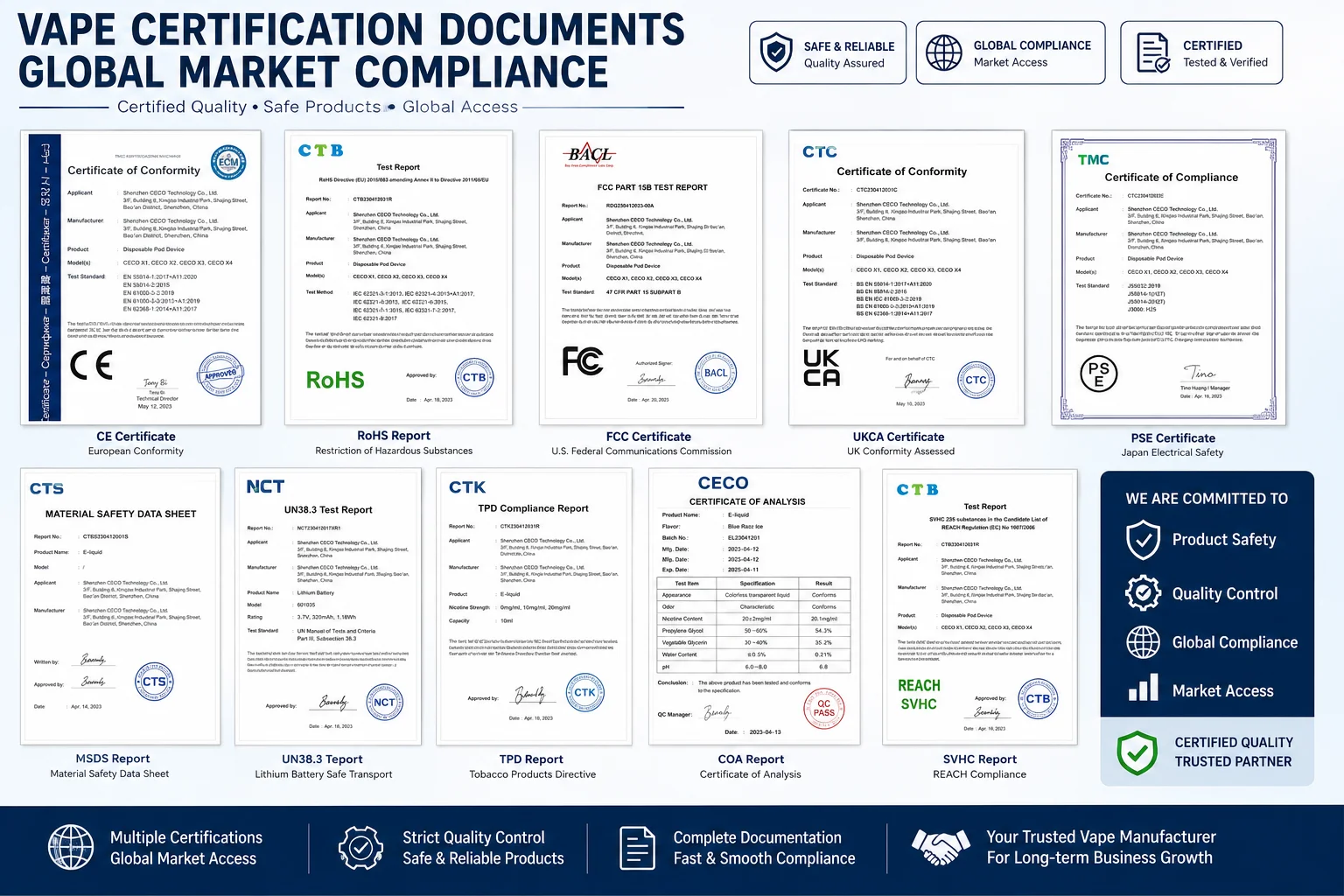
A vape supplier should provide certification documents that match your target market, product model, and current rules. For Europe and the United States, buyers should check compliance needs for batteries, electronics, packaging, labeling, nicotine rules, and local vape regulations.
How I read certificates
I do not treat certificates as decoration. I read the model number, applicant name, test standard, issue date, and lab name. I also check whether the certificate belongs to the exact product. Some suppliers send a certificate for a similar model. That may not help you when customs asks questions.
Vape rules are not the same in every market. Europe may need CE, RoHS, EMC, battery transport documents, and local rules for nicotine products.[^5] Some markets may require TPD-related registration or local notification.[^6] The United States has strict rules for vape products, and buyers should check FDA-related duties with local experts.[^7] A supplier can support documents, but the importer still carries serious responsibility.
| Document type | Main use | What can go wrong |
|---|---|---|
| CE or EMC report | Electronic safety and interference | Model number does not match |
| RoHS report | Restricted substances | Old report or wrong product |
| Battery transport documents | Air or sea shipping support | Missing cell model |
| Local vape compliance file | Market entry support | Not valid for your country |
| Label review | Retail sale support | Wrong language or warning |
I always tell buyers not to ask, “Do you have certificates?” I ask them to say, “Please send the certificates for this exact model for my country.” That wording saves time.
5. Battery, E-liquid, and Component Test Reports?
A cheap vape may fail because of one hidden part. The battery, liquid, coil, or shell can become the real problem.
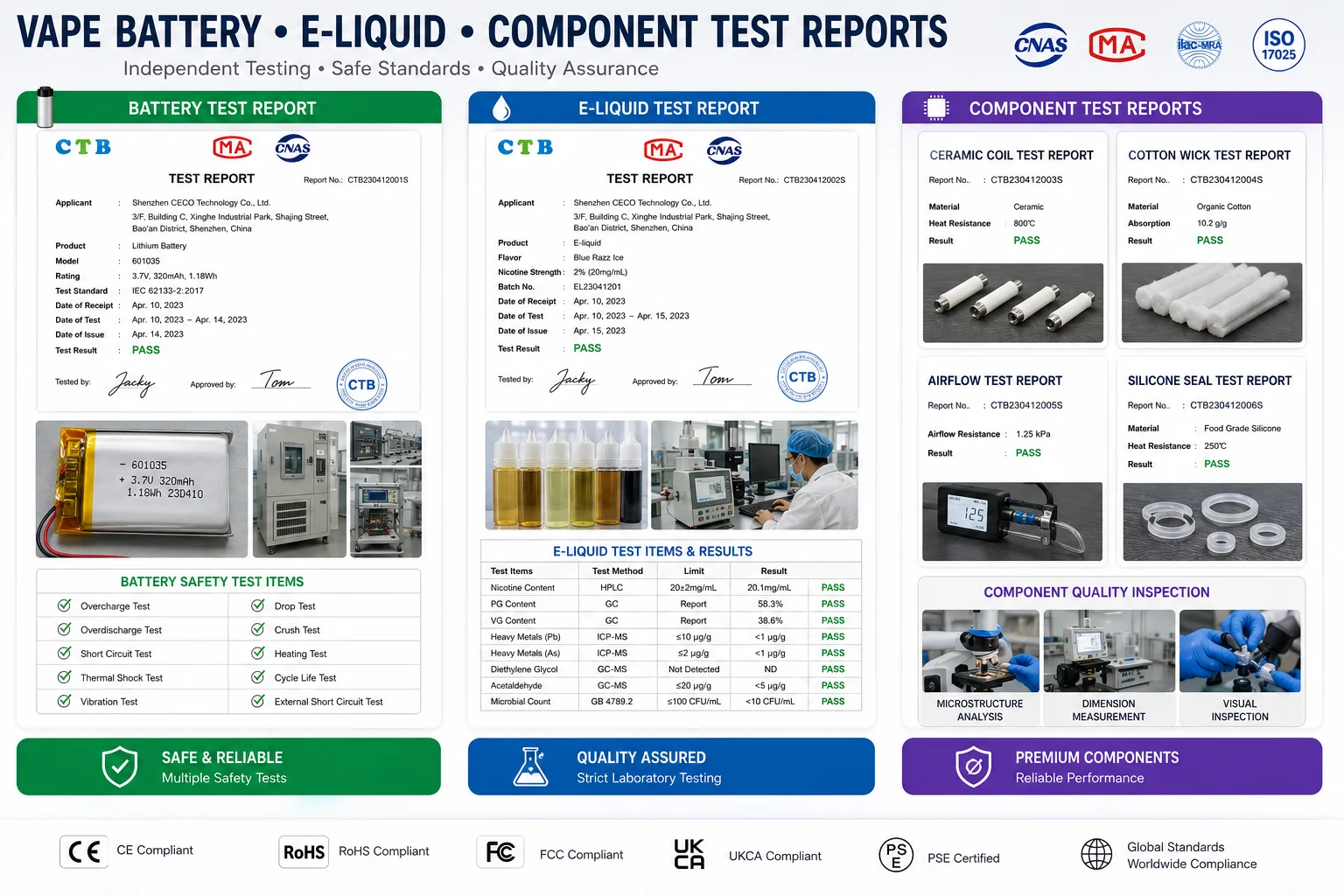
A vape supplier should provide test reports for key parts such as battery cells, e-liquid, coil, heating component, mouthpiece material, and finished product safety. These reports help buyers check safety, shipping acceptance, and product quality before payment.
What reports I ask for
Vape products are not only plastic shells. They combine electronics, battery power, heating parts, and e-liquid. That mix creates more risk than a normal phone cable or simple charger.[^8] From my 3C export experience, I already know batteries need careful handling. With vape products, I pay even more attention because the product is close to the user’s mouth and body.
I ask for battery cell information first. The supplier should show the battery model, capacity, supplier name, and transport documents. I ask for e-liquid test reports if the product contains liquid. I check nicotine strength, ingredient list, and harmful substance testing based on market needs. I also ask about coil resistance, leak testing, charging test, and aging test.
| Part | Proof to request | Reason |
|---|---|---|
| Battery cell | MSDS, UN38.3[^9], cell spec | Shipping and safety |
| E-liquid | Ingredient and lab test report | Market and health concerns |
| Coil | Resistance and material info | Stable performance |
| Shell and mouthpiece | Material safety report | User contact safety |
| Finished product | QC and function test record | Bulk quality control |
I also ask how many units were tested. A report with no batch link is weak. A supplier should connect reports to the product model and order batch when possible.
6. Clear Price Breakdown and Payment Terms?
A low unit price can hide extra fees. You may pay later through shipping cost, packaging cost, or rejected goods.
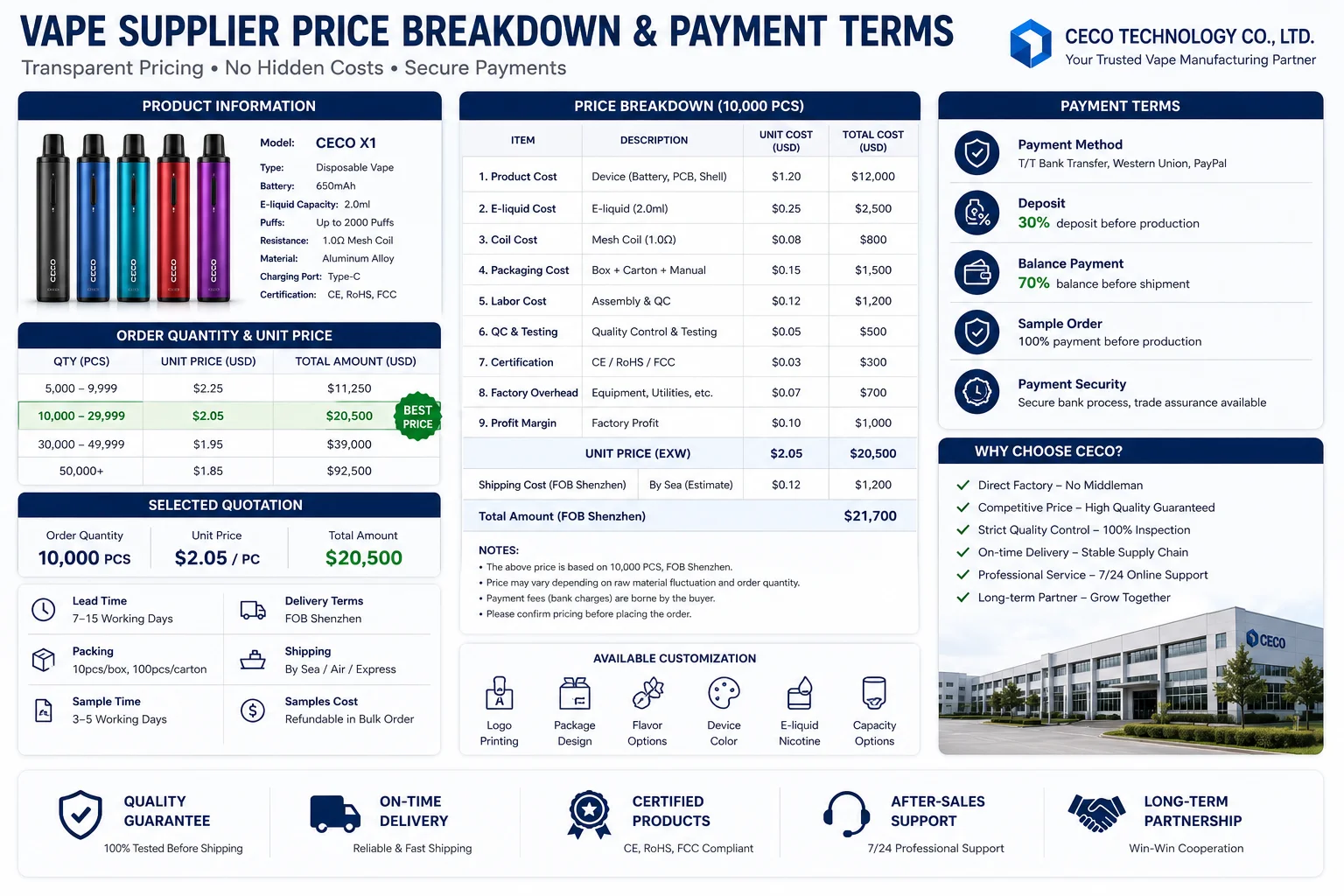
A vape supplier should give a clear price breakdown that includes unit price, MOQ, packaging, logo cost, certification support, shipping terms, payment schedule, lead time, and refund or replacement conditions before payment.
Why I do not chase only the lowest price
When a client asks me for the “best price,” I always ask about their sales channel first. A chain store, an online seller, and a wholesale importer do not carry the same risk. A very low price may work for market testing, but it may not work for a brand that needs stable reviews and repeat orders.
The quotation should show what is included. Does the price include plain packaging or custom packaging? Does it include flavor stickers? Does it include barcode printing? Does it include carton marks? Does it include inspection support? Does it include documents for shipping? If the answer is not written, I do not assume it is free.
| Price item | Question to ask |
|---|---|
| Unit price | What MOQ is this price based on? |
| Packaging | Is custom box included or extra? |
| Logo | Is printing fee included? |
| Documents | Are test reports included? |
| Shipping | Is the price EXW, FOB, CIF, DDP, or door to door? |
| Payment | What deposit and balance terms apply? |
I prefer simple payment terms with clear milestones. For example, deposit after document check, balance after batch proof, and shipment after final approval. This structure protects both sides.
7. Packaging, Labeling, and Flavor List Confirmation?
The product may be correct, but the box may be wrong. A wrong label can stop retail sales or create customer complaints.
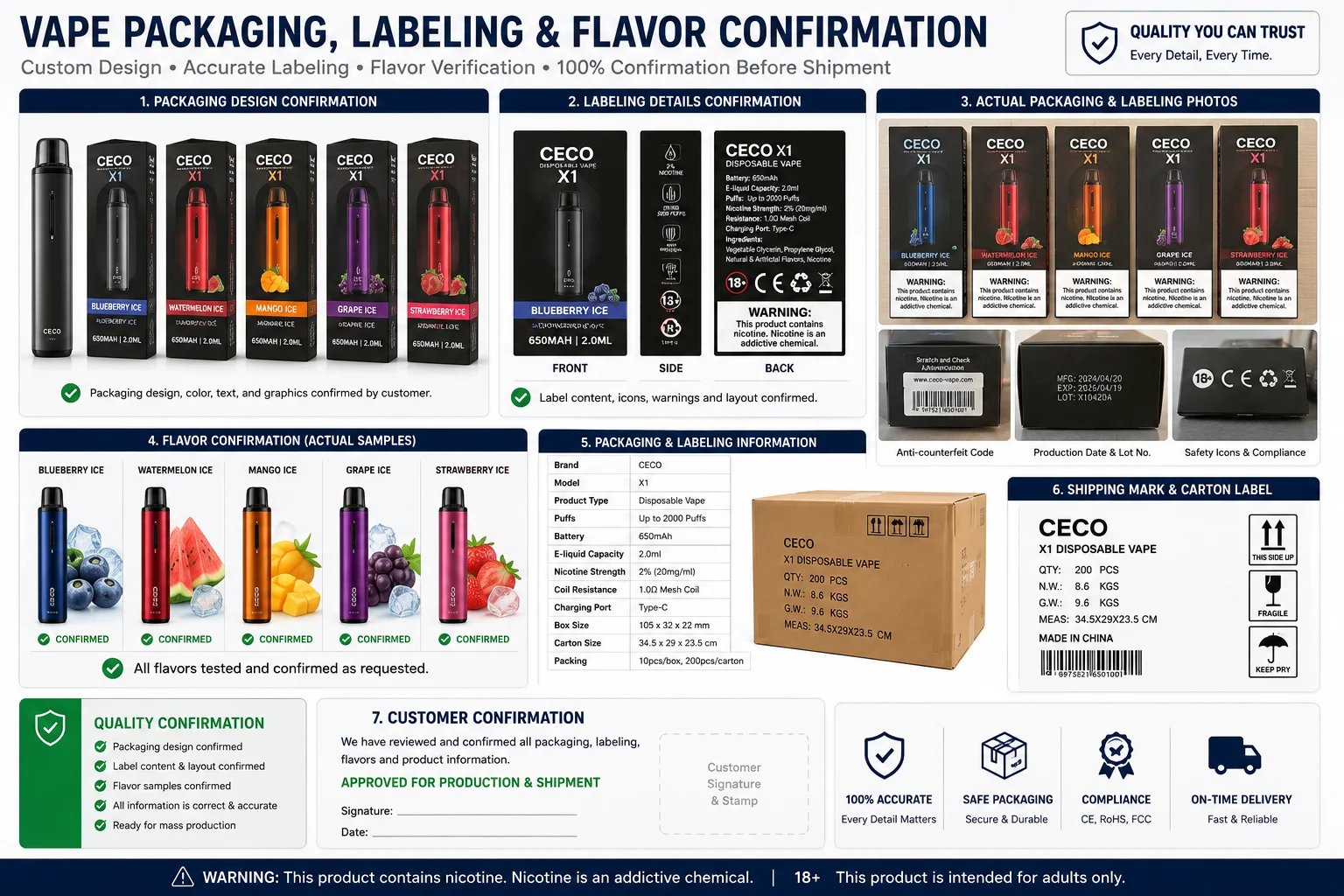
A vape supplier should confirm packaging artwork, warning labels, language, barcode, flavor list, nicotine strength, carton marks, and quantity per carton before production or shipment. Written confirmation helps avoid expensive mistakes.
Why I confirm small details in writing
Packaging is not a small issue in vape business. It carries legal information, brand image, and customer trust. I have seen buyers focus on device price and forget box details. Then the goods arrive with a wrong flavor name, missing warning, or wrong language. That mistake is painful because the product may work, but the retailer cannot sell it[^10].
I ask the supplier to send a final packaging file and a physical packaging photo before mass packing. I also ask for a flavor list in table form. The list should show flavor name, quantity, nicotine strength, device model, color if needed, and carton number if the supplier can provide it. This makes counting easier when goods arrive.
| Item to confirm | Example check |
|---|---|
| Flavor list | Mango 5%, Mint 5%, Blueberry 5% |
| Language | English, German, French, or local language |
| Warning label | Correct position and size |
| Barcode | Scans correctly and matches SKU |
| Carton mark | Buyer name, SKU, quantity, gross weight |
| Retail box | Artwork version is final |
I also ask who owns the artwork risk. If the buyer provides files, the buyer should check local rules. If the supplier provides files, the supplier should state what standard they followed. This reduces blame later.
8. Shipping Plan, Tracking Method, and After-Sales Policy?
A paid order is not finished when it leaves the warehouse. Shipping, customs, and after-sales can decide your real profit.
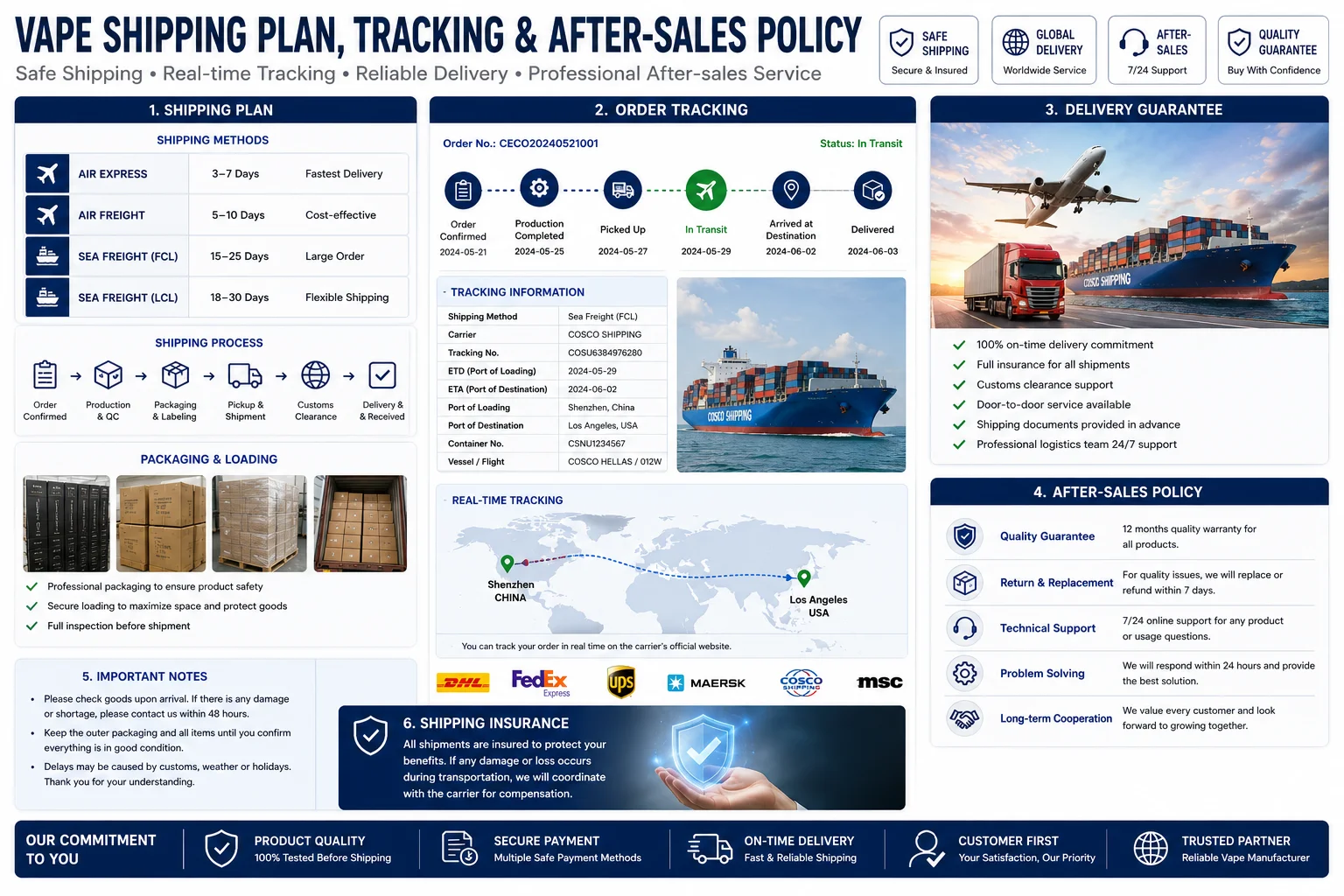
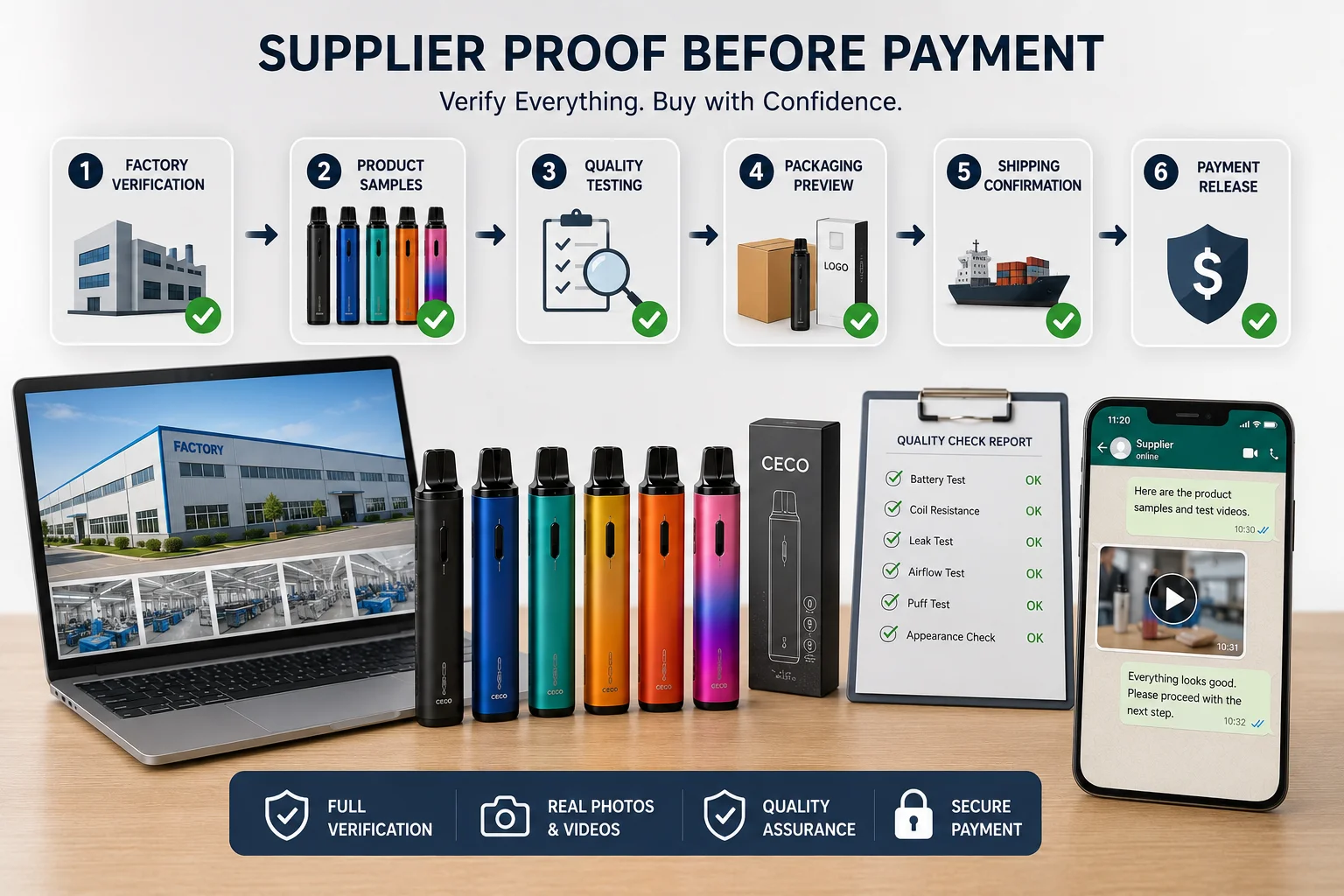
A vape supplier should provide a shipping plan with method, route, documents, tracking method, estimated delivery time, customs responsibility, insurance option, and written after-sales policy. This should be agreed before final payment.
What I want before shipment
Shipping vape products is more sensitive than shipping many normal 3C items.[^11] Batteries, e-liquid, and local vape rules affect the route. Some express channels do not accept certain products. Some air routes need special documents. Some buyers ask for DDP service, but they do not understand who handles customs risk. I always ask the supplier to write the shipping plan clearly.
The plan should show the shipping method, carrier, estimated time, export documents, tracking method, and what happens if customs asks for extra papers. If the supplier offers door-to-door shipping, I ask what country, what route, and what kind of import support they use. I do not accept only “no problem” as an answer.
| Shipping point | What to confirm |
|---|---|
| Shipping method | Air, sea, truck, express, or special line |
| Trade term | EXW, FOB, CIF, DAP, DDP |
| Tracking | Tracking number and update frequency |
| Documents | Invoice, packing list, reports, labels |
| Customs role | Who handles export and import issues |
| Insurance | Whether loss or damage is covered |
After-sales policy also matters. I ask the supplier how they handle defective units, leakage, battery issues, wrong flavor, and short quantity. The policy should say whether they offer replacement, credit, or refund in the next order. It should also say what proof the buyer must provide, such as photos, videos, and defect count.
Conclusion
I do not pay a vape supplier based on words. I pay after documents, batch proof, compliance checks, clear terms, and a written shipping plan.
[^1]: "Operation Red Mist: CBP, federal partners seize millions of illegal e ...", https://www.cbp.gov/newsroom/national-media-release/operation-red-mist-cbp-federal-partners-seize-millions-illegal-e. A source from a national customs agency or trade commission can provide examples of common compliance failures for imported vaping products, such as incorrect labeling, unauthorized ingredients, or failure to meet electronic safety standards, which can lead to shipment seizure. Evidence role: general_support; source type: government. Supports: The source should detail the reasons why customs authorities may detain, reject, or seize shipments of vaping products, including issues with labeling, undeclared nicotine, missing certifications, or improper tax payment.. [^2]: "Report International Scams at econsumer.gov", https://www.ftc.gov/media/70962. Reports on international trade fraud often highlight schemes where perpetrators use high-quality product images and accessible communication apps to build a facade of legitimacy before disappearing after receiving a deposit. Evidence role: general_support; source type: institution. Supports: The source should describe common tactics used in online B2B trade fraud, where scammers create convincing but fake company profiles using stolen images and communicate through informal channels to solicit advance payments.. [^3]: "[PDF] Lithium-ion Battery Safety - OSHA", https://www.osha.gov/sites/default/files/publications/OSHA4480.pdf. Research and safety guidelines for lithium-ion batteries detail risks of thermal runaway and capacity loss when stored improperly. Similarly, studies on e-liquids show that exposure to heat and light can alter their chemical composition, affecting both safety and quality. Evidence role: mechanism; source type: research. Supports: The source should explain the safety risks associated with storing lithium-ion batteries and e-liquids, including the potential for thermal runaway in batteries and the degradation of nicotine and flavor compounds in liquids under improper temperature or light conditions.. [^4]: "Examples of Unacceptable vs Acceptable Cargo Descriptions", https://www.cbp.gov/trade/basic-import-export/e-commerce/examples-unacceptable-vs-acceptable-cargo-descriptions. Official customs guidelines state that import declarations, commercial invoices, and packing lists must accurately reflect the contents of a shipment. Discrepancies, even if minor, can lead to delays, fines, or seizure of goods as they may indicate misdeclaration or duty evasion. Evidence role: general_support; source type: government. Supports: The source should explain the customs verification process, where officials compare the physical goods in a shipment to the details provided in the commercial invoice, packing list, and import declaration, and outline the potential consequences of discrepancies.. [^5]: "[PDF] Regulation of e-cigarettes - World Health Organization (WHO)", https://www.who.int/docs/librariesprovider2/default-document-library/10-regulation-of-e-cigarettes-tobacco-factsheet-2024.pdf. The European Union regulates electronic cigarettes under several directives. These include the Radio Equipment Directive (for CE marking), the Restriction of Hazardous Substances (RoHS) Directive, the Electromagnetic Compatibility (EMC) Directive, and the Tobacco Products Directive (TPD) for nicotine-containing products. Evidence role: definition; source type: government. Supports: The source should be an official EU publication or summary that explains the requirements for electronic cigarettes, covering the CE mark (safety), RoHS (hazardous substances), EMC (electromagnetic compatibility), and TPD (nicotine product rules).. [^6]: "The revision of the 2014 European tobacco products directive - PMC", https://pmc.ncbi.nlm.nih.gov/articles/PMC4669229/. Article 20 of the European Union's Tobacco Products Directive (2014/40/EU) requires manufacturers and importers to notify competent national authorities of new electronic cigarette products six months before they intend to place them on the market, providing detailed information on ingredients, emissions, and design. Evidence role: definition; source type: government. Supports: The source should be an official government or EU page explaining Article 20 of the Tobacco Products Directive, which mandates that manufacturers and importers submit a notification for electronic cigarettes and refill containers to the competent authorities of Member States before placing them on the market.. [^7]: "E-Cigarettes, Vapes, and other Electronic Nicotine Delivery Systems ...", https://www.fda.gov/tobacco-products/products-ingredients-components/e-cigarettes-vapes-and-other-electronic-nicotine-delivery-systems-ends. The U.S. Food and Drug Administration (FDA) regulates electronic cigarettes as tobacco products, requiring them to undergo a premarket review process, such as a Premarket Tobacco Product Application (PMTA), to receive marketing authorization. Products marketed without this authorization are considered illegal. Evidence role: general_support; source type: government. Supports: The source should be an official FDA page explaining its authority to regulate electronic nicotine delivery systems (ENDS) and the requirement for manufacturers to receive marketing authorization, typically through a Premarket Tobacco Product Application (PMTA), to legally market their products.. [^8]: "Analysis of common methodological flaws in the highest cited e ...", https://pmc.ncbi.nlm.nih.gov/articles/PMC9018638/. Safety analyses and standards like UL 8139 highlight the unique combination of risks in vape products, which integrate a power source (lithium-ion battery), a heating element, and a chemical mixture (e-liquid) in a device used close to the body, creating hazards not found in simple chargers or cables. Evidence role: mechanism; source type: research. Supports: The source should identify the specific hazards associated with electronic cigarettes, such as battery thermal runaway, e-liquid leakage and ingestion, and potential emissions from the heating process, which are not present in simpler electronics like chargers.. [^9]: "Lithium Battery Test Summaries (TS) - PHMSA", https://www.phmsa.dot.gov/training/hazmat/new-un-requirement-test-summaries. International air transport regulations, such as those from IATA, mandate that lithium batteries must pass UN38.3 testing to ensure they can withstand transport conditions. A Material Safety Data Sheet (MSDS) or Safety Data Sheet (SDS) must also accompany shipments to inform handlers of potential hazards and safety procedures. Evidence role: definition; source type: institution. Supports: The source should define UN38.3 as the international standard for testing lithium batteries for transport and MSDS (or SDS) as the document providing safety information, and state that these are required by transport regulators like IATA.. [^10]: "CPSC Labeling Requirements Overview", https://www.cpsc.gov/Business--Manufacturing/Business-Education/Business-Guidance/CPSC-Labeling-Requirements-Overview. Consumer protection and tobacco control laws in many jurisdictions, such as the EU's TPD and the FDA's regulations in the US, mandate specific information on vape packaging, including health warnings, nicotine concentration, and ingredient lists. Products that fail to meet these labeling requirements cannot be legally sold to consumers. Evidence role: general_support; source type: government. Supports: The source should outline the legal requirements for the labeling of vape products in a major market, such as mandatory health warnings, nicotine content disclosure, and ingredient lists.. [^11]: "PackSafe - Electronic Cigarettes, Vaping Devices | Federal Aviation ...", https://www.faa.gov/hazmat/packsafe/e-cigarettes-vaping. The International Air Transport Association (IATA) classifies portable electronic devices containing lithium-ion batteries, including vape devices, as items that are subject to specific shipping regulations. These rules restrict how they can be packed and whether they can be carried in passenger baggage or cargo, making their shipment more complex than that of many other electronics. Evidence role: general_support; source type: institution. Supports: The source should explain how transport regulations classify electronic cigarettes, particularly those containing lithium batteries, as items requiring special handling, documentation, and packaging..