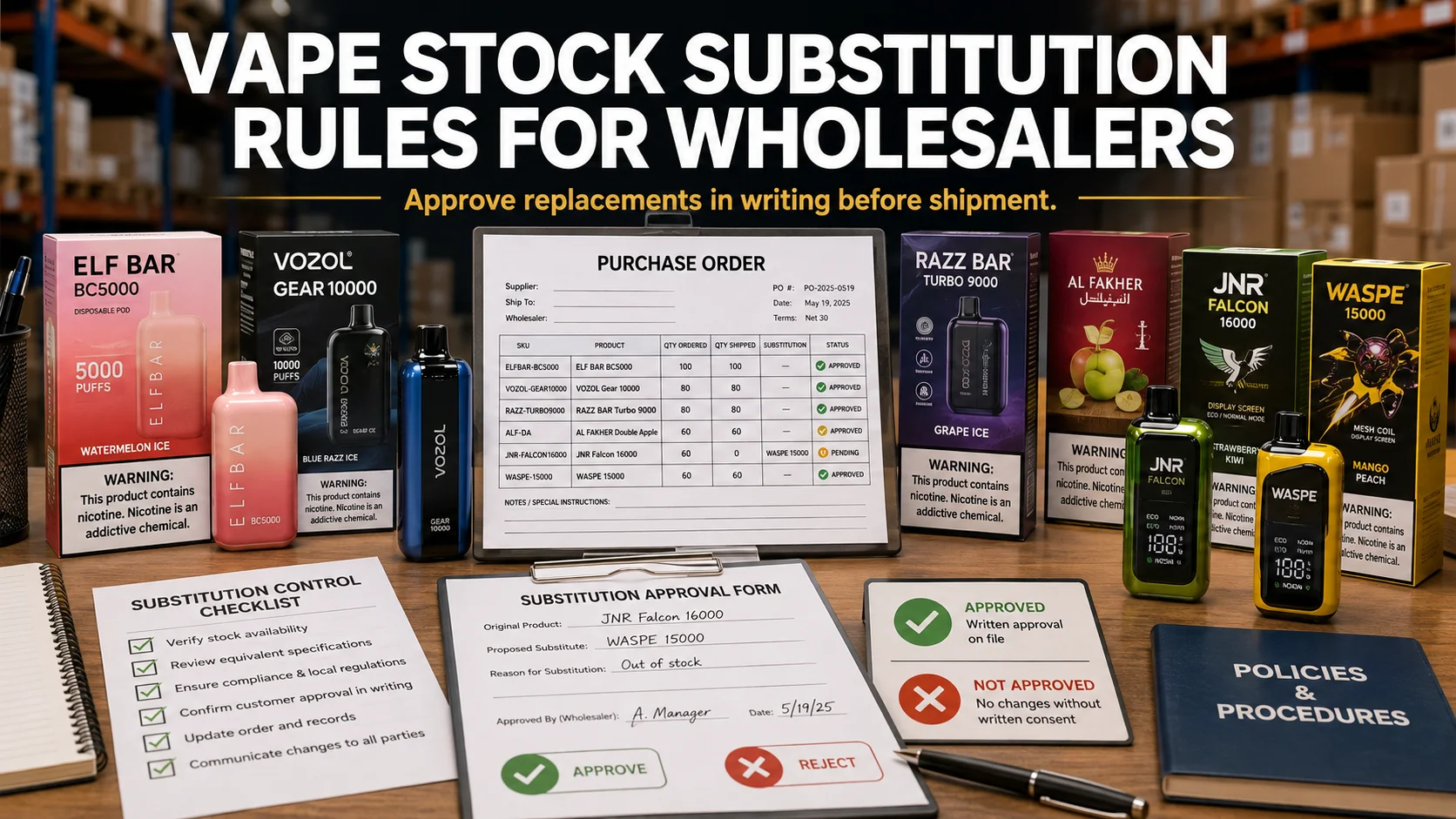
Vape stock substitution rules for wholesalers matter because a mixed-brand order can quickly become difficult when one requested SKU is unavailable. A supplier may suggest a “similar” product, but an unapproved replacement can create slow-moving stock, pricing pressure, packaging issues, or customer complaints[^1]. I recommend agreeing on clear substitution boundaries before payment.
Before paying for a multi-brand vape order, wholesalers should define exactly which SKUs may be substituted, which changes require written buyer approval, and how price, quantity, packaging, and delivery changes will be handled. Brand, model, flavour, nicotine strength, market version, packaging, and quantity should never be changed automatically.[^2] Clear vape stock substitution rules for wholesalers help buyers protect inventory quality, resale plans, cash flow, and downstream customer trust.
A multi-brand order is not simply a list of products. It is a commercial plan built around specific customer demand, margins, shelf space, local compliance, and delivery timing. In my daily work with importers and wholesalers, I often see that a product may look similar on paper but still be unsuitable for the buyer’s market.
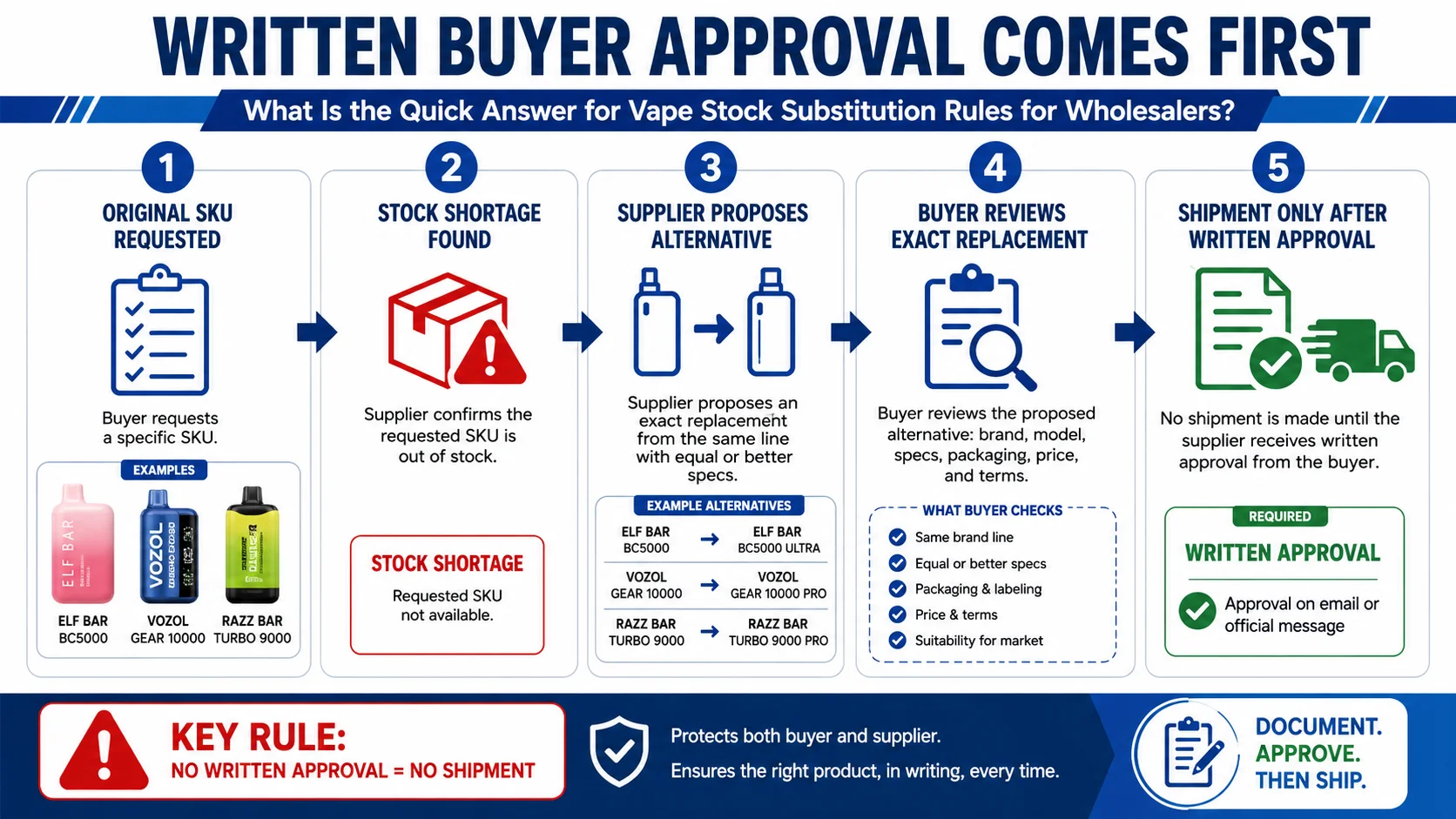
What Is the Quick Answer for Vape Stock Substitution Rules for Wholesalers?
A stock shortage can create pressure. The buyer wants the order shipped quickly, while the supplier wants to avoid delays. However, fast decisions without a process can move the commercial risk from the supplier to the buyer.
The practical rule is simple: a supplier can propose alternatives, but the buyer must approve the exact replacement SKU in writing before it is added to the order or shipped. The order confirmation should state what “out of stock” means, which substitutions are permitted, the approval deadline, the price adjustment method, and whether the buyer may choose a refund or wait for replenishment.
I treat substitution as an order-control issue, not only an inventory issue. A supplier may have another device with the same puff count, a similar retail price, or the same brand name. Still, that does not mean the replacement fits your purchasing plan.
For example, a buyer may order one flavour because local stores have already requested it. Another flavour with the same specification may be technically close, but it may not match local demand. The same applies to packaging language, nicotine specification, display design, carton quantity, and destination-market version.
Before I allocate or confirm a mixed-brand order, I recommend creating three groups:
-
No substitution permitted
These are exact SKUs that must not change under any condition without a new buyer decision. -
Conditional substitution permitted
These products may be changed only if the replacement meets listed conditions, such as the same brand, same device series, same market version, and an agreed price range. -
Flexible items
These are lower-risk items where the buyer allows several approved flavours, colours, or accessory options.
This approach does not eliminate stock shortages. It does give both sides a clear route when shortages happen.
Why Do Vape Stock Substitution Rules for Wholesalers Matter in Multi-Brand Orders?
Multi-brand vape wholesale supply can involve dozens or hundreds of SKUs. Each SKU can have its own stock position, carton requirement, market version, price level, and shipping restrictions. Without rules, one unavailable item can affect the whole order.
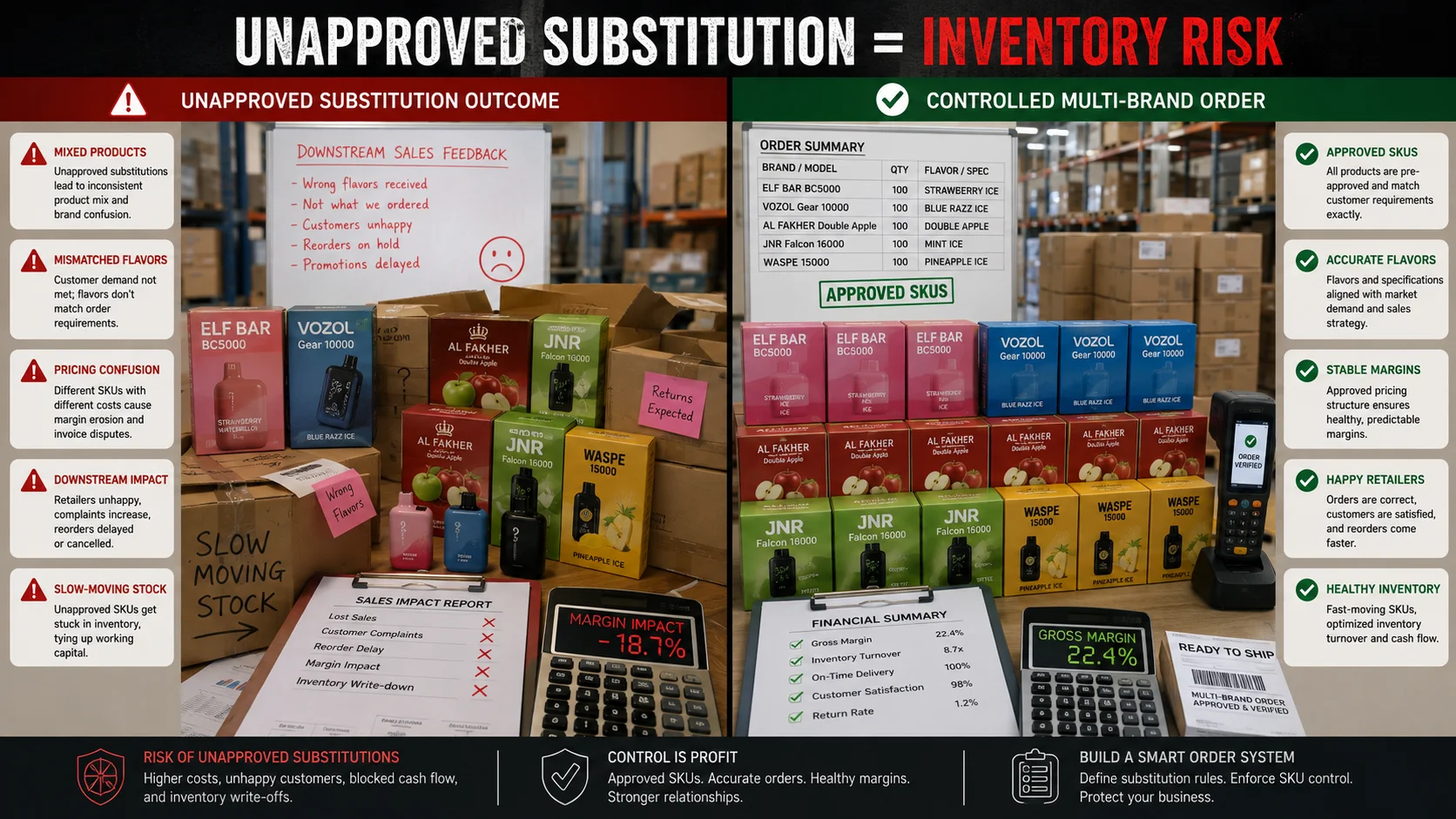
Vape stock substitution rules for wholesalers matter because unapproved changes can alter a buyer’s inventory mix, expected margin, retail acceptance, compliance review, and delivery plan. Written rules help the buyer decide whether to accept an alternative, remove the SKU, request a refund, or wait for replenishment instead of receiving a product chosen for supplier convenience.
A “Similar” Product May Not Be Commercially Similar
Buyers sometimes assume that the same brand, same puff count, or similar price means two products are interchangeable. In reality, several factors can change the commercial result:
- Model and format: A box-style disposable, slim device, pod system, or rechargeable format may serve different customers.
- Flavour profile: A replacement flavour may sell slowly even if it is popular elsewhere.
- Nicotine specification: Nicotine strength and format can affect both customer suitability and destination-market requirements.[^3]
- Packaging version: Different packaging may affect shelf presentation, local labeling review, or retailer acceptance.[^4]
- Carton quantity: A replacement with a different inner box or master carton can affect warehouse planning.
- Batch and shelf-life considerations: Buyers should ask for relevant production and expiry information where applicable.
A buyer who sells to vape shops, smoke shops, convenience stores, gas stations, or regional distributors needs control over what reaches the shelf. If the supplier makes an automatic change, the buyer may be left explaining an unexpected product to downstream customers.
From my side, I believe the supplier’s job is to make shortages visible early, provide traceable information, and present practical options. The buyer’s job is to decide whether the option fits the local market and purchasing strategy.
What Should Buyers Confirm Before Allowing Any Vape Product Substitution?
When stock is moving quickly, a vague message such as “this item is unavailable, can we change it?” is not enough. Both parties need a fixed checklist so the buyer can make a real decision.
Before allowing a vape substitution, buyers should confirm the exact original SKU, proposed replacement SKU, brand, model, flavour, nicotine specification, destination-market version, packaging, carton quantity, price difference, stock evidence, source traceability, and expected shipping effect. Every approved change should appear in the updated order document.
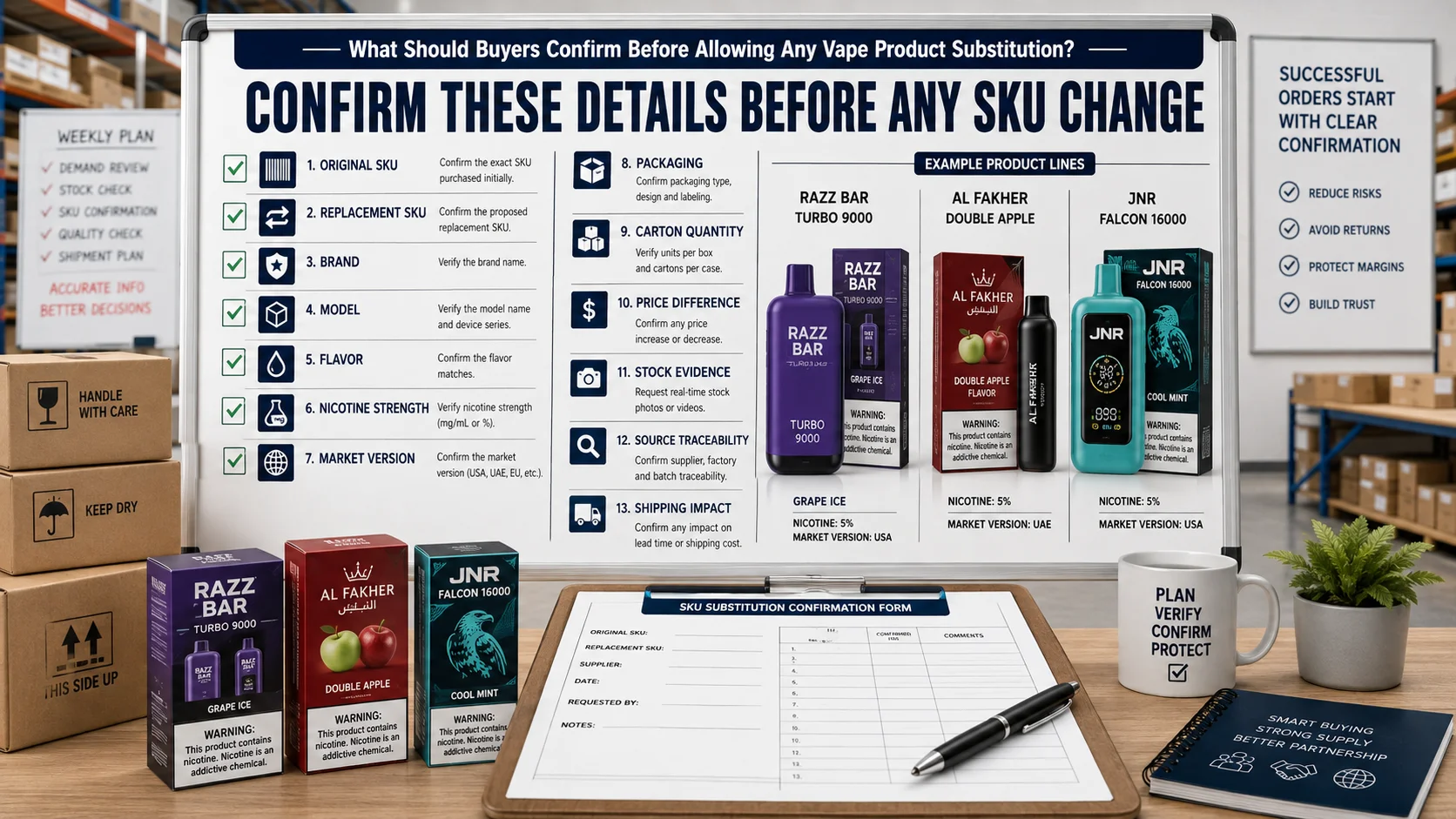
I recommend buyers ask for the following information in one message or one spreadsheet. This prevents confusion caused by separate chat messages, photos, and verbal confirmations.
| Confirmation Field | What the Buyer Should Check |
|---|---|
| Original SKU | Brand, full model name, flavour, nicotine strength, colour, and quantity ordered |
| Replacement SKU | Full product name and complete specification, not only “new model” or “similar item” |
| Destination version | Packaging, labeling, markings, and version intended for the destination market |
| Price difference | Unit price, total value change, and whether freight or handling cost changes |
| Carton configuration | Units per box, inner box quantity, master-carton quantity, and carton dimensions |
| Stock evidence | Current warehouse photos, timestamped stock list, video, or other mutually accepted evidence |
| Source information | Brand authorization document or traceable source documents where relevant |
| Shipping impact | Whether the substitute affects packing, documents, route, delivery timing, or shipment feasibility |
| Approval record | Written buyer approval linked to the PI, order sheet, or revised packing list |
Ask for Evidence That Matches the Actual SKU
Old catalogue photos do not prove that a product is currently available.[^5] Product images may also show a different packaging version or previous batch. When the order value is meaningful, I suggest asking for evidence that connects the product to the actual order:
- A current stock photo showing the SKU and quantity.
- A short warehouse video where practical.
- Carton-label photos for bulk goods.
- A revised proforma invoice or order sheet.
- Updated packing details before shipment.
- Supporting source or authorization documents when buyers need to verify distribution status.
Certifications, authorizations, and compliance documents should be reviewed as documents that buyers must verify for their own market.[^6] They should not be treated as automatic proof that a product is suitable or legal in every destination.
Which Vape Stock Substitution Options Carry the Highest Risk?
A supplier may offer several solutions when a requested product is unavailable. Each option creates a different level of cost, resale, and execution risk. Buyers should compare the options instead of accepting the first available item.
The lowest-risk substitution is usually a pre-approved variation within the same exact product family and destination version.[^7] Different models, different brands, altered nicotine specifications, changed packaging versions, or forced replacements create higher risk and should require explicit written approval from the buyer.
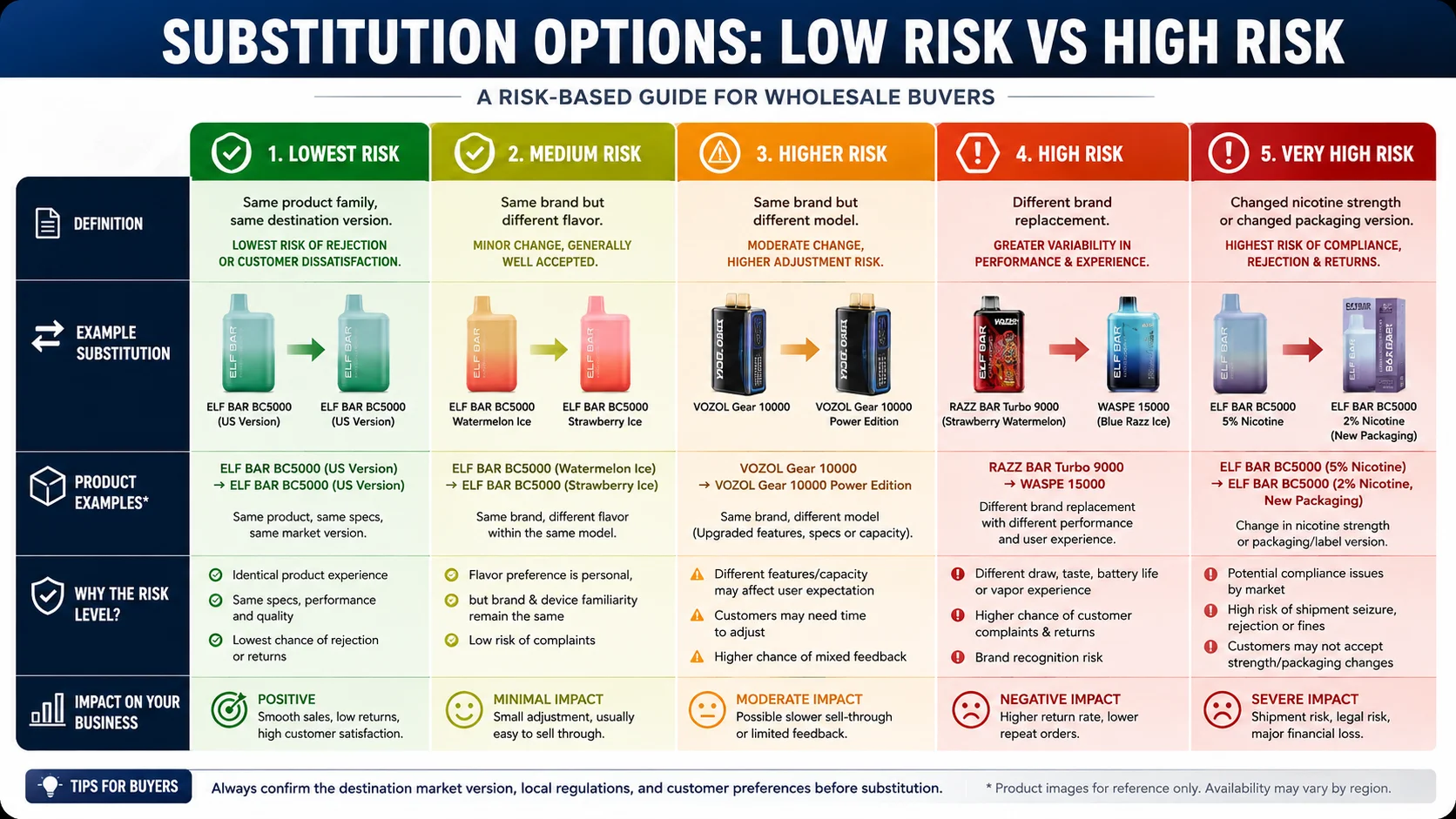
| Substitution Type | Buyer Approval Needed | Evidence Required | Cost Impact | Main Risk |
|---|---|---|---|---|
| Same model, approved flavour change | Yes, unless pre-approved in writing | Current SKU stock proof and revised quantity list | Usually low | Flavour may not fit local demand |
| Same brand, different model | Always | Full specification, photos, price, packaging, stock proof | Moderate | Different customer acceptance and margin |
| Same product, different packaging version | Always | Packaging photos, market-version details, carton data | Low to moderate | Labeling, shelf display, market-fit concerns |
| Different nicotine strength or specification | Always | Full technical specification and destination review | Moderate | Compliance and customer-suitability concerns |
| Different brand replacement | Always | Product details, pricing, source evidence, stock proof | Often moderate to high | Brand acceptance and resale uncertainty |
| Partial refund for unavailable SKU | Buyer chooses | Revised PI and payment record | May reduce order value | Lower shipment efficiency |
| Wait for replenishment | Buyer chooses | Estimated replenishment date and stock update | May affect freight or lead time | Delayed cash conversion |
| Remove the SKU and ship balance | Buyer chooses | Updated PI, packing list, and shipping plan | Can change freight allocation | Incomplete assortment |
Do Not Treat Price as the Only Decision Point
A lower-priced replacement may look attractive. Yet it can still cost more if it sells slowly or creates returns.[^8] A higher-priced replacement may also be acceptable if the buyer has confirmed demand and margin room.
I have found that experienced wholesalers usually evaluate a substitution through four questions:
- Can I legally and practically sell this version in my target market?
- Will my regular customers accept this exact SKU?
- Does the total landed cost still support my intended margin?
- Will this change delay the order or complicate shipping?
That is why a replacement policy should not say only “similar products may be substituted.” It should define what “similar” means in measurable fields.
Which Vape Product Changes Should Always Require Buyer Approval?
The biggest problem in a multi-brand vape order substitution is not a shortage itself. The biggest problem is shipping a changed product before the buyer has had the chance to decide. Some changes are simply too important to assume.
Buyers should always provide written approval before any change to brand, model, flavour, nicotine strength, liquid capacity, battery configuration, packaging version, destination-market version, quantity, batch-related information, unit price, or carton configuration. These changes can affect resale, compliance review, warehouse planning, and after-sales handling.
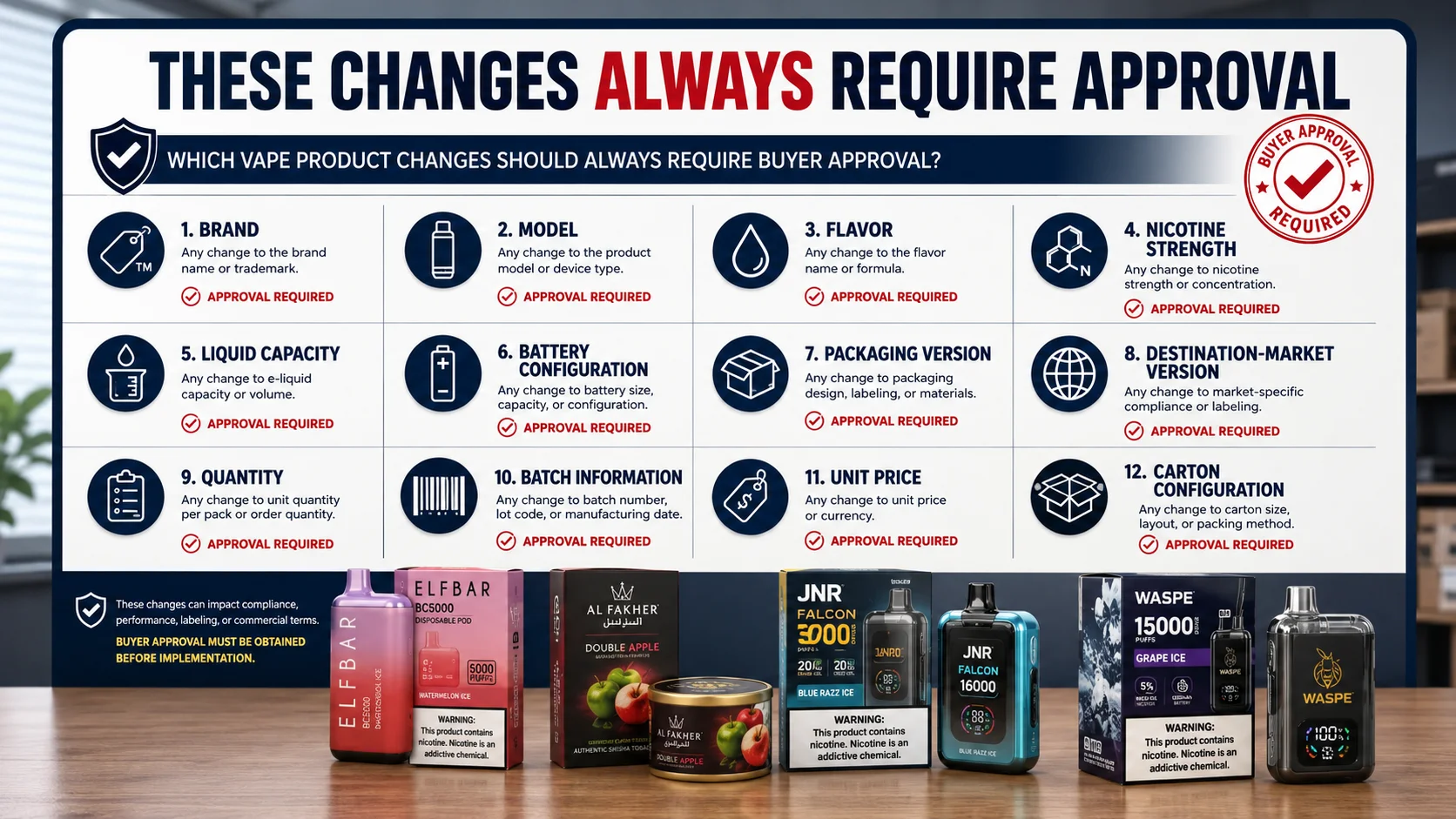
Non-Negotiable Approval Boundaries
I recommend putting the following statement into a purchase order, PI confirmation, or written order agreement:
No substitution, quantity reduction, price adjustment, packaging change, destination-version change, or shipment of alternative SKU is permitted without the buyer’s written approval.
Buyers can then add specific exceptions. For example, a buyer might allow three flavours within the same approved series, but only when the total quantity remains unchanged and the price difference stays within an agreed range.
The following changes should be treated as a new buyer decision, not as a routine supplier adjustment:
- A different brand.
- A different product series or model.
- A different puff count or device format.
- A different nicotine specification.
- A different flavour where flavours are not pre-approved.
- A different capacity, charging type, or battery specification.
- A changed package design, language, or market marking.
- A different carton count or mixed-carton arrangement.
- A lower quantity because the supplier cannot fulfill the original order.
- A higher or lower unit price.
- A product from a different source than the buyer has approved.
These controls are important even when buyers work with a trusted long-term supplier. Good working relationships make communication easier, but they should not replace an accurate written record.[^9]
How Do Vape Stock Substitution Rules for Wholesalers Affect MOQ, Lead Time, and Landed Cost?
A substitute can change more than the product itself. It can affect minimum order quantities, carton layout, shipping volume, payment balance, and delivery scheduling. Buyers should review the entire order after any significant replacement.
Vape stock substitution rules for wholesalers should cover MOQ, unit price, carton quantity, freight allocation, lead time, customs documentation, and shipment release. A replacement may be available immediately but still increase landed cost or delay the overall order because it changes packing, consolidation, or destination-market requirements.[^10]
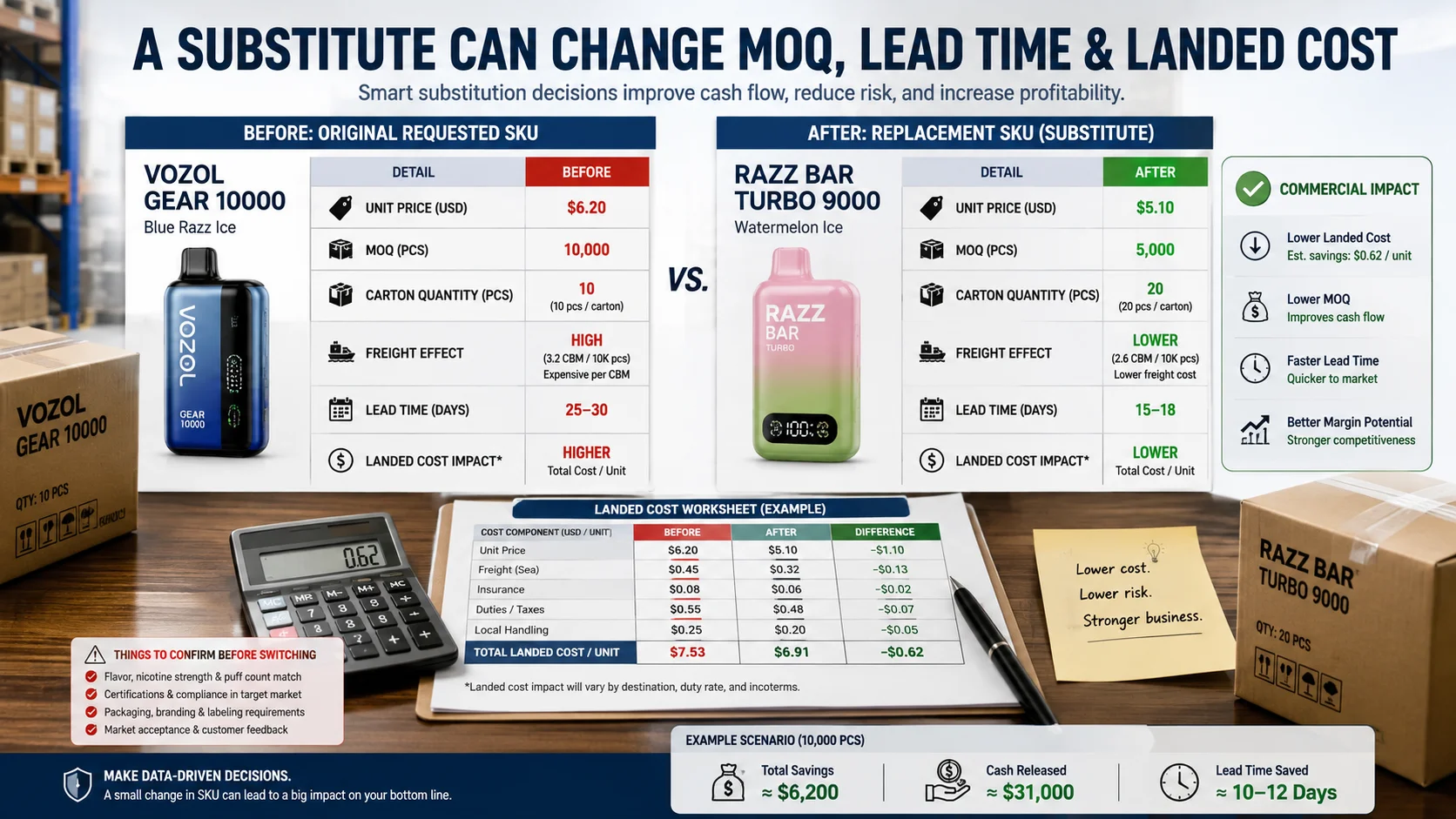
MOQ Can Change the Practical Cost
A product may have a low unit price but require a higher MOQ.[^11] For a small or medium buyer, that can create unnecessary inventory pressure. This is especially relevant when buyers use an overseas warehouse route for faster EU delivery and lower per-SKU starting quantities.[^12]
For buyers who need smaller, faster orders, I can help review available stock routes and mixed-brand order planning. Our European warehouse network has stock in several locations, including Germany, Austria, Poland, and Belgium, depending on product availability. Buyers should confirm actual inventory, market suitability, and delivery options before payment.
For larger importers, wholesalers, and distributors, China-direct purchasing may offer more flexibility for bulk quantities, sourcing, OEM, or ODM development. However, buyers should still review shipping feasibility, destination requirements, and the total commercial impact of any replacement.
A Replacement Can Change Freight
A substitute may have:
- Larger retail packaging.
- Different master-carton dimensions.
- Different battery or product category considerations.
- Different document requirements.
- A different shipping route or consolidation arrangement.
These factors can affect freight quotations and dispatch timing. I recommend recalculating the total landed cost, not only comparing the unit price.
A revised order should show:
- Updated product quantities.
- Updated unit prices.
- Revised total value.
- Carton count and gross weight where available.
- Freight changes, if any.
- New estimated dispatch date.
- Any balance payment or refund amount.
What Are Common Vape Supplier Substitution Mistakes and Red Flags?
Most substitution disputes start with unclear expectations. However, some supplier behaviors should make buyers slow down and request a clearer written process before releasing payment or shipment approval.
Common red flags include automatic substitutions after payment, vague descriptions such as “same quality” or “similar model,” hidden price changes, old inventory photos, forced replacement policies, and shipment without written confirmation. A reliable vape supplier substitution process should give the buyer real options and a clear record of every approved change.
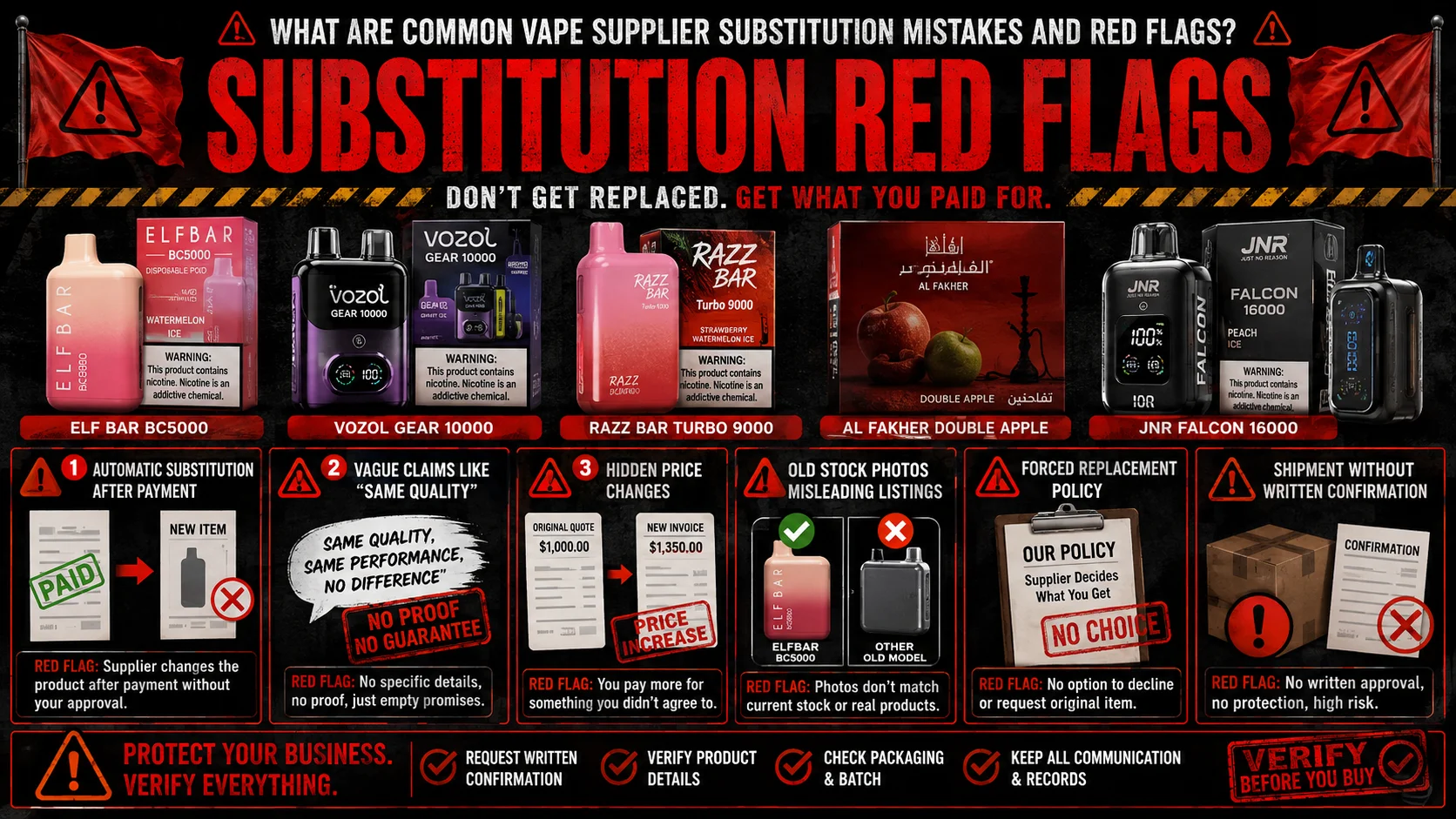
Here are the patterns I believe buyers should watch carefully:
- Automatic replacement after payment: The supplier says that substitutions are normal but does not ask for approval.
- Unclear product descriptions: The supplier offers “same function” without listing the exact model, flavour, specification, or package version.
- No price transparency: The supplier changes to a higher-priced item without showing the difference.
- Old or generic stock evidence: The supplier shares catalogue photos but cannot show current availability.
- Forced substitution: The supplier refuses to remove the unavailable item, refund it, or wait for restock.
- No revised documentation: The PI and packing list remain unchanged even though the SKU changed.
- Unclear source: The supplier cannot provide practical sourcing information when the buyer needs to evaluate authenticity or distribution status.
- Pressure to ship immediately: The supplier frames approval as unnecessary because the replacement is “better.”
A buyer does not need to assume bad intent every time stock changes. Fast-moving vape inventory can change for legitimate reasons. Still, a professional supplier should be able to explain the situation, provide evidence, and wait for the buyer’s decision.
How Can Buyers Build a Practical Vape Stock Substitution Rules Checklist?
A practical checklist reduces repeated discussions and helps both sides act faster when a shortage occurs. The goal is not to create unnecessary paperwork. The goal is to prevent a small stock issue from becoming an expensive inventory problem.
The best vape stock substitution rules for wholesalers use a simple sequence: lock the original SKU list, classify what can and cannot change, request current stock evidence, define price treatment, require written approval, revise order documents, verify packing, and approve shipment only after the final SKU list is confirmed.
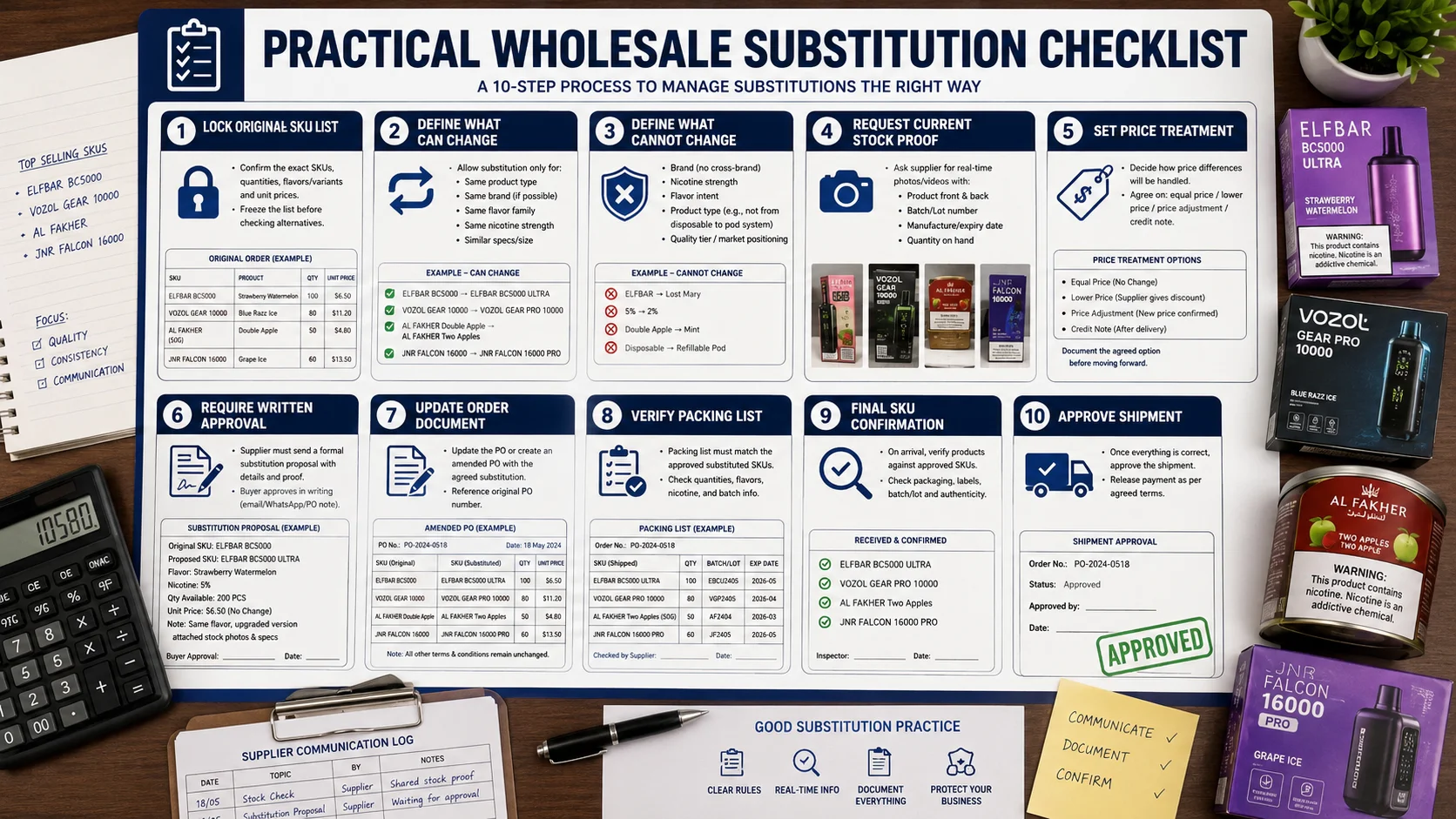
A Step-by-Step Order-Control Process
-
Lock the original SKU list
Include brand, model, flavour, nicotine specification, version, quantity, unit price, and carton details. -
Mark non-substitutable items
Identify products that must remain exact because of customer demand, regulatory review, promotional plans, or margin requirements. -
Define conditional substitution ranges
State whether the buyer accepts certain flavours, colours, or variants under fixed conditions. -
Set the shortage notification trigger
Agree when the supplier must notify the buyer. For example, notification may be required as soon as the supplier cannot allocate the confirmed quantity. -
Set an approval window
The buyer may need 24, 48, or 72 hours to decide. The appropriate time depends on order urgency and time zones. -
Agree on price-difference treatment
Clarify whether the buyer pays the difference, receives a credit, receives a refund, or chooses another SKU. -
Request stock and product evidence
Use current photos, videos, warehouse lists, carton labels, or other agreed evidence. -
Update the PI and packing list
The documents should match the final approved order. -
Review before shipment
Check final SKU quantities, carton count, shipping marks, and destination details. -
Give shipment release approval
The supplier should ship only after the buyer confirms the final order version.
At Shenzhen Kingfuji Tech. Co., Ltd., I work with buyers who need mixed-brand sourcing, regular stock items, product development support, and consolidated purchasing. I believe this checklist is useful because it protects the buyer’s control over the goods, even when the supplier helps identify practical alternatives.
How Should Buyers Choose Between Replacement, Refund, or Waiting for Restock?
When a product is unavailable, there is no single best answer. The right choice depends on urgency, customer demand, available cash flow, freight timing, and the role of that SKU in the overall assortment.
Buyers should accept a replacement only when the proposed SKU meets their agreed conditions and supports their resale plan. If it does not, the buyer should be able to remove the item, request a refund or credit, replace it with another approved SKU, or wait for replenishment based on the commercial value of the original product.
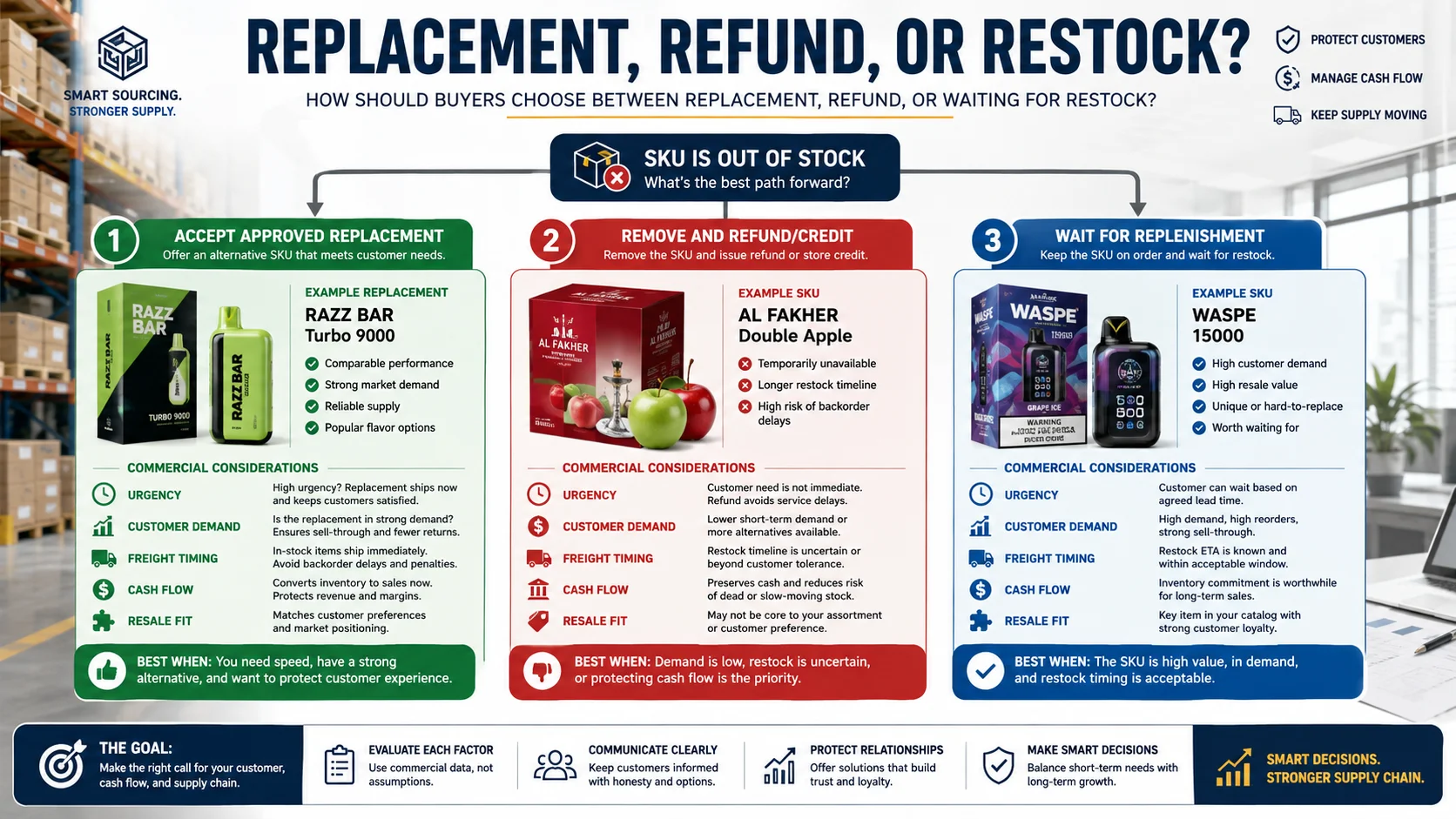
I usually suggest looking at the order in this way:
| Buyer Situation | More Practical Option |
|---|---|
| The original SKU is a proven fast seller | Wait for restock or choose only a pre-approved equivalent |
| The shipment is urgent and the item is not essential | Remove the SKU and ship the balance |
| The buyer needs a full assortment for a customer | Select an approved replacement after reviewing specifications |
| The replacement costs less | Confirm whether the buyer receives a refund, credit, or extra approved items |
| The replacement costs more | Request a new quotation and approve the additional amount before shipment |
| The buyer is uncertain about demand | Avoid forced substitutions and consider a smaller test quantity where practical |
A supplier can help with options, but the buyer should not be pushed into taking stock that does not fit the downstream market. This is especially important for wholesalers who need quick inventory turnover and want to protect working capital.
Frequently Asked Questions
Can a supplier replace vape flavours without buyer approval?
No. A flavour change should require written buyer approval unless the buyer has already listed approved replacement flavours in the order agreement. Even within the same model, flavour demand can vary by country, city, retailer type, and customer group.
Should a different vape model be treated as a new order item?
Yes, in most cases. A different model can have different packaging, capacity, format, carton quantity, price, and customer acceptance. Buyers should evaluate it as a separate SKU rather than accepting it automatically because it has a similar puff count or brand name.
What happens if the replacement vape product costs more or less?
The order should state the price-difference rule before payment. If the replacement costs more, the buyer should approve the added amount. If it costs less, the buyer should receive an agreed refund, account credit, or approved additional products.
Can buyers request a refund instead of accepting a vape substitution?
Yes, buyers can request a refund, credit, or removal of the unavailable SKU if that option is included in the agreed vape stock replacement policy. Buyers should confirm this process before payment, especially for mixed-brand orders with changing inventory.
When should a buyer use independent inspection?
Independent inspection may be useful for larger orders, new supplier relationships, custom OEM or ODM projects, or orders where packaging, quantities, and product versions are critical. Buyers should define inspection standards, timing, and acceptance criteria before production or shipment.
Conclusion
Clear vape stock substitution rules for wholesalers give buyers control over the exact products they pay for and receive. They help prevent unwanted changes to brands, models, flavours, packaging, prices, quantities, and market versions. Written approval does not remove every inventory or shipping risk, but it creates a practical process for managing shortages without losing control of your resale plan. Send me your destination country, requested brands, models, quantities, and delivery destination, and I can help you review stock availability, sourcing options, substitution boundaries, and a practical multi-brand vape order route.
[^1]: "Reverse Supply Chain Forecasting and Decision Modeling ...", https://dspace.mit.edu/bitstream/handle/1721.1/80988/857788622-MIT.pdf?sequence=2. Supply-chain research finds that product substitution decisions can alter demand allocation, inventory performance, and customer-service outcomes when proposed alternatives do not match customer preferences. Evidence role: general_support; source type: paper. Supports: Research on product substitution and inventory management showing that substitutions can affect demand fulfillment, inventory allocation, and customer outcomes.. Scope note: This evidence supports the general commercial risk of substitution; it does not establish the outcome for every vape SKU or wholesale market. [^2]: "2-209. Modification, Rescission and Waiver. - Law.Cornell.Edu", https://www.law.cornell.edu/ucc/2/2-209. International commercial-law instruments provide that a contract may be modified by agreement of the parties, supporting the use of express buyer approval for material changes to an agreed goods order. Evidence role: general_support; source type: institution. Supports: International commercial-law principles that contract modifications generally require agreement of the parties.. Scope note: The applicable legal rule depends on the governing contract, jurisdiction, and any valid no-oral-modification clause. [^3]: "Regulating nicotine and tobacco products", https://www.who.int/activities/regulating-nicotine-and-tobacco-products. Regulatory frameworks for electronic cigarettes in several jurisdictions set requirements related to nicotine concentration and product presentation, so an alternative nicotine specification may require destination-market review. Evidence role: general_support; source type: government. Supports: Government or international regulatory guidance showing that nicotine concentration and product characteristics are regulated for electronic nicotine-delivery products in some markets.. Scope note: Requirements differ substantially by jurisdiction; compliance in one market is not evidence of compliance in another. [^4]: "Labeling and Warning Statements for Tobacco Products", https://www.fda.gov/tobacco-products/products-guidance-regulations/labeling-and-warning-statements-tobacco-products. Official tobacco-product rules in regulated markets include packaging and labeling requirements for electronic nicotine-delivery products, meaning a packaging-version change can require renewed market-specific review. Evidence role: general_support; source type: government. Supports: Official requirements demonstrating that packaging and labeling can be regulated for nicotine-containing products.. Scope note: The source addresses regulatory labeling requirements and does not directly measure retailer acceptance or shelf-performance effects. [^5]: "Best Practices in Achieving Consistent, Accurate Physical Counts of ...", https://www.gao.gov/products/gao-02-447g. Inventory-control guidance emphasizes reconciling records with physical inventory verification; a catalogue image identifies a product but does not by itself verify present stock quantity or allocation. Evidence role: general_support; source type: government. Supports: Inventory-control guidance distinguishing records or product depictions from verified physical inventory evidence.. Scope note: The guidance concerns inventory control generally and does not prescribe a specific photo, video, or timestamping method for wholesale orders. [^6]: "Product market regulation", https://www.oecd.org/en/topics/sub-issues/product-market-regulation.html. Product-compliance guidance requires economic operators to assess the rules applicable to the market where goods are placed, so documents supplied for one product or jurisdiction may require separate verification for the destination market. Evidence role: general_support; source type: institution. Supports: Authoritative guidance that product conformity obligations depend on applicable market-specific rules and responsible economic operators.. Scope note: The exact documentation and responsible party vary by product category, destination, and import arrangement. [^7]: "Competitive pricing of substitute products under supply disruption", https://pmc.ncbi.nlm.nih.gov/articles/PMC7236753/. Studies of demand substitution indicate that replacement acceptance depends on product similarity and customer preferences, supporting narrower, pre-approved alternatives over materially different replacements. Evidence role: mechanism; source type: paper. Supports: Research explaining that substitution performance depends on the degree of similarity between the unavailable and replacement products and on consumer preferences.. Scope note: The research generally models consumer or retail substitution and may not capture all regulatory, packaging, or channel-specific risks in vape wholesaling. [^8]: "A comparison of inventory carrying cost in literature and in practice", https://dr.lib.iastate.edu/bitstreams/8d2b0874-381d-4752-b619-a8d340042d5d/download. Inventory-cost guidance recognizes that carrying costs, markdown risk, and product returns can reduce profitability, so a substitute with a lower purchase price may still impose a higher total commercial cost. Evidence role: mechanism; source type: education. Supports: Operations and accounting guidance explaining that inventory carrying costs, markdowns, and returns can affect total profitability beyond purchase price.. Scope note: The financial effect must be calculated from the buyer's own sell-through rate, storage costs, return terms, and selling price. [^9]: "UNCITRAL Model Law on International Commercial ...", https://uncitral.un.org/sites/default/files/media-documents/uncitral/en/22-01363_mediation_guide_e_ebook_rev.pdf. Commercial-contract guidance emphasizes clear records of contractual terms and amendments because documented communications help establish what the parties agreed and can reduce uncertainty in later disputes. Evidence role: general_support; source type: institution. Supports: Commercial-contract guidance recognizing the evidentiary and dispute-prevention value of clear records of agreed terms and amendments.. Scope note: A written record does not by itself determine legal enforceability; governing law, contract terms, and the parties' conduct remain relevant. [^10]: "The New Logistics Performance Indicators 2.0 (LPI 2.0)", https://openknowledge.worldbank.org/entities/publication/c5d723f0-fe2b-41e0-8194-c790f99436ef. International logistics guidance identifies shipment characteristics, consolidation arrangements, documentation, and border procedures as factors that influence freight costs and delivery time, so a replacement SKU can alter the economics of an order. Evidence role: mechanism; source type: institution. Supports: Trade and logistics evidence that shipment characteristics, consolidation, documentation, and border procedures influence transport cost and lead time.. Scope note: The source supports the logistics mechanism generally; the actual cost effect depends on the carrier, route, shipment dimensions, and destination rules. [^11]: "Inventory Management for Supply Chains with Uncertainty", https://preserve.lehigh.edu/lehigh-scholarship/graduate-publications-theses-dissertations/theses-dissertations/inventory-0. Inventory-management research shows that minimum order quantities can increase order size and inventory exposure, meaning a lower unit price may not minimize the buyer's total inventory-related cost. Evidence role: mechanism; source type: paper. Supports: Operations-management research showing that minimum order quantities influence inventory levels, ordering decisions, and associated costs.. Scope note: The appropriate MOQ depends on demand variability, storage costs, financing terms, and the buyer's replenishment strategy. [^12]: "Trade in the time of parcels (EN)", https://www.oecd.org/content/dam/oecd/en/publications/reports/2021/05/trade-in-the-time-of-parcels_acf1943f/0faac348-en.pdf. Cross-border e-commerce and logistics research indicates that holding inventory nearer to destination customers can shorten fulfillment lead times and may support more frequent, smaller replenishment orders. Evidence role: general_support; source type: institution. Supports: Trade and e-commerce research explaining how inventory positioned closer to customers can reduce fulfillment lead times and support smaller replenishment orders.. Scope note: This does not verify the availability, speed, cost, or legal suitability of any particular warehouse network or route.