
I have seen vape pages lose buyer trust when the copy sounds too wide, too bold, or too close to claims that the seller cannot support.
I write Europe-focused vape pages more carefully by using clear B2B product facts, separating markets, avoiding health or compliance promises, and showing buyers what they still need to verify locally before ordering, listing, or promoting vape products.
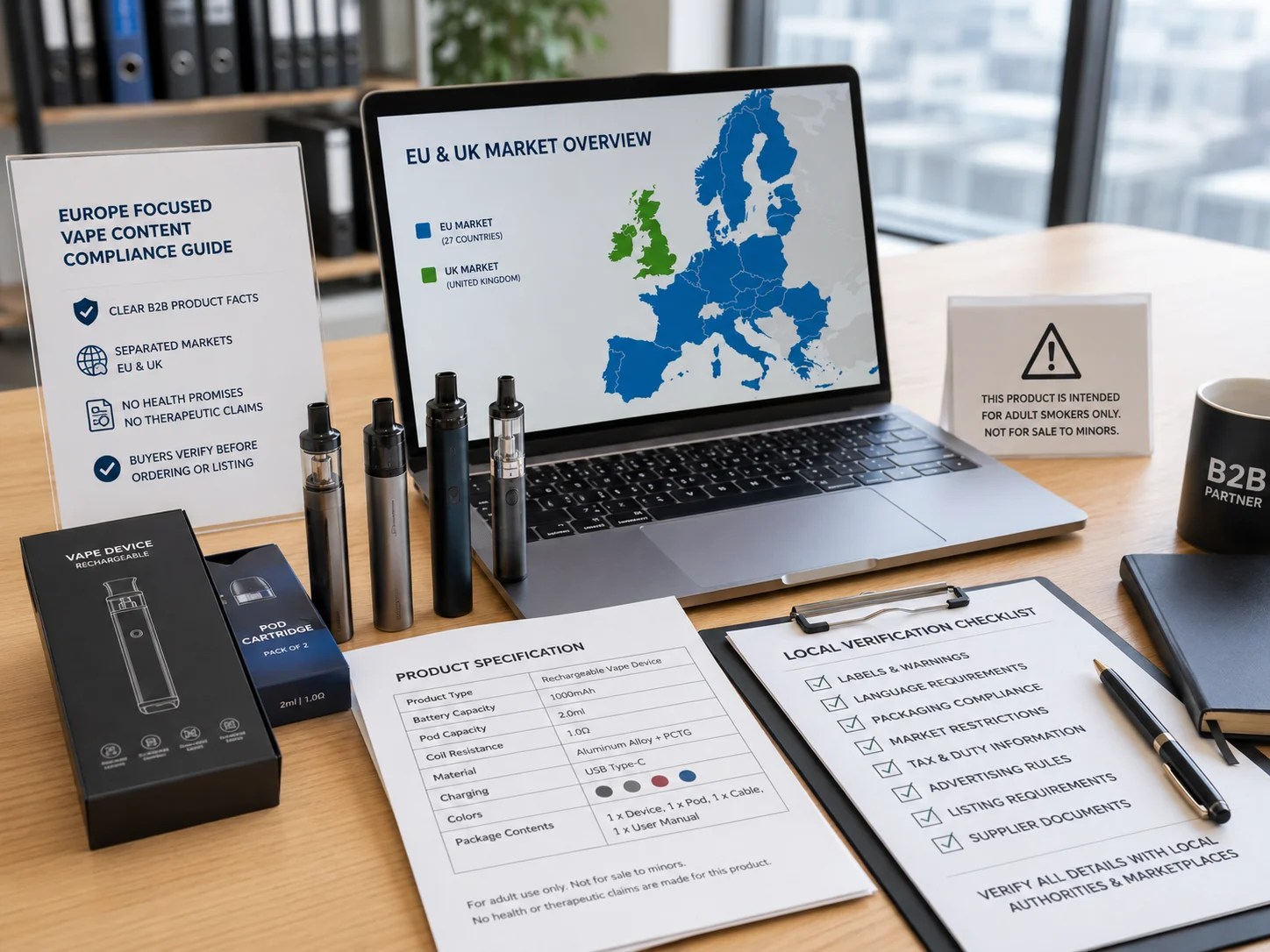
When I work on vape pages for European buyers, I do not see the page as only a sales tool. I see it as a risk filter. The page should help a buyer understand the product, the limits, the market fit, and the questions they still need to ask. If the page creates false confidence, the inquiry may come faster, but the problem may come later. I prefer slower words and cleaner facts because they help both sides talk with less confusion.
Why Do Europe-Focused Vape Pages Need Clearer Market-Specific Messaging?
I have seen many pages say “for Europe” as if Europe is one market. That wording looks simple, but it can create serious confusion fast.
Europe-focused vape pages need market-specific messaging because the EU, the UK, and each local country can have different rules[^1], buyer habits, listing needs, and product expectations. One broad claim can mislead buyers and increase business risk.

I treat “Europe” as a starting point, not as a final market label. When I write or review vape pages, I ask which market the page really means. I ask if the buyer is in Germany, France, the Netherlands, Spain, Italy, the UK, or another market. I also ask if the content is for wholesalers, vape shops, smoke shops, cash and carry buyers, or importers.
What I check before I use market wording
| Content wording | What I ask myself | Safer content direction |
|---|---|---|
| “Suitable for Europe” | Which country or channel does this mean? | I write “for selected European B2B buyers” if that is more accurate. |
| “EU compliant” | Has this been verified for that exact product and market? | I say buyers should verify local requirements. |
| “Best for European market” | Based on sales data, inquiry data, or opinion? | I write about demand signals or buyer interest. |
| “Accepted in Europe” | Accepted by whom, and under what process? | I avoid this unless there is real support. |
I have learned that clear market wording reduces repeated messages. Buyers ask better questions when the page does not overpromise. My goal is not to make the product look weaker. My goal is to make the offer easier to understand. When I write the page with clear limits, I help the buyer judge whether the product fits their channel before they spend time on samples, labels, logistics, and local checks.
What Should Vape Buyers Understand Before Entering European Markets?
I have spoken with buyers who wanted to move fast, but they did not yet know which details could affect sales, listing, or repeat orders.
Vape buyers should understand product specifications, nicotine limits[^2], flavor expectations, packaging needs, local rules, sales channels, logistics timing, and documentation questions before entering European markets. They should verify market-specific requirements before making final purchasing decisions.
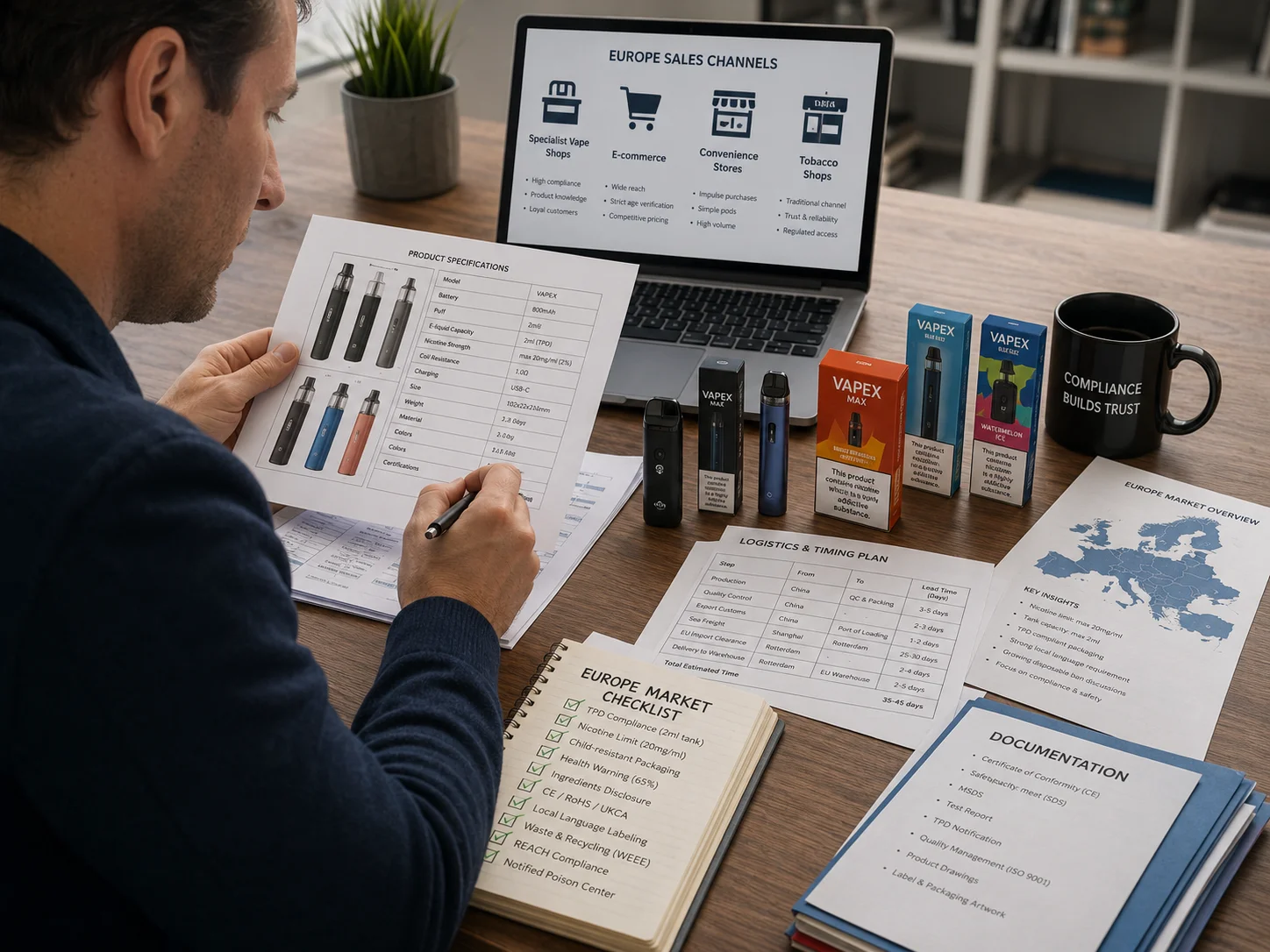
I believe a good product page should help buyers slow down at the right places. A buyer may care about price first. I understand that. Still, price is only one part of the order. A vape product can look attractive, but the buyer still needs to check capacity, puff count, nicotine strength, language needs, packaging format, barcode needs, and local listing steps[^3].
Buyer questions I try to support with page content
| Buyer concern | Page content should clarify | Page content should not promise |
|---|---|---|
| Product fit | Main specs, MOQ, available options | Guaranteed market success |
| Local rules | Need for buyer-side verification | Full legal approval |
| Logistics | Available shipping paths and timing ranges | Customs clearance guarantee |
| Retail sale | Packaging and display information | Guaranteed listing acceptance |
| Repeat order | Supply capacity and lead time | Unlimited stock at all times |
I often explain to buyers that content can help them compare products, but it cannot replace their local professional checks. I am not a lawyer. I am not a regulator. I am not a customs consultant. I can support product information, supplier communication, packaging discussion, and sourcing choices. I can also help make the page clearer so the buyer does not misunderstand what is being offered. This is the practical role of careful content in B2B vape trade.
How Do European Vape Regulations Affect Product Pages and Content Strategy?
I have seen content teams write strong claims because they want conversions, but regulated categories need a different style of selling.
European vape regulations affect product pages by limiting how sellers should describe nicotine products, flavors, usage, safety, compliance, and market entry[^4]. Content should focus on accurate product facts, buyer verification, and responsible B2B communication.
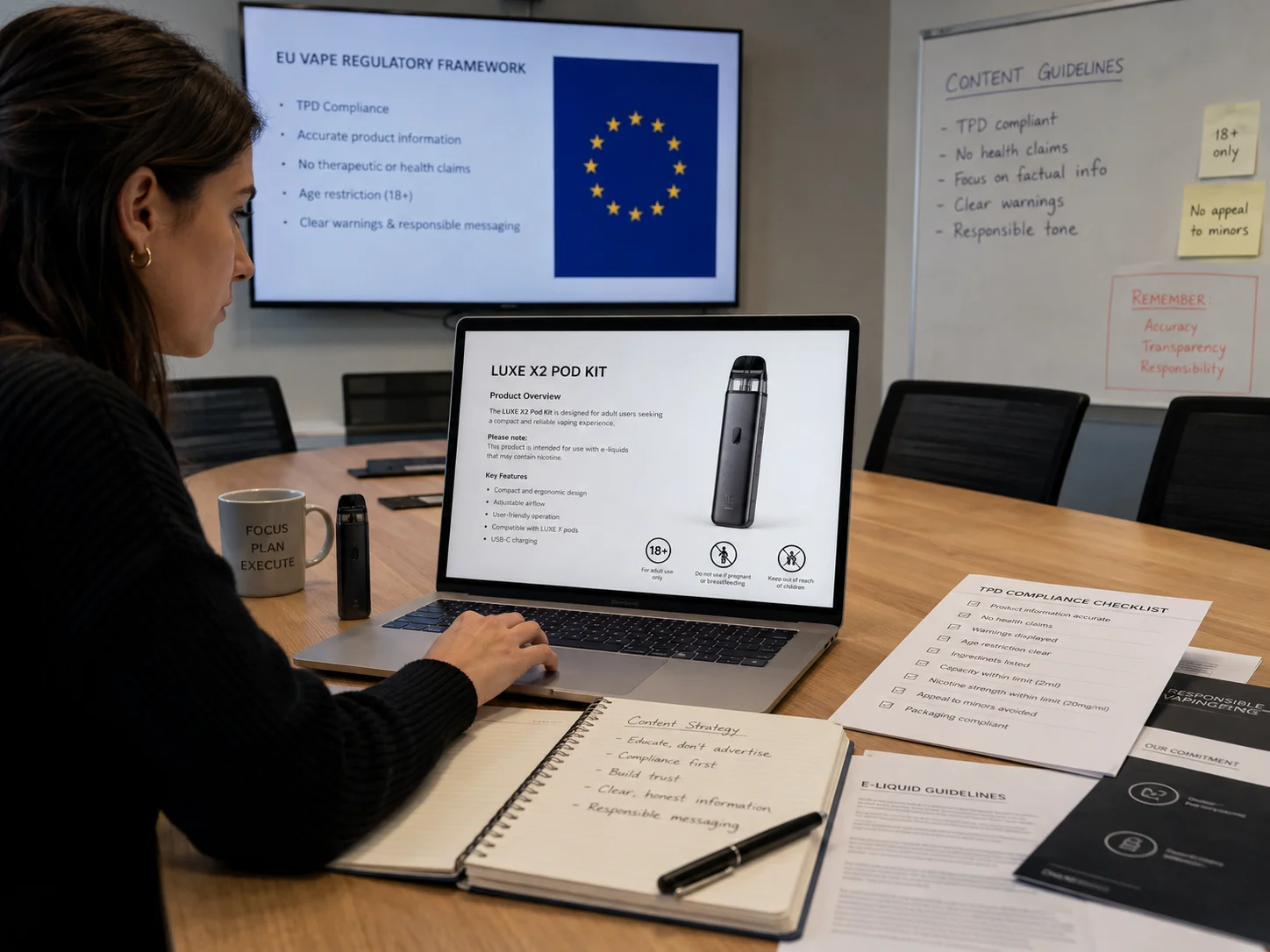
I do not write product pages as if the page can solve every compliance question. I write pages so the buyer can see the product clearly and decide what to verify. This approach changes the content strategy. The page should not push health meanings. It should not imply quitting support.[^5] It should not say the product is safe, healthy, or risk-free[^6]. It should not make broad compliance claims unless the seller has clear support for the exact product and market.
How regulation changes page writing
| Page area | Careful approach | Risky approach |
|---|---|---|
| Nicotine | I state available strengths if appropriate. | I imply one strength is allowed everywhere. |
| Flavors | I list options with market caution. | I say all flavors are suitable for all Europe. |
| Device capacity | I show product specs clearly. | I suggest every size fits every market. |
| Compliance | I ask buyers to verify local rules. | I promise approval or acceptance. |
| Usage | I describe product type and features. | I connect usage with health results. |
I have found that buyers respect direct limits. A serious wholesaler does not need a supplier to make unrealistic claims. A serious buyer needs clean information that can be checked by their own team. I also think this helps SEO in a real way. A page that avoids vague claims and gives exact product facts can answer better buyer questions. It may not sound as loud as aggressive copy, but it can create more qualified inquiries.
What Should I Separate Between Global Vape Claims and Europe-Specific Vape Claims?
I have seen one product description used across many markets. That method saves time, but it can also spread the wrong message.
I should separate global vape claims from Europe-specific vape claims by keeping general product features apart from market-limited statements about rules, listing, packaging, nicotine, flavors, and sales channels. Europe-specific content needs careful verification.

I usually divide content into two layers. The first layer is the product layer. This layer can describe the device, battery, capacity, material, design, packaging style, available models, and wholesale options. The second layer is the market layer. This layer deals with where the product may be sold, how it may be listed, what language may be needed, and what rules the buyer should check.
How I separate the two layers
| Content layer | Example topic | How I write it |
|---|---|---|
| Global product layer | Battery, coil, mesh, charging, mouthpiece | I write clear specs and options. |
| Global supply layer | MOQ, carton size, lead time, OEM/ODM | I write service facts and limits. |
| Europe market layer | Nicotine, capacity, labeling, local rules | I add buyer-side verification notes. |
| Country layer | UK, Germany, France, Spain, Italy | I avoid claims unless the market detail is checked. |
This separation helps my team avoid copy that travels too far. A phrase that works in one market may be wrong in another. A product that is popular in one country may need a different package or strength in another.[^7] I prefer to keep the global product description stable and then build careful market notes around it. This makes updates easier when the market changes. It also helps sales teams answer questions without correcting the website again and again.
What Should Wholesalers Avoid Saying on Europe-Focused Vape Pages?
I have reviewed pages that tried to sound confident, but the strongest words were often the words that created the most risk.
Wholesalers should avoid saying that vape products are safe, healthy, risk-free, approved everywhere, guaranteed compliant, guaranteed through customs[^8], or suitable for all European markets. They should avoid health, quitting, and blanket legal claims.
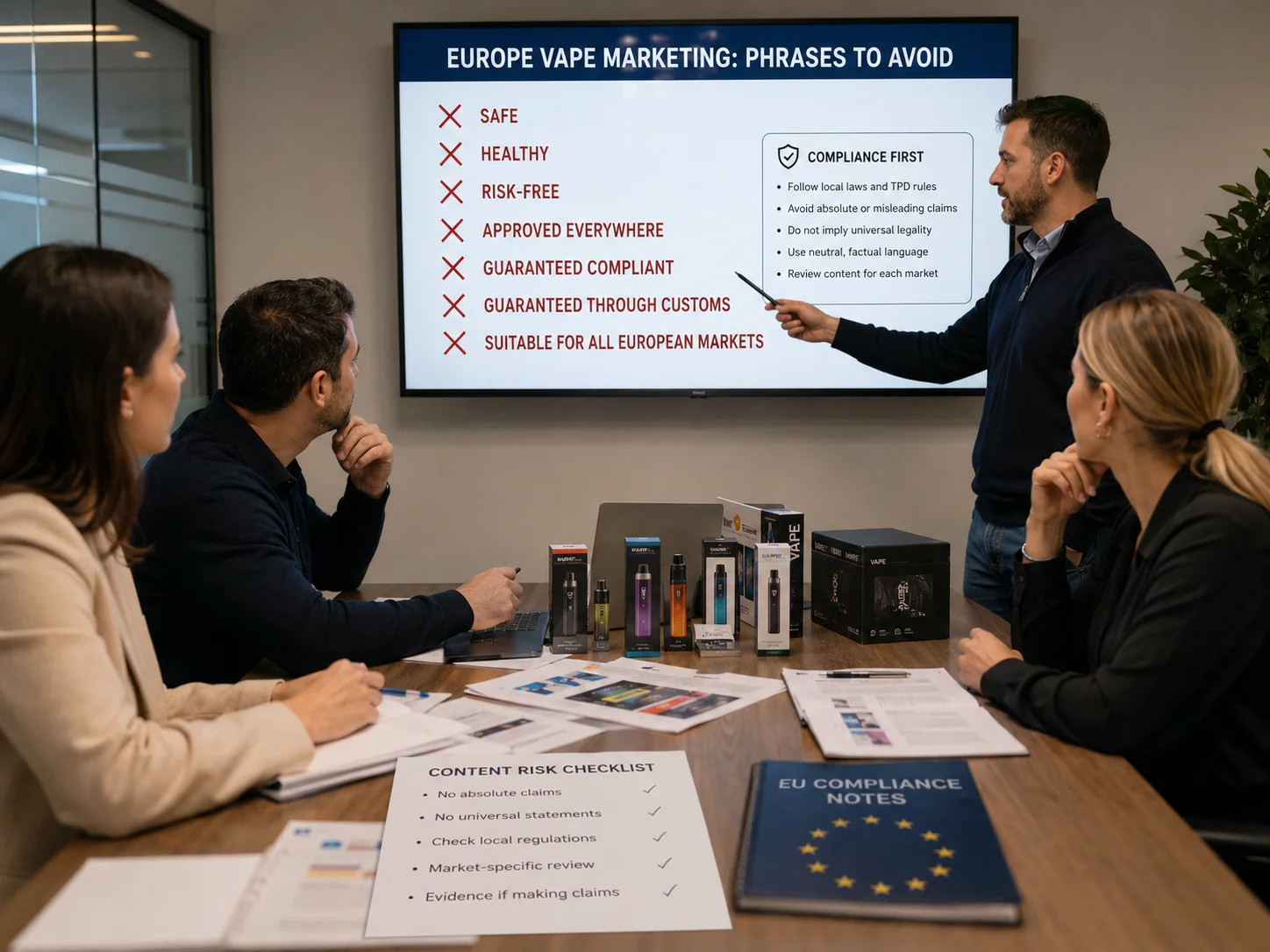
I understand why wholesalers want strong copy. They want buyers to trust them fast. They want fewer doubts. They want more inquiries. I also want inquiries, but I do not want inquiries built on wording that cannot be supported. In vape content, some words create problems because they imply legal, medical, or market-entry certainty.
Phrases I avoid or rewrite
| Risky phrase | Why I avoid it | Safer direction |
|---|---|---|
| “100% safe” | It creates a health or safety claim. | I describe product materials and testing documents if available. |
| “Helps quit smoking” | It creates a health or cessation claim. | I avoid this topic in B2B product pages. |
| “EU approved” | It is too broad without exact proof. | I ask buyers to verify local requirements. |
| “No customs problem” | Customs results cannot be promised. | I explain available shipping experience and limits. |
| “Legal in Europe” | Europe is not one single rule set. | I mention selected markets only if verified. |
I also avoid language that targets minors[^9], non-smokers, or lifestyle identity too strongly. I keep the page focused on B2B buyers. I write for importers, wholesalers, distributors, vape shops, smoke shops, convenience channels, and cash and carry customers. I want the page to show supply value, product choice, MOQ options, and communication support. I do not want the page to sound like a consumer health message or a universal legal statement.
Why Does Educational Content Build More Trust in Regulated Vape Categories?
I have seen buyers trust a supplier more when the supplier explains limits, questions, and trade details instead of only pushing hot products.
Educational content builds trust in regulated vape categories because it helps buyers understand product choices, market checks, sourcing risks, and communication steps[^10] without relying on exaggerated claims or unclear sales language.

I use educational content to answer real buyer questions. I do not use it to replace legal advice. A good guide can explain how to compare disposable vapes, 510 batteries, CBD batteries, vaporizers, grinders, or glass pipes from a sourcing view. It can explain MOQ, stock choice, private label options, packaging discussions, sample steps, and shipping routes. It can also explain why European buyers should check local rules before they order.
Educational topics that help B2B buyers
| Topic | Why it helps | Boundary I keep |
|---|---|---|
| Product comparison | Buyers can match product type with sales channel. | I do not promise best-selling results. |
| MOQ and stock | Buyers can plan cash flow and trial orders. | I do not imply stock is always available. |
| Packaging basics | Buyers can prepare questions early. | I do not confirm legal label approval. |
| OEM/ODM process | Buyers can understand timelines. | I do not promise instant launch. |
| Market checks | Buyers can avoid early mistakes. | I do not give legal advice. |
I often tell content teams that education is not weak selling. It is better selling in a regulated space. When I explain the limits, I show that I understand the buyer’s real job. A buyer needs to protect money, time, brand reputation, and local relationships. If my content helps them ask better questions, the sales conversation becomes more useful. Trust grows because the page does not pretend to know everything.
How Does Regulation Change Vape SEO Opportunities in Europe?
I have watched SEO teams chase keywords without thinking about what those words may imply. That can bring traffic, but it can also bring risk.
Regulation changes vape SEO opportunities in Europe by making clarity, buyer intent, product facts, and cautious wording more important than aggressive claims. Safer SEO focuses on useful B2B information, not health promises or broad compliance statements.

I do not treat vape SEO like a normal product category. I still care about search demand, page structure, headings, internal links, and helpful answers. I also care about the meaning of each keyword. Some keywords can push the page toward health claims, consumer targeting, or compliance promises.[^11] I try to choose keywords that match B2B sourcing intent.
SEO angles I prefer for Europe-facing vape pages
| SEO angle | Good use | Risk I avoid |
|---|---|---|
| Wholesale vape products | I explain supply, MOQ, product range. | I avoid consumer health claims. |
| Disposable vape supplier | I show specs, options, lead time. | I avoid market approval promises. |
| 510 battery wholesale | I explain device fit and buyer checks. | I avoid medical use claims. |
| Europe vape sourcing | I discuss market questions and verification. | I avoid treating Europe as one country. |
| OEM vape manufacturer | I describe process and limits. | I avoid guaranteed launch claims. |
I think regulation pushes SEO toward better content. A page cannot just repeat “best,” “safe,” and “approved.” The page must answer buyer questions in plain words. It should help a buyer compare products, understand sourcing steps, and prepare for local checks. This can also improve inquiry quality. A buyer who reads clear content may send a more useful message. They may ask about stock, nicotine options, packaging, shipping, certificates, or samples. That kind of inquiry is easier to handle than a vague request built on vague copy.
How Can I Create Safer, Clearer, and More Useful Vape Content for European Buyers?
I have learned that the best vape content often feels calm. It gives enough detail, and it also leaves room for buyer verification.
I can create safer vape content for European buyers by writing accurate product facts, naming market limits, avoiding health or legal guarantees, separating global and local claims, and guiding buyers toward proper local verification.

I use a simple content process when I write Europe-focused vape pages. I start with the product facts. I check the model, battery, capacity, nicotine options, flavor list, charging type, packaging, MOQ, lead time, and available stock. I then check the target reader. I ask if the page is for importers, wholesalers, distributors, vape shops, smoke shops, convenience suppliers, gas station suppliers, or cash and carry buyers. I then check the market wording. I remove anything that sounds like a promise I cannot support.
My practical content checklist
| Step | What I do | Why I do it |
|---|---|---|
| 1 | I confirm product specs. | I avoid basic product errors. |
| 2 | I define the buyer type. | I keep the page B2B-focused. |
| 3 | I separate global and local claims. | I reduce market confusion. |
| 4 | I remove health-related wording. | I avoid unsafe claim direction. |
| 5 | I avoid blanket compliance promises. | I keep authority within limits. |
| 6 | I add verification reminders. | I help buyers make responsible checks. |
| 7 | I write clear inquiry prompts. | I help sales teams receive better questions. |
I also like to add plain contact prompts. I may invite buyers to ask for current stock, MOQ, packaging details, OEM/ODM options, or shipping choices. I do not say that I can guarantee customs, listing, or local approval. I can support the sourcing process. I can share product information. I can help buyers compare options. I can arrange communication with the factory and sales team. I can also help buyers use Europe warehouse stock when it fits their trial order needs. I keep the message useful, but I keep the boundary clear.
Conclusion
I write Europe-focused vape pages with clearer facts, stricter limits, and less hype because careful wording helps buyers trust the offer and ask better questions.
[^1]: "Tobacco and Vapes Act 2026", https://en.wikipedia.org/wiki/Tobacco_and_Vapes_Act_2026. European and UK regulatory materials show that e-cigarettes are governed by EU-level rules under the Tobacco Products Directive, national implementation measures, and separate UK tobacco and nicotine product regulations, supporting the need to distinguish European markets rather than treating them as a single jurisdiction. Evidence role: general_support; source type: government. Supports: An authoritative source should show that EU e-cigarette rules are framed by the Tobacco Products Directive while the UK applies its own post-Brexit regulatory regime and member states may impose additional national measures.. Scope note: This supports the regulatory part of the claim, but it does not directly prove differences in buyer habits or commercial expectations. [^2]: "Emerging Electronic Cigarette Policies in European Member States ...", https://pmc.ncbi.nlm.nih.gov/articles/PMC8025686/. Official EU and UK guidance on e-cigarette regulation identifies a maximum nicotine concentration of 20 mg/ml for nicotine-containing e-liquids, making nicotine strength a material specification for buyers assessing market suitability. Evidence role: definition; source type: government. Supports: An official source should confirm that EU and UK rules restrict nicotine-containing e-liquids to a maximum nicotine concentration, commonly 20 mg/ml.. [^3]: "Awareness of Changes in E-cigarette Regulations and Behavior ...", https://pmc.ncbi.nlm.nih.gov/articles/PMC7171274/. EU tobacco product rules specify requirements for e-cigarette nicotine concentration, refill and tank volumes, packaging warnings, and product information, supporting the article’s view that buyers should verify core specifications and packaging details before market entry. Evidence role: general_support; source type: government. Supports: A regulatory source should support that nicotine strength, container or tank capacity, packaging warnings, and consumer information are regulated product attributes in the EU.. Scope note: The source would support capacity, nicotine strength, and packaging requirements directly, but barcode practices and puff-count presentation may depend on commercial practice or national guidance rather than the cited EU rule alone. [^4]: "Recommendations for updating regulations on advertising ... - PMC", https://pmc.ncbi.nlm.nih.gov/articles/PMC12118587/. The EU Tobacco Products Directive includes rules on e-cigarette product information and restrictions on certain commercial communications, providing regulatory context for cautious wording about nicotine products, safety, use, and market access. Evidence role: general_support; source type: government. Supports: A government or EU legal source should show that e-cigarette regulation includes restrictions on commercial communications and product information, which can affect product-page language.. Scope note: The support is contextual because the Directive does not prescribe every sentence on a B2B product page or address SEO copywriting practices in detail. [^5]: "E-Cigarette Advertising in the UK: A Content Analysis of Traditional ...", https://pmc.ncbi.nlm.nih.gov/articles/PMC8496471/. UK medicines and advertising guidance treats smoking-cessation or therapeutic claims for nicotine products as regulated claims that may require appropriate authorization, supporting the article’s caution against implying quitting support in ordinary product-page copy. Evidence role: definition; source type: government. Supports: An official source should confirm that products making smoking-cessation or medicinal claims may require medicinal authorization or must comply with strict advertising rules.. Scope note: This is strongest for UK-facing copy; other European jurisdictions may apply comparable but not identical regulatory tests. [^6]: "Health Effects of Vaping | Smoking and Tobacco Use - CDC", https://www.cdc.gov/tobacco/e-cigarettes/health-effects.html. Public-health assessments by bodies such as the WHO and national scientific panels state that e-cigarettes are not risk-free and may expose users to harmful substances, supporting avoidance of absolute claims that products are safe, healthy, or risk-free. Evidence role: expert_consensus; source type: institution. Supports: A public-health institution or consensus report should state that e-cigarette use is not risk-free and that aerosols may contain harmful substances.. [^7]: "E-Liquids from Seven European Countries–Warnings Analysis and ...", https://pmc.ncbi.nlm.nih.gov/articles/PMC8875468/. Country-level regulatory materials, such as national e-cigarette flavor restrictions and labeling requirements, illustrate that product presentation and formulation choices can vary by European market, supporting the need to reassess packaging or strength country by country. Evidence role: case_reference; source type: government. Supports: A country-level or comparative source should show that European countries can impose different e-cigarette rules, such as flavor restrictions or national labeling requirements.. Scope note: This would be a contextual or case-based citation; it would not prove that every product needs a different package or strength in every country. [^8]: "EU - Import Requirements and Documentation", https://www.trade.gov/country-commercial-guides/eu-import-requirements-and-documentation. Official customs guidance explains that goods entering a market may be subject to documentary checks, risk-based controls, and prohibitions or restrictions, supporting the article’s caution that a supplier should not guarantee customs clearance. Evidence role: general_support; source type: government. Supports: An official customs source should explain that imports are subject to customs controls, risk management, documentation checks, and prohibitions or restrictions.. Scope note: The support is general customs context rather than a vape-specific determination for a particular shipment. [^9]: "E-Cigarette Use Among Youth | Smoking and Tobacco Use - CDC", https://www.cdc.gov/tobacco/e-cigarettes/youth.html. Public-health and advertising standards materials identify youth exposure to e-cigarette marketing as a regulatory concern and commonly restrict advertising directed at under-18 audiences, supporting the article’s avoidance of minor-targeted language. Evidence role: expert_consensus; source type: institution. Supports: A public-health or advertising standards source should support that e-cigarette marketing should not be directed at minors and that youth exposure is a regulatory concern.. [^10]: "How risk communication affects public trust in government - PMC - NIH", https://pmc.ncbi.nlm.nih.gov/articles/PMC12116495/. Research on risk communication and trust indicates that transparent information, acknowledgement of uncertainty, and practical decision support can improve perceived credibility, providing a basis for using educational rather than exaggerated content in regulated product categories. Evidence role: expert_consensus; source type: paper. Supports: A scholarly source should support that transparent communication, acknowledgement of uncertainty, and useful information can increase trust or credibility in risk-related decisions.. Scope note: The evidence would likely be contextual and not specific to vape wholesale pages unless a vape-specific B2B study is found. [^11]: "E-Cigarette Advertising in the UK: A Content Analysis of Traditional ...", https://pmc.ncbi.nlm.nih.gov/articles/PMC8496471/. Advertising standards guidance for e-cigarettes restricts unapproved health or medicinal claims and limits youth-directed promotion, supporting the article’s point that search terms and page wording can create claim and audience-targeting risks. Evidence role: general_support; source type: institution. Supports: An advertising standards source should show that e-cigarette marketing is restricted in relation to health claims, medicinal implications, and targeting of young audiences.. Scope note: The citation supports advertising-risk logic; it does not directly measure how specific SEO keywords affect search performance or enforcement outcomes.