Selling vapes is tough. You use words like "authentic" or "compliant" to build trust, but they can backfire and cause huge problems. It's a frustrating situation for any honest seller.
To talk about vape authenticity and compliance safely, avoid making absolute claims like "100% authentic" or "fully compliant." Instead, provide specific, verifiable evidence like supply chain documentation for authenticity and clearly state the intended market (e.g., "Designed for the UK market") for compliance.
I've been in this export business for over 15 years, and I've seen it all. Misunderstandings about these two words can destroy a business relationship before it even starts. It’s crucial to be precise and honest. The goal is to build long-term partnerships, not to make a quick sale with flashy words. Let's break down how you can do this correctly, so you protect your business and help your customers succeed. It all starts with understanding why common marketing phrases are so risky.
Why Are “Authentic” and “Compliant” High-Risk Marketing Claims?
You see vague claims on wholesale sites all the time, and it creates confusion. Buyers feel misled, and sellers face angry customers or legal trouble. It's a mess.
These claims are high-risk because they are absolute, subjective, and often legally indefensible. A product can be authentic but not compliant in a specific market, and "fully compliant" is almost impossible to guarantee across different regions with constantly changing laws.
In my experience, you have to separate authenticity from compliance. They are two completely different things. Just because a vape is a genuine ELF BAR doesn't mean you can sell it in the UK. If it's the 5000-puff model, it's not TPD compliant there[^1], even if it's 100% authentic. The opposite is also true. A product might be configured for the EU market, but it could be a cheap knock-off. Broad claims just don't work because they ignore these details.
Common Misleading Phrases
Here are some phrases I see all the time that cause problems:
100% authenticFully compliantLegal worldwideGovernment approvedGuaranteed genuine
These phrases promise everything but guarantee nothing. A buyer in France might see "fully compliant" and assume it's legal there, but the product might only be compliant for Germany. This leads to seized shipments and lost money. We want to help our customers succeed, which means giving them clear, factual information, not making empty promises.
What Evidence Can Support an Authenticity Claim?
You're worried about selling fakes, but yelling "it's authentic!" isn't enough. Customers are skeptical and need proof. How do you show them you're the real deal?
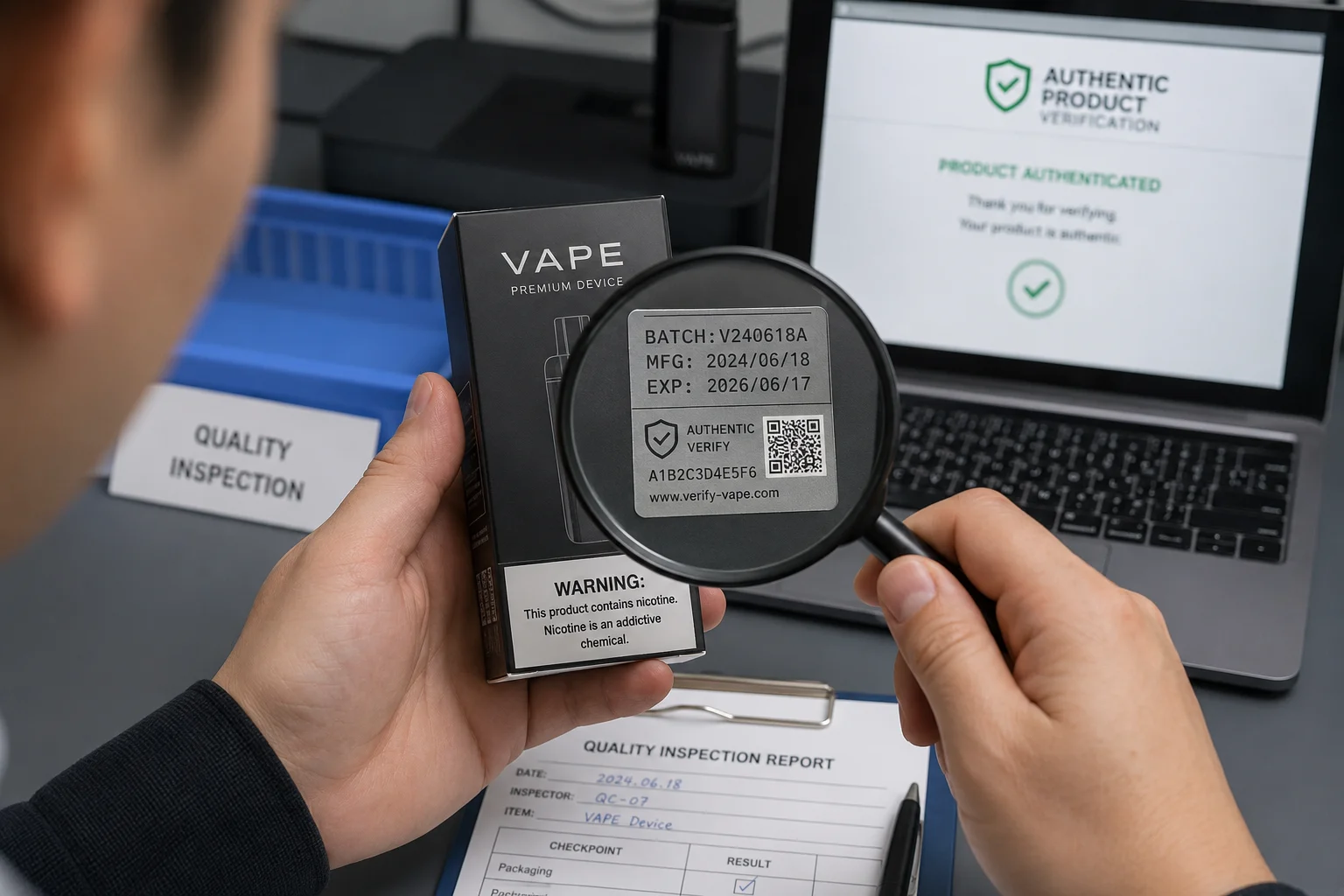
You support an authenticity claim with verifiable proof. This includes showing documentation like purchase invoices from the brand, authorized distributor letters, and having traceable batch numbers. It’s about showing, not just telling. This builds real trust with your buyers.
I deal with this every day. We see so many fakes, especially for popular brands like JNR in France, where fakes might even outnumber genuine ones[^2]. A customer recently told me they were offered JNR vapes for €2. I had to be honest with them. The factory price for a real one is over €4. A price that low is the biggest red flag. Scammers use low prices to make you pay fast. After you pay, they disappear. We often get messages from buyers who've been scammed, asking us to help them contact a Chinese number that's gone silent. There’s nothing we can do.
A real supplier wants a long-term business. We ask questions. We want to know your market. We want you to succeed and come back. A scammer just wants your money now. So, instead of using empty words, we use specific, verifiable language.
How to Describe Authenticity
| Instead of This... | Use This Verifiable Statement |
|---|---|
| "100% Authentic Product" | "Sourced through documented supply channels." |
| "Official Distributor" | "Brand verification information is available where provided." |
| "Guaranteed Genuine" | "Batch and packaging details are checked during our receiving inspection." |
Also, be very careful with QR codes. Fakers are smart. They create fake websites. You scan the code, and it takes you to their site that says "Genuine Product!"[^3] The only safe way is to go to the brand's official website yourself—like elfbar.com—and manually enter the security code. Don't trust a QR code to take you to the right place.
Why Does Authentic Not Automatically Mean Market-Compliant?
You've sourced a 100% authentic, popular vape. You think it's a guaranteed bestseller. But then your customer's shipment gets seized by customs. What went wrong?
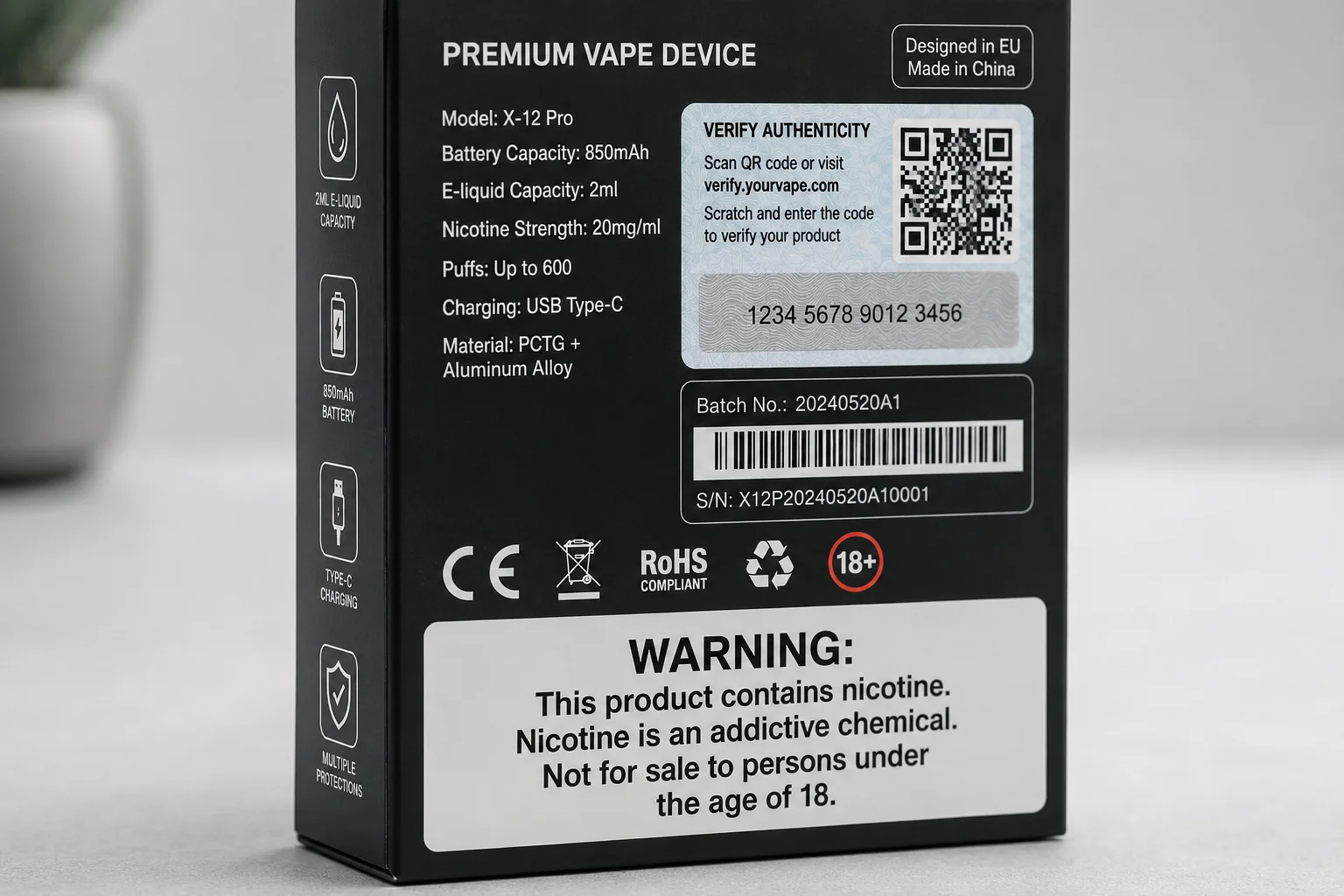
An authentic product might not be compliant because of market-specific rules. These include limits on nicotine strength, e-liquid capacity, packaging language, and required health warnings. A product made for one country is often illegal in another.
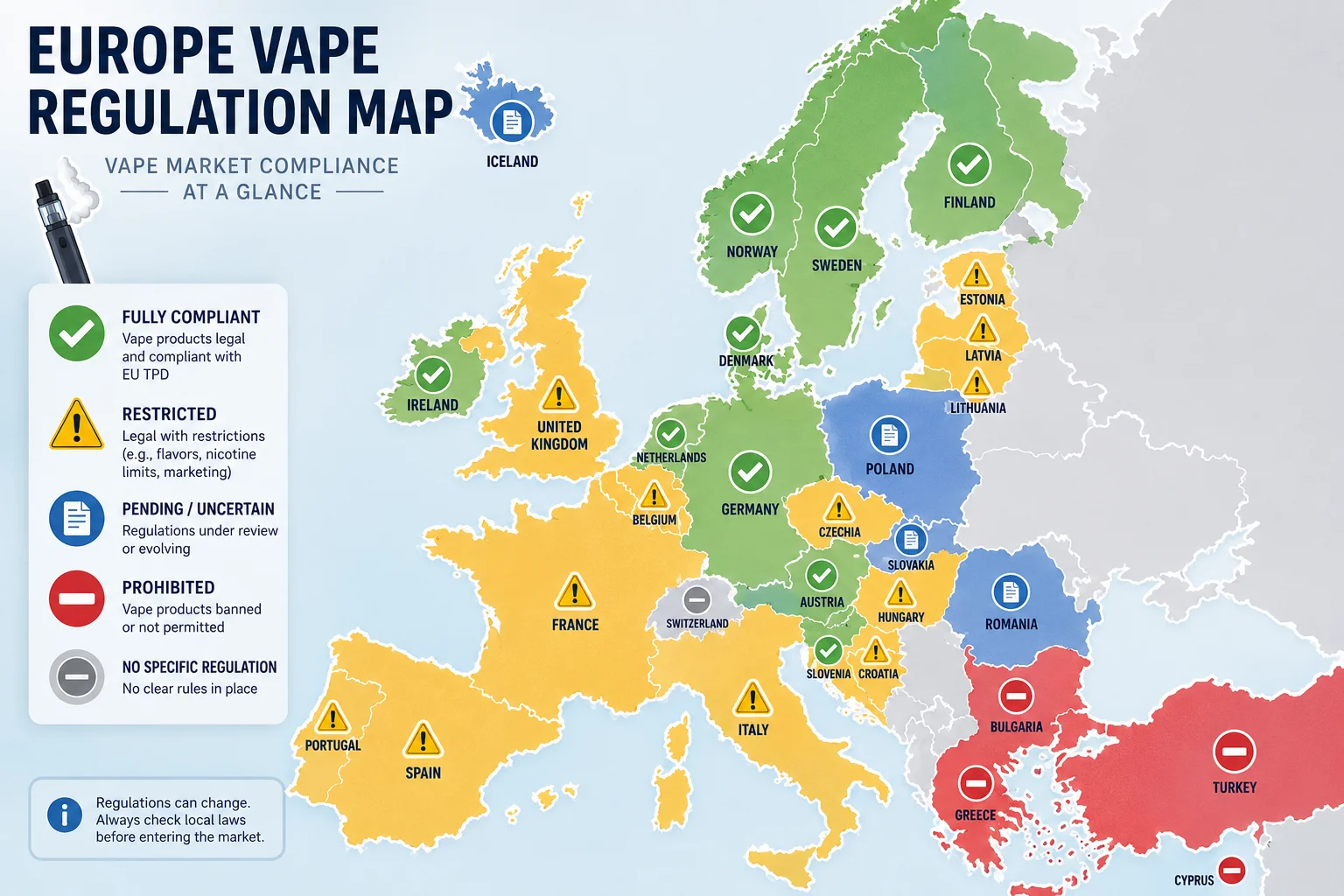
This is a huge issue in our business. The best example is the UK's TPD regulation. It limits e-liquid capacity to 2ml[^4], which is about 600 puffs. So, if we sell an authentic ELF BAR BC5000 (a 5000-puff device) to a UK customer for open sale, we're setting them up for failure. That product is authentic, but it's not compliant for the UK market. We make it our job to know these things. When a customer from a country with tricky customs, like Denmark or Sweden[^5], comes to us, we don't just take their money. We tell them about the risks of secondary customs clearance. We advise them to ship to a safer neighboring country like Germany and arrange transport from there. A scammer would just say, "No problem," take the payment, and let the customer deal with the seized goods. We can't do that. We want our customers to get their products safely, sell them, make money, and order from us again. That's a real business partnership.
Reasons an Authentic Vape Might Not Be Compliant
- Nicotine Strength: Exceeds the local limit (e.g., over 20mg/ml in the EU).[^6]
- Product Capacity: Tank or pod size is too large (e.g., over 2ml in the UK).
- Packaging: Language or warnings are wrong for the destination country.
- Authorization: The specific SKU hasn't been notified to the local authorities.
- Product Type: The product category itself is banned.
How Can You Describe Compliance More Precisely?
You know "fully compliant" is a dangerous phrase. You feel stuck. How do you communicate a product's status without making promises you can't keep and putting yourself at risk?
Describe compliance with precision and qualifiers. Instead of broad guarantees, state facts. Use phrases like "Designed for the UK market" or "EU-market configuration available." This gives buyers the correct information to make their own decision.
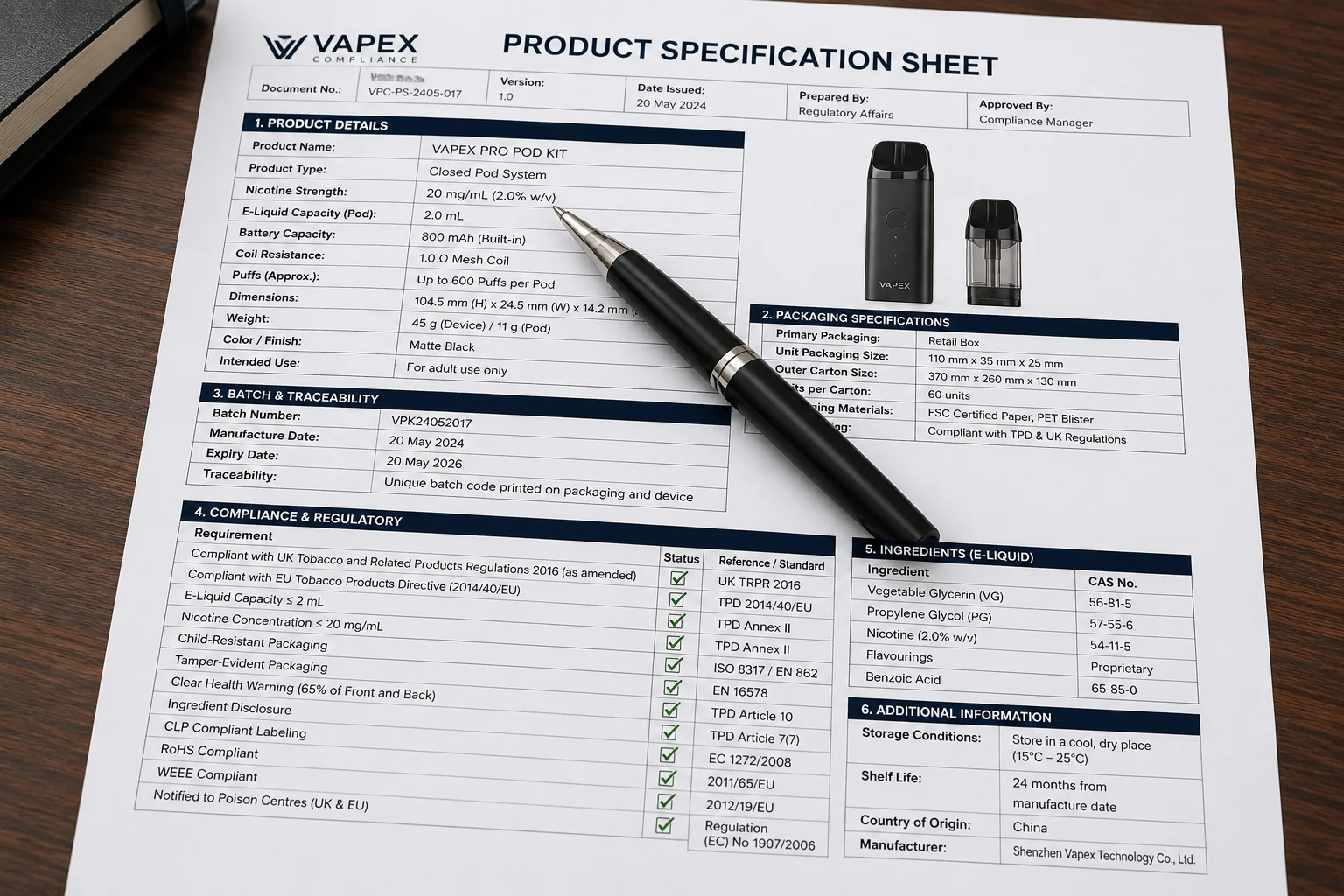
This is all about being honest and managing expectations. A government's main concerns are usually taxes and controlling the black market. For instance, if you want to sell legally in a country that requires tax stamps, the process is clear. You, the importer, need to register a local company, apply for tax stamps, and send them to us in China. We then apply these stamps during production before shipping the goods to you. Now the product is legal to import and sell openly because the government gets its tax money. This is how you work with the system. But this only applies to compliant products, like 600-puff vapes. Big-puff disposables often can't be sold on the open market this way. You have to understand these rules to describe your product correctly. Being precise protects both you and your customer.
Better Ways to Describe Compliance
| Avoid These Vague Claims | Use These Precise Statements |
|---|---|
| "Fully compliant" / "TPD approved" | "Designed for the UK market (2ml/600 puffs)." |
| "EU certified" | "Available in a configuration intended for specified EU markets." |
| "Guaranteed to pass inspection" | "Documentation available for importer review." |
| "FDA approved vape" | "Buyers should verify the SKU against current FDA marketing records." |
Always add a disclaimer. Something like, "Market suitability is subject to destination-country verification by the importer." This makes it clear that the final responsibility for compliance lies with them.
How Can You Separate Product Facts From Legal Conclusions?
You want to be helpful, so you tell your customer, "This product is legal to import." But laws change, and you're not a lawyer. This well-intentioned advice could lead to disaster.
Present objective, verifiable product facts on your page, and let the importer draw their own legal conclusions. List specifications like nicotine concentration, e-liquid capacity, and battery size. Avoid making legal judgments for your customer.
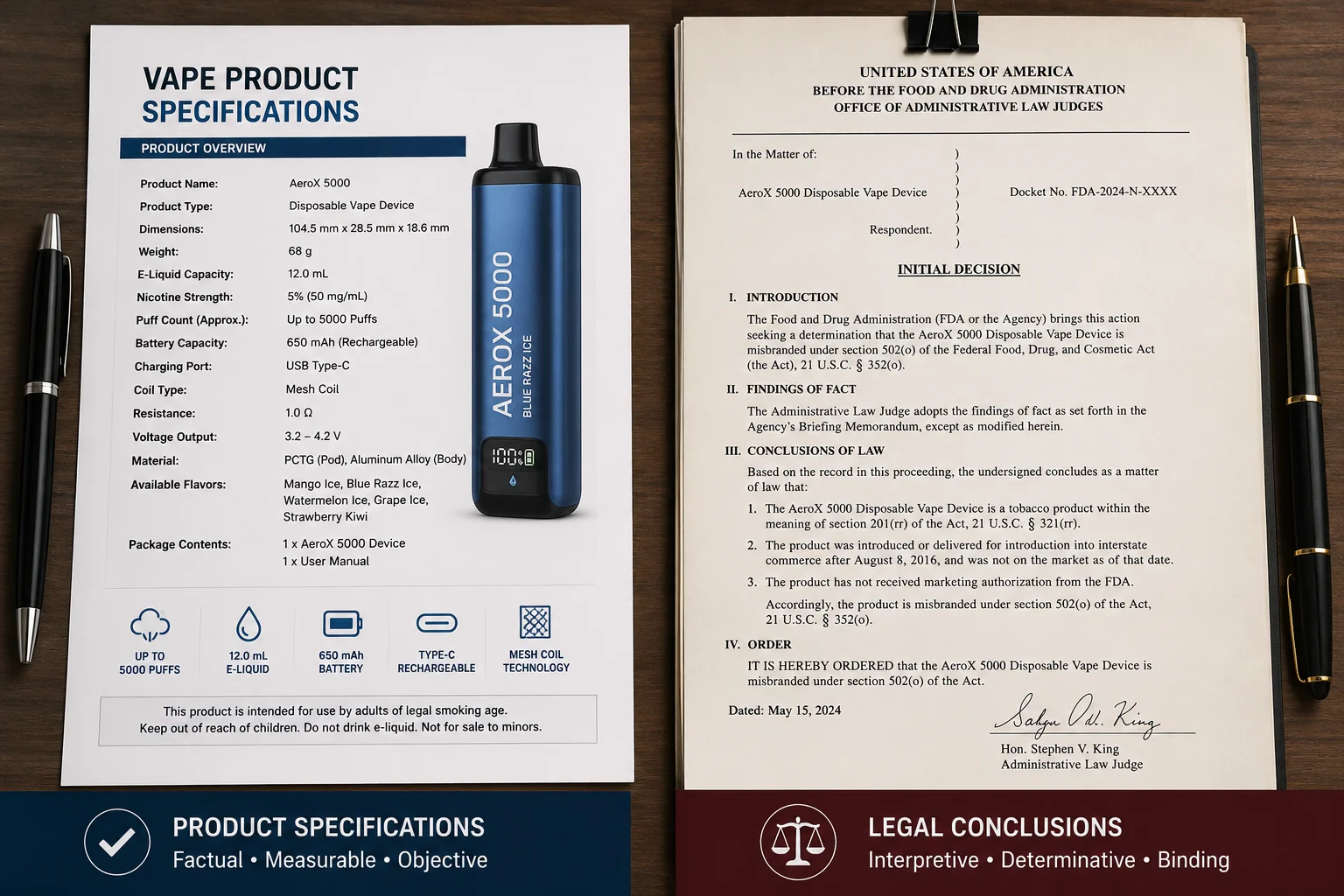
This is a core part of our philosophy. We take on the hard parts for our customers—like stocking inventory in our German warehouse, which means we tie up huge amounts of our own capital and take on all the risks of shipping, customs, and storage. For the customer, it becomes easy. They just need to place an order, and we ship it from Germany, arriving in 1-2 days locally or 3-5 days across the EU. We do this so they can focus on selling. But one thing we don't do is act as their lawyer. We provide all the facts they need to make a decision.
For example, the obsession with puff count is a huge distraction. We're seeing products advertised with 300,000 puffs! It's just a numbers game. The physical size of a disposable vape limits its battery and liquid capacity. A good rule of thumb is that 1ml of liquid equals about 200 puffs.[^7] The biggest, most reliable disposables hold maybe 50ml, which is 10,000 real puffs.[^8] Anything beyond that is just marketing fluff. So, on our product pages, we focus on the real spec: e-liquid capacity. This is a verifiable fact. "100,000 puffs" is a legal and marketing conclusion. Sticking to the facts keeps us honest and helps our customers see through the hype.
What to Display on Your Product Page
- Nicotine concentration (e.g., 20mg/ml)
- E-liquid capacity (e.g., 18ml)
- Battery specification (e.g., 650mAh, rechargeable)
- Packaging language and warnings
- Available test reports or registration numbers
- Intended destination market
Then, add a clear statement: "This configuration is intended for the stated market. Importers should confirm all current national and local requirements before ordering."
How Do You Present Certificates, Reports, and Registrations Correctly?
You have a folder full of PDF reports for your products. You're tempted to label them "Global Compliance Certificate" on your website. This seems easy, but it's dangerously misleading.
Present documents with full context. Clearly state what the document is (e.g., a lab test report, not a government approval), who issued it, the exact product it covers, and the issue date. Never misrepresent a test report as a sales license.
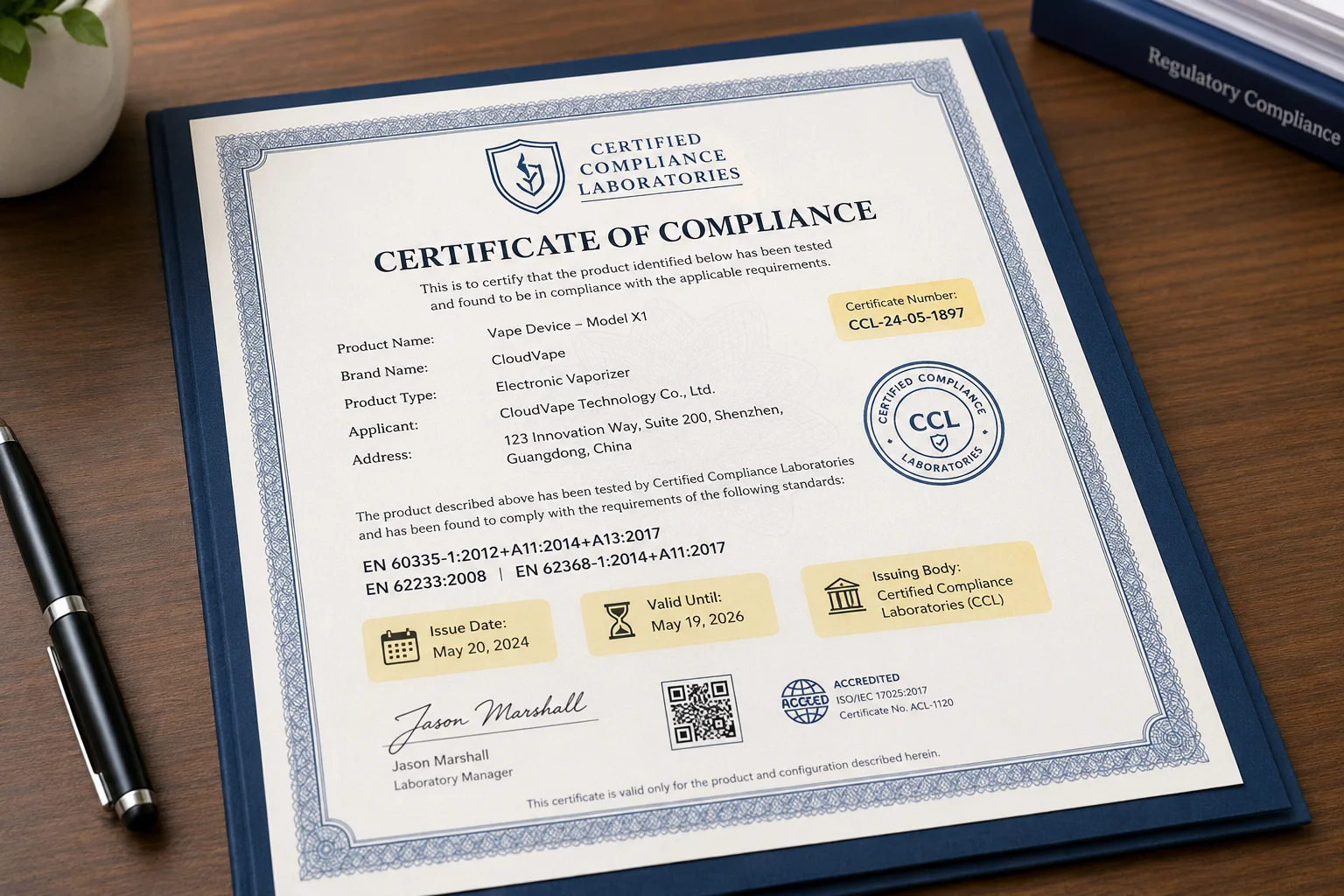
This is about precision. A test report, a registration, a notification, and a sales authorization are all very different things. Mixing them up causes confusion and destroys trust. For example, we have CE and RoHS test reports for many of our 3C products like chargers and cables. These reports show that the product passed certain safety tests in a lab. They do not mean a government has "approved" the product for sale.[^9] It's just one piece of the puzzle that an importer uses to build their compliance file. When a customer asks for documents, we provide them with all the details clearly labeled. We never just send a PDF and call it "government approval." That would be a lie. A reliable partner is truthful about what a document actually means.
Checklist for Presenting Documents:
When you display or send a document, make sure you clarify:
- What is it? A test report, a registration, or an authorization?
- Who issued it? Name of the lab or government body.
- What does it cover? The exact product model.
- Who holds it? The name of the applicant.
- When was it issued? Include the issue and expiry dates.
- Which markets are covered?
- Is it verifiable? Is there a public database to check the reference number?
Never describe a lab test report as a "product safety guarantee" or "customs clearance certificate." It's not. It's just a report.
What Are Some Good Wording Examples for Wholesale Pages?
You understand the principles, but you need to see it in action. How do you rewrite your product descriptions to be safe, honest, and effective without sounding weak or unconfident?
The key is to replace absolute promises with specific, factual statements about your process and the product's configuration. This sounds more professional and builds more trust than empty hype. It shows you know what you're doing.
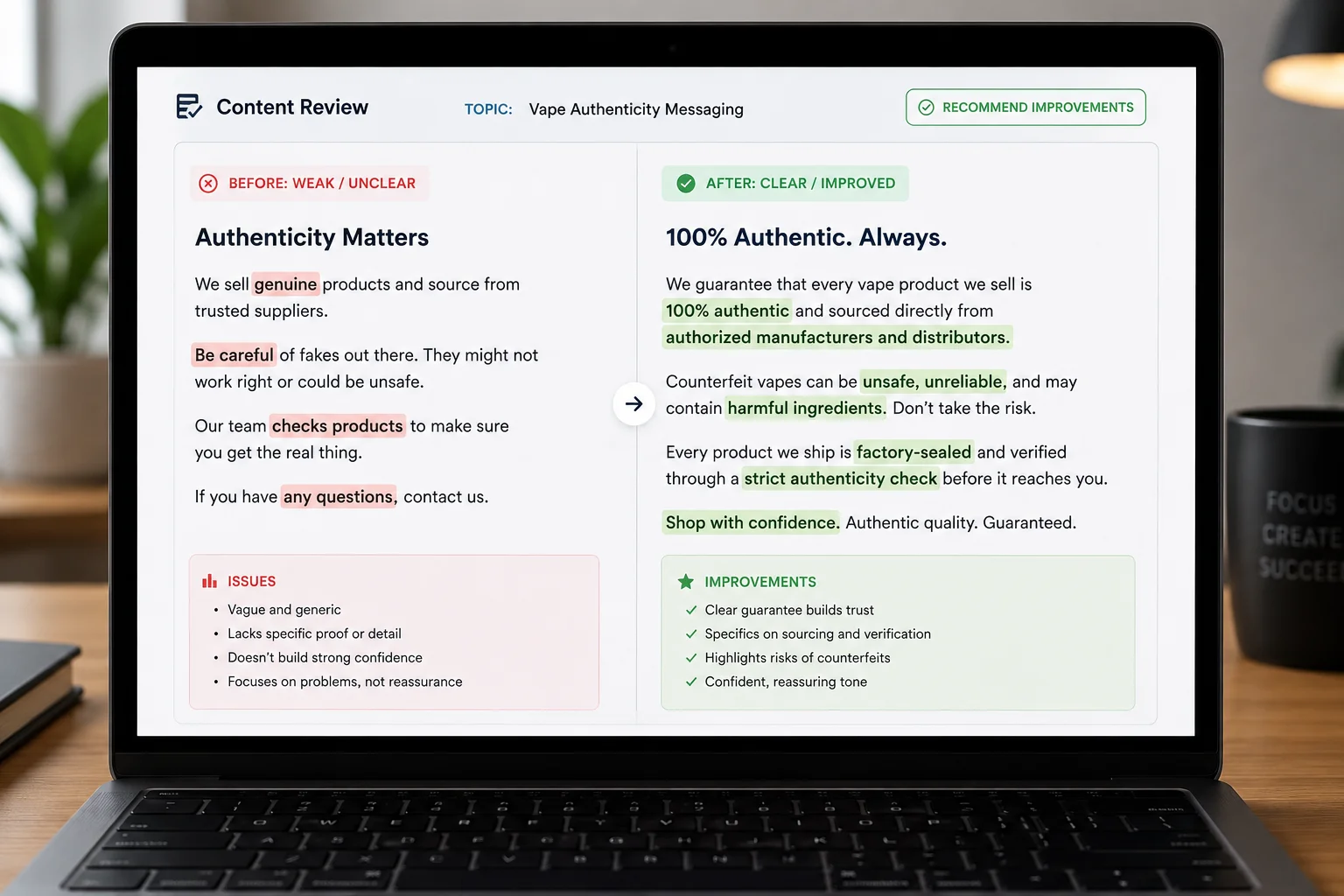
We've been refining our language for years. It's a balance. You want to give customers confidence, but you can't make guarantees that are outside your control, like customs clearance. Our goal is to empower the customer with information. For example, for experienced buyers ordering over 2,000 units directly from China, we always discuss customs insurance. We explain that for a little extra per kilo in shipping cost, they can get full insurance. If customs seizes the shipment, the insurance covers a complete re-shipment at no extra cost to them.[^10] We explain the process and the options. We don't just say "Guaranteed customs clearance," because that's impossible for anyone to promise. This honest approach helps customers see us as a partner looking out for their interests.
Wording Makeovers
| Instead of This Risky Claim: | Write This Factual Alternative: |
|---|---|
| "100% authentic and fully compliant vapes." | "Products are sourced via documented channels. Market-specific configurations and compliance documents can be reviewed before ordering." |
| "TPD-certified products legal throughout Europe." | "Select products are available in configurations for specified EU markets. Buyers should verify requirements for their destination country." |
| "FDA-approved vape products." | "For U.S. products, buyers should verify the SKU against current FDA marketing authorization records." |
| "Guaranteed customs clearance." | "We provide shipping documents and product records to support the importer’s review. Final clearance is subject to destination authorities." |
This wording shows you are professional, knowledgeable, and transparent. That's far more valuable to a serious buyer than empty promises.
What Is the Pre-Publication Authenticity and Compliance Checklist?
You've written your new product descriptions. They feel much better. But before you hit "publish," you feel a flicker of doubt. Did you miss anything? A simple checklist can prevent costly mistakes.
Before publishing, run through a checklist. Verify that your claims match your records, you haven't confused terms like "certified" and "notified," and you haven't guaranteed things outside your control, like customs clearance or absolute safety.
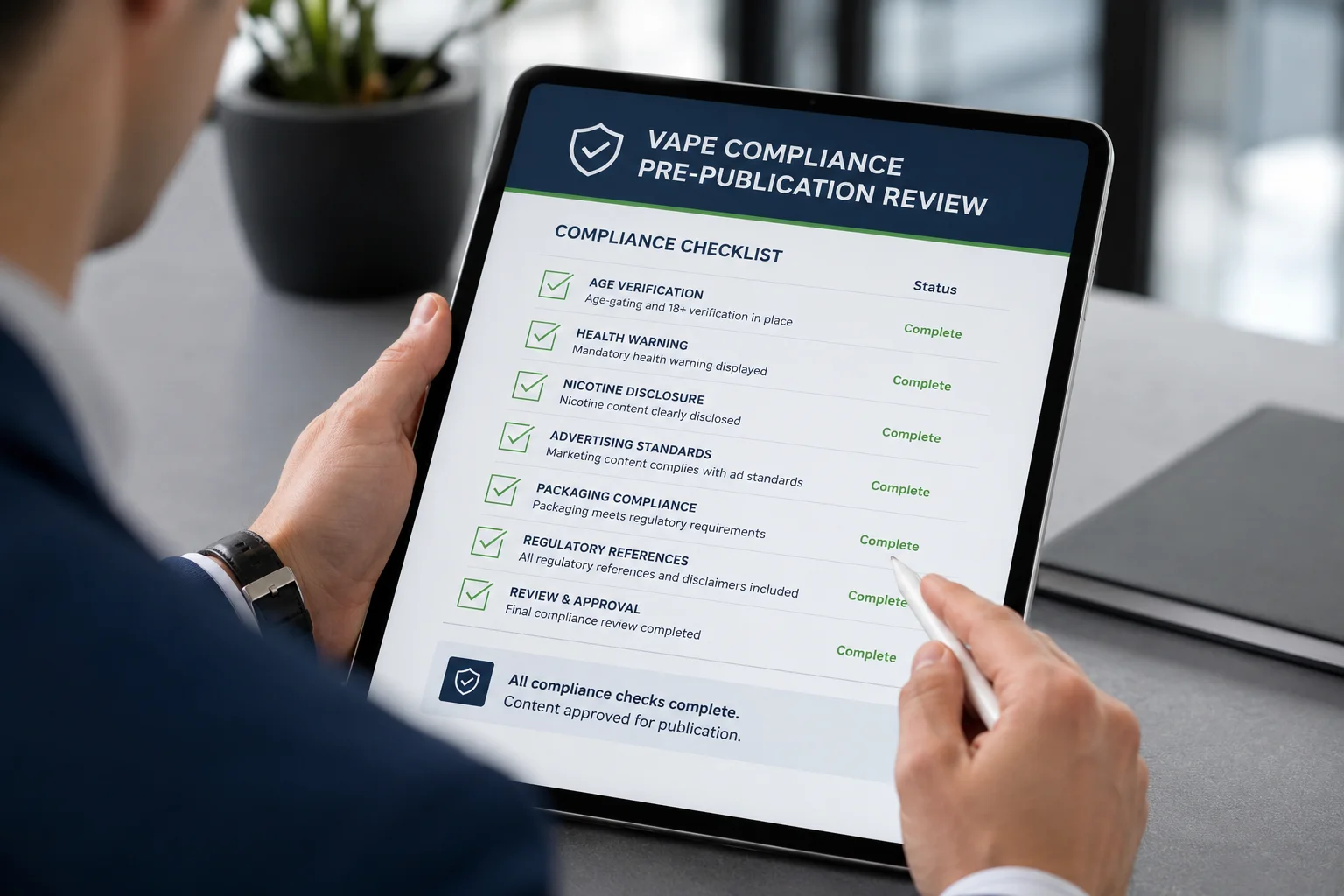
My team and I do this for every single product we list. This process is non-negotiable. It has saved us from countless headaches and is a cornerstone of how we build trust. We check everything from the product facts to the metadata and image captions. For example, we double-check that a certificate we display actually covers the model shown in the picture and that the report hasn't expired. We make sure our descriptions for EU-bound products don't accidentally imply that one country's notification is valid for all 27 member states[^11]. This attention to detail is what separates a professional operation from a careless one. It takes a few extra minutes, but it protects our business and our clients' businesses for the long term.
Your Final 10-Point Check:
- Authenticity: Do we have records to back up authenticity claims?
- SKU and Market: Is the exact SKU and intended market clearly identified?
- Terminology: Are "approved," "certified," and "notified" used correctly?
- Document Match: Do product facts on the page match the supporting documents?
- Current Docs: Are all reports and registrations still current?
- U.S. Claims: Have we avoided misusing "FDA approved"?
- EU Claims: Do we make it clear notifications are country-specific?
- Customs: Have we removed any "guarantees" of customs clearance?
- Safety: Have all absolute health and safety claims been removed?
- Document Access: Is it clear that qualified buyers can request supporting documents?
Conclusion
To build a lasting wholesale business, talk with facts, not hype. This approach protects you, builds real trust with customers, and helps them make smarter decisions for their own markets.
Avoid Counterfeit and Supply Risk
For bulk vape orders, supplier verification protects your business from counterfeits and quality issues. Reach out to our team for factory audits and QC.
Related reading: Which Records Should Support Every Authenticity Claim on a Vape Wholesale Website?
[^1]: "Tobacco: E-cigarettes", https://www.who.int/news-room/questions-and-answers/item/tobacco-e-cigarettes. Sources from the UK government, including the Medicines and Healthcare products Regulatory Agency (MHRA), confirm that the Tobacco and Related Products Regulations 2016 (TRPR) restrict disposable e-cigarette tanks to a capacity of no more than 2ml. Evidence role: general_support; source type: government. Supports: The claim that a vape with a capacity equivalent to 5000 puffs is not compliant for open sale in the UK.. [^2]: "CBP, FDA Seize Unapproved E-Cigarettes Worth $719453", https://www.cbp.gov/newsroom/local-media-release/cbp-fda-seize-unapproved-e-cigarettes-worth-719453. Reports from industry observers and news outlets have highlighted the significant issue of counterfeit disposable vapes in the French market, noting that their prevalence can make it difficult for consumers and retailers to distinguish them from genuine products. Evidence role: case_reference; source type: other. Supports: The claim that counterfeit vapes are a significant problem in the French market.. Scope note: The source may not provide a precise ratio of fake to genuine products but can establish that counterfeiting is a widespread and recognized problem. [^3]: "Scam alert: QR code on an unexpected package | Consumer Advice", https://consumer.ftc.gov/consumer-alerts/2025/01/scam-alert-qr-code-unexpected-package. Cybersecurity experts and consumer protection agencies have issued warnings about 'quishing' (QR code phishing), a technique where malicious QR codes on products or packaging direct users to convincing but fake websites designed to steal information or falsely verify a counterfeit product. Evidence role: mechanism; source type: other. Supports: The claim that counterfeiters use fake QR codes that link to fraudulent verification websites.. [^4]: "Awareness of Changes in E-cigarette Regulations and Behavior ...", https://pmc.ncbi.nlm.nih.gov/articles/PMC7171274/. The UK's Tobacco and Related Products Regulations 2016 (TRPR), which implements the EU TPD, specifies requirements for e-cigarettes, including a maximum volume of 2ml for the tank of a disposable e-cigarette, a refill container, or a cartridge. Evidence role: definition; source type: government. Supports: The claim that UK regulations limit e-cigarette tank/pod capacity to 2ml.. [^5]: "Travelling to Denmark - anyone know the rules? : r/Vaping - Reddit", https://www.reddit.com/r/Vaping/comments/16ct5ce/travelling_to_denmark_anyone_know_the_rules/. National laws in countries like Sweden and Denmark include specific, often strict, rules on the sale and importation of e-cigarettes, such as bans on flavored products and requirements for registration, which can create challenges for importers. Evidence role: case_reference; source type: government. Supports: The claim that Denmark and Sweden have complex or strict regulations regarding the importation of vaping products.. Scope note: The source would describe the specific regulations, supporting the idea of 'tricky customs' without necessarily using that exact subjective term. [^6]: "Emerging Electronic Cigarette Policies in European Member States ...", https://pmc.ncbi.nlm.nih.gov/articles/PMC8025686/. Article 20 of the European Union's Tobacco Products Directive (2014/40/EU) mandates that e-liquid containing nicotine may only be placed on the market if the nicotine concentration does not exceed 20 mg/ml. Evidence role: definition; source type: government. Supports: The claim that EU regulations limit nicotine strength in e-liquids.. [^7]: "E-cigarette use behaviors and device characteristics of daily ... - PMC", https://pmc.ncbi.nlm.nih.gov/articles/PMC7668279/. While puff count can vary based on device power, coil resistance, and user inhalation style, industry analysis and product teardowns often use a general estimate where 1ml of e-liquid provides between 150 and 300 puffs, making 200 puffs a common median figure. Evidence role: statistic; source type: other. Supports: The claim that there is a general ratio between e-liquid volume and puff count.. Scope note: The source would confirm this is a general estimation and not a precise conversion, as puff count is affected by multiple variables. [^8]: "Evidence That Metal Particles in Cannabis Vape Liquids Limit ... - PMC", https://pmc.ncbi.nlm.nih.gov/articles/PMC9713800/. Technical reviews of high-capacity disposable vapes note that practical limits on battery size and e-liquid volume are often reached around 20-30ml, with claims of significantly higher capacity or puff counts often being a result of marketing rather than verifiable performance. Evidence role: mechanism; source type: other. Supports: The claim that there are physical and technological limits to the capacity of disposable vapes.. Scope note: The exact maximum capacity can change as technology evolves, but the source supports the principle that there are physical constraints and that puff counts are often inflated. [^9]: "CE marking - Wikipedia", https://en.wikipedia.org/wiki/CE_marking. According to the European Commission, the CE marking signifies that a product has been assessed by the manufacturer and deemed to meet EU safety, health, and environmental protection requirements; it is not a mark of origin or a quality mark, and it is distinct from a government-issued license to sell. Evidence role: definition; source type: government. Supports: The claim that CE and RoHS are declarations of conformity to standards, not government approvals for sale.. [^10]: "Duty - Cost Insurance and Freight (CIF) - help.CBP.gov", https://www.help.cbp.gov/s/article/Article1126. Logistics providers and third-party insurers offer various forms of freight and cargo insurance, some of which can be specifically structured to cover losses resulting from customs seizure or rejection, often providing for the cost of the goods or a replacement shipment. Evidence role: definition; source type: other. Supports: The claim that specialized insurance products exist to mitigate the financial risk of customs seizures.. Scope note: The availability and terms of such insurance can vary significantly depending on the provider, shipping route, and type of goods being insured. [^11]: "Revocation of Regulations Regarding the Mutual Recognition of ...", https://www.federalregister.gov/documents/2026/02/19/2026-03286/revocation-of-regulations-regarding-the-mutual-recognition-of-pharmaceutical-good-manufacturing. Under the EU Tobacco Products Directive (TPD), manufacturers must submit a notification for e-cigarettes and refill containers to the competent authorities of the specific Member States where they intend to place the products; there is no single, EU-wide notification. Evidence role: mechanism; source type: government. Supports: The claim that TPD notifications are handled on a per-country basis..