Mixed brand vape wholesale MOQ planning can become difficult when you need several brands, models, flavours, and accessories but cannot afford to lock too much cash into slow-moving stock. A first order that looks “complete” can create storage pressure, delayed cash flow, and missed replenishment opportunities. I recommend building a controlled assortment around proven demand first.
Mixed brand vape wholesale MOQ planning should not mean splitting your budget equally across every brand or flavour. A safer first-order approach is to prioritize proven channel demand, place most capital into core SKUs, reserve a limited amount for controlled tests, and verify stock, MOQ rules, source traceability, legal suitability, and shipping feasibility before payment.
A mixed order gives wholesalers more choice, but choice is not the same as a purchasing strategy. In my conversations with importers, vape shop suppliers, smoke-shop wholesalers, and convenience-store distributors, the strongest first orders usually focus on replenishment potential, not catalogue size.
What Is the Quick Answer for Mixed Brand Vape Wholesale MOQ Planning?
A mixed-brand order can feel risky when every supplier has different carton rules, available stock, and market versions. Buyers often worry that they will either miss sales by buying too little or trap cash by buying too much. I suggest starting with sales evidence rather than starting with the supplier’s catalogue.
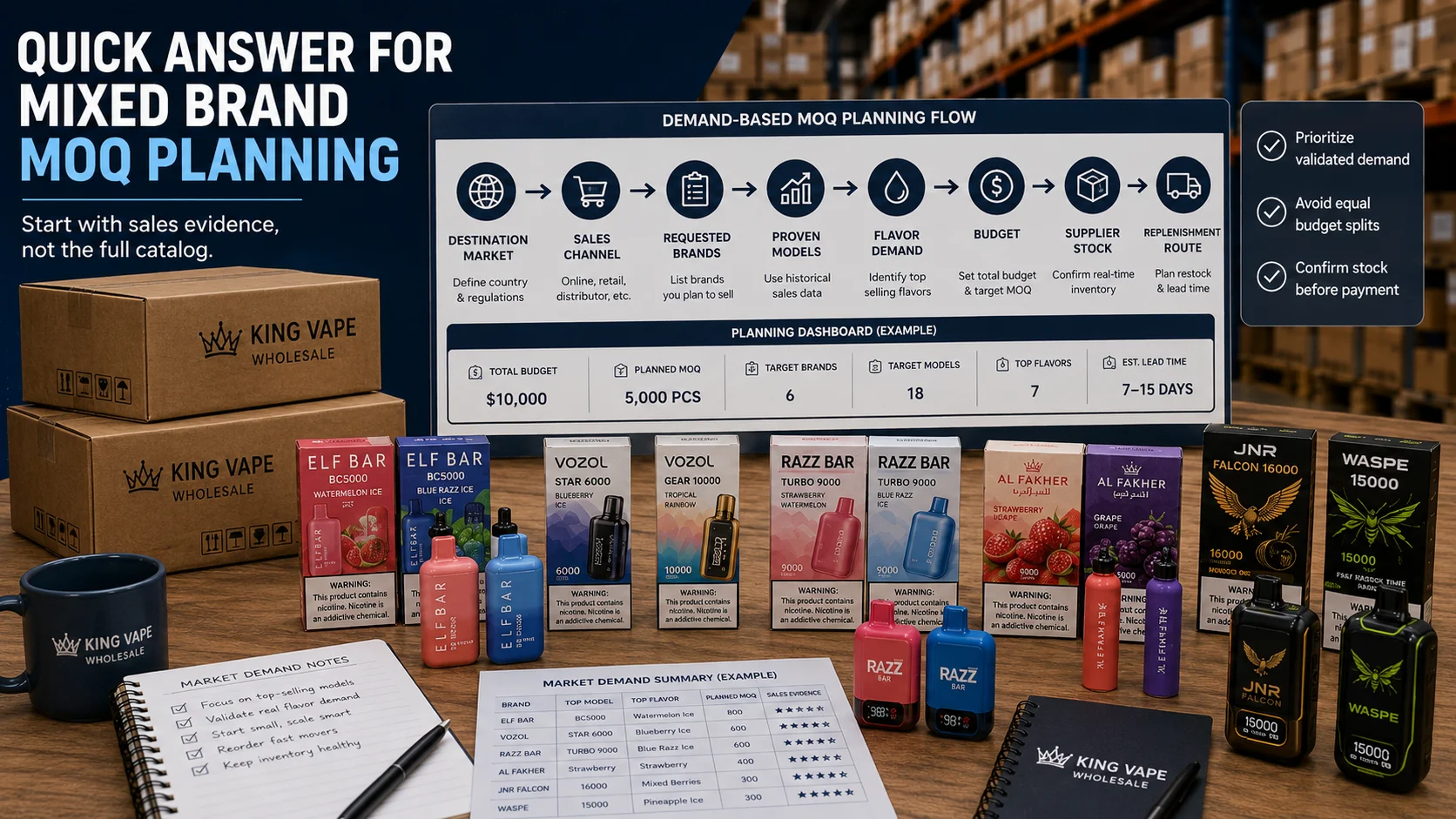
For mixed brand vape wholesale MOQ planning, I recommend allocating quantities according to your destination market, sales channel, requested brands, proven models, flavour demand, available budget, supplier stock, and replenishment route. You should also verify whether products can actually be combined across brands, warehouses, and carton requirements.
Start With the Buyer’s Real Question
Many buyers ask me, “What is the MOQ for this brand?” That question matters, but I believe a more useful question is:
“Which SKUs already have evidence of demand in my own customer channel?”
A broad catalogue can help you source products, but it cannot tell you what your stores will reorder. Before I suggest a mixed vape wholesale order, I normally need to understand:
- Whether you sell to vape shops, smoke shops, gas stations, convenience stores, or direct consumers
- Which brands customers already request
- Which device categories are already moving in your area
- Whether your buyers prefer high-puff disposables, refillable systems, batteries, atomizers, or accessories
- Whether your channel has restrictions on flavours, nicotine formats, packaging, or device capacity
- How quickly you need to replenish successful products
For a first order, I would not treat every brand equally. A product with customer requests or prior sell-through evidence deserves more space than a product selected only because it is new.
I also recommend that buyers verify destination-country requirements and local sales legality independently. Product rules can change by country, state, region, and retail channel.[^1] A commercially attractive price does not make a product suitable for every market.
Why Does Mixed Brand Vape Wholesale MOQ Planning Matter to Wholesale Buyers?
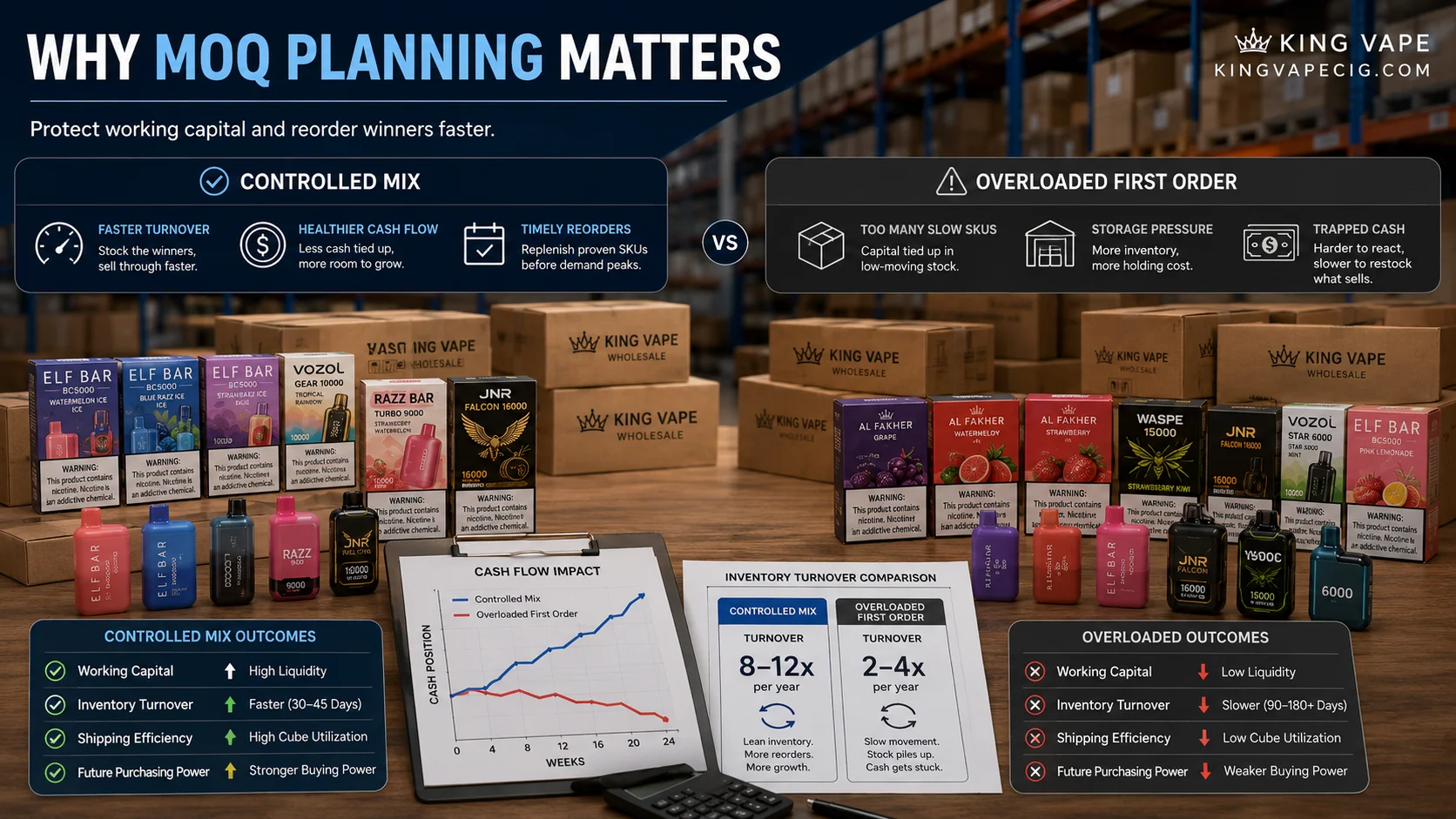
A first mixed-brand order can create flexibility, but it can also spread capital across too many untested products. When cash is tied up in slow-moving flavours or unknown models, buyers may not have enough budget left to reorder the products that customers actually want.
Mixed brand vape wholesale MOQ planning matters because it affects working capital, inventory turnover, product testing range, shipping efficiency, and future purchasing power.[^2] The main goal is not simply to achieve the lowest MOQ. The goal is to keep enough cash and supply capacity available to reorder winning SKUs quickly.
Avoid the “Complete Catalogue” Trap
I have seen buyers build first orders with many brands, many device types, and too many flavours because they want to offer everything immediately. I understand the logic. A wholesaler wants stores to see variety.
However, variety can create hidden pressure:
| Risk Area | What Can Go Wrong |
|---|---|
| Cash flow | Too much money is tied up in stock that has not been tested[^3] |
| Storage | Multiple low-volume SKUs create warehouse complexity |
| Reordering | Best sellers cannot be replenished because the budget is already spent |
| Sales training | Store staff may not understand every model or feature |
| Compliance | Different market versions may not suit the destination |
| After-sales work | More models can mean more packaging, usage, and troubleshooting questions |
A lower MOQ is not automatically lower risk.[^4] For example, a low-MOQ item may have a higher unit cost, weaker local demand, or a slower replenishment route. On the other hand, a carton-level MOQ may be reasonable if the SKU is already requested by multiple stores.
I use a simple principle: a first order should give you enough range to learn, but not so much range that you lose the ability to react.
For smaller wholesalers, a European warehouse route may help reduce upfront exposure when suitable stock is available. KingVape has overseas warehouse inventory in Europe for selected products and brands, with low starting quantities for certain items. However, I always recommend confirming actual inventory, applicable product versions, delivery coverage, and order conditions case by case.
What Should Buyers Confirm Before Setting Order Quantities?
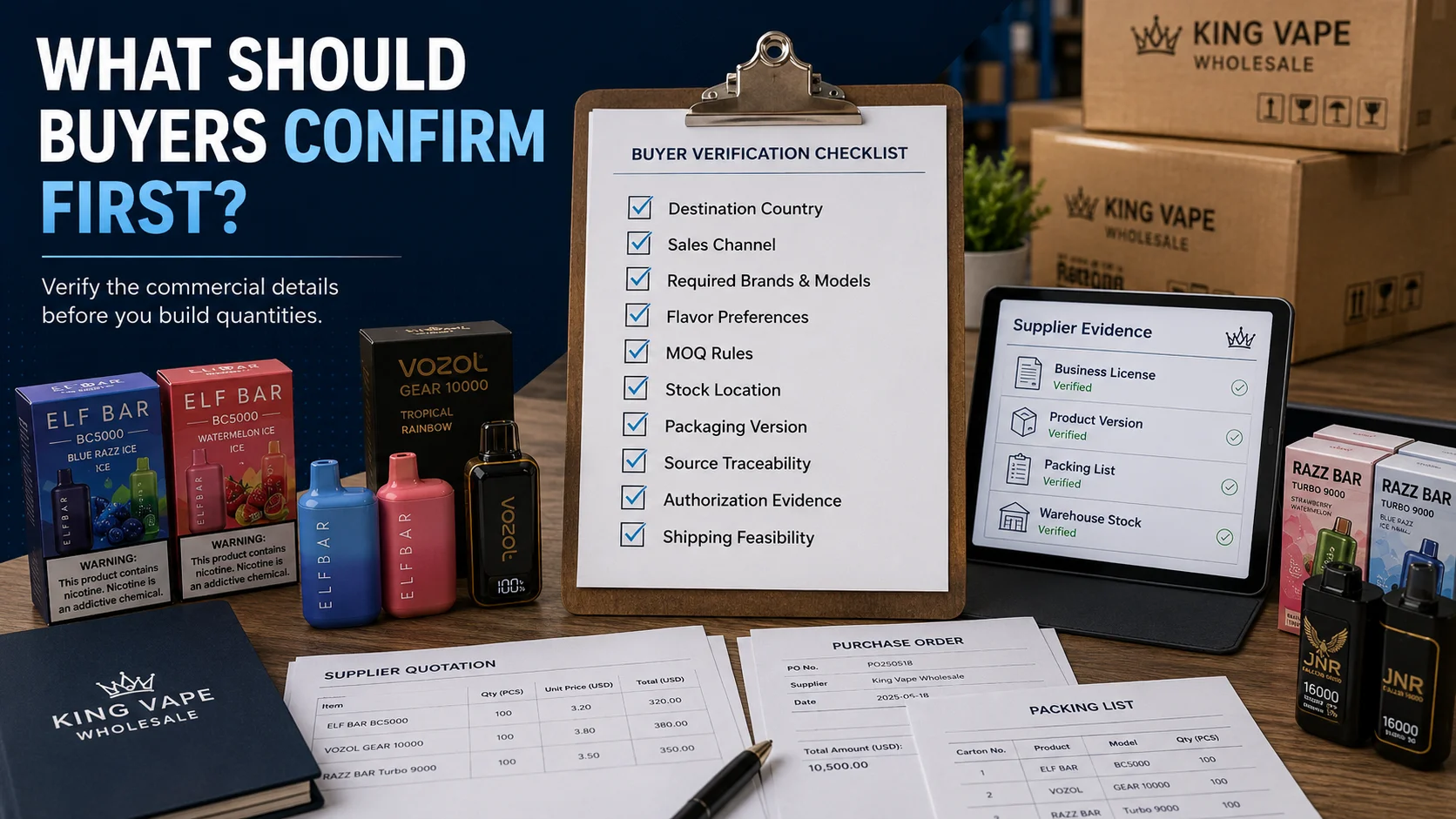
Buyers can make an attractive quotation useless if they do not first confirm the destination market, required specifications, and actual stock position. I often see quantity discussions begin too early, before the buyer and supplier agree on what can legally, practically, and commercially be supplied.
Before setting quantities, buyers should confirm their destination country, sales channel, required brands and models, flavour preferences, practical MOQ rules, stock location, packaging version, traceable source or authorization evidence, and shipping feasibility. These checks should happen before payment, not after the order is built.
Questions I Need Before I Can Suggest a Useful Order Mix
When a buyer sends only a message such as “Please quote your best price,” I can provide a starting quotation, but I cannot responsibly design a purchasing route. I need more commercial context.
I recommend preparing this information:
-
Destination country and delivery city
Shipping routes, product suitability, documentation needs, and delivery time can vary.[^5] -
Your sales channel
A gas-station buyer may need a different assortment from a specialist vape-shop distributor. -
Requested brands and models
I ask buyers to separate “must-have” products from “interesting to test” products. -
Target price range
Your ideal wholesale price helps identify which products can fit your local margin structure. -
Quantity by SKU or category
A product name alone is not enough. Colour, flavour, resistance, battery type, and packaging version can matter. -
Actual stock and supply route
I recommend confirming whether goods are available in China, available in a European warehouse, or subject to a production or replenishment period. -
Source evidence and product documentation
Buyers should ask for the appropriate documentation available for the specific product and market. Brand authorization, invoices, traceable supply information, and compliance documents should be reviewed rather than assumed. -
Shipping feasibility
Vape-related logistics can involve carrier restrictions and destination-specific rules.[^6] Buyers should verify feasibility for each order.
For OEM, custom packaging, custom flavours, or new product development, I would not use the same logic as in-stock multi-brand purchasing. Those projects involve separate material, production, packaging, testing, and MOQ conditions.
Which Mixed-Brand MOQ Planning Option Fits Your Business?
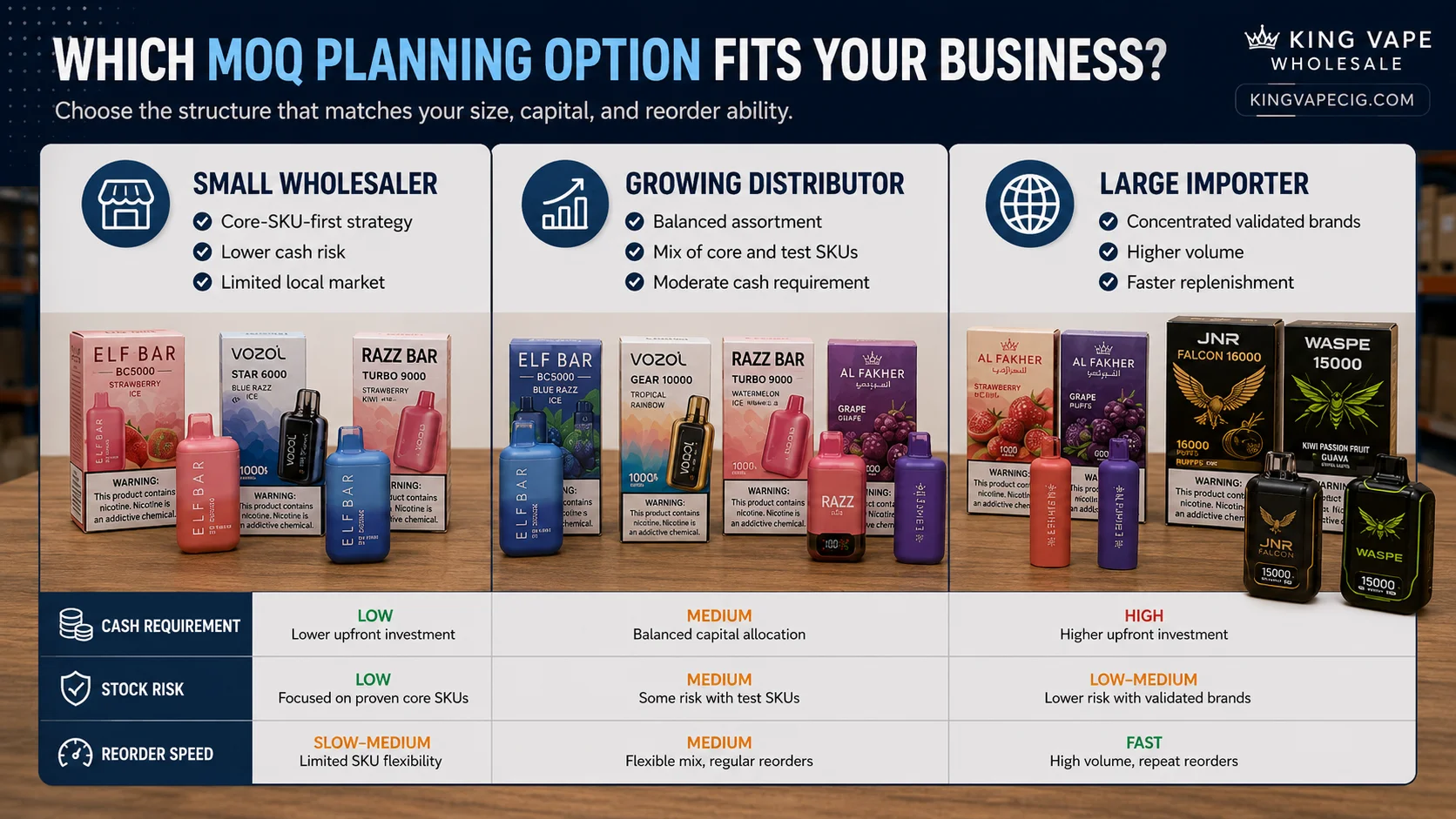
Not every buyer needs the same order structure. A small wholesaler serving a limited local area needs a different plan from an importer supplying hundreds of stores. I recommend comparing order structures by cash requirement and stock risk, not only by the product price.
The best mixed brand vape wholesale MOQ planning option depends on your validated demand, available capital, sales speed, supplier evidence, and ability to reorder. Most early-stage buyers benefit from a core-SKU-first strategy, while larger importers may gain more from concentrated purchasing of validated brands.
| MOQ Planning Option | Supplier Evidence Needed | Cash Requirement | Stock Risk | Best-Fit Buyer |
|---|---|---|---|---|
| Equal quantity across many brands | Stock proof, carton rules, source evidence | Medium to high | High | Rarely ideal for a first order |
| Core SKU priority | Sales evidence, live stock, reorder route | Medium | Lower | Small and mid-sized wholesalers |
| Small multi-brand test | Stock confirmation, mix eligibility, shipping quote | Lower | Moderate | Buyers testing a new market |
| Concentrated order across fewer brands | Brand supply evidence, volume pricing, lead time | High | Lower if demand is proven | Established importers and distributors |
| Overseas warehouse replenishment | Warehouse stock, local delivery coverage | Lower to medium | Lower for selected in-stock items | EU buyers needing faster turnover |
| OEM or private-label production | Production MOQ, artwork approval, material schedule | Medium to high | Varies | Buyers with proven brand plans |
Compare the Real Cost, Not Just the Unit Price
A buyer may see a cheaper unit price on one product and assume it is the better deal. I advise looking beyond that first number.
Your practical cost can include:
- Product unit price
- MOQ-related carton quantity
- Freight or delivery charge
- Consolidation and handling costs
- Inspection costs, if arranged
- Customs, taxes, duties, or local fees where applicable
- Warehousing and shelf space
- Capital tied up before sell-through
- Potential losses from slow-moving inventory
For example, a product that costs $1 less per unit may still be the weaker choice if it requires a larger MOQ and uses money needed for a fast-selling core SKU. I encourage buyers to calculate expected gross margin and expected sell-through together.
How Should You Allocate MOQ Across Brands, Models, and Flavours?
Equal allocation is simple, but it is usually not strategic. If you buy the same quantity of every brand, every model, and every flavour, you are assuming all products will sell at the same speed. In most real wholesale channels, that assumption is not reliable.
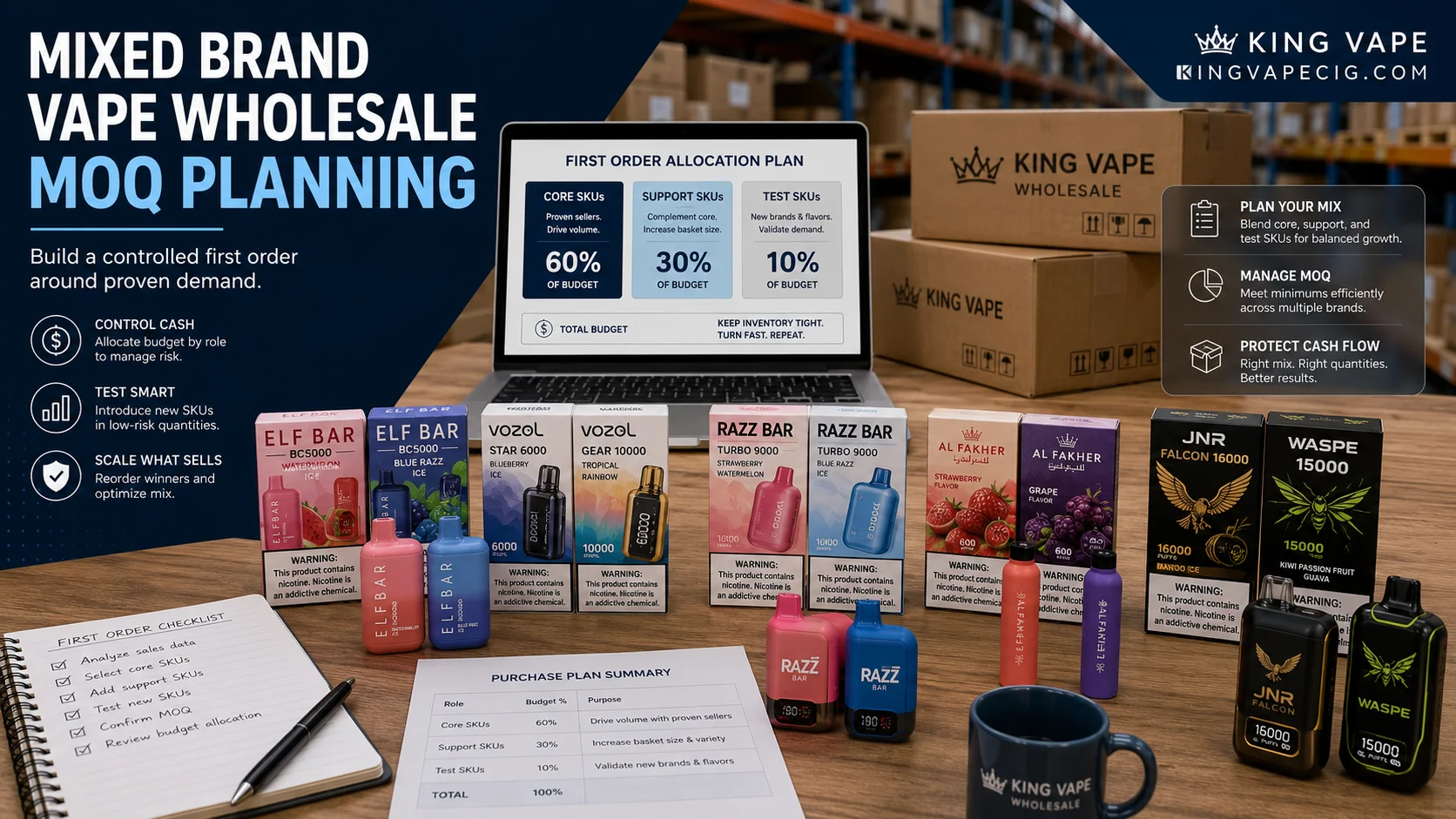
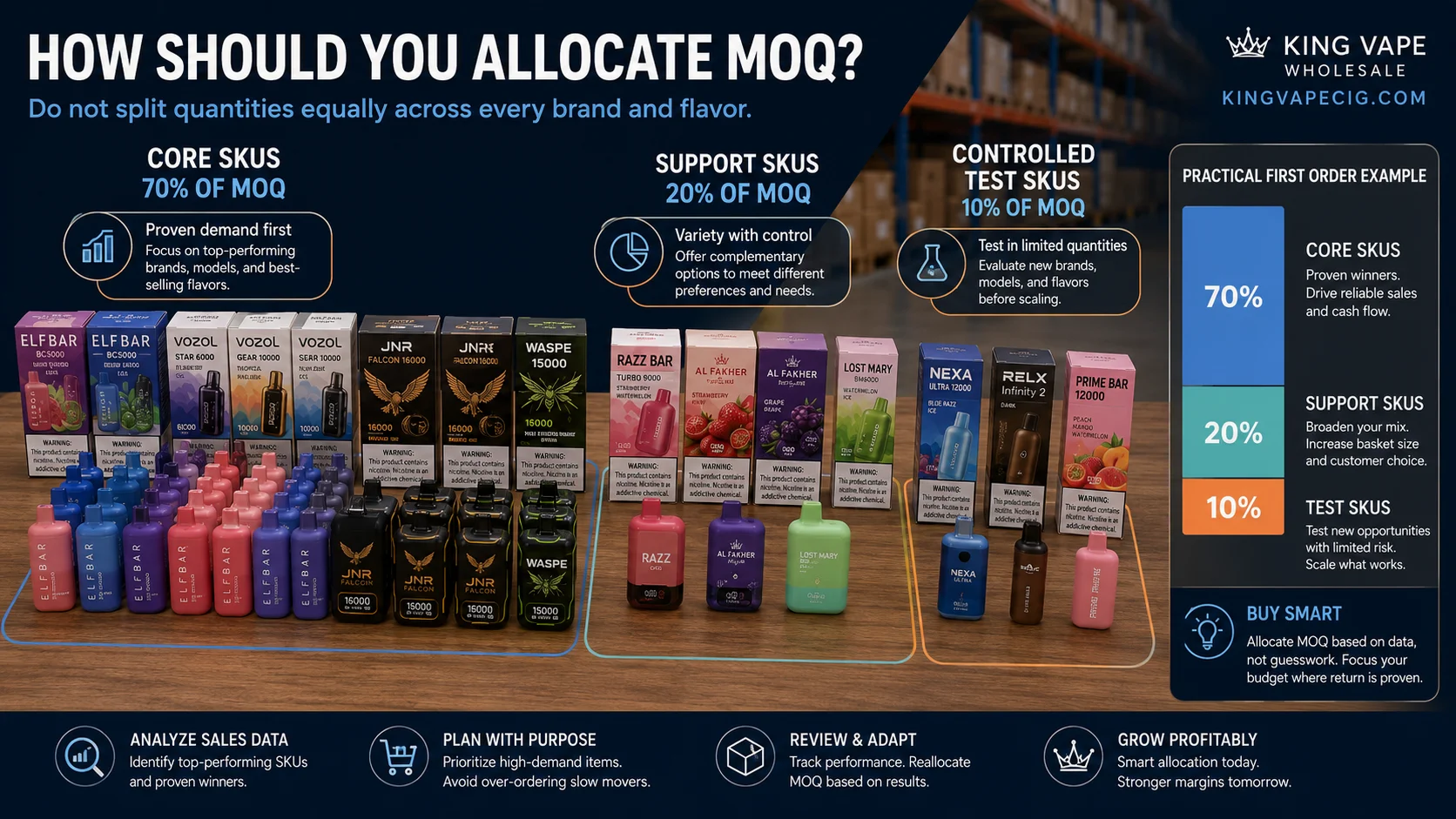
For mixed brand vape wholesale MOQ planning, I suggest separating products into core SKUs, support SKUs, and controlled test SKUs. Most of the first-order budget should go to products with actual channel demand, while a smaller planned portion can test new brands, flavours, or device formats.
A Practical Three-Level Allocation Method
I use a simple structure when discussing first orders with wholesale buyers.
1. Core SKUs: Usually the Largest Share
Core SKUs are products with the strongest evidence of demand. That evidence may come from store requests, prior sales records, repeat customer demand, or a model that your customers already know.
Examples of evidence include:
- Several retail customers asking for the same model
- A known brand with repeat demand in your local market
- A format that already sells through your current channel
- A flavour profile that is consistently requested where legal and appropriate
I generally suggest that core SKUs receive the largest share of the budget.
2. Support SKUs: Enough Variety Without Excessive Exposure
Support SKUs give your customers alternatives. They may include a second device model, a complementary brand, compatible batteries, atomizers, grinders, or other relevant smoke-shop products.
Support products can help you serve more customer needs, but I would keep quantities controlled unless you already have sales evidence.
3. Test SKUs: A Deliberately Limited Experiment
Test SKUs are not random additions. They are small, measurable bets. I recommend choosing only a limited number of trend products, new flavours, or unfamiliar brands.
A useful internal rule can be:
- Core SKUs: about 60–75% of available product budget
- Support SKUs: about 15–30%
- Test SKUs: about 5–15%
These are planning examples, not universal formulas. Your local customer demand, legal environment, MOQ requirements, and budget should decide the final allocation.
How Do MOQ, Lead Time, and Landed Cost Change the Decision?
A low product MOQ can appear attractive until you calculate the full cost of getting the goods into your warehouse. Buyers may also underestimate how a longer delivery period affects cash flow and missed sales. I recommend evaluating quantity, time, and logistics together.
Mixed brand vape wholesale MOQ planning should include the practical landed cost and replenishment timeline for every major SKU. A product is not truly low-risk simply because its MOQ is small; it must also fit your margin, delivery window, storage capacity, and ability to reorder after sell-through.[^7]
Build a Replenishment-Focused Cost Sheet
I recommend creating a basic worksheet before payment. You do not need complex software. A spreadsheet can be enough.
| SKU | MOQ | Product Cost | Estimated Landed Cost | Expected Sales Speed | Reorder Route | Decision |
|---|---|---|---|---|---|---|
| Proven core device | Carton-based | Medium | Medium | Faster | In-stock or scheduled | Prioritize |
| New flavour range | Small quantity | Medium | Medium to high | Unknown | Check availability | Test only |
| Accessory item | Low MOQ | Low | Low | Moderate | Often easier to replenish | Support SKU |
| Custom OEM product | Production MOQ | Varies | Varies | Depends on your brand | Production lead time | Separate project |
Consider the Supply Route
For buyers who import from China, I recommend allowing time for stock preparation, consolidation, export handling, shipping, customs procedures, and local delivery. Actual timing can vary widely due to route conditions, carrier capacity, inspection, and destination requirements.[^8]
For eligible EU customers, selected stock from European warehouses may reduce delivery time and lower the amount of capital committed to a large advance order. Our European warehouse network can serve suitable orders through local courier options such as DHL, DPD, UPS, or FedEx, depending on destination and availability. Buyers should still confirm stock, terms, shipment suitability, and local compliance before placing an order.
For larger importers, direct China purchasing may offer better volume economics and more OEM/ODM options. However, this route usually requires stronger demand forecasting, larger working capital, and more careful delivery planning.
What Mixed-Brand Order Mistakes and Red Flags Should Buyers Avoid?
A mixed order can fail long before the goods arrive. The most common problems usually come from unclear product versions, unverified stock, unrealistic quantity splits, or decisions based only on the lowest quoted unit price. I recommend slowing down before payment and checking the commercial details.
The main red flags in mixed brand vape wholesale MOQ planning include equal budget allocation without demand evidence, too many untested SKUs, unclear “in-stock” claims, mixed market versions, ignored carton quantities, and quotations that do not show the practical supply route. Each issue can affect your margin and reorder ability.
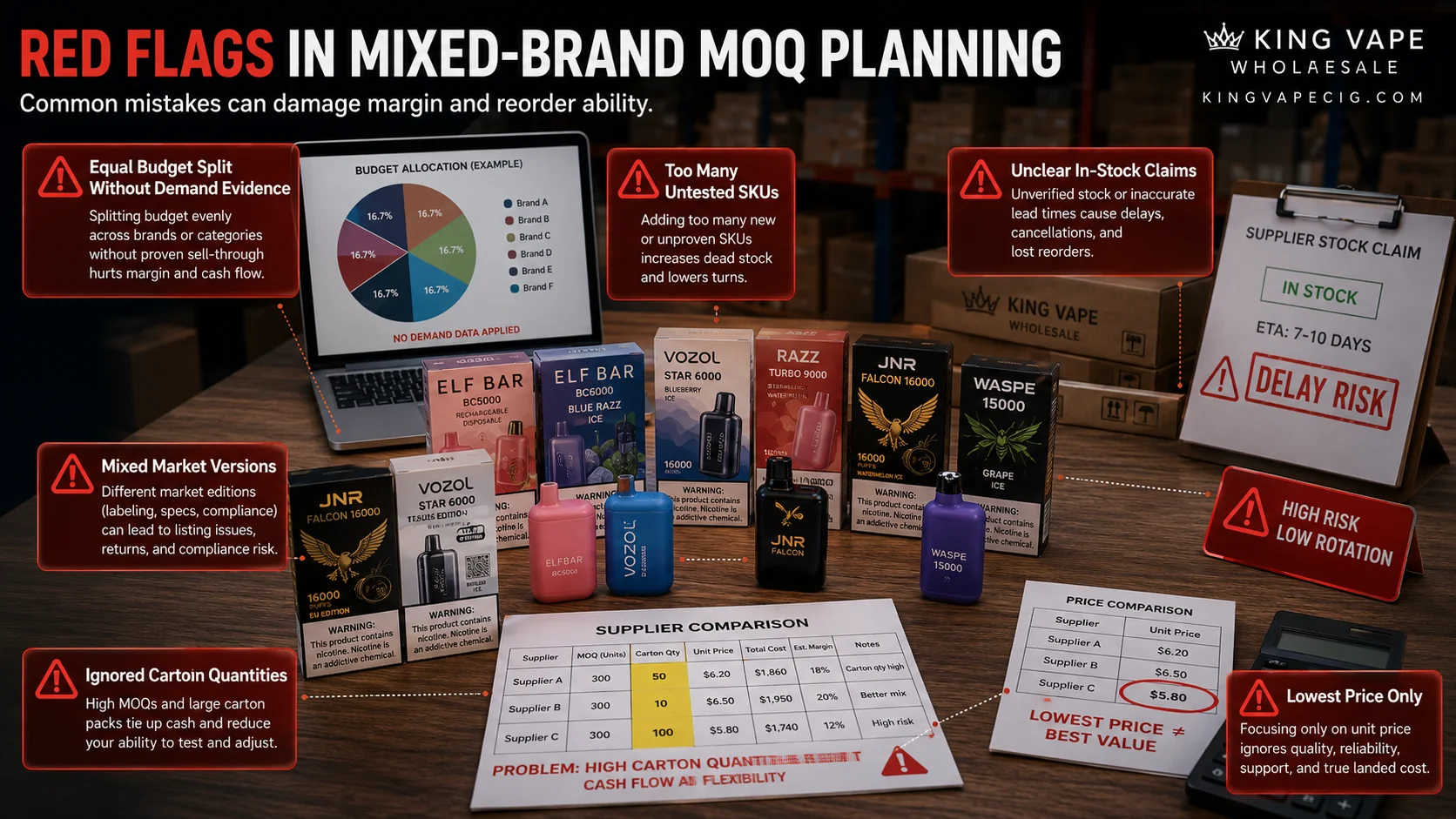
Mistakes I Encourage Buyers to Avoid
-
Buying every flavour in equal volume
Flavour demand can differ sharply by location, retail channel, and consumer preference.[^9] -
Selecting too many brands for a first order
More brands can mean more complexity, not necessarily more sales. -
Accepting “ready stock” without confirmation
Stock can change quickly. I recommend confirming the exact model, flavour, colour, packaging, warehouse location, and available quantity. -
Mixing product versions meant for different markets
Packaging, specifications, labelling, and compliance requirements can vary.[^10] Buyers should evaluate market suitability independently. -
Ignoring carton and inner-box requirements
A supplier may quote a unit price, while the practical order must follow carton quantity rules. -
Comparing only product price
Freight, landed costs, cash tied up, and slow-moving inventory can change the result. -
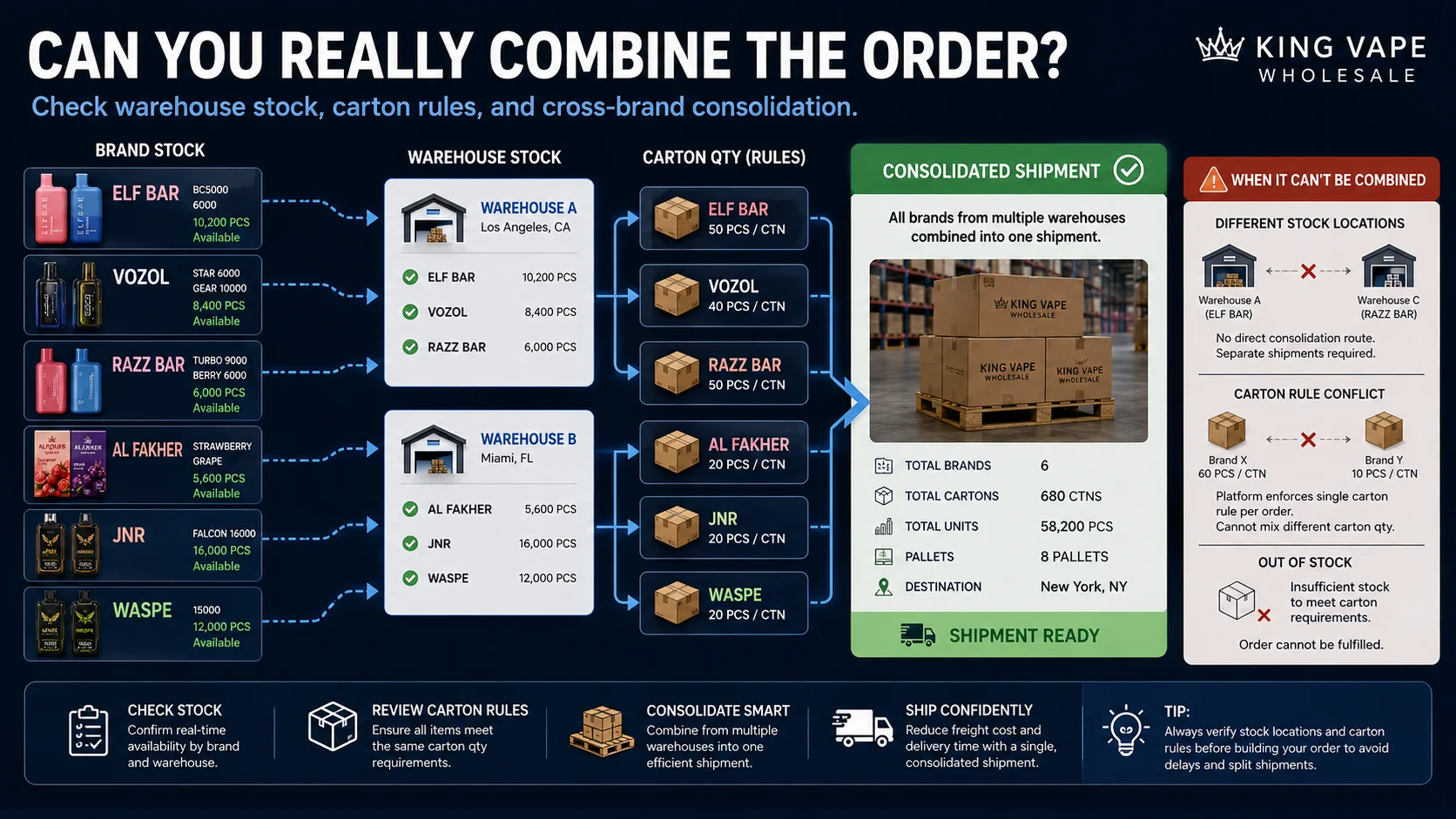
Assuming brands can always share one MOQ
Some products can be consolidated, while others must follow separate brand, warehouse, or carton requirements. This should be checked order by order. -
Treating OEM as a small in-stock test order
OEM and ODM projects have separate conditions. Custom packaging, mould development, materials, and production schedules require their own evaluation.[^11]
What Is the Practical Buyer Checklist Before Placing a Mixed-Brand Order?
A first order should be a controlled learning process, not a blind inventory gamble. Buyers need a clear route from market demand to supplier verification, then from a small test to a data-based reorder. I recommend documenting each decision so you can improve the next purchase.
A practical mixed brand vape wholesale MOQ planning checklist starts with your market and sales channel, then moves through SKU selection, stock verification, cost calculation, inspection planning, and measured replenishment. This process helps you protect working capital while still giving customers useful product choice.
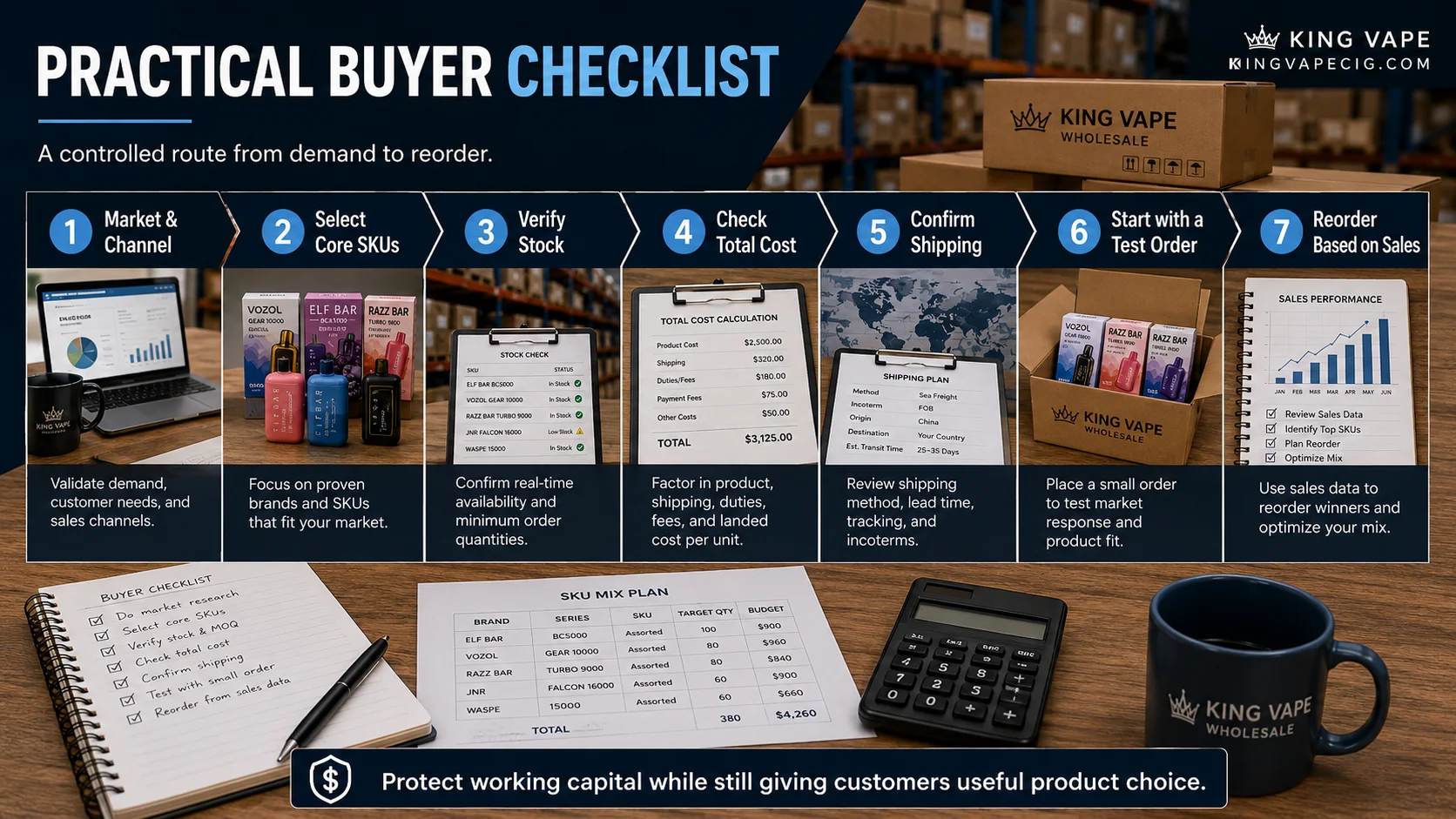
Follow This Order Before You Pay
-
Define your destination market and customer channel.
Identify where the products will be sold and which customer type you serve. -
List requested brands and proven product categories.
Separate confirmed demand from products you simply want to explore. -
Choose core, support, and test SKUs.
Do not give every SKU the same quantity automatically. -
Confirm MOQ rules for each selected item.
Check whether MOQ applies by brand, model, flavour, inner box, carton, warehouse, or production run. -
Request current stock confirmation.
Ask for the exact version and available quantity before payment. -
Review source evidence and available documentation.
Buyers should verify relevant authorization, supply traceability, and product documents for their intended market. -
Calculate estimated landed cost.
Include goods, shipping, handling, taxes or duties where applicable, and possible inspection costs. -
Confirm consolidation and shipment feasibility.
Ask whether the goods can ship together and what route is appropriate. -
Consider independent inspection where appropriate.
A qualified third party can help verify application-specific details before shipment.[^12] -
Track sales and reorder from evidence.
Reorder the winners first. Reduce or stop products that do not move as expected.
I have found that this process gives buyers a better chance of staying flexible. The goal is not to predict every best seller perfectly. The goal is to make the first order small enough to learn and strong enough to support fast replenishment.
Frequently Asked Questions
Can different vape brands share one total MOQ?
Sometimes they can, but buyers should not assume this. Each brand, product model, warehouse, carton configuration, and supply route may have separate conditions. I recommend confirming mix-and-match eligibility, available stock, and carton rules in writing before you finalize a mixed order.
Should my first vape wholesale order include many flavours?
I would not recommend including every available flavour unless you already have strong demand evidence. A first order should focus on requested or proven flavour profiles, with a limited number of carefully selected test options. This approach helps reduce slow-moving stock.
What supplier evidence is most useful for a mixed-brand order?
Useful evidence can include current stock confirmation, product photos or videos, packaging details, carton specifications, traceable supply information, relevant authorization documents where applicable, and clear shipping terms. Buyers should review documents for their destination market rather than relying on general statements.
When should buyers use a smaller trial order?
A smaller trial order can be useful when you are entering a new market, testing a new brand, evaluating an unfamiliar device type, or selling to a new customer channel. However, a small MOQ is not automatically the best value, so I recommend checking landed cost and reorder feasibility.
Can different brands be inspected and shipped together?
This can be possible when products are available through compatible warehouses and supply routes. However, it depends on actual stock locations, carton requirements, inspection arrangements, and shipping feasibility. I recommend confirming consolidation details before payment rather than assuming all products can be combined.
Request a Practical Multi-Brand Purchasing Route
Mixed brand vape wholesale MOQ planning works best when it reflects your real sales channel instead of a generic product list. A controlled first order can help you test demand, protect cash flow, and keep funds available for fast-moving replenishment. I recommend focusing on core SKUs first, testing only selected new items, and checking evidence before you commit.
Send KingVape your destination country, sales channel, required brands, target quantity, budget range, and delivery destination. I can help you review MOQ allocation, stock availability, sourcing evidence, consolidation feasibility, and major order risks.
You can contact me at info@kingvapecig.com or visit www.kingvapecig.com to discuss multi-brand wholesale supply, in-stock purchasing options, and OEM/ODM opportunities for qualified projects.
[^1]: "E-Cigarettes, Vapes, and other Electronic Nicotine Delivery ...", https://www.fda.gov/tobacco-products/products-ingredients-components/e-cigarettes-vapes-and-other-electronic-nicotine-delivery-systems-ends. International and national regulatory authorities document that rules for electronic nicotine-delivery systems differ across jurisdictions and may be supplemented by national, regional, state, or local requirements. Evidence role: general_support; source type: institution. Supports: That laws governing electronic nicotine-delivery products differ among countries and may be supplemented by subnational or local restrictions.. Scope note: The cited regulatory overview does not establish the legal status of any particular product in a specific destination market. [^2]: "the promise of fintech for micro and small enterprises", https://documents1.worldbank.org/curated/en/099063023144019557/pdf/P1743540cb2bcb0e5098310bc4228598684.pdf. Inventory-management research describes inventory as a working-capital commitment and identifies inventory turnover as a measure of the rate at which stock is sold and replaced. Evidence role: mechanism; source type: research. Supports: That inventory investment ties up working capital and that inventory turnover is a standard measure of how efficiently inventory is converted into sales.. Scope note: This evidence explains the general financial mechanism and does not predict turnover for a particular vape assortment. [^3]: "Manage your finances | U.S. Small Business Administration", https://www.sba.gov/business-guide/manage-your-business/manage-your-finances. Working-capital guidance explains that funds invested in inventory remain unavailable for other uses until the goods are sold and converted back into cash. Evidence role: mechanism; source type: education. Supports: That unsold inventory represents capital committed to stock and can reduce liquidity available for operating needs or replenishment.. Scope note: The source addresses general business finance rather than the sales performance of any individual product category. [^4]: "Inventory Management for Supply Chains with Uncertainty", https://preserve.lehigh.edu/lehigh-scholarship/graduate-publications-theses-dissertations/theses-dissertations/inventory-0. Inventory-optimization studies show that minimum-order constraints must be evaluated together with demand uncertainty, purchasing costs, and inventory holding costs, so a smaller MOQ alone does not determine commercial risk. Evidence role: mechanism; source type: paper. Supports: That minimum-order constraints interact with demand uncertainty, unit cost, ordering cost, and inventory holding cost rather than independently determining inventory risk.. Scope note: The research provides a general inventory model and does not evaluate a particular supplier's MOQ terms. [^5]: "WTO Trade Facilitation Agreement", https://www.congress.gov/crs_external_products/R/PDF/R44777/R44777.4.pdf. International trade-facilitation bodies report that customs procedures, documentary requirements, and border-processing conditions differ among economies and can affect shipment timing. Evidence role: general_support; source type: institution. Supports: That cross-border trade procedures, documentary requirements, and transit conditions vary across routes and importing economies.. Scope note: Such sources describe systemic variation and cannot establish a delivery date or documentation list for a specific consignment. [^6]: "Treatment of E-Cigarettes in the Mail", https://www.federalregister.gov/documents/2021/10/21/2021-22787/treatment-of-e-cigarettes-in-the-mail. Transport and postal authorities publish restrictions for electronic cigarettes and lithium-battery devices, while destination import rules may impose additional conditions on their carriage or entry. Evidence role: general_support; source type: institution. Supports: That transport of electronic cigarettes and related devices can be restricted by transport rules, carrier policies, battery-safety requirements, and destination regulations.. Scope note: Applicable requirements depend on the carrier, transport mode, battery configuration, and destination, and must be checked for the individual shipment. [^7]: "Capacity in Supply Chain Management: A Practical Guide", https://blogs.bu.edu/kongta/capacity-supply-chain-management-guide/. Operations-management literature treats inventory risk as a function of demand, replenishment lead time, capacity constraints, and carrying costs rather than minimum order quantity alone. Evidence role: mechanism; source type: paper. Supports: That inventory decisions are jointly affected by demand, lead time, replenishment capability, capacity constraints, and the costs of carrying stock.. Scope note: The source supports the decision framework but does not calculate the appropriate order quantity for a specific retailer or wholesaler. [^8]: "Logistics performance index - Glossary | DataBank - World Bank", https://databank.worldbank.org/metadataglossary/world-development-indicators/series/LP.LPI.CUST.XQ. Trade and logistics institutions identify transport capacity, route conditions, border clearance, and inspection processes as factors that can affect international shipment transit times. Evidence role: mechanism; source type: institution. Supports: That transport capacity, route disruptions, border clearance, and inspections can affect international transit and delivery times.. Scope note: These factors explain possible variation but cannot guarantee or forecast the transit time of a particular shipment. [^9]: "A systematic review of consumer preference for e-cigarette attributes", https://pmc.ncbi.nlm.nih.gov/articles/PMC5854347/. Population surveys of e-cigarette use report differences in flavor preferences across user groups, indicating that demand patterns are not uniform across consumers. Evidence role: general_support; source type: government. Supports: That e-cigarette flavor use and preferences differ across surveyed demographic groups and populations.. Scope note: Population survey findings may not represent local wholesale demand, individual retail channels, or markets outside the surveyed jurisdiction. [^10]: "Labeling and Warning Statements for Tobacco Products", https://www.fda.gov/tobacco-products/products-guidance-regulations/labeling-and-warning-statements-tobacco-products. Government regulatory frameworks for electronic cigarettes include market-specific requirements for product presentation, labeling, notifications, and—in some jurisdictions—technical product characteristics. Evidence role: general_support; source type: government. Supports: That electronic-cigarette markets may impose requirements concerning labeling, packaging, product notifications, nicotine content, or technical characteristics.. Scope note: Requirements vary by jurisdiction and product type; the source does not confirm compliance of any specific packaging or device version. [^11]: "Manufacturing and Quality | www.waru.edu", https://www.waru.edu/tools/dau-systems-engineering-brainbook/design-considerations/manufacturing-quality. Manufacturing-planning research indicates that customized products may require coordinated decisions on tooling, material availability, packaging specifications, and production scheduling before production can begin. Evidence role: mechanism; source type: research. Supports: That customized manufacturing introduces product-development and production-planning dependencies involving tooling, materials, packaging, and lead time.. Scope note: The evidence concerns customized manufacturing generally and does not establish the requirements or lead time of a particular OEM project. [^12]: "Trade Guide: WTO PSI", https://www.trade.gov/trade-guide-wto-psi. International trade rules and guidance recognize pre-shipment inspection as a process that may verify specified aspects of goods, including quantity, quality, price, or classification, before shipment. Evidence role: general_support; source type: institution. Supports: That pre-shipment inspection is a recognized process for checking specified characteristics such as quantity, quality, price, or classification before export.. Scope note: An inspection only covers the scope, sampling method, and criteria agreed for that inspection and does not guarantee future product performance or regulatory acceptance.