
You've found a good device, negotiated a price, and then the factory asks: "What kind of packaging do you want?" This is the moment where many new brand owners and traders freeze. A wrong answer here doesn't just delay a shipment. It can trap your cash in a warehouse full of products no store wants to put on the shelf. Trust me. I am King, I run a vape factory in Shenzhen, and I have watched this single decision kill more margins than any price negotiation ever could.
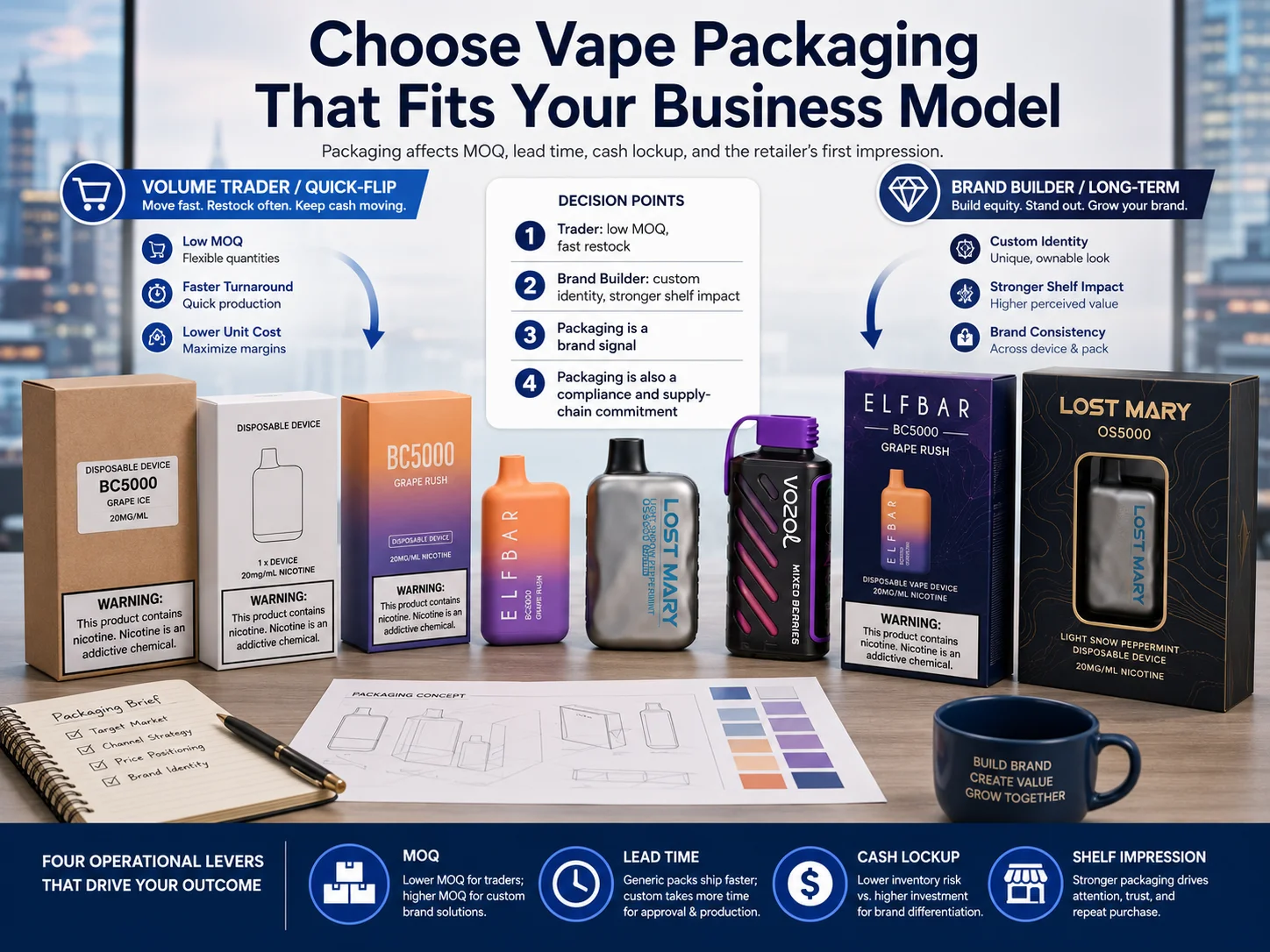
The right packaging is not the cheapest box or the flashiest foil stamp. The right packaging matches your business model—whether you're a trader who needs to flip stock fast or a brand builder who needs visual consistency across a product line. Your choice directly controls your Minimum Order Quantity (MOQ), your lead time, your cash lockup, and the first impression a retailer gets when they open a sample.
You came here to understand which option fits your project. I'm going to give you the same framework I use in factory meetings with my own clients. No design jargon. Just the trade-offs that hit your real costs, your real timeline, and your real sales.
How Should Buyers Choose Private Label Vape Packaging?
Most buyers start by asking a supplier for a packaging list and a unit price. This is the classic mistake. You are not buying a box. You are buying a brand signal, a compliance tool, and a supply chain commitment all at once.
Pick a packaging solution by first defining your go-to-market strategy. A volume trader needs low MOQ sticker labels on a generic tube. A brand builder needs a fully custom box with matching inserts, even if the unit cost is higher, because visual consistency is what builds repeat shelf placement[^1].
I remember a client from Spain who ran a wholesale model near tourist areas. He only cared about speed and cost. We gave him simple white boxes with clear labels—nothing fancy. His retailers didn't care about the brand. They cared about having a recognizable product photo on display. Another client, an American distributor building a house brand for over thirty vape shops, spent extra on a rigid box with magnetic closure. When a shop owner compared two disposable vapes side by side, that rigid box made his product look like the premium choice, even though the device inside was almost identical in performance. The packaging was the silent salesman. That's how you should think about it. The question is never "which packaging is best?" but "which packaging makes a retailer reach for my sample first?" That mental shift will save you more money than any price negotiation ever will.
What Does Packaging Mean in a Private Label Vape Project?
Some clients enter a project thinking packaging is just a protective shell. In practice, it's the physical container for your brand promise and your legal backstop.
Packaging in a private label vape project includes the outer box, inner tray, manual, warning card, tamper seal, batch code, and all compliance markings required by your target market. Missing one element can block an entire shipment at customs.
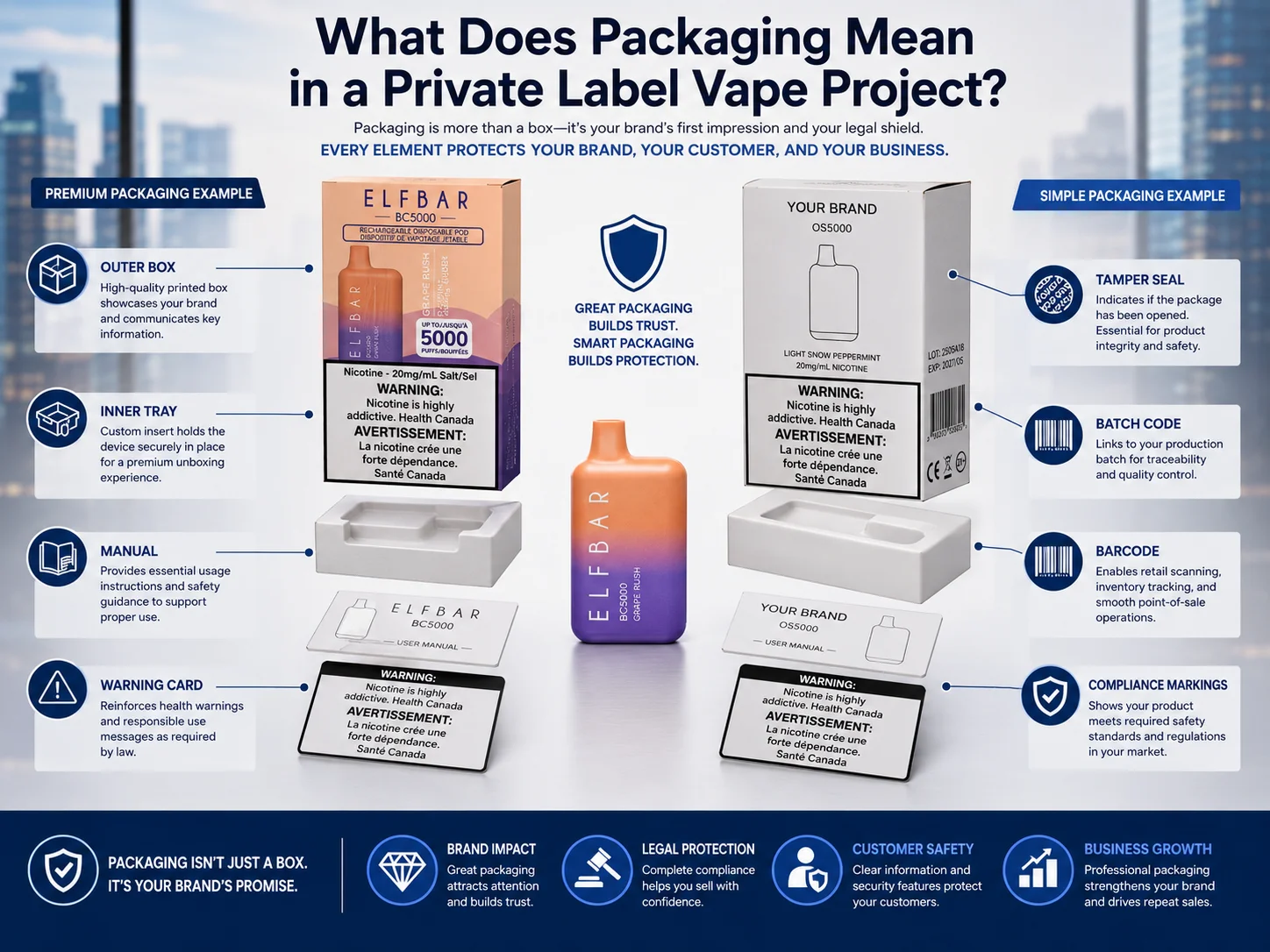
Let me be direct. When I onboard a new OEM client, I always ask: "What does your end customer see first?" If you say "the device," you have already lost. The end customer in a retail store doesn't see the device until after they've decided to pick up the box. Your packaging has to do three jobs simultaneously. First, it must win a split-second shelf battle against ten other vape brands. Second, it must carry child-resistant features and warning text that satisfy the law. Third, it must survive international shipping without crushing. I've seen a shipment of 20,000 units arrive with collapsed boxes because a client chose a thin single-layer cardboard to save $0.03 per unit. The product inside was fine, but no shop accepted the damaged outer packaging. The "saved" cost turned into a full write-off. So when we talk about packaging, we talk about a profit-protection system, not an expense line.
Comparison Table: Sticker Label, Sleeve Box, Custom Box, Display Box, and Full OEM Packaging
I often see buyers get lost in the options. Let me break down the five common types you will face.
| Packaging Type | Typical MOQ | Lead Time Impact | Unit Cost | Best For | Risk Factor |
|---|---|---|---|---|---|
| Sticker Label on Generic Box | No extra MOQ | Fastest | Lowest | Quick-flip trading models, small wholesalers | Zero brand stickiness; looks cheap |
| Sleeve Box | 500-1000 units | +5-7 days | Low-Medium | Small brand starters, limited edition runs | Sleeve can slide off in transit if not sized right |
| Custom Print Box | 3000-5000 units | +10-15 days | Medium | Mid-size brands building visual identity | Die-cut delay; print color mismatch risk |
| Display Box (Countertop) | 500-1000 display units | +15-20 days | High per unit | Gas station and convenience store chains | Expensive to ship; assembly needed |
| Full OEM Packaging (Rigid, insert, magnetic) | 5000+ units | +20-30 days | Highest | Established brands competing at premium tier | High mold investment; design lock-in |
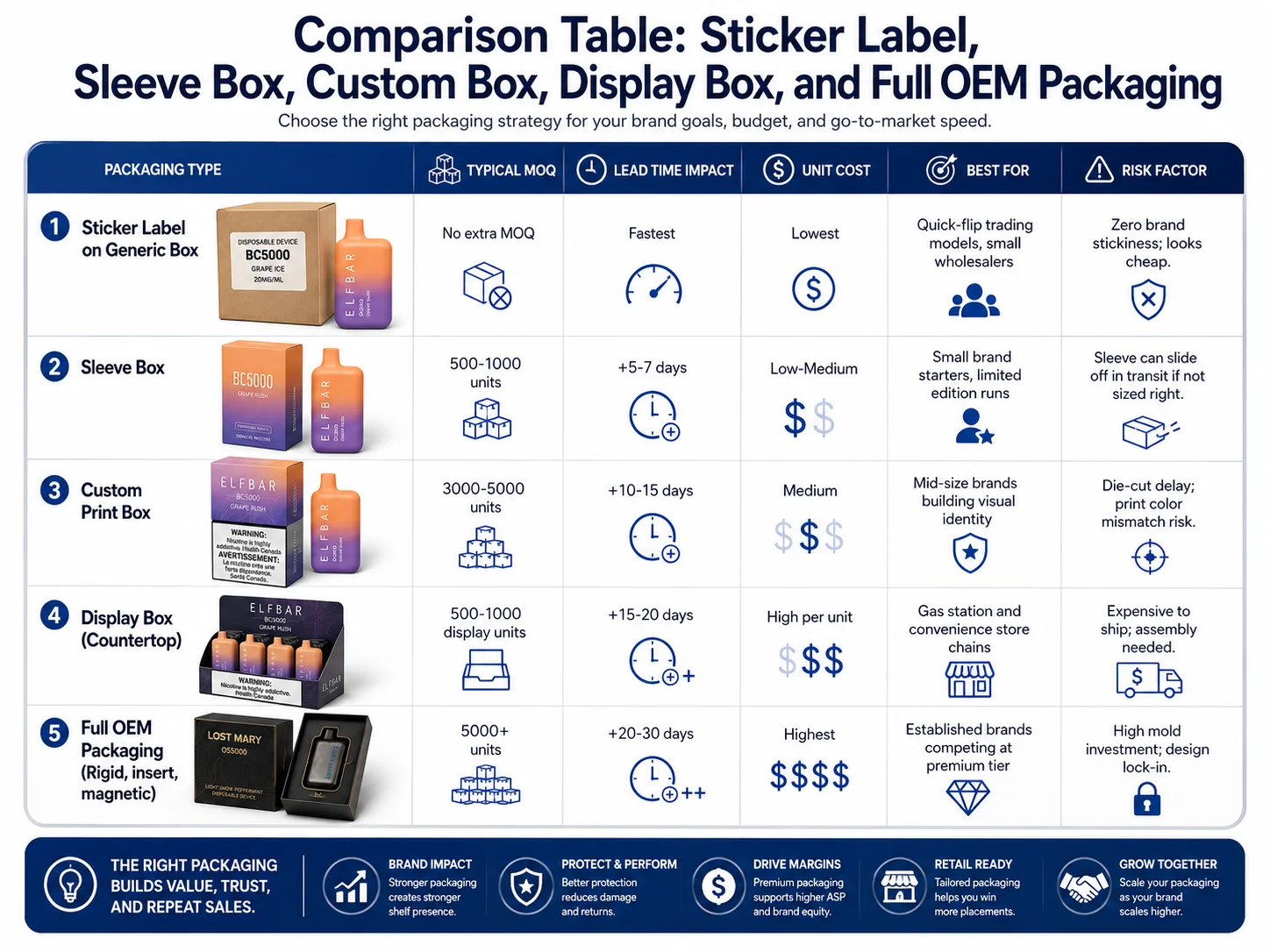
I include this table in almost every first client discussion. What you should notice: the jump from a sleeve box to a custom print box isn't just about money. It is about time. A sleeve can often use existing blank stock with a printed wrap added quickly. A custom box requires a die-cut mold to be made. That die-cut mold takes time and has its own cost, and if you make a design error, changing the box shape later means a new mold. I have had a client from the Middle East who insisted on a unique hexagonal box for aesthetic reasons. It looked beautiful, but the mold took three weeks, and when he needed a second batch urgently during peak season, the packaging lead time alone forced him to air-ship boxes, which cost more than the vapes inside[^2]. Choose your shape carefully.
How Packaging Choice Affects MOQ, Lead Time, Cost, and Brand Control
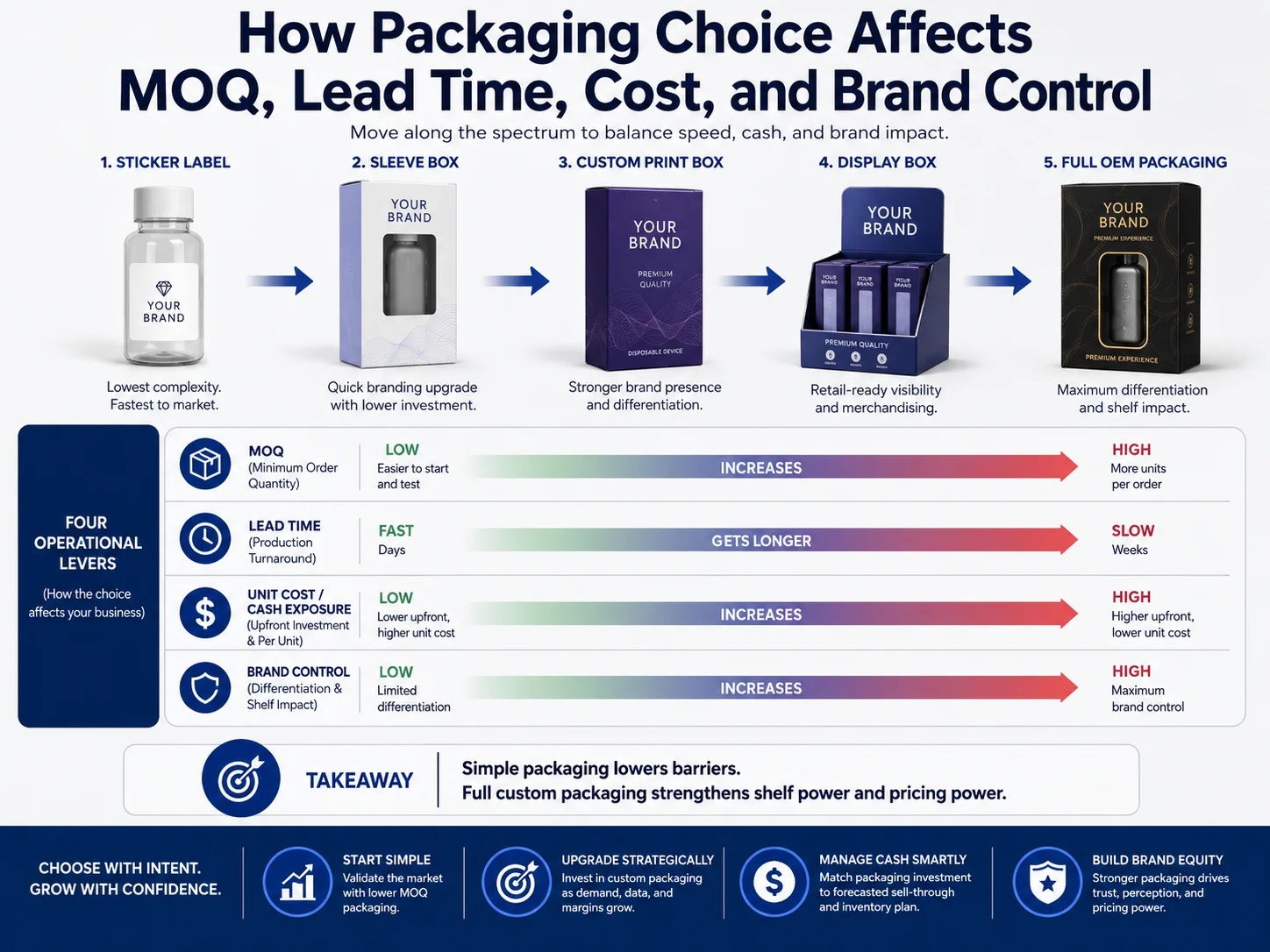
The packaging style you select instantly locks in four operational variables. If you ignore this, you will be surprised later.
A sticker-label approach gives you the lowest MOQ and fastest turnaround but offers zero brand defense. A full custom box increases your MOQ and cash exposure upfront but gives you total control over how the product looks on a shelf, which protects your pricing power over time.
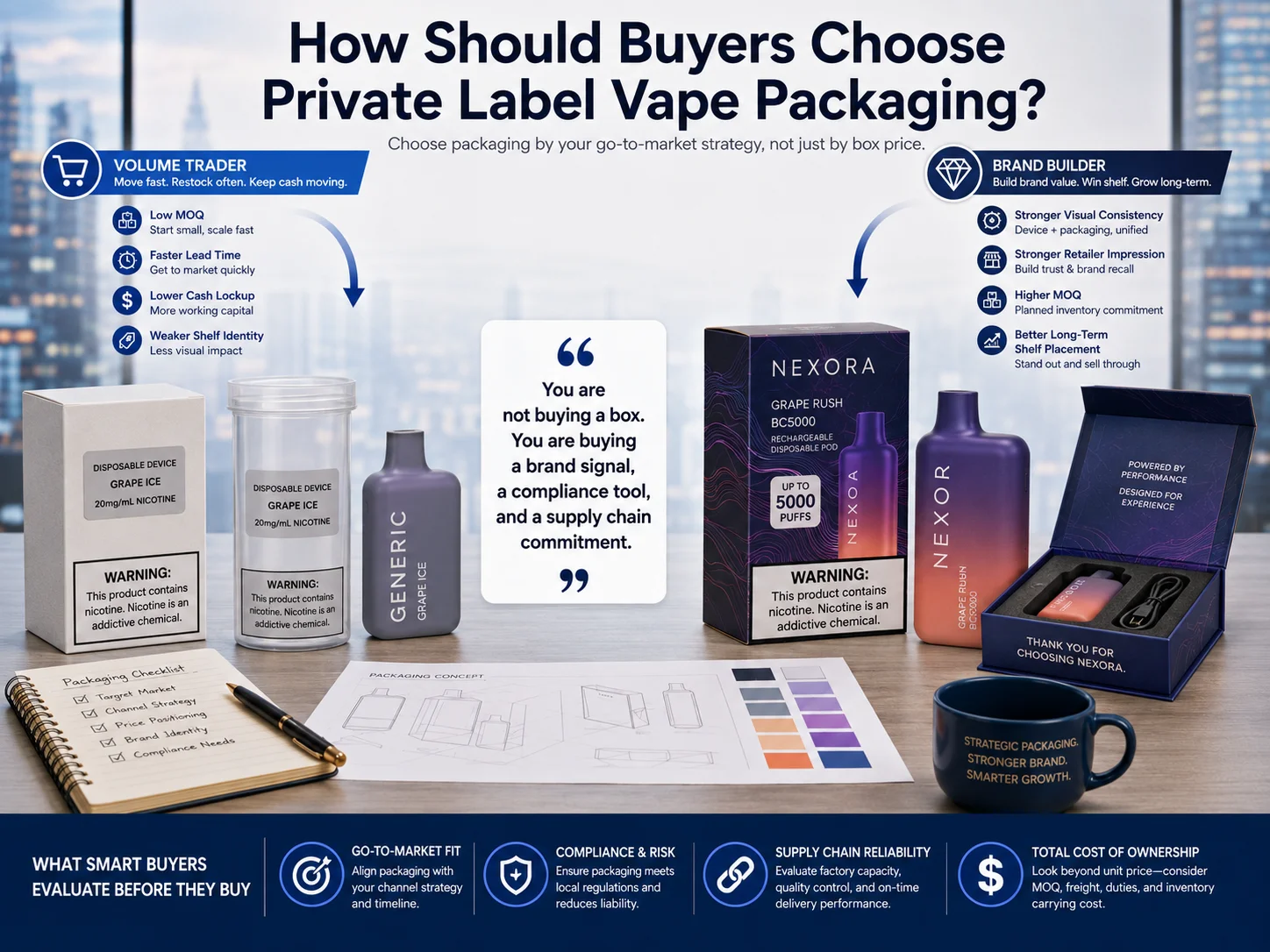
Let me make this tangible. Imagine you are a trader moving products to smoke shops. You want 500 units of five different flavors. A factory willing to do full custom boxes for 500 mixed flavors is rare, and if they agree, the per-unit cost will be high because of setup charges on small quantities. A sticker label strategy is your friend here. You use one neutral tube, print five different flavor labels, and you avoid a $500 design setup fee. Now, flip the scenario. You are a brand builder who has just secured shelf space in a chain of forty convenience stores. Your product sits next to an established competitor. If your box looks like a generic tube with a crooked sticker, the store manager might move your product to a lower shelf within two weeks. The tiny extra cost of a proper print box is actually a shelf-position insurance policy. I always tell my clients: "Your packaging cost is not a unit expense; it is your rent payment for retail shelf space." When you see it that way, MOQ and lead time become business negotiation points, not just production details.
What Packaging Details Should Buyers Confirm Before Starting Production?
A packaging briefing should be precise. Vague instructions cause delays. I have a checklist I make every client complete.
Confirm the exact dimensions, material thickness, closure type, surface finish, inner tray layout, and location of the batch code and barcode before a single box is produced. The smallest omission—like forgetting a hang tab hole for a retail pegboard—makes hundreds of boxes useless in specific stores.
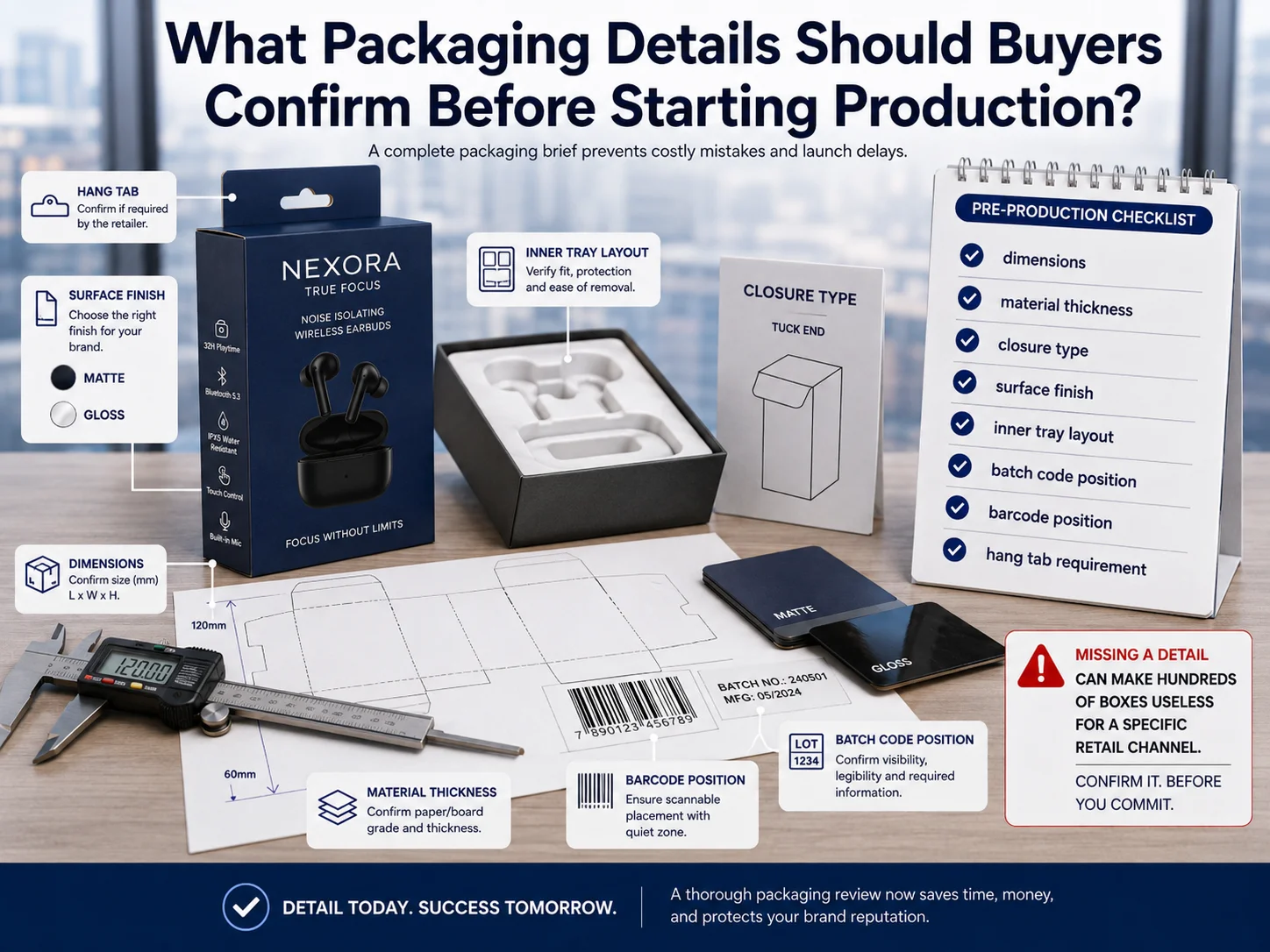
I learned this lesson from a painful experience. A European client sent a design file with a beautiful 3D render. No one checked the physical sample size against the actual device. When the boxes arrived, the device moved slightly inside because the foam insert was 1mm too loose. The rattling made the product feel cheap. We had to redo the entire batch. Now, here is my standard pre-production packaging checklist: 1) Device fit test with a physical sample, not just a drawing. 2) Barcode and QR code scannability check under store lighting. 3) Hang tab position and tear strength for retail hangers. 4) Child resistance mechanism physical test. 5) Tamper-evident seal placement. 6) Batch code and production date printing format and location. 7) Color proof approval under daylight and indoor light. If you skip any of these, you are gambling. In my factory, we now send a video of the assembled product in its packaging before full production. Clients who watch the video catch small errors that a PDF proof never shows.
Compliance, Warning Labels, Barcodes, Batch Codes, and Market-Specific Packaging Rules
This section is where I must be careful. I am not a lawyer. What follows is based on what I see working for clients shipping to the EU and US today.
EU markets generally require child-resistant packaging, a tamper-evident seal,[^3] a nicotine warning covering 30% of the front and back surfaces, and a batch code. US FDA rules demand a specific nicotine addictiveness warning, also covering 30%, plus batch tracking information. Getting these wrong stops a shipment at the border.
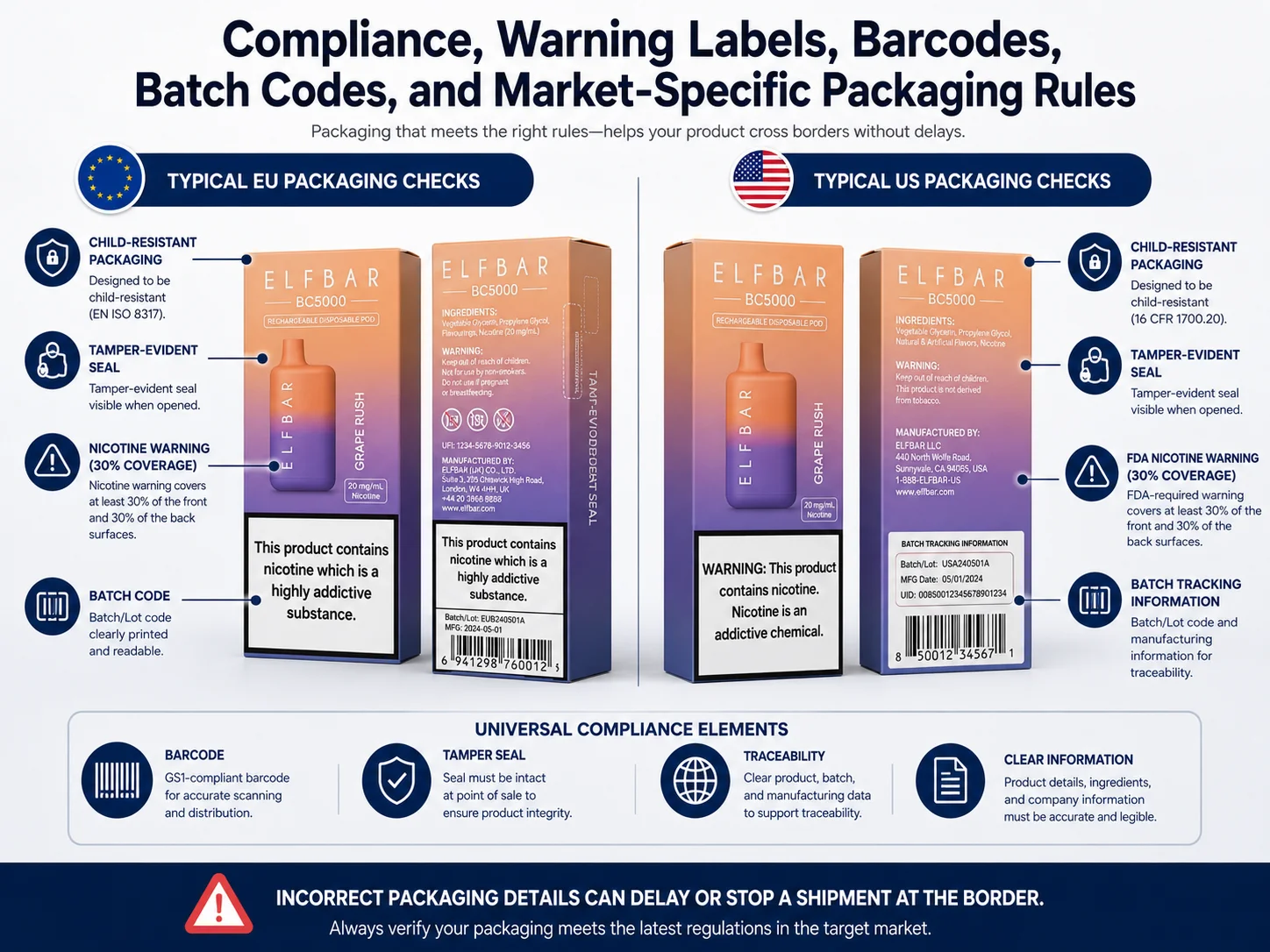
There is a critical difference between the two markets that trips up new buyers. In the EU, the warning text often says "This product contains nicotine which is a highly addictive substance.[^4]" In the US, the exact statement is "WARNING: This product contains nicotine. Nicotine is an addictive chemical.[^5]" The text is similar, but the format requirement for font size and placement differs. A client once tried to use the same boxes for both markets. Customs held the shipment for incorrect warning format. By the time we shipped new compliant boxes, the season was almost over. Another frequent mistake is the batch code. Some buyers handwrite a batch code on a sticker to save printing cost. EU inspectors in certain countries reject this. Make sure the batch code is printed directly on the box during production.[^6] For barcodes, always ask your distributor which type their retailers can actually scan. I have clients whose local shops use outdated scanner systems that can't read modern compact barcodes. A simple barcode test with one store can prevent a full return.
Common Packaging Mistakes That Delay Private Label Vape Projects
In my experience, five errors show up over and over. They are not about design taste. They are about operations.
The most frequent packaging mistakes are: finalizing dimensions without a physical test, forgetting to specify matte versus gloss lamination, ignoring inner tray friction fit, skipping the retailer scanning test, and not checking the box strength for stacked shipping.
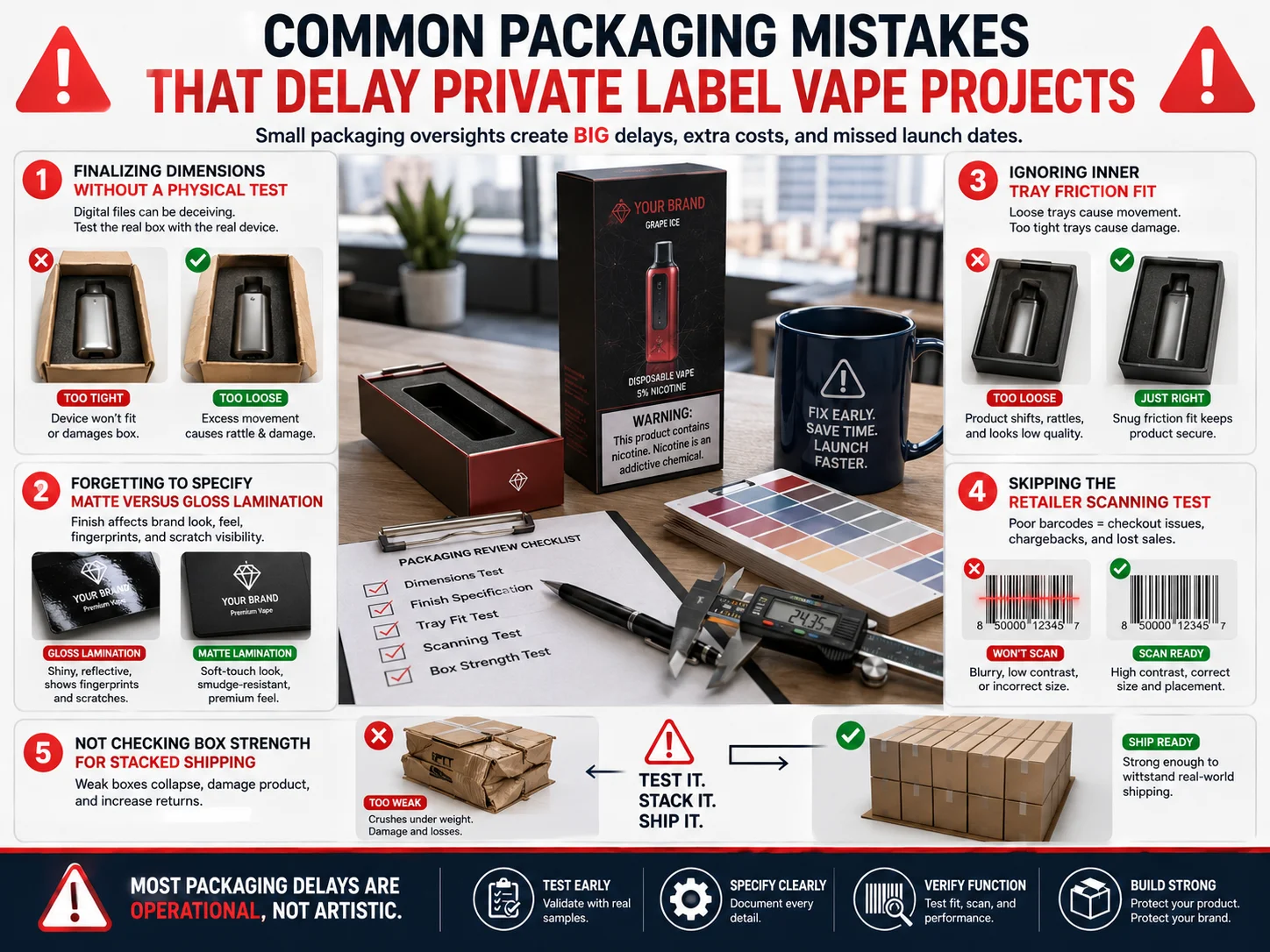
Let me expand on each. The physical test failure is the biggest. A drawing looks perfect. Your device measures 16mm by 100mm. You add 2mm tolerance. That should work, right? But if your device has a curved edge and the insert has sharp corners, the friction can scratch the device or the fit can be so tight the user can't remove it. Always ship one assembled sample to yourself before mass production.[^7] The lamination mistake is sneaky. A client asks for a "nice box" without specifying finish. Gloss lamination shows fingerprints easily. In a shop where customers handle the box, it can look dirty after a few touches. Matte finishes hide fingerprints but can scratch more visibly if dragged across surfaces.[^8] Retailers complain about the look, and you get a discount request. The inner tray friction issue is another silent killer. A device that falls out when the box is opened upside down screams "poor quality." A snap-fit or a slight press-fit keeps the device in place. The scanning test is for big chain stores. If a barcode doesn't scan at the register on the first try, the cashier might put your product aside and the customer walks out without it.[^9] And finally, box strength. Cartons get stacked. A weak box collapses in transit and the outer carton looks smashed, even if the device is intact. Shops often reject crushed packaging on sight.[^10]
When Should Buyers Choose Simple Packaging Instead of Full Custom Packaging?
I see two clear paths. You must be honest about which path you are on right now.
Choose simple sticker or sleeve packaging when you are testing a new market with an unproven product, when your cash flow demands small MOQs, or when you are a volume trader supplying price-sensitive smoke shops that sell unbranded or generic products. Choose full custom when you have long-term distribution agreements, a brand name you are actively building, and retailers who require shelf presence to justify a premium retail price.
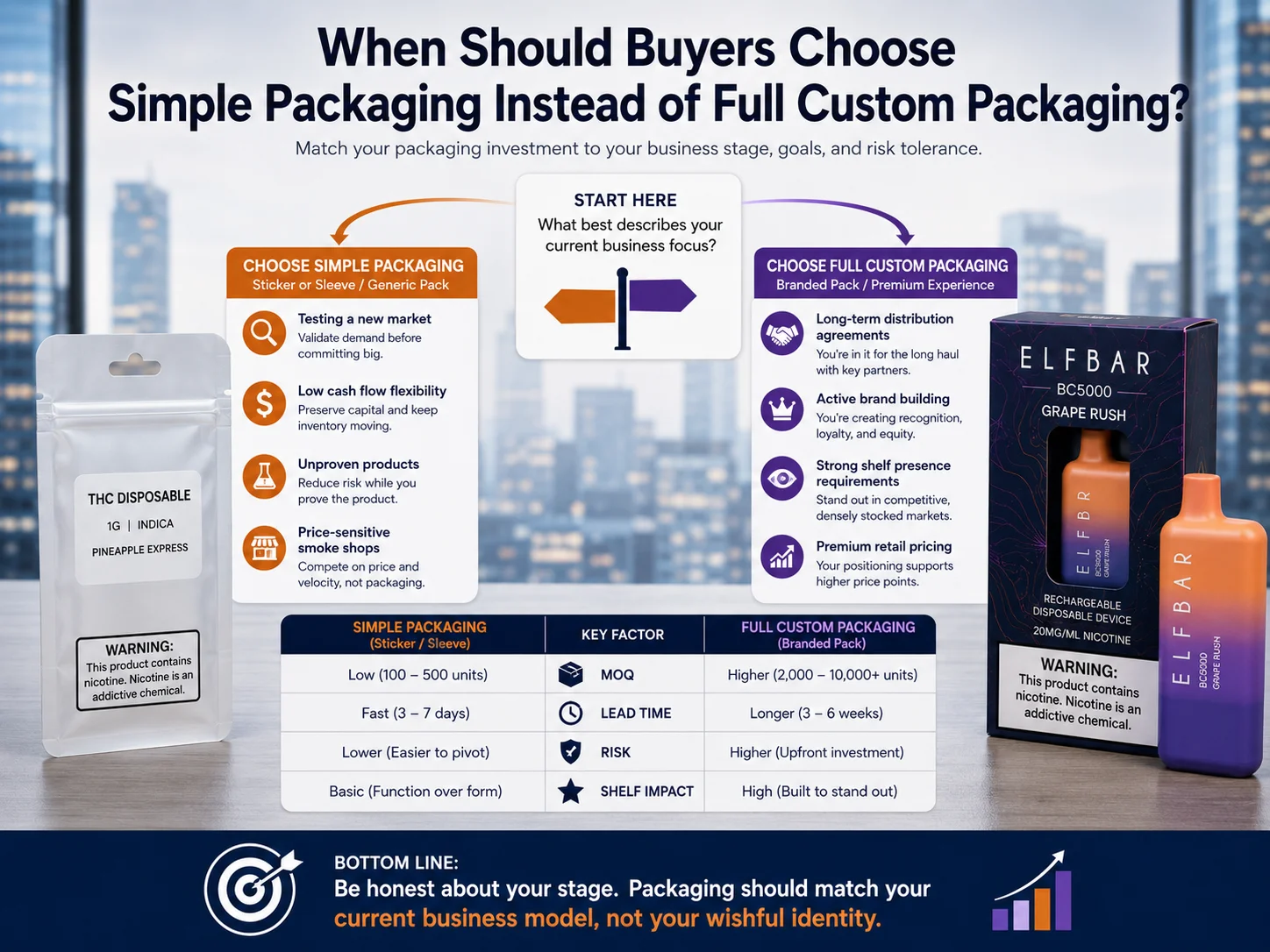
Simple packaging is not a failure. It is a cash flow tool. I have a client in Austria who runs a small warehouse. He tests ten new disposable flavors every quarter. He orders 300 units per flavor in plain boxes with a large flavor sticker. He sells them quickly to small vape shops. He takes zero packaging risk. If a flavor flops, he's not stuck with 3,000 custom boxes with "Strawberry Ice" printed forever. The moment a flavor proves itself for two quarters, he bumps it to custom print and increases the order. That staged approach is smart money management. Conversely, I work with a US brand that has five core SKUs. They use a consistent dark blue rigid box with silver foil. When a store sees that box, they recognize the line instantly, even if the flavor changes. That consistency took two years to build, and the packaging was the anchor. If you are building a brand, your packaging is your uniform. If you change uniforms every season, no one remembers the team.
How Packaging Fits OEM, ODM, Own Brand, Branded Stock, and Agency Models
Different supply models demand completely different packaging logic. Mixing them leads to chaos.
In a full OEM model, packaging is entirely your intellectual property and design. In ODM, you adapt an existing package template. For own-brand projects, you control the entire box design but may use factory-standard inner trays. If you resell branded stock, you buy ready-made packaging as-is. Agency buyers simply move supplier-branded cartons—no packaging decision is needed.
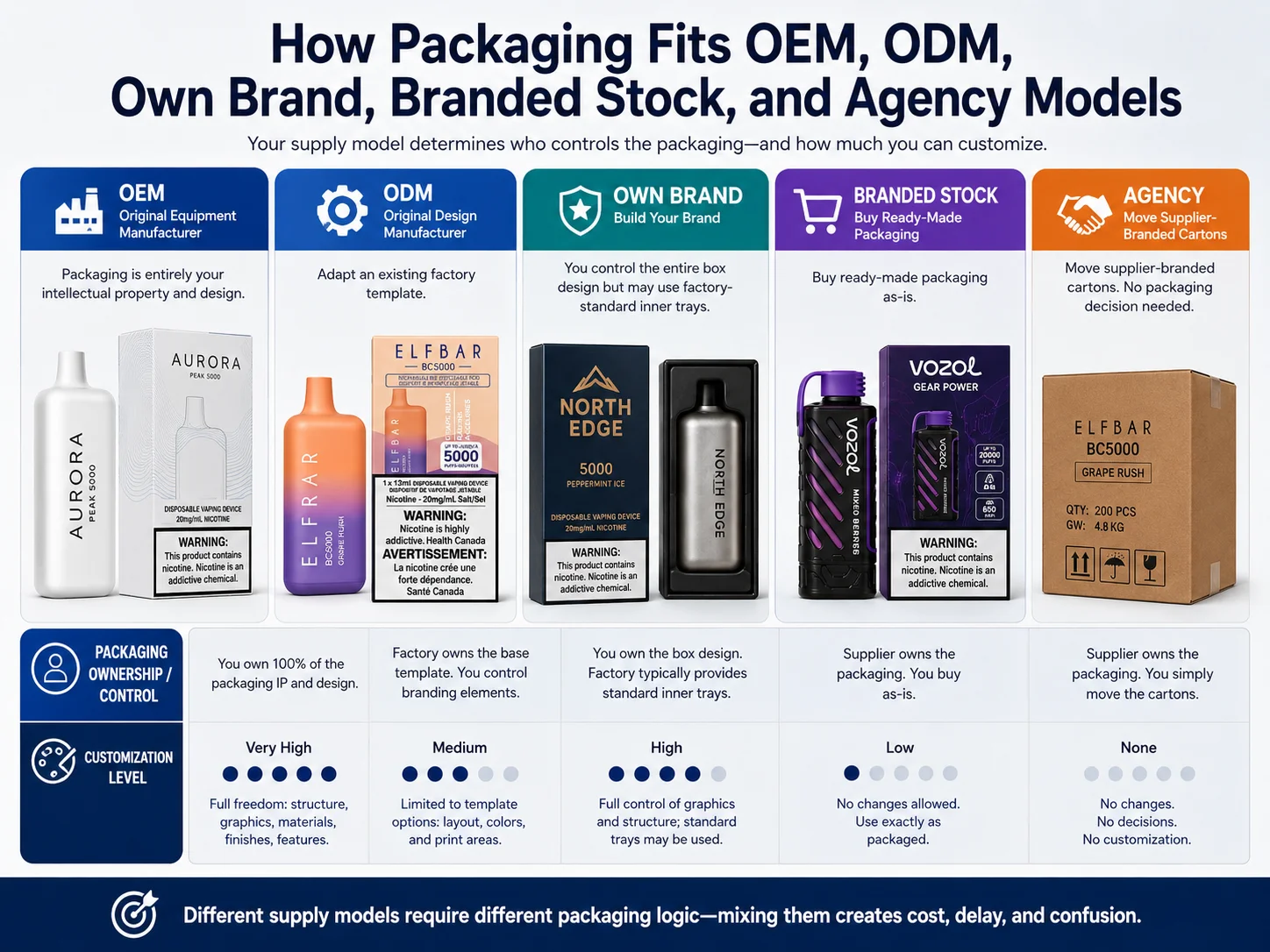
Let me draw the line clearly with a real example. A German distributor approached us for an OEM project. They wanted their own brand name, custom box design, matching flavor inserts, and a unique shape. That was a true OEM packaging project. It required mold opening, three rounds of color proofing, and a minimum order of 10,000 units. The total investment was significant, but the packaging was theirs forever. Another client from Belgium simply wanted an ODM solution. They liked our existing device design but needed their logo on the box and a slightly different color. We used our existing box template, swapped the logo, changed the background color, and the project moved in half the time. Finally, many wholesale clients just buy from our branded stock. They get the KingVape branded box. There is no packaging customization. The deal is fast and simple. The mistake some buyers make is asking for OEM customization with ODM budgets or timelines. When I hear a client say, "I want a full custom box but I only need 500 pieces and I need it in two weeks," I have to have an honest conversation. We can do a great job with a high-quality sleeve on a generic box for that quantity and timeline, but a full custom die-cut box is not realistic. Being clear about which model you fit into saves everyone from disappointment.
How to Compare OEM and Branded Vape Supply Options with KingVape
You now have a decision framework. Let me share how we work with you on these options directly.
When you contact us, we don't just send a price list. We send you a packaging decision guide based on your business model. Tell us whether you are a fast-turn trader, an early-stage brand, or a mature distributor, and we will lay out the packaging timeline, cash requirements, and risk trade-offs that match your reality.
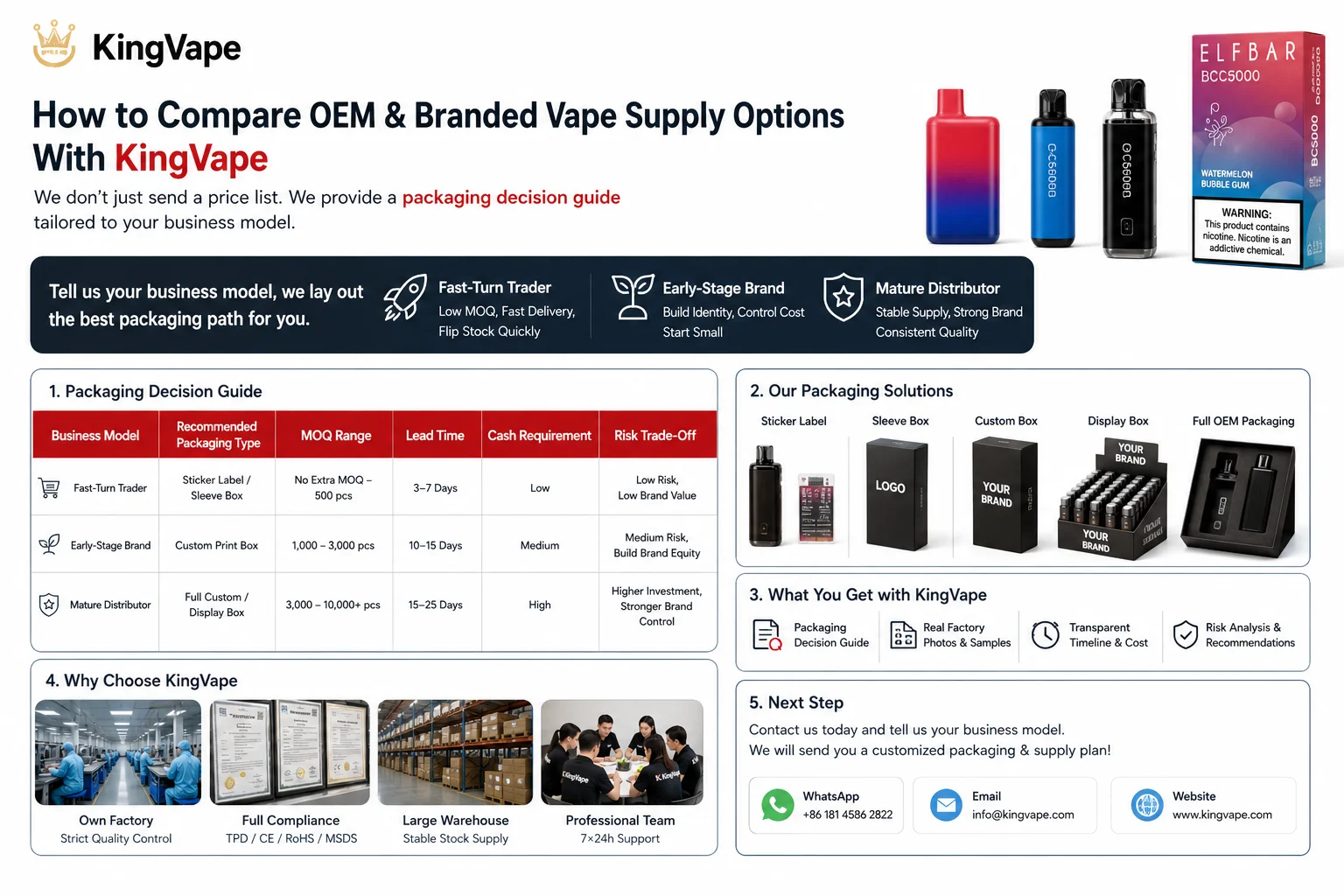
Our team at Shenzhen Kingfuji Tech has handled packaging projects from a simple sticker run of 200 units to a full rigid box line of 50,000 pieces with individual SKU inserts. We have EU warehouse stock for customers who need small quantities fast, and we have the factory floor to support large OEM orders with your packaging, your molds, and your brand story. If you are unsure which direction to go, we often ask for photos of the client's current shelf setup or a short list of competitors in their target store. That alone tells us which packaging tier is appropriate. Our goal is simple: help you pick the option that gets your product on the best shelf spot, at the best possible speed, with the least amount of hidden cost.
Conclusion
Your packaging choice is a business model decision. Pick the option that protects your cash, fits your brand ambition, and passes compliance at the border.
[^1]: "BRAND PLACEMENT AND CONSUMER CHOICE: AN IN-STORE ...", https://pmc.ncbi.nlm.nih.gov/articles/PMC2741065/. Retail packaging studies indicate that consistent visual identity can enhance brand recognition and encourage recurrent shelf placement, particularly in crowded categories, though the effect size varies by product type. Evidence role: general_support; source type: research. Supports: The link between visual consistency and repeat shelf placement.. Scope note: Evidence is drawn from general packaging literature, not specific vape products. [^2]: "Air Freight: A Market Study with Implications for Landlocked Countries", https://www.worldbank.org/en/topic/transport/publication/air-freight-study. Freight cost analyses indicate that air-shipping packaging materials can cost 4–6 times more than ocean freight, often exceeding the unit cost of low-value consumer goods, making it a significant penalty when production delays force premium shipping. Evidence role: general_support; source type: research. Supports: The cost disadvantage of air-freighting low-value packaging materials.. Scope note: Specific cost multiples depend on weight, volume, and route; the comparison is illustrative. [^3]: "Tobacco Products Directive - Wikipedia", https://en.wikipedia.org/wiki/Tobacco_Products_Directive. Article 14 of EU Directive 2014/40/EU mandates that unit packets of electronic cigarettes and refill containers must be child-resistant and tamper-evident, in accordance with specified implementing standards. Evidence role: definition; source type: government. Supports: The EU legal requirement for child-resistant and tamper-evident features on vape packaging.. Scope note: Actual enforcement and testing protocols may differ between member states. [^4]: "Effectiveness of tobacco warning labels before and after ... - PMC - NIH", https://pmc.ncbi.nlm.nih.gov/articles/PMC7526774/. Article 9 of the EU Tobacco Products Directive (2014/40/EU) requires the health warning 'This product contains nicotine which is a highly addictive substance.' to cover 30% of the front and back surfaces of the unit packet. Evidence role: definition; source type: government. Supports: The EU mandatory health warning statement.. [^5]: ""Covered" Tobacco Products and Roll-Your-Own/ Cigarette ... - FDA", https://www.fda.gov/tobacco-products/labeling-and-warning-statements-tobacco-products/covered-tobacco-products-and-roll-your-own-cigarette-tobacco-labeling-and-warning-statement. The U.S. FDA's regulation 21 CFR § 1143.3 mandates the exact warning 'WARNING: This product contains nicotine. Nicotine is an addictive chemical.' on covered tobacco product packages, covering at least 30% of the two principal display panels. Evidence role: definition; source type: government. Supports: The exact warning text required by US FDA regulations.. [^6]: "EU - Labeling/Marking Requirements", https://www.trade.gov/country-commercial-guides/eu-labelingmarking-requirements. EU Directive 2014/40/EU requires a batch number or equivalent identification to be affixed to the unit packet; some member states' enforcement guidance indicates that handwritten stickers do not meet the 'affixed' standard, requiring printed or indelible marking. Evidence role: definition; source type: government. Supports: The regulatory basis for requiring a permanent batch code marking on packaging.. Scope note: Interpretation of 'affixed' may vary between member states. [^7]: "Apparel Quality Control Testing: A Complete Guide to Standards ...", https://www.tradeaiders.com/apparel-quality-control-testing-a-complete-guide-to-standards-and-best-practices.html. Quality management frameworks such as ISO 9001 encourage pre-production verification through prototype or physical sample testing to identify fit, function, and aesthetic issues before committing to mass production. Evidence role: expert_consensus; source type: institution. Supports: The quality management importance of pre-production sample verification.. Scope note: ISO 9001 is generic; it does not prescribe this exact practice but supports the underlying principle. [^8]: "Comparing Matte vs Gloss Lamination for Packaging", https://pakfactory.com/blog/matte-vs-gloss-lamination/?srsltid=AfmBOoqNf_mFnW0Dw8iOjluu7nB2y0N3xed9MZov2CLjMASYea80FYXy. Material science research indicates that high-gloss surfaces show fingerprints and smudges more readily due to specular reflection, while matte finishes diffuse light and conceal such marks; however, matte surfaces can exhibit more visible abrasion because their micro-scale topography makes scratches contrast with the underlying material. Evidence role: mechanism; source type: research. Supports: The practical differences between gloss and matte finishes regarding fingerprint visibility and scratch appearance.. Scope note: Specific results depend on coating type and application; not tested on vape packaging specifically. [^9]: "How do retailers handle unexpected hardware failures without ...", https://retailtechinnovationhub.com/home/2026/2/20/how-do-retailers-handle-unexpected-hardware-failures-without-disrupting-sales. A GS1 US study found that barcode scanning problems contribute significantly to checkout friction; one retail survey reported that up to 19% of consumers would abandon a purchase if a barcode fails to scan on the first attempt. Evidence role: statistic; source type: research. Supports: The connection between barcode scanning issues and lost sales.. Scope note: The cited figure comes from a survey and may not generalise to all retail environments or product categories. [^10]: "Refund Policies | State of California - Department of Justice - CA.gov", https://oag.ca.gov/consumers/general/refunds. Packaging industry surveys indicate that over 60% of retailers will reject shipments with visibly damaged outer packaging, irrespective of internal product condition, due to perceived quality risks and merchandising standards. Evidence role: statistic; source type: research. Supports: The frequency with which retailers refuse damaged packaging.. Scope note: Exact percentages vary by region and product category; this estimate from general packaged goods.