
How to turn educational vape content into better product pages is a practical question for wholesale buyers who need more than a list of puff counts and colors. When a product page leaves important questions unanswered, buyers may delay orders, compare too many suppliers, or face avoidable complaints after resale[^1]. I use educational content to make purchasing decisions clearer.
Educational vape content improves wholesale product page conversion[^2] by explaining product differences, suitable sales channels, important specifications, ordering conditions, and common resale questions. A clear page helps buyers understand whether a vape product fits their market, can be explained by downstream stores, and can be supported after purchase.[^3] It does not guarantee sales, but it can reduce uncertainty and improve the quality of wholesale enquiries.
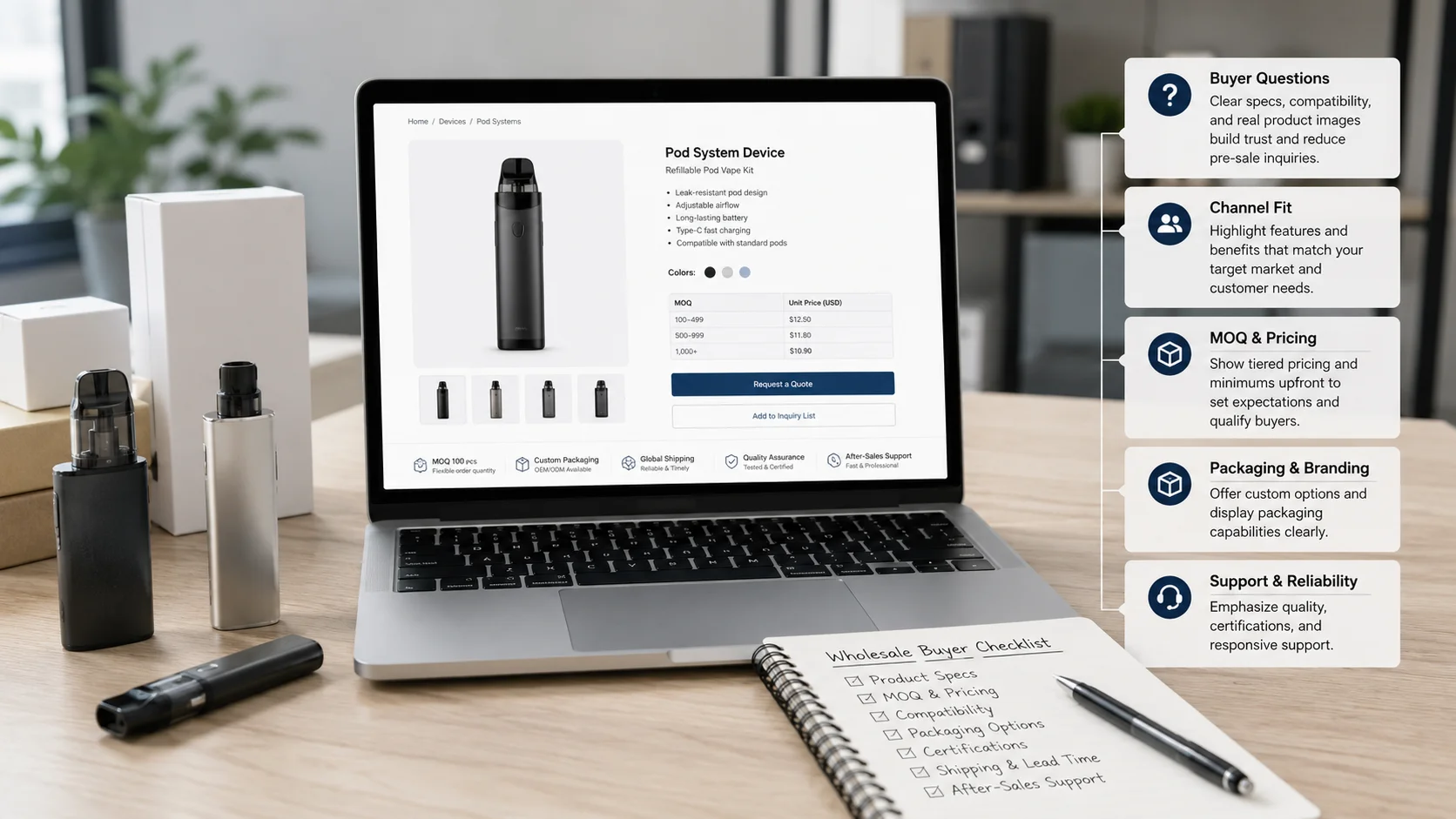
For me, a good vape product page is not simply an online catalogue. It is a sales-support tool for importers, wholesalers, vape shops, smoke shops, convenience stores, and gas-station suppliers[^4]. It should help buyers make a faster and more informed decision before they invest cash, warehouse space, and local reputation.
How to Turn Educational Vape Content into Better Product Pages Quickly?
Many wholesale buyers see dozens of similar disposable vapes, pod systems, batteries, grinders, and smoking accessories every week. The problem is not always a lack of choice. The real problem is that product information often looks the same, while the resale situation is completely different.
To turn educational vape content into better product pages, I start by answering the buyer’s practical questions: who is likely to sell the product, what makes it different, how staff can explain it, what ordering options are available, and what support is available after purchase. This turns specifications into useful buying guidance.
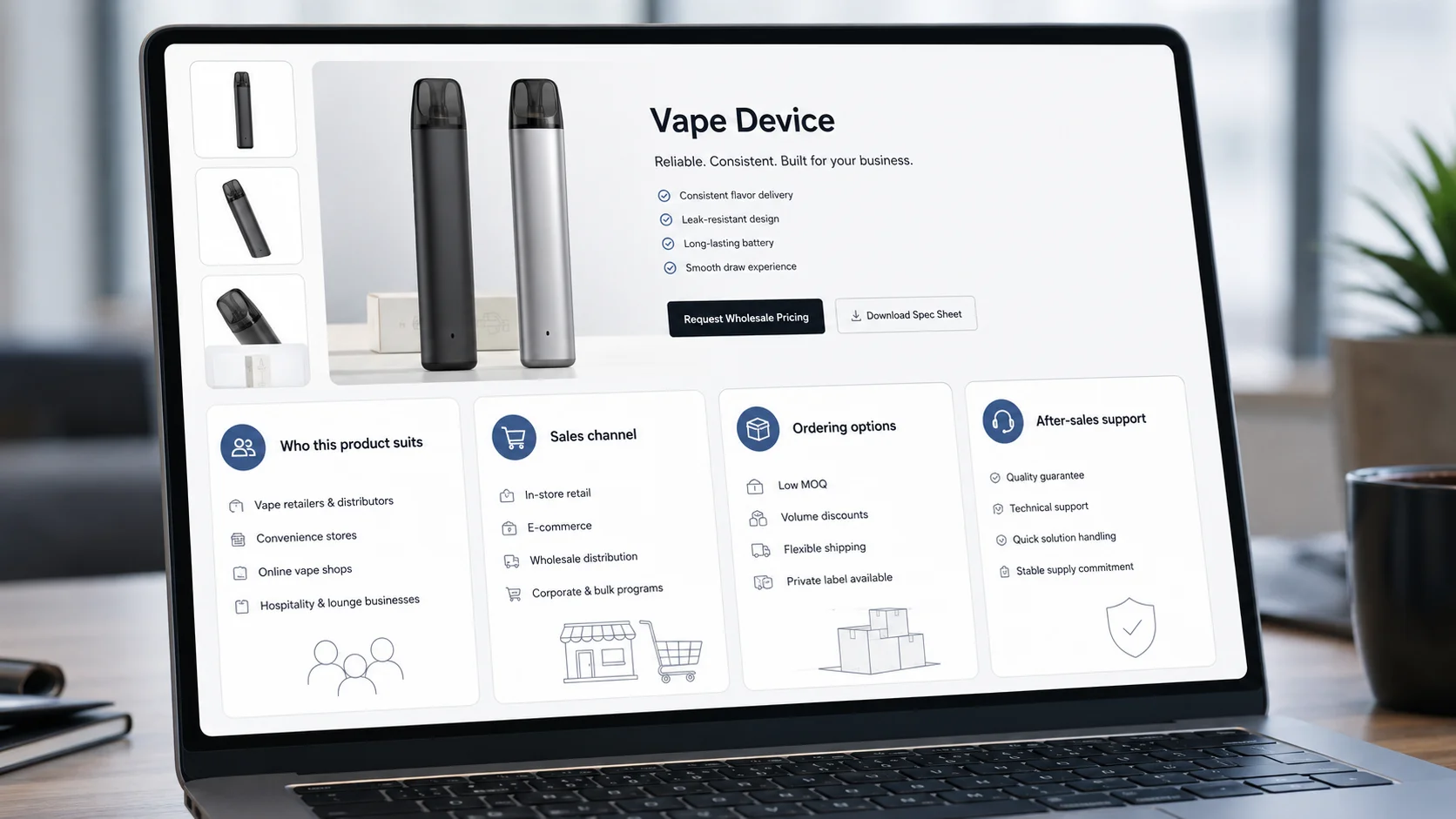
A product page should support a resale decision
In my experience, wholesale buyers do not purchase specifications alone. They purchase confidence.
A buyer who supplies small vape shops in Spain may need fast-moving products with manageable carton quantities. A wholesaler supplying gas stations in the United States may need packaging options, straightforward product explanations, and reliable replenishment planning. A larger importer may focus more on OEM branding, price structure, production capacity, and long-term supply consistency.
That is why I recommend building product pages around the real buying journey:
-
Understand the product
- What category is it?
- What are the key specifications?
- What is included in each unit and carton?
-
Understand the resale fit
- Which channel may find it easier to introduce?
- Is it better suited to vape shops, smoke shops, convenience stores, or general wholesalers?
- Does the product need staff explanation?
-
Understand the purchasing conditions
- What is the MOQ?
- Is stock available?
- Can the buyer order from an overseas warehouse?
- Is OEM or custom packaging possible?
-
Understand the support process
- What information can be provided before ordering?
- How are product videos, packaging details, and after-sales cases handled?
- Who should the buyer contact for a quotation or product recommendation?
I have learned from repeated wholesale conversations that buyers usually ask these questions anyway[^5]. A strong product page simply answers the common questions earlier.
Why Does Educational Content Matter on Vape Product Pages?
A basic product page can make a product visible. However, visibility alone does not help a buyer decide whether the product is suitable for their customers, sales channel, local stock level, or purchasing budget. Unclear pages create more back-and-forth and more hesitation.
Educational vape content matters because it gives B2B buyers context. It explains not only what a product is, but also how its specifications, packaging, product category, and supply options may affect resale, staff training, customer expectations, and inventory planning.

Buyers need context, not just technical figures
A disposable vape page may show a puff-count claim, battery capacity, e-liquid capacity, and charging type. Those details matter, but they do not answer the full commercial question: “Can I confidently introduce this product to my downstream customers?”
For example, a buyer may need to know:
- Whether the product is simple for store staff to explain.
- Whether the device has a visible charging port.
- Whether the packaging has a clear flavor or variant system.
- Whether different versions are available for different markets.
- Whether the buyer can start with lower quantities through a European warehouse.
- Whether the product is available for OEM or private-label development.
I do not treat buyers as uninformed. In a multi-layer distribution chain, information gaps are normal. Importers, regional wholesalers, store owners, and end users all see the product from different angles. Educational content helps each level communicate more consistently.
A clear product page cannot guarantee that a product will sell. However, it can help a buyer avoid ordering a product that is difficult to explain, difficult to position, or unsuitable for the intended channel.
How to Turn Educational Vape Content into Better Product Pages with Comparison Tables?
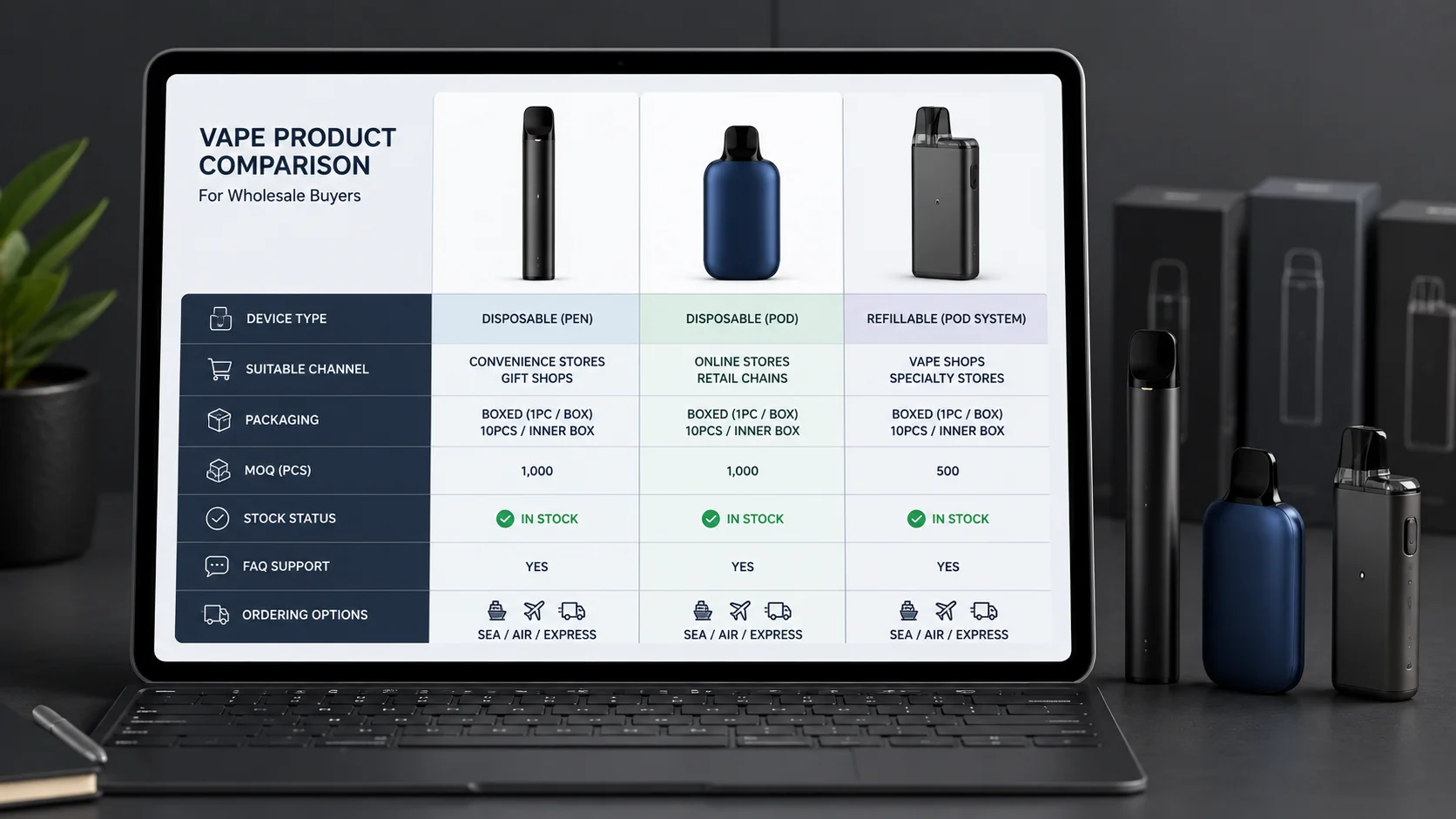
When buyers compare multiple suppliers or models, they need a fast way to see meaningful differences. A comparison table can prevent a product page from becoming a wall of technical text. It also helps buyers identify what they still need to ask before ordering.
How to turn educational vape content into better product pages with comparison tables is simple: compare buyer-relevant information, not just specifications. I include product differences, suitable channels, ordering choices, stock status, FAQ guidance, and support signals so buyers can compare options with less effort.
| Page Element | Basic Product Page | Educational Product Page | Buyer Benefit |
|---|---|---|---|
| Specifications | Lists battery, capacity, and size | Explains what each specification means in daily resale conversations | Easier product evaluation |
| Product differences | Uses general marketing wording | Shows differences between models, versions, or categories | Faster comparison |
| Suitable sales channel | Usually missing | Suggests relevant channels such as vape shops, smoke shops, or convenience stores | Better market matching |
| MOQ and supply | May only say “contact us” | Explains stock, overseas warehouse options, and bulk-order routes | Clearer purchase planning |
| Packaging information | Shows one image | Shows packaging versions, carton details, and branding options where available | Fewer surprises |
| FAQ | Missing or generic | Answers common wholesale and downstream questions | Fewer repetitive enquiries |
| Trust signals | Product image only | Includes real images, videos, contact details, and transparent support process | More confidence |
| CTA | “Buy now” or “contact us” | Requests destination market, channel, target price, and quantity | More qualified enquiries |
What I would compare on a real product page
I would not compare products only by “bigger” or “smaller” numbers. Higher puff count, larger capacity, or bigger battery figures do not automatically mean stronger market performance. The right product depends on how buyers sell, how quickly they replenish, and how easily downstream stores can explain the item.
For a comparison page, I would include:
- Product category: disposable vape, pod kit, 510 battery, atomizer, grinder, glass pipe, or vaporizer.
- Core user-facing difference: rechargeable or non-rechargeable, compact or larger format, simple or feature-rich operation.
- Sales-channel fit: specialist vape retail, smoke shops, convenience stores, or wholesale distribution.
- Packaging format: individual box, display box, master carton, custom packaging possibilities.
- Supply route: China factory shipment, standard inventory, or European warehouse stock where available.
- Buyer action: request a quote, request a video, ask for a sample discussion, or ask for a category recommendation.
This kind of vape product page optimization does not replace direct communication. Instead, it makes the first conversation more productive.
Which Buyer Questions Should a Vape Product Page Answer?
Wholesale buyers often lose time because they must ask several suppliers the same basic questions. If a page does not explain order conditions, product positioning, packaging, or support, the buyer may not know whether the product deserves further attention.
A vape product page should answer who the product is for, which sales channels may suit it, what makes it different, what the MOQ is, how it is packaged, what supply options exist, and how buyers can request market-specific information before ordering.
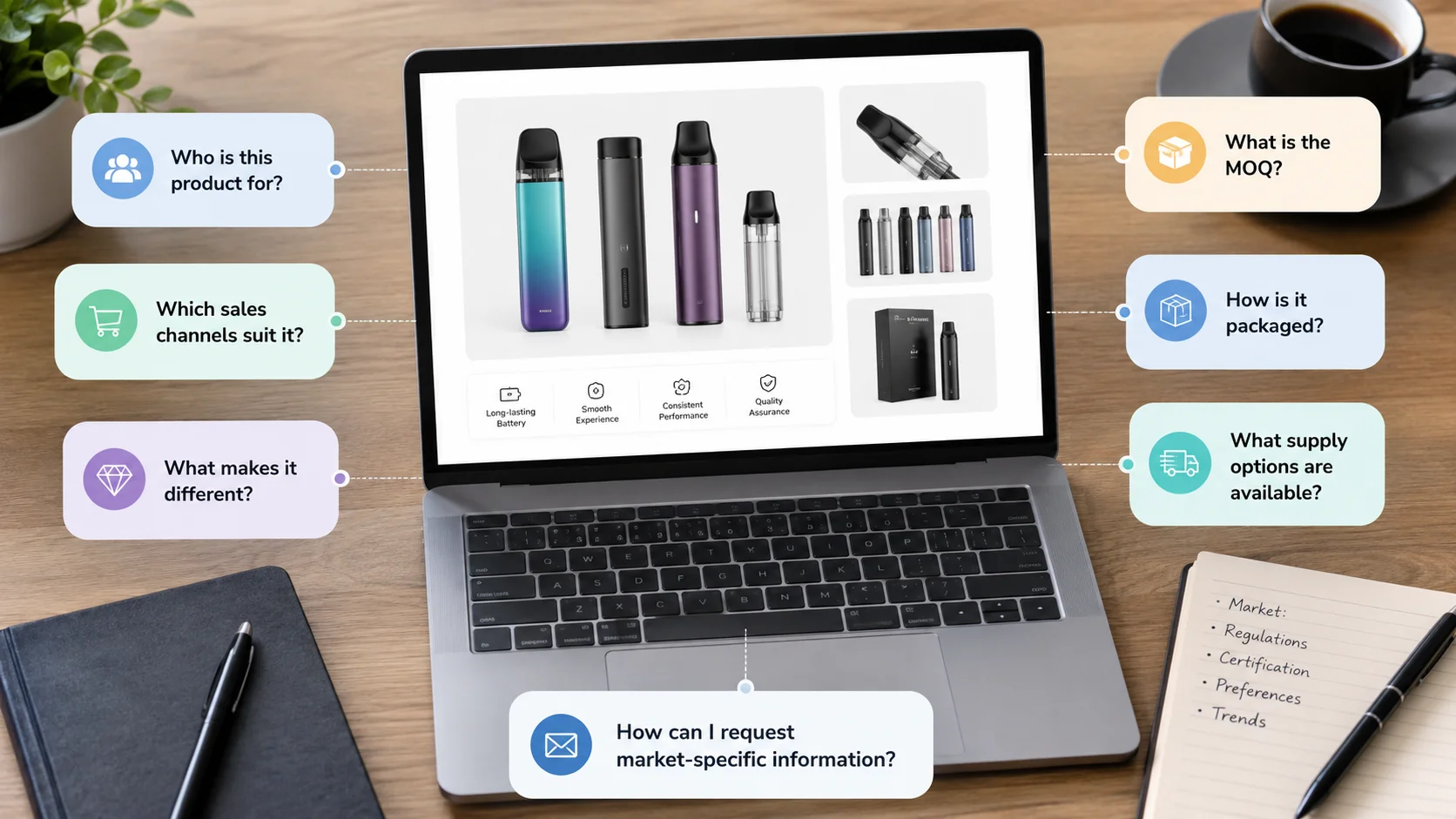
Questions I hear repeatedly from wholesale customers
From my conversations with importers and wholesalers, the same questions appear again and again. These are not “basic” questions. They are normal risk-control questions for any buyer who must resell products to stores.
A useful B2B vape product description should answer:
-
Who is this product most suitable for?
I would explain whether the product appears easier for specialist vape shops, smoke shops, convenience stores, or broader general-merchandise channels. -
What is the product’s main difference?
I would identify the actual point of difference, such as operation style, format, charging method, packaging presentation, or product category. -
What should downstream store staff understand?
I would explain normal use expectations, charging information where relevant, and any points that should be communicated clearly to end users. -
What are the ordering conditions?
I would provide available MOQ information, stock status where applicable, and whether small buyers can use overseas warehouse inventory. -
Can the product be customized?
For larger importers and distributors, I would clarify whether OEM, ODM, private-label packaging, or new-product development discussions are possible. -
How can buyers restock?
I would explain whether the product can be supplied from China, whether European warehouse stock may be available, and what information is needed for a quotation.
Clear answers reduce unnecessary friction. They also help buyers send more complete enquiries, which lets me recommend products more accurately.
How to Turn Product Specifications into Useful Buying Information?
Specifications are necessary, but raw specifications can create confusion when buyers do not know how those details affect resale. A product page should never force a buyer to guess why a number matters or how to explain it to their own customers.
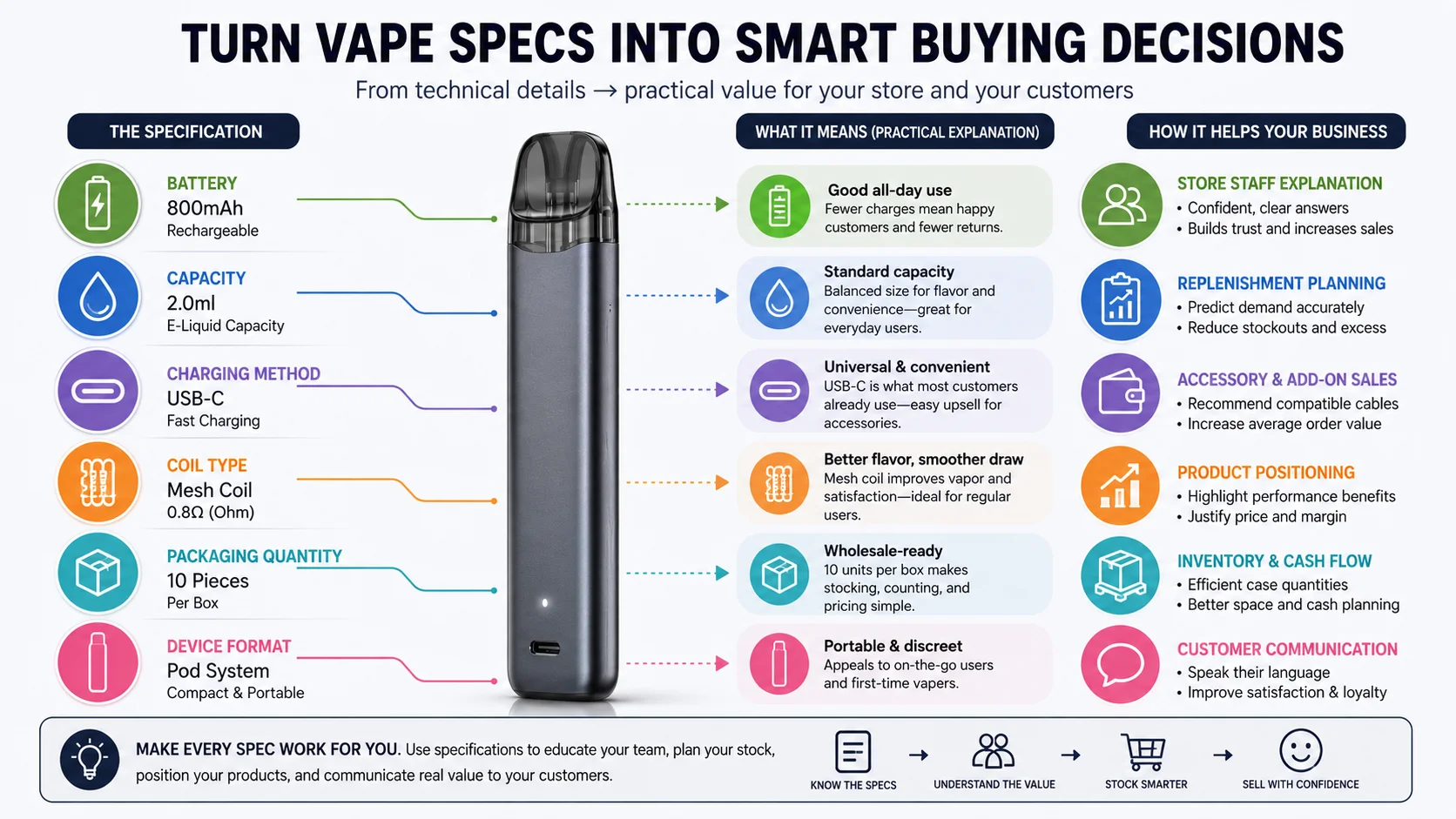
To turn product specifications into useful buying information, I connect each figure to a practical wholesale question. I explain what the battery, capacity, charging method, coil type, packaging quantity, and device format may mean for store staff, replenishment planning, product positioning, and customer communication.
Translate numbers into purchasing decisions
Here is the difference between a specification list and educational content:
| Specification | Basic Description | Useful Buyer Explanation |
|---|---|---|
| Battery | “650mAh battery” | Clarify whether charging is supported and whether store staff should explain charging expectations |
| E-liquid capacity | “X ml capacity” | Explain that capacity is one product detail to compare, not a guarantee of performance or sales |
| Puff count | “Up to X puffs” | State that puff claims can vary with individual use conditions[^6] and should not be treated as a guaranteed resale outcome |
| Coil | “Mesh coil” | Explain that buyers may want a simple product benefit description for downstream staff, without making unsupported performance claims |
| Packaging | “10 pcs/display” | Show how many units buyers receive and how display packaging may fit store shelving or cash-and-carry sales |
| Charging | “Type-C charging” | Help buyers understand the operation point that downstream staff may need to communicate |
I have seen buyers make faster decisions when the page explains why a detail matters. For example, carton quantity is not only a logistics number. It affects warehouse planning, cash flow, and how easily a small retailer can test a new item.
For small and medium buyers in Europe, a lower starting quantity from an overseas warehouse can reduce upfront inventory pressure[^7] when suitable stock is available. For larger buyers, direct China imports may offer a stronger structure for larger quantities, customized products, and OEM/ODM projects.
How Does Comparison Content Help Wholesale Buyers Choose Faster?
Buyers often compare similar-looking models across many websites. When every product description uses broad phrases like “premium,” “best,” or “hot-selling,” buyers still need to do the hard work themselves. That slows enquiries and makes product selection less confident.
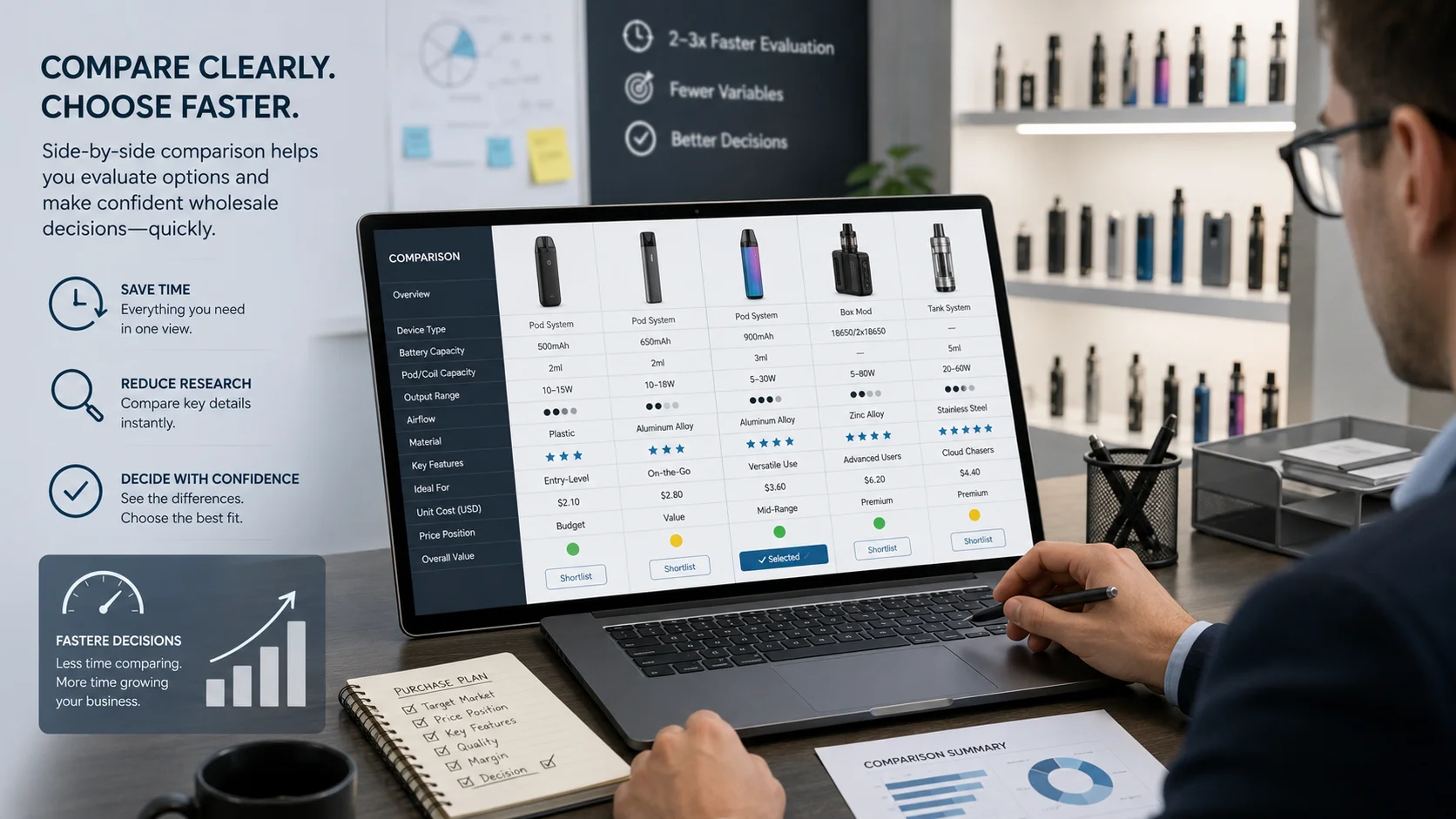
Comparison content helps wholesale buyers choose faster by showing relevant differences between models, categories, sales channels, price positions, and supply routes. I use comparison content to reduce research time, not to claim that one product is automatically best for every market.
Build comparisons around real purchasing scenarios
I recommend comparison content that answers practical scenarios, such as:
- Disposable vape versus refillable pod system for a specific store type.
- Compact 510 battery versus a more feature-focused battery for smoke-shop customers.
- Standard branded stock versus OEM/private-label development for established distributors.
- European warehouse replenishment versus direct China bulk importing.
- Entry-price products versus more premium-positioned formats.
A helpful comparison article can link directly to category pages and individual products. For example, an article about “How to choose a vape product for convenience-store resale” can link to suitable product categories, product pages, and a contact form for tailored recommendations.
I would always use careful language. I would say that a product may suit a certain channel or may be easier to introduce in a certain situation. I would not claim that a particular model will definitely become a best-seller in every country.
Markets change quickly.[^8] Local customer preferences, packaging rules, product availability, competitor activity, and store staff confidence can all influence results. Educational content gives buyers a better starting point, but local market judgment still matters.
Which Trust Signals Improve B2B Vape Product Page Conversion?
Wholesale buyers take real financial and reputation risks when they purchase inventory. They need to know who they are dealing with, whether the product information is clear, and whether someone will respond when questions or after-sales issues arise.
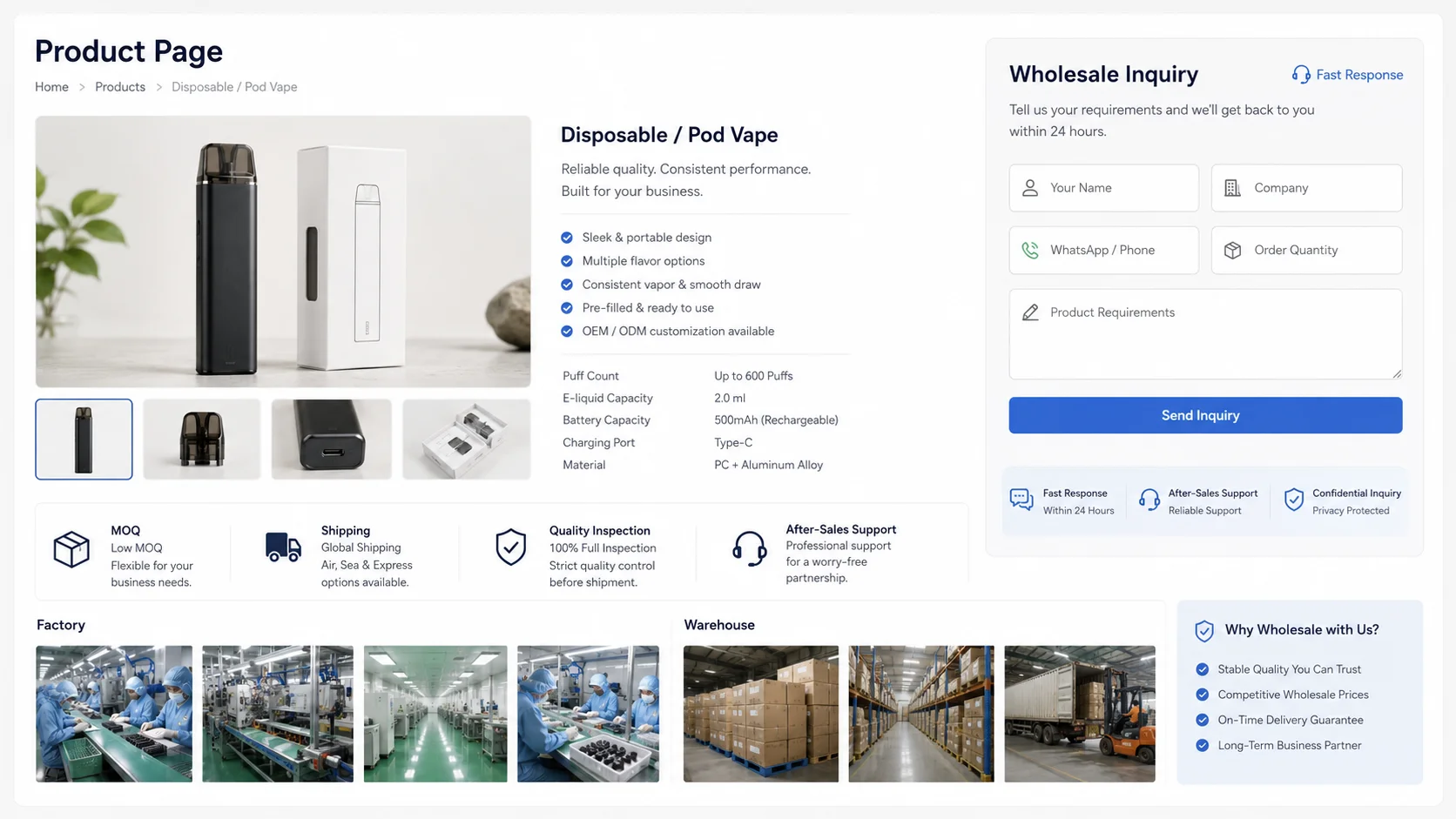
Trust signals improve B2B vape conversion when they make the supplier, product, packaging, supply process, and contact route easier to verify. I focus on transparent information, real product visuals, clear communication, and realistic support explanations rather than exaggerated promises.
Trust is built before and after payment
At KingVape, I represent Shenzhen Kingfuji Tech. Co., Ltd., a factory-and-trading business established in Shenzhen in 2011. Shenzhen is a major global center for vape manufacturing, related accessories, supply-chain services, and export logistics.[^9]
For a buyer, that background only matters if it creates a practical advantage. The useful value is that I can help buyers source across vape and smoking-accessory categories, coordinate purchasing, and reduce the need to contact many separate suppliers.
Useful trust signals include:
- Real product photos and videos so buyers can check the actual appearance and packaging.
- Clear product and carton details to support warehouse and retail planning.
- Transparent contact information for quotation requests and purchasing questions.
- Brand and product-source clarity where applicable.
- Practical after-sales communication instead of vague promises.
- Overseas warehouse information for eligible European buyers needing faster, lower-quantity replenishment.
- OEM/ODM discussion options for importers and distributors with suitable project requirements.
I also believe a product page should clearly say when buyers need to verify local requirements. Regulations, labeling rules, product restrictions, taxes, and import conditions can differ by destination market.[^10] I can provide supply information, but buyers should confirm their own local compliance obligations before ordering.
What Educational Content Mistakes Should Vape Websites Avoid?
Many vape websites publish content, but not all content helps a wholesale buyer make a decision. Generic blogs may attract clicks, yet fail to guide visitors toward a relevant category, product page, or enquiry. That creates traffic without useful commercial action.
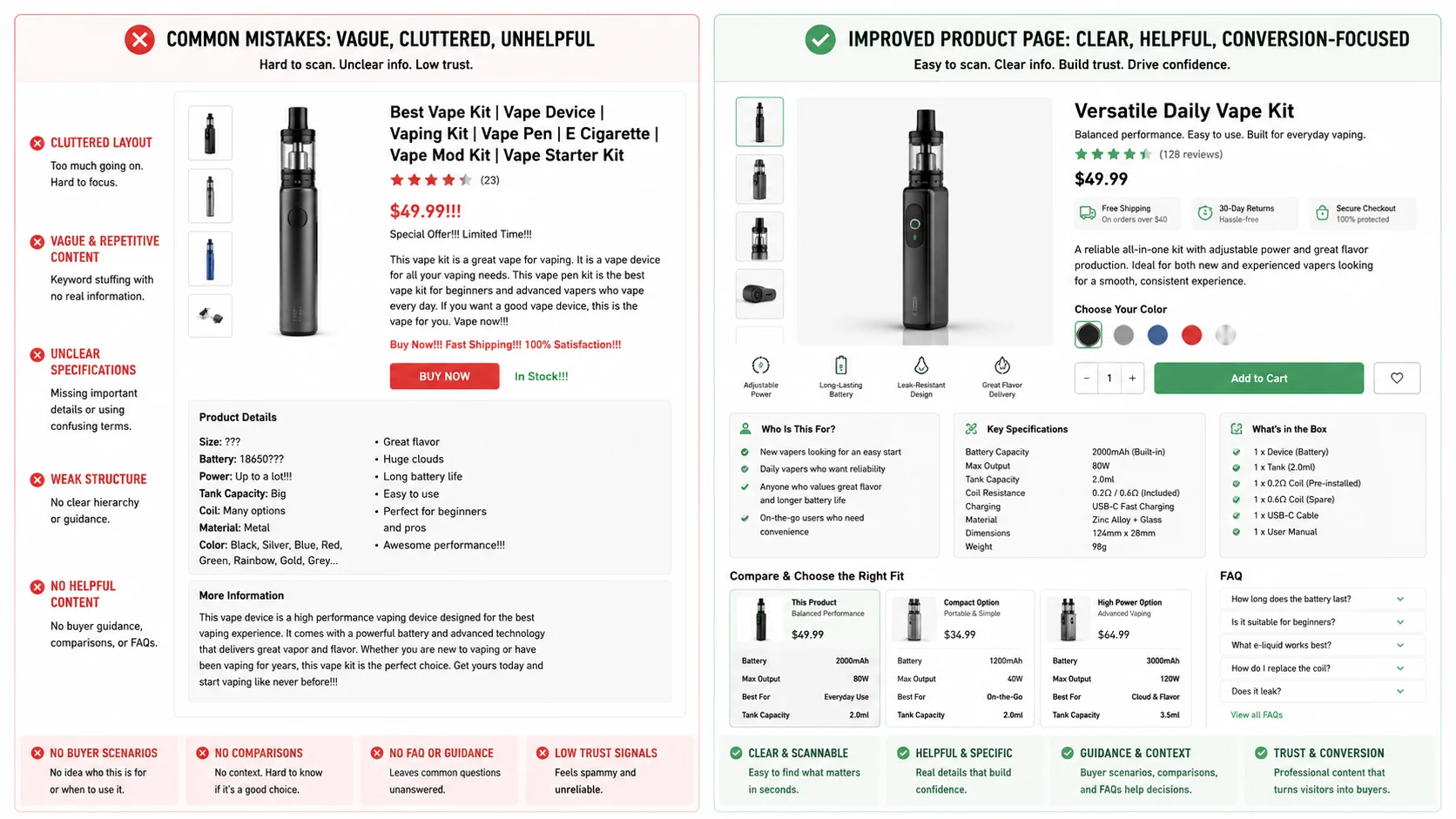
The biggest educational content mistakes are vague claims, repeated keywords, unclear specifications, missing buyer scenarios, unsupported compliance statements, and weak links between blog articles, category pages, and product pages. I avoid these issues by writing for real purchasing decisions.
Mistakes that create uncertainty
I avoid the following problems when building a vape wholesale content strategy:
- Writing only for search engines: Repeating “vape wholesale” or “best disposable vape” does not answer a buyer’s question.
- Using unverified claims: Technical, regulatory, health, and market-performance claims should be checked before publication.
- Listing specifications with no explanation: Buyers need to understand the resale implication.
- Ignoring the sales channel: A vape shop, smoke shop, gas station, and regional wholesaler may need different guidance.
- Hiding MOQ and supply options: Buyers need to know whether they can start small or need a larger direct-import order.
- Leaving out internal links: A buying guide should connect naturally to categories, products, FAQs, and contact pages.
- Using generic calls to action: “Contact us” is weaker than asking for destination market, sales channel, target price, and expected quantity.
I have found that the best content answers a real buyer question and then gives the buyer a clear next step.
How to Connect Educational Vape Content with Product and Category Pages?
A single product page cannot answer every question. At the same time, a blog article should not sit alone without helping visitors find products or contact the supplier. The strongest approach is a connected content system that guides buyers from research to enquiry.
How to turn educational vape content into better product pages also means connecting guides, comparisons, FAQs, category pages, and product pages through clear internal links. This helps buyers explore relevant options and helps search engines understand the relationship between topics and products.[^11]
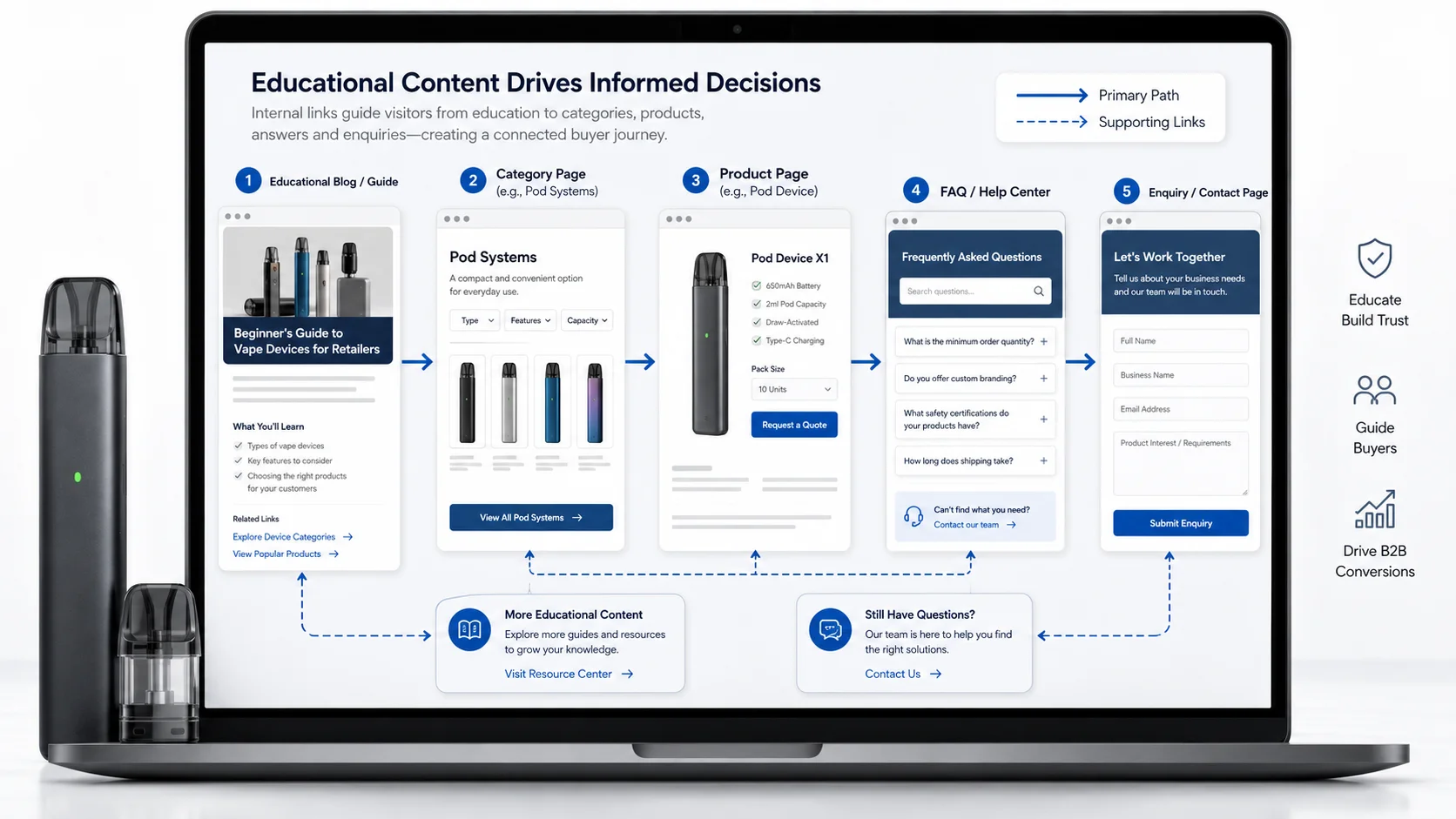
A practical content-cluster structure
I would structure content like this:
-
Educational guide
Example: “How to choose vape products for smoke-shop wholesale.” -
Comparison article
Example: “Disposable vape versus pod system: what should wholesale buyers compare?” -
Category page
Example: disposable vapes, 510 batteries, atomizers, grinders, glass pipes, or vaporizers. -
Individual product page
Include product details, packaging, order guidance, images, FAQs, and enquiry options. -
Contact or quotation page
Ask buyers for their destination market, sales channel, preferred category, target price range, and estimated order quantity.
This structure works because different buyers enter at different points. Some buyers already know the exact model they want. Others only know that they need a fast-moving category for local vape shops or convenience stores.
For European small and medium customers, I can discuss available overseas warehouse options with lower starting quantities on selected stocked items. For larger importers, distributors, and established wholesalers, I can discuss direct China supply, broader product sourcing, OEM/ODM opportunities, and larger-volume pricing.
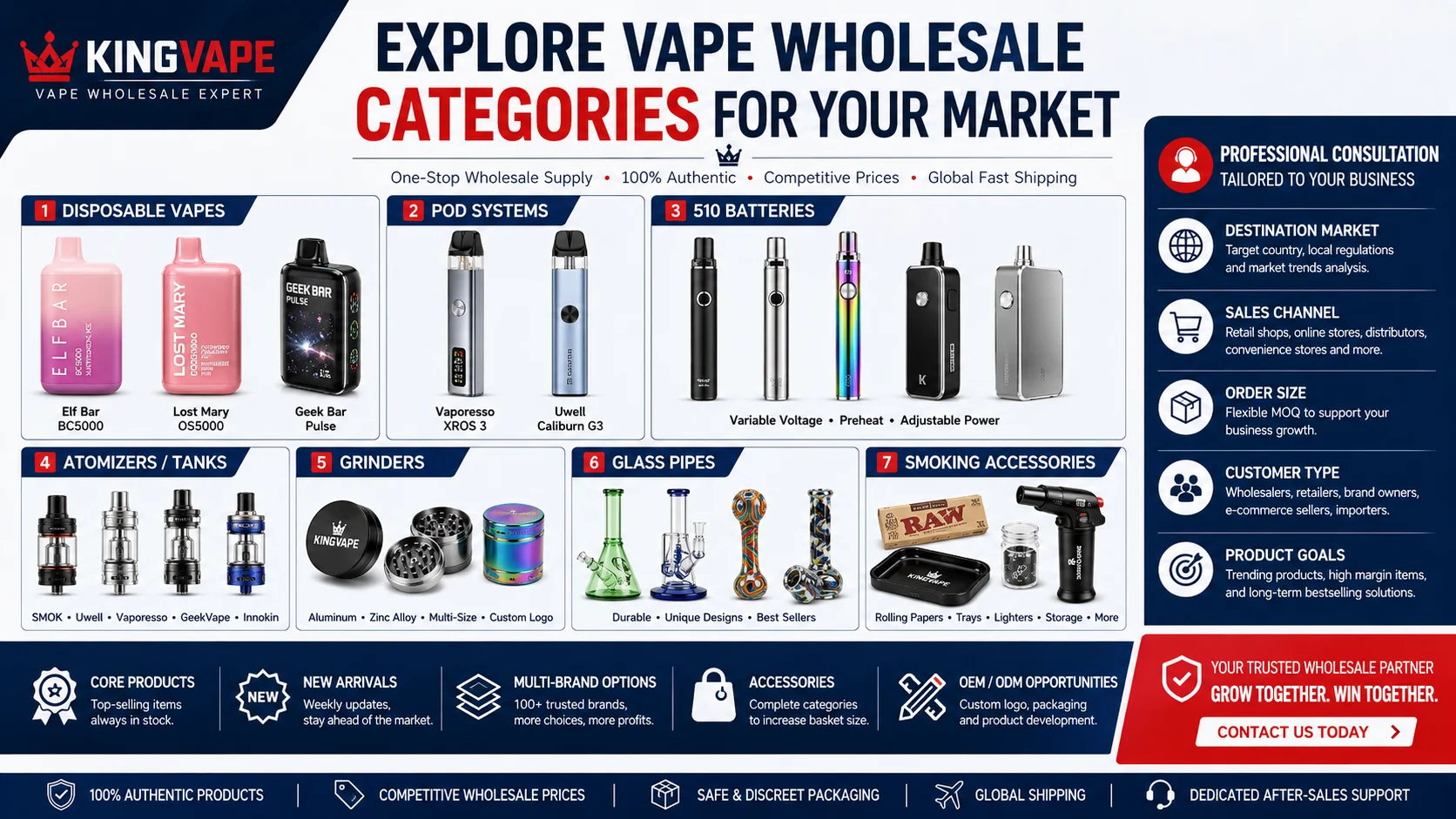
Explore Vape Wholesale Categories for Your Market
I work with buyers who need disposable vapes, ecigs, vape devices, atomizers, 510 batteries, CBD batteries, grinders, glass pipes, vaporizers, and related smoking accessories. My goal is to help each buyer build a more workable product selection instead of simply sending a large catalogue without guidance.
If you want to improve your vape wholesale product selection, send me your destination market, sales channel, preferred product category, target price range, and estimated quantity. I will help you narrow the options and build a more practical wholesale product strategy based on your purchasing route and resale needs.
Frequently Asked Questions
Can educational vape content guarantee more wholesale sales?
No. Educational content cannot guarantee sales, conversion rates, or market fit. It can help buyers understand products more clearly, reduce avoidable confusion, and send more qualified enquiries. Actual results still depend on local demand, pricing, competition, channel execution, and buyer decisions.
What should a B2B vape product description include?
I recommend including key specifications, product differences, packaging details, carton information, suitable sales-channel guidance, MOQ or enquiry guidance, available stock options, and a clear contact route. The description should explain what the details mean for purchasing and resale.
Can small wholesale buyers order from a European warehouse?
For selected products and available stock, European warehouse delivery may suit smaller buyers who need faster replenishment and lower starting quantities. Availability can change, so I recommend contacting me with your destination country, required products, and estimated quantity before planning an order.
When should a buyer consider OEM or ODM vape products?
OEM or ODM may suit established importers, distributors, and wholesalers who want to build their own brand, packaging, or product concept. The right approach depends on project requirements, quantity, timeline, and product-development conditions. I can discuss options after reviewing the project details.
Why should buyers verify local vape regulations independently?
Vape-related product rules can differ by market and can change over time.[^12] Buyers should confirm local import, labeling, tax, sales, and compliance requirements before ordering. I can clarify product and supply information, but local legal verification remains the buyer’s responsibility.
Conclusion
How to turn educational vape content into better product pages is not about adding more words or repeating more keywords. It is about helping wholesale buyers understand product differences, resale implications, supply routes, and support options before they commit capital. Clear product education can reduce confusion across the importer, wholesaler, store, and end-user chain. If you need vape wholesale guidance for Europe, the United States, or another market, contact KingVape with your product needs and purchasing plan.
[^1]: "B2B sales now require a 'holistic' selling approach, study finds", https://business.ku.edu/news/article/b2b-sales-now-require-a-holistic-selling-approach-study-finds. Research on online purchasing finds that clearer and more complete product information can reduce perceived uncertainty and support purchase decisions; the magnitude of any effect on wholesale ordering or complaints depends on the market and transaction context. Evidence role: general_support; source type: research. Supports: Research on information quality, perceived risk, and purchase decisions in online or B2B buying contexts.. Scope note: Evidence from general e-commerce or B2B contexts may not directly measure vape-wholesale transactions. [^2]: "The effects of website quality on customer satisfaction, use ...", https://dr.lib.iastate.edu/server/api/core/bitstreams/f0db43d0-6c43-4537-9ab5-0c6158513c81/content. Studies of digital B2B buying associate information quality and perceived usefulness with buyer trust and purchase intention; they do not establish that educational vape content alone increases conversion for every supplier or market. Evidence role: mechanism; source type: paper. Supports: Evidence that informational website quality and useful content can influence trust, perceived usefulness, and purchase intention in digital B2B settings.. Scope note: The source should be framed as evidence of a general decision-making mechanism, not proof of this page's conversion performance. [^3]: "Evaluating the drivers of B2B performance: An empirical analysis ...", https://pmc.ncbi.nlm.nih.gov/articles/PMC11244795/. Research on information quality in online purchasing indicates that relevant, understandable information supports buyer evaluation and can lower perceived risk; assessing local market fit and after-sales capacity still requires buyer-specific evidence. Evidence role: general_support; source type: paper. Supports: Research linking product or supplier information quality to buyer evaluation, perceived risk, and decision confidence.. Scope note: General research cannot verify that any particular vape product is suitable for a given market. [^4]: "Encouraging Retailers to Stop Selling Illegal Vapes", https://www.fda.gov/news-events/press-announcements/statement-fda-commissioner-marty-makary-md-mph-encouraging-retailers-stop-selling-illegal-vapes. Public-health and regulatory sources describe e-cigarette sales through specialist vape shops and other retail outlets, including convenience stores in some jurisdictions; permitted channels and product assortments vary by country and local law. Evidence role: general_support; source type: government. Supports: Government or public-health descriptions of retail environments in which e-cigarette products are sold.. Scope note: Retail-channel evidence from one jurisdiction should not be generalized to all destination markets. [^5]: "The role of supplier performance evaluations in mitigating risk", https://digitalcommons.bryant.edu/cgi/viewcontent.cgi?article=1117&context=mark_jou. B2B buying research identifies product information, supplier reliability, price, delivery, and service as recurring evaluation criteria; the exact questions asked vary by buyer role, product category, and procurement process. Evidence role: general_support; source type: research. Supports: Research or surveys identifying common information needs and supplier-evaluation criteria among B2B buyers.. Scope note: A general B2B survey may not specifically cover vape wholesalers. [^6]: "Puffing Topography: A Tool to Evaluate Vaping Behavior ... - PMC", https://pmc.ncbi.nlm.nih.gov/articles/PMC12958158/. Laboratory and behavioral studies show that e-cigarette aerosol generation and device consumption can vary with puff duration, flow rate, power, and user behavior, so nominal puff counts are not uniform real-world usage outcomes. Evidence role: mechanism; source type: paper. Supports: Experimental evidence that e-cigarette aerosol output and use duration depend on puffing behavior and device operating conditions.. Scope note: Device-specific testing is needed to quantify variation for a particular model. [^7]: "Economic Order Quantity (EOQ) | www.waru.edu", https://www.waru.edu/acquipedia-article/economic-order-quantity-eoq. Inventory-management literature explains that lower order quantities can reduce cash tied up in inventory and exposure to excess stock, although unit cost, freight cost, stock availability, and replenishment reliability may offset those benefits. Evidence role: mechanism; source type: education. Supports: Inventory-management principles relating order size and inventory levels to working-capital commitments and carrying risk.. Scope note: This principle does not show that an overseas warehouse will be the lowest-cost option for a specific buyer. [^8]: "Smoking and vaping: Health at a Glance 2025", https://www.oecd.org/en/publications/2025/11/health-at-a-glance-2025_a894f72e/full-report/smoking-and-vaping_23b355e4.html. International tobacco-control reporting documents continuing changes in electronic nicotine-delivery-system regulation and product markets across jurisdictions; it does not establish the pace of change for every local wholesale segment. Evidence role: historical_context; source type: institution. Supports: International monitoring of changing regulation, product development, and market conditions for electronic nicotine-delivery systems.. Scope note: International reports provide contextual evidence rather than a direct measure of a particular supplier's market. [^9]: "The Impact of New Regulations on Prevention and Control of E ... - PMC", https://pmc.ncbi.nlm.nih.gov/articles/PMC11018711/. Official and academic accounts describe Shenzhen as a major concentration of electronic-cigarette manufacturing and related export supply chains; this regional context does not verify the capabilities or compliance status of any individual company. Evidence role: historical_context; source type: government. Supports: Official or academic documentation of Shenzhen's concentration of e-cigarette manufacturing and export-related industry activity.. Scope note: Industrial-cluster evidence is not evidence of the named business's quality, capacity, or regulatory compliance. [^10]: "Cross-Country Comparison of Bans on Internet Tobacco Advertising ...", https://pmc.ncbi.nlm.nih.gov/articles/PMC12397592/. International and national regulatory authorities document that electronic-cigarette requirements differ by jurisdiction and may address product composition, labeling, notification or authorization, sales restrictions, taxation, and importation. Evidence role: expert_consensus; source type: institution. Supports: Authoritative documentation that rules governing e-cigarettes differ across jurisdictions and may cover product authorization, labeling, sales, taxation, and importation.. Scope note: Buyers must consult the current rules and competent authorities for their specific destination market. [^11]: "SEO Link Best Practices for Google | Google Search Central", https://developers.google.com/search/docs/crawling-indexing/links-crawlable. Search-engine documentation explains that crawlable internal links help systems discover pages and understand site structure, while usability research supports navigational links as aids to finding related information; neither source guarantees rankings or enquiries. Evidence role: mechanism; source type: research. Supports: Official search documentation and usability research on internal links, site navigation, discoverability, and page relationships.. Scope note: Internal linking is one technical and navigational factor, not a standalone measure of search visibility or conversion. [^12]: "Tobacco: E-cigarettes", https://www.who.int/news-room/questions-and-answers/item/tobacco-e-cigarettes. Official regulatory materials show that electronic-cigarette requirements vary among jurisdictions and are periodically amended, making current destination-specific verification necessary before importation or sale. Evidence role: historical_context; source type: government. Supports: Current official regulatory materials showing jurisdictional variation and amendments to rules for electronic-cigarette products.. Scope note: A general regulatory source cannot substitute for legal advice or confirmation of current local requirements.