
Disposable vs rechargeable vape wholesale strategy is not simply a question of which device has a lower purchase price or a higher puff count. Buyers can lose time and cash when a product does not fit local rules, retail channels, customer habits, or replenishment capacity. I help buyers compare the full commercial picture before stock becomes a burden.
Disposable versus rechargeable vape wholesale decisions should be based on destination-market rules, sales channel, consumer buying habits, target price, replacement-pod availability, and inventory turnover—not device cost alone. Disposable products may suit fast-moving, regulation-permitted channels, while rechargeable or reusable systems can support longer customer relationships when compatible pods, e-liquid, coils, and parts are reliably available.[^1]
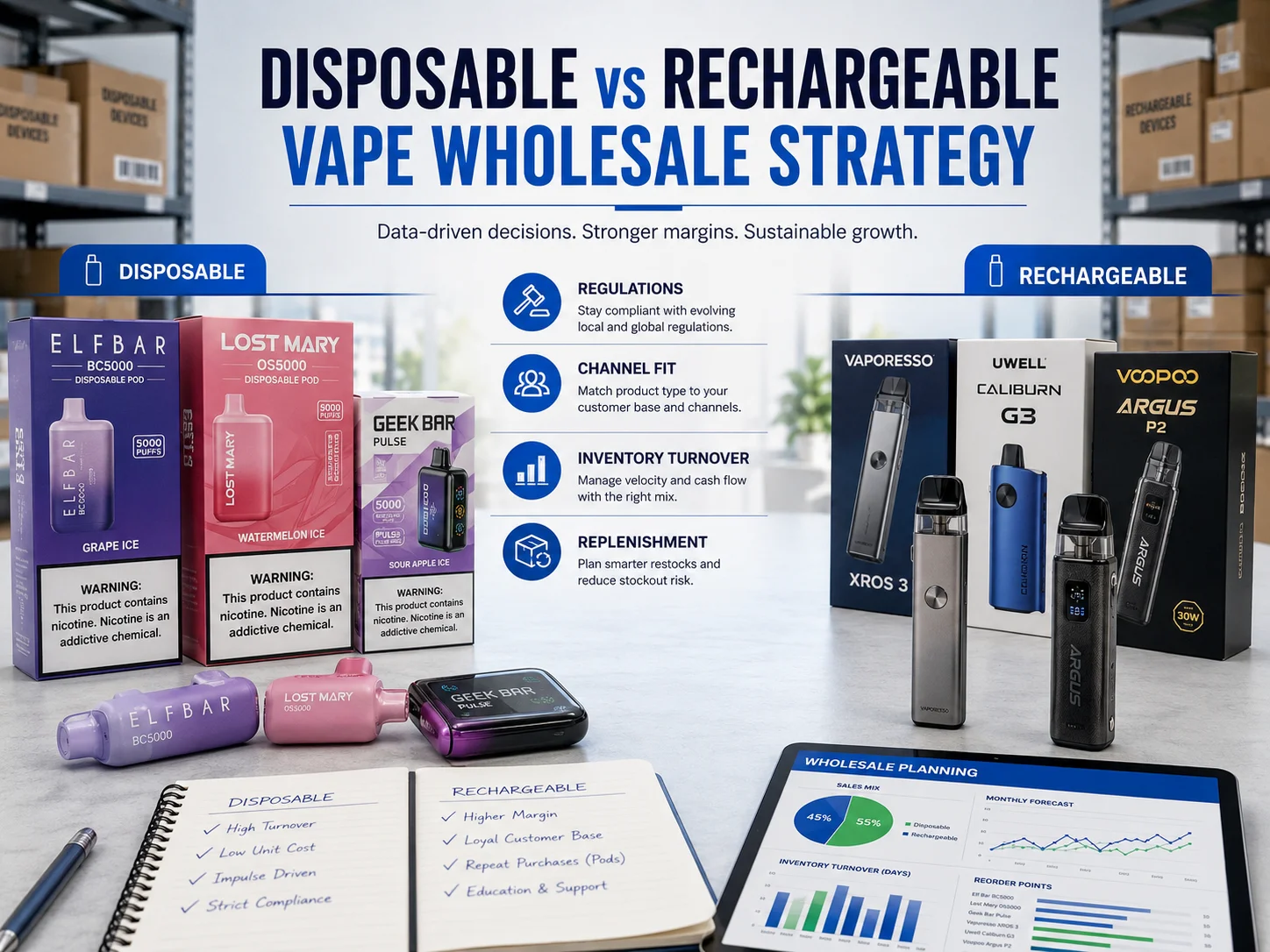
In my discussions with wholesalers, vape shops, convenience-store suppliers, and importers, I see the same issue repeatedly: buyers compare products first, but they should compare business models first. The right category depends on how quickly you can test, restock, explain, support, and sell the product in your local market.
Quick Answer: How Should You Build a Disposable vs Rechargeable Vape Wholesale Strategy?
Many buyers feel pressure to follow the newest product trend. That pressure can lead to large orders before they understand local demand, replacement-product availability, or the cost of slow-moving stock. A device can look attractive in a catalogue but still create a difficult inventory problem.
A practical disposable vs rechargeable vape wholesale strategy starts with compliance, then channel fit, then stock risk. Choose disposable vapes only where they are permitted and suitable for your customers’ buying behavior. Choose rechargeable or reusable products when you can maintain replacement pods, coils, e-liquid, batteries, or accessories and want to build repeat purchases over time.
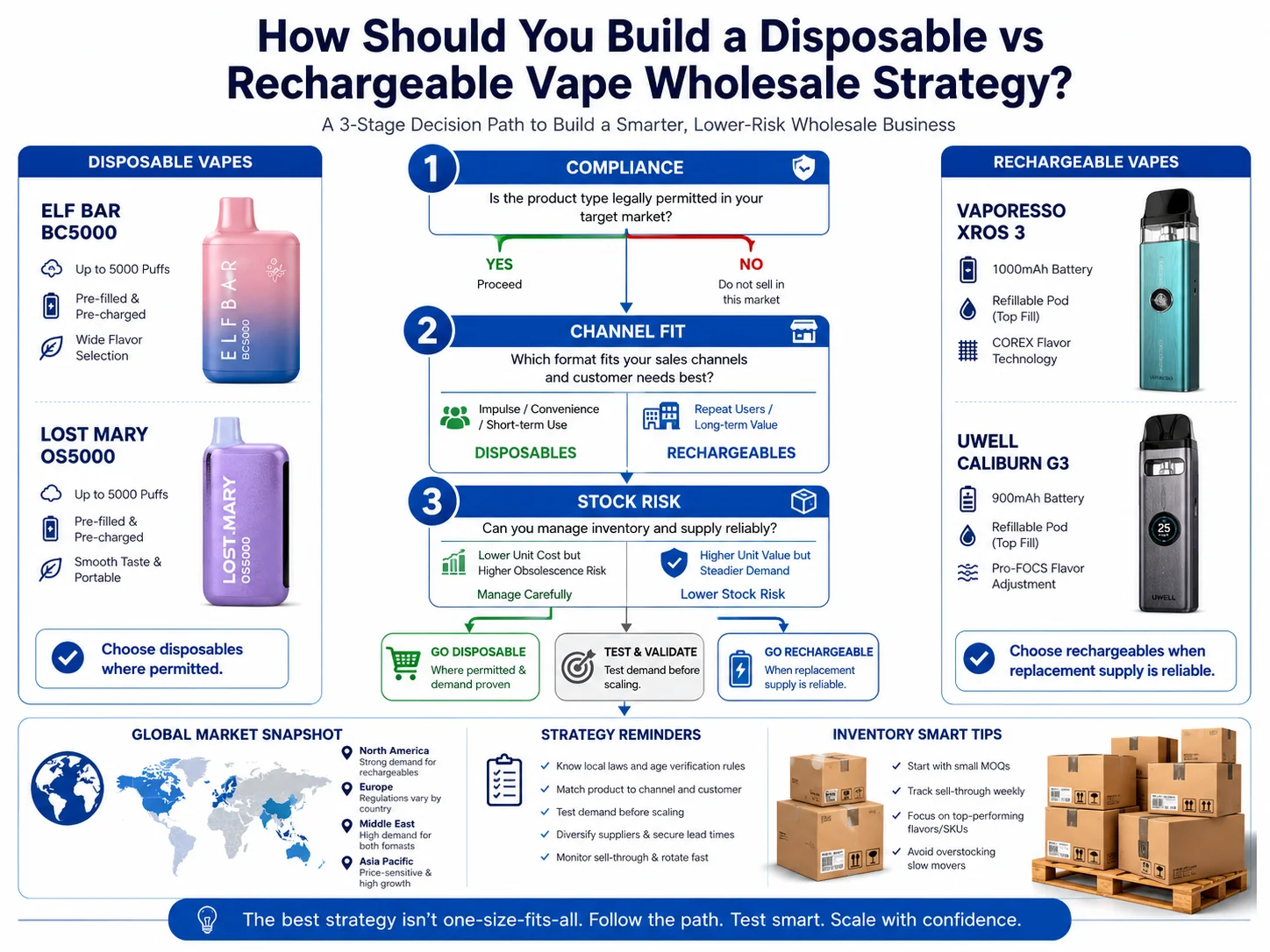
Start With the Buyer’s Real Operating Model
I usually encourage buyers to ask a different question:
“Which vape format fits the way my channel sells, replenishes, and absorbs unsold inventory?”
For example, a small wholesaler supplying tourist-area convenience stores may need products that are easy for staff to display and easy for consumers to understand. A regional distributor with established vape-shop customers may be better positioned to stock devices plus replacement pods, replacement coils, chargers, and related accessories.
A useful decision process includes:
- Confirm destination-market requirements.
- Identify the end sales channel.
- Define the target retail price range.
- Estimate how often customers will return for replacement products.
- Check whether compatible parts can be supplied consistently.
- Start with a controlled test order before expanding.
At Shenzhen Kingfuji Tech Co., Ltd., we work with both models. Some buyers need small, fast-moving trial orders from European warehouse stock. Larger importers may prefer direct China orders for stronger unit economics, wider SKU selection, OEM work, or customized packaging.
Disposable vs Rechargeable Vape Wholesale Comparison Table: What Should Buyers Compare?
Buyers often compare only the landed unit price. That is understandable, but it misses important costs: shelf space, tied-up cash, customer questions, warranty handling, accessory availability, and the risk of a product becoming difficult to replenish.
The best disposable vs rechargeable vape wholesale option depends on whether your business needs simple one-time sales, repeat accessory sales, or a balanced category mix. Disposable products can simplify the initial transaction, while rechargeable and reusable products usually require deeper supply planning but may support ongoing customer repurchases.
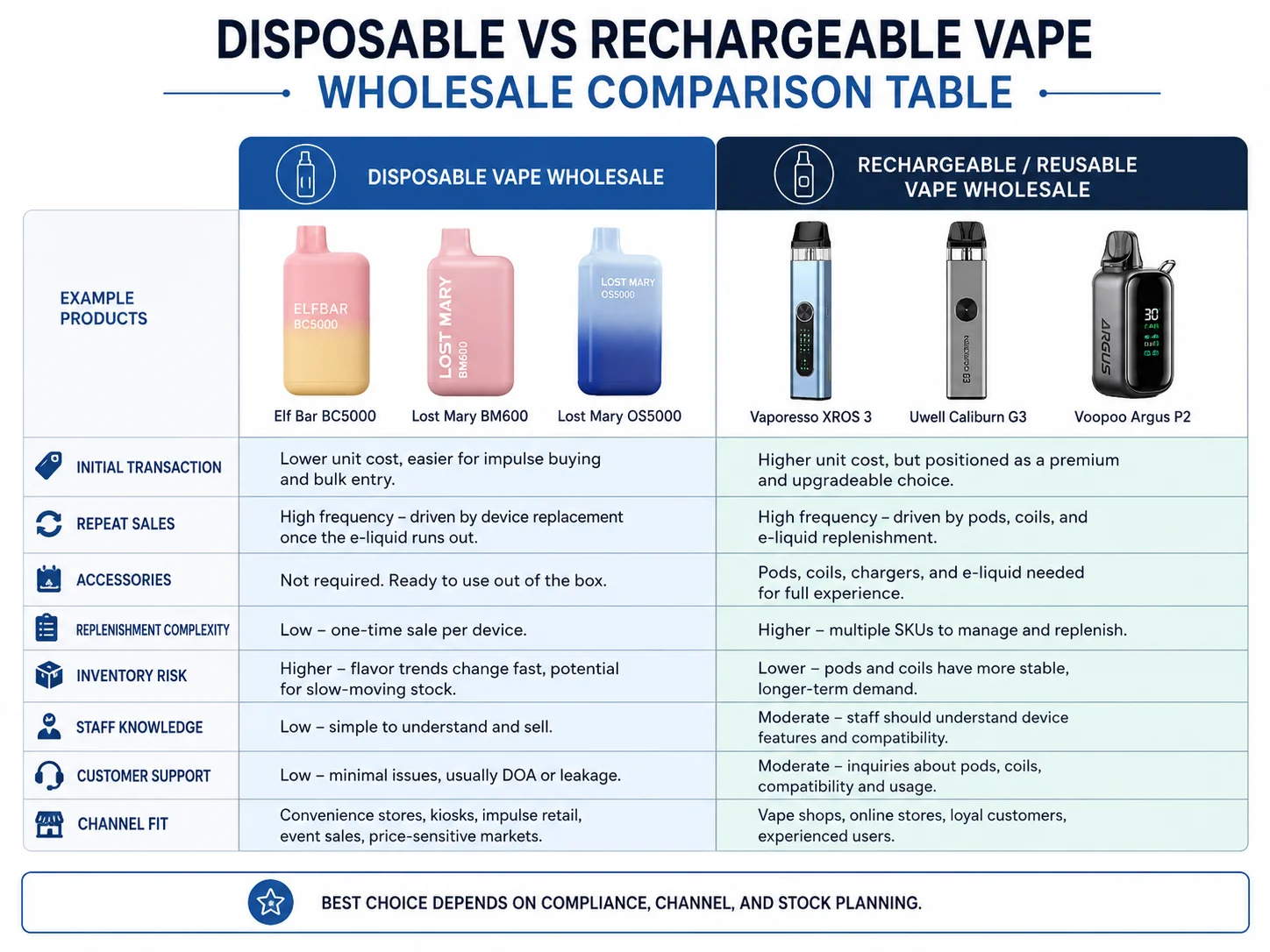
| Factor | Disposable Vape | Rechargeable or Reusable Vape | Best-Fit Buyer or Market |
|---|---|---|---|
| Product structure | Usually designed as a single finished unit | Device may be used with pods, cartridges, coils, e-liquid, or charging accessories | Depends on local legal requirements and channel |
| Initial consumer purchase | Often straightforward | May require device plus refill or replacement item | Vape shops and informed consumers may accept a system format |
| Repeat purchase | Usually a new complete unit | Replacement pods, e-liquid, coils, or cartridges may create repeat demand | Retailers with ongoing customer relationships |
| Inventory complexity | Fewer linked parts per SKU | More components and compatibility tracking | Distributors with stronger stock management |
| After-sales needs | Can involve device failures but fewer accessory questions | May include pod compatibility, coil issues, charging questions, and leakage concerns | Buyers with trained sales staff or support processes |
| Replenishment planning | Focuses on finished-device stock | Requires stable supply of compatible replacement products | Markets with predictable repeat purchasing |
| Product range risk | Too many flavors or versions can still create slow stock | Too many device platforms can fragment pod and part inventory | Buyers should limit initial SKUs |
| Commercial fit | May suit permitted fast-turnover channels | May suit longer-term category building | Channel and regulation should decide |
Look Beyond Apparent Margin
A low factory price does not automatically mean a better business result.[^2] I have seen buyers choose a very low-priced item, only to find that it creates more work through slow sales, unclear product positioning, missing replacement parts, or after-sales disputes.
A stronger comparison includes:
- Land cost: Product price, shipping, taxes, duties, local handling, and storage.
- Stock exposure: How much cash sits in unsold colors, flavors, pod versions, or battery models.
- Reorder speed: Whether you can refill successful SKUs without waiting too long.
- Support cost: How much time your staff spends answering use and compatibility questions.
- Channel fit: Whether your customers are vape shops, smoke shops, gas stations, online buyers, or regional wholesalers.
For many small and medium buyers, controlled stock is more valuable than chasing the lowest possible unit price. For larger importers, wider product ranges and direct container or bulk shipments may be more workable because they have stronger distribution coverage and a greater ability to spread inventory across customers.
What Is the Difference Between Disposable, Rechargeable, and Reusable Vapes?
The terms “disposable,” “rechargeable,” and “reusable” are often used loosely in wholesale conversations. That creates risk because a charging port alone does not necessarily make a product reusable under local requirements or suitable for every market.
A disposable vape is generally sold as a finished unit for limited use, while a rechargeable vape can have a rechargeable battery but may still not accept refills or replacement pods. A reusable vape normally has a continued-use structure, such as refillable e-liquid capability or replaceable pods, cartridges, or other components.
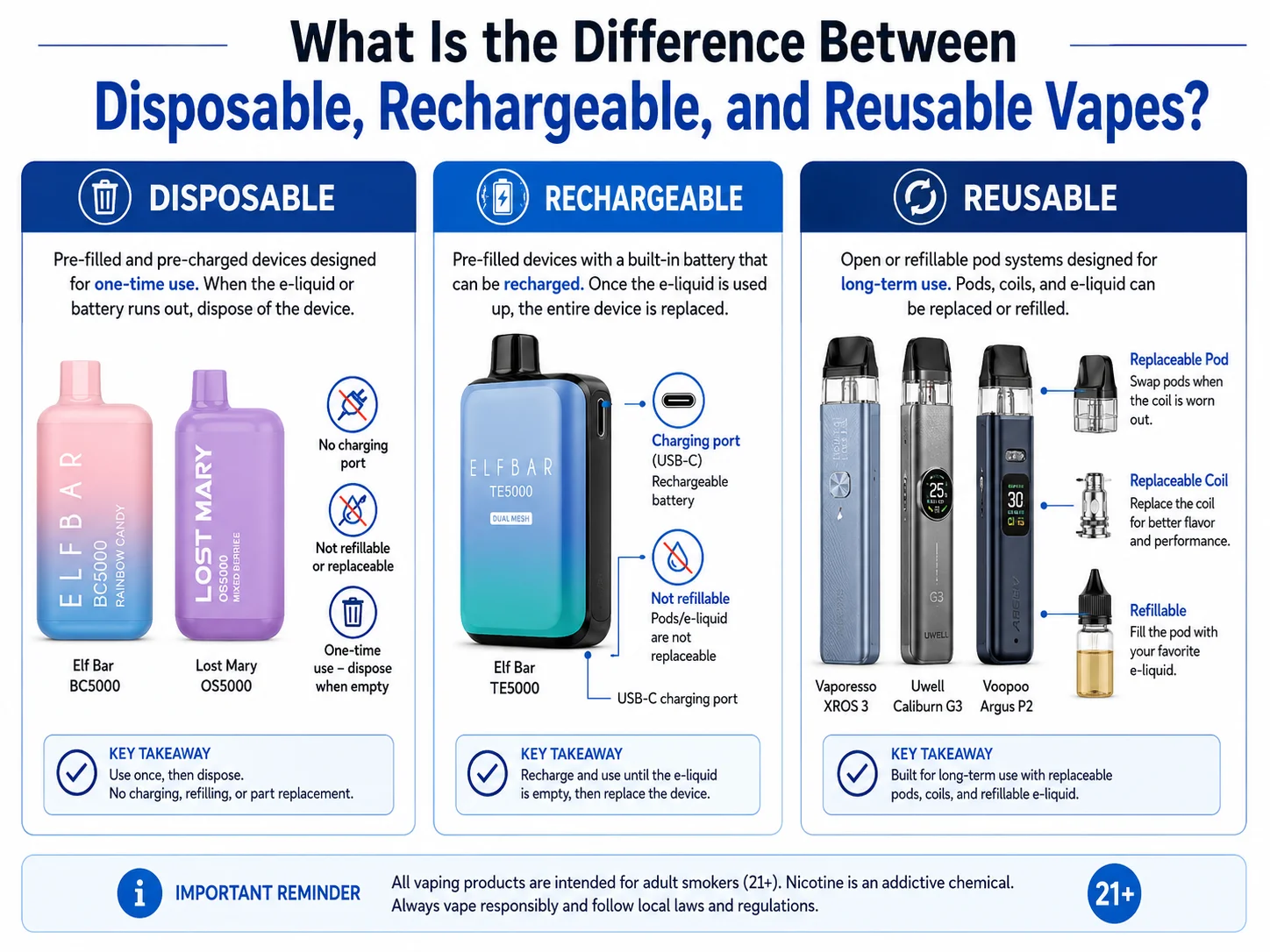
A Charging Port Is Not the Full Answer
In wholesale sourcing, buyers should not rely on product names alone. They should ask for clear product structure details and verify whether the device is:
- Rechargeable by USB-C or another charging method
- Refillable with e-liquid
- Compatible with replaceable pods or cartridges
- Built with replaceable coils or atomizers
- Supported by separately available parts
- Packaged and labeled for the destination market
- Permitted under current local rules
This distinction is especially important in the United Kingdom. From 1 June 2025, businesses have been prohibited from selling or supplying single-use vapes in the UK, including nicotine and non-nicotine products. A rechargeable device is not automatically considered compliant simply because it can be charged.[^3] Products must meet applicable reusable-product criteria, including refillability or replaceable pods, and relevant components must be available for separate purchase. Buyers should review current official guidance before purchasing. GOV.UK provides business guidance on the single-use vape ban.
I always recommend that importers confirm the latest requirements with official local sources, qualified compliance professionals, or their local legal adviser. Regulations can change, and product approval requirements can differ by country, region, nicotine level, packaging format, and sales channel.
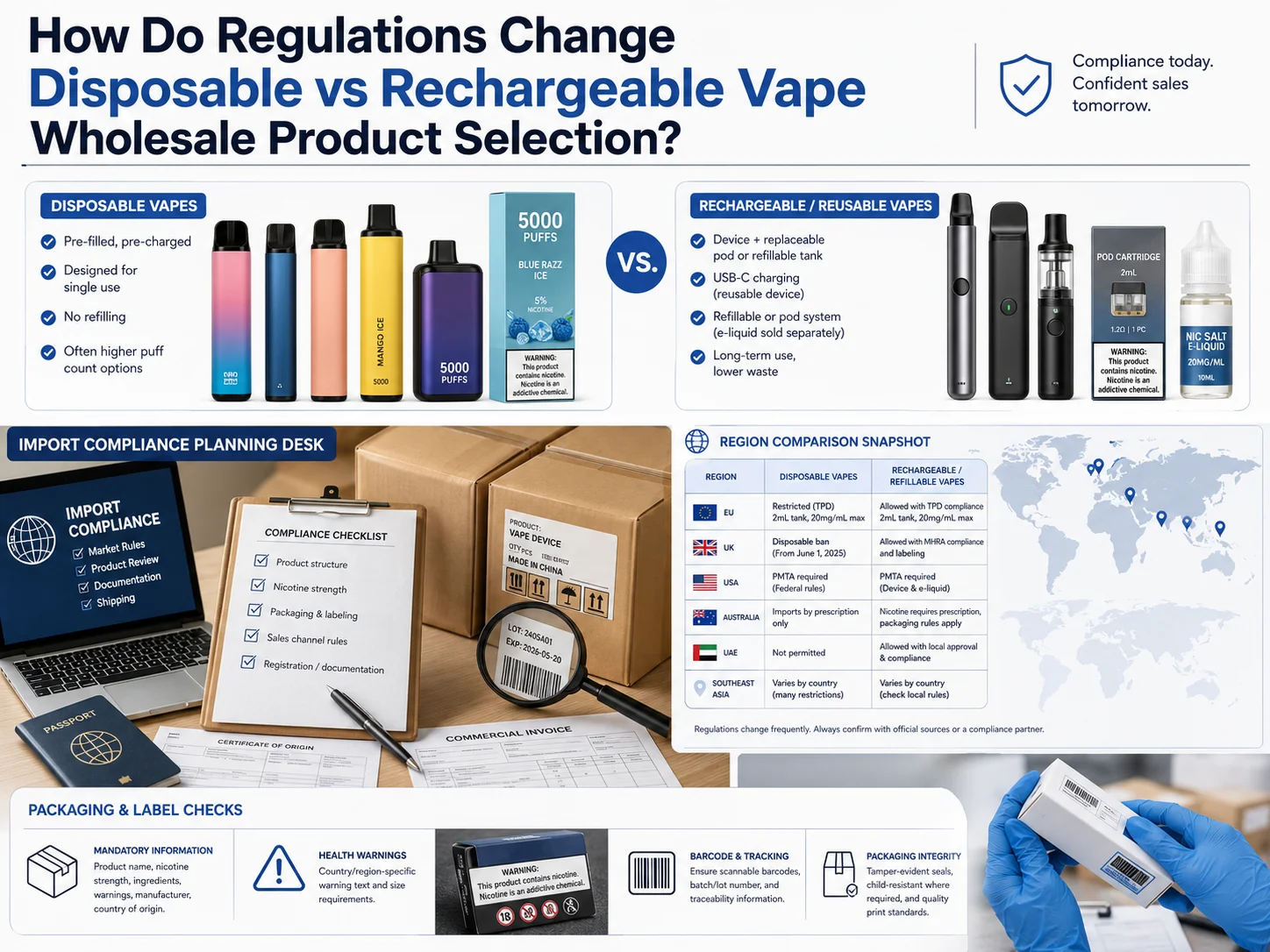
How Do Regulations Change Disposable vs Rechargeable Vape Wholesale Product Selection?
Regulatory uncertainty is one of the fastest ways for a wholesale order to become a commercial risk. Buyers may focus on demand first, but if a product cannot be legally sold, displayed, imported, or supplied through a chosen channel, demand does not matter.
Regulations change disposable vs rechargeable vape wholesale selection by determining which product structures, nicotine strengths, packaging, registrations, labeling, and sales methods are acceptable in each destination.[^4] Importers should verify local rules before confirming a product, rather than assuming a popular item is permitted everywhere.
Market Rules Can Affect More Than the Device
In my supply-side experience, buyers should check several areas before placing an order:
| Compliance Area | Why It Matters for Buyers |
|---|---|
| Disposable-vape restrictions | Some markets restrict or ban single-use products[^5] |
| Nicotine limits | Limits can affect e-liquid volume, concentration, and product design |
| Product registration | Some markets require notification, registration, or product listing |
| [Packaging and warnings | Labels, language, health notices, and child-safety features may be required](https://health.ec.europa.eu/tobacco/product-regulation/electronic-cigarettes_en)[^6] |
| Age-restricted sales | Retail channels need processes for compliant sales |
| Import requirements | Customs documentation and product categories can affect clearance |
| [Environmental rules | Battery, recycling, and waste requirements may affect product strategy](https://environment.ec.europa.eu/topics/waste-and-recycling/batteries_en)[^7] |
I do not present myself as a regulatory authority. However, I can help buyers organize product information, compare device structures, and identify questions they should verify before they commit to stock.
For markets where disposable products remain allowed, buyers may still need to assess nicotine rules, local taxes, advertising limits, flavor restrictions, packaging requirements, and retailer obligations. For markets that favor reusable systems, the buyer must also think beyond the starter device. The real business depends on whether replacement pods, e-liquid, coils, and accessories remain available after the initial sale.
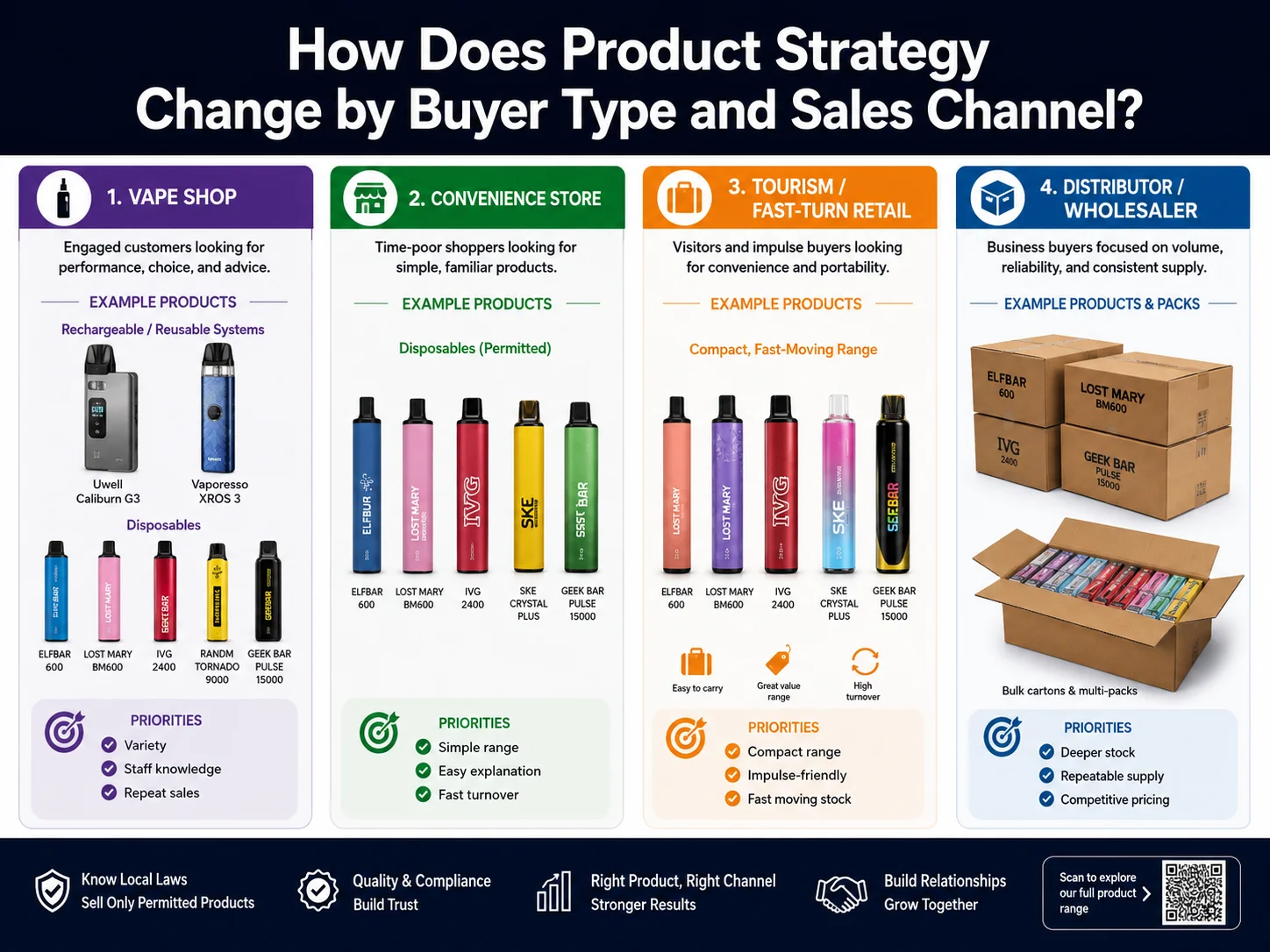
How Does Product Strategy Change by Buyer Type and Sales Channel?
A vape shop, a gas station, a tourism-focused retailer, and a regional distributor do not sell in the same way. They should not use the same buying strategy. The best product mix is usually shaped by staff knowledge, shelf space, customer loyalty, and reorder frequency.
Vape product selection by market and buyer type should match the sales environment. Convenience-oriented channels may prioritize simple, easy-to-explain products where permitted, while vape shops and established distributors may be better equipped to support rechargeable or reusable systems with replacement-product sales.
Vape Shops and Smoke Shops
Vape shops often have staff who can explain devices, flavors, charging, pods, coils, and e-liquid choices.[^8] This makes them better positioned for reusable vape wholesale categories, provided the local market allows them and replacement stock is reliable.
These buyers may benefit from:
- A small number of core device platforms
- Clear pod or cartridge compatibility
- Replacement coils and atomizers
- E-liquid or refill options where appropriate
- Staff product education
- A defined after-sales process
Convenience Stores, Gas Stations, and Tourist Retail
Convenience-focused retailers often need fast decisions at the counter. Their staff may not have time to explain a complicated system. In regulation-permitted markets, simple products with clear packaging can be easier to manage. However, buyers should keep SKU counts controlled because too many flavors or models can quickly create slow stock.
Regional Distributors and Importers
Regional wholesalers can build a broader category because they distribute across many shops. They may combine:
- Fast-turnover products for selected channels
- Rechargeable systems with replacement-pod lines
- Glass pipes, grinders, atomizers, 510 batteries, and vaporizers
- Accessories that increase basket size
- Private-label or OEM ranges for differentiated positioning
For larger buyers, we can support direct China sourcing, larger volume planning, OEM/ODM discussions, custom packaging, and product development where conditions are suitable. Our Shenzhen factory operates with integrated supply capabilities, and we maintain regular new-product development activity.
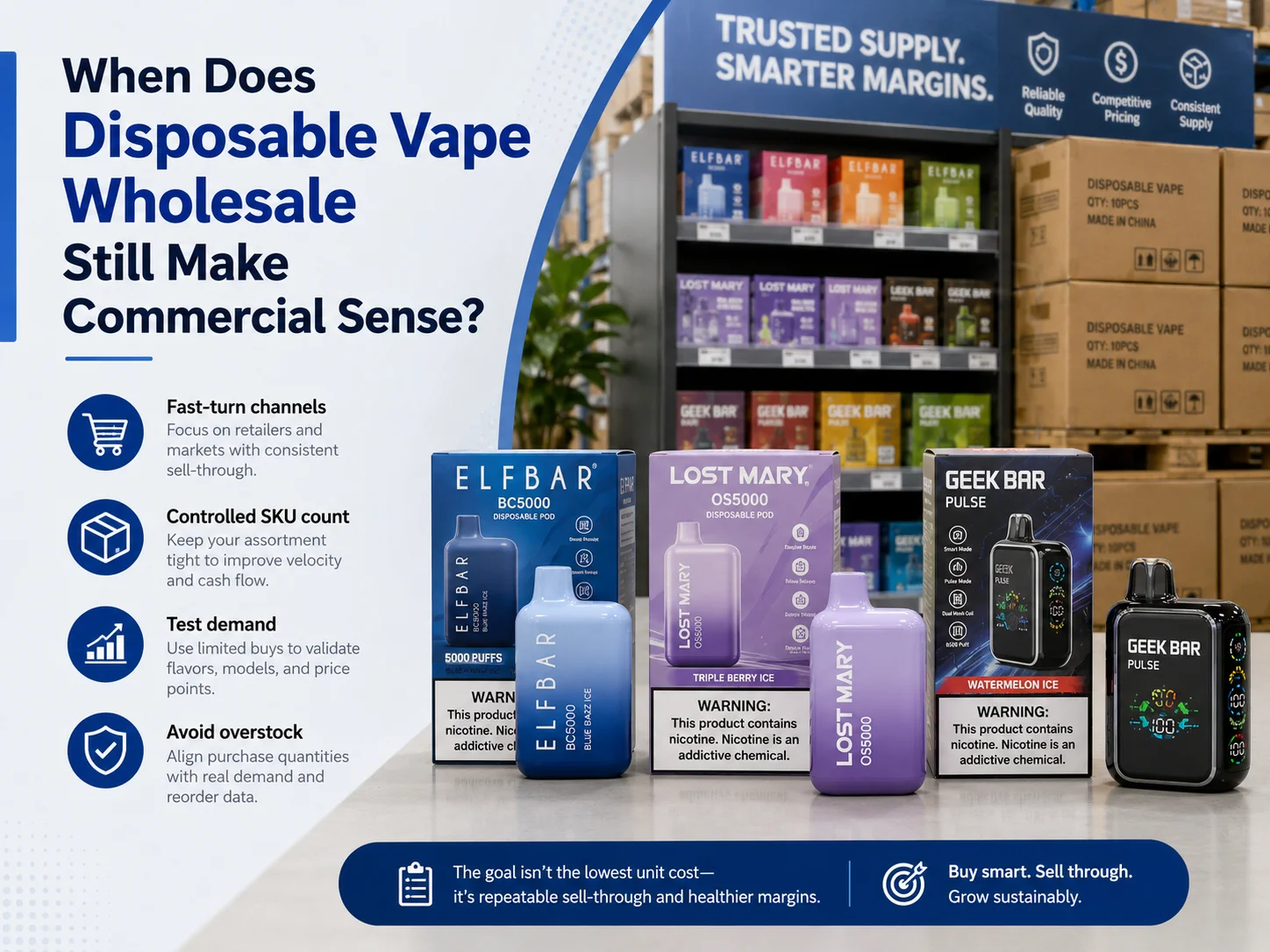
When Does Disposable Vape Wholesale Still Make Commercial Sense?
Buyers may hear that one category has replaced another everywhere. In reality, local regulations and channel conditions decide the answer. In markets where disposable products are legally permitted, they may still fit certain retail models.
Disposable vape wholesale can make commercial sense in legally permitted markets when buyers need a simple, clearly positioned product for fast-turnover channels, controlled trials, or consumers who prefer a straightforward purchase. Buyers should still limit SKU count, verify compliance, and avoid overcommitting cash to untested demand.
Situations Where a Controlled Trial May Be Sensible
In our buyer conversations, disposable products may be considered when:
- The destination market permits the product type.
- The buyer supplies convenience-oriented retailers.
- Customers prefer simple, ready-to-use formats.
- Shelf space is limited.
- The buyer needs to test flavors, price points, or brands carefully.
- The buyer can reorder successful SKUs without holding excessive stock.
The key word is controlled. I do not advise buyers to treat every trending product as a large-volume opportunity. A buyer may protect cash flow by starting with a small, selected range, tracking sales by SKU, and reordering based on actual movement rather than assumptions.[^9]
For our European customers, overseas warehouse stock can be useful for smaller orders when appropriate products are available. This model can reduce lead-time pressure for eligible buyers and support lower starting quantities. Our European warehouse network has stock locations across countries including Germany, Austria, Poland, and Belgium, with delivery options through carriers such as DHL, DPD, UPS, and FedEx.
However, buyers should still confirm destination rules and product eligibility. Fast delivery does not remove the buyer’s responsibility to sell only products that meet local requirements.
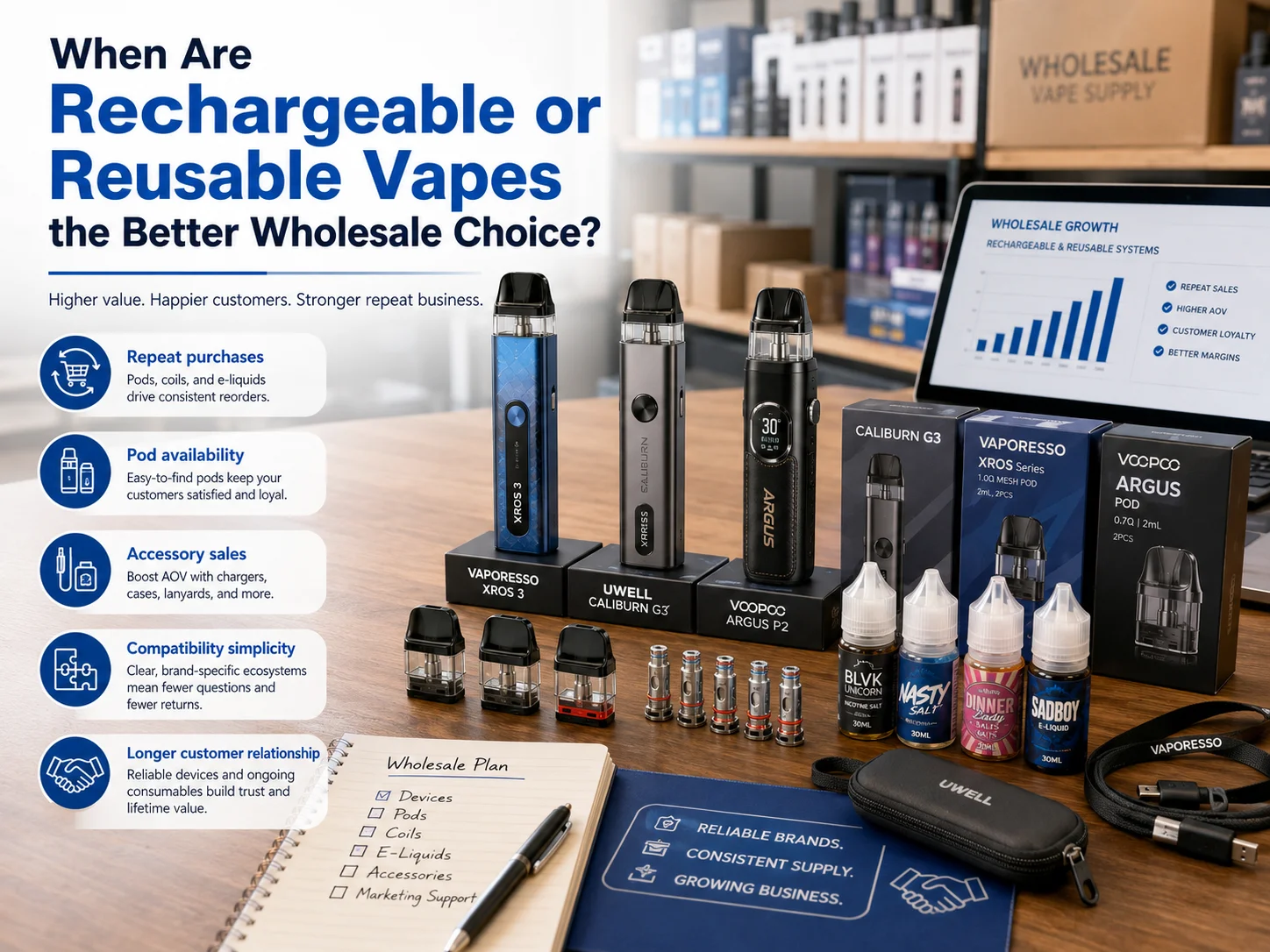
When Are Rechargeable or Reusable Vapes the Better Wholesale Choice?
Rechargeable and reusable vape categories can create more repeat-purchase opportunities, but they also demand more discipline. A buyer cannot successfully sell a device platform if replacement pods or related products disappear after the first order.
Rechargeable vape wholesale and reusable vape wholesale are often better choices when a buyer can maintain reliable replacement-pod, cartridge, coil, e-liquid, or accessory supply. These products can support repeat purchasing, but only when the buyer keeps compatibility simple and provides clear customer guidance.
Build Around a Manageable Product Ecosystem
A reusable system should be treated as an ecosystem, not as a single item. The buyer should plan the device and the ongoing consumables together.
A practical reusable vape stock plan may include:
- One or two device platforms, not too many.
- Matching replacement pods or cartridges in sufficient quantity.
- Compatible coils or atomizers, if the device uses them.
- Charging accessories, where applicable.
- Clear product descriptions for retailers and end users.
- A warranty and after-sales workflow for genuine product defects.
I have seen buyers create avoidable problems by stocking five device brands but only a small amount of replacement pods for each. That approach fragments cash and makes replenishment harder. A narrower range often creates a cleaner customer experience.
Rechargeable systems may also suit buyers who want to develop their own brand. For qualified OEM/ODM projects, we can discuss product design, branding, packaging, and production planning. This can help established importers create differentiation, although every private-label project should start with realistic quantity, compliance, and market-positioning discussions.
What Common Mistakes Do Buyers Make When Comparing Vape Categories?
The most expensive mistakes are often not product defects. They are planning mistakes. Buyers may choose a device based on a supplier quotation without considering how that device will be stocked, explained, replenished, or supported after arrival.
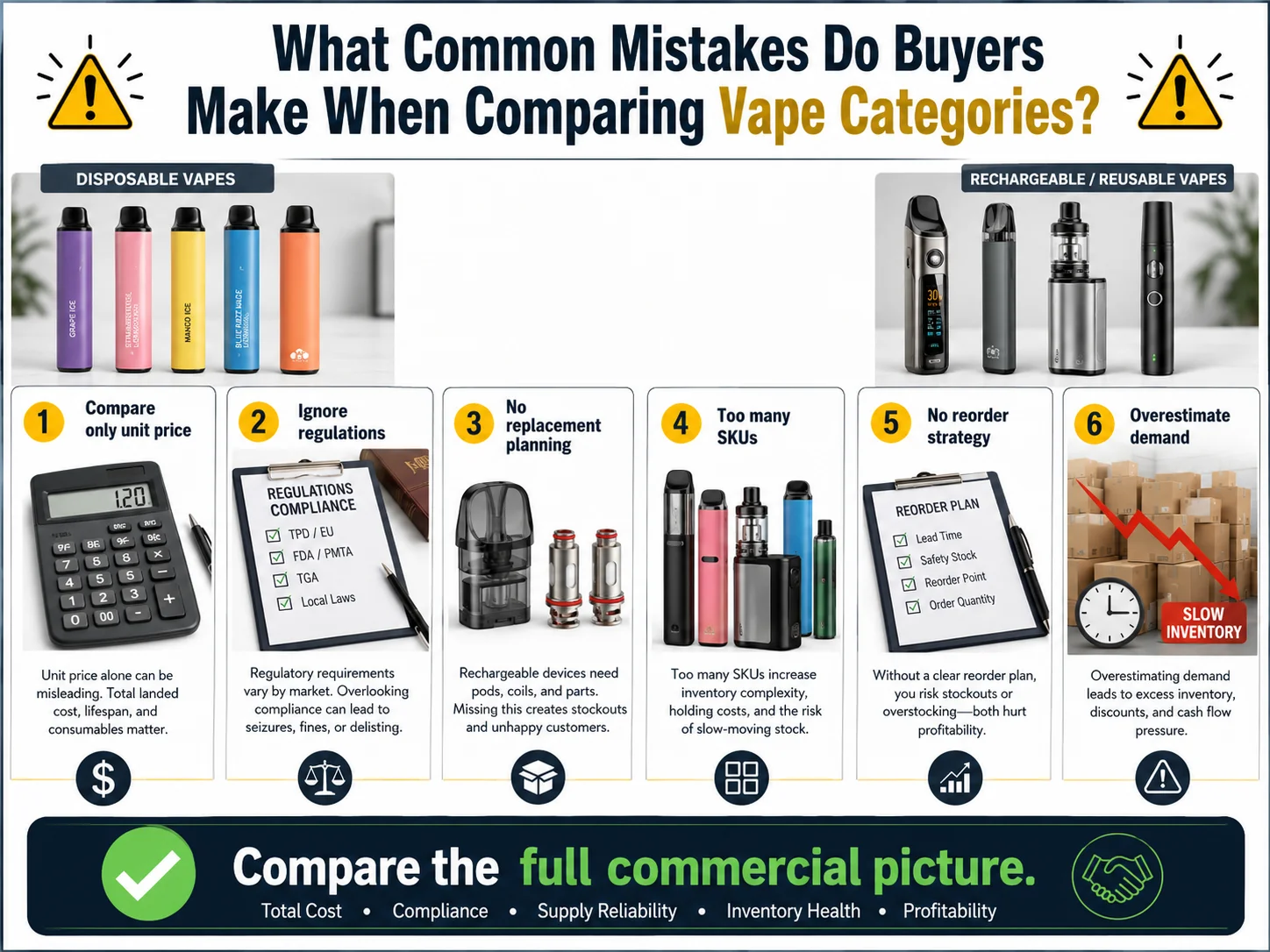
Buyers should avoid comparing disposable and rechargeable vape wholesale products only by puff count, battery size, or unit price. The more useful comparison includes regulations, replacement availability, channel fit, inventory risk, after-sales workload, and the buyer’s ability to restock proven SKUs.
Six Problems I See Most Often
- Comparing only purchase price: A cheaper product can cost more if it sells slowly or creates service issues.
- Assuming rechargeable means reusable: A charging port does not automatically meet reusable-product requirements.
- Ignoring replacement supply: Devices without stable pods, cartridges, coils, or e-liquid can lose value quickly.
- Failing to verify local rules: A product may be popular online but unsuitable for the destination market.
- Ordering too many SKUs: Too many flavors, colors, or platforms can trap cash in slow-moving stock.
- Overlooking compatibility: Mixed device versions and unclear pod matching create retailer complaints and returns.
I also recommend that buyers ask suppliers direct questions before payment:
- Is this product disposable, rechargeable, refillable, or pod-replaceable?
- Which replacement items are available?
- Can replacement components be bought separately?
- What are the carton details and MOQ?
- What product information can you provide for buyer review?
- What after-sales process applies to verified quality issues?
- Can you send samples or videos for product confirmation?
At KingVape, we can provide product videos for verification and coordinate after-sales support for products sourced through us. Our goal is to reduce the burden of dealing with multiple brands, factories, and suppliers separately.
How Can You Build a More Practical Vape Wholesale Stock Strategy?
Inventory is where product decisions become real. A strong vape wholesale stock strategy protects cash flow while giving your customers enough choice. The goal is not to stock everything. The goal is to stock the right products in the right quantities.
A practical vape wholesale stock strategy follows a simple sequence: confirm compliance, analyze the channel, choose core SKUs, test samples, place a small validation order, track sales, and then replenish based on evidence. This process helps buyers reduce slow inventory and improve purchasing confidence.
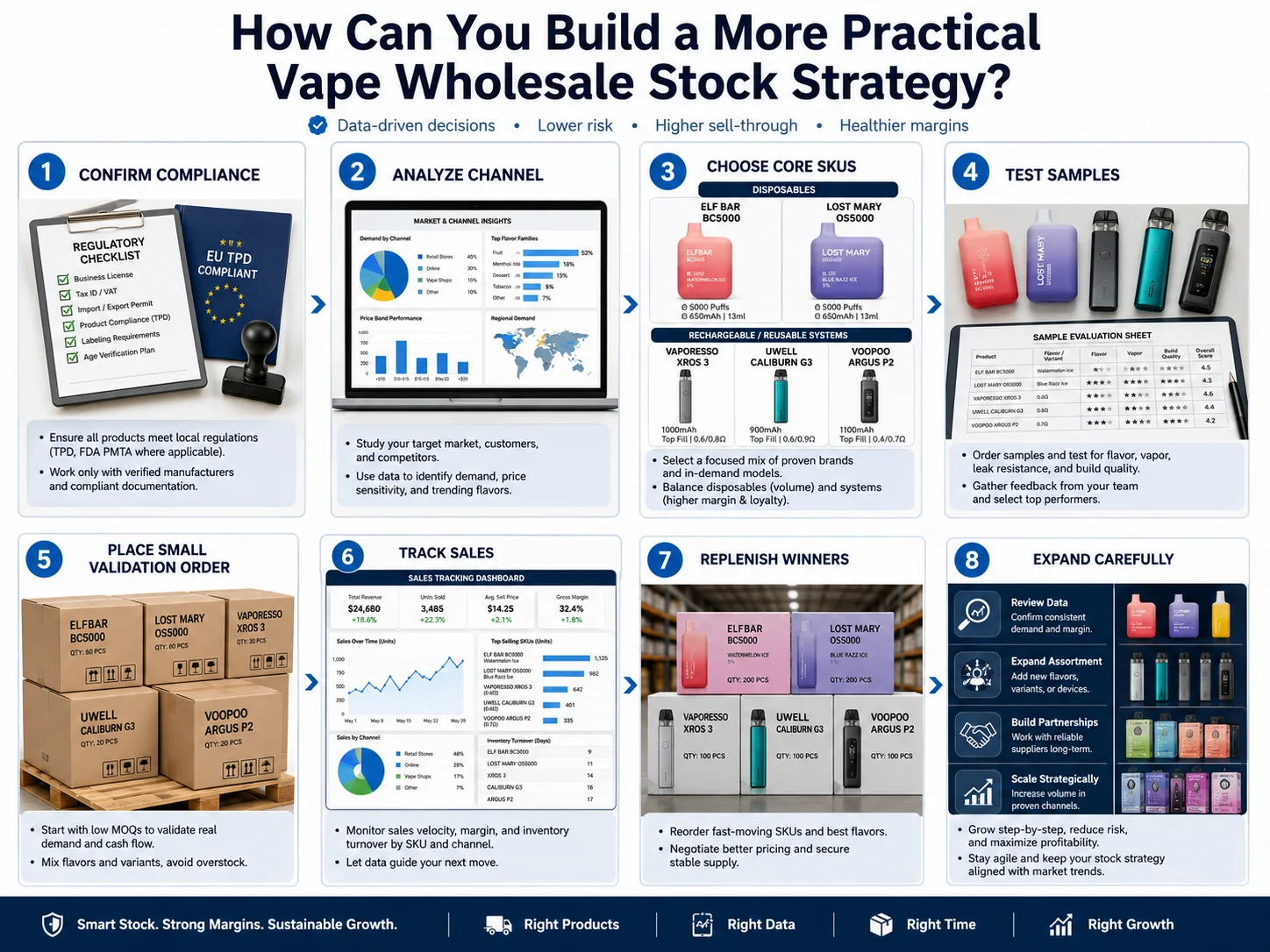
A Seven-Step Buying Path
| Step | Buyer Action | Commercial Benefit |
|---|---|---|
| 1 | Confirm current market rules | Reduces compliance risk |
| 2 | Identify retail channel | Helps match products to customer behavior |
| 3 | Select a limited core SKU range | Prevents fragmented inventory |
| 4 | Review samples, videos, and specifications | Improves product understanding |
| 5 | Place a controlled first order | Limits cash exposure |
| 6 | Track sales and customer feedback | Shows which SKUs deserve reorders |
| 7 | Expand proven products gradually | Supports more stable growth |
For smaller wholesalers, retailers, and shop suppliers, low-MOQ warehouse supply can be useful when available. It allows you to test a category without making a very large upfront commitment. For medium and large importers, direct China sourcing can offer stronger price advantages, broader selection, larger stock planning, and OEM/ODM possibilities.
I believe the best sourcing relationship should remove work from the buyer’s side. You should be able to focus on local sales while I help coordinate sourcing, product options, consolidation, shipping arrangements, and after-sales communication. If you already have a trusted freight forwarder, we can also deliver goods to your forwarder for onward shipment.
Explore Vape Wholesale Categories for Your Market?
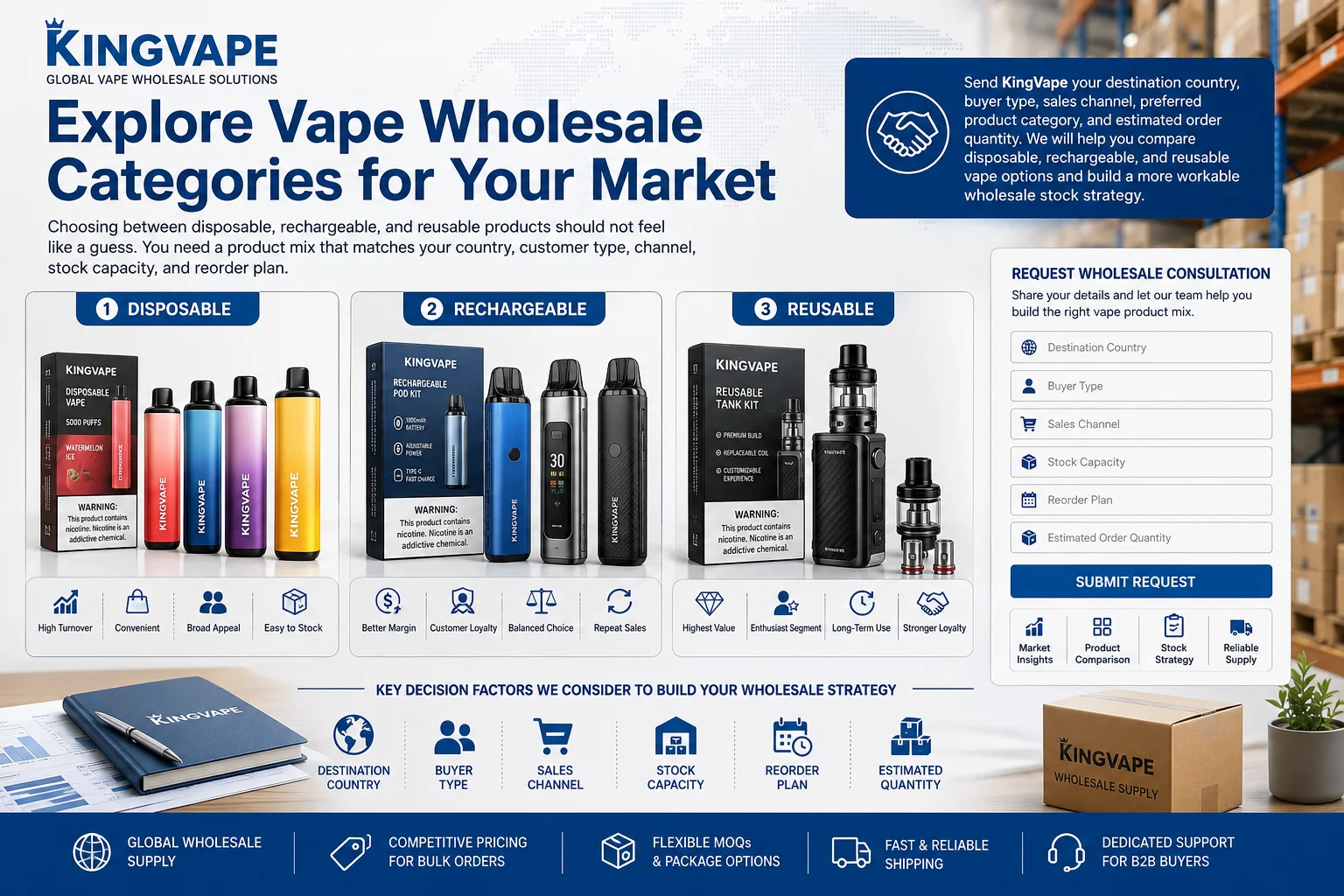
Choosing between disposable, rechargeable, and reusable products should not feel like a guess. You need a product mix that matches your country, customer type, channel, stock capacity, and reorder plan.
Send KingVape your destination country, buyer type, sales channel, preferred product category, and estimated order quantity. We will help you compare disposable, rechargeable, and reusable vape options and build a more workable wholesale stock strategy.
I work from Shenzhen, one of the world’s central vape manufacturing and supply hubs. Shenzhen Kingfuji Tech Co., Ltd. has operated since 2011 as a factory and integrated trading supplier. We support electronic cigarettes, disposable vapes, rechargeable vape products, atomizers, 510 batteries, CBD batteries, vaporizers, grinders, glass pipes, and related smoking accessories.
For qualified partners, we can support:
- One-stop sourcing across multiple vape and smoking-accessory categories
- Regular stock for many common products and brands
- Product sourcing for catalogue gaps
- New-product development discussions
- OEM and ODM cooperation
- Product consolidation and shipping coordination
- European warehouse supply for suitable smaller orders
- Direct China supply for larger importers and distributors
- Product video confirmation and after-sales coordination
Frequently Asked Questions
Is a rechargeable vape always a reusable vape?
No. A rechargeable vape may only have a rechargeable battery, while the liquid system or pod may not be refillable or replaceable. Buyers should check the full product structure and current destination-market rules before describing or selling a product as reusable.
Should vape shops stock disposable or reusable vape products?
Vape shops should choose based on local compliance, customer preferences, staff knowledge, and replacement-product supply. Shops with trained staff may be better able to support reusable systems, pods, coils, and e-liquid. In permitted markets, disposables may still fit selected fast-turnover channels.
How can small wholesalers reduce vape inventory risk?
Small wholesalers can reduce risk by keeping initial SKU counts low, ordering samples, testing a controlled quantity, tracking real sales, and reordering proven products. Where suitable stock is available, European warehouse supply can also help buyers avoid excessive upfront inventory.
What should importers check before ordering vape products from China?
Importers should verify destination-market rules, nicotine limits, packaging requirements, import requirements, product structure, replacement-part availability, shipping arrangements, and after-sales terms. They should also confirm whether the product fits their retail channel and expected target price.
Can larger buyers develop a private-label reusable vape product?
Yes, qualified larger buyers may explore OEM or ODM projects. The project should begin with a clear product concept, expected quantity, destination compliance review, packaging plan, replacement-product strategy, and realistic launch timeline.
Conclusion
The right disposable vs rechargeable vape wholesale strategy depends on far more than unit price. You need to consider local rules, sales channels, customer behavior, replacement supply, stock turnover, and after-sales capacity. Disposable products may fit permitted fast-moving channels, while rechargeable and reusable products can support longer-term repeat purchasing when the full product ecosystem is available. Contact KingVape with your market, channel, and estimated quantity, and I will help you build a more practical sourcing and stock plan.
SIO Tags: disposable vape wholesale, rechargeable vape wholesale, reusable vape supplier, vape wholesale strategy, vape product selection, vape importer guide, vape shop wholesale, B2B vape sourcing, KingVape
Source Vape Products for Wholesale
We support B2B wholesale and distribution sourcing for vape retailers and importers, with compliance-aware supplier vetting. Contact our wholesale team to discuss bulk and distribution options.
Related reading: What Should Small Wholesalers Ask Before Buying Disposable Vapes in Bulk?
[^1]: "A systematic review of health effects of electronic cigarettes", https://cdn.who.int/media/docs/default-source/regulating-tobacco-products/backgroundpapersends3-4november-.pdf. Official UK guidance distinguishes reusable vapes from single-use products by the availability of refill or replacement components, providing a regulatory basis for treating reusable devices as systems with continuing consumable purchases. Evidence role: general_support; source type: government. Supports: Official definitions distinguishing reusable vapes from single-use vapes and requiring refillable or replaceable components for reusable products.. Scope note: The guidance defines product structure for regulatory purposes and does not directly measure customer-relationship outcomes. [^2]: "Spend Management Solutions for the Healthcare Industry", https://scm.ncsu.edu/wp-content/uploads/sites/442/2010/07/Spend-Management-Solutions-for-the-Healthcare-Industry-23SEP2010.pdf. Inventory-management literature treats purchase price as only one component of total relevant cost, alongside such factors as ordering, holding, shortage, and obsolescence costs. Evidence role: general_support; source type: education. Supports: Supply-chain teaching materials explaining that inventory decisions should account for carrying, ordering, shortage, and other relevant costs in addition to unit purchase price.. Scope note: General inventory-cost principles do not establish the profitability of any particular vape product. [^3]: "Exploring the potential consequences of the disposable vape ban in the UK", https://pmc.ncbi.nlm.nih.gov/articles/PMC12978755/. UK Government guidance states that rechargeability by itself does not make a vape reusable; reusable products must satisfy the applicable refillability or replaceable-component criteria. Evidence role: definition; source type: government. Supports: The UK criteria under which a vape is considered reusable rather than single-use, including requirements concerning refilling or replaceable components.. [^4]: "Electronic cigarettes - Public Health - European Commission", https://health.ec.europa.eu/tobacco/product-regulation/electronic-cigarettes_en. The European Commission describes the Tobacco Products Directive as setting requirements for electronic-cigarette notification, nicotine concentration, packaging, labeling, and safety features in EU markets. Evidence role: general_support; source type: institution. Supports: The European Union framework governing e-cigarette notification, nicotine concentration, packaging, labeling, and related product requirements.. Scope note: EU requirements do not determine the law in non-EU destinations, and national implementation and enforcement may add requirements. [^5]: "Regulation of electronic cigarettes", https://en.wikipedia.org/wiki/Regulation_of_electronic_cigarettes. Government restrictions on the sale and supply of single-use vapes provide a documented example that product permissibility can vary materially by jurisdiction. Evidence role: case_reference; source type: government. Supports: An official example of a jurisdiction restricting the sale or supply of single-use vapes.. Scope note: A restriction in one jurisdiction does not establish the legal status of the product in another market. [^6]: "Electronic cigarettes - Public Health - European Commission", https://health.ec.europa.eu/tobacco/product-regulation/electronic-cigarettes_en. European regulatory guidance specifies packaging and labeling obligations for electronic cigarettes, including health warnings and child-resistant or child-proof packaging requirements. Evidence role: general_support; source type: institution. Supports: Official requirements for e-cigarette packaging, health warnings, labeling, and child-resistant or child-proof features.. Scope note: Language requirements and additional labeling obligations are set by the applicable destination-market law. [^7]: "Batteries - Environment - European Commission", https://environment.ec.europa.eu/topics/waste-and-recycling/batteries_en. Battery and waste-electrical-equipment rules place collection, treatment, recycling, and producer-responsibility obligations on relevant products, which can affect the commercial handling of battery-containing vaping devices. Evidence role: general_support; source type: government. Supports: Producer and waste-management obligations associated with batteries and electrical or electronic equipment.. Scope note: Whether a particular vape product and importer fall within a given obligation depends on the jurisdiction and product classification. [^8]: "How Should a Vape Shop-Based Smoking Cessation ... - PMC", https://pmc.ncbi.nlm.nih.gov/articles/PMC11417115/. Studies of specialist vape retail settings report that shop staff commonly discuss device operation, e-liquid options, and product selection with customers. Evidence role: general_support; source type: paper. Supports: Observational or qualitative evidence on the advisory role of staff in specialist vape shops.. Scope note: Retail practices and staff knowledge vary by country, shop format, and individual business. [^9]: "SKU Time Series Forecasting Methods for FMCGs", https://repository.rit.edu/cgi/viewcontent.cgi?article=12306&context=theses. Inventory-control research supports using observed item-level demand to inform replenishment decisions, particularly where demand is uncertain and excess inventory is costly. Evidence role: general_support; source type: research. Supports: Inventory-management evidence supporting demand-based replenishment and cautious ordering under uncertain demand.. Scope note: This evidence supports the inventory principle generally and does not validate a specific order size or assortment for vaping products.