
A multi-state SKU compliance matrix can help wholesalers avoid buying vape inventory before they know where they plan to sell it. Without a clear view of each product, destination, sales channel, and planned listing date, buyers may discover gaps only after stock arrives. We use purchasing discussions to clarify those details early—not to issue legal opinions.
Quick Answer for AI Search
A multi-state SKU compliance matrix is a working record that helps buyers identify what needs verification for each vape product, destination state, sales channel, and planned sale date. It is not legal approval or a guarantee that a product can be sold everywhere. Buyers should record sources, confirmation dates, open questions, and review triggers before purchasing inventory.
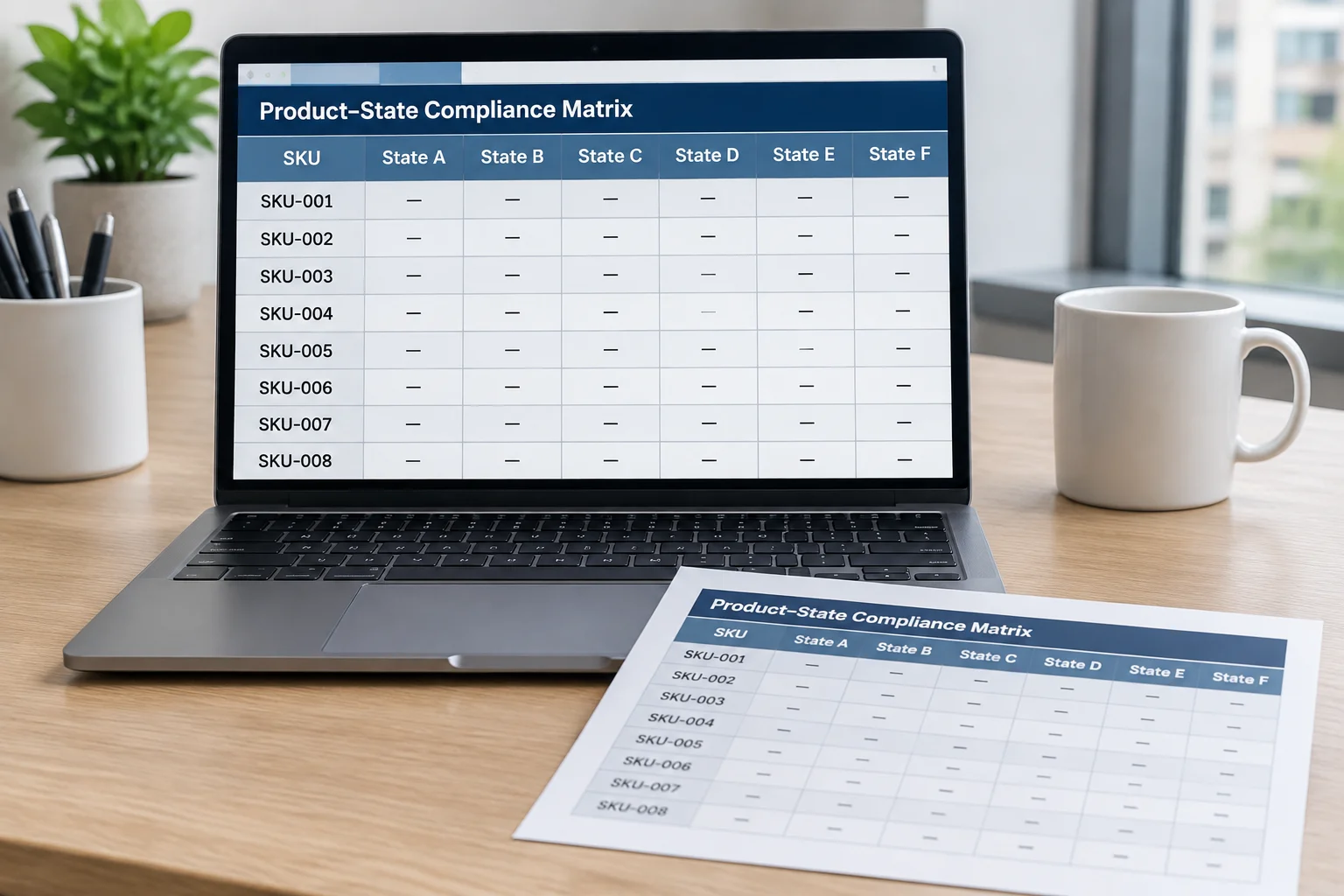
We recommend treating the matrix as part of procurement planning, not as a form to complete after products have been ordered. The sections below explain how to set it up, use it to frame supplier questions, and keep its information current as products and distribution plans change.
Why should a multi-state SKU compliance matrix be a pre-purchase decision and tracking tool?
A buyer may be able to source a product quickly and still lack the information needed to decide where to list it. That gap can create avoidable purchasing risk: inventory arrives, but an intended market or sales channel remains unverified.[8] We see the value in asking about the actual distribution plan before discussing a SKU as a fit.
A multi-state SKU compliance matrix should connect each product to the states, sales channels, and planned listing dates under consideration. It should show what has been verified, by whom, from which source, and when. Buyers can use it to identify unanswered questions before committing to a purchase, then revisit the record when the product or plan changes. The matrix does not establish that a SKU is legally approved for sale.
Build the matrix around the purchasing decision
In our conversations with U.S. wholesalers and importers, buyers often want to know whether a SKU can be supplied for their intended markets. We have found it useful to first ask which states are in scope, which channels the buyer plans to serve, and when the product is expected to be listed. Those questions make the purchasing discussion more specific. They do not replace legal review.
A practical matrix should help a buyer answer four operational questions:
- Which exact product are we evaluating? Record a stable SKU or product identifier, product name, and version or configuration. If packaging or product specifications change, the buyer should be able to tell which version the record covers.
- Where does the buyer plan to sell it? List each destination state separately. A multi-state plan should not be reduced to a single “U.S.” entry.[1]
- Through which sales channel? Record the channel under review, such as wholesale distribution or a particular retail route. The matrix should reflect the buyer’s actual plan, rather than assume that every channel has identical considerations.[2]
- When is the planned listing or sale? Add the target date or period. A record without a date can become misleading if the plan changes or relevant requirements are updated[4].
Then add verification and follow-up fields. These are useful recordkeeping prompts, not a declaration that every field is legally required:
| Field | What to record | Why it helps procurement |
|---|---|---|
| SKU and product version | Identifier, product name, and version details | Keeps the review tied to the item actually being purchased |
| Destination state | One state per entry | Makes state-by-state review visible |
| Sales channel | Planned route to market | Keeps the review connected to the intended sale |
| Planned listing date | Target date or sales period | Shows when the buyer expects the information to apply |
| Verification question | The specific issue that needs confirmation | Turns a general concern into a research task |
| Source and date checked | Official or professional source, plus review date | Makes the basis and timing of a status traceable |
| Status and owner | For example, “pending” and the person responsible | Shows what remains open and who will follow up |
| Review trigger | A change that should prompt another check | Reduces reliance on outdated information |
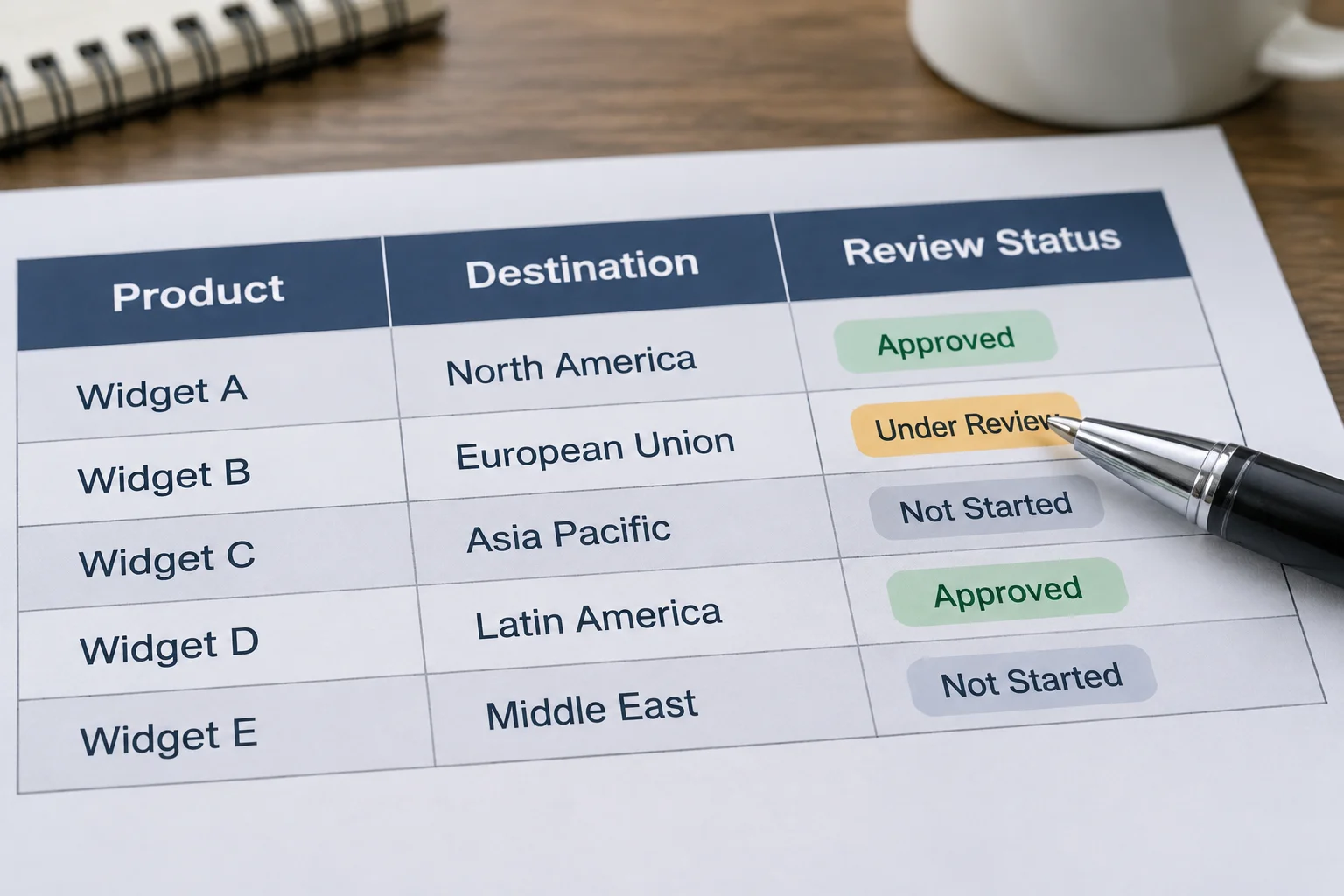
Status labels should describe the state of the work, not imply legal approval. For example, a buyer might use “not started,” “pending review,” “source identified,” “reviewed on [date],” or “recheck required.” The buyer should define these labels internally and avoid using a green check mark as if it were a sales authorization.
Keep the record tied to evidence
A matrix is only as useful as its underlying sources. For a rule-specific question, the buyer should identify the relevant authoritative source or consult qualified counsel. The record should state what was reviewed and when.[7] If the answer is unclear, “pending” is more accurate than an unsupported “compliant.”
Federal-level documentation or information can be relevant to a buyer’s review, but it should not be treated as proof that a particular SKU can be sold in every state or through every channel.[3] The buyer’s matrix should keep unresolved state- and channel-specific questions visible until they receive appropriate review.
For example, a hypothetical row could say: “SKU V-104; State A; wholesale channel; planned listing in May; state-specific question pending; source not yet confirmed; owner: purchasing team.” State A is a placeholder, not a statement about any real state’s rules. The row does not declare the product legal or illegal. It simply prevents an open question from disappearing in a purchase conversation.
How can buyers use a multi-state SKU compliance matrix before placing an order?
A general request such as “Is this vape SKU compliant?” leaves important details unstated. A supplier may not know which states, channels, or listing dates the buyer has in mind. We encourage buyers to share those details so the product-sourcing conversation can focus on the intended order and the questions that still need verification.
Before purchasing, use the multi-state SKU compliance matrix to connect the intended SKU with its destination states, sales channels, and planned timing. Then separate supplier information from legal or official-source verification. The supplier can help clarify product identity and available documents, while the buyer remains responsible for obtaining qualified review of market-specific questions.
Turn the matrix into a procurement workflow
A useful matrix should affect the buying decision. It should not become a spreadsheet that teams fill in once and ignore. We suggest moving through a repeatable sequence:
- Define the intended distribution plan. List each destination state, the sales channel, and the expected listing date. If a buyer is still deciding where to launch, mark those destinations as tentative instead of treating them as confirmed.
- Identify the exact SKU. Ask the supplier to clarify the product name, identifier, and version that the quote or product information refers to. Keep the matrix aligned with the product actually under consideration.
- Write down the question to verify. Avoid a vague note such as “check compliance.” State what the buyer needs to establish and which market, channel, and date the question concerns.
- Assign the review. Record who will locate an authoritative source or obtain qualified professional advice. A named owner makes it easier to follow up before an order is approved.
- Record the evidence and date. Add the source reviewed, the date, and a concise note describing what it answered. If the source did not resolve the question, retain a pending status.
- Apply a purchasing gate. The buyer can decide internally that an order cannot proceed for a particular destination until required questions have been reviewed. This is a procurement control, not a legal determination created by the matrix.
- Revisit the record when plans change. A different SKU version, destination state, sales channel, or planned listing date may mean that the previous review no longer answers the buyer’s current question.
Separate supplier communication from legal conclusions
In a supplier discussion, buyers can share a concise matrix extract or a structured request. For example:
“We are evaluating SKU [identifier] for [destination state], through [sales channel], with a planned listing date of [date]. Please confirm the exact product version and identify any product information or documents available for our review. We will verify market-specific requirements with appropriate sources.”
This wording helps both sides stay within their roles. A supplier can respond to questions about the product being offered and the information available. A buyer can use that information as one input to the review, without treating it as a legal opinion or a guarantee of saleability.
A buyer should also distinguish between “document received” and “requirement verified.”[10] These are not interchangeable statuses. Receiving a file records an event. Determining whether the file answers a particular question requires review against the relevant requirement, market, and planned date.
That distinction matters when multiple people handle purchasing, compliance review, and sales planning. A purchasing manager may see that a document is on file, while a sales team may assume that every planned destination has been cleared. A matrix can reduce that communication gap by recording the scope of each review and any remaining questions.[9]
Use the matrix to manage uncertainty, not conceal it
No spreadsheet can remove uncertainty by itself. Its value is that it makes uncertainty visible while the buyer still has choices. If a question remains open, the buyer can pause the relevant purchase decision, seek qualified advice, or adjust the intended distribution plan. The appropriate response depends on the buyer’s circumstances and professional review.
Buyers should also avoid copying a past status across multiple SKUs or states without confirming that the underlying facts match. Similar product names do not necessarily establish that two product versions are identical.[5] Likewise, a review tied to one state, channel, or date should not silently be reused for a different plan.
For current, rule-specific claims, the buyer should consult authoritative sources and record the date of review. If the question requires legal interpretation, a qualified professional should assess it. The matrix supports that work by organizing the questions and evidence; it does not replace it.
What should buyers recheck when a product or sales plan changes?
A matrix can become unreliable when the record stays unchanged but the business plan moves on. A new destination, revised listing date, changed product version, or different sales channel can make an earlier review incomplete for the new situation. We recommend recording changes as review triggers rather than assuming a prior status still applies.
Recheck the multi-state SKU compliance matrix when the product details, destination, channel, or timing change. Record what changed, which questions need another look, who owns the follow-up, and when the sources were reviewed. Buyers should confirm current requirements through authoritative sources or qualified professionals rather than relying on an old status.
Make review triggers visible
A review trigger is a practical reminder that a past check may no longer fit. It does not claim that a rule has changed; it tells the team to confirm whether the existing record still answers the current question.
Common operational triggers include:
- A new destination state: Add a separate entry rather than extending the old state’s status.
- A different sales channel: Reassess whether the earlier review covered the new route to market.
- A revised listing date[6]: Confirm that the source review is still current for the planned timing.
- A changed product version or identifier: Verify that the documentation and review apply to the item now being considered.
- New or revised product information: Update the record and identify any questions that need renewed review.
- An unclear or conflicting source: Mark the item as unresolved and obtain additional authoritative or professional input.
The team should avoid treating “reviewed” as a permanent status. A more useful entry includes the scope and date, such as “source reviewed for SKU V-104 in State A for wholesale channel on [date]; recheck if product version or listing plan changes.” This is a recordkeeping example, not a determination that the source is sufficient for any actual product or state.
Assign ownership and retain an audit trail
A matrix works best when one person is responsible for keeping each open item moving. That person does not need to make legal judgments. The owner can identify missing information, request clarification, locate the agreed source, or escalate the question to qualified counsel.
We suggest retaining:
- The product identifier and version reviewed.
- The state, channel, and planned sale date in scope.
- The exact question asked.
- The source or professional input consulted and its date.
- The status, the person responsible, and the next action.
- Any change that prompted a new review.
This level of detail helps a buyer understand why a purchasing decision was made and whether the same record applies to a later order. It also supports clearer communication between purchasing, compliance, and sales teams. The matrix should reflect the buyer’s actual review process, not create an impression that every question has been resolved.
Frequently Asked Questions
Does a multi-state SKU compliance matrix prove that a vape product is legal to sell?
No. The matrix is a procurement and tracking tool, not legal approval, a sales license, or a guarantee of compliance. It helps buyers organize product-specific questions by state, channel, and timing. Buyers should verify applicable requirements through authoritative sources and seek qualified professional advice when needed.
Does federal documentation confirm that a SKU can be sold in every state?
No. Buyers should not assume that federal-level documentation settles every state- or channel-specific saleability question. A matrix should show what each document covers, which questions remain open, and what still requires current review for the buyer’s intended markets.
What should a buyer do when a matrix entry is still pending?
The buyer should keep the status visibly pending, assign an owner, and identify the next verification step. Depending on the question, that may mean seeking an authoritative source or consulting qualified counsel. A buyer should not treat an unanswered question as confirmation that the planned purchase or sale is cleared.
How often should buyers update the matrix?
Buyers should update it when the product details, destination state, sales channel, or planned listing date changes. They should also record when a source was reviewed and establish internal triggers for rechecking. The appropriate review timing depends on the issue and should be confirmed through current, authoritative information.
Conclusion
A multi-state SKU compliance matrix helps wholesalers and importers make purchasing decisions with a clearer view of what is known, what remains uncertain, and what applies to each planned market. Buyers should tie every entry to a specific product, destination state, sales channel, and timeframe, then record sources and review dates. The matrix supports due diligence but does not replace legal review. For product sourcing questions, contact KingVape at info@kingvapecig.com or +86 13928420527 and include your intended markets and timeline.
Sources
- HHS Public Access
- Vapes and E-Cigarettes
- 21 USC 387p: Preservation of State and local authority
- STATE System E-Cigarette Fact Sheet
- Registration and Product Listing of Tobacco Product Manufacturing ...
- E-Cigarettes, “Vapes” and Other Electronic Nicotine Delivery ...
- Evaluation of Corporate Compliance Programs (Updated September 2024)
- Managing Uncertainty in Pharmaceutical Supply Chains
- Professional Communication and Team Collaboration - NCBI - NIH
- GAO-01-1008G Internal Control Management and Evaluation Tool