
Quick Answer
USB-C compatibility on reusable vape devices can look simple, but a familiar port does not guarantee reliable charging for every customer. I have seen buyers treat one successful charging demonstration as enough evidence, then face complaints after a batch reaches the market. I recommend a repeatable supplier-side test before volume purchasing.
USB-C compatibility on reusable vape devices should be tested with representative USB-C cables, chargers, repeated connection cycles, and different charging conditions. Buyers should confirm that charging starts reliably, remains stable, and finishes as expected. They should also request written charging instructions and record the agreed compatibility expectations in the purchase and quality documents.
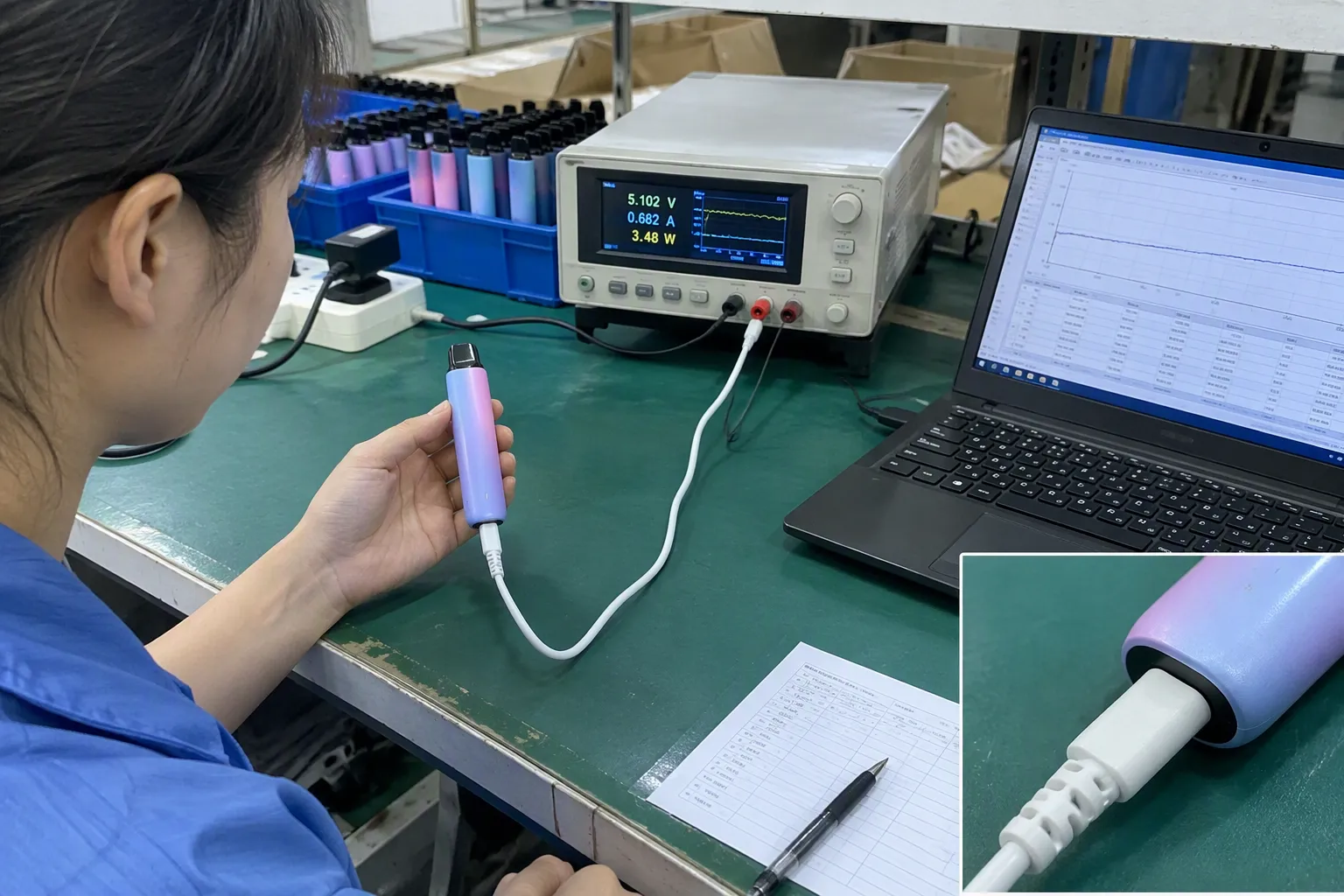
A reusable vape device may pass a quick demonstration and still create problems in normal retail use. Customers may use different cables, wall chargers, computer ports, or power adapters.[5] I therefore view charging compatibility as both a product-quality question and a purchasing-risk question. The following process helps importers, wholesalers, distributors, and private-label buyers make a more informed decision.
How Should USB-C Compatibility Be Tested on Reusable Vape Devices?
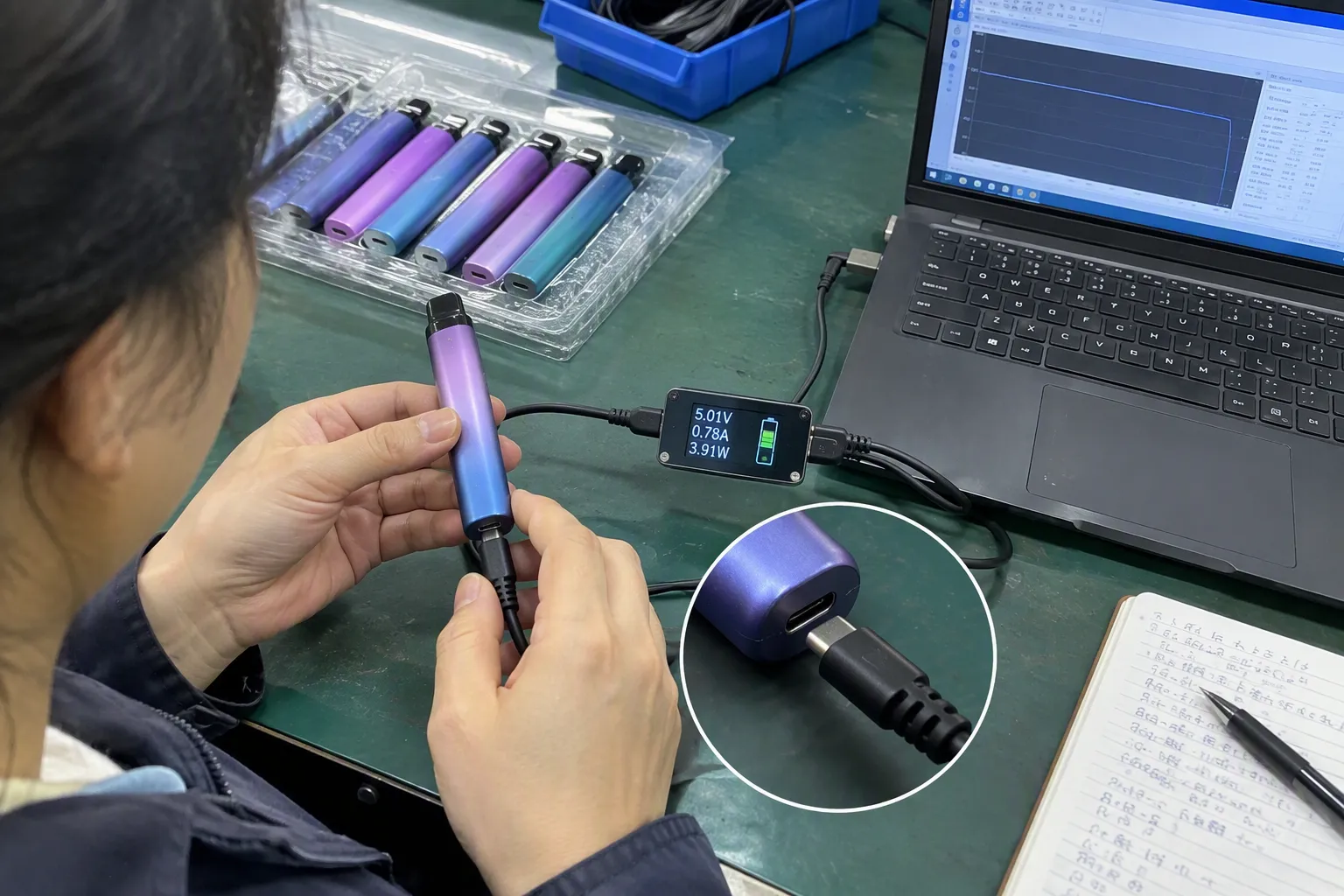
When I evaluate a reusable vape device for a buyer, I do not stop after checking whether the screen or indicator shows charging once. I look at the complete charging experience: the port, cable, power source, connection stability, repeated use, instructions, and the supplier’s ability to explain the supported conditions.
USB-C compatibility on reusable vape devices should be tested through a documented matrix rather than one charging demonstration. The test should use several suitable cables and chargers, repeated plugging and unplugging, different power sources, and observation of charging stability. Any limitations should be disclosed before the buyer approves samples or places a volume order.
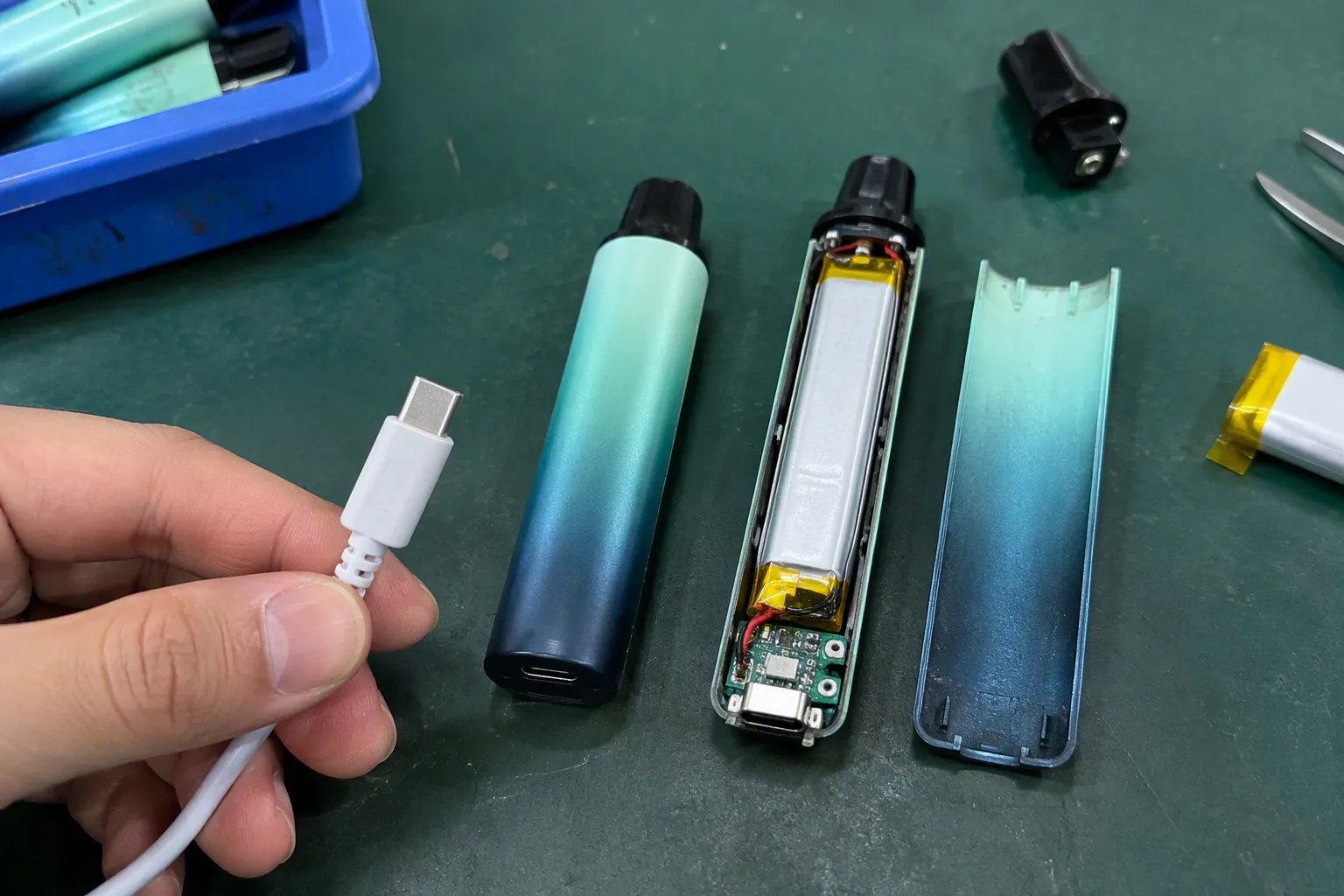
Why does the USB-C port create a false sense of security?
The shape of a USB-C connector is only one part of the charging system.[1] A device can have a USB-C receptacle while still supporting a limited range of cables, power sources, or charging conditions.[2] The port appearance does not tell a buyer everything about the internal charging design or the manufacturer’s intended use.
I often explain this point during product selection discussions because “USB-C” is commonly understood as “universal.” That assumption may be convenient, but it is not a sufficient purchasing conclusion. A buyer needs to know what the supplier has actually verified.
The supplier should clarify, in writing where possible:
- Which cable types were tested.
- Which charging sources were tested.
- Whether the device is intended for a specific charger output.
- Whether charging through a computer, power bank, or wall adapter has been evaluated.
- Whether the device can charge while connected to a cartridge or atomizer.
- Whether the charging indicator behaves consistently.
- Whether the charging process stops or changes when the battery is full.
- What the user should do if charging does not begin.
I do not recommend making a technical claim about a charging protocol, voltage, current, or power level unless the information appears in verified product documentation or actual test records. A supplier should not use a general USB-C statement to cover conditions that it has never checked.
What should a practical compatibility test include?
I recommend separating the test into several stages. Each stage answers a different question, and together they provide stronger procurement evidence.
1. Visual and mechanical inspection
The buyer or supplier should first inspect the port and connector area. The purpose is not to prove electrical compatibility. It is to identify visible conditions that may affect daily use.
The inspection can include:
- Port alignment.
- Housing strength around the port.
- Signs of looseness or movement.
- Debris or obstruction.
- Cable fit and insertion depth.
- Contact stability when the cable is gently moved.
- Whether the cable can be inserted without unusual force.
A cable that fits loosely may disconnect during charging.[3] A port that sits too deeply inside the housing may make some connectors difficult to insert fully. These conditions can produce intermittent complaints that are later mistaken for a battery or charger problem.
I would record the inspection result with photographs and a simple pass, concern, or fail note. I would also ask the supplier whether the sample represents normal production. A sample with a carefully adjusted port is not useful if the mass-produced version uses a different component or assembly process.
2. Multiple representative cables
A single cable only demonstrates that one cable worked with one sample at one moment.[4] It does not demonstrate broad compatibility.
The test group should include cables that represent the buyer’s expected market. The group may include:
- A standard USB-C cable supplied or recommended by the vendor.
- A second cable from another source.
- A shorter and longer cable, if both are likely to be used.
- A cable connected to a wall charger.
- A cable connected to a computer or another permitted power source.
- Any cable commonly bundled with the buyer’s private-label product.
I would not claim that every USB-C cable must work unless the device has been specifically tested for that condition. Instead, I would define the tested group and communicate the result clearly. If the supplier recommends one cable type, the product packaging and customer instructions should say so in plain language.
3. Multiple charging sources
A reusable vape device may be used with different charging sources after it reaches the market. The buyer should therefore test the sources that customers are reasonably likely to use, while following the device documentation.
Potential test sources include:
| Charging source | What the buyer should observe | Procurement value |
|---|---|---|
| Recommended wall charger | Whether charging starts and remains stable | Confirms the intended use case |
| Alternative compatible charger | Whether the device behaves consistently | Identifies known operating limits |
| Computer USB port | Whether charging begins and remains stable | Represents a common lower-power source |
| Power bank | Whether connection remains stable | Reflects mobile and travel use |
| Buyer-supplied charger | Whether the private-label package works as planned | Helps verify the final customer experience |
The buyer should not connect a product to an unknown or unsuitable power source simply to increase the number of tests.[8] The supplier and qualified technical personnel should define safe test conditions. My role in procurement is to ensure that the conditions are clearly agreed and documented, not to replace engineering evaluation.
Is one successful charging demonstration enough?
No. One successful demonstration shows only that the device charged under one specific combination of sample, cable, charger, and contact position. It does not prove repeatable performance in the hands of different users.
A useful repeat test should examine whether:
- Charging starts after the cable is inserted.
- The indicator or display gives a consistent status.
- Charging remains active without unexplained interruption.
- The connector stays in place during normal handling.
- The device responds consistently after the cable is removed and reconnected.
- The result is similar across more than one sample.
- The device behaves as described in the instructions.
I would use several samples from the same production batch where possible. If a buyer is evaluating a new OEM or ODM design, I would request samples that reflect the intended production configuration. A prototype may use a different port, battery, circuit board, or housing process from the final product.[7]
How should repeated plugging and unplugging be evaluated?
Repeated connection is important because customers do not use a charging port only once.[6] They connect, disconnect, move, store, and reconnect the product over its service life. A port that works only when the cable is held in a perfect position can create avoidable support work.
I recommend that the supplier and buyer agree on a practical test method before testing begins. The method should state:
- The number of connection and disconnection cycles.
- The cable used.
- The charging source used.
- The condition of the device before each cycle.
- What counts as a pass or concern.
- How intermittent charging will be recorded.
I would avoid presenting an internally chosen cycle count as a formal industry standard. The purpose is to create repeatable evidence for the specific purchase, not to imply a certification or laboratory qualification.
During the test, the observer should record more than the final result. Useful observations include:
- Whether the cable needs to be pressed or repositioned.
- Whether charging stops when the product is moved normally.
- Whether the indicator changes unexpectedly.
- Whether the port or housing becomes visibly damaged.
- Whether different samples show different behavior.
If a sample fails intermittently, I would not immediately blame the cable or the user. I would first check the device, connector, power source, contact stability, and instructions. A fair investigation protects the buyer’s reputation and helps the supplier identify the real cause.
How can buyers turn testing into purchasing evidence?
Testing creates value only when the results influence the purchasing decision. I recommend preparing a simple compatibility record that the buyer, supplier, and quality team can understand.
The record may include:
- Product model and sample version.
- Sample quantity.
- Battery and charging information supplied by the vendor.
- Cable identification.
- Charger or power-source identification.
- Test date.
- Test operator.
- Number of connection cycles.
- Charging start and interruption observations.
- Photographs or video evidence.
- Exceptions and limitations.
- Corrective actions, if required.
The buyer can then use the record in several ways:
- Approve or reject the sample.
- Request a design or component change.
- Define the cable included with the product.
- Improve the user manual and packaging.
- Establish a pre-shipment inspection point.
- Agree on how charging-related defects will be handled.
- Compare competing suppliers using the same evaluation method.
I believe this step is especially important for importers and wholesalers. A charging complaint does not remain only between the consumer and the device. It can reach a vape shop, smoke shop, convenience store, gas station, distributor, and original importer. Repeated complaints may affect reorder decisions and the buyer’s local reputation.
What commercial risks come from weak compatibility testing?
Inconsistent charging can create several costs even when the product looks attractive at the quotation stage. The purchase price may be competitive, but the total commercial result can weaken after the products enter the market.
Possible consequences include:
- Customer questions and technical support requests.
- Retailer dissatisfaction.
- Product returns.
- Warranty replacements.
- Extra inspection and sorting.
- Delayed payment or dispute handling.
- Negative reviews.
- Slower inventory turnover.
- Damage to a private-label brand.
For a buyer who wants fast-moving products and quick cash flow, these costs are particularly important. A product that stays in after-sales handling does not support the same business objective as a product that sells and reorders smoothly.
I have worked with buyers who care about more than the product’s appearance or initial wholesale price. They want products that are easy for local shops to explain, unlikely to generate avoidable complaints, and supported by a supplier that accepts responsibility for after-sales coordination. USB-C compatibility is one part of that wider purchasing assessment.
How should suppliers communicate charging limitations?
Clear instructions are better than broad promises. If a device has been tested only with a specified cable and charging source, the instructions should reflect that fact. The supplier should not describe the product as universally compatible without supporting evidence.
A useful instruction set can explain:
- Which cable the user should use.
- Which charging source the supplier recommends.
- How the charging indicator behaves.
- What the user should check if charging does not start.
- When the user should stop using the device.
- How the user should contact the seller for support.
The language should remain simple because the final user may not understand technical charging terms. The importer should review translated instructions before printing them. Poor translation can turn a manageable limitation into a confusing customer experience.
I also recommend that buyers ask for the same charging information in the quotation, product specification, sample report, and final artwork where relevant. Consistency matters. If the sales quotation says one thing and the manual says another, the buyer may have difficulty determining which condition was actually agreed.
How does testing differ for small and large B2B buyers?
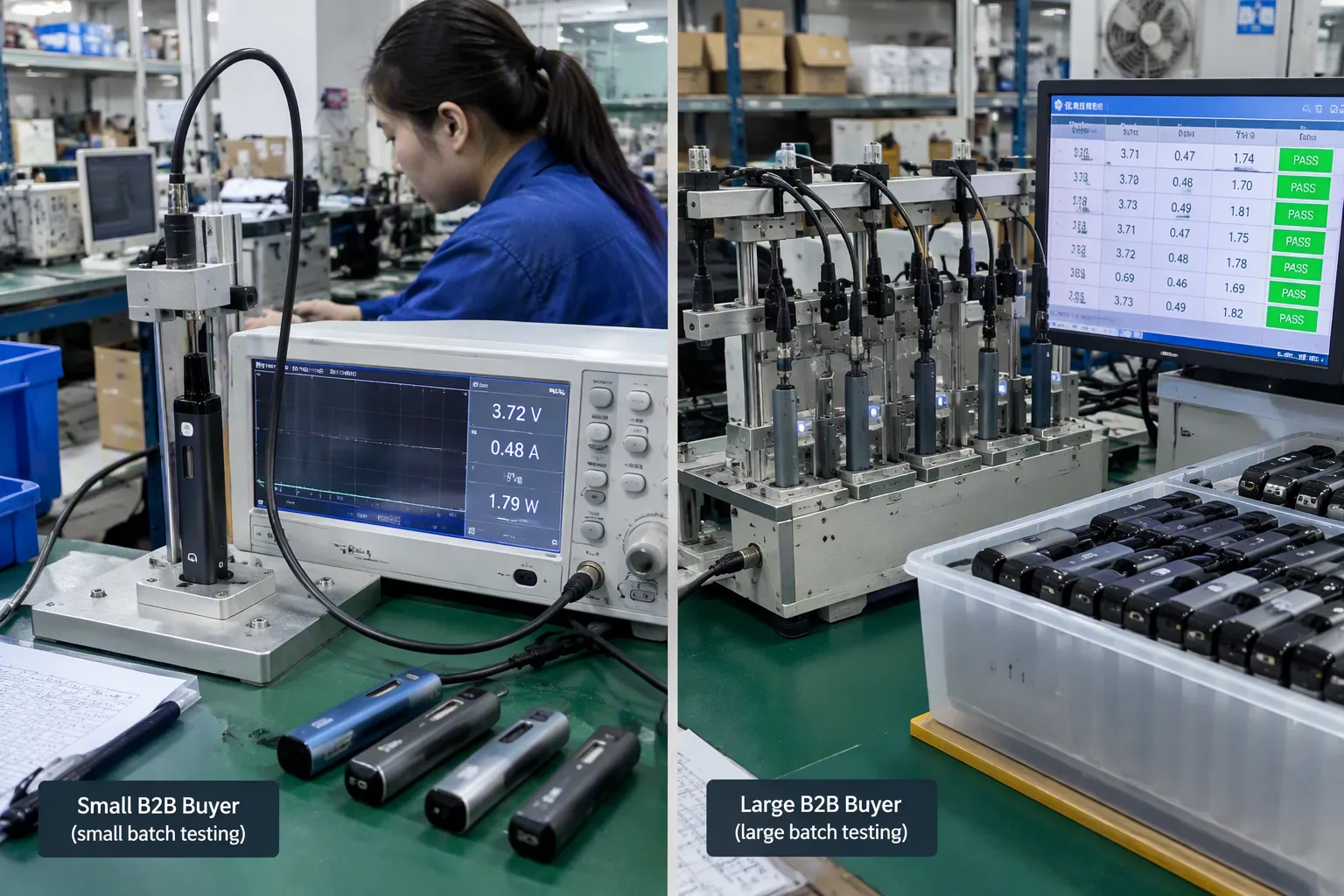
The basic principle stays the same, but the purchasing response may differ according to order size, inventory model, and market.
For a small or medium buyer, a low-MOQ overseas warehouse option may reduce exposure. I can support buyers who need smaller quantities through available European warehouse inventory, where applicable. The stated service model includes warehouses in several European locations and delivery through carriers such as DHL, DPD, UPS, or FedEx, with delivery commonly planned within 1–5 working days for suitable EU orders. Buyers should confirm current stock, destination, timing, and terms before purchasing.
This model can help a buyer test demand without committing to a large shipment from China. It does not remove the need for USB-C compatibility testing. The buyer should still ask which batch was tested and whether the warehouse stock matches the approved sample.
For larger importers, distributors, and wholesalers, direct China purchasing may provide stronger price advantages and more choices. A larger buyer may also consider:
- OEM packaging.
- ODM product development.
- Private-label charging instructions.
- Pre-shipment inspection.
- Batch documentation.
- Production follow-up.
- A defined after-sales process.
- A new mold or product development project when the commercial conditions are suitable.
Our company operates as a manufacturer and trading-integrated supplier, with a 5,000-square-meter factory, OEM/ODM experience, and a stated maximum production capacity of up to 5 million units per month. I present these points as supplier capabilities for buyers to evaluate, not as a substitute for product-specific verification. Every reusable vape device should still be assessed through its own sample, documents, and agreed quality requirements.
What should a buyer ask before placing a volume order?
I would ask the supplier direct questions and request clear answers before approving production:
- What exact USB-C charging conditions has this model passed?
- Which cables and charging sources were used?
- How many samples were checked?
- Was repeated connection and disconnection included?
- What happens if charging is interrupted?
- What cable and charger will the user instructions recommend?
- Does the production version match the tested sample?
- How will charging-related defects be handled after delivery?
- Can the supplier provide a sample test record or video evidence?
- Can the agreed requirements be added to the purchase order or inspection document?
I would also ask the supplier to identify any unverified conditions. A clear limitation is easier to manage than an ambiguous promise. If the buyer needs a particular market requirement, the buyer should have the product evaluated by qualified electrical, battery, and regulatory professionals before commercial distribution.
Frequently Asked Questions
Does a USB-C port mean that a reusable vape device works with every USB-C cable?
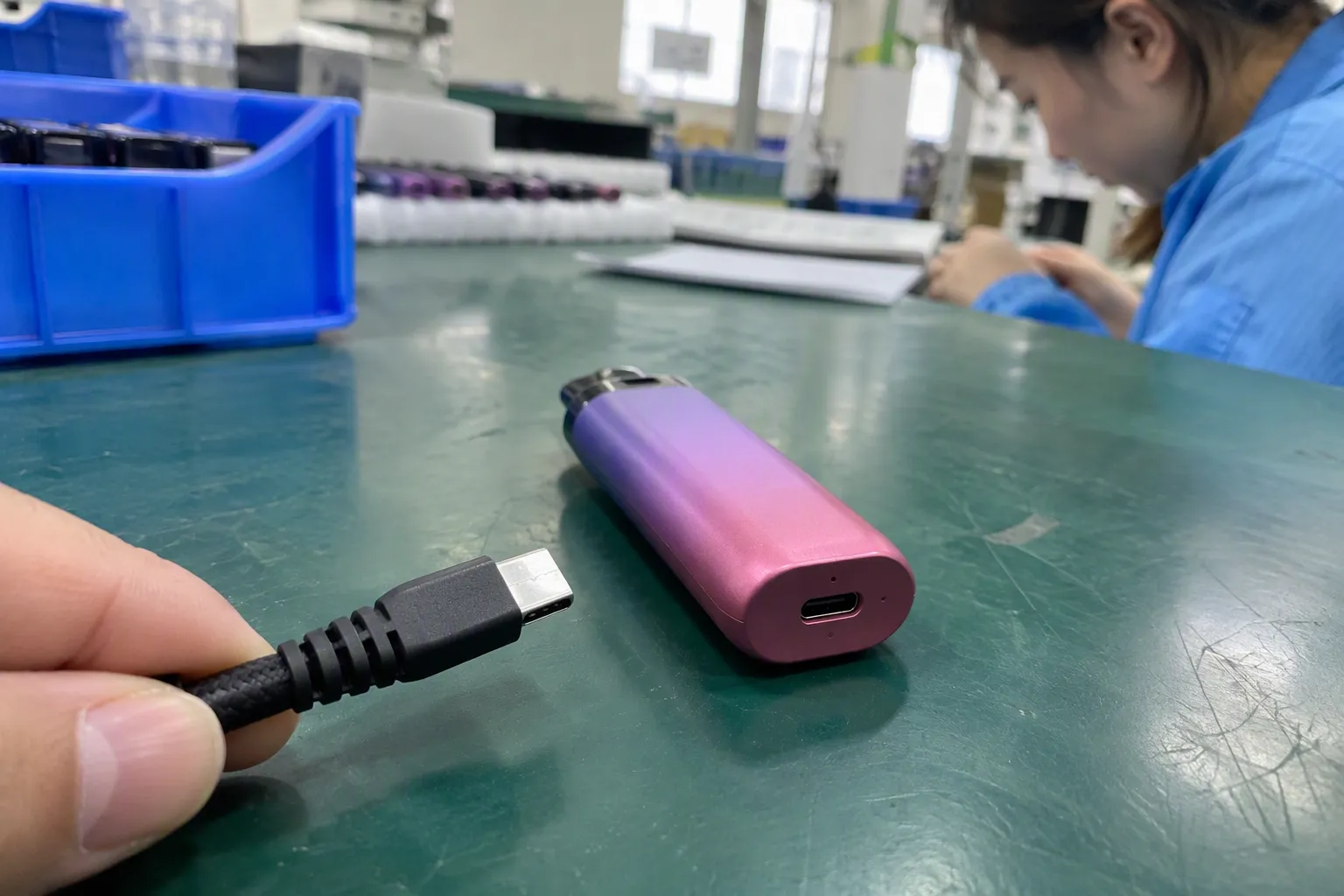
No. The connector shape alone does not prove universal compatibility. The buyer should confirm which cables and charging sources the supplier tested and should communicate any limitations in the final instructions.
How many cables should a buyer test?
There is no single number that applies to every product or purchase. I recommend testing several representative cables and recording the exact results. The selection should reflect the cables and charging sources that customers in the target market are likely to use.
Should buyers test charging after repeated connection and disconnection?
Yes. Repeated connection helps identify loose contact, intermittent charging, port movement, and inconsistent indicator behavior. The buyer and supplier should agree on a practical test method and should not present it as a formal laboratory or regulatory standard.
Who is responsible when a reusable vape device does not charge?
The buyer should investigate the complete charging system before assigning responsibility. The device, cable, charger, contact stability, instructions, and user conditions may all be relevant. A supplier should provide a clear after-sales process and should help assess confirmed product defects.
Can a buyer purchase small quantities before placing a large order?
In some cases, yes. Buyers may use samples or suitable overseas warehouse inventory to test demand and customer response before making a larger commitment. The buyer should confirm current stock, product batch, shipping terms, and compatibility evidence before ordering.
Conclusion
USB-C compatibility on reusable vape devices should be treated as a repeatable purchasing requirement, not as a label based on connector appearance. I recommend testing representative cables and chargers, checking repeated connections, documenting interruptions, confirming the production version, and placing agreed expectations into the purchasing and inspection records. At Kingfuji, I help importers, wholesalers, distributors, vape shops, and private-label buyers evaluate reusable vape products, source suitable inventory, and coordinate OEM/ODM or delivery solutions. Contact King at info@kingvapecig.com or +86 13928420527 to discuss your product and procurement requirements.
Sources
- Statement on Charging Interoperability", USB Type-C technical documentation distinguishes the connector and receptacle from optional capabilities such as USB Power Delivery and alternative modes; consequently, connector appearance alone does not establish a device's complete charging functionality
- USB-C power delivery for military portable systems", Technical analyses of USB Type-C charging describe interoperability as dependent on device implementation, cable characteristics, and power-negotiation behavior rather than on the receptacle shape alone
- USB-C longevity is becoming a big problem! - General Topics", Research on electrical connectors indicates that inadequate retention or mechanical disturbance can increase contact intermittency and interrupt continuity, providing a plausible basis for charging disconnection during handling
- How sample size influences research outcomes - PMC - NIH", Engineering test-method guidance treats repeated measurements and representative samples as necessary for assessing repeatability and for limiting overgeneralization from a single observation
- The History and Evolution of USB Charging Standards", Studies of portable-device use report that consumers commonly charge devices through multiple accessory and power-source configurations rather than through a single standardized setup
- Type-C Cable Cycle Testing : r/UsbCHardware", Connector durability standards and reliability studies evaluate performance across repeated mating cycles because insertion, withdrawal, and handling can affect retention and electrical contact quality
- Importance of Prototyping & Conceptual Design Validation", Engineering-development guidance distinguishes prototype evaluation from production validation and emphasizes configuration control because components, materials, and processes may change before manufacture
- Airline Passengers and Batteries", Government safety guidance for lithium-ion products advises using compatible charging equipment and following the manufacturer's instructions, because inappropriate charging conditions can contribute to overheating, damage, or fire