Firing noise is often one of the first things I hear when I check a vape sample or discuss an incoming shipment with a buyer. A sharp, soft, loud, or different sound can quickly create confidence or concern. However, a few seconds of sound can also lead buyers to approve the wrong batch or reject a product that performs well in real use.
Quick Answer
Firing noise can be a useful initial observation, but it cannot prove vape quality, safety, or long-term reliability by itself.[^1] In my product and after-sales experience, buyers should treat sound as one checkpoint within a wider review of batch consistency, vapor performance, leakage, odor, battery life, user experience, and likely after-sales risk. A sound difference should prompt further inspection when it appears with other symptoms—not become a pass/fail rule for a sample or shipment.
When I work with vape importers, distributors, smoke shop wholesalers, and OEM customers, I see the same pressure repeatedly: buyers need products that sell quickly without creating returns, complaints, or cash-flow problems. The practical question is not whether one device sounds impressive. The practical question is whether the full batch can deliver a stable customer experience after it reaches your market.
Firing noise is only an initial observation, not proof of vape quality
A buyer may hear a crisp firing sound from a vape and assume that the device is powerful, fresh, or well-made. That reaction is understandable. The sound is immediate, and it can feel like a quick way to judge a sample. However, this shortcut can create risk when a large purchase decision depends on it.
Firing noise should be used as an initial check, not as proof of vape quality. A consistent or noticeable sound may be worth noting during sample review, but buyers should compare it with actual vaping performance, leakage, odor, charging or battery behavior where applicable, appearance, and batch-level consistency before approving an order.
Why a first impression can mislead a buyer
I have seen products with a normal firing sound that later delivered a disappointing user experience. I have also seen acceptable products with sound characteristics that differed from another sample. This is why I do not recommend using firing noise as a universal technical standard.
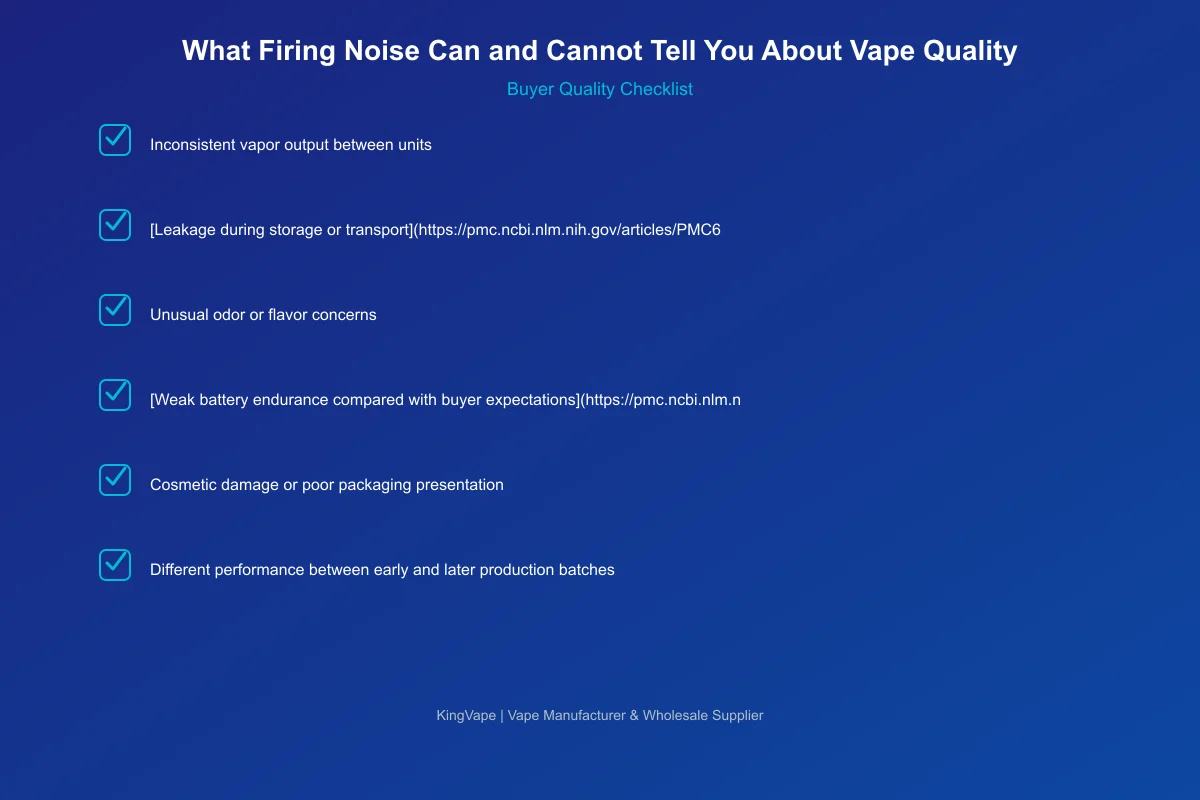
A vape is a complete product system.[^2] The buyer’s commercial outcome depends on much more than one audible moment. A product can sound consistent in a short sample check but still create problems later through:
- Inconsistent vapor output between units
- Leakage during storage or transport[^3]
- Unusual odor or flavor concerns
- Weak battery endurance compared with buyer expectations[^4]
- Cosmetic damage or poor packaging presentation
- Different performance between early and later production batches
- High after-sales workload caused by customer complaints
For a wholesale buyer, these issues matter because they affect more than the unit cost. They can slow inventory turnover, tie up working capital, damage relationships with retail customers, and force staff to spend time handling replacements.
I encourage buyers to ask one commercial question: “If I sell this batch to my customers, what will the after-sales workload look like?” That question is more useful than “Does this sample sound good?”
Sound variation does not automatically mean a defect
A change in firing noise can attract attention, but attention is not the same as a conclusion. Buyers should avoid two common mistakes:
-
Treating every sound variation as a product failure.
This approach may cause unnecessary alarm and may lead a buyer to reject suitable stock without reviewing the full product experience. -
Treating a preferred sound as proof that everything is correct.
This approach may allow other important issues to be missed during sample approval or incoming-goods inspection.
In my experience, a buyer should compare similar units under a consistent review process. If the firing noise appears unusual and is also accompanied by poor vapor, leakage, odor, heating concerns, or inconsistent draw behavior, then I would treat it as a reason to investigate further with the supplier.
What wholesale buyers should assess instead
The best purchasing decision comes from combining several observations. I recommend that buyers document what they see and experience across multiple samples rather than relying on memory or one device.
| Evaluation area | What the buyer should check | Why it matters commercially |
|---|---|---|
| Firing noise | Whether the sound is noticeably different across similar samples | Helps identify units that may require closer inspection |
| Vapor performance | Consistency of vapor and draw experience across samples | Supports repeat purchases and reduces retail complaints |
| Leakage | Visible leakage in use, storage, or shipping condition | Protects packaging, inventory value, and shop relationships |
| Odor and taste | Any unusual odor or unexpected user experience | Helps reduce customer dissatisfaction and return requests |
| Battery performance | Expected use duration and consistency between units | Affects perceived value and end-user confidence |
| Appearance and packaging | Device finish, labeling, seals, cartons, and count accuracy | Supports shelf presentation and incoming-stock control |
| Supplier response | Speed and clarity when issues are reported | Reduces the buyer’s after-sales burden |
I do not present this as a laboratory protocol. I present it as a practical purchasing framework based on direct involvement in samples, production coordination, and after-sales communication.
For buyers who source from China, this framework is especially important because a large order can involve long lead times, freight planning, customs exposure, and significant cash commitment. A brief firing noise check does not protect the buyer from those larger business risks.
How I use firing noise in a practical sample-approval process
Many buyers need a fast way to evaluate vape samples because they are following new market trends, planning promotions, or filling gaps in their current assortment. I understand that speed matters. Still, speed without a process can create expensive after-sales problems later.
I use firing noise as one early observation during sample evaluation. If it seems different from comparable samples, I do not immediately approve or reject the product. Instead, I compare it with other performance indicators and ask whether the difference appears alongside a real user-experience or consistency issue.
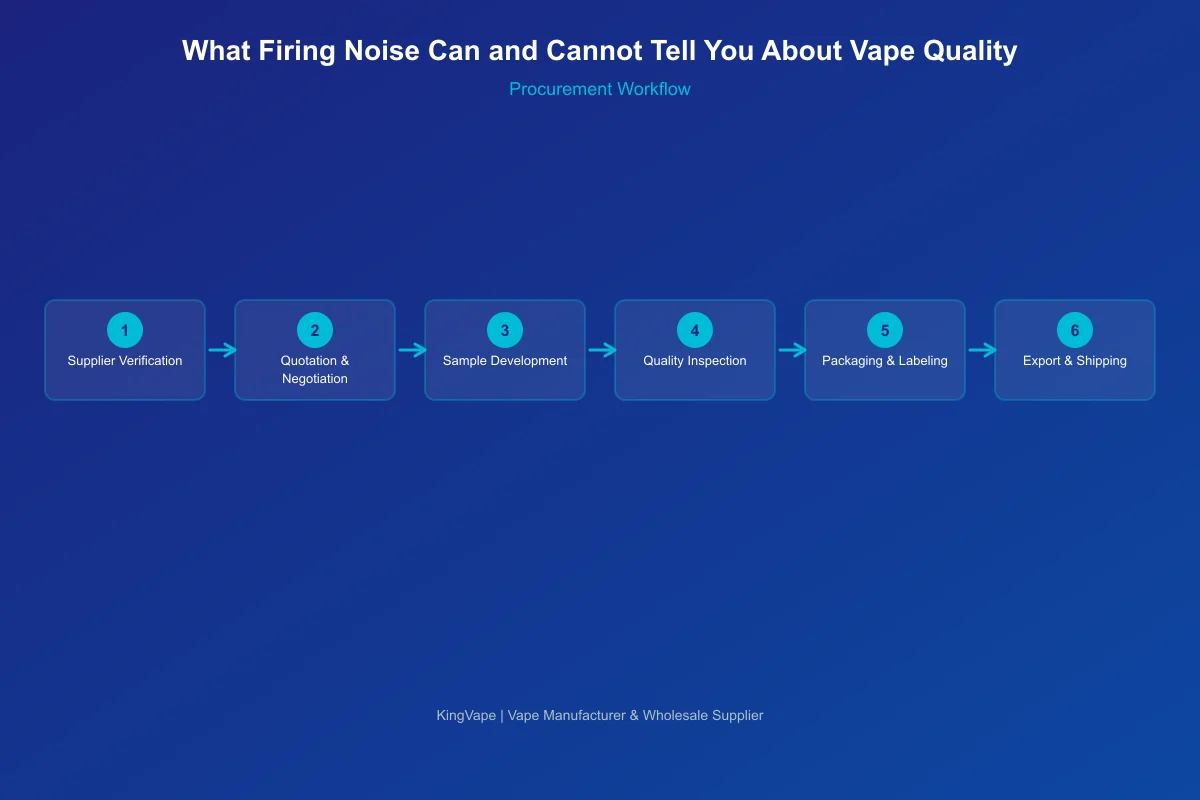
Step 1: Check more than one unit
One sample can be useful, but one sample cannot represent a full production batch[^9]. I suggest that buyers review multiple units where possible, especially before placing a larger import order or launching an OEM/ODM product.
A practical sample review can include:
- Checking several devices from the same sample set
- Comparing color options or versions if they use different components
- Recording noticeable differences in firing noise
- Checking whether the sound difference matches a performance difference
- Reviewing the device appearance, seals, packaging, and labeling
- Asking the supplier how sample production relates to planned mass production
For an importer or distributor, this comparison is important because end users do not buy “one sample.” They buy units from a batch. Your customers will judge your business based on the unit they receive, not the best sample you tested.[^5]
Step 2: Test the user experience in a structured way
I recommend a simple written checklist. This gives the purchasing team a record that can be shared with sales, warehouse, and supplier contacts. It also reduces confusion when several people review the same product.
For example, a buyer can note:
- Product name, version, flavor, and sample date
- Number of units reviewed
- Whether firing noise was consistent or noticeably different
- Draw feel and vapor consistency
- Any leakage, unusual odor, or visible issue
- Packaging and labeling observations
- Questions that require supplier clarification
- Final decision: approve, revise, inspect further, or reject
This process is useful for vape shop chains, regional wholesalers, and importers who buy fast-moving products. It helps teams make decisions based on evidence rather than first impressions.
Step 3: Connect the sample decision to after-sales risk
The most important part of sample approval is often overlooked: buyers should consider what happens after the goods are sold.
A low unit price may not be low-cost if the batch causes replacements, staff complaints, damaged customer relationships, or inventory that retailers do not want to reorder.[^10] In my experience, buyers should estimate the likely operational burden before confirming a volume order.
Questions I would ask include:
- If a retailer reports a problem, who will handle the communication?
- What information will the retailer need to identify the affected batch?
- Can the supplier provide reasonable after-sales coordination?
- Does the buyer have clear incoming-goods checks before stock reaches customers?
- Is the buyer ordering a quantity that matches market demand and cash flow?
At Shenzhen Kingfuji Tech. Co., Ltd., I work with customers who need different purchasing models. Smaller European buyers may prefer available stock from European warehouses, with lower starting quantities and faster local delivery. Larger importers, distributors, and brand owners may prefer direct China purchasing for stronger volume pricing and OEM/ODM flexibility.
In both cases, I believe the product decision should be based on a repeatable quality review, not only on firing noise.
When should firing noise trigger further inspection?
Buyers can become worried when they notice a sound they did not expect. That concern is reasonable, especially when the buyer has already experienced returns or supplier quality problems. However, an inspection decision should be based on the full situation.
Firing noise should trigger further inspection when it is accompanied by other warning signs, such as inconsistent vapor, leakage, unusual odor, visible damage, irregular draw behavior, or repeated differences between units. Sound by itself is not enough to classify a vape as good, bad, safe, or unsafe.
Look for patterns, not isolated moments
A single device may behave differently for many reasons that are not clear from a quick check. I do not recommend that buyers make technical conclusions without appropriate qualified evaluation. Instead, I recommend looking for a repeated pattern across similar units.
A buyer should pay closer attention when:
- Several units show noticeably different firing noise
- The sound difference occurs with weak or inconsistent vapor
- The device has visible leakage or packaging contamination
- Users report an unusual odor or unsatisfactory experience
- The product behavior differs from the approved sample
- The supplier cannot clearly identify the product version or batch details
- The issue appears after transport or during warehouse inspection
When these signs appear together, the buyer has a stronger reason to pause distribution, separate the affected stock, document the findings, and contact the supplier.
Separate stock before it becomes a customer problem
For incoming goods, I recommend a simple quarantine approach when a buyer finds questionable units. The buyer can separate the relevant cartons or lot, take clear photos and videos, record carton markings, and avoid mixing the stock with already approved inventory.
This approach helps protect the buyer’s position during after-sales communication. It also helps the supplier understand the situation more clearly.
I have found that vague messages such as “the product is not good” are difficult for any supplier to investigate. More useful information includes:
- Product model and flavor or version
- Purchase order or invoice reference
- Carton and batch markings, if available
- Quantity affected
- Photos or video of the issue
- A description of whether the issue is isolated or repeated
- Whether the product has already been distributed or sold
This is not only a quality-control issue. It is a business-protection issue. Clear records help buyers reduce confusion, negotiate faster solutions, and avoid sending questionable inventory to retail customers.[^6]
Keep regulatory requirements separate from sound checks
Firing noise is not a regulatory compliance test.[^7] Importers and distributors should verify the rules that apply to their own destination market, product category, nicotine content, packaging, labeling, and sales channel.
For example, businesses selling vape products into the United States should review information from the U.S. Food and Drug Administration (FDA), including its tobacco product requirements and PMTA-related guidance. Businesses supplying Great Britain should check the UK Medicines and Healthcare products Regulatory Agency (MHRA) guidance. EU buyers should review applicable requirements with the relevant national authority and the European Commission.
I recommend that buyers use qualified compliance professionals for market-specific decisions. A product sample that appears acceptable during a commercial review is not, by itself, evidence that it meets every legal or regulatory requirement.[^8]
Frequently Asked Questions About Firing Noise
Does a loud firing noise mean a vape is better quality?
No. A loud firing noise may create a strong first impression, but it does not independently confirm vape quality, long-term reliability, or expected after-sales performance. I recommend comparing the sound with vapor consistency, leakage, odor, battery performance, packaging quality, and multiple units from the same sample set.
Does a quiet firing noise mean a vape is defective?
No. A quiet or different firing noise is not automatically a defect. In my experience, acceptable products can have different sound characteristics. Buyers should investigate further only when the sound difference appears with other issues, such as inconsistent performance, leakage, unusual odor, or repeated variation across units.
How many vape samples should I check before placing a wholesale order?
The right quantity depends on the order size, product type, and buyer risk tolerance. However, I suggest checking more than one unit whenever possible. Buyers should compare several samples, document observations, and confirm whether the approved samples are representative of planned production.
What should I do if incoming stock sounds different from the approved sample?
I recommend that you separate the affected stock, document the product version and carton details, test a reasonable selection of units, and record any related performance issues. You should then contact the supplier with photos, videos, quantities, and a clear description. Do not rely on firing noise alone when deciding how to handle the shipment.
Can firing noise replace a full vape quality inspection?
No. Firing noise is only one initial observation. A practical vape quality inspection should also consider product consistency, vapor performance, leakage, odor, battery behavior, packaging, labeling, and the supplier’s ability to support after-sales issues. This broader review is more relevant to wholesale purchasing decisions.
Conclusion: Firing Noise Is a Screening Clue, Not a Buying Decision
Firing noise can help a buyer notice differences during sample review or incoming-goods inspection, but it cannot tell the full story about vape quality. I recommend that importers, wholesalers, distributors, and shop owners focus on batch consistency, real-world performance, leakage risk, user experience, packaging, and expected after-sales exposure. At KingVape, I can support buyers with product sourcing, factory production, OEM/ODM development, sample communication, and one-stop supply options designed around practical wholesale needs. Contact me to discuss a product evaluation and sourcing plan that fits your market.
[^1]: "Orthodox and Unorthodox Uses of Electronic Cigarettes - PMC", https://pmc.ncbi.nlm.nih.gov/articles/PMC6751517/. E-cigarette performance and safety are assessed through multiple device, emissions, and exposure factors; an audible firing characteristic is not established as a stand-alone indicator of product safety or reliability. Evidence role: general_support; source type: research. Supports: E-cigarette safety and performance assessment requires evaluation of device design, electrical operation, emissions, and user exposure rather than a single audible characteristic.. Scope note: The source may not test firing noise specifically, but it provides context on the multidimensional nature of e-cigarette assessment. [^2]: "Metal Concentrations in e-Cigarette Liquid and Aerosol Samples", https://pmc.ncbi.nlm.nih.gov/articles/PMC6066345/. An e-cigarette functions through interacting components—including a power source, heating element, liquid, and aerosol-delivery system—rather than through a single observable feature. Evidence role: mechanism; source type: government. Supports: Electronic nicotine-delivery systems combine a battery or power source, heating element, liquid formulation, and aerosol pathway whose operation collectively affects the product experience.. [^3]: "Electronic Cigarette Chemicals Transfer from a Vape Shop to ...", https://pmc.ncbi.nlm.nih.gov/articles/PMC6458093/. Published evidence and safety guidance identify leakage of e-cigarette liquids or containers as a potential handling concern because escaped liquid can contaminate packaging and create exposure risks. Evidence role: general_support; source type: paper. Supports: Research or regulatory guidance documents leakage and accidental exposure as recognized risks associated with e-cigarette liquids, containers, or devices.. Scope note: Evidence concerning refill liquids or containers may not quantify leakage rates for every closed-system vape design. [^4]: "A Systematic Literature Review on the Composition, Health Impacts, and ...", https://pmc.ncbi.nlm.nih.gov/articles/PMC11368577/. Battery capacity and power-delivery characteristics influence the duration and consistency of electronic-cigarette operation, making battery performance relevant to the user experience. Evidence role: mechanism; source type: paper. Supports: Battery capacity, discharge behavior, and power delivery influence the duration and consistency of e-cigarette operation.. Scope note: Measured endurance depends on device settings, puffing behavior, coil resistance, and environmental conditions. [^5]: "Quality in Customer Service and Its Relationship with ... - PMC", https://pmc.ncbi.nlm.nih.gov/articles/PMC6843569/. Consumer and quality-management research generally finds that perceived product quality and consistency are associated with customer satisfaction, complaints, and repeat-purchase intentions. Evidence role: general_support; source type: research. Supports: Research links perceived product quality and consistency with customer satisfaction and behavioral intentions such as repeat purchase or complaint behavior.. Scope note: This evidence is general consumer-product research and does not establish the magnitude of the effect for any particular vape brand or market. [^6]: "[PDF] caraco | fda", https://www.fda.gov/files/Caraco-Pharmaceutical-Laboratories--Ltd.--Detroit--MI.-Response-letter-to-483-issued-5-12-2009.pdf. Traceability and complaint documentation support the identification of affected lots, investigation of reported problems, and implementation of corrective actions or other disposition decisions. Evidence role: general_support; source type: government. Supports: Traceability and complaint records support identification of affected lots, investigation of product issues, and implementation of corrective actions.. Scope note: Documentation improves the ability to investigate but does not itself establish that a reported product issue is valid or supplier-caused. [^7]: "Premarket Tobacco Product Applications - FDA", https://www.fda.gov/tobacco-products/market-and-distribute-tobacco-product/premarket-tobacco-product-applications. Relevant e-cigarette regulatory frameworks address authorization or notification, product composition, emissions, labeling, and safety-related requirements; they do not identify firing noise as a stand-alone compliance test. Evidence role: definition; source type: government. Supports: Regulatory frameworks for e-cigarettes address matters such as product authorization, ingredients, emissions, labeling, notifications, and safety requirements rather than an audible firing-noise criterion.. Scope note: Requirements vary by jurisdiction and may change; this statement does not substitute for market-specific legal advice. [^8]: "Premarket Tobacco Product Applications - FDA", https://www.fda.gov/tobacco-products/market-and-distribute-tobacco-product/premarket-tobacco-product-applications. Regulatory compliance for vaping products is determined against jurisdiction-specific legal requirements and associated evidence, such as required notifications, product information, testing, labeling, or authorization materials, rather than informal sample acceptance alone. Evidence role: definition; source type: government. Supports: Vape-product compliance requires specified submissions, notifications, testing, labeling, or other evidence defined by the relevant regulator, beyond an informal commercial product review.. Scope note: The exact evidence required depends on the destination market, product type, nicotine status, and applicable law. [^9]: "6.2.1. What is Acceptance Sampling?", https://www.itl.nist.gov/div898/handbook/pmc/section2/pmc21.htm. Statistical acceptance-sampling principles recognize that product quality can vary within a lot; consequently, a single unit provides limited evidence about the conformity of an entire production batch. Evidence role: expert_consensus; source type: government. Supports: Statistical quality-control practice uses sampling plans because individual items can vary within a lot and one observation cannot reliably characterize lot quality.. Scope note: The appropriate sample size depends on the lot size, defect tolerance, inspection method, and applicable quality standard. [^10]: "[PDF] One Motorola - NIST", https://www.nist.gov/system/files/documents/2017/10/11/MotorolaCGISS_Application_Summary.pdf. Quality-management frameworks distinguish purchase price from the broader cost of poor quality, which can include returns, complaint handling, warranty or replacement costs, and customer-loss effects. Evidence role: general_support; source type: institution. Supports: Cost-of-quality frameworks include internal and external failure costs such as rework, returns, warranty claims, complaint handling, and lost customer goodwill.. Scope note: The framework supports the direction of the cost relationship but does not calculate the financial impact for a specific batch or buyer.