How to compare multi brand vape quotations is a common challenge for wholesalers, importers, and local distributors. A low unit price can look attractive, but it may hide a higher MOQ, unavailable stock, slower delivery, different packaging, or unclear after-sales responsibility. I recommend comparing every offer using one consistent commercial framework before placing an order.
The best way to compare multi-brand vape quotations is to standardize the exact product, quantity, packaging version, trade terms, stock status, payment terms, delivery scope, and after-sales responsibilities before comparing prices. Buyers should calculate the estimated landed cost per sellable unit, not just compare EXW unit prices. A quote with a slightly higher product price may create better margin protection if it has verified stock, lower MOQ, faster replenishment, consolidated shipping, and clearer responsibility for problems.
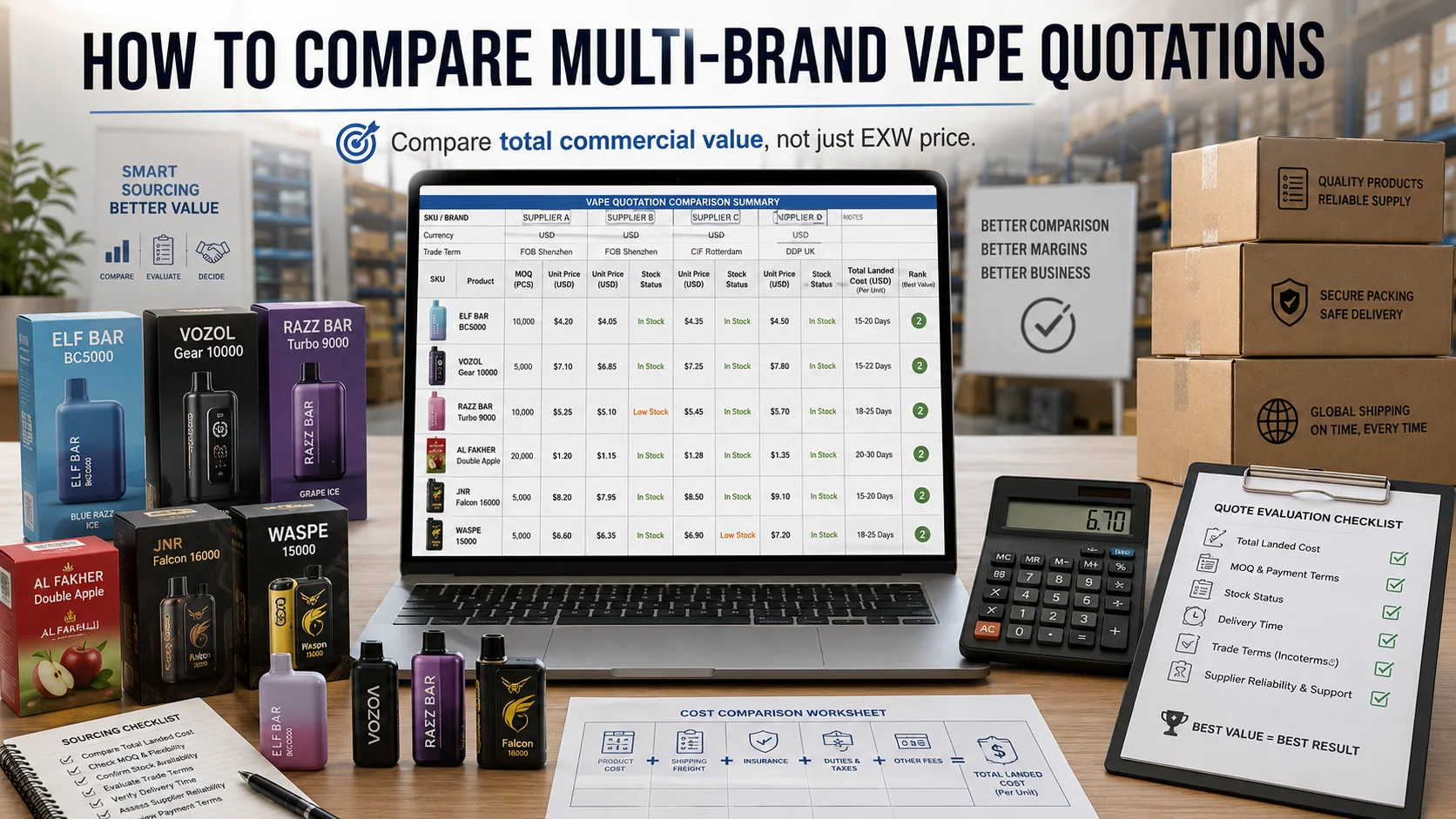
When I receive a cross-brand RFQ, I often see buyers comparing numbers that are not really comparable. One supplier may quote an old packaging version, another may quote a different flavour mix, and a third may include delivery while the others do not. The following framework helps you turn mixed supplier quotes into a practical buying decision.
How to Compare Multi Brand Vape Quotations Quickly?
A multi-brand quotation can become confusing when every supplier uses a different format. Buyers may feel pressure to choose fast because popular vape products move quickly. However, a rushed comparison can lead to stock delays, wrong versions, unexpected freight costs, or slow-moving inventory.
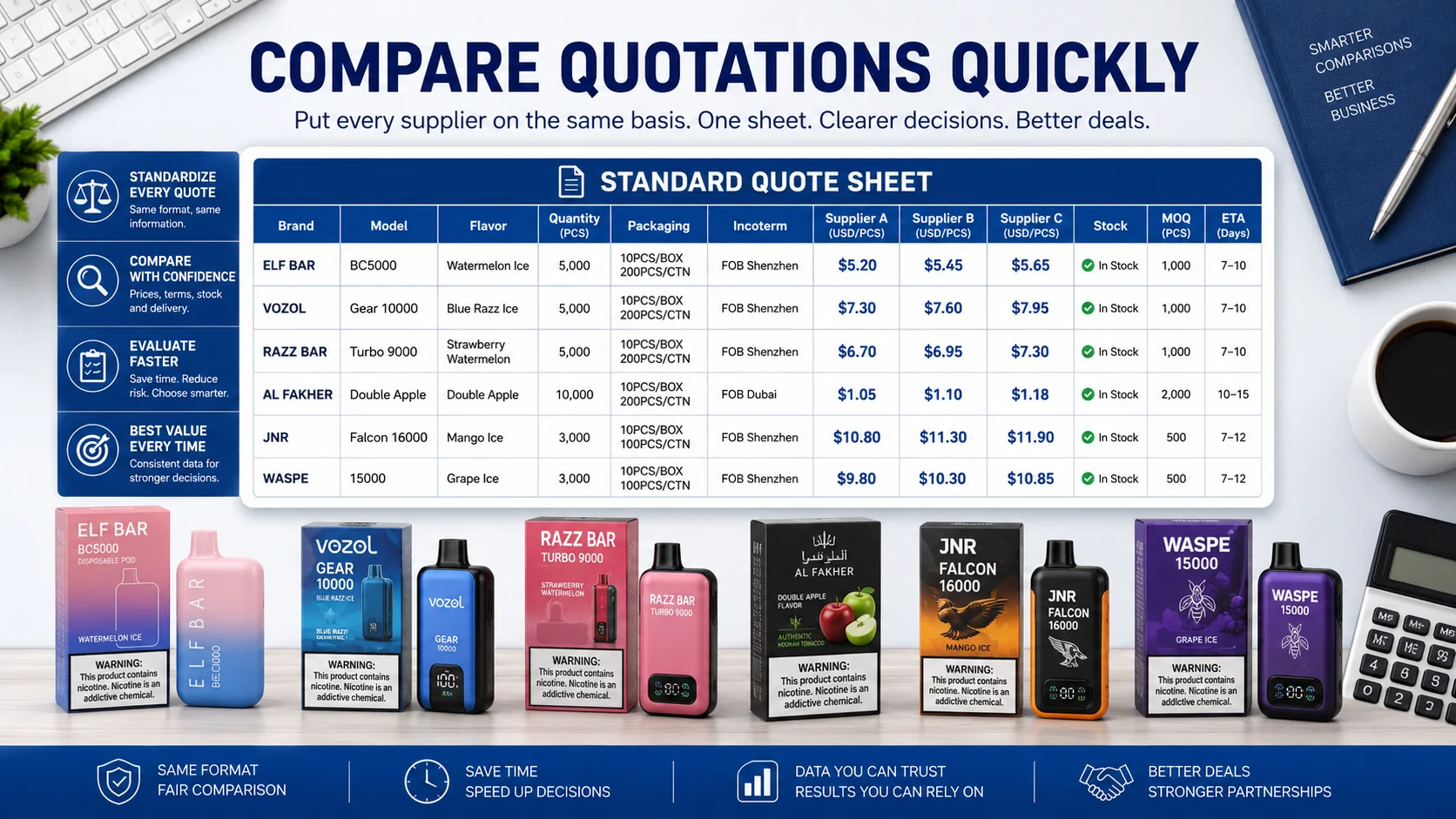
The quickest way to compare multi brand vape quotations is to build one spreadsheet with one row per SKU. Every supplier should quote the same brand, model, flavour, version, quantity, packaging, Incoterm, and destination basis. Then compare the full commercial result instead of price alone.
Start With Product Identity, Not Price
A product name alone is not enough. Similar product names can refer to different capacities, puff-count claims, nicotine options, packaging versions, or market versions. This matters especially when a wholesaler supplies vape shops, smoke shops, convenience stores, and gas stations that expect consistent products.
I suggest that every RFQ includes:
- Brand name
- Exact model name
- Capacity or stated puff specification
- Nicotine strength where applicable
- Flavour names and quantities
- Packaging language and market version
- Included accessories
- Units per carton
- Required quantity by SKU
- Destination country and delivery location
For example, “Brand X 20K disposable vape” is not a complete purchasing request. A buyer should confirm whether the quotation covers the same model, the same tank configuration, the same packaging edition, and the same destination-market version.
My rule is simple: if two suppliers cannot prove they are quoting the same item, I do not treat their prices as comparable.
A clean quote sheet prevents internal confusion as well. Your sales team can see what is coming, your warehouse team can prepare space, and your finance team can estimate the real cash requirement before payment.
Why Does Comparing Vape Quotations on the Same Basis Matter?
The lowest quoted price often attracts attention first. However, the lowest number may come from a higher MOQ, limited stock, a different shipping term, or an offer that excludes handling and delivery costs. These differences can reduce your margin after the goods arrive.
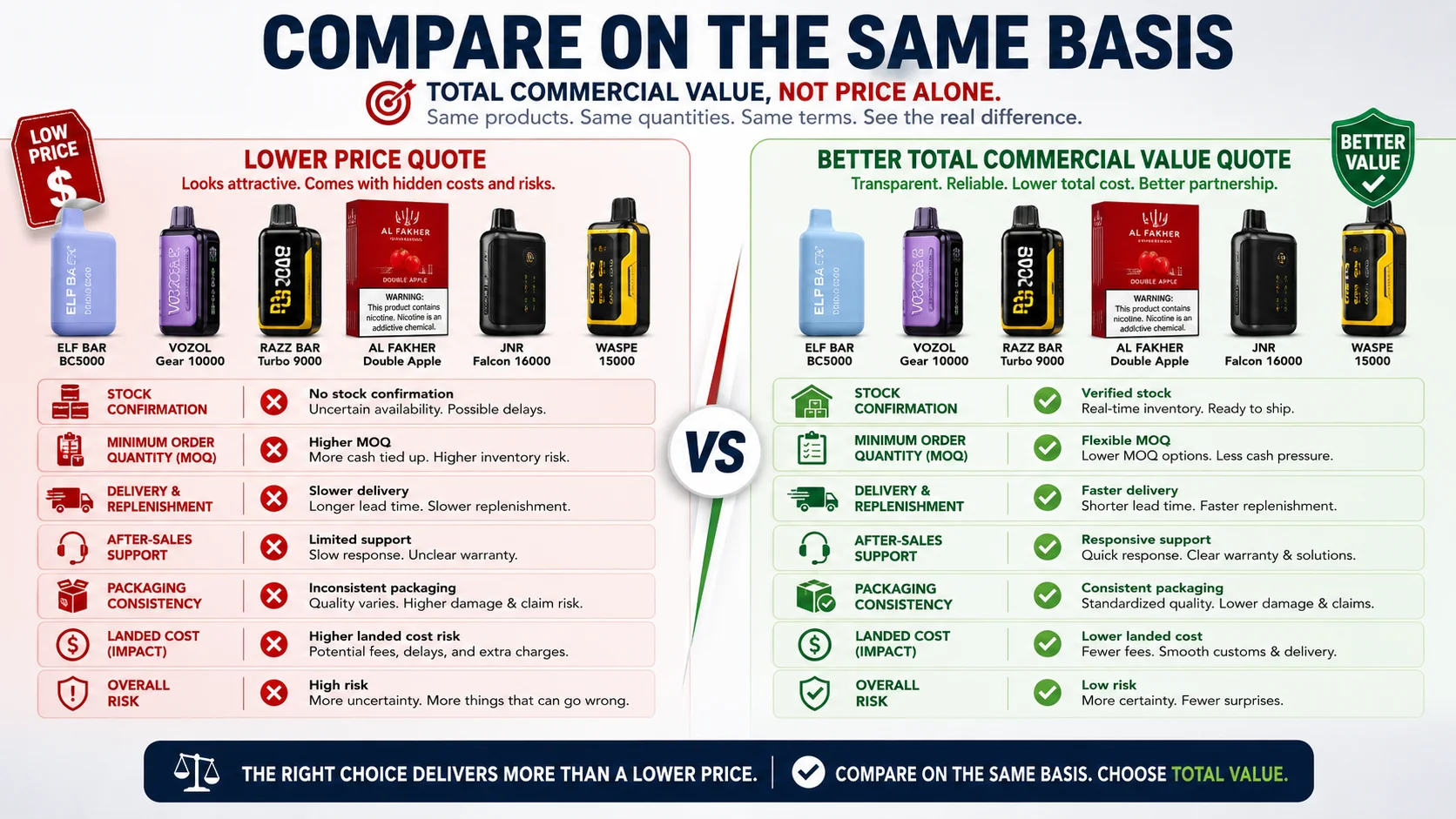
A same-basis comparison matters because a vape wholesale price comparison should measure total commercial value: product availability, expected landed cost, delivery timing, inventory exposure, and supplier responsibility. A low EXW price is only one part of the decision.
Surface Price vs. Commercial Cost
I have seen buyers receive three quotes for what appeared to be the same mixed-brand order. One quote looked cheaper, but it required larger quantities and did not confirm whether the goods were ready. Another offer had a higher unit price but allowed a smaller mixed order from available stock. For a local distributor, the second option may create less cash pressure and faster sell-through.
A useful comparison should include these commercial variables:
| Commercial Factor | Why It Matters to Buyers |
|---|---|
| Unit price | Affects gross margin, but does not show the total cost alone |
| MOQ | Determines how much cash and inventory you must commit |
| Stock status | Affects whether the order can move on the expected schedule |
| Packaging version | Affects whether the product matches your intended market |
| Freight basis | Changes the true delivered cost |
| Payment terms | Changes your working-capital exposure |
| Lead time | Affects replenishment and lost sales risk |
| After-sales scope | Affects your cost if defects or shipment issues occur |
For smaller customers, lower MOQ and quicker access to verified stock may be more valuable than chasing the lowest factory-style price. For larger importers, a bigger direct import order may offer stronger unit economics if the demand forecast, regulatory position, storage capacity, and delivery plan are already clear.
What Should Buyers Confirm Before Comparing Vape Quotations?
Many quotation errors start before a supplier even sends a price. A buyer may send a short request such as “Please quote best price for popular vapes.” That request leaves too much room for assumptions. Different suppliers may quote different products and terms.
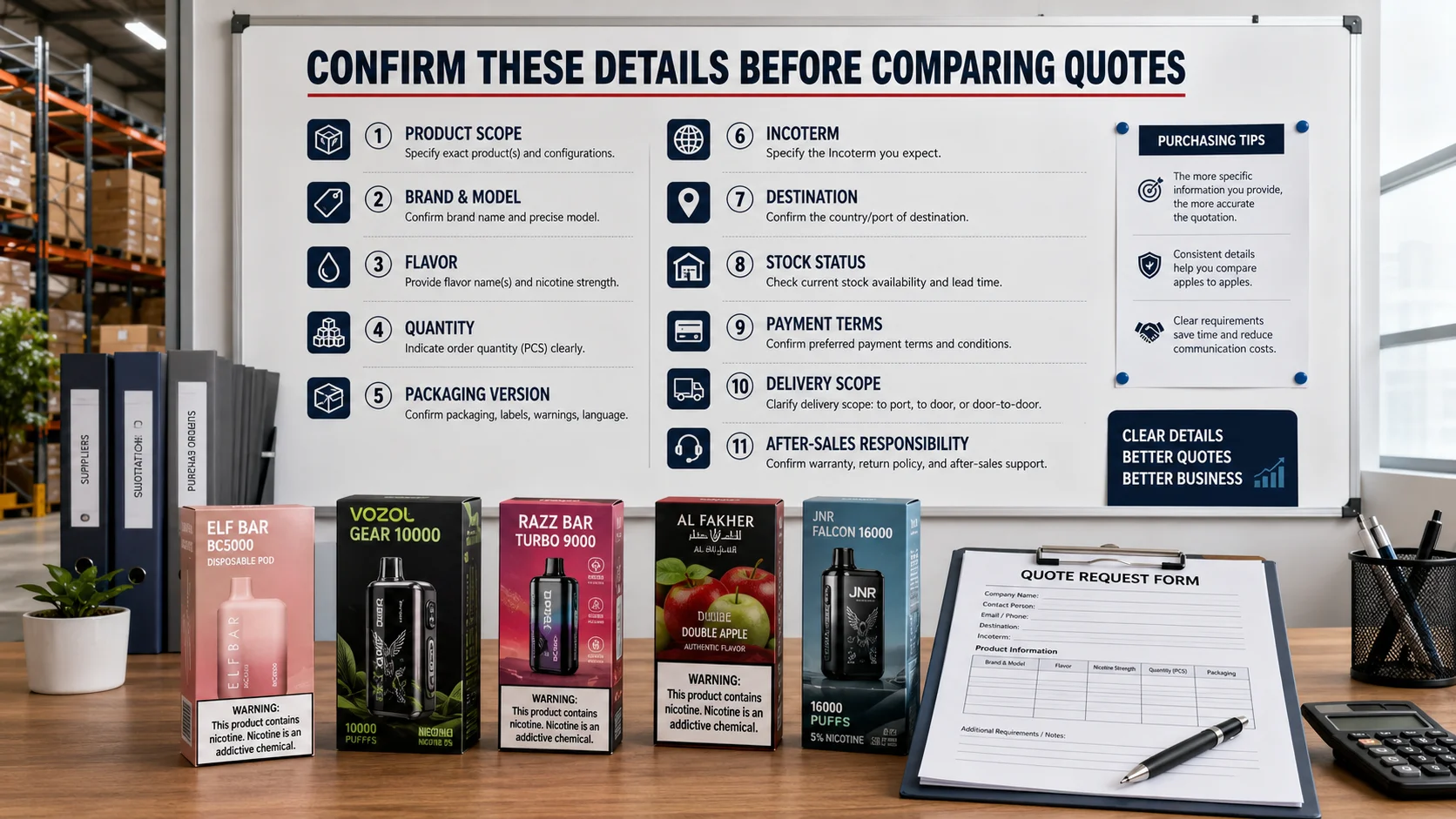
Before you compare multi brand vape quotations, confirm the product scope and commercial conditions in writing. A complete request produces more useful quotations and reduces back-and-forth messages later.
A Practical RFQ Checklist
I recommend sending the same information to each supplier. You can use the following checklist:
-
Exact brand, model, and flavour
List the requested SKUs separately. Do not rely on a general product family name. -
Destination-market version
Confirm packaging language, nicotine presentation, labelling, and intended sales market. Buyers should independently verify local regulatory requirements before purchase.[^1] -
Quantity and MOQ
State the quantity you want for each SKU. Ask whether the supplier can support a mixed-brand order or mixed flavours. -
Units per carton and packaging configuration
A carton price is not comparable when one carton contains 100 units and another contains 200 units.[^2] -
Current stock status
Ask whether stock is physically available, reserved, in production, or subject to confirmation. -
Traceable source or authorization evidence
Ask for available purchase-source documentation, batch information, or brand authorization evidence where relevant. Buyers should verify documents independently. -
Payment and Incoterms
Confirm whether the price is EXW, FOB, CIF, DDP, or another agreed basis. Never compare these terms as if they mean the same thing.[^3] -
Shipping scope and delivery destination
Confirm whether the quote covers delivery to your forwarder, port, warehouse, or door.
A well-prepared RFQ also makes it easier for me to suggest whether a customer should use mixed-stock purchasing, consolidated shipping, a larger China shipment, or an OEM/ODM route.
How to Compare Multi Brand Vape Quotations in One Table?
Buyers often receive quotations in screenshots, chat messages, PDFs, and separate spreadsheets. That format makes errors likely. It also makes it difficult to explain a purchasing decision to business partners or finance staff.
The most reliable way to compare multi brand vape quotations is to place every quote into a single standardized table. The table should separate facts that are confirmed from items that still require verification.
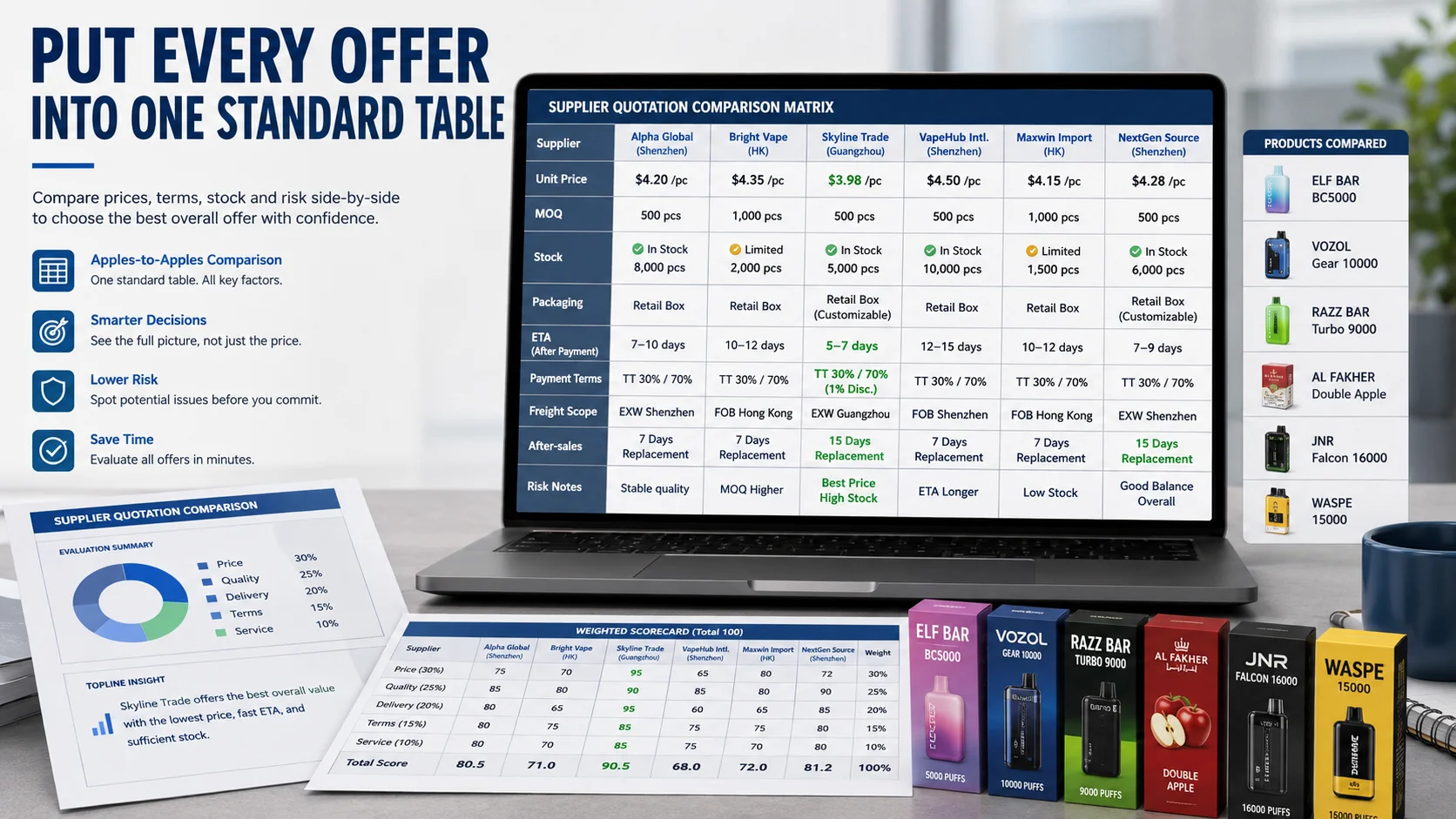
Supplier Comparison Template
| Comparison Factor | Supplier A | Supplier B | Supplier C | Buyer Risk |
|---|---|---|---|---|
| Exact brand and model | Confirmed | Confirmed | Needs clarification | Wrong product version |
| Flavour mix | 10 listed flavours | 8 listed flavours | Mixed assortment | Unbalanced inventory |
| Unit price | $X.XX | $X.XX | $X.XX | Price alone is incomplete |
| MOQ per SKU | 50 units | 200 units | 500 units | Higher cash commitment |
| Units per carton | Confirmed | Confirmed | Not stated | Incorrect cost per unit |
| Stock evidence | Video/photos available | Statement only | Production pending | Delivery uncertainty |
| Quote validity | 3 days | 7 days | Not stated | Price may change |
| Payment terms | Confirmed | Confirmed | Needs clarification | Cash-flow exposure |
| Incoterm | EXW | FOB | Delivered basis | Terms are not comparable |
| Estimated delivery window | To be confirmed | To be confirmed | To be confirmed | Replenishment risk |
| Freight estimate | Separate | Included to port | Included to door | Landed-cost differences |
| Inspection option | Available | Available | Not stated | Quality-control uncertainty |
| After-sales handling | Written scope | General statement | Not stated | Unclear responsibility |
Use a “Confirmed / Assumed / Unknown” System
I use simple status markers because quotations often contain hidden assumptions:
- Confirmed: The supplier provided a clear written answer or evidence.
- Assumed: The buyer or supplier has mentioned it, but it is not fully documented.
- Unknown: No answer has been provided.
This approach protects you from treating an estimate as a commitment. It is particularly useful for stock status, delivery schedules, shipping costs, customs-related arrangements, and product versions.
How Do You Compare Unit Price With Real Landed Cost?
A cheap factory price can become expensive after freight, consolidation, handling, taxes, inspection, and delivery costs are added. Buyers who only compare the product price may underestimate the cash needed to get goods into their warehouse.
A proper vape landed cost comparison adds all reasonably expected purchasing and delivery costs to the total goods value, then divides that figure by the number of sellable units. Destination-specific taxes, clearance charges, and delivery outcomes should always be verified case by case.
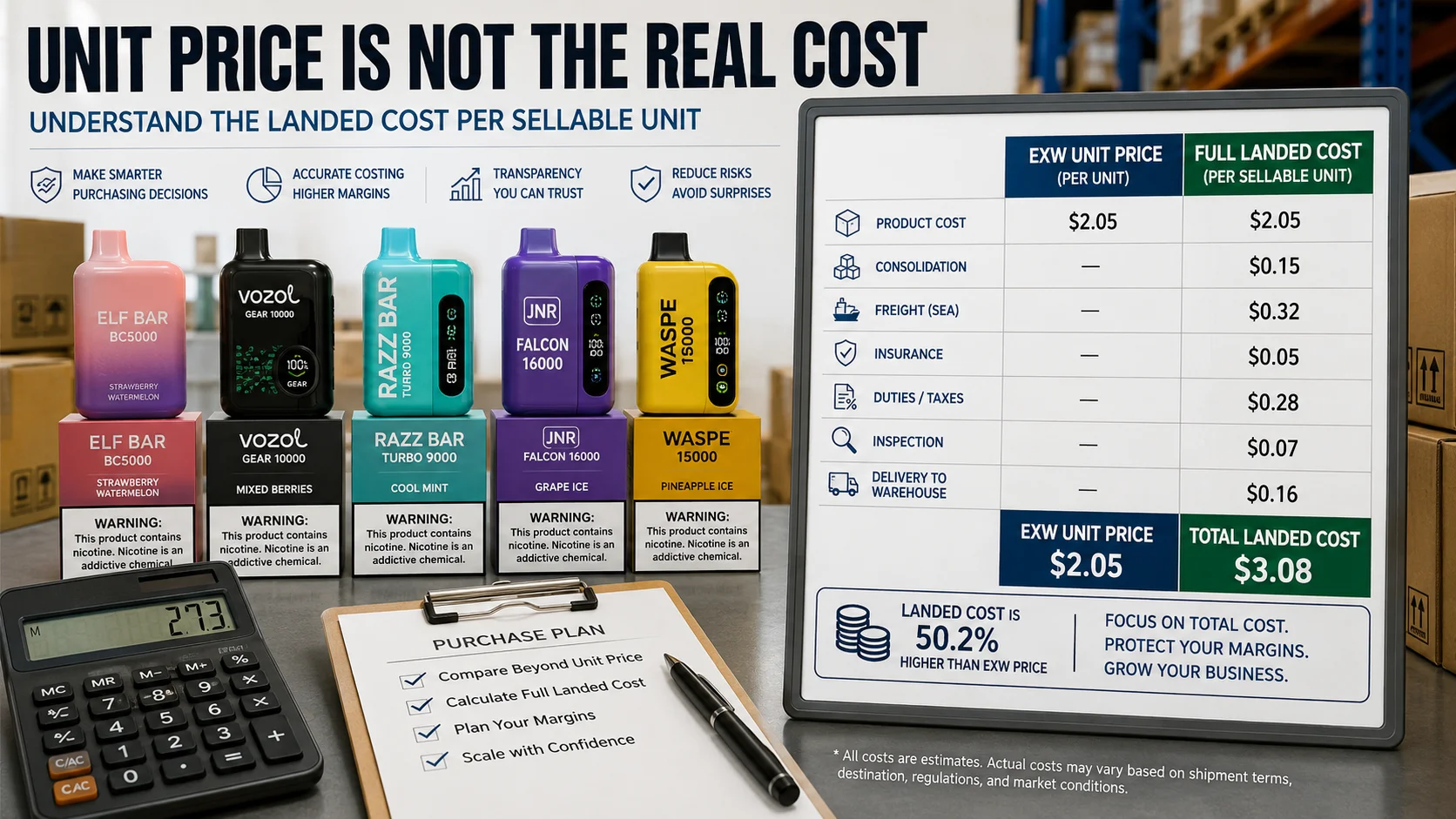
A Simple Landed-Cost Formula
Use this working formula:
Estimated landed cost per unit =[^4]
(Goods value + domestic handling + consolidation + inspection + international freight + insurance where applicable + destination charges + local delivery) ÷ sellable units
The actual fields depend on your trade term and destination. For example, an EXW quotation may require you to arrange collection from the supplier, export handling, freight, clearance, and local delivery. A delivered quotation may cover more services, but buyers should still confirm what is included and what is excluded.
Compare Like With Like
| Cost Item | EXW Quote | FOB Quote | Delivered Quote |
|---|---|---|---|
| Product price | Usually included | Usually included | Usually included |
| China-side collection | Usually buyer cost | Usually supplier-side to port | Depends on agreement |
| Export handling | Usually buyer cost | Usually included to named port | Depends on agreement |
| International freight | Buyer cost | Buyer cost | May be included |
| Import taxes and duties | Buyer responsibility unless stated otherwise | Buyer responsibility unless stated otherwise | Must be confirmed |
| Final delivery | Buyer cost | Buyer cost | May be included |
I advise buyers not to assume that a delivered quote eliminates every destination-side risk. Customs requirements, local product rules, tax obligations, and inspection outcomes differ by country and shipment.[^5] A qualified customs, tax, and compliance professional should review application-specific requirements.
How Do MOQ, Lead Time, and Cash Flow Change the Better Quote?
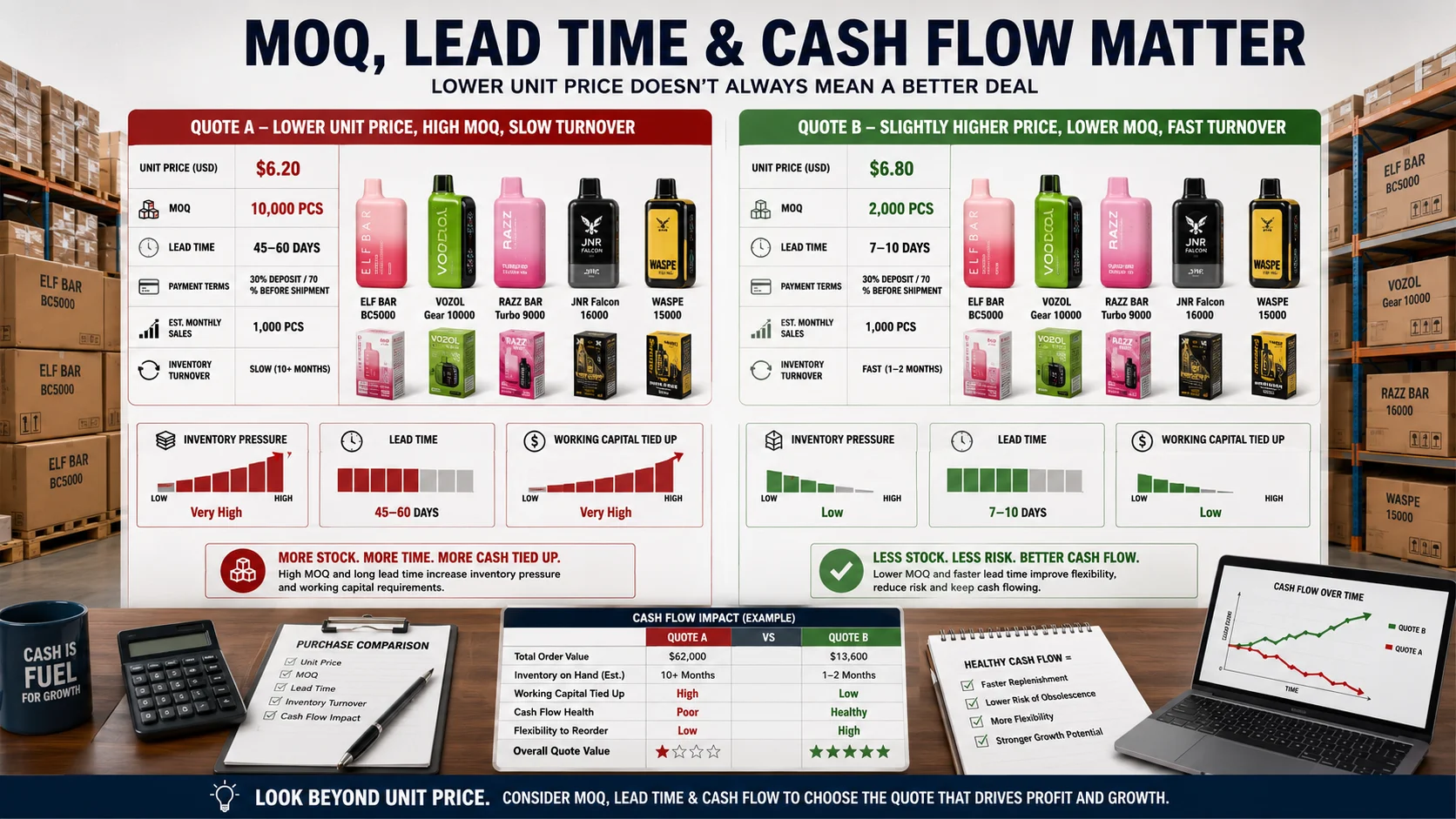
A quote with a lower unit price may require a much larger order. This can look profitable on paper but create slow inventory turnover, limited cash for new products, and pressure to discount goods later.[^6] These risks are common in fast-moving vape and smoke-shop categories.
MOQ, lead time, and payment structure can change the better quote because they determine how much money is tied up before you can sell the product. The best offer is often the one that fits your actual sales speed and replenishment plan.[^7]
Small Orders and Overseas Warehouse Stock
For small and medium wholesale customers, a lower-MOQ route can reduce risk. KingVape maintains European overseas warehouse inventory for selected products and brands. Subject to current availability and order confirmation, customers can purchase from relatively low quantities, with some products starting from 50 units per model.
This route may suit buyers who need to:
- Test a new local market
- Refill fast-moving store inventory
- Avoid a large upfront purchase
- Reduce inventory pressure
- Combine several brands in one purchasing plan
- Improve cash rotation
European warehouse stock is not automatically the lowest-cost option for every order. However, it can be commercially practical for customers who value shorter replenishment cycles and lower initial capital exposure. Delivery availability, timing, and destination coverage should be verified for each order.
Larger China Import Orders
For established importers, distributors, and wholesalers with reliable demand, direct bulk import from China may offer stronger pricing advantages. This route can make sense when you have:
- A stable sales network
- Sufficient warehouse capacity
- Clear product demand forecasts
- A known logistics and clearance process
- Larger purchase volumes
- A need for OEM or ODM development
At Shenzhen Kingfuji Tech Co., Ltd., I can help organize multi-brand sourcing and also discuss factory-based OEM/ODM opportunities when the project conditions are suitable. Our factory has operated since 2011, has approximately 5,000 square meters of production space, and states a maximum monthly capacity of up to 5 million units. Buyers should still evaluate samples, specifications, documentation, and production arrangements for their own project.
Which Supplier Evidence Makes a Vape Quotation More Reliable?
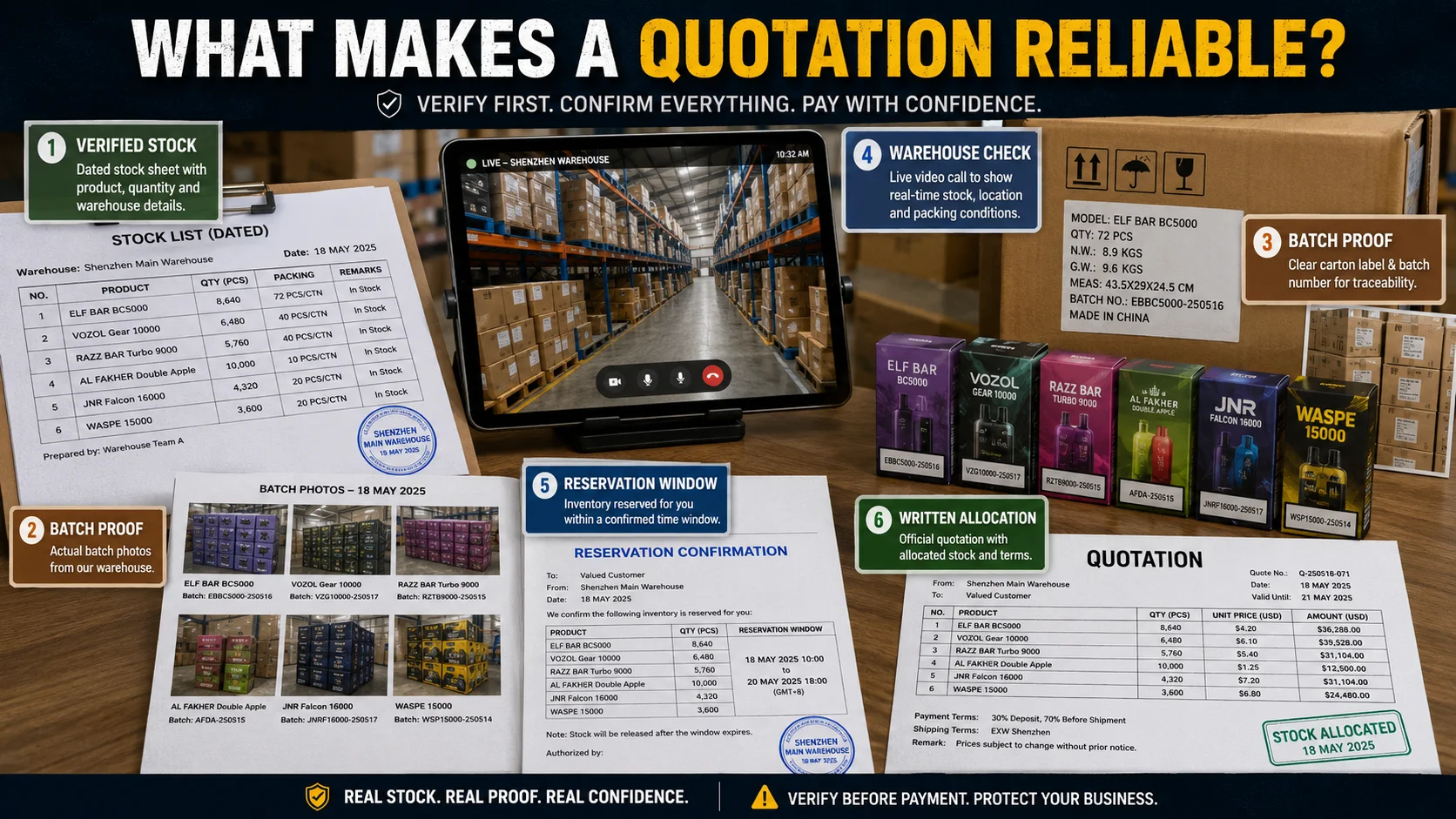
A polished quotation document does not prove that the products are available or that the quoted version matches your request.[^8] Buyers can lose time when a supplier confirms price first and checks stock later. That issue becomes more serious when several brands are involved.
A more reliable multi brand vape wholesale quotation should be supported by current evidence. Buyers should ask suppliers to show what they can verify now, not only what they expect to source later.
Evidence That Buyers Can Request
I recommend asking for appropriate evidence based on the order size and urgency:
- Current warehouse photos
- Live video verification for major orders
- Product and outer-carton photos
- SKU list with quantities
- Packaging version confirmation
- Batch or production information where available
- Specification sheet
- Sample availability
- Purchase-source or authorization documents where relevant
- Written quotation validity period
- Shipping plan and delivery scope
- Written after-sales process
I have found that live video verification is especially helpful[^9] when customers are buying a mixed order from several brands. It helps the buyer confirm product appearance, quantity, carton markings, and stock condition before payment or dispatch.
However, video is not a substitute for professional product testing, regulatory verification, or a formal inspection process.[^10] For large or application-sensitive orders, buyers should consider qualified third-party inspection and consult appropriate compliance professionals.
What Quotation Mistakes and Supplier Red Flags Should Buyers Avoid?
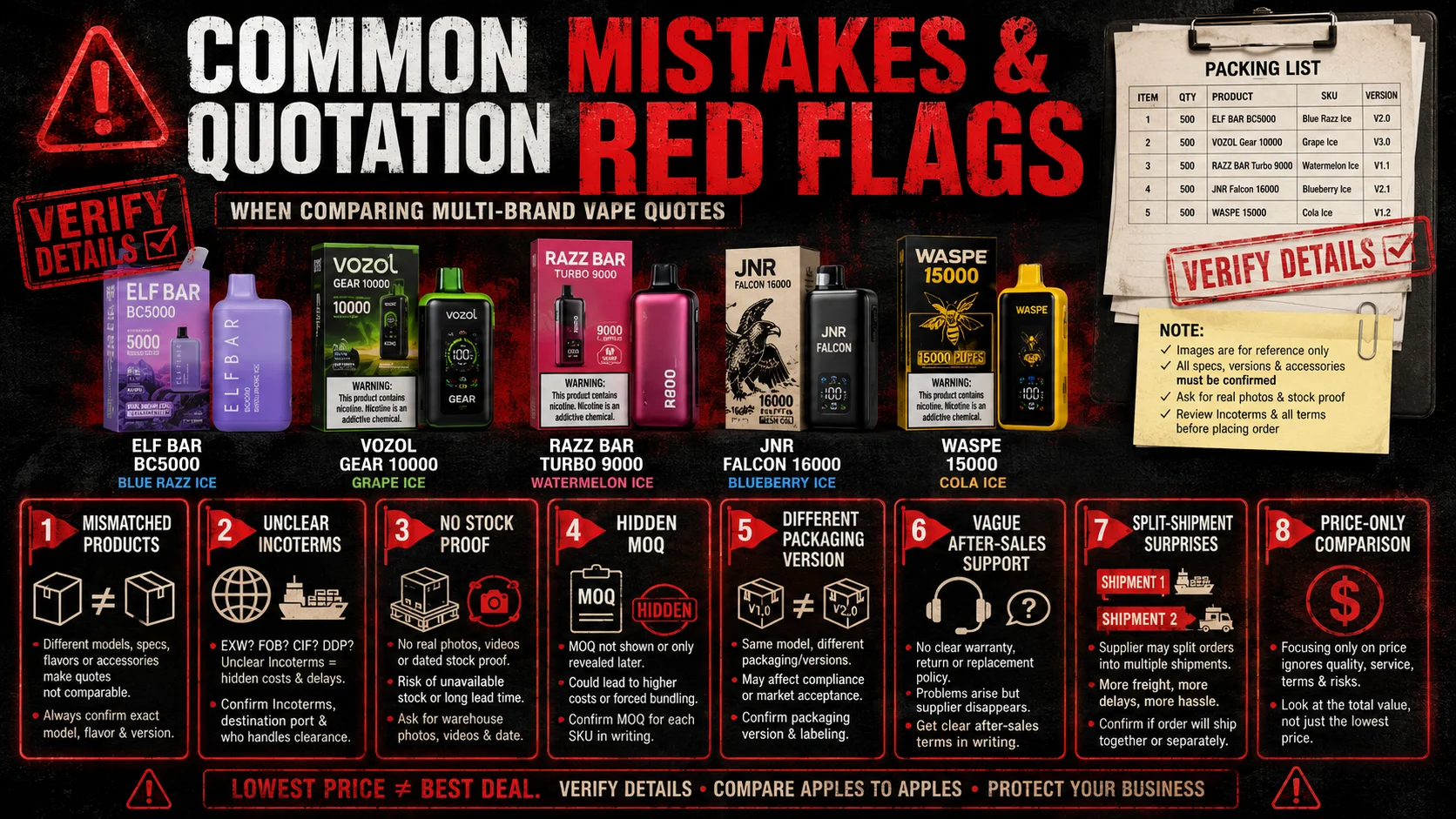
The biggest quotation mistake is assuming that every price represents the same product and the same commercial promise. This mistake can affect margin, delivery planning, and your relationship with local stores.
Buyers should avoid comparing vape supplier quotes without checking product identity, stock evidence, Incoterms, MOQ, and written after-sales scope. A cheap quote becomes risky when important commercial details remain unclear.
Common Mistakes
- Comparing different models under the same brand name
- Comparing different destination-market packaging versions
- Ignoring carton quantities and MOQ differences
- Treating EXW, FOB, and delivered prices as equal
- Assuming stock is available without evidence
- Ignoring quote expiry dates
- Forgetting flavour allocation and product mix
- Choosing a low price without calculating landed cost
- Accepting vague after-sales language
- Ordering large quantities before testing demand
Red Flags Worth Clarifying
A red flag does not always mean a supplier is unreliable. It means you need a clearer answer before payment.
Watch for:
- A price that is far below other credible offers without explanation
- No stated product version or packaging details
- No evidence of current stock
- No quotation validity date
- Unclear delivery destination
- A broad “all included” promise without written scope
- No process for defective goods or wrong-item claims
- Pressure to pay before key details are confirmed
I prefer transparent conversations over vague promises. A supplier should be able to explain what is in stock, what requires production, what the quote includes, and which items still need confirmation.
How Can You Use a Practical Multi-Brand Vape Quotation Checklist?
A repeatable process helps you make faster purchasing decisions without skipping important checks. It also helps your team compare supplier offers consistently as your product range grows.
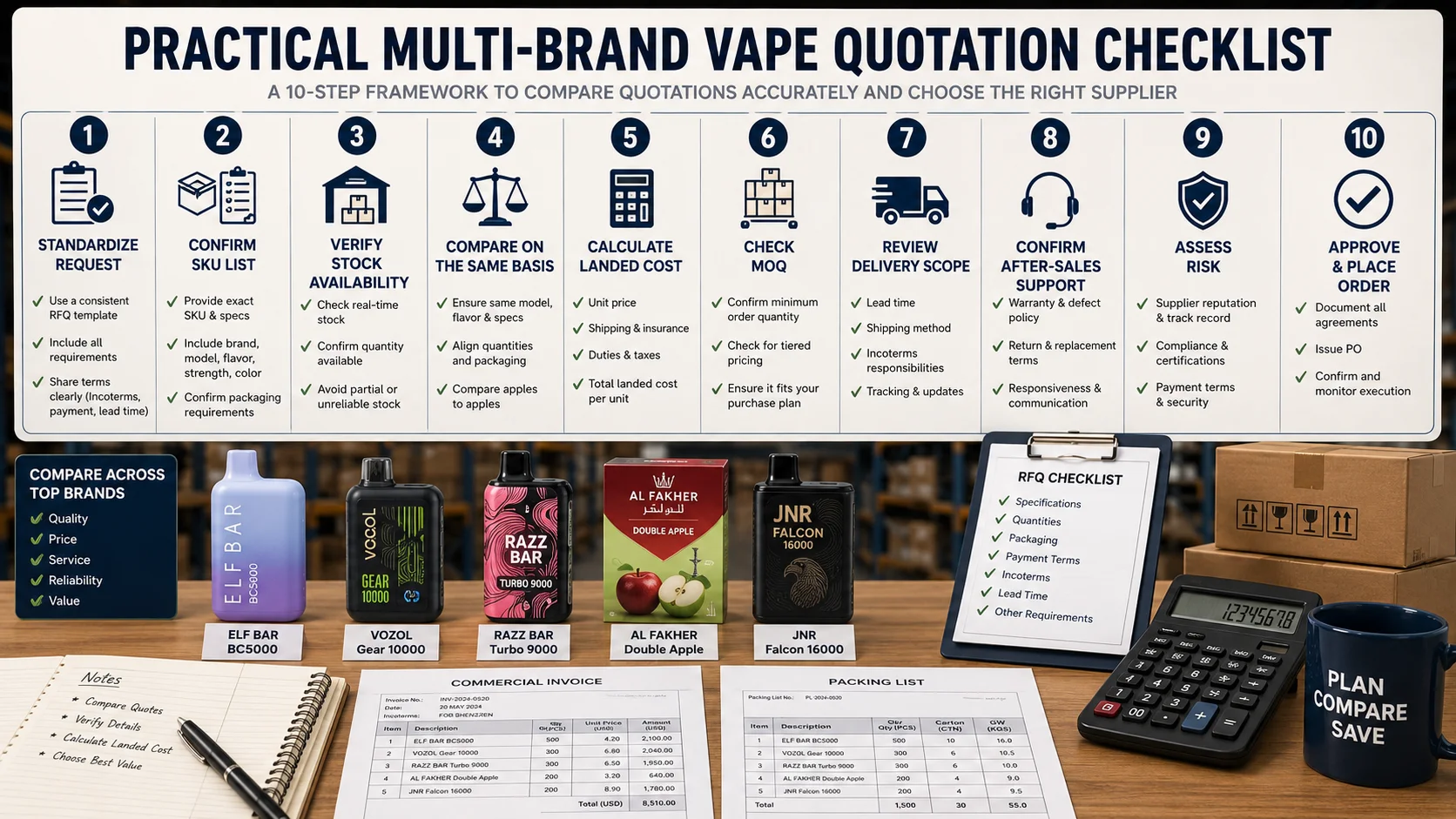
To compare multi brand vape quotations effectively, standardize the request, verify the product and stock, calculate the same landed-cost basis, and test the supplier relationship before increasing volume.
Step-by-Step Buying Process
-
Standardize your demand
Create a SKU list with brands, models, flavours, quantities, and market versions. -
Request quotes on the same basis
Give every supplier the same product list and the same destination details. -
Confirm stock and source information
Ask what is physically available now and what needs further confirmation. -
Align trade terms
Separate EXW, FOB, and delivered offers. Do not place them in the same price column without adjustment. -
Calculate estimated landed cost
Add all relevant costs and divide by sellable units. -
Compare MOQ and cash commitment
Check whether the savings justify the additional inventory and capital risk. -
Review delivery timing
Consider replenishment needs, seasonal demand, and possible logistics delays. -
Confirm after-sales responsibilities
Ask how defective units, wrong items, and shipment discrepancies are handled. -
Test before scaling
Start with samples, a smaller order, or an inspection step when the commercial risk is significant.[^11] -
Review sell-through before reordering
Your best reorder decision should reflect actual sales, not only supplier pricing.
Can KingVape Help You Build a Comparable Multi-Brand Quote?
Buyers often need several brands, accessories, and smoke-shop products in the same order. Contacting many factories and trading companies can take time, especially when each supplier uses different MOQ, stock, and shipping terms.
I can help you organize a multi-brand vape wholesale supply request on the same commercial basis. I can also suggest whether European warehouse stock, consolidated sourcing, direct China import, or an OEM/ODM discussion may better fit your order size and business model.
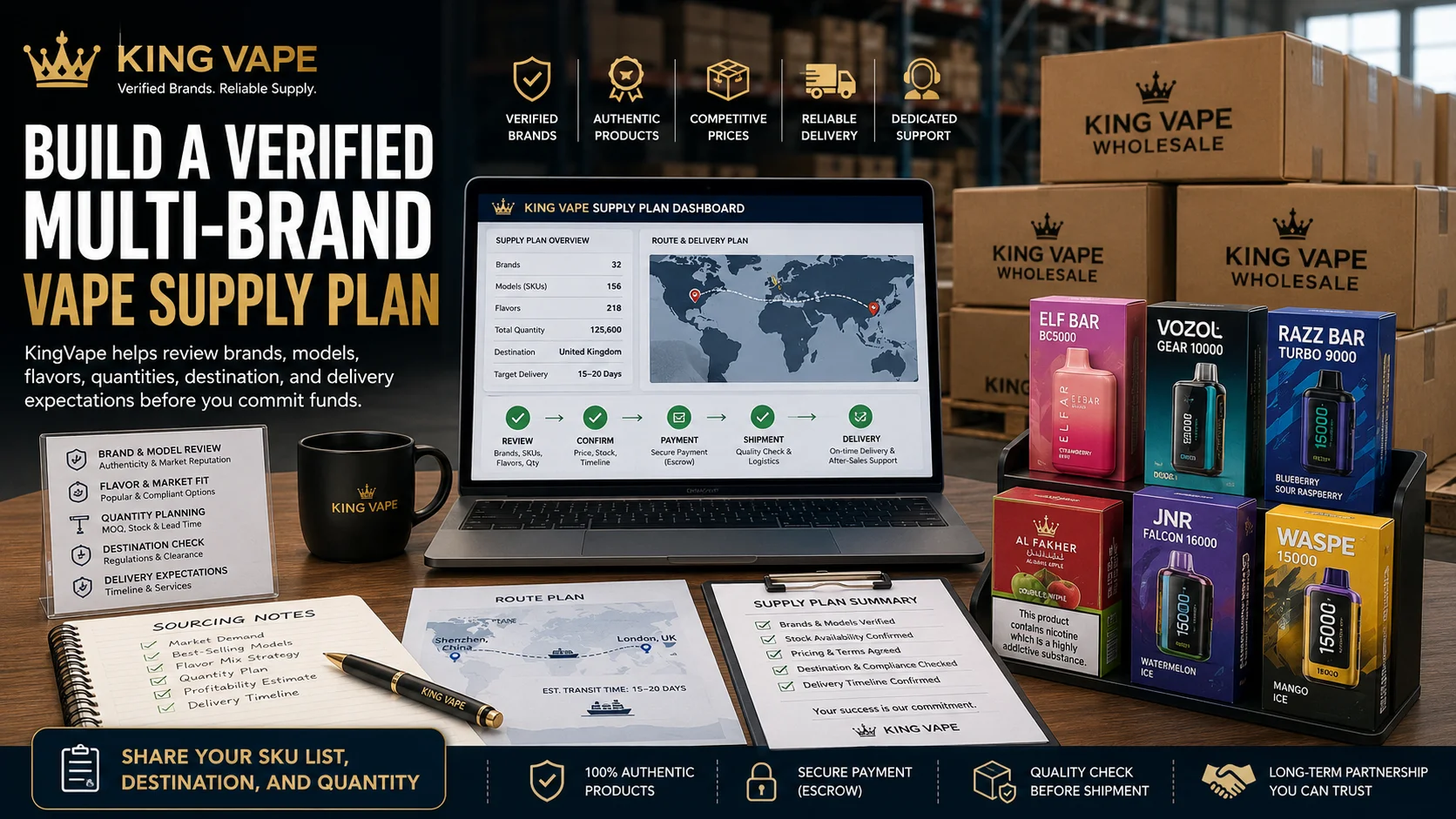
Send me the following details:
- Destination country and city
- Sales channel, such as vape shops, smoke shops, gas stations, or wholesale distribution
- Required brands and models
- Preferred flavours and quantities
- Delivery address or forwarder details
- Target delivery timing
- Whether you need stock goods, OEM, ODM, or both
KingVape is part of Shenzhen Kingfuji Tech Co., Ltd. We operate as a factory and integrated sourcing business in Shenzhen, China. I work with customers who need a more practical way to source electronic cigarettes, disposable vapes, atomizers, 510 batteries, CBD batteries, vaporizers, grinders, glass pipes, and related smoke-shop products.
For European customers, I can also check available overseas warehouse options for suitable orders. Availability, shipping scope, and delivery arrangements require order-by-order confirmation.
Frequently Asked Questions
Should I choose the lowest vape wholesale quotation?
Not automatically. The lowest unit price may require a higher MOQ, exclude freight, have limited stock, or use a different packaging version.[^12] I recommend comparing total landed cost, stock certainty, payment terms, delivery timing, and after-sales responsibilities before deciding.
What is the most important field in a multi-brand vape quotation?
The most important field is the exact product identity. You should confirm the brand, model, flavour, version, packaging, included items, carton quantity, and intended market. Without this information, a unit-price comparison is not reliable.
Can I compare EXW and delivered vape prices directly?
No. EXW and delivered prices cover different responsibilities and costs. You should add freight, handling, clearance-related costs, destination charges, and local delivery where applicable. Then compare offers using the same estimated landed-cost basis.
How can I confirm whether vape stock is really available?
You can ask for current warehouse photos, SKU-level quantity lists, packaging photos, and live video verification. For larger orders, you may also consider sample checks or qualified third-party inspection. Stock should be reconfirmed before payment and dispatch.
Is a lower MOQ always better for vape wholesalers?
A lower MOQ can reduce cash-flow and inventory risk, especially when you are testing new products or serving smaller stores. However, a larger MOQ may offer better unit pricing when you have proven demand, storage capacity, and a reliable replenishment plan.
Conclusion
Learning how to compare multi brand vape quotations helps you protect margin, reduce inventory pressure, and make more confident purchasing decisions. I recommend that you compare verified product identity, MOQ, stock, payment terms, trade terms, landed cost, delivery timing, and after-sales scope—not just the lowest unit price. If you need a multi-brand quotation for your local wholesale business, send KingVape your product list, quantities, and destination. I will help you organize a more practical sourcing route for your purchasing needs.
[^1]: "Importing Tobacco Products", https://www.fda.gov/industry/importing-fda-regulated-products/importing-tobacco-products. World Health Organization reporting documents that countries regulate electronic nicotine-delivery systems through differing measures, including product, sales, advertising, and nicotine-related controls. Evidence role: general_support; source type: institution. Supports: That electronic-cigarette products are subject to regulatory controls that vary among jurisdictions.. Scope note: The source provides international regulatory context and does not replace review of the laws, product classification, and enforcement practice in a specific destination market. [^2]: "CFPB Publishes Research Finding Higher Price Complexity Leads ...", https://www.consumerfinance.gov/about-us/newsroom/cfpb-publishes-research-finding-higher-price-complexity-leads-consumers-to-pay-more/. Consumer price-comparison guidance explains that packages with different quantities should be evaluated using a common unit price rather than the package price alone. Evidence role: mechanism; source type: government. Supports: That prices for packages of unequal quantities should be normalized to a common unit for comparison.. Scope note: Unit-price normalization compares quantity-based cost only and does not account for product quality, availability, freight, or contractual terms. [^3]: "Know Your Incoterms", https://www.trade.gov/know-your-incoterms. International Chamber of Commerce guidance explains that Incoterms rules such as EXW, FOB, CIF, and DDP assign different delivery obligations, cost allocations, and risk-transfer points to buyers and sellers. Evidence role: definition; source type: institution. Supports: That Incoterms define distinct allocations of delivery obligations, costs, and risk between contracting parties.. [^4]: "Duty - Cost Insurance and Freight (CIF) - help.CBP.gov", https://www.help.cbp.gov/s/article/Article1126. Customs and trade guidance describes the total cost of imported goods as extending beyond the supplier invoice price to include applicable transport, insurance, duty, and related charges; allocating those costs per sellable unit is a managerial-costing calculation. Evidence role: mechanism; source type: government. Supports: That import-related costs such as freight, insurance, duties, and handling contribute to the total cost of acquired goods.. Scope note: The precise components of landed cost vary by contract terms, destination law, tax treatment, and accounting policy. [^5]: "Know the import and export laws and regulations", https://www.sba.gov/business-guide/grow-your-business/export-products/international-sales/know-import-export-laws-regulations. World Trade Organization and UN trade-facilitation materials describe customs procedures, import conditions, and border charges as jurisdiction-specific requirements that traders must determine for the relevant market. Evidence role: general_support; source type: institution. Supports: That import procedures and market-access requirements are determined by the importing jurisdiction and can differ among markets.. Scope note: Such sources establish the general country-specific nature of import requirements but do not determine compliance for a particular vape product or shipment. [^6]: "Successful Inventory Management Strategies in the Office Supply ...", https://scholarworks.waldenu.edu/cgi/viewcontent.cgi?article=15184&context=dissertations. Supply-chain research identifies inventory as a working-capital commitment and associates excess stock with carrying costs, obsolescence exposure, and potential markdowns when demand does not materialize as expected. Evidence role: mechanism; source type: research. Supports: That excess inventory can tie up working capital and generate holding, obsolescence, and markdown-related costs.. Scope note: The magnitude of these effects depends on demand uncertainty, product shelf life, financing conditions, and the seller's inventory practices. [^7]: "ECONOMIC ORDER QUANTITY (EOQ) MODEL", https://scm.ncsu.edu/scm-articles/article/economic-order-quantity-eoq-model-inventory-management-models-a-tutorial. Operations-management teaching materials describe inventory replenishment as a balance among expected demand, ordering costs, lead time, service requirements, and the cost of holding stock. Evidence role: mechanism; source type: education. Supports: That inventory-ordering decisions balance demand, replenishment timing, ordering costs, and holding costs.. Scope note: These models provide a decision framework; they do not identify a universally best quotation without buyer-specific sales and cost data. [^8]: "Procurement Policy Drafting 101: Guidance for LSC Grantees", https://www.lsc.gov/i-am-grantee/grantee-guidance/procurement-policy-drafting-101-guidance-lsc-grantees. ISO quality-management guidance on externally provided products emphasizes defining purchasing requirements and evaluating suppliers' ability to meet them, rather than treating a commercial quotation as proof of conformity or availability. Evidence role: general_support; source type: institution. Supports: That purchasing controls require suppliers and purchased products to be evaluated against specified requirements rather than relying solely on commercial documents.. Scope note: This quality-management principle does not prescribe a specific method for verifying stock at a particular supplier. [^9]: "The Utility of Remote Inspections During the COVID-19 Health ... - PMC", https://pmc.ncbi.nlm.nih.gov/articles/PMC8511654/. Research on remote and virtual inspection indicates that live visual tools can support observation and communication when physical access is limited, while their effectiveness depends on image quality, inspection protocol, and the characteristics being assessed. Evidence role: general_support; source type: research. Supports: That remote visual inspection can provide supplementary observational information when in-person inspection is impractical.. Scope note: Video observation cannot independently verify product authenticity, internal quality, regulatory compliance, or the complete quantity of inventory. [^10]: "Conformity assessment", https://www.iso.org/conformity-assessment.html. ISO conformity-assessment standards distinguish inspection from laboratory testing and other evaluation activities, each of which requires defined methods, competent personnel, and documented controls. Evidence role: expert_consensus; source type: institution. Supports: That inspection, testing, and conformity assessment are distinct controlled activities conducted under defined competence and procedural requirements.. Scope note: The standards describe assessment-system principles and do not determine whether a specific vape product complies with a particular jurisdiction's rules. [^11]: "Supplier Qualification - QP-7.1 Revision 0", https://energy.gov/sites/prod/files/2015/09/f26/QP-7.1%20Supplier%20Qualification%20Rev0.pdf. Procurement and quality-management teaching resources describe supplier qualification as an evidence-gathering process that may include samples, audits, inspections, and trial orders before full-scale purchasing. Evidence role: general_support; source type: education. Supports: That supplier qualification and product verification commonly use samples, audits, inspections, or trial purchasing before broader sourcing commitments.. Scope note: The appropriate level of qualification depends on the product's risk, regulatory status, order value, and the buyer's quality requirements. [^12]: "Subpart 15.4 - Contract Pricing", https://www.acquisition.gov/far/subpart-15.4. Public-procurement guidance on total cost of ownership states that the initial purchase price alone may not capture transport, operating, inventory, service, and other costs relevant to purchasing decisions. Evidence role: general_support; source type: government. Supports: That procurement decisions should consider lifecycle or total costs in addition to initial purchase price.. Scope note: Total-cost frameworks support the comparison principle but do not establish that any particular supplier quotation is more economical.