One stop vape supplier vs separate brand suppliers is a decision that affects far more than your product price. When you buy several vape brands, accessories, and fast-moving SKUs, scattered orders can create delays, excess stock, payment friction, and unclear after-sales responsibility. The right sourcing model helps you protect cash flow while keeping your shelves stocked.
A one-stop vape supplier is usually the more practical choice for buyers who need multiple brands or product categories, lower per-brand quantities, consolidated shipping[^1], and one contact for order coordination. Separate brand suppliers can be better for high-volume buyers focused on one brand, direct authorization, exclusivity, or deep customization. The real comparison is total procurement cost—not just the unit price.
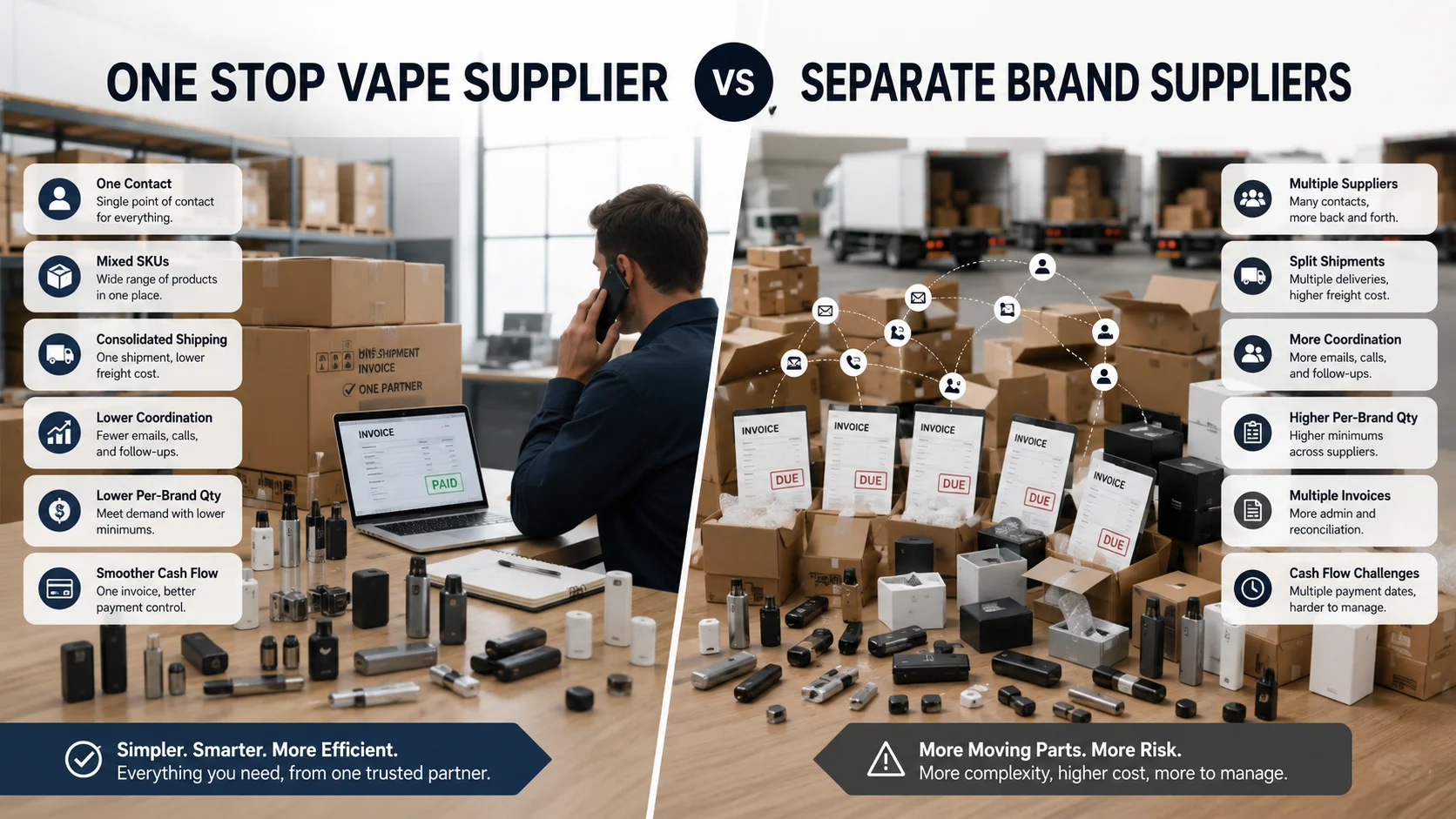
I have seen this question repeatedly in multi-brand inquiries from vape wholesalers, smoke shops, distributors, and importers. A quote may look cheaper at first, but buyers often discover later that multiple MOQs, separate freight arrangements, slow replenishment, and inventory pressure have changed the real cost.
Is One Stop Vape Supplier vs Separate Brand Suppliers the Quick Answer?
Buyers often want a simple answer because purchasing decisions move fast in the vape market. However, choosing only by the lowest quote can create a bigger problem after payment, especially when the order includes several brands and categories.
A one stop vape supplier normally fits buyers who need a mixed order and want to reduce purchasing work. Separate suppliers normally fit buyers with large, focused demand for one brand and the ability to meet direct factory or brand conditions.
Start with the buying pattern, not the price list
In the orders we coordinate, the best sourcing route usually depends on these questions:
- How many brands do you need in one order?
- How many SKUs are you testing?
- Can you meet each supplier’s MOQ?
- How much cash can you safely tie up in inventory?
- Do you need products shipped together?
- Who will handle defects, missing items, or packaging issues?
- Is the product version suitable and lawful for your destination market?
A buyer who needs 15 items from five brands may spend too much time managing separate suppliers. Each supplier may require its own quotation process, minimum quantity, payment, stock confirmation, packing list, and shipment arrangement.
By contrast, a buyer purchasing one established brand every month in high volume may have a strong reason to work directly with that brand. The buyer may receive deeper product support, direct policies, better production planning, or a more suitable commercial agreement.
The important point is simple: separate sourcing is only cheaper if it remains cheaper after operational time, stock exposure, freight coordination, and risk are counted.
Why Does One Stop Vape Supplier vs Separate Brand Suppliers Matter to Wholesalers?
Wholesale buyers do not only buy products. They also buy speed, availability, reliability, and the ability to turn inventory back into cash. A supplier model can directly affect every part of that cycle.
A one stop vape supplier vs separate brand suppliers comparison matters because it changes your MOQ exposure, number of payments, replenishment speed, shipping complexity, and accountability when something goes wrong.
Every extra supplier creates another workflow
A small or medium wholesaler may carry disposable vapes, pod systems, 510 batteries, atomizers, grinders, glass pipes, and other smoke-shop products. This product mix can help attract more store customers, but it also makes procurement harder.
When each category comes from a different supplier, your team may need to manage:
- Several sales contacts and time zones.
- Different quotation formats and payment terms.
- Separate stock confirmations.
- Different lead times.
- Multiple quality-check requirements.
- Separate shipping schedules.
- Several after-sales channels.
This workload is not always visible on an invoice. Still, it affects your business. It can delay your purchasing decisions and make it harder to know when the complete order will be ready.
I often recommend that buyers treat procurement like a cash-flow system. A product that is slightly cheaper but arrives too late may not be cheaper in practice.[^2] It can cause lost sales, emergency reorders, or excess stock in other items that arrived early but cannot move without the rest of the planned assortment.
For buyers selling to vape shops, smoke shops, gas stations, convenience stores, or local distributors, availability often matters as much as item cost. Your customers want popular products ready to sell. They do not want to hear that you are waiting for three different factories to finish production.
How Does One Stop Vape Supplier vs Separate Brand Suppliers Compare?
The two models have clear strengths. The better route depends on order structure, volume, brand concentration, and how much purchasing complexity your business can absorb.
The table below compares a one stop vape supplier vs separate brand suppliers model through the lens of real purchasing operations, not just product unit price.
| Comparison Factor | One-Stop Vape Supplier | Separate Brand Suppliers | Buyer Impact |
|---|---|---|---|
| Brand selection | Multiple brands and categories through one contact | Usually focused on one brand or factory | One-stop sourcing simplifies mixed orders |
| MOQ | May allow lower quantities across brands | Each supplier may require its own MOQ | Separate MOQs can increase stock pressure[^3] |
| Quotation process | One consolidated quote | Multiple quotes and negotiations | More suppliers mean more purchasing time |
| Payments | Fewer payment transactions | Several payments and reconciliations | More payments create more admin work |
| Stock confirmation | Centralized coordination | Confirmed separately by each supplier | Fragmented stock can delay a full order |
| Inspection | One coordinated inspection process | Separate checks for separate suppliers | Buyers need more control points |
| Shipping | Consolidated dispatch may be possible | Multiple shipments or consolidation work | Freight planning becomes more complex |
| After-sales | One service window for supplied goods | Each supplier handles only its own products | Responsibility can become unclear |
| Cash tied up | More flexible for mixed-SKU testing | Higher if each MOQ must be met | Inventory risk may rise with fragmented buying |
| Best fit | Multi-brand and multi-category buyers | Large, single-brand strategic buyers | Choose based on your actual purchase pattern |
Unit price is only one line in the calculation
A direct supplier may offer a lower price for one SKU. That can be valuable. However, a buyer should also calculate the less obvious costs:
- Staff time spent collecting and comparing quotes
- Extra bank charges or payment processing fees
- Minimum order quantities for each brand
- Storage costs for slow-moving products[^4]
- Freight costs from several origins
- Delays caused by incomplete orders
- Time spent chasing different after-sales contacts
- Lost sales caused by out-of-stock fast movers
A lower product price does not automatically mean a lower procurement cost.
For a buyer with a concentrated monthly order of one or two high-volume products, direct purchasing can make sense. For a buyer who needs many smaller product lines, vape order consolidation can make the business more manageable and reduce unnecessary inventory exposure.
What Should You Verify Before Choosing Either Supplier Model?
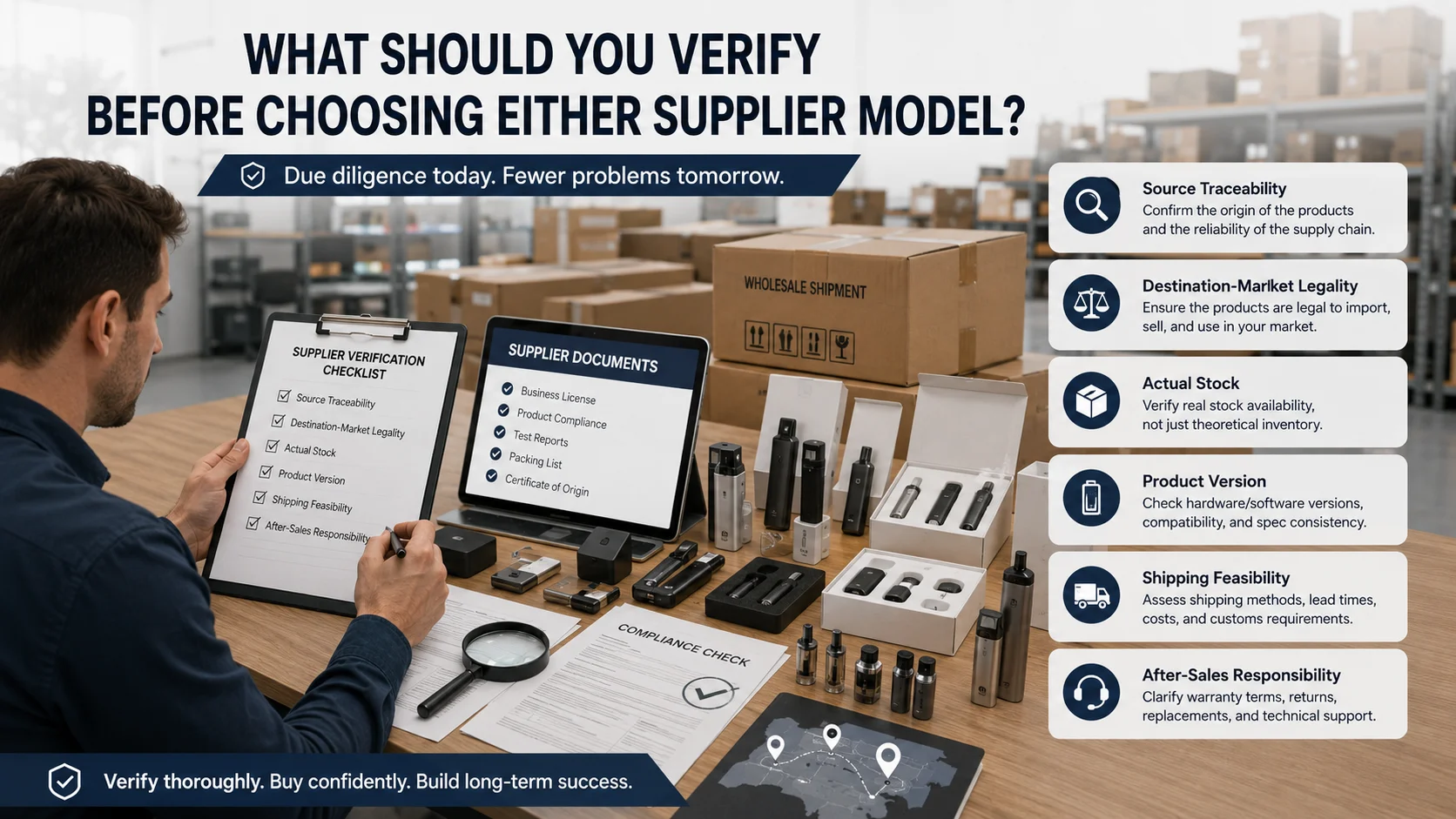
A supplier model is only useful if the products, stock, shipping route, and responsibility terms are real and clear. Buyers should verify key details before comparing prices or sending payment.
Whether you choose a one-stop partner or direct brand suppliers, you should verify source traceability, destination-market legality, actual stock, product version, shipping feasibility, and after-sales responsibility in writing.
Verify the order before you scale it
I suggest using this checklist before placing a meaningful wholesale order:
1. Confirm product source and authenticity
Ask whether the supplier has authorized channels, traceable sourcing, or a clear explanation of where the goods come from. For branded products, buyers should avoid assumptions. Product authenticity and batch consistency protect your local reputation.
2. Confirm the exact product version
A product name is not enough. Confirm:
- Device capacity and specification
- Packaging language
- Flavor list
- Nicotine format where applicable
- Batch or production version
- Compliance markings required for the market
- Retail display requirements
3. Confirm real inventory and lead time
A catalog does not always mean immediate stock. Ask for current stock information, photos or videos where appropriate, and a realistic dispatch timeline. Buyers should also ask what happens if one SKU is unavailable after payment.
4. Confirm destination requirements
Vape and nicotine-related regulations differ by country, state, and local market.[^5] Buyers must confirm that the products, labeling, and import route are lawful for their destination. A supplier can provide sourcing information, but the importer remains responsible for understanding local requirements[^6].
5. Confirm the after-sales boundary
Ask who handles shortages, damaged goods, defective units, and incorrect items. A clear process is more valuable than a vague promise. You should know what evidence is required, how claims are reviewed, and how the solution will be handled.
How Do MOQ, Lead Time, and Cash Flow Change the Decision?
MOQ and lead time can turn a low unit price into a slow-moving inventory problem. Buyers need to compare how much cash is required to test, reorder, and maintain each product line.
A one stop vape supplier vs separate brand suppliers decision often comes down to cash flow. One-stop buying can reduce per-brand stock commitments for mixed orders, while direct sourcing can improve pricing when your single-brand volume is consistently high.
The hidden cost of meeting several minimum orders
Imagine that you want to test five brands. If each direct supplier requires a separate MOQ, you may need to buy more units than your market can absorb quickly. The products may be good, but your cash is now sitting in cartons instead of supporting your next fast-moving purchase.
This problem becomes more serious when trends change quickly. In vape wholesale, popular flavors, device formats, packaging styles, and brand demand can move faster than a buyer expects[^7]. A large stock position is not always an advantage.
A multi-brand vape wholesale supply route can help buyers test a broader assortment with less commitment per line. This does not remove inventory risk, but it can make testing more controlled.
Consider the full cash cycle
Use this simple buying framework:
| Cash-Flow Question | Why It Matters |
|---|---|
| How much do I pay before dispatch? | Higher deposits create greater working-capital pressure |
| How many separate MOQs must I meet? | More MOQs can force unnecessary stock purchases |
| How long until the goods are ready? | Longer lead times delay resale and cash recovery |
| How long will transport take? | Transit time affects replenishment planning |
| How fast can I sell the products? | Slow turnover increases inventory risk |
| Can I reorder small quantities? | Flexible replenishment supports fast-moving sales |
For smaller European buyers, an overseas warehouse option can also change the calculation. At KingVape, we can support eligible smaller orders from European stock locations, with some products available from low quantities such as 50 units per model. This can suit buyers who want to test products, reduce upfront stock pressure, and receive stock more quickly within Europe.
For larger importers and distributors, direct China sourcing may offer stronger price advantages when volumes are high enough. The key is to order according to proven sales data, not hope.
When Does a One-Stop Multi-Brand Vape Supplier Make More Sense?
A one-stop model works best when your order combines several brands, categories, or test quantities. It is especially useful when your team values one purchasing contact and a coordinated delivery process.
A one stop vape supplier makes more sense for wholesalers, shop chains, and importers who need multiple vape brands wholesale, lower per-brand commitments, consolidated packing, and one after-sales contact for the products supplied.
Buyers who usually benefit most
This model often fits:
- Vape and smoke-shop wholesalers carrying many categories
- Convenience-store and gas-station suppliers
- Importers testing new vape brands or accessories
- Retail chains that need mixed-SKU replenishment
- Buyers who do not want to coordinate many China suppliers
- Businesses with limited purchasing staff
- Distributors who need quick-selling products without excessive stock
At Shenzhen Kingfuji Tech Co., Ltd., we combine factory capability with integrated sourcing. We have operated in Shenzhen since 2011, close to the core vape manufacturing and supply-chain ecosystem. That location matters because it gives us practical access to electronic cigarettes, disposable vapes, atomizers, batteries, vaporizers, and related smoking accessories.
We also maintain our own factory and brand capability. Our 5,000-square-meter factory supports production capacity of up to 5 million units per month, while our team continues to develop new products regularly. This gives larger buyers an OEM/ODM route when a standard catalog product is not enough.
The benefit for you is not simply “more products.” The benefit is less supplier chasing, clearer order coordination, and a more practical route from product selection to delivery.
When May Separate Brand Suppliers Be the Better Choice?
A one-stop model is not always the strongest choice. Some buyers need the depth, control, and strategic relationship that comes from working directly with a single brand or factory.
Separate brand suppliers may be better when you purchase large volumes of one brand, require direct authorization, need exclusive commercial terms, or plan a long-term customized product program.
Direct relationships can be strategically valuable
Separate sourcing can be the right decision when you have:
- Stable monthly demand for a specific brand
- Volume high enough to meet direct MOQ conditions
- A need for exclusive territory discussions
- A requirement for direct technical training
- A private-label or custom hardware project
- Dedicated packaging, tooling, or compliance needs
- Internal staff capable of managing several suppliers
For example, an established distributor may sell one device family in large quantities every month. That buyer may gain more from direct access to the brand, closer forecasting, and a deeper commercial relationship than from a mixed-order buying model.
The same applies to OEM and ODM projects. A customer with clear product requirements, sufficient volume, and a long-term plan may need direct engineering communication, custom molds, packaging development, and structured production control. At that stage, the buyer is not simply purchasing inventory. The buyer is building a product program.
I would not advise a buyer to use one route for every situation. Many mature wholesalers use both models:
- They buy core, high-volume brands directly.
- They use a one-stop partner for mixed brands, accessories, trending products, and replenishment.
- They test products in smaller quantities before committing to a large import order.
That hybrid approach can protect both margin and flexibility.
What Common Mistakes Make Vape Wholesale Sourcing More Expensive?
The most expensive sourcing mistakes usually happen before goods ship. Buyers often focus on the unit price while ignoring the operational details that determine whether products can be sold profitably.
The biggest risk in one stop vape supplier vs separate brand suppliers decisions is treating every supplier and every order as the same. Buyers should match the sourcing route to their volume, channel, market rules, and cash position.
Avoid these costly mistakes
Comparing only the product price
A lower quote may hide higher MOQs, multiple freight charges, delayed dispatch, or more internal work. Always compare landed and operational cost.
Assuming catalog availability means in-stock availability
Ask for current confirmation. Fast-moving models can change quickly, and stock may be allocated to other orders.
Buying large quantities before testing local demand
A product that sells well in one country may not move in another.[^8] Start with test quantities where possible, then scale based on sales data.[^9]
Ignoring product and packaging versions
Different destinations may require different packaging, nicotine formats, warnings, or legal documentation. Buyers should verify before payment.
Leaving after-sales responsibility unclear
If there is a defect issue, who collects evidence? Who makes the decision? Who provides replacement, credit, or another solution? Confirm the process early.
Combining unrelated shipping promises
Shipping routes can vary based on destination, product type, volume, and customs requirements. No supplier should present international logistics as risk-free.[^10] Buyers should request a realistic route and understand the agreed responsibility boundary.
What Is the Practical Buyer Checklist Before Scaling an Order?
A good purchasing process reduces surprises. Buyers should use small, controlled steps before committing large amounts of cash to a new supplier, brand, or product line.
A practical vape wholesale sourcing process is: define demand, verify products and legality, compare total cost, test the order, confirm shipping, review sales, and only then scale the next purchase.
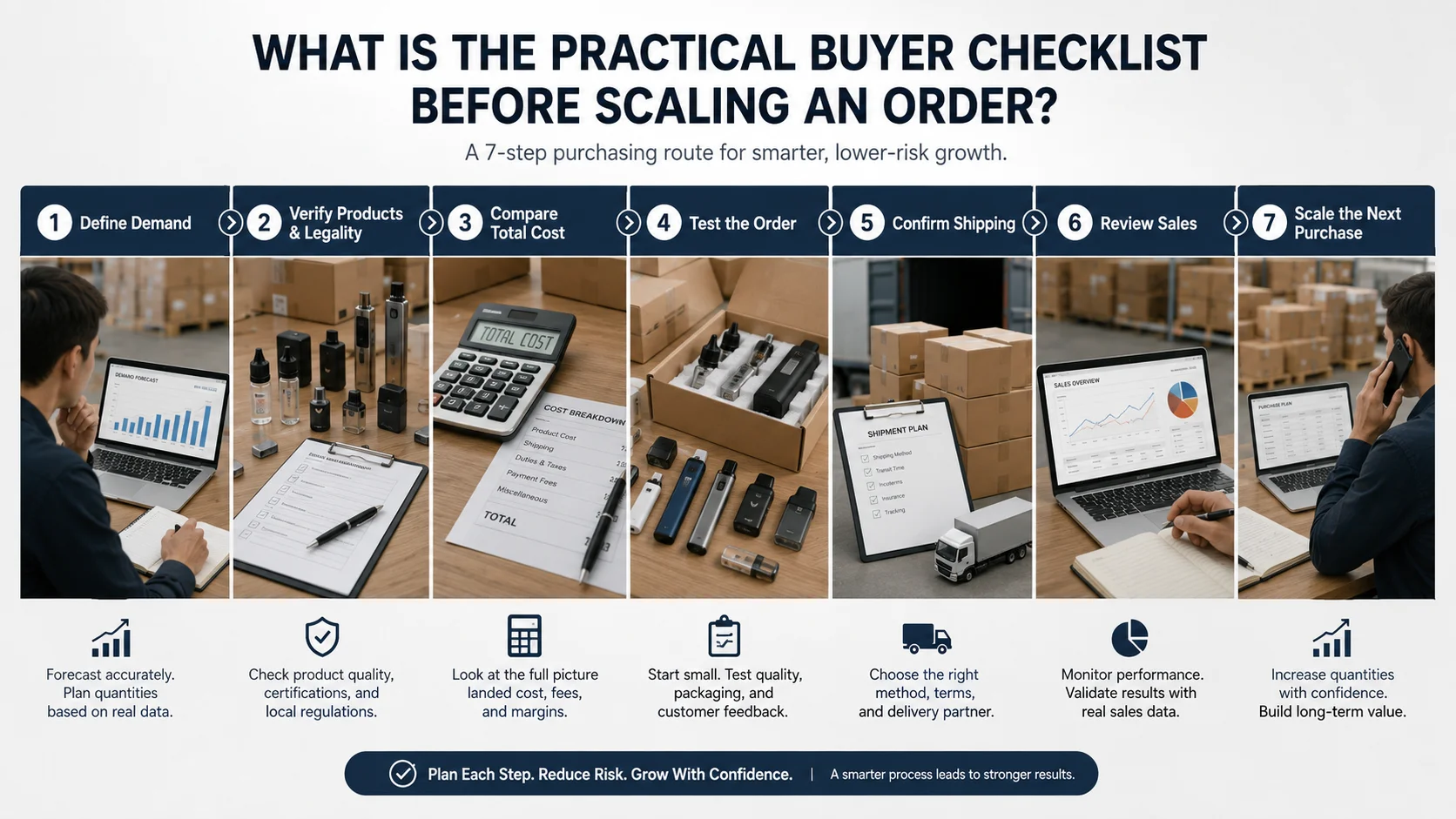
A safer route from inquiry to repeat order
-
Send a clear buying request.
Include destination country, customer type, required brands, target quantity, and delivery location. -
Confirm market suitability.
Check local product rules, packaging needs, import requirements, and sales-channel restrictions. -
Request stock and product confirmation.
Confirm the exact models, versions, colors, flavors, and available quantity. -
Compare total cost.
Review product cost, MOQ, payment terms, consolidation, shipping, and expected inventory exposure. -
Start with a test order when appropriate.
Use real sales results instead of assumptions to decide whether a SKU deserves a larger order. -
Arrange inspection or verification.
Confirm goods before final dispatch when the order value or product risk justifies it. -
Confirm the shipping plan.
Clarify destination, delivery method, packing requirements, documents, and the responsibility process. -
Track sell-through after arrival.[^11]
Record which products move quickly, which create after-sales questions, and which do not justify another order. -
Scale proven winners.
Increase quantities only after you understand local demand, margin, and reorder timing.
This process takes discipline, but it helps buyers avoid the common trap of buying too much of unproven products just because a supplier offered an attractive price.
Can We Help You Build a Practical Multi-Brand Purchasing Route?
Many buyers do not need another generic catalog. They need a practical sourcing route that matches their market, budget, order size, and delivery needs.
We can help you compare multi-brand sourcing, available stock, consolidation feasibility, overseas warehouse options for eligible European orders, China export routes, and OEM/ODM possibilities for larger projects.
Work with one team from inquiry to after-sales
At KingVape, our goal is to make purchasing easier for buyers who want to focus on local sales instead of managing many separate suppliers. We can support multi-brand and multi-category purchasing, product sourcing for items outside a current list, consolidated delivery coordination, and after-sales communication for goods supplied by us.
For larger wholesalers, importers, and distributors, we can also discuss direct China purchasing, competitive volume pricing, private-label development, and OEM/ODM projects. For smaller European buyers, our overseas warehouse route may help reduce lead time and initial stock pressure when suitable products are available.
Send us:
- Your destination country
- Your sales channel
- Required brands or product categories
- Target quantity
- Delivery destination
- Whether you need stock products, mixed orders, or OEM/ODM development
Frequently Asked Questions
Is a one-stop vape supplier always cheaper?
No. A one-stop supplier is not automatically cheaper on every SKU. It can be more cost-effective when you need several brands because it may reduce MOQs, payments, communication time, shipping coordination, and excess inventory. High-volume single-brand buyers may still receive better direct pricing.
Can I buy multiple vape brands in one wholesale order?
Yes, a multi-brand vape wholesale supply model can allow buyers to combine different brands and categories in one purchasing process. Buyers should still confirm stock, authenticity, exact product versions, destination compliance, and whether consolidated shipping is available for the order.
What should I check before importing vape products?
You should check local import and sales rules, product specifications, packaging requirements, stock availability, source traceability, shipping feasibility, and after-sales terms. You should also confirm the exact SKUs and quantities in writing before making payment.
Is an overseas warehouse better than shipping from China?
An overseas warehouse can be useful for smaller, urgent, or test orders because it may shorten delivery time and reduce upfront inventory pressure. Direct China shipping can be more suitable for larger orders that need stronger volume pricing, broader customization, or large-scale replenishment.
Can KingVape support OEM and ODM vape projects?
Yes. We are a factory and integrated trade partner with OEM/ODM experience. Buyers with clear requirements and sufficient project conditions can discuss product development, custom branding, packaging, and, where appropriate, new product or mold development.
Conclusion
The one stop vape supplier vs separate brand suppliers choice should never be based on unit price alone. You should compare MOQ, lead time, cash tied up in stock, shipping coordination, supplier workload, product verification, and after-sales responsibility. One-stop purchasing can be a strong solution for mixed orders and fast-moving wholesale needs. Separate suppliers can be the better route for large, focused, strategic brand programs. Contact KingVape with your buying list and destination, and we will help you assess the most practical sourcing route before you scale.
Choose a Reliable Vape Supplier in China
Finding a trustworthy manufacturer matters for bulk orders. We verify factories and support due diligence. Contact us to start supplier vetting.
Related reading: Own Brand, OEM or Brand Agency: Which Model Fits Your Vape Business Best?
[^1]: "Study the Impacts of Freight Consolidation and Truck Sharing ...", https://rosap.ntl.bts.gov/view/dot/42413. Logistics research describes freight consolidation as combining consignments into fewer transport movements to improve vehicle or container utilization and reduce handling complexity. Evidence role: mechanism; source type: research. Supports: That freight consolidation combines multiple consignments or orders into fewer shipments and can improve transport utilization.. Scope note: Consolidation may also add coordination time and is not necessarily cheaper or faster for every shipment size, route, or delivery deadline. [^2]: "An analytical review of predictive methods for delivery delays in supply ...", https://www.sciencedirect.com/science/article/pii/S2949863525000305. Operations-management research finds that replenishment lead times and delivery uncertainty affect stockout risk and can produce lost-sales costs beyond the supplier's quoted unit price. Evidence role: mechanism; source type: paper. Supports: That lead-time variability and delayed replenishment can contribute to stockouts and lost sales, which affect the economic value of a purchasing decision.. Scope note: This does not establish that every delayed shipment is costlier than a higher-priced alternative; the result depends on demand, inventory buffers, and service levels. [^3]: "Inventory Management", https://www.uky.edu/~dsianita/300/inventory. Inventory-management literature explains that order-size constraints affect stock levels and carrying costs, so larger purchase commitments can increase capital tied up in inventory. Evidence role: mechanism; source type: education. Supports: That larger procurement lots can increase inventory held and the capital committed to stock, while also creating carrying costs.. Scope note: The effect of any particular MOQ depends on demand variability, supplier terms, storage costs, and the buyer's replenishment policy. [^4]: "Inventory Control for Farm Supply Cooperatives", https://extension.okstate.edu/programs/agribusinessand-cooperative-management/site-files/docs/inventory_management_for_farm_supply_cooperatives-1.pdf. Inventory-cost research treats warehousing, capital commitment, and obsolescence as carrying costs that rise when goods remain unsold for longer periods. Evidence role: mechanism; source type: research. Supports: That inventory held for longer periods generates carrying costs such as warehousing, insurance, obsolescence, and capital costs.. Scope note: The size of these costs differs by product, warehouse arrangement, financing terms, and risk of obsolescence. [^5]: "Tobacco: E-cigarettes", https://www.who.int/news-room/questions-and-answers/item/tobacco-e-cigarettes. World Health Organization reporting documents that countries adopt differing regulatory approaches to electronic nicotine delivery systems, including bans, product controls, and sales restrictions. Evidence role: general_support; source type: institution. Supports: That legal approaches to electronic nicotine delivery systems differ substantially among jurisdictions, including restrictions on sale, products, advertising, and use.. Scope note: A global overview does not determine the current legal requirements of a particular country, state, or municipality. [^6]: "Importers and distributors - Internal Market, Industry ...", https://single-market-economy.ec.europa.eu/single-market/goods/ce-marking/importers-and-distributors_en. Official product-compliance guidance describes importers as economic operators with obligations to verify that products meet applicable requirements before they are placed on the market. Evidence role: general_support; source type: government. Supports: That importers have defined obligations to ensure products placed on a market meet applicable legal and safety requirements.. Scope note: The precise obligations, enforcement regime, and applicability to nicotine products depend on the destination jurisdiction. [^7]: "Results from the Annual National Youth Tobacco Survey (NYTS)", https://www.fda.gov/tobacco-products/youth-and-tobacco/results-annual-national-youth-tobacco-survey-nyts. Tobacco-surveillance reports have documented year-to-year changes in e-cigarette device types, brands, and flavor use, indicating that product preferences can shift over time. Evidence role: statistic; source type: government. Supports: That surveys and surveillance have recorded changes over time in e-cigarette product use, flavors, brands, and device types.. Scope note: Consumer-use survey findings, often focused on particular populations such as youth, may not directly represent wholesale demand in every market. [^8]: "Findings From the 2018 ITC Four Country Smoking and Vaping Survey", https://pmc.ncbi.nlm.nih.gov/articles/PMC7542635/. Cross-national studies of e-cigarette use report differences among countries in prevalence, product characteristics, and flavor preferences, consistent with market-specific demand patterns. Evidence role: general_support; source type: paper. Supports: That e-cigarette use patterns and product preferences vary across national markets and population groups.. Scope note: Population surveys do not directly predict retail sell-through for a particular brand, price point, or distribution channel. [^9]: "Inventory Management for Supply Chains with Uncertainty", https://preserve.lehigh.edu/lehigh-scholarship/graduate-publications-theses-dissertations/theses-dissertations/inventory-0. Inventory and demand-learning research shows that early sales observations can be used to update demand estimates and inform later ordering decisions under uncertainty. Evidence role: mechanism; source type: paper. Supports: That firms can use early demand observations to update forecasts and adjust subsequent inventory decisions under uncertainty.. Scope note: Small test orders can raise per-unit logistics costs or cause stockouts, so the appropriate test size depends on service-level and margin requirements. [^10]: "Why smarter logistics are essential for trade, growth, and jobs", https://blogs.worldbank.org/en/trade/why-smarter-logistics-are-essential-for-trade--growth--and-jobs. International trade and logistics assessments identify transport reliability, customs and border procedures, documentation, and external disruptions as factors that can affect cross-border delivery performance. Evidence role: general_support; source type: institution. Supports: That international trade logistics is affected by transport reliability, border procedures, documentation, and other sources of delay or disruption.. Scope note: General logistics-risk evidence cannot predict the outcome, transit time, or customs treatment of a specific shipment. [^11]: "Forecasting and Inventory Management", https://psep.smeal.psu.edu/short-courses/supply-chain-management/forecasting-and-inventory-management. Retail-operations research uses point-of-sale sales data as an input to demand forecasting and replenishment decisions, helping firms distinguish fast- and slow-moving items. Evidence role: mechanism; source type: research. Supports: That point-of-sale and sell-through data can improve demand forecasting, replenishment, and assortment management.. Scope note: Sales records alone may not capture future demand changes caused by seasonality, price changes, regulation, or competitor activity.