
How product complexity affects small vape wholesalers is a real business issue because every extra model, flavour, nicotine option, and price level needs cash, storage, sales explanation, replenishment, and after-sales support[^1]. If a small team copies a large distributor’s product range, inventory can quickly become difficult to control. A simpler, channel-focused range usually protects cash flow and makes repeat sales easier.
Product complexity affects small vape wholesalers more than large distributors because small businesses usually have less purchasing capital, less warehouse space, fewer sales data points, and smaller teams. Too many vape SKUs can divide cash across slow-moving products, make replenishment harder, and create more after-sales work. The practical answer is not to carry as few products as possible, but to build a manageable product range that fits the buyer’s real sales channels and replenishment capacity.
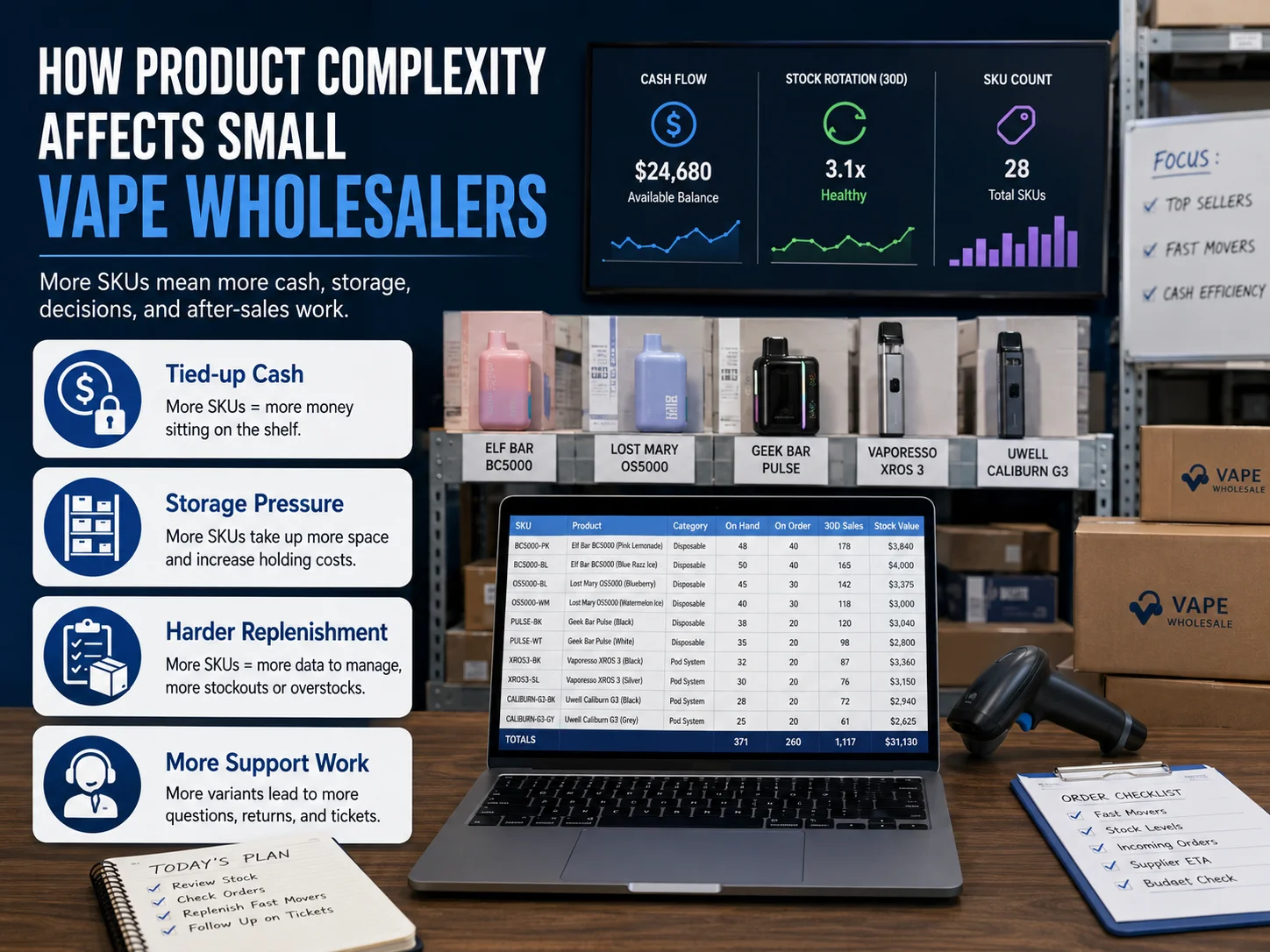
From my experience coordinating multi-brand purchasing, new product selection, and after-sales communication from Shenzhen, I repeatedly see the same pattern. A buyer finds several hot products, orders many variations at once, and later discovers that only a small part of the range moves consistently. The goal should be controlled growth, not a bigger catalog for its own sake.
How Product Complexity Affects Small Vape Wholesalers: Quick Answer?
Small wholesalers often feel pressure to offer everything their competitors offer. That pressure is understandable. Retail customers ask for new flavours, new puff counts, different battery formats, and lower-priced alternatives. However, each new option adds another decision after the order is placed.
How product complexity affects small vape wholesalers is mainly through tied-up cash, slower stock rotation, harder purchasing decisions, and increased service workload. Large distributors can usually absorb these costs with bigger teams, larger order volumes, and deeper sales data. Small wholesalers should focus on a controlled mix of proven core products and limited test items rather than copying a broad distributor catalog.[^2]
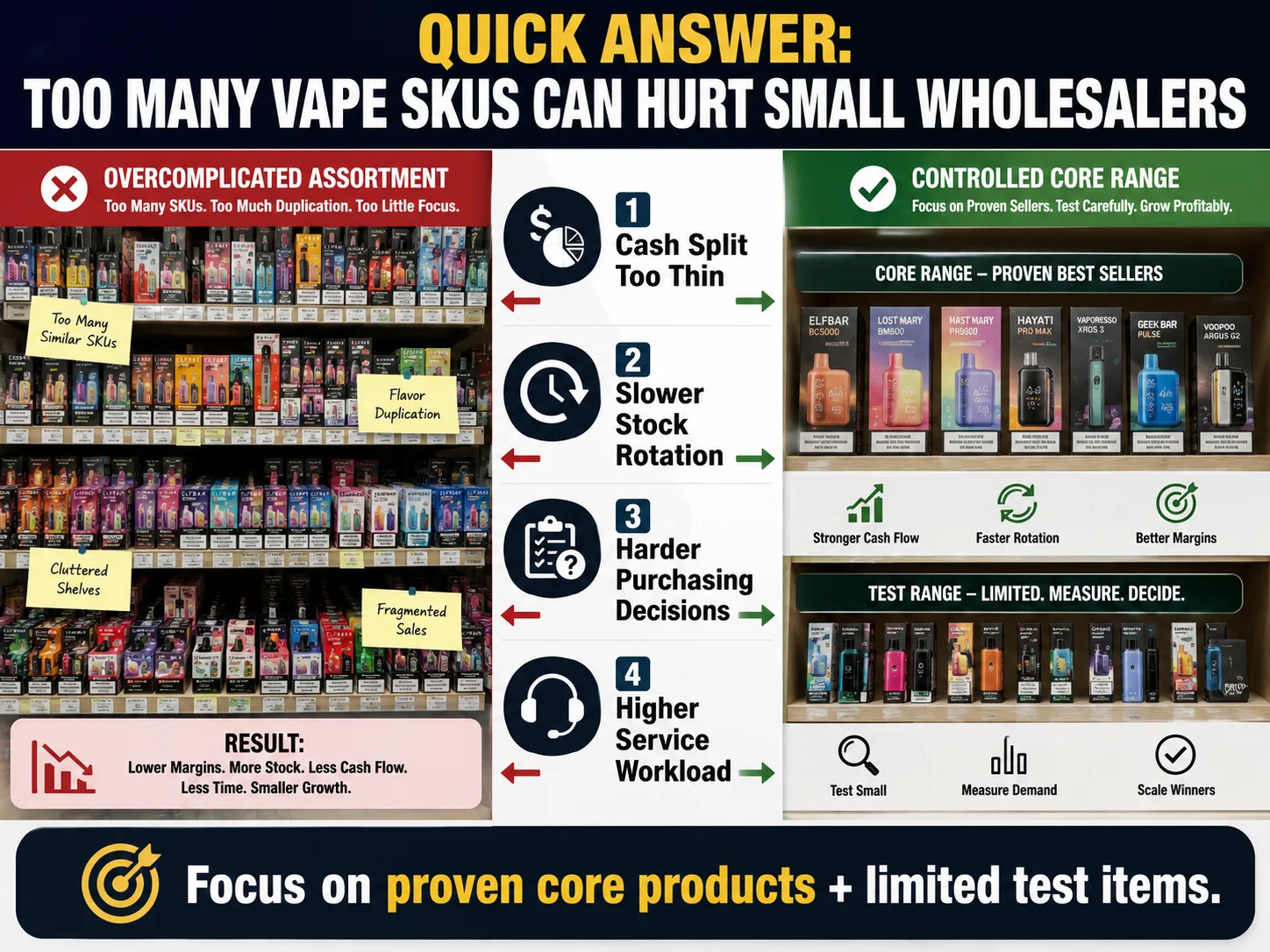
For small teams, the hidden work matters as much as the factory price. A low-cost vape can become expensive if staff must repeatedly explain it, solve compatibility questions, coordinate a supplier, or manage unclear after-sales responsibility.
The hidden cost is operational attention
Every SKU needs more than a place on a shelf. It needs a clear answer to several questions:
- Who will buy it?
- What makes it different from the similar item beside it?
- How many units can the channel realistically sell each week?
- When should it be reordered?
- Who handles a complaint or a defective item?
- Is the margin enough after shipping, storage, service, and discounting?
Large distributors often have category buyers, warehouse systems, sales representatives, and account data. A local importer or a small regional wholesaler may have one owner managing purchasing, sales, warehouse activity, and customer calls. In that situation, a catalog with too many near-identical products creates friction.
I do not believe small wholesalers should avoid fast-moving products. A new product can create good opportunities. However, the product needs a place in a workable assortment. If the team cannot explain, replenish, and support it, a “hot” SKU can become a distraction rather than a profitable line.
What Does Product Complexity Mean in Vape Wholesale?
Product complexity in vape wholesale is not only about the number of products. It comes from the number of decisions attached to each product. Two disposable vapes may look similar, but their flavours, capacity, packaging, nicotine strength, charging method, local market version, and price level may all be different.
Vape wholesale product complexity includes the combined effect of device models, flavour choices, nicotine specifications, capacities, packaging, charging formats, price bands, and market-specific versions. The more combinations a wholesaler carries, the more purchasing, inventory, sales training, and after-sales coordination the business must manage.
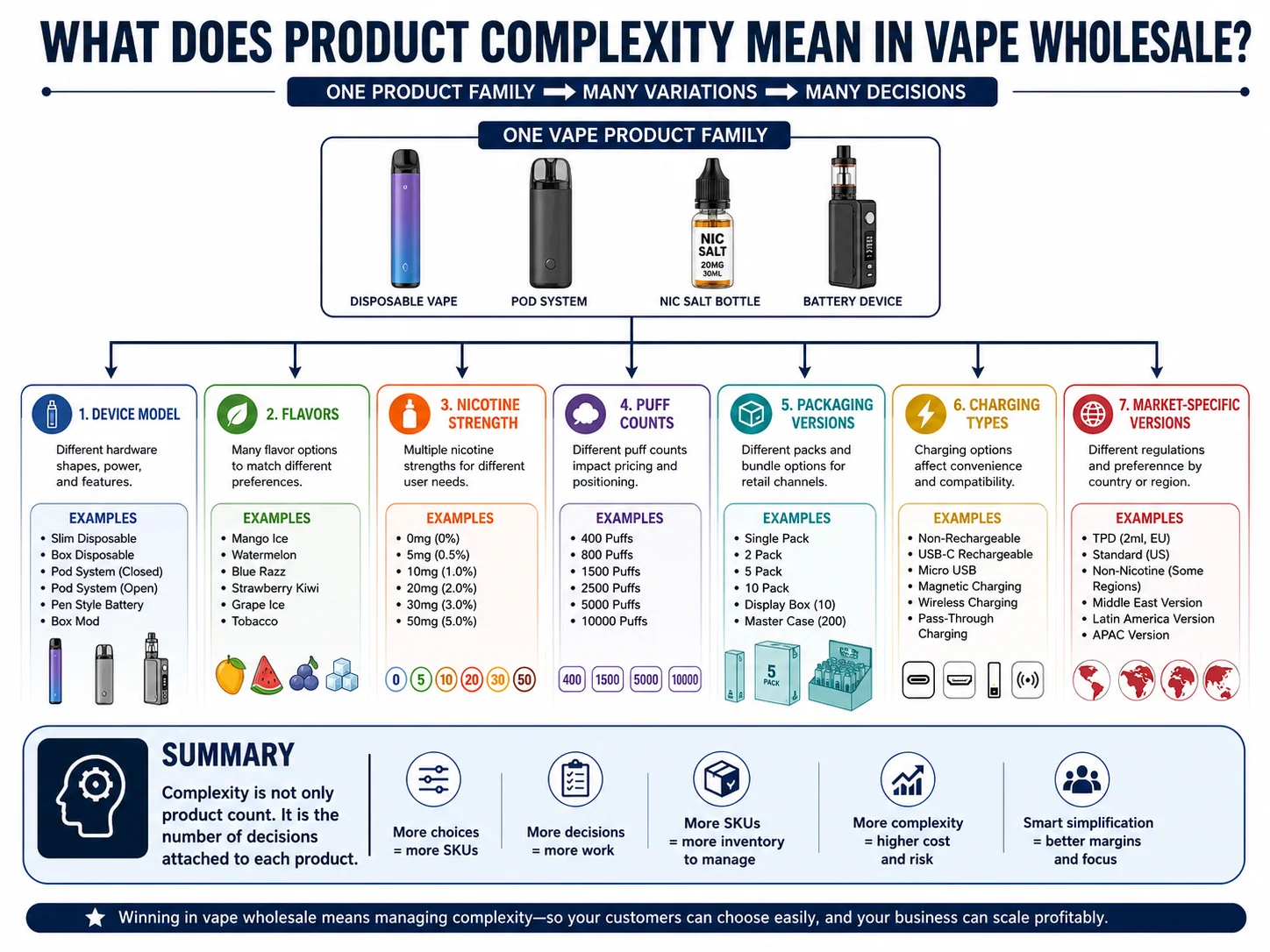
A broad range can be useful when it serves real demand. The problem begins when products overlap without a clear reason.
Complexity can grow faster than expected
A wholesaler may start with one device in 10 flavours. Then the supplier introduces another capacity, two packaging options, three nicotine levels, and a lower-price version. The result is not just “a few extra products.” The range may become dozens of separate SKU decisions.[^3]
Common complexity drivers include:
| Complexity driver | Example | Operational effect |
|---|---|---|
| Device models | Disposable vape, pod kit, 510 battery | Different buyer profiles and product explanations |
| Flavours | Fruit, mint, beverage, dessert options | Uneven flavour demand and slow sellers |
| Specifications | Capacity, resistance, nicotine level | More purchasing and compliance checks |
| Price bands | Entry, mid-range, premium | Margin confusion and channel mismatch |
| Packaging versions | Display box, retail pack, market version | More storage and order-picking errors |
| Accessories | Chargers, pods, atomizers, grinders | Different replenishment cycles |
In supplier coordination, I often see buyers compare only the unit price. Yet the purchase cost also includes the time spent managing the product after it arrives. A product that produces repeated questions or unclear service responsibility can cost far more than its invoice price suggests.
How Product Complexity Affects Small Vape Wholesalers Compared With Large Distributors?
It can feel logical to copy the assortment of a large distributor. They appear to carry every popular brand, device type, flavour, and accessory. But their range works because their operational capacity is built to support it. A smaller wholesaler needs a strategy that matches its own team and cash position.
How product complexity affects small vape wholesalers differs from its effect on large distributors because smaller businesses have fewer resources to absorb slow stock, reorder mistakes, customer questions, and supplier coordination[^4]. Large distributors may manage broad catalogs with dedicated staff and stronger purchasing volume[^5], while small teams need tighter SKU discipline.
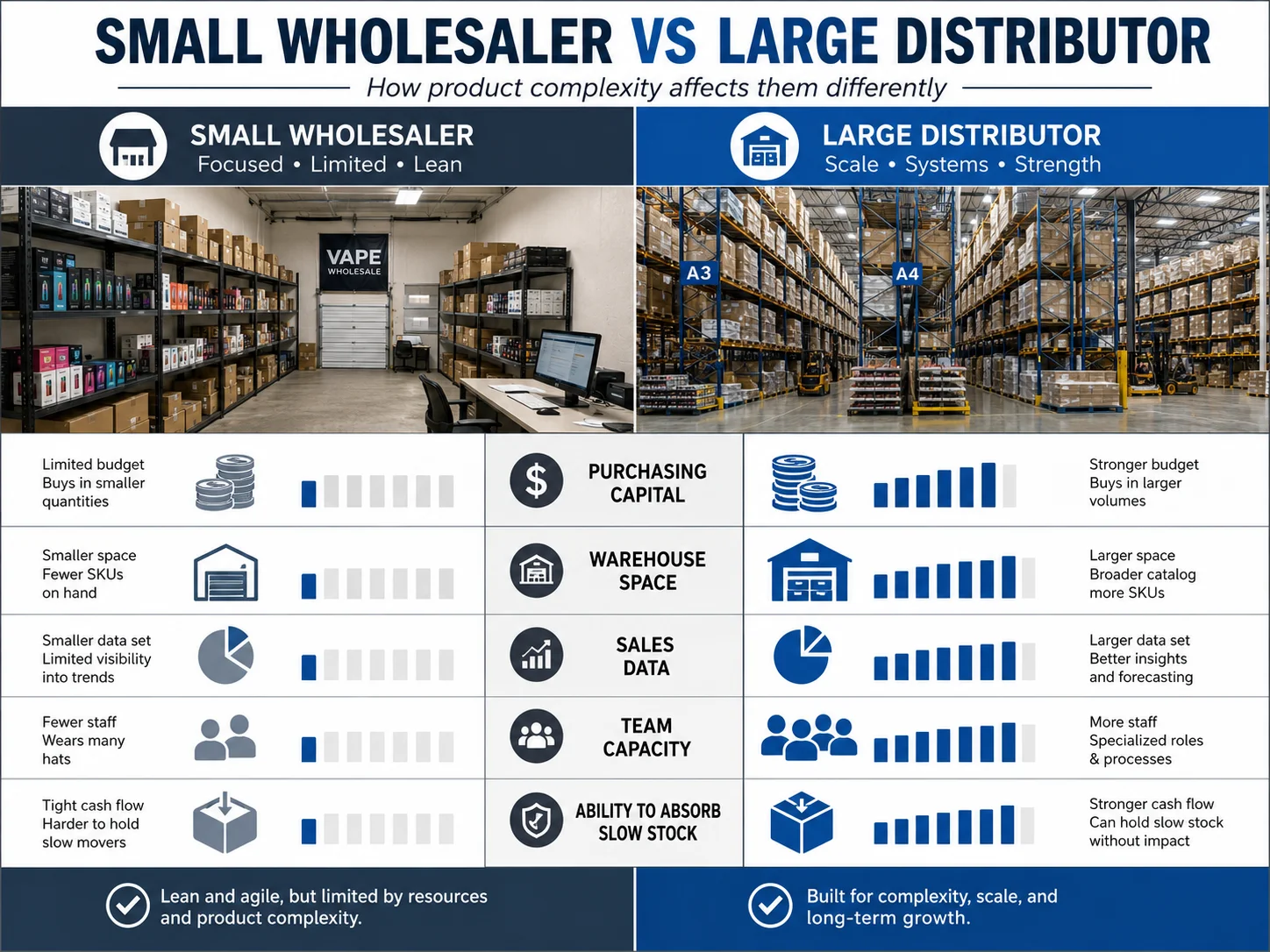
The comparison is not about saying that one business model is better. It is about matching product variety to operational capacity.
| Complexity Factor | Small Vape Wholesaler | Large Distributor | Main Business Impact |
|---|---|---|---|
| Purchasing capital | Usually more limited | Usually larger and more diversified | Slow stock can affect core replenishment |
| Warehouse capacity | Often limited | More storage and systems | Overstock becomes visible quickly |
| SKU count | Needs tighter control | Can support a broader range | More SKUs increase planning work |
| Replenishment speed | May rely on fewer orders | Can place frequent, larger orders | Stockouts and overstock become harder to balance |
| Sales data | Often based on customer feedback | More account and category data | Product decisions may be less precise |
| Slow-stock tolerance | Lower | Often higher | Discounting can damage margin faster |
| After-sales resources | Owner or small team handles issues | Dedicated departments may exist | Service workload can interrupt selling |
Capacity is what makes variety safe
Large distributors do not only have more products. They often have more mechanisms to manage those products. They can split inventory across regions, negotiate deeper purchasing terms, use detailed sales reports, and assign staff to specific categories.
For a small vape wholesaler inventory plan, a narrower but reliable range can be stronger than a large but confusing catalog. Retail customers often value immediate availability, clear recommendations, and dependable replenishment more than an endless list of options.
Why Does Product Complexity Put More Pressure on Cash Flow?
Cash flow pressure is one of the clearest ways how product complexity affects small vape wholesalers. When a buyer spreads a limited budget across too many models and flavours, the business may look well stocked while lacking enough cash to reorder the products that actually sell.
Too many vape SKUs pressure cash flow because each SKU requires a minimum purchase quantity, shipping allocation, storage space, and reorder decision.[^6] If sales are spread too thinly, money remains locked in slow products instead of supporting fast-moving core items, operating expenses, or carefully selected new-product tests.
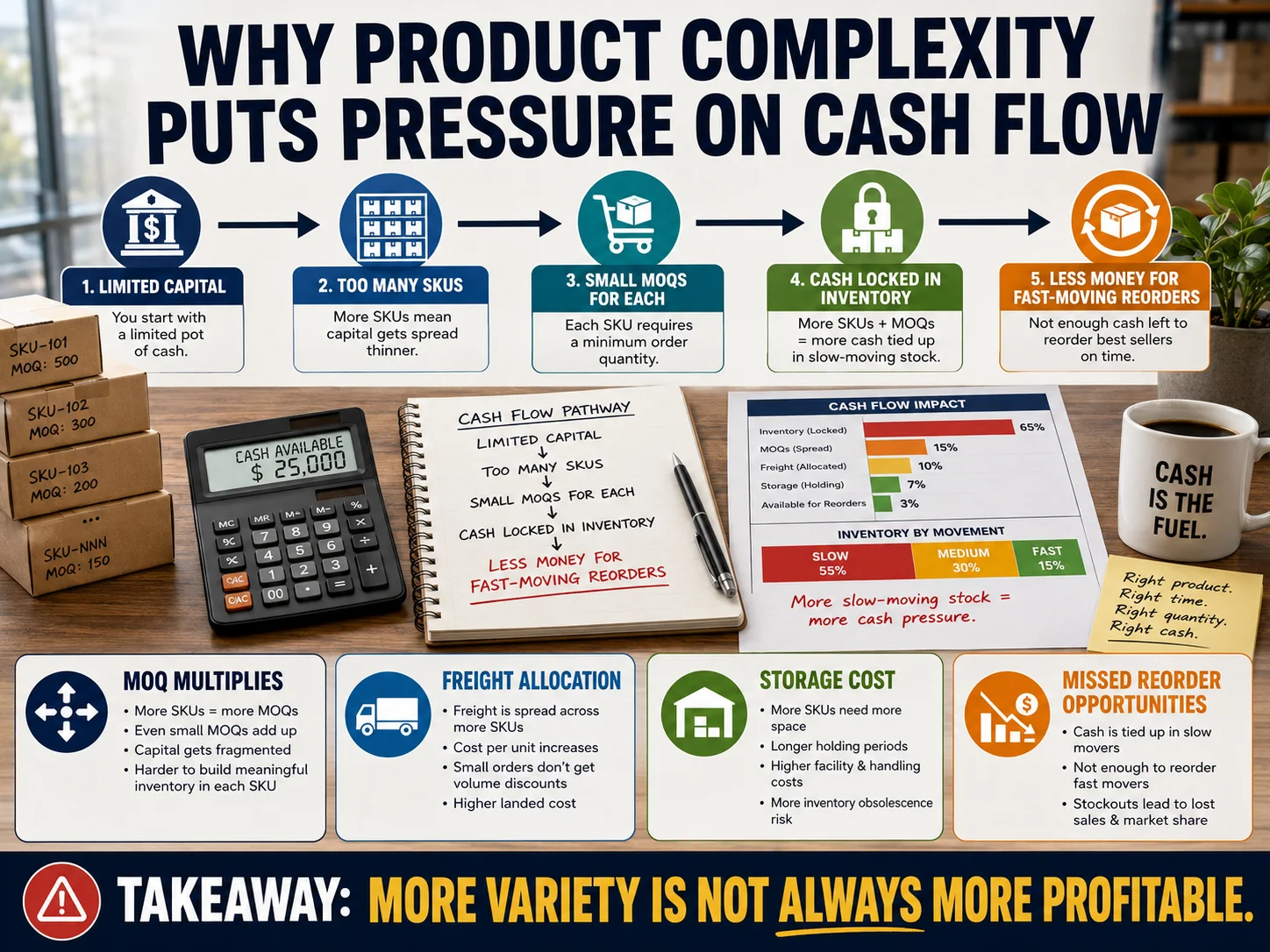
A common mistake is to view inventory as an asset without considering how quickly it can convert back into cash. Inventory only helps when it sells at a healthy margin and within a reasonable time.
A simple cash-flow example
Imagine a wholesaler has a fixed purchasing budget. The business can either buy:
- A focused selection of proven items with deeper quantity; or
- A broad range of many new and similar items with shallow quantity.
The broad order may feel safer because it offers “more choice.” However, if only a few items move, the buyer may need to place another order for those winners while still holding cash in the slow lines. That creates a double burden: the warehouse is full, but the best sellers are understocked.
I suggest separating purchasing money into practical buckets:
- Core replenishment budget: Products with repeat demand.
- Controlled test budget: Limited quantities for emerging products.
- Seasonal or channel-specific budget: Products for confirmed opportunities.
- Cash reserve: Freight, unexpected demand, and normal operating needs.
This approach does not eliminate risk. It makes risk visible before the order is placed. It also helps a buyer avoid sacrificing proven replenishment because too much cash has been used on untested variety.
How Does Product Complexity Create Slow-Moving Vape Inventory?
Slow-moving stock rarely happens for only one reason. Product quality can be a factor, but it is not the only factor. Product fit, duplicated flavours, unclear pricing, unsuitable channels, and weak sales explanation can all create inventory that stays too long on the shelf.
Vape product complexity creates slow-moving inventory when a wholesaler carries too many similar devices, overlapping flavours, unclear price levels, or untested trend products. Sales become fragmented across many SKUs, making it harder to identify winners, reorder confidently, and clear weak products without reducing margin.[^7]
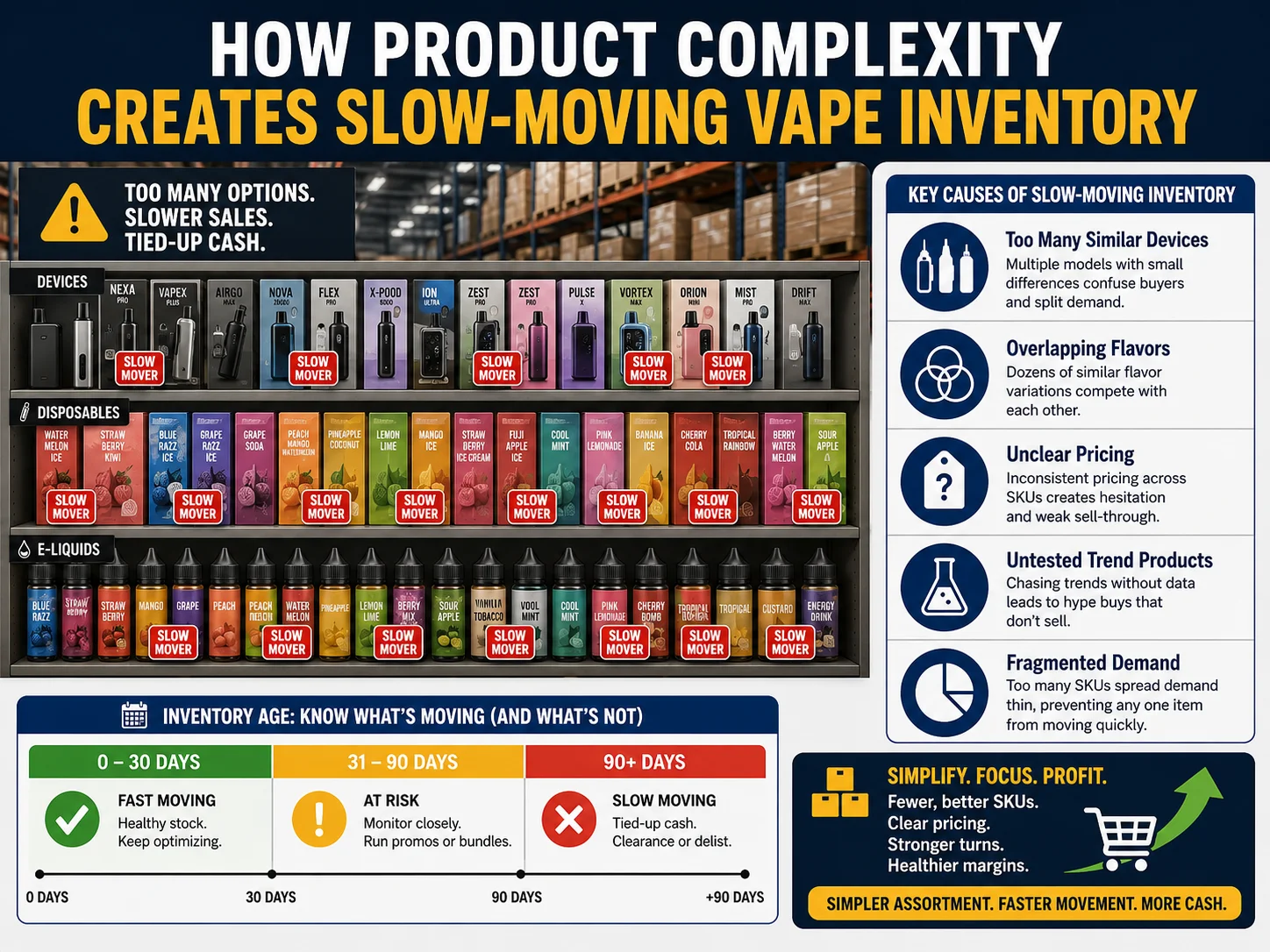
Small teams often find this problem after the products have already arrived. At that point, the issue is no longer just selection. It is storage, discounting, customer communication, and the opportunity cost of missing better-selling items.
Why products become slow movers
These are the most common patterns I see in vape SKU management discussions:
- Too many similar flavours: Several mango, berry, icy, or mixed-fruit versions may compete with each other.
- Overlapping device specifications: Buyers cannot easily explain why one similar device costs more.
- Confused price positioning: A mid-range product sits too close in price to a premium product without a clear advantage.
- Wrong sales channel: A product intended for specialist vape shops is offered mainly to convenience stores.
- Trend chasing without a test plan: A buyer orders a full range before confirming local demand.
- No exit rule: Weak SKUs remain in the catalog because nobody decides when to stop reordering them.
A useful question is: Would my customer immediately understand who this product is for? If the answer is unclear, the product may create unnecessary complexity.
For small businesses, one strong product in each price or use category can often do more work than five nearly identical options. The right level of variety gives retail customers choice without making the buyer’s own warehouse difficult to manage.
How Do Sales Channels Change the Right Level of Product Variety?
A product range should reflect where products will be sold. A vape shop, smoke shop, gas station, convenience store, online retailer, and regional wholesaler do not need the same SKU depth. Many inventory problems begin when a wholesaler builds a catalog without defining the sales channel first.
How product complexity affects small vape wholesalers also depends on their sales channels. Specialist vape shops may support more device and flavour variety, while convenience stores and gas stations often need simpler, recognizable, fast-turning selections.[^8] The best range is the one that fits how customers actually buy.
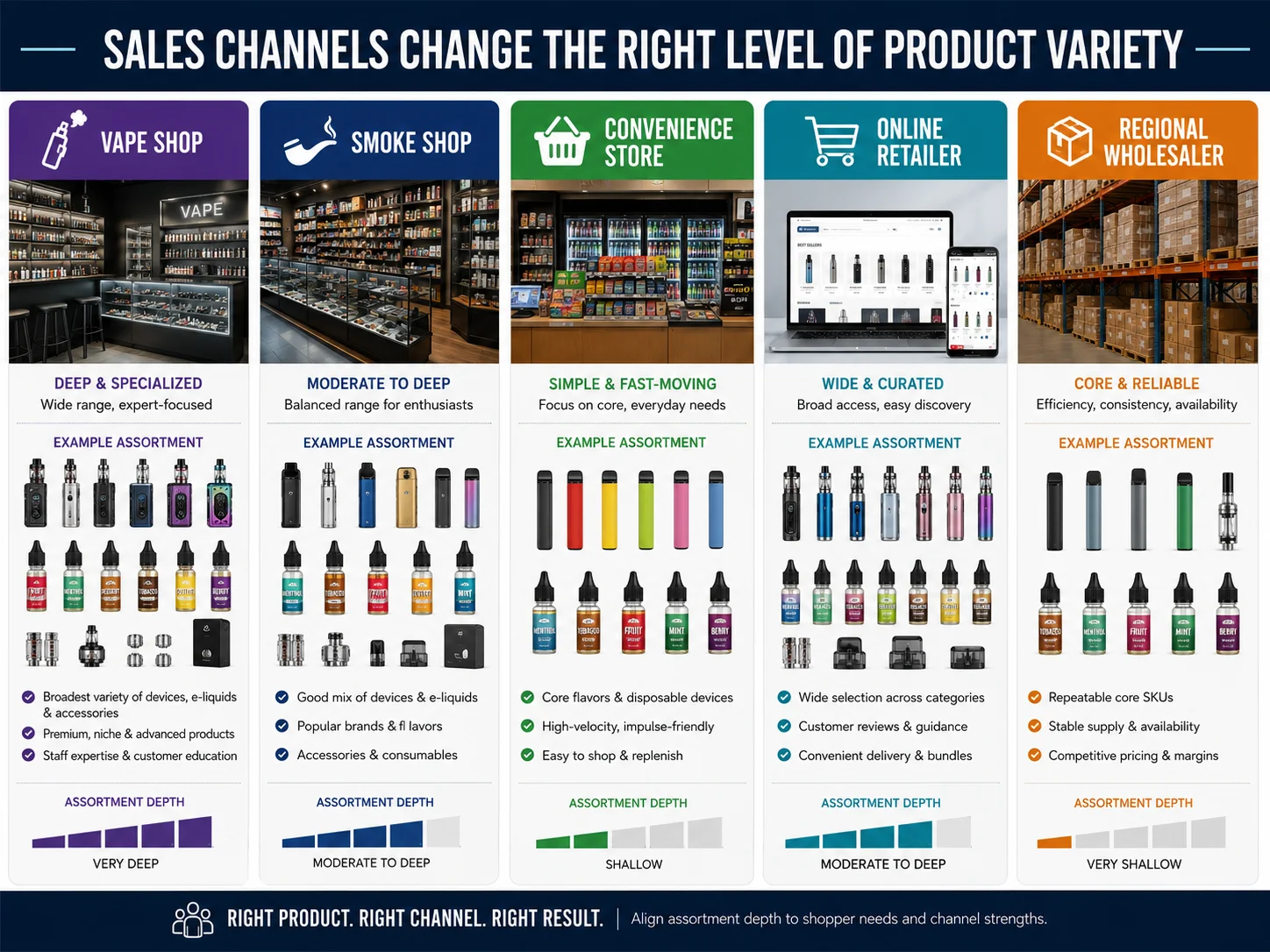
A channel-first approach helps a buyer avoid carrying products simply because they are available.
Match assortment depth to customer behavior
| Sales channel | Typical assortment need | Practical focus |
|---|---|---|
| Vape shops | Wider product knowledge and variety | Clear device differences, accessories, refill needs |
| Smoke shops | Balanced vape and smoking-accessory mix | Fast movers plus a limited specialist range |
| Convenience stores | Simple, low-maintenance selection | Familiar products and easy choices |
| Gas stations | Fast decisions and limited shelf space | Compact, proven, quick-turning items |
| Online retailers | Search-driven variety | Accurate listings and dependable stock data |
| Regional wholesalers | Broader but controlled range | Reliable replenishment and margin structure |
For example, a local wholesaler supplying tourist-area convenience stores may benefit from a small number of easy-to-understand fast movers. A specialist vape retailer may need more flavour and device choices because its staff can explain them to consumers.
I recommend that buyers ask their retail customers direct questions before expanding:
“Which three products do customers ask for most often?”
“Which price point sells fastest?”
“Which products cause the most returns or questions?”
“What do you wish you could reorder more easily?”
These answers are often more valuable than a large supplier catalog.
Which Products Should Small Vape Wholesalers Prioritize?
Small wholesalers do not need to ignore new opportunities. They need a selection standard. A product deserves a place in the core range when it has clear demand, a clear customer, a workable margin, dependable supply, and manageable after-sales requirements.[^9]
Small vape wholesalers should prioritize products with stable demand, clear product differences, sensible margins, reliable supply, low avoidable after-sales workload, and easy repeat replenishment. A practical vape product range strategy combines proven core SKUs with a smaller, controlled group of test products.
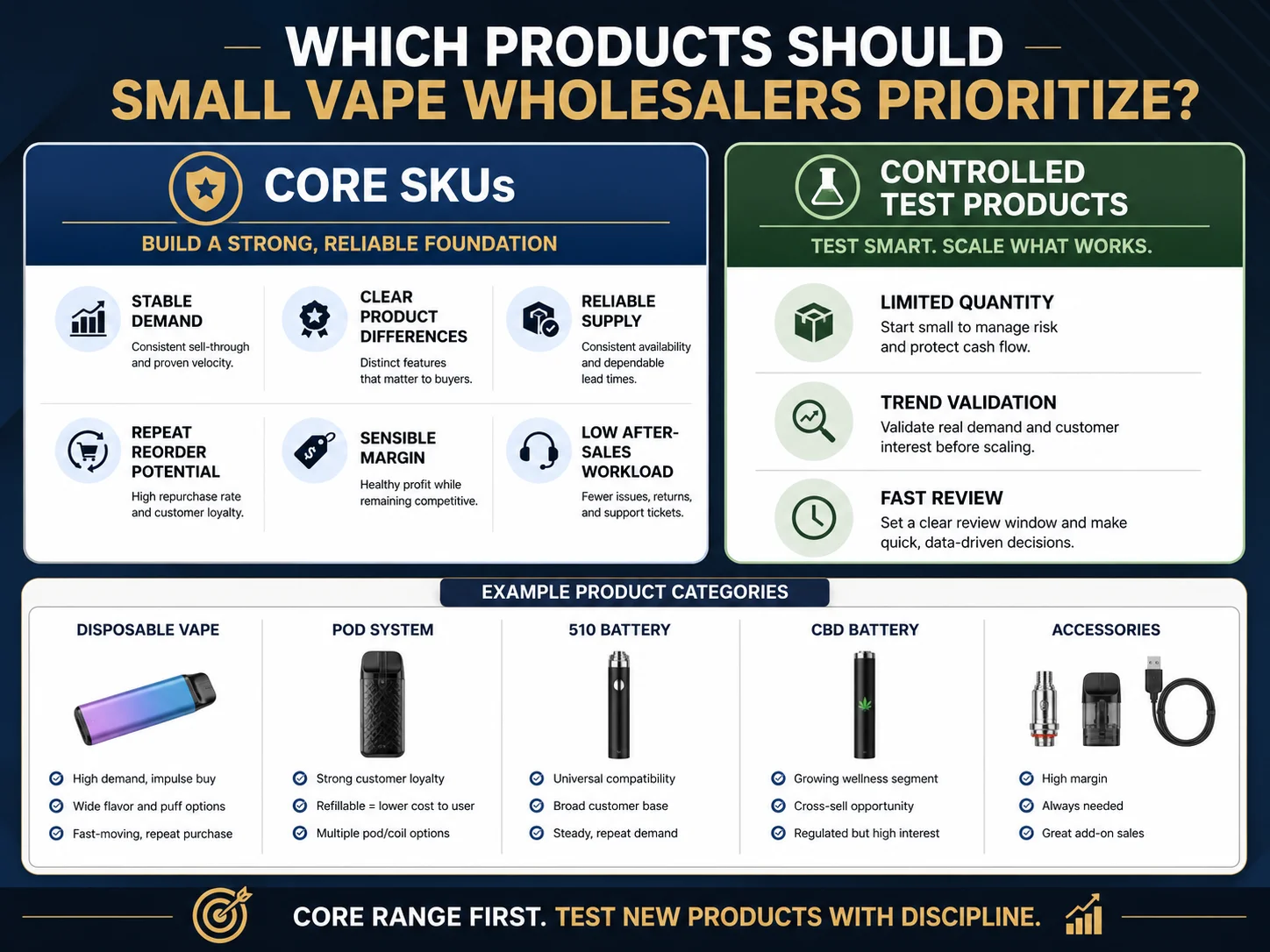
This approach gives a business room to react to trends without turning every trend into a large inventory commitment.
Build a core range before expanding
A manageable assortment often includes:
- Reliable entry-level products for price-sensitive retail channels.
- A mid-range fast-moving option with clear value and repeat demand.
- Selected premium or differentiated products for customers who want more features.
- Essential accessories and compatible items that support repeat sales.
- A limited test group for new formats, brands, or flavours.
The key is not the exact number of SKUs. The key is whether each SKU has a job. If two products serve the same customer at the same price and with no clear difference, the buyer may only need one of them.
At KingVape, I can help buyers consolidate product sourcing and after-sales communication across categories when that reduces coordination work. I present this as an operational option, not as a reason to buy unnecessary products. A one-stop supplier arrangement only creates value when it helps the buyer maintain a more workable stock plan.
What Mistakes Do Wholesalers Make When Expanding a Vape Product Range?
Expanding a range can increase sales when the buyer has a clear reason. However, many small wholesalers expand because they fear missing a trend or because a large catalog looks more competitive. Those reasons alone can create costly inventory decisions.
Common vape wholesale product selection mistakes include introducing too many models at once, copying large distributor catalogs, buying only on product hype, ignoring the actual sales channel, and expanding without test orders or SKU removal rules.[^10] These mistakes increase inventory risk without guaranteeing stronger demand.
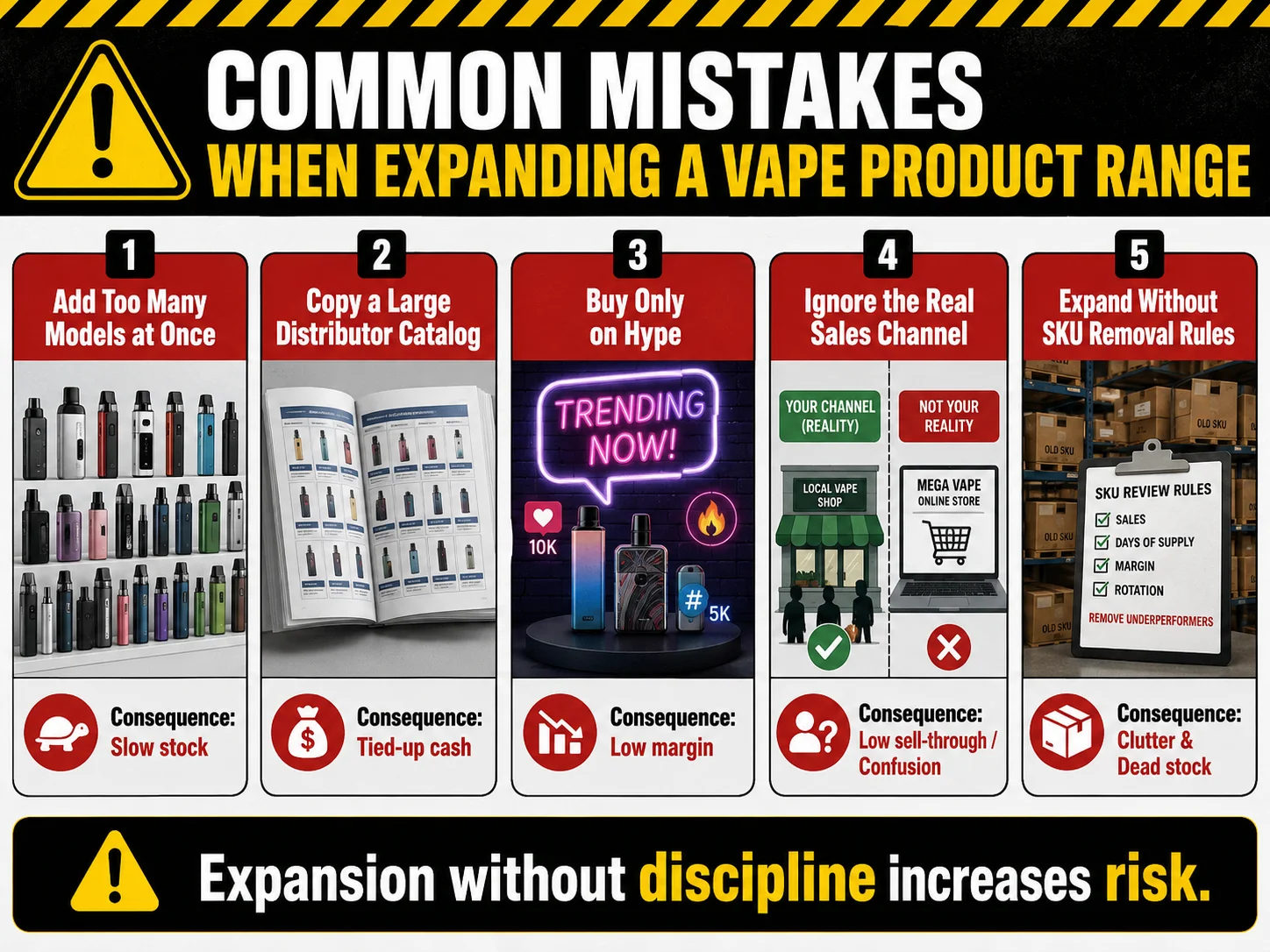
The good news is that most of these mistakes can be reduced through a basic purchasing process.
Five mistakes to avoid
- Ordering every flavour at launch: Start with flavours that match known local demand.
- Treating a large catalog as a competitive advantage: A catalog only helps if products are available, understood, and supported.
- Buying only at the lowest unit price: Consider support cost, shipping, customer questions, and replacement handling.
- Ignoring product education: Retail customers need clear product information to sell confidently.
- Keeping every weak SKU forever: Set a review date and decide whether to reorder, reduce, bundle, or discontinue.
I have had many conversations where buyers were frustrated with “product problems,” but the root cause was broader. Sometimes the product was unsuitable for the channel. Sometimes staff had not received a clear explanation. Sometimes the supplier chain made after-sales responsibility difficult to identify.
A disciplined range review protects customer trust. It also lets the wholesaler spend more time selling and less time trying to rescue poor inventory decisions.
How Can Small Wholesalers Build a Simpler Vape Stock Strategy?
A simpler strategy does not mean a weak strategy. It means the product range is intentional. The buyer knows which products drive repeat orders, which products are being tested, and which products should be removed if they do not perform.
How product complexity affects small vape wholesalers can be controlled through a structured stock strategy: confirm the sales channel, choose core price bands, limit core SKUs, test new products in smaller quantities, track stock rotation, and expand only after demand is confirmed. This creates manageable complexity instead of uncontrolled variety.
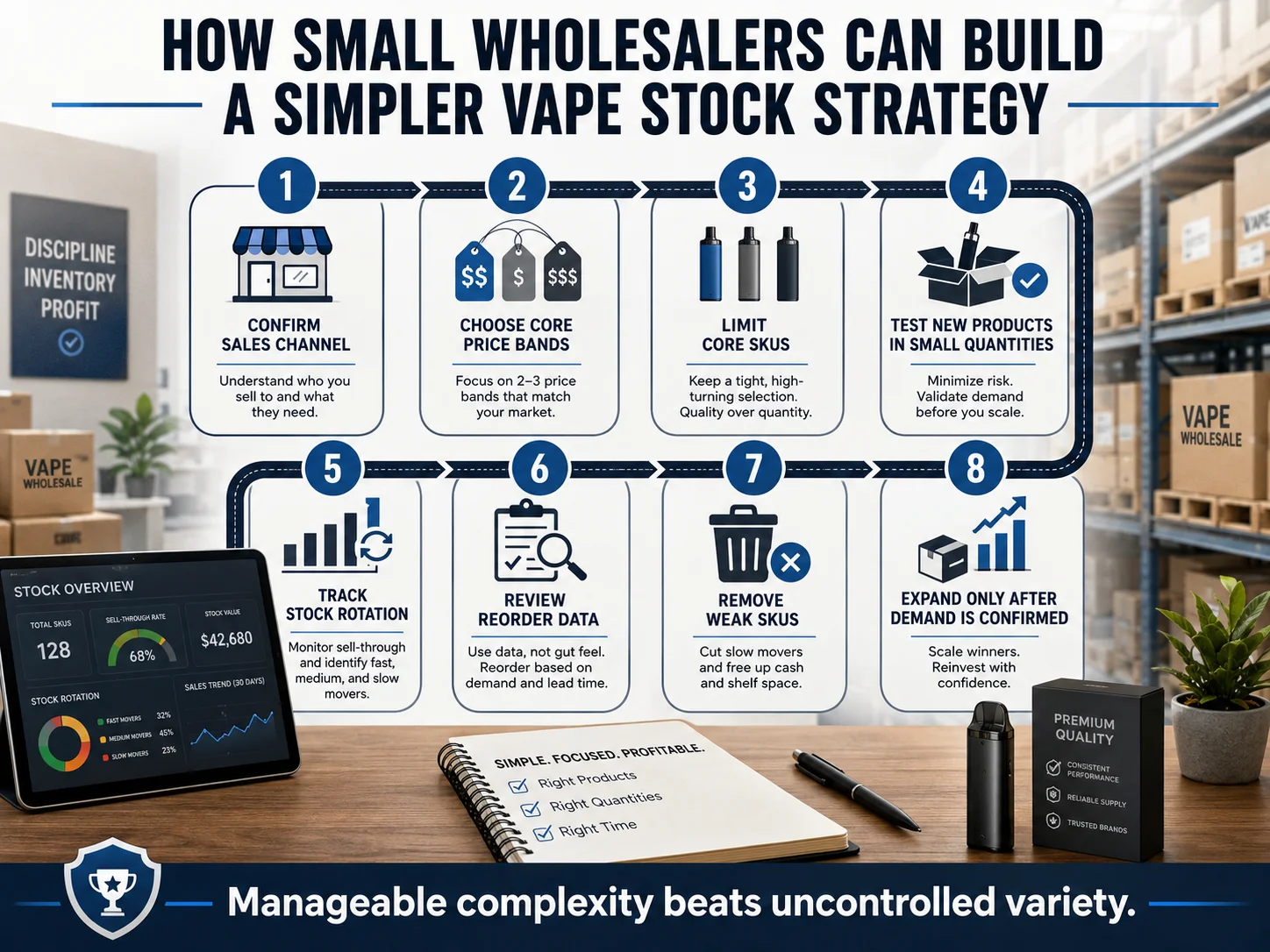
This process works for small importers, local wholesalers, smoke-shop suppliers, and growing distributors. The quantities will vary, but the logic remains the same.
A practical six-step process
-
Confirm your buyer and channel.
Identify whether you supply vape shops, smoke shops, convenience stores, gas stations, online customers, or other wholesalers. -
Choose your core price bands.
Avoid placing too many similar products in the same price area unless the difference is obvious. -
Limit your core SKU list.
Build around products that your team can explain, replenish, and support consistently. -
Use smaller test orders for uncertain demand.
Test products before committing deeply. In Europe, suitable customers may use available overseas-warehouse stock for faster, lower-MOQ testing where applicable. -
Track rotation, not just sales.[^11]
Measure how quickly each SKU sells and how much cash it holds. A product with occasional sales may still be too slow for repeat purchasing. -
Expand gradually and remove weak lines.
Add products based on proven channel demand. Reduce or stop products that do not meet the business’s agreed standards.
For medium and larger importers, direct bulk purchasing from China may provide stronger price advantages and OEM/ODM options when quantities and project conditions fit. For smaller buyers, lower-MOQ stock and faster European delivery can reduce upfront pressure[^12]. The best option depends on the buyer’s market, order size, timing, and ability to manage inventory.
How Can You Explore Vape Wholesale Categories for Your Market?
Choosing products should not begin with a supplier’s longest list. It should begin with your market reality. Your customer type, local price point, sales channel, expected order quantity, and delivery timeline should guide the assortment.
A practical vape wholesale category plan starts with market information: buyer type, sales channel, target price range, preferred product categories, and estimated order quantity. This information helps reduce unnecessary product complexity and supports a vape inventory strategy that fits the wholesaler’s real operating capacity.
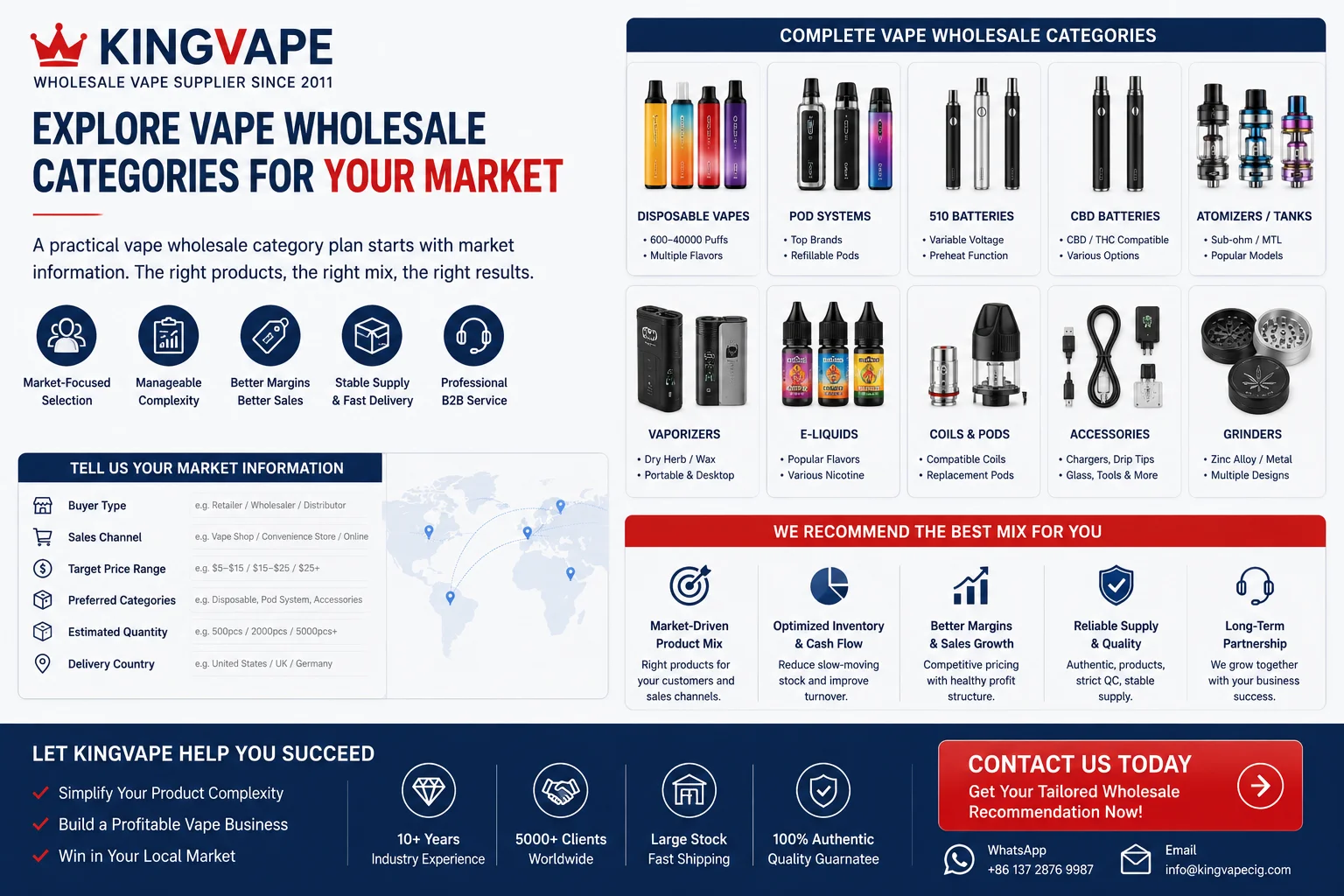
I work from Shenzhen, where I can coordinate factory resources, multi-brand categories, accessories, and logistics options. I also understand that a good product list is not automatically a good business plan.
Start with the information that matters
When you contact KingVape, send me:
- Your country or target market
- Your buyer type and main sales channel
- Your target retail or wholesale price range
- The vape categories you want to test or replenish
- Your estimated order quantity
- Whether you need China shipment, delivery to your freight forwarder, or available European warehouse options
I can then help you review which products are likely to create unnecessary overlap and which categories may deserve priority. For qualified European small and mid-sized customers, our overseas warehouse options can support faster delivery and lower starting quantities on selected available products. For larger importers and distributors, I can also discuss direct China supply, competitive volume purchasing, and OEM/ODM development based on project requirements.
Frequently Asked Questions
Is a larger vape product range always better for wholesalers?
No. A larger range is useful only when the wholesaler has the cash flow, storage, sales data, and team capacity to manage it. For small teams, a focused mix of proven products and controlled test items often creates stronger stock rotation and easier replenishment.
How many vape SKUs should a small wholesaler carry?
There is no universal number. The right quantity depends on the sales channel, budget, storage space, and customer demand. I recommend choosing a manageable core range first, then adding new items only when the business can explain, stock, and support them properly.
Why can a cheap vape product become expensive to sell?
The invoice price is only one part of the cost. A cheap product may create extra expense through slow sales, customer questions, defects, unclear supplier responsibility, discounts, and time spent coordinating after-sales. A workable product fit can be more valuable than the lowest unit price.
Should small wholesalers avoid trendy vape products?
No. Trend products can create opportunities and attract new customers. However, small wholesalers should test trends with controlled quantities, confirm channel demand, and set clear reorder rules. A trend should complement the core range rather than consume the full purchasing budget.
Can one supplier help reduce vape SKU management workload?
A consolidated supplier can reduce the time spent coordinating multiple orders, brands, shipping arrangements, and after-sales contacts. However, the product range still needs discipline. Supplier consolidation works best when it supports a clear inventory plan instead of encouraging unnecessary purchases.
Conclusion
How product complexity affects small vape wholesalers is not simply a question of carrying fewer products. It is about carrying products that your team can sell, replenish, explain, and support without damaging cash flow or customer trust. Large distributors can often absorb more complexity because they have more capital, data, staff, and systems. Small wholesalers can compete by building a practical, channel-focused range with strong core SKUs and carefully managed tests. Contact KingVape with your market and purchasing plan, and I will help you create a more workable wholesale stock strategy.
Source Vape Products for Wholesale
We support B2B wholesale and distribution sourcing for vape retailers and importers, with compliance-aware supplier vetting. Contact our wholesale team to discuss bulk and distribution options.
Related reading: How to Translate Product Labels and Manuals Before Production
[^1]: "Understanding the Dynamics of Value-Driven Variety ...", https://sloanreview.mit.edu/article/understanding-the-dynamics-of-valuedriven-variety-management/. Operations-management research finds that product-variety expansion can increase forecasting, inventory, handling, and coordination burdens because each additional variant requires separate planning and control. Evidence role: mechanism; source type: research. Supports: Research on product variety and SKU proliferation should document how additional variants increase forecasting, inventory, handling, and operational coordination requirements.. Scope note: Such research generally addresses retail or manufacturing assortments rather than vape wholesale specifically. [^2]: "Development of an Assortment-Planning Model for", https://vtechworks.lib.vt.edu/bitstreams/020a17b3-782d-483e-98c5-ced810db5efd/download. Assortment-planning literature supports concentrating replenishment on established demand while using limited commitments to evaluate uncertain items, thereby reducing inventory exposure under demand uncertainty. Evidence role: general_support; source type: paper. Supports: Research should support the use of assortment planning and controlled testing to limit exposure to uncertain demand while maintaining availability of established products.. Scope note: The literature supports the inventory principle, not a universal SKU mix or a vape-specific assortment. [^3]: "Stock keeping unit", https://en.wikipedia.org/wiki/Stock_keeping_unit. A stock-keeping unit is a distinct inventory-tracked item; differences such as product configuration, packaging, or specification can therefore create separate SKU-level planning decisions. Evidence role: definition; source type: encyclopedia. Supports: An authoritative reference should establish that distinct product attributes and variants are tracked as separate stock-keeping units.. Scope note: This definition explains why variants create separate records but does not quantify the number of SKUs in a particular vape range. [^4]: "Recent trends in SME and entrepreneurship finance", https://www.oecd.org/en/publications/financing-smes-and-entrepreneurs-2026_075d8058-en/full-report/recent-trends-in-sme-and-entrepreneurship-finance_95d4725c.html. OECD and World Bank analyses report that small and medium-sized enterprises commonly face tighter financing and managerial-capacity constraints than larger firms, making working-capital disruptions more consequential. Evidence role: general_support; source type: institution. Supports: International SME evidence should show that small firms commonly face tighter financing and managerial-resource constraints than larger firms.. Scope note: These sources address SMEs across sectors and do not directly measure vape wholesalers' tolerance for slow stock. [^5]: "Global Sourcing, Domestic Distribution, and Scale Economies", https://tuck.dartmouth.edu/uploads/content/Ganapati_Wholesalers_2016_copy.pdf. Research on economies of scale in distribution indicates that larger purchasing volumes and specialized functions can spread procurement, inventory-control, and service costs across more transactions. Evidence role: mechanism; source type: paper. Supports: Research should support the proposition that scale and specialization can reduce per-unit coordination and procurement costs in distribution.. Scope note: Scale advantages vary with logistics networks, supplier terms, and product characteristics; they do not guarantee that every large distributor manages variety efficiently. [^6]: "Cash flow management and its effect on firm performance - PMC", https://pmc.ncbi.nlm.nih.gov/articles/PMC10281586/. Inventory-management guidance explains that stock ties up working capital and generates carrying costs, including storage, handling, insurance, and obsolescence risk, until it is sold. Evidence role: mechanism; source type: education. Supports: Supply-chain teaching or research should explain that inventory ties up working capital and creates carrying costs such as storage, handling, and obsolescence risk.. Scope note: The source would establish the general financial mechanism rather than the minimum-order terms of any specific vape supplier. [^7]: "RETAIL DEMAND MANAGEMENT: FORECASTING , ASSORTMENT ...", https://repository.upenn.edu/bitstreams/6be55fef-a8dd-470b-bd83-a89db025b9fc/download. Inventory and assortment research shows that demand distributed across many low-volume items can complicate forecasting and replenishment, increasing the risk of residual stock that may require markdowns. Evidence role: mechanism; source type: paper. Supports: Assortment and inventory research should document that fragmented demand across many items complicates forecasting and raises the risk of excess inventory and markdowns.. Scope note: The magnitude of the effect depends on demand data quality, replenishment lead times, and the ability to transfer or bundle stock. [^8]: "The evolving role of hit and niche products in brick-and-mortar ...", https://pmc.ncbi.nlm.nih.gov/articles/PMC7387359/. Retail-format research indicates that convenience-oriented outlets typically operate with constrained space and quick-purchase missions, whereas specialty retailers can sustain deeper assortments and more product explanation. Evidence role: general_support; source type: research. Supports: Retail-format research should compare how limited shelf space, shopping missions, and staff expertise influence assortment breadth and turnover requirements.. Scope note: This evidence concerns retail formats in general and does not establish that every vape, smoke, or gas-station outlet follows the same assortment pattern. [^9]: "Assortment Planning: Review of Literature and Industry Practice⇤", https://mysite.ku.edu.tr/gkok/wp-content/uploads/sites/31/2023/07/AP_chapter_2014.pdf. Assortment-planning frameworks evaluate items using expected demand, customer relevance, profitability, and availability or supply considerations rather than unit cost alone. Evidence role: general_support; source type: education. Supports: Retail and supply-chain materials should support evaluating product demand, profitability, availability, and customer fit when designing an assortment.. Scope note: After-sales workload may require a separate internal measure because it is not included in every standard assortment framework. [^10]: "SKU Rationalization: Streamlining Your Product Portfolio", https://www.finaleinventory.com/guides/sku-rationalization/. Retail assortment research supports limited new-product tests and periodic SKU rationalization as methods for managing uncertain demand and reducing persistent low-performing inventory. Evidence role: general_support; source type: paper. Supports: Research should support using new-product tests and periodic SKU rationalization to manage uncertain demand and remove persistently weak items.. Scope note: The source supports these management practices generally and cannot determine whether a specific vape product should be discontinued. [^11]: "7(a) Working Capital Pilot program", https://www.sba.gov/partners/lenders/7a-loan-program/7a-working-capital-pilot-program. Inventory turnover measures how often inventory is sold and replaced during a period and is commonly used to assess stock movement and the capital committed to inventory. Evidence role: definition; source type: education. Supports: An accounting or operations source should define inventory turnover and explain its use in evaluating how rapidly inventory is sold and replaced.. Scope note: A high turnover ratio is not automatically desirable if it is caused by stockouts or insufficient service levels. [^12]: "Understanding safety stock and mastering its equations", https://web.mit.edu/2.810/www/files/readings/King_SafetyStock.pdf. Inventory theory links order quantities and replenishment lead times to inventory investment and safety-stock requirements; smaller commitments and shorter lead times can reduce capital tied up in stock. Evidence role: mechanism; source type: research. Supports: Inventory research should show that order quantities and replenishment lead times affect inventory commitments, safety stock, and working-capital requirements.. Scope note: The actual benefit depends on unit prices, freight, demand variability, service targets, and the availability of the stated warehouse stock.