
What makes a vape product line easier to sell is a common question for importers, regional wholesalers, vape shops, smoke shops, and convenience-store suppliers. The problem is that a product can look popular online but still move slowly in your local channel. That creates tied-up cash, confusing sales conversations, and difficult replenishment decisions. I believe the solution is to build a product line around clear channel roles, price levels, and repeatable buying reasons.
A vape product line is easier to sell when every SKU has a clear purpose: it fits a specific buyer, price band, sales channel, and replenishment need. Instead of relying on one “hot” product, wholesalers should combine a focused core range, understandable product differences, stable supply, practical margins, and suitable local specifications. This structure helps retailers explain products, customers choose faster, and buyers replenish with more confidence.
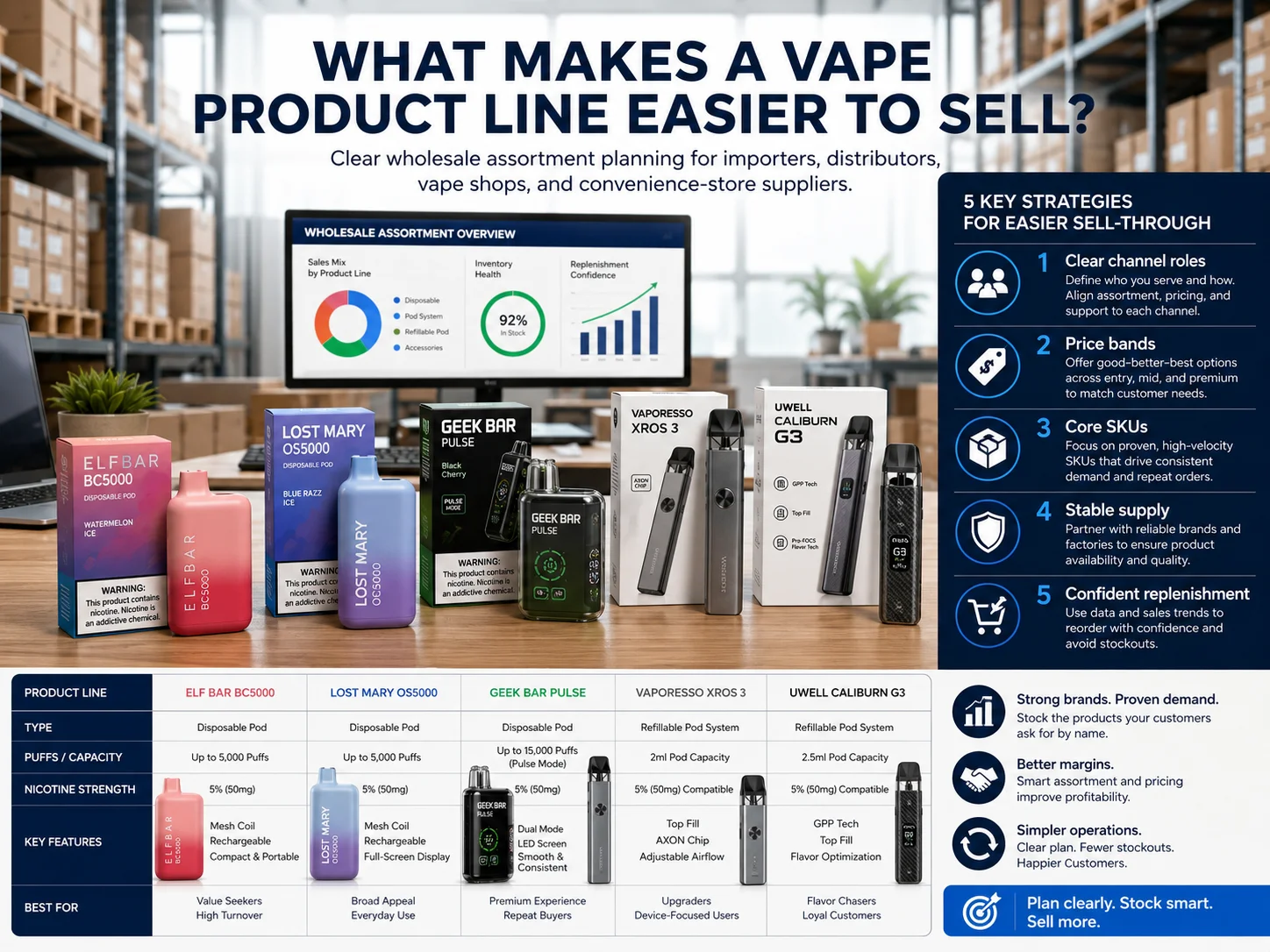
I work with buyers who supply very different downstream customers, from small vape shops and smoke shops to cash-and-carry wholesalers, convenience stores, and multi-store retail networks. I often see the same issue: buyers ask for the newest product first, but the more important question is whether that product has a clear role in their own sales channel.
Quick Answer: What Makes a Vape Product Line Easier to Sell?
Many wholesalers struggle because they buy a long list of products without deciding where each item will be sold. That approach may look like a complete assortment, but it can create duplicate flavors, unclear pricing, slow-moving stock, and too many after-sales questions.
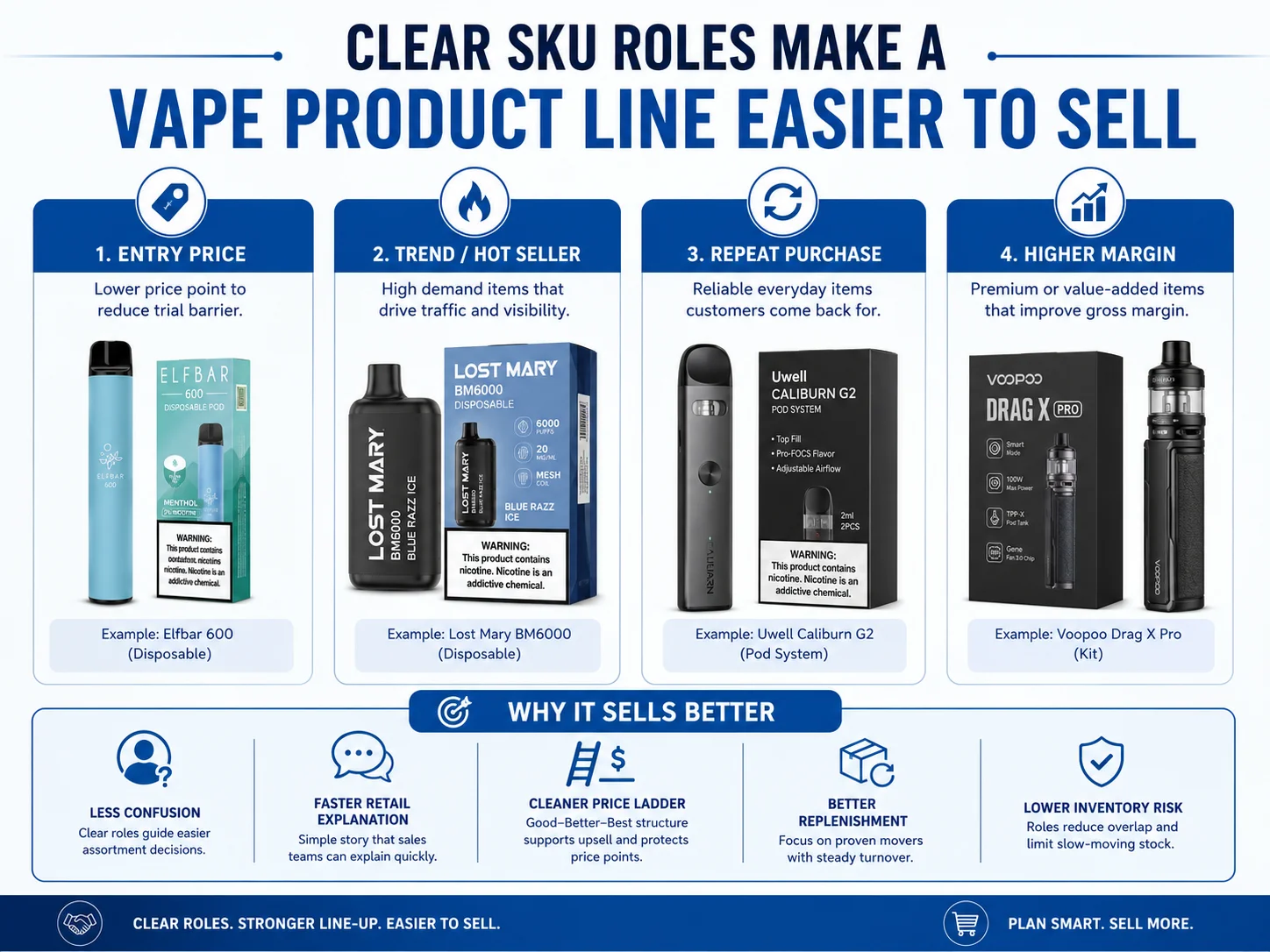
What makes a vape product line easier to sell is clear channel fit. The range should include a limited number of core SKUs, logical retail price levels, easy-to-understand product differences, reliable replenishment options, and products that match the needs of the intended retailer. Every item should serve a job, such as entry-price sales, trend demand, repeat purchases, or higher-margin positioning.
Think in SKU Jobs, Not Just Product Names
In my experience, a product line becomes easier to manage when a buyer can explain each product in one sentence. For example:
- “This is our entry-price disposable option.”
- “This is the higher-capacity option for vape-shop customers.”
- “This is a familiar, easy-to-explain device for convenience stores.”
- “This is our trend-led item for customers who want something newer.”
- “This category supports repeat purchases and accessory sales.”
A wholesale product line should work like an operating system, not a random product list. Each SKU should help the buyer make a practical decision about stock, sales training, retail placement, and replenishment.
I do not believe there is one universal bestseller for every country or channel. A device that works well in a specialist vape shop may require too much explanation for a convenience-store counter. A low-cost product that suits a fast-moving retail environment may not create enough differentiation for a premium smoke shop.
The strongest vape product line strategy starts with the downstream customer, not with the factory catalog.
Before you order, I recommend asking:
- Who will buy this product from my customer?
- Where will the retailer display it?
- What retail price can the local market reasonably accept?
- Does the product need staff explanation?
- Can the retailer reorder it easily if it starts moving?
- Does this SKU overlap too much with another item in the range?
What Makes a Vape Product Line Easy to Sell in Real Wholesale Markets?
A broad range can feel safer, especially when you want to offer customers more choices. However, too many similar products can make the buyer’s job harder[^1]. Retailers may not understand why one device costs more than another, and consumers may not see enough difference to choose confidently.
What makes a vape product line easier to sell in wholesale markets is a balance between variety and clarity. Buyers need enough choices to cover different budgets and customer types, but not so many overlapping devices, flavors, and specifications that inventory becomes difficult to explain, rotate, and replenish.
The Six Factors I See Most Often
When I speak with importers and wholesalers, I usually see six factors affecting whether a range is workable.
| Factor | Why It Matters to the Buyer | Practical Question |
|---|---|---|
| Customer fit | Different stores serve different shoppers | Who is the final user? |
| Price structure | Retailers need clear price steps | What is the entry, mid, and premium level? |
| Product recognition | Familiar products are easier to explain | Can staff describe it quickly? |
| Flavor structure | Too much duplication slows decisions | Are the flavors clearly differentiated? |
| Supply stability | Reorders matter after the first order | Can the range be replenished consistently? |
| After-sales workload | Product issues can harm retailer trust | Who handles the support process? |
A Product Line Needs Both Demand and Structure
A trend can bring attention, but attention alone does not create a sustainable assortment. A buyer may see a product gaining traction in one market and assume it will work everywhere. In reality, channel behavior, local competition, pricing, packaging expectations, and regulations may differ. These points should always be verified in the destination market before an order is placed.
I suggest separating products into three working groups:
- Core products: Stable, easy-to-understand items that support normal replenishment.
- Opportunity products: Newer products that may create interest but need controlled purchasing.
- Support products: Accessories, batteries, atomizers, glass pipes, grinders, or related categories that help retailers build a fuller basket.
This method reduces the risk of putting too much capital into one short-term trend. It also gives your sales team a simpler story when they visit shops or send product lists to customers.
What Makes a Vape Product Line Easier to Sell Across Sales Channels?
A vape shop, convenience store, online retailer, and regional wholesaler do not sell for the same reason.[^2] Each channel has different staff knowledge, display space, customer expectations, buying patterns, and acceptable complexity. A product line should reflect those differences.
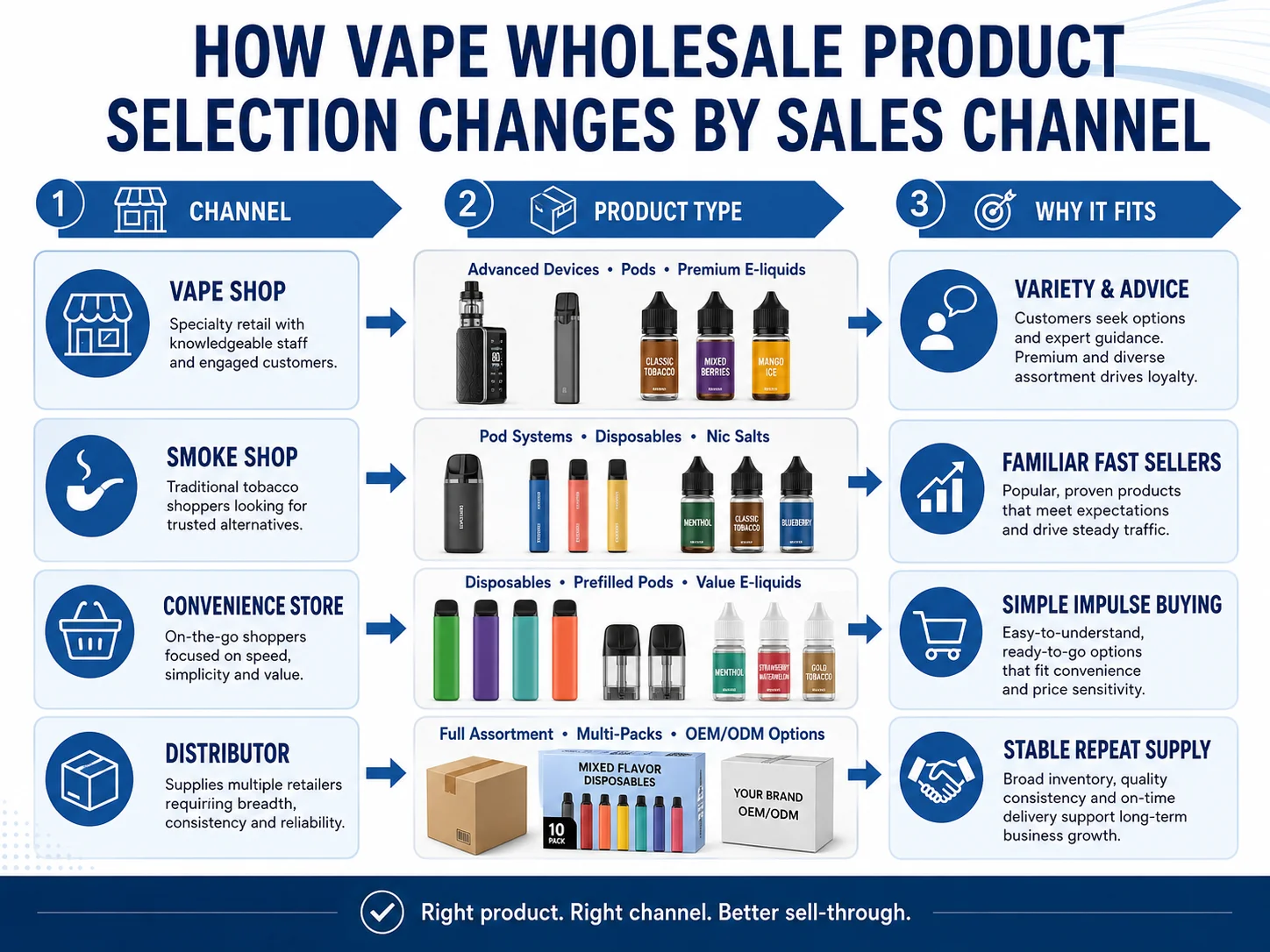
What makes a vape product line easier to sell across channels is assigning suitable products to suitable retail environments. Vape shops may support more technical or differentiated products, while convenience stores often need simpler choices. Wholesalers need ranges that their retail customers can understand, stock, and reorder without excessive training or inventory risk.

| Sales Channel | Buyer Priority | Suitable Product Type | Recommended Range Size | Main Sales Challenge |
|---|---|---|---|---|
| Vape shops | Differentiation, product knowledge, margin | Broader vape devices, atomizers, batteries, accessories | Medium to broad | Staff must explain product differences |
| Smoke shops | Variety, add-on sales, visual appeal | Disposables, vaporizers, glass pipes, grinders, related accessories | Medium | Avoiding too many overlapping items |
| Convenience stores | Simple choices, quick transactions | Easy-to-understand, compact, price-clear products | Narrow | Limited shelf space and staff time |
| Online retailers | Clear specifications, comparison content | Products with strong images, specs, and simple option structure | Narrow to medium | Product-page conversion and price competition |
| Regional wholesalers | Replenishment, assortment logic, channel coverage | Multi-tier product lines with clear SKU roles | Medium to broad | Supporting many different retailers |
| Importers and distributors | Supply consistency, pricing, scale, brand options | Core catalog plus OEM/ODM opportunities | Medium to broad | Balancing volume commitments and market risk |
Channel Fit Protects Your Cash Flow
I have seen buyers purchase the same large assortment for every customer type because it appears efficient. But this can create a hidden cost. The buyer may need to hold more stock, explain more items, and deal with more fragmented reorders.
A better approach is to create channel-specific recommendations. For example:
- A convenience-store pack may focus on fewer, simpler, clearly priced items.
- A vape-shop pack may include more choice, feature differentiation, and accessories.
- A smoke-shop pack may combine vape products with traditional smoking accessories.
- A wholesaler pack may include proven core items plus a limited number of test products.
This does not mean you need separate warehouses for every channel. It means your sales proposal should make the buyer’s decision easier.
How Does Vape Wholesale Product Selection Change by Sales Channel?
Choosing vape wholesale products is not only about selecting devices with attractive specifications. It is also about how the product will be presented, sold, priced, and supported after it reaches the retailer. A good product can still be difficult to sell if it is placed in the wrong channel.
Vape wholesale product selection changes by sales channel because each channel has different needs for price, packaging, product education, flavor range, display space, and profit structure. Buyers should match their assortment to the retailer’s selling environment instead of expecting every product to work equally well everywhere.
Vape Shops Need a Stronger Product Story
Vape shops often have staff who can spend more time speaking with customers. This channel may support a wider range of product types, technical specifications, charging options, battery formats, and accessories.
For these customers, I would consider:
- Clear product specifications
- Distinct device formats
- Flavor choices with limited duplication
- Compatible accessories where relevant
- Strong packaging and product comparison materials
- A clear difference between entry, mid-range, and premium options
Convenience Stores Need Faster Decisions
Convenience stores usually have less shelf space and less time for detailed product education.[^3] Their staff may need products that are easier to identify and sell during a short transaction.
The range should usually focus on:
- Fewer SKUs
- Clear price points
- Easy-to-recognize product types
- Packaging that is simple to display
- Products that require minimal explanation
- Stable replenishment choices
Wholesalers Need a System They Can Resell
A regional wholesaler needs more than a product. They need a range that can be sold to many stores without creating confusion. Their salespeople may visit vape shops, smoke shops, gas stations, and independent retailers in the same week.
For this reason, I recommend that wholesalers keep a practical product matrix. It should show the target channel, target price level, key selling point, available flavors or variants, and suggested reorder role for each SKU.
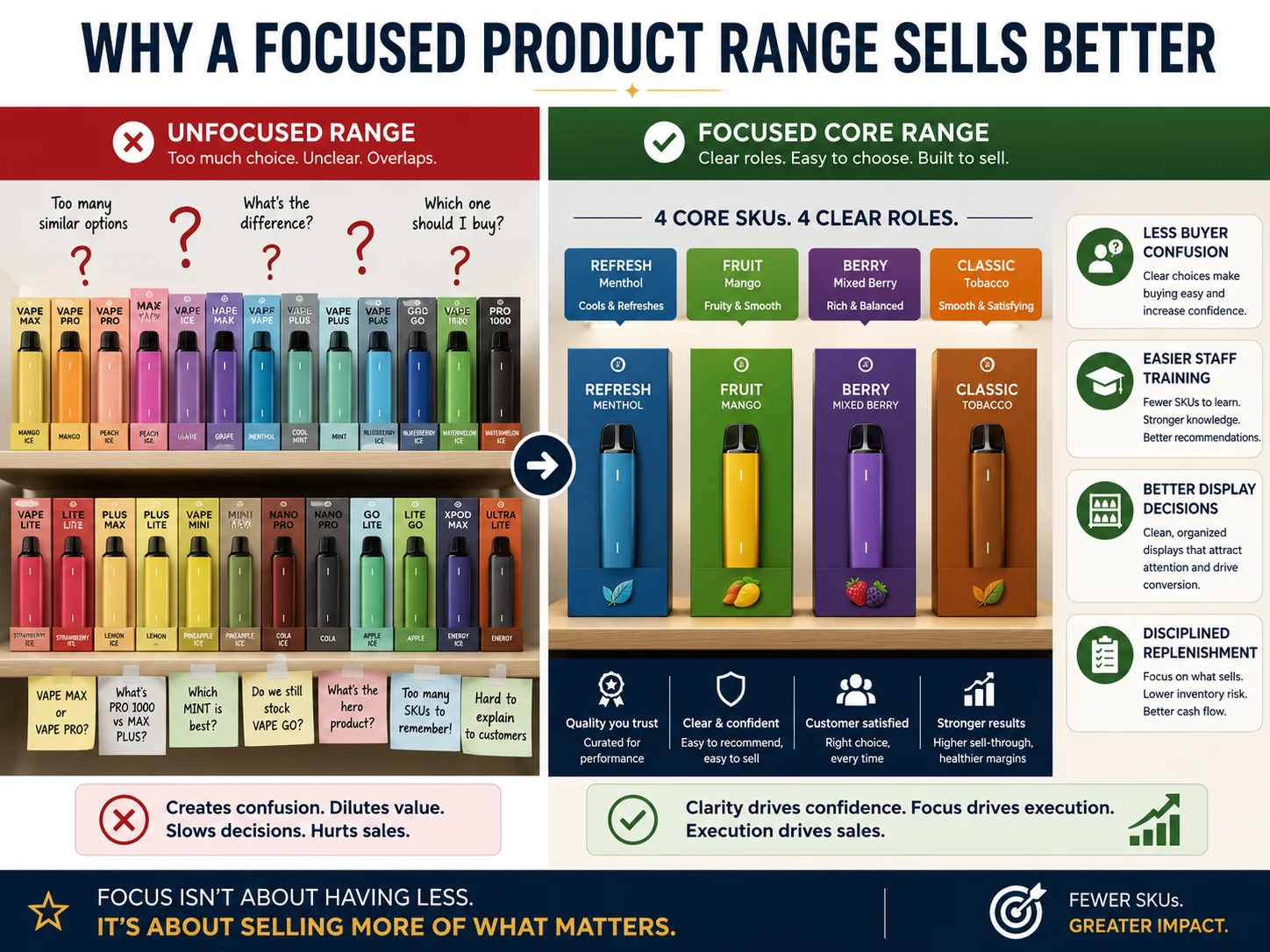
Why Does a Clear and Focused Product Range Often Sell Better?
Many buyers worry that a small range may cause them to lose sales. That can happen if the range is too narrow. However, an unfocused range can create a bigger problem: too many products compete with each other while none receives enough attention from the sales team.
A clear and focused product range often sells better because it reduces buyer confusion[^4], makes staff training easier, improves display decisions, and supports more disciplined replenishment. A smaller number of well-positioned core SKUs can be more useful than many similar products with unclear differences.[^5]
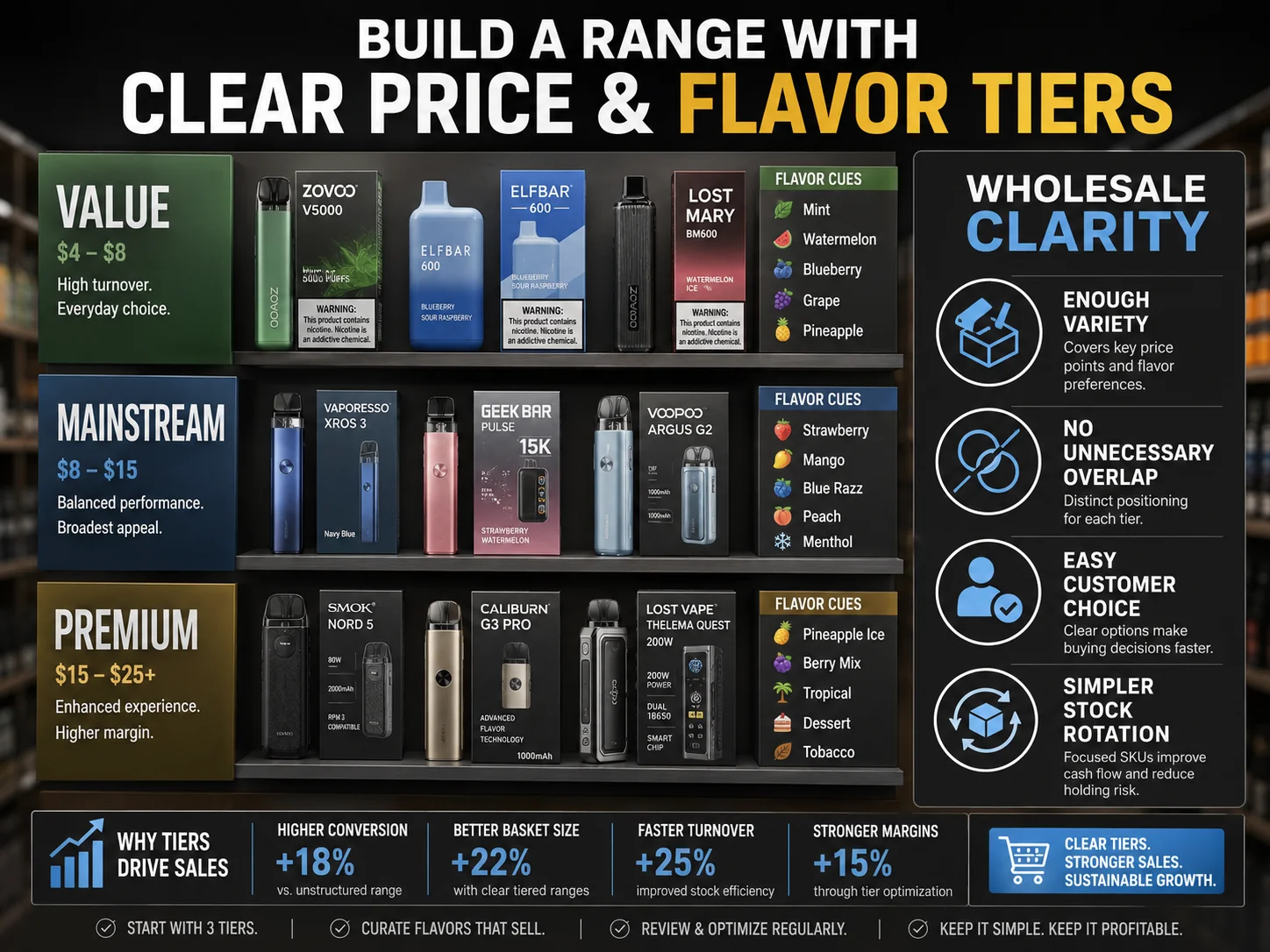
Build Around Price Ladders
A practical vape product line strategy usually has price steps. The exact price points depend on the destination market, taxes, regulations, local competition, and retailer position, so buyers should verify these locally.
The important part is the logic:
| Product Role | Customer Need | Buyer Benefit |
|---|---|---|
| Entry option | Accessible purchase decision | Helps retailers reach price-sensitive customers |
| Core option | Reliable everyday choice | Supports repeat replenishment |
| Premium option | Better features or perceived value | Creates higher-value selling opportunities |
| Trend option | Newness and conversation value | Gives customers a reason to revisit |
| Accessory option | Add-on purchase | Helps improve basket value |
Reduce Flavor Overlap
Flavor selection can also become a stock problem. If five flavors are too similar, retailers may struggle to explain the difference. The result can be slow movement across several small quantities instead of stronger movement in a smaller group.
I usually encourage buyers to begin with a controlled flavor structure. They can then expand based on verified local feedback. This approach is especially useful for smaller wholesalers and retailers that want to protect their working capital.
A focused range does not mean a weak range. It means every item earns its place.
Which Product Features Actually Help Wholesale Sales?
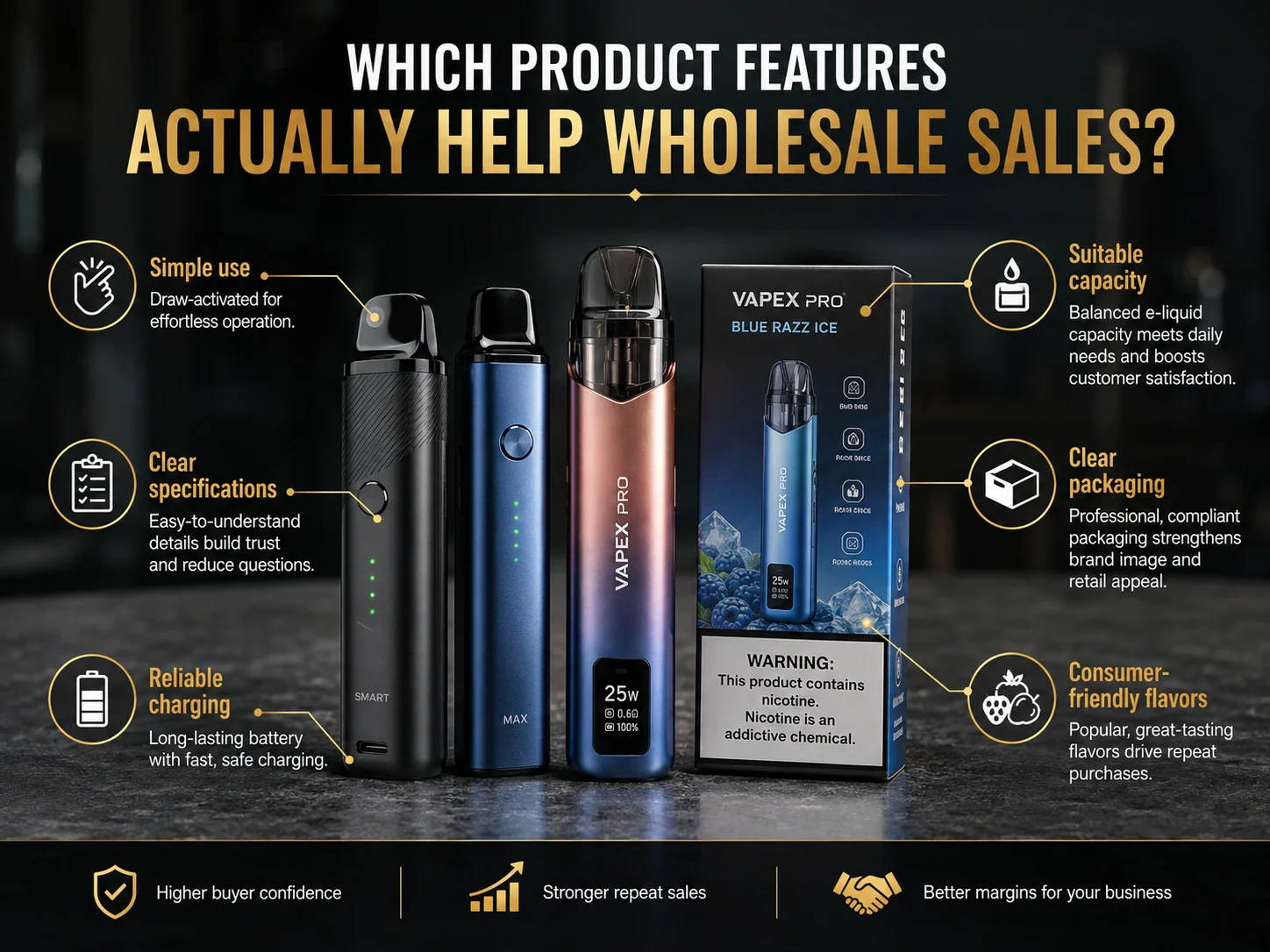
Buyers often compare product features first: capacity, battery size, charging type, device format, and appearance. These factors matter, but the best features are the ones that help retailers sell more clearly and reduce avoidable support questions.
The product features that help wholesale sales are usually practical features: simple use, understandable specifications, suitable capacity, reliable charging design, clear packaging, consumer-friendly flavor choices, and manageable after-sales risk. A feature only adds value when the retailer can explain why it matters to the final customer.
Features Should Solve a Sales Problem
I encourage buyers to ask, “What problem does this feature solve for my retailer or their customer?”
For example:
- A clear charging method can reduce staff questions.
- Simple packaging can help display and identification.
- A suitable device format can make purchasing decisions faster.
- Distinct flavor naming can help customers choose.
- A clear specification sheet can support online product pages.
- Consistent product information can reduce misunderstandings.
Reliability Has Commercial Value
After-sales issues can cost more than the value of one defective item.[^6] They can take staff time, create customer complaints, and weaken a retailer’s confidence in the whole category.
At KingVape, I understand why wholesalers want fewer supplier conversations when something goes wrong. A buyer may purchase multiple brands and categories, but they do not want to chase several factories for support. That is why one-stop coordination matters commercially. It helps buyers simplify product sourcing, order handling, shipping coordination, and after-sales communication.
However, no supplier should promise that a product will never have issues. The more practical goal is to establish a clear support process before the order.
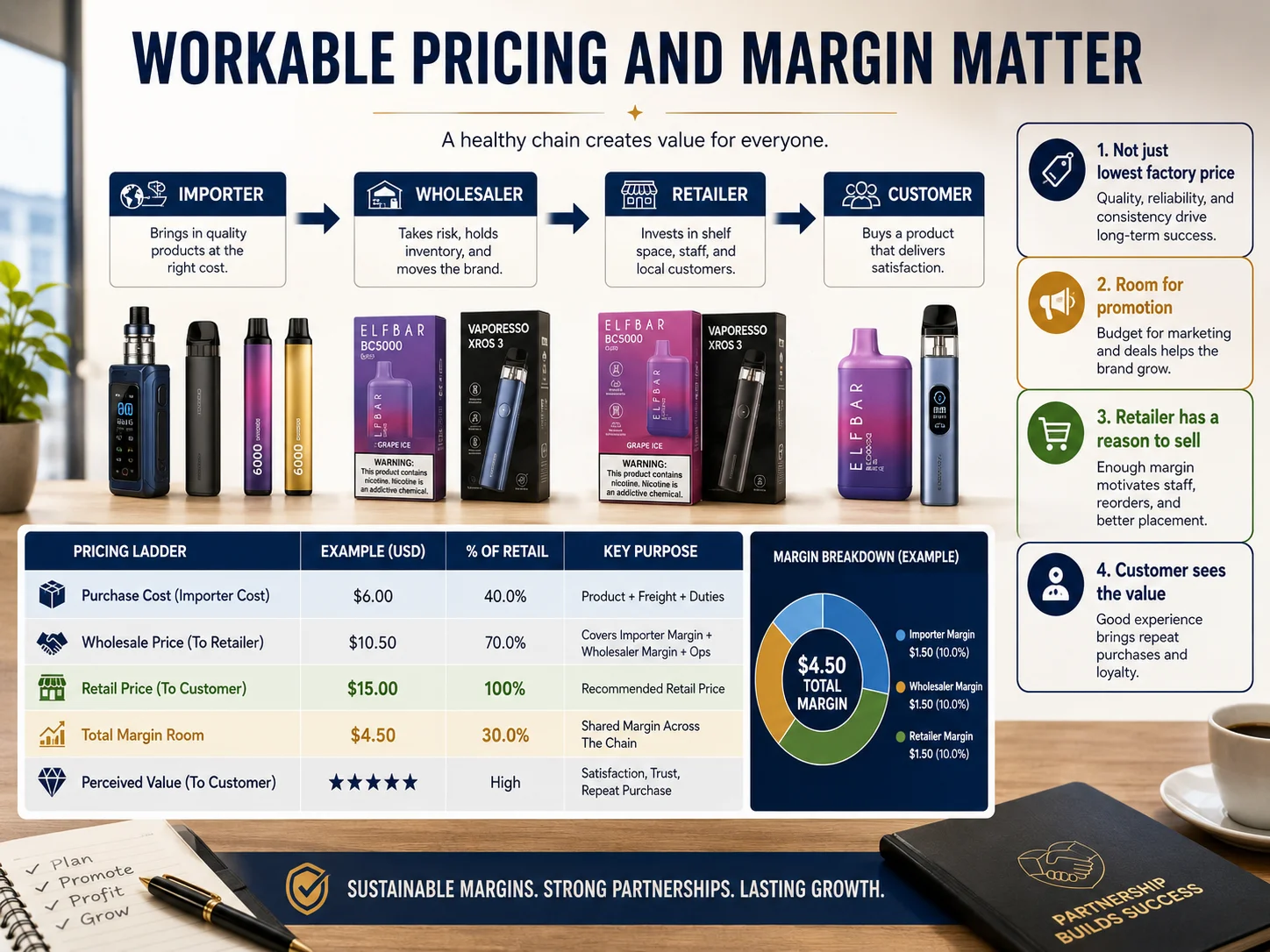
How Do Pricing and Margin Affect Vape Product-Line Performance?
The lowest factory price is not always the best buying decision.[^7] A very cheap item may leave little room for the importer, wholesaler, retailer, promotion, or replacement costs. At the same time, a high-priced item may not match the local customer’s willingness to pay.
Pricing and margin affect vape product-line performance because each level in the supply chain needs a reason to sell the product[^8]. A workable range should connect purchase cost, wholesale price, retail price, promotional flexibility, and perceived customer value rather than focusing only on the lowest unit price.
Look at the Full Commercial Picture
Before choosing a product, I suggest buyers calculate more than the purchase price:
- Product cost
- International or local shipping cost
- Duty, tax, and compliance-related costs where applicable
- Warehouse and handling costs
- Expected retailer margin
- Promotional allowance
- Potential after-sales and replacement exposure
- Cash tied up in inventory
A product line should give retailers enough reason to display and recommend it. If every SKU has almost the same price but unclear differences, the retailer may simply choose the cheapest one.
For importers and larger distributors, direct China sourcing can offer stronger purchasing flexibility, particularly when order volumes support it. For smaller and medium buyers serving Europe, our overseas warehouse options can help them test or replenish selected products with lower starting quantities, subject to available stock and destination requirements. This can reduce the need to make a large upfront commitment before the market response is clearer.
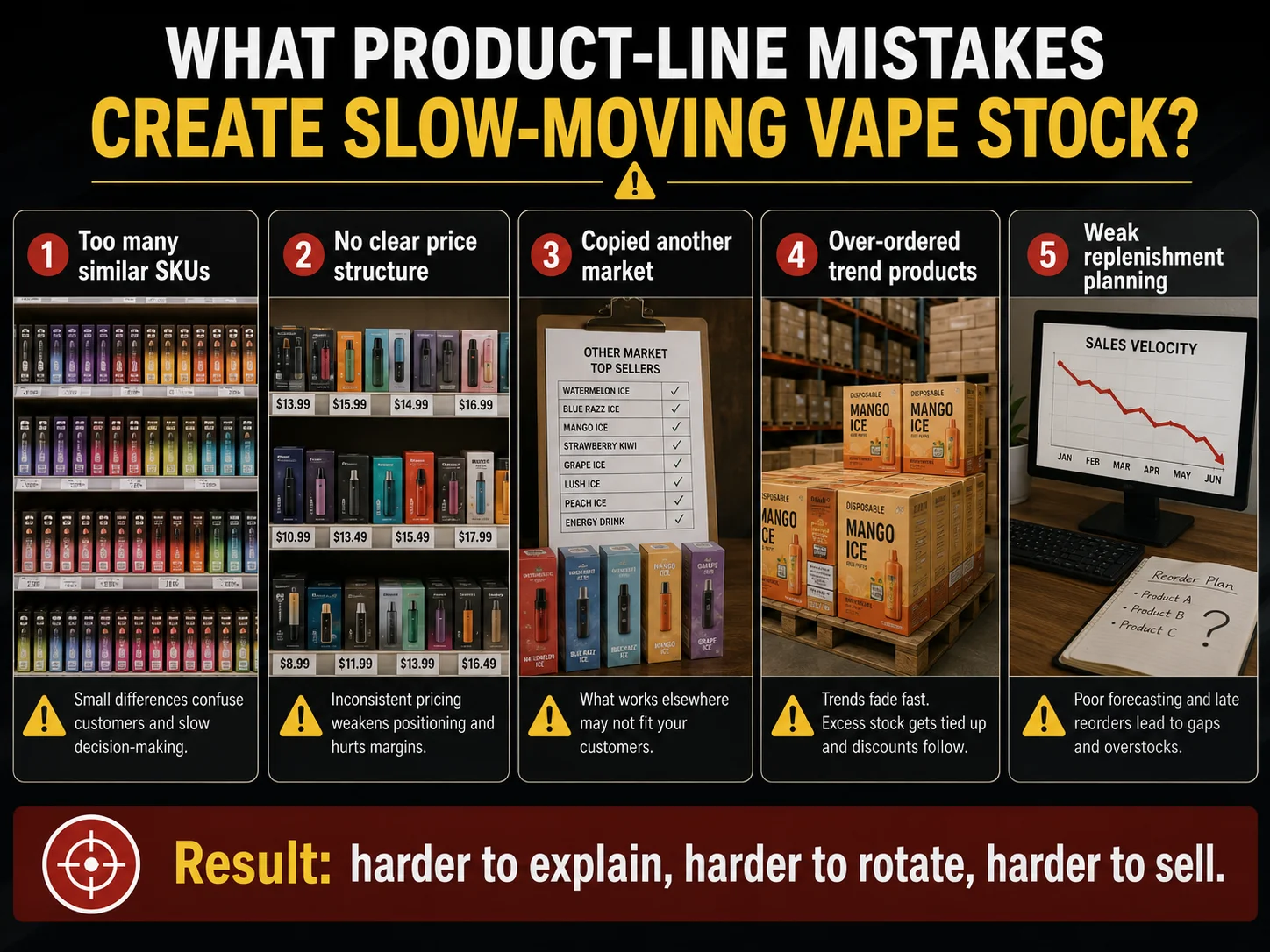
What Product-Line Mistakes Create Slow-Moving Vape Stock?
Slow-moving stock usually does not come from one mistake alone. It often comes from several small decisions: too many models, too many flavors, no price structure, unclear channel fit, or a trend purchase that became too large too quickly.
The most common product-line mistakes are buying too many similar SKUs, mixing price levels without a clear reason, copying another market without verification, over-ordering trend products, and failing to keep stable replenishment products. These mistakes make a vape product line harder to explain, rotate, and sell through different channels.[^9]
Mistakes I Recommend Avoiding
- Too many similar devices: Customers cannot understand why they should choose one over another.
- Too many flavors at launch: Inventory becomes scattered across low quantities.
- No entry-level product: Retailers lose customers who want a lower spending option.
- No premium step: Retailers have limited ability to trade customers up.
- Buying only hot products: Trends can be useful, but they should not replace core stock.
- Ignoring the retailer’s sales environment: A specialist product may not work in a fast counter-sale setting.
- No after-sales process: Small problems can become large relationship problems.
- No reorder plan: Buyers may sell the first batch but struggle to maintain consistency.
I have spoken with buyers who initially wanted a very long product list because they did not want to miss any opportunity. After discussing their customer base, they often realized that a more focused starting range would be easier for their sales team to promote.
The goal is not to limit opportunity. The goal is to make opportunity manageable.
How Can Educational Content Improve Product-Page Conversion?
A buyer does not always need more product choices. Sometimes the buyer needs better information. Clear product content helps importers, wholesalers, and retailers understand which items fit their business before they invest in stock.
Educational content can improve product-page conversion[^10] by explaining product roles, specifications, channel fit, price positioning, and buying considerations in plain language. Comparison tables, FAQs, use-case guidance, and accurate product information can help B2B buyers make faster and more confident purchasing decisions.
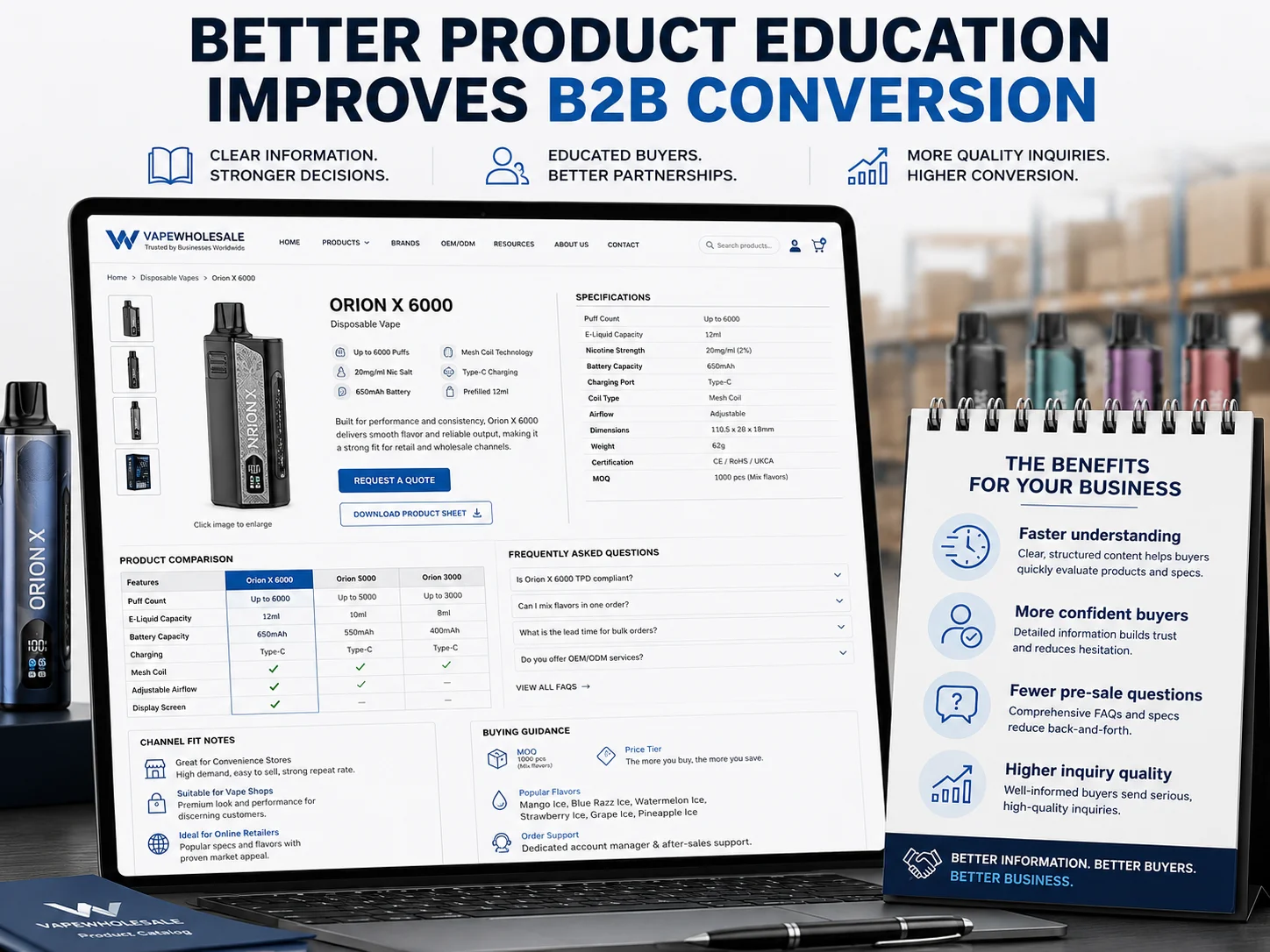
Content That Helps B2B Buyers Decide
For each product category, I recommend providing:
- Product type and intended channel
- Key specifications
- Available options or flavors
- Packaging information
- Suggested price-position role
- Target retailer type
- Clear photos and display information
- Basic usage guidance
- After-sales process details
- Frequently asked questions
A comparison table is especially useful when buyers are deciding between several similar products.[^11] It helps them see which product is better for entry-level sales, which one is more suitable for specialist stores, and which one should be purchased only as a limited trial.
Educational content also supports your own sales team. When your representatives can send a customer a clear guide instead of a long catalog, they can spend more time discussing the buyer’s market and less time explaining basic differences.
Explore Vape Wholesale Categories for Your Market
Choosing the right vape product line can feel difficult when you serve several retail channels at once. You may need disposable vapes, atomizers, 510 batteries, CBD batteries, vaporizers, grinders, glass pipes, and related accessories, but you still need a structure that protects your inventory and cash flow.
What makes a vape product line easier to sell is not simply having more products. It is having the right products for your customers, with clear SKU roles, sensible pricing, suitable channel positioning, and a replenishment plan that your business can manage.
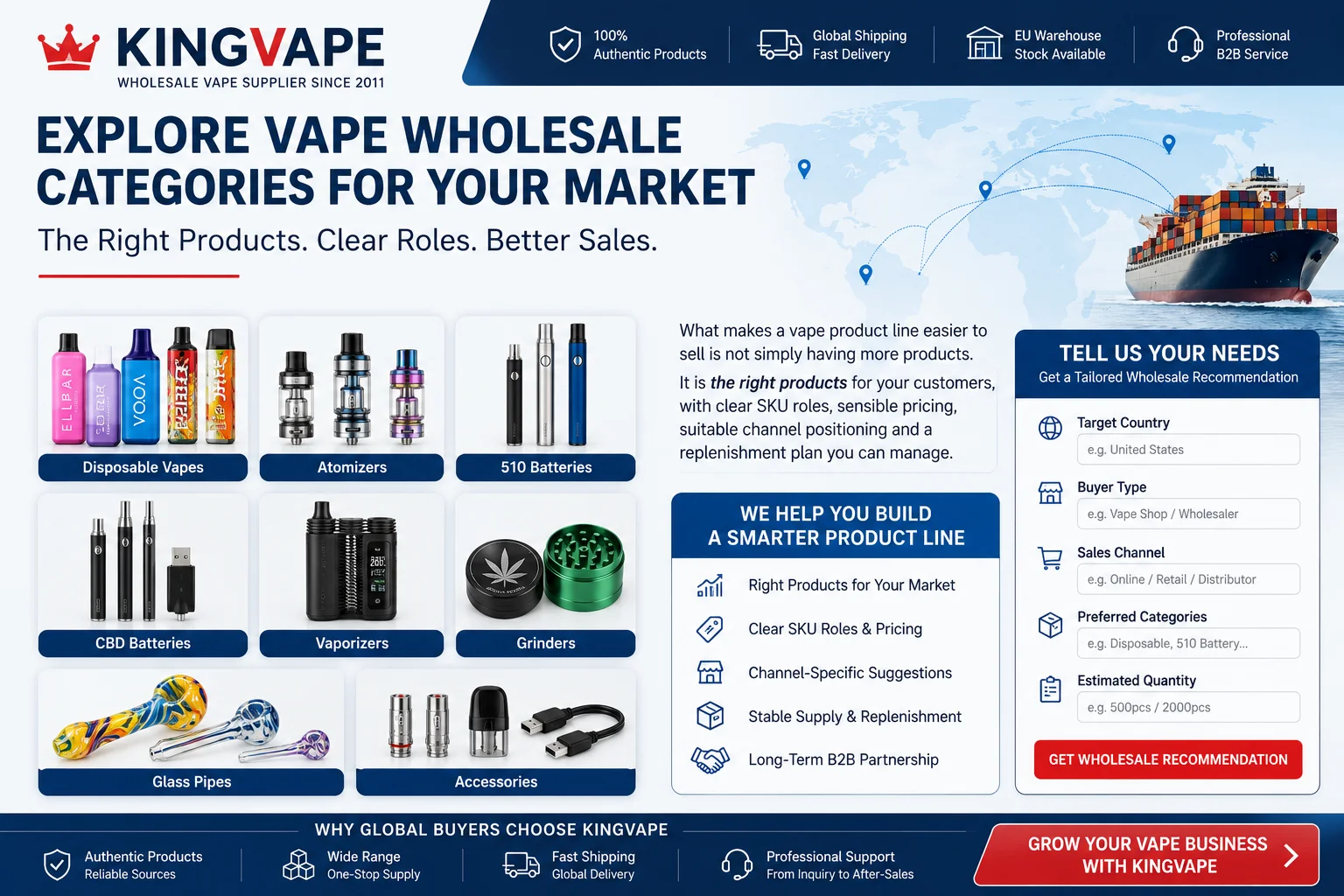
At Shenzhen Kingfuji Tech Co., Ltd., I help buyers build more practical sourcing plans from Shenzhen, one of the world’s main vape manufacturing and supply-chain hubs. We are an integrated factory and trading business established in 2011. We offer our own products, multi-brand and multi-category sourcing, OEM/ODM support, and one-stop coordination for vape and smoking-related products.
For small and medium European buyers, selected overseas warehouse stock may support lower-MOQ purchasing and faster EU delivery options. For larger importers, distributors, and wholesalers, China-based bulk purchasing and OEM/ODM development may provide more flexibility for pricing, product development, and brand-building.
Send KingVape your destination market, sales channel, preferred product type, target price range, and estimated quantity. I will help you build a more focused and workable vape wholesale stock strategy.
Frequently Asked Questions
Should every vape shop carry the same product line?
No. Each vape shop serves different customers, price levels, and product preferences. I recommend using a core range for stable demand, then adding selected products based on the shop’s location, customer type, staff knowledge, and available display space.
How many vape SKUs should a wholesaler start with?
The right number depends on your market and sales channels. In general, I recommend starting with enough SKUs to cover entry, core, premium, and trend roles, while avoiding too many similar models or overlapping flavors that can create slow-moving stock.
Are hot vape products always the best products to wholesale?
Not always. A hot product may create demand, but it can also carry trend risk. I suggest treating trend-led products as controlled opportunities while keeping stable, easy-to-explain core products available for normal retailer replenishment.
What should I consider before importing vape products from China?
You should consider product fit, local regulations, packaging requirements, target retail price, shipping plan, order quantity, after-sales process, and replenishment needs. You should also verify destination-market requirements before placing an order, especially for regulated vape categories[^12].
Can I buy vape products in small quantities for the European market?
Depending on available stock, selected products may be available through our European overseas warehouse network with lower starting quantities. This can be useful for smaller wholesalers, retailers, and buyers who want to test categories without making a large initial import commitment.
Conclusion
What makes a vape product line easier to sell is not one universal device, one flavor, or one short-term trend. It is a clear product structure that matches the way your customers actually buy and sell. When every SKU has a channel role, price role, and replenishment role, you can reduce confusion, improve stock decisions, and create a more practical wholesale operation. If you are building a vape shop wholesale range, supplying smoke shops, or importing for a wider retail network, contact KingVape at info@kingvapecig.com to discuss your market and sourcing plan.
[^1]: "Joseph K. Goodman", https://scholar.google.com/citations?user=NT0GlpQAAAAJ&hl=en. Studies of consumer choice overload report that extensive or complex assortments can increase decision difficulty and may reduce choice or satisfaction in particular purchasing contexts. Evidence role: mechanism; source type: paper. Supports: Research on choice overload and product assortment indicating that a large or complex set of similar options can increase decision difficulty under some conditions.. Scope note: Effects vary by product category, buyer expertise, decision stakes, and the way options are organized. [^2]: "Evolution of retail formats: Past, present, and future", https://www.smu.edu/-/media/site/cox/faculty/research/foxedward/evolution-of-retail-formats-past-present-and-future-2021.pdf. Retail-format research distinguishes convenience, specialty, wholesale, and online channels by their shopper missions, service intensity, assortment practices, and transaction conditions. Evidence role: general_support; source type: research. Supports: Retail research describing how store formats and sales channels differ in shopper missions, service levels, assortment depth, and merchandising constraints.. Scope note: This literature describes retail channels generally and does not independently validate the suitability of any particular vape product. [^3]: "How assortment size, distinctive allocations, and local market density ...", https://www.sciencedirect.com/science/article/pii/S0969698925002711. Research on convenience retail characterizes the format as serving time-sensitive, quick-trip purchases, with limited selling space relative to larger store formats. Evidence role: general_support; source type: research. Supports: Evidence that convenience retail is oriented toward quick trips and operates with comparatively constrained selling space and interaction time.. Scope note: The degree of staff interaction and available display space differs substantially among individual convenience stores. [^4]: "Demand-estimation---assortment-optimization. ...", https://faculty.wharton.upenn.edu/wp-content/uploads/2012/07/Demand-estimation---assortment-optimization.pdf. Assortment research finds that clear categorization and manageable option sets can reduce cognitive burden during product evaluation and choice. Evidence role: mechanism; source type: paper. Supports: Research examining how assortment complexity, option similarity, and assortment structure affect consumer evaluation and purchase decisions.. Scope note: A focused range does not necessarily outperform a broad range where customer heterogeneity or demand for variety is high. [^5]: "AI in Omnichannel", https://ctl.mit.edu/ai-omnichannel. Operations and assortment-management studies associate SKU proliferation and overlapping items with added forecasting, inventory, and merchandising complexity, while rationalization can improve manageability. Evidence role: general_support; source type: paper. Supports: Operations and retail studies on SKU proliferation, assortment rationalization, and the costs of maintaining overlapping items.. Scope note: The optimal SKU count is market-specific and cannot be inferred from a general rationalization finding alone. [^6]: "One Motorola", https://www.nist.gov/system/files/documents/2017/10/11/MotorolaCGISS_Application_Summary.pdf. Quality-cost frameworks recognize that product failures may create costs beyond replacement, including complaint handling, diagnosis, warranty administration, and lost customer goodwill. Evidence role: mechanism; source type: research. Supports: Quality-management evidence that failures generate direct warranty or replacement costs as well as diagnostic, handling, service, and relationship costs.. Scope note: The total cost depends on failure rates, contractual terms, return procedures, and the commercial relationship. [^7]: "Analyzing Costs Using Total Cost of Ownership", https://psep.smeal.psu.edu/short-courses/supply-chain-accelerator/advanced-procurement-analyzing-costs-using-total-cost-of-ownership. Total-cost-of-ownership approaches to procurement assess purchase price alongside logistics, quality, service, operating, and risk-related costs. Evidence role: general_support; source type: government. Supports: Procurement guidance explaining that supplier evaluation can account for lifecycle and transaction costs in addition to the initial purchase price.. Scope note: A total-cost assessment requires buyer-specific assumptions and does not establish that a higher-priced supplier is preferable in every transaction. [^8]: "Incentives for Retailer Promotion in a Marketing Channel", https://www.academia.edu/34413125/Incentives_for_Retailer_Promotion_in_a_Marketing_Channel. Marketing-channel theory treats intermediaries as independent firms whose stocking and selling decisions are influenced by expected margins, services required, risks, and customer demand. Evidence role: mechanism; source type: education. Supports: Marketing-channel theory explaining that intermediaries respond to economic incentives, service obligations, risk, and expected returns.. Scope note: Margin is one influence among many; regulations, supplier relationships, brand demand, and local competition also shape reseller decisions. [^9]: "A Demand Estimation Procedure for Retail Assortment Optimization with ...", https://faculty.wharton.upenn.edu/a-demand-estimation-procedure-for-retail-assortment-optimization-with-results-from-implementations-workingpaper-file-file/. Retail and operations research indicates that greater assortment complexity can complicate demand forecasting, replenishment, shelf execution, and inventory control. Evidence role: mechanism; source type: paper. Supports: Evidence linking assortment complexity and SKU proliferation to more difficult forecasting, replenishment, merchandising, and inventory management.. Scope note: The cited mechanism is general; it does not quantify the effect for vape products or for a particular distributor. [^10]: "An Evaluation of Product Descriptions and Brand Trust as influencers of ...", https://digitalcommons.spu.edu/cgi/viewcontent.cgi?article=1006&context=rpsy_etd. Ecommerce studies find that product-information quality can reduce perceived uncertainty and is associated with stronger online purchase intentions and decision confidence. Evidence role: mechanism; source type: paper. Supports: Ecommerce research showing that useful, accurate product information can reduce perceived uncertainty and support online purchase intentions or decisions.. Scope note: Purchase intention and conversion are not identical, and results depend on audience, website design, product type, price, and trust signals. [^11]: "Supporting informed consumer health care decisions: data presentation ...", https://pubmed.ncbi.nlm.nih.gov/12428034/. Decision-support research shows that structured comparative displays can help users inspect attributes and evaluate alternatives, particularly when options differ across several features. Evidence role: mechanism; source type: paper. Supports: Decision-support research on structured comparative displays and their role in helping users evaluate alternatives with multiple attributes.. Scope note: Table design can also overwhelm users if it contains too many attributes, options, or poorly defined comparisons. [^12]: "Importing Tobacco Products", https://www.fda.gov/industry/importing-fda-regulated-products/importing-tobacco-products. Public-health and regulatory authorities document that electronic nicotine delivery systems are subject to jurisdiction-specific rules concerning product authorization, ingredients, labeling, advertising, sale, and importation. Evidence role: historical_context; source type: institution. Supports: Authoritative public-health and regulatory sources documenting that electronic nicotine delivery systems are regulated and that requirements vary by jurisdiction.. Scope note: Requirements change over time and must be confirmed with the competent authority or qualified legal advisers in the destination market.