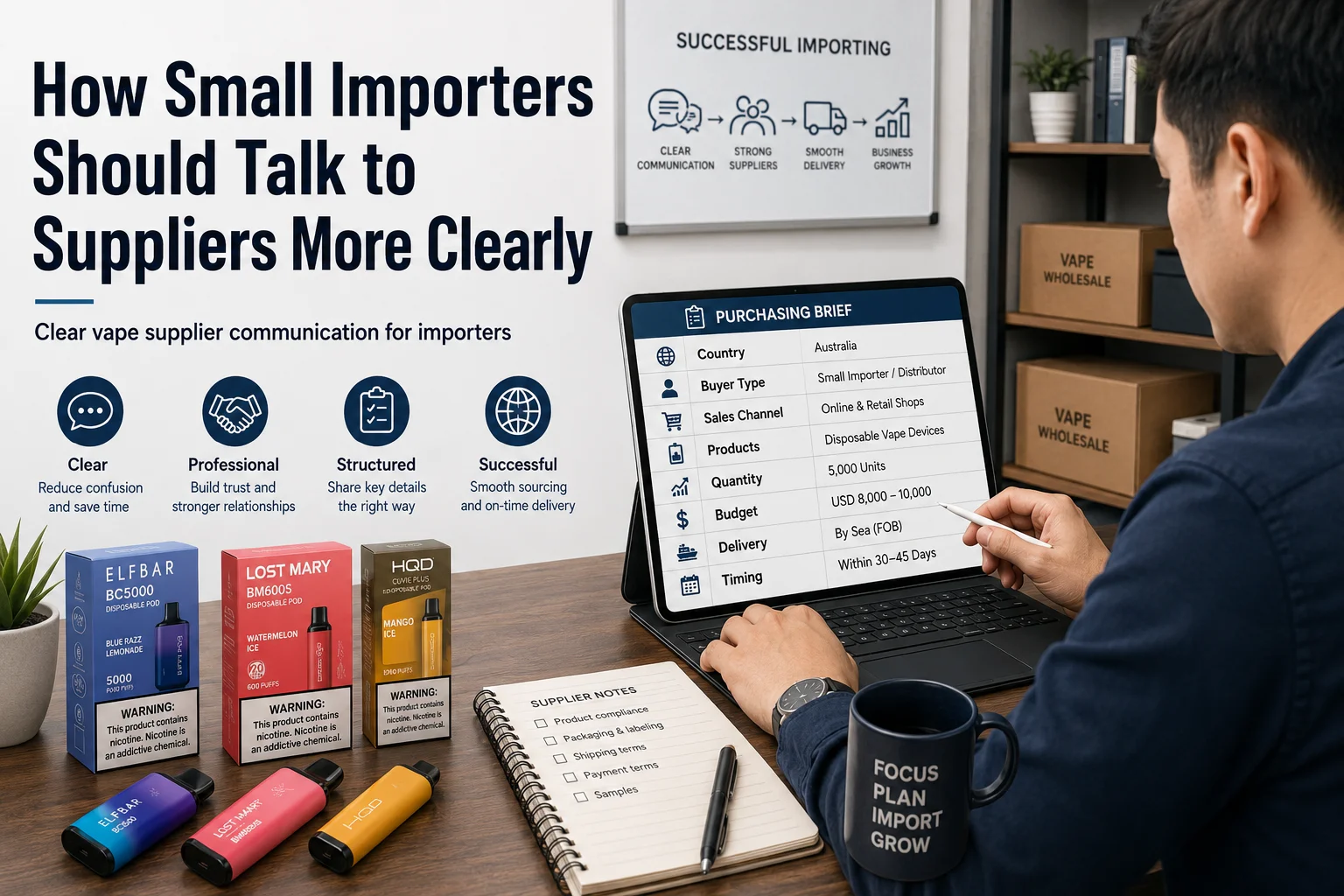
How small importers should talk to suppliers more clearly is a major issue for vape buyers because a vague message often leads to vague prices, unsuitable products, and avoidable delays. Many buyers only ask for a catalog or “best price,” then lose time comparing quotations that do not include the same products, shipping terms, or service scope. I recommend turning every enquiry into a short purchasing brief.
Small vape importers should tell suppliers their sales country, buyer type, sales channel, required products, estimated quantity, budget range, delivery location, compliance needs, and preferred delivery timing. This information helps suppliers recommend suitable products, calculate a more accurate vape wholesale quotation, and suggest an order route that matches the buyer’s cash flow, replenishment needs, and local market.
I have handled many enquiries from vape shops, smoke shop wholesalers, convenience-store suppliers, and first-time importers. The buyers who receive the most useful answers are not always the biggest buyers. They are usually the buyers who explain what they need clearly enough for us to evaluate products, stock, delivery options, and possible risks.
Quick Answer: How Small Importers Should Talk to Suppliers More Clearly?
Many small buyers worry that suppliers will ignore them if they do not place a large order. That concern can lead to short messages such as “send price” or “what is your hot product?” Unfortunately, those messages make it difficult for any supplier to provide a practical answer.
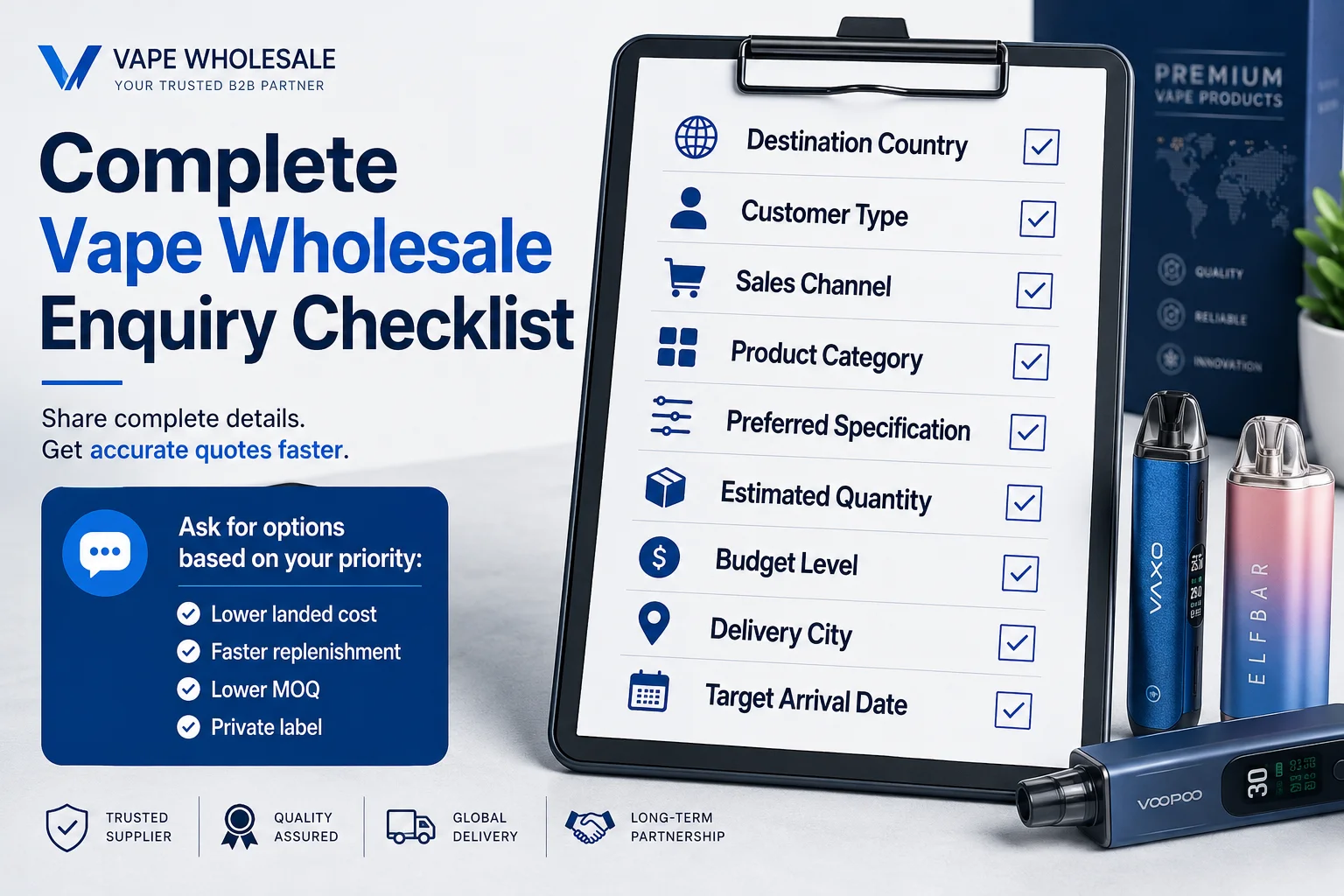
How small importers should talk to suppliers more clearly is simple: send a short brief with your destination country, customer type, sales channel, product category, preferred specification, estimated quantity, budget level, delivery address or city, and target arrival date. Then ask for options based on your real priority: lower landed cost, faster replenishment, lower MOQ, or private-label development.
A clear enquiry does not mean you need to know every technical detail. I do not expect a first-time buyer to understand every vape model, coil type, packaging specification, or shipping route. I only need enough information to avoid giving you a misleading recommendation.
What I Need Before I Recommend Products
When I receive a useful vape wholesale enquiry, I can normally begin with these points:
- Where will you sell? Country, city, or region.
- Who will buy from you? Vape shops, smoke shops, gas stations, convenience stores, online customers, or local wholesalers.
- What do you need? Disposable vapes, pod systems, batteries, atomizers, grinders, glass pipes, or related products.
- How many units do you expect to buy? Even a range is helpful.
- What is your purchasing schedule? One test order, monthly replenishment, or a larger import plan.
- How should the goods be delivered? China export, European warehouse delivery, or delivery to your own freight forwarder.
- What matters most? Fast arrival, low product cost, branded products, lower MOQ, or OEM/ODM potential.
A supplier can then tell you whether a product is suitable for your channel rather than simply sending a random catalog. This is the foundation of how small importers should talk to suppliers more clearly.
What Information Should Small Importers Send to a Vape Supplier?
A first enquiry can feel difficult when you do not know the supplier yet. Some buyers want to protect their market information, while others do not have a final buying plan. Still, incomplete information makes quotations hard to compare and can create confusion later.
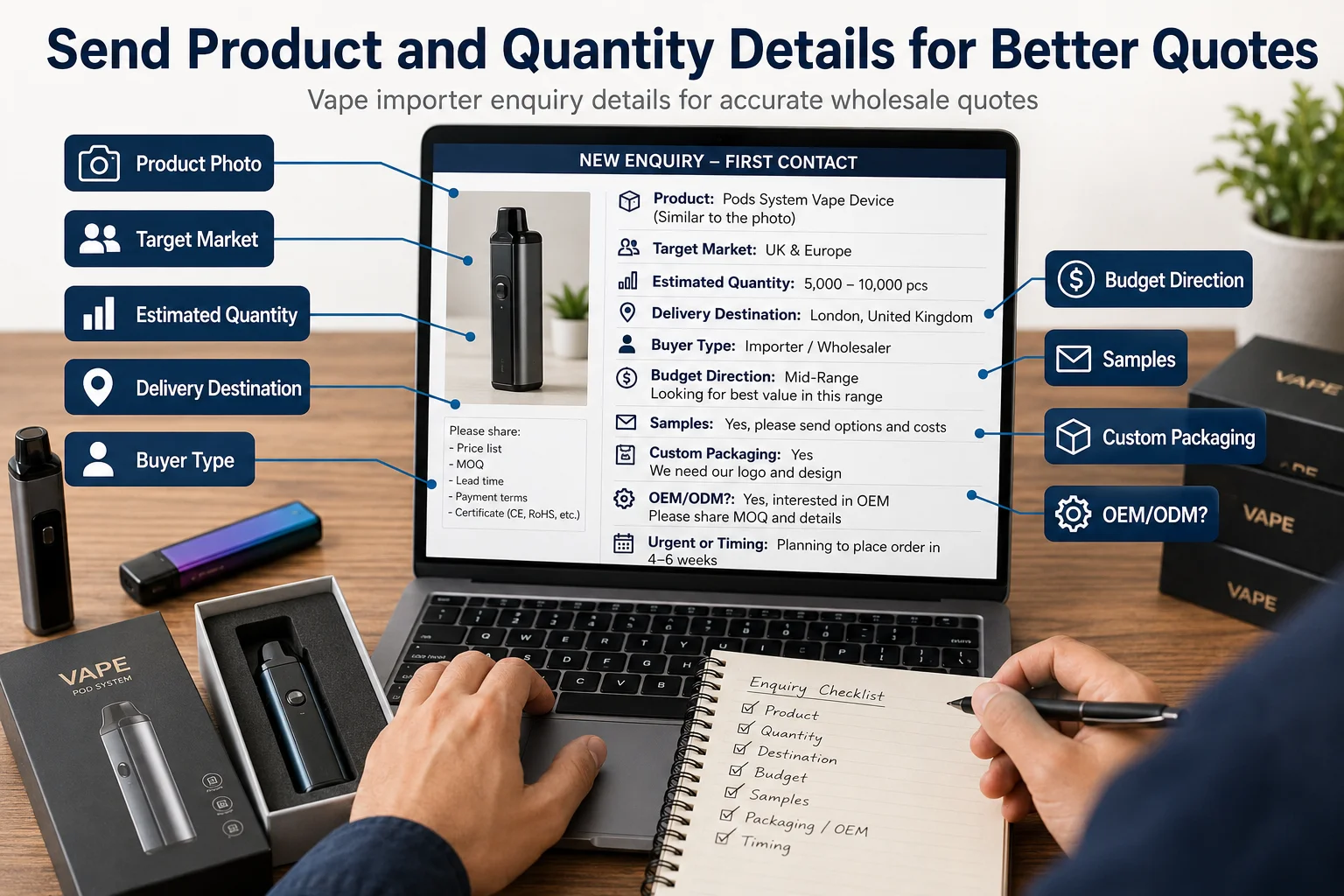
A practical first message to a vape supplier should include the product or product photo, target market, estimated quantity, delivery destination, buyer type, budget direction, and required timing. Buyers should also mention whether they need branded stock, samples, custom packaging, or an OEM/ODM discussion.
I often see messages that say only “send catalog” or “give me your best price.” I can send a catalog, but a catalog may contain hundreds of products. It does not tell me which items match your customers, local price level, or delivery plan.
A Reusable Vape Wholesale Enquiry Template
You can copy and adapt this message:
Hello, I am buying for the [country/city] market. I sell mainly to [vape shops/smoke shops/convenience stores/wholesale customers]. I am interested in [product type or model]. My estimated first order is [quantity], with possible repeat orders [monthly/quarterly/as needed].
I need delivery to [city/country/postcode or freight forwarder]. My priority is [fast replenishment/lowest practical landed cost/lower MOQ/branded products/OEM]. Please recommend suitable options, MOQ, sample availability, packaging details, estimated lead time, and quotation terms.
This template helps you get an answer that you can actually use. It also protects you from comparing incomplete numbers. For example, one supplier may quote an ex-works unit price, while another may quote a delivered price. Those are not the same commercial offer.[^1]
For buyers in Europe, I also suggest stating whether you are looking for stock that can be dispatched from a European warehouse or whether you are planning a larger shipment from China. The best route depends on your order size, urgency, available capital, and local handling ability.[^2]
Why Should Buyer Type and Sales Channel Be Explained Clearly?
A disposable vape that moves well in a tourist-area smoke shop may not be the best choice for a convenience-store chain. A local wholesaler may need deeper stock and more stable replenishment than a single retail shop. When buyers do not explain their channel, suppliers can only guess.
Buyer type and sales channel affect product selection, packaging, quantity, price range, inventory planning, and after-sales expectations. Vape shops often need variety and new products, while wholesalers need repeatable supply, stable specifications, and a product range that their retail customers can reorder confidently.
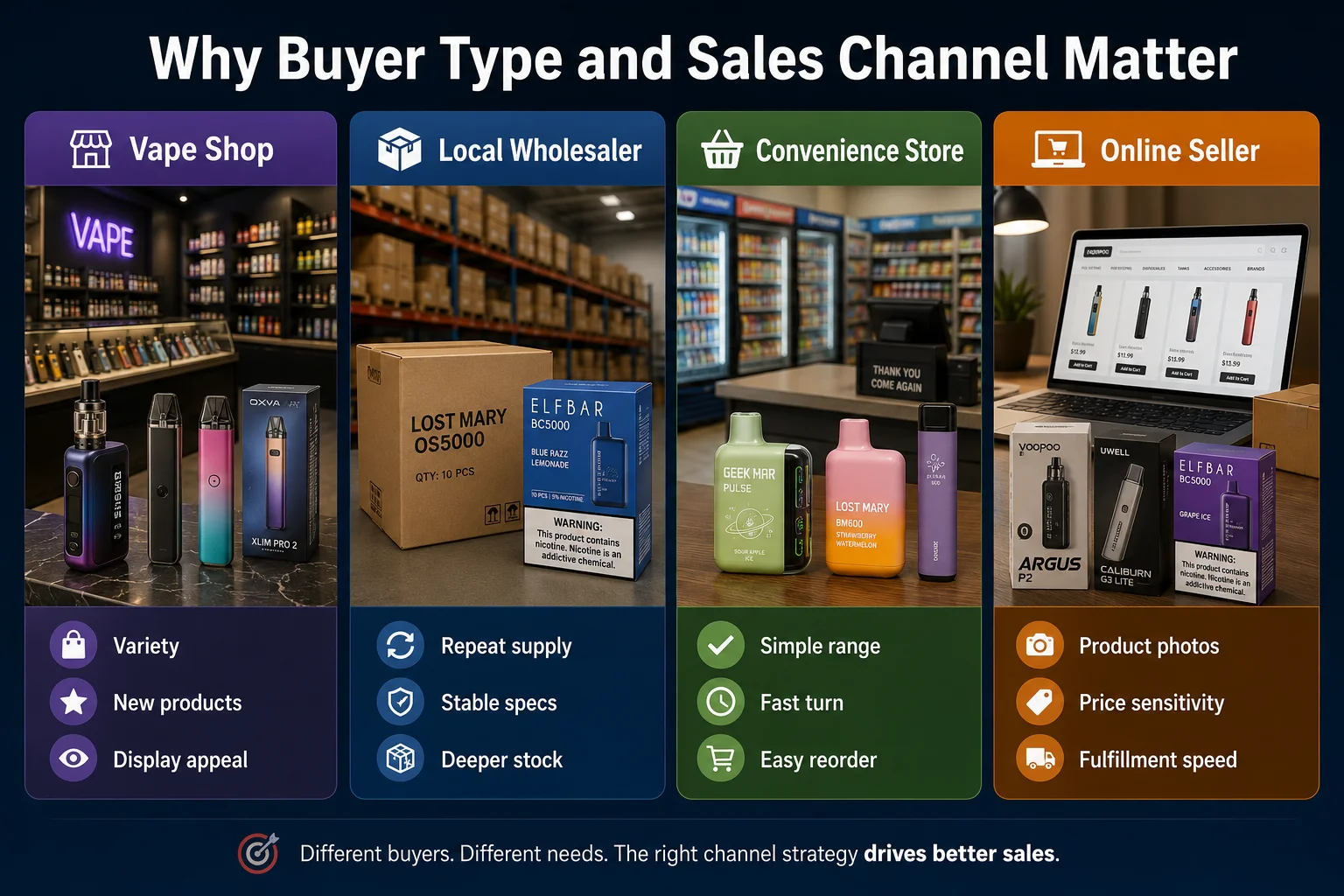
From my supplier-side experience, the same product can be “right” or “wrong” depending on where and how it will be sold.
Different Channels Need Different Buying Logic
| Buyer Type | Typical Priority | Practical Purchasing Need |
|---|---|---|
| Vape shop | New products, flavors, variety | Smaller mixed orders and regular replenishment |
| Smoke shop | Broad category selection | Vapes plus batteries, grinders, glass pipes, and accessories |
| Convenience store supplier | Simple, proven items | Easy-to-sell price points and stable supply |
| Local wholesaler | Margin and repeat sales | Consistent models, larger quantities, reliable restocking |
| Online seller | Product content and packaging | Clear specifications, compliant market positioning, product photos |
| Importer/distributor | Scale and control | Larger China shipments, OEM/ODM options, planning support |
A buyer who sells to independent vape shops may want several product options to test. A buyer who supplies gas stations may need a more focused range with familiar price points and simple packaging. A distributor with two or three warehouses may care more about carton quantities, production stability, and the next replenishment cycle.
This is why how small importers should talk to suppliers more clearly includes explaining not only what you want to buy, but also how you plan to sell it.
How Does Product Selection Change by Market and Sales Channel?
Many buyers see a hot vape product online and assume it will perform in every country. In reality, product demand can vary by local rules, consumer habits, retail channel, price sensitivity, and flavor preferences.[^3] A supplier should not choose for you without market context.
Product selection should match the destination market, customer profile, retail channel, local compliance requirements[^4], target retail price, and replenishment ability. Buyers should ask suppliers for suitable options, but they should verify local legal and regulatory requirements independently before placing an order.
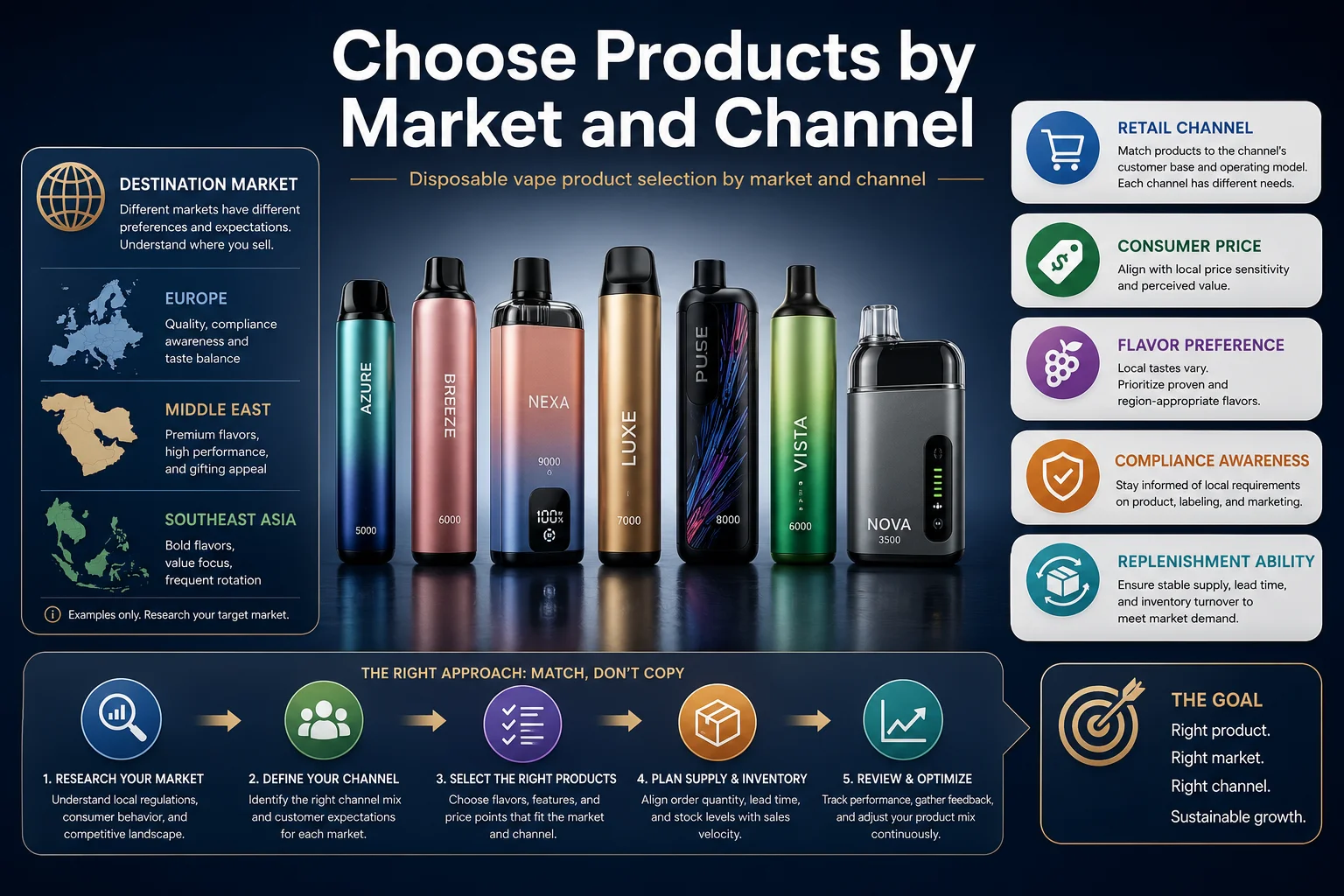
I recommend that buyers describe their market in practical terms. For example, tell me whether your customers are tourists, local repeat customers, price-sensitive convenience-store buyers, specialist vape users, or other wholesalers.
Questions That Improve Product Recommendations
Before I suggest a product range, I usually want to understand:
-
What retail price range works in your market?
The product must leave enough room for your margin, your retailer’s margin, and local operating costs. -
Do your customers prefer simple or advanced products?
Some channels need easy, ready-to-sell disposable products. Others may have demand for pod kits, 510 batteries, vaporizers, or accessories. -
Do you need broad flavor choice or a focused range?
More flavors can help retail testing, but they can also create slow-moving inventory. -
What packaging works for your channel?
Retail-ready packaging, language needs, warning requirements, and branding expectations can differ by market. -
How quickly can you reorder?
Fast-moving products are useful only if you can replenish them before your customers move to another option.
For smaller buyers, lower MOQ and quicker local replenishment may be more valuable than a slightly lower China unit price. For larger importers, a direct China order may create better purchasing leverage if the buyer can manage inventory, shipping arrangements, and a longer planning cycle.
Comparison Table: Clear vs Unclear Vape Wholesale Enquiries?
A vague enquiry can produce a fast reply, but it rarely produces a decision-ready quotation. The problem is not that suppliers refuse to help. The problem is that important variables are missing, so each supplier may assume something different.
Clear vape wholesale enquiries help buyers receive comparable prices, realistic delivery discussions, suitable product suggestions, and fewer later changes. Unclear messages often create quotations that appear cheap but exclude necessary details such as specifications, freight, packaging, lead time, or after-sales process.
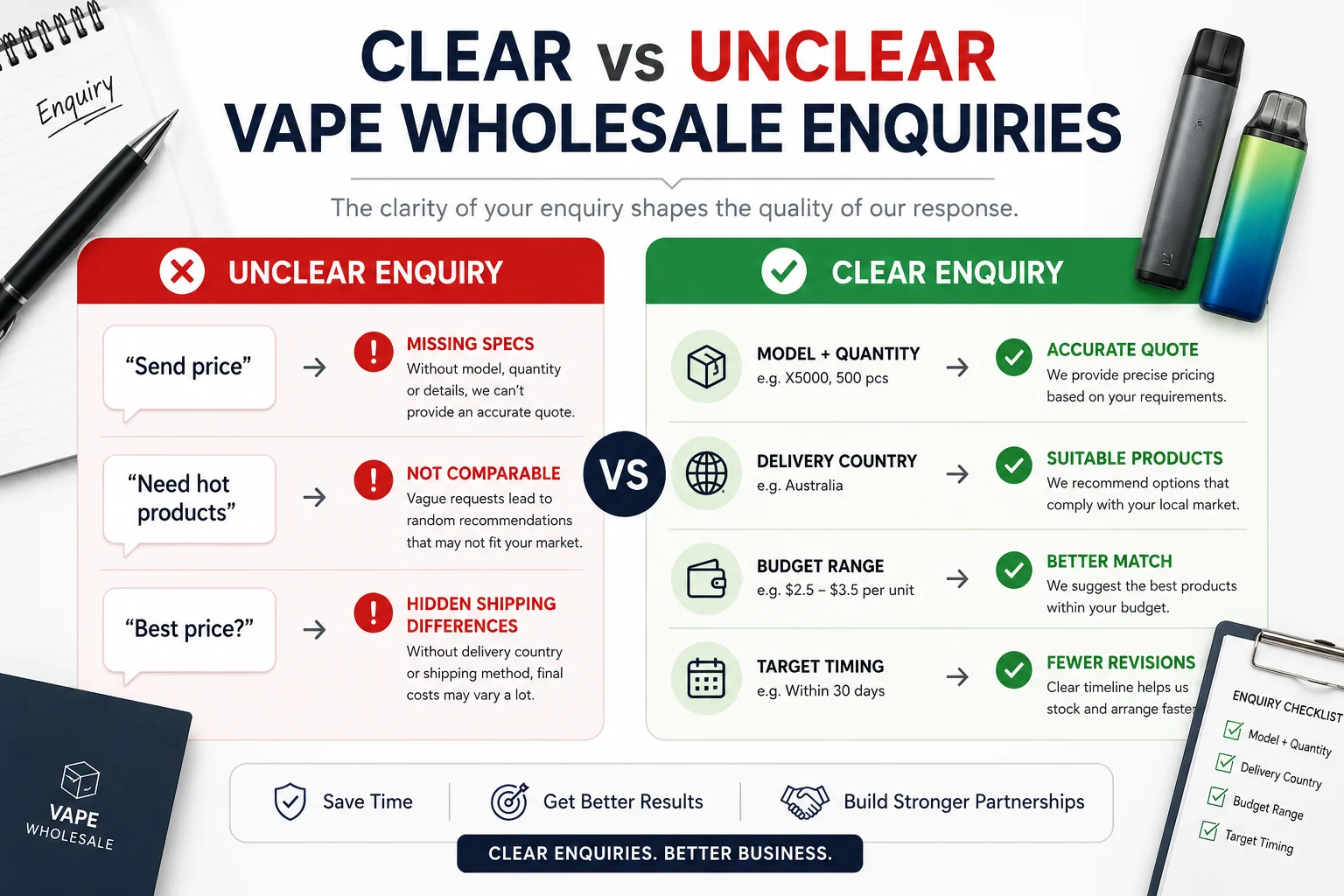
Here is a practical comparison I use when reviewing buyer messages.
| Enquiry Detail | Unclear Message | Clear Buyer Request | Supplier Benefit |
|---|---|---|---|
| Product | “Send vape price” | “Need disposable vape model X or similar” | Supplier can quote the correct category |
| Quantity | “Small order” | “First order: 500–1,000 units” | Supplier can check MOQ and price tiers |
| Destination | “Ship to Europe” | “Deliver to Madrid, Spain” | Supplier can discuss workable delivery options |
| Sales channel | “I sell vapes” | “I supply local smoke shops and gas stations” | Supplier can recommend a better range |
| Timing | “Need fast” | “Need stock available within 10 days if possible” | Supplier can assess stock and route options |
| Branding | “Need my logo maybe” | “Considering OEM packaging after sample test” | Supplier can separate stock and OEM discussions |
| Priority | “Best price” | “Priority is low cash pressure for first test order” | Supplier can suggest a more suitable route |
| Compliance | Not mentioned | “Please share available product documents; I will verify local requirements” | Supplier understands documentation needs |
The table shows why how small importers should talk to suppliers more clearly is not only about polite communication. It is about giving both sides enough facts to build a workable buying plan.
How Should You Ask for an Accurate Vape Wholesale Quotation?
Some buyers compare only the lowest unit price. I understand why. Unit price is easy to see and easy to compare. However, it does not show the full cost of a buying decision, especially for a small importer with limited cash tied up in inventory.
An accurate vape wholesale quotation should state the exact product model, specification, quantity tier, MOQ, unit price, packaging, sample policy, payment method, stock or production status, lead time, shipping basis, and estimated delivery approach. Buyers should compare like-for-like quotations instead of comparing one headline number.
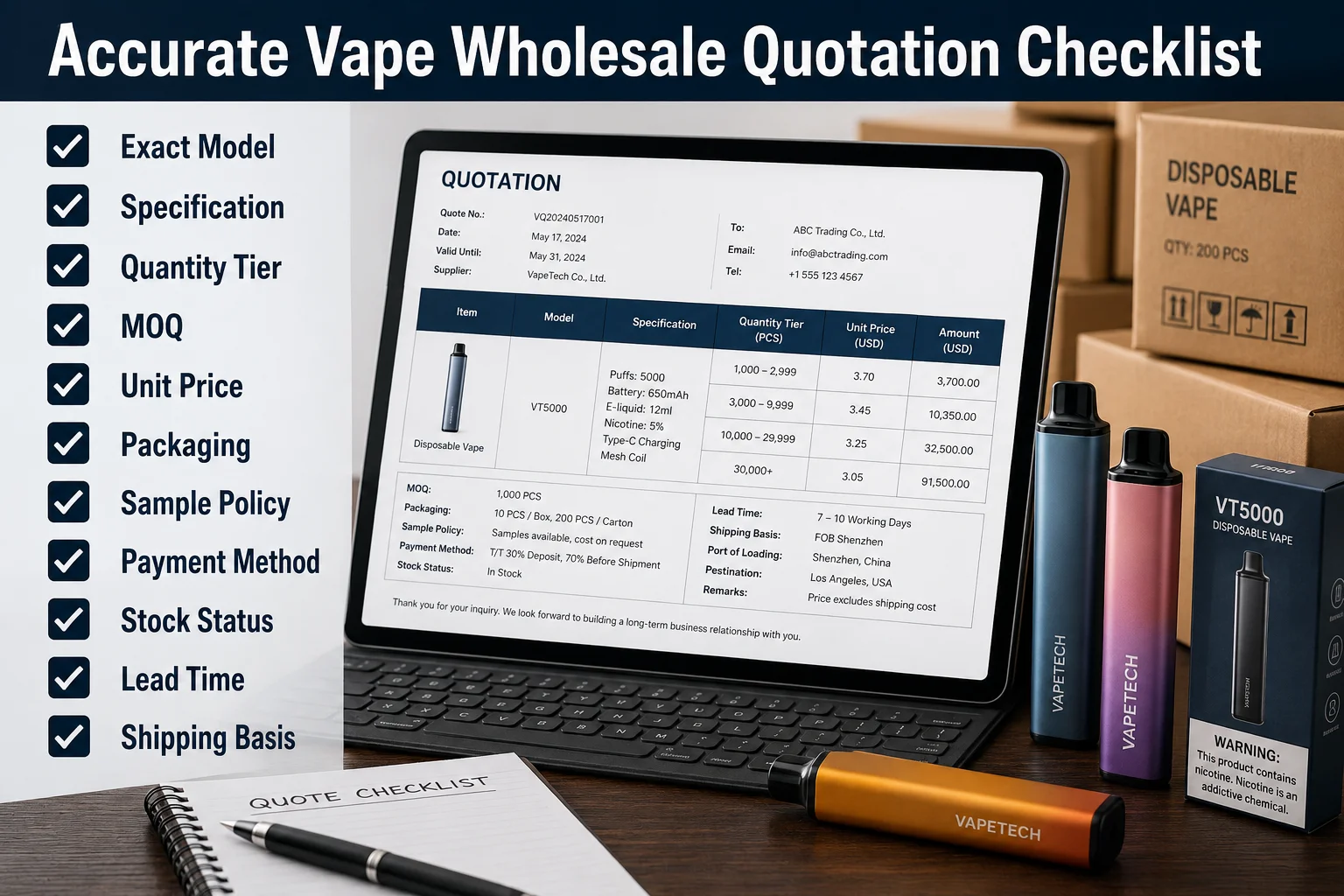
When you ask for a quote, I suggest asking for each item below in writing.
Wholesale Quotation Checklist
- Product name, model, color, flavor, capacity, and relevant specification
- Brand status: original brand, house brand, or OEM/ODM project
- Unit price at different quantity levels
- MOQ for stock products and MOQ for custom packaging
- Inner box and master-carton packing quantity
- Sample cost and sample shipping arrangement
- Stock availability or production lead time
- Payment method and order confirmation process
- Shipping basis: EXW, delivery to your forwarder, or another agreed arrangement
- Estimated freight options where available
- After-sales handling process for confirmed quality issues
- Available product documents or testing information, if relevant
I recommend asking the supplier to clearly state what is included and excluded. For example, a price may exclude shipping, taxes, local duties, destination handling charges, or custom packaging. The buyer should also understand that customs clearance, local regulations, and transport disruptions are outside a supplier’s complete control.
A useful question is: “What is the most practical option for my quantity and delivery deadline?” That question is better than asking for the fastest or cheapest option without context.
What Trust Signals Should Importers Request from Suppliers?
Trust is important in vape sourcing because buyers may be ordering branded products, electronic devices, batteries, packaging, and goods that require careful handling. A polished website or low quote is not enough for a serious purchasing decision.
Importers should request practical trust signals such as company information, real product photos or videos, stock confirmation, brand authorization information where applicable, available testing or product documents, sample arrangements, clear order steps, and a written after-sales process. These checks help buyers evaluate a supplier before increasing order size.
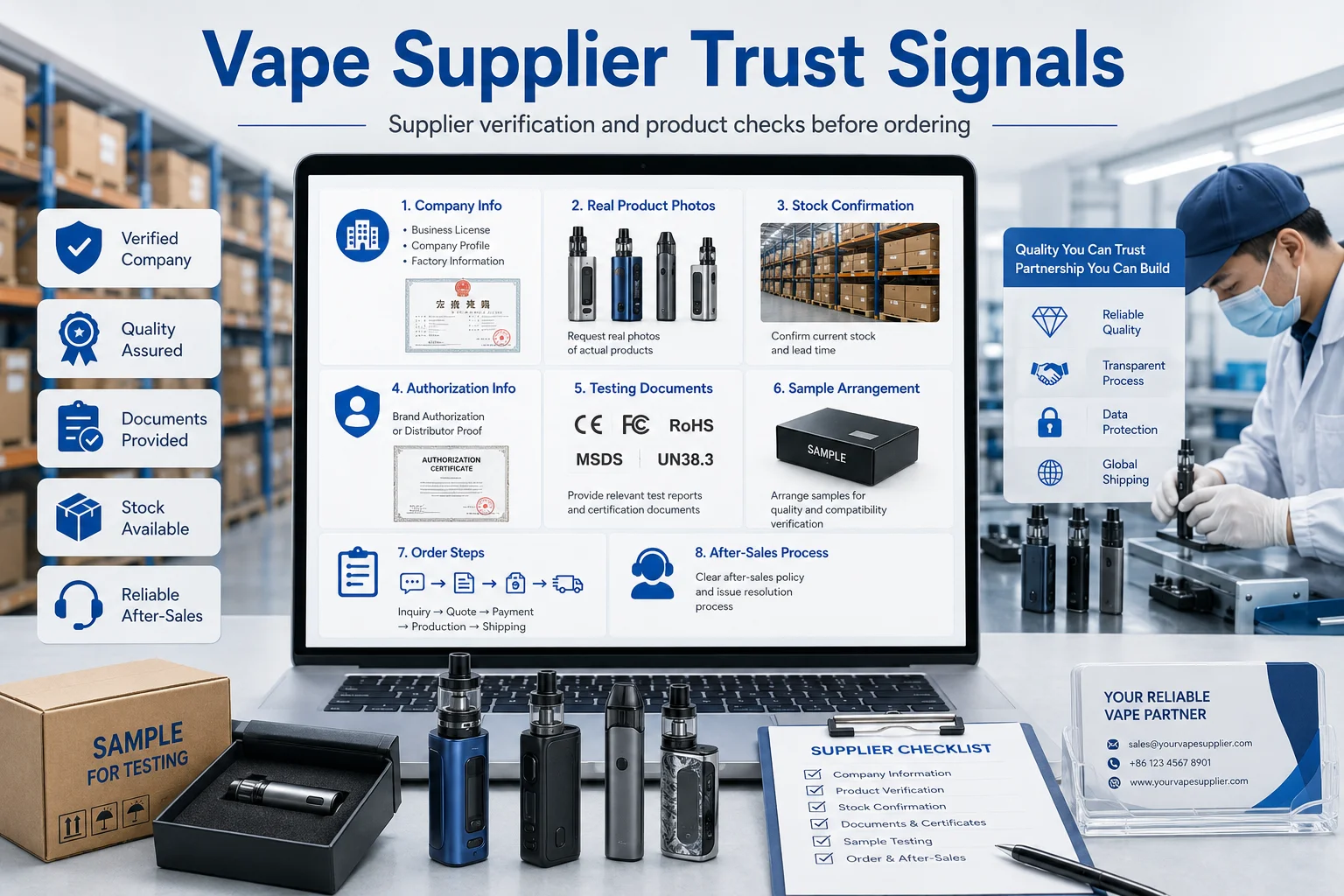
At Shenzhen Kingfuji Tech. Co., Ltd., we have operated in Shenzhen since 2011. Shenzhen is a major global supply base for vape hardware, accessories, related components, and logistics services. Our team works as a factory and integrated trading supplier, which means buyers can discuss our own products as well as broader one-stop sourcing needs.
What Buyers Can Reasonably Ask For
I encourage buyers to request:
- Company name, business contact details, and website
- Current product photos, videos, or live video verification where practical
- Inventory confirmation for stock orders
- Packaging photos and carton information
- Available documentation for the requested product
- Clarification on whether products are original branded stock, factory products, or OEM items
- Sample order procedures
- A written process for quality claims and after-sales communication
- Clear confirmation before payment of the final product specification
For larger buyers, I also recommend discussing factory capacity, OEM/ODM capability, packaging development, and project timelines. Our own factory covers approximately 5,000 square meters and has a stated maximum monthly capacity of up to 5 million units. However, buyers should always confirm the real production schedule for their specific product, not assume that capacity automatically means immediate availability.
What Communication Mistakes Delay Vape Orders?
Most vape order delays do not begin at production. They often begin when product details, quantities, packaging, or delivery expectations change after the quotation has already been prepared. These changes are normal in business, but they need to be managed clearly.
Common communication mistakes include changing requirements repeatedly, sending incomplete product details, ignoring the destination market, comparing only unit prices, assuming delivery terms, and failing to confirm final specifications before payment. Buyers can reduce confusion by keeping one written order summary that both sides approve.
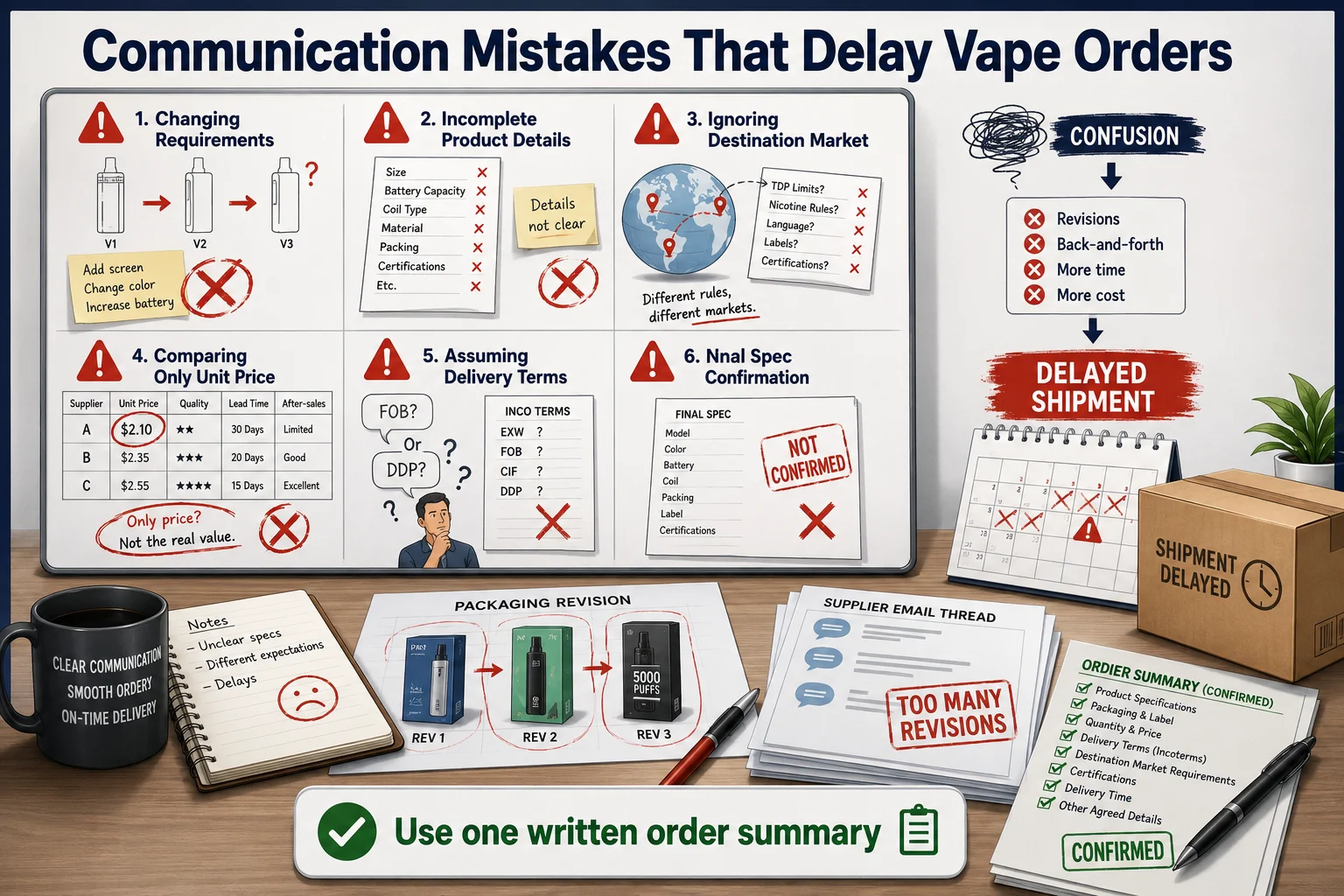
I have seen buyers spend days requesting prices from many suppliers, only to discover that every quote is based on a different product version, order quantity, or shipping assumption.
Mistakes to Avoid
-
Changing the product after receiving a quotation
A different flavor mix, battery specification, package, or quantity can change the price and lead time. -
Treating all shipping quotes as identical
Freight depends on destination, timing, volume, service method, and market conditions.[^5] Ask what the quote covers. -
Ignoring cash-flow pressure
A larger order may reduce unit price, but it may also tie up more money in slow-moving stock.[^6] -
Skipping samples for new product lines
Samples cannot eliminate all risk, but they can help you check product appearance, packaging, and suitability before a broader launch.[^7] -
Assuming compliance is the supplier’s full responsibility
Suppliers may provide available information, but importers should verify their own local laws, product requirements, taxes, and selling rules. -
Not confirming the final order summary
Confirm SKU, flavor, quantity, price, packaging, delivery terms, and payment details before proceeding.
This is another reason how small importers should talk to suppliers more clearly should be treated as an operating habit, not a one-time task.
What Is a Practical Buying Process for Smaller Vape Importers?
Small importers need a process that protects cash flow while allowing them to test demand. A first order should not try to solve every future product need. It should help the buyer learn what sells, what needs support, and what should be reordered.
A practical buying process for smaller vape importers is: define the sales channel, shortlist products, request comparable quotations, verify samples or product evidence, confirm available documents, place a manageable test order, review sell-through, and then expand the next order based on actual demand.
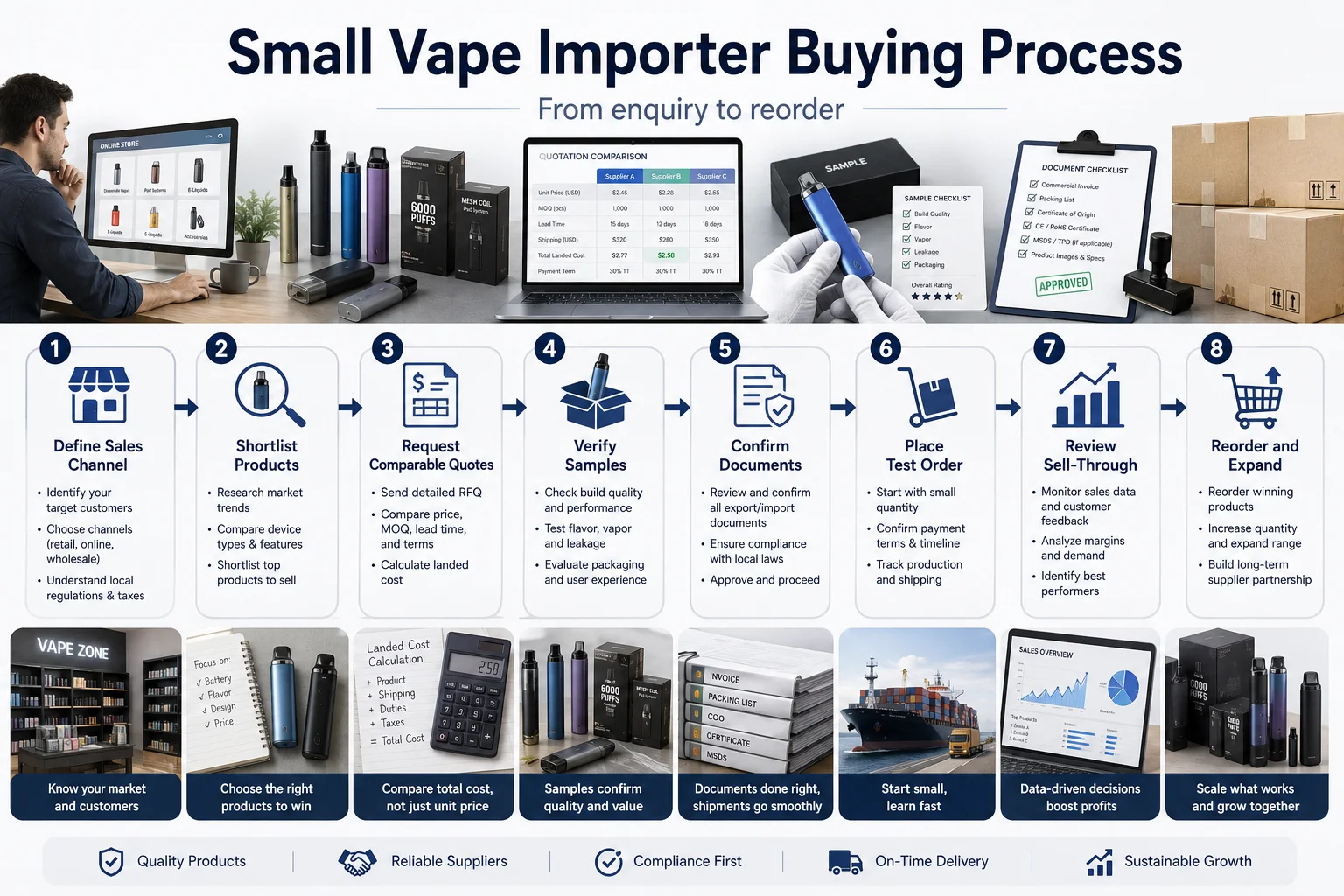
I recommend the following path:
1. Define Your Channel and Customer
Decide whether you sell mainly to vape shops, smoke shops, convenience stores, local retailers, or other wholesalers. Your channel determines your product mix.
2. Choose a Focused Starting Range
Do not start with too many slow-moving options. Select a manageable product range that fits your customers and budget.
3. Request a Comparable Quote
Give each supplier the same product, quantity, destination, and service requirements. This makes comparison more meaningful.
4. Verify Before Scaling
Use samples, product videos, packaging confirmation, and available documents. Ask questions early, before you commit to a larger order.
5. Select the Right Delivery Approach
For some smaller European buyers, available European warehouse stock may support lower MOQ and quicker local dispatch.[^8] For medium and larger importers, direct China sourcing may be more suitable when volume supports a stronger purchasing plan. The correct route depends on your needs, not on a universal rule.
6. Run a Controlled Test Order
Track sell-through, customer feedback, defects, and reorder timing. Then use that information for your second order.
This process helps buyers avoid chasing every new product without a plan. It also gives suppliers better information for future recommendations.
How Can You Request a Practical Vape Wholesale Recommendation?
A supplier can only make a useful recommendation when the buyer gives enough commercial context. You do not need a perfect business plan, but you do need to explain your market, channel, order size, and delivery needs honestly.
Tell KingVape your target country, sales channel, preferred products, estimated quantity, and delivery location. We will suggest a more practical wholesale product range and order approach based on your stated needs, available stock or production conditions, and the options that may fit your purchasing plan.
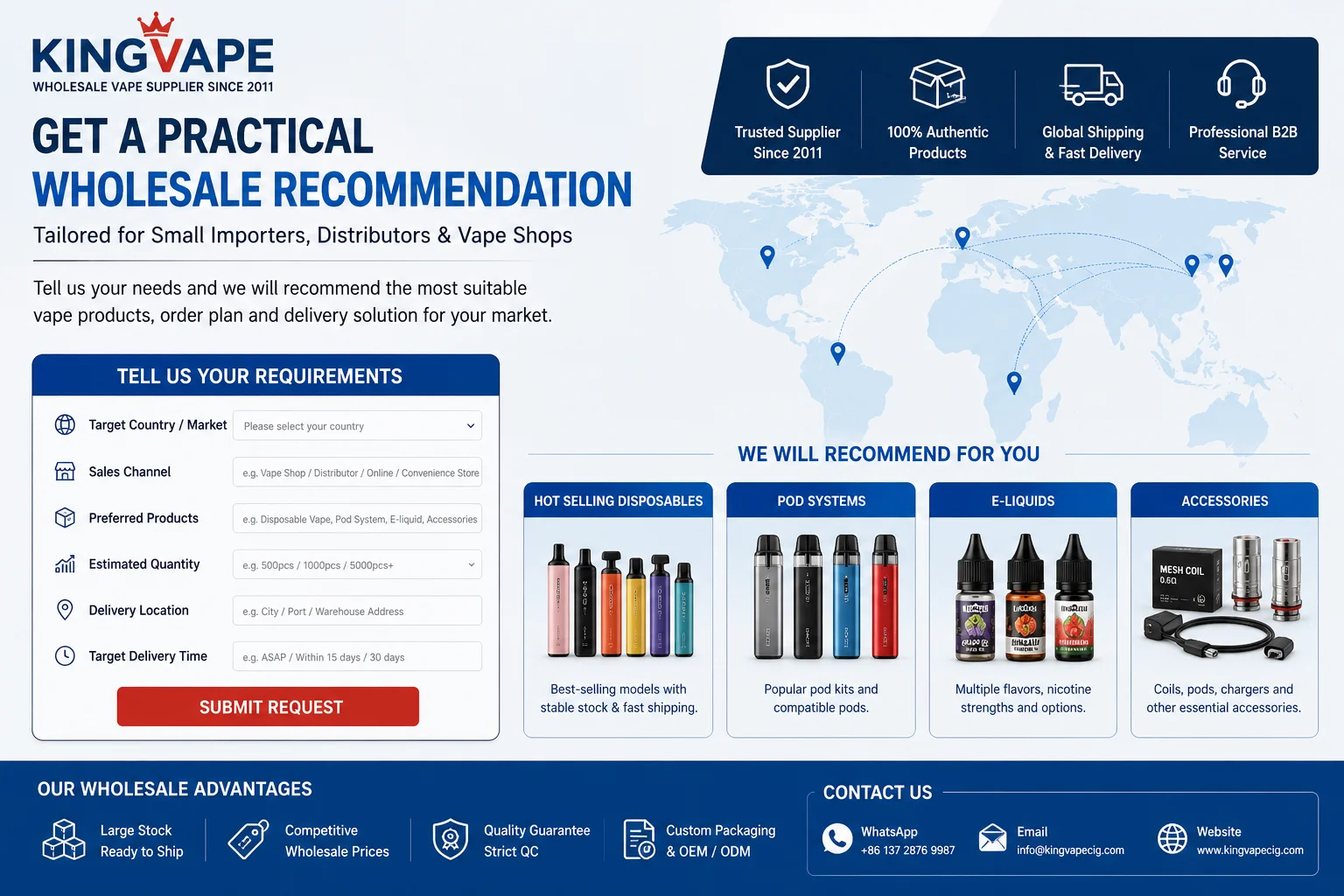
I work with buyers who need different routes:
- Smaller buyers may want lower MOQ, mixed products, and faster replenishment where European warehouse stock is available.
- Vape shop and smoke shop suppliers may need a broader one-stop range, including disposable vapes, batteries, atomizers, grinders, glass pipes, and related accessories.
- Medium and larger importers may prefer direct China purchasing for volume-based planning, wider product selection, and possible OEM/ODM discussions.
- Growing distributors may need new product development, custom branding, and one supplier to coordinate product sourcing and after-sales communication.
I do not believe the “best price” is always the best result. The better result is a product and delivery plan that your business can sell, replenish, and manage with confidence.
Frequently Asked Questions
What should I include in my first vape wholesale enquiry?
You should include your country, sales channel, desired product category or model, estimated order quantity, delivery location, target timing, and main priority. You should also state whether you need samples, branded stock, custom packaging, or OEM/ODM support.
How can I get an accurate vape quotation?
Ask for the exact product specification, quantity tier, MOQ, packaging quantity, stock status, lead time, payment terms, shipping basis, and included services. Compare quotations only when the product and delivery assumptions are the same.
Should small vape importers buy from a European warehouse or China?
The answer depends on your order size, urgency, cash flow, and inventory plan. European warehouse stock may suit smaller, faster test orders where available. Direct China imports may suit larger, planned orders that can support longer lead times and larger quantities.[^9]
Why is the lowest vape unit price not always the best choice?
The lowest unit price may not include freight, destination charges, packaging, delivery timing, after-sales handling, or inventory risk.[^10] Buyers should consider total landed cost, likely sell-through speed, reorder ability, and cash tied up in stock.
Can a supplier guarantee customs clearance or local compliance?
No supplier can fully control customs decisions, logistics disruptions, or local legal requirements.[^11] A supplier may provide available product information and shipping options, but the importer should verify local compliance, taxes, and import requirements independently.[^12]
Conclusion
How small importers should talk to suppliers more clearly is one of the simplest ways to improve vape wholesale buying results. A clear message helps you receive more relevant product suggestions, more comparable quotations, and a delivery plan that better fits your budget and sales channel. Focus on your destination, customer type, products, quantity, timing, and service priorities—not only the unit price. If you are sourcing vapes, vape accessories, or OEM/ODM products, contact KingVape with your purchasing brief at info@kingvapecig.com or visit www.kingvapecig.com.
Tags: small vape importer, vape supplier communication, vape wholesale enquiry, reliable vape supplier, vape wholesale quotation, vape shop wholesale, disposable vape importer, B2B vape sourcing, KingVape
Choose a Reliable Vape Supplier in China
Finding a trustworthy manufacturer matters for bulk orders. We verify factories and support due diligence. Contact us to start supplier vetting.
Related reading: How to Choose a Reliable Vape Wholesale Supplier in China
[^1]: "Know Your Incoterms", https://www.trade.gov/know-your-incoterms. International Chamber of Commerce Incoterms guidance explains that EXW places goods at the seller's premises for collection, with subsequent transport and related responsibilities generally borne by the buyer; a delivered quotation may therefore cover a materially different scope of costs and services. Evidence role: definition; source type: institution. Supports: The differing allocation of delivery, transport, export, and risk obligations under EXW and other delivery arrangements.. Scope note: The exact meaning of a delivered quotation depends on the named place and the contract terms used by the parties. [^2]: "Lead time to import, median case (days) - Glossary | DataBank", https://databank.worldbank.org/metadataglossary/world-development-indicators/series/LP.IMP.DURS.MD. Supply-chain research describes a recurring trade-off between faster replenishment, transport cost, inventory held, and working capital, supporting the need to evaluate sourcing routes against a buyer's volume, timing, and operational constraints. Evidence role: general_support; source type: education. Supports: The general trade-offs among transport lead time, inventory levels, order size, and working capital in supply-chain decisions.. Scope note: Such research provides a general decision framework and does not determine the best route for a particular importer or shipment. [^3]: "E-CIGARETTE FLAVOR RESTRICTIONS' EFFECTS ON ...", https://pmc.ncbi.nlm.nih.gov/articles/PMC13089908/. Public-health and consumer-behavior research reports that e-cigarette product use and preferences vary by jurisdiction, consumer group, product characteristics, and policy environment, including restrictions affecting flavors and sales. Evidence role: general_support; source type: research. Supports: That e-cigarette use and product preferences can differ across populations and regulatory environments, including by flavor and price-related factors.. Scope note: Evidence on consumer preferences does not establish demand for any specific product in a particular local market. [^4]: "Tobacco: E-cigarettes", https://www.who.int/news-room/questions-and-answers/item/tobacco-e-cigarettes. World Health Organization and regional regulatory guidance document that electronic nicotine-delivery systems may be subject to national or regional requirements concerning product characteristics, labelling, notifications, and sales practices. Evidence role: general_support; source type: institution. Supports: That electronic nicotine-delivery products are subject to jurisdiction-specific product, packaging, notification, and marketing rules.. Scope note: Applicable obligations depend on the destination jurisdiction and product classification and should be checked against current local law. [^5]: "Fathoming Shipping Costs: An Exploration", https://documents1.worldbank.org/curated/en/099436104042241280/pdf/IDU0c20d2ae90046304ca009ab508217e50747bd.pdf. UNCTAD analysis of maritime transport explains that freight costs are influenced by route characteristics, vessel capacity and demand, cargo and shipment conditions, fuel and operating costs, and wider market disruptions. Evidence role: mechanism; source type: institution. Supports: The main factors that influence freight costs and service availability, including route, demand, capacity, shipment characteristics, and transport mode.. Scope note: A general freight-rate analysis cannot validate a specific supplier's shipping quotation or delivery estimate. [^6]: "Inventory Management", https://www.uky.edu/~dsianita/300/inventory. Inventory-management research on quantity discounts and order-size decisions shows that lower purchase prices at higher volumes must be balanced against inventory holding costs, capital commitment, and the risk of demand not matching stocked quantities. Evidence role: mechanism; source type: research. Supports: The trade-off between quantity discounts and the holding-cost or working-capital burden of larger inventory purchases.. Scope note: The financially optimal order quantity depends on demand forecasts, financing costs, shelf life, and the buyer's specific replenishment conditions. [^7]: "Supplier Evaluation Process", https://supplychain.ucdavis.edu/procure-contract/supplier-evaluation. Quality-management guidance recognizes product sampling, inspection, and verification as methods for assessing specified characteristics before acceptance or scale-up; these controls reduce uncertainty but do not guarantee all future performance outcomes. Evidence role: general_support; source type: institution. Supports: That pre-production or pre-purchase samples and inspection are used to assess conformance before wider procurement or production.. Scope note: A sample may not be fully representative of later production, shipping conditions, or market performance. [^8]: "New Trends in Logistics in Europe (EN)", https://www.oecd.org/content/dam/oecd/en/publications/reports/1997/06/new-trends-in-logistics-in-europe_g1g3053e/9789282105634-en.pdf. Distribution-network research finds that inventory positioned nearer to customers can reduce delivery lead times and support more frequent replenishment, potentially making smaller shipments operationally feasible. Evidence role: general_support; source type: research. Supports: That geographically closer inventory locations can reduce distribution lead times and enable more frequent, smaller replenishment shipments.. Scope note: Local warehousing does not inherently guarantee a lower MOQ, lower cost, or faster dispatch; these depend on the warehouse operator's stock and commercial terms. [^9]: "Dual sourcing inventory management with nonconsecutive ...", https://pmc.ncbi.nlm.nih.gov/articles/PMC10170462/. Global-sourcing research describes how offshore procurement commonly involves longer transport and coordination lead times, making demand planning, shipment consolidation, and inventory decisions more consequential than in nearby sourcing arrangements. Evidence role: general_support; source type: research. Supports: The general relationship between offshore sourcing, longer replenishment lead times, shipment consolidation, and inventory planning.. Scope note: This general pattern does not show that direct imports from China are preferable for every large order, product category, or destination. [^10]: "Cost-Ins.-Freight (CIF) | BETA - International Trade Administration", https://beta.trade.gov/article?id=Cost-Insurance-and-Freight-CIF. Trade and procurement guidance distinguishes a product's unit purchase price from landed or total acquisition cost, which can include transport, insurance, duties, handling, and other costs associated with obtaining and holding imported goods. Evidence role: definition; source type: government. Supports: That landed or total procurement cost includes elements beyond the supplier's unit price, such as freight, insurance, duties, handling, and inventory-related costs.. Scope note: After-sales costs and inventory risk are business-specific and may not be included in formal landed-cost calculations. [^11]: "Chapter 4: Customs in a World of Enhanced Trade Facilitation in", https://www.elibrary.imf.org/display/book/9798400200120/CH004.xml. World Customs Organization materials describe customs administrations as the authorities responsible for applying import and border requirements, while international transport analyses document that disruptions can affect transit times and supply chains beyond an individual supplier's control. Evidence role: general_support; source type: institution. Supports: That customs authorities make clearance decisions under applicable law and that transport operations can be disrupted by external conditions.. Scope note: This does not excuse inaccurate supplier documentation or contractual non-performance where either is within the supplier's control. [^12]: "Basic Importing and Exporting", https://www.cbp.gov/trade/basic-import-export. Government customs and product-safety guidance commonly identifies importers as responsible for ensuring that imported goods meet applicable declaration, duty or tax, and product-compliance requirements before they are placed on the market. Evidence role: general_support; source type: government. Supports: That importers have responsibilities to meet applicable customs, tax, and product-compliance rules in the importing jurisdiction.. Scope note: The scope of responsibility varies by jurisdiction, product category, contractual arrangement, and whether another party is the importer of record.