
You see a new vape fly off the shelf in week one. Then the returns start piling up. That first order was a trap. Now you're stuck with dead stock and angry customers.
The real test of a vape product line is not how fast it sells the first time. It's whether customers come back for more without complaints. A product that generates repeat orders proves flavor consistency, low defect rate, and stable supply.[^1] Those are the actual profit drivers.
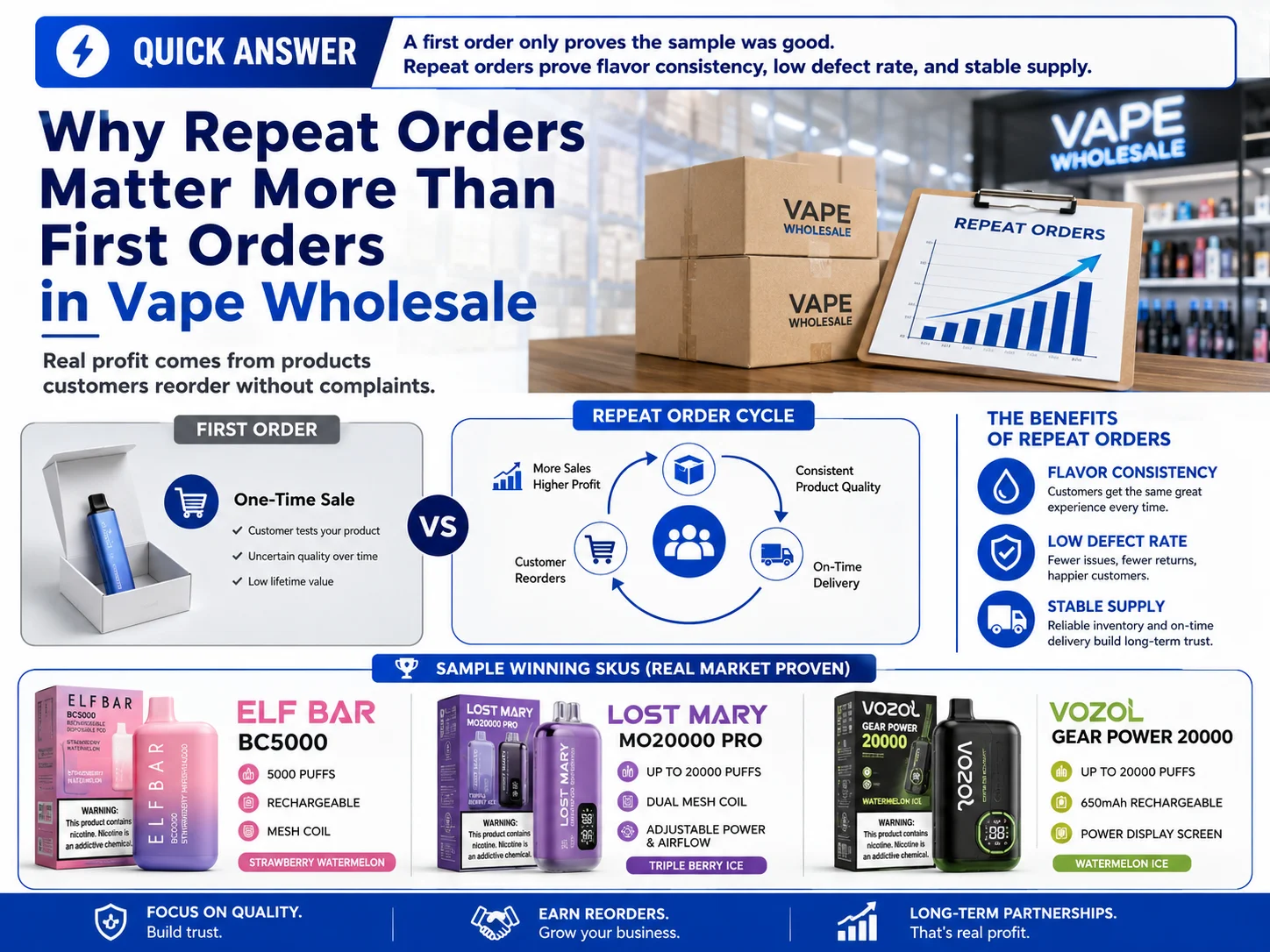
You know the feeling. You place a small test order, the product moves, and your confidence builds. But then you order a full container and the next batch tastes different. Batteries die early. The packaging is slightly off. Welcome to the real world of vape wholesale. Here, the repeat order is the only honest report card.
Quick Answer: Why Are Repeat Orders More Important Than First Orders in Vape Wholesale?
You worry that a hot new vape will make you rich overnight. But what if the second batch ruins your reputation? That's the hidden danger.
Repeat orders matter more because they confirm manufacturing consistency. A first order only proves the sample was good. The repeat order shows the factory can make the same product reliably at scale, batch after batch. That's what keeps your shop trusted.
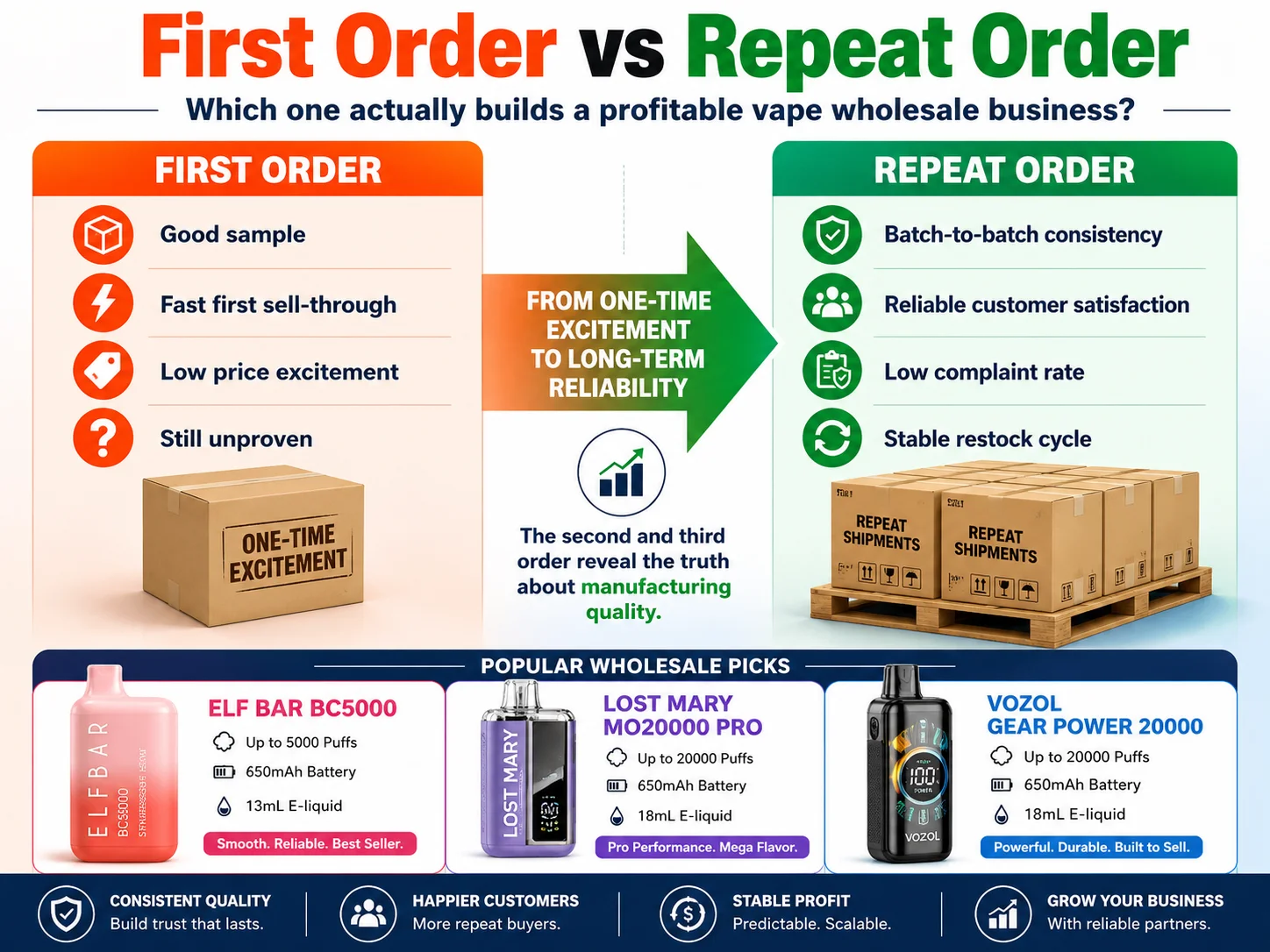
In my factory, we've seen this play out dozens of times. A customer tests a sample of a new disposable vape. It's great. The flavor pops, the draw is smooth. They place a first order of 5000 units. They reorder another 20,000 because the first batch sold out quickly. Then the third order arrives and the flavor is muted. The mouthfeel is different. The customers start returning them. I've had to sit with a buyer in Spain, a man named Carlos who runs a small chain of vape shops, and explain why the third batch felt dry. It wasn't the flavor house. It was a change in the cotton wick's density from a new supplier we had to use during a material shortage.[^2] We fixed it. But by then, Carlos had lost three weeks of sales and a few regular customers. That's the lesson. The first order is a lab test. The repeat order is the production line. Your business rides on the production line, not the lab.
What Does Repeat Order Logic Mean for Vape Wholesalers?
You think a product that sells fast must be a winner. But fast sales can hide a ticking time bomb of quality issues that only show up later.
Repeat order logic means you judge a product by its reorder rate and return rate, not just initial sell-through.[^3] A product with a high repeat order rate and low defect rate creates a predictable, low-risk inventory for your business. Without it, you're just gambling.
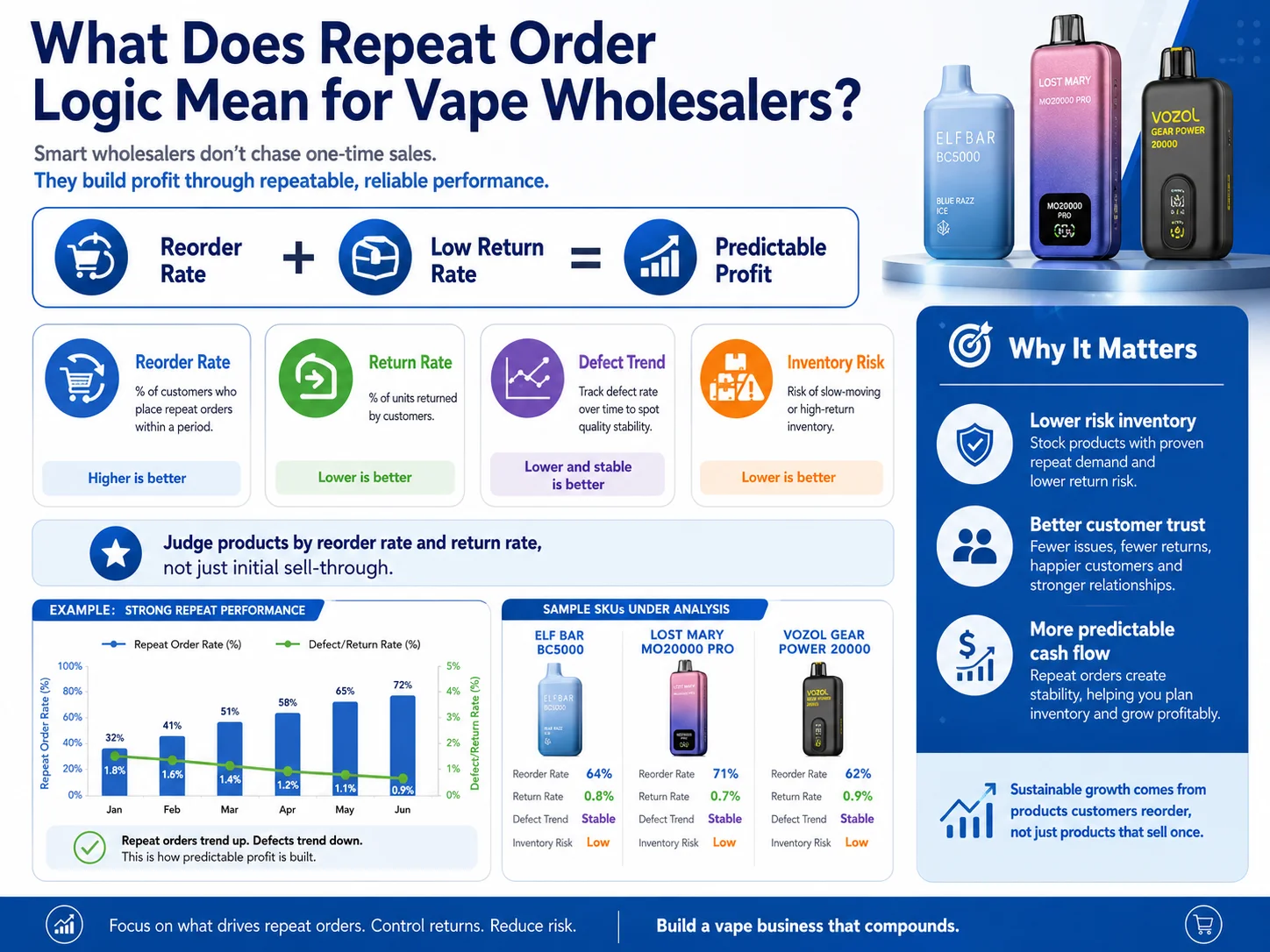
Here's what repeat order logic actually demands from you. Stop looking at the speed of the first 1000 units sold. Start watching what happens after the first 5000 units. In my experience, a product line can show a 95% sell-through on the first batch and then collapse on the second. Why? Because the first batch was made under ideal conditions: slow production speed, top-tier materials, and the most experienced workers on the line. When the order volume jumps, the factory speeds up the line. They might switch to a backup coil supplier because the main one can't deliver on time. The QC team might sample fewer units per hour to keep up with the packing schedule. These small changes add up. I've seen a 510 battery go from less than 1% failure rate to 8% between batch one and batch three.[^4] The buyer didn't notice until his retail customers started calling. Your job as a wholesaler is to ask: "What was the defect rate on the last three batches?" not "How many did you sell last month?" That's the repeat order logic.
Comparison Table: First Order Thinking vs Repeat Order Thinking
You get excited by a low price on a first order. But that low price might evaporate when you factor in the cost of returns and lost customers from a bad repeat order.
First order thinking chases the lowest price and fastest flash sale. Repeat order thinking tracks post-sale data like defect rate, flavor consistency, and supplier response time. One builds a business. The other builds a clearance rack.
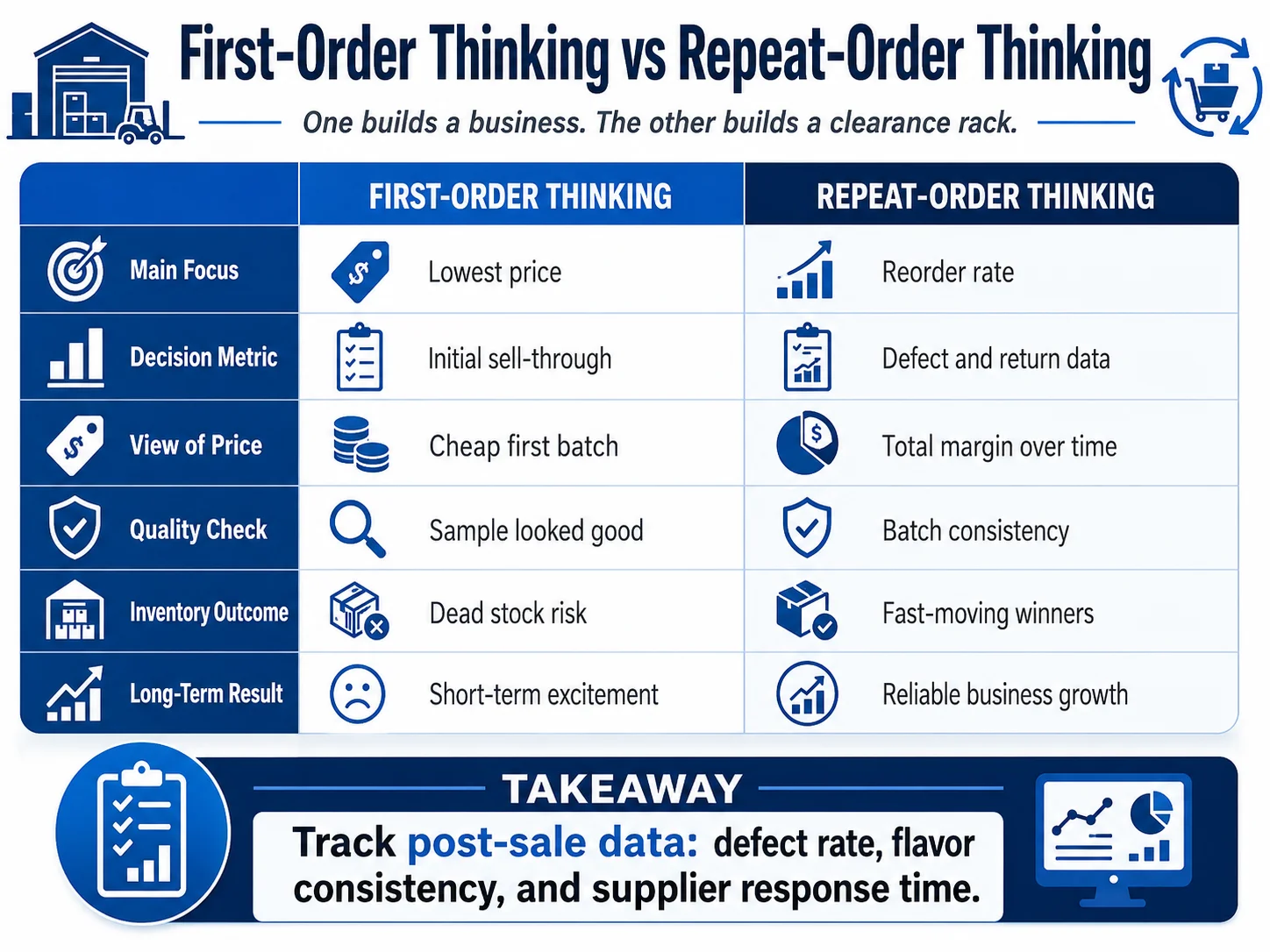
The difference looks like this in the real world. A customer of mine in the US, let's call him Mike, used to order a new rainbow-colored disposable every month. He'd buy 2000 units, sell them to a chain of gas stations, and move on to the next shiny thing. His first order thinking was simple: "If it's new and cheap, I'll sell it." But then he started noticing something. The gas stations were calling less. When he visited, he saw his own products sitting on the back shelf, not the front counter. The reason? The repeat orders of those "new and cheap" products were inconsistent. One batch had a strong throat hit, the next was weak. The store clerks stopped recommending them. Mike switched to a few core product lines from our factory. These lines had a boring but reliable track record. Yes, the unit price was a bit higher. But his repeat order rate stabilized. His returns dropped below 2%. His gas station owner asked for the same SKU every month. That's the table you need to internalize. First order thinking is a sprint. Repeat order thinking is a marathon. The marathon wins in wholesale.
Why Fast-Moving Products Matter More Than a Large Product Range
You believe a huge product catalog impresses your customers. But carrying 200 different disposable vapes with no repeat order data is a recipe for a storage unit full of dead money.
Fast-moving products mean products that reorder fast, not just sell fast once. A product that generates repeat orders every two weeks is worth more than ten products that sit on your shelf after one order. Focus on a few products with proven reorder velocity.
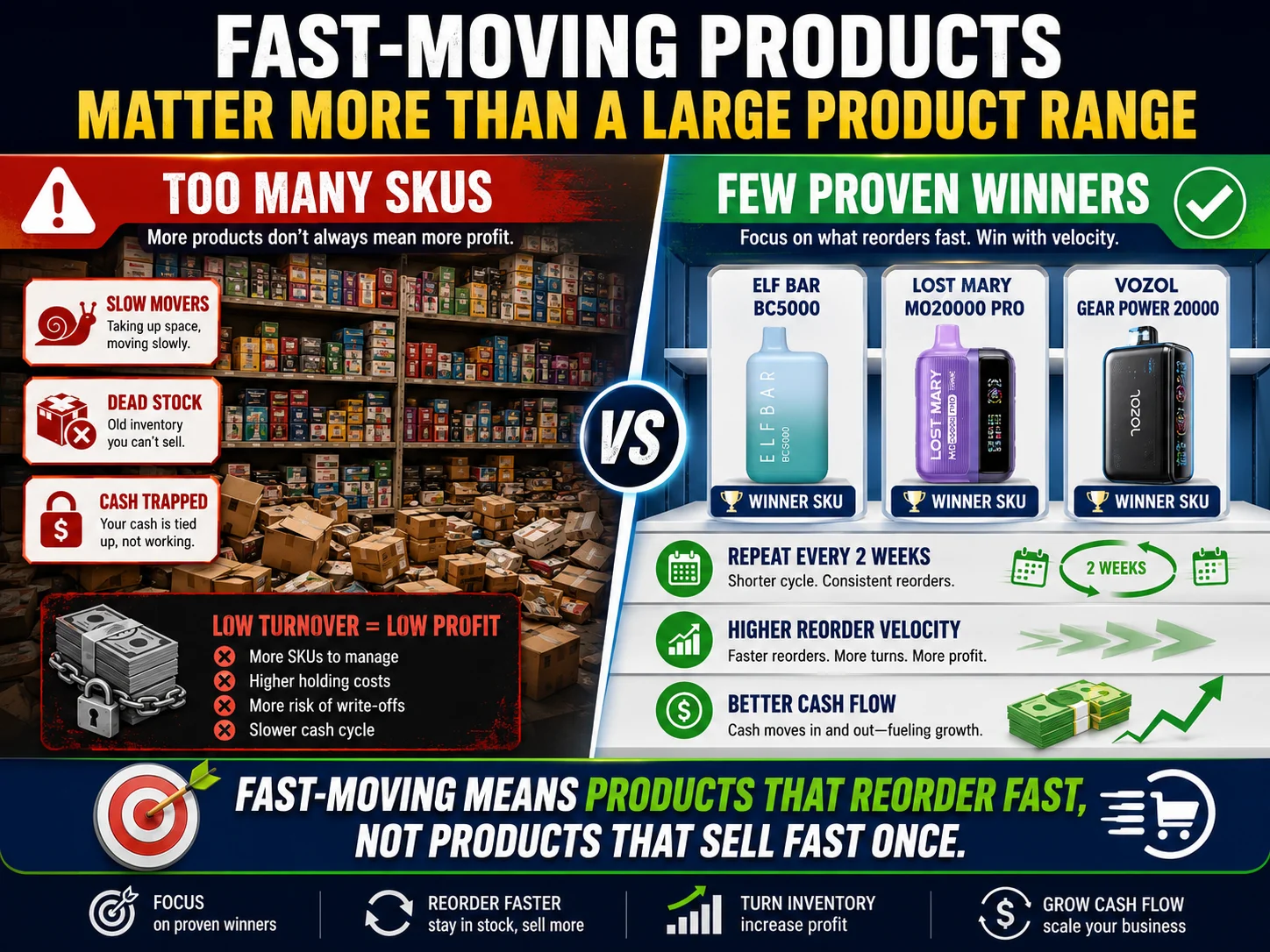
A large product range is often a sign of fear. Fear of missing out on the next trend. But in my factory, we see the sales data from hundreds of buyers. The buyers who grow steadily are the ones who double down on a handful of SKUs that have predictable reorder cycles. One of my customers in Germany, a small wholesaler named Anna, started with 50 different disposables. She was always chasing the next flavor and the next brand. Her cash flow was a mess. She was paying for air freight on new samples while old stock gathered dust. We sat down and looked at her reorder data. Only six products had been reordered more than three times without a single quality complaint. She cut her range to those six. Her sales didn't drop. They went up. Because now she could buy those six products in larger quantities and get a better price. She knew the defect rate was low, so she didn't have to factor in heavy return costs. Her cash flow smoothed out. She had room to breathe. Fast-moving products in the repeat order sense are not just the ones that sell quickly. They are the ones that sell quickly and come back without noise. That's a distinction worth a lot of money.
How Smoke Shops, Kiosks, Online Sellers, and Small Wholesalers Think About Reorders Differently
You might think a vape shop owner and a kiosk operator both want the same thing. But their reorder pain points are different, and you need to understand them to supply them well.
Smoke shops need consistent flavor and low defect for loyal customers. Kiosks need flashy newness but also fast reorder on a winner. Online sellers need low return rates to keep platform metrics healthy. Small wholesalers need a few stable products to build their route. Each values repeat order differently.
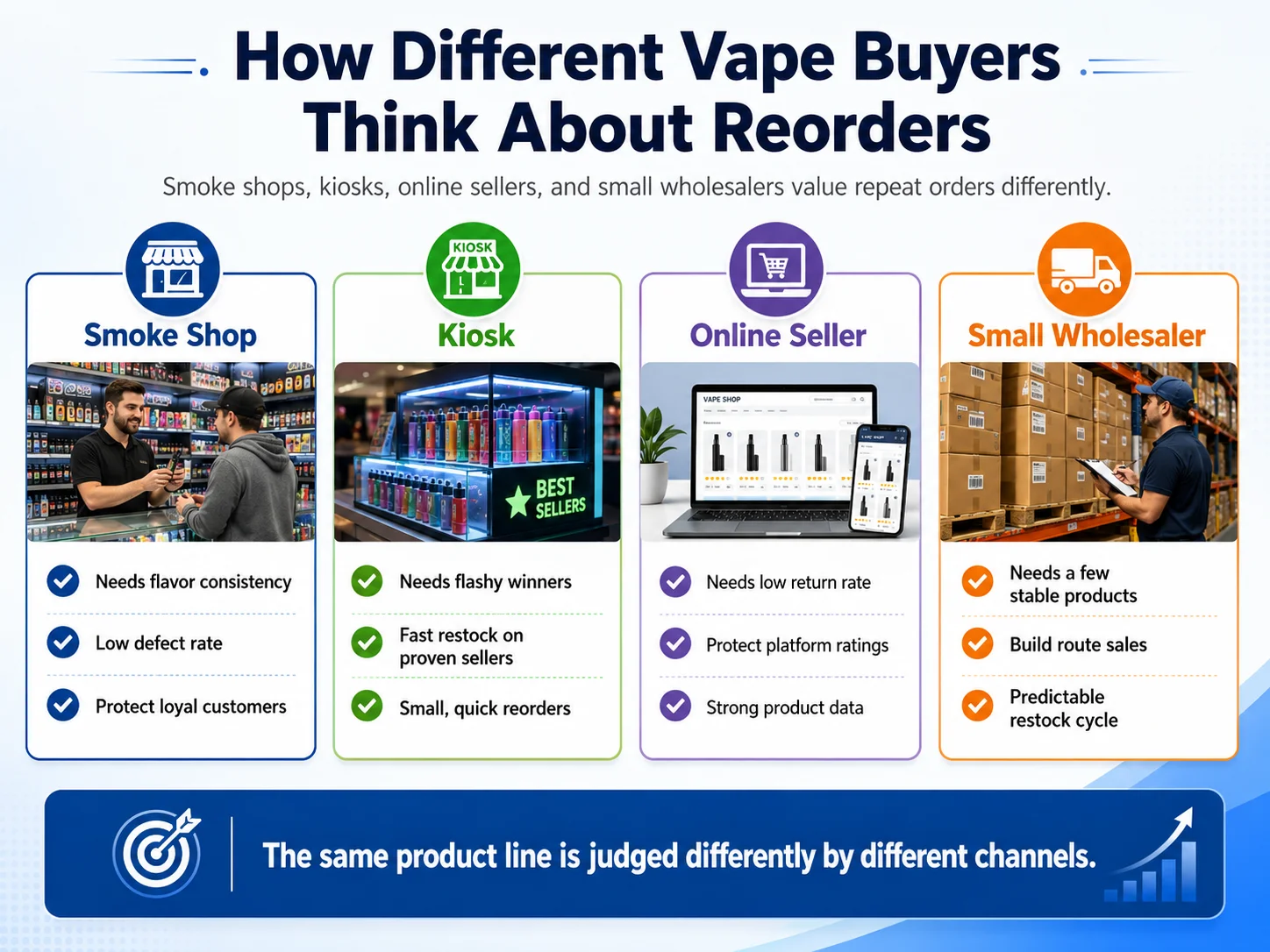
Let me break this down from the factory side. A smoke shop owner in a small town relies on repeat faces. If a customer buys a specific flavor of disposable every week, and one week it tastes different, that customer might walk. The smoke shop owner's reorder priority is batch-to-batch flavor consistency above all else. A kiosk in a mall, however, thrives on novelty. But the kiosk operator still needs a quick reorder on the one flavor that breaks out. Their pain is different: they can't afford to wait six weeks for a restock. They need a supplier with ready stock and fast shipping. An online seller on a platform like Amazon or a vape-specific site has another problem. Return rates matter. If a product has a 5% return rate, the platform algorithm punishes the listing.[^5] Their repeat order thinking is built on the lowest possible defect rate and the fastest possible supplier response to a quality complaint. Small wholesalers who drive a van to shops are the most pragmatic. They need a product that sells itself so they don't have to spend 20 minutes explaining it. They need it to be in stock, and they need it to not generate a call back the next day. Understanding these different angles lets you position your product line correctly. You don't sell the same story to a smoke shop that you sell to a kiosk, even if the product is the same.
What Product Signals Show a Vape Line Has Repeat Order Potential?
You see a shiny new product. The packaging is great, the price is low. But you can't see the signals that predict whether it will generate repeat orders. You need to know where to look.
Product signals for repeat order potential include: a simple, well-understood technology (like a mesh coil), a proven flavor profile, a history of the factory's batch consistency, and a low defect rate from past similar products. If the supplier can't show you that data, you're guessing.
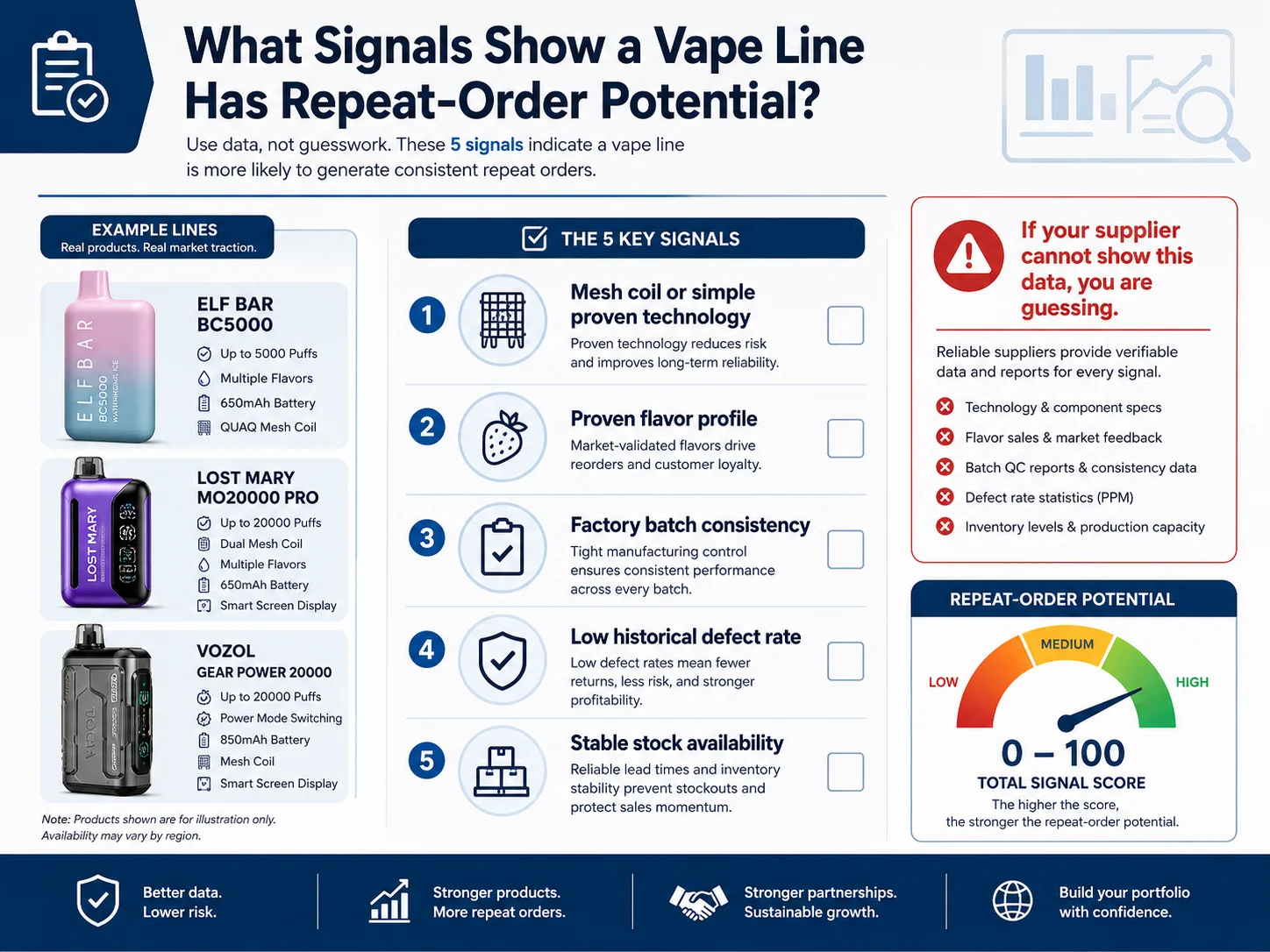
In my factory, I look for a few specific things on a new product before I even recommend it to a buyer. First, the coil. Mesh coils have a more predictable manufacturing process than traditional wire coils.[^6] The heating surface is more uniform, which means fewer dry hits and fewer returns. A product with a mesh coil is a safer bet for repeat orders. Second, the flavor. Stay away from exotic, complex flavor blends that are hard to replicate. A simple clear mint or a straightforward fruit mix is much easier to keep consistent from batch to batch.[^7] I've seen a complex dessert flavor that was a hit on the first order become a disaster on the third because the flavor house changed the caramel note slightly. Customers noticed. Third, the air flow sensor. A pressure sensor is more reliable than a button-activated one for disposables.[^8] Buttons can stick, and the quality of the button can vary. A pressure sensor with a tight manufacturing tolerance is a better signal. Finally, ask the supplier for the defect rate on their last three production runs of a similar product. If they look at you blankly, walk away. If they can show you a report with a defect rate under 2% and a consistent trend, the product has repeat order potential. It's not about the shiny wrapper. It's about the boring, internal data.
Why Stock Stability, Flavor Consistency, Defect Control, and Supplier Response Time Matter
You might think stock stability is just a logistics issue. But when a product is out of stock for three weeks, your customers forget about it. That kills the repeat order cycle.
Stock stability means the product is available when you need to reorder. Flavor consistency means the same taste every batch. Defect control means low returns. Fast supplier response time means problems get fixed before they hurt your business. These four pillars hold up repeat order profitability.
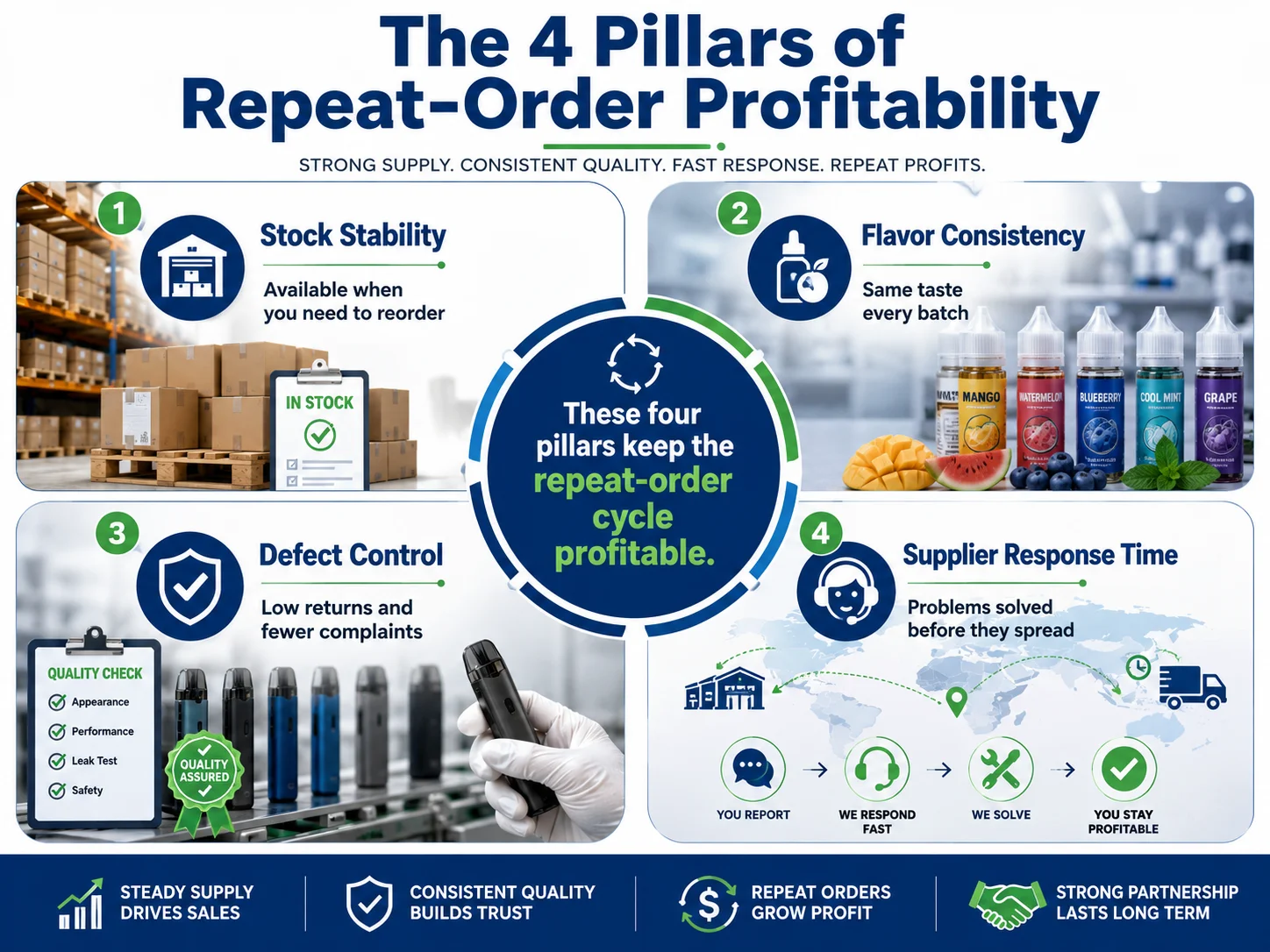
Let me explain how these four pillars work together, and how one cracks the others. A buyer in Ukraine, let's call him Dmytro, built a nice business on a single disposable vape from us. It had a perfect mint flavor and a solid battery. He was reordering every month. Then we had a material shortage. The cotton wick we used was out of stock. We had to substitute with a similar but not identical material. We informed Dmytro. He still ordered. The batch went out. The flavor was slightly different. His customers noticed. Some switched to a competitor. Then, because of the war situation, the shipping time doubled. That's the stock stability pillar crumbling. The defect rate from the substitute material was also slightly higher, about 4% instead of the usual 1.5%. That's defect control crumbling. The whole time, we were in contact with him quickly, offering partial credit and prioritizing the next batch with the original material. That's supplier response time holding the last thread. But the damage was done. The repeat order cycle was broken. It took him six months to rebuild that product's momentum. The lesson is this: these four pillars are not separate. They are a chain. If one breaks, the repeat order engine stops. You need to check all four with your supplier, not just the price.
Common Mistakes That Make Vape Products Hard to Reorder Profitably
You think you're saving money by choosing the cheapest option. But you're actually making a set of mistakes that turn a potential repeat seller into a one-time headache.
Common mistakes include: buying based on sample alone, ignoring the defect rate trend, chasing seasonal flavors with no reorder history, and not locking in a clear quality agreement with the supplier. Each mistake adds risk to the repeat order cycle.
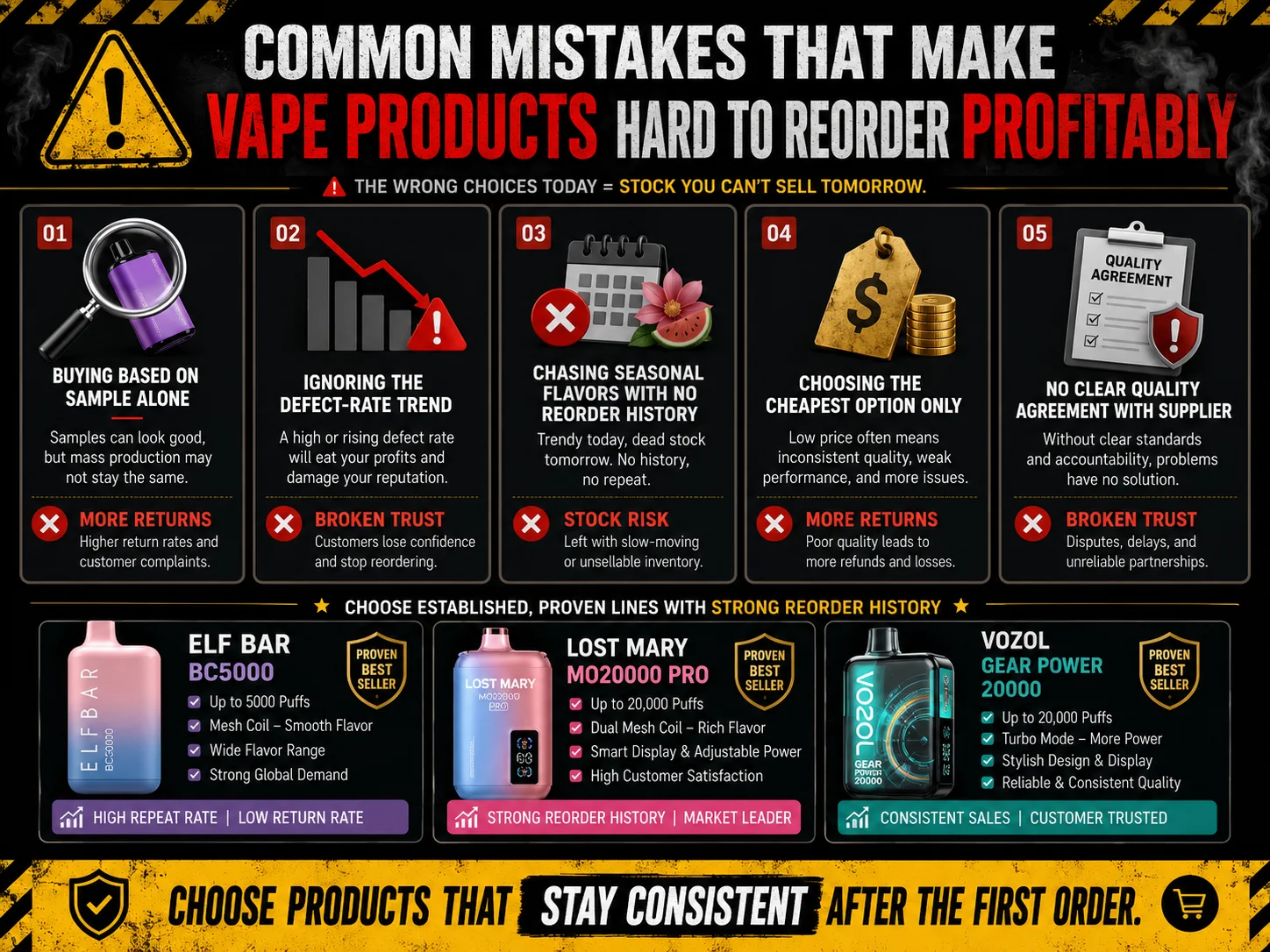
The biggest mistake I see is a buyer who falls in love with a sample and orders a container without a single quality checkpoint. A sample is made by hand, often by the engineering team. It's not a production unit.[^9] The second mistake is ignoring the defect rate trend. A defect rate of 3% on the first batch might be acceptable. But if it's 3% on the first, 5% on the second, and 7% on the third, the trend is fatal.[^10] You need to see the numbers moving in the right direction, not just a static number. The third mistake is chasing seasonal flavors. A pumpkin spice disposable in October might sell out. But will you get a repeat order next October? Probably not. The market moves on. You're left with leftover stock and a broken repeat cycle. The fourth mistake is the handshake deal. "We'll take care of defects." That's not a quality agreement. You need a written standard: what defect rate triggers a chargeback, how returns are handled, and what the response time is. Without that, you're arguing on the phone while your shop shelves are empty. Avoid these mistakes, and you give your product line a real chance to become a repeat order engine.
A More Practical Wholesale Approach Based on Repeat Demand
You are tired of the hype cycle. You want a simple, boring, profitable way to run your wholesale business. The answer is a repeat demand approach.
A practical approach means: pick a few products with proven repeat order data, buy them in larger quantities to get better pricing, and monitor the defect rate on every batch. Then build your sales pitch around the product's consistency, not its novelty.
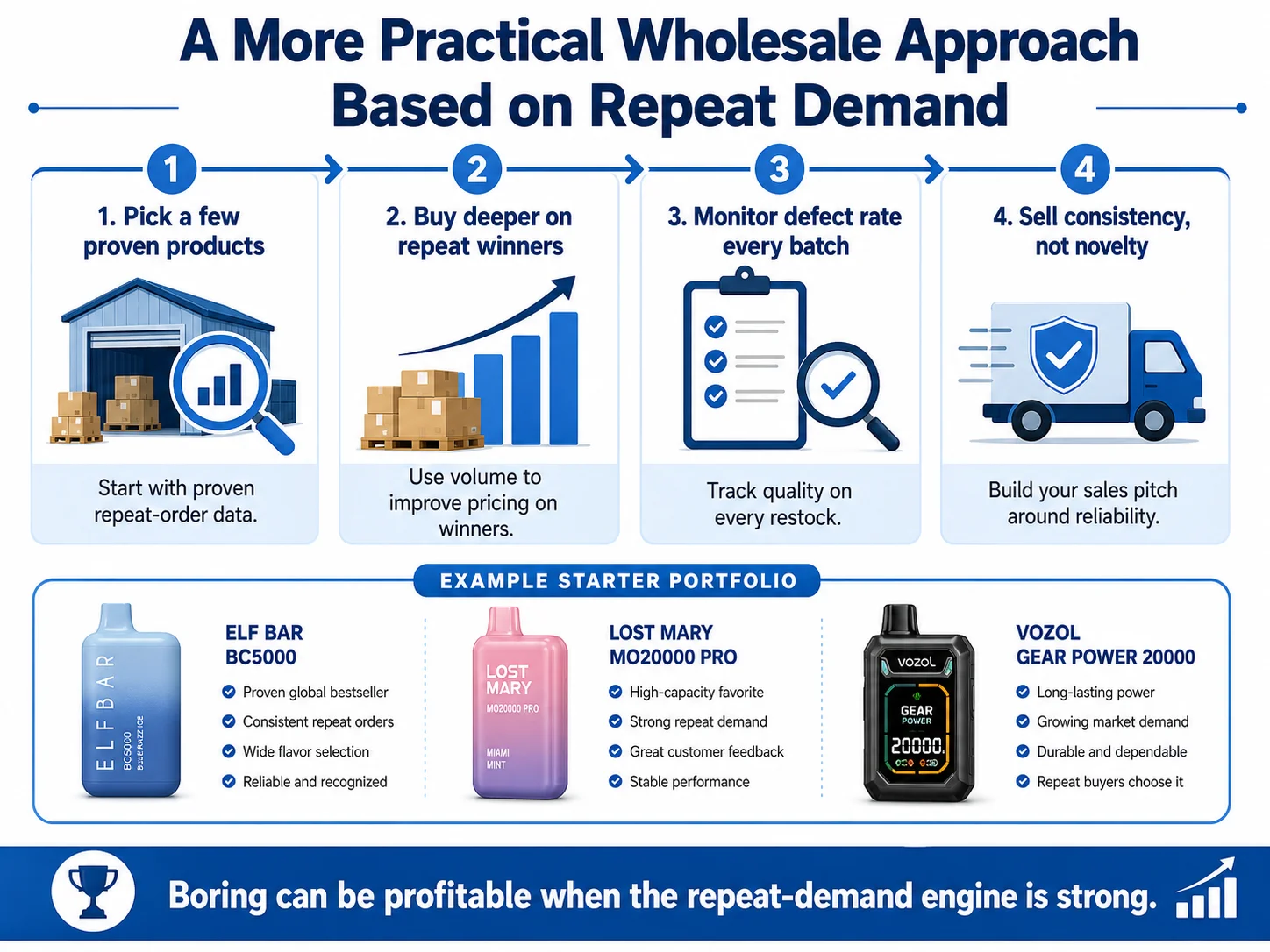
This approach changes how you talk to your customers. Instead of saying, "This is the newest, hottest vape," you say, "This is the disposable that my other shops reorder every two weeks. The defect rate is under 2%. The flavor is the same every time. You won't get a return." That's a much more powerful sales pitch to a busy shop owner. They don't want to be the tester. They want to be the seller. One of my customers in the UK, a wholesaler named Liam, adopted this approach. He narrowed his catalog to eight products. He had six months of repeat order data on each. He could show the shops the reorder frequency. He even offered a simple guarantee: if the defect rate on a batch exceeded 3%, he'd replace the defective units with no questions. His business grew because he removed the risk for his customers. He made their cash flow predictable. That's the power of a repeat demand approach. It's not flashy. It's not fast. But it turns your wholesale business into a utility, not a lottery ticket.
How KingVape Helps Buyers Choose Vape Products with Better Reorder Potential
You might think a factory just wants to push product. But at KingVape, we've built our reputation on helping buyers avoid the repeat order trap. We do it by sharing the data we have.
We help by showing defect rate trends, sharing batch consistency reports, and recommending products with a history of stable repeat orders. Our factory data and our European warehouse stock are built for buyers who want to build a repeat business, not just a one-time flash sale.
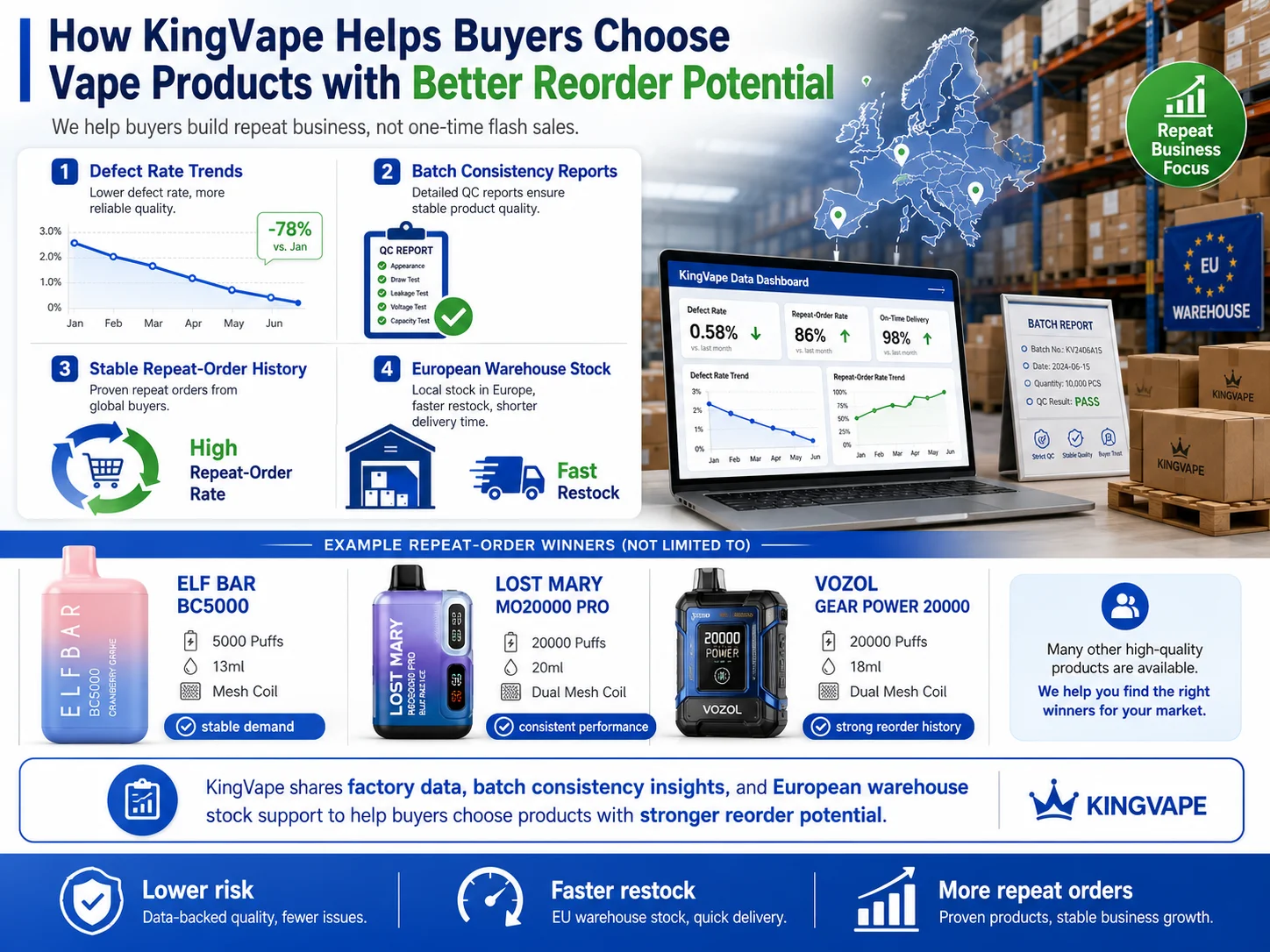
I'll be direct. We make money when you reorder. So it's in our interest to help you pick products that will reorder. That's why we don't push every new thing we make. We push the products that have a stable track record. For our European warehouse customers, we specifically stock products that have at least three months of consistent repeat order data from our Chinese shipments. We know the defect rate. We know the flavor stability. And we can ship them to you in 1-5 days with a low MOQ of 50 units, so you can test the repeat cycle yourself without a huge investment. For larger importers, we open up our production data. We can show you the incoming quality control reports, the aging test results, and the defect rate log for the last five production runs. That's not something every factory will do. But we want you to see that the repeat order is not a mystery. It's a process. And we've been running that process since 2011.
Conclusion
A first order is just a test. The repeat order is the proof. Build your vape wholesale business on the proof, not the promise.
[^1]: "[PDF] Customer Loyalty, Repurchase and Satisfaction: A Meta-Analytical ...", https://commons.erau.edu/cgi/viewcontent.cgi?article=1017&context=db-management. Academic studies in retail management indicate that perceived product consistency and low defect rates are significant predictors of repeat purchase behavior and long-term customer value. Evidence role: general_support; source type: research. Supports: Consistent product quality and low defect rates increase repeat purchases and customer lifetime value.. Scope note: This relationship has been examined in broad consumer goods categories and may not account for the specific regulatory and usage patterns of vaping products. [^2]: "The Evolving E-cigarette: Comparative Chemical Analyses of ...", https://pmc.ncbi.nlm.nih.gov/articles/PMC8915913/. Research on e-cigarette aerosol dynamics suggests that wick porosity and density influence liquid feed rate and vaporization temperature, which in turn may affect the sensory profile of the aerosol. Evidence role: mechanism; source type: paper. Supports: Changes in wicking material properties can alter vaporization and aerosol characteristics, affecting perceived flavor consistency.. Scope note: Controlled studies directly linking commercial cotton supplier variations to end-user flavor perception in mass-produced vapes are not publicly available. [^3]: "[PDF] The Effects of Return Policies in E-commerce", https://www.colorado.edu/economics/sites/default/files/attached-files/newberry.pdf. In retail analytics, metrics such as repeat purchase rate and product return rate are widely used to forecast product lifecycle profitability, often proving more informative than initial sell-through alone. Evidence role: general_support; source type: research. Supports: Repeat purchase and return rates are stronger leading indicators of sustainable product demand than first-order velocity.. Scope note: The relative importance of these metrics can vary by product category and channel; specific benchmarks for vape products are not established in academic literature. [^4]: "Batch‐to‐batch pharmacokinetic variability confounds current ...", https://pmc.ncbi.nlm.nih.gov/articles/PMC5102576/. Manufacturing engineering research documents that scaling production without corresponding process optimization can elevate defect rates due to factors such as supplier material variance and reduced inspection intensity. Evidence role: mechanism; source type: paper. Supports: Rapid production ramp-up can lead to increasing defect rates if process controls are not adequately adapted.. Scope note: The specific failure rate figures cited are anecdotal and the study results are from general electronics assembly, not from vape battery production lines. [^5]: "Amazon Return Rate Too High: How to Fix - Marknology", https://www.marknology.com/blogs/latest-e-commerce-news/amazon-return-rate-too-high-how-to-fix. E-commerce platform governance studies and seller guidelines confirm that product return rate is a significant factor in performance scoring, and elevated return rates can lead to reduced search visibility and even listing suppression in competitive categories. Evidence role: case_reference; source type: research. Supports: Major online marketplaces use customer return rates as a key metric for seller and product performance evaluation, which can affect search ranking.. Scope note: Specific numeric thresholds (such as 5%) are not publicly confirmed by platforms and may vary by product category and time; seller community reports often cite such benchmarks anecdotally. [^6]: "Carbonyls and Aerosol Mass Generation from Vaping Nicotine Salt ...", https://pmc.ncbi.nlm.nih.gov/articles/PMC10583227/. Investigations into e-cigarette heating element geometry indicate that mesh coils achieve more even heat distribution compared to single-wire coils, theoretically reducing the occurrence of localized overheating and dry hits. Evidence role: mechanism; source type: paper. Supports: Mesh heating elements provide more uniform surface temperature distribution, which can improve vaporization consistency.. Scope note: Most available studies are industry-funded or limited to laboratory setups rather than mass-production quality tracking. [^7]: "From Sensory Measurement to Consumption Behavior - PMC", https://pmc.ncbi.nlm.nih.gov/articles/PMC9818391/. Flavor chemistry literature notes that complex flavor profiles, comprising numerous volatile organic compounds, are more susceptible to sensory drift due to small variations in ingredient sourcing and blending, making simple profiles easier to standardize. Evidence role: mechanism; source type: paper. Supports: Simpler flavor formulations involve fewer volatile compounds, reducing the probability of perceptible batch-to-batch variation.. Scope note: Direct experimental comparisons specific to e-liquid flavor stability are sparse; the principle is extrapolated from food and beverage formulation research. [^8]: "MEMS Pressure Sensors | The Design Engineer's Guide - Avnet EMEA", https://my.avnet.com/abacus/solutions/technologies/sensors/pressure-sensors/core-technologies/mems/. Component reliability databases indicate that solid-state pressure sensors typically offer higher mean cycles to failure than mechanical push-button switches, making them mechanically more robust in high-cycle applications like disposable vapes. Evidence role: mechanism; source type: research. Supports: MEMS-based pressure sensors generally exhibit higher durability and longer operational life than mechanical button switches under repeated use.. Scope note: Overall system reliability also depends on integration quality and environmental protection; direct failure rate comparisons in disposable vape form factors are not publicly benchmarked. [^9]: "3 Reasons Why You Need a Golden Sample - SEACOMP", https://www.seacomp.com/resources/why-you-need-a-golden-sample. Product development research highlights the 'prototype-production gap', where hand-assembled samples frequently outperform production units, leading to optimistic quality expectations that must be managed during scaling. Evidence role: general_support; source type: paper. Supports: Pre-production engineering samples often exhibit superior performance metrics compared to mass-produced units due to controlled assembly conditions and selected components.. Scope note: The extent of this gap varies by product complexity and manufacturing maturity; no published data specifically quantifies this gap for disposable vape devices. [^10]: "Factors Affecting the Repurchase Intention of Organic Tea ...", https://pmc.ncbi.nlm.nih.gov/articles/PMC8869451/. Quality management research indicates that consistent or increasing defect rates, rather than one-time quality lapses, are interpreted by buyers as signs of poor process control, significantly reducing repurchase intentions. Evidence role: expert_consensus; source type: paper. Supports: An upward defect rate trend signals systemic degradation and can rapidly erode customer confidence and repurchase willingness.. Scope note: The specific defect percentages (3%, 5%, 7%) are illustrative; the acceptable tolerance and the point of “fatality” are product and market specific and not defined by a universal academic standard.