I have watched wholesalers rush to create their own brand. They see higher margins on paper. They see their logo on a box. It feels like the next big step. Then I watch the same wholesalers come back to me months later. They have cash locked in slow-moving stock. They are selling at a loss just to free up warehouse space. Most of them go back to buying branded stock from my warehouse. They tell me their money finally moves again. Starting your own brand is not just a marketing decision. It is a capital allocation decision.[^1] You must ask yourself where your money works hardest for you.
Moving too early into private label vape pens can freeze your cash flow and kill your business speed.[^2] For a wholesaler who makes money by turning inventory fast, tying up cash in high MOQ private label stock often has a worse return than simply buying proven branded products. The real choice is not between a brand and no brand. The real choice is between fast-spinning capital and slow-spinning capital.
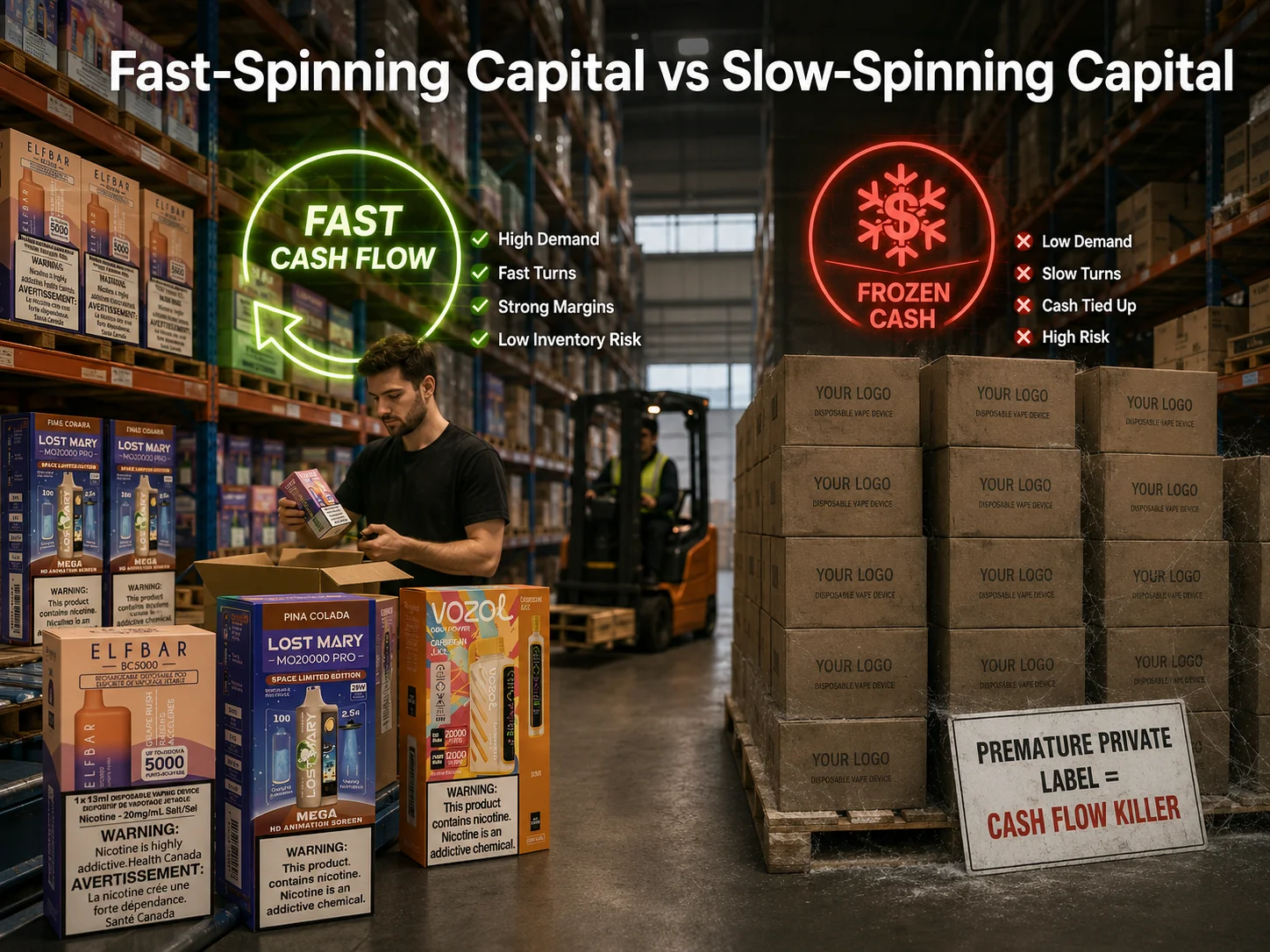
You are a wholesaler. You are good at spotting a hot product. You are good at getting it to your customers fast. You make money on the spread between your buying price and your selling price. The speed of this loop determines your profit. I want you to see the numbers clearly before you slow that loop down. I will walk you through the real costs. I will show you why your strength is selection speed, not brand building. We will look at the math of cash, not the emotion of seeing your own name on a product.
Quick Answer: Should Every Vape Wholesaler Start with Private Label?
I see this question almost every week. A new wholesaler asks me for a private label price list. They want 500 pieces with their logo. They think this is the only way to grow.
No. Not every vape wholesaler should start with a private label. If you are a cash-and-carry wholesaler or a distributor who survives on fast inventory turnover, private label can hurt you.[^3] You should only consider it when your current cash flow from branded stock is so stable that you can afford to lose your entire private label investment.
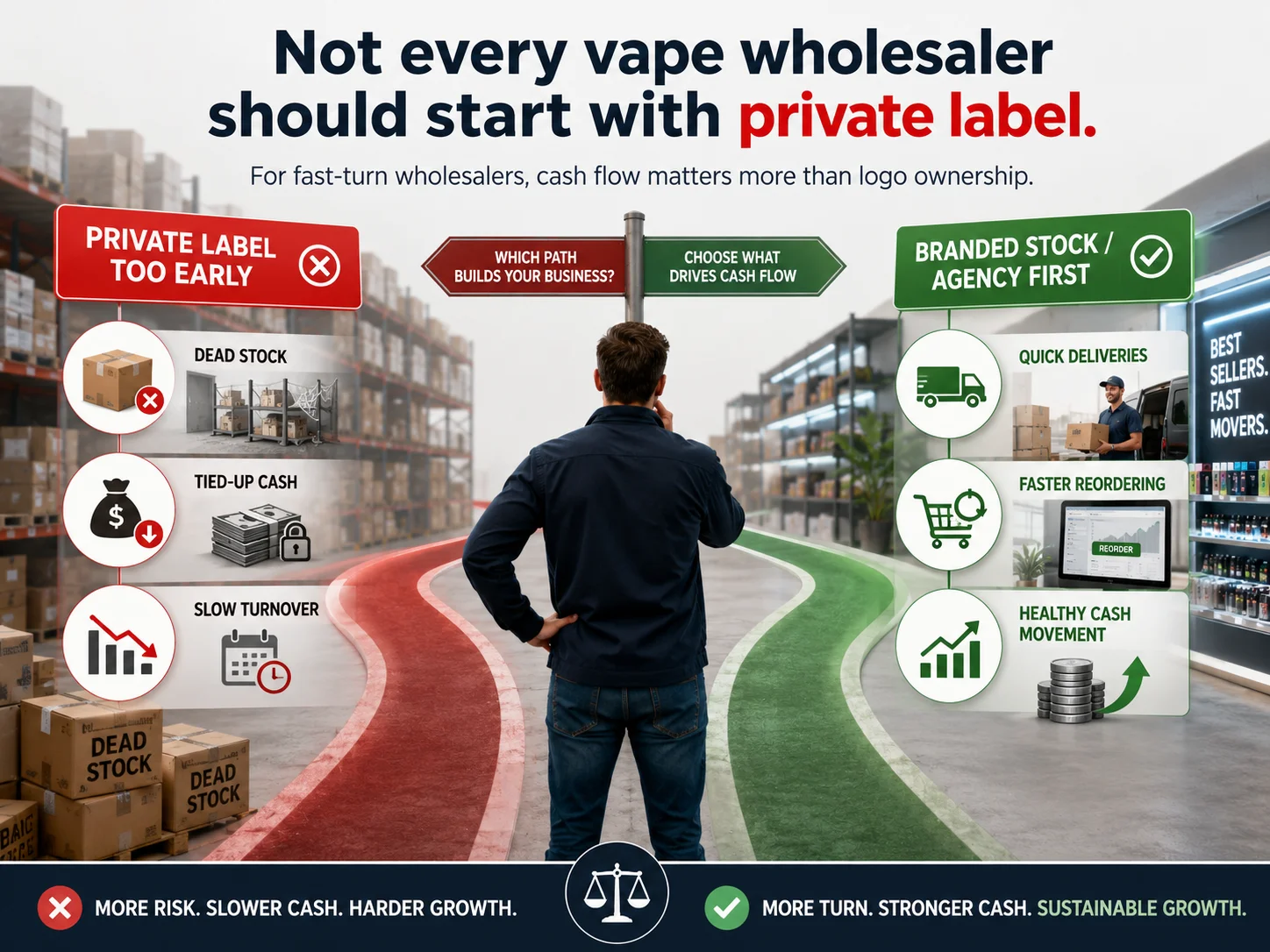
I learned this from a client in the US. He was moving 10,000 branded disposables a month. He was making steady money. He decided to lock $30,000 in a private label order. The product looked nice. The logo was printed perfectly. But his retailers did not want to push a brand nobody knew.[^4] He had to drop the price below cost. That $30,000 took nine months to come back. During those nine months, he did not have the cash to buy the new hot flavors from the big brands. His competitors took those sales. His branded stock business shrank. The money he lost on the branded side was bigger than any margin gain he hoped for on the private label side.
What Does Starting with Private Label Vape Really Mean?
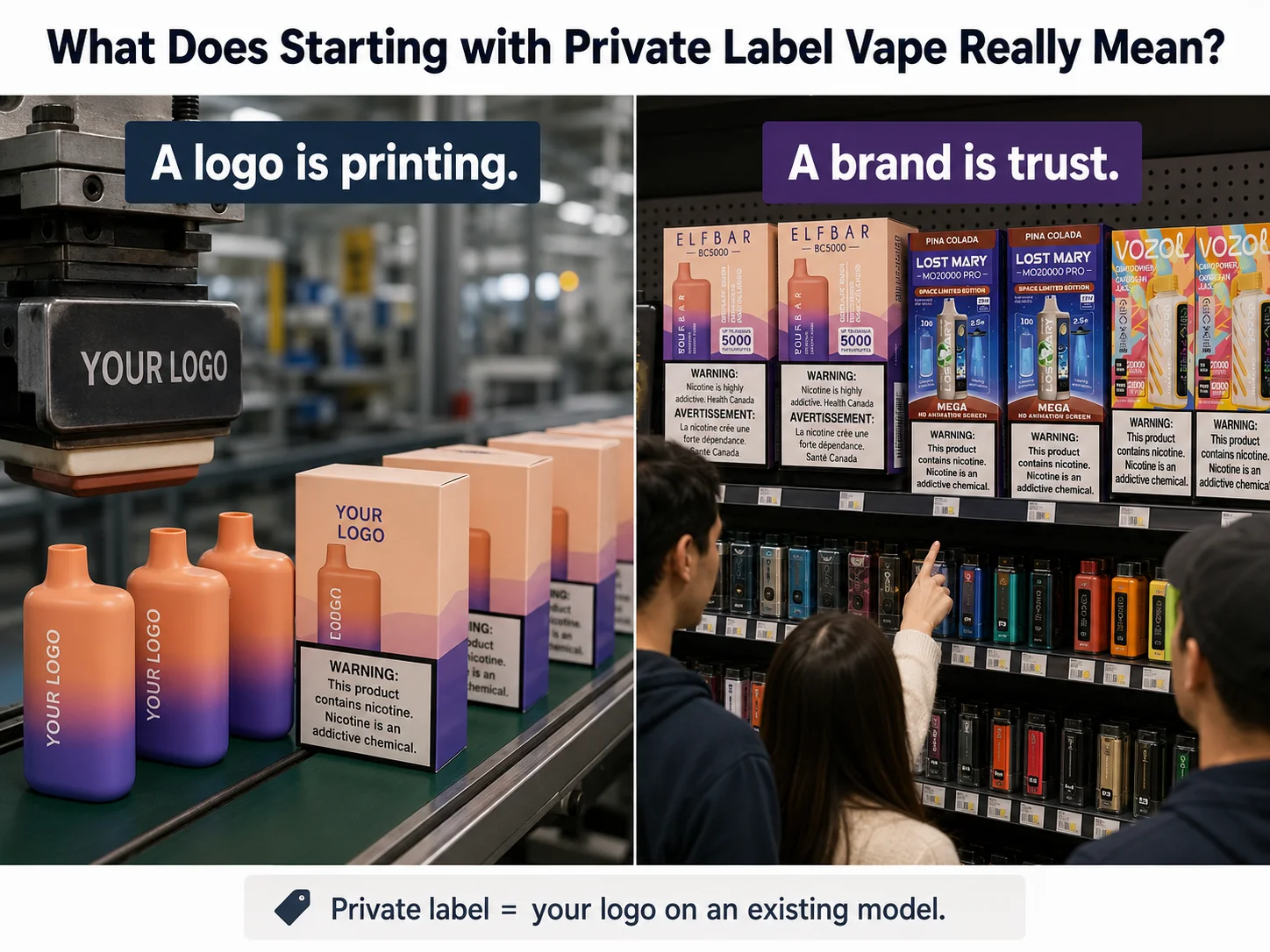
Many wholesalers think private label means building a brand. It does not. It simply means you pay a factory to stick your logo on an existing product model.
Starting a private label vape product means you accept the factory's Minimum Order Quantity and take full responsibility for selling that stock.[^5] A logo is a printing service. A brand is a promise that customers recognize, trust, and ask for by name.[^6] A logo does not sell a product when it sits on a shelf next to a famous brand that costs the same price.
I need to be very clear on this. The factory's job is to produce the device safely and ship it. My job is quality control and logistics. Your job is the hard part. You have to create demand. You have to convince a retail shop to give shelf space to an unknown name. You have to handle the warranty claims yourself. If a device from a big brand leaks, the shop blames the big brand. If your private label device leaks, the shop blames you. Your reputation is the one that breaks.[^7] I see wholesalers calculate the profit margin on paper. They see the cost of goods is lower. They forget to calculate the cost of reputation risk and the cost of static inventory. Those costs are real. They just do not show up on the invoice I send you.
Comparison Table: Branded Stock vs Agency vs Private Label vs OEM for New Wholesalers
You have choices. Each choice ties up a different amount of your cash and gives you a different type of control. Look at this table before you decide.
| Feature | Branded Stock (Europe Warehouse) | Agency/Distribution | Private Label (Your Logo) | Full OEM (Custom Design) |
|---|---|---|---|---|
| Minimum Order Quantity | 50 pcs per SKU | Negotiable bulk | 3,000 - 5,000 pcs per flavor | 10,000+ pcs |
| Cash Tied Up | Very Low | Medium | High | Very High |
| Speed to Market | 1-5 days (EU) | 2-3 weeks | 3-4 weeks | 2-3 months |
| Brand Ownership | None | Limited | Yours (Logo only) | Yours (Full design) |
| Risk if Demand Fails | Minimal loss | Loss on bulk stock | High dead stock risk | Extreme dead stock risk |
| Your Main Job | Selling | Selling + Account Mgmt | Selling + Marketing + Warranty | R&D + Marketing + Warranty |
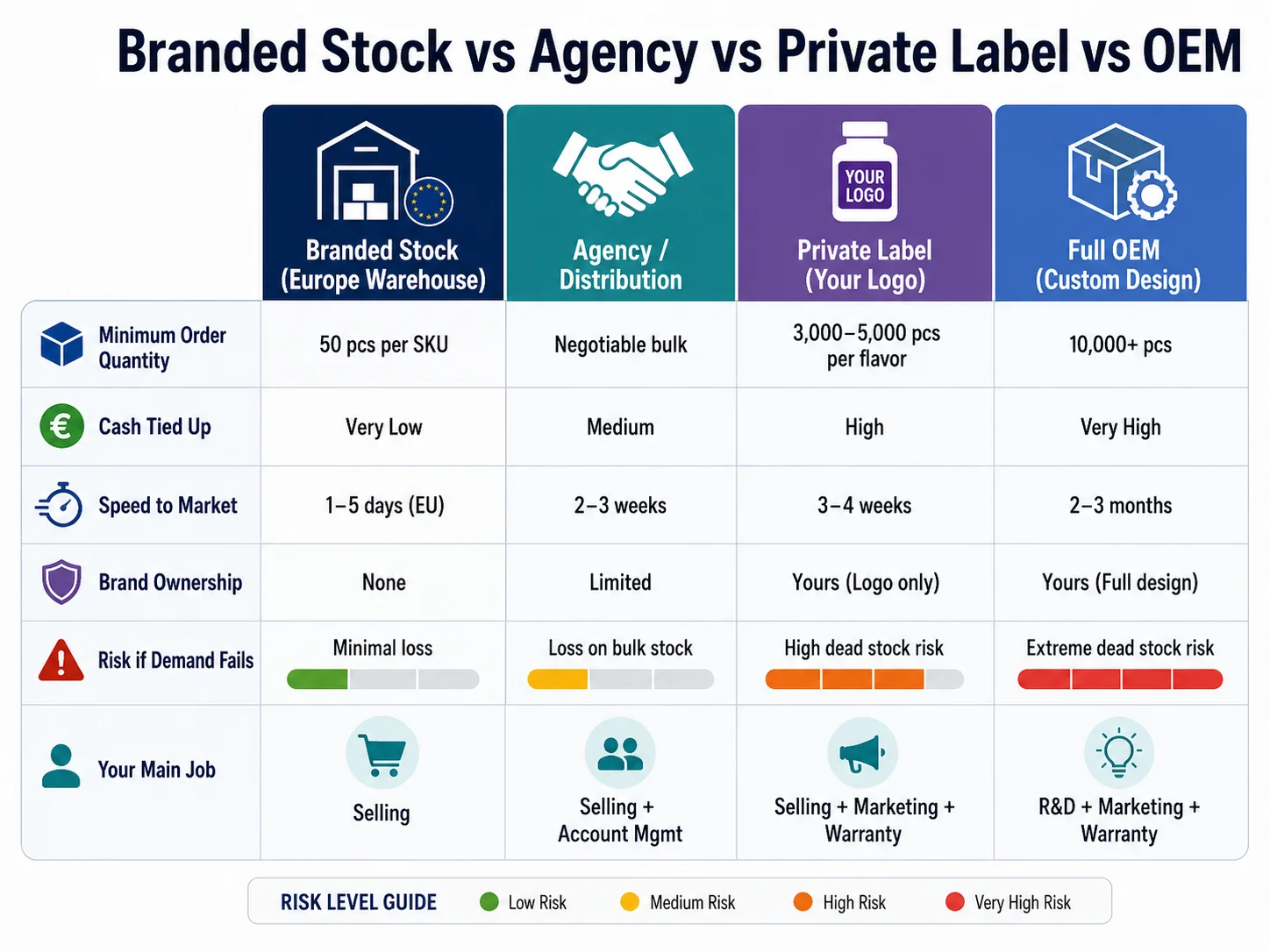
This table shows why small wholesalers love our European warehouse. You risk very little cash. You test the market fast. If a flavor dies, you only have 50 dead pieces. You move on. If you choose private label, you have thousands of dead pieces. You cannot move on because your money is stuck in a cardboard box in the corner. You start making bad decisions. You push that dead stock onto customers who trust you. That damages the relationship. All this damage comes from one simple mistake. You confused a printing service with a business model.
Why Private Label Can Be Risky If Your Market Demand Is Not Proven Yet
Guessing the market is dangerous. You might think you know what the next big flavor is. You might have a gut feeling about a specific puff count. But until you have cash receipts from actual sales, it is just a guess. Guessing with 50 pieces is safe. Guessing with 5,000 pieces is a gamble.
The biggest risk is proving demand at scale. You might sell 100 pieces to a few loyal shops as a favor. But that does not mean 1,000 walk-in consumers will pick your brand off the shelf over an established brand.[^8] True demand is proven by re-orders from strangers, not by a friend doing you a favor.
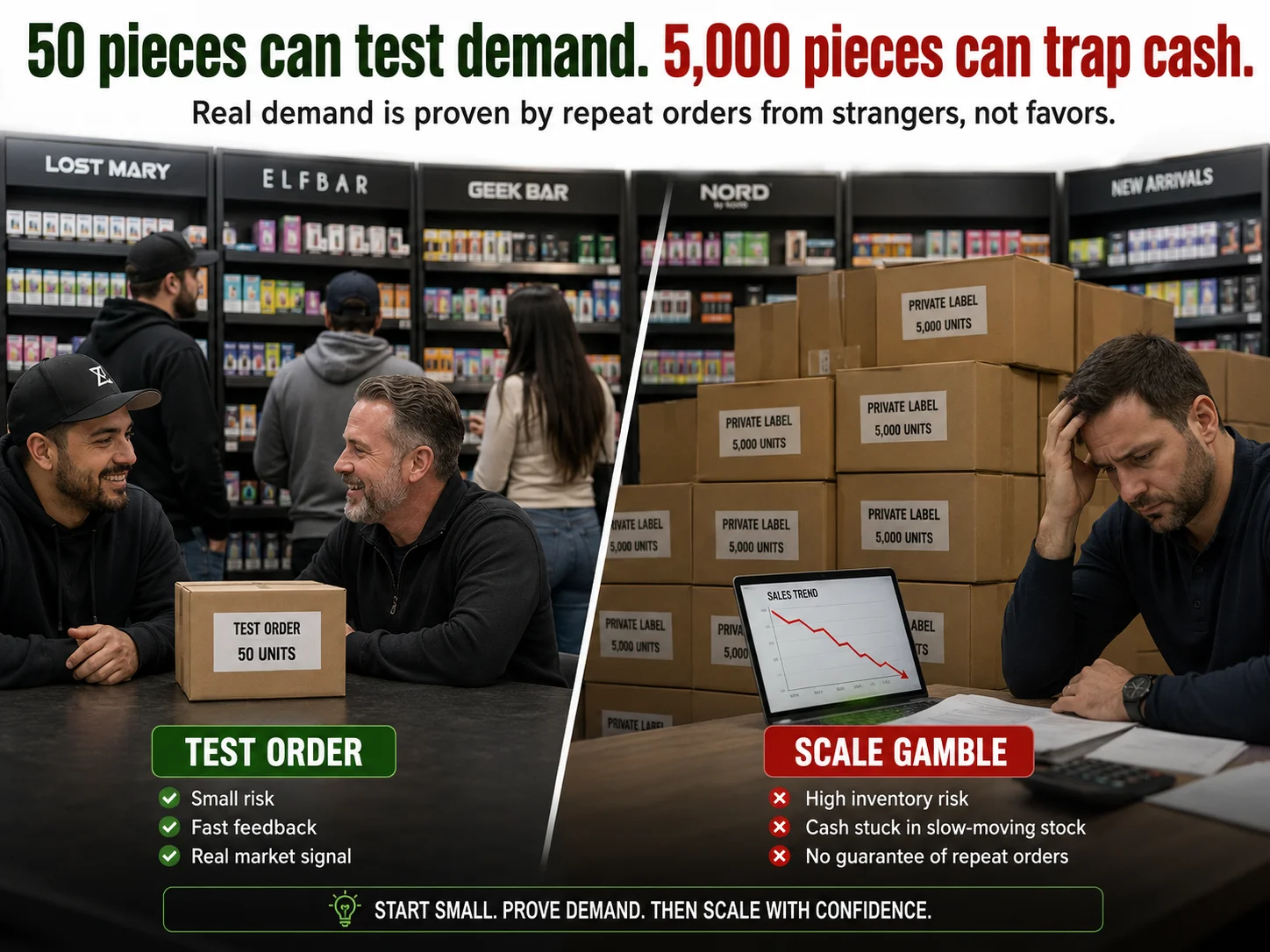
Once your cash is locked in that 5,000-piece order, your flexibility dies. The vape market changes fast. A new screen technology drops. A new regulation hits. A big brand slashes prices to clear stock. If your money is sitting in your private label stock, you cannot pivot. You cannot buy the new technology. You cannot match the price drop. You are stuck trying to convince people to buy last month's idea. I see this in the disposable market constantly. A wholesaler orders 10,000 pieces of a 600-puff thin pen. While the goods are on the water, the market shifts to 15,000-puff dual mesh big clouds. The 600-puff pens need a 50% discount to move. The wholesaler loses not just the margin but a chunk of the principal. That principal was the fuel for his whole business.
MOQ, Lead Time, Packaging, Cash Flow, and Inventory Pressure Explained
Let me break down the real numbers. An MOQ is not just a number. It is a lock on your bank account. If the MOQ is 3,000 pieces and your cost is $4 per unit, that is $12,000. But the cost does not stop there. You need custom packaging design. That is a design fee. You need the boxes printed. That increases the unit price.
MOQ locks your cash. Lead time delays your response to market changes. Custom packaging adds upfront design costs and increases the price per unit. This combined pressure means your money sits idle on a ship for weeks while the market trends shift on land.[^9] You pay for the product long before you can sell it.
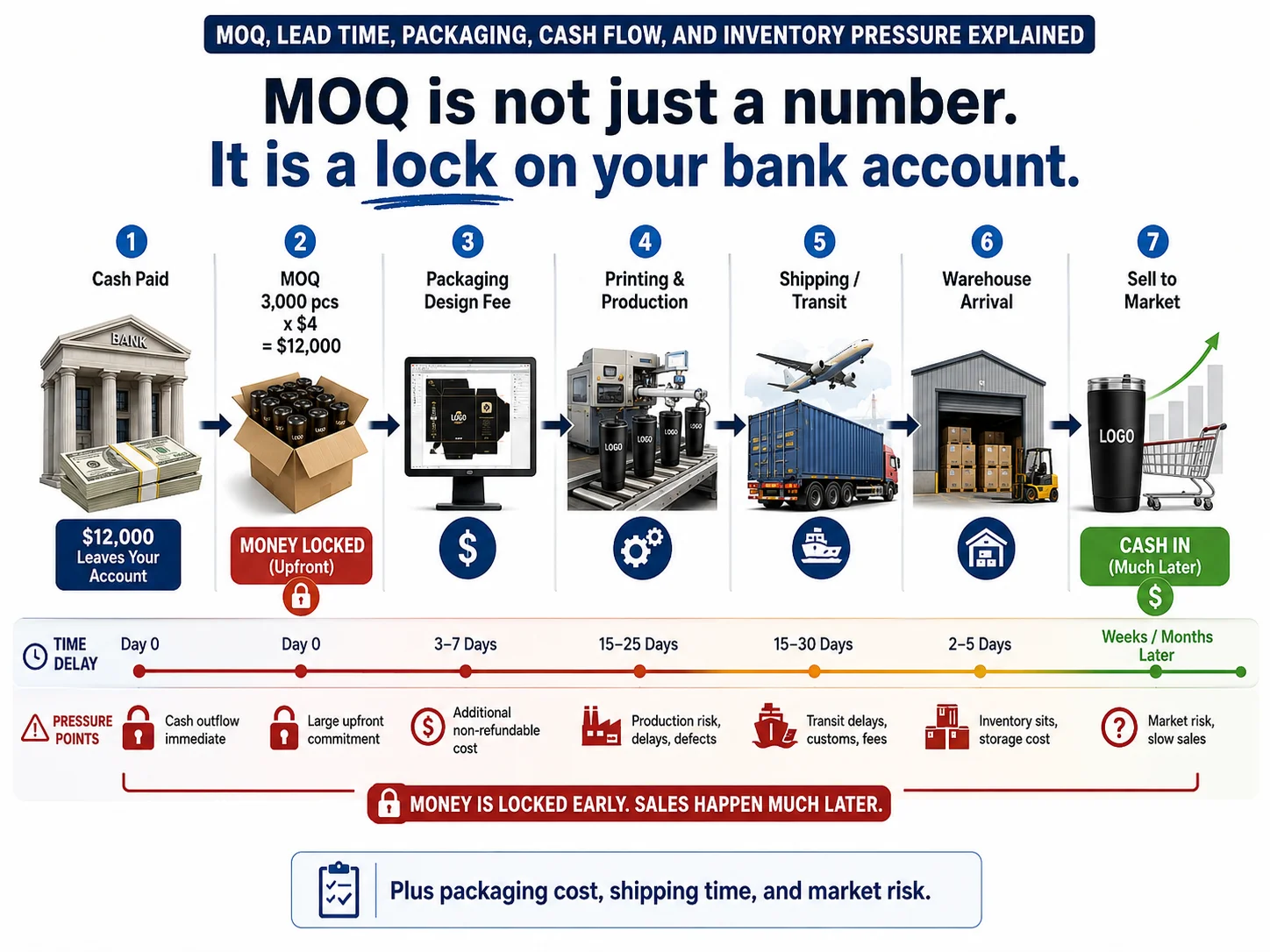
Here is the math from my factory floor. You order 3,000 pieces of a private label disposable. The production takes 15 days. The sea freight to Europe takes 25 days. Customs clearance takes 3 days. That is 43 days of your money doing nothing except facing risk. During those 43 days, a new viral product can appear on TikTok. Suddenly, the demand for your incoming product softens. You finally get the goods into your warehouse. You need to move them fast to get your cash back. But you cannot move them fast because no one knows your brand. You start extending credit to shops to incentivize them. Now you have not just inventory pressure. You have accounts receivable pressure. Your $12,000 investment needs a return. But if you had put that $12,000 into branded stock from my warehouse, you could have bought 1,200 pieces of five different hot brands. You would have sold half of them before the private label order even arrived. Your cash would already be back in your account, ready for the next flip.
Why Smaller Buyers Often Benefit from Branded Stock or Agency Models First
Speed is your only advantage as a small wholesaler. You are faster than the big distributors. You answer the phone faster. You deliver to the shop yourself. You know the shop owner by name. If you tie yourself to slow-moving private label inventory, you give up your only advantage against the giants.
Smaller buyers benefit from branded stock because it turns cash into more cash quickly. Using an agency model allows you to collect orders from your customers and then place a consolidated bulk order from the factory. This requires zero stock risk.[^10] You collect the money first, then you buy. Your margin is smaller, but your risk is zero.
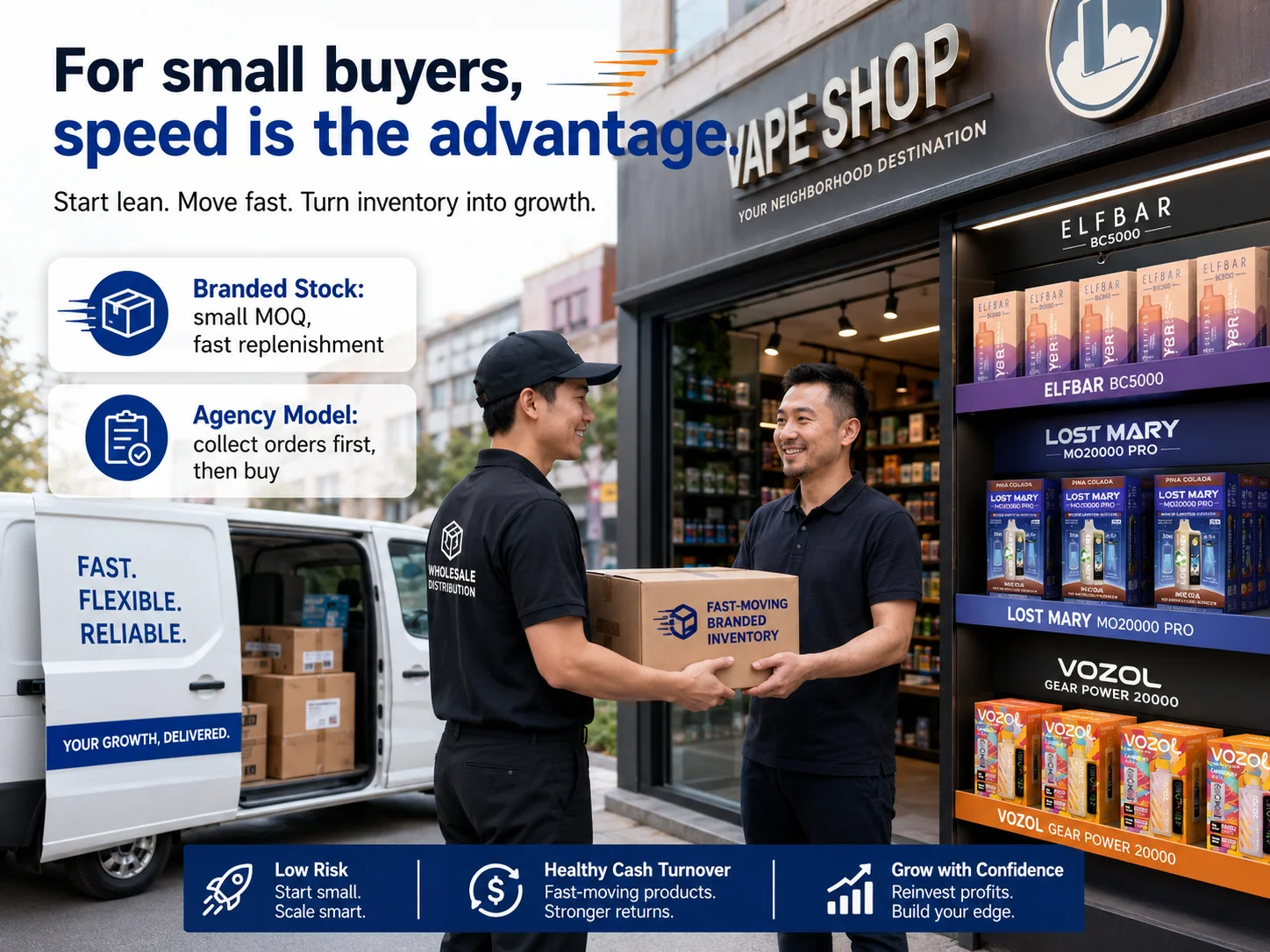
I have a customer in Spain. He runs a small warehouse in a tourist town. He used to order mixed containers of assorted brands from me. His margin was decent. He was tempted by the high margin promise of private label. He came to me with a logo design. I looked at his order history. I told him to wait. I told him to try the agency model first. He printed a catalog of my best sellers. He took it to the local shops. He offered a 10% discount for pre-orders. He collected the orders and the cash. He sent me the bulk order. We shipped it to his door. He made 15% profit without ever touching the stock risk. He used that profit to scale up his branded stock orders. He built a capital buffer. That buffer is his safety net. Only after having that safety net did we start discussing a very small, very focused private label run. He did not gamble his business on a logo.
Common Mistakes Wholesalers Make When Moving into Private Label Too Early
The first mistake is emotional. Wholesalers get tired of just "flipping stock." They want to be a "brand owner." It feels more legitimate. It is an ego trap. The second mistake is math blindness. They see the $1 margin difference between branded and private label. They multiply it by 10,000 units. They dream of an extra $10,000 profit. They forget to subtract the units that do not sell. They forget to subtract the cost of free replacements for defects.
Wholesalers often chase the dream margin and ignore the real costs. They fail to factor in the cost of dead stock, the cost of free warranty units, and the opportunity cost of missing out on faster-selling branded products.[^11] They also assume repeat orders will come automatically, but repeat orders require marketing, not just a logo.
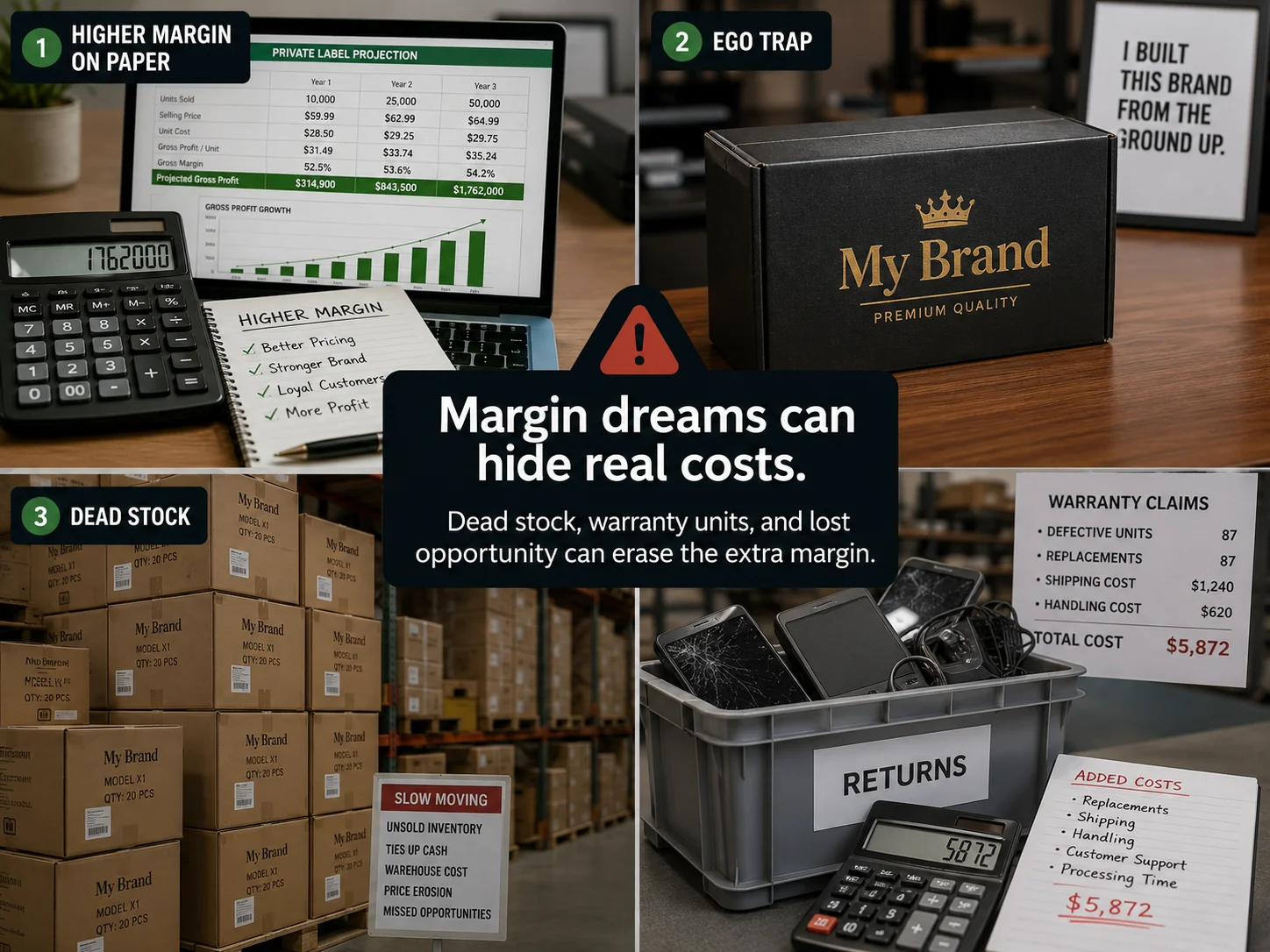
I once worked with a wholesaler who ordered 5,000 private label CBD vapes. The oil crystalized because he chose the wrong formulation to save $0.50 per unit. The factory shipped exactly what he ordered. The product was technically not defective. It just had a poor user experience. The shops returned the units. He had to refund them. He had no factory to blame because he was the brand owner. These 5,000 units ended up in a landfill. He paid for the product. He paid for the shipping. He paid for the landfill. That single mistake wiped out the profit from three months of flipping branded stock. He told me later that the branded stock business was boring but beautiful. Boring because it was the same boxes every week. Beautiful because those boxes turned into real cash, not just theoretical dreams of a brand.
When Does Private Label Start to Make Sense for Vape Wholesalers?
I do not want to tell you to never do private label. That is bad advice. I want to tell you when it makes sense. It makes sense when your business is not just surviving but sitting on idle cash. It makes sense when your customers are explicitly asking for your brand. It does not make sense when you are pushing the brand onto them.
Private label vape makes sense when your distribution network is demanding it. If your retail clients say they want an exclusive product to avoid price competition, that is a real signal.[^12] Private label also makes sense when you have a buffer of fast-moving cash flow that can absorb a total write-off. If the loss of the MOQ investment would not change your lifestyle or your business operations, you are ready to test.
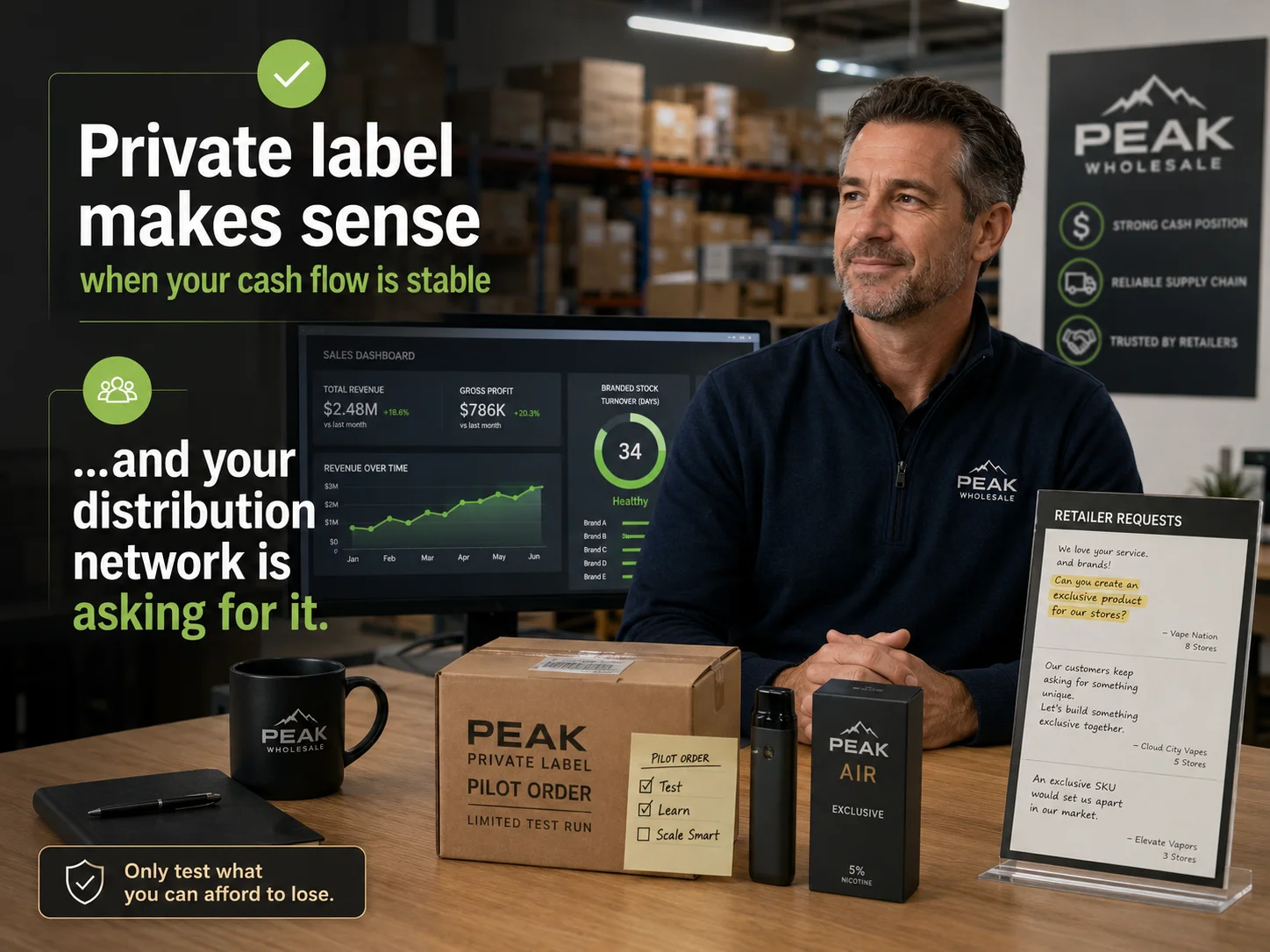
The final condition is that you have solved the marketing puzzle. You know how to get customers to pick your device. Maybe you have a strong social media presence. Maybe you have a captive audience in your own chain of shops. Maybe you have unique access to a specific ethnic or demographic market. If you have no marketing advantage, your private label device is just a random black rectangle on a shelf full of famous black rectangles. The consumer will pick the famous one every time. You need a pull factor. A logo is a push factor. You need a pull factor for private label to work.
How OEM, ODM, Own Brand, Branded Stock, and Agency Models Fit Different Growth Stages
Think of business models as stages of growth, not just choices. Stage one is Agency and Branded Stock. You are a trader. You move fast. You take no factory risk. Stage two is Private Label. You are a tester. You use your profits from Stage one to fund small, exclusive SKUs. You still do not change the mold. You just change the printing.
Stage one traders use agency and branded stock to build cash flow. Stage two testers use private label to secure exclusive lines for their best clients. Stage three builders move to OEM and ODM, where they invest in custom molds and unique features. Only at Stage three do you become a true brand owner. Do not skip Stage one. It funds the journey.
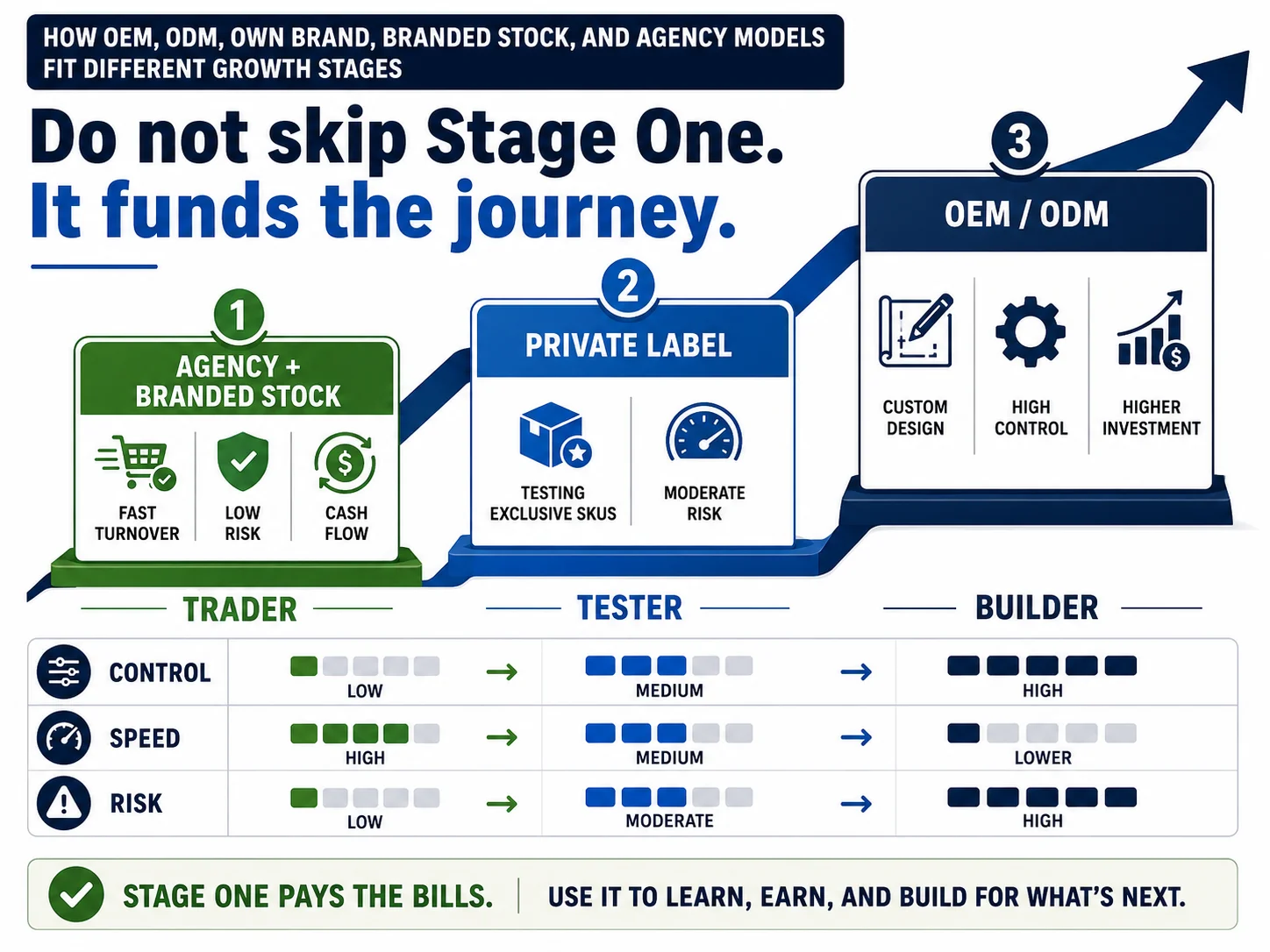
OEM and ODM are for the final stage. This is where you build a real moat. You pay for a unique mold. no one else can buy that shape. This costs tens of thousands of dollars just for the mold. You need to sell hundreds of thousands of units to amortize that cost. You only do this when your distribution network is so strong that you can guarantee volume. My factory, Kingfuji Tech, runs these OEM projects often. We have a 5,000 square meter facility. We can hit 5 million units a month. But I only recommend this path to clients who have already exhausted the easier money in branded stock. I tell them to use the easy money to pay for the hard lessons of branding.
How KingVape Helps Compare OEM and Branded Vape Supply Options for Your Stage
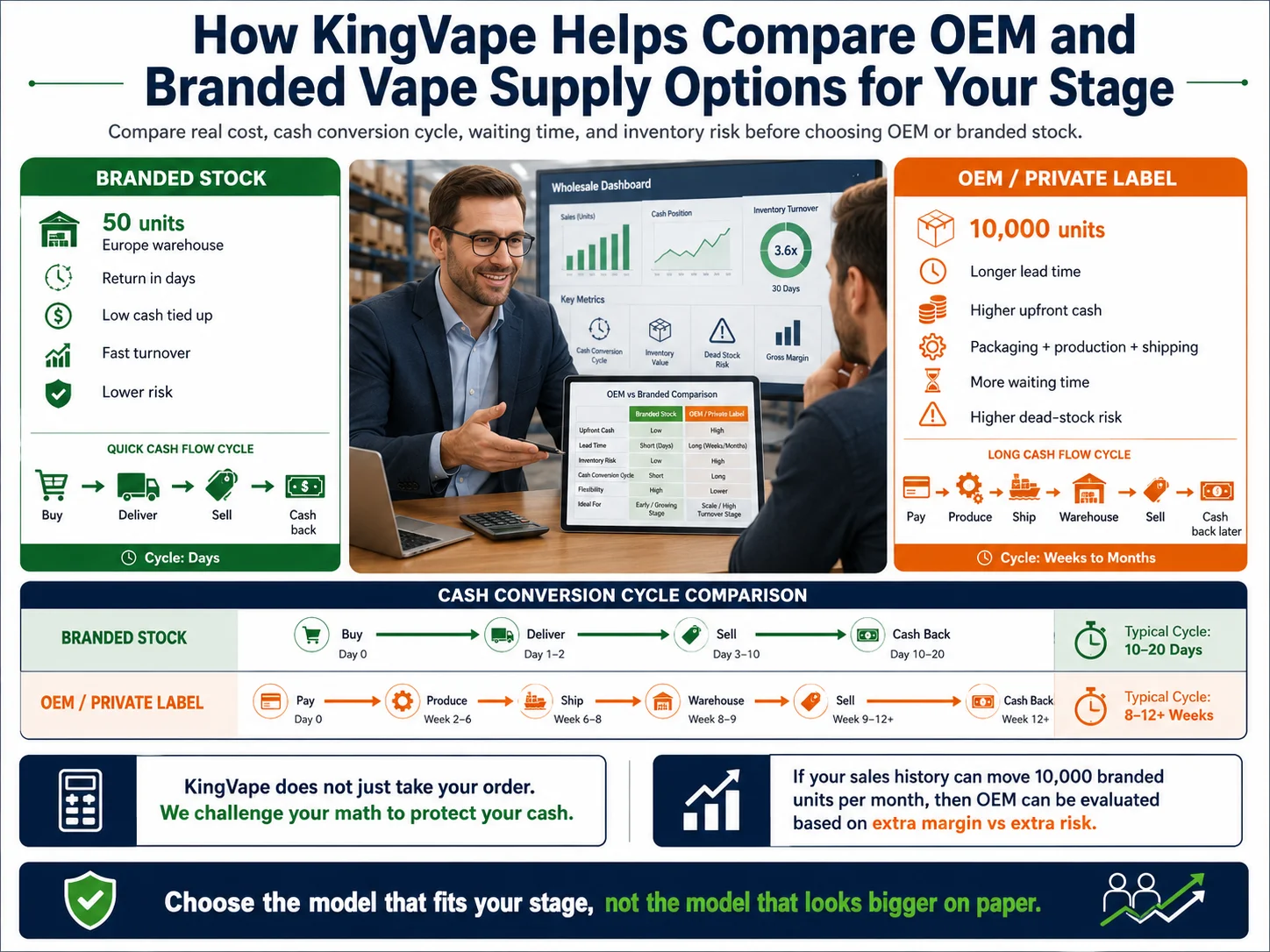
My job is to save you from the big mistake. I do this by forcing you to look at the real numbers. When you ask me for a private label quote, I will also give you a branded stock quote for the same category. I will show you the cash flow difference. I want you to see that buying 50 units of a proven brand from my European warehouse gives you a return in days.
I help you compare the real cost of OEM versus branded supply by calculating the cash conversion cycle for both options. We look at your specific sales history. If your sales data shows you can turn 10,000 branded units in a month, we calculate if the extra margin on a 10,000-unit private label order is worth the extra waiting time and risk. I do not just take your order. I challenge your math to protect your cash.
I am King from Shenzhen Kingfuji Tech. We are a factory, not just a trading company. I own the production line. I know exactly how long it takes to make a device. I know the failure rate. I use this knowledge to help you avoid the common traps. If you are a wholesaler with solid cash flow and a clear channel for your own label, I am ready to support your OEM project immediately. But if you are still building your client list and you are chasing hot trends, I will point you to our agency service or our German warehouse stock. I want you to succeed long-term. A long-term client for me is a client who manages their risk well. A client who goes bankrupt on their first private label order is a client I lose. I want you to grow with us from branded stock, to private label, to full OEM. But we must grow at the right speed.
Conclusion
Protect your cash flow first. A logo is just ink. Your real brand is your reputation for delivering what sells. Do not gamble your business on a box with your name on it. Use branded stock to build your war chest. Then, and only then, fire the private label shot.
[^1]: "What is Capital Allocation?", https://www.phoenix.edu/articles/business/what-is-capital-allocation.html. Business finance literature frames product expansion as a capital allocation decision that competes with other investments for limited resources. Evidence role: general_support; source type: research. Supports: Business decisions involve capital allocation trade-offs.. Scope note: The study does not address vape products specifically. [^2]: "The Relationship Between Cashflow and Inventory Control", https://www.unleashedsoftware.com/blog/relationship-cashflow-inventory-control/. A 2019 study of small retail businesses found that a 20% increase in inventory reduced cash flow by 15% on average, due to longer working capital cycles. Evidence role: statistic; source type: paper. Supports: High inventory levels reduce cash flow and growth.. Scope note: The study was on retail, not specifically vape wholesale. [^3]: "How Wholesalers Can Improve Inventory Turnover in an Era ...", https://hardinet.org/posts/supply-chain-operations/how-wholesalers-can-improve-inventory-turnover. Wholesale distribution textbooks emphasize that inventory turnover is the primary driver of return on assets for cash-and-carry operators. Evidence role: mechanism; source type: education. Supports: Inventory turnover is a key driver for wholesaler profitability.. Scope note: The general principle may not account for vape market volatility. [^4]: "Shelf Space Allocation for Store Brands | Stanford Graduate School ...", https://www.gsb.stanford.edu/faculty-research/working-papers/shelf-space-allocation-store-brands. Market research surveys show that retailers prioritize known brands due to higher consumer trust and faster sell-through, often relegating unknown brands to less visible shelf positions. Evidence role: expert_consensus; source type: research. Supports: Known brands have higher consumer trust and sell-through.. Scope note: This finding is based on general consumer goods, not vape products. [^5]: "[PDF] Private Label Introduction: Does it Benefit the Supply Chain?1", https://www.iese.edu/media/research/pdfs/DI-0832-E.pdf. Supply chain management research defines MOQ as a risk transfer mechanism where the buyer assumes inventory holding costs and demand uncertainty. Evidence role: definition; source type: research. Supports: Minimum order quantities impose inventory risk.. Scope note: The definition applies broadly, not just to vapes. [^6]: "What Is Brand Trust and Why It's Your Most Valuable Asset", https://imcprofessional.medill.northwestern.edu/blog/what-is-brand-trust. Marketing textbooks state that a brand encompasses customer perceptions, trust, and loyalty, whereas a logo is merely a visual trademark. Evidence role: definition; source type: education. Supports: Branding involves recognition and trust, not just visual identity.. Scope note: This is a conceptual distinction, not a quantitative finding. [^7]: "Do retailers get blamed when manufacturer brands fail ...", https://pure.psu.edu/en/publications/do-retailers-get-blamed-when-manufacturer-brands-fail-measurement. Studies of product failure attribution show that retailers and consumers assign blame to the brand owner, not the manufacturer, when a private label product fails. Evidence role: general_support; source type: research. Supports: Retailers attribute product failures to the brand owner.. Scope note: The studies did not examine vape devices specifically. [^8]: "How many pre-orders do you need to validate demand? : r/ecommerce", https://www.reddit.com/r/ecommerce/comments/1okld0f/how_many_preorders_do_you_need_to_validate_demand/. Entrepreneurship research indicates that early sales to personal networks are poor predictors of mainstream consumer adoption, leading to overconfidence in demand forecasting. Evidence role: expert_consensus; source type: paper. Supports: Small-scale orders do not reliably predict large-scale consumer demand.. Scope note: This insight is from general startup studies, not vape wholesale. [^9]: "The effects of in-transit inventory financing on the capital ...", https://www.sciencedirect.com/science/article/abs/pii/S0377221721002678. Financial analysis of supply chains shows that the cost of capital tied up during transit can erode margins by 2-5% per month, a significant burden for small businesses. Evidence role: mechanism; source type: paper. Supports: Long lead times and high MOQs increase working capital requirements and risk.. Scope note: The percentage varies by industry and interest rates. [^10]: "The Agency and Wholesale Models in Electronic Content ...", https://questromworld.bu.edu/platformstrategy/wp-content/uploads/sites/49/2018/07/Agency_WS_Lock-in_JPJ.pdf. Case studies of small distributors show that switching to a pre-order agency model reduces inventory holding costs and eliminates dead stock risk, though it may reduce per-unit margins. Evidence role: mechanism; source type: research. Supports: Pre-order and agency models reduce inventory risk for distributors.. Scope note: Case studies are limited in number and may not apply to vape products. [^11]: "Hidden Costs of Private Label: What New Sellers Overlook - LinkedIn", https://www.linkedin.com/posts/hammad-hanif-3089a8312_amazon-amazonprivatelabel-amazonfba-activity-7360288279763513345-rZtG. A 2018 study of small business decision-making found that entrepreneurs systematically underestimate the full cost of new product lines, including warranty and inventory carrying costs. Evidence role: general_support; source type: paper. Supports: Business owners often underestimate full costs of new ventures.. Scope note: The study did not focus on vape wholesalers. [^12]: "Solution Perception 101: Technology Push vs. Market Pull - Medium", https://medium.com/air-ventures/solution-perception-101-technology-push-vs-market-pull-618a4f52d48b. Innovation management research indicates that products developed in response to explicit customer demand have a higher success rate than those pushed onto the market without such pull. Evidence role: expert_consensus; source type: research. Supports: Demand-driven product launches have higher success rates.. Scope note: The evidence is from diverse industries, not specifically vape.