Many buyers ask for ODM too early. The idea sounds exciting. The risk starts when sales volume, timing, and cash flow cannot support it.
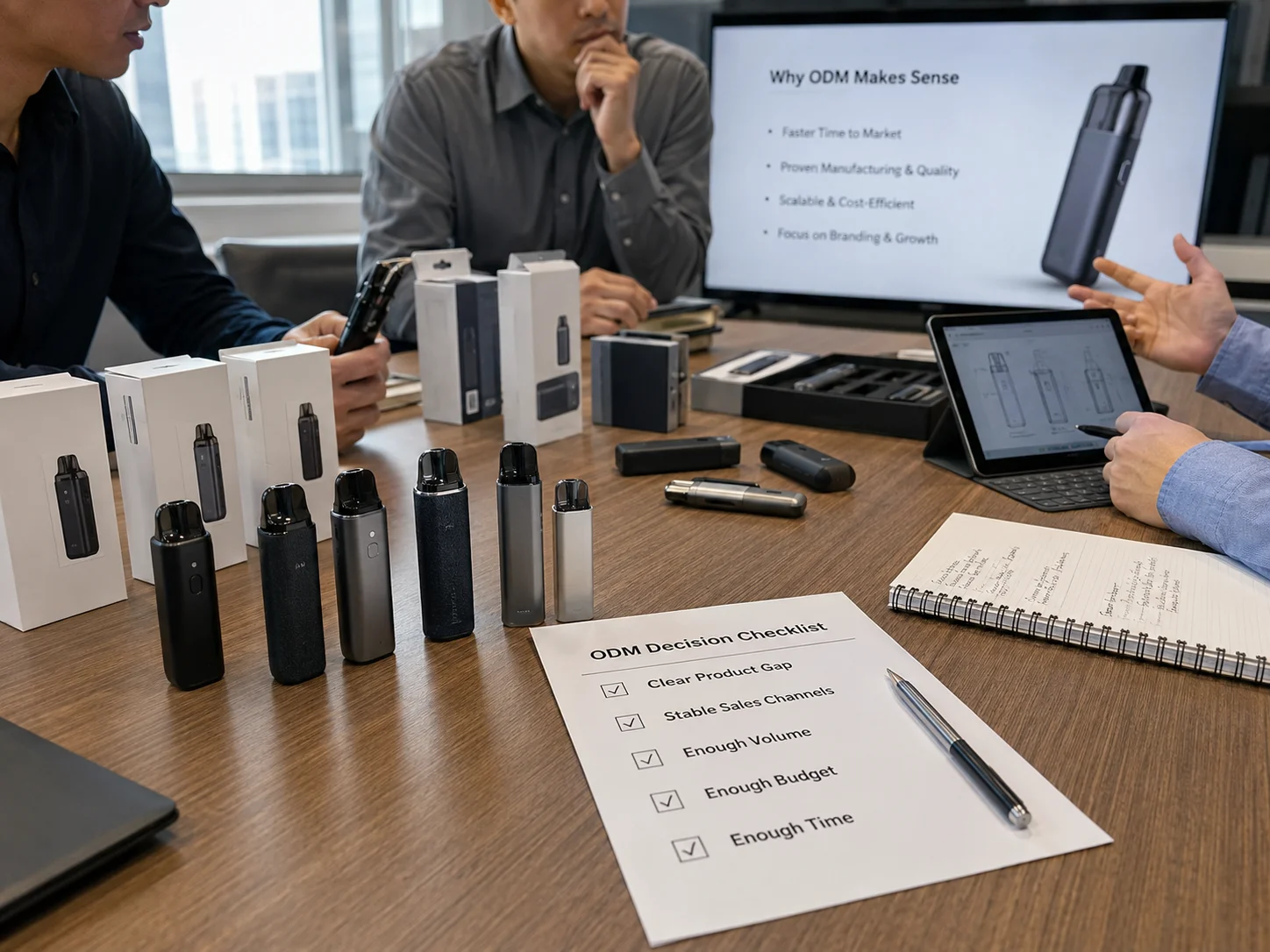
ODM vape product development makes sense when I have a clear product gap, stable sales channels, enough volume, enough budget, and enough time. It does not make sense when I only chase a short-term hot product or need fast stock turnover.
I work from Shenzhen, where most vape supply chains, accessories, e-liquid support, packaging, and global logistics services are close to each other[^1]. I have seen many buyers make money through ready stock, OEM, private label, and ODM. I have also seen buyers spend too much time on a product that the market no longer wants when it is ready. So I do not treat ODM as a “higher level” choice. I treat it as a business decision. The real question is simple. Can the expected sales cover the development cost, MOQ, sampling time, testing, inventory pressure, and possible failure? If the answer is not clear, I usually suggest a safer model first. Keep reading, because the right model can save time, protect cash flow, and still help a buyer build a stronger vape business.
1. What ODM Vape Product Development Really Means?
Many buyers think ODM means making a cool new vape. That is not wrong. It is just not complete enough for real business.
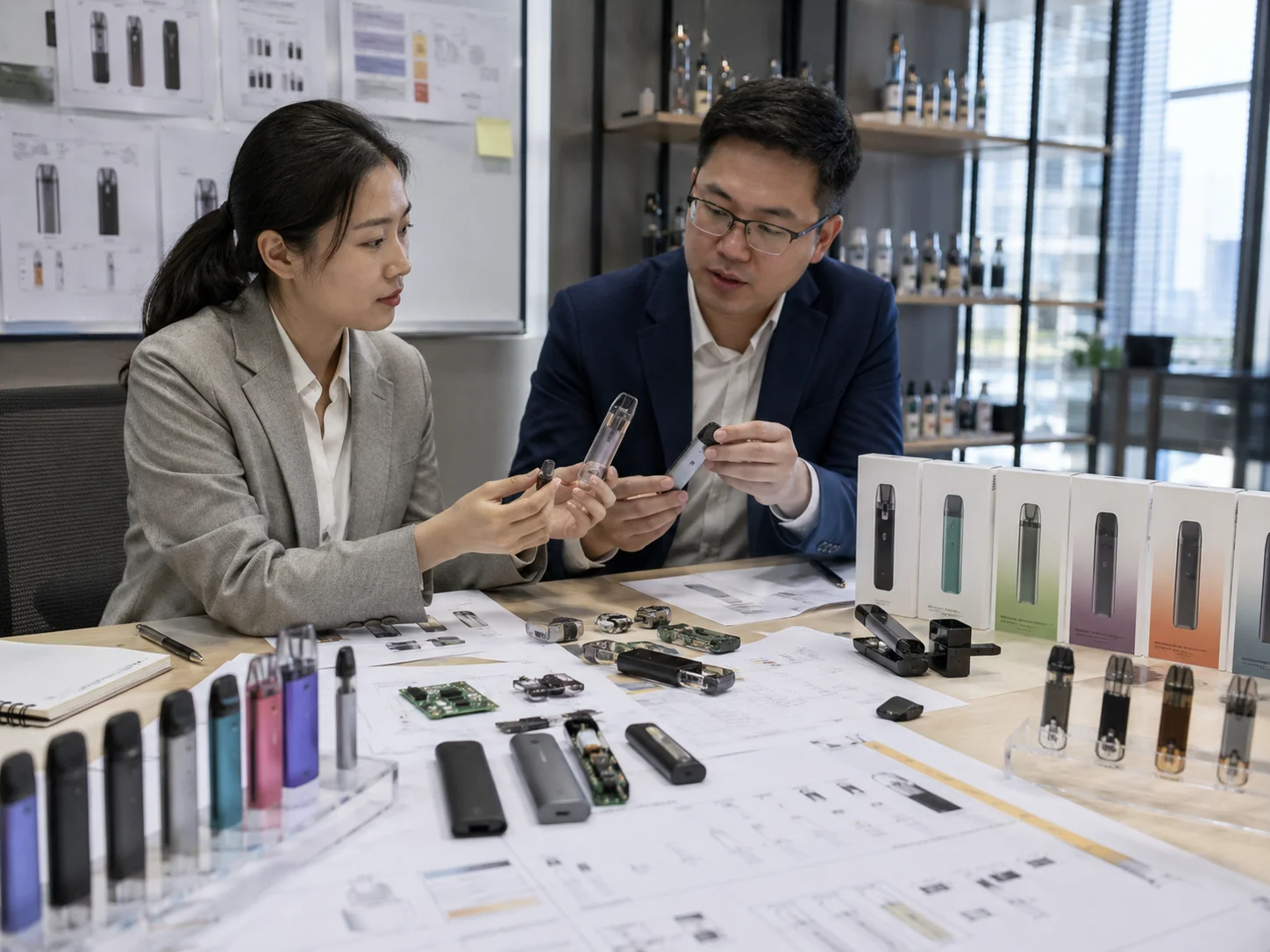
ODM vape product development means I develop or adjust a product based on a buyer’s market need, sales plan, design direction, and function request.[^2] It includes more than appearance. It also includes structure, performance, packaging, MOQ, sampling, testing, and launch timing.
ODM is not only design
In my daily work, I often hear a buyer say, “I want to make my own model.” My first reaction is not to quote tooling cost. I first ask why this model must exist. If the buyer only wants a different shell color, OEM or private label may be enough. If the buyer wants a different size, battery capacity, airflow feel, screen layout, puff position, oil capacity, or user experience, then ODM may be useful.
| Question I ask first | Why it matters |
|---|---|
| What problem does this product solve? | It shows if the idea has real market value. |
| What is the first order target? | It shows if MOQ and cost can be covered. |
| When must the product launch? | It shows if ODM time is acceptable. |
| What market will sell it? | It helps avoid wrong specs and wrong packaging. |
For importers and brand distributors, the risk is often not the idea itself. The risk is whether the market window and order volume support the idea. A product can be smart, but it can still fail if it is too late, too expensive, or too hard to explain to vape shops and smoke shops.
2. How ODM Differs from OEM, Private Label, Own Brand, and Branded Wholesale?
Many buyers mix these words together. That causes wrong expectations, wrong budgets, and long delays before the first shipment even starts.
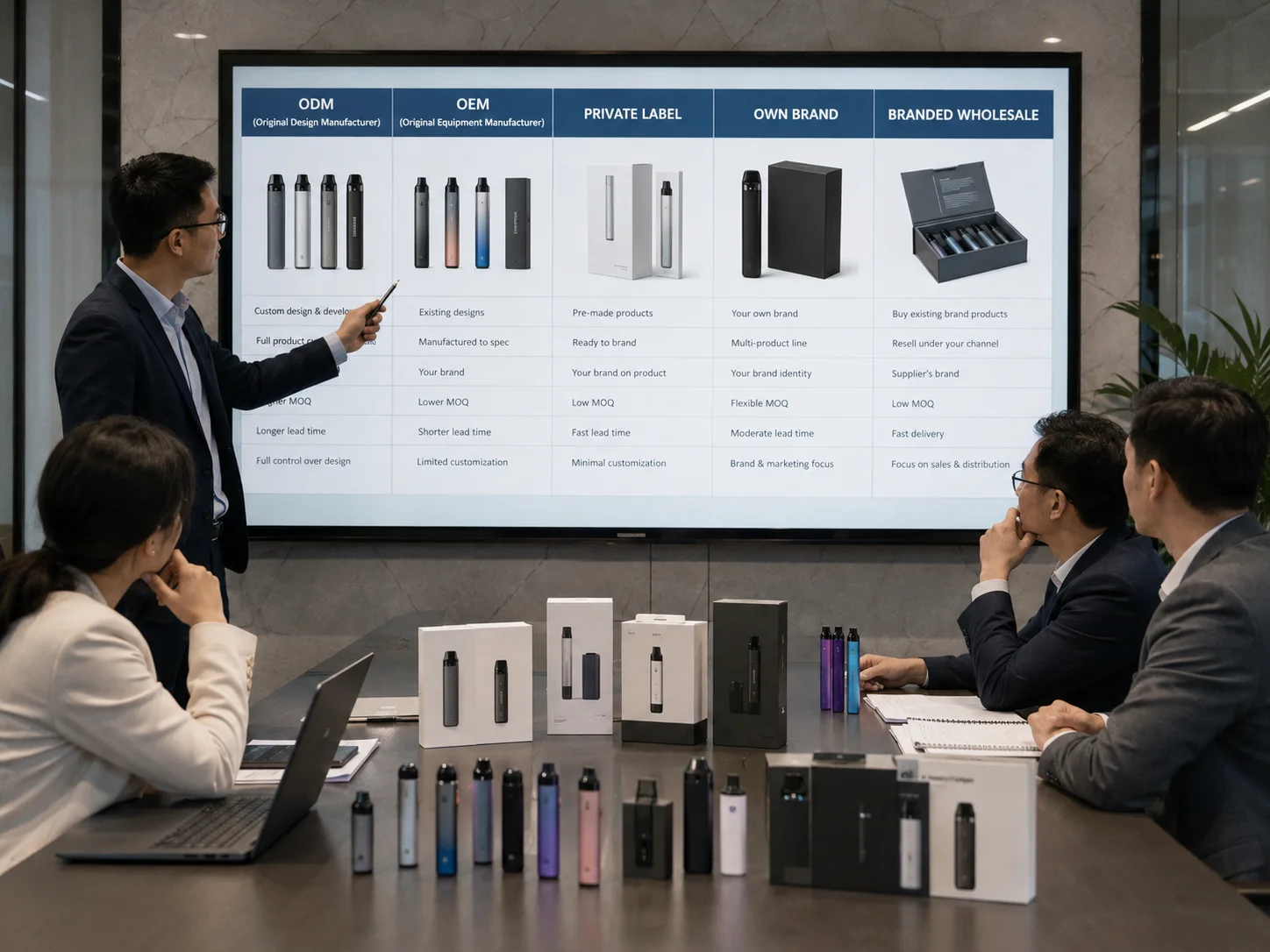
ODM creates or changes a product more deeply. OEM usually puts a buyer’s brand on an existing product.[^3] Private label is often lighter branding. Own brand means the buyer builds market identity. Branded wholesale means buying existing famous or hot-selling brands.
I separate the models before I quote
I am a factory and trading integrated supplier, so I handle different supply models. I can help buyers buy big brands and many categories from stock. I can help them do OEM. I can support private label. I can also discuss ODM when the business condition is right. These models do not serve the same goal.
| Supply model | Best for | Main risk |
|---|---|---|
| Branded wholesale | Fast turnover and tested demand | Lower differentiation |
| Ready stock | Quick delivery and smaller orders | Limited customization |
| Private label | Simple brand start | Product may look common |
| OEM | Own logo on existing stable product | Less product uniqueness |
| ODM | Clear product gap and long-term brand plan | Higher cost, time, and MOQ |
If a buyer owns vape shops, smoke shops, gas station channels, or wholesale routes, I look at the buyer’s selling style. If the buyer needs stock fast, branded wholesale or ready stock may be better. If the buyer wants to build a long-term local brand, OEM or ODM may fit. If the buyer wants a new product that existing stock cannot solve, ODM becomes a serious option. I do not push the most complex model first, because complexity only helps when sales can support it.
3. When ODM Vape Development Makes Sense for Growing Brands?
Some buyers are ready for ODM. They already know their market. They know what sells. They also know what current products fail to solve.
ODM vape development makes sense when I see stable channels, predictable sales volume, a clear unmet market need, enough budget, enough launch time, and a serious plan for repeat orders.

ODM fits buyers with channel confidence
In many ODM discussions, I first check if the buyer has a real selling base. A good idea is not enough. The buyer needs stores, distributors, sales teams, online channels where legal, or repeat wholesale customers.[^4] ODM works better when the buyer already hears feedback from the market every week.[^5]
| Good ODM signal | What it means in real business |
|---|---|
| Stable monthly sales | The buyer can absorb MOQ and inventory. |
| Clear customer feedback | The product idea comes from real demand. |
| Repeat wholesale channels | The launch has buyers waiting. |
| Budget for samples | The buyer can accept trial and adjustment. |
| Clear launch window | The project can match market timing. |
For example, I may hear from a distributor that local shops complain about weak battery life, poor flavor stability, too much leakage, or boring product design. If that distributor already sells good volume, ODM may help build a better product for that exact channel. This is different from guessing. The buyer is not inventing from nothing. The buyer is solving a known pain point. That is when ODM has a better chance to create profit, brand memory, and repeat orders.
4. When ODM Is Not the Right Choice for Smaller or First-Time Buyers?
ODM can look attractive to new buyers. A new buyer may feel that a custom product will make the business look bigger. That thinking can be dangerous.
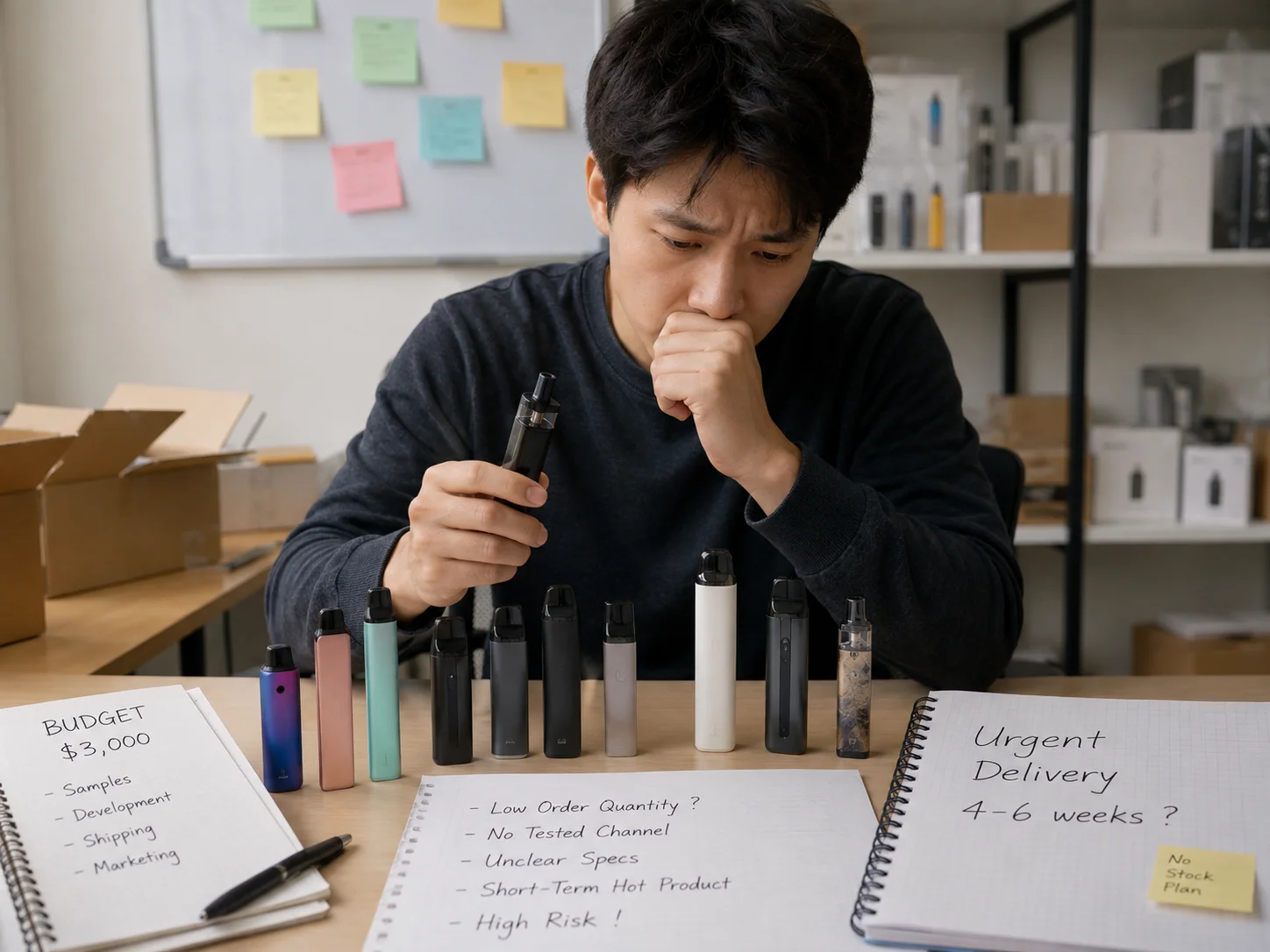
Fast money needs fast stock more often
I work with many buyers who need fast turnover. Some sell to tourist shops. Some sell to vape shops, smoke shops, hookah shops, convenience stores, and gas stations. Some buyers only want products that can move fast this month. For these buyers, ODM may lock cash in the wrong place.
| Buyer situation | Better first choice |
|---|---|
| First vape order | Ready stock or branded wholesale |
| Small test order | EU warehouse stock or low MOQ stock |
| Hot trend chasing | Existing fast-moving models |
| No clear specs | Market testing before ODM |
| Urgent selling season | Stock model with quick delivery |
For small or first-time buyers, I often suggest starting with ready products. If the buyer is in Europe, our overseas warehouse can support smaller MOQ for many stock items and faster delivery across the EU. This helps the buyer test demand without waiting weeks or taking bigger customs and inventory risk from China shipment.[^7] If the buyer sells well, then we can review repeat order data. After that, OEM or ODM becomes more logical. I prefer this path because it protects the buyer’s cash flow. It also helps the buyer learn what local customers really want before paying for product development.
5. MOQ, Lead Time, Customization, and Control in ODM Vape Projects?
ODM gives more control, but it also brings more responsibility. Many problems start when a buyer wants full control with small MOQ and instant delivery.
In ODM vape projects, MOQ, lead time, customization level, and control move together. More custom work usually means higher MOQ, longer sampling time, more testing, and more inventory pressure.[^8]
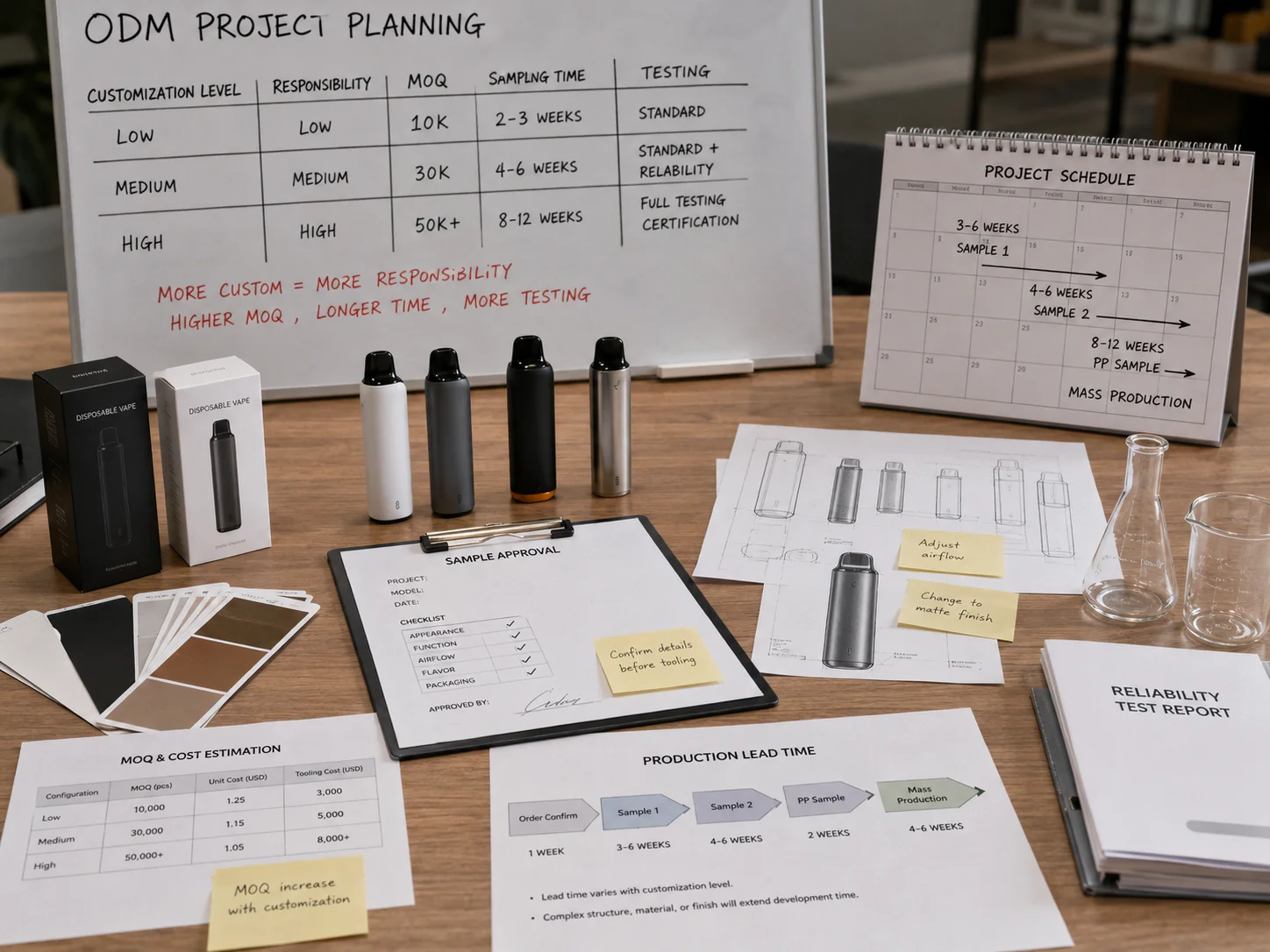
More control usually means more cost
I always explain this point clearly. If a buyer chooses a stock product, the product is already made or ready to produce. The price, lead time, and risk are easier to see. If a buyer wants a new mold, new structure, new PCB layout, special screen, special finish, special packaging, or special performance request, then the project needs more coordination.
| Custom level | Typical effect |
|---|---|
| Logo and package | Lower cost and faster time |
| Color and minor parts | Medium control and medium time |
| Function adjustment | More testing and more risk |
| New structure or mold | Higher MOQ and longer cycle |
| Full ODM project | Highest control and highest pressure |
I do not say this to scare buyers. I say it because real planning helps profit. Sampling may need several rounds. Product stability must be checked.[^9] Packaging must fit the market. Regulation and market rules must be confirmed by the buyer for the destination country. If the product fails after launch, after-sales pressure can damage both cash flow and reputation. So I ask buyers to match ambition with volume. A buyer who can place strong repeat orders can carry more customization. A buyer who is still testing should stay closer to existing stable products.
6. Common Mistakes and Unrealistic Expectations in ODM Product Development?
A good ODM idea can fail from wrong expectations. I have seen this happen before the first sample is even finished.
Common ODM mistakes include vague product ideas, unrealistic MOQ requests, rushed launch timing, unclear target users, no sales plan, and the belief that a new design alone will guarantee sales[^10].

The market does not pay for imagination alone
In my experience, the biggest mistake is starting from appearance only. A buyer may send a picture and say, “Make something like this, but different.” That is not enough. I need to know the price point, target shops, expected daily sales, flavor direction if related, battery request, user habit, and after-sales tolerance. A small detail can decide if the product is easy to sell or hard to explain.
| Mistake | Better approach |
|---|---|
| “I want something unique.” | Define what customer problem is solved. |
| “MOQ must be very small.” | Start with stock, then upgrade later. |
| “I need it next week.” | Use ready stock or existing OEM model. |
| “The market will love it.” | Test with real channels first. |
| “Quality must be perfect.” | Set standards, test samples, and plan after-sales. |
Another mistake is ignoring failure cost. Even strong buyers can have products that sell slower than expected. That does not mean ODM is bad. It means ODM needs a safety plan. I like buyers who can accept sample changes, discuss trade-offs, and make decisions based on sales logic. I worry when a buyer wants everything: low MOQ, low price, new mold, fast delivery, no risk, and guaranteed sales. In real business, that combination rarely exists.
7. What Usually Slows Down an ODM or Private-Label Vape Project?
Many buyers think production is the slow part. Sometimes production is not the main delay. The slow part is often decision-making and unclear information.

Clear input saves more time than pressure
I have seen buyers ask for fast shipment, but they send logo files late. I have seen buyers approve a sample, then change the color after materials are prepared. I have seen buyers delay packaging text because local language rules or warning requirements are not confirmed. These delays are common, and they can be avoided with better preparation.
| Delay point | How I try to prevent it |
|---|---|
| Unclear product target | I ask sales volume and market use first. |
| Late logo or artwork | I request files before sample schedule. |
| Too many changes | I set approval steps clearly. |
| Packaging uncertainty | I remind buyers to check local rules. |
| Payment or deposit delay | I confirm timeline before production plan. |
| Sample feedback delay | I ask for one decision person. |
For vape products, market-specific regulation can differ a lot.[^12] I do not tell buyers that one package or one spec fits every country. The buyer must confirm local compliance with their own local advisor or authority. My role is to support product supply, development coordination, packaging production, and shipment options based on confirmed requirements. When both sides prepare well, the project moves faster. When information changes every few days, even a simple private-label project can become slow.
8. How to Choose the Right Vape Supply Model for Your Business Stage?
The best supply model is not the most advanced one. The best model is the one that matches current sales, cash flow, timing, and risk level.
I choose the right vape supply model by looking at business stage, monthly sales, order size, delivery urgency, brand goal, product gap, and risk tolerance.

I match the model to the stage
When a buyer comes to me, I do not only ask what product they want. I also ask how they sell. A buyer with a few shops has different needs from a national wholesaler. A tourist city distributor has different timing from a brand importer. A buyer with fast cash-and-carry business may need quick stock more than deep customization.
| Business stage | Recommended model |
|---|---|
| Testing market | Ready stock or overseas warehouse stock |
| Small wholesale growth | Branded wholesale and low MOQ stock |
| Building brand identity | Private label or OEM |
| Stable repeat orders | OEM with deeper customization |
| Clear product gap and strong volume | ODM |
| Large importer or distributor | ODM, OEM, and direct China shipment mix |
For European small and medium buyers, overseas warehouse stock can reduce waiting time and lower the pressure of big first orders. For larger importers and distributors, China shipment can give stronger price advantage and wider product choice. For buyers with their own brand plan, OEM and ODM can help create differentiation. I normally suggest a step-by-step path. First, sell what is already proven. Then, build private label. Then, use sales data to decide if ODM is worth the investment. This path may sound slower, but it often protects profit better.
Conclusion
ODM is useful when sales, volume, timing, and product need support it. If not, ready stock, OEM, or wholesale may create safer profit.
[^1]: "Electronic cigarette - Wikipedia", https://en.wikipedia.org/wiki/Electronic_cigarette. A source on China’s e-cigarette industry describes Shenzhen and the broader Guangdong manufacturing region as a major production base for electronic cigarettes and related components, supporting the article’s description of local supply-chain concentration. Evidence role: historical_context; source type: institution. Supports: A neutral industry, government, or research source should support that Shenzhen and nearby Guangdong cities are major centers for e-cigarette manufacturing and supporting supply chains.. Scope note: Such a source would support the regional industry context, but it would not prove the author’s specific supplier network or logistics access. [^2]: "Original design manufacturer - Wikipedia", https://en.wikipedia.org/wiki/Original_design_manufacturer. A general definition of an original design manufacturer states that an ODM designs and manufactures a product that another company may brand or sell, supporting the article’s distinction between product development and simple branding. Evidence role: definition; source type: encyclopedia. Supports: A neutral definition should confirm that an original design manufacturer designs and manufactures products that may be marketed or branded by another firm.. Scope note: The source would define ODM generally and may not address vape products specifically. [^3]: "OEM (disambiguation) - Wikipedia", https://en.wikipedia.org/wiki/OEM_(disambiguation). A standard definition of an original equipment manufacturer describes OEMs as firms that make products or components for another company’s use or sale, supporting the article’s explanation of OEM as a less design-intensive model than ODM. Evidence role: definition; source type: encyclopedia. Supports: A neutral source should define OEM as a company that produces goods or components used or sold by another company, often under the buyer’s brand.. Scope note: The citation would support the general OEM concept, not the specific commercial terms used in any individual vape order. [^4]: "Navigating new product development: Uncovering factors and ...", https://pmc.ncbi.nlm.nih.gov/articles/PMC10788447/. Studies of new product commercialization identify distribution access and launch capabilities as important factors in market performance, supporting the article’s emphasis on stores, distributors, sales teams, and repeat buyers before undertaking ODM. Evidence role: general_support; source type: paper. Supports: A scholarly source should connect distribution capability, commercialization resources, or channel access with new product launch success.. Scope note: The source would support the broader commercialization principle rather than any one buyer’s channel strength. [^5]: "Navigating new product development: Uncovering factors and ...", https://pmc.ncbi.nlm.nih.gov/articles/PMC10788447/. Research on new product development links market orientation and customer involvement with improved product performance, supporting the article’s view that ODM decisions are stronger when based on recurring market feedback. Evidence role: expert_consensus; source type: paper. Supports: Research should show that customer input, market orientation, or customer involvement is associated with better new product development outcomes.. Scope note: The evidence would be general to product development and would not directly measure vape ODM projects. [^6]: "Financial Risk and Uncertainty in New Product Development", https://scholarsmine.mst.edu/engman_syseng_facwork/304/. Project management and new product development research identifies unclear requirements, time constraints, limited resources, and market uncertainty as common contributors to project risk, supporting the article’s caution against ODM under those conditions. Evidence role: expert_consensus; source type: paper. Supports: Evidence should show that resource constraints, unclear requirements, time pressure, and market uncertainty increase project risk or reduce product-development success.. Scope note: The evidence would support the risk factors generally and would not set a universal threshold for when ODM becomes inappropriate. [^7]: "Supply and Demand Uncertainty in Multi-Echelon Supply ...", https://coral.ise.lehigh.edu/larry/files/pubs/suppdem10.pdf. Supply-chain research on inventory positioning and demand uncertainty explains that holding stock closer to customers and using smaller test quantities can reduce delivery lead time and limit inventory exposure, supporting the article’s rationale for warehouse stock before larger China shipments. Evidence role: mechanism; source type: paper. Supports: A supply-chain source should explain that positioning inventory closer to customers and using smaller replenishment quantities can reduce delivery lead time and exposure to demand uncertainty.. Scope note: The source would support the supply-chain mechanism, not the specific performance of the author’s EU warehouse. [^8]: "The relationship between mass customization and sustainable ...", https://pmc.ncbi.nlm.nih.gov/articles/PMC10950661/. Operations research on product customization shows that greater customization can increase production complexity, coordination requirements, and lead-time pressure, supporting the article’s claim that deeper ODM work carries higher operational burden. Evidence role: mechanism; source type: paper. Supports: A manufacturing or operations source should support that customization increases production complexity and can affect lead times, testing, cost, and inventory planning.. Scope note: The source may not specifically discuss MOQ practices, which are often contract- and supplier-specific. [^9]: "Iterative design - Wikipedia", https://en.wikipedia.org/wiki/Iterative_design. Engineering design references describe prototyping, testing, evaluation, and refinement as iterative stages of product development, supporting the article’s statement that sampling may require multiple rounds and stability checks. Evidence role: mechanism; source type: education. Supports: An engineering design or product development source should explain that prototypes are tested, evaluated, and refined through iterative cycles.. Scope note: The citation would describe standard product-development practice and would not specify the exact number of samples needed for vape products. [^10]: "Product Innovation: What Business Leaders Need to Know", https://online.hbs.edu/blog/post/product-innovation. New product development research emphasizes customer needs, market orientation, and commercialization capabilities as determinants of product performance, supporting the article’s caution that a new design alone does not guarantee sales. Evidence role: expert_consensus; source type: paper. Supports: A source should show that commercial success depends on market fit, customer needs, positioning, or commercialization capabilities, not merely product novelty or design.. Scope note: The evidence is general across product categories and does not predict sales for any particular vape design. [^11]: "1. Risk - View Source", https://swehb.nasa.gov/plugins/viewsource/viewpagesrc.action?pageId=215777481. Project management research identifies unclear requirements, requirement volatility, and delayed decision-making as recurring causes of schedule delay, supporting the article’s explanation of why ODM and private-label projects can slow down. Evidence role: general_support; source type: paper. Supports: A project management or product development study should support that unclear requirements, requirement changes, and delayed approvals contribute to schedule delays.. Scope note: The source would support the main delay mechanisms but may not specifically address artwork files, buyer payment timing, or vape packaging. [^12]: "Regulation of electronic cigarettes - Wikipedia", https://en.wikipedia.org/wiki/Regulation_of_electronic_cigarettes. International public-health sources report that e-cigarette regulation varies across jurisdictions, including differences in sales rules, product standards, packaging, advertising, and nicotine-related restrictions, supporting the article’s warning that one specification or package may not fit every market. Evidence role: general_support; source type: institution. Supports: An international institution or government source should show that e-cigarette regulation differs across jurisdictions in areas such as sales restrictions, packaging, warnings, flavors, nicotine content, and advertising.. Scope note: The source would document regulatory variation but would not provide legal advice for a specific destination country.