
Many vape suppliers still chase traffic first. That creates weak inquiries, wrong products, slow turnover, and buyers who only ask for the lowest price.
Regulation does not remove vape wholesale SEO opportunity. It changes the opportunity.[^1] I see better results when content attracts buyers who care about product fit, shipping route, inventory risk, local market limits, and supplier support[^2].
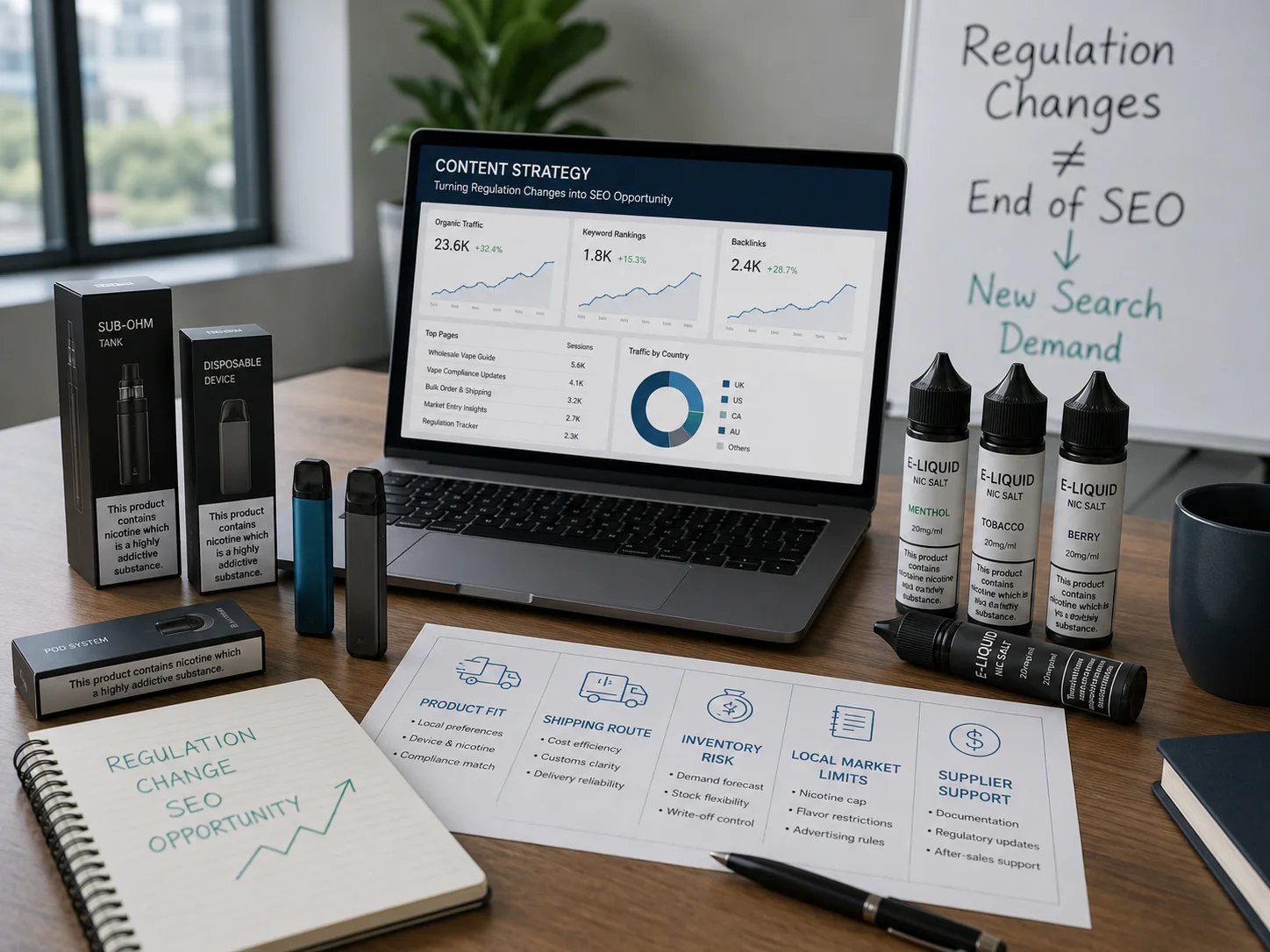
I work from Shenzhen, where most vape products, accessories, parts, e-liquids, and smoking accessories are made or supplied[^3]. I speak with importers, wholesalers, vape shops, smoke shops, convenience store buyers, and gas station suppliers from Europe, the United States, and other markets. I see one clear change. Buyers do not only ask, “What is hot?” They also ask, “Can this product move safely in my market?” This is where SEO becomes more useful. It can bring fewer random visitors, but more serious buyers.
1. Why Does Vape Regulation Change the Way Wholesale SEO Works?
Many vape websites still use old keyword logic. That brings traffic, but it often brings buyers who do not understand risk.
Regulation changes wholesale SEO because buyers search with more serious intent.[^4] They want product information, sourcing options, delivery choices, and supplier reliability before they send a real inquiry.
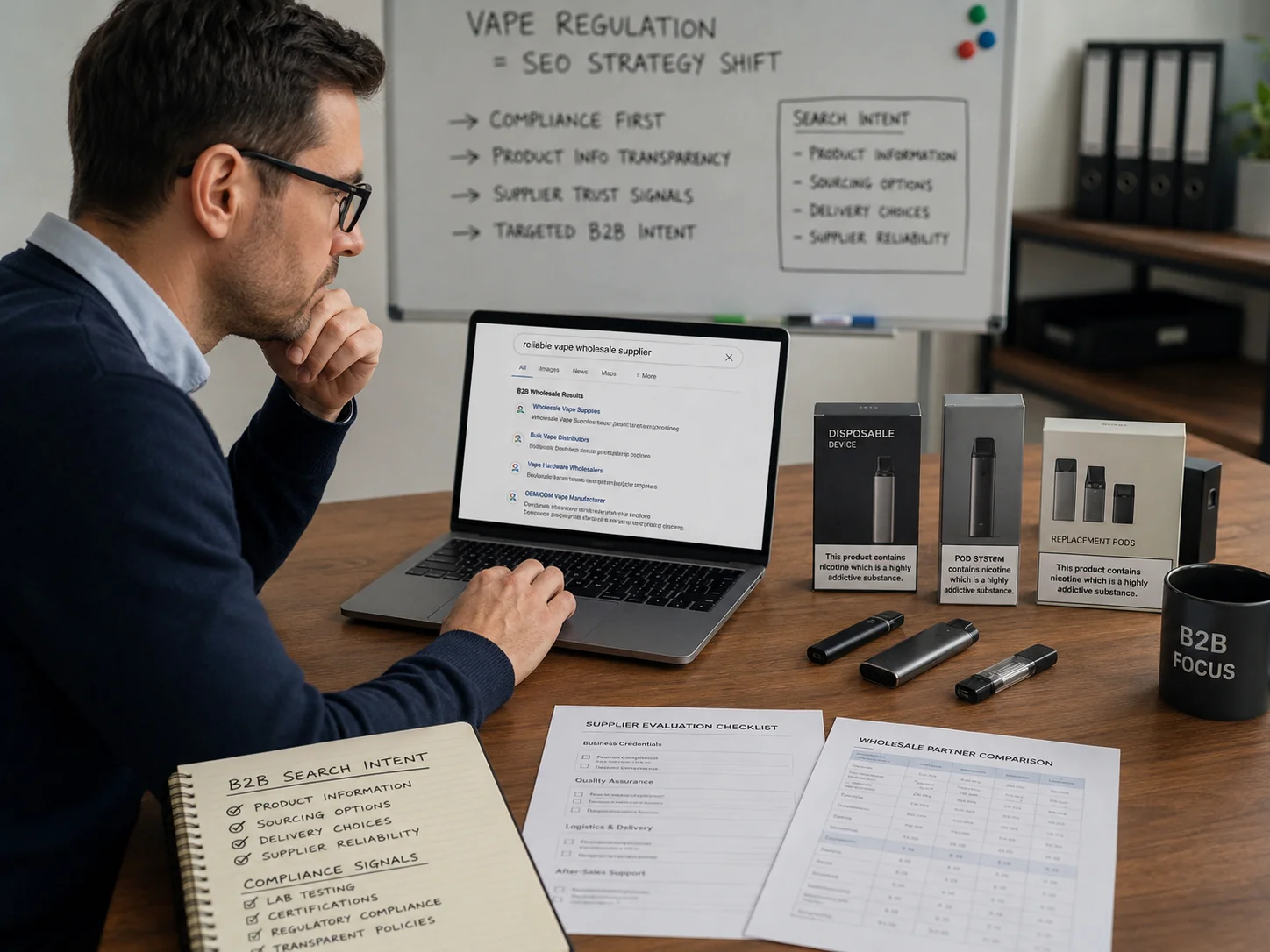
I do not see regulation as only a legal topic. I see it as a business filter. In many supplier-buyer talks, wholesalers ask about shipping, packaging, product type, stock location, after-sales support, and how fast they can turn inventory. These questions are not separate from SEO. They are the keywords behind serious B2B searches.
| Old SEO Focus | New SEO Focus in Regulated Markets |
|---|---|
| Hot vape products | Market-fit vape products |
| Cheap disposable vapes | Stable supply and lower risk sourcing |
| High search volume | High buyer intent |
| Product photos only | Product use, channel fit, and delivery plan |
| One global product page | Market-aware product and sourcing pages |
I have learned that the best inquiry is not always the biggest one at first. The best inquiry often comes from a buyer who already knows his market problem. He may run a vape shop chain, supply smoke shops, or serve convenience stores. He wants to know if a product fits his customer base. He also wants to know if the sourcing path fits his cash flow. SEO should answer these points before the first message.
2. What Has Changed in Global Vape Markets and Why Does It Matter?
Many buyers still want fast-moving products. The problem is that a fast-moving product can become slow inventory if it does not fit the local market.
Global vape markets have become more sensitive to product type, shipping route, local sales channel, and buyer responsibility.[^5] I always suggest that buyers verify local rules before ordering.

From my experience, the main change is not only regulation itself. The main change is how regulation affects business decisions. A buyer may see a hot disposable vape online. He may think it can sell fast. Yet the product may not match his local shops, customer age group, flavor rules, nicotine limits, labeling expectations, or logistics route[^6]. I am not a legal adviser. I do not give legal opinions. I treat these points as sourcing and business risk.
| Buyer Question | Why It Matters |
|---|---|
| Can this still be shipped? | It affects delivery time and cash flow. |
| Is this product suitable for my market? | It affects sell-through speed and complaints. |
| Should I import from China or use overseas stock? | It affects MOQ, price, speed, and risk. |
| What happens if customs delays the shipment? | It affects warehouse planning and capital turnover. |
I often see small and mid-sized buyers care more about speed and low MOQ. They may prefer overseas warehouse stock in Europe[^7] when available. Bigger importers may accept longer lead time because they need better unit price, larger volume, OEM/ODM work, or full container planning. SEO content should explain this difference clearly.
3. How Does Regulation Turn Vape SEO from Product Selling into Buyer Education?
If a vape page only says “best price” and “hot sale,” it may attract attention. It may not help a buyer make a safe decision.
Regulated market SEO works better when it educates buyers.[^8] It should explain product fit, order route, stock choice, delivery timing, and after-sales handling in simple language.

I see many buyers ask the same practical questions again and again. They do not always ask them in perfect SEO language. A Spanish wholesaler may ask whether a small batch can arrive faster. A U.S. distributor may ask whether OEM packaging can support his local brand plan. A convenience store supplier may ask which products are easier to explain to store owners. These questions are content opportunities.
| Buyer Education Topic | Search Intent Behind It |
|---|---|
| China direct vs overseas warehouse | Buyer wants the right purchase path. |
| Low MOQ vape wholesale | Buyer wants lower stock pressure. |
| Disposable vape market fit | Buyer wants fewer slow-moving items. |
| Vape after-sales support | Buyer wants protection from defects. |
| OEM/ODM vape supplier | Buyer wants brand and margin control. |
I believe B2B vape SEO should make buyers smarter before they contact a supplier. It should not push every product to every market. It should help buyers compare. If a buyer is testing a new channel, he may need 50 pieces per model from overseas stock. If a buyer already has stable distribution, he may need China direct supply with stronger price advantage. Education builds trust before quotation.
4. Why Do Market-Specific Vape Pages Perform Better Than One Global Page?
A single global page looks simple. It often misses the real questions buyers ask in different markets.
Market-specific vape pages perform better because buyers search with local problems in mind.[^9] They care about delivery path, stock access, product fit, and local sales channels.
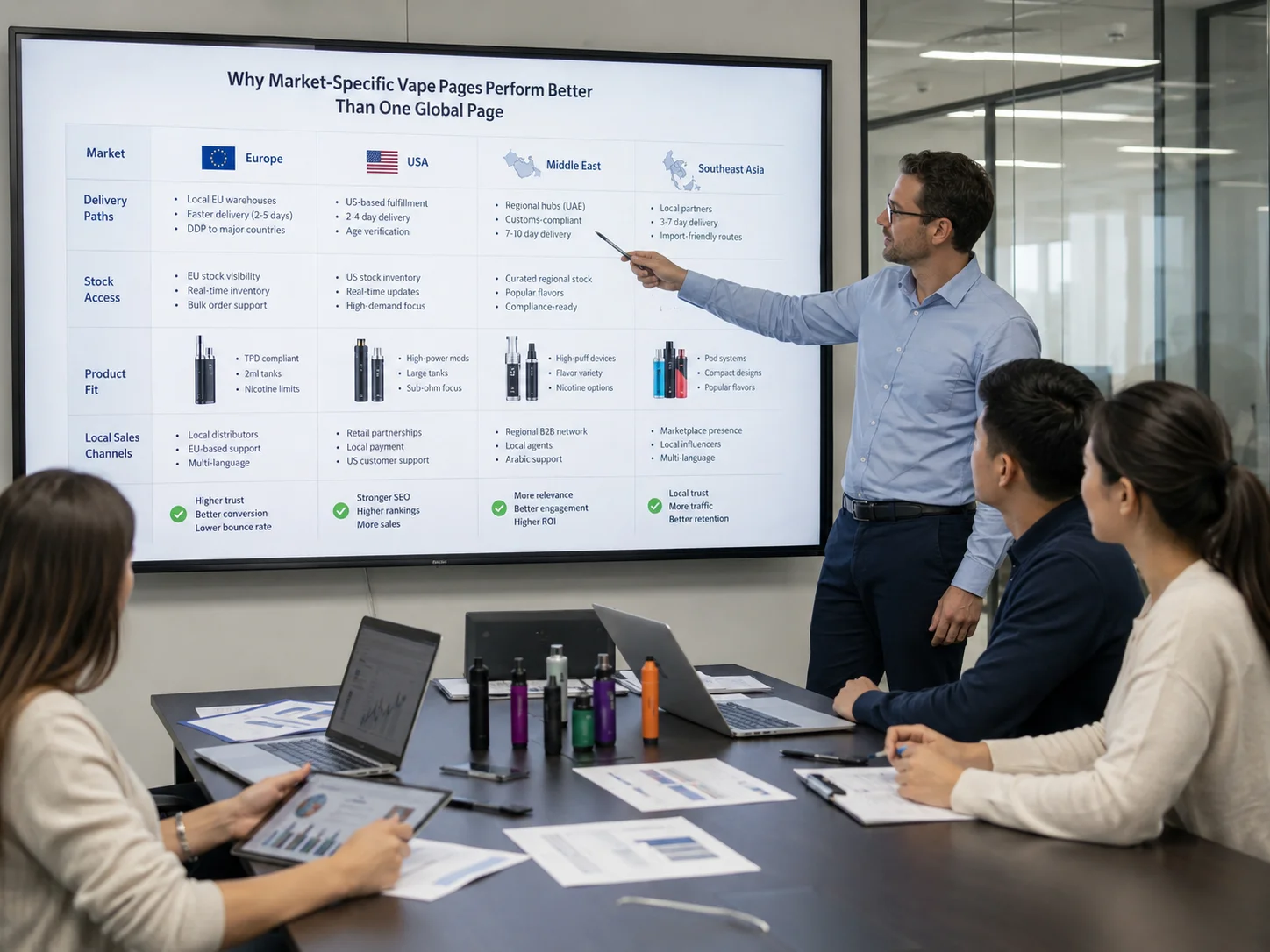
I have seen that buyers from Europe and the United States may ask similar questions, but the best answer is not always the same. A European buyer may care about fast replenishment from nearby warehouse stock. A U.S. wholesaler may care more about brand building, larger orders, and OEM/ODM planning. A buyer in a tourism city may want quick-turn products for seasonal visitors. A cash-and-carry distributor may want steady stock for repeat store buyers.
| Page Type | Better For | Main Content Angle |
|---|---|---|
| Europe vape wholesale page | Small and mid-sized buyers | Overseas stock, low MOQ, fast replenishment |
| U.S. vape distributor page | Larger wholesalers | OEM/ODM, full product range, stable supply |
| Vape shop supply page | Retail-focused buyers | Fast-moving SKUs, after-sales support |
| Smoke shop accessories page | Mixed product buyers | Vapes, glass pipes, grinders, batteries |
| China vape sourcing page | Importers | Price advantage, factory capacity, category depth |
I prefer market-specific content because it shows respect for the buyer’s real situation. It does not mean I promise one rule for one country. It means I explain the business choices that buyers usually compare. I also remind buyers to check local rules before ordering. This keeps the page useful and safer.
5. What Should Vape Wholesalers Avoid Saying on Regulated Market Pages?
Some vape content sounds powerful but creates risk. It can also attract the wrong buyers.
Vape wholesalers should avoid absolute claims, legal promises, health claims, guaranteed clearance claims, and content that ignores local verification.[^10] Safer content should focus on sourcing support and buyer decision-making.
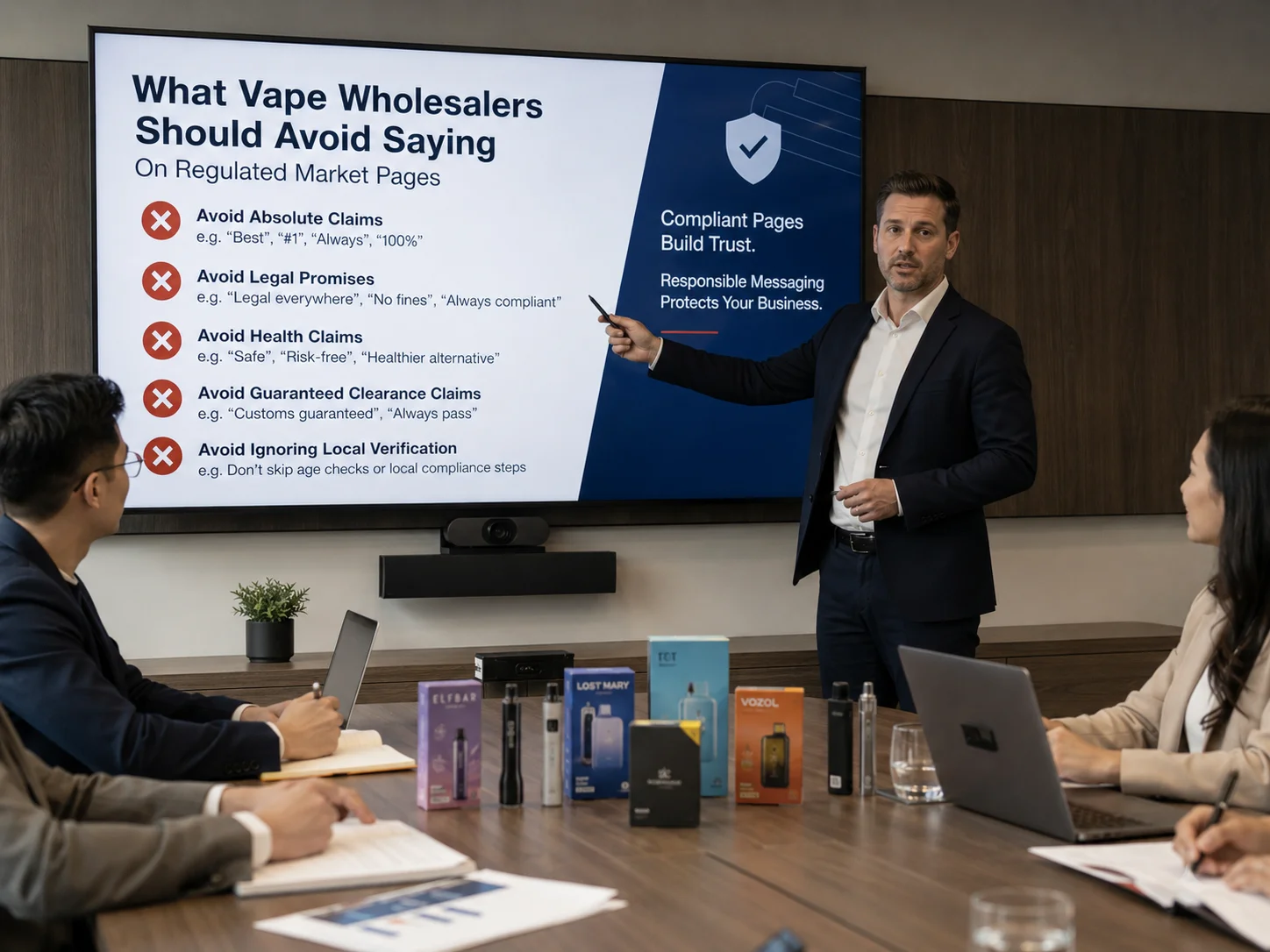
I think regulated market pages should be direct, but not careless. A supplier should not say every product is suitable for every country. A supplier should not promise customs clearance in all markets. A supplier should not make medical or health claims.[^11] A supplier should not push buyers to order without checking local rules. These words may bring short-term inquiries, but they may damage trust.
| Avoid Saying | Safer Way to Say It |
|---|---|
| “100% customs safe” | “We discuss shipping options and risk points before shipment.” |
| “Legal in every country” | “Please verify local rules before ordering.” |
| “No risk at all” | “We help buyers compare safer sourcing routes.” |
| “Best for all markets” | “We help match products with your channel and customer base.” |
| “Cures smoking problems” | “We supply vape products for adult market channels.” |
In my work, honest language helps close better orders. Buyers who run real wholesale businesses know that no international trade is zero risk. They respect a supplier who explains options clearly. For example, some buyers prefer overseas warehouse replenishment because they want faster delivery and less pressure on cash flow. Some buyers still choose China direct shipment because they need price advantage and volume. The right content does not hide these trade-offs. It explains them.
6. How Does Compliance Education Create New Long-Tail SEO Opportunities?
High-volume vape keywords are crowded. They often bring buyers who only ask for cheap prices.
Compliance education creates long-tail SEO opportunities because serious buyers search specific problems.[^12] They search shipping, MOQ, stock location, market fit, OEM support, and after-sales terms.

I see long-tail keywords as the new useful area in vape wholesale SEO. A buyer who searches “cheap disposable vape” may compare many suppliers and disappear. A buyer who searches “low MOQ disposable vape wholesale Europe warehouse” is more specific. He may already know his problem. He wants faster stock, less capital pressure, and lower testing risk. This buyer is more useful to a supplier.
| Long-Tail Topic | Buyer Problem |
|---|---|
| Low MOQ vape wholesale Europe | Buyer wants small batch replenishment. |
| China vape supplier with OEM ODM | Buyer wants brand control and margin. |
| Disposable vape wholesale shipping options | Buyer worries about delivery feasibility. |
| Vape products for smoke shop distributors | Buyer needs mixed category supply. |
| 510 battery and CBD battery wholesale | Buyer wants accessory category depth. |
| Vape after-sales support for wholesalers | Buyer fears defect loss and complaint pressure. |
I believe this type of content creates better-qualified inquiries. It also helps buyers trust the supplier before price discussion. In our own one-stop supply model, buyers often ask for disposable vapes, atomizers, 510 batteries, CBD batteries, grinders, glass pipes, vaporizers, and related smoking accessories together. A long-tail page can explain how mixed-category sourcing saves time. It can also explain how one after-sales contact reduces trouble after delivery.
7. How Can I Build Safer Vape Content for Importers, Distributors, and Retailers?
A buyer does not need pretty words only. He needs content that helps him avoid a bad purchase.
I build safer vape content by speaking to each buyer type separately. Importers need supply depth. Distributors need turnover. Retailers need simple product choices and fast replenishment.
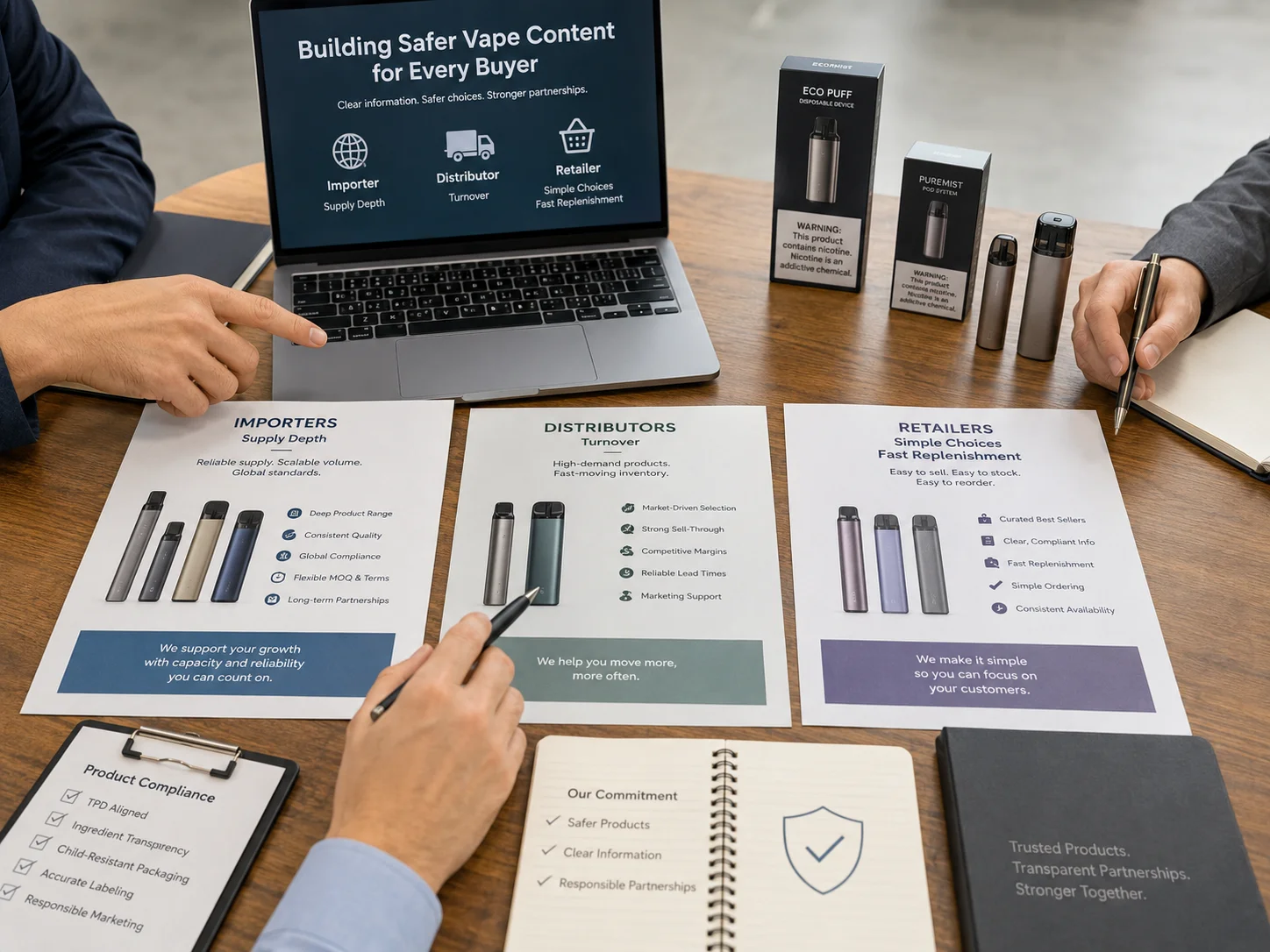
I think safer vape content starts with buyer type. A large importer may want factory capacity, stable pricing, OEM/ODM ability, and product development support. A mid-sized wholesaler may want full-category sourcing and one-stop shipment. A vape shop or smoke shop buyer may want small MOQ, fast delivery, and products that do not create too many after-sales problems. When one page speaks to all buyers in the same way, it becomes weak.
| Buyer Type | Main Need | Useful Content |
|---|---|---|
| Importer | Price, volume, OEM/ODM | Factory capacity, product development, bulk sourcing |
| Distributor | Fast turnover, stock range | One-stop product mix and delivery planning |
| Vape shop buyer | Low MOQ, quick refill | Overseas stock and fast replenishment |
| Smoke shop buyer | Mixed categories | Vapes, pipes, grinders, batteries, accessories |
| Convenience store supplier | Simple sales flow | Popular SKUs and stable supply |
I also think content should include real sourcing paths. From China, buyers can access stronger price advantage, deeper product choice, and OEM/ODM flexibility. From overseas warehouse stock, buyers can test products faster, reduce waiting time, and avoid holding too much inventory at once. In Europe, overseas warehouse replenishment can be useful for small and mid-sized buyers because orders can move faster through local express options. Buyers still need to verify local rules and sales limits.
8. How Can Vape Suppliers Adapt SEO Strategy for Regulated Markets?
If a supplier only changes keywords, the strategy is too shallow. The full buyer journey must change.
Vape suppliers can adapt SEO by targeting qualified intent, building market-aware pages, explaining sourcing routes, avoiding risky claims, and supporting buyers with clear after-sales communication.

My practical approach is simple. I do not write only for search engines. I write for the buyer who will send a message after reading. That buyer may ask about product choice, local fit, MOQ, shipping plan, stock location, and what happens if a product has defects. Good SEO should prepare that conversation. It should reduce repeated basic questions. It should also filter out buyers who only want impossible promises.
| SEO Action | Business Purpose |
|---|---|
| Create buyer-type pages | Match importers, wholesalers, and retailers separately |
| Create market-aware pages | Answer local business concerns without giving legal advice |
| Explain China direct sourcing | Show price, volume, OEM/ODM, and category depth |
| Explain overseas warehouse stock | Show speed, low MOQ, and cash-flow advantage |
| Add after-sales content | Build trust before order |
| Use clear disclaimers | Remind buyers to verify local rules |
As a Shenzhen-based supplier, I also believe SEO should reflect real supply ability. A content page should not promise products that a supplier cannot support. At Kingfuji, the supply advantage comes from Shenzhen’s full vape and smoking accessories chain, one-stop product sourcing, factory and trading integration, regular new products, OEM/ODM experience, and support for different buyer sizes. This kind of real base makes SEO stronger because the content connects with actual service.
Conclusion
Regulation does not kill vape wholesale SEO. It rewards useful content that helps serious buyers choose safer products, routes, inventory plans, and supplier relationships.
[^1]: "Electronic Nicotine Delivery Systems: Recommendations to ... - PMC", https://pmc.ncbi.nlm.nih.gov/articles/PMC6775917/. International public-health and regulatory summaries document substantial variation in e-cigarette rules across jurisdictions, supporting the view that regulation changes the commercial information environment for vape suppliers rather than simply removing market activity. Evidence role: general_support; source type: institution. Supports: A neutral institutional source should document that vaping products are regulated differently across jurisdictions, creating compliance and communication constraints that can affect market-facing content.. Scope note: This would support the regulatory context, not directly prove SEO performance outcomes. [^2]: "Assessing the Best Supplier Selection Criteria in Supply Chain ...", https://pmc.ncbi.nlm.nih.gov/articles/PMC9102987/. Research on B2B supplier selection identifies delivery reliability, product quality or fit, operational risk, and supplier service as recurring evaluation criteria in purchasing decisions. Evidence role: expert_consensus; source type: paper. Supports: A procurement or supply-chain study should show that B2B buyers commonly evaluate suppliers on delivery reliability, product suitability, risk, cost, and service support.. Scope note: This would be general B2B procurement evidence rather than vape-wholesale-specific proof. [^3]: "[PDF] December 2, 2024 Shenzhen HanQingDa Technology Co. Ltd. 12th ...", https://democrats-selectcommitteeontheccp.house.gov/sites/evo-subsites/democrats-selectcommitteeontheccp.house.gov/files/evo-media-document/Letter%20to%20Shenzhen%20HanQingDa.pdf. Government and trade statistics on China's e-cigarette industry identify Shenzhen and the surrounding Pearl River Delta as a major manufacturing and export cluster for vaping products. Evidence role: statistic; source type: government. Supports: A government, customs, or industry-cluster source should support Shenzhen's role as a leading e-cigarette manufacturing and export hub.. Scope note: The evidence may substantiate Shenzhen's leading role in e-cigarettes but may not cover all smoking accessories or prove that 'most' of every listed category is made there. [^4]: "Online Health Information Seeking Behavior: A Systematic Review", https://pmc.ncbi.nlm.nih.gov/articles/PMC8701665/. Studies of buyer information search indicate that perceived risk and purchase complexity increase the need for detailed online information before purchase decisions. Evidence role: mechanism; source type: paper. Supports: A study should support the mechanism that higher perceived risk or purchase complexity increases information search and more specific evaluation behavior.. Scope note: This would explain a plausible mechanism for vape wholesale search behavior but would not directly measure vape SEO queries. [^5]: "Barriers and Facilitators to Enforcing E-Cigarette Regulations for ...", https://pmc.ncbi.nlm.nih.gov/articles/PMC12958444/. International regulatory surveys show that e-cigarette rules vary by jurisdiction and may address product characteristics, sale channels, marketing, packaging, and import or distribution conditions. Evidence role: general_support; source type: institution. Supports: An international public-health or regulatory database should show that vaping regulations vary by product type, sales channel, marketing, and distribution rules.. Scope note: This supports the regulatory sensitivity of markets, but it does not directly evaluate individual buyers' commercial decisions. [^6]: "[PDF] Enforcement Priorities for Electronic Nicotine Delivery ... - FDA", https://www.fda.gov/media/133880/download. Government e-cigarette regulations in major markets establish requirements such as nicotine limits, labeling obligations, and restrictions or enforcement priorities affecting certain flavored products. Evidence role: definition; source type: government. Supports: Government regulatory sources should show that e-cigarette products can be subject to nicotine-strength limits, labeling requirements, flavor restrictions, or import/shipping controls.. Scope note: The source may document regulatory factors but may not address the commercial logistics route for every market. [^7]: "Effects of supply chain integration on lead time in the retail industry ...", https://www.academia.edu/65251955/Effects_of_supply_chain_integration_on_lead_time_in_the_retail_industry_in_Ghana. Supply-chain research shows that regional warehousing can shorten replenishment lead times and reduce some inventory-planning uncertainty for downstream buyers. Evidence role: mechanism; source type: paper. Supports: A supply-chain or logistics study should explain how local or regional warehousing can reduce delivery lead times and support smaller replenishment orders.. Scope note: This would support the logistics mechanism generally, not prove vape buyers in Europe prefer this option. [^8]: "Using Consumer Behavior Research In Business", https://online.longwood.edu/business/mba/marketing/how-consumer-decisions-are-researched/. Research on B2B purchasing and content marketing indicates that informative content can reduce buyer uncertainty and contribute to trust formation during supplier evaluation. Evidence role: mechanism; source type: paper. Supports: Academic research should support that informative, educational content can increase trust or reduce uncertainty in B2B purchase decisions.. Scope note: This would support the buyer-education mechanism rather than directly compare vape SEO page performance. [^9]: "The 6 Types of Search Intent (Including the New ...", https://seranking.com/blog/search-intent/. Research on website localization and international search behavior finds that content adapted to local language, context, and user needs can improve relevance for target audiences. Evidence role: general_support; source type: research. Supports: A search or localization source should support that localized content better matches user intent and international audience needs.. Scope note: This would support the general localization principle, not directly prove that market-specific vape pages outperform a global page. [^10]: "Guidance Related to Tobacco Products - FDA", https://www.fda.gov/tobacco-products/rules-regulations-and-guidance-related-tobacco-products/guidance-related-tobacco-products. Regulatory guidance on tobacco-product advertising and import compliance requires claims to be substantiated and cautions that regulated products remain subject to jurisdiction-specific legal requirements. Evidence role: expert_consensus; source type: government. Supports: Government sources should show that health or compliance claims in regulated products require substantiation and that importers remain responsible for customs and legal compliance.. Scope note: This supports the risk of unsupported claims but does not provide legal advice for every market. [^11]: "E-Cigarettes Authorized by the FDA", https://www.fda.gov/tobacco-products/market-and-distribute-tobacco-product/e-cigarettes-vapes-and-other-electronic-nicotine-delivery-systems-ends-authorized-fda. FDA guidance explains that nicotine or vaping products promoted with therapeutic claims, such as claims to treat or mitigate disease, may be subject to drug or device regulation rather than ordinary tobacco-product marketing rules. Evidence role: definition; source type: government. Supports: A regulator source should explain that products marketed with therapeutic or disease-related claims may be regulated as drugs, devices, or require claim substantiation.. [^12]: "The Influence of Price on Purchase Intentions: Comparative Study ...", https://pmc.ncbi.nlm.nih.gov/articles/PMC7911682/. Search-behavior research describes long-tail queries as numerous, lower-frequency searches that often express more specific information needs than broad head terms. Evidence role: mechanism; source type: research. Supports: A search research source should show that a large share of search demand consists of specific, low-frequency long-tail queries that reflect detailed information needs.. Scope note: This supports the search mechanism generally, not the volume or conversion rate of vape compliance queries.