
Disposable bans can cut your shelf fast. If you choose the wrong reusable products, you may face slow sales, returns, and confused retailers.
After the UK disposable vape ban[^1], wholesalers should focus on reusable vape systems with rechargeable batteries, refillable tanks or pods, replaceable parts, clear instructions, and stable replacement supply. Refillable pod systems, open-system starter kits, replacement pods, coils, tanks, refill products, and reusable-system bundles deserve the most attention.
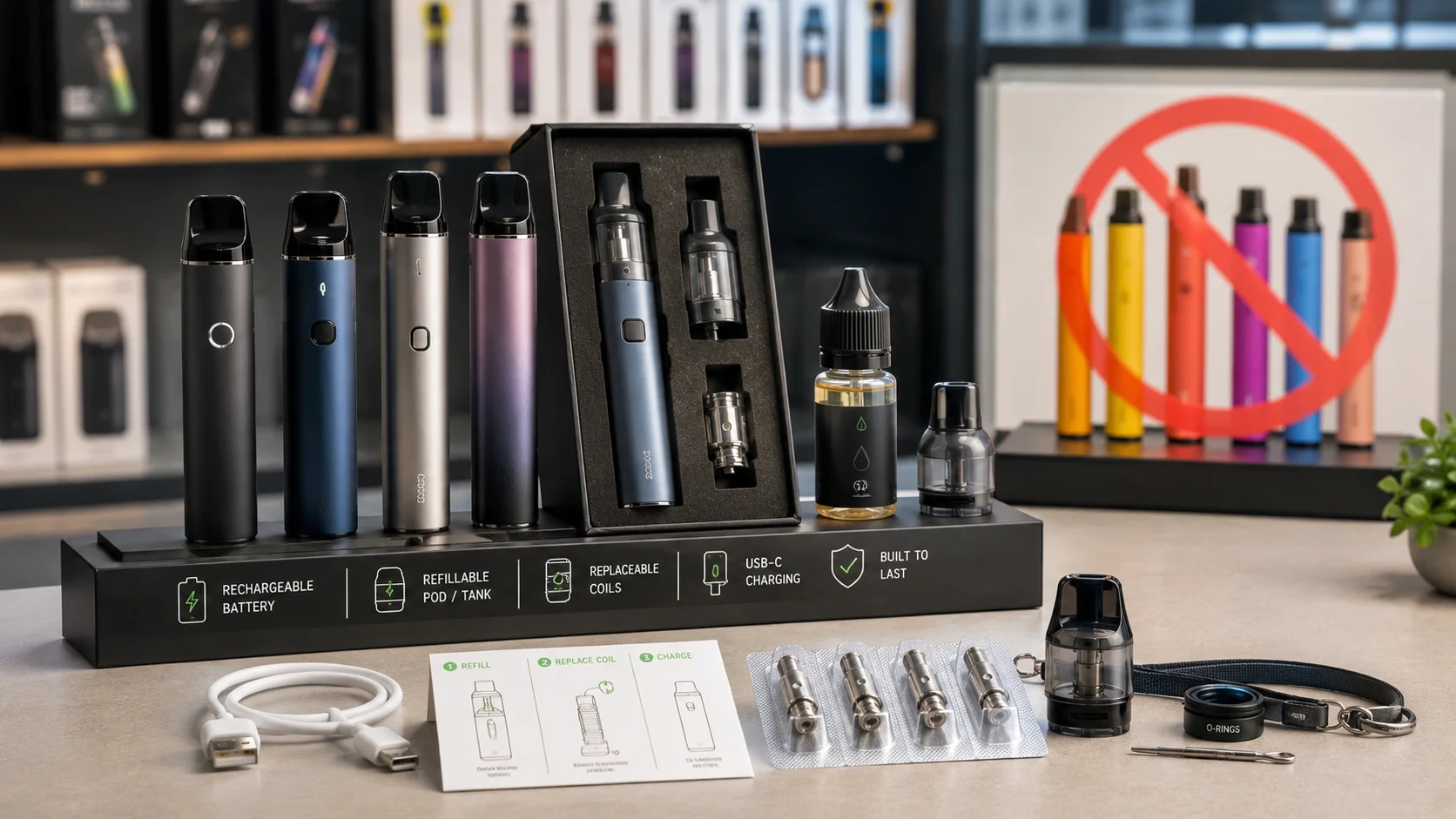
I see the UK market moving from “use and throw” to “buy once, refill, replace parts, and reorder accessories.” This change is not only a product change. It is a business model change. If I only sell the device, I may miss the real repeat orders. If I plan the device, pod, coil, tank, refill product, and retail bundle together, I help my customers build a better shelf and a stronger cash flow. I also reduce the chance that a retailer sells a device but cannot supply the right spare parts later. That is where many wholesalers will either win or lose after the ban.
1. What Counts as a Reusable Vape After the UK Ban?
A product name can look safe. The real structure may still be wrong. If I trust only words on the box, I may buy risk.
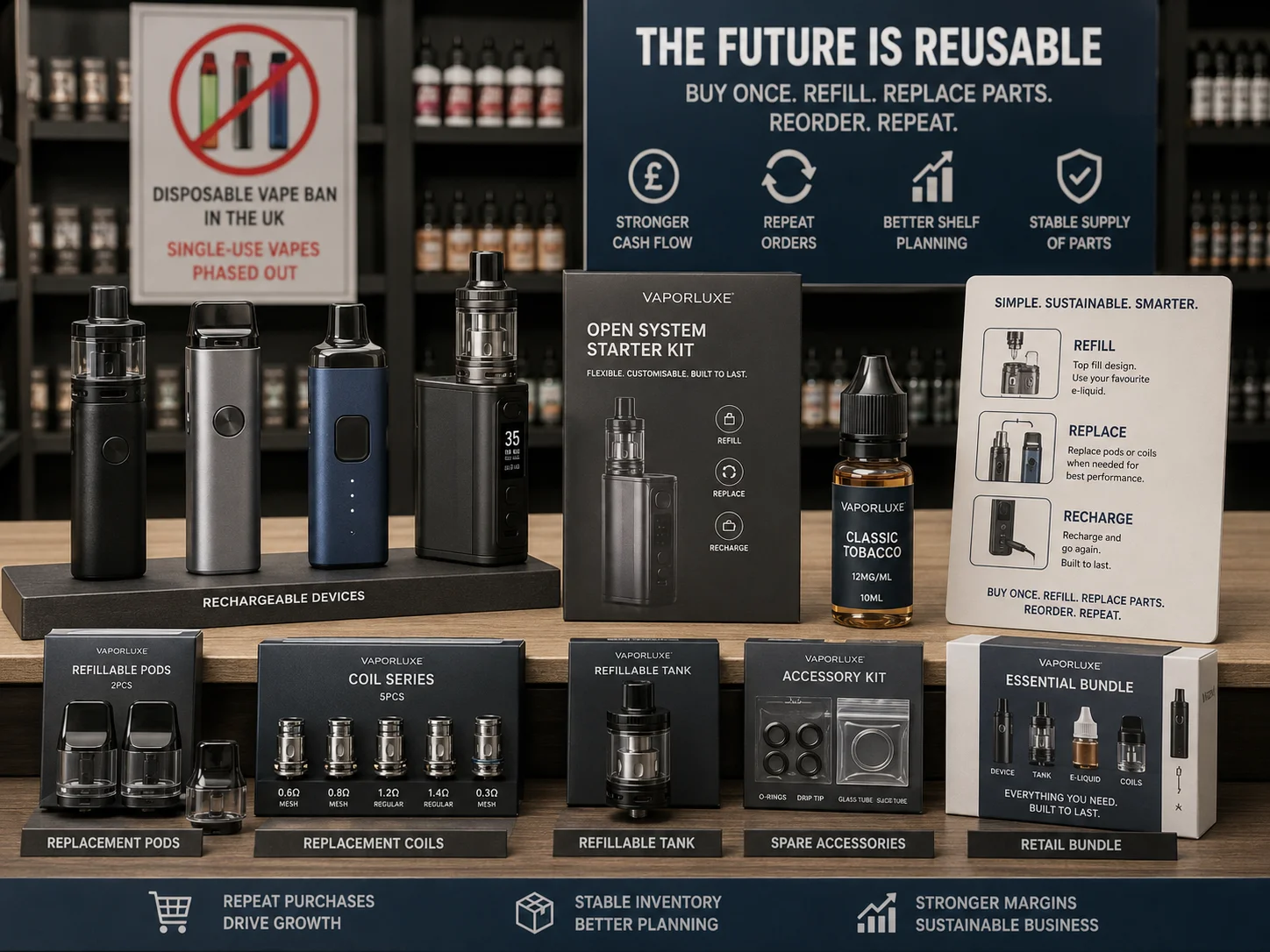
My Basic Reusable Vape Check
When I check a reusable product for wholesale, I do not start with the brand name. I start with the structure. I ask simple questions. Can the battery recharge? Can the user refill the tank, pod, or cartridge? If the device uses a coil, can the coil or the complete pod be removed and replaced? Can the shop buy the replacement parts later? Are the instructions clear enough for a normal retail customer? Was the product clearly designed for repeated use, not only for marketing?
I also remind my customers that words like “rechargeable,” “pod,” or “reusable” do not prove that a product fits UK requirements. A disposable can be rechargeable. A pod-shaped product can still be closed and not refillable. A product can say reusable on the box but still have no realistic spare-parts plan. For me, the safer way is to inspect the actual product and confirm the replacement chain before buying quantity.
| Check Point | What I Want To See | Why It Matters |
|---|---|---|
| Battery | Rechargeable battery | The device can be used many times |
| Container | Refillable tank, pod, or cartridge | The user can add refill liquid |
| Coil | Removable or replaceable coil where needed | The user can refresh performance |
| Parts | Replacement components sold separately | Retailers can create repeat sales |
| Instructions | Clear refilling and replacing steps | Users make fewer mistakes |
| Design | Built for repeated use | The product is not only renamed disposable |
2. Why Should Refillable Pod Systems Get Attention From Users Moving Away From Disposables?
Disposable users like easy devices.[^3] If I push a complex kit too fast, the user may reject it and return to old habits.
Refillable pod systems deserve attention because their size, hand feel, use style, and pocket-friendly design are usually close to disposable vapes[^4], while still supporting refilling and replacement.
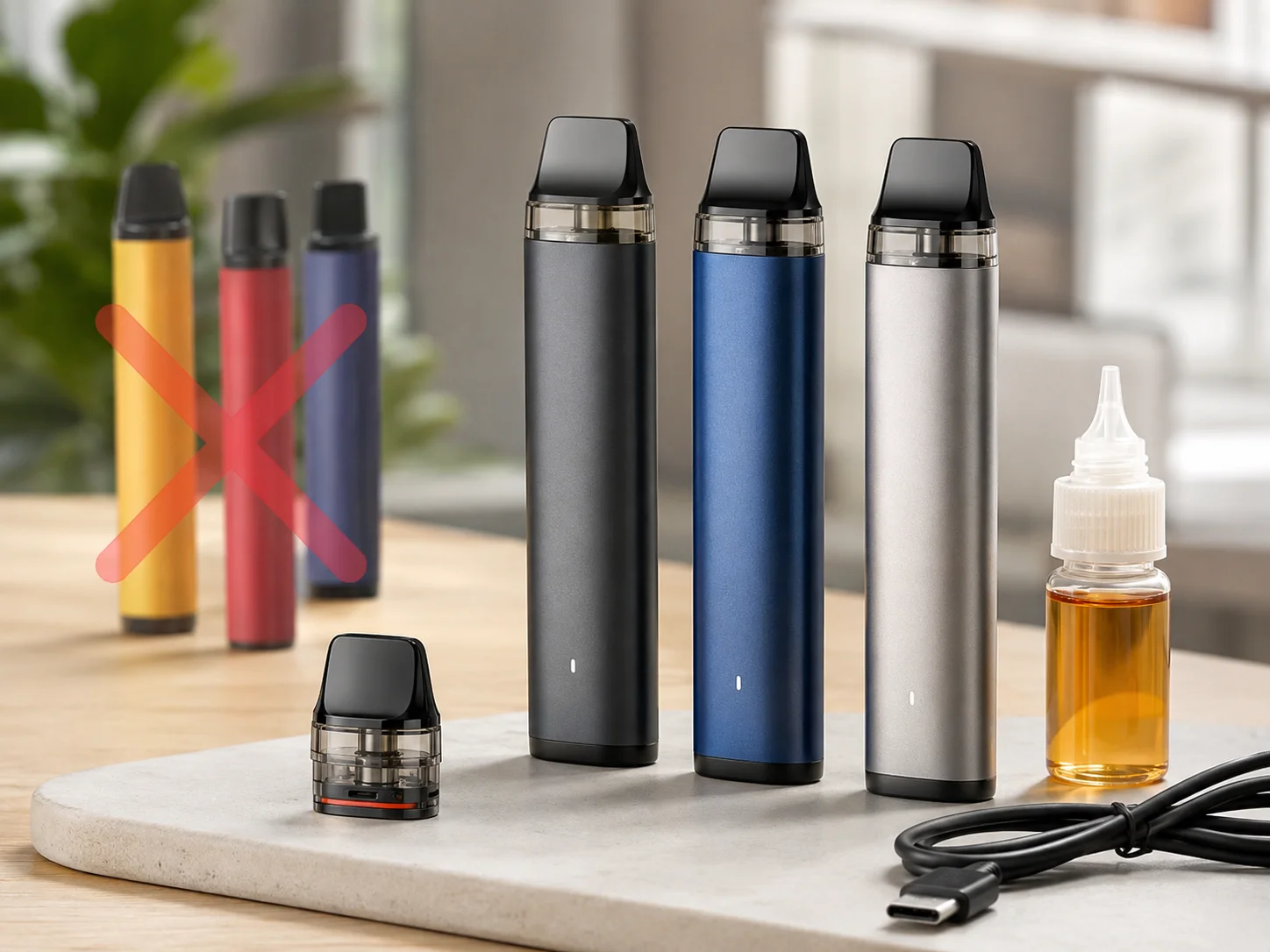
How I Choose Refillable Pod Systems
I like refillable pod systems for the first step after disposables because they do not scare the customer. The user already understands a small device. The user only needs to learn refilling, charging, and changing the pod or coil. That is a much smaller behavior change than jumping straight into a big open tank system.
When I choose this category, I focus on simple refill design, compact shape, leak-resistant pod structure, airflow that is easy to understand, USB-C charging, and clear pod or coil options. I also care about documented compatibility. A retailer must know which pod fits which device. If the shelf staff cannot explain this in ten seconds, the product creates confusion.
I also warn wholesalers not to buy only the device. That is a common mistake. If I sell the main device but do not prepare refillable pods and coils, I create future complaints. The customer may like the device but cannot keep using it. Then the retailer loses trust, and I lose reorder business.
| Selection Point | Good Sign | Risk Sign |
|---|---|---|
| Refill Mechanism | Simple side or top filling | Hard-to-open rubber plugs |
| Size | Compact and pocket-friendly | Too large for disposable users |
| Leakage Control | Strong seal and tested pod | Wet box or oil smell |
| Airflow | Fixed or simple adjustable airflow | Unclear settings |
| Charging | USB-C | Old or weak charging design |
| Compatibility | Written pod list | “It should fit” answer |
| Parts Supply | Stable pod and coil stock | Device only, no spares |
3. Why Are Replaceable-Pod Kits With User-Replaceable Coil Solutions Important?
A device can look easy to sell. If the pod or coil supply fails, the whole product becomes dead stock.
Replaceable-pod kits are useful because they keep operation simple for users, but wholesalers must confirm whether the pod, coil, or pod-with-coil solution can be replaced and supplied separately.
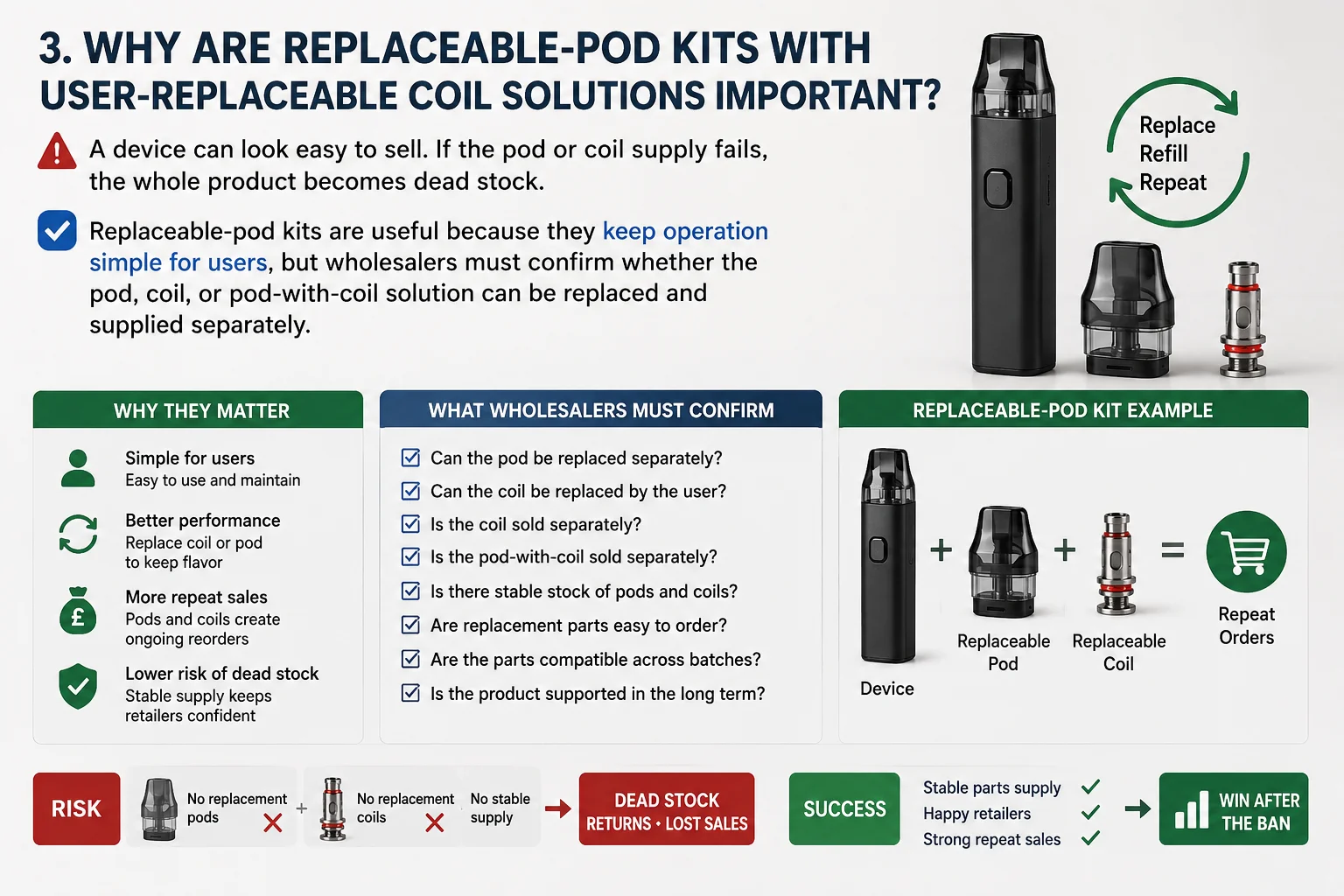
What I Check Before I Buy Replaceable-Pod Kits
Replaceable-pod kits sit in a smart middle position. They are easier than traditional tank systems. They are more reusable than closed disposable-style products. I like them for retailers who want to move disposable customers into a cleaner long-term system without teaching too much technical knowledge at once.
I always ask whether the complete pod can be replaced. I also ask whether the coil is built into the pod, or whether the user must replace the coil inside the pod. Both can work. The key point is that the replacement method must be real, simple, and stable. If different pod versions look almost the same but are not compatible, I know future returns may come.
I also ask how long compatible pods will remain available. This matters more than many new buyers think. A good device without spare pods is not a product. It is a short-term trap. I have seen buyers focus only on a cheaper device price. Later, they could not get matching pods. Then their customers stopped buying. The small saving became a bigger loss.
| Question I Ask | Why I Ask It | Best Answer |
|---|---|---|
| Can the complete pod be replaced? | It shows real reuse | Yes, and it is sold separately |
| Is the coil built into the pod? | It affects user operation | Clearly explained |
| Are pods sold separately? | It supports repeat orders | Yes, with stable stock |
| How long will pods remain available? | It reduces dead stock risk | Supplier has production plan |
| Are versions clearly marked? | It avoids wrong matching | Model code is clear |
| Do batches remain compatible? | It protects old stock | Supplier confirms consistency |
| Can the pod be refilled normally? | It fits reusable logic | Yes, with clear instructions |
4. Why Do Open-System Starter Kits Create Longer-Term Repeat Sales?
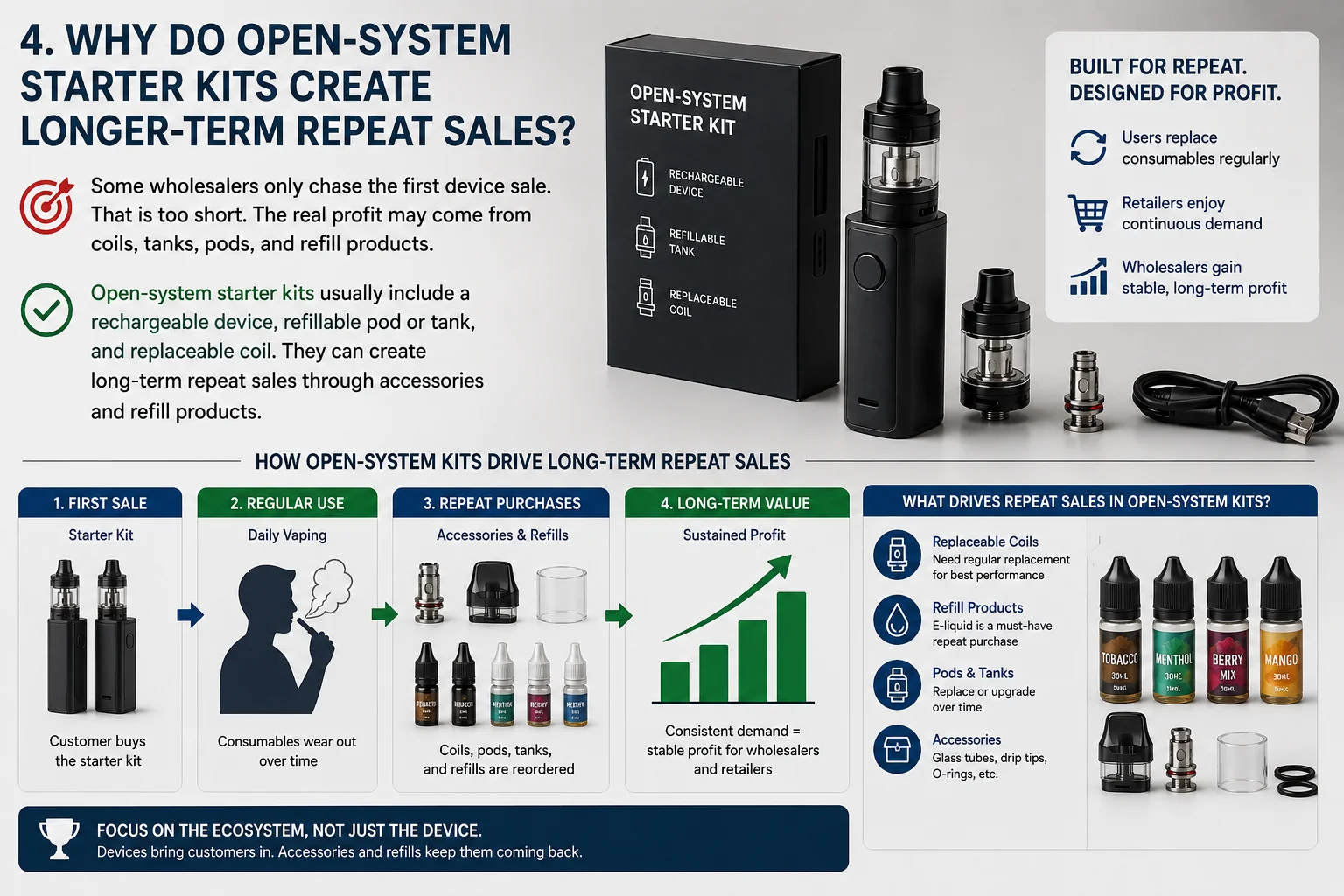
Some wholesalers only chase the first device sale. That is too short. The real profit may come from coils, tanks, pods, and refill products.
Open-system starter kits usually include a rechargeable device, refillable pod or tank, and replaceable coil. They can create long-term repeat sales through accessories and refill products.[^5]
How I Build Starter Kits For Retail Shelves
Open-system starter kits are stronger for repeat business because the customer does not only buy one item. The customer buys a system. The device needs coils. The tank or pod may need replacement. The user needs refill bottles. The retailer can keep selling these parts every week or every month.
For wholesale, I prefer a simple starter bundle. It can include the reusable device, refillable tank or pod, replacement coils, charging cable, user instructions, compatible refill bottles, optional spare pod, and retail-ready packaging. The point is not to make the kit look big. The point is to make the first user experience smooth.
I also choose models with clear compatibility. If one coil fits many devices, the retailer has less stock pressure. If one device needs rare parts, the retailer may not reorder. I also avoid products that need too much training. A good beginner product should make refilling and coil replacement easy enough for a normal customer. Simple products reduce after-sales pressure. Simple products also help the shop staff sell with confidence.
| Bundle Item | Retail Value | Wholesale Benefit |
|---|---|---|
| Reusable device | First sale | Main product margin |
| Refillable tank or pod | Daily use | Drives refill demand |
| Replacement coils | Regular maintenance | Repeat order |
| Charging cable | Ready-to-use kit | Fewer customer complaints |
| User instructions | Easy learning | Lower return rate |
| Refill bottles | Immediate use | Higher order value |
| Spare pod | Backup part | Better user experience |
| Retail starter bundle | Shelf-ready | Easier retailer promotion |
5. Why Should Replacement Pods, Coils and Tanks Become Core Wholesale Categories?
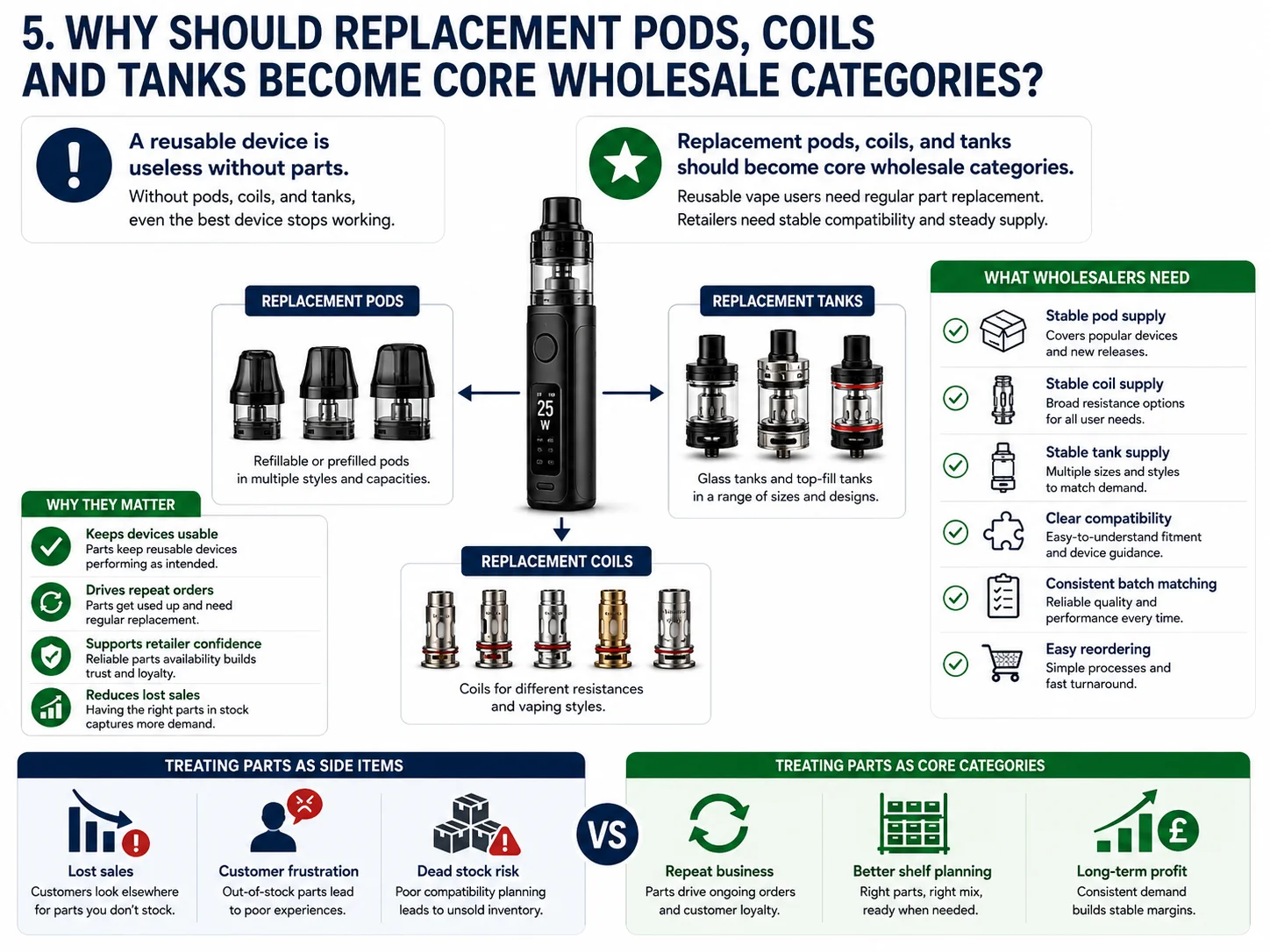
A reusable device is useless without parts. If I treat parts as side items, my customers may lose sales after the first purchase.
After the UK ban, replacement pods, coils, and tanks should become core wholesale categories[^6] because reusable vape users need regular part replacement and retailers need stable compatibility.
Why I Treat Replacement Parts Like Main Products
Before, many buyers treated spare pods and coils as small accessories. After the move to reusable products, I think this mindset must change. Replacement parts are not extra items. They are the engine of repeat business. A retailer who sells reusable devices must also sell replacement pods, coils, tanks, mouthpieces, seals, and mixed spare-part packs.
I pay close attention to compatibility. This is one of the biggest causes of returns.[^7] A pod may look similar but not fit. A coil may have the wrong resistance. A tank may belong to another version. If a retailer matches by appearance only, the customer may come back angry. That costs time, money, and reputation.
On a wholesale page, I want clear information. I want the compatible device model, pod or coil resistance, pack quantity, refill method, replacement instructions, recommended reorder quantity, and expected production continuity. I also like mixed replacement-part packs for retailers who test a new device line. This helps them avoid overstocking one part and missing another part.
| Replacement Category | What To Show Clearly | Main Risk If Unclear |
|---|---|---|
| Refillable pods | Device model and version | Wrong fit |
| Pods with integrated heating element | Resistance and pack quantity | Bad performance |
| Standalone coils | Ohm value and device list | Burnt taste or no use |
| Replacement tanks | Thread or model fit | Return claims |
| Mouthpieces and seals | Exact compatible model | Leakage complaints |
| Spare components | Batch compatibility | Slow-moving stock |
| Mixed packs | Included parts | Retail confusion |
6. Which Compliant Refill Products and Market-Ready E-Liquid Options Should Wholesalers Watch?
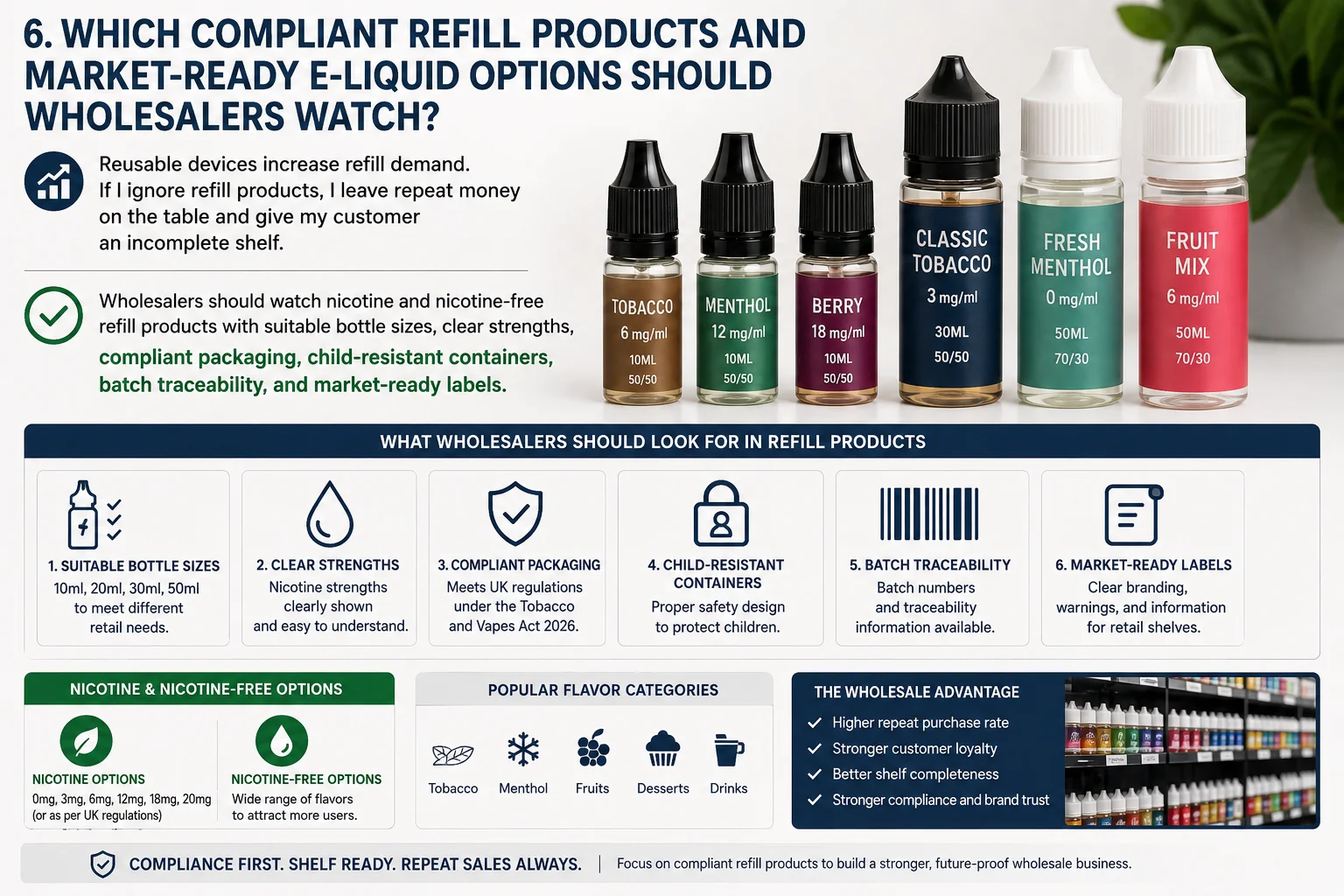
Reusable devices increase refill demand. If I ignore refill products, I leave repeat money on the table and give my customer an incomplete shelf.
Wholesalers should watch nicotine and nicotine-free refill products with suitable bottle sizes, clear strengths, compliant packaging, child-resistant containers, batch traceability, and market-ready labels[^8].
How I Think About Refill Products After the Ban
Reusable devices naturally create demand for refill products. This is good for wholesalers, but it also needs careful product selection. I do not want my customers to make unsupported health claims, safety claims, or smoking-cessation claims. I want product pages to show facts. The page should show capacity, nicotine strength, ingredients, packaging type, target market, filling nozzle, and traceability information.
For the UK and Europe, wholesalers should check local rules carefully before buying or selling nicotine-containing products. I always tell customers that compliance is not a decoration. It is part of the business cost. If a market needs tax stamps, local-language labels, or specific registration steps, the buyer should prepare these before import and retail sale. If the market is the United States, the buyer should pay close attention to state rules and PMTA-related requirements.[^9]
I also remind buyers not to chase only the cheapest refill products. E-liquid is an inhaled product. Poor raw materials, unstable nicotine strength, bad bottle seals, or unclear labels can destroy customer trust.[^10] A stable refill product may look less exciting than a hot new device, but it can create steady repeat orders.
| Refill Product Point | What I Prefer | Why It Helps |
|---|---|---|
| Nicotine options | Clear strengths | Easier retailer selection |
| Nicotine-free options | Clearly marked | Wider customer choice |
| Bottle size | Market-appropriate | Better compliance planning |
| Container | Child-resistant design | Safer retail handling |
| Seal | Tamper-evident packaging | More trust |
| Bottle design | Leak-resistant | Fewer transport issues |
| Label | Local language when needed | Easier shelf sale |
| Batch | Traceable code | Better after-sales control |
| Nozzle | Fits common pods | Less messy refilling |
7. Why Do Charging Accessories, Cases and Reusable-System Bundles Matter More Now?
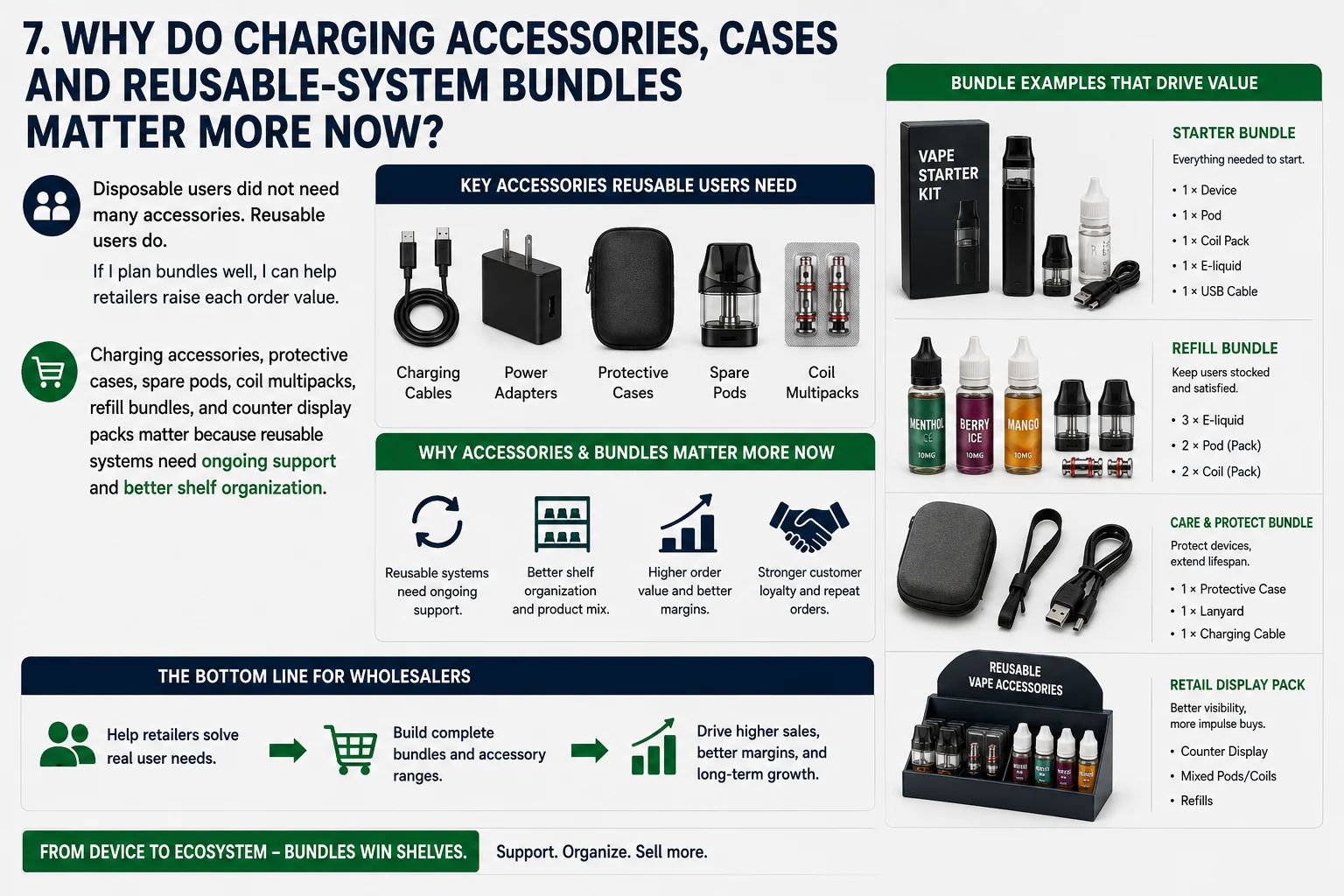
Disposable users did not need many accessories. Reusable users do.[^11] If I plan bundles well, I can help retailers raise each order value.
Charging accessories, protective cases, spare pods, coil multipacks, refill bundles, and counter display packs matter because reusable systems need ongoing support and better shelf organization.
How I Use Bundles To Help Retailers Sell Faster
When the market moves from disposable to reusable, the shelf should also change. A reusable product has more parts. The user may need USB-C charging cables, protective cases, storage cases, replacement seals, spare pods, coil multipacks, device-and-refill bundles, travel storage accessories, and counter display packs.
I like bundles because they make selling easier. A retailer can sell a starter device with refill liquid and spare pods together. The customer leaves the shop with everything needed for the first week or first month. This reduces confusion. It also helps the retailer increase order value without pushing random items.
For wholesale, I use bundles to reduce buying fear. A small retailer may not know how many pods or coils to buy. A ready bundle gives the retailer a simple answer. For example, one box can include devices, matching pods, coils, and refill bottles. Another bundle can focus on replacement parts only. A counter display pack can make the reusable category look organized. This matters because many disposable customers are used to simple buying. The new shelf must still feel simple.
| Bundle Type | Best For | What It Can Include |
|---|---|---|
| Device starter bundle | New users | Device, pod, cable, instructions |
| Device-and-refill bundle | First purchase | Device, refill bottle, spare pod |
| Coil multipack bundle | Repeat users | Several coils, small guide |
| Spare pod bundle | Retail reorder | Matching pods by model |
| Travel bundle | Daily carrying | Case, cable, spare pod |
| Counter display pack | Shop shelf | Devices, pods, coils, refill items |
| Replacement seal pack | After-sales support | Seals and mouthpieces |
| Mixed retail bundle | Small shops | Small MOQ across SKUs |
8. How Should Wholesalers Prioritize Reusable Vape Categories?
Too many choices can freeze a buyer. If I rank products with no system, I may buy what looks nice instead of what sells.
Wholesalers should prioritize reusable vape categories by scoring market suitability, refill ease, replacement-part supply, compatibility, defect rate, reorder frequency, MOQ, documentation, and inventory risk.
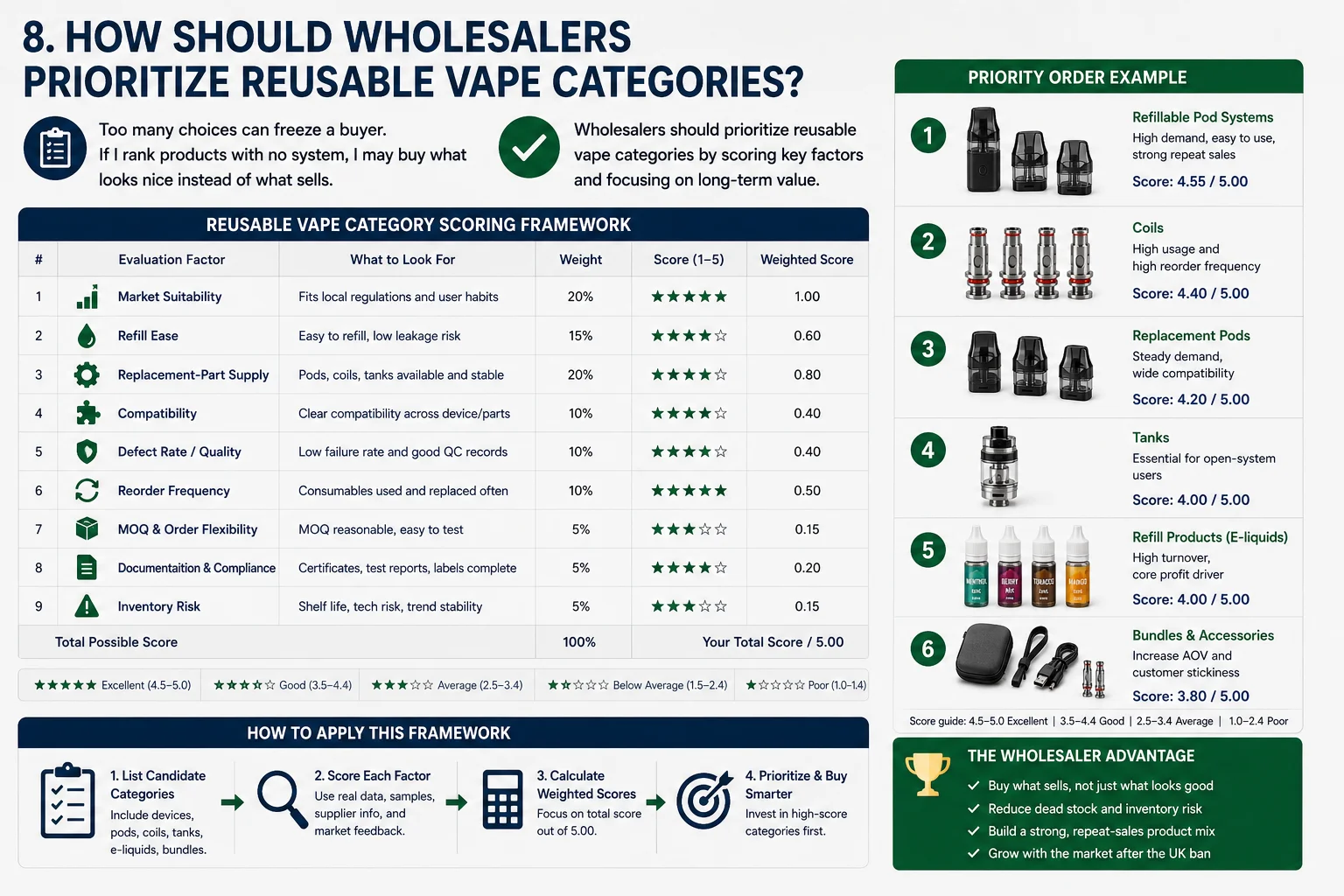
My Simple Scoring Method For Reusable Vape Buying
I use a simple scoring system when I help customers choose reusable categories. I do not let one factor control the decision. A product with a low price may still be bad if it leaks, has no parts, or needs too much retailer training. A product with a higher price may be better if it sells fast, creates repeat orders, and reduces after-sales problems.
I score suitability for the UK market, refilling ease, pod or coil replacement ease, replacement-part availability, component compatibility, defect and leakage rate[^12], reorder frequency, supplier production continuity, packaging readiness, documentation availability, MOQ, mixed-SKU flexibility, retailer training needs, warranty process, total inventory risk, and long-term repeat-order potential.
For new or small buyers, I usually prefer low MOQ, fast delivery, and small test orders. In our European warehouse model, small customers can test from low quantities and receive goods fast in many EU areas. This helps them reduce pressure and check real demand. For larger importers and distributors, China direct purchase can give stronger price advantage, more SKU choices, and OEM or ODM options. The right route depends on order size, risk level, and cash-flow plan.
| Score Factor | Why I Care | High Score Means |
|---|---|---|
| UK market suitability | Reduces compliance risk | Product structure is clear |
| Ease of refilling | Reduces user mistakes | Simple and clean refill |
| Ease of replacement | Reduces returns | Pod or coil is easy to change |
| Parts availability | Drives repeat sales | Stable spare stock |
| Compatibility | Protects retailers | Clear model matching |
| Leakage rate | Protects reputation | Low defect history |
| Reorder frequency | Supports cash flow | Parts and refill sell often |
| Production continuity | Avoids dead shelves | Supplier can keep making it |
| Packaging readiness | Helps retail sale | Shelf-ready package |
| Documentation | Helps staff explain | Clear instructions |
| MOQ flexibility | Helps small buyers | Mixed SKU support |
| Warranty process | Reduces disputes | Clear claim method |
| Inventory risk | Protects cash | Low chance of stuck stock |
| Repeat potential | Builds long-term value | Customer comes back |
Conclusion
I will focus on reusable systems with clear parts, stable refill supply, simple use, and real repeat value, because fast turnover beats blind low-price buying.
[^1]: "Tobacco and Vapes Act 2026", https://en.wikipedia.org/wiki/Tobacco_and_Vapes_Act_2026. Provides the official announcement and legislative details regarding the UK government's plan to ban the sale and supply of disposable vapes as part of its efforts to curb youth vaping. Evidence role: historical_context; source type: government. Supports: the UK government's plan to ban the sale and supply of disposable vapes. [^2]: "Single-use vapes ban: information for businesses - GOV.UK", https://www.gov.uk/guidance/single-use-vapes-ban. Outlines the official definitions and criteria for vaping products under UK regulations, which helps clarify what constitutes a reusable device that will remain legal for sale after the ban on disposables is implemented. Evidence role: definition; source type: government. Supports: the criteria used by regulatory bodies to distinguish between disposable and reusable vaping products. Scope note: The source may provide general principles rather than an exhaustive checklist that perfectly matches every point made by the author. [^3]: "Young people's use of disposable vapes: A qualitative study - PubMed", https://pubmed.ncbi.nlm.nih.gov/38880489/. Presents findings from consumer surveys or market research indicating that convenience, lack of maintenance, and simplicity are key reasons cited by users for choosing disposable vapes over other systems. Evidence role: general_support; source type: research. Supports: that simplicity and ease of use are primary drivers for the adoption of disposable vapes among consumers. [^4]: "Type of E-Cigarette Device Used Among Adolescents and Young ...", https://pmc.ncbi.nlm.nih.gov/articles/PMC5896438/. Provides analysis from industry observers or product reviewers comparing the form factor, draw activation, and overall user experience of disposable vapes and refillable pod systems, supporting the claim that the latter offers a familiar feel. Evidence role: general_support; source type: other. Supports: the design and user experience similarities between disposable vapes and modern refillable pod systems. Scope note: The source would likely be based on expert opinion and product analysis rather than quantitative, peer-reviewed user data. [^5]: "Trends in where people buy their vaping products and differences ...", https://pmc.ncbi.nlm.nih.gov/articles/PMC11813730/. Presents market data or business analysis showing the revenue structure of the vaping market, indicating that the business model for open systems relies on recurring purchases of accessories and refills, leading to a higher customer lifetime value. Evidence role: statistic; source type: research. Supports: that open-system vaping products generate higher long-term revenue per customer through the repeat sale of consumables like e-liquids and coils. Scope note: Data would likely come from private market research firms and may not be from a peer-reviewed academic source. [^6]: "Exploring the potential consequences of the disposable vape ban in ...", https://pmc.ncbi.nlm.nih.gov/articles/PMC12978755/. Provides market analysis and forecasts from industry experts on how the UK disposable vape ban will restructure the market, projecting significant growth in the segment for replacement parts like pods, coils, and tanks. Evidence role: general_support; source type: research. Supports: that the ban on disposable vapes is expected to shift market demand significantly towards reusable systems, thereby increasing the market share and sales volume of replacement components. [^7]: "6 Common Retail Return Reasons (And Why You Should Care)", https://corp.narvar.com/blog/common-reasons-for-retail-returns. Presents data or analysis from retail industry reports on the common causes of product returns, which often include customer confusion and the purchase of incompatible accessories or components. Evidence role: case_reference; source type: other. Supports: that product incompatibility is a frequent reason for customer returns in retail, especially for products with an ecosystem of accessories. Scope note: The source may discuss retail in general or the broader consumer electronics category, rather than focusing specifically on the vape industry. [^8]: "Tobacco and Vapes Act 2026 - Wikipedia", https://en.wikipedia.org/wiki/Tobacco_and_Vapes_Act_2026. Details the Tobacco and Related Products Regulations (TRPR), which mandate requirements for e-cigarette refill containers, including child-resistant packaging, specific warning labels, and maximum limits on nicotine strength and volume. Evidence role: definition; source type: government. Supports: the specific requirements for e-liquid containers and packaging under UK law. [^9]: "Premarket Tobacco Product Applications - FDA", https://www.fda.gov/tobacco-products/market-and-distribute-tobacco-product/premarket-tobacco-product-applications. Provides information from the U.S. Food and Drug Administration (FDA) explaining the Premarket Tobacco Product Application (PMTA) process and other regulatory requirements for vaping products sold in the United States. Evidence role: general_support; source type: government. Supports: the regulatory pathway, including the Premarket Tobacco Product Application (PMTA) process, required by the U.S. Food and Drug Administration (FDA) for new tobacco products to be legally marketed. [^10]: "A systematic review of refillable e-liquid nicotine content accuracy", https://pubmed.ncbi.nlm.nih.gov/33012670/. Presents findings from chemical analyses of commercial e-liquids, showing significant discrepancies between labeled and actual nicotine content, as well as the presence of impurities and potential toxicants in some products. Evidence role: mechanism; source type: paper. Supports: that unregulated or poorly manufactured e-liquids can contain harmful contaminants and often have nicotine concentrations that are inconsistent with their labels. [^11]: "FTC Issues Third Report on E-Cigarette Advertising and Sales in the ...", https://www.ftc.gov/news-events/news/press-releases/2024/04/ftc-issues-third-report-e-cigarette-advertising-sales-us. Provides market research data showing the sales volume and growth of the vaping accessories market, linking this growth to the rising popularity of reusable and open-system devices. Evidence role: statistic; source type: research. Supports: that the market for vaping accessories, such as chargers, cases, and replacement parts, is directly correlated with the installed base and sales of reusable hardware systems. Scope note: The source is likely to be a market research report from a private firm rather than a public institution or peer-reviewed paper. [^12]: "Vaping Devices (Electronic Cigarettes) DrugFacts", https://nida.nih.gov/publications/drugfacts/vaping-devices-electronic-cigarettes. Explains the business impact of product quality and defect rates in consumer electronics, detailing how common failures can increase costs for distributors and retailers through returns, customer support, and reputational harm. Evidence role: mechanism; source type: paper. Supports: that high product defect rates, such as leakage in vaping devices, lead to increased costs from returns and warranty claims, thereby damaging brand reputation and reducing profitability for distributors. Scope note: The source may discuss general principles of quality management in manufacturing or consumer electronics rather than focusing specifically on vaping products.