
Vape stock can look healthy today and disappear tomorrow. When I plan too late, I lose sales, cash, and customer trust fast.
A monthly vape replenishment plan tracks last month’s sales, ranks fast and slow items, sets minimum stock, counts lead time, adds safety stock, and places reorders before stock runs out[^1]. I use it to keep best sellers available, test new products carefully, and protect cash flow.
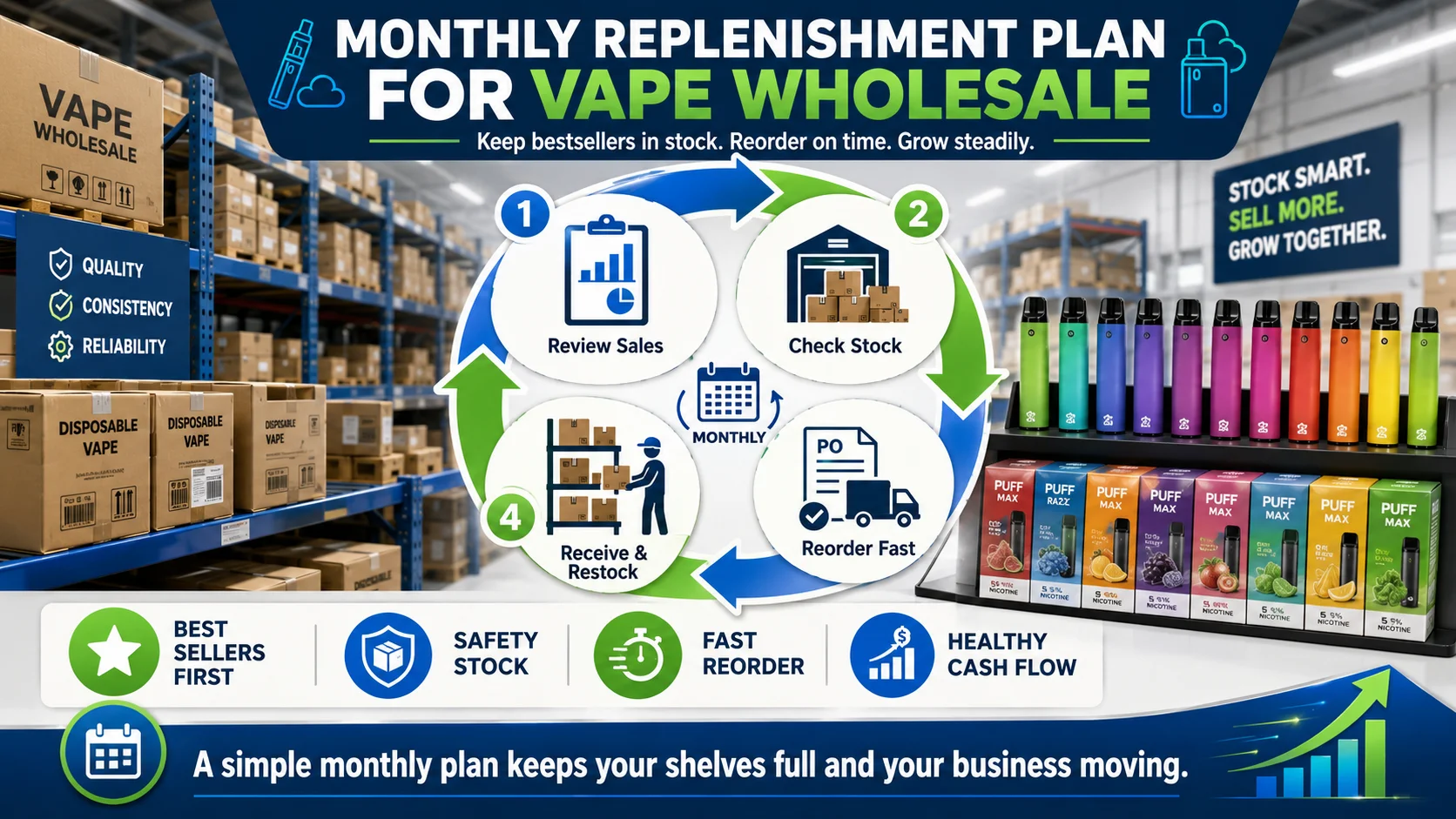
Many buyers ask me one simple question: “How much should I order this month?” I never answer with one number first. I ask about sales speed, stock on hand, shipping time, cash flow, and local compliance. In vape wholesale, the real problem is not only buying products. The real problem is buying the right products at the right time, in the right quantity, with the right risk level.
I have worked with many international B2B buyers for years. Some are small shop owners. Some are online sellers. Some are wholesalers with their own local distribution. I have seen one mistake again and again. A buyer sells one flavor very fast, then waits until it is out of stock before ordering again. By the time the new stock arrives, customers have already moved to another seller.
A good replenishment plan does not need to be complex. It needs to be honest. It needs to be based on real sales data, not feelings[^2]. It also needs to respect your local laws, tax rules, age rules, packaging rules, and product restrictions. If a product is not allowed in your market, no stock plan can save that business. If a product is compliant and has real demand, then a monthly plan can make your business much smoother.
1. How Should I Review Last Month’s Sales by Model, Flavor, and Quantity?
Many vape wholesalers only look at total sales. That hides the real problem. One hot flavor may carry the whole month while five slow flavors eat cash.
You should review last month’s sales by model, flavor, and quantity because each SKU moves at a different speed[^3]. I separate data by product name, puff count, flavor, nicotine level, pack size, and sales channel. This shows what to reorder, what to reduce, and what to stop buying.
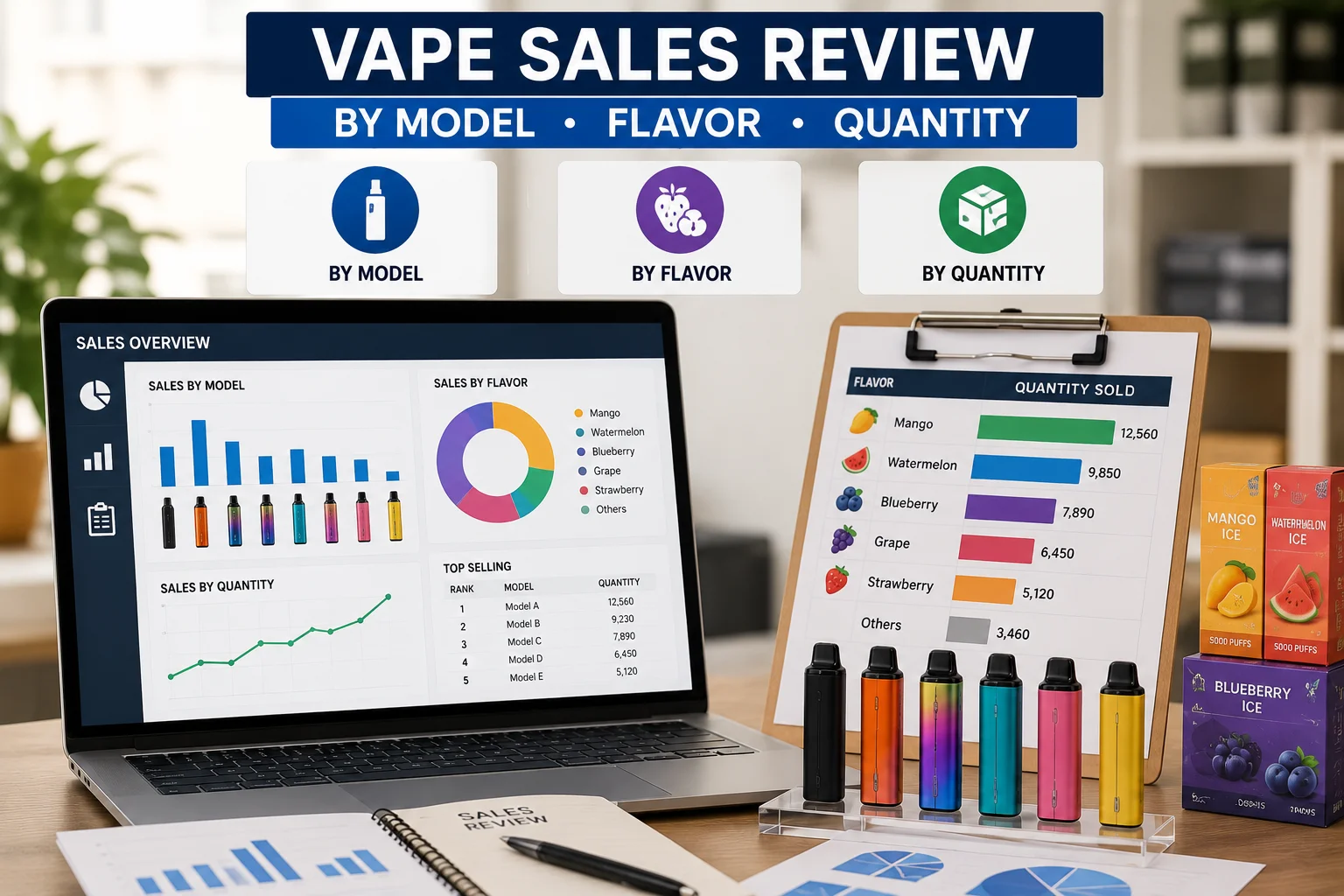
Build a Simple Sales Sheet First
I always start with a simple sheet. I do not need fancy software in the beginning. I need clean data. If I sell to shops, I record which shop bought which model. If I sell online, I record which listing brought the order. If I sell to small resellers, I still record the flavor and quantity, because small buyers often show local demand faster than big buyers.
A common question I get from first-time importers is, “Can I just reorder the same mix as last time?” My answer is no, unless last month’s mix sold evenly. Most of the time, it did not. Mango, mint, watermelon, blue razz, and tobacco may all behave differently in each country. A model that sells well in Germany may not sell the same in France or the UK. A large puff-count model may move fast in one channel but sit in another.
| Data Point | Why I Track It | What It Tells Me |
|---|---|---|
| Model name | Each device has its own demand | Which product line deserves more stock |
| Flavor | Flavor drives repeat buying | Which taste should be reordered first |
| Quantity sold | Sales volume shows real demand | How much to order next month |
| Stock left | Stock left shows risk | Whether I am close to running out |
| Sales channel | Each channel behaves differently | Where to push or reduce stock |
| Customer feedback | Complaints affect reorder decisions | Which products may create after-sales issues |
I also look at returns and complaints. A product can sell fast but still be dangerous for my business if it creates too many quality issues. For vape wholesale, stable quality matters more than a one-time hot sale. If customers complain about leaking, burnt taste, short battery life, or wrong flavor feeling, I treat that product carefully. I may reduce the reorder even if the sales number looks good.
2. How Do I Identify My Best-Selling and Slow-Moving Vape Products?
Slow stock is quiet, but it kills cash every day. Fast stock makes money only when I keep it available at the right time.
I identify best sellers by sell-through rate, repeat orders, customer feedback, and stockout frequency[^4]. I identify slow movers by low sales, long shelf time, poor feedback, and repeated discount needs. The best products are not always the cheapest. They are the products that move fast and bring repeat orders.
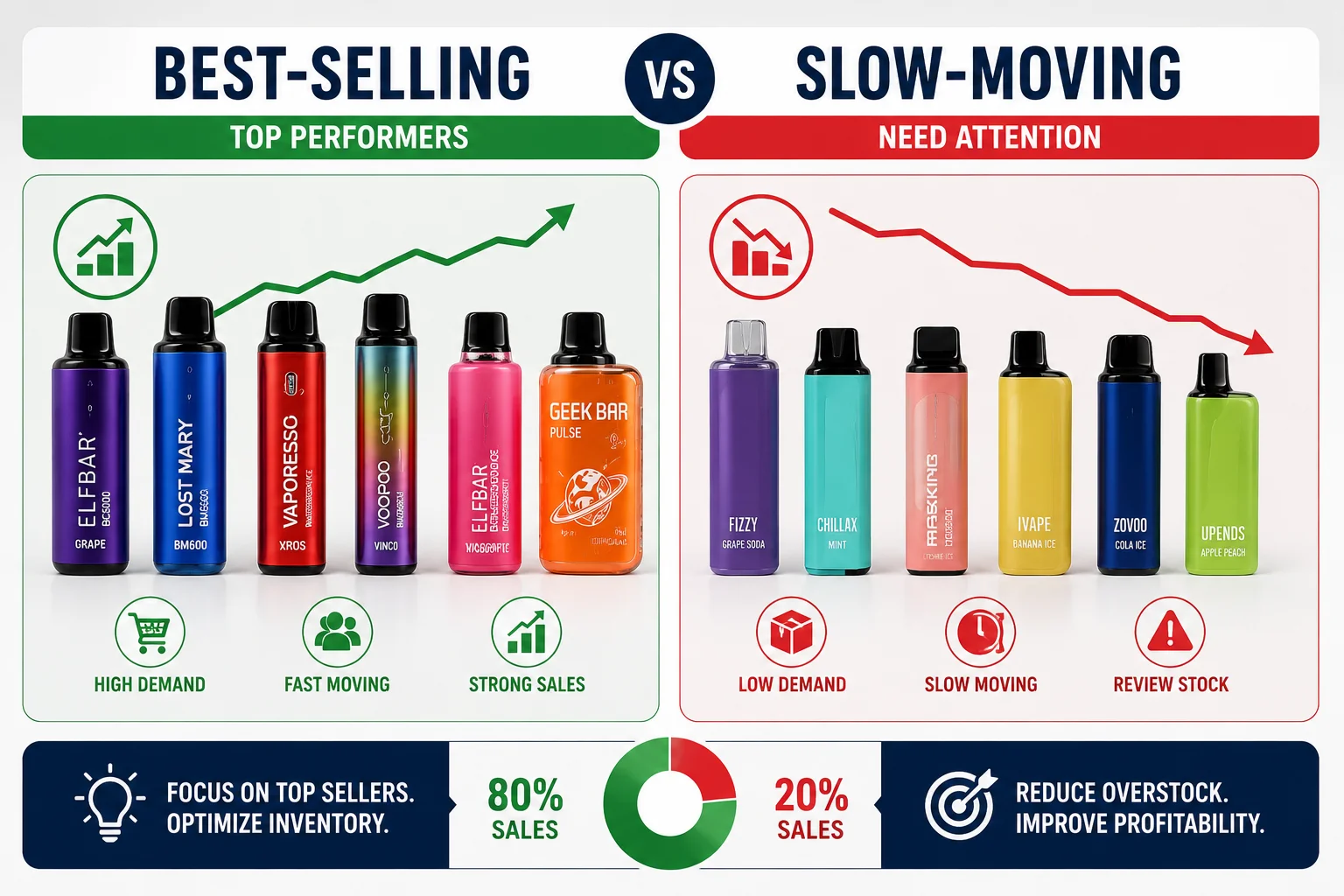
Use Speed, Not Only Quantity
I do not call a product a best seller only because it sold 1,000 pieces. I ask how fast it sold. If 1,000 pieces sold in 5 days, that is very strong. If 1,000 pieces sold in 60 days, that is a different story. The same rule works for slow-moving products. A product may look small because I only bought 100 pieces, but if it sold out in two days, it may be a hidden winner.
Here is a simple way I rank products:
| Product Type | Sales Speed | Customer Feedback | My Action |
|---|---|---|---|
| Best seller | Fast | Good | Increase reorder |
| Stable seller | Medium | Good | Keep normal reorder |
| Test winner | Fast | Limited but positive | Reorder carefully |
| Slow mover | Slow | Neutral or weak | Reduce or clear |
| Problem product | Any speed | Bad | Stop or replace |
I have seen buyers chase very cheap vape products because they believe low price means easy sales. I do not agree. If cheap stock does not move, it is expensive. If a higher-priced official product sells fast and brings repeat buyers, it may be the better business. I also pay attention to brand effect. Big names like ELF BAR, GEEK BAR, VOZOL, RAZZ BAR, FUMOT, and other known brands can create strong demand in some markets. But I still check access, authorization, and local rules. Some brands use strict regional distribution. Some products may not be available through normal channels in every country.
The key is simple. I do not fight the market. I follow demand, feedback, and risk. If a product moves fast, has stable quality, and fits local rules, I give it more space in my monthly plan.
3. How Do I Set Minimum Stock Levels for Popular Models?
Running out of best sellers feels worse than holding slow stock. I lose today’s order and maybe lose tomorrow’s customer too.
You should set minimum stock levels by using average daily sales, supplier lead time, shipping time, and safety stock. For popular vape models, I never wait for zero stock. I set a reorder point so I can place the next order before stock becomes dangerous[^5].
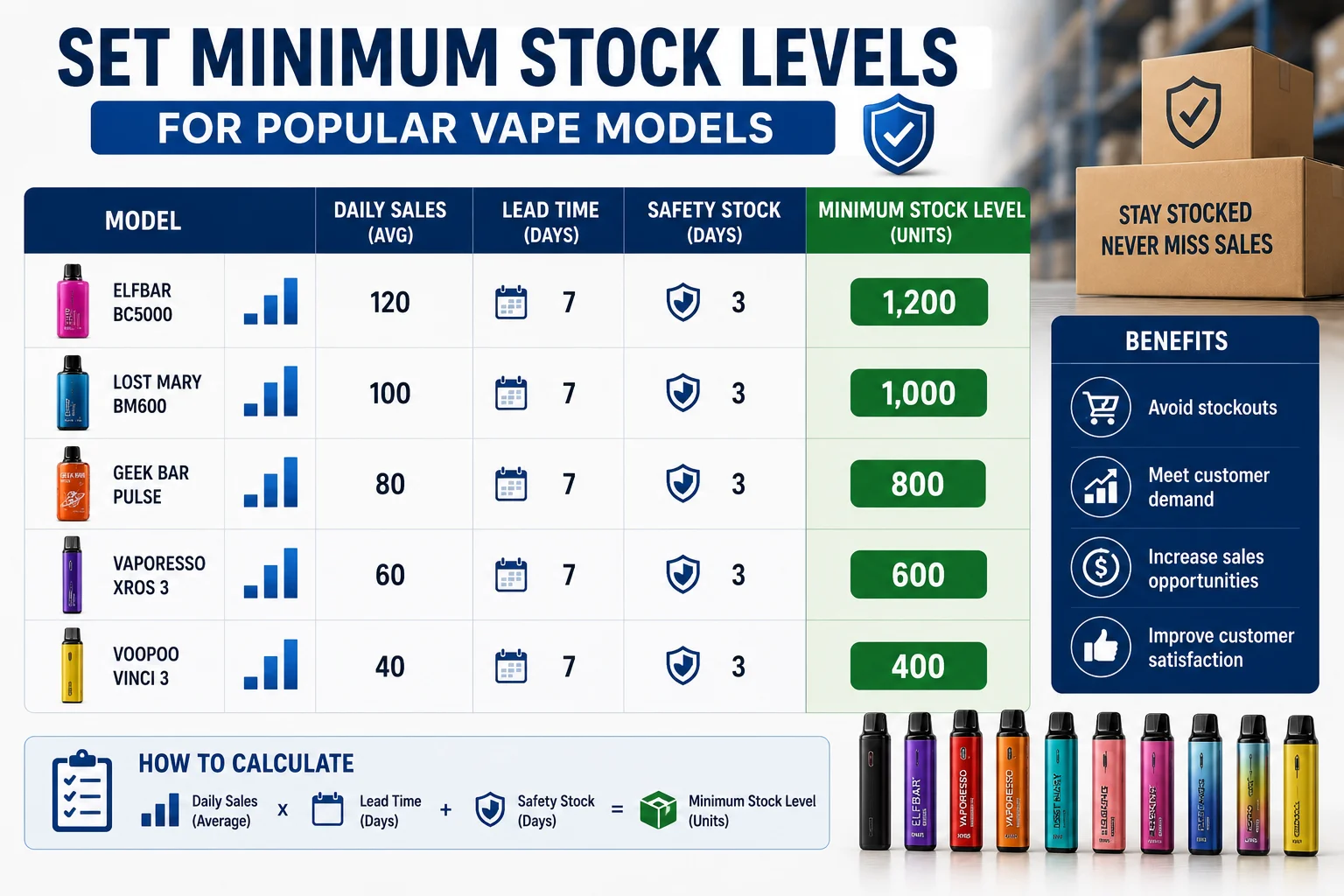
Use a Reorder Point Formula
I use one basic formula:
Minimum Stock Level = Average Daily Sales × Total Replenishment Days + Safety Stock[^6]
This formula is simple, but it changes how I think. If I sell 100 pieces per day, and it takes 10 days to replenish, I need at least 1,000 pieces before I even think about safety stock. If I add 500 pieces as safety stock, my reorder point becomes 1,500 pieces. When my stock drops to 1,500 pieces, I place the next order.
| Item | Example Number | Meaning |
|---|---|---|
| Average daily sales | 100 pcs | Normal daily demand |
| Supplier handling time | 2 days | Time before dispatch |
| Shipping time | 5 days | Transit time |
| Buffer time | 3 days | Delay allowance |
| Total replenishment days | 10 days | Time needed to restock |
| Safety stock | 500 pcs | Extra protection |
| Reorder point | 1,500 pcs | Order again at this level |
I also set different minimum levels for different products. I do not give every flavor the same rule. A top flavor needs stronger protection. A test flavor needs less stock. A slow flavor may not need a reorder at all.
For vape wholesale, I also think about compliance stock. If my market requires tax stamps, health warnings, TPD-style packaging, PMTA-related rules, or other legal documents, I add that time into the plan. A legal and stable business cannot depend on “maybe it will pass.”[^7] I would rather plan earlier than rush later. Rush orders often create bad decisions, higher shipping cost, and higher risk.
4. When Should I Plan Reorder Timing Before Products Run Out?
Many buyers reorder when the shelf is empty. At that moment, they are already late. Empty shelves are a sign of poor planning.
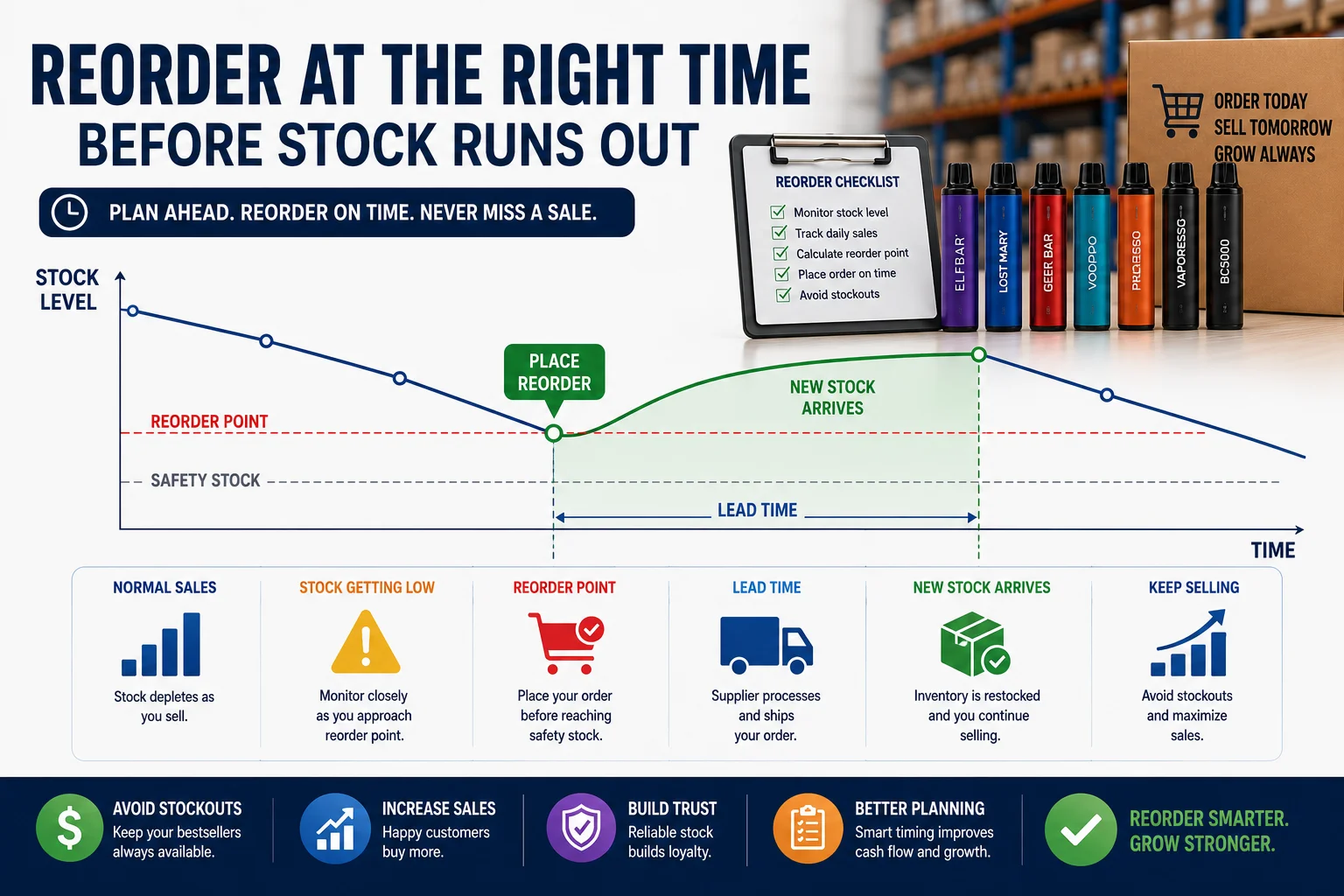
You should plan reorder timing when stock reaches the reorder point, not when stock reaches zero. I calculate reorder timing from sales speed, supplier response time, payment time, production or picking time, and delivery time. This keeps sales moving without panic buying.
Create a Monthly Reorder Calendar
I like using a monthly calendar. I mark the first week for sales review. I mark the second week for order planning. I mark the third week for payment and shipment. I mark the fourth week for receiving, checking, and selling. This is not fixed for every business, but it gives me rhythm.
A scenario I often discuss with e-commerce sellers is this: they sell 50 pieces per day and think they still have enough because 500 pieces are left. But if shipping and handling need 12 days, then 500 pieces only cover 10 days. They are already short by 2 days before the next stock arrives. This is how stockouts happen.
| Week | Main Task | My Focus |
|---|---|---|
| Week 1 | Review sales | Find best sellers and slow movers |
| Week 2 | Plan reorder | Decide quantity and budget |
| Week 3 | Confirm order | Pay, arrange shipment, prepare documents |
| Week 4 | Receive stock | Check quantity, quality, and update inventory |
I also plan earlier before holidays. Christmas, New Year, summer travel, school season, and local events can change demand. Logistics can slow down before big holidays. Customs and local checks may also take longer.[^8] I do not wait until everyone is rushing.
If I use local warehouse stock from a supplier, I can move faster. This works well for small buyers who want low MOQ and fast delivery. But I still check legality, product source, and stock freshness. Fast delivery is useful only when the product is real, stable, and allowed in the market.
5. How Do I Balance Fast-Moving Items with New Product Testing?
If I only buy old winners, I may miss new demand. If I only chase new products, I may lose my stable cash flow.
I balance fast-moving items and new product testing by using most of my budget for proven sellers and a small part for controlled tests[^9]. I usually protect core products first, then test new models, flavors, or brands in small batches with clear sales targets.
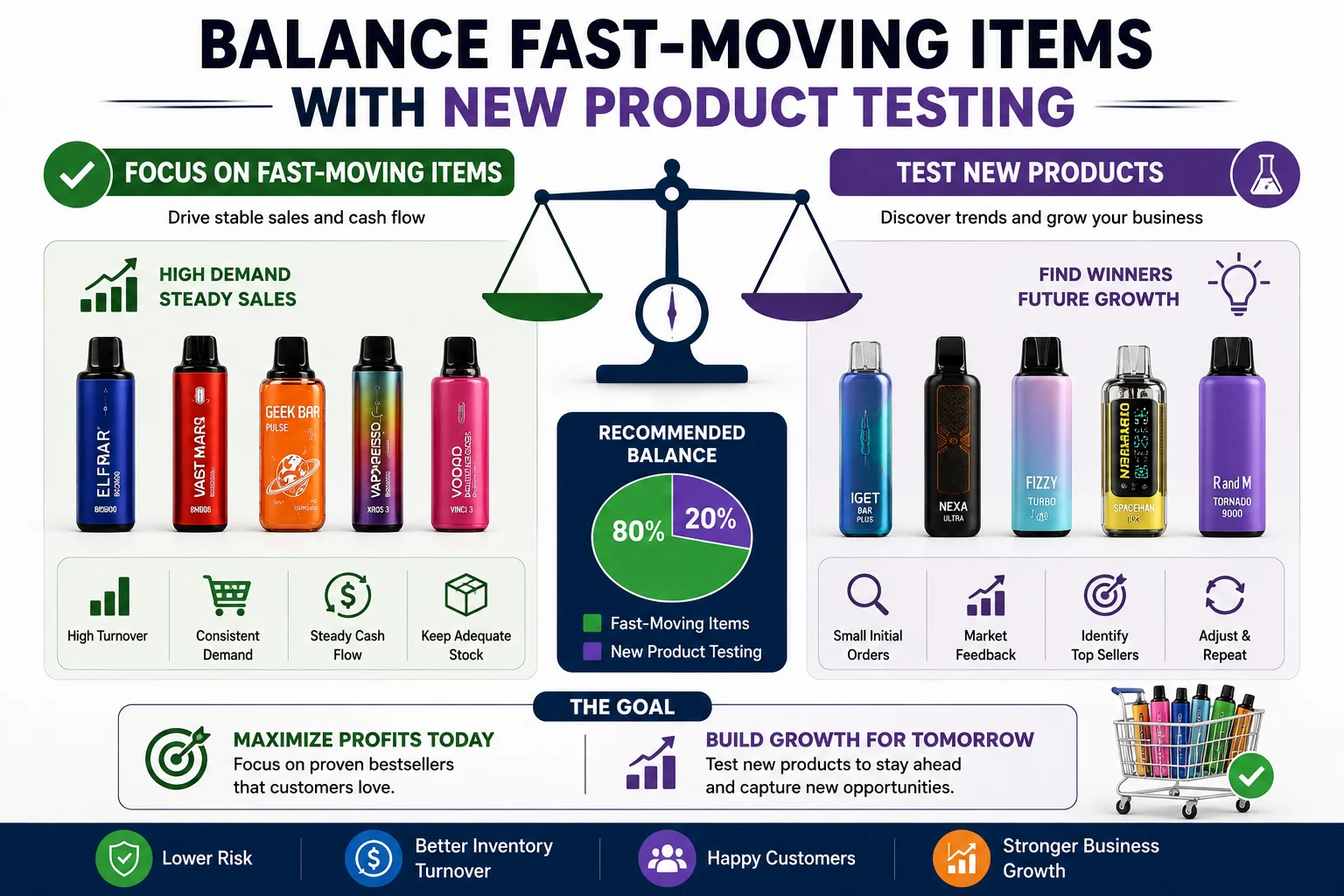
Use the 70-20-10 Buying Rule
I often suggest a simple buying structure. It is not perfect, but it helps buyers avoid emotional orders.
| Budget Share | Product Type | Purpose |
|---|---|---|
| 70% | Proven best sellers | Protect monthly sales |
| 20% | Stable secondary products | Offer variety |
| 10% | New tests | Find future winners |
This rule is very useful for new buyers. I have seen people put half of their money into a new model only because the packaging looks cool or the puff number looks huge. That is risky. In vape wholesale, packaging can attract attention, but repeat sales come from taste, device stability, and customer trust.
I also do not blindly chase the biggest puff-count number. Many new buyers only look at the number on the box. They see 100K, 200K, or even bigger numbers and think bigger means better. I look at real e-liquid volume, battery quality, coil life, taste stability, and complaint rate. A disposable vape has a physical limit.[^10] The coil and cotton cannot stay perfect forever. If a product claims a very high puff count but the actual structure does not support it, I treat it as a marketing number, not a business foundation.
When I test new products, I define success first. For example, I may say: “If 200 pieces sell within 10 days with low complaints, I will reorder.” If the product fails, I do not argue with the market. I clear it and move on.
6. How Do I Calculate Lead Time, Shipping Time, and Safety Stock?
Wrong lead time destroys even a good buying plan. I may order enough, but I still run out if the timing is wrong.
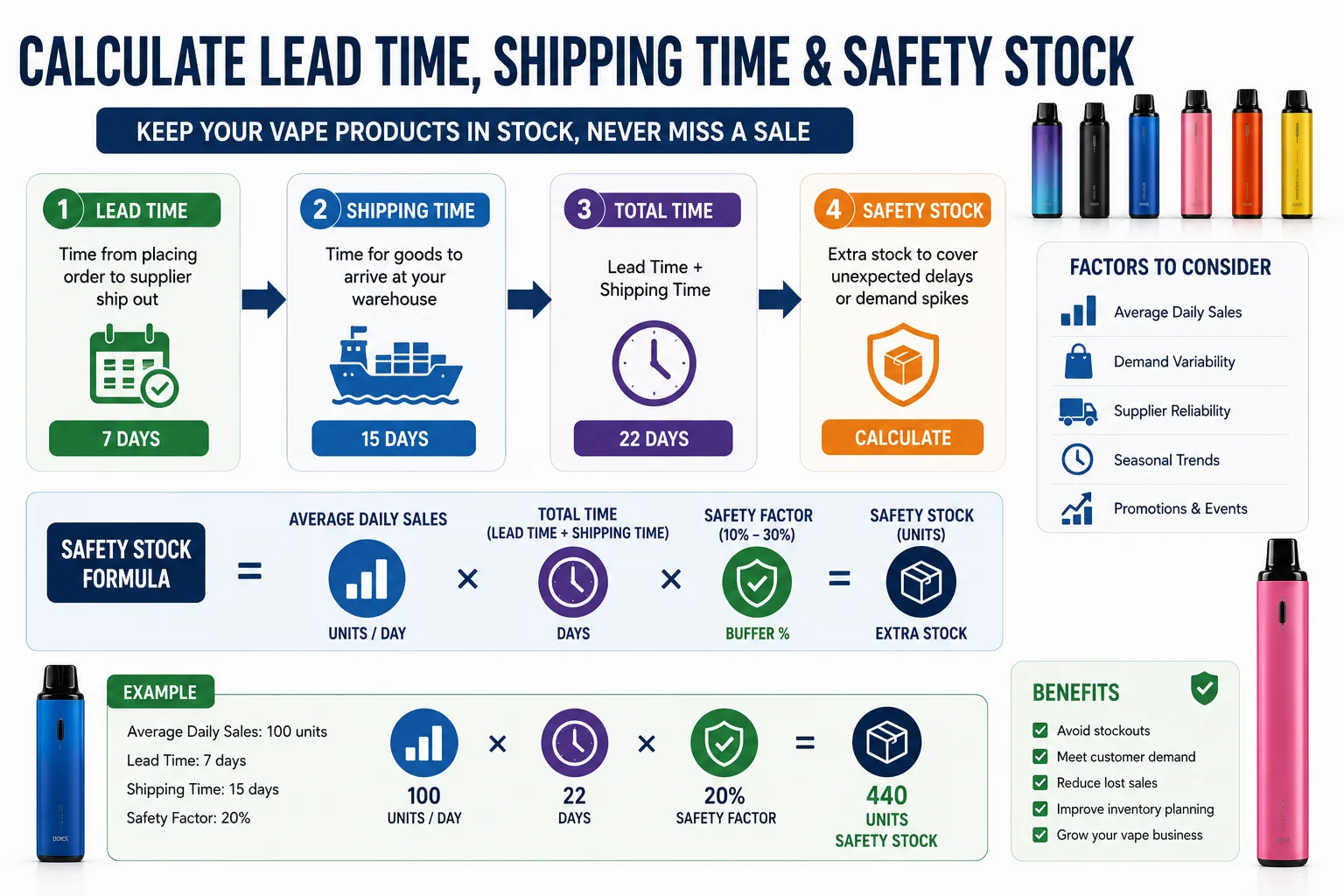
You should calculate lead time by adding supplier preparation time, production time if needed, payment confirmation, shipping time, customs or local checks, and receiving time. Safety stock should cover delays, demand spikes, and supplier stock gaps.[^11] I never use only the fastest delivery estimate.
Count the Real Time, Not the Best Time
Many buyers ask suppliers, “How many days to arrive?” They hear the shortest answer and build the plan on that. I do not do that. I build my plan on real average time and worst-case delay.
If the supplier says local delivery takes 2 to 5 days, I plan with 5 days. If international shipping takes 10 to 18 days, I plan with 18 days. If customs or legal document review may take extra time, I add it. This may feel conservative, but it keeps my business safer.
| Time Part | What It Means | Example |
|---|---|---|
| Order confirmation | PI, payment, stock lock | 1 day |
| Picking or production | Warehouse picking or factory lead time | 2–21 days |
| Export handling | Packing and dispatch | 1–3 days |
| Shipping | Air, truck, courier, sea, or local delivery | 2–30 days |
| Import and local checks | Legal entry and inspection | Varies |
| Receiving | Count and check goods | 1 day |
Safety stock is not dead stock. It is insurance. But I do not make it too large. Too much safety stock traps cash. Too little creates stockouts. I usually use higher safety stock for best sellers, regulated products with long document time, and products from brands with unstable supply.
I also separate overseas warehouse replenishment and China-direct replenishment. Local stock can support quick small orders. China-direct stock may give better pricing and more choices for bigger orders. The right choice depends on order volume, legal route, cash level, and stock speed. I do not tell every buyer to choose the same way.
7. How Do I Keep Cash Flow Healthy with Smart Order Quantities?
Inventory can make money, but it can also lock money. If I buy too much of the wrong item, my cash stops moving.
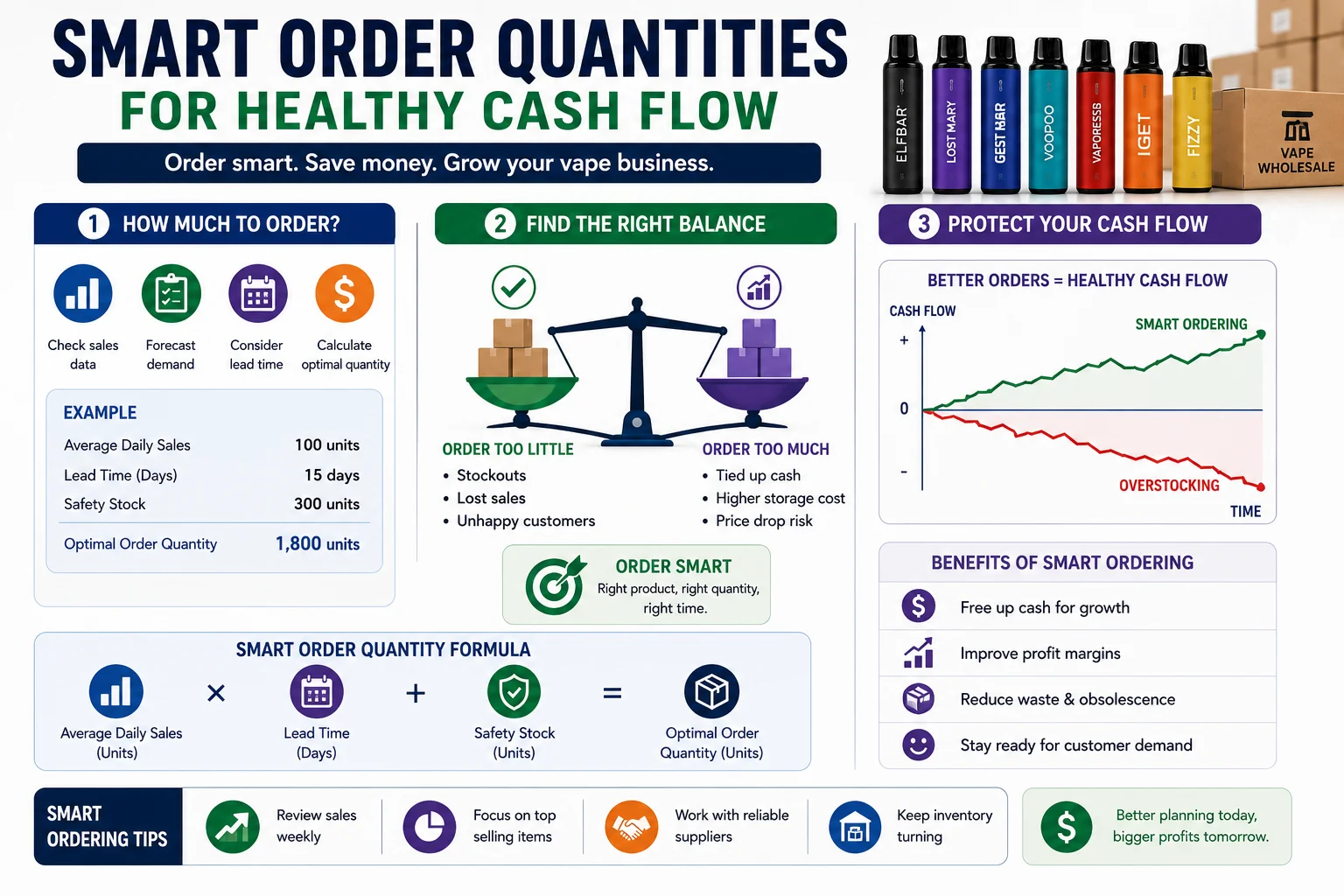
You keep cash flow healthy by ordering based on sell-through speed, not hope. I use smaller and more frequent orders for uncertain products, larger orders for proven winners, and strict budget limits for tests. The goal is fast turnover, not the lowest unit price only.
Focus on Turnover, Not Only Price
This is one of the biggest lessons I learned in trade. The cheapest product is not always the most profitable product. A product with 20% margin that sells in one week can be better than a product with 50% margin that sits for three months.[^12]
Let me give a simple example.
| Option | Margin | Sell Time | Cash Result |
|---|---|---|---|
| Fast official product | 20% | 7 days | Cash turns often |
| Cheap unknown product | 50% on paper | 90 days | Cash gets stuck |
| Slow premium product | 30% | 60 days | Risk depends on demand |
| Tested best seller | 25% | 10 days | Strong reorder choice |
I often tell small buyers to start with low MOQ and fast delivery when they are still testing their sales channel. If a buyer only sells 50 to 200 pieces at a time, a local warehouse or smaller batch can reduce pressure. The unit price may be higher, but the risk is lower. The buyer can test flavors, learn demand, and turn cash faster.
For larger wholesalers, bigger orders can make sense. They may need better pricing, stable supply, and wider product choice. But even then, I do not suggest buying blindly. I still split the order by sales rank. Best sellers get the biggest share. New products get a controlled share. Slow products get little or none.
Cash flow is the oxygen of wholesale. If my money is all sitting in slow stock, I cannot buy the next winner. So I protect cash first.
8. How Do I Work with a Supplier Who Supports Stable Monthly Reorders?
A supplier can make stock planning easy or painful. If supply changes every week, my monthly plan becomes guessing.
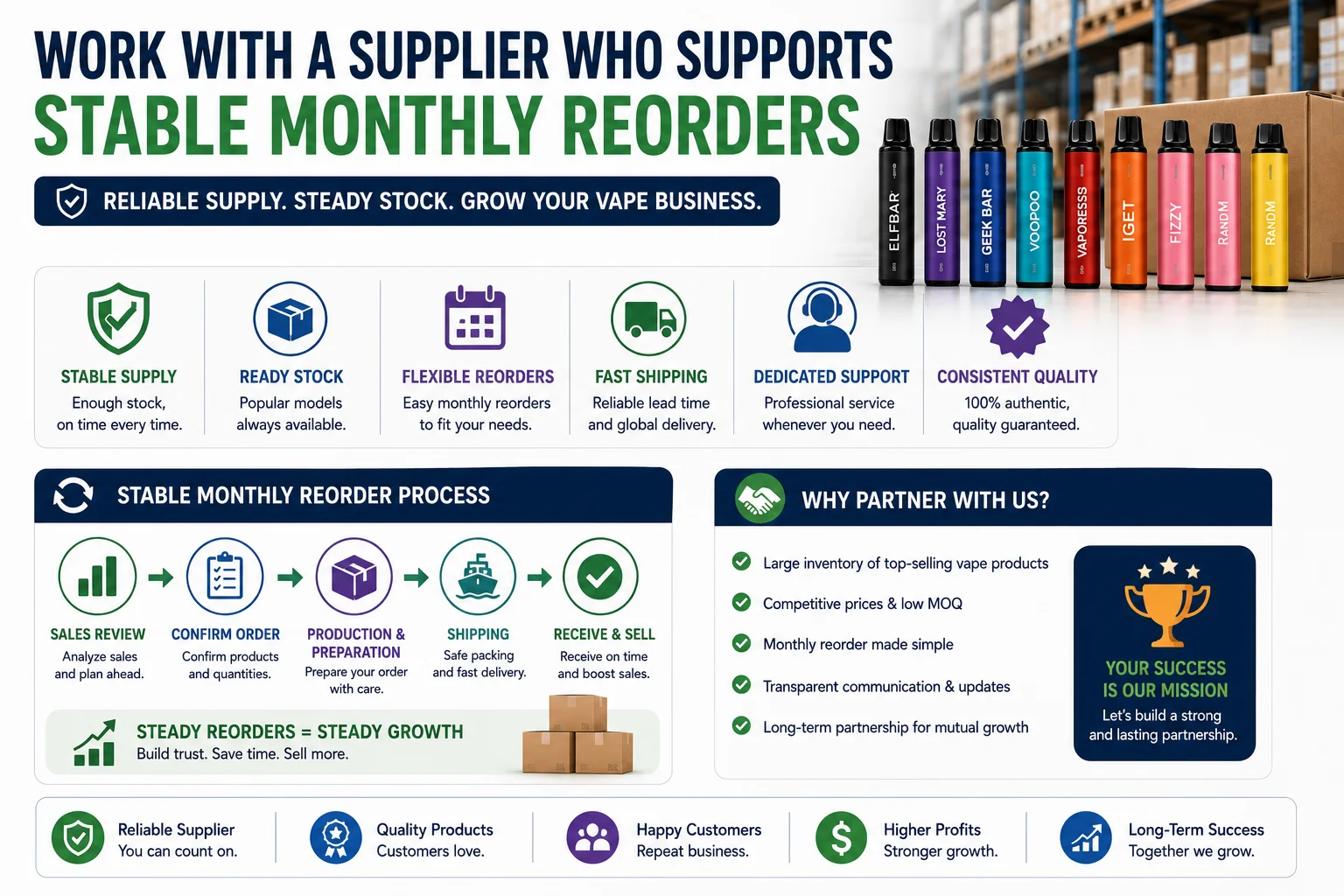
You should work with a supplier who can support stable monthly reorders, real product source, clear stock updates, reasonable MOQ, legal documents, and honest risk communication. I value suppliers who ask about my market, sales channel, and compliance needs before pushing me to pay.
Choose Long-Term Support Over One-Time Cheap Offers
When a client asks for the “best supplier,” my first question is always about their sales channel and risk level. A shop owner, a small online seller, and a national distributor do not need the same supply plan.
A strong monthly reorder supplier should help with more than price. They should help with stock visibility, product version updates, legal packaging needs, delivery timing, and after-sales handling. They should also be honest about brand restrictions. Some large vape brands work through strict distributors. Some products may require local approval or special tax handling. If a supplier says every product is available, every route is safe, and every price is the lowest, I become careful.
| Supplier Factor | Good Sign | Risk Sign |
|---|---|---|
| Product source | Clear and verifiable | Vague or only says “don’t worry” |
| Stock update | Regular and specific | Random screenshots only |
| MOQ | Matches buyer stage | Pushes oversized orders |
| Payment | Company account matches PI | Account name does not match |
| Compliance | Asks about local rules | Ignores legality |
| Reorder support | Helps plan monthly supply | Only chases payment |
| After-sales | Has a process | Disappears after shipment |
I also care about original products. Counterfeit vape products can look cheap, but the risk is huge. They may use poor e-liquid, weak batteries, bad packaging, fake QR codes, or unsafe materials. They can also damage my customer trust. I prefer a supplier who explains these risks clearly.
For stable monthly reorders, I need a partner who thinks long term. I do not need someone who only wants one order. A real supplier helps me sell better, avoid bad stock, and keep customers coming back.
Conclusion
A strong monthly vape replenishment plan protects stock, cash, timing, and trust. I reorder with data, test carefully, follow rules, and keep best sellers moving.
[^1]: "[PDF] Chapter Thirteen Inventory Management", https://web.eng.fiu.edu/chen/Fall%202015/EGN%205620%20PMSEM/C13%20-%20Part%202.pdf. A standard operations-management source defines reorder-point planning as ordering when inventory reaches expected demand during lead time plus safety stock, supporting the inclusion of lead time, minimum stock, and buffer stock in a replenishment plan; the source explains general inventory control rather than vape-specific purchasing. Evidence role: definition; source type: education. Supports: A university or textbook-style operations-management source should define reorder points as expected demand during lead time plus safety stock and explain their use in replenishment before inventory depletion.. Scope note: General inventory-management support; not evidence about the vape category specifically. [^2]: "A practical approach to replenishment optimization with extended (R ...", https://pmc.ncbi.nlm.nih.gov/articles/PMC12722329/. Demand-forecasting literature identifies historical sales data as a primary input for estimating future demand and setting replenishment quantities, supporting the article’s preference for recorded sales evidence over intuition; the finding is methodological and does not guarantee forecast accuracy in a particular market. Evidence role: expert_consensus; source type: paper. Supports: A peer-reviewed or educational source should explain that historical sales data are a common input for demand forecasting and replenishment decisions.. Scope note: Supports the forecasting principle generally, not any specific vape sales outcome. [^3]: "[PDF] Understanding safety stock and mastering its equations - MIT", https://web.mit.edu/2.810/www/files/readings/King_SafetyStock.pdf. Inventory-control materials on SKU classification and ABC analysis note that items vary in demand rate and value contribution, supporting SKU-level review rather than aggregate sales totals; this is general retail and operations guidance, not evidence for any named vape flavor or model. Evidence role: general_support; source type: education. Supports: An operations-management source should support the idea that inventory items differ in demand rate and should be classified or managed by SKU-level movement.. Scope note: Contextual support from inventory theory; not vape-market-specific evidence. [^4]: "Free Sell Through Rate Calculator + Analysis - mabts.edu |", https://dev.mabts.edu/sell-through-rate-calculator/. Retail inventory guidance commonly treats sell-through and stockout measures as indicators of product movement and stock adequacy, while repeat purchasing and feedback provide contextual demand signals; the source supports the metric framework but not the article’s specific product rankings. Evidence role: definition; source type: education. Supports: A retail analytics or inventory-management source should define sell-through and stockout measures as indicators of product performance and inventory adequacy.. Scope note: Supports metric selection generally, not the performance of any specific vape product. [^5]: "[PDF] Analysis of an Economic Order Quantity and Reorder Point Inventory ...", https://digitalcommons.calpoly.edu/cgi/viewcontent.cgi?article=1006&context=imesp. Operations-management sources define a reorder point as the inventory level that triggers a new order so expected lead-time demand can be covered, supporting its use before stock reaches zero; the definition is general and does not specify vape-industry lead times. Evidence role: definition; source type: education. Supports: A source should define the reorder point as the inventory position at which a replenishment order is placed to cover demand during lead time and reduce stockout risk.. Scope note: General definition; does not validate a particular reorder threshold. [^6]: "[PDF] Chapter Thirteen Inventory Management", https://web.eng.fiu.edu/chen/Fall%202015/EGN%205620%20PMSEM/C13%20-%20Part%202.pdf. Inventory-management references commonly express the reorder point as average demand during lead time plus safety stock, which supports the article’s minimum-stock calculation; the formula assumes demand and lead-time estimates are reliable enough for planning. Evidence role: mechanism; source type: education. Supports: A standard inventory-management source should state the reorder point formula as demand during lead time plus safety stock.. Scope note: Formulaic support; actual safety-stock values depend on demand variability and service-level assumptions. [^7]: "[PDF] Premarket Tobacco Product Applications for Electronic Nicotine ...", https://www.fda.gov/media/127853/download. Official regulatory materials from agencies such as the FDA and European Commission document that e-cigarette products may be subject to authorization, labeling, packaging, and sales restrictions, supporting the article’s claim that replenishment planning must account for compliance; the exact obligations vary by jurisdiction. Evidence role: general_support; source type: government. Supports: Official FDA, EU, or WHO material should document that e-cigarette or vaping products are regulated through authorization, labeling, packaging, tax, or youth-access rules in many jurisdictions.. Scope note: Contextual regulatory support; requirements differ across markets. [^8]: "Holiday Deliveries—Important Shipping Deadlines and USPS's ...", https://www.gao.gov/blog/holiday-deliveries-important-shipping-deadlines-and-uspss-efforts-meet-them. Government postal and customs guidance commonly warns that peak shipping periods and customs-clearance procedures can lengthen delivery timelines, supporting the article’s recommendation to plan earlier around holidays; such guidance is broad and does not predict delays for a specific shipment. Evidence role: general_support; source type: government. Supports: A government postal, customs, or trade-logistics source should support that peak periods and customs procedures can affect delivery and clearance times.. Scope note: General logistics support; not proof of delay in a particular route or month. [^9]: "[PDF] Tradeoffs in marketing exploitation and exploration strategies", https://people.duke.edu/~moorman/Publications/IJRM2004.pdf. Research on exploration and exploitation in product and portfolio management supports allocating resources between established performers and controlled experimentation with new options; this literature supports the budgeting logic conceptually but not the specific 70-20-10 split used in the article. Evidence role: expert_consensus; source type: paper. Supports: Research on exploration versus exploitation or retail assortment planning should support balancing established revenue sources with limited experimentation.. Scope note: Contextual support for the principle; does not validate the article’s exact allocation percentages. [^10]: "Puffing Topography: A Tool to Evaluate Vaping Behavior and ... - PMC", https://pmc.ncbi.nlm.nih.gov/articles/PMC12958158/. Studies of e-cigarette devices and puff topography show that aerosol delivery and device use are affected by device design, liquid volume, power, and user puffing patterns, supporting the claim that disposable-device puff counts have physical and behavioral constraints; the evidence does not verify or refute any particular product’s advertised puff number. Evidence role: mechanism; source type: paper. Supports: A scientific paper should explain that e-cigarette output and usable life depend on device characteristics and puffing behavior, making puff counts conditional rather than absolute.. Scope note: Mechanistic support; not a test of a specific marketed disposable vape. [^11]: "[PDF] Understanding safety stock and mastering its equations - MIT", https://web.mit.edu/2.810/www/files/readings/King_SafetyStock.pdf. Operations-management references define safety stock as inventory held to buffer demand variability, lead-time uncertainty, and supply disruption, supporting its use for delays, spikes, and supplier gaps; the appropriate quantity depends on service-level targets and variability estimates. Evidence role: definition; source type: education. Supports: An operations-management source should define safety stock as extra inventory held to protect against demand variability, lead-time uncertainty, and supply disruptions.. Scope note: Supports the purpose of safety stock generally; does not set a vape-specific buffer amount. [^12]: "The Impact of Gross Profit Margin on Inventory Turnover", https://research.library.fordham.edu/gabelli_thesis/178/. Finance and operations references on inventory turnover and cash conversion explain that returns depend on both margin and the speed at which inventory converts back into cash, supporting the article’s comparison between fast low-margin items and slow high-margin items; the numerical example is illustrative rather than empirically measured. Evidence role: mechanism; source type: education. Supports: A finance or operations source should explain that profitability depends not only on gross margin but also on inventory turnover and cash conversion.. Scope note: Conceptual financial support; does not prove the exact example under all cost structures.