
Struggling to pick the right vape products for your shop? You worry about buying stock that just sits on the shelf, tying up your cash and gathering dust.
The best product mix for a European smoke shop focuses on a core of 2-3 fast-selling, high-demand disposable vape brands in their top 10 flavors, supplemented by 1-2 new or premium items for testing. This balances fast cash flow with the potential for higher margins and new hits.
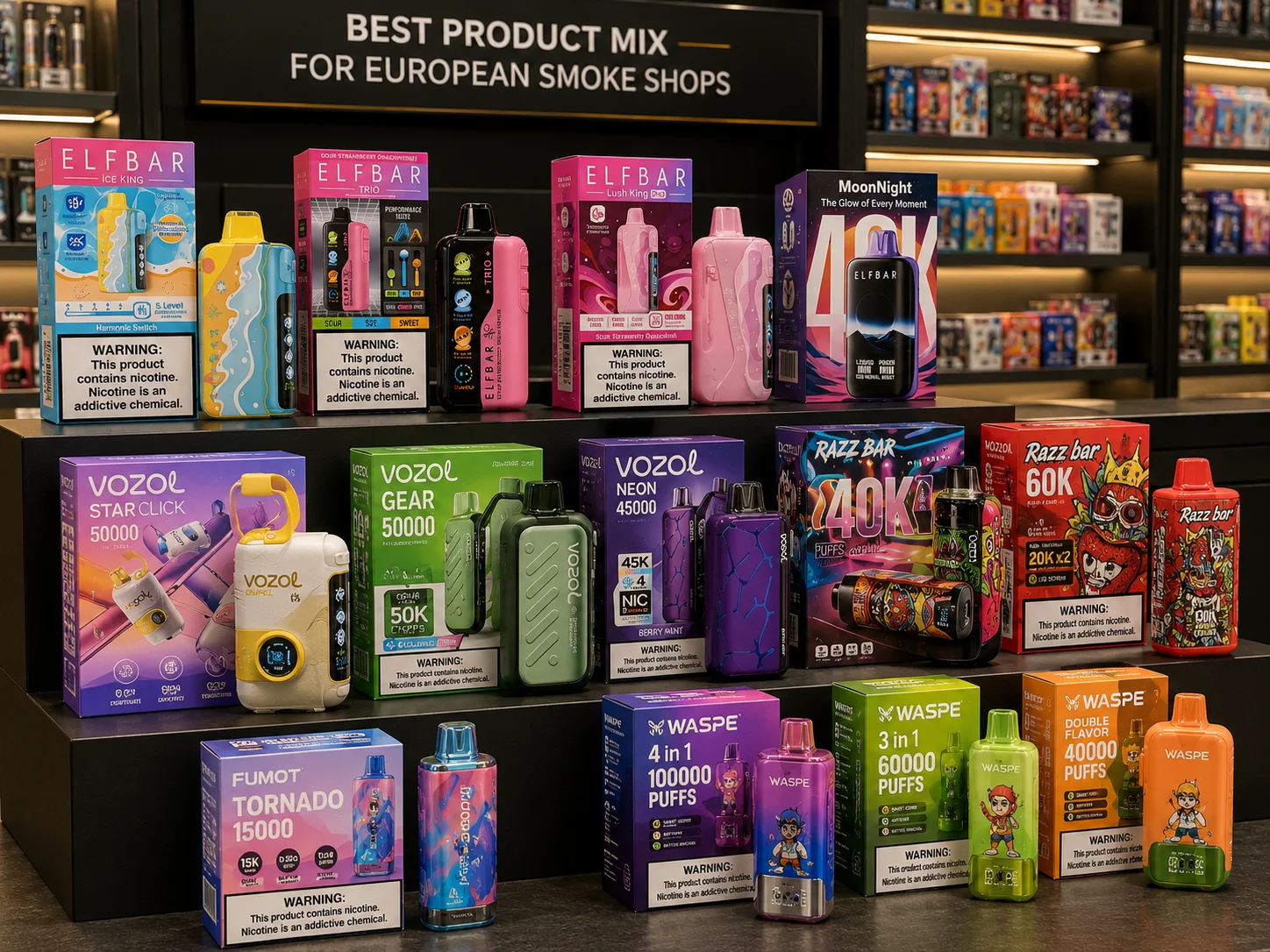
I've been in the export business for over 15 years, and I've seen many smoke shop owners make the same mistakes. They either buy too many different products and end up with dead stock, or they chase the lowest prices and end up with fake, low-quality junk that ruins their reputation. But there is a better way to build your inventory. You need a smart strategy that keeps your cash moving and your customers happy. Let's break down how you can build a product mix that actually makes you money, reduces your risk, and sets you up for long-term success.
Why Do European Smoke Shops Need a Balanced Product Mix?
Are you focusing only on the cheapest products? You might think this is smart, but it can actually kill your business and leave you with angry customers.
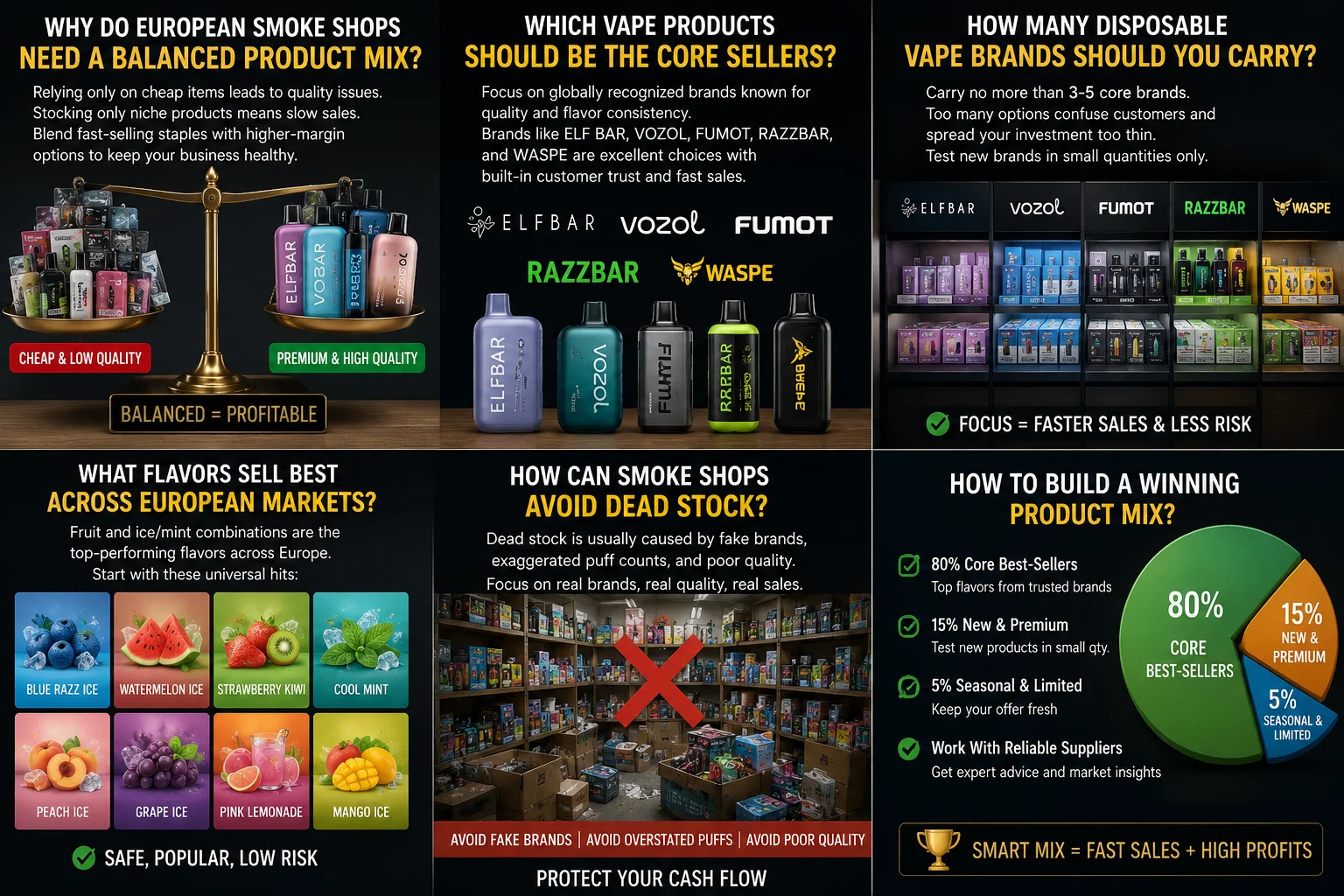
A balanced product mix is crucial because it protects your cash flow and reputation. Relying only on cheap items leads to quality issues, while stocking only niche products means slow sales. The key is to blend fast-moving staples with higher-margin options to keep your business healthy.
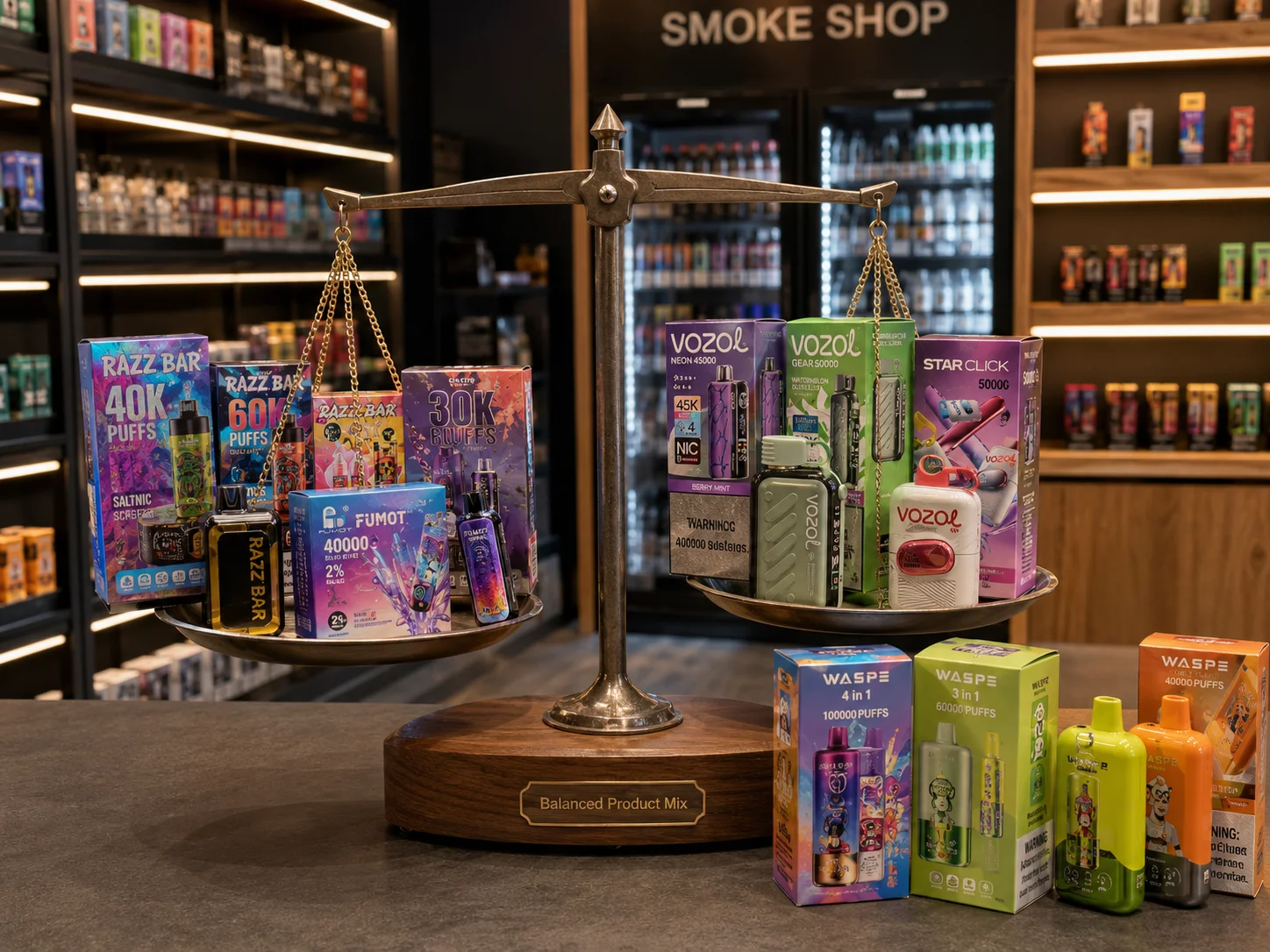
I see a lot of new business owners make this one big mistake. They believe that if something is cheaper, it will be easier to sell and they will make more money. This is the biggest misunderstanding in business. If the cheapest things were the most profitable, the best-selling items in the world would be plastic bags and rubber bands. But they aren't. Think about it. Why does Apple sell the most expensive phones and still dominate the market[^1], while many cheap phones fail? It's not about price. It's about demand.
The real secret to business is how fast your money moves. We call this capital turnover[^2]. If you have a product that sells quickly, even with a smaller profit margin, you can reinvest that money and earn profit again and again. If you buy a cheap product that nobody wants, your money is stuck. Even if it's just €100, that €100 is dead until you sell the product. A smart product mix ensures most of your inventory is made of things people actually want to buy, so your money is always working for you.
Which Vape Products Should Be the Core Sellers?
Wondering which big brands to build your inventory around? You see names like ELF BAR and GEEK BAR everywhere, but getting them seems impossible or confusing.
Your core sellers should be globally recognized brands known for quality and flavor consistency. Brands like ELF BAR, VOZOL, and FUMOT are excellent choices because customers already trust them. This built-in demand means they will sell faster, forming a reliable backbone for your shop's revenue.
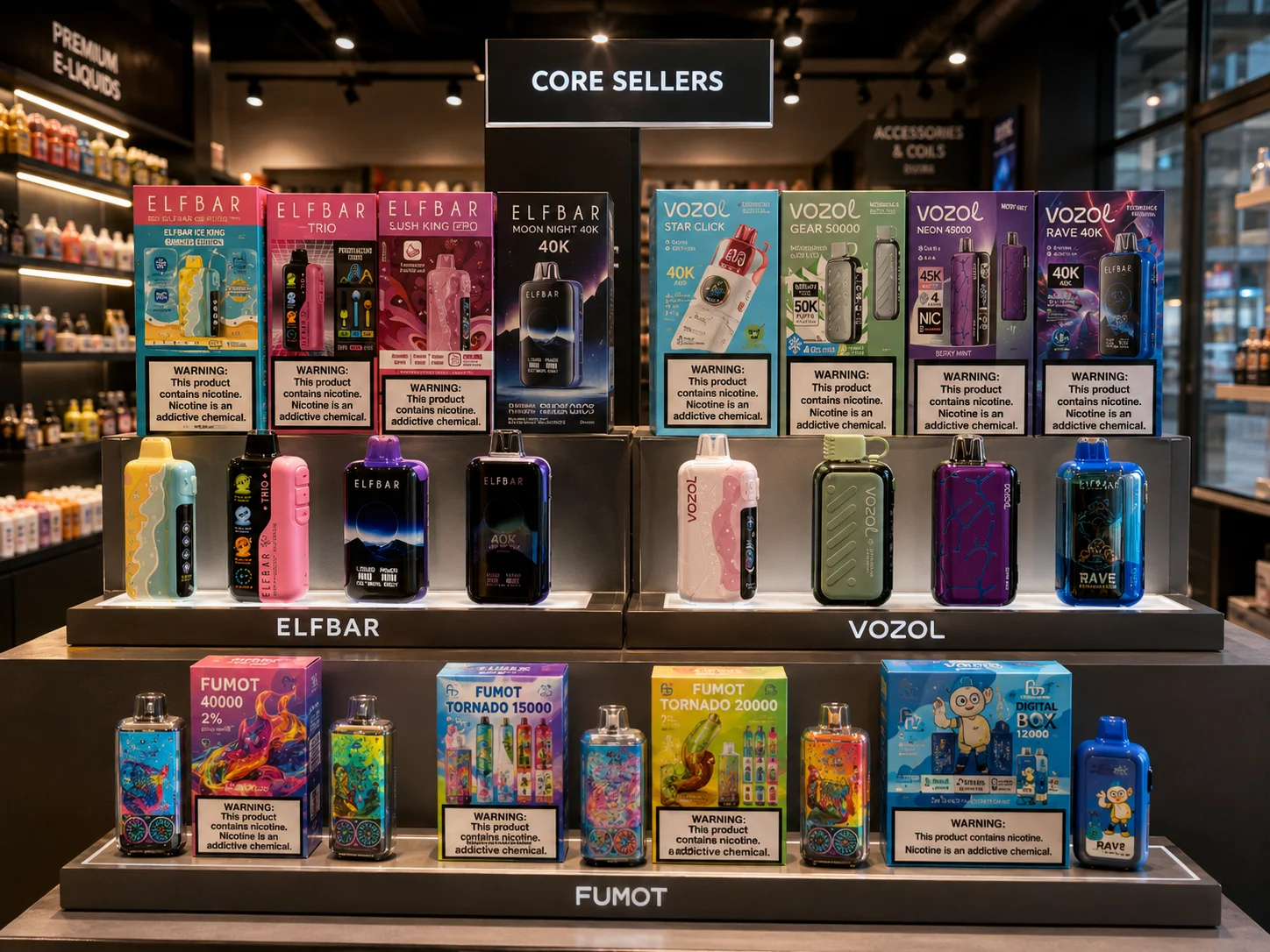
You need to know how the industry works. The biggest brands, like ELF BAR (which also owns GEEK BAR), VOZOL, AL FAKHER, RAZZ BAR, and FUMOT, are huge. They do billions in sales[^3]. They don't just sell to anyone. They set up exclusive agent deals in each country[^4]. To become an agent, you need to commit to buying hundreds of thousands, or even millions, of units every month. This system keeps prices stable and the brand image strong.
So, for a typical shop owner, you can't just call them up and place an order for a few thousand units. They won't even talk to you. This is why you hear about some brands being hard to get. You either have to buy from the official agent in your country at a higher price, or you have to find a supplier who has a different kind of access. Or, you choose a reliable alternative. A good supplier will be honest about this. They won't promise you brands they can't deliver. Instead, they will offer you other high-quality, popular brands that are just as good and easier for you to stock and profit from.
| Brand Tier | Examples | Quality & Consistency | Price Point | Availability |
|---|---|---|---|---|
| Top Tier | ELF BAR, GEEK BAR, VOZOL | Highest | High | Often exclusive |
| High Quality | RAZZ BAR, FUMOT, VAPSOLO | Excellent | Medium-High | Good |
| Entry-Level | Bang King, Bang Leader | Basic | Low | Very high |
How Many Disposable Vape Brands Should You Carry?
Is your shop packed with dozens of different vape brands? You might think more choice is better, but it could be confusing customers and hurting your profits.
You should carry no more than 3-5 core brands. Offering too many options leads to customer confusion and spreads your investment too thin, increasing your risk of dead stock. Focus on proven sellers and only test new brands in very small quantities.
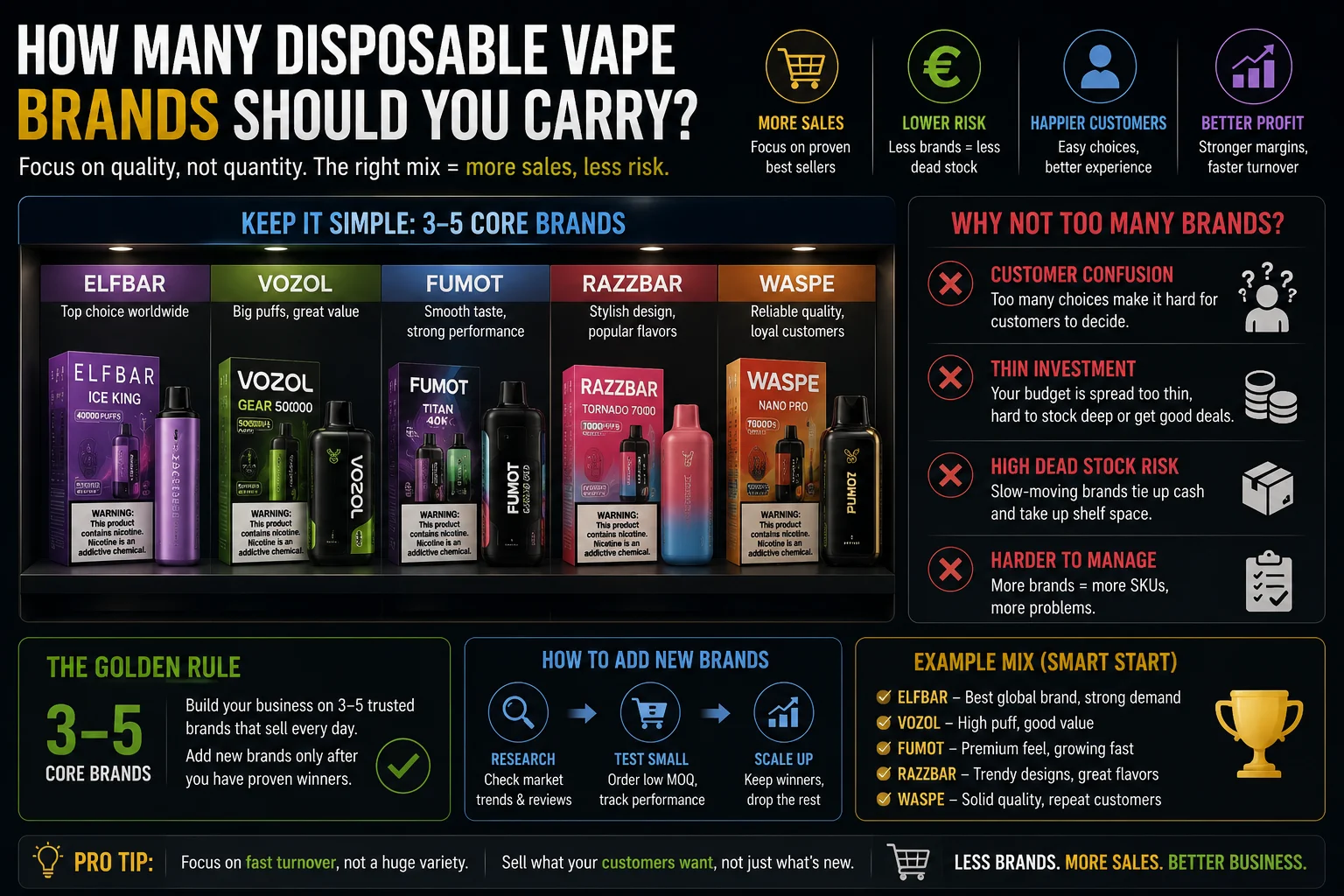
When customers walk into a shop and see 50 different brands, they get overwhelmed[^5]. They don't know what to choose, so they might not buy anything at all. From a business perspective, it's even worse. Let's say you have a €5,000 budget for inventory. If you buy 20 different brands, you can only spend €250 on each. That's not enough to get good stock levels on the popular flavors.
A much smarter strategy is what I call "Core + Test." You take your €5,000 and invest €4,000 into your 3-4 best-selling, most reliable brands. You know these will sell. You get deep stock on their most popular flavors. Then, you take the remaining €1,000 to test 1 or 2 new brands. You buy a very small amount. Maybe just 50 pieces. This is where having a supplier with an overseas warehouse is a game-changer. For example, from our German warehouse, you can order as little as 50 units. This lets you test the market with almost no risk. If the new brand sells out fast, you know you have a winner. If it doesn't, you've only lost a tiny amount, not thousands.
What Flavors Sell Best Across European Markets?
Are you guessing which flavors to buy for your shop? Picking the wrong flavors is a fast way to create dead stock that nobody wants to buy.
Across Europe, the best-selling vape flavors are consistently fruit and ice/mint combinations[^6]. Start with universal hits like Blue Razz Ice, Watermelon Ice, Strawberry Kiwi, and Cool Mint. These flavors have the broadest appeal and are the safest bet for any brand you carry.
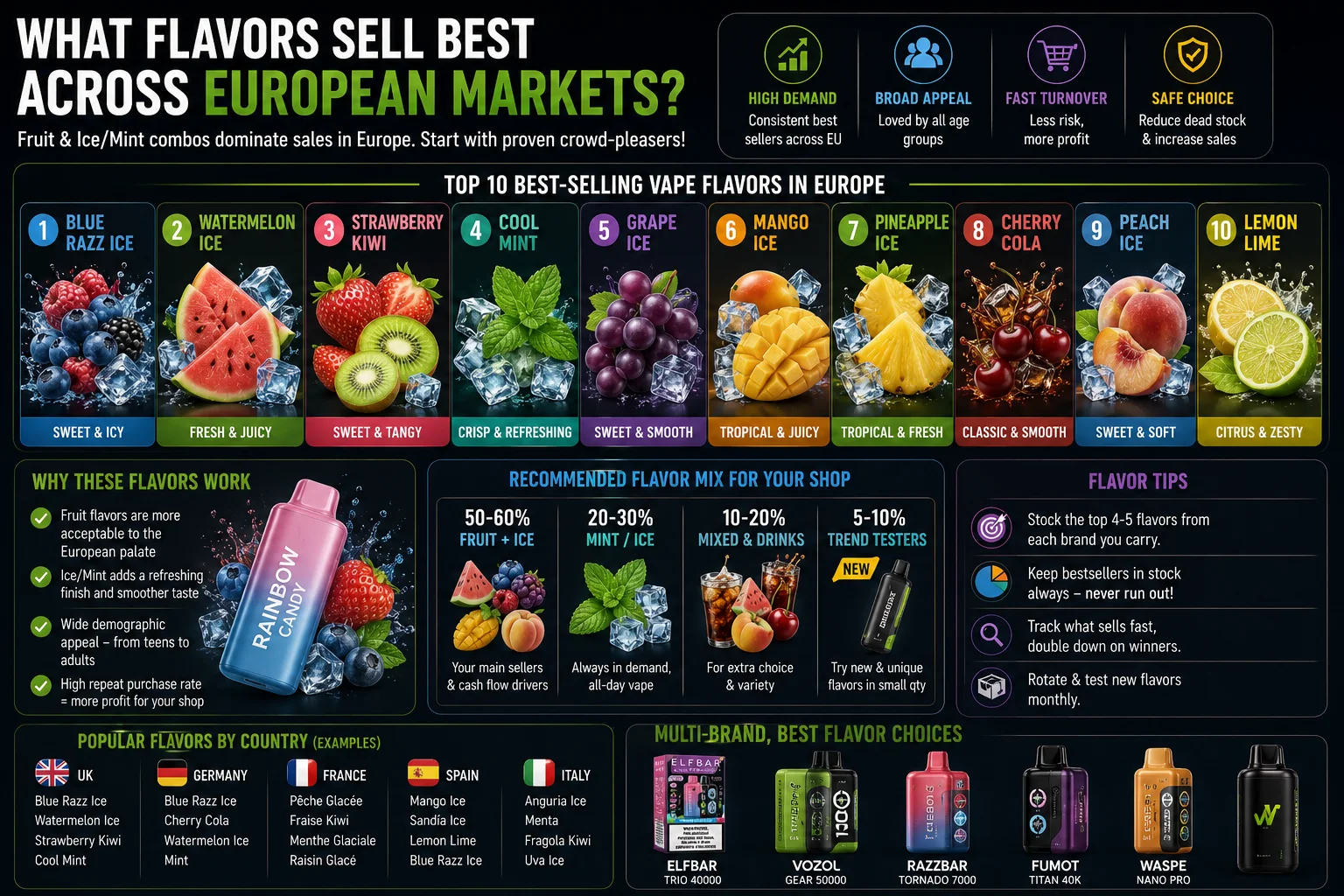
While every country has some unique preferences, there are some flavors that sell everywhere. It's the 80/20 rule[^7]. About 80% of your sales will come from 20% of your flavors. My advice is simple: don't try to be a hero and guess the next big exotic flavor. Start with the classics. When you bring in a new brand, always begin by ordering their top 5 or top 10 best-selling flavors.
How do you know what those are? Ask your supplier. A good, honest supplier will have this data. We ship millions of units, so we know exactly what is selling and where. We can tell you, "For this brand, Blue Razz Ice is number one, followed by Watermelon Ice, then Strawberry Banana." We want you to succeed, because if you sell your stock quickly, you will come back and buy more from us. A bad supplier doesn't care. They will just try to sell you whatever they have too much of. So, always ask for the sales data. Stick to the proven winners, especially at first. Once you have a steady business, you can start testing a few more adventurous flavors in small batches.
Should You Add Premium Devices and Accessories?
Are you only selling low-priced disposable vapes? You might be missing out on customers who are willing to pay more for better quality and a better experience.
Yes, you should add a small, curated selection of premium devices. While disposables provide fast turnover, premium items offer higher profit margins per sale. This could include high-quality disposables with better batteries and e-liquid, or entry-level refillable pod systems for customers looking to upgrade.

Not all vapes are created equal, and not all customers are looking for the cheapest option. There's a big difference between a €2 fake vape and a €10 premium disposable. That difference is in the components. A premium vape uses a good lithium battery. It holds a charge, works in the cold, and provides consistent power. A cheap vape uses a manganese battery[^8] that might die after a few puffs or stop working if it's chilly outside. The same goes for e-liquid. Premium brands use high-quality, clean ingredients for a better taste. Cheap fakes use unknown oils from dirty workshops[^9].
By adding a few premium options, you do two things. First, you cater to a different type of customer—one who values quality and is willing to pay for it. Second, you increase your average sale value. Maybe a customer comes in for a cheap disposable but sees a much nicer one and decides to treat themselves. You just turned a €5 sale into a €15 sale. You don't need to stock a huge range. Just one or two high-quality brands with better materials and performance can make a big difference to your bottom line.
How Can Smoke Shops Avoid Dead Stock?
Is your back room filled with products that just won't sell? Dead stock is a cash flow killer, and every shop owner's worst nightmare.
To avoid dead stock, you must be disciplined. Test new products with very small orders, focus on proven fast-sellers, and ignore marketing gimmicks like inflated puff counts. Most importantly, work with a reliable supplier who will guide you away from potential duds.
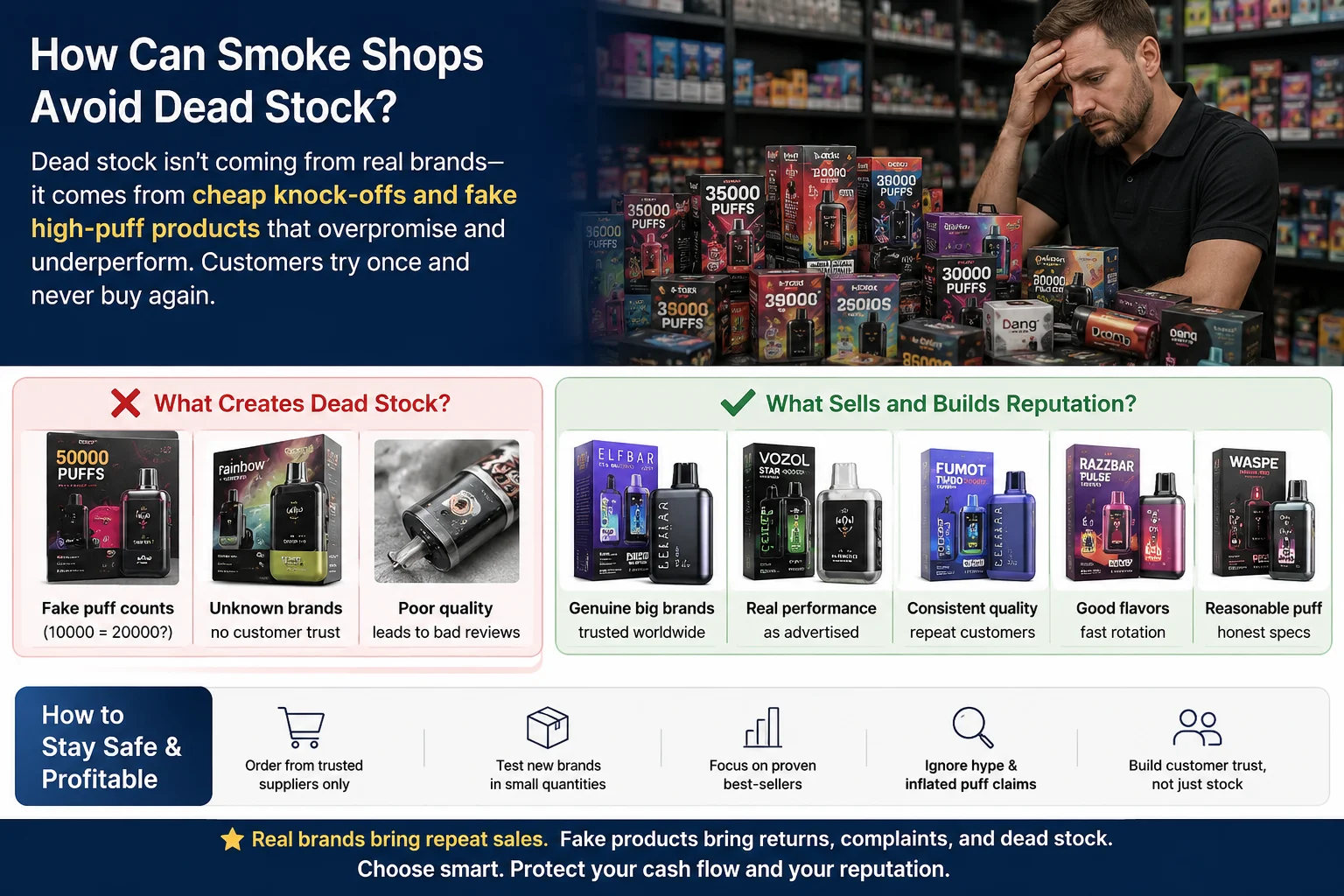
I see this problem all the time, and it's almost always preventable. First, stop falling for the puff count game. I see products claiming 50,000, 100,000, even 300,000 puffs. It's a joke. It's just a numbers game. A disposable vape can only hold so much liquid and the battery and coil only last for so long. A realistic maximum is around 10,000 true puffs[^10]. Anything more is just marketing nonsense. As a professional, you should look at the e-liquid volume in milliliters (ml), not the puff count on the box.
Second, you absolutely must avoid fake products. I have customers in France who are surrounded by fake JNR vapes selling for €2[^11]. They ask me for that price. I tell them the real factory price is over €4. A €2 vape is guaranteed to be a fake. These fakes are dead stock waiting to happen. They use terrible batteries, awful-tasting liquid, and have a high failure rate. You might sell them once, but the customer will never come back. Your reputation will be ruined. The best way to avoid dead stock is to sell quality, authentic products that people actually enjoy using and want to buy again.
What Products Should New Shops Test First?
Are you a new shop owner feeling completely overwhelmed? You have a limited budget and can't afford to make a big mistake with your first order.
New shops should start by testing the waters with a small, low-risk order. Choose 2-3 well-known brands, pick their top 5 classic fruit and mint flavors, and place a small order of 50-100 total units from a local EU warehouse.
If I were starting a new shop today with a small budget, this is exactly what I would do. I would not contact a factory in China. The risk is too high. Instead, I would find a supplier with a warehouse in Europe, like our warehouse in Germany. This is the key.
Here's your step-by-step plan:
- Find a supplier with an EU warehouse. This eliminates customs risk for you.
- Tell them your budget. For example, you can start a business with us for under €400.
- Ask for 2-3 of their best-selling, reliable brands. Don't chase the brands that are exclusive and hard to get. Ask for strong alternatives.
- For each brand, buy only the top 5 flavors. Stick to the fruit and ice combinations.
- Place a very small order. Our MOQ from the German warehouse is just 50 units. You can mix and match. This is your test batch.
- Get it delivered fast. From Germany, it's 1-2 days within the country and 3-5 days to the rest of the EU[^12].
Now you have a small amount of high-demand inventory. You haven't tied up much cash, and you have zero customs risk. You can focus 100% on selling. See what sells out first, listen to your customers, and then you can place your next, slightly larger order with confidence. This is the lean, smart way to start.
Final Advice: Build Around Fast Turnover, Not Too Many Choices
Confused by all the options and advice? Let me give you the single most important piece of advice for running a profitable retail business.
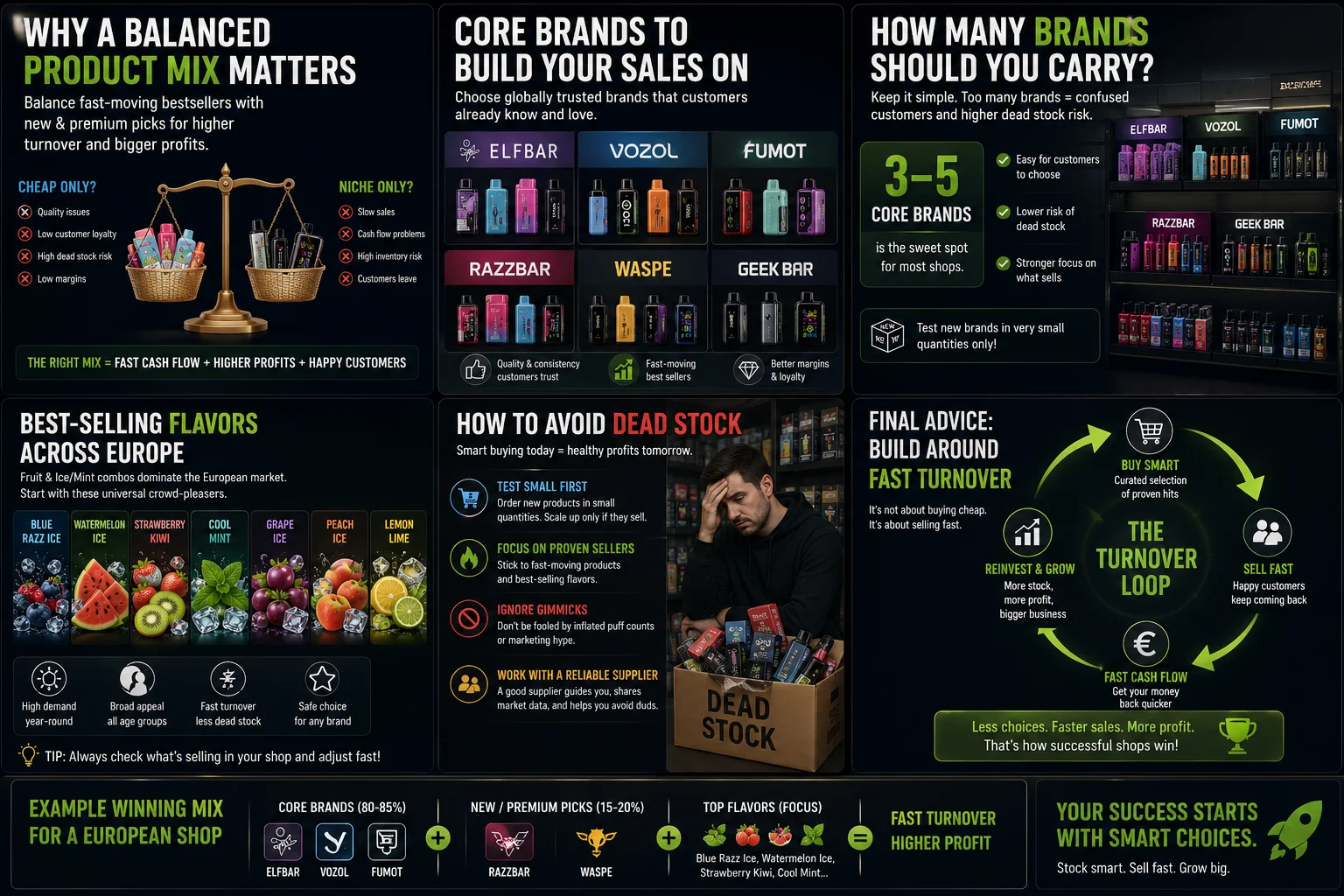
Focus on the speed of your sales, not just the price you buy at. The goal is to sell products quickly, get your money back, and reinvest it. A reliable supplier and a small, curated selection of proven hits are your keys to success.
The whole point of our business model, especially with the German warehouse, is to make it easy for you. We are the ones who take the big risks. We invest hundreds of thousands of euros to buy in bulk and get the best prices. We deal with shipping, customs, and the risk of stock being seized. We store it all. We have done the hard part. Your job is the easy part: selling.
Think about the math. Let's say you spend two months trying to find a cheaper supplier in China to save 10%. Then you wait two months for sea shipping. You might make a 40% profit, but you can only do this maybe two or three times a year. Your money is tied up for months. Now, compare that to buying from our German warehouse. You get the goods in a few days. Maybe your profit is 20%. But you sell out in a week and order again. You can turn your money over 30 or 40 times a year. A 20% profit 40 times is much, much more than a 40% profit twice. This is the real secret. It's not about finding the cheapest price. It's about finding a partner who helps you sell fast and consistently.
Conclusion
Building the right product mix is about being smart, not cheap. Focus on fast-selling authentic brands, test new items in small batches, and partner with a supplier who minimizes your risk.
[^1]: "Global Smartphone Market Share: Quarterly - Counterpoint Research", https://counterpointresearch.com/en/insights/global-smartphone-share. Market research from firms like Counterpoint Research shows that while Apple's unit shipment market share is often second to brands like Samsung, it consistently captures over 80% of the global smartphone market's operating profits, supporting the principle that premium pricing can lead to market dominance in terms of value. Evidence role: statistic; source type: research. Supports: The source should provide data showing that Apple, despite not always leading in unit sales, captures a majority of the smartphone industry's revenue and profits.. [^2]: "Invested Capital Turnover: What It Means For Your Business", https://communitycollaborator.eauclairewi.gov/eauclairewi-news/invested-capital-turnover-what-it-means-for-your-business-1767648007. Capital turnover is a financial ratio that measures how efficiently a company is using its capital to generate sales. A higher ratio is generally better, as it indicates that the company is producing more revenue per dollar of capital, a key metric for success in high-volume, low-margin businesses like retail. Evidence role: definition; source type: education. Supports: The source should define the capital turnover ratio and explain its significance as a measure of a company's efficiency in generating revenue from its capital.. [^3]: "Elf Bar - Wikipedia", https://en.wikipedia.org/wiki/Elf_Bar. Financial reports from parent companies like Smoore International Holdings (linked to brands like Vaporesso and Feelm technology used in many disposables) and market analysis reports estimate that the leading global e-cigarette brands generate revenues in the billions of U.S. dollars annually. Evidence role: statistic; source type: research. Supports: The source should provide revenue data for the parent companies of major vape brands or market research estimates of their global sales.. Scope note: Precise, publicly available revenue figures for specific private brands like Elf Bar are rare; figures are often based on market research estimates or revenues of publicly traded parent companies. [^4]: "Exclusive Distribution Agreement between the Registrant ... - SEC.gov", https://www.sec.gov/Archives/edgar/data/1376231/000121390024001269/ea191186ex10-1_vprbrands.htm. Industry reporting confirms that major e-cigarette manufacturers frequently employ a tiered distribution strategy, appointing exclusive national agents to manage the supply chain, control pricing, and maintain brand consistency, making direct factory access difficult for smaller retailers. Evidence role: mechanism; source type: other. Supports: The source should be an industry report or article describing the common use of exclusive national or regional distributorships by large e-cigarette manufacturers.. [^5]: "future research directions in choice overload and its moderators - PMC", https://pmc.ncbi.nlm.nih.gov/articles/PMC11111947/. This effect is known in psychology as 'choice overload' or the 'paradox of choice.' Research, including a famous study on jam tasting, has shown that while consumers are initially attracted to more options, an overabundance can lead to difficulty in making a decision and lower overall purchase rates. Evidence role: expert_consensus; source type: paper. Supports: The source should describe the concept of choice overload, where an excess of options can lead to decision-making paralysis and reduced satisfaction.. [^6]: "E-Liquid Flavor Preferences and Individual Factors Related to Vaping", https://pmc.ncbi.nlm.nih.gov/articles/PMC6926905/. Consumer surveys and market data from various European countries consistently indicate a strong preference for fruit-based and mint/menthol-based e-liquid flavors, which together account for the vast majority of sales, particularly in the disposable vape segment. Evidence role: statistic; source type: research. Supports: The source should provide data or analysis showing that fruit and menthol/mint flavors are the most popular categories in the European e-cigarette market.. Scope note: While the general trend is consistent, the specific ranking of top flavors can vary by country and evolve over time. [^7]: "[PDF] The Pareto Principle", https://cklixx.people.wm.edu/teaching/math400/Kwaku.pdf. The 80/20 rule, also known as the Pareto principle, is an aphorism which asserts that for many outcomes, roughly 80% of consequences come from 20% of causes. In a retail context, this often translates to a small number of 'hit' products accounting for the majority of sales. Evidence role: definition; source type: encyclopedia. Supports: The source should define the Pareto principle (or 80/20 rule) and explain its common application in business, where a large percentage of results often comes from a small percentage of efforts or inputs.. [^8]: "Building batteries that don't break in the cold - Texas A&M Stories", https://stories.tamu.edu/news/2026/02/11/building-batteries-that-dont-break-in-the-cold/. Technical sources on battery chemistry note that different types of lithium-ion cells have varying trade-offs. For instance, Lithium Manganese Oxide (LMO) batteries are often cheaper but can have lower specific energy and poorer performance in cold temperatures compared to more expensive Lithium Cobalt Oxide (LCO) batteries, which are common in consumer electronics requiring stable power output. Evidence role: mechanism; source type: education. Supports: The source should explain the performance differences between various lithium-ion battery chemistries, particularly regarding temperature sensitivity and cost.. [^9]: "E-cigarettes Warning Labels and Modified Risk Statements - PMC", https://pmc.ncbi.nlm.nih.gov/articles/PMC6141046/. Laboratory analyses of seized counterfeit vaping products, conducted by public health authorities, have revealed that they are often produced in unsanitary conditions and can contain a range of unlisted and potentially harmful substances, including contaminants like heavy metals and incorrect nicotine concentrations. Evidence role: case_reference; source type: government. Supports: The source should be a public health or law enforcement report detailing the analysis of seized counterfeit e-liquids and the conditions of their manufacture.. [^10]: "Comparison of Measurement Methods for Electronic Cigarette Puff ...", https://pmc.ncbi.nlm.nih.gov/articles/PMC8096180/. Investigative reports and industry analyses have shown that advertised puff counts on disposable vapes are often highly inflated and not based on standardized testing. The actual number of puffs is fundamentally limited by the device's e-liquid capacity (measured in ml) and battery life, making claims of tens of thousands of puffs from a standard-sized device physically improbable. Evidence role: mechanism; source type: other. Supports: The source should explain that puff count is not a standardized unit and is highly dependent on factors like puff duration, e-liquid volume, and battery capacity.. [^11]: "Health Effects of Vaping | Smoking and Tobacco Use - CDC", https://www.cdc.gov/tobacco/e-cigarettes/health-effects.html. Reports from European law enforcement and public health agencies frequently warn about the circulation of counterfeit vaping products. These illicit goods are often sold at prices far below the authentic items' production cost and are manufactured in unregulated conditions, posing significant health risks. Evidence role: case_reference; source type: government. Supports: The source should be a report from a European government body (like customs or public health) about the prevalence and dangers of counterfeit e-cigarettes.. Scope note: Official reports typically discuss counterfeit products in general terms and may not name specific brands like 'JNR'. [^12]: "European single market - Wikipedia", https://en.wikipedia.org/wiki/European_single_market. Major logistics carriers operating within the EU, such as DHL and DPD, list standard delivery times for business parcels shipped from Germany to other EU member states as typically falling within a 2-to-5-business-day window, depending on the destination. Evidence role: statistic; source type: other. Supports: The source should be the official documentation from a major European courier service showing their standard ground shipping times from Germany to other EU member states.. Scope note: Actual delivery times can vary based on the specific destination, chosen service level, and potential carrier delays.