
Quick Answer
UK online age verification and retail licensing for vape sales in 2026 create a wider procurement question than a simple “18+” checkbox. I see retailers focus on the age gate while overlooking product documents, delivery controls, supplier responsibilities, and possible retail permissions. That gap can create unlawful sales, blocked orders, disputes, and unsellable inventory.
For UK online vape sales in 2026, retailers should verify more than an age declaration. They should review the customer-age process, product suitability, online sales duties, delivery controls, record-keeping, retail permissions, and supplier documentation. Retailers should confirm current requirements through official UK sources and obtain qualified legal or compliance advice before relying on a particular process.
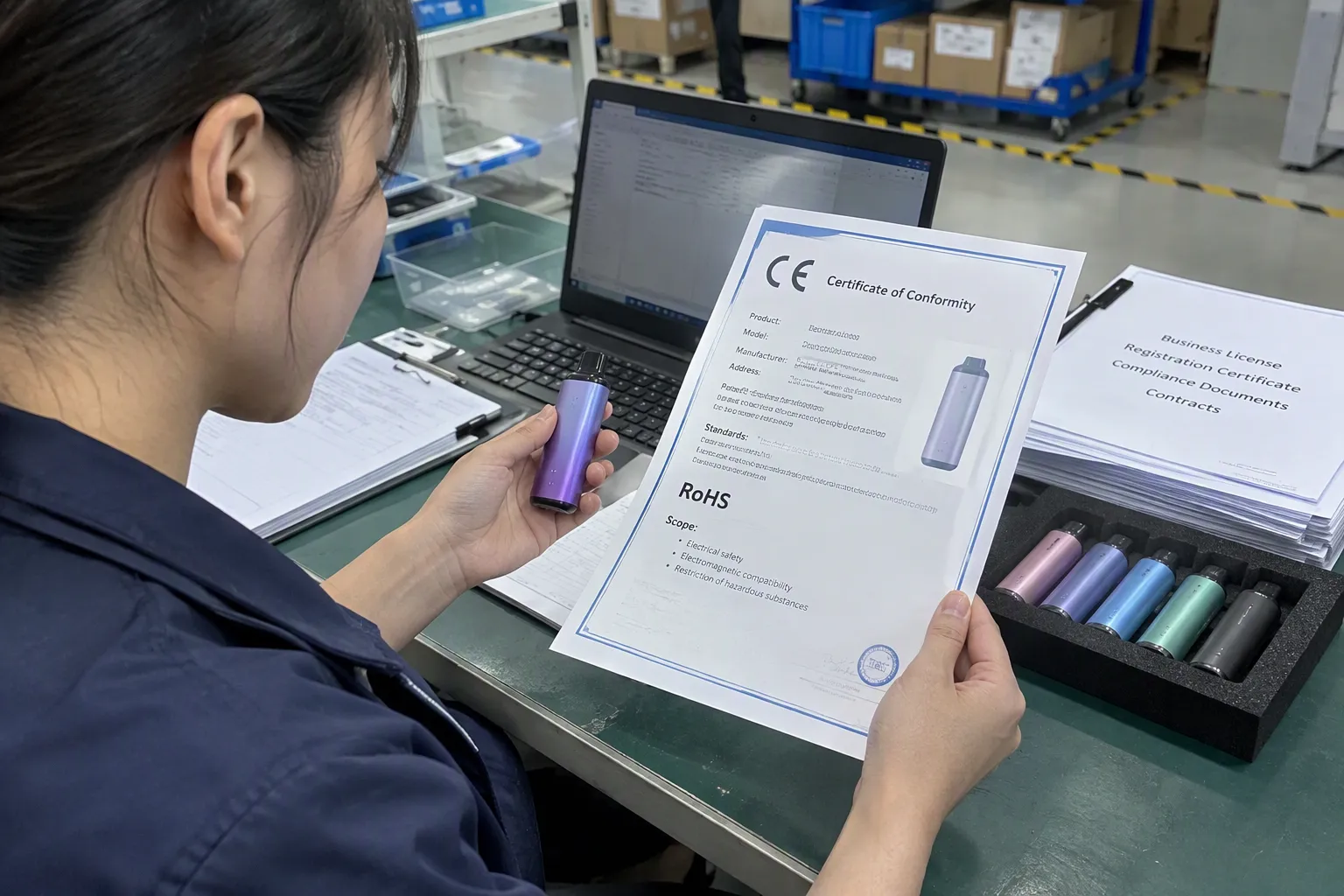
I have handled European customer questions about whether vape products are suitable for the UK market and what documents should be available before purchase. In my experience, the safest procurement discussion starts by separating each compliance responsibility. A supplier’s general statement that a product is “UK compliant” is only a starting point, not complete evidence.
What should UK retailers verify before online vape sales in 2026?
The main risk comes from treating different obligations as one issue. An age gate, a compliant product, a delivery procedure, and a retail permission address different parts of the transaction. I recommend that retailers review each part separately and record what they have verified.
Before selling vape products online in the UK in 2026, a retailer should check how age is verified, whether the products are suitable for the intended market, what sales and delivery controls apply, whether any registration or licensing requirement affects the business, and which documents the supplier can provide. Current UK official guidance should decide the final position.
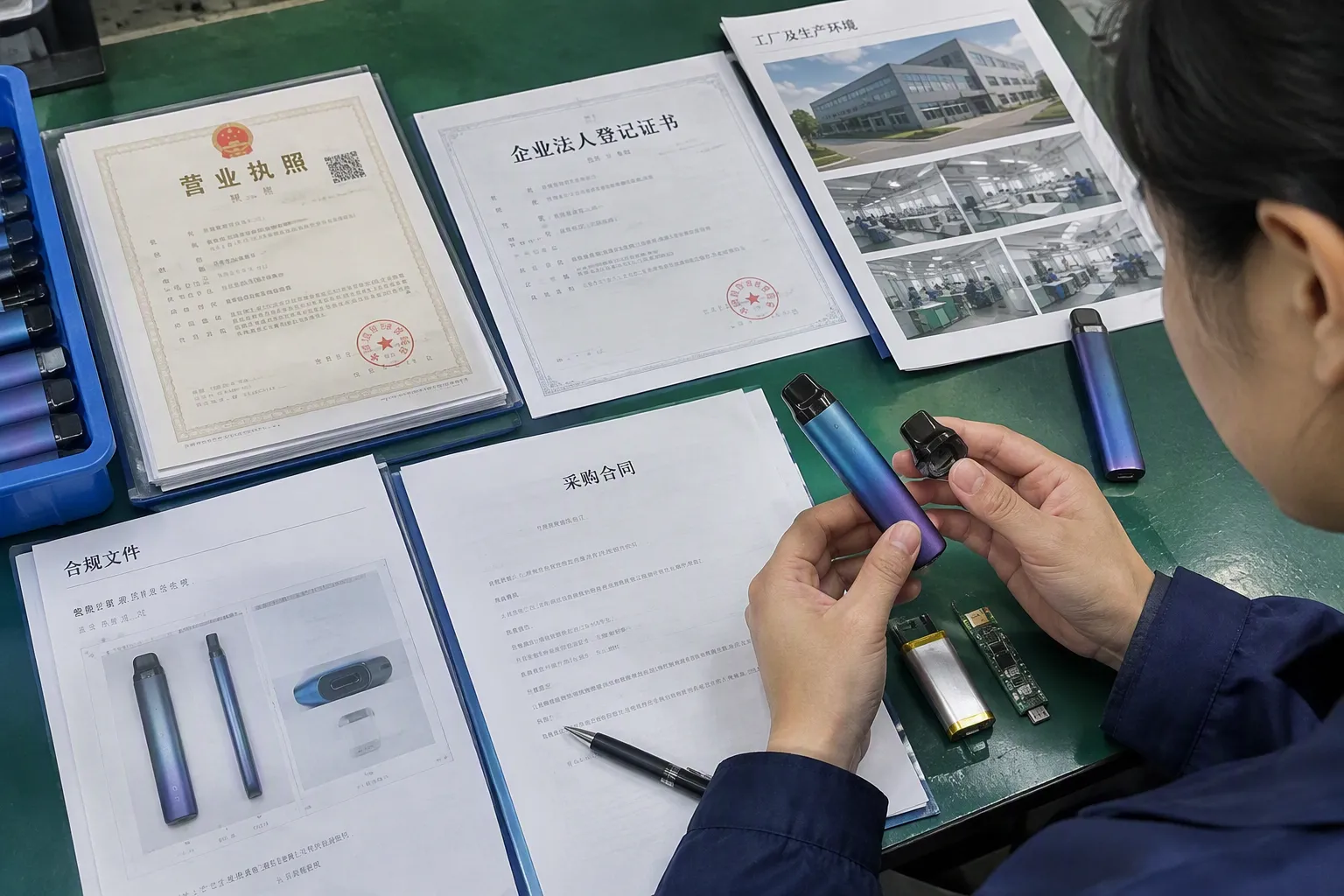
A retailer does not need to become a laboratory, lawyer, or enforcement officer. However, the retailer remains responsible for making sensible procurement decisions. I can help customers organise product information and supplier documents, but I do not present myself as a UK lawyer, regulator, laboratory, or age-verification technology auditor.
The following framework helps me explain the issue to importers, wholesalers, vape shops, and independent online sellers.
Is an 18+ checkbox enough for online vape sales?
A simple age declaration may record what a customer states, but it may not establish that the buyer is an adult.[1] Retailers should understand what their chosen process actually verifies, at which stage it operates, and what happens when the system cannot confirm the customer’s age.
A basic checkbox can be easy for a customer to complete. It may also be easy to bypass. I therefore advise retailers not to describe a checkbox, pop-up, or landing-page age gate as automatically sufficient. The retailer should review the relevant current guidance and assess whether the process is proportionate to its sales channel and risk.
I usually ask five practical questions:
-
What information does the system use?
The retailer should know whether the process relies on a declaration, account information, database checks, identity evidence, or another method. -
When does verification happen?
A retailer should identify whether the check occurs before browsing, before checkout, before payment, before dispatch, or at delivery. -
What happens if verification fails?
The order should not simply continue because the customer cannot complete the check. The retailer should understand the blocking and review process. -
Can the retailer keep evidence?
The business should know what records exist, how long they are retained, and how access is controlled. -
Who operates the process?
The retailer should distinguish between its own responsibility and the role of an age-verification or delivery provider.
I also recommend testing the process from a customer’s perspective. A retailer can place a controlled test order, review the checkout journey, examine failure messages, and confirm whether dispatch staff receive the correct instructions. A policy that looks complete on paper may not operate consistently when an order is placed through a mobile phone, guest checkout, marketplace account, or repeat-customer account.
How is age control different from product compliance?
Age control concerns the buyer and the sales process. Product compliance concerns the product, its presentation, its ingredients or components where relevant, its notification or market documentation where applicable, and the rules governing its sale.[2] One does not replace the other.[3]
I have seen buyers ask whether a product is “legal in the UK” as though a single document can answer every question. That wording is too broad for responsible procurement. I prefer to break it into specific questions:
| Procurement question | What the retailer should clarify |
|---|---|
| Is the product suitable for the intended UK market? | Which product rules, restrictions, notifications, labelling duties, and presentation requirements apply? |
| Can the supplier identify the exact product? | Does the file match the brand, model, flavour, packaging, batch, and intended version? |
| What evidence is available? | Can the supplier provide relevant declarations, test reports, specifications, labels, and traceability information? |
| Who is responsible after import? | Which party acts as manufacturer, importer, distributor, or retailer for the relevant transaction? |
| Can the product change? | Will a new formulation, package, component, or marketing claim require a fresh review? |
I do not treat a supplier spreadsheet or marketing catalogue as a substitute for supporting documentation. I ask whether the documents identify the product clearly and whether they are current. I also ask whether the document belongs to the exact stock being offered, rather than to a similar product.
What documents should a retailer request from a vape supplier?
The exact document list depends on the product category, intended market, transaction structure, and current UK requirements. A retailer should request relevant evidence rather than collect paperwork without understanding it.
A practical supplier file may include:
- Product name, model, brand, and unique product description.
- Product specification and technical information.
- Ingredient or material information where relevant.
- Packaging and label artwork for the exact market version.
- Applicable declarations or notifications.
- Relevant laboratory or test reports, with scope and product identity.
- Batch, lot, or production traceability information.
- Manufacturer and factory details.
- Importer or responsible economic operator details where applicable.
- Safety information and handling instructions.
- Product photographs showing actual packaging.
- Written confirmation of any changes to the formulation, hardware, firmware, or packaging.
- Commercial invoice and shipping information for procurement records.
- A clear statement of which party supplies each document and which party accepts each legal responsibility.
I tell buyers to check the connection between the document and the product. A report with a different model number may not prove anything about the product in the retailer’s warehouse.[4] A generic certificate may not confirm the status of a specific disposable vape, e-liquid, atomizer, battery, or accessory.[5]
Retailers should also check document dates. A document may still be useful, but the retailer should know whether a later product revision, packaging update, or regulatory change affects it. I recommend maintaining a simple document register with the following fields:
| Field | Example purpose |
|---|---|
| Product reference | Links the document to the stock-keeping unit |
| Version or batch | Shows which production version was reviewed |
| Document type | Identifies the specification, report, declaration, or label |
| Issue date | Helps identify outdated evidence |
| Supplied by | Records the responsible contact |
| Review status | Shows whether the retailer accepted, queried, or rejected it |
| Next review date | Supports ongoing supplier control |
Does a supplier’s “UK compliant” statement prove compliance?
No. The phrase may reflect a supplier’s understanding, but it does not explain the evidence, scope, date, or responsibility behind the statement.[6] I ask suppliers to replace broad language with a product-specific document pack and a written explanation of what has actually been checked.
This distinction protects both sides. A retailer can make a better buying decision, and a supplier can avoid promising more than it can support. At Shenzhen Kingfuji Tech. CO., Ltd., I discuss UK-market questions with European customers as a procurement and supply-chain matter. I can help organise product information, factory communication, and available documents, but I do not make an unsupported legal conclusion for the retailer.
A useful supplier question is:
“Please identify the exact documents that support this product’s intended UK sale, explain their scope, and identify which responsibilities remain with us as the retailer.”
The answer should be specific. It should not only repeat “compliant,” “approved,” or “ready for the UK.” If a supplier cannot identify the product, document type, issue date, or responsible party, I would treat that as a procurement warning.
What retail licensing or permissions should a UK seller check?
Retailers should not assume that every permission issue can be answered by an overseas supplier. The seller should check its own business structure, premises, sales channel, location, product category, and current local or national requirements.
The term “retail licensing” can be used loosely. In practice, a retailer may need to investigate more than one type of requirement, including:
- Business registration and trading details.
- Local authority rules connected with the premises.
- Product notifications or registrations that affect the products being sold.
- Importer or distributor duties.
- Online selling information and consumer-facing terms.
- Delivery and age-control arrangements.
- Advertising and marketing restrictions.
- Tax, customs, and record-keeping obligations.
- Rules affecting specific product types or substances.
I do not state that one universal vape retail licence applies to every UK online seller.[7] The correct position may depend on the current legal framework and the retailer’s exact activities. A business selling from a UK warehouse may face different questions from a business selling cross-border, using a marketplace, importing directly, or fulfilling orders through a third-party warehouse.[8]
I recommend that the retailer contacts the relevant official UK authority or a qualified adviser. The retailer should keep a written record of the source, date checked, and interpretation used for its business model. That record can be more useful than an informal message saying that another seller “does it the same way.”
Who is responsible for online delivery age controls?
Responsibility can be divided across the retailer, payment provider, fulfilment company, courier, and age-verification provider. The retailer should not assume that outsourcing one stage transfers every duty.
I recommend mapping the customer journey:
- The customer visits the website.
- The customer sees age-related notices and product information.
- The customer creates an account or uses guest checkout.
- The customer completes age verification.
- The customer pays.
- The retailer approves or rejects the order.
- The warehouse picks and packs the order.
- The courier receives the parcel.
- The parcel is delivered or returned.
- The retailer records the outcome and handles complaints.
For every stage, the retailer should identify the responsible party. A courier may offer an age-check service, but the retailer should confirm how that service works, when it applies, and what happens if the recipient is unavailable or another person tries to accept the parcel.
The retailer should also check whether the website allows an order to proceed through an alternative route. For example, a mobile checkout, subscription renewal, marketplace listing, telephone order, or manual invoice may bypass the standard age-control process. I find that these exceptions often deserve as much attention as the main website.
How should an importer evaluate a vape supplier for the UK market?
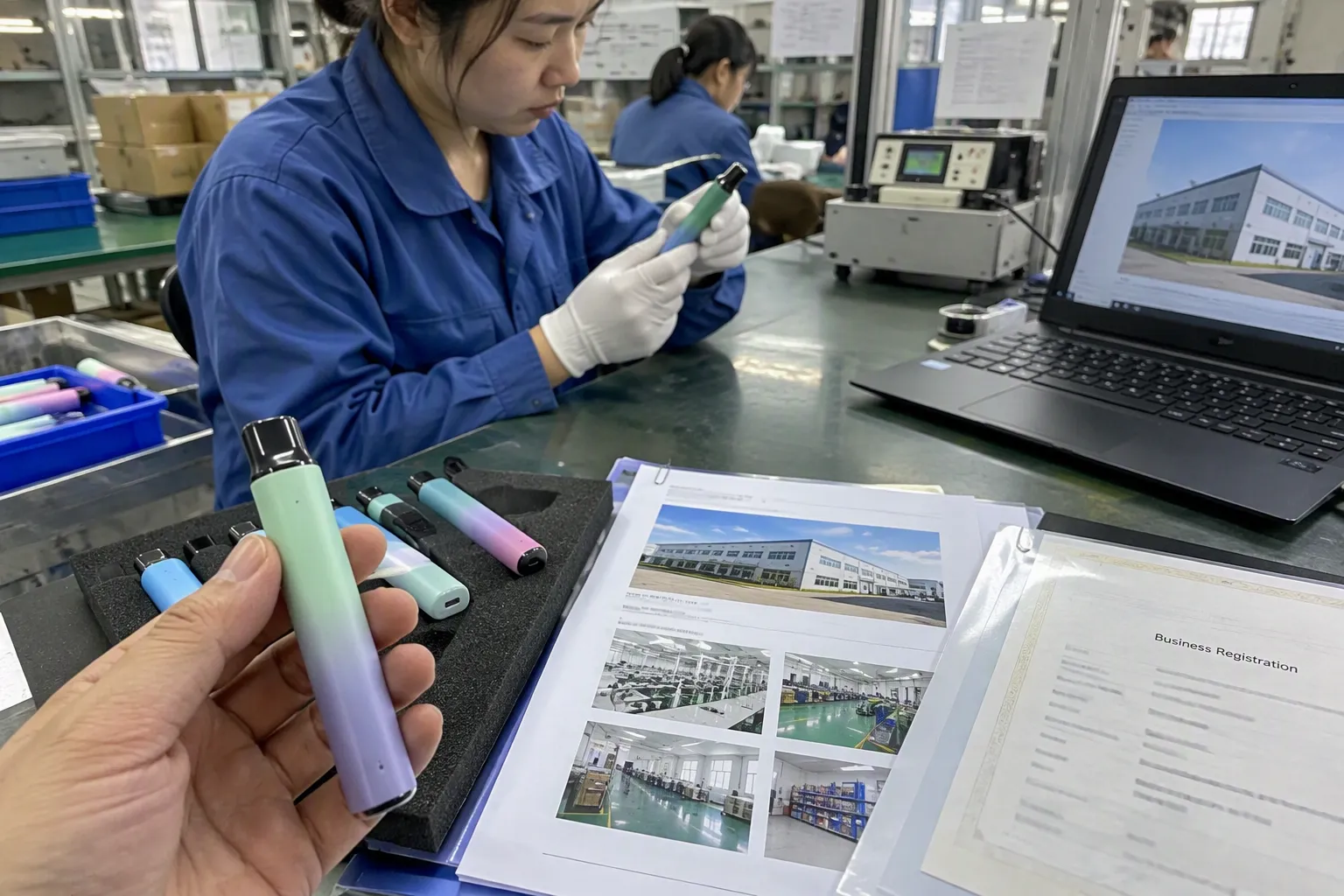
A supplier evaluation should combine commercial capability with documentation discipline. Low price and fast dispatch can be useful, but they do not solve a product or process problem after the stock arrives.
I suggest that buyers use a weighted checklist:
| Evaluation area | Questions for the supplier |
|---|---|
| Product identity | Can the supplier provide exact model, batch, packaging, and specification details? |
| Documentation | Are relevant documents available, current, and connected to the exact product? |
| Manufacturing control | Can the supplier explain production, inspection, and change-control procedures? |
| Traceability | Can the supplier identify the factory, production batch, and shipment records? |
| Communication | Does the supplier answer specific questions instead of using broad assurances? |
| After-sales support | Is there a written process for defective goods and evidence review? |
| Fulfilment | Can the supplier support the buyer’s required shipping method and delivery schedule? |
| Customisation | Can OEM or ODM changes be reviewed before production and shipment? |
| Market responsibility | Does the supplier clearly separate its responsibilities from the retailer’s? |
My company, Shenzhen Kingfuji Tech. CO., Ltd., was established in Shenzhen in 2011. We operate as a factory and trading company, with a 5,000-square-metre factory, OEM and ODM experience, and a stated maximum production capacity of up to 5 million units per month. We also work as a one-stop supplier and agent for a broad range of vape and smoking-accessory products.
That structure can help buyers who need several product categories from one supply chain. It does not remove the buyer’s responsibility to verify whether a particular product is suitable for the UK market. I prefer to make that distinction clear at the beginning of a quotation discussion.
For smaller European buyers, our European warehouses may provide a practical route for selected stocked products. The information supplied to me states that warehouses operate in Germany, Austria, Poland, Belgium, and other European locations, with delivery through services such as DHL, DPD, UPS, and FedEx. The stated minimum order quantity can be as low as 50 units per product for available stock, and the stated delivery range is commonly 1–5 working days within the EU. Buyers should confirm current stock, destination, product availability, delivery terms, and legal responsibility before ordering.
For larger importers, distributors, and wholesalers, direct China procurement may offer wider OEM/ODM choices and volume pricing. I would still recommend a staged process:
- Define the intended market and sales channel.
- Confirm the product specification.
- Request the relevant document pack.
- Review samples and packaging.
- Confirm commercial terms and responsibilities.
- Approve a pilot order.
- Review the received goods before scaling.
This process can reduce the risk of buying a large quantity before the retailer has resolved a documentation or market-suitability question.
What should retailers record during a 2026 compliance review?
A retailer should record decisions in a way that another member of the business can understand. The record does not need to be complicated. It should show what was checked, where the information came from, and what remains unresolved.
I recommend keeping:
- The product reference and supplier name.
- The intended sales territory.
- The relevant official guidance checked.
- The date of each check.
- The age-verification method and failure process.
- The delivery-age process.
- The product documents received.
- The identity of the manufacturer, importer, and distributor where relevant.
- Any legal or compliance advice obtained.
- Open questions and the person responsible for resolving them.
- Evidence of product, packaging, and batch approval.
- Records of complaints, returns, and defective goods.
I also recommend a change-control trigger. The retailer should reopen the review if the supplier changes the flavour, formulation, nicotine content, device design, battery, packaging, label, brand owner, or fulfilment route. A product that was reviewed earlier may not remain identical after a revision.
Frequently Asked Questions
Is online age verification legally required for every UK vape sale in 2026?
I would not give a universal answer without checking the current official UK position and the retailer’s exact sales model. Retailers should review the applicable age-sale rules, online selling guidance, delivery process, and local requirements. A qualified UK legal or compliance adviser should confirm any uncertain point before launch.
Can a retailer rely on an overseas supplier’s UK compliance certificate?
A retailer should not rely on a vague certificate or general statement. The retailer should request product-specific evidence, check the document’s issuer and scope, and confirm that it matches the exact product, batch, packaging, and intended market. The retailer should also identify which obligations remain with the importer or seller.
Does an age gate make an online vape store compliant?
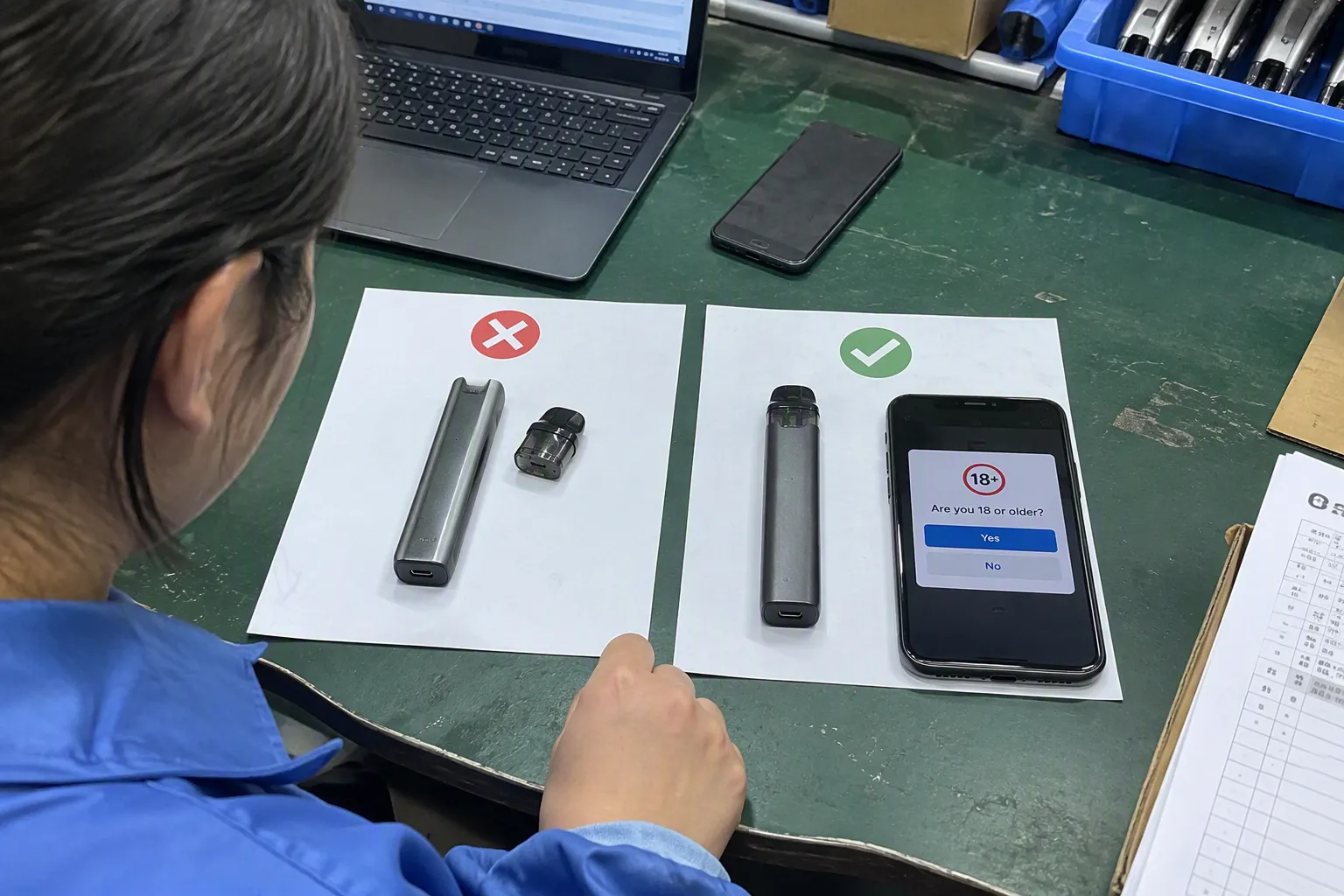
No. An age gate addresses only one part of the sales process, and its effectiveness depends on how it operates. Retailers must also review product suitability, labels, notifications or registrations where applicable, delivery controls, advertising, records, retail permissions, and the responsibilities of each party.
What should I do if my supplier cannot provide the requested documents?
I would pause the purchase or limit it to a controlled evaluation until the supplier answers the questions. The retailer should ask for exact product references, current supporting documents, packaging information, and responsibility details. If the supplier continues to provide only verbal assurances, the retailer should consider another source.
Can a small UK retailer buy low-MOQ stock from a European warehouse?
A low-MOQ European warehouse option may reduce cash-flow and delivery pressure, but it does not automatically resolve UK market requirements. The retailer should confirm the stock’s product documents, supply chain, importer details, destination rules, taxes, delivery controls, and current UK requirements before placing an order.
Conclusion
UK online age verification and retail licensing for vape sales in 2026 should be treated as a documented risk-control process, not a single checkbox or supplier slogan. I recommend separating age verification, product suitability, retail permissions, delivery, records, and supplier responsibilities. I can support buyers with product sourcing, factory communication, OEM/ODM development, documentation organisation, and available-stock options, while qualified professionals verify application-specific UK requirements. Contact Shenzhen Kingfuji Tech. CO., Ltd. at info@kingvapecig.com or +86 13928420527 to begin a product and procurement review.
Sources
- Online Age Verification: Government Legislation, Supplier ...", UK government and trading-standards guidance identifies self-declaration as distinct from measures that provide stronger assurance of a purchaser's age in age-restricted online transactions
- Selling vaping and nicotine products - GOV.UK", The UK regulatory framework treats the purchaser's age and the product's market requirements as separate compliance matters, with distinct rules governing sale, notification, composition, packaging, and presentation
- E-cigarette and vape advice for retailers / producers - GOV.UK", Official UK rules impose separate conditions on the sale of age-restricted vaping products and on the products' composition, notification, packaging, and presentation; satisfying one category does not by itself demonstrate compliance with the other
- General Use Products: Certification and Testing", Conformity-assessment guidance generally requires technical evidence to be traceable to the specific product, model, or production version assessed, so a report for a materially different model cannot ordinarily establish the same product's conformity
- Conformity Assessment of Medical Devices - PMC - NIH", Product-assurance documents have evidentiary value only within their stated scope and identifiers; a generic certificate without a clear connection to the specific product, component, or version does not necessarily demonstrate conformity of that item
- Placing UKCA or CE marked products on the market in Great Britain", Official product-safety guidance places importance on identifiable compliance documentation and defined responsibilities; an unqualified supplier assurance does not, by itself, disclose the evidence, scope, date, or legal role on which the assertion depends
- E-cigarette and vape advice for retailers / producers - GOV.UK", Current official guidance should be consulted because UK requirements for vaping-product retail may arise from several regimes rather than from a single uniform licence applicable to every online seller
- E-cigarette and vape advice for retailers / producers - GOV.UK", UK product-regulatory guidance allocates duties according to the economic operator's role and the route by which goods enter and reach the market; warehouse location, direct importation, marketplace sales, and third-party fulfilment can therefore affect the relevant compliance analysis