
A multi brand vape sample bundle can look simple, but a poor selection can leave you with the wrong products, unclear supplier information, and slow-moving inventory. I recommend treating samples as a low-cost buying decision tool, not as a box of random popular devices.
A useful multi brand vape sample bundle should include a limited range of brands, formats, price points, and flavors that match your real sales channel. Before placing a larger order, buyers should compare product performance, packaging, versions, documentation, local compliance requirements, stock availability, and feedback from target stores. The goal is to reduce SKU risk and build a first order around evidence rather than personal preference.
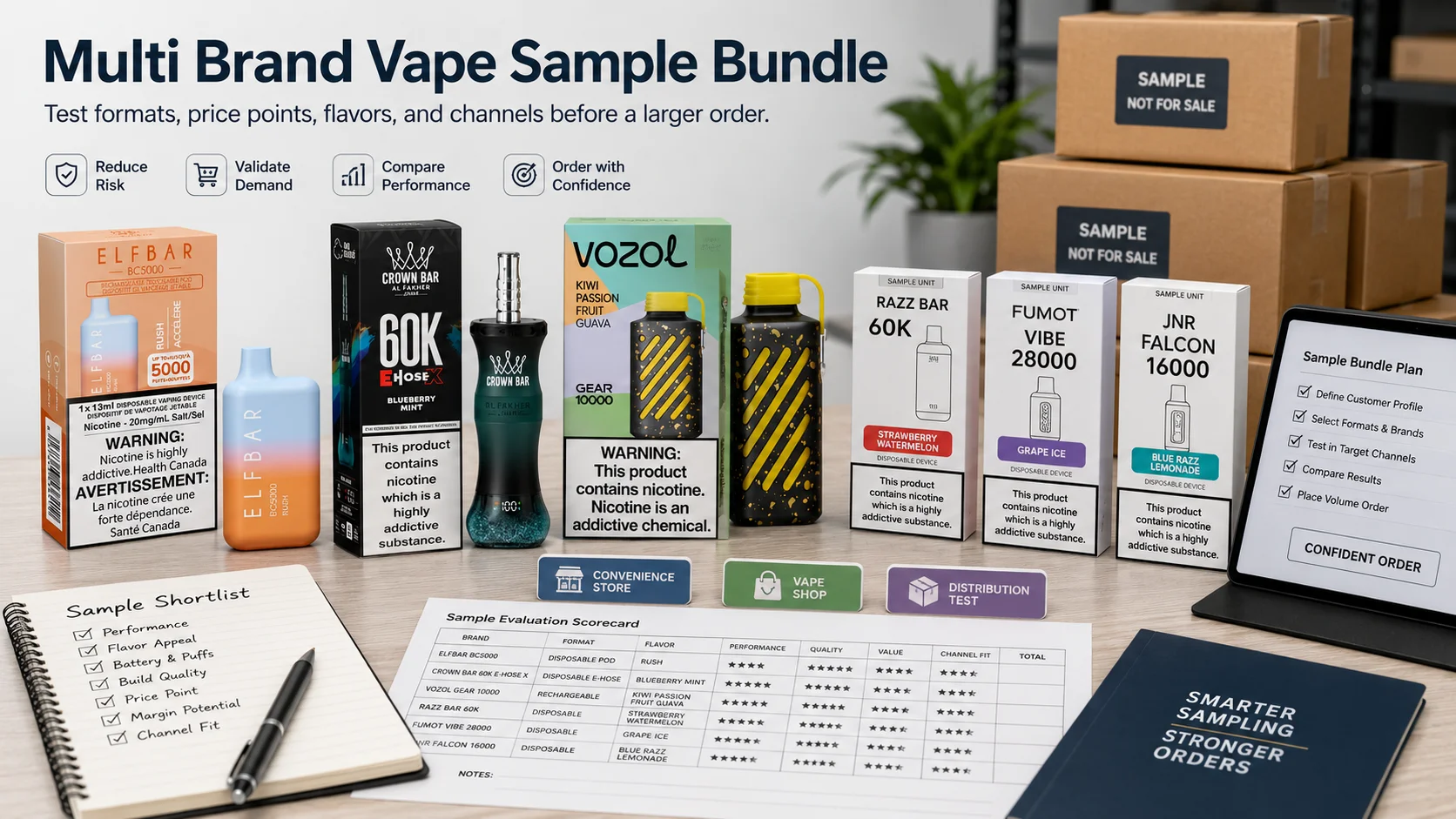
I have seen many buyers start with a long list of “hot” products, then struggle to decide what actually fits their market. A more useful approach is to give every sample a clear purpose: test a price level, a device format, a brand position, or a customer segment.
Quick Answer: How Should I Build a Multi Brand Vape Sample Bundle?
A buyer may worry that testing too few products creates blind spots, while testing too many creates confusion. That concern is valid. A mixed sample order should be broad enough to compare options, but narrow enough to produce a practical buying decision.
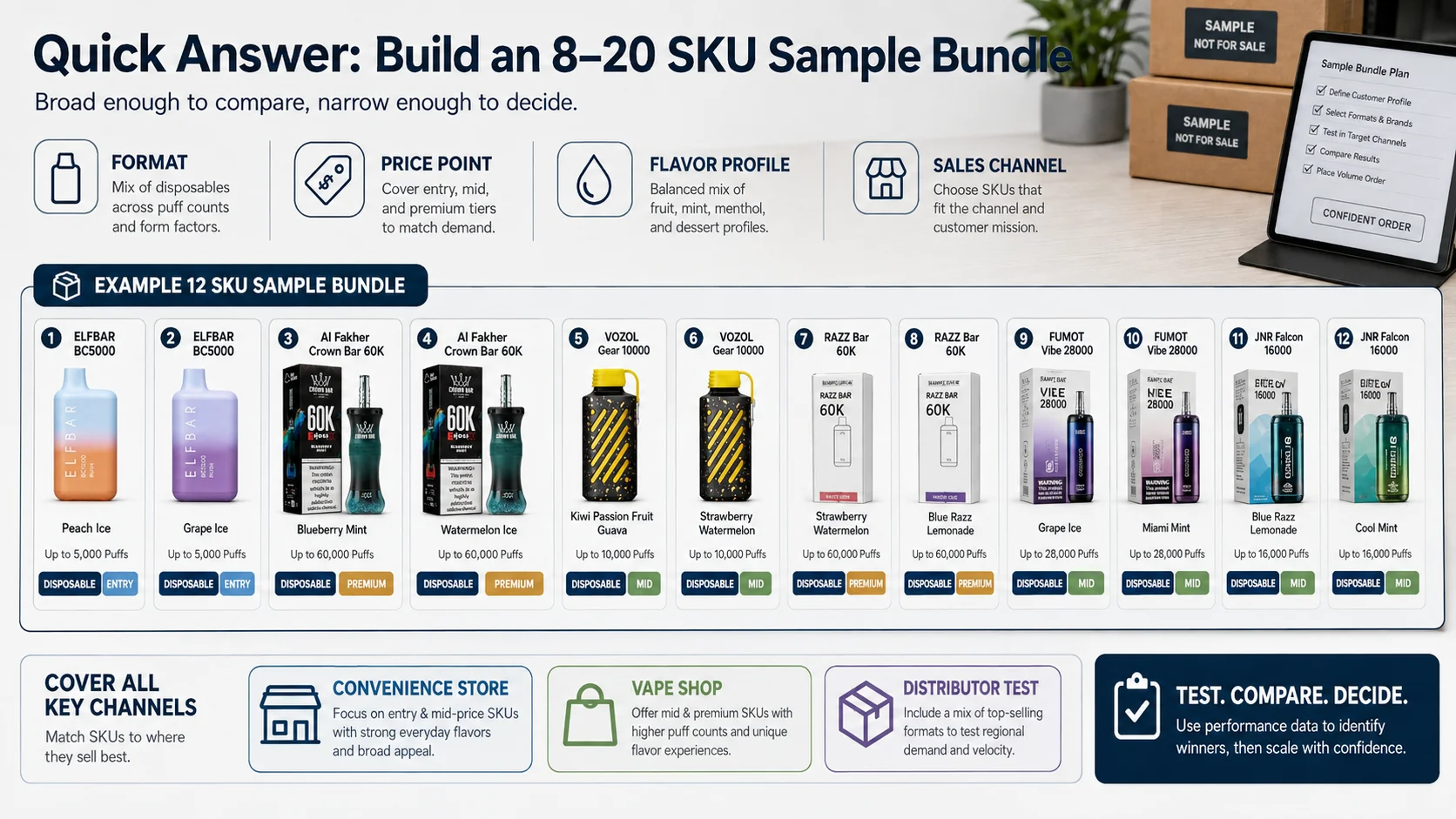
A multi brand vape sample bundle should normally contain 8–20 carefully selected SKUs[^1], grouped by format, price level, target customer, and intended sales channel. I suggest choosing products that answer specific questions, such as whether a compact disposable vape suits convenience stores or whether a higher-priced branded device fits specialist vape shops.
Start With the Selling Situation
Before I suggest brands or models, I first want to understand where the buyer plans to sell. A vape shop, smoke shop, petrol station, wholesale warehouse, and tourist-area convenience store may all need different products.[^2]
For example, a small European wholesaler may need fast-moving, familiar formats with clear shelf appeal. A specialist vape shop may care more about device features, refill compatibility, or repeat-purchase potential. A distributor selling to several store types may need a broader but controlled assortment.
I recommend that every sample SKU answers one of these questions:
- Does this product fit my target retail price?
- Does this device format match my local channel?
- Does this brand fill a missing position in my assortment?
- Is this product easy for store staff to explain?
- Does the packaging look suitable for my customer base?
- Can I obtain reliable replenishment if the product performs well?
- Does the product version meet destination-market requirements?
A sample bundle is useful only when it helps you remove options. It should not create twenty more unanswered questions.
At Shenzhen Kingfuji Tech., I regularly help buyers build mixed sample orders around their budget, channel, and expected turnover. However, I always recommend that buyers combine my product guidance with local retailer feedback and independent compliance checks.
Why Does a Multi Brand Vape Sample Bundle Matter Before a Larger Order?
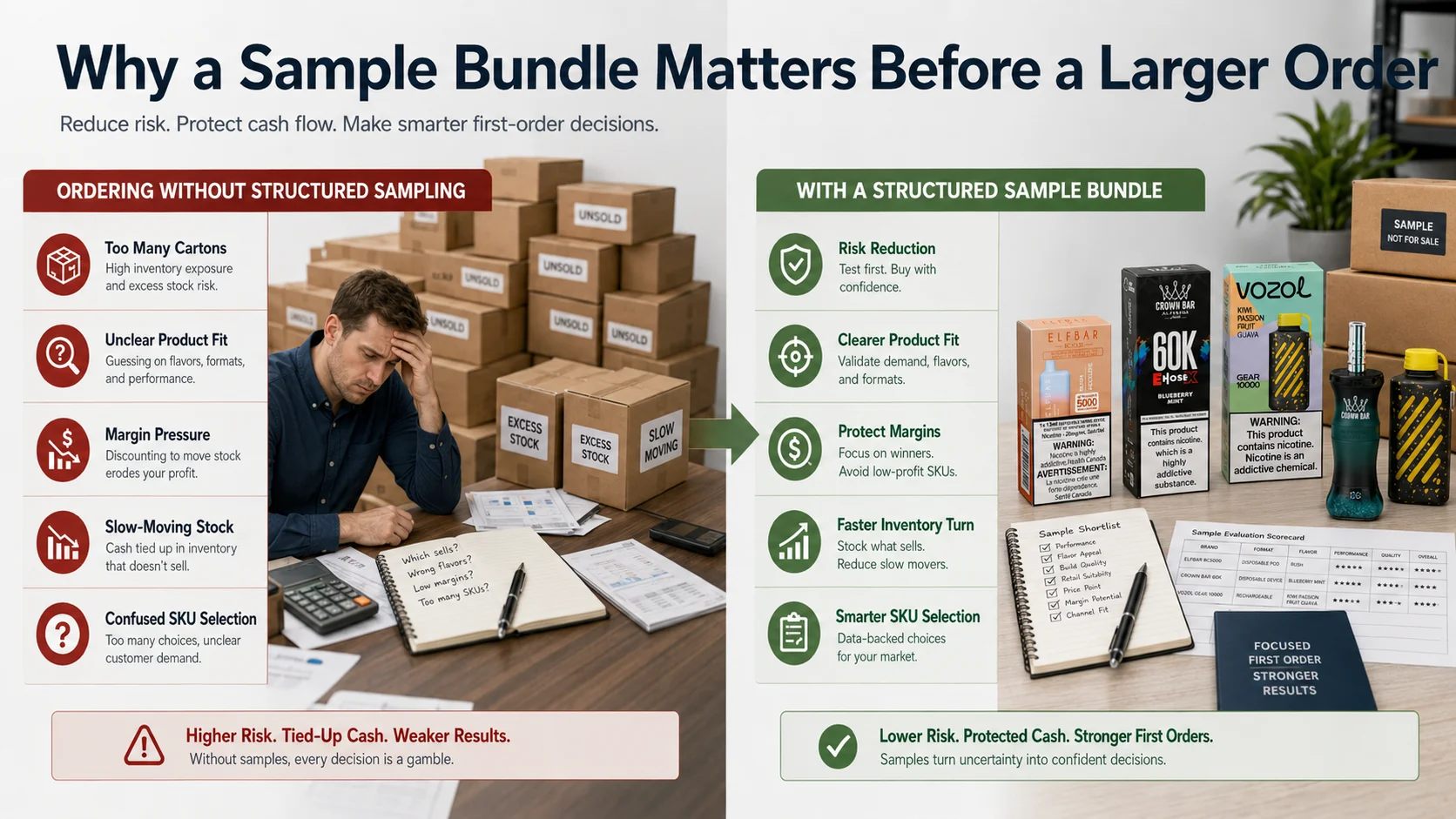
A larger wholesale order can tie up cash, warehouse space, and customer relationships.[^3] When the wrong SKUs arrive, the issue is not only the product cost. The buyer may also face slow turnover, discounting pressure, customer complaints, and delayed reordering[^4].
A multi brand vape sample bundle matters because it helps buyers identify product-fit, packaging, version, and supplier risks before they commit to a larger quantity. It gives buyers a structured way to compare products under similar conditions and narrow a first order to the most relevant SKUs.
Samples Reduce More Than Product Risk
Many buyers only test flavor or device appearance. Those details matter, but they are not the full decision. For B2B sourcing, I suggest looking at the complete product and supply experience.
A sample-stage review can uncover issues such as:
- A device is physically larger or smaller than expected.
- Packaging does not match the listing photos.
- Flavor names, nicotine information, or capacity details vary by version.
- The product sits in a price band that local retailers may resist.
- A supplier cannot confirm whether the same version is available for bulk supply.
- The outer carton configuration does not suit the buyer’s warehouse or sales method.
- The product requires market-specific documentation that has not been reviewed.
The Cost of a Wrong SKU Is Often Hidden
A low purchase price does not automatically mean a low-risk order. A product can be inexpensive but still become costly if it does not sell, creates after-sales work, or needs to be discounted.
I have spoken with long-term wholesale buyers who adjusted later orders after receiving store feedback on samples. They did not necessarily reject an entire brand. Instead, they removed weak formats, reduced flavor variety, changed price tiers, or reordered only the models that matched their customers.
That is the real value of sampling: you learn what not to buy in bulk.
Which Brands, Models, and SKUs Should Be Included in a Multi Brand Vape Sample Bundle?
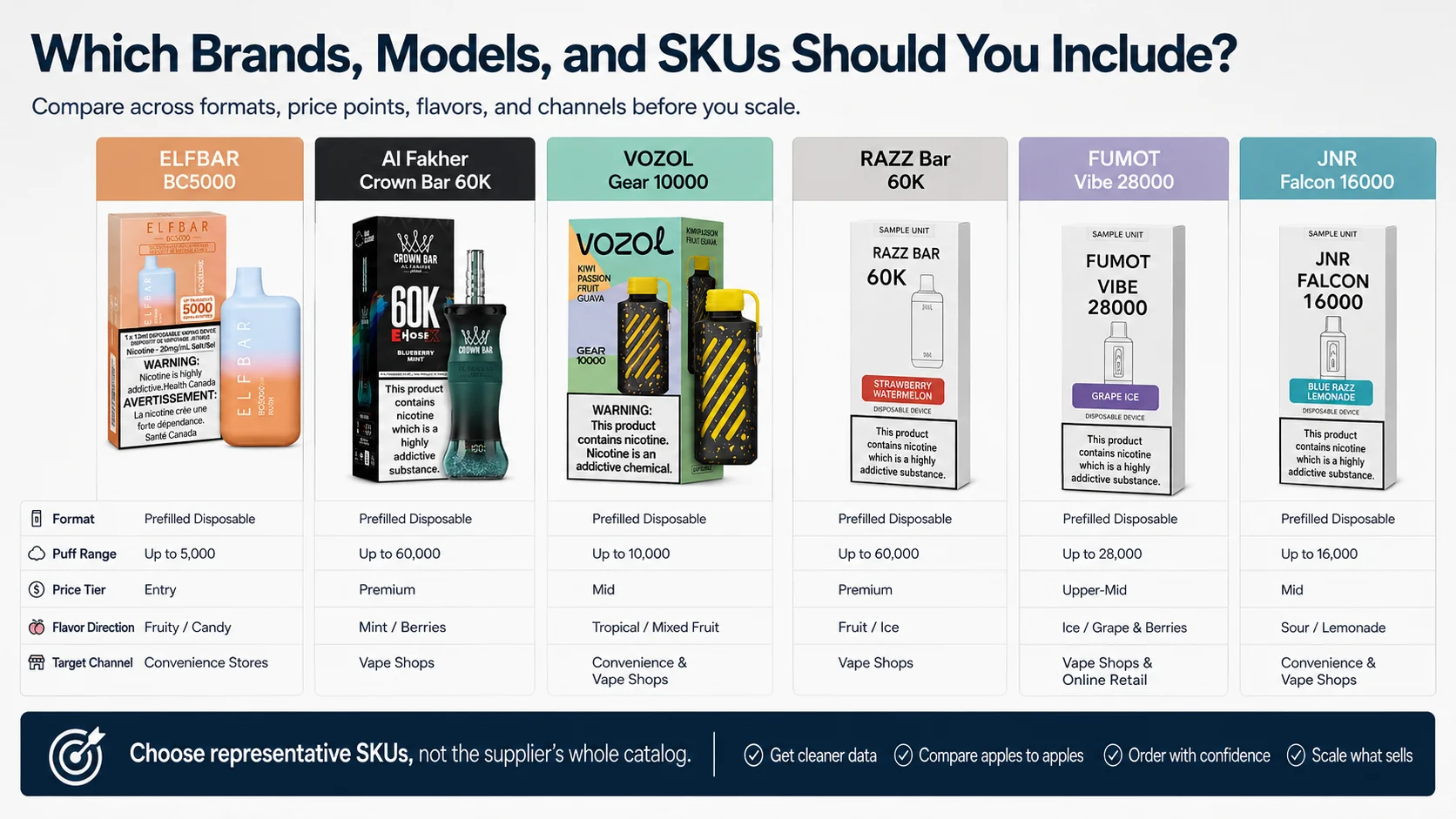
Buyers often feel pressure to include every well-known brand or every new device. This can quickly make a sample shipment expensive and unfocused. A better bundle reflects the buyer’s actual assortment plan, not the supplier’s full catalog.
A multi brand vape sample bundle should include representative brands and models across key buying variables: device format, puff range, price level, flavor profile, packaging style, and target channel. Buyers should avoid adding products simply because they are popular elsewhere or personally appealing.
Build the Bundle Around Product Roles
I usually suggest selecting products by role rather than by brand name alone. A practical bundle may include entry-level, mid-tier, and premium-positioned options, as well as different device formats where relevant.
| Product Role | What It Helps You Test | Example Evaluation Question |
|---|---|---|
| Entry-price disposable | Value positioning | Can local shops sell this at an acceptable margin? |
| Mid-range branded device | Mainstream demand | Does the format suit the buyer’s core customer? |
| Premium-positioned product | Higher retail price acceptance | Will specialist shops support this price band? |
| Compact device | Convenience and travel use | Does this fit small-store shelf space and customer habits? |
| Higher-capacity format | Different usage expectations | Is the format suitable and compliant in the destination market? |
| 510 battery or vaporizer | Accessory demand | Does the buyer’s channel already sell compatible products? |
| Glass pipe or grinder | Cross-selling potential | Does the smoke-shop customer base support this category? |
Avoid Random Flavor Sampling
Flavors can influence shopper interest, but flavor testing alone should not control a wholesale decision. I recommend including a manageable range rather than a large collection of near-identical flavor names.
For a first evaluation, a buyer could select:
- A small number of fruit profiles.
- One or two cooling or mint-style profiles, where permitted and appropriate.
- A limited number of beverage, candy, or other profiles that fit the local channel.
- The same flavor profile across different brands only when a direct comparison is useful.
A buyer should also verify local rules before ordering. Regulations can differ by country and can change over time.[^5] I cannot treat a sample selection as proof that a product is legal to sell in a particular market.
What Should Buyers Verify When Testing Vape Samples?
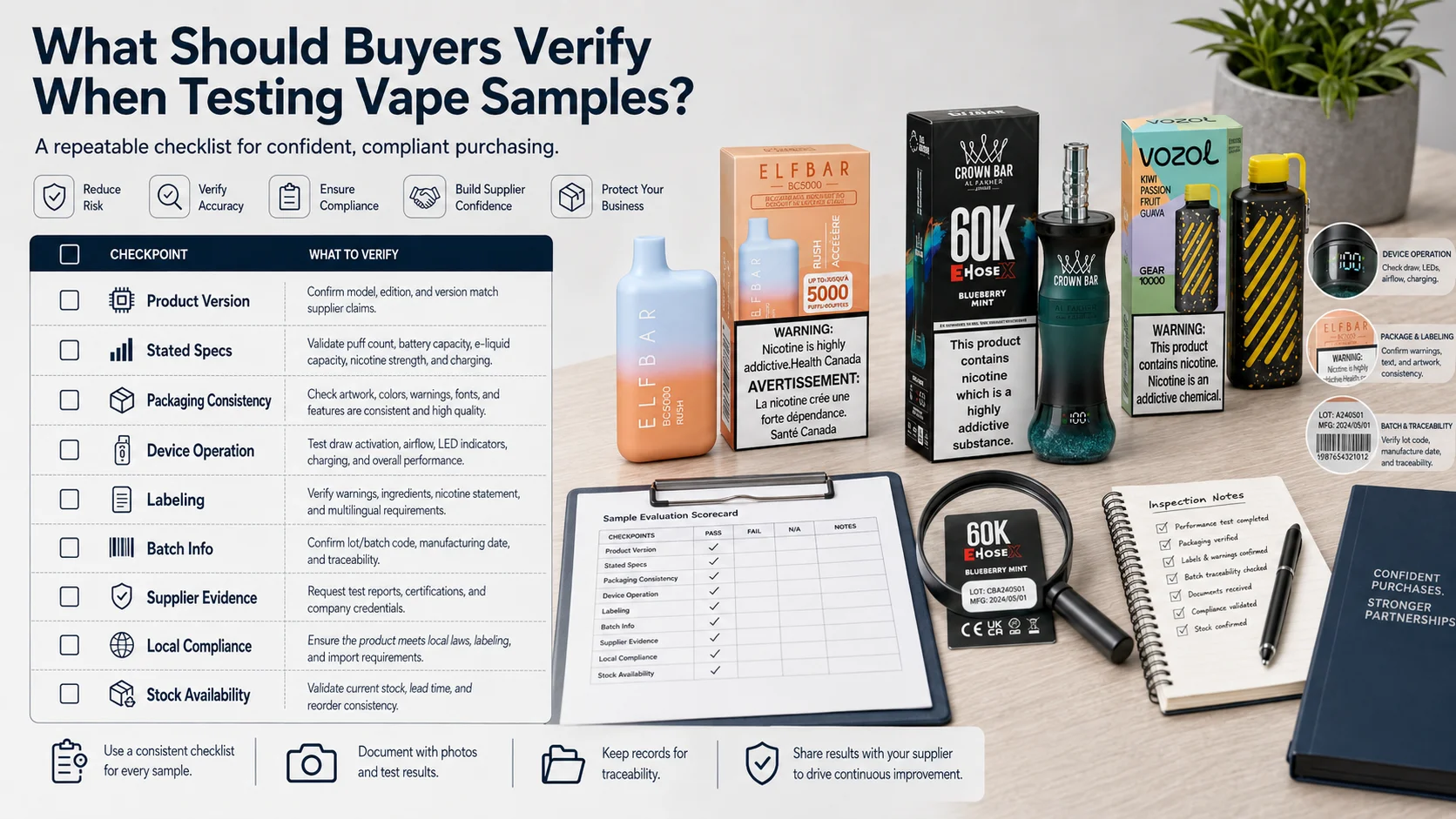
A sample can look good in hand but still be unsuitable for a larger order. Buyers need a repeatable process because memory and personal preference can distort comparison results, especially when several brands are tested over multiple days.
When testing vape samples, buyers should verify the product version, stated specifications, packaging consistency, device operation, labeling, batch information where available, and supplier evidence. Buyers should also collect feedback from intended retailers or knowledgeable local channel partners instead of relying only on personal use.
Use a Standard Testing Record
I advise buyers to use one simple form for every SKU. This makes it easier to compare products fairly and share results with business partners.
Record the following points:
- Brand, model name, and exact version
- Device format and claimed specifications
- Nicotine information and capacity details[^6], where applicable
- Packaging language and warning labels[^7]
- Barcode, QR code, scratch code, or verification feature, if provided
- Flavor name and actual product labeling
- Device activation, draw consistency, charging behavior, and visible finish
- Leakage, damage, or packaging defects on arrival
- Supplier quotation date and available stock status
- Store-owner or channel feedback
- Destination-market documentation required for your business
Ask About Evidence, Not Just Promises
For a larger order, I recommend asking the supplier what documents or records are available for the specific product version. Depending on the product and destination, buyers may need to review relevant declarations, test reports, ingredient information, labeling materials, brand authorization evidence, or shipping documentation.
These documents should be verified by the buyer and, where needed, qualified regulatory or legal professionals. A document’s existence does not automatically prove that a product is approved for every market, version, or sales channel.[^8]
At our company, we can help clarify product versions, stock status, packaging details, and available supplier-side information. Buyers should still make the final compliance decision based on their own destination-market obligations.
How Can Buyers Compare Multi Brand Vape Samples Using the Same Criteria?
A buyer may receive samples from several brands but compare them emotionally: one looks premium, another has a preferred flavor, and another seems cheap. This approach makes it difficult to decide what belongs in a first wholesale order.
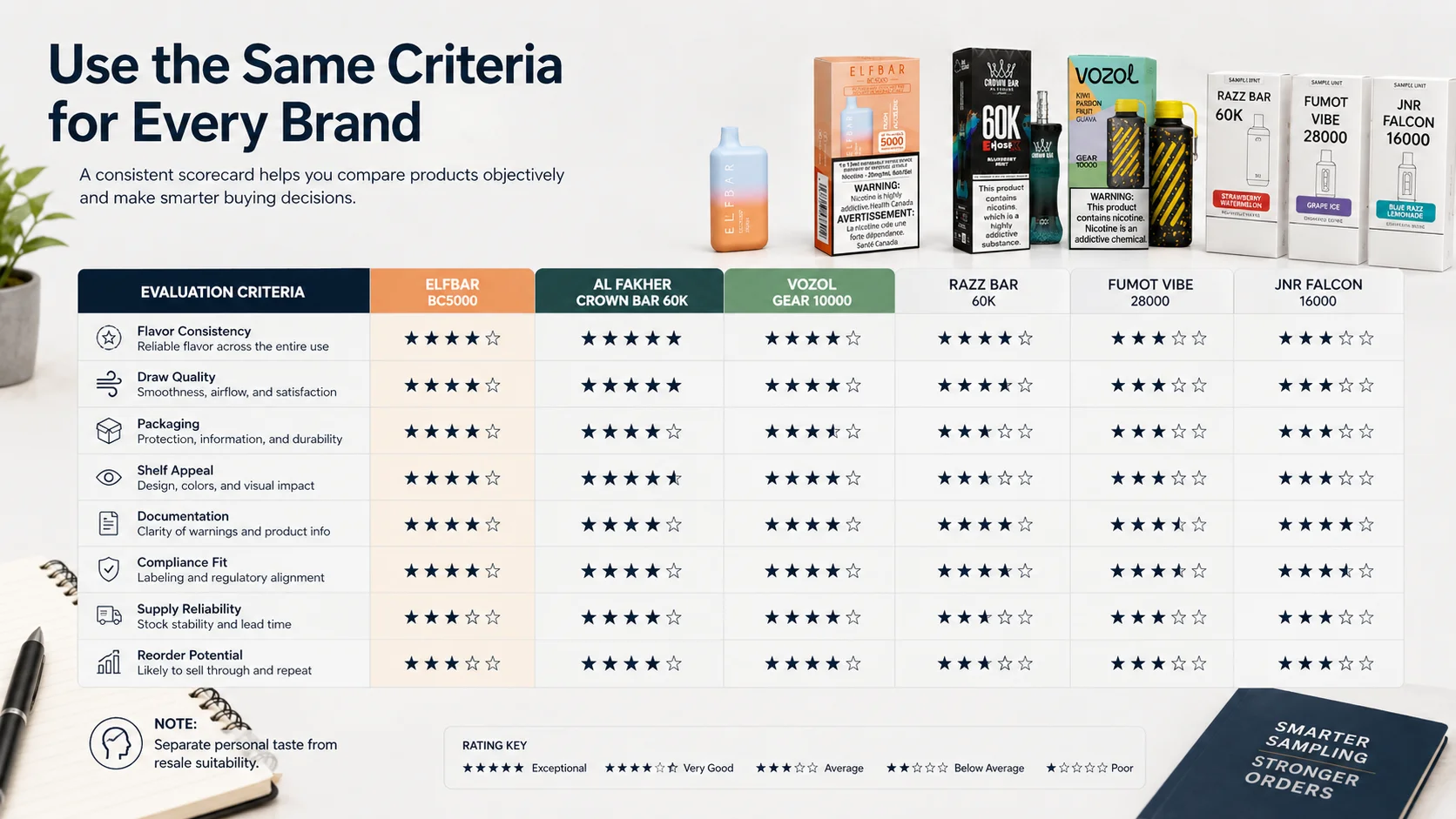
A multi brand vape sample bundle works best when every brand is evaluated against the same commercial and quality-control criteria. A standard scorecard helps buyers separate personal preference from resale suitability, supply reliability, and inventory risk.[^9]
Compare Commercial Fit as Well as Product Fit
I recommend scoring each SKU from 1 to 5 across a small set of criteria. The score is not a guarantee of sales. It is a decision aid that helps the buyer identify where more information is needed.
| Evaluation Area | What to Compare | Why It Matters |
|---|---|---|
| Target customer fit | Shop type, customer budget, usage preference | Helps avoid channel mismatch |
| Product positioning | Entry, mid-range, or premium | Supports a balanced assortment |
| Packaging | Shelf visibility, consistency, language, warnings | Affects retailer presentation and compliance review |
| Device experience | Basic function, finish, draw, charging where relevant | Helps identify obvious quality concerns |
| Price structure | Sample price, bulk price, retailer margin room | Helps assess commercial feasibility |
| Stock availability | Current stock and replenishment possibility | Reduces repeat-order uncertainty |
| Version clarity | Exact SKU, packaging, specifications | Helps prevent unwanted substitutions |
| Supplier communication | Response speed and detail of answers | Indicates procurement coordination quality |
Compare Like With Like
A compact entry-level disposable should not be judged by the same expectations as a higher-priced device with different features. Instead, compare products within the same role.
For example, if you test three mid-range disposable models, ask:
- Which one fits the same retail price band?
- Which one has the clearest packaging?
- Which one has the most consistent version information?
- Which one can be replenished more reliably?
- Which one receives the strongest feedback from target stores?
This process gives buyers a better reason to select a product than “I liked it most.”
How Should Sample Results Influence MOQ and the First Wholesale Order?
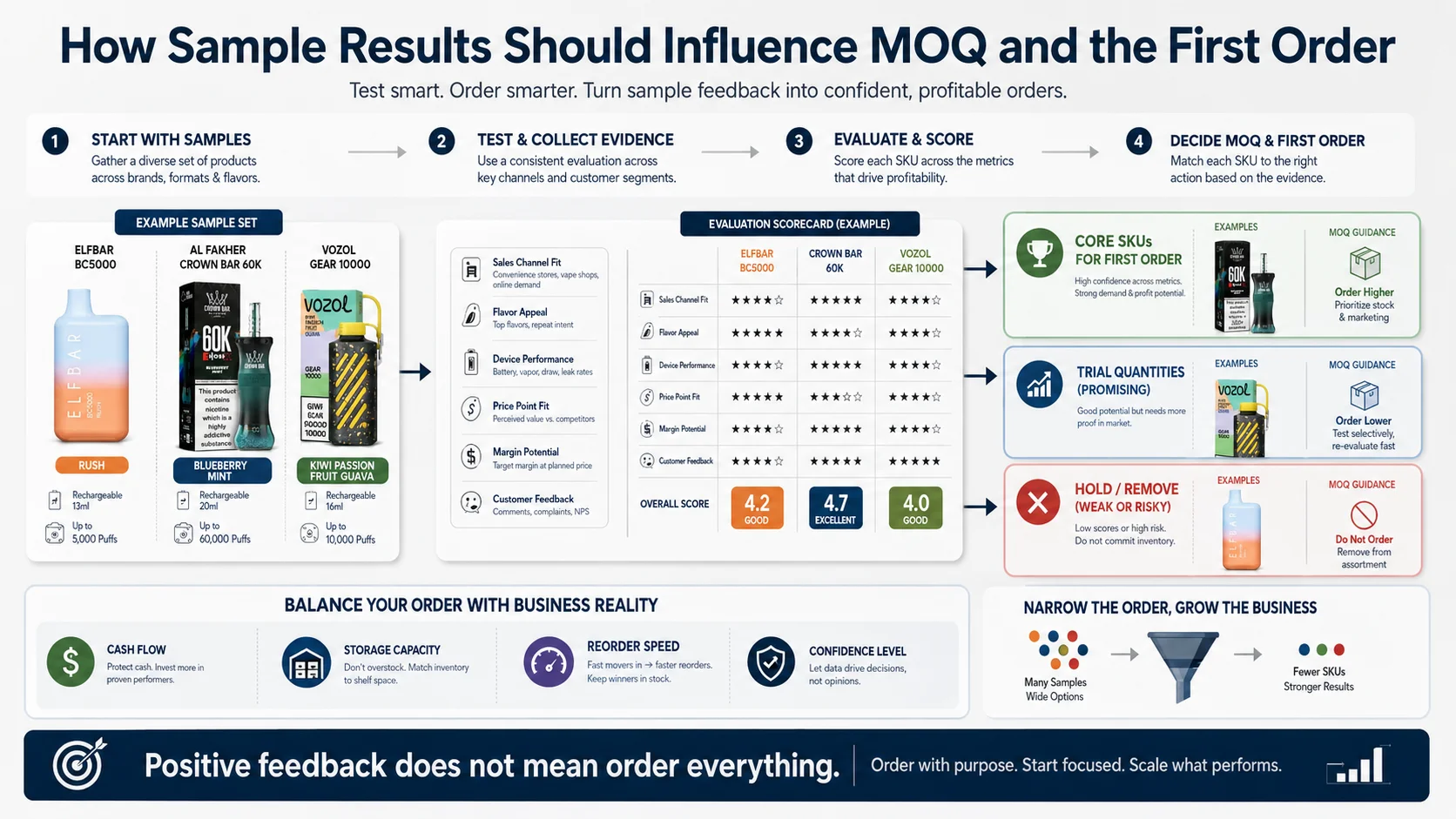
After testing, buyers may feel ready to order everything that received positive feedback. That can still create inventory risk. A first bulk order should reflect confidence levels, available cash flow, storage capacity, and the ability to reorder quickly.
A multi brand vape sample bundle should guide buyers toward a focused first order with controlled quantities. Buyers should place more weight on SKUs supported by consistent evidence, while keeping uncertain items at lower trial quantities or removing them until better market feedback is available.
Create Three Buying Groups
I suggest dividing tested products into three categories:
-
Core SKUs
These products match the intended channel, price band, and store feedback. Buyers may assign a larger share of the first order to these items. -
Trial SKUs
These products show potential, but the buyer still needs more local feedback. Buyers can order smaller quantities if MOQ, cash flow, and compliance conditions allow. -
Do-not-order-yet SKUs
These products have unclear versions, weak feedback, uncertain stock, poor packaging fit, or no clear role in the assortment.
Use MOQ as a Risk-Control Tool
MOQ is not only a supplier requirement. It is also a way to control exposure.[^10] A buyer should not accept a larger MOQ simply because the unit price is lower if the product-fit evidence is weak.[^11]
For smaller European buyers, our overseas warehouse options may support lower-quantity purchases for selected stocked products, with some items starting from 50 units per model. This can help buyers test a tighter assortment and reduce upfront inventory pressure. Availability, destination, product category, and delivery terms should always be confirmed before payment.
For larger importers and distributors, a direct China order may offer better unit economics and OEM/ODM options when volumes justify the commitment. In either case, I recommend confirming the final SKU list, version, carton details, price validity, and delivery plan in writing.
What Are Common Multi Brand Vape Sampling Mistakes and Red Flags?
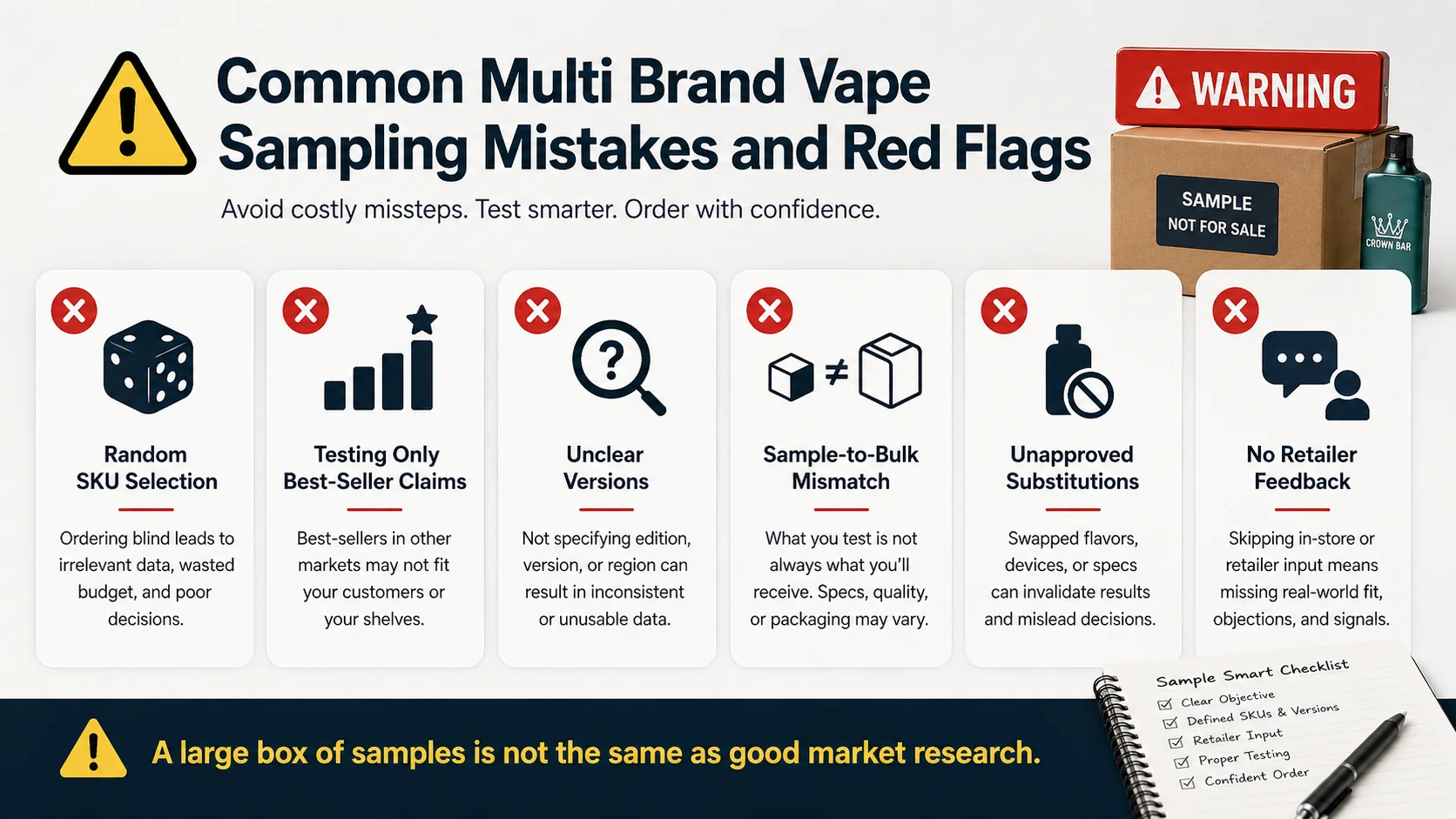
The biggest sampling mistake is assuming that a large box of products equals good market research. Without a plan, buyers may spend money on samples and still have no clear basis for choosing a first order.
Common multi brand vape sample bundle mistakes include random SKU selection, testing only a supplier’s best-selling claims, accepting unclear versions, and failing to confirm whether sample products match future bulk stock. Buyers should pause when the product information is inconsistent or substitutions are proposed without written approval.
Mistakes I Recommend Avoiding
- Ordering too many brands with no defined target customer.
- Testing only one flavor or one SKU from a broad product category.
- Choosing based only on personal taste or online hype.
- Ignoring packaging, warning labels, and version differences.
- Assuming a sample is identical to the future bulk product.
- Failing to ask whether stock is live, reserved, or subject to change.
- Treating low price as proof of commercial value.
- Skipping destination-market regulatory review.
- Letting the supplier substitute brands, flavors, or versions without written confirmation.
Red Flags During Supplier Communication
I recommend extra caution if a supplier cannot clearly answer basic questions about the product version, stock condition, carton quantity, quotation validity, or available documents.
A responsible supplier should be able to explain:
- What exact SKU is being quoted
- Whether the sample and bulk version are the same
- What changes may occur if stock runs out
- Whether substitution requires buyer approval
- What shipping route is being discussed
- Which buyer responsibilities apply at the destination
No supplier can remove every commercial or regulatory risk. However, clear communication makes those risks easier to identify before a larger payment is made.
What Should Be on Your Multi Brand Vape Sample Bundle Checklist Before Scaling?
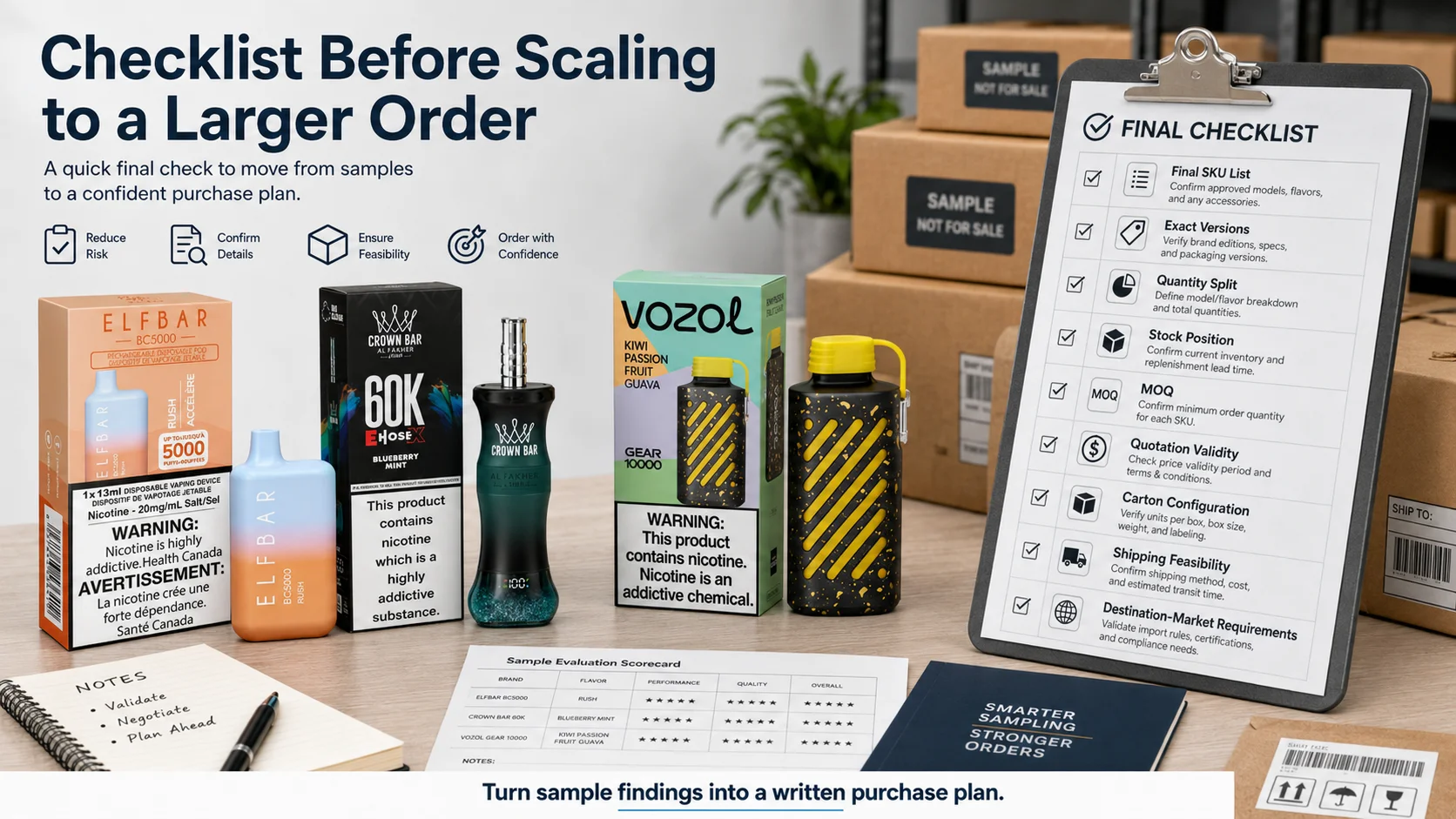
A buyer can receive good samples and still make a weak bulk-order decision if key commercial details are not confirmed. The final step is to turn sample findings into a written purchasing plan that both the buyer and supplier can follow.
Before scaling from a multi brand vape sample bundle to a larger order, buyers should confirm the final SKU list, exact versions, quantity split, stock position, MOQ, quotation validity, carton configuration, shipping feasibility, and destination-market requirements. This protects both sides from avoidable misunderstandings.
Pre-Bulk Order Checklist
Use this checklist before approving the purchase order:
- [ ] Final brand, model, flavor, and version list is confirmed.
- [ ] Every SKU has a clear role in the planned assortment.
- [ ] Current stock is checked close to payment time.
- [ ] The quotation has a clear validity period.
- [ ] MOQ and quantity split are confirmed by SKU.
- [ ] Product packaging and labeling have been reviewed.
- [ ] Carton quantity, dimensions, and gross weight are available.
- [ ] The buyer understands the shipping route and delivery terms.
- [ ] Any product substitutions require written approval.
- [ ] Available documentation has been requested and reviewed.
- [ ] Destination-market compliance has been evaluated by qualified parties where needed.
- [ ] A process for after-sales issues and damaged goods is understood.
I also recommend keeping screenshots, product photos, version notes, quotations, and email confirmations in one purchasing file. This record is useful when a repeat order is placed months later and product versions or packaging have changed.
Frequently Asked Questions
How many vape SKUs should be included in a sample bundle?
I generally suggest 8–20 SKUs for a first multi-brand sample bundle. The right number depends on your budget, sales channel, and how many product roles you need to test. Each SKU should answer a specific buying question rather than simply adding more variety.
Should buyers test several brands before choosing one?
Yes, comparing several brands can be useful when each brand serves a similar role or price level. However, buyers should not test brands randomly. I recommend comparing brands using the same criteria: product version, packaging, pricing, availability, retailer feedback, and resale suitability.
How can buyers confirm samples match future bulk orders?
Buyers should request confirmation of the exact SKU, model, flavor, packaging version, and available stock before placing a bulk order. I also recommend adding a written no-substitution rule unless the buyer gives approval. Product photos and order records should be retained.
Which product differences should be recorded during testing?
Buyers should record format, stated specifications, packaging, labeling, flavor name, device behavior, visible finish, carton details, price, available stock, and supplier information. Feedback from target stores should also be documented, because personal preference does not prove local demand.
When should a buyer place a small trial order instead of a full wholesale order?
A buyer should consider a small trial order when sample feedback is positive but still limited, when local demand is uncertain, or when a new brand has unclear turnover potential. A trial order can provide more realistic sales feedback before larger inventory is committed.[^12]
Conclusion
A multi brand vape sample bundle is most useful when it is built around your real customers, sales channel, budget, and planned inventory turnover. I recommend selecting fewer, more purposeful SKUs; testing them with a consistent scorecard; collecting local feedback; and confirming version, stock, pricing, and shipping details before scaling. At KingVape, we can help you organize a practical mixed-brand purchasing route, from lower-quantity European warehouse options to larger China-based wholesale and OEM/ODM orders. Send us your country, sales channel, target quantity, and delivery destination, and we will suggest a practical multi-brand purchasing route.
[^1]: "On Size Substitution and Its Role in Assortment and Inventory ...", http://personal.anderson.ucla.edu/felipe.caro/papers/pdf_FC36.pdf. Assortment-planning research describes SKU rationalization as a means of reducing inventory complexity and improving purchasing decisions; it does not establish a universal 8–20-SKU range for vape samples. Evidence role: general_support; source type: research. Supports: Research or guidance on using constrained assortments and SKU rationalization to limit complexity and inventory exposure during product selection.. Scope note: The specific numerical range remains a practical heuristic unless supported by data from the buyer's own channel. [^2]: "A Demand Estimation Procedure for Retail Assortment ...", https://faculty.wharton.upenn.edu/a-demand-estimation-procedure-for-retail-assortment-optimization-with-results-from-implementations-workingpaper-file-file/. Retail-assortment literature finds that store format and customer segment influence product selection, pricing, and merchandising strategy. Evidence role: general_support; source type: paper. Supports: Retail research showing that assortment decisions vary with store format, customer needs, and channel positioning.. Scope note: General retail findings support channel differentiation but do not determine which vape products are appropriate or lawful in a particular location. [^3]: "Cash flow management and its effect on firm performance - PMC", https://pmc.ncbi.nlm.nih.gov/articles/PMC10281586/. Inventory-management guidance explains that excess stock ties up working capital and creates carrying costs, including storage, handling, and obsolescence risk. Evidence role: mechanism; source type: education. Supports: Evidence that inventory consumes working capital, incurs storage and carrying costs, and creates financial exposure when demand is uncertain.. Scope note: The effect on customer relationships depends on the buyer's service levels and local market conditions. [^4]: "Inventory Control Improvement Within the Discount Stores", https://digitalcommons.lindenwood.edu/cgi/viewcontent.cgi?article=2302&context=theses. Operations and retail research associates demand–assortment mismatch with slow-moving inventory and markdowns used to clear unsold goods. Evidence role: mechanism; source type: paper. Supports: Research connecting demand uncertainty and poor assortment performance with excess inventory, markdowns, and reduced inventory turnover.. Scope note: Customer complaints and reorder delays may have additional causes beyond SKU selection. [^5]: "Electronic Nicotine Delivery Systems: International Tobacco Control Four ...", https://pmc.ncbi.nlm.nih.gov/articles/PMC3627474/. The World Health Organization documents that regulation of electronic nicotine-delivery systems varies substantially among jurisdictions and continues to develop over time. Evidence role: historical_context; source type: institution. Supports: Authoritative information showing that regulation of electronic nicotine-delivery systems differs across jurisdictions and evolves through legislation and policy updates.. Scope note: A cross-country overview is not a substitute for confirming the current law, product category, and enforcement practice in the destination market. [^6]: "Emerging Electronic Cigarette Policies in European Member ...", https://pmc.ncbi.nlm.nih.gov/articles/PMC8025686/. The EU Tobacco Products Directive sets conditions for electronic-cigarette nicotine content, refill-container and tank capacity, and specified consumer information requirements. Evidence role: definition; source type: government. Supports: Regulatory requirements or official guidance concerning nicotine-strength information, container capacity, and labeling for electronic cigarettes in the relevant jurisdiction.. Scope note: These requirements apply within the Directive's legal framework and may differ for products, territories, or jurisdictions outside it. [^7]: "Emerging Electronic Cigarette Policies in European Member States ... - PMC", https://pmc.ncbi.nlm.nih.gov/articles/PMC8025686/. Official electronic-cigarette regulations require specified health warnings and consumer information on unit packaging, with national rules governing the language used in the destination market. Evidence role: definition; source type: government. Supports: Official rules requiring specified health warnings and product information on electronic-cigarette packaging, including applicable language requirements.. Scope note: Exact wording, format, and language obligations must be checked against the current rules of the market where the product will be placed on sale. [^8]: "EU Legislation and CE Marking - International Trade Administration", https://www.trade.gov/country-commercial-guides/eu-eu-legislation-and-ce-marking. Official product-compliance guidance distinguishes supporting conformity documentation from the broader obligation to meet all applicable rules for a product placed on a particular market. Evidence role: general_support; source type: government. Supports: Official compliance guidance showing that technical documentation and declarations are part of conformity assessment but do not replace market-specific legal obligations.. Scope note: The exact documentation and approval pathway for vape products depends on the destination jurisdiction and product classification. [^9]: "developing an effective supplier scorecard process to measure", https://scholarworks.calstate.edu/downloads/t722h954j. Multi-criteria decision-analysis research shows that predefined evaluation criteria can make procurement comparisons more transparent and reproducible than unstructured judgments. Evidence role: mechanism; source type: paper. Supports: Research on multi-criteria decision analysis and supplier evaluation showing that explicit criteria can make comparisons more transparent and repeatable.. Scope note: A scorecard improves decision consistency but cannot predict local sales performance without valid market data. [^10]: "Inventory Management for Supply Chains with Uncertainty", https://preserve.lehigh.edu/lehigh-scholarship/graduate-publications-theses-dissertations/theses-dissertations/inventory-0. Supply-chain studies identify minimum order quantities as a driver of inventory accumulation and holding-cost exposure when demand is uncertain. Evidence role: mechanism; source type: paper. Supports: Supply-chain research explaining how minimum order quantities influence inventory levels, holding costs, and exposure to uncertain demand.. Scope note: MOQ may also reflect production, logistics, or contractual constraints and is not solely a buyer-controlled risk tool. [^11]: "The effects of quantity discounts on supply chain performance", https://pmc.ncbi.nlm.nih.gov/articles/PMC7578567/. Inventory models show that lower unit prices from quantity discounts can be offset by carrying costs and the risk of excess stock when demand is uncertain. Evidence role: mechanism; source type: research. Supports: Inventory-cost analysis showing that quantity discounts must be evaluated against holding costs and the risk of unsold stock.. Scope note: The appropriate order quantity depends on demand forecasts, shelf life, financing costs, replenishment lead time, and contractual terms. [^12]: "How to Conduct Market Research for a Startup", https://online.hbs.edu/blog/post/how-to-do-market-research-for-a-startup. Test-marketing and demand-learning research finds that limited initial sales can provide information that improves later production or inventory decisions. Evidence role: mechanism; source type: paper. Supports: Research showing that pilot sales, test markets, or limited initial orders can provide information about demand before a full-scale commitment.. Scope note: Trial-order results may not generalize if the trial stores, timing, price, promotion, or supply conditions differ from the later rollout.