
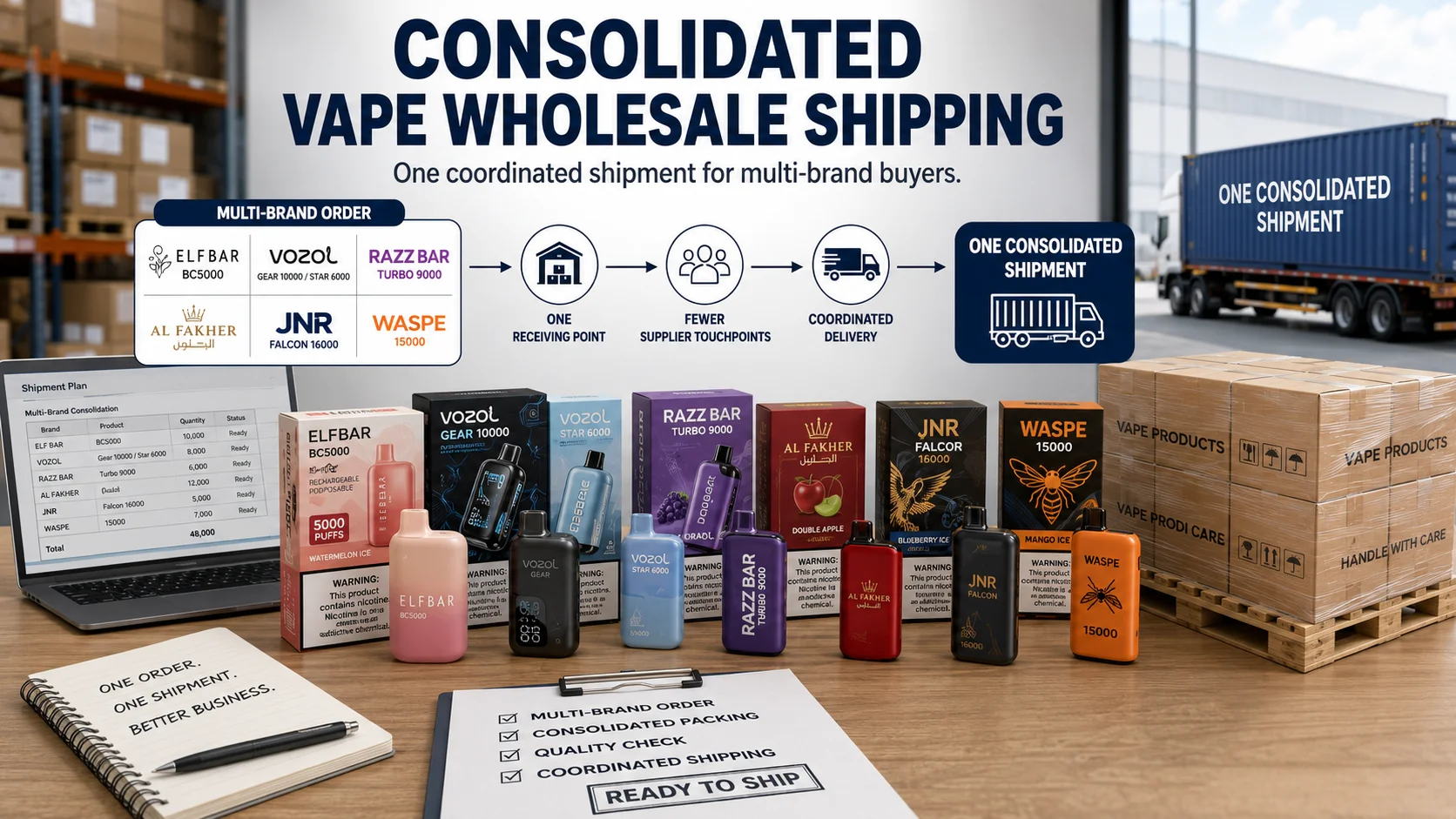
Consolidated vape wholesale shipping can solve a common problem for importers and wholesalers: buying several brands and product categories without managing multiple suppliers, freight bookings, delivery dates, and after-sales contacts. However, a single shipment is not always the cheapest or fastest choice when urgent best-selling SKUs need replenishment.
Consolidated vape wholesale shipping makes the most sense when products from several brands can be ready within a similar time window, the buyer needs one coordinated delivery, and the total operational cost is lower than handling separate shipments. Buyers should still compare stock readiness, destination rules, battery transport conditions, storage costs, urgent replenishment needs, and the risk of losing sales while waiting for a full order[^1].
I have seen that freight cost is only one part of the decision. A buyer may save money by combining cartons, but that saving can disappear if a fast-moving disposable vape or 510 battery stays out of stock for too long. The practical question is not “Can everything ship together?” It is “Which route protects margin, cash flow, and sales continuity?”
Quick Answer: When Does Consolidated Vape Wholesale Shipping Work Best?
Buyers often want one simple answer, but multi-brand purchasing creates moving parts. Different brands may have different stock levels, packaging requirements, product versions, and arrival dates. If these details are not checked early, a “simple” consolidated order can become delayed and difficult to reconcile.
Consolidated vape wholesale shipping is usually suitable when a buyer purchases multiple brands in small or medium quantities, wants one receiving point, and can wait for products to be collected into one shipment. It is less suitable when one proven fast-selling SKU is urgently needed, when brands have very different readiness dates, or when destination requirements make mixed cargo difficult to manage.
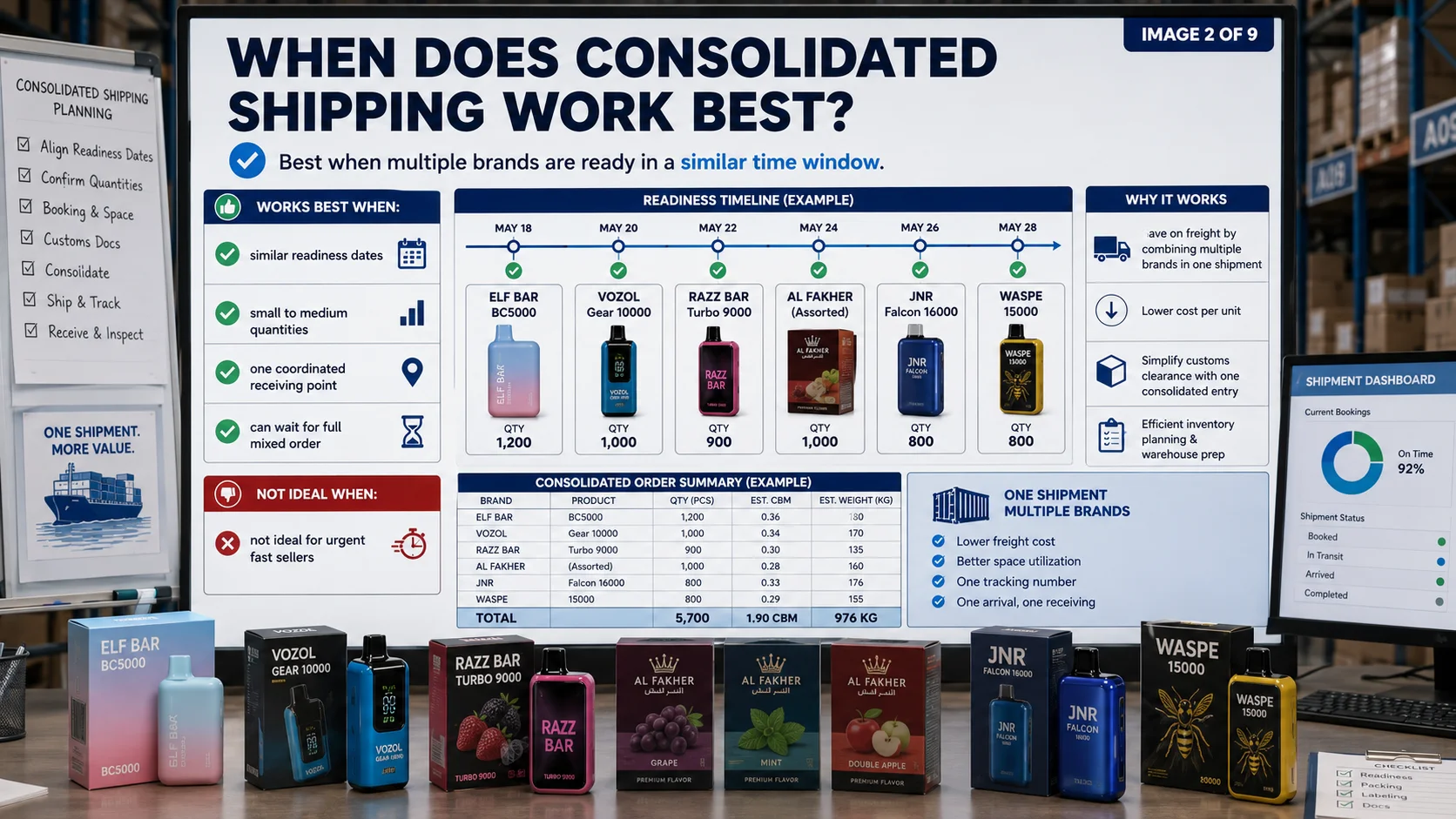
Think Beyond the Freight Quote
I encourage buyers to compare the total cost of receiving an order, not only the quoted shipping charge. A lower freight rate does not always mean a lower business cost.[^2]
A complete purchasing decision should include:
- Freight booking and handling charges
- Supplier communication time
- Payment coordination across multiple orders
- Receiving and warehouse labor at destination
- Customs-facing document coordination
- Product inspection and carton reconciliation
- Cost of delayed store replenishment
- Cash tied up in slow-moving inventory[^3]
- After-sales communication with several parties
For many wholesalers, one coordinated order makes day-to-day operations easier. This is especially true for businesses supplying vape shops, smoke shops, convenience stores, gas stations, and general retail outlets. Their customers often want mixed categories, such as disposable vapes, atomizers, batteries, grinders, glass pipes, and other smoking accessories.
Still, order consolidation should support the buyer’s sales plan. It should not force the buyer to wait indefinitely for a low-priority SKU while local customers are asking for products that are already selling.
The best shipping plan is usually the one that balances freight efficiency with stock availability and sales urgency.
Why Does Consolidated Vape Wholesale Shipping Matter to Multi-Brand Buyers?
Separate shipments can look flexible at first. Each supplier sends products when they are ready, and the buyer does not need to wait for a full mixed order. However, separate shipments can create more work, more documents, more delivery points, and more opportunities for stock and communication mistakes.
Consolidated vape wholesale shipping matters because it can turn several brand purchases into one coordinated receiving process. Instead of managing multiple freight bookings, delivery dates, carton lists, and after-sales contacts, buyers can review one overall shipment plan while still checking each brand and SKU separately.
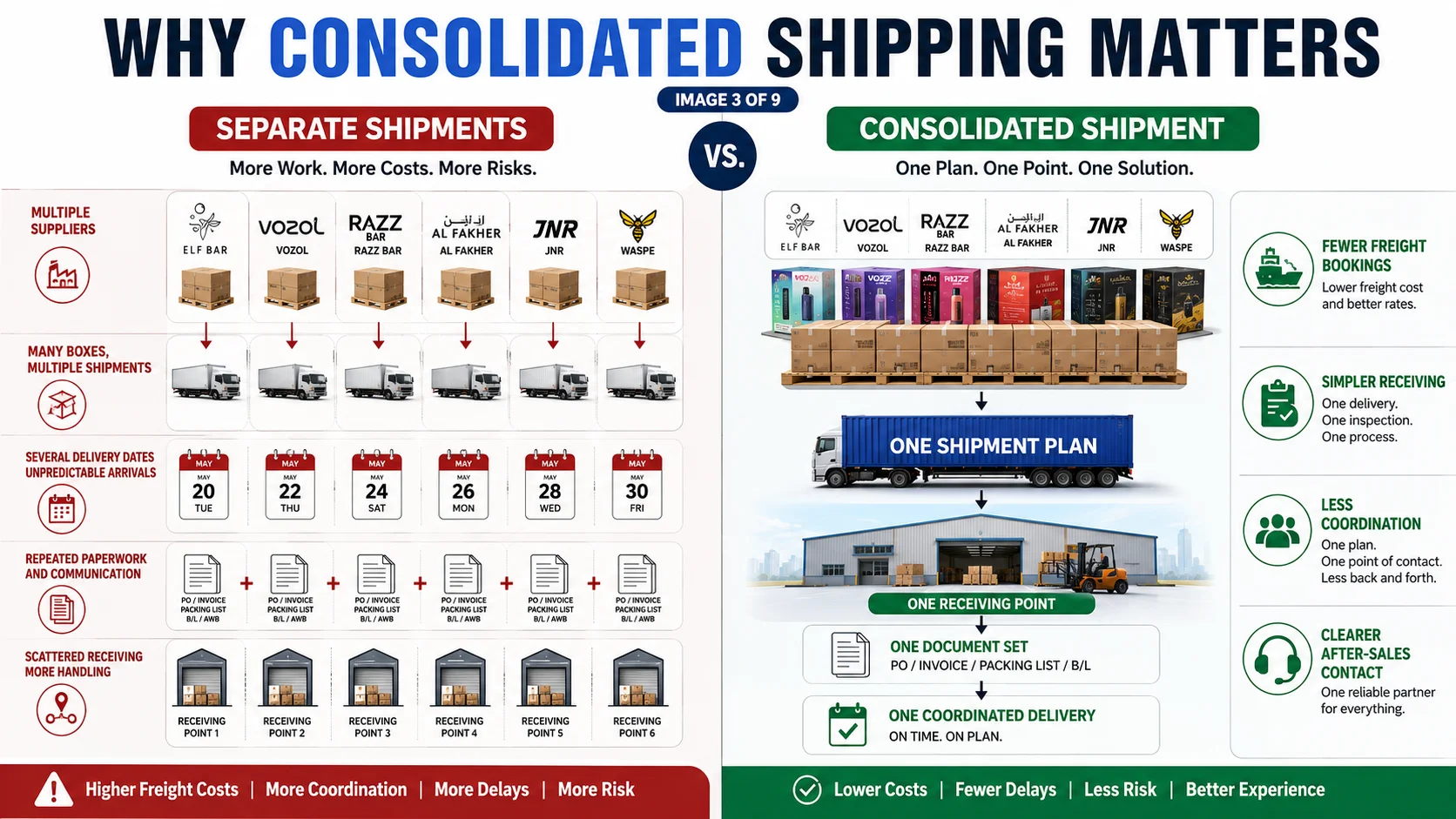
The Operational Cost of Fragmented Shipments
A multi-brand vape wholesaler may buy from several factories, brand agents, or trading companies. Each supplier may provide a different invoice format, carton specification, product lead time, and shipping suggestion. This creates friction long before cargo leaves China.
Here is what fragmented purchasing can mean in practice:
| Operational Issue | Separate Shipments | Consolidated Order |
|---|---|---|
| Freight bookings | Multiple bookings may be needed | One main shipping arrangement may be possible |
| Delivery dates | Products arrive at different times | Buyer can target a coordinated arrival |
| Receiving work | Staff receive and check several deliveries | One receiving process can cover more SKUs |
| Documentation | Multiple packing lists and invoices | Documents can be reviewed in one shipment plan |
| After-sales contact | Buyer may need to contact several suppliers | One main coordination window can simplify follow-up |
| Warehouse allocation | Products may arrive unevenly | Buyer can allocate a fuller assortment together |
I work from Shenzhen, which is a major production and supply area for vape products and related accessories. In this market, buyers can find a very broad product range, but broad choice also creates a sourcing challenge. A buyer may need one supplier for a known brand, another for accessories, and another for a custom project.
At KingVape, I help buyers coordinate multi-brand purchasing as part of an integrated factory and sourcing service. This can reduce the number of separate supplier conversations for buyers who need a practical one-stop route. However, buyers should still verify the final product list, source traceability, destination requirements, and shipping feasibility before approving any shipment.
What Should Buyers Confirm Before Consolidating Vape Shipments?
A mixed order can fail at the planning stage if the buyer only confirms unit price and total quantity. Product readiness, battery classification, local rules, and correct documentation all affect whether a consolidated vape order is commercially workable.
Before consolidating vape shipments, buyers should confirm the final SKU list, available inventory, expected arrival dates, source traceability, product transport conditions, destination-market requirements, packaging details, and shipping route restrictions. These checks help buyers avoid waiting for unavailable items or shipping products that do not match their market needs.
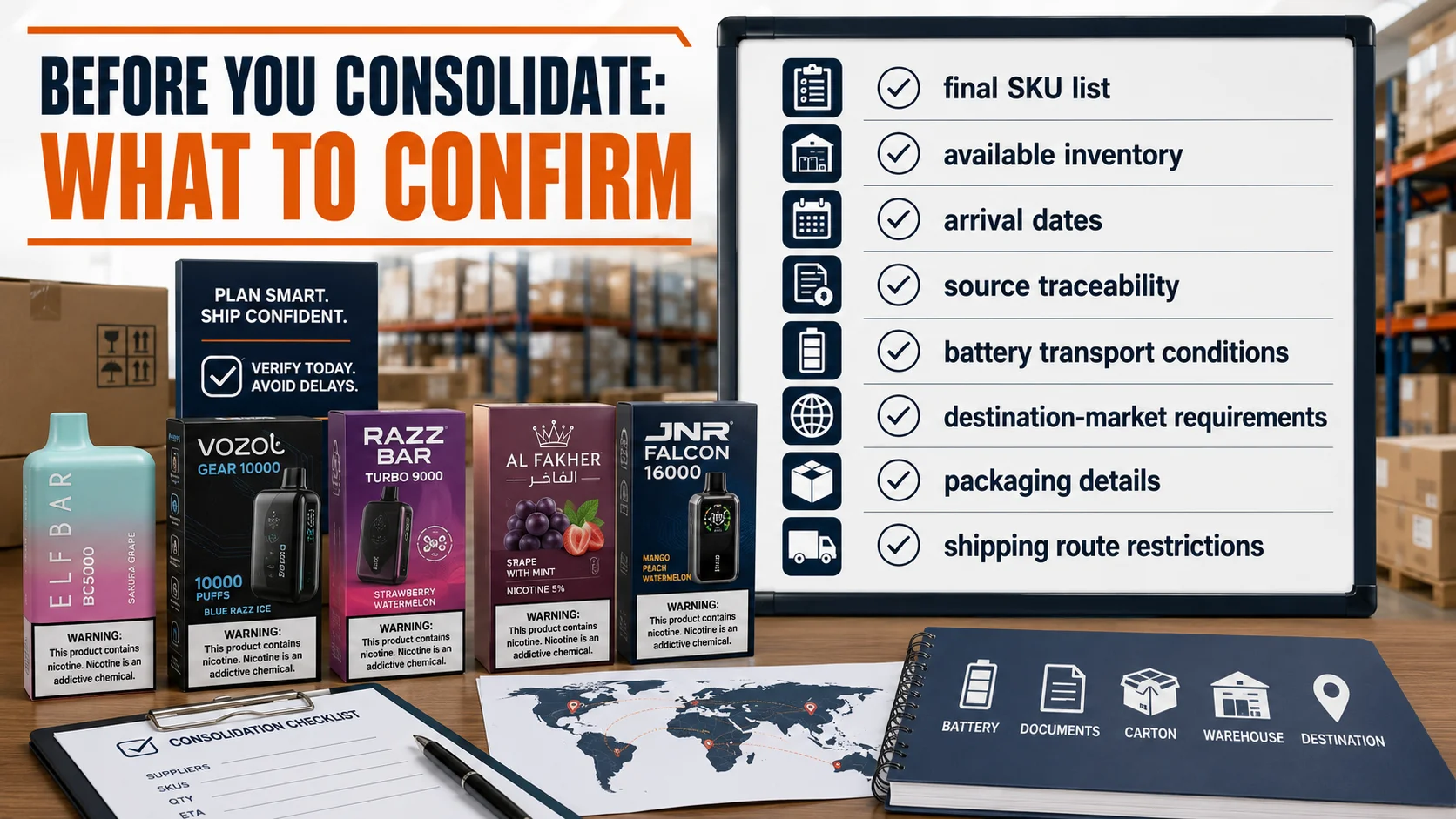
A Pre-Shipment Verification List
I recommend that buyers confirm the following points in writing before goods are packed together:
-
Final brands, models, flavors, and quantities
Product names can be similar, especially with different versions, nicotine strengths, capacities, colors, or regional packaging. A clear SKU list reduces mistakes. -
Source and authorization records where relevant
Buyers should ask for reasonable evidence of source traceability or brand authorization when they need it. A supplier statement alone may not meet the buyer’s internal compliance standard. -
Current stock and estimated warehouse arrival date
“Available” can mean different things. It may mean physically in stock, expected from a factory, or allocated but not yet received. Buyers should ask which condition applies. -
Destination-market legality
Vape product rules vary by country and can change.[^4] Buyers should verify product requirements, age restrictions, nicotine rules, packaging rules, labeling obligations, tax requirements, and any local registration obligations[^5] with qualified local advisers. -
Battery and transport classification
Many vape products contain lithium batteries.[^6] Buyers should confirm applicable transport classification, packaging needs, carrier restrictions, and route availability[^7] with qualified freight professionals. -
Packaging, labels, and documents
Carton markings, invoices, packing lists, product descriptions, and labels should match the approved order. Incorrect carton information can create reconciliation and clearance problems. -
The practical shipping route
A route that works for one product type may not work for another. Buyers should not assume that every carrier, warehouse, or destination accepts the same product mix.
For application-specific transport and regulatory decisions, I recommend that buyers consult qualified logistics, customs, and legal professionals in their destination market.
Separate Shipments vs. Consolidated Vape Wholesale Shipping: Which Is Better?
Buyers can become stuck between two options: send everything separately as soon as it is ready, or hold every item until the complete order is available. In reality, the best route may be a full consolidation, a partial consolidation, or urgent replenishment from available local stock.
Consolidated vape wholesale shipping can reduce repeated handling and simplify receiving[^8], but separate shipments may protect sales when urgent high-turnover products cannot wait. Buyers should compare total landed cost, stockout risk, readiness dates, and operational workload before choosing either method.
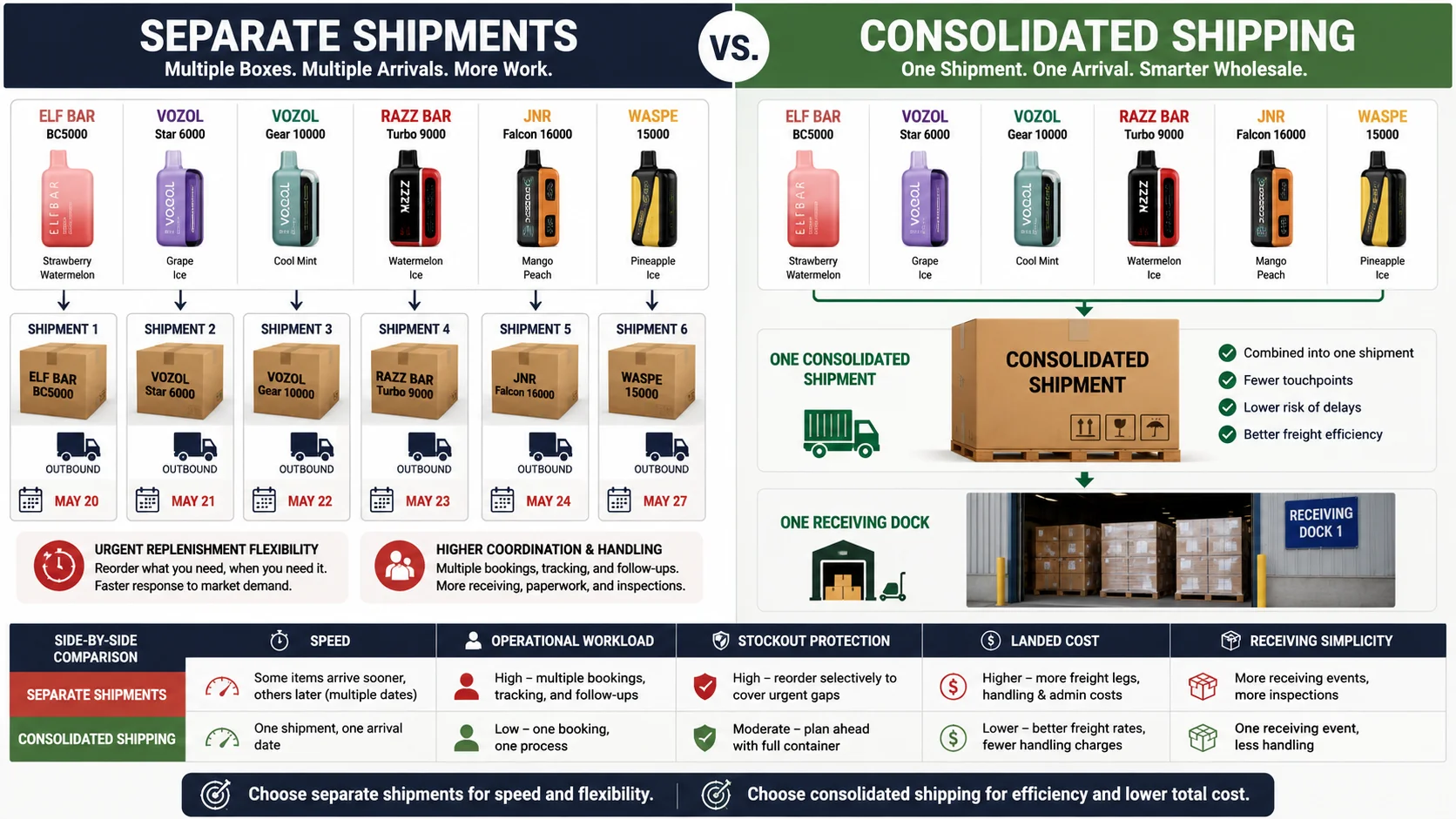
| Comparison Factor | Separate Shipments | Consolidated Shipping | Buyer Impact |
|---|---|---|---|
| Freight bookings | Several bookings may be required | One main booking may be possible | Consolidation can reduce coordination work |
| Customs-facing coordination | May occur across several deliveries | Can be reviewed around one shipment | Buyers still need accurate documents |
| Freight cost | May be higher per smaller shipment | May be more efficient, but not always | Compare actual quotations and fees |
| Delivery timing | Ready products can move sooner | Order may wait for slower items | Urgent SKUs may need separate treatment |
| Warehouse receiving | Multiple deliveries and checks | One larger receiving process | Consolidation can simplify labor planning |
| Cash flow | Payments and arrivals may be spread out | More inventory may arrive at once | Buyers should plan working capital |
| Stockout risk | Lower for urgent replenishment | Higher if waiting for incomplete orders | Fast sellers should not wait too long |
| Product inspection | Checks occur across several deliveries | Inspection can be coordinated before dispatch | Scope and standards should be agreed first |
| After-sales coordination | Several supplier contacts may be needed | One main service contact can help | Responsibility should remain clearly documented |
| Missing-SKU risk | Fewer items are held for one shipment | One delayed SKU can affect the whole plan | Set a cut-off date for late items |
Use a Three-Route Decision
In my experience, buyers often get better results when they choose one of three routes rather than forcing every order into one method:
- Full consolidation: Use this when most SKUs are ready within a close window and the buyer needs a complete assortment.
- Batch shipping: Use this when most products are ready, but a smaller number of non-urgent items need more time.
- Urgent local replenishment: Use this when a proven fast seller is likely to go out of stock and available European inventory can protect local sales.
KingVape maintains European warehouse stock for selected products and brands. For eligible EU buyers, this can be a practical option for smaller orders, with a low starting quantity of 50 units per model according to available stock conditions. Buyers should confirm the current stock, product version, destination availability, and applicable requirements before placing an order.
When Does Consolidated Vape Wholesale Shipping Make More Sense?
A full mixed shipment is attractive when it helps a buyer receive a fuller assortment, reduce supplier fragmentation, and organize warehouse allocation more efficiently. It is not a good strategy when it creates a long delay for products that local stores are already waiting to buy.
Consolidated vape wholesale shipping makes more sense when a buyer has predictable demand, similar product readiness dates, several brands or categories to purchase, and a clear benefit from receiving one planned assortment. It is especially useful for wholesalers that supply multiple retail accounts and need one main coordination point for purchasing, inspection, documents, and delivery planning.
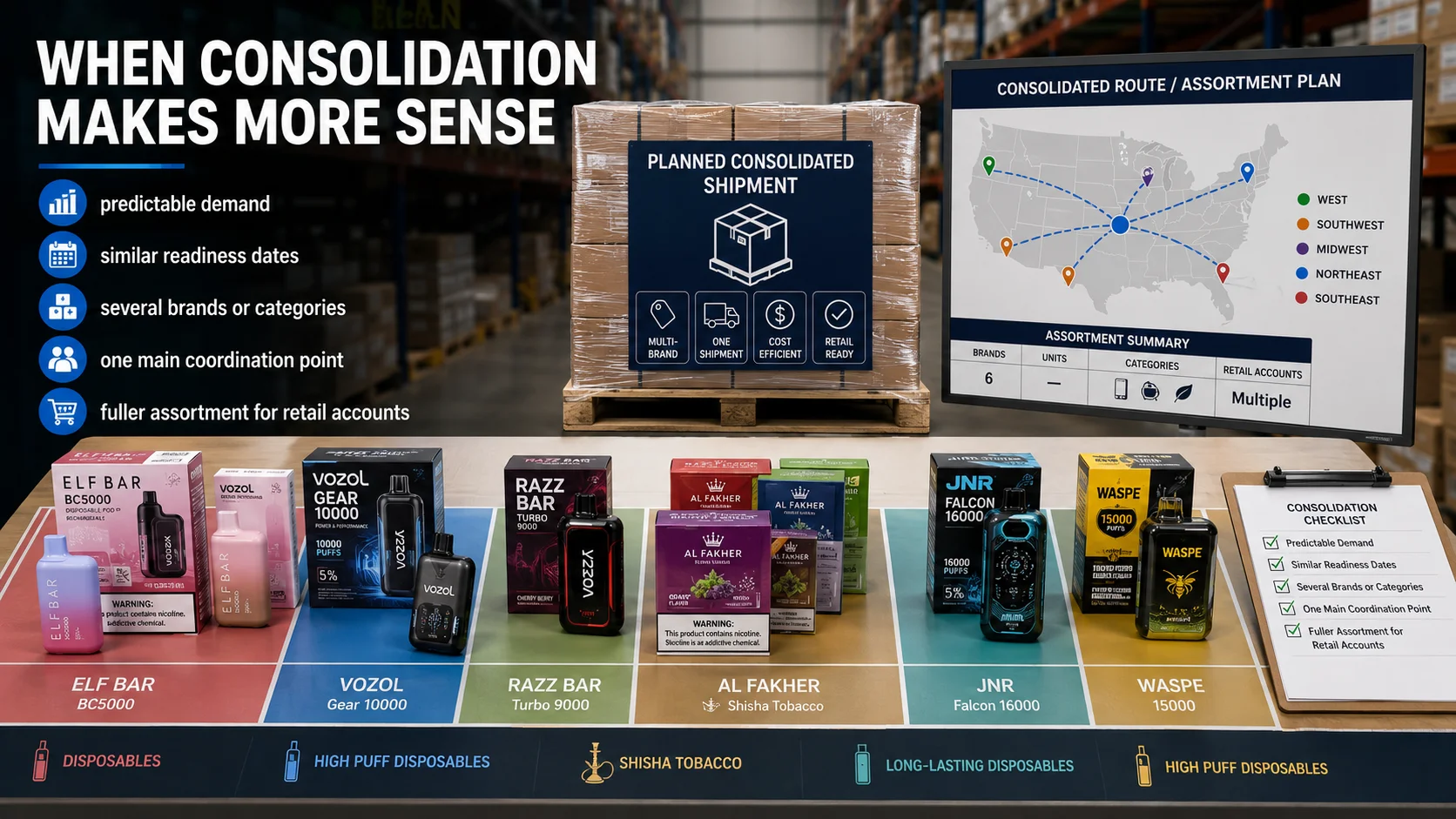
Situations Where Consolidation Is Often Practical
A buyer may benefit from a consolidated vape order when they:
- Purchase several vape brands in moderate quantities
- Need disposable vapes, batteries, accessories, and smoking products in one purchase
- Supply many stores that expect a mixed assortment
- Want one carton plan and one warehouse receiving schedule
- Need centralized quality checks before dispatch
- Prefer a main supplier contact for post-order coordination
- Have enough local stock to cover urgent demand during consolidation
- Want to reduce time spent collecting quotations from many suppliers
For example, a wholesaler may need several disposable vape models, 510 batteries, grinders, and glass pipes for different retail accounts. If these products are ready in a similar period, a consolidated order can support a more complete store delivery program.
When It Does Not Make Sense
I would not recommend waiting simply to make an order look complete. Buyers should consider shipping urgent items separately when:
- A top-selling SKU is close to stockout
- A delayed item has uncertain availability
- One brand’s delivery date is much later than the others
- The buyer has confirmed store orders for immediately needed products
- The product mix has incompatible transport or documentation requirements
- The buyer needs to test a new product before committing to a larger mixed order
A delayed best seller can cost more than extra freight. Lost shelf space may also give competitors an opportunity to replace the buyer’s product with another brand.[^9]
How Do MOQ, Lead Time, and Landed Cost Change With Consolidation?
Small buyers often assume that they must import a large quantity from China to receive a workable price. Large buyers may assume that one large shipment automatically produces the best landed cost. Both assumptions can be incomplete because MOQ, readiness, storage, and sales speed all affect the result.
Consolidated vape wholesale shipping can help buyers combine smaller quantities from different brands, but it does not eliminate each product’s MOQ, stock limits, or lead time. The real decision depends on the total landed cost, including product price, handling, storage, repacking, freight, taxes, compliance costs, and the commercial cost of delayed sales[^10].
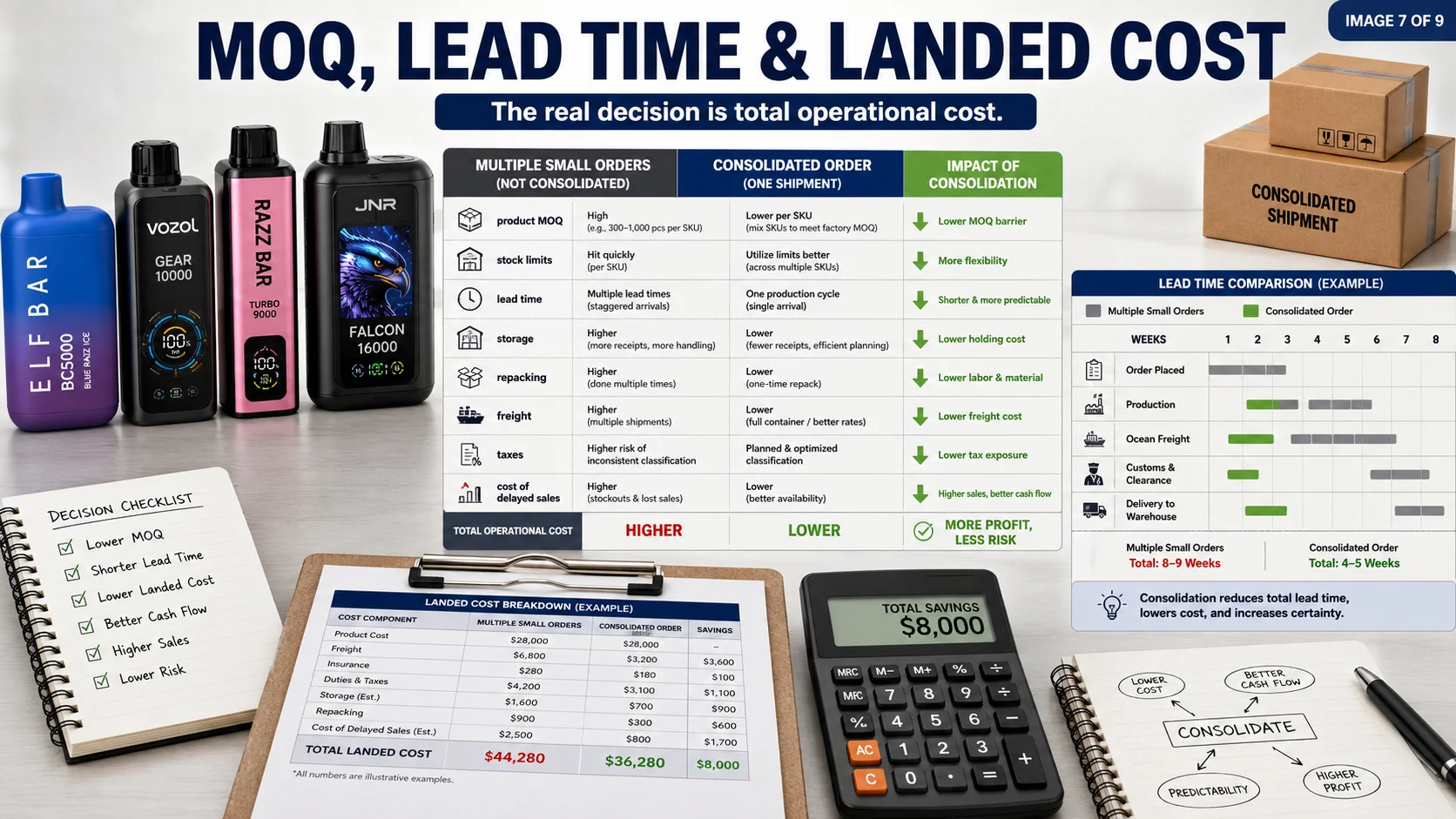
Calculate the Full Landed Cost
A practical landed-cost review can include:
| Cost Area | Questions Buyers Should Ask |
|---|---|
| Product cost | Is the price based on current stock, factory production, or a future allocation? |
| MOQ | Does each brand or model have a separate minimum order quantity? |
| Consolidation handling | Is there a handling, warehousing, inspection, or repacking cost? |
| Freight | Is the quotation based on actual weight, volume weight, cartons, or another method? |
| Storage | How long can goods wait before storage charges apply? |
| Destination costs | What duties, taxes, broker charges, or local compliance costs may apply? |
| Cash flow | Can the buyer sell the assortment quickly after receiving it? |
| Stockout exposure | What revenue or customer relationship risk comes from waiting? |
At KingVape, I work with buyers ranging from smaller wholesalers and retailers to larger importers and distributors. Smaller customers may prefer available European warehouse products because they can test demand with lower starting quantities and avoid a larger upfront commitment. Larger importers may prefer direct China purchasing when order volume supports stronger pricing, broader OEM/ODM options, and a more customized purchasing plan.
Our factory operates in Shenzhen and has approximately 5,000 square meters of production space, with stated maximum capacity of up to 5 million units per month. We also develop new products regularly and can discuss OEM/ODM projects when a buyer’s conditions and product requirements are suitable. Buyers should evaluate samples, specifications, compliance needs, and production terms for their own market before committing to a project.
What Are the Common Consolidated Shipping Mistakes and Red Flags?
A consolidated order can look organized on a spreadsheet while still carrying serious commercial risk. Most problems do not begin at the airport, port, or warehouse. They begin when buyers approve incomplete information or accept broad shipping promises without checking the actual order conditions.
The most common consolidated vape shipping mistakes are failing to confirm SKU readiness, ignoring battery transport conditions, mixing unsuitable market versions, accepting inaccurate packing lists, and focusing only on freight cost. Buyers should treat vague “all-inclusive” or “guaranteed clearance” claims as a reason to ask more questions, not as a reason to stop checking.
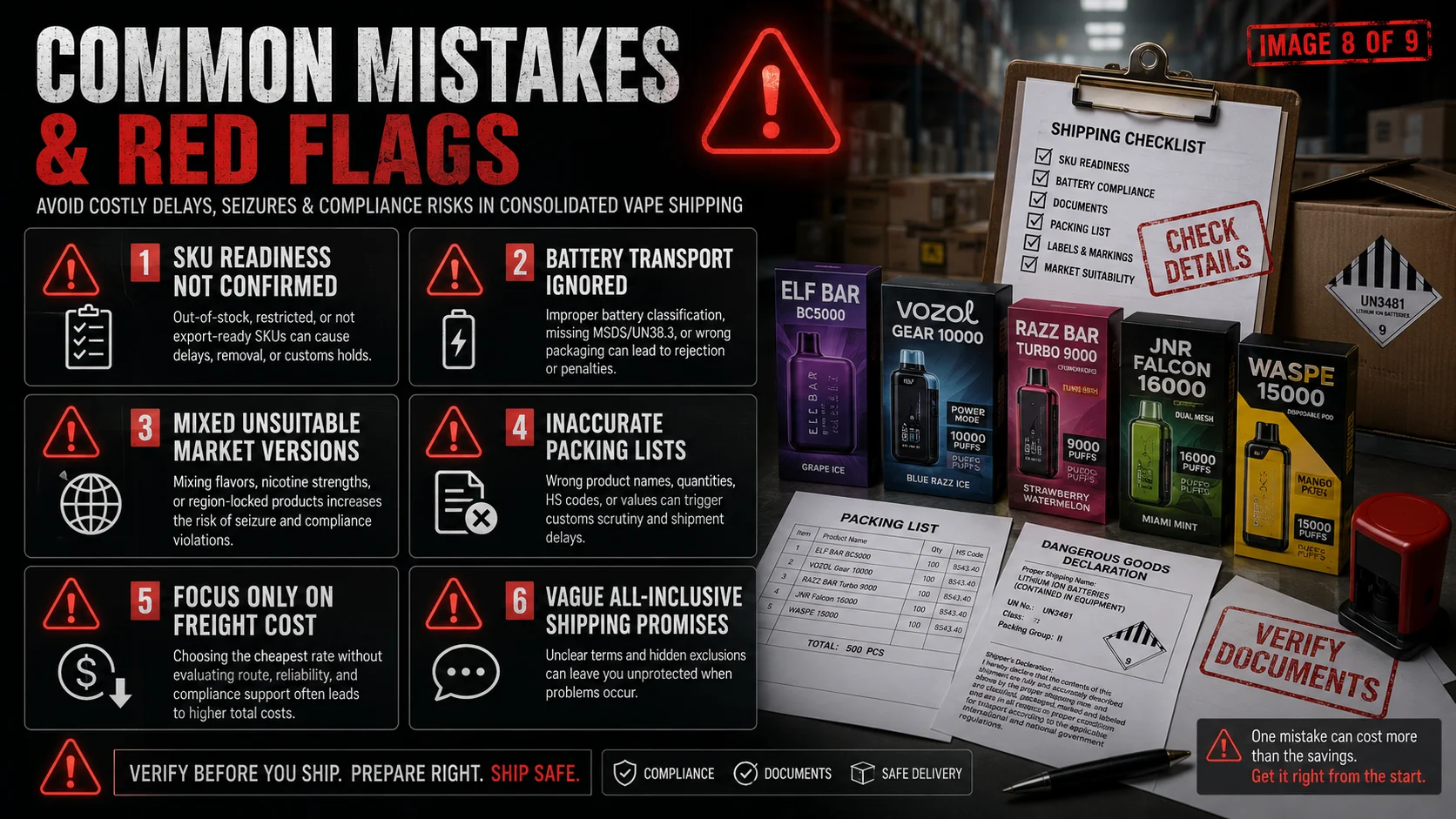
Red Flags to Watch Before Payment or Dispatch
- A supplier cannot clearly separate in-stock goods from goods that are still expected.
- The SKU list does not include model, flavor, color, capacity, quantity, and packaging version.
- Carton counts change without a revised packing list.
- The buyer does not know which items are being held for consolidation and until when.
- A supplier says “no problem” about destination rules without asking the destination country or product details.
- Battery products are added to a shipment without a route-specific transport review.
- The buyer accepts a shipping promise without confirming carrier, route, transit assumptions, and exclusions.
- Different market versions are mixed in one order without checking labels and local requirements.
- Inspection standards are never agreed before goods are packed.
- The buyer has no plan for what happens if one late SKU delays the full order.
I also recommend setting a decision deadline. For example, the buyer can agree that if a delayed SKU is not available by a defined date, the order will move in batches or the SKU will be removed. This protects the buyer from an open-ended waiting period.
What Is a Practical Multi-Brand Vape Shipping Checklist?
A good shipping plan should be simple enough for purchasing staff to use, but detailed enough to catch problems before goods are handed to a carrier. Buyers do not need to manage every supplier individually if they have a reliable coordinator, but they should remain involved in key approvals.
A practical consolidated vape wholesale shipping checklist starts with a complete SKU list and ends with written shipping approval. Buyers should verify stock, source information, destination requirements, documents, inspection scope, packing details, landed cost, and contingency plans before cargo is released.
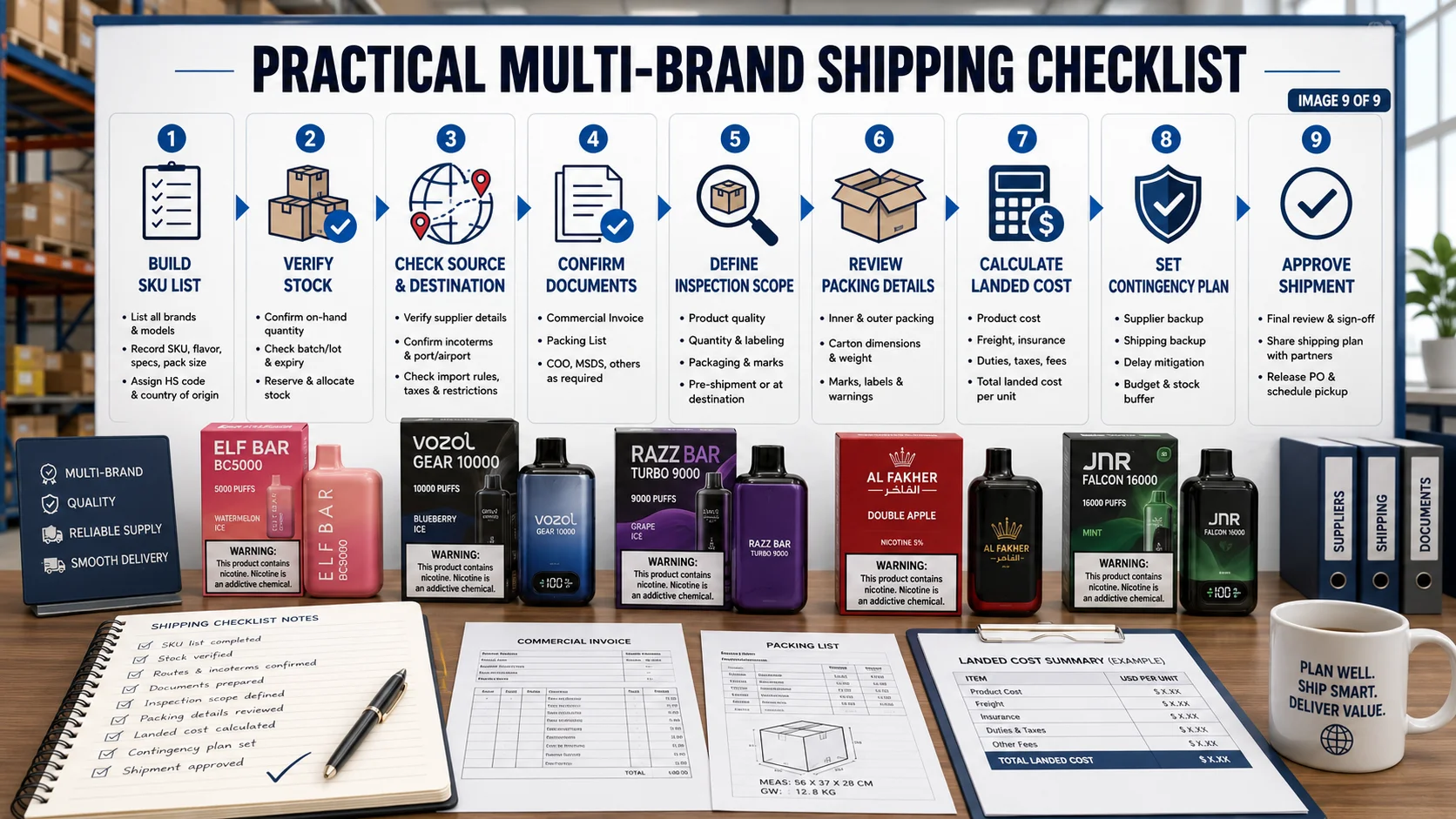
Eight Steps Before Shipment Approval
-
Submit a complete SKU list
Include brands, models, flavors, colors, quantities, and any required versions. -
Confirm source and product suitability
Review source traceability where needed and confirm that the products suit the intended market. -
Check stock and expected arrival dates
Separate physically available stock from goods that are still in production or transit. -
Rank SKUs by urgency
Identify best sellers, seasonal products, test items, and slow-moving accessories. -
Review transport and destination requirements
Confirm battery-related shipping conditions, carrier limits, labels, documents, and local obligations. -
Agree on inspection and packing standards
Confirm carton counts, outer labels, packing list format, and any video verification or inspection needs. -
Calculate total landed cost and delay risk
Compare full consolidation, batch shipping, and urgent replenishment options. -
Approve the final shipment route in writing
The buyer should approve the final SKU list, quantities, carton plan, documents, and dispatch arrangement.
This process gives buyers a clearer answer than simply asking for “the cheapest shipping.” It also supports better communication between the buyer, supplier, warehouse, and freight partner.
Frequently Asked Questions
Can different vape brands ship in one consolidated order?
Yes, different vape brands can often ship in one consolidated order if the products are available within a similar period and the shipping route accepts the full product mix. Buyers should still verify stock, source records, battery conditions, documents, and destination requirements before approval.
Does consolidated vape wholesale shipping always reduce shipping cost?
No. Consolidation may reduce repeated handling and freight bookings, but it can also add warehouse time, repacking costs, or delays. Buyers should compare the total landed cost and the sales impact of waiting for slower SKUs, not only the freight quotation.
How long should buyers wait for different brands to arrive?
Buyers should set a clear cut-off date based on SKU urgency and local inventory. I recommend that buyers avoid open-ended waiting. If a delayed item risks a stockout of proven sellers, batch shipping or local replenishment may be the better commercial choice.
Which documents should buyers check before a vape shipment?
Buyers should review the commercial invoice, packing list, final SKU and quantity list, carton information, and product-related documents required for their destination or transport route. Requirements vary by market, so buyers should seek qualified local compliance and freight advice where necessary.
When is separate shipping the safer option?
Separate shipping can be safer when one fast-selling product is urgently needed, when products have very different readiness dates, or when mixed products create transport complications. It can also be useful when a buyer wants to test a new product before combining it with a larger order.
Ready to Build a More Practical Multi-Brand Shipping Route?
Consolidated vape wholesale shipping can reduce purchasing friction, but only when it supports your stock position, cash flow, sales speed, and destination requirements. The right plan may be one full shipment, several planned batches, or urgent replenishment from available European inventory.
Send KingVape your destination country, sales channel, required brands, target quantities, and delivery destination. I can help you review stock availability, multi-brand consolidation feasibility, product sourcing options, shipping requirements, and a more practical purchasing route for your business.
For multi-brand vape wholesale supply, OEM/ODM discussions, or mixed-category sourcing, contact Shenzhen Kingfuji Tech. CO., Ltd. at www.kingvapecig.com, email info@kingvapecig.com, or reach me at +86 13928420527.
[^1]: "The Impact of Stockouts on Customer Loyalty to Lean Retailers", https://scholarworks.waldenu.edu/dissertations/1011/. Research on retail stockouts finds that unavailable products can cause consumers to defer purchases, substitute alternatives, or leave the store, creating a risk of lost sales. Evidence role: mechanism; source type: paper. Supports: Research evidence that retail stockouts can lead to lost or deferred purchases and substitution to other products or sellers.. Scope note: Observed stockout effects vary by product category, buyer loyalty, availability of substitutes, and the duration of the stockout. [^2]: "Synchromodal Supply Chains for Fast-Moving Consumer ...", https://dspace.mit.edu/bitstream/handle/1721.1/148468/applsci-13-03119-v2.pdf?sequence=1&isAllowed=y. Supply-chain cost models treat transportation expense as one component of total logistics cost, alongside inventory carrying, handling, ordering, and customer-service effects. Evidence role: mechanism; source type: education. Supports: Supply-chain analysis showing that transport decisions should be assessed alongside inventory, handling, service, and other logistics costs.. Scope note: The relative importance of each cost component depends on the buyer's demand pattern, product value, and operating model. [^3]: "Manufacturers: Manage Inventory to Boost Working Capital", https://www.otcpas.com/manufacturers-manage-inventory-to-boost-working-capital/. Inventory represents an investment of working capital: cash used to acquire goods remains committed until the inventory is sold, returned, or written down. Evidence role: mechanism; source type: education. Supports: Accounting and operations principles explaining that inventory requires capital investment until it is sold or otherwise realized.. Scope note: The financial impact varies with payment terms, financing arrangements, demand uncertainty, and inventory obsolescence risk. [^4]: "Tobacco: E-cigarettes", https://www.who.int/news-room/questions-and-answers/item/tobacco-e-cigarettes. International tobacco-control reporting documents that jurisdictions regulate electronic nicotine-delivery systems through differing legal approaches, including product, sales, advertising, and public-health measures. Evidence role: general_support; source type: institution. Supports: International evidence that regulation of electronic nicotine delivery systems differs across jurisdictions and evolves over time.. Scope note: The source provides regulatory context; importers must still verify the current law and enforcement practice in the destination market. [^5]: "Call to action on electronic cigarettes", https://cdn.who.int/media/docs/default-source/tobacco-hq/regulating-tobacco-products/ends-call-to-action-background.pdf?sfvrsn=7dd2856e_11&download=true. Electronic-cigarette regulatory frameworks may prescribe nicotine-content limits, product notifications, packaging and labeling requirements, and restrictions on sales, with additional fiscal or registration requirements depending on the jurisdiction. Evidence role: general_support; source type: government. Supports: Regulatory examples showing that electronic-cigarette rules may address nicotine concentration, packaging, labeling, notification, and sales restrictions.. Scope note: Specific obligations, including taxation and registration, are jurisdiction-dependent and should not be inferred from one regulatory system alone. [^6]: "Lithium Batteries in Baggage", https://www.faa.gov/newsroom/lithium-batteries-baggage. Official transport guidance classifies electronic cigarettes and similar personal vaporizers as devices containing lithium batteries, for which specific transport precautions apply. Evidence role: general_support; source type: government. Supports: Official transport guidance identifying electronic cigarettes as devices commonly powered by lithium batteries.. [^7]: "DANG WORKIN GEROUS G NG GROUP GOODS PA P ...", https://www.icao.int/sites/default/files/DangerousGoods/DGP%20Meeting%20Documentation/DGPWG15/DGPWG.15.WP.024.2.en.pdf. Dangerous-goods transport guidance applies specific conditions to lithium-battery-powered electronic cigarettes, including requirements related to battery protection, packaging, and permitted modes of carriage. Evidence role: mechanism; source type: institution. Supports: Dangerous-goods guidance explaining why lithium-battery-powered electronic cigarettes can face mode- and carrier-specific transport controls.. Scope note: Carrier acceptance policies and national implementation rules can impose additional restrictions beyond the baseline international guidance. [^8]: "Supply Chain Assessment of the Transportation Industrial ...", https://www.transportation.gov/sites/dot.gov/files/2022-02/EO%2014017%20-%20DOT%20Sectoral%20Supply%20Chain%20Assessment%20-%20Freight%20and%20Logistics_FINAL.pdf. Freight-consolidation practices combine smaller consignments into fewer movements, which can reduce repeated shipment administration and receiving activity when timing and cargo compatibility permit. Evidence role: general_support; source type: research. Supports: Logistics evidence that consolidating shipments can reduce the number of separate transport movements and receiving transactions.. Scope note: Consolidation can also introduce holding time, handling steps, and coordination costs, so it is not inherently more efficient in every case. [^9]: "Involuntary switching behavior in restricted decision environments", https://digitalcommons.uri.edu/cgi/viewcontent.cgi?article=3265&context=oa_diss. Empirical studies of retail stockouts report that customers may substitute another brand, purchase from another retailer, postpone the purchase, or abandon it when a preferred item is unavailable. Evidence role: mechanism; source type: paper. Supports: Research showing that product unavailability can prompt substitution to alternative brands or retailers.. Scope note: The likelihood of brand replacement depends on retailer assortment, product differentiation, customer loyalty, and the availability of close substitutes. [^10]: "Determine Total Export Price", https://www.trade.gov/determine-total-export-price. Trade and customs guidance describes landed cost as the aggregate cost of obtaining imported goods, commonly including the product price, transportation, insurance, duties, taxes, and other import-related charges. Evidence role: definition; source type: government. Supports: Official trade guidance defining landed cost as broader than the supplier's product price and including transportation, duties, taxes, and import-related charges.. Scope note: The treatment of warehousing, compliance administration, and lost-sales risk may be included in an internal total-cost model but is not always part of a formal customs landed-cost definition.