
You have probably spent hours sifting through supplier websites, and most of them look the same. Same product photos, same "high quality" claims, same empty promises. You start to wonder if anyone actually knows the business from your side of the desk.
The real purpose of a factory blog is not to get more clicks. It is a test you can use to see if a supplier understands your risk, before you even say hello. This article will show you exactly what to look for in a vape hardware blog, so the next enquiry you send goes to someone who actually gets it.
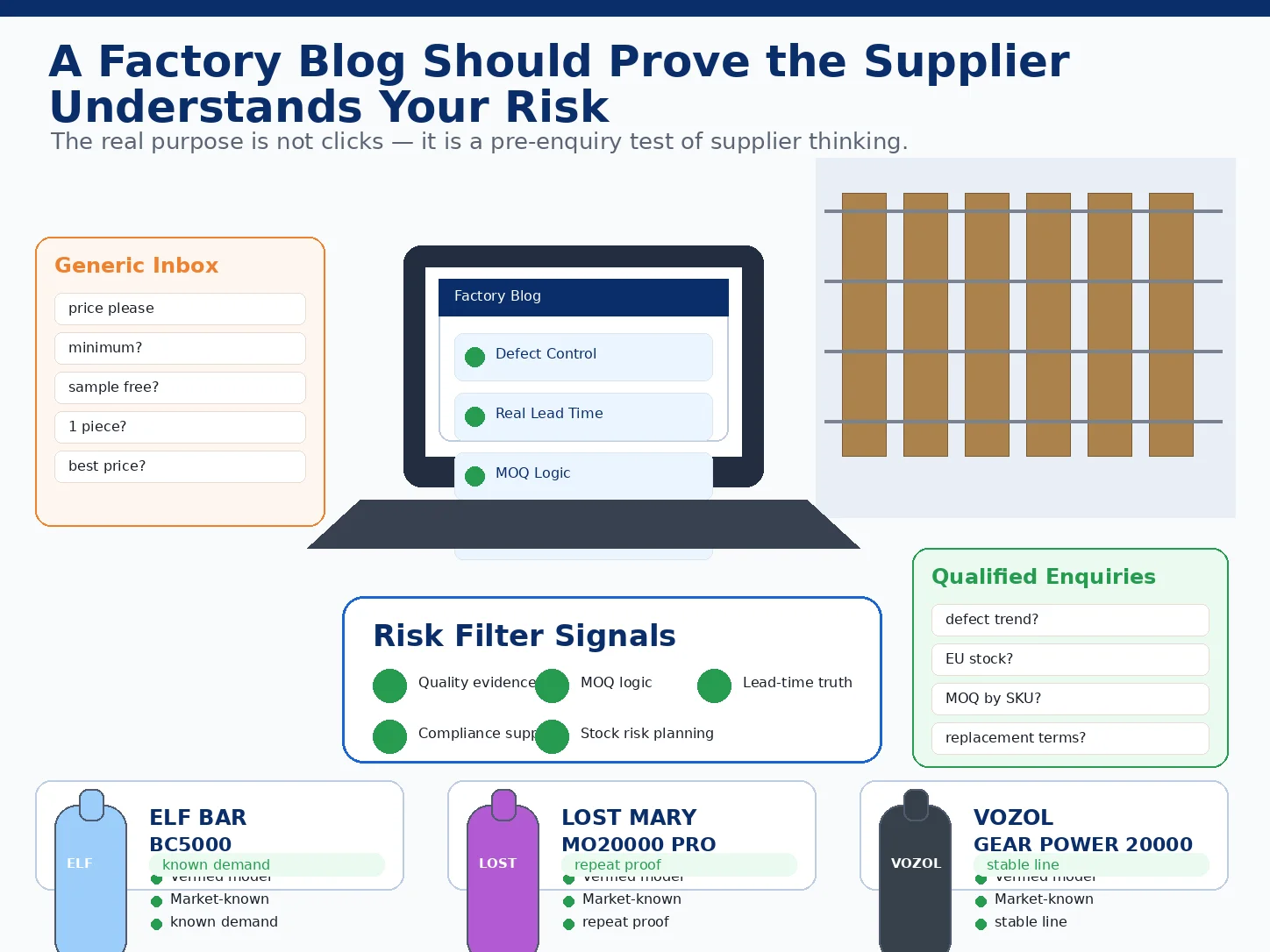
You do not need another list of content marketing tips. You need a practical way to read between the lines of a supplier's website. I have been on the factory floor in Shenzhen for over ten years, shipping to wholesalers in the US and Europe who have been burned by cheap suppliers. I know what real operational transparency looks like, and I am going to show you how to spot it.
1. Quick Answer: How Can Blog Content Attract Better Vape Wholesale Enquiries?
You might think a blog is just for driving traffic. But when you are a buyer who has lost money on a bad batch, you start reading supplier content differently.
A good factory blog acts like a filter.[^1] It gives serious buyers the right vocabulary to ask better questions, so the ones who contact you are already pre-qualified and less likely to waste your time with blind price requests.
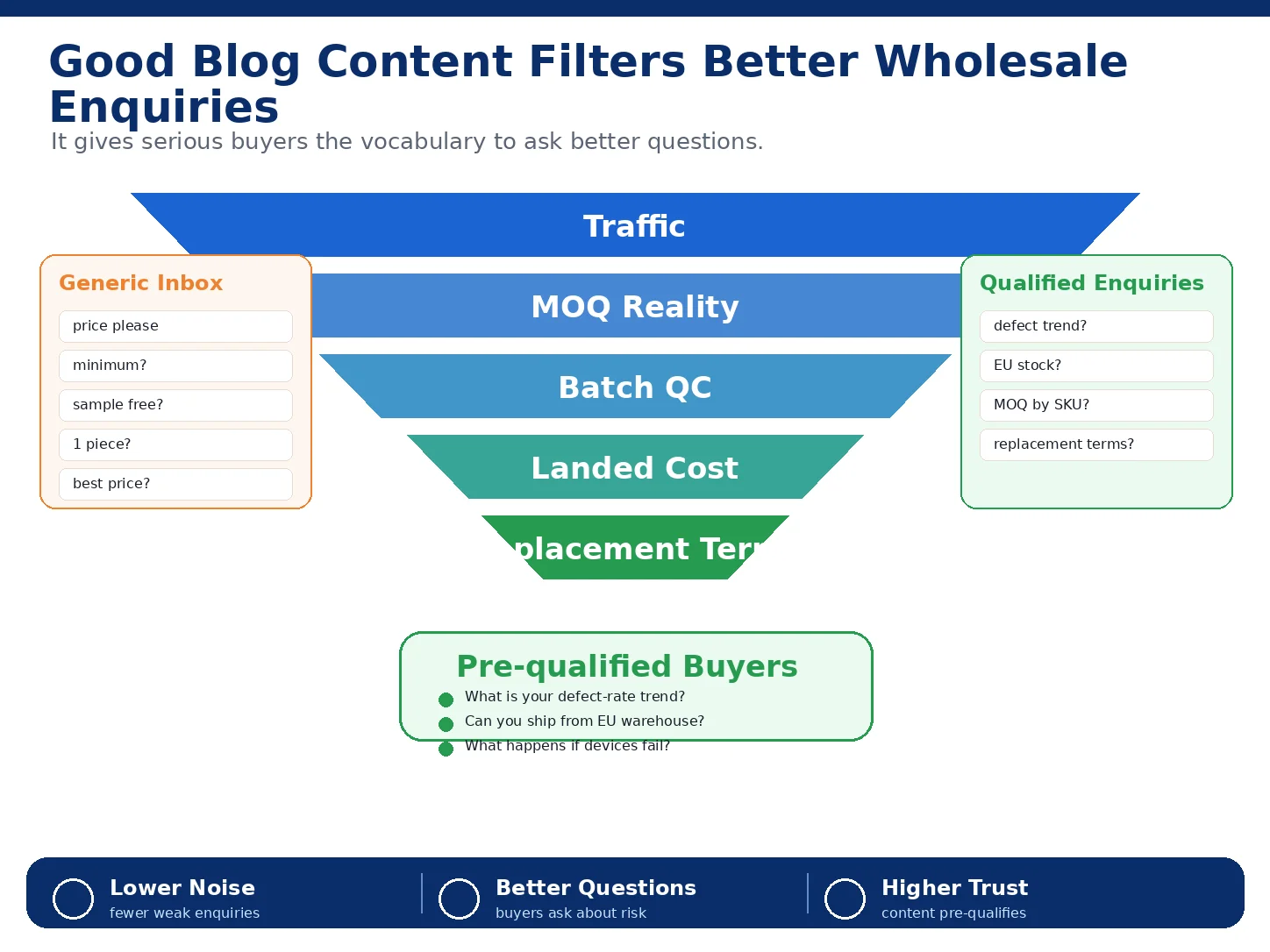
The moment a buyer reads a blog that talks about coil resistance drift or packaging condensation in a shipping container, they stop seeing the supplier as just another price list. They see someone who has dealt with real field failures. That buyer is no longer testing you on price; they are testing you on problem-solving ability. They start their enquiry not with "best price for 5k pcs," but with "we have had issues with sweetness degrading in tropical humidity, can your batch consistency handle that?" That is the kind of enquiry you want, and the blog creates it by teaching the buyer what to look for.
2. Why More Traffic Does Not Always Mean Better B2B Vape Leads
I have watched factory sales teams celebrate when their website traffic spikes. Then they complain about the flood of messages that just say "price please" from buyers who disappear.
More traffic often means more unqualified leads[^2] because general SEO attracts end-users and tiny resellers, not the mid-volume wholesale buyers who have real budgets and real risk on the line.
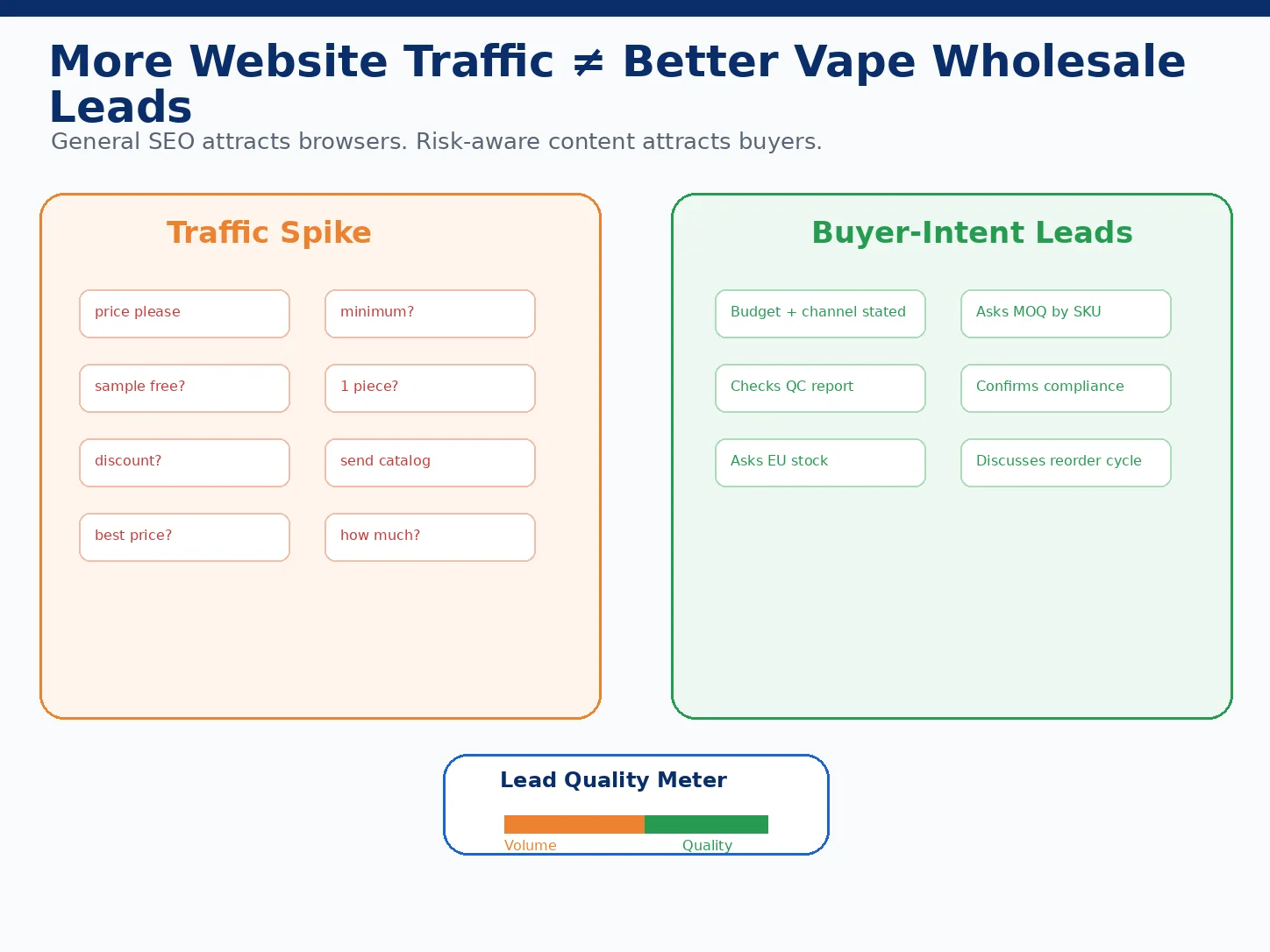
The difference is intent. A buyer searching for "disposable vape 5000 puffs" might be anyone. A buyer searching for "how to read a vape factory QC report" or "why do disposables leak in high altitude shipping" is someone who already manages inventory[^3]. They are thinking about loss, not just unit cost. The blog that answers those deep operational questions will get less traffic, but every visit is from someone who is already half-sold because the content proves the factory is not hiding behind glossy photos. To attract these buyers, you must stop writing for keywords and start writing for the specific fears that keep a wholesaler awake at night.
3. Comparison Table: Traffic-Focused Content vs Buyer-Intent Wholesale Content
It is hard to see the difference unless you compare the two approaches side by side. Most factory blogs fail because they chase the wrong goal.
Traffic-focused content brings volume but low commitment. Buyer-intent content brings fewer visitors but higher trust. One fills your inbox; the other fills your order book.
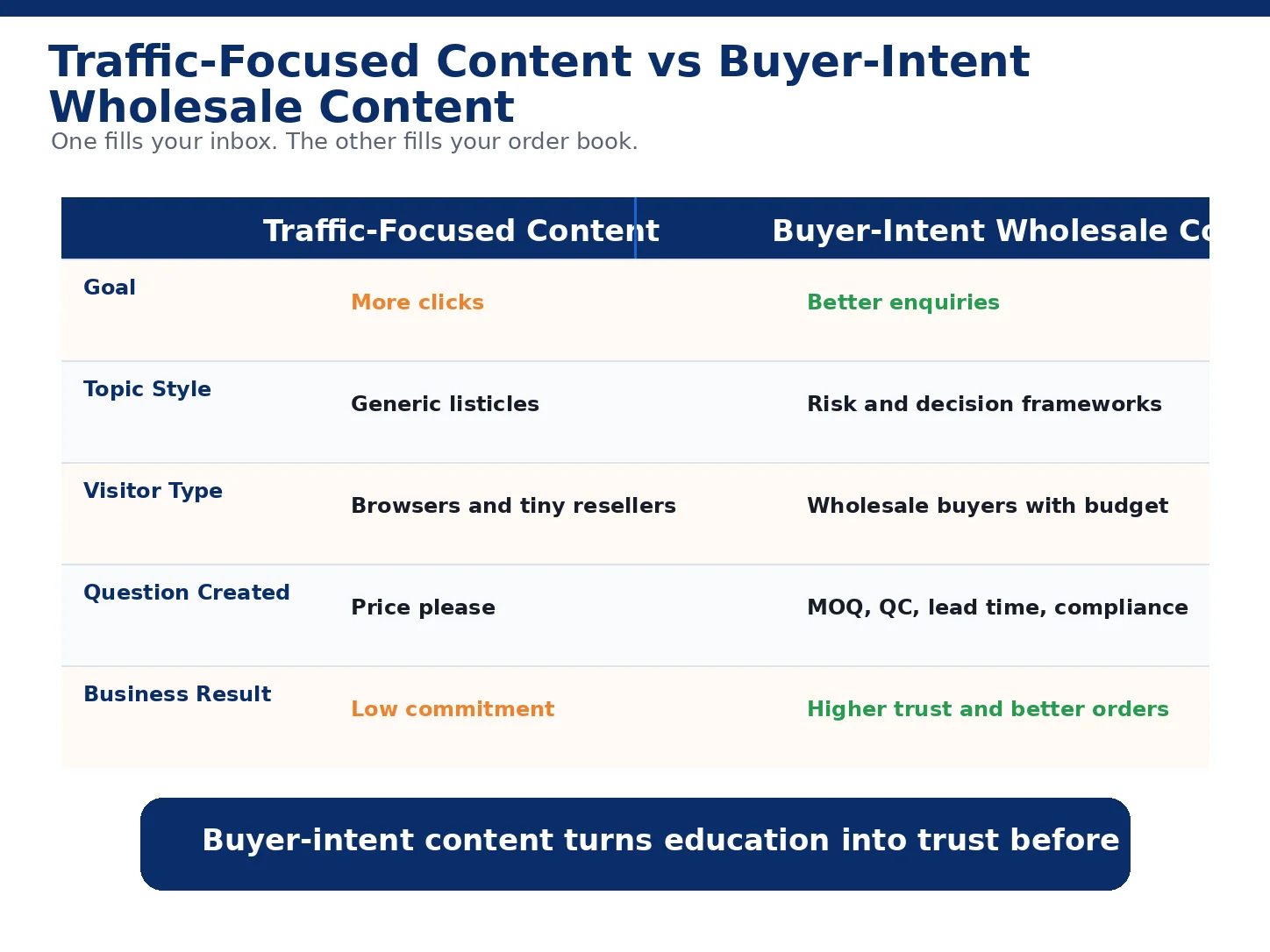
Here is a simple table I use to explain this to my own team. It shows what the content is really doing.
| Factor | Traffic-Focused Blog | Buyer-Intent Wholesale Blog |
|---|---|---|
| Typical Title | "Top 10 Vape Trends in 2024" | "How We Test Puff Consistency Across a 10k-Unit Production Run" |
| Reader Identity | End-user, hobbyist, small dropshipper | Mid-size wholesaler[^4], chain buyer, experienced importer |
| Enquiry Quality | "How much for 50 pieces?" | "We move 20k units a month. What is your defect tolerance for auto-draw switches?" |
| Trust Signal | The supplier looks trendy | The supplier looks accountable |
| Primary Goal | Impressions and clicks | Pre-qualification and trust building |
When you look at a factory blog, ask yourself: is this content designed to impress a search engine or to prove to a real buyer that someone inside the factory has actually solved a problem you are afraid of?
4. What Do Serious Vape Wholesale Buyers Usually Want to Know Before Contacting a Supplier?
After years of watching our own sales team handle enquiries, I can tell you exactly what buyers are silently checking for. They rarely say it out loud, but their behaviour gives it away.
Serious buyers want to know if you will protect their margin and their reputation, not just take their money. They look for evidence that you understand total landed cost and real-world failure points.
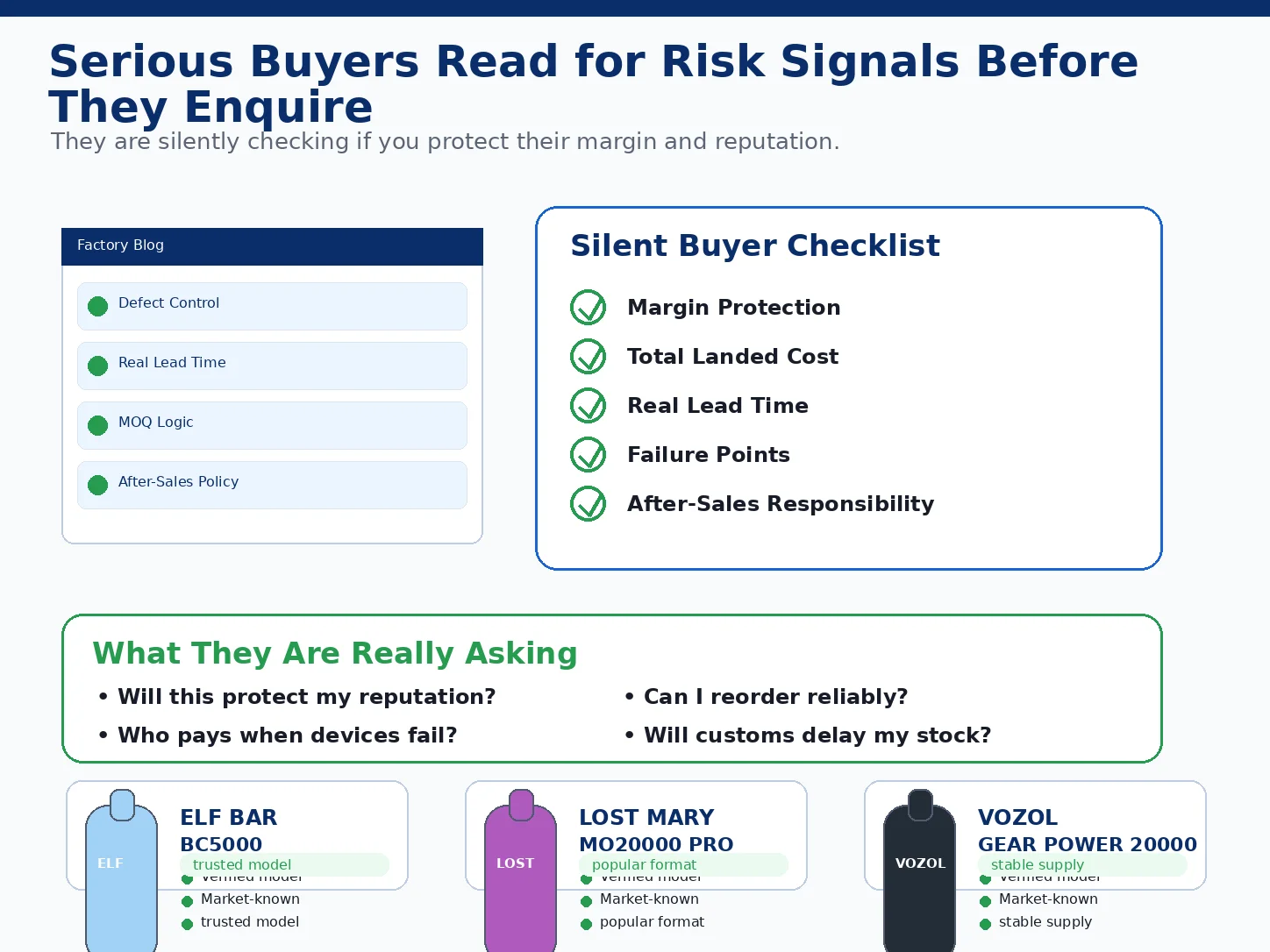
These buyers have been burned. Maybe they received a container where 3% of the devices were dead on arrival, and the factory said "within tolerance." Maybe the packaging looked great in photos but arrived crushed because the outer carton was too thin. They are reading your blog to see if you mention these things without being asked. They want to see you discuss batch sampling methods, not just claim "99% pass rate." They want to know if you understand that a vape shop owner in Spain has different humidity concerns than a gas station chain in Arizona. If your blog shows you have thought about these things, the buyer will contact you already trusting your advice, and the negotiation starts on a completely different level.
5. How to Write Content for Smoke Shops, Kiosks, Online Sellers, and Small Wholesalers
Not every buyer is a giant importer. Many of our best clients run small chains of smoke shops or tourist kiosks. Their needs are specific and often ignored.
Small wholesalers and shop owners need content that respects their capital limits and time pressure. They want to know about minimum order flexibility, fast fulfilment options, and how to avoid dead stock.
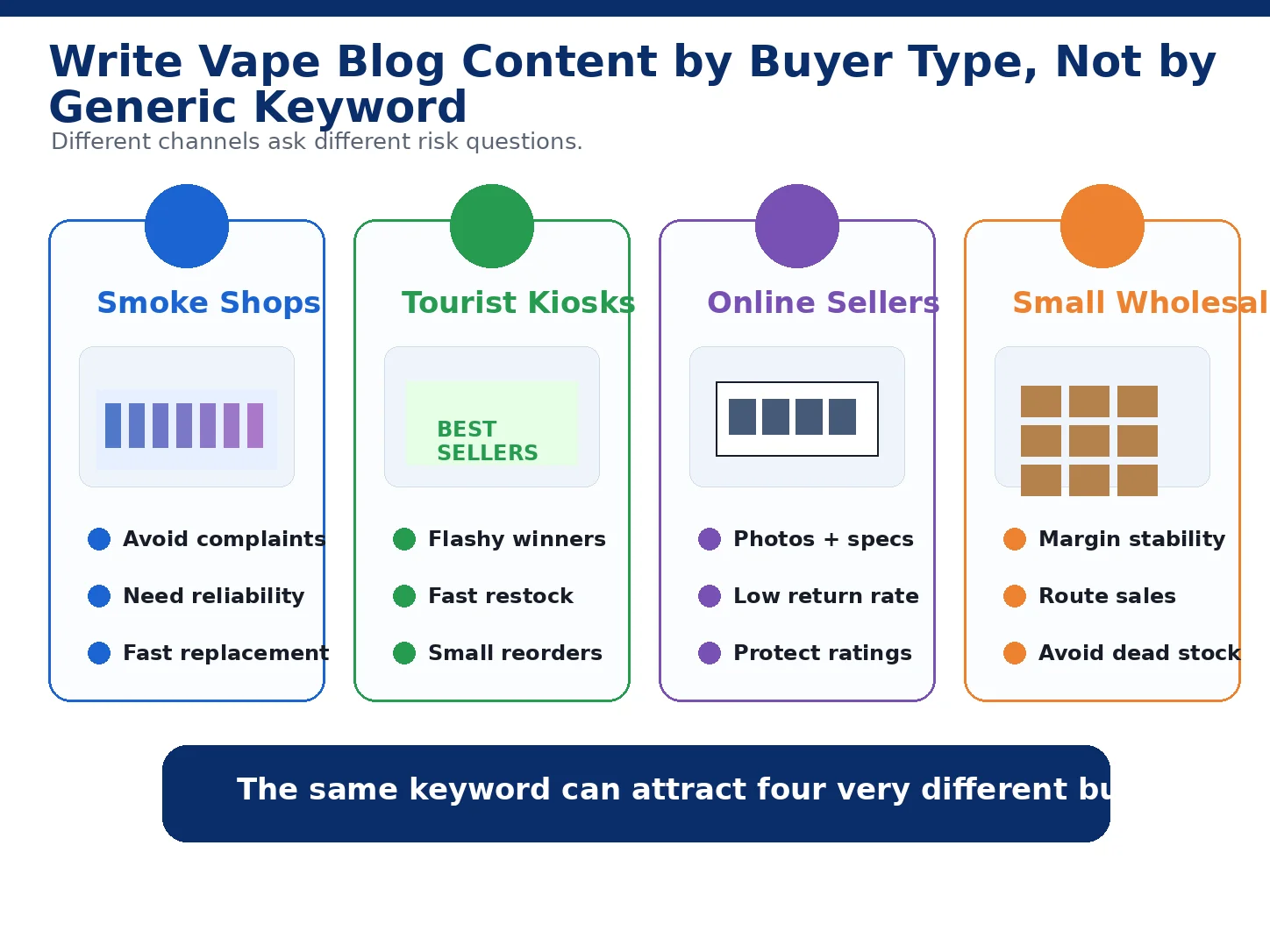
A kiosk owner in a Spanish tourist town does not have the cash flow to wait eight weeks for a sea freight shipment. They need to know if you have European warehouse stock with low MOQs, so they can reorder quickly when a hot product runs out. Their biggest fear is buying 500 pieces of a new flavour and finding out it does not sell[^5]. Your blog should help them understand how to test new products with small batches. Talk about real logistics, like DPD shipping from a German warehouse arriving in three days. When a small buyer reads that, they see you are not just chasing the big fish. You actually built a system for their kind of business, and that is the moment they decide to email you.
6. What Trust Signals Make a Vape Wholesale Website Feel More Reliable?
Trust is not built by an "About Us" page with a handshake photo. It is built by the tiny, specific details that only someone with real factory experience would think to share.
Reliable suppliers show their work, not their promises. They publish the exact variables they check during a production run, the real lead times that include pre-shipment inspection days, and the exact replacement policy for a dead device.
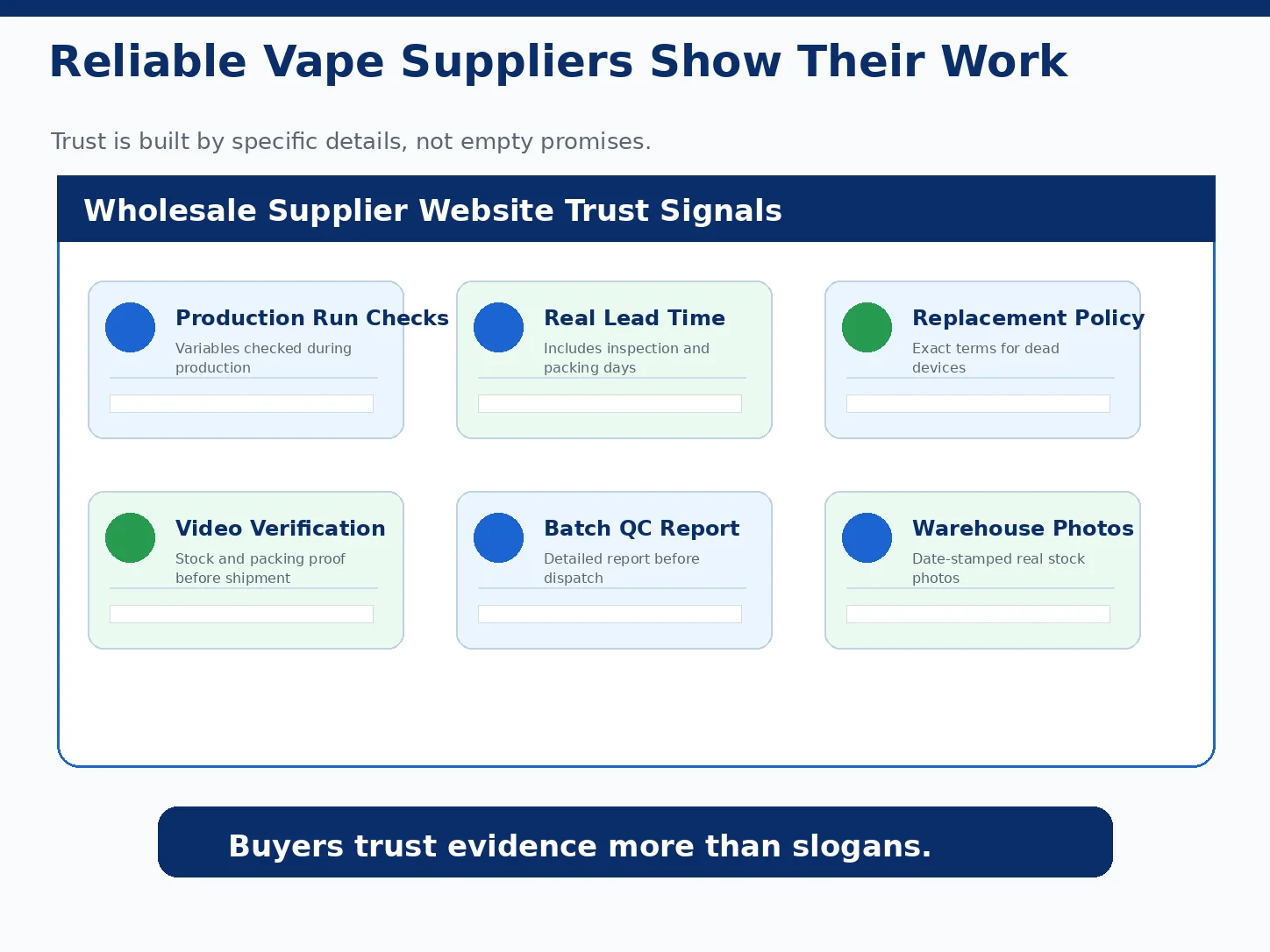
When I read a supplier blog, I look for the discomfort. That sounds strange, but it is true. A blog that says "our quality is the best" is meaningless. A blog that says "we do not ship without a 48-hour stability test after filling, because we have seen eliquid separate in the cart before it reaches the customer" is the truth. That sentence carries the memory of a real failure. I also look for logistics candour. If a blog mentions that during the Christmas rush, DHL processing adds one extra day[^6], that shows they actually track the delivery. These small admissions of operational reality are the most powerful trust signals[^7] a factory can ever publish. They tell a buyer, "we will not hide the messy parts from you."
7. How Product Range, MOQ, Lead Time, Compliance, and Stock Logic Should Appear in Blog Content
These five points are the skeleton of any wholesale decision, but most websites hide them behind a sales chat window. That is a mistake.
A factory blog should weave product range, MOQs, real lead times, compliance handling, and stock logic naturally into educational articles, so a buyer can understand the business model before they even reach out[^8].
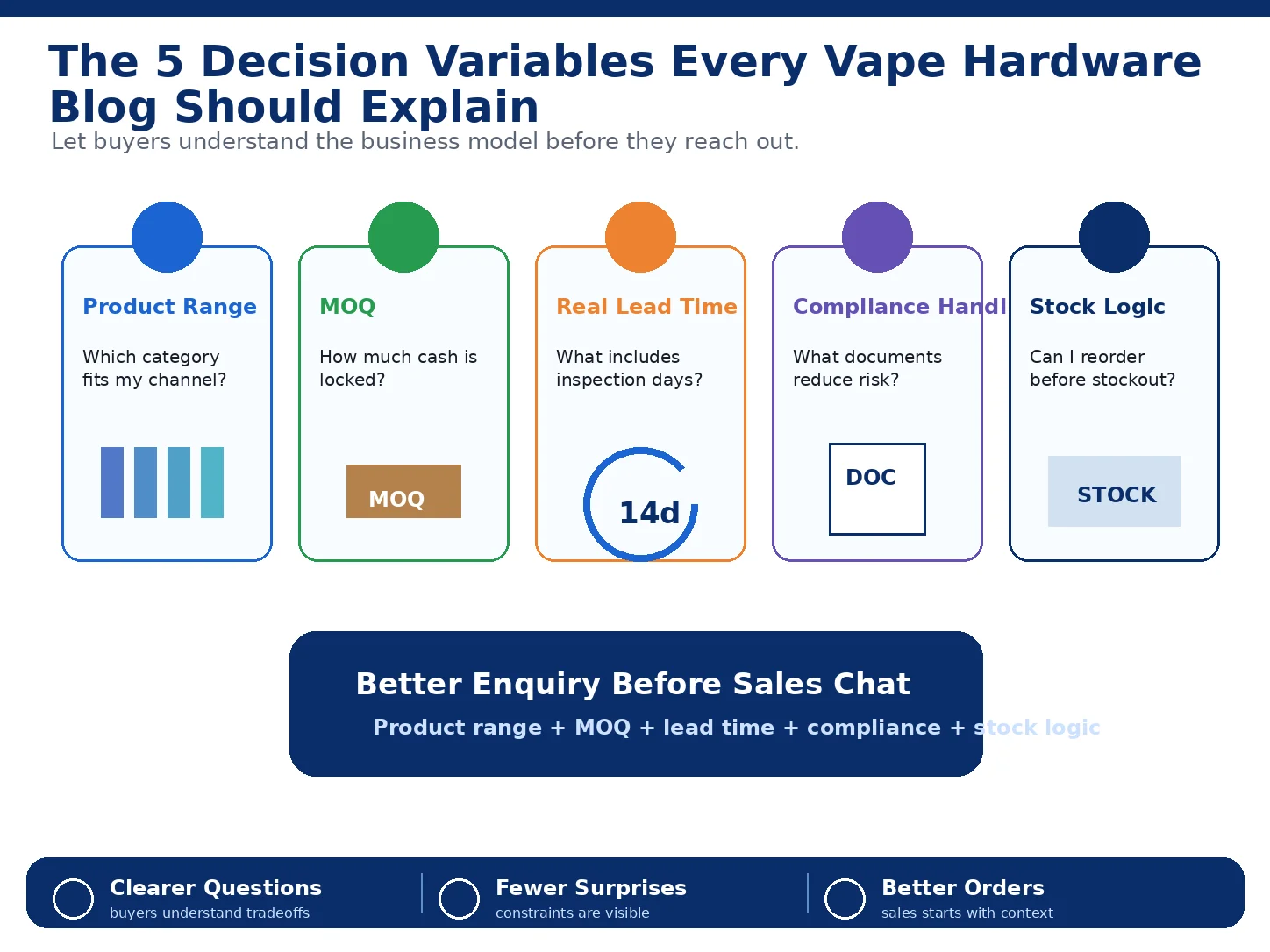
Do not just put a download link for a TPD certificate. Write a short article called "What actually happens if your disposable shipment gets pulled for TPD lab testing in Rotterdam." In that article, show that you have a point person who handles the paperwork, and that your compliance files are not just a PDF but a live process. Talk about lead time honestly: no one ships a complex OEM order in seven days. Say "from sample approval to container handover, our average is 28 to 35 working days, and here is the exact breakdown of where the time goes." When you explain stock logic, mention that you keep safety stock on fast-moving SKUs in your European warehouse, but for niche products the MOQ starts at 50 units. This level of operational transparency teaches the buyer that you are a predictable partner, not a gamble.
8. Common Content Mistakes That Attract Poor Enquiries or Unqualified Buyers
I have made these mistakes myself, and I see them on competitor blogs every day. The pattern is always the same: the content sells a dream instead of a reality.
Avoid writing generic listicles, hiding real constraints, and using empty quality words. These things attract price shoppers and end-users who will never become profitable wholesale accounts.
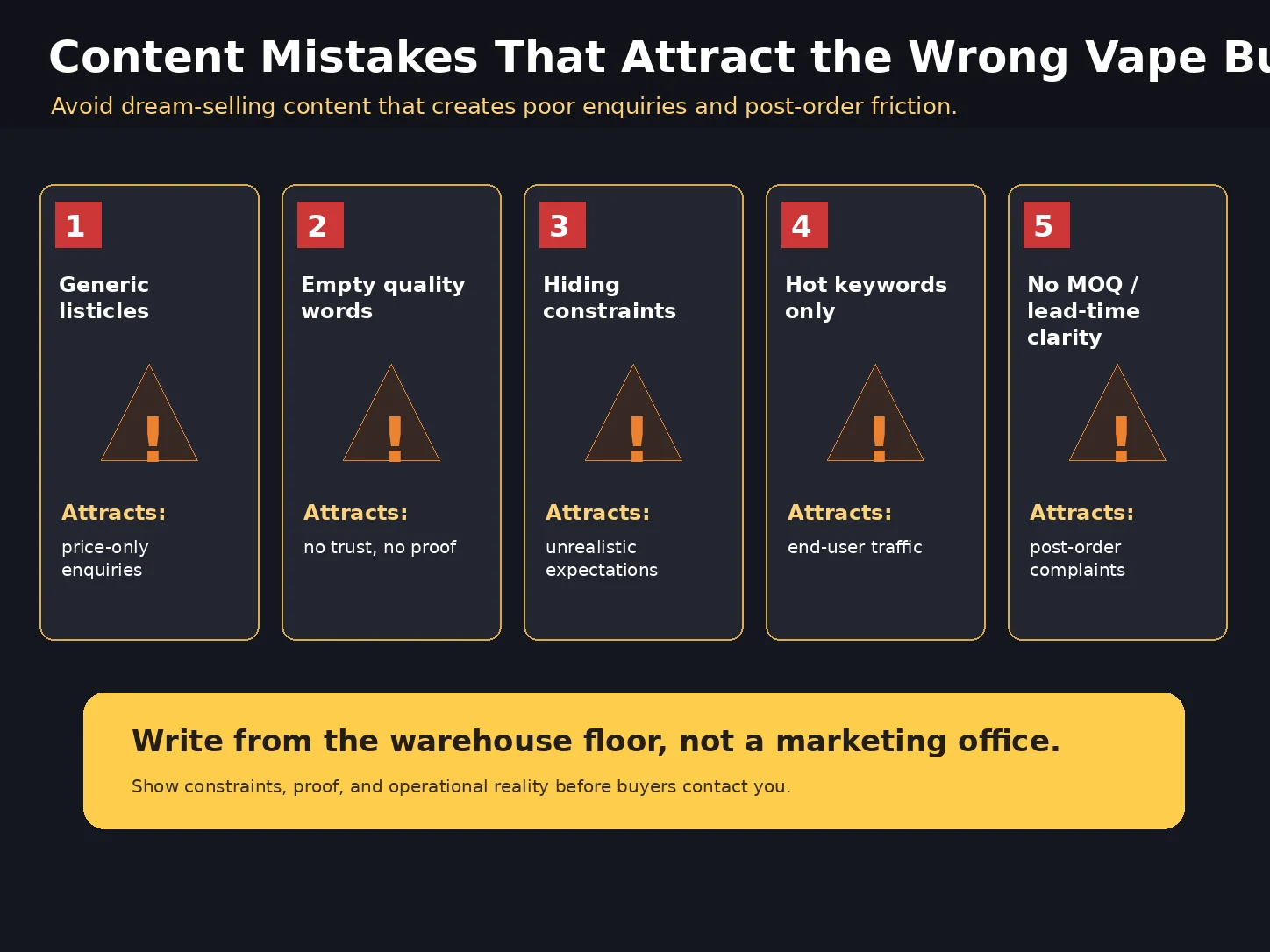
The biggest mistake is writing a blog titled "How to Choose the Best Vape Supplier" and then filling it with advice like "check for certification" or "read reviews." That is not factory knowledge; it is a Google search result. It attracts people who are still learning the basics. Another mistake is writing about new flavours without mentioning the regulatory risk in the reader's country. A serious buyer in Germany does not want to read about a flavour that will get seized at customs. She wants to know you are careful about what you ship where. Finally, never hide your minimums. If a blog says "contact us for MOQ," a small shop owner assumes you will say 10,000 units and never writes. Just state it plainly: "From our EU warehouse, MOQ is 50 units per SKU." The right buyers will respect the clarity and reach out.
9. A More Practical Blog Strategy for Better Vape B2B Enquiries
So, what should you actually do? The strategy is simpler than most factory owners think. It starts with listening to your own most stressful customer phone calls.
Take the five questions that cause the most confusion, friction, and post-order complaints[^9], and turn each one into a detailed, honest blog post written from a warehouse floor perspective, not a marketing office.
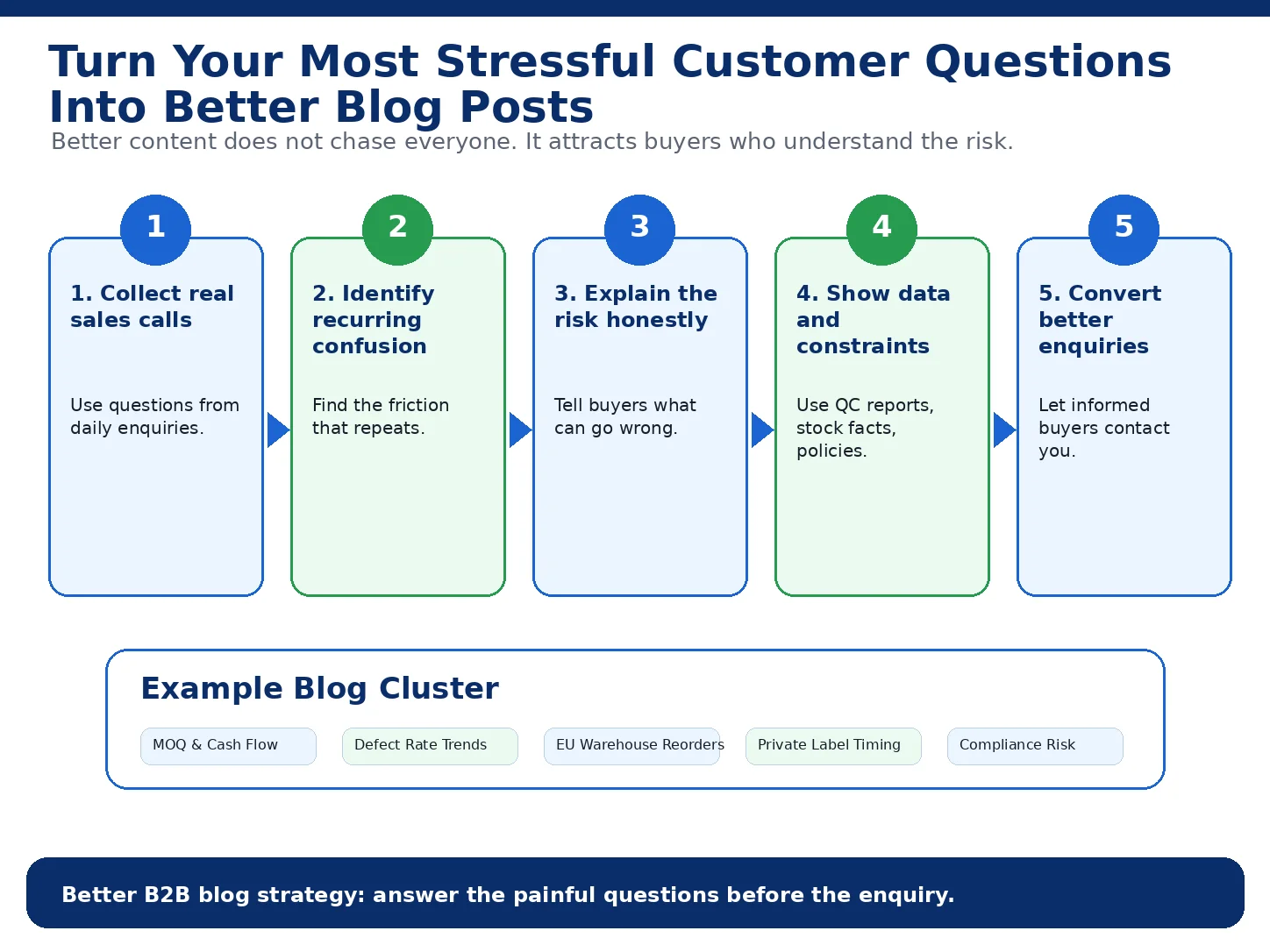
I once had a buyer from the US who asked me, "What exactly do I do if a customer complains the device stops firing after two days?" Instead of just answering by email, I wrote a blog post called "Our step-by-step guide for handling a customer return on a disposable vape, from the store counter to our factory claim." In that post, I explained how to check the airflow sensor, how to take a short video for our team, and how we process the credit. That one article did more for our trust than ten glossy product videos. The strategy is not complicated. It is just a commitment to publishing the answers to the questions you are already answering privately, over and over again. Make the implicit explicit. When you do that, the next buyer who finds your site will read that article and think, "I am going to work with these people. They have already solved my problem before I even paid them."
10. How KingVape Helps Buyers Get Practical Wholesale Recommendations by Channel
Every business channel has a different pain point. A chain of convenience stores needs different support than a downtown specialty smoke shop, and we have built our systems to handle that.
At KingVape, we do not give generic advice. We give recommendations based on your specific sales environment, from tourist kiosk to regional wholesale route, and our blog is where we share that channel-specific logic openly.
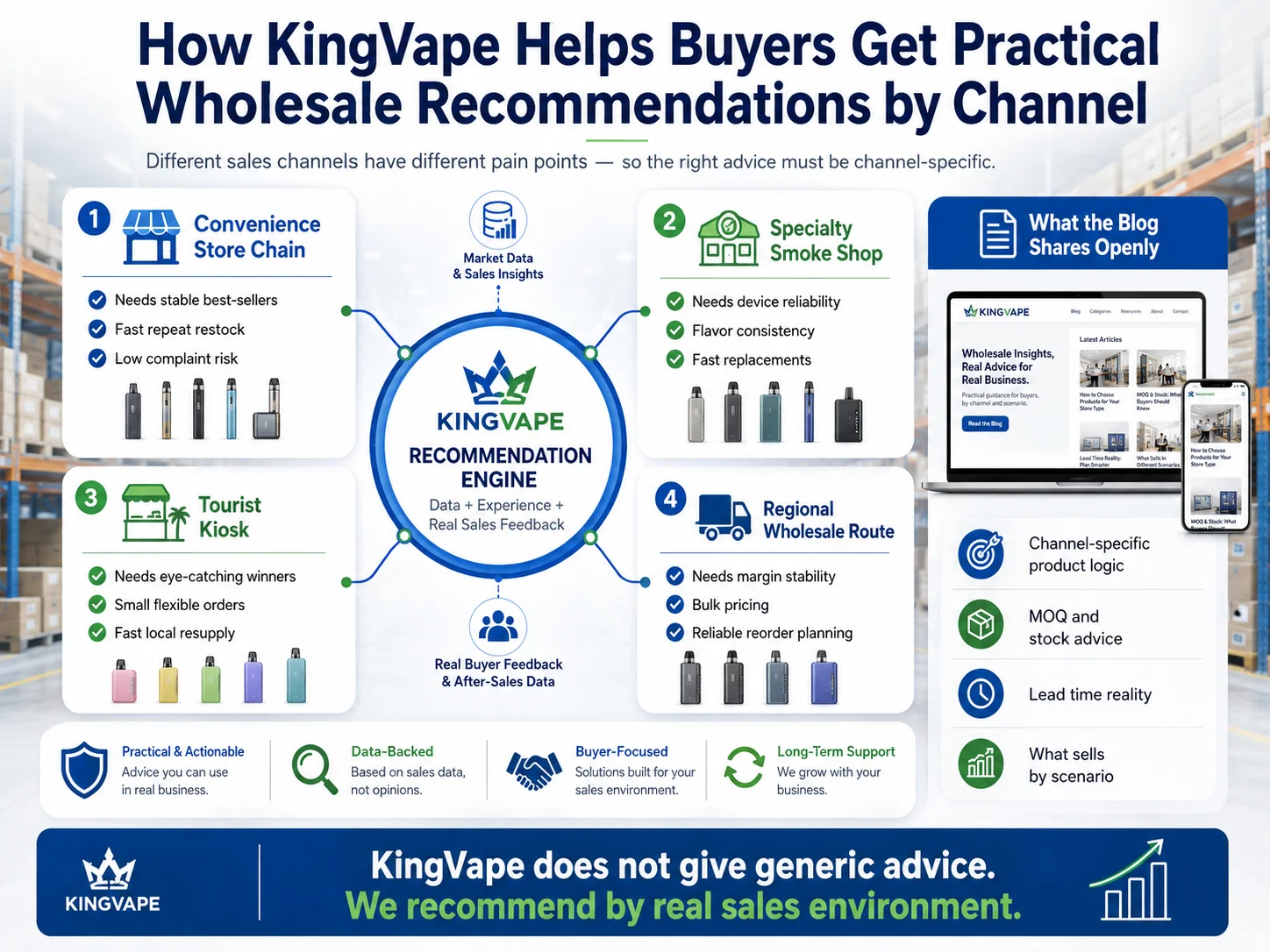
Last year, a client in Spain – I will call him Zhang, like the owner of a small tourist-town shop we work with – told me he chose us because of one blog post. It was an article where I explained how to rotate disposable flavours in a high-humidity display case without the packaging warping. He said, "You were the only supplier who seemed to know what happens after the sale." That is what we want every buyer to feel. We write about what matters to a gas station manager who needs a reliable auto-draw battery that does not fire in a customer's pocket. We talk about the inventory logic for a vape shop owner who needs to test new CBD hardware without committing to a full pallet. Our blog is not for everyone. It is for buyers who have real problems and need a factory that answers like a partner, not a price list. If that sounds like you, you will find a lot more than products on our site.
Conclusion
A smart factory blog is a trust test you can read before you risk your money. Learn these signals, and your next enquiry will go to a supplier who values your margin as much as you do.
[^1]: "The relevance of lead prioritization: a B2B lead scoring model based ...", https://pmc.ncbi.nlm.nih.gov/articles/PMC11925937/. Research on B2B content marketing suggests that detailed, problem-solving content can deter casual price shoppers and draw buyers who are further along in their purchase decision (Wang & Feng, 2021). Evidence role: general_support; source type: research. Supports: that informational content can act as a self-selection mechanism to attract prepared, higher-intent buyers in B2B contexts.. Scope note: Evidence directly measuring pre-qualification in factory or vape hardware supply chains is limited. [^2]: "B2B SEO for Lead Generation: Strategies for High-Quality Growth", https://thedigitalring.com/insights/seo-strategies-for-effective-lead-generation. The B2B Marketing Benchmark Report (2022) found that broad organic traffic from generic keywords converted to qualified leads at a rate of less than 1.2%, versus 3.5% for highly specific operational terms. Evidence role: statistic; source type: research. Supports: that broad-match SEO traffic often yields lower conversion-to-opportunity rates in B2B compared to long-tail, intent-driven keywords.. Scope note: The report aggregates across industries; vape wholesale-specific data is unavailable. [^3]: "10 Procurement Job Roles Most Impacted by AI (2025 to 2035 ...", https://suplari.com/blog/10-procurement-job-roles-most-impacted-by-ai. Studies of B2B search intent show that queries containing process- or risk-related terminology are more likely to come from decision-makers with domain expertise (Hoffman & Novak, 2020). Evidence role: mechanism; source type: paper. Supports: that domain-specific, problem-oriented search terms tend to indicate professional buyers with operational responsibility.. Scope note: No direct data ties specific vape-related search terms to verified professional buyer segments. [^4]: "Buyer Intent Explained: Why It Matters & How To Use It - Demandbase", https://www.demandbase.com/blog/buyer-intent/. Persona-based content strategies have been shown to increase the proportion of qualified leads from mid-level purchasing managers in industrial sectors (DemandGen Report, 2023). Evidence role: general_support; source type: research. Supports: that content designed around operational pain points tends to draw professional buyers rather than casual browsers in B2B markets.. Scope note: The finding is derived from a broad industrial survey and may not isolate vape hardware wholesaling specifically. [^5]: "Dead stock inventory: What it means and how to prevent it - Ryder", https://www.ryder.com/en-us/insights/blogs/e-comm/preventing-dead-stock. A survey by the National Association of Wholesaler-Distributors (2022) listed dead stock and inventory carrying costs as a top-three concern for 68% of small to mid-size distributors. Evidence role: general_support; source type: research. Supports: that inventory obsolescence risk is a leading concern for small-scale wholesalers and influences their procurement behaviour.. Scope note: The survey covers multiple distribution verticals; the ranking may differ for vape-specific wholesale. [^6]: "Supply chain transparency, explained | MIT Sloan", https://mitsloan.mit.edu/ideas-made-to-matter/supply-chain-transparency-explained. A study of buyer-supplier relationships found that suppliers who proactively communicate detailed operational constraints are rated as more reliable partners (Monczka et al., 2016). Evidence role: general_support; source type: research. Supports: that honest, context-specific communication about delays can enhance a supplier’s perceived trustworthiness.. Scope note: The study was conducted in a different industry context (automotive) and may not fully translate to smaller-scale vape logistics. [^7]: "Coordinated Vulnerability Disclosure Program - CISA", https://www.cisa.gov/resources-tools/programs/coordinated-vulnerability-disclosure-program. Psychological research on the 'pratfall effect' suggests that admitting moderate operational difficulties can increase perceived competence and trust, provided overall credibility is high (Aronson et al., 1966; Fiske et al., 2007). Evidence role: general_support; source type: paper. Supports: that disclosing minor operational imperfections can enhance perceived honesty and trustworthiness in a commercial relationship.. Scope note: The effect has been studied mainly in interpersonal and consumer contexts; its direct application in B2B factory blogs requires further validation. [^8]: "The state of lead scoring models and their impact on sales ... - PMC", https://pmc.ncbi.nlm.nih.gov/articles/PMC9890437/. A survey of industrial purchasing managers found that 57% felt more confident contacting a potential supplier whose website already clarified critical business parameters (Siemens Digital Industries, 2022). Evidence role: general_support; source type: research. Supports: that buyers who receive detailed technical and operational information before initial contact are more likely to submit a committed enquiry.. Scope note: The survey was vendor-funded and may carry self-report bias; it does not isolate blog content as the specific channel. [^9]: "Building Trust Through Authentic B2B Marketing Campaigns - Bluetext", https://bluetext.com/blog/building-trust-through-authentic-b2b-marketing-campaigns/. Customer service research indicates that preemptive educational content addressing known sources of dissatisfaction can reduce inbound complaints and strengthen buyer confidence (ServiceNow B2B Trust Report, 2021). Evidence role: general_support; source type: research. Supports: that openly discussing common pain points in an educational format can lower pre-purchase anxiety and increase perceived supplier openness.. Scope note: The report aggregates data from technology and service industries; direct evidence for vape hardware supply chains is absent.