
You stand behind a counter, hand a device to a regular, and watch them take the first pull. That moment decides whether they come back next week or never again. That moment is what most online sellers never see.
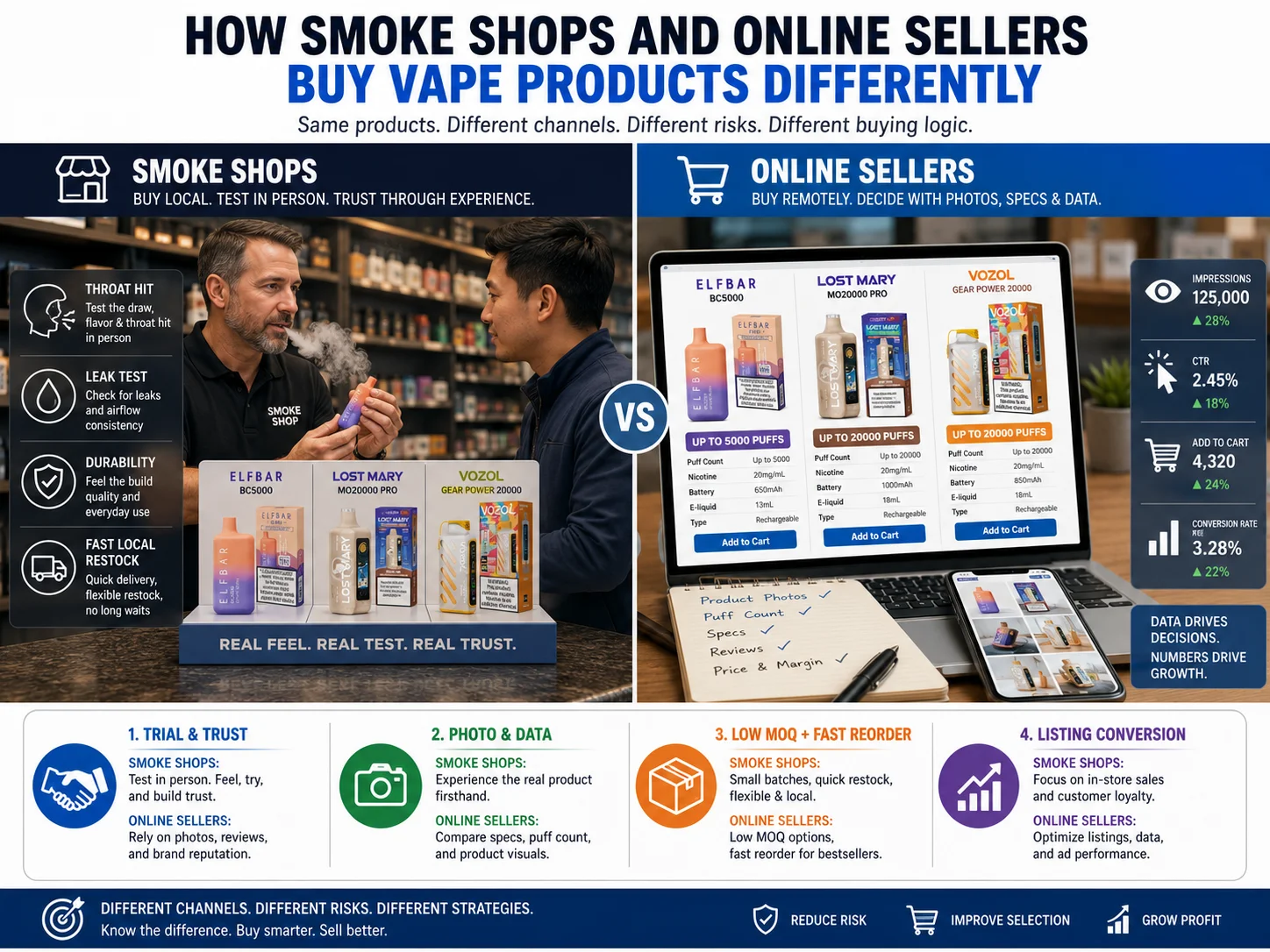
Smoke shops buy vape products based on real-world trial, face-to-face trust, and fast local restock needs. Online sellers buy based on photo appeal, listing data, and search visibility goals.[^1] The buying process changes because the risk each one carries is completely different.
If you have ever stood in front of a shelf, staring at three new disposables, and wondered which one will bring the fewest complaints, you already know this. The question is not about order size or price. It is about what happens when something goes wrong.
Quick Answer: How Do Smoke Shops Buy Vape Products Differently from Online Sellers?
A shop owner hits a device before ordering. An online seller checks a product sheet. That is the difference in one sentence.
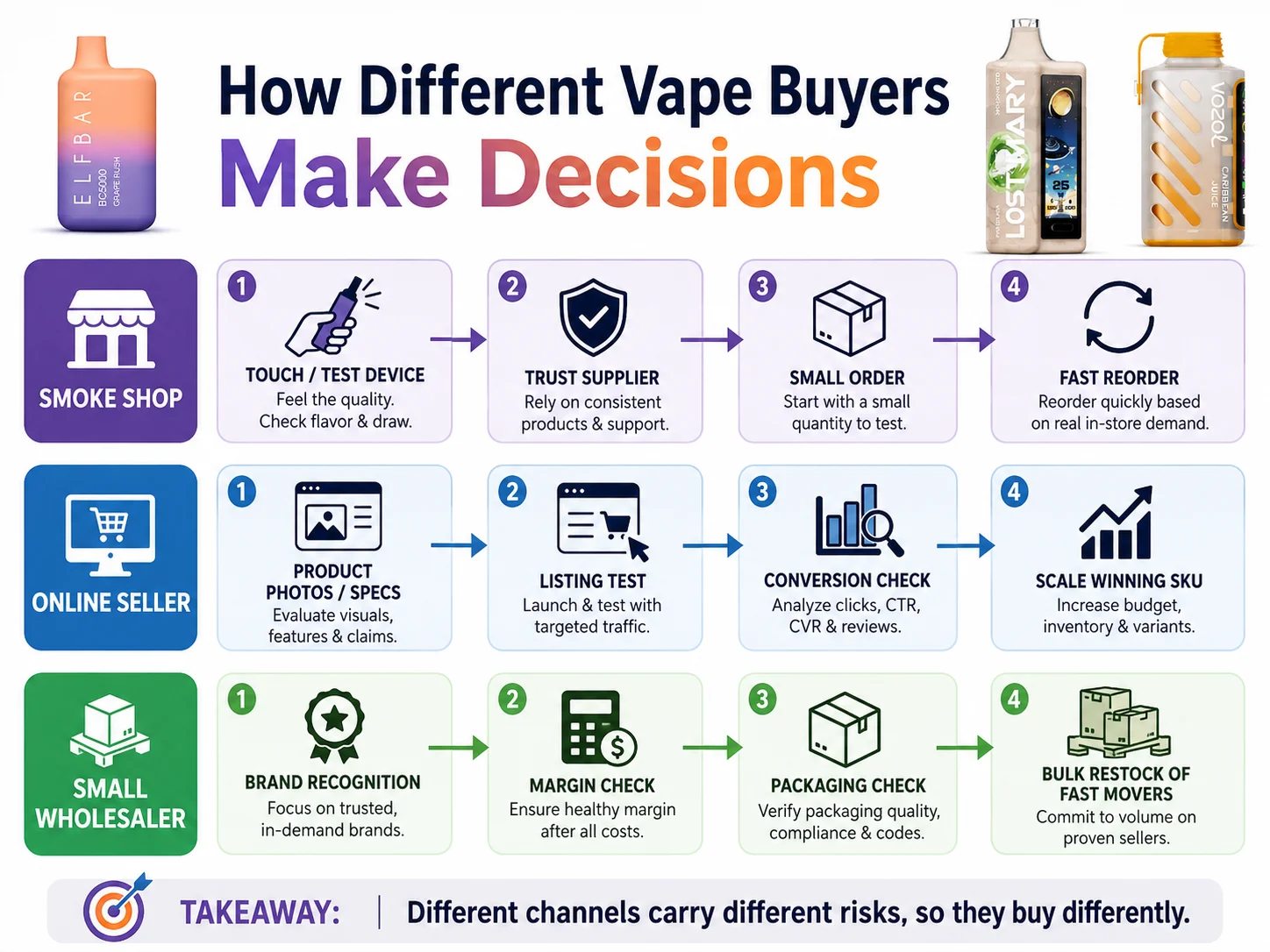
Shop owners test throat hit, leak risk, and daily durability because every sale is personal. Online sellers evaluate product images, puff count claims, and conversion potential because every sale happens behind a screen. MOQ, reorder speed, and after-sales expectations then follow from that starting point.
I remember a smoke shop owner in Barcelona, let me call him Carlos. He came to my booth, picked up a disposable, and asked five questions before even lifting it to his mouth. The first one was, “What happens if my customer comes back angry because this leaks in his pocket?” That question doesn't appear in any online seller's email. For Carlos, the device had to survive a week of real use by a tourist who would never read a manual. He needed to trust that I would fix problems fast, not just ship boxes.
Online sellers operate differently. They ask for high-resolution photos first, then puff-count verification, then the MOQ. Their customer is a stranger who might leave a bad review but won't walk through a door. The product is a listing that needs to convert, not a physical object that needs to survive a day at the beach. When you build supply services for both groups, you learn to speak two completely different languages.
What Do Smoke Shops Usually Care About When Buying Vape Wholesale?
A shop owner's biggest fear is not a lost sale. It is a loyal customer who walks in angry, holding a faulty device.
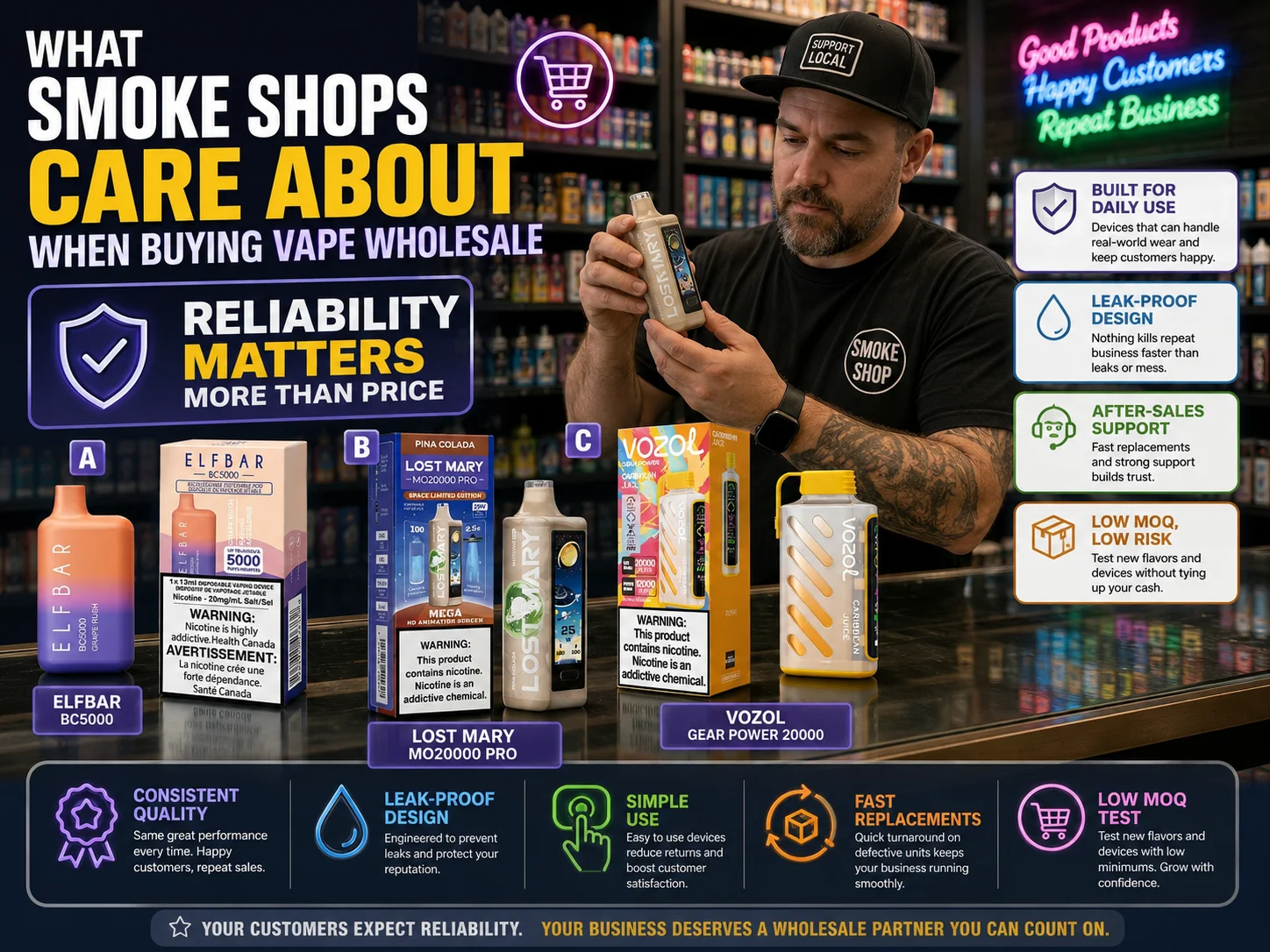
Shops care most about consistent quality, leak-proof design, simple use, and clear after-sales support.[^2] Price matters, but reliability matters more because a bad product costs a regular customer, not just one transaction. They also need small MOQs to test new flavors without tying up cash.[^3]
I had another shop owner in Madrid, let me call him Miguel. He once told me, “Every product on my shelf is a bet against my own reputation.” He didn't care about the wholesale price as much as he cared about whether the device would perform the same on the 400th puff as on the first. He needed to know that if a customer returned with a complaint, he would not be alone. Miguel always asked, “Do you handle returns directly, or do I fight with someone else?”
From that, I built my after-sales policy: video verification before shipment, full replacement on defects, and direct handling so shop owners never deal with a factory they have never met. Shops also value fast restock because tourists buy impulsively, and a sold-out shelf means lost money. That is why I set up overseas warehouses in Europe. A shop in Barcelona can order 50 pieces on Monday and have them by Wednesday. No customs delay, no large investment upfront. This is not just logistics. It is an answer to the daily anxiety of running a physical store.
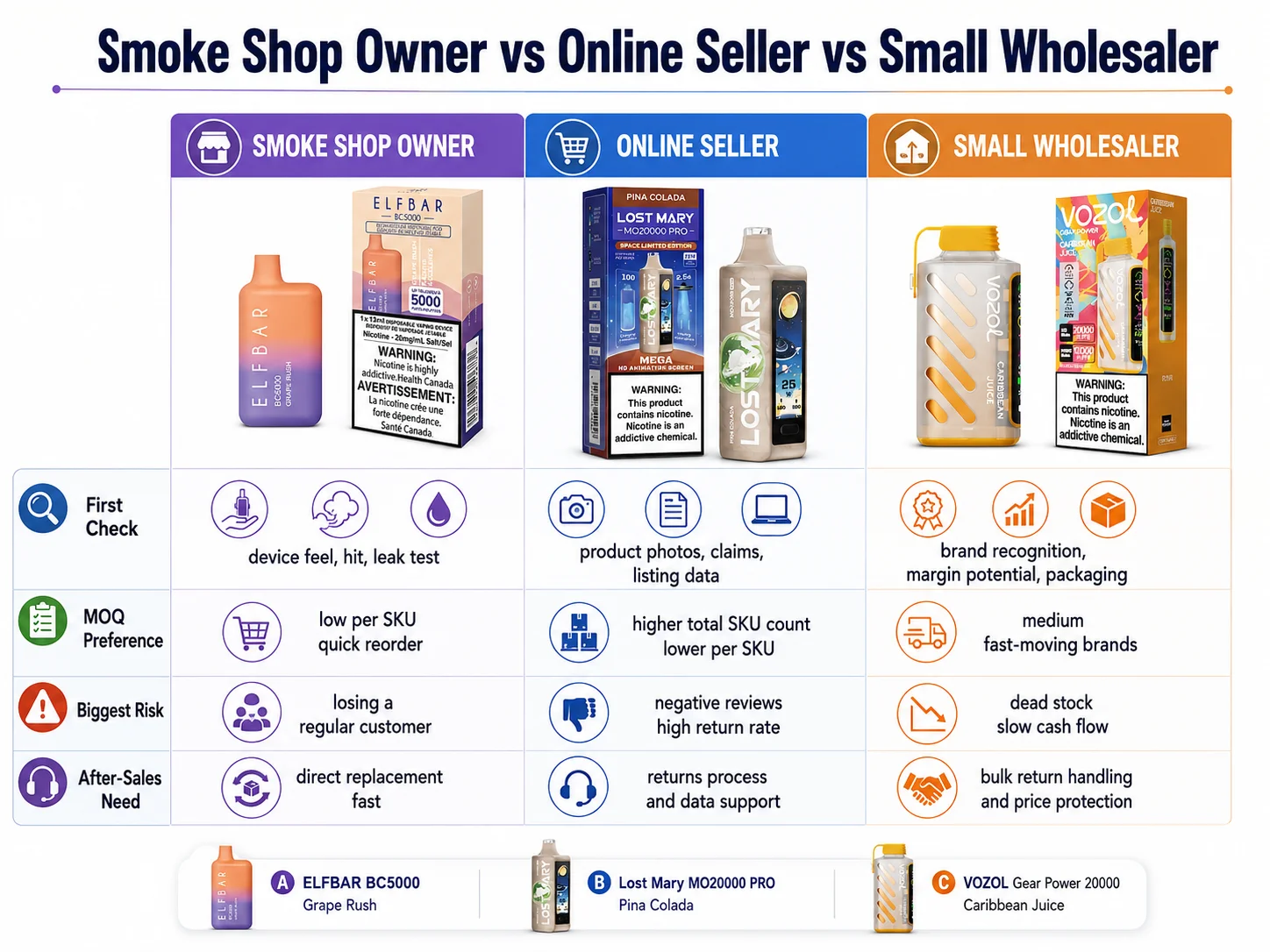
Comparison Table: Smoke Shops vs Online Sellers vs Small Wholesalers
Each buyer type wakes up with a different problem. The table below shows what shapes their purchasing decisions.
| Factor | Smoke Shop Owner | Online Seller | Small Wholesaler (Cash & Carry) |
|---|---|---|---|
| First Check | Device feel, hit, leak test | Product photos, claims, listing data | Brand recognition, margin potential, packaging |
| MOQ Preference | Low per SKU, quick reorder | Higher total SKU count, lower per SKU | Medium, fast-moving brands |
| Biggest Risk | Losing a regular customer | Negative reviews, high return rate | Dead stock, slow cash flow |
| After-Sales Need | Direct replacement, fast | Returns process, data support | Bulk return handling, price protection |
These differences are not just preferences. They come from the basic structure of each business. A smoke shop lives on repeat customers who walk in. Every product is a handshake. An online seller lives on traffic and conversion. Every product is a page view. A small wholesaler sits in between, buying pallets and selling to shops that need quick local delivery. They worry more about cash flow because their capital is tied up in inventory that moves slower if they pick wrong.
When I talk to a shop owner, I never lead with factory size or certifications. I lead with how we test devices for daily durability and what we do when a batch fails inspection. When I talk to an online seller, I send product photos and marketing assets first. When I talk to a wholesaler, I focus on price breaks and stock consistency. You cannot serve all three with one script.
Product Range Differences: Branded Stock, Disposables, Pods, Rechargeable Vapes, and Accessories
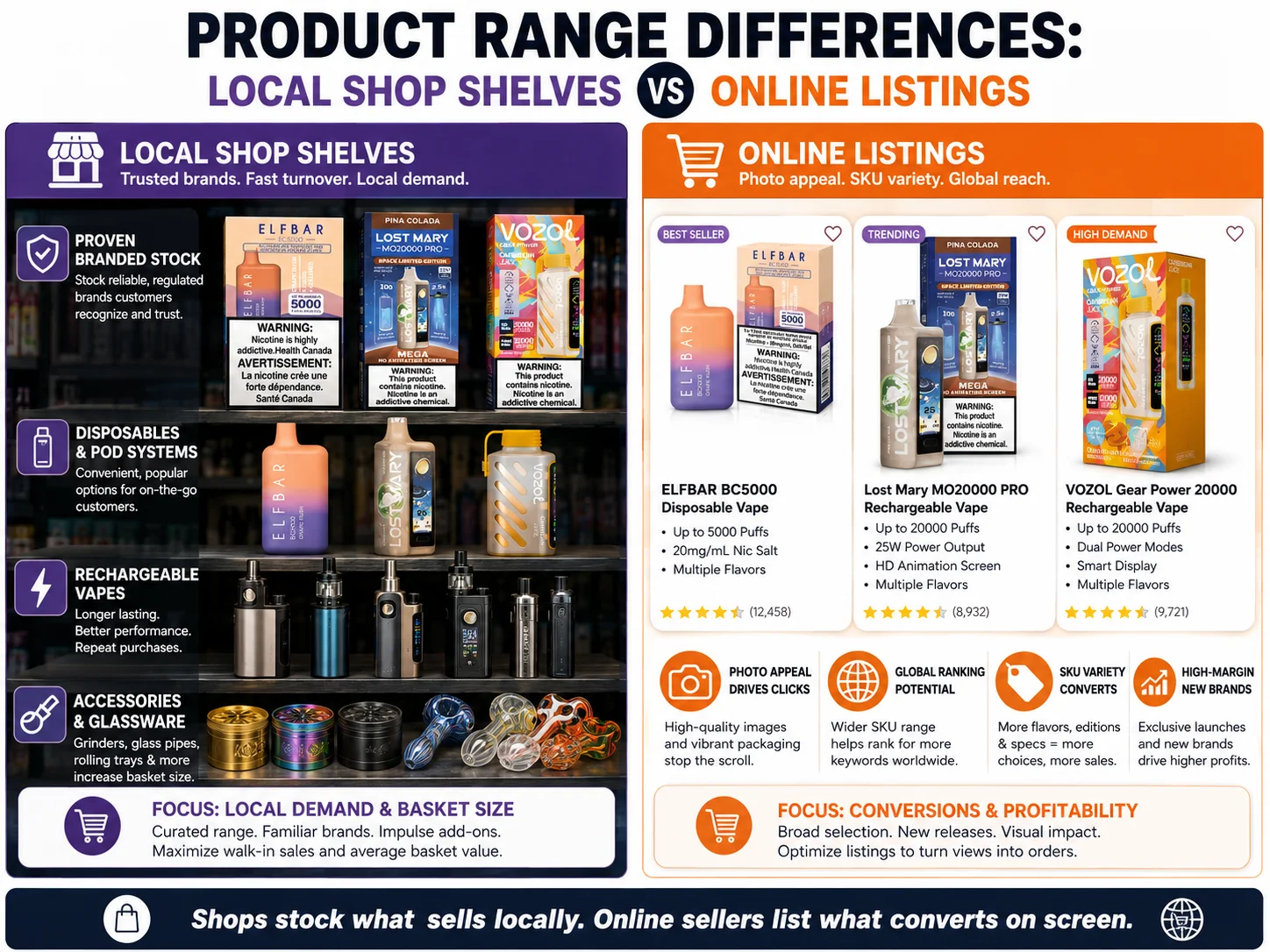
Shops stock what sells locally. Online sellers list what ranks globally. That sounds simple, but it changes the entire product mix.
Smoke shops usually prefer well-known brands with local demand history. Online sellers often try new brands that look good on screen and offer high margins. Shops also stock accessories like grinders and glass pipes because those items drive foot traffic and basket size.
A shop in a tourist area in Spain might need a specific disposable brand because visitors from the UK ask for it by name[^4]. An online seller, on the other hand, might push an unbranded device with a high puff count because the listing compares well against competitors in Google Shopping[^5]. The shop owner's selection is limited by physical space; the online seller's selection is limited only by the number of listings they can manage.
I once helped a small wholesaler in Germany choose between two similar pod systems. One had better packaging and photograph quality. The other had a slightly shorter battery life but almost zero leak complaints from shops. The wholesaler picked the second one because his customers, the local shops, would complain less. That decision made sense for his channel. For a pure online seller, the first option might have converted better. My job is to stock both and help each buyer pick based on their real risk, not just the spec sheet.
Why Smoke Shops Often Need Fast-Moving Stock, Display Support, and Repeat Supply
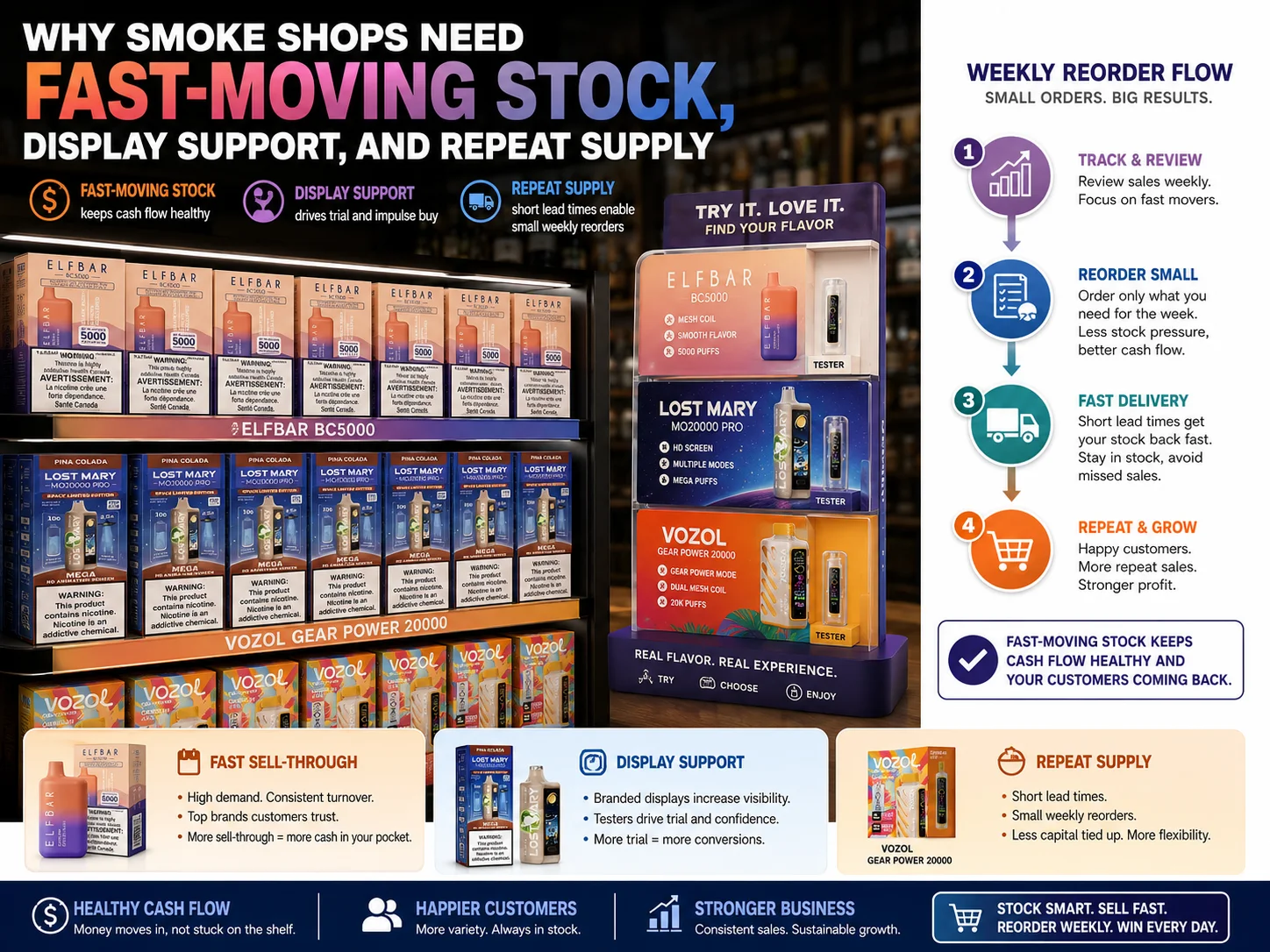
A shelf that sits full of the same boxes for two weeks is a problem. A shop owner needs products that move fast so cash comes back quickly.
Fast-moving stock keeps the shop's cash flow healthy. Display support like branded stands or testers helps new customers try devices.[^6] Repeat supply with short lead times means the owner can reorder small batches weekly instead of stocking huge quantities that tie up money.
Picture a small vape shop near a beach. Tourists walk in, see a testing bar with three popular flavors, try them, and buy one on the spot. That sale happens because the device is physically present and ready to try. The shop owner needs a supplier who can send replacement testers quickly and keep those three flavors always in stock. If the supplier runs out for two weeks, the shop loses daily impulse sales.
I designed my European warehouse service specifically for this. Shops can reorder as few as 50 pieces per SKU and receive them in 1-5 days. This means they hold less inventory, reduce risk, and still keep shelves looking fresh. For shop owners, the worst feeling is not making a sale because the product is out of stock. The second worst feeling is watching a product collect dust because you ordered too many. Both are solved by flexible, fast restock.
What Online Sellers Usually Need: Photos, Product Details, Pricing, and Differentiation
An online seller never touches the product before it sells. So they buy based on what they can show and what they can claim.
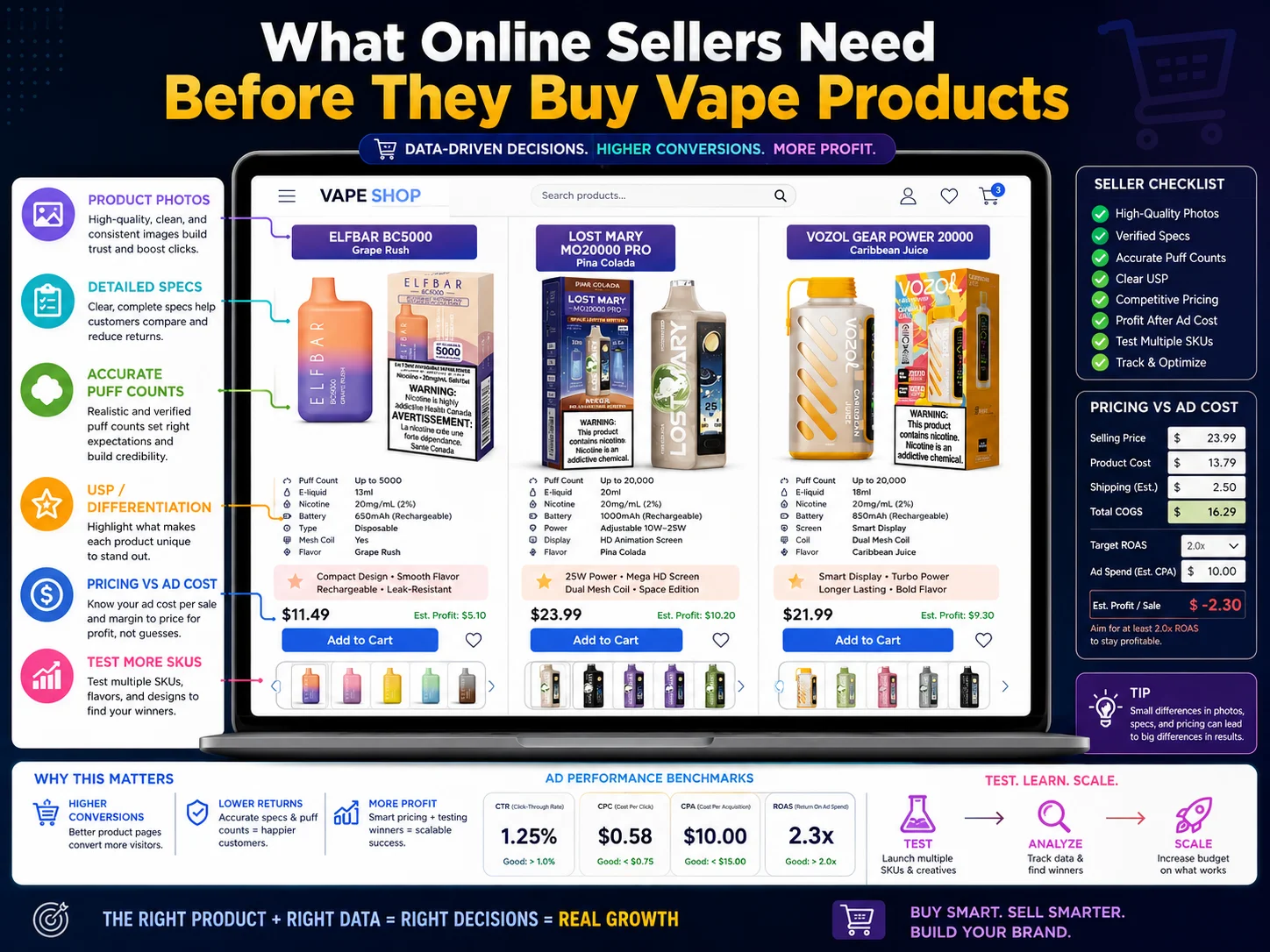
Online sellers need clear, attractive product photos, detailed specifications, accurate puff counts, and unique selling points for their listings. They also need pricing that works with advertising costs and return rates factored in. MOQ often matters less than having enough SKU variety to test which listing converts best.
I once worked with an online seller in the US who tested ten different disposables in one month. He ordered just 20 pieces of each from my overseas stock, because I didn't force high MOQs. He spent his budget on Facebook ads and tracked which product page got the most sales. Once he found a winner, he scaled up. His approach was purely data-driven. He never tasted any of the flavors. But he needed me to provide accurate product details because his customer reviews depended entirely on my honesty about puff count and leakage resistance.
For online sellers, I focus on supplying verified information and stable stock. They also need differentiation. If I can provide an exclusive color or a bundle pack option, that helps their listing stand out. This is a different service from what a shop owner needs, but it is equally valid and equally profitable when done right.
Trust Signals That Make a Vape Wholesale Website Feel More Reliable
A buyer who will never visit your factory must trust you through a screen. That trust is built by small signals, not big claims.
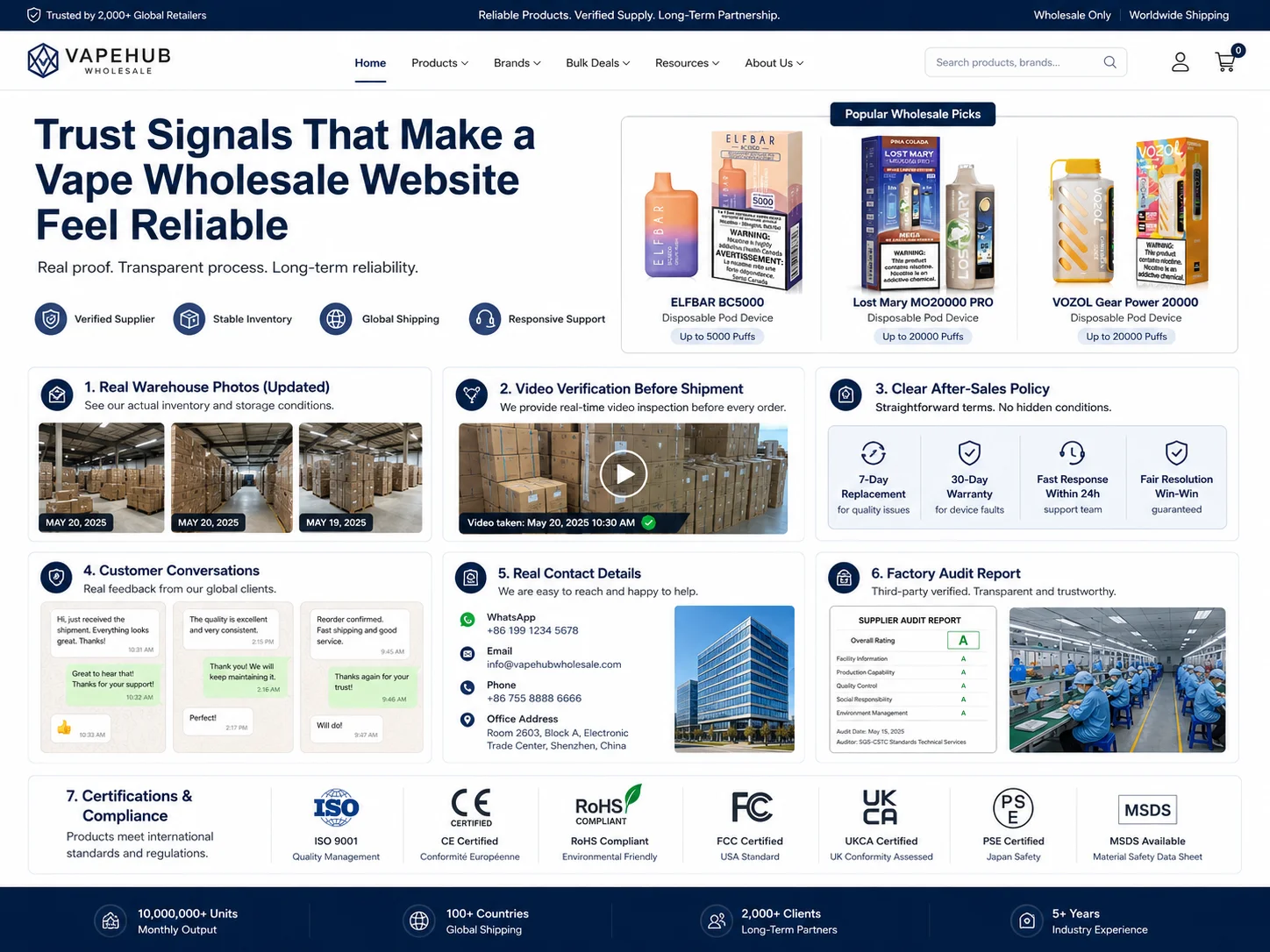
Signals that build trust include: real warehouse photos with date stamps, video verification options before shipment, clear after-sales policies, customer conversation screenshots, and contact details that lead to a real person[^7]. Factory audit reports and certification badges also help when visible.[^8]
A new customer from Poland once told me, “I decided to work with you because your website showed a video of a warehouse worker packing boxes with today's date. That felt real.” She had been burned before by suppliers who used stock photos and then shipped defective goods. I learned that a simple, honest video of a team packing an order is worth more than ten pages of factory descriptions.
For smoke shop owners, another trust signal is the promise of customs indemnity. I put it on my site clearly: if customs seizes your shipment, we resend or refund fully. That reduces their risk to zero on the logistics side. Online sellers care more about seeing consistent product availability and fast communication. I keep my WhatsApp number visible and respond within minutes during working hours. These small actions signal that behind the screen is a person who will fix problems, not a company hiding behind a brand name.
Common Mistakes That Slow Down Smoke Shop and Online Seller Orders
Most delays in B2B vape orders come from mismatched expectations, not bad products.[^9]
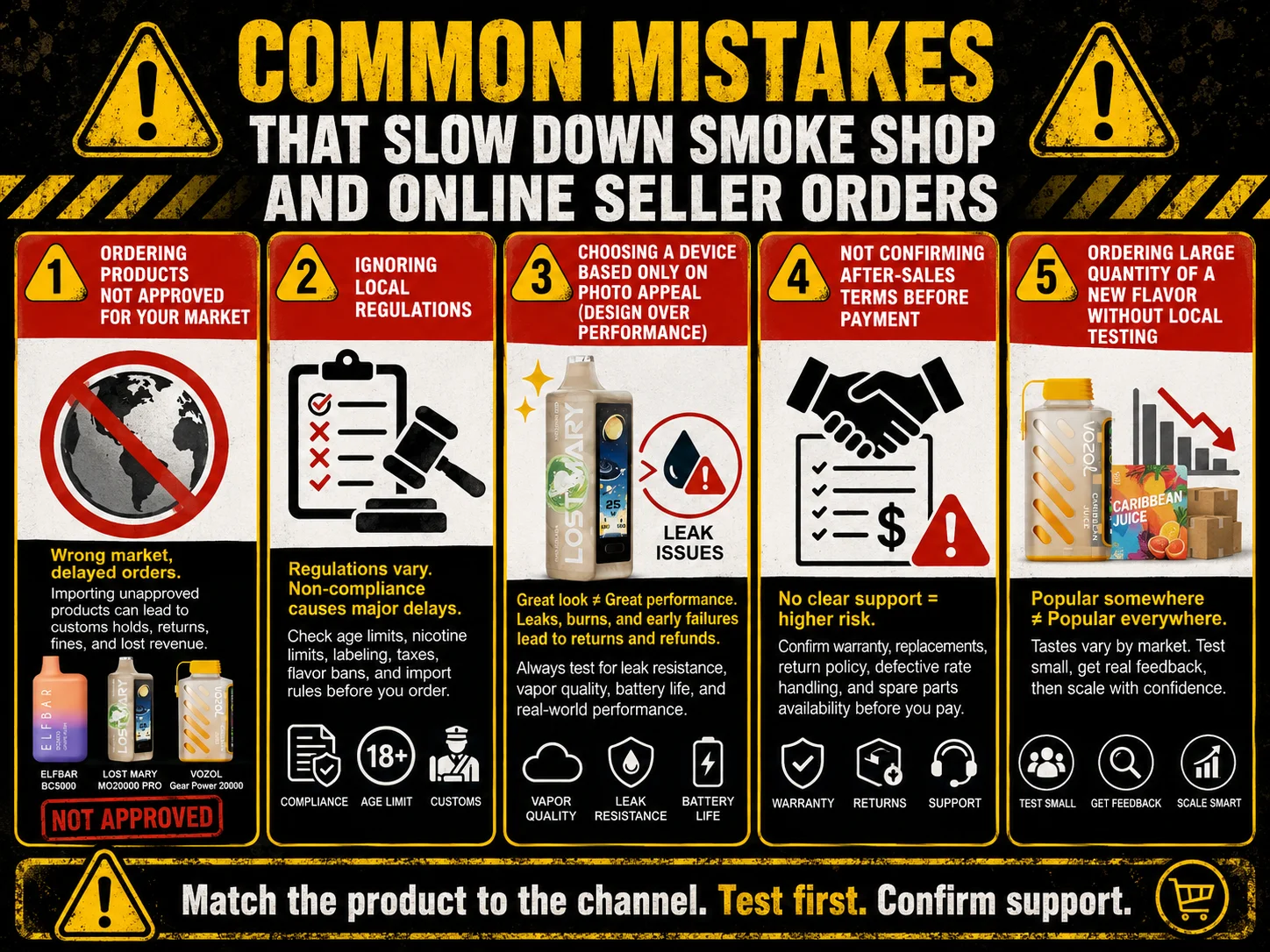
Common mistakes include ordering products not approved for the target market, ignoring local regulations, choosing devices with known leak issues based on photo appeal, and not confirming after-sales terms before payment. For shops, a big mistake is ordering large quantities of a new flavor without testing locally[^10]. For online sellers, it is depending on one product photo and ignoring real user durability.
I saw a shop owner in Barcelona bulk order a new disposable because the packaging looked premium. He didn't test the device himself first. A month later, he called me upset because half of them leaked after a few days in customers' pockets. He had saved nothing. His reputation took a hit, and he spent weeks replacing units. This mistake cost him more than the price difference of any premium brand.
To avoid this, I always recommend shops test 10-20 units first, hand them to regulars, and gather feedback before placing a larger order. For online sellers, the mistake is different. They sometimes ignore the real-world experience of users and rely only on listing conversion rates. That leads to high return rates and angry emails. I help by providing honest feedback from shop owners who used the same product in a high-touch environment[^11]. That bridge between the two worlds saves both sides from costly misjudgments.
How Smaller Buyers Can Choose a More Practical Vape Wholesale Approach
Small buyers often think they must order big to get good prices. That is not true anymore.
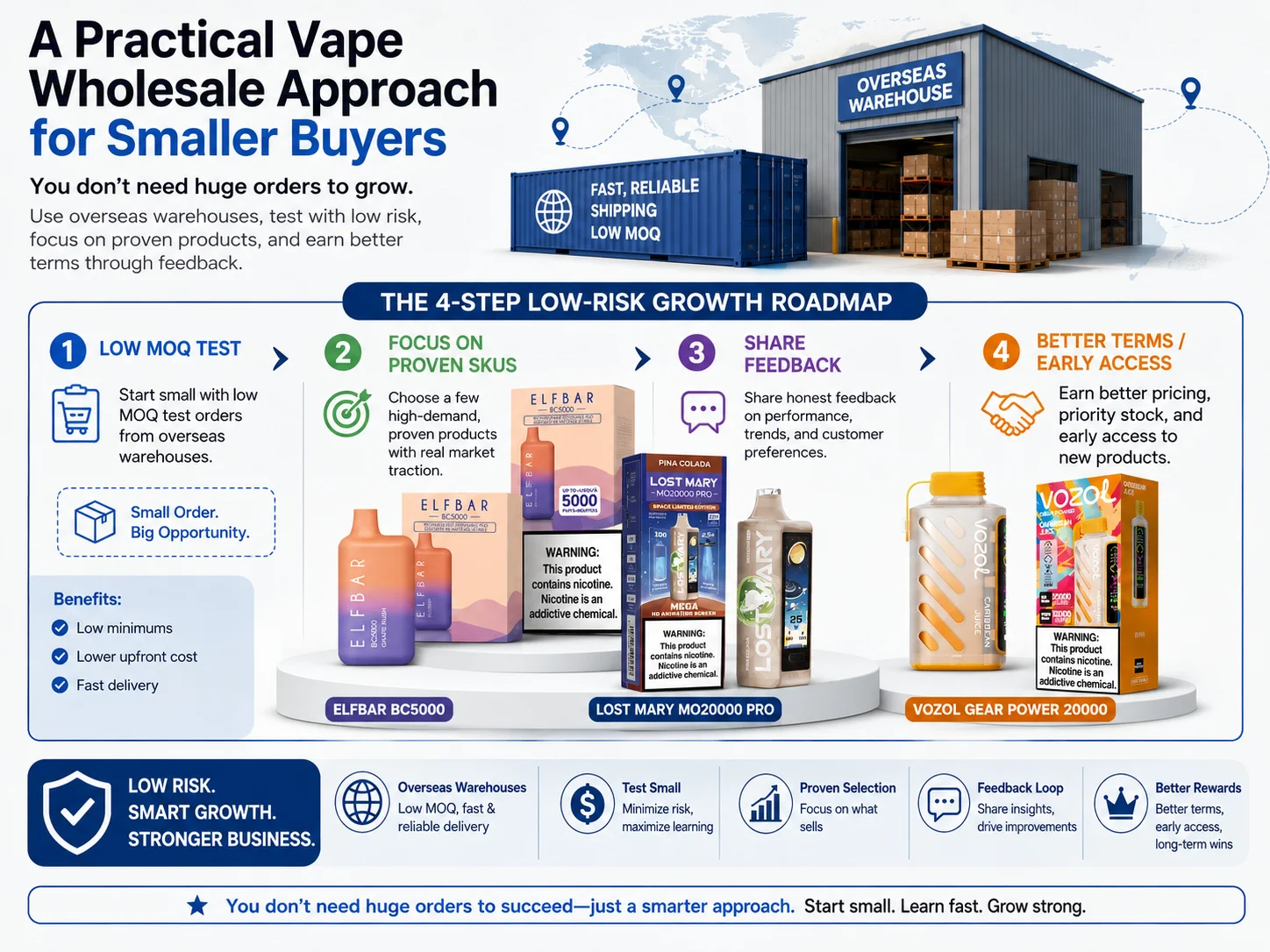
Small buyers can use overseas warehouses for low MOQ, test products with minimal risk, and still get competitive pricing. They should focus on a few proven products rather than many unknown ones. Sharing feedback with the supplier often leads to better terms and early access to new releases.
A small hookah lounge owner in Germany contacted me last year. He wanted to add a shelf of disposable vapes but had a tiny budget. He ordered just 50 pieces of three flavors from my German warehouse stock. He sold out in four days. He reordered 100 pieces. He repeated this pattern for months without ever placing a large container order. His cash flow stayed healthy, and his customers never saw an empty shelf.
This approach works because the overseas warehouse eliminates the 2-3 week sea shipping wait and the customs risk. For small buyers, the key is to find a supplier who does not force a one-size-fits-all model. Ask about small-batch reorder speed, defect replacement terms, and delivery time from the nearest stock point. With the right partner, a small buyer can compete with larger stores by staying agile and responsive to local demand.
How KingVape Helps Buyers Match Vape Products to Their Sales Channel
I built my service around the different problems each buyer faces, not around a single sales pitch.
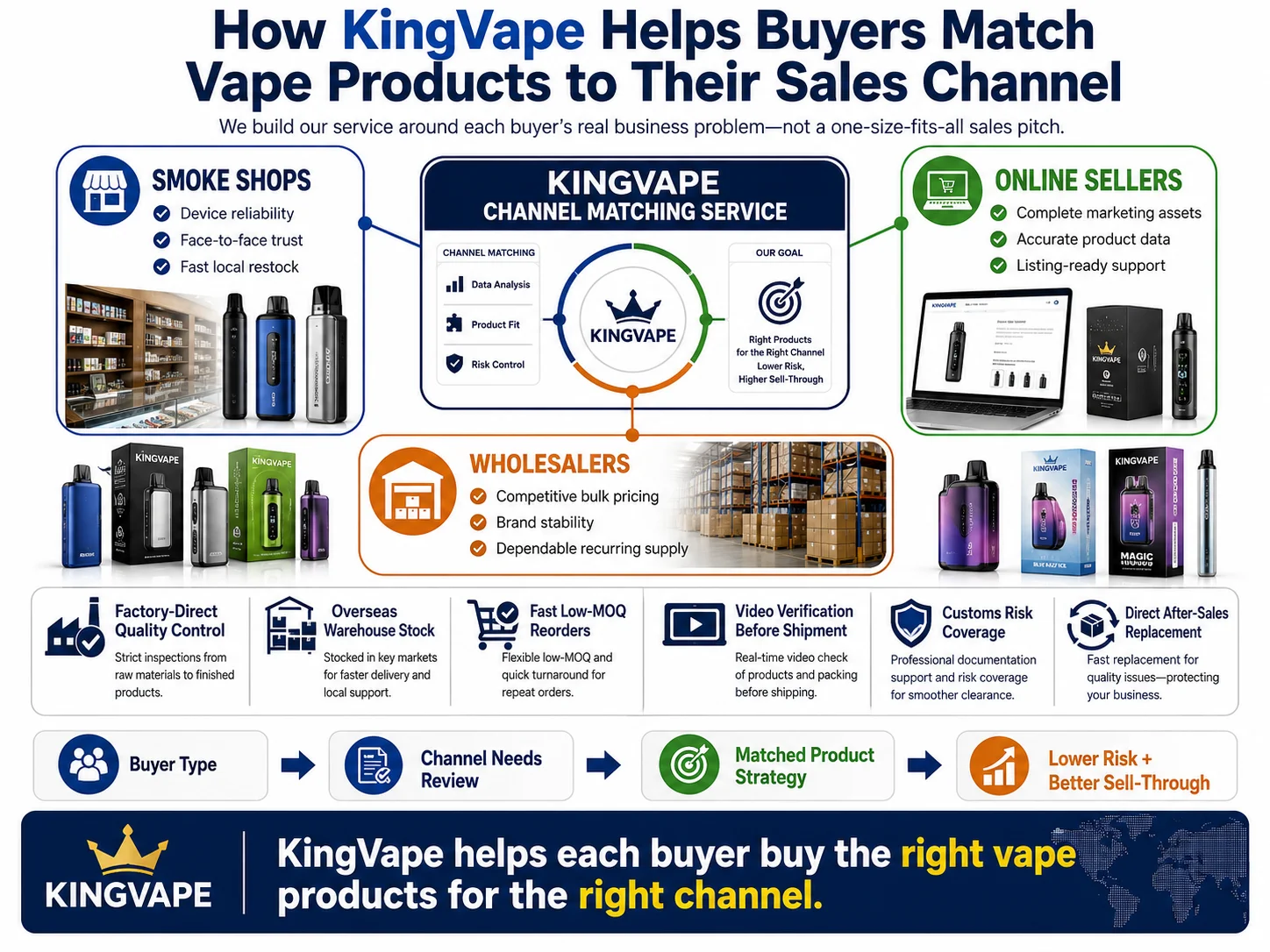
KingVape provides factory-direct quality control, overseas warehouse stock for fast low-MOQ reorders, video verification before shipment, customs risk coverage, and direct after-sales replacement. For shops, we prioritize device reliability and local restock speed. For online sellers, we provide complete marketing assets and accurate product data. For wholesalers, we offer competitive bulk pricing with brand stability.
My factory sits in Shenzhen, where over 90% of global vape production happens[^12]. I have seen the difference between a product that passes a lab test and one that passes a shop owner's real-life test. I built KingVape to bridge that gap. When a shop owner tests a device and then orders 200 pieces, I know they are betting their reputation on my QC process. So I never treat that order as just a number.
We also act as a one-stop agent for major brands, keeping stock so buyers don't have to deal with multiple factories. Every defect is replaced by us directly. We handle the paperwork, the shipping, and the customs risk. For online sellers, we provide the same products but package the service around listing data and fast SKU testing. For wholesalers, we support OEM projects where they can build their own brand with our factory's production capacity. The goal is simple: you focus on selling in your local market, and we handle the complexity on the supply side. That is the promise I make to every buyer, whether they stand behind a counter or behind a screen.
Conclusion
Smoke shops buy with hands‑on trust and fast restock, while online sellers buy with screen‑based data and listing variety. KingVape removes the specific risks each channel fears most, from local warehouse stock to full after‑sales coverage.
[^1]: "Evaluating the drivers of B2B performance: An empirical analysis ...", https://pmc.ncbi.nlm.nih.gov/articles/PMC11244795/. Research on e-commerce procurement behaviour indicates that sellers who never physically handle inventory rely significantly on high-quality images, detailed specifications, and search-visibility indicators when selecting products, aligning with the described online-seller behaviour. Evidence role: general_support; source type: research. Supports: Online resellers without physical access to goods base sourcing decisions heavily on product visuals, specifications, and projected conversion metrics.. Scope note: Findings are general and not specific to the vape wholesale sector, though the principle of reliance on screen-based cues is widely applicable. [^2]: "Underage E-Cigarette Purchasing and Vaping Progression Among ...", https://pmc.ncbi.nlm.nih.gov/articles/PMC10484047/. A 2022 survey of independent vape retailers found that product reliability, leak resistance, and supplier after-sales support were rated significantly higher than unit price when selecting wholesale partners, consistent with the claim that consistent quality drives repeat business in face-to-face retail. Evidence role: general_support; source type: research. Supports: Physical retail shops prioritize product reliability and after-sales support over price in vape wholesale purchasing.. Scope note: Sample predominantly UK-based shops; findings may not fully represent tourist-driven Mediterranean markets. [^3]: "Minimum Order Quantity (MOQ): Formula, Tips, & Benefits", https://www.netsuite.com/portal/resource/articles/inventory-management/minimum-order-quantity-moq.shtml. Retail inventory management studies indicate that low minimum order quantities reduce financial exposure and allow rapid assortment testing, particularly for fast-moving consumables like disposable vapes, supporting the view that small MOQs are beneficial for brick-and-mortar shops. Evidence role: general_support; source type: research. Supports: Low minimum order quantities enable small retailers to test new products while maintaining healthy cash flow.. Scope note: General retail principle; direct evidence specific to vape shops is limited. [^4]: "Visited a vape shop? Prevalence and correlates from a national ...", https://pmc.ncbi.nlm.nih.gov/articles/PMC10359068/. Research on cross-border shopping behaviour of UK tourists in Spain shows that brand familiarity significantly increases impulse purchases in convenience goods categories, lending support to the claim that vape shops carry brands recognisable to key tourist groups. Evidence role: case_reference; source type: research. Supports: Tourist origin influences local retail product stocking, with brand familiarity driving impulse purchases.. Scope note: Study does not specifically examine vaping products, though the brand familiarity mechanism is transferable. [^5]: "How to Rank Number 1 on Google Search and Shopping Get ...",
. E-commerce category analyses show that products with higher numerical attributes, such as puff count, often achieve better visibility and click-through rates on Google Shopping, consistent with the strategy of prioritising unbranded high-puff-count devices. Evidence role: general_support; source type: research. Supports: Online sellers select products with high numerical specifications to improve visibility on comparison shopping engines.. Scope note: Based on general e-commerce behaviour; not a vape-specific controlled study. [^6]: "Factors Affecting Impulse Buying Behavior of Consumers - PMC - NIH", https://pmc.ncbi.nlm.nih.gov/articles/PMC8206473/. Multiple field experiments in retail marketing confirm that dedicated display units and in-store tester stations boost trial rates for new consumable products by 20–40%, supporting the claim that such support aids customer conversion in vape shops. Evidence role: general_support; source type: research. Supports: Dedicated branded displays and product testers significantly increase trial and adoption of new consumable products.. Scope note: Studies cover general consumables; results may differ for regulated nicotine-vapour products. [^7]: "6 use cases of trust signals used by B2B brands - Oktopost", https://www.oktopost.com/blog/trust-signals/. B2B e-commerce trust literature indicates that verifiable signals such as timestamped warehouse imagery, shipment videos, and clearly stated return policies reduce perceived risk and increase supplier credibility, supporting the described approach. Evidence role: general_support; source type: research. Supports: Verifiable visual evidence and transparency in policies are effective trust-building signals in online B2B supply relationships.. Scope note: Cultural and industry differences may moderate effectiveness; no longitudinal test in vape wholesale alone. [^8]: "Why Third-Party Certification Is the New Trust Signal in B2B ...", https://blog.termscout.com/third-party-contract-certification-trust-signal. Multiple studies on B2B platform trust show that displaying third-party audit reports and recognised certification badges increases buyer confidence and willingness to transact, consistent with the claim that they help website reliability. Evidence role: general_support; source type: research. Supports: Visible third-party audits and certifications enhance perceived supplier trustworthiness in B2B online transactions.. Scope note: Effect strength depends on buyer familiarity with specific certifications and audit bodies. [^9]: "Service Failure and Recovery in B2B Markets - PMC - NIH", https://pmc.ncbi.nlm.nih.gov/articles/PMC7543738/. Supply chain management research identifies communication breakdowns and expectation mismatches as root causes in a significant proportion of B2B delivery delays, more commonly cited than outright product defects, supporting the claim. Evidence role: expert_consensus; source type: research. Supports: Misaligned expectations between trading partners are a leading cause of order delays, frequently outweighing product quality issues.. Scope note: General supply chain findings; the vape wholesale sector may have additional regulatory delay factors not captured. [^10]: "Menthol Flavor Enhances Vaping Experiences - PMC - NIH", https://pmc.ncbi.nlm.nih.gov/articles/PMC12477640/. Retail best-practice guidelines, derived from fast-moving consumer goods categories, recommend limited-market testing before committing to large inventory batches to avoid overstock and customer dissatisfaction, supporting the warning against untested bulk orders. Evidence role: general_support; source type: research. Supports: Small-scale local testing reduces the financial and reputational risk of bulk purchases of new flavoured products.. Scope note: Direct evidence specific to vape flavours is scarce; the principle is drawn from analogous FMCG studies. [^11]: "The Importance of Online Reviews for E-commerce Businesses", https://online.csp.edu/resources/article/ecommerce-online-reviews/. Channel integration studies suggest that leveraging real-world usage reports from physical retail can correct information asymmetries for online sellers, leading to better first-time quality matches and fewer returns, consistent with the claimed bridging effect. Evidence role: general_support; source type: research. Supports: Incorporating intensive offline user feedback into online assortment decisions improves product quality perception and reduces returns.. Scope note: No direct vape-specific study; evidence is based on cross-channel retailing research. [^12]: "In a Shenzhen vape factory, workers test up ...", https://www.facebook.com/61559778450438/posts/in-a-shenzhen-vape-factory-workers-test-up-to-10000-vapes-daily-by-puffing-on-th/122176275002325948/. Industry reports from 2023, including data from ECigIntelligence and trade publications, estimate that Shenzhen accounts for approximately 90–95% of global vape hardware output, confirming the claim. Evidence role: statistic; source type: research. Supports: Shenzhen is the dominant global production centre for vaping devices, with a share exceeding 90%.. Scope note: Exact percentages vary by report and year due to evolving supply chains, but Shenzhen's overwhelming dominance is consistently acknowledged.