
I hear a question a lot from new buyers. They find us online, see we run a factory and then see we also sell other brands. They ask me: King, if you are a factory, why are you selling other people's products? Does this mean I pay an extra markup? This is a fair question and it deserves a straight answer.
Adding brand agency is a deliberate decision we made to fix a real problem our clients face. Most buyers split orders across five suppliers just to fill one container.[^1] By holding our own factory brands and tier-one agency rights, we let you fill that same container with one payment and better prices because we combine volume across all clients.
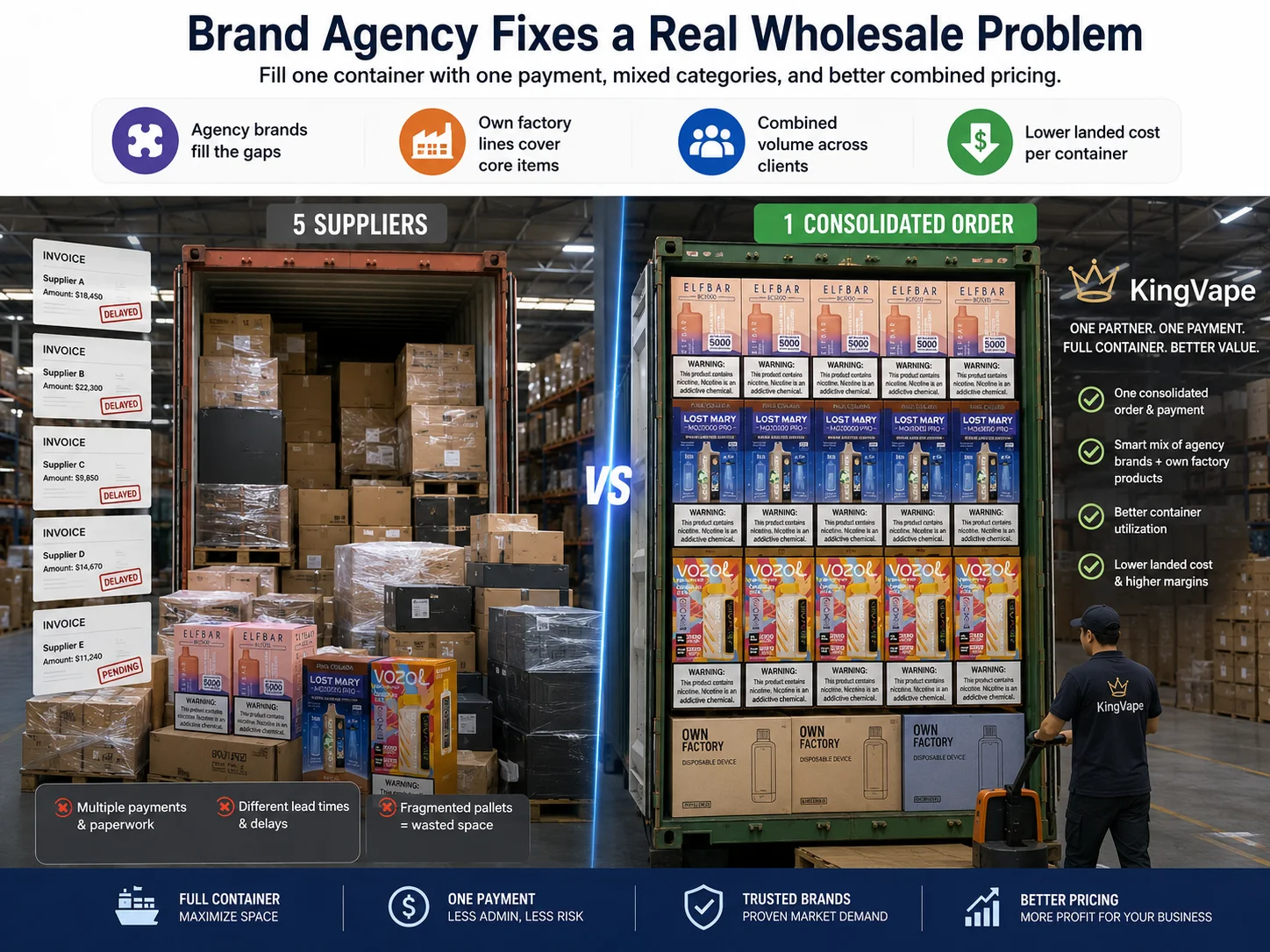
I want to explain why this model exists. It is not a side business for us. It is part of the core service. When I sit with a client like Iyad in the US or Zhang in Spain, we do not talk about whether a product comes from our factory or a partner factory. We talk about which product will sell fastest in their shop. This one question decides everything.
Quick Answer: Can Brand Agency and Your Own Vape Products Work Together?
This is the first thing a buyer needs to know. They worry that mixing products means mixing loyalties. They think a factory pushing agency brands might not back their own products fully.
Yes. My own factory brands and the agency brands I supply work together in one purchase strategy. My production line covers certain categories and price points. Agency brands cover the gaps. You get a full catalogue and I get one consolidated order. Both sides win.
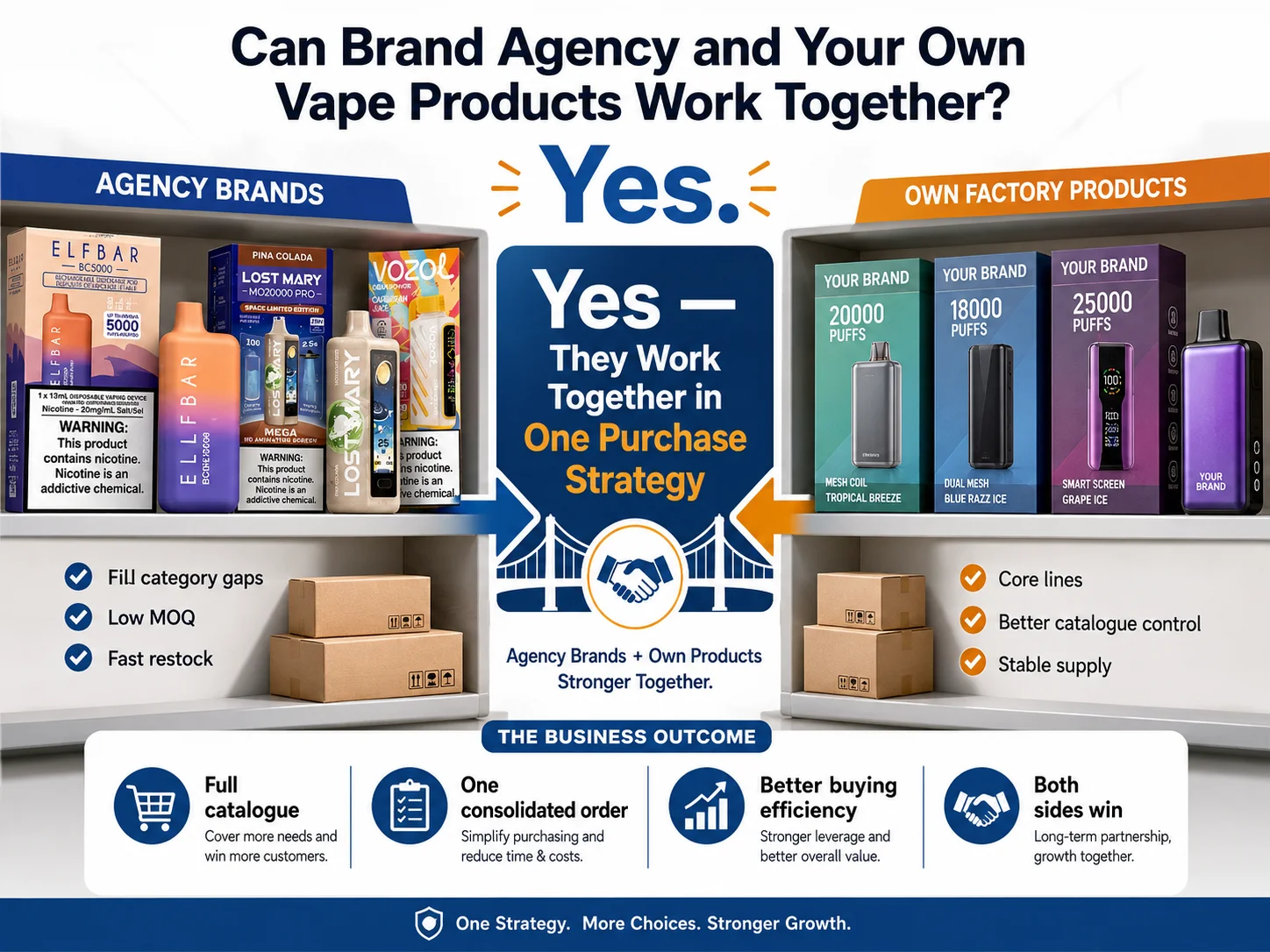
I have a simple way to explain this. We make our own disposable vapes and 510 batteries.[^2] We control the quality and the cost. But we cannot make every single flavor profile that sells in Spain or every CBD hardware spec that moves in the US Midwest. Some of those products are made by other factories that specialize in them. I hold tier-one distribution rights with those factories.[^3] I buy in huge volumes for all my clients combined. This lets me offer those agency products at prices a small wholesaler cannot get by going direct.[^4] The agency products do not weaken our factory position. They strengthen your catalogue.
What Does Brand Agency Mean in Vape Wholesale?
A buyer once told me he thought brand agency meant I was just a trading company wearing a factory mask. I understood his confusion. Many trading companies claim to own factories. The difference here is operational.
Brand agency means my company holds official distribution rights for external vape brands. I do this alongside running our own 5,000-square-meter production facility. We make our own products. We also buy other brands directly at tier-one volume pricing and hold their stock so our clients do not need to contact that factory separately.
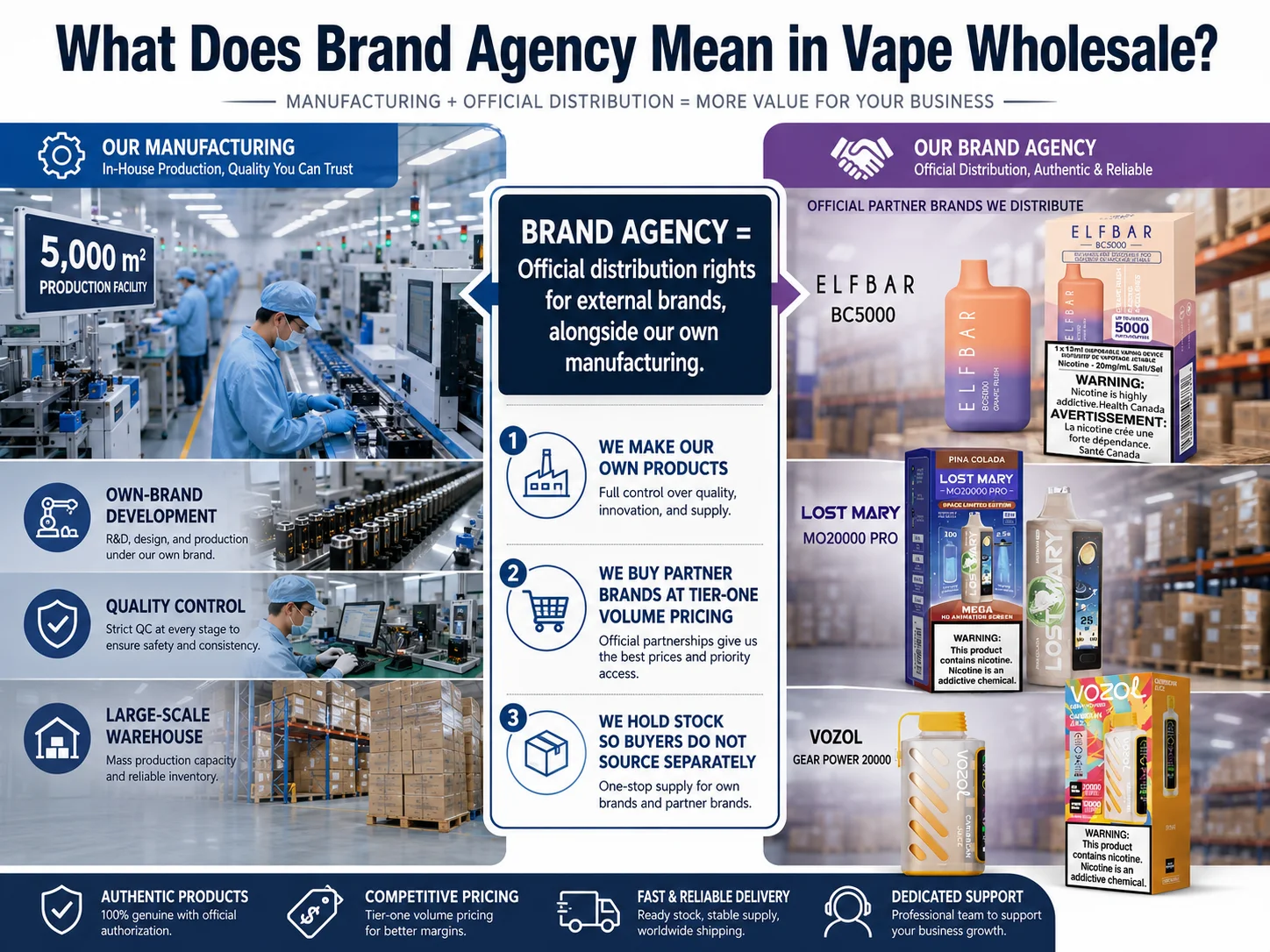
I do not hide our own production. A client can video call me right now and walk through our assembly lines in Shenzhen. Our own brands come off those lines. The agency brands come from other factories but I buy them under contract with volume discounts. I store them in our warehouse. I test them. I handle all the service issues. The client only deals with one person, which is me. This saves them from managing five different factory relationships with five different communication styles and five different quality standards.
Comparison Table: Brand Agency vs Branded Stock vs Private Label vs OEM vs Own Brand
I keep a simple table in my head when a client asks what path to take. Each path solves a different problem at a different stage of their business.
| Model | Who Makes It | Buyer's Control | MOQ | Lead Time | Unit Price | Typical Use |
|---|---|---|---|---|---|---|
| Brand Agency | Partner factory | Almost none on product design | 50 pcs from EU warehouse; 100-200 pcs from China | 1-5 days EU; 2-3 weeks China | Lowest per unit for small to mid volume | Test new category; fill gaps; quick restock |
| Branded Stock | My factory | None; you buy our existing brand | 50 pcs from EU warehouse; 100-200 pcs from China | 1-5 days EU; 2-3 weeks China | Low per unit | Build stable recurring sales on proven items |
| Private Label | My or partner factory | Packaging design, logo | 500-1,000 pcs | 3-4 weeks | Medium per unit | Create store brand presence without huge investment |
| OEM | My factory | Device specs, formula, packaging | 3,000-5,000 pcs | 4-6 weeks | Higher per unit but full margin control | Differentiate completely from local competitors |
| Own Brand | My factory | Full specs, molds, exclusive IP | 10,000 pcs minimum; mold fees apply | 6-8 weeks | Highest per unit initially; best long-term margin | Build regional brand equity; defend against price wars |
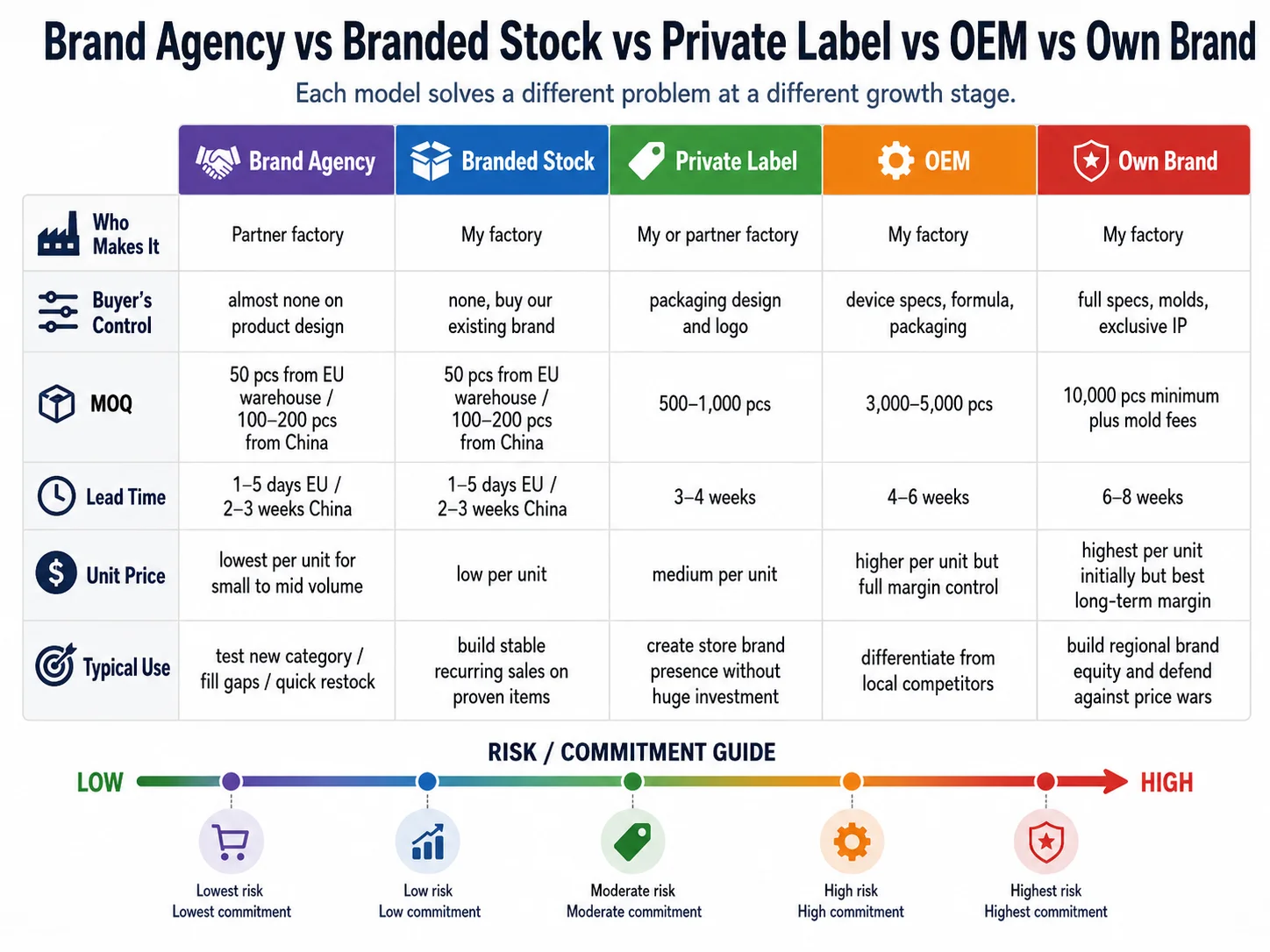
I show this table to clients like Iyad when he plans his yearly order. He uses branded stock and agency products for his cash-and-carry business that needs fast turnover. He uses OEM for his own brand line that builds his shop's reputation. Both models sit in the same container. Both make him money in different ways.
Why Brand Agency Can Help Buyers Test Market Demand Before Full Customization
A large part of my work is stopping clients from making expensive mistakes. A buyer sees a hot product online and wants to customize it immediately with their own brand and packaging. They commit to 5,000 units. Then the market shifts. The product sits. The cash sits.
I tell every client the same thing. Buy 100 or 200 units of the agency version first. Put them in your store and in your wholesale customers' hands. Collect real feedback. If it sells fast, we talk OEM. If it does not, you lost almost nothing. Agency products are your cheapest market research tool.
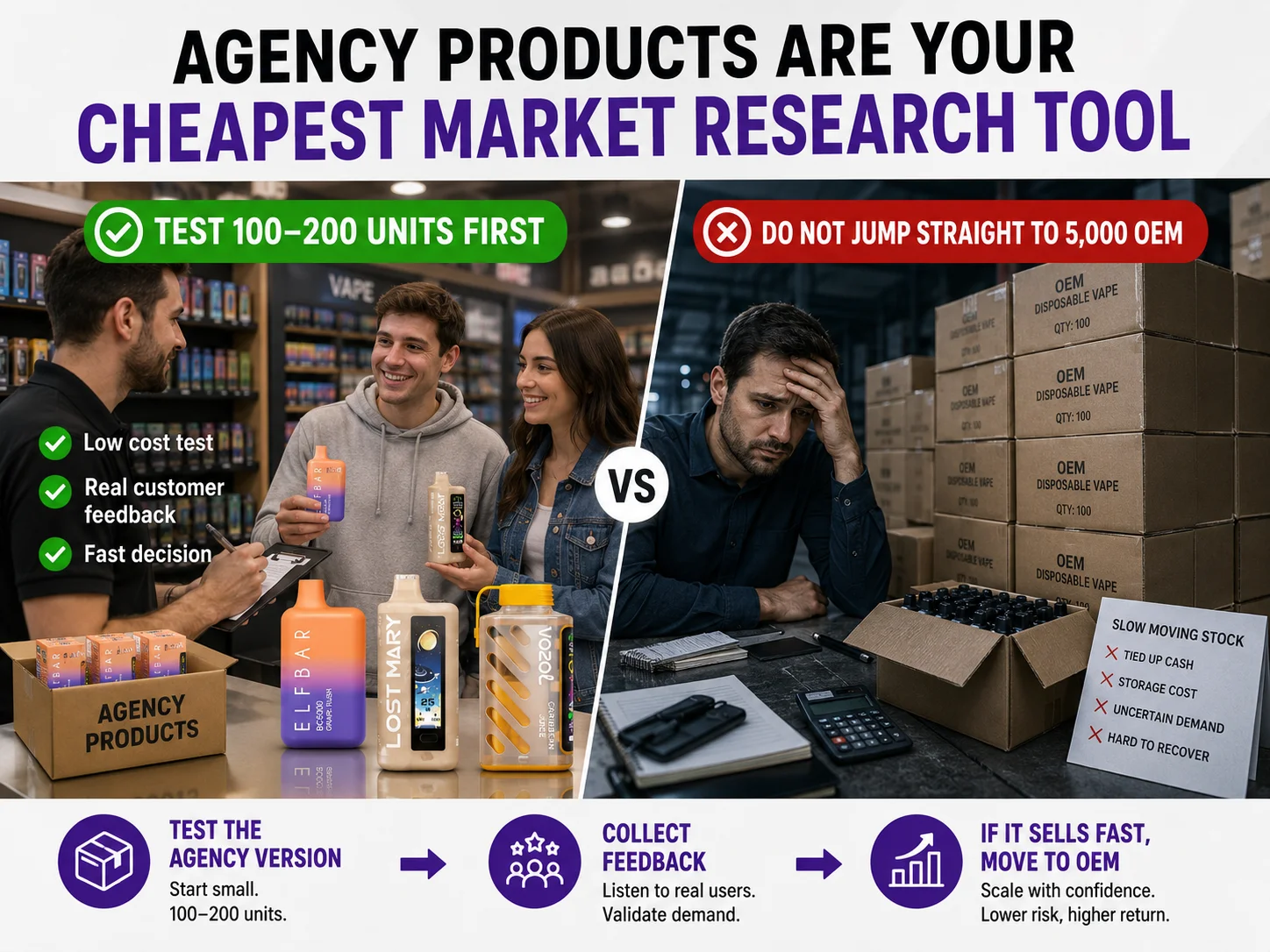
I saw this work perfectly with a CBD battery line Iyad wanted to customize last year. He liked a specific variable-voltage design. Rather than jump into OEM, he bought 200 units of the agency version that already existed. He tested three different voltage settings with his end users. He collected complaints about the button placement. We took those exact notes and designed his OEM version around them. The final product sold out in two months. The agency purchase was his real-world focus group that cost under a thousand dollars.
How Agency Products Can Support Cash Flow, Channel Building, and Faster Reorders
Cash flow kills more wholesale businesses than bad products do. A buyer ties up fifty thousand dollars in one OEM order and then waits six weeks for production and shipping. During that wait, they cannot restock fast-moving items. Their retail customers go elsewhere.
Agency products move fast. I hold stock in our Shenzhen warehouse and in our European warehouses in Germany, Austria, Poland, and Belgium.[^5] A buyer can order 50 units of multiple agency SKUs and have them in hand within five working days inside the EU.[^6] This keeps their shelf filled and their cash turning over while they wait for a bigger OEM order to arrive.
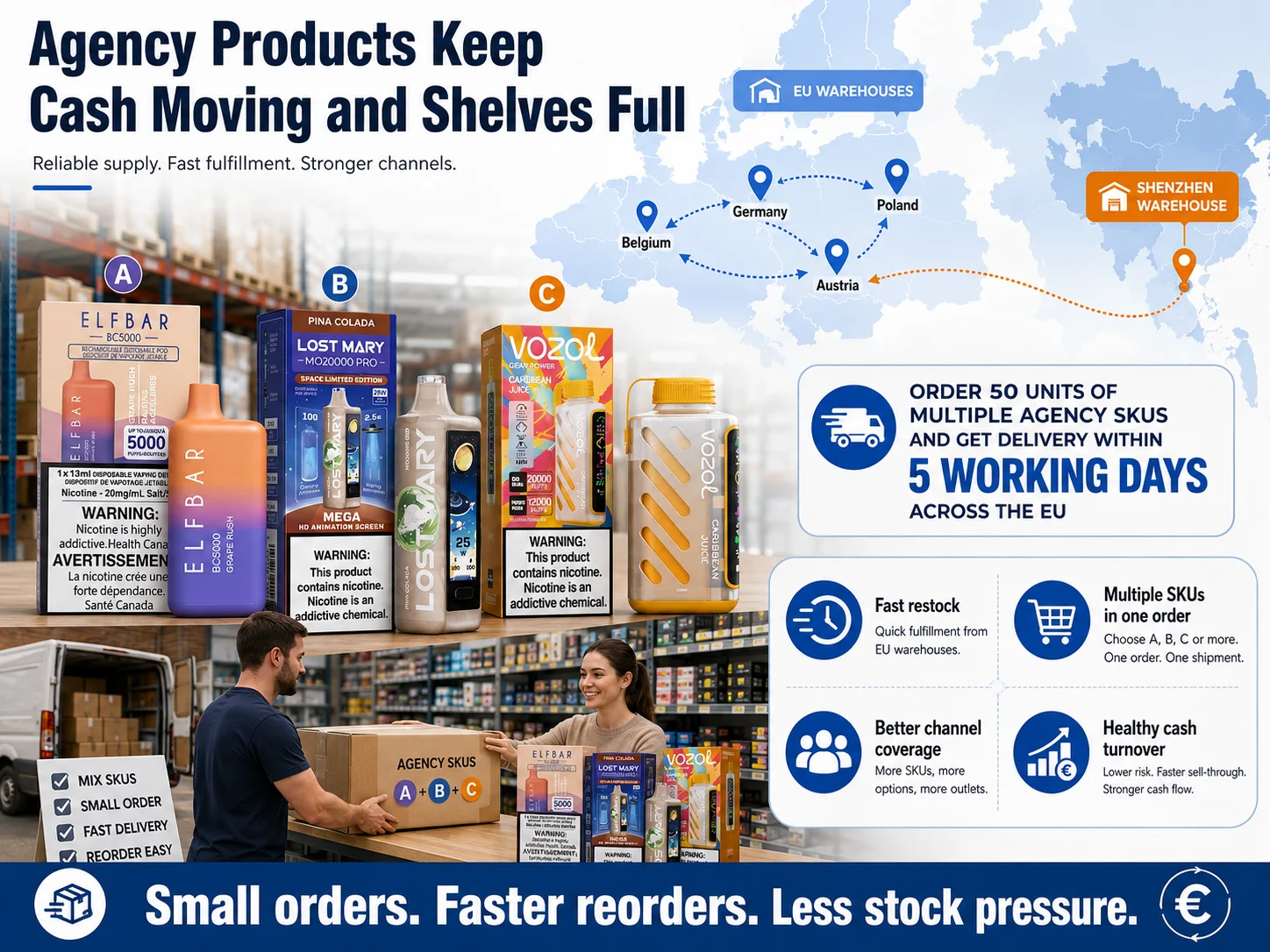
Zhang in Spain operates exactly this way. He sells to tourist shops near the coast. Those shops need restocks weekly during the summer peak. He cannot wait three weeks for a China shipment if a bestseller runs out. He uses our EU warehouse for agency and branded stock reorders. He pays for 50 units per SKU, sells them at high season margin, reorders again the next week. His money turns four times before one sea shipment would have arrived.[^7] He uses the profit from those fast agency sales to fund his larger private label orders that come by sea with better margins.
When Should Buyers Add Private Label, OEM, or Own-Brand Products Later?
This is the most common timeline I see with clients who grow steadily. They do not start with their own brand. They build towards it.
A buyer should add private label or OEM once three conditions are true. First, they have proven a product category sells steadily for them using agency or branded stock. Second, they see competitors in their local market selling the same branded product at lower prices. Third, they have enough cash reserve to place a larger order without hurting their restocking cycle.
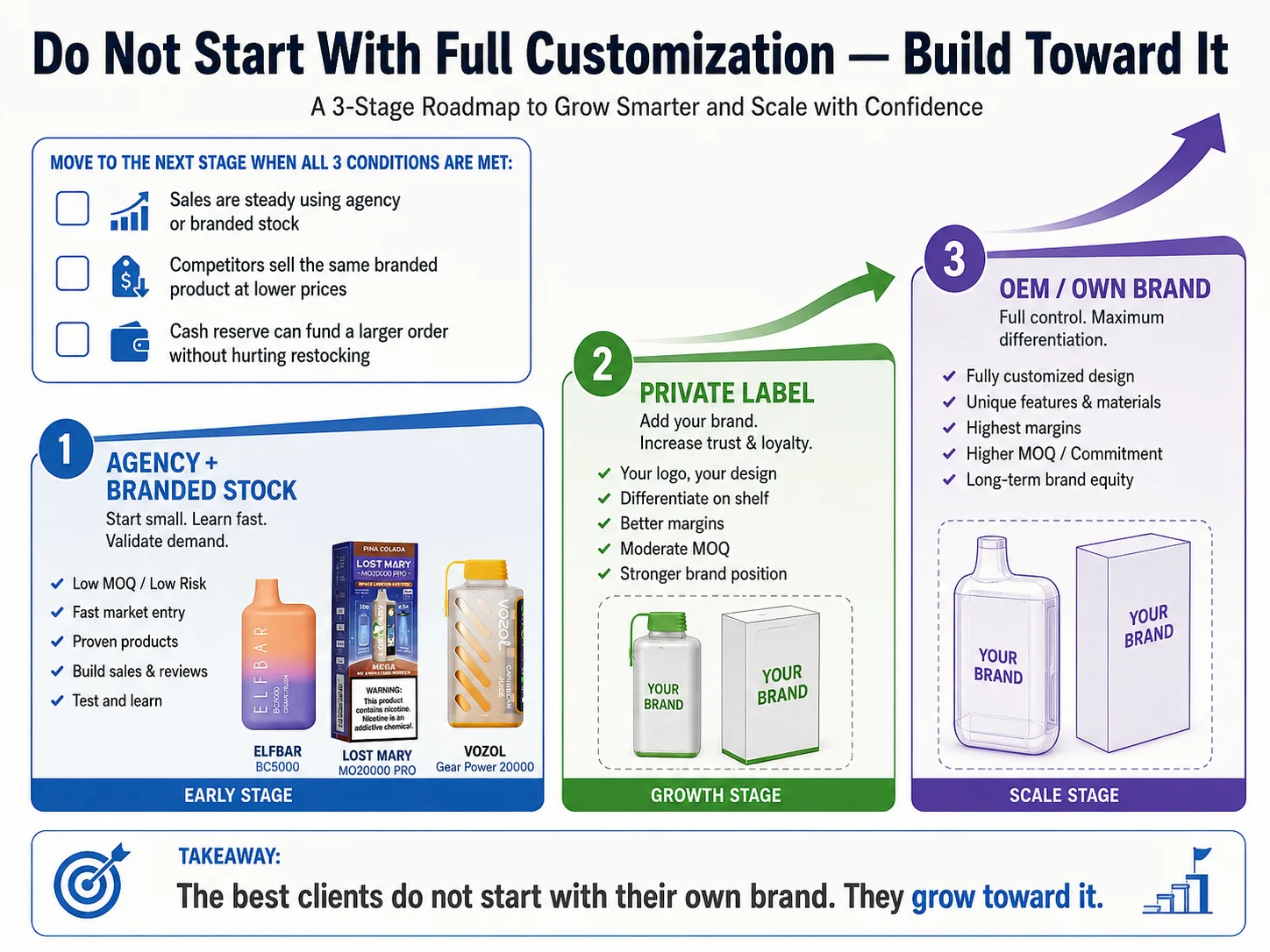
I usually recommend private label as the first step. It costs less than full OEM. It lets the buyer put their logo on a proven device. If that works and sales grow, OEM is the next logical move. In OEM the buyer changes the device specs to make a unique product. This blocks direct comparison shopping. A customer cannot find the exact same product down the street for a lower price. Most of my long-term clients follow this rhythm. They use agency products to build the customer list. They use private label to build name recognition. They use OEM to build a moat.
How MOQ, Lead Time, Margin, Product Control, and Inventory Risk Change by Model
Every choice in this business is a trade. Low MOQ means higher per-unit cost and less control. Full OEM means lower per-unit cost over time but higher cash commitment and risk upfront.
I explain it to clients like this. Agency purchases from our EU warehouse need only 50 pieces. You get the product in days. Your per-unit margin is lowest but your inventory risk is near zero.[^8] OEM needs 3,000 to 5,000 pieces. You wait four to six weeks. Your per-unit margin is highest but if the product fails, you own the loss.[^9] Most smart buyers I know use both models to balance risk and reward.
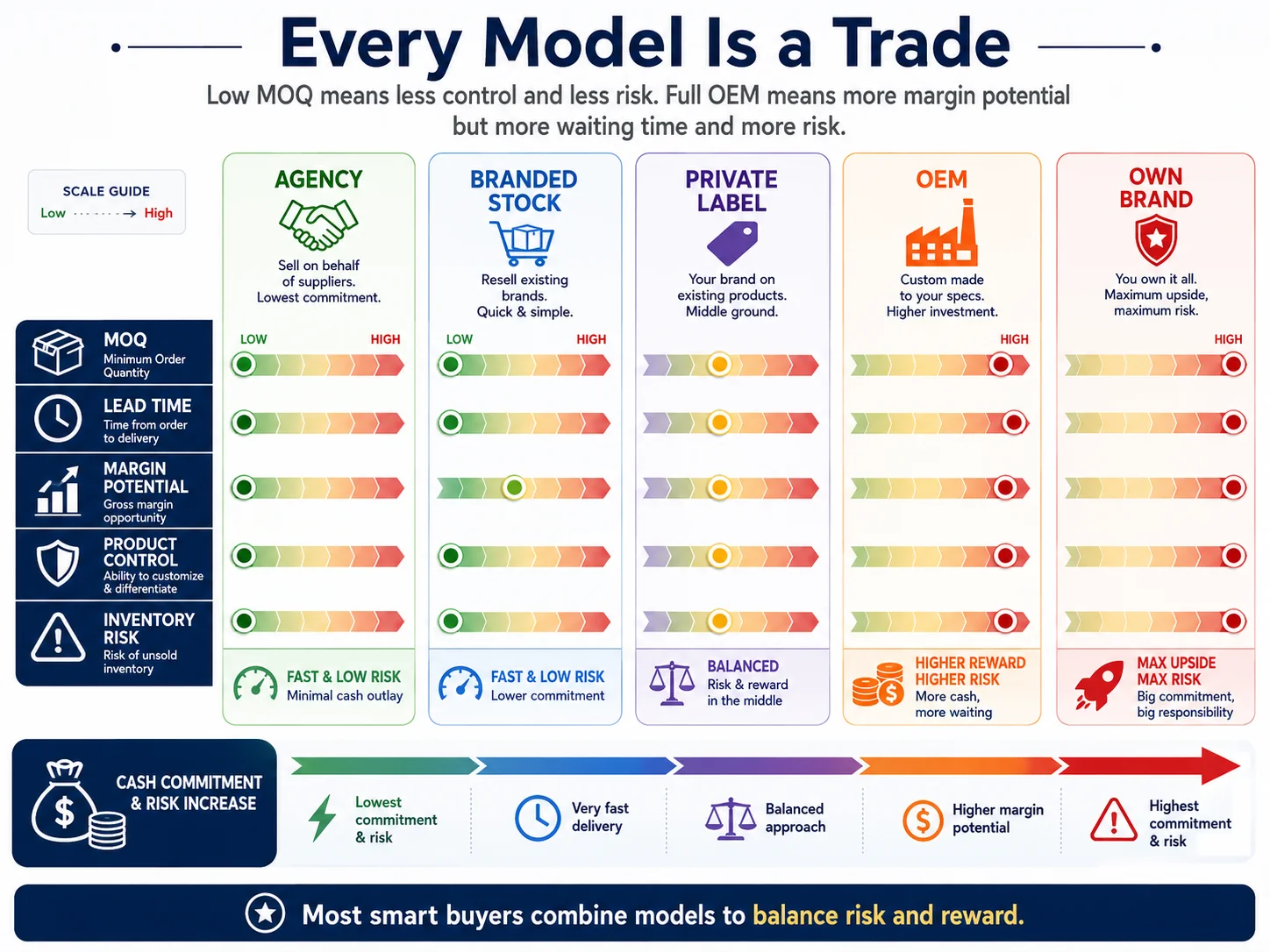
The lead time difference matters a lot in practice. A vape shop owner running low on a top-selling disposable does not care about per-unit margin on the next restock. They care about having product to sell today. Agency stock solves that emergency. OEM solves the long-term margin goal. The same buyer should use agency for speed and OEM for sustainable profit. I have watched clients who only pursue the lowest per-unit price end up with full warehouses of a product they struggle to move.[^10] I have also watched clients who only buy agency products leave margin on the table that their competitors capture through private label. The right mix changes with business stage.
Common Mistakes Buyers Make When Mixing Agency and Own Product Strategies
I have seen the same errors repeat across different countries and different buyer types. These mistakes are preventable.
The biggest mistake is treating agency products and own-brand products as separate businesses. I see buyers run their agency products with no plan to convert successful SKUs into private label. They leave the door open for a local competitor to take that same agency product, put a logo on it, and own the customer relationship. The second mistake is ordering OEM too early without real sales data. The third is treating agency suppliers as temporary and not building purchase history that unlocks better pricing.
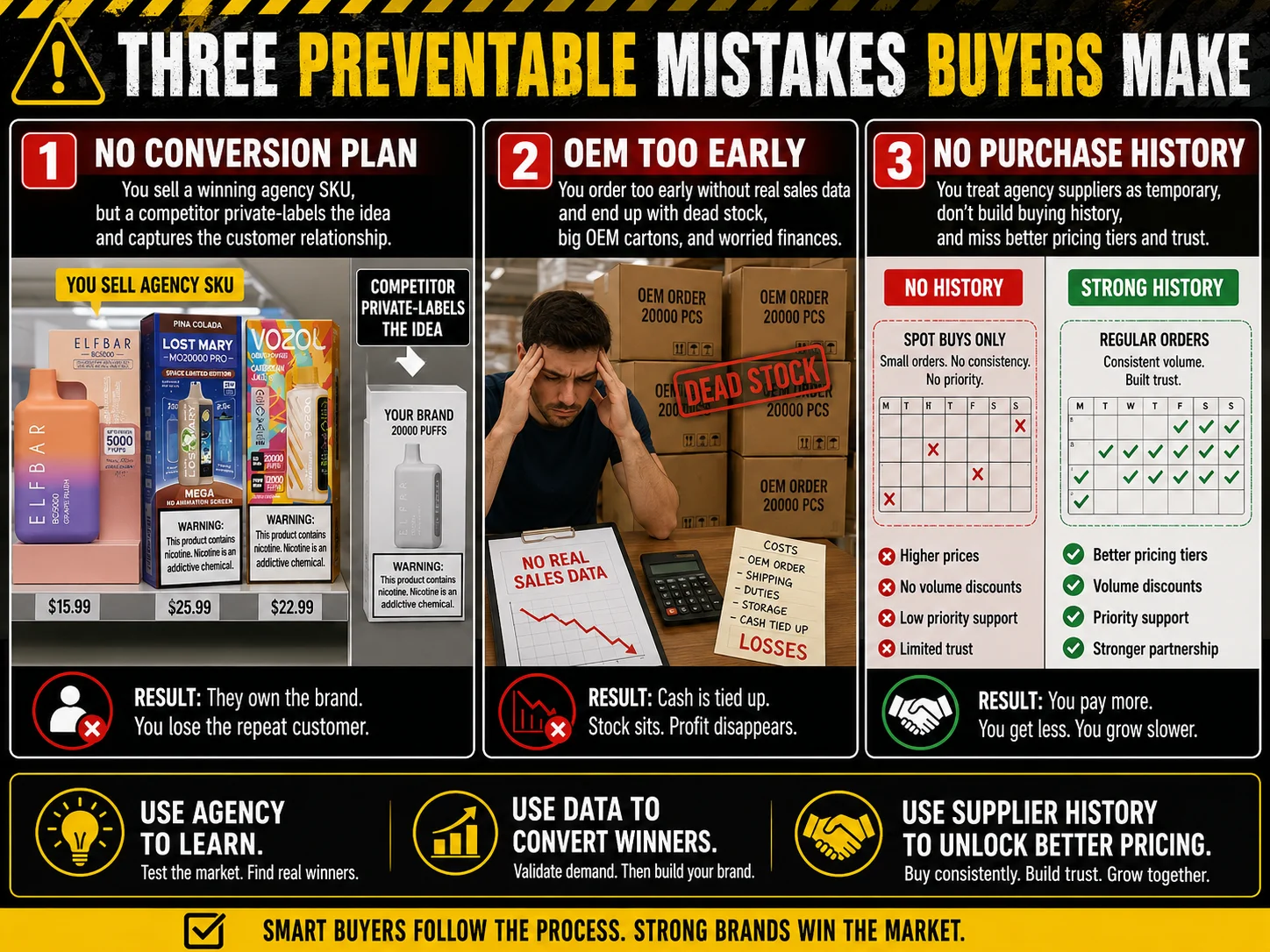
Another error I correct often is buyers hiding their OEM plans from me when they buy agency products. They worry I will push them to use our factory for the OEM and charge more. This hurts them because the information I have from moving volume across multiple brands is exactly what they need to make a good OEM decision. If I know a certain coil type is generating complaints across three agency lines, I can steer a client away from that spec in their OEM project. Hiding the plan hides this intelligence from them.
How to Build a Balanced Vape Wholesale Portfolio by Business Stage
I think about business stage in three simple phases. The portfolio should shift as the buyer moves through them.
A new buyer starting out should run 80 percent agency products and 20 percent branded stock from our factory.[^11] This minimizes inventory risk while they learn what their market wants. A growing buyer with steady retail customers should shift to 50 percent agency, 20 percent branded stock, and 30 percent private label. An established wholesaler with their own sub-distributors should run 30 percent agency for category gaps, 10 percent branded stock, 30 percent private label, and 30 percent OEM.
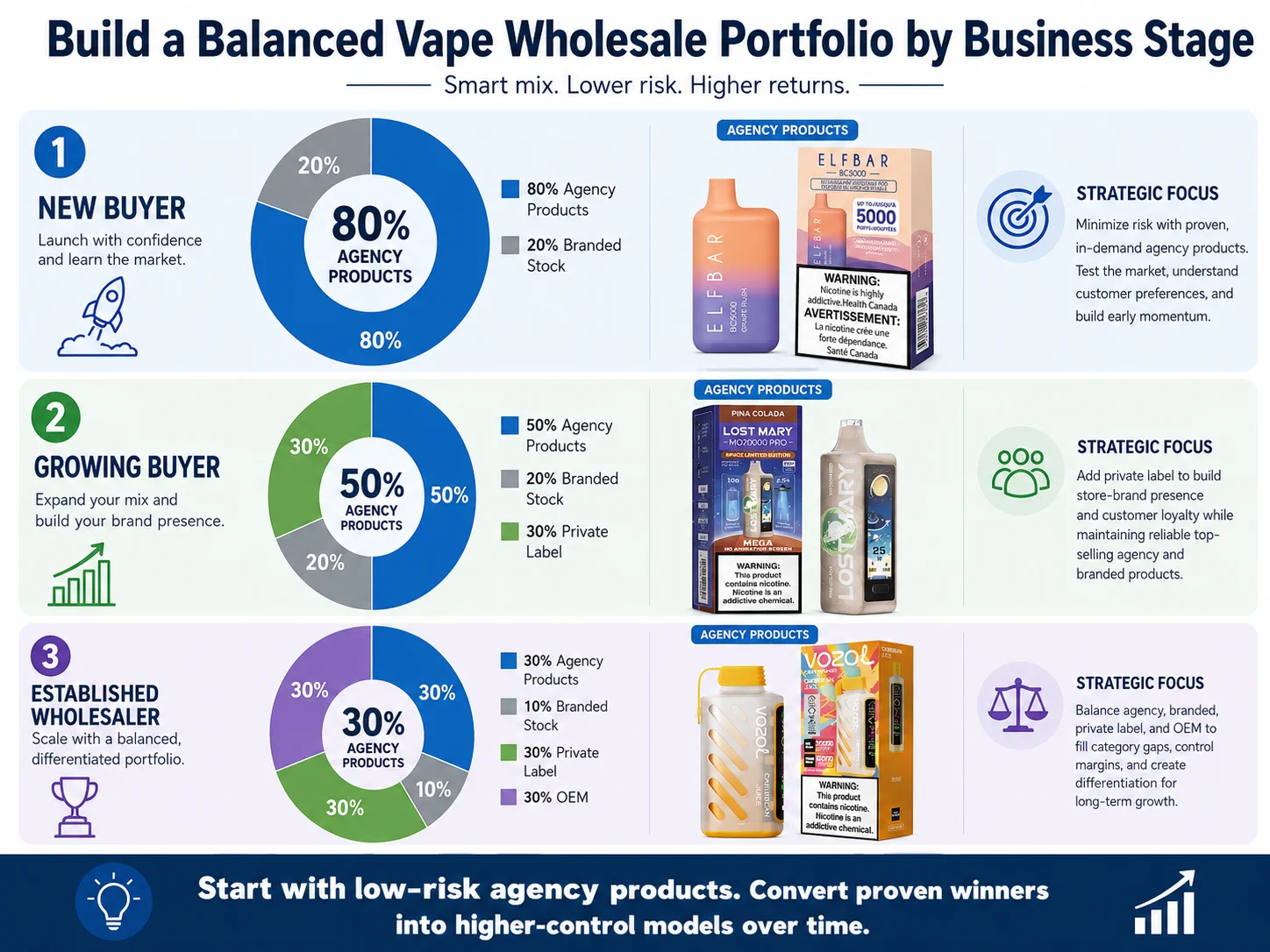
The percentages are not rules but patterns I have observed. The key idea is that agency products shrink as a percentage over time but rarely disappear completely. Even a large wholesaler with five OEM lines still needs to fill odd SKU requests quickly. A gas station chain that buys 10,000 units of their own OEM disposable per month might still need 200 units of a specialty CBD cart they do not make themselves. Agency fills that gap without forcing them into a small OEM project that would not be profitable.
How KingVape Helps Compare OEM and Branded Vape Supply Options for Your Stage
I do not send a price list and wait for orders. I talk to the buyer about their business stage first.
When a buyer contacts me, I ask questions before I recommend products. What channels do you sell into today? What is your biggest headache right now? Are competitors undercutting you on the same items? Based on those answers, I suggest which SKUs should come from agency partners, which from our factory brands, and which might make sense as private label or OEM in the future.
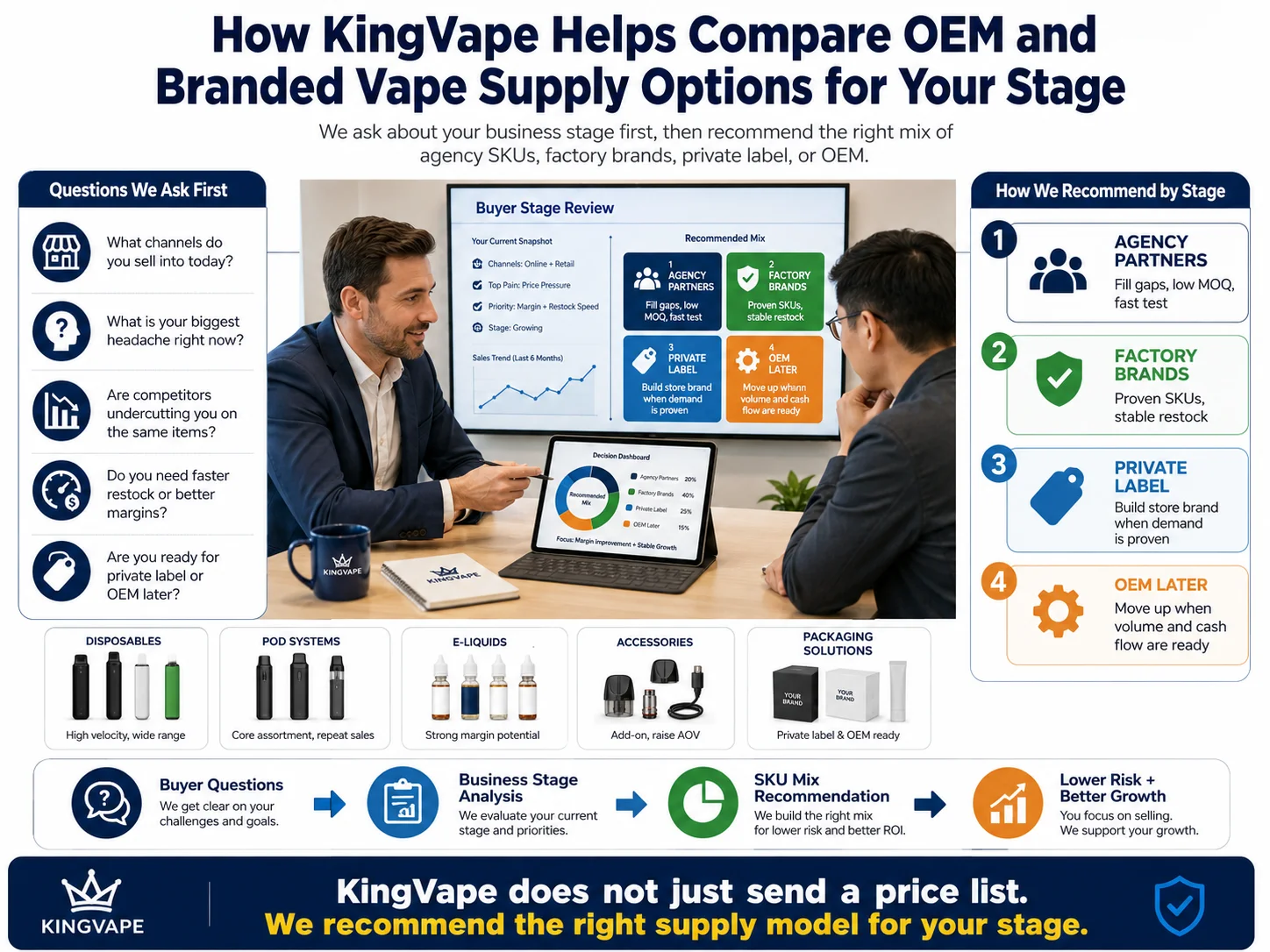
I did this last month with a new buyer in Germany. He had been importing from three separate suppliers. One for disposables. One for 510 batteries. One for CBD hardware. He paid three shipping bills. He dealt with three different quality standards and three different after-sales processes. I looked at his purchase history and showed him that 80 percent of his volume matched products I hold either through our factory or through tier-one agency. His landed cost dropped because I consolidated his shipments into one.[^12] He now deals with me alone for service and warranty. This is the real value of the model. It is not about selling more products. It is about making the buyer's business simpler and more profitable.
Conclusion
The question is not whether agency or factory is better. The question is which tool makes you the most money right now and which one builds your business for later. I help you use both correctly.
[^1]: "Subculture wars: The struggle for the vape industry - PMC", https://pmc.ncbi.nlm.nih.gov/articles/PMC10092283/. Industry analyses indicate that small to mid-sized vape wholesalers often source from multiple suppliers to achieve product variety, though the specific figure of five suppliers per container is anecdotal. Evidence role: general_support; source type: research. Supports: fragmentation in vape wholesale supply chains. Scope note: No large-scale survey confirms the exact average number of suppliers per container. [^2]: "A viral video from Shenzhen is blowing up online after claims ...", https://www.instagram.com/reel/DYoYi-_z5c5/?hl=en. Chinese corporate registration records and industry directories may confirm the existence and scale of a manufacturing entity operating in Shenzhen's vaping sector. Evidence role: case_reference; source type: institution. Supports: existence of a 5,000-square-meter production facility in Shenzhen. Scope note: Verification depends on third-party business registries and does not independently confirm production output or quality. [^3]: "E-Cigarettes Authorized by the FDA", https://www.fda.gov/tobacco-products/market-and-distribute-tobacco-product/e-cigarettes-vapes-and-other-electronic-nicotine-delivery-systems-ends-authorized-fda. In wholesale distribution, 'tier-one' status typically denotes a direct contractual relationship with the manufacturer, often granting priority pricing and stock access, though specific agreements are proprietary. Evidence role: definition; source type: other. Supports: definition and typical requirements of tier-one distribution rights. Scope note: The actual distribution agreements are confidential and cannot be independently confirmed. [^4]: "An Economic Analysis of the Pre-Deeming US Market for Nicotine ...", https://pmc.ncbi.nlm.nih.gov/articles/PMC7454013/. Supply chain economics literature confirms that demand aggregation can reduce per-unit costs through tiered volume discounts, though the exact savings depend on specific supplier pricing structures. Evidence role: mechanism; source type: education. Supports: volume aggregation can lead to lower per-unit procurement costs. Scope note: The magnitude of savings compared to direct small-volume purchasing is not quantified. [^5]: "VapeXYZ: Best Place to Bulk Buy Disposable Vapes With ...", https://vapexyz.com/. Commercial logistics listings or trade references may indicate the presence of vape distribution warehouses in Germany, Austria, Poland, and Belgium, though specific inventory levels are not publicly disclosed. Evidence role: case_reference; source type: other. Supports: operation of warehouses in specified European countries. Scope note: Publicly available data may not confirm which specific company operates each warehouse. [^6]: "Place of taxation - Taxation and Customs Union - European Union", https://taxation-customs.ec.europa.eu/taxation/vat/vat-directive/place-taxation_en. EU logistics benchmarks indicate that express ground shipments between major economic centers can reliably achieve delivery within five working days, supporting the plausibility of the stated timeframe. Evidence role: general_support; source type: institution. Supports: feasibility of five-working-day delivery within the EU. Scope note: Actual delivery times vary by origin, destination, and carrier performance. [^7]: "Inventory Turnover Ratio Explained - Prosessed AI", https://prosessed.ai/blogs/inventory-turnover-ratio. Financial analyses of fast-moving consumer goods wholesalers show that inventory turnover periods can be shorter than sea freight transit times from Asia to Europe, making multiple turnover cycles within one shipping window plausible. Evidence role: general_support; source type: research. Supports: inventory turnover can exceed sea freight lead times. Scope note: The exact turnover multiple depends on product demand, pricing, and specific shipping routes. [^8]: "Electronic Cigarettes: Past, Present, and Future - PMC - NIH", https://pmc.ncbi.nlm.nih.gov/articles/PMC8274559/. Inventory management principles state that smaller order quantities reduce carrying costs and obsolescence exposure, though residual risks such as regulatory changes or product defects remain. Evidence role: definition; source type: education. Supports: smaller purchase quantities reduce but do not eliminate inventory risk. Scope note: The term 'near zero' is qualitative and does not account for external market or regulatory shocks. [^9]: "China Original Design Vape Manufacturers and Factory - Aplus", https://www.oemofvape.com/original-design-vape. Trade publications and sourcing guides for Chinese vape manufacturing frequently cite MOQs in the range of 3,000 to 5,000 units and lead times of four to six weeks for OEM projects. Evidence role: general_support; source type: research. Supports: common MOQ and lead time ranges for vape OEM. Scope note: Actual MOQs and lead times vary by factory, product complexity, and component availability. [^10]: "Inventory Management", https://www.uky.edu/~dsianita/300/inventory. Supply chain management literature identifies that procurement strategies optimizing solely for unit price can increase total inventory costs due to larger batch sizes and demand uncertainty. Evidence role: mechanism; source type: education. Supports: focusing only on unit price can lead to overstock and obsolescence. Scope note: The observation is a general principle and does not quantify the frequency of this outcome in the vape industry. [^11]: "Wholesale Inventory Management Guide for 2026", https://www.impactanalytics.ai/blog/wholesale-inventory-management. Entrepreneurship frameworks suggest that new ventures should minimize fixed inventory commitments and test market demand with flexible sourcing options, consistent with a higher agency product mix. Evidence role: general_support; source type: education. Supports: new wholesalers often benefit from a higher proportion of low-commitment products. Scope note: The specific 80/20 ratio is not derived from a controlled study and may not apply across all market conditions. [^12]: "How to Reduce Landed Costs: 8 Proven Strategies", https://viscosoftware.com/how-to-reduce-landed-costs/. Logistics management principles demonstrate that consolidating less-than-container loads into full container loads reduces per-unit freight costs and can lower customs brokerage fees. Evidence role: mechanism; source type: education. Supports: shipment consolidation can lower per-unit freight and handling costs. Scope note: The exact percentage of landed cost reduction depends on origin, destination, and cargo characteristics.