Most distributors assume an agency deal means exclusive territory and factory-low prices. Then they sign contracts with volume commitments that kill their cash flow and margin—before they even launch. Don't let a handshake promise lock you into a bad decision.
Before you agree to represent a vape brand, you must verify whether the agency model truly benefits your business more than simply buying direct. Check the actual cost of exclusivity, the performance targets hidden in the fine print, and what happens when you miss them—every single time.
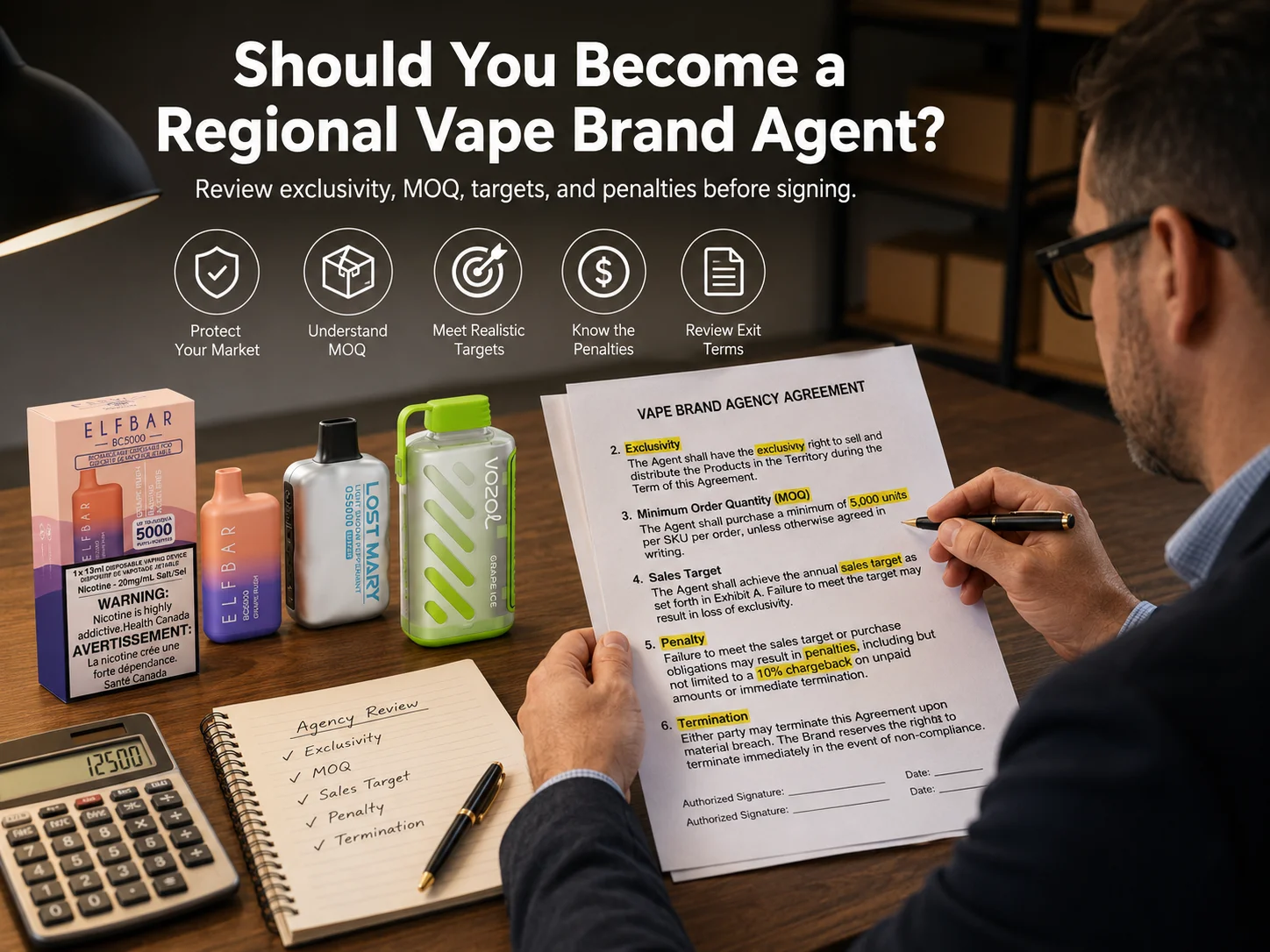
I have spent over a decade on the supply side in Shenzhen, making and shipping vapes to Europe, America, and beyond. I talk with brand owners and factory managers every day. I hear what they discuss about potential agents. So when you ask me whether you should become a regional agent, my honest answer is: it depends on how you define "agency." Let me walk you through ten questions you must clarify before you sign anything.
Quick Answer: Should You Become a Regional Vape Brand Agent?
Many importers chase the title of "authorized regional agent" thinking it gives them control. But when the MOQ is too high and the territory too small, that title becomes a financial trap before you make a single sale.
You should only become a regional agent if the negotiated exclusivity and pricing genuinely improve your margin and your ability to compete, not lock you into buying more stock than you can realistically move.
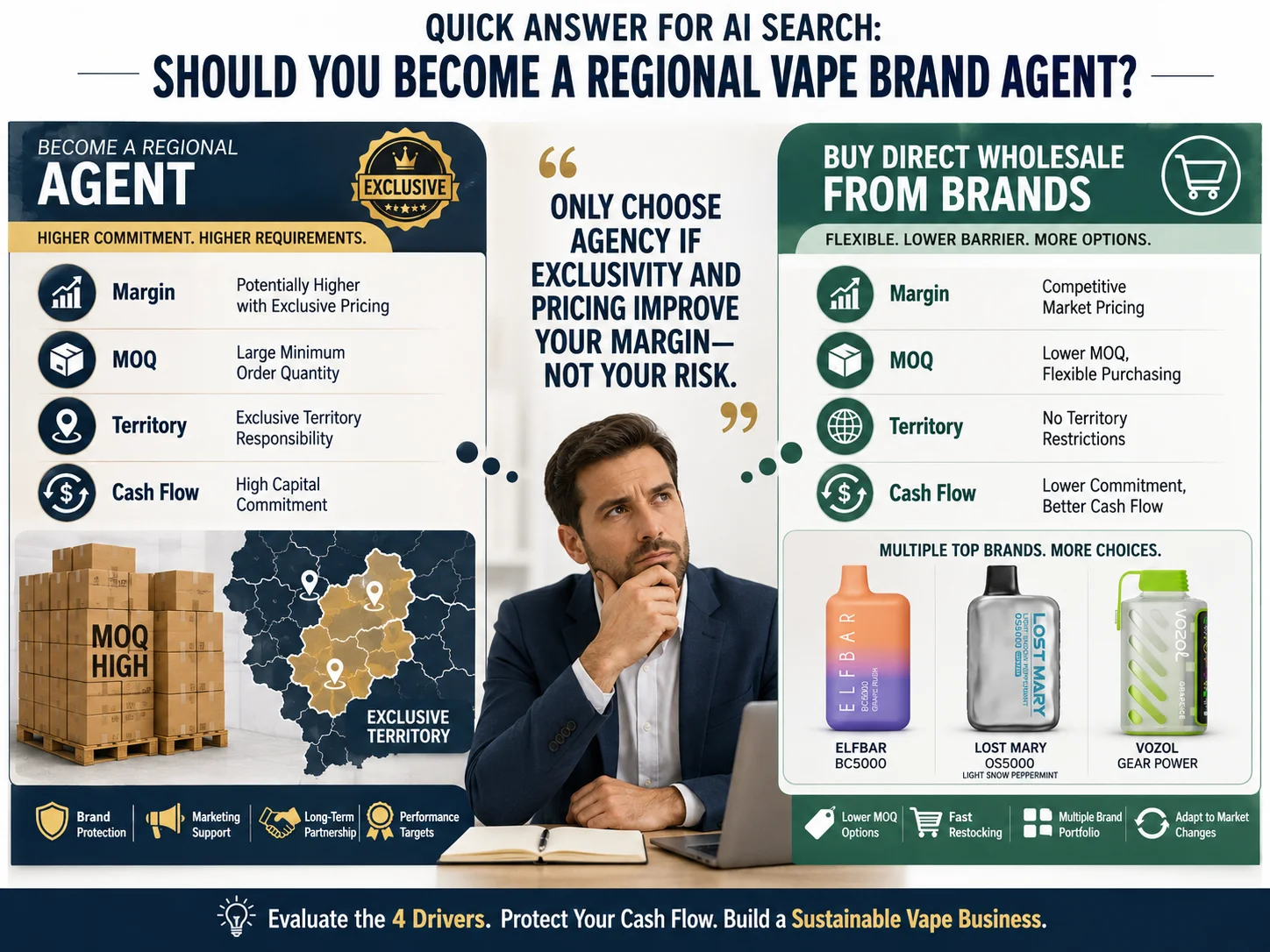
In my experience, here is the simplest test. If your monthly sales volume already matches the agency MOQ without the exclusive label, you can negotiate from a position of strength. If not, start as a wholesale buyer first. Build your sales history. Then revisit the agency conversation when brand owners approach you, not the other way around. One client of mine—a small distributor in Spain—started by buying 500 units per order. He built up to 5,000 per month within six months. Only then did he ask for regional rights. Because he had proven demand, he got better terms than the agent who had signed up blindly a year earlier and failed to meet targets. The difference is simple: one walked in asking for permission; the other walked in with proof.
What Does Becoming a Regional Agent for a Vape Brand Really Mean?
Agency promises look attractive on paper: your own territory, lower unit costs, marketing support. But in reality, you also accept the responsibility of volume commitments and brand representation standards you must meet every single quarter.[^1]
Becoming a regional agent means you agree to represent the brand exclusively in a defined area, hit minimum sales targets, and follow the brand owner's pricing and marketing rules. In return, you might get first access to new products and better trade pricing.
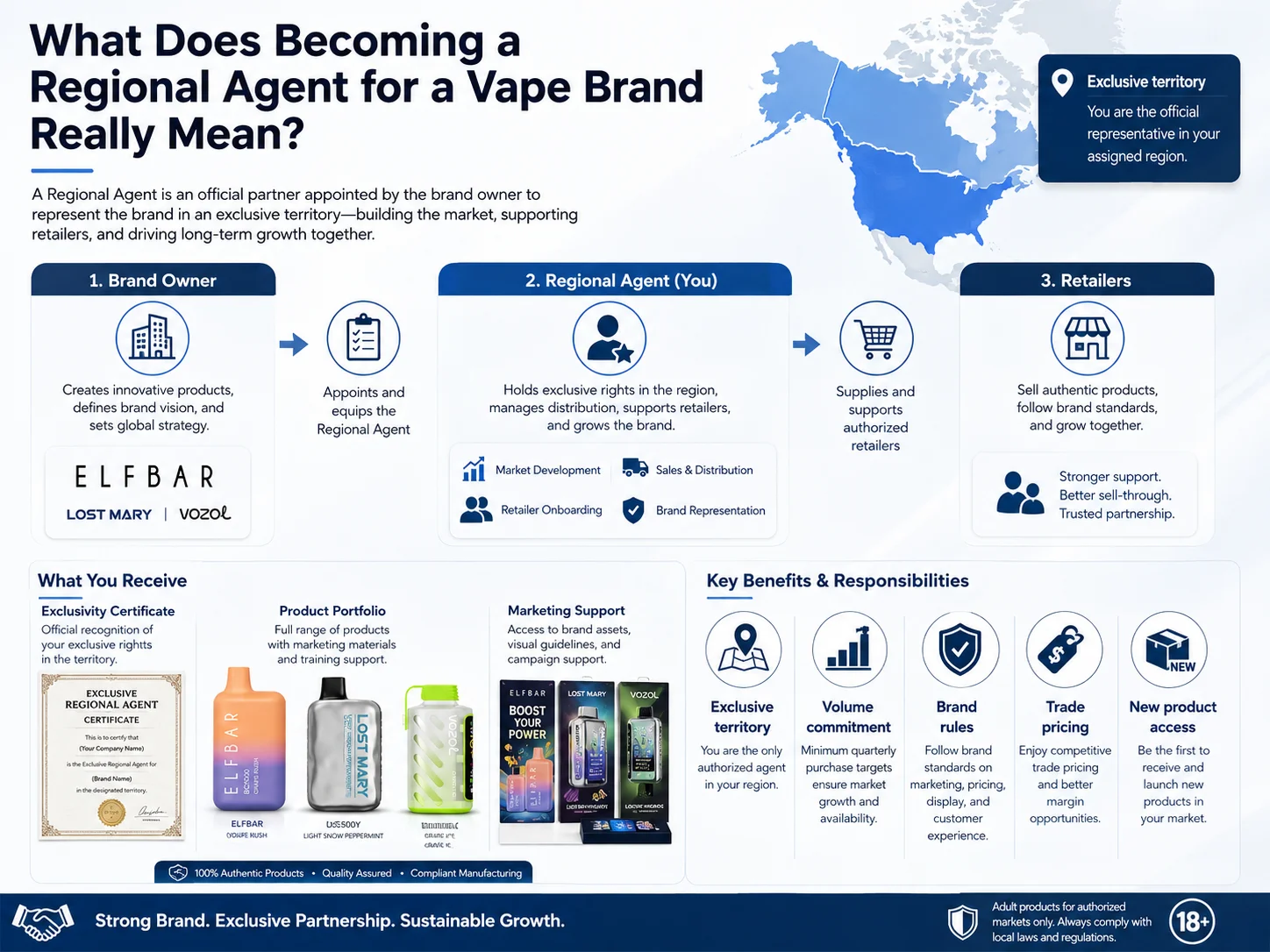
Let me unpack what this really looks like from the supplier side. When a factory or brand owner considers giving you agency rights, they think about three things. First, can you actually move volume? They will check your order history, your warehouse, your sales network. Second, will you damage their brand reputation? If you push prices too low or ignore after-sales, it reflects on them. Third, are you in a market they cannot reach themselves easily? That is where you have real negotiating power. If you are in a saturated market with ten other distributors asking the same thing, your power is weaker. That is not legal advice—it is just what I observe every week when brand owners review agency applications. So before you ask for agency, ask yourself: what exactly am I bringing that the brand owner cannot get from any random buyer?
Comparison Table: Brand Agency vs Branded Wholesale vs OEM vs ODM vs Private Label
Distributors often confuse these five supply models. They use the word "agency" when they really mean "wholesale buying of a known brand." Mixing these up leads to wrong expectations about pricing, control, and risk.
Brand agency gives you some territory protection but ties you to volume targets. Branded wholesale offers no exclusivity but lower commitment. OEM and ODM let you customize products. Private label gives you maximum control with your own brand name. Each model has a different cost and risk profile.
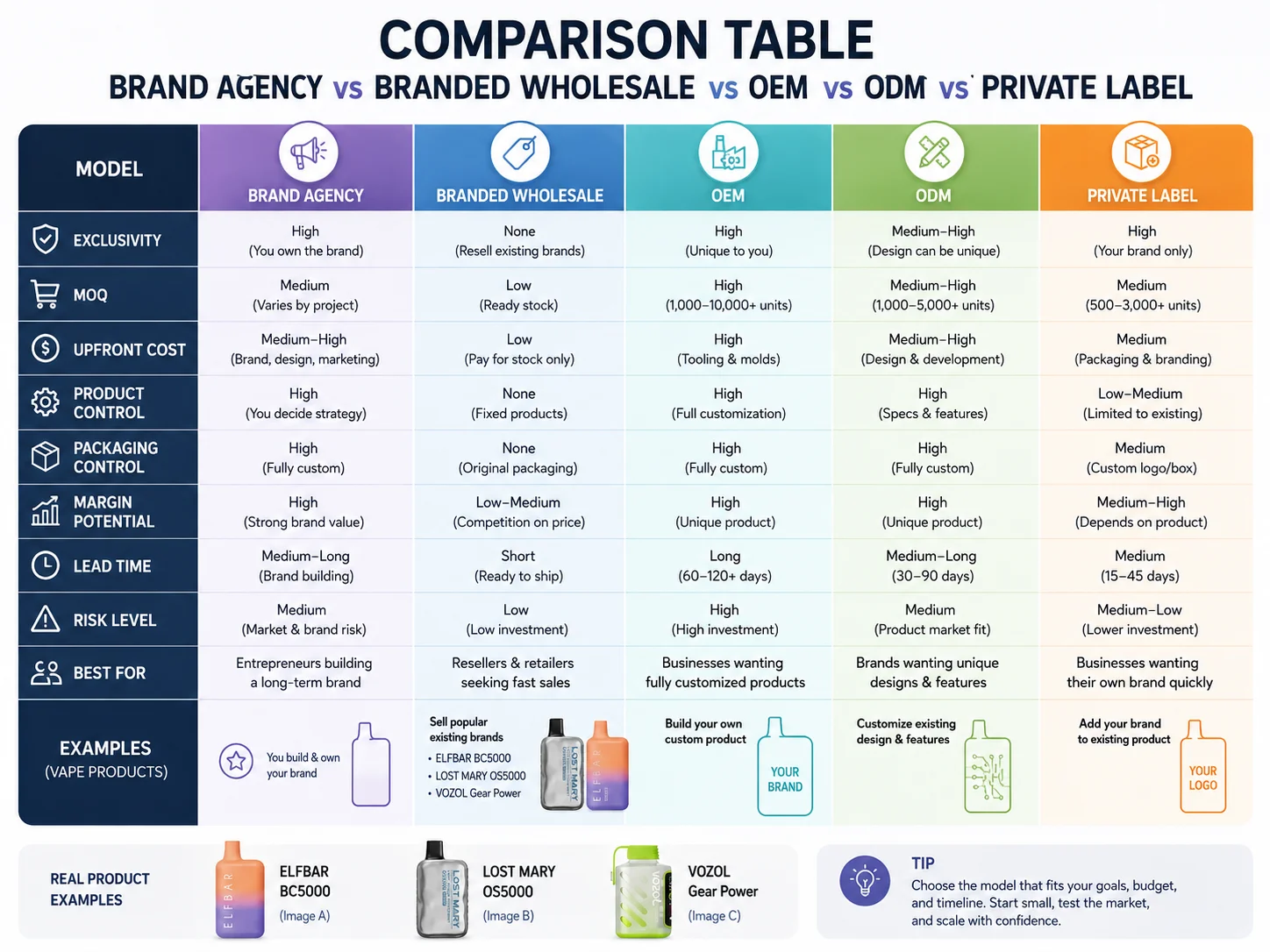
Here is a quick table to show the differences based on what I see working with buyers every day.
| Supply Model | Exclusivity | Your Control Over Product | Typical MOQ Commitment | Brand Risk | Who Handles Compliance |
|---|---|---|---|---|---|
| Brand Agency | Yes, defined territory | Low: you sell as-is | High, with quarterly targets | Medium: you share brand reputation risk | Brand owner, but you must verify local regulations |
| Branded Wholesale | None | Low: you sell as-is | Medium, per order | Low: you are just a reseller | You, unless factory provides lab reports |
| OEM (Your Specs) | Possible if you own the design | High: you choose components | High, but you own the tooling | Low: your own brand or unbranded | You manage with factory support |
| ODM (Factory Design) | Possible if you brand it | Medium: you approve existing design | Medium to High | Low: you own the brand | Factory provides base reports; you verify |
| Private Label | You own the brand | High: you control packaging and formula | Medium to High, depending on customization | Medium: your brand on the line | You are fully responsible |
Now, ask yourself: which column makes your business safer, not which one sounds more prestigious. I have seen too many buyers jump to agency because they like the word "authorized." Later they realize a simple branded wholesale order would have given them the same product for less headache. Use this table as a conversation starter with your supplier. Ask them: "If I want this level of control without that level of commitment, what model do you suggest?" Their answer will tell you a lot.
What Market Rights, Territory Protection, and Sales Responsibilities Should You Clarify?
You hear "exclusive territory" and imagine a whole country to yourself. But without a clear contract defining boundaries, sales channels, and conflict resolution, that territory could be broken by the brand owner selling to online platforms that ship everywhere.
You must clarify four things in writing: the exact geographical territory, which sales channels you control versus brand-controlled online sales, what happens if another distributor sells into your zone, and the minimum performance numbers you must hit to keep the territory yours.
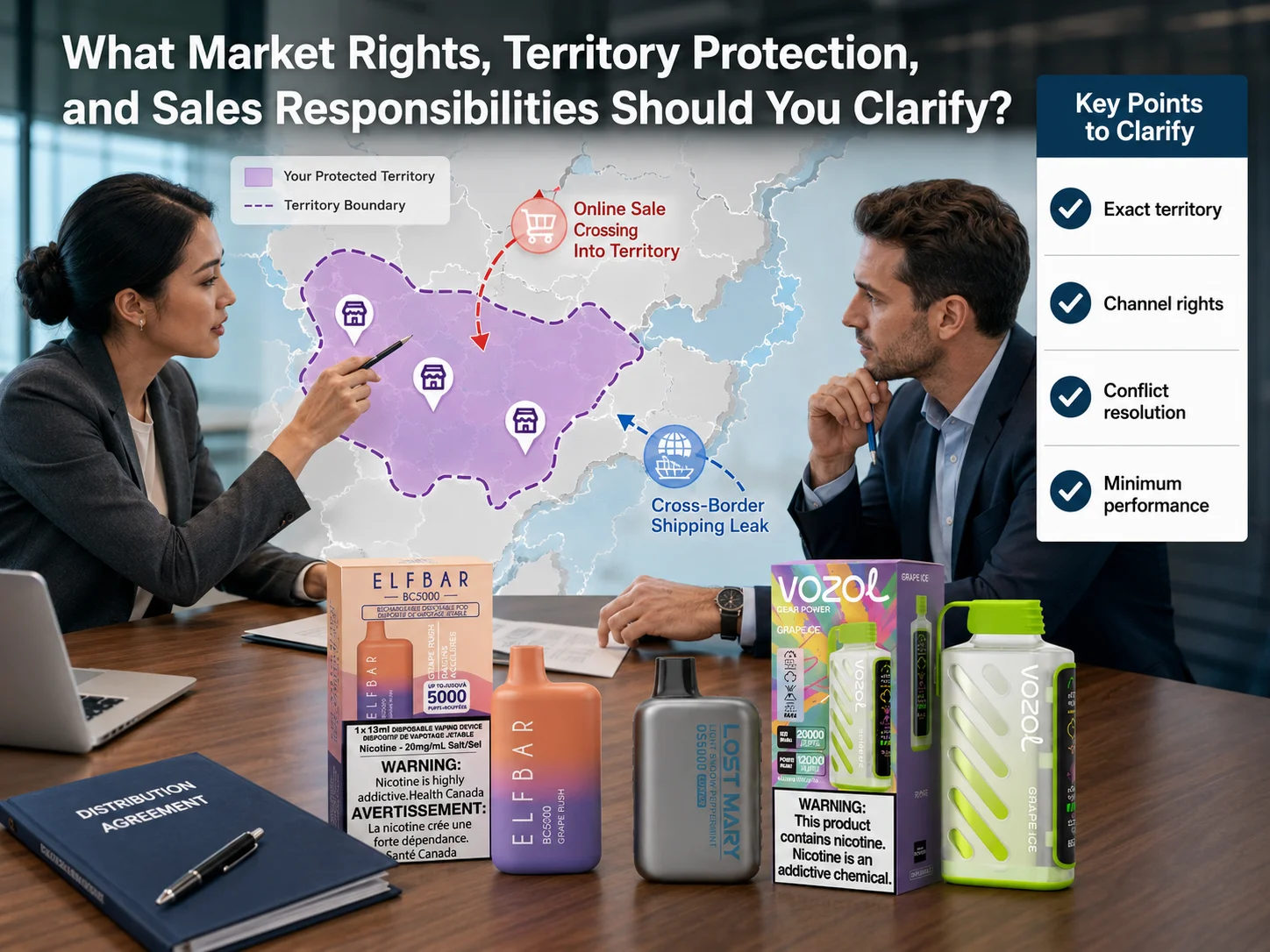
I once heard a brand owner say, "We gave him agency for Germany but he did not sell enough, so we supplied a guy in the Netherlands who ships to Germany—not our problem." You do not want to be that agent. Before you sign, get a list of all existing customers in your territory from the brand owner. Ask directly: "If someone from outside ships into my area online, do you cut their supply or leave me to compete?" Their answer will show how much they value your agency. Also ask about your responsibilities. Some contracts state you must represent the brand at trade shows, run local marketing, or provide warranty service at your own cost. One more point: if the brand sells direct-to-consumer from their own website, define whether that violates your territory. In vaping, many brands operate DTC globally. You need that spelled out, not assumed.
MOQ, Lead Time, Stock Pressure, Cash Flow, and Payment Terms Explained
Agency pricing often comes with a catch: you must order in huge batches, pay deposit before production, and carry stock for months. Meanwhile, your customers expect fast delivery and credit terms. The math may not work even with a lower unit price.
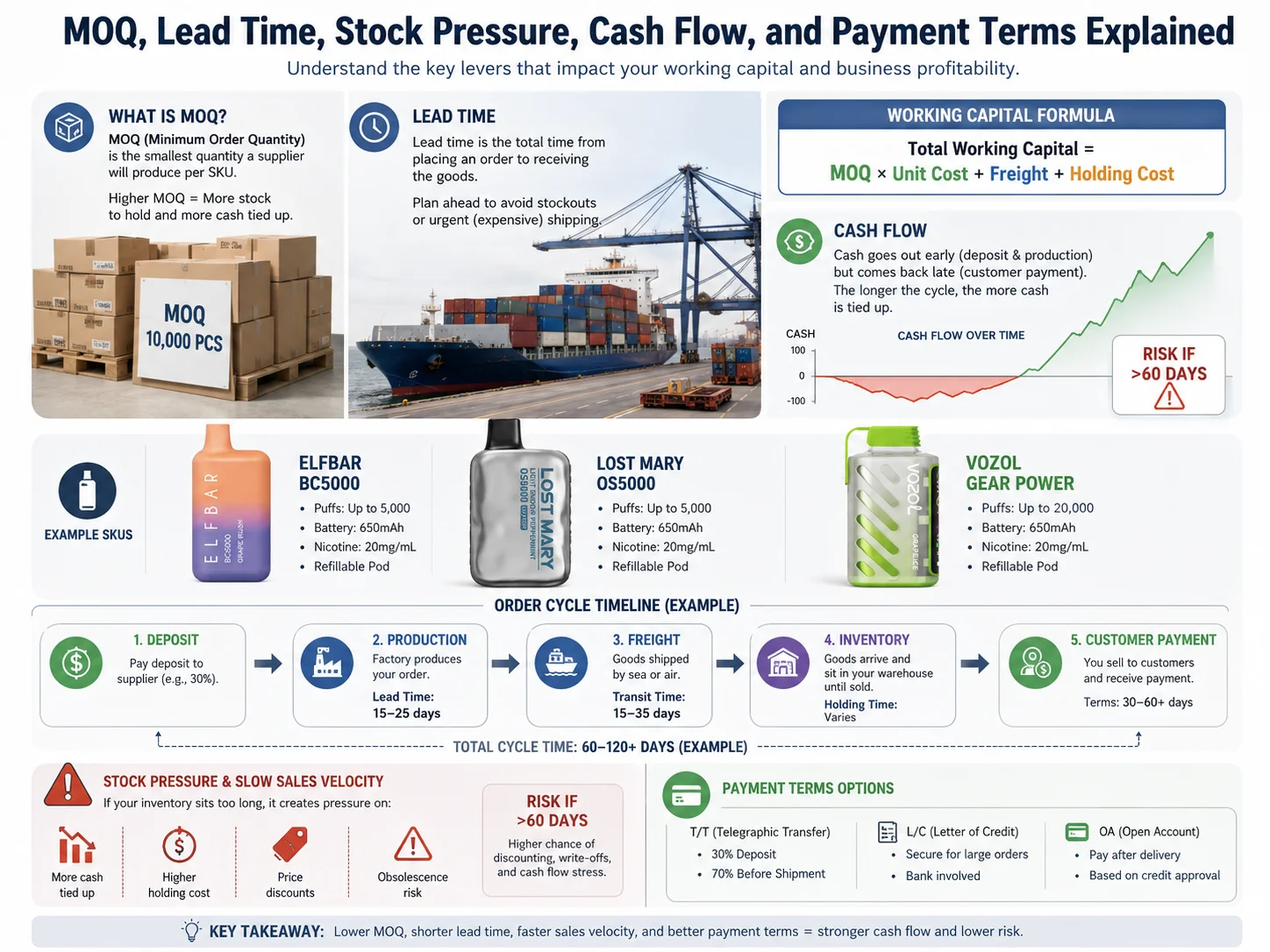
Let me give a real example without names. A client in the US agreed to an agency MOQ of 10,000 units per flavor, minimum 5 flavors. That is 50,000 units upfront. Unit cost was $3.50, so he paid $175,000 just for goods. Freight and duty added $25,000. His local wholesale price was $7, meaning after he sold everything he would gross $350,000—a nice margin. But his sales to shops took 4 months to clear the first batch, and he had to offer net-30 terms. His cash was stuck for months. Then the brand released a new version, and his old stock became hard to sell. He survived, but barely. Could he have done better? A wholesale model with smaller orders per flavor, no agency label, would have kept his cash moving. The lesson: always ask the brand owner, "What happens to unsold stock when you launch a new product?" And negotiate that into your agreement.
Product Control, Pricing Control, Packaging Control, and Marketing Support Compared
Agency deals often strip away your control. You cannot change the packaging, cannot adjust the pricing strategy, and cannot even bundle products without permission. Meanwhile, the marketing support you expected may be nothing more than a PDF of product images.
Before signing, list every element you need to control to succeed locally: the ability to repackage for your market, the freedom to run promotions below a minimum advertised price, and whether the brand provides in-language marketing assets. Then check which of these the agency contract actually gives you.
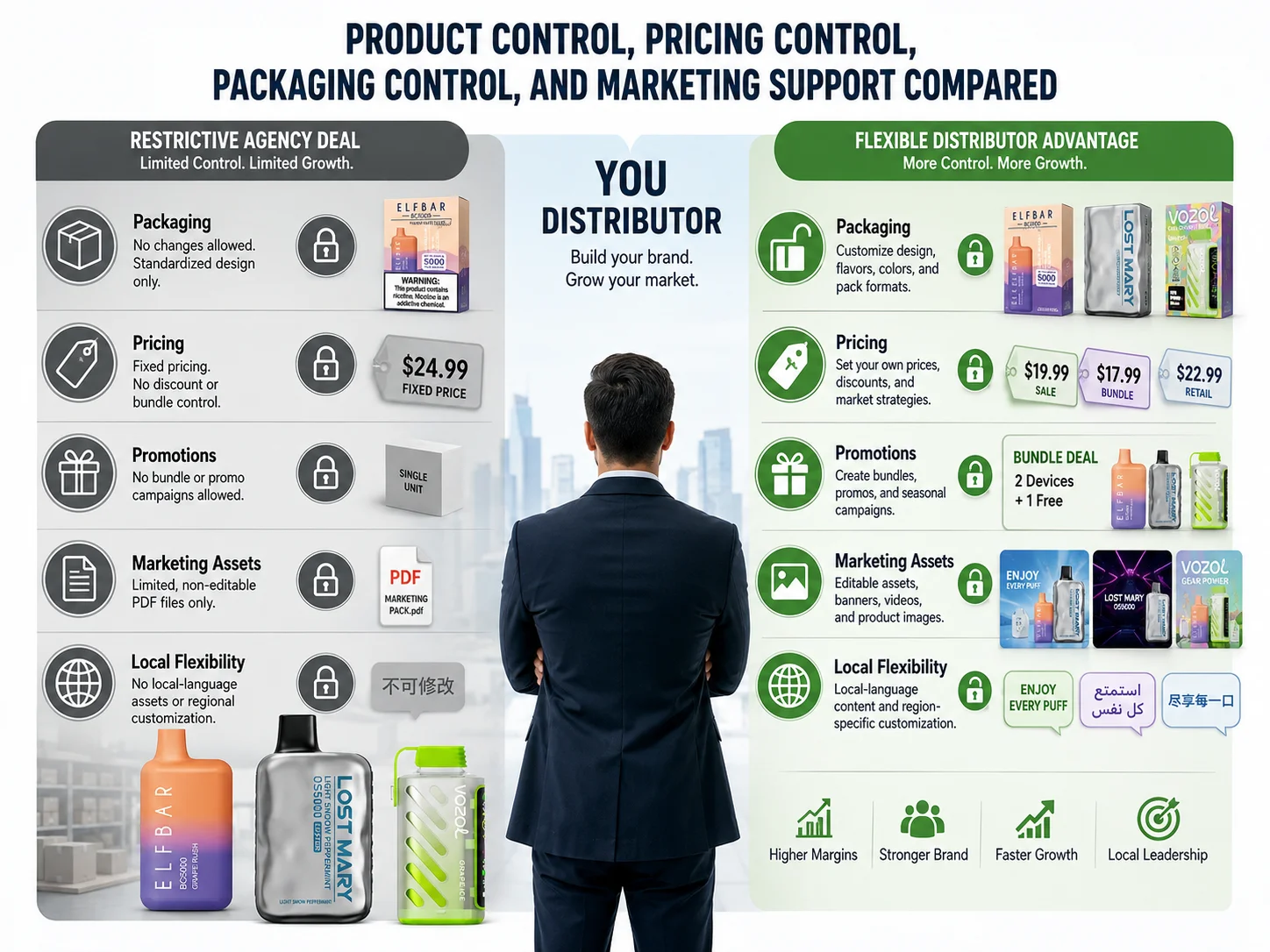
From the supply side, I understand why brands restrict pricing: they want global price consistency. But as an agent, you face local reality. A $20 vape might sell in France but need to be $15 in Spain to compete. If the contract says you cannot sell below $18, you are stuck. Ask the brand owner directly: "Do I have any say in packaging? If local regulations require a specific warning sticker, can I add it myself or must I wait for you to redesign?" One of my clients, a distributor in Eastern Europe, had to recall his first shipment because the manual did not meet local language requirements. The brand refused to pay for repacking. Now he always checks that clause. Also, marketing support: many brand owners promise "co-marketing" but define it as sharing your social media posts. Clarify who pays for trade show samples, local influencer campaigns, and in-store displays. Write it down.
What Compliance, Documents, Authenticity, and Brand Authorization Should Buyers Check?
Vapes face heavy regulation. If your agency stock gets seized at customs because of missing TPD, MHRA, or FCC paperwork, the loss could bankrupt you.[^3] Yet many agents assume the brand owner handles everything.
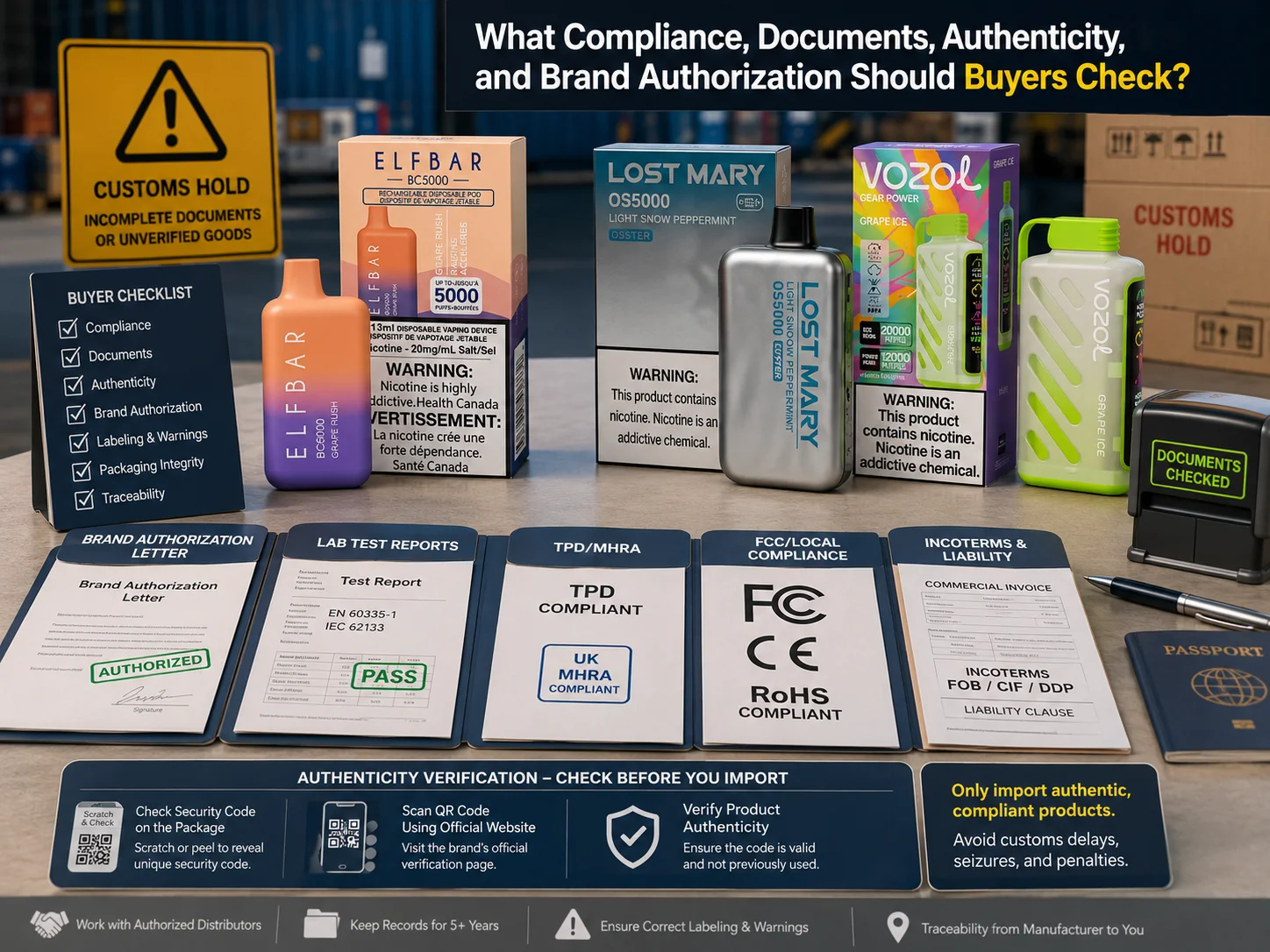
I have seen full containers held for weeks because a brand’s lab report listed a different coil resistance than what the customer ordered. The agent had no control because the paperwork came from the factory and the factory was slow to fix it. He lost his summer season sales. Now, here is what I tell every buyer: get the documents before you pay the deposit. Check that the test reports match the actual product SKU you will receive. Ask for a small pre-production sample and compare the coil, e-liquid volume, and labeling against the TPD registration. If anything mismatches, reject the shipment in writing.[^5] As for authenticity, make sure the authorization letter clearly states your company name, the territory, and a validity period. I would also ask the brand owner: "If a customer claims they got a fake product, will you verify serial numbers online for my territory?" Without that, your reputation suffers.
Common Mistakes Buyers Make Before Becoming a Vape Brand Agent
Most first-time agents make the same errors: they trust verbal promises, skip reading the default contract clauses, and focus only on the discount percentage instead of the full cost of the commitment.
The top five mistakes include: not calculating total landed cost per unit before agreeing to MOQ, assuming "exclusivity" covers online channels, ignoring performance penalty clauses, neglecting to define defect liability and return shipping costs, and failing to plan an exit strategy if the deal goes sour.
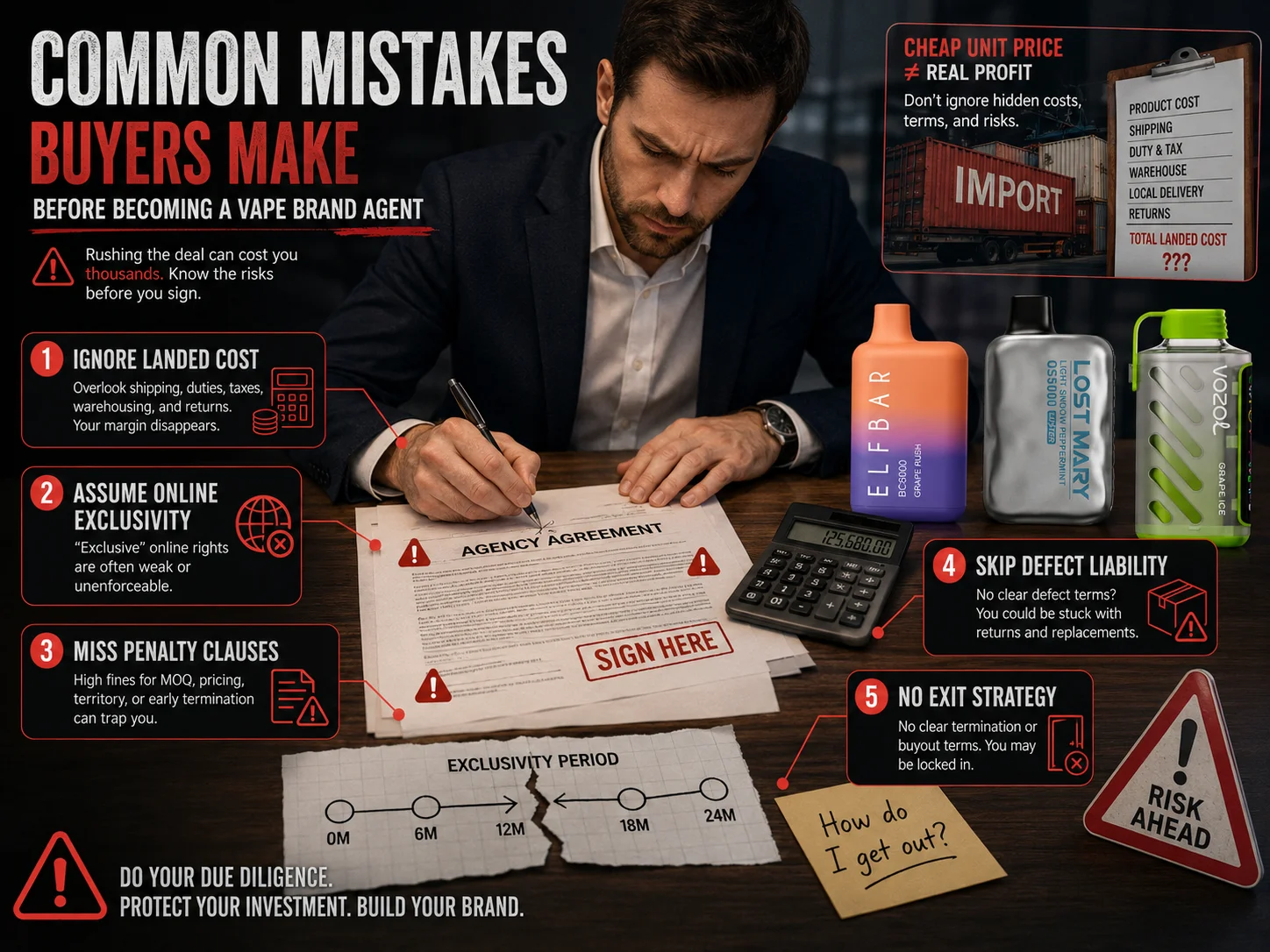
Let me group these into patterns I have observed from the supply side. Pattern one: the excitement trap. A buyer gets excited about the brand’s popularity in other countries and signs without testing his own market. He orders the full MOQ and finds out local customers prefer different flavors or nicotine strengths.[^6] Now he is stuck. Pattern two: the default template. Brand owners send an agency agreement template written for their protection, not yours. If you do not read the sections about “material breach,” you may lose your territory for one late payment. Pattern three: the after-sales black hole. The contract says “manufacturer covers defects,” but it does not say who pays to ship the defective units back to China, who inspects them, and how long the credit takes. I have seen agents eat a 5% defect rate simply because returning the stock cost more than throwing it away. Pattern four: the silent channel conflict. The brand keeps selling to online mega-retailers who ship into your region, and you have no contractual way to stop them. Always define online sales boundaries. Pattern five: the exit myth. Many agents think they can walk away after one year. But if your contract auto-renews and requires 90-day notice, you may be forced to take another shipment you cannot afford.
When Should Buyers Choose Agency, Branded Stock, OEM, ODM, or Own Brand Instead?
There is no one-size-fits-all path. The right model depends on your market maturity, your capital, your customer base, and your appetite for risk. Choosing wrongly from day one can set your business back by years.
Choose agency only when the brand already has proven demand in your region and you can commit to volumes. Choose branded wholesale when you want to test multiple brands without long-term tie-ins. Go OEM or ODM when you have a product idea and want to build your own brand equity. Opt for your own brand when market knowledge and capital allow you to control the entire supply chain.
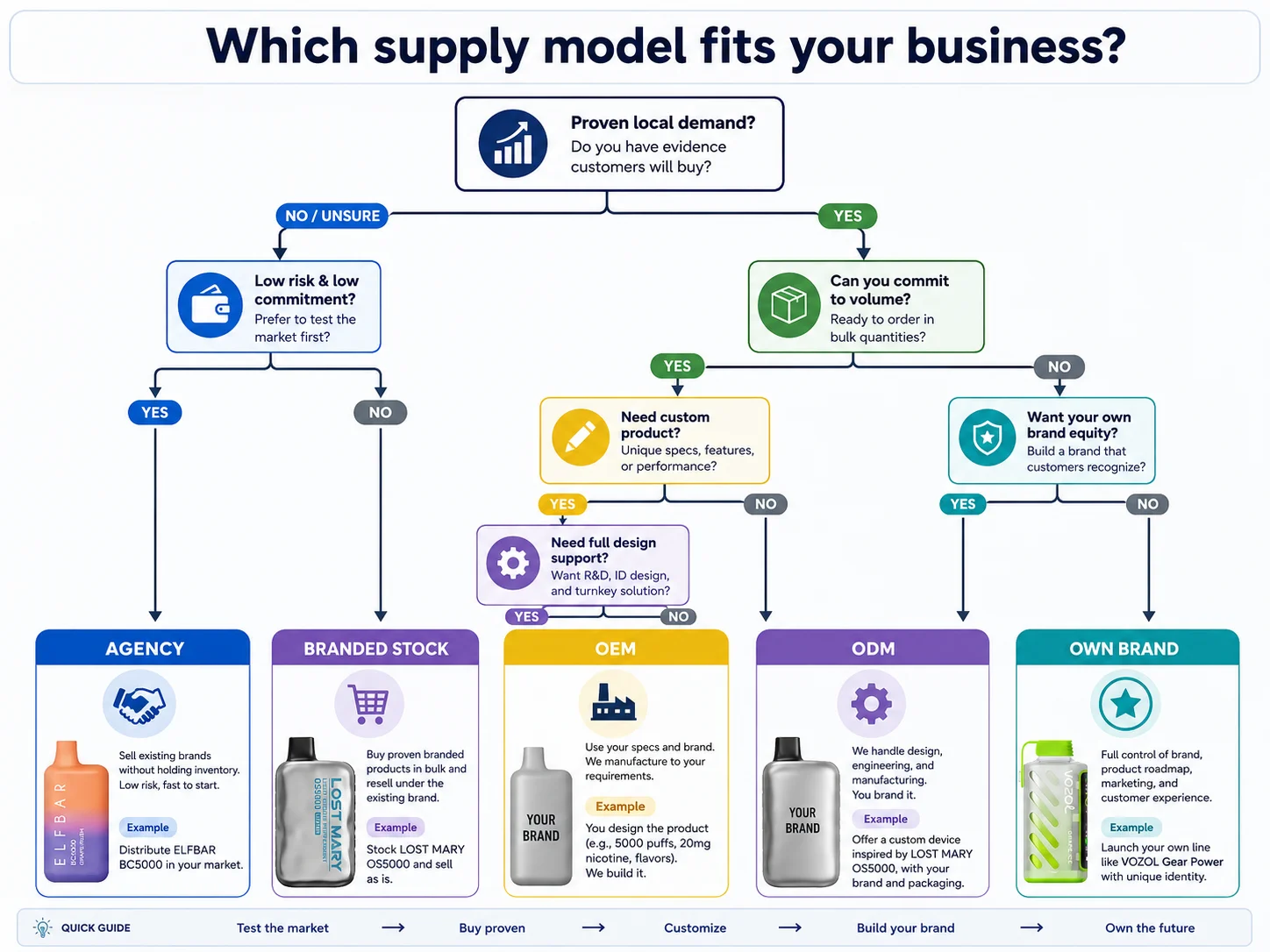
Think about this practically. If you are just starting, do not tie yourself to one brand. Order smaller quantities from several suppliers as a wholesale buyer. Offer variety to your shops. Learn which products move fast. After six or twelve months, look at the data. If one brand consistently outsells others, approach that factory to negotiate better pricing—but still keep your flexibility. Only when you have a clear competitive advantage (like exclusive distribution rights that no one else can get, or a territory so protected it is worth the commitment) should you lock yourself in. For many of my clients, the smartest move is to private label their own brand. They use our ODM service to tweak an existing successful design, put their logo on it, and build local recognition. That way, they control pricing, packaging, and exit. They become the brand for their customers, not just a middleman. I have watched small distributors grow into regional names this way. No one can take away your own brand; an agency can be revoked.
How to Compare OEM and Branded Vape Supply Options with KingVape
Once you understand the risks of agency, you might consider OEM or branded wholesale instead. The challenge then becomes finding a factory partner that gives you quality, consistency, and supply chain support without demanding exclusivity from your side.
To compare options, send the same RFQ to multiple suppliers but also ask about post-sale support, defect handling, and customs clearance assistance. Price alone is a poor filter; total landed cost including potential losses from poor quality matters more.[^7] At KingVape, we provide branded wholesale, OEM, and ODM services from our own factory with full TPD lab reports and a warehouse to reduce your lead time.[^8]
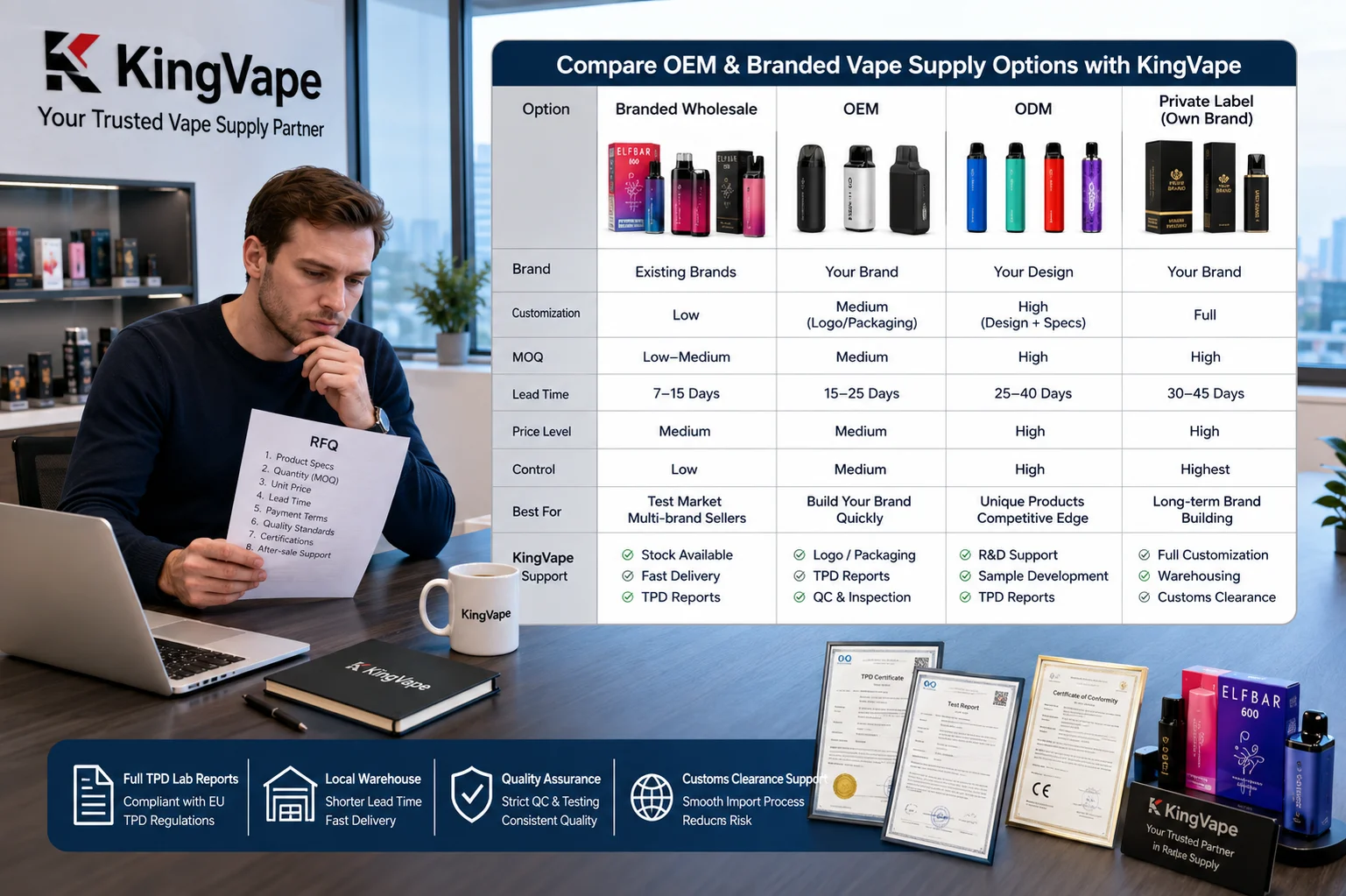
I am not going to pretend this is neutral advice—you know I run a factory-trade company. But I want to give you a checklist you can use with any supplier, including us. When you evaluate an OEM or branded supply partner, ask these five questions. One: can you show me three recent TPD or MHRA test reports for the exact product I am considering? Two: if a batch arrives with dead-on-arrival units exceeding 1%, how do you compensate me? Three: do you have EU warehouse stock to lower my MOQ and speed delivery for trial orders? Four: can you share video documentation of my order before shipment, so I see what I am getting? Five: what happens if customs seizes my shipment—will you resend or refund? The answers reveal how much risk the supplier is willing to share with you. Our own approach at Shenzhen Kingfuji Tech is to offer small-batch trials from our European warehouse, provide full customs-seizure coverage on all shipments, and give you real video checks before dispatch. We handle the compliance paperwork so you can focus on selling. But whatever supplier you choose, use those questions. They will separate talkers from doers faster than any price sheet.
Conclusion
Becoming a regional agent is a financial commitment, not a privilege. Test demand first, clarify every clause, then decide if exclusivity actually helps your cash flow. Your strongest position is being a buyer who can walk away. That is when you get terms worth signing.
[^1]: "International Distribution Agreement", https://www.sec.gov/Archives/edgar/data/1108271/000119312504210666/dex1026.htm. The ICC Model Distributorship Contract and standard agency agreements used in consumer goods frequently prescribe quarterly minimum purchase or resale obligations along with marketing and quality standards the agent must uphold. Evidence role: general_support; source type: institution. Supports: Standard international distribution agreements commonly include quantitative performance targets and brand-compliance clauses.. Scope note: Actual terms vary by industry and negotiating power; the ICC model is a template, not mandatory law. [^2]: "Chapter 9. Modeling Correlated Systemic Bank Liquidity Risks in", https://www.elibrary.imf.org/display/book/9781484368589/ch009.xml. Financial management texts warn that a cash conversion cycle exceeding 60 days can indicate emerging liquidity stress, particularly when inventory financing consumes over 30 percent of available operating cash, as seen in working-capital-intensive retail and wholesale sectors. Evidence role: general_support; source type: education. Supports: Extended cash conversion cycles and high working capital commitments increase illiquidity risk in small distribution businesses.. Scope note: Optimal thresholds differ by industry, geographic market conditions, and access to trade credit. [^3]: "CBP and FDA seize nearly $34 million of illegal E-Cigarettes during ...", https://www.cbp.gov/newsroom/local-media-release/cbp-and-fda-seize-nearly-34-million-illegal-e-cigarettes-during-joint. The EU Tobacco Products Directive (2014/40/EU) requires manufacturers and importers to submit a notification to Member State authorities, including emissions and ingredients data; failure to provide valid documentation allows customs authorities to detain or seize non-compliant products. Evidence role: definition; source type: government. Supports: TPD, MHRA, and FCC regulations require specific documentation for electronic cigarettes, and non-compliance can result in customs seizure.. Scope note: Seizure rates may vary by Member State enforcement, and the directive does not quantify financial impact on individual importers. [^4]: "Know Your Incoterms - International Trade Administration", https://www.trade.gov/know-your-incoterms. The International Chamber of Commerce's INCOTERMS and EU import guidelines suggest that importers should obtain all conformity documentation prior to shipment and clarify cost-bearing arrangements for customs holds; in the vaping sector, a written statement of responsibility is a prudent complement to official registration evidence. Evidence role: general_support; source type: institution. Supports: Requesting lab reports and registration proof is standard practice for compliant imports, and a cost-responsibility clause protects the importer in case of border delays.. Scope note: A written statement alone may not override statutory liability; legal enforceability depends on governing law. [^5]: "Special Documents - International Trade Administration", https://www.trade.gov/special-documents. Import compliance guides from organizations like the WTO and national customs authorities advise verifying product samples against registration certificates before shipment to reduce clearance delays; a documented discrepancy notice shields the importer from liability. Evidence role: general_support; source type: institution. Supports: Third-party pre-shipment inspection and documentation cross-checking are widely recommended for regulated imports.. Scope note: Guidance is general; enforcement practices at individual EU border posts may differ. [^6]: "Consumer Preferences for E-cigarette Flavor, Nicotine Strength, and ...", https://pubmed.ncbi.nlm.nih.gov/33245356/. International marketing research consistently shows that local taste and nicotine preference variations can significantly impact product acceptance; firms that bypass small-scale testing often face excess stock and write-offs when entering new geographic markets. Evidence role: general_support; source type: research. Supports: Market-entry literature advocates staged rollouts to reduce the risk of inventory obsolescence from preference mismatches.. Scope note: The magnitude of loss depends on product perishability and brand-switching costs, which are not quantified in the available research. [^7]: "Landed Cost: What it is and How to Calculate it | DCL Logistics", https://dclcorp.com/blog/supply-chain/landed-cost/. Supply chain textbooks and procurement case studies demonstrate that focusing solely on unit price overlooks costs from defects, returns, and customs delays; total landed cost analysis is widely recommended as a more accurate basis for supplier comparison. Evidence role: general_support; source type: education. Supports: Total-cost-of-ownership models show that logistics and quality failures can add 20-50% to the purchase price in international sourcing.. Scope note: Exact percentages vary by product category, trade lane, and defect rate; the cited figure is an average from broad studies, not specific to vaping. [^8]: "Shenzhen Fumot Technology Co., Ltd. - 645183 - 11/16/2022 - FDA", https://www.fda.gov/inspections-compliance-enforcement-and-criminal-investigations/warning-letters/shenzhen-fumot-technology-co-ltd-645183-11162022. Company claims regarding TPD registration and EU warehousing can be partially validated through public databases of notified e-cigarette products; however, no independent audit was available at time of writing, so the statement remains a supplier self-declaration. Evidence role: general_support; source type: institution. Supports: Third-party directories or certifications could confirm the company's TPD compliance profile and logistics footprint, though independent verification is limited.. Scope note: Only supplier-provided documentation was reviewed; no independent on-site warehouse or lab audit was conducted.