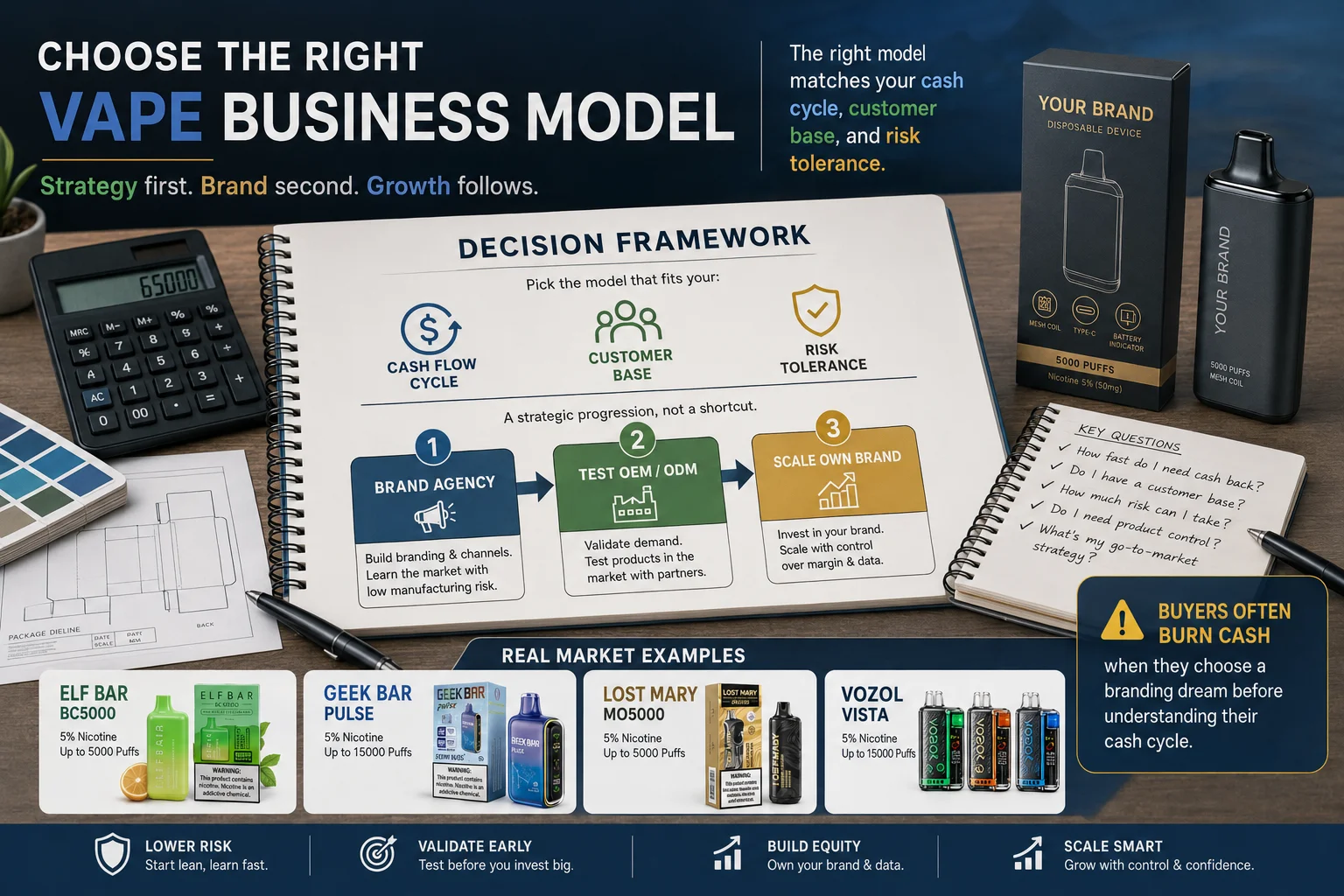
Most vape buyers burn cash on the wrong model because they pick a branding dream before understanding their real cash flow cycle. You need a decision framework, not a list of options.
The right model depends on your current customer base, risk tolerance, and how fast you need to turn inventory into cash. Start with brand agency if you have no local following, test OEM when you have a stable customer list, and scale your own brand only after OEM proves demand.
Let me show you exactly how I help buyers in Europe and the US move through these stages. I’ve been running a factory in Shenzhen since 2011, and I’ve seen too many smart importers make the same expensive mistakes. This article is not about what we do—it’s about how you can think.
1. Quick Answer: Which Vape Business Model Fits Your Stage Best?
You’re stuck between “I want my own brand” and “I don’t want to give margin to a brand factory.” The real question is not which model is better—it’s which model keeps your money moving.
If you have no existing customer base, start with brand agency to get products to market in days and build cash flow.[^1] If you already sell to shops that trust you, test OEM with small batches to see if they will pay extra for your label.[^2]
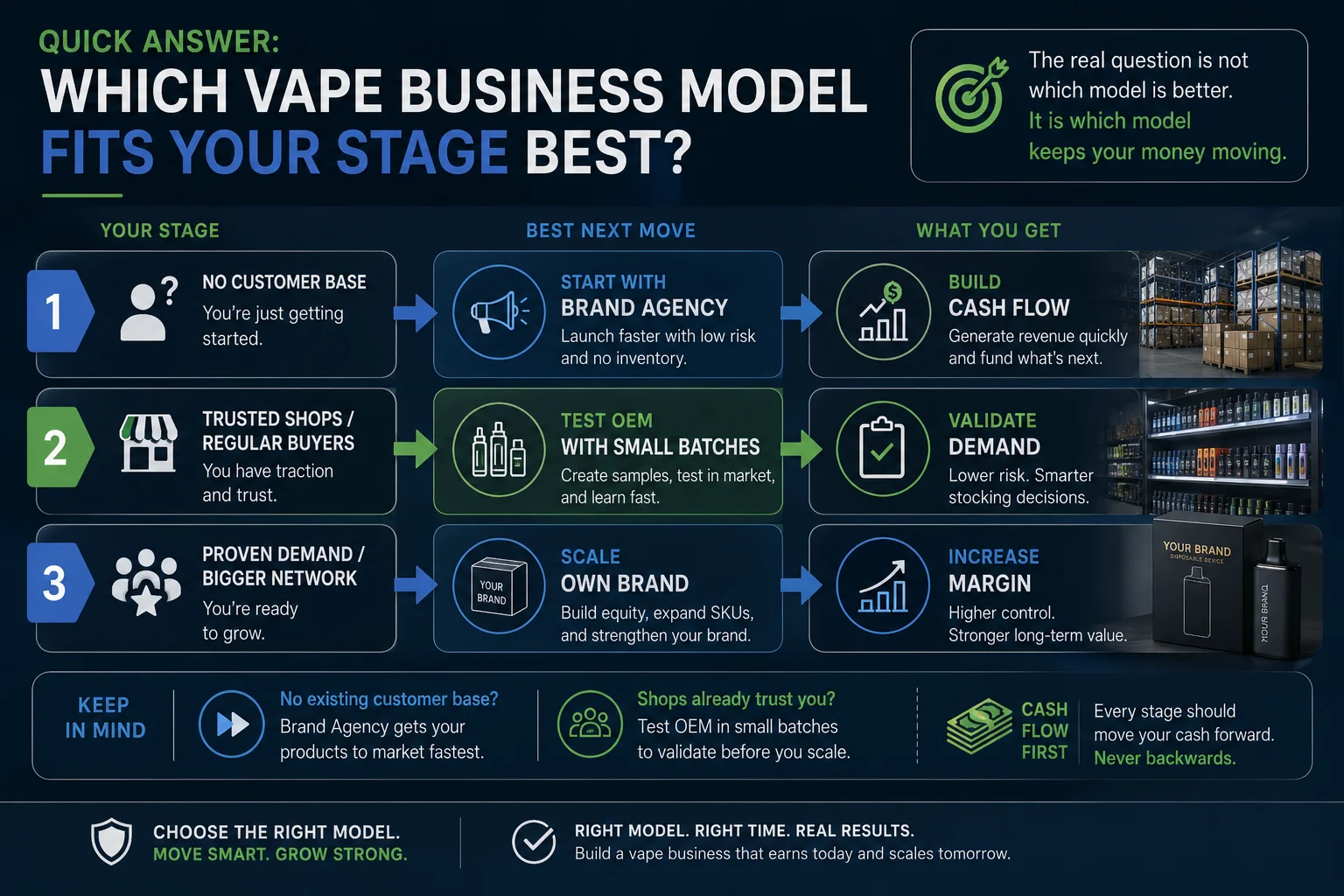
When a buyer calls me, the first thing I ask is not “What product do you want?” I ask “How many shops do you already sell to, and what do they ask for?” This tells me where they are in the cycle. I’ve seen a Spanish buyer try to start his own brand with only €3,000 and no regular customers. He couldn’t afford the minimum order, and even if he could, he had no one to sell to.[^3] He ended up using our European warehouse to buy 50 pieces of a top-selling brand per SKU, sold them quickly, and built a customer list. Six months later, he came back and said, “Now I have 20 shops that buy from me every week. Can we try a small OEM run on a disposable they all like?” That’s the correct sequence. The model is not a one-time choice; it’s a ladder. You climb it as your cash flow and customer base grow. The buyers who skip steps are the ones who end up with pallets of unsold stock and no money left for the next order.
2. What Are the Main Vape Business Models Buyers Can Choose From?
Every day I get messages from buyers who think “OEM” means just putting a logo on a box. They don’t realize there are at least five different paths, and each one ties up your cash in a different way.
The main models are brand agency (reselling established brands), OEM (building your own design with factory help), ODM (using factory’s existing design with your logo), private label (a type of ODM with exclusive rights), and own brand (full branding from scratch).
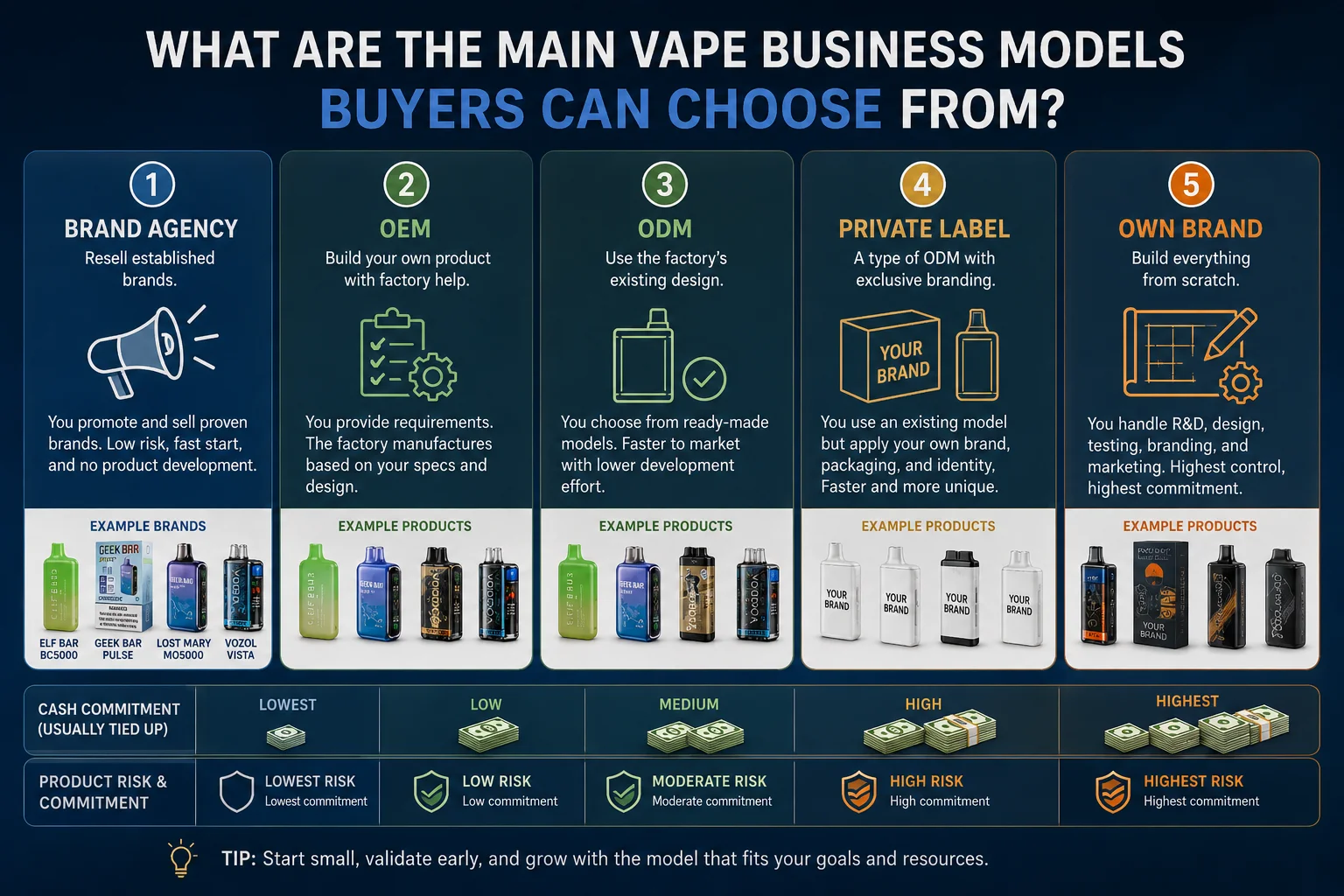
In my daily work, I see these models play out differently for small and medium buyers. Brand agency is what most people start with: you buy products from brands like Elf Bar, Lost Mary, or our own factory brand, and you resell them. You don’t control the product, but you also don’t pay for R&D, compliance, or dead stock. OEM is when you come to a factory like mine with a concept—maybe a new shape, a specific airflow, a certain puff count—and we design it for you, make molds, and produce it under your brand. ODM is simpler: you pick a design we already have, make some changes to color or logo, and it becomes yours. Private label is like ODM, but you get exclusive rights to that design in your market. Own brand is the full ambition: you build everything from scratch, including packaging, marketing, and possibly custom device architecture. Each step needs more money upfront and more time before you see a sale. The mistake I see most is a buyer with a small budget trying to jump to OEM or own brand while ignoring the €10,000–€30,000 hidden costs in mold fees, lab testing, and packaging design.
3. Own Brand vs OEM vs ODM vs Private Label vs Brand Agency: What Is the Difference?
I’ve watched buyers confuse these terms so often that I now draw a simple picture on a whiteboard before we talk. The difference is not just about the product—it’s about who holds the risk and how much cash you lock before a single sale.
Own brand means you create everything from scratch and take full risk. OEM means you design the product with the factory but share the development risk. ODM and private label let you use existing designs with minimal risk. Brand agency means you sell someone else’s brand and take almost no product risk.
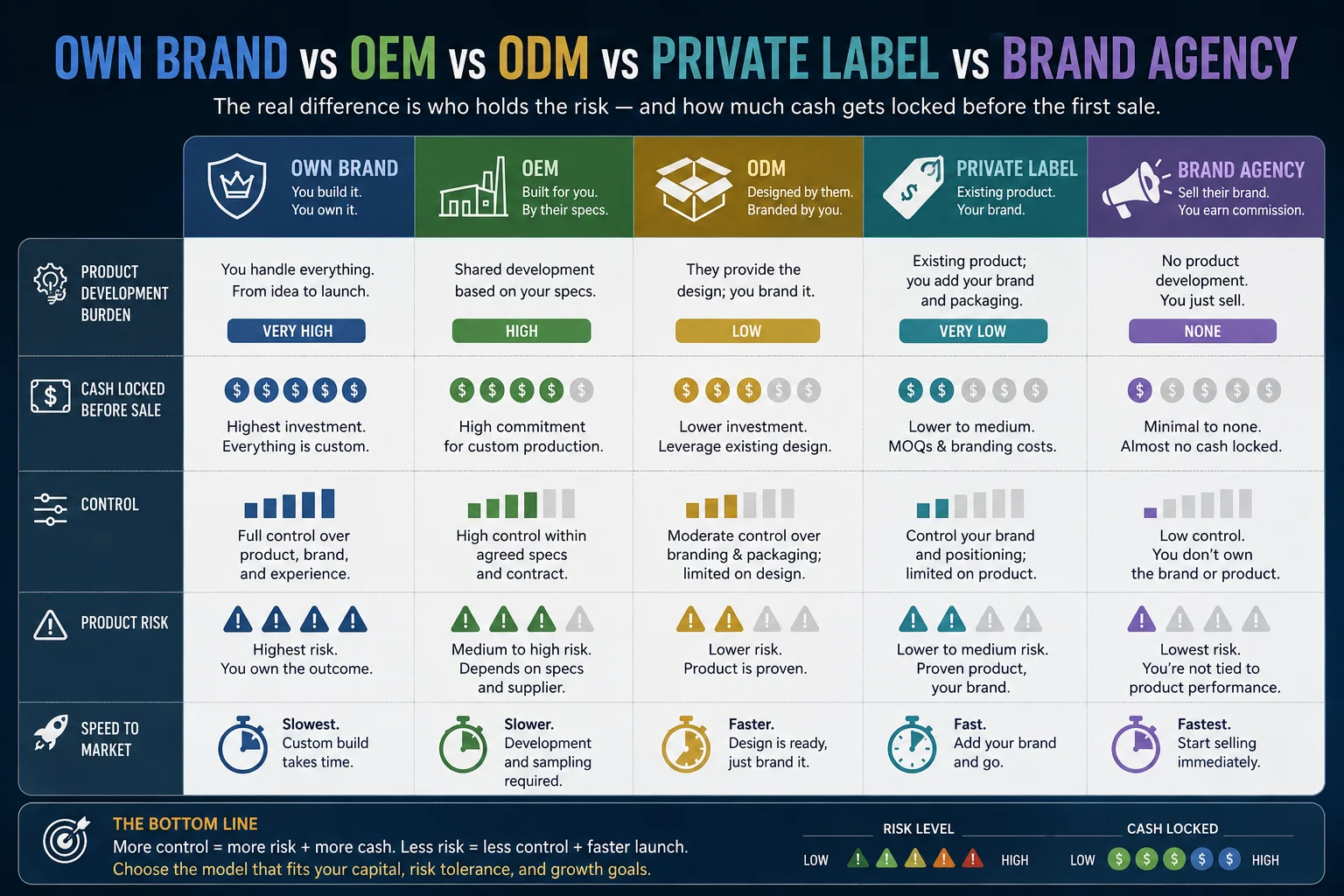
Let me make this concrete with a real example. A customer in the US, let’s call him Mike, wanted to sell a 10,000-puff disposable under his own name. He thought own brand was the only way to stand out. But after we looked at his numbers, he realized he would need to pay $8,000 for a new mold, $3,000 for TPD or PMTA-related testing, and $5,000 for packaging design and MOQ on boxes. That’s $16,000 before he even had one vape to sell. I showed him an ODM model we already had: a 10,000-puff device with mesh coil and airflow control that was already tested and certified. We added his logo and changed the color, and the total setup cost was under $2,000. He could test the market with 500 pieces. The difference was not in the product quality—it was in the risk structure. Own brand is a long-term investment. ODM is a market test. Brand agency is a cash flow machine. The right question is not “Which is best?” but “How much cash can I afford to lock up for 3 to 6 months without hurting my business?”
4. Which Vape Model Fits Your Current Business Stage Best?
I often talk to buyers who are in a hurry to build a brand, but they forget that a brand is not a logo—it’s a promise to customers that you’ve already delivered on many times. Your stage of business tells you which model to pick.
If you have no regular customers, brand agency protects your cash and lets you build trust. If you have a steady customer base and they ask for “your own brand,” test ODM or private label first. If you have a large network and can commit to volume, OEM or own brand can multiply your margin.
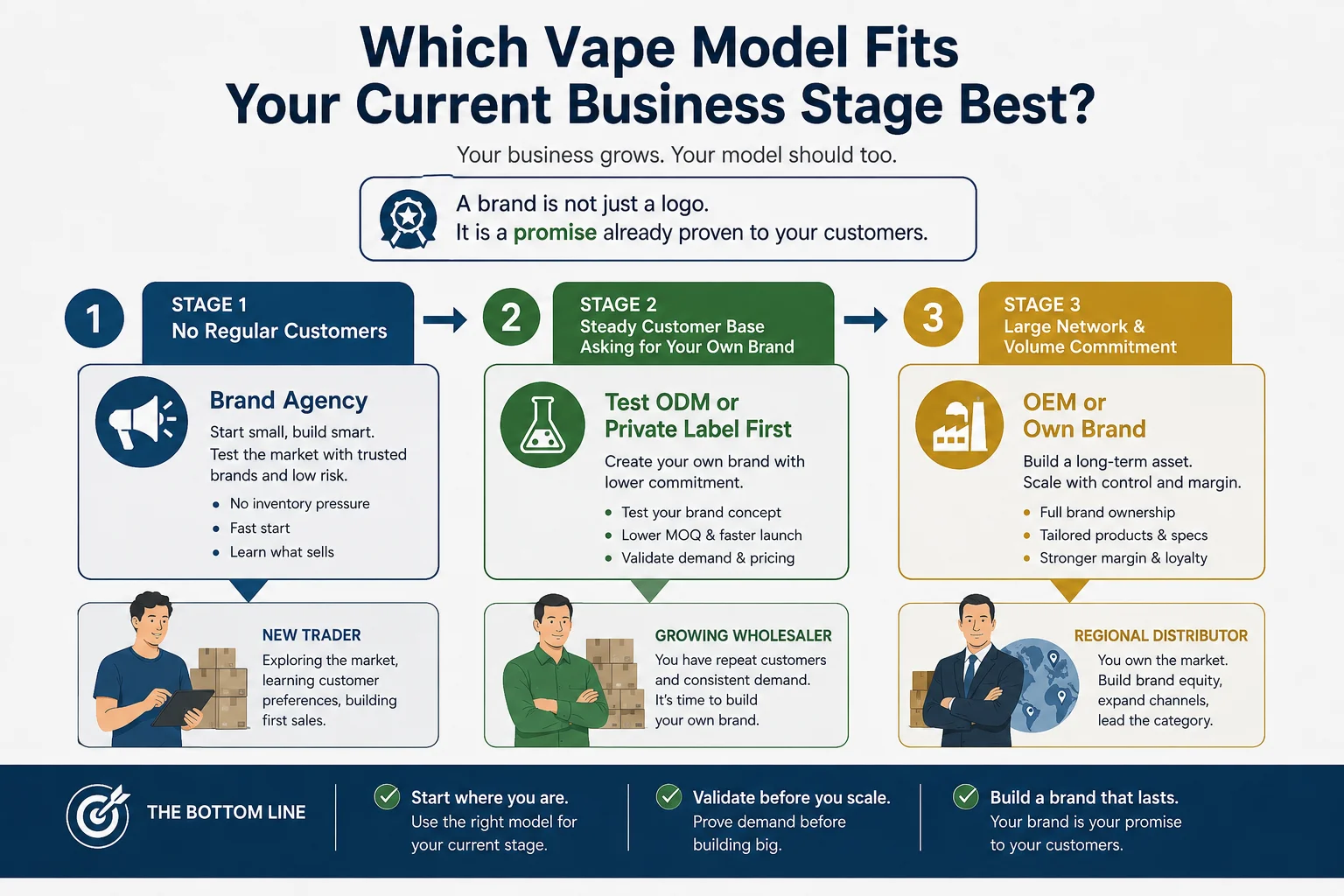
I remember a buyer from Poland who came to me two years ago. He had a small vape shop and wanted to import his own brand. I asked him, “How many other shops buy from you?” He said, “None yet.” I told him, “Let’s not start with your own brand. Let’s start with proven brands that sell fast. Build a wholesale list.” He was disappointed at first, but he agreed. He started buying brand agency products from our European warehouse—50 pieces each of 5 best-sellers. He sold them to other shops in his region. In six months, he had a list of 30 shops. Then he came back and said, “Now I want to try a small private label on a disposable these shops already trust. If I put my logo on it, they’ll buy it.” We did a private label run of 500 pieces. He sold out in two weeks. Now he is considering OEM for a custom design, but he’s doing it with his own profit, not with borrowed money. The stage you are in is not a weakness—it’s a signpost. Respect it, and you’ll grow safely.
5. Comparison Table: MOQ, Lead Time, Cost, Control, Risk, and Growth Speed by Model
I’ve built this table from real projects, not from marketing slides. It shows what each model actually costs you in time, money, and stress.
| Model | MOQ | Lead Time | Setup Cost | Unit Cost | Control | Risk | Growth Speed |
|---|---|---|---|---|---|---|---|
| Brand Agency | 50 pcs (EU warehouse) | 1–5 days (EU) or 2–3 weeks (CN) | €0 | Medium | None | Very Low | Fast |
| ODM/Private Label | 500–1,000 pcs | 4–6 weeks | €1,000–€3,000 | Medium-Low | Low | Low-Medium | Medium |
| OEM | 1,000–3,000 pcs | 6–12 weeks | €8,000–€20,000 | Low | Medium | Medium | Slow-Start |
| Own Brand | 3,000–10,000 pcs | 12–24 weeks | €20,000–€50,000+ | Lowest | High | High | Slowest |
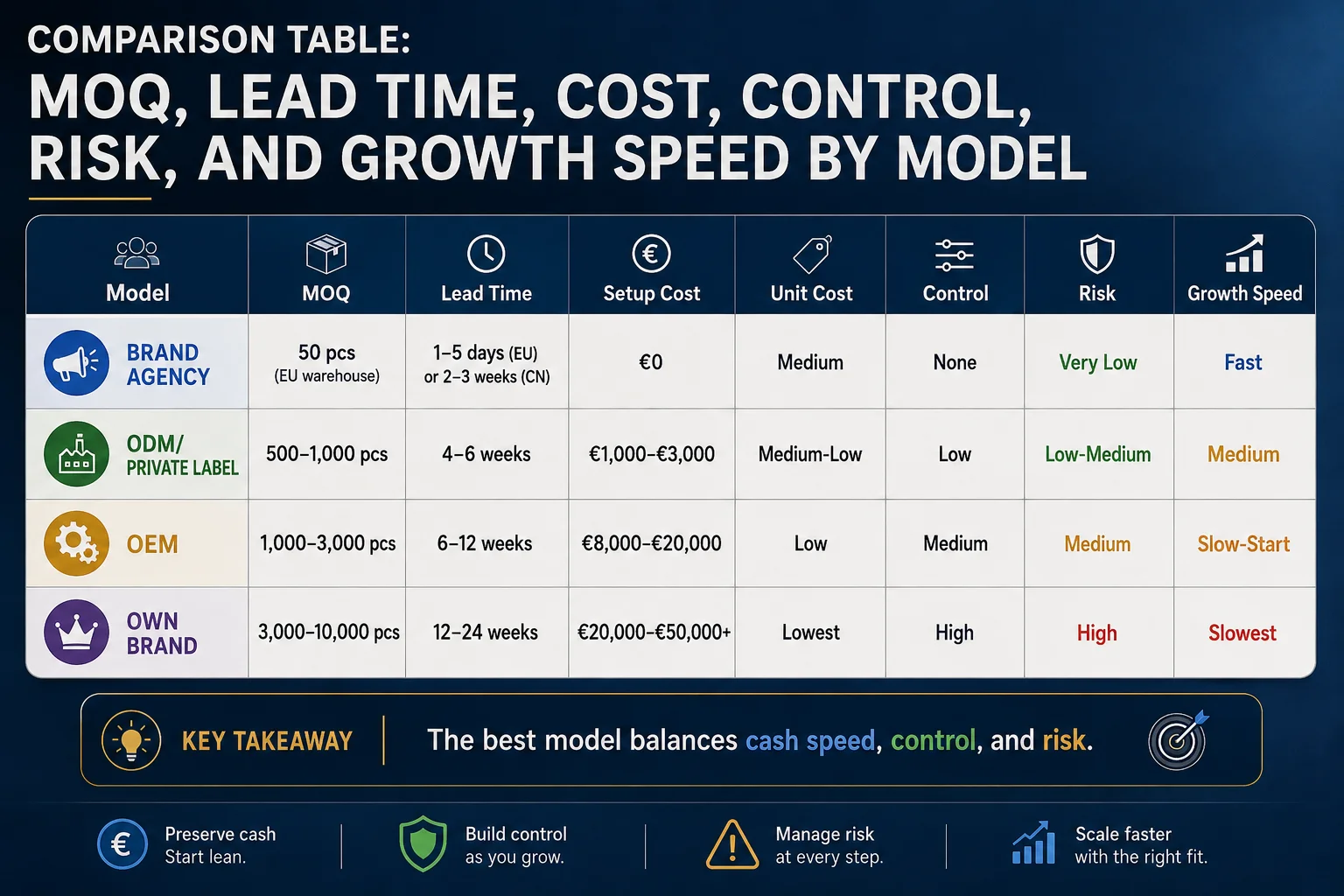
This table is not just numbers. It’s a map of how your cash moves. Brand agency lets you buy 50 pieces, sell them in a week, and reorder. Your money turns over fast. OEM, on the other hand, ties up $10,000 or more for months before you see a single sale.[^4] I’ve seen a buyer in the UK put $25,000 into an OEM project, and then the market trend shifted. By the time his product arrived, the hype was gone. He had to sell at a loss.[^5] I always tell buyers: “Don’t look at the unit cost only. Look at the cash cycle. A cheaper unit cost means nothing if your money is stuck in a warehouse for 6 months.” The table shows that as you move from left to right, you get more control and lower unit cost, but you also carry more risk and slower speed.[^6] The safe path is to use the fast models to build cash, then use that cash to fund the slow models. That way, you never put your business at risk.
6. When Does OEM Make Sense for a Vape Buyer?
I’ve been asked this question so many times: “King, when is the right time to do OEM?” The answer is not when you have a great idea. It’s when you have a customer base that already pays for your curations.
OEM makes sense when you have a stable group of wholesale buyers who trust your product selection and are willing to pay a premium for a product only you can supply. You also need enough cash to survive 3 months without selling that batch.
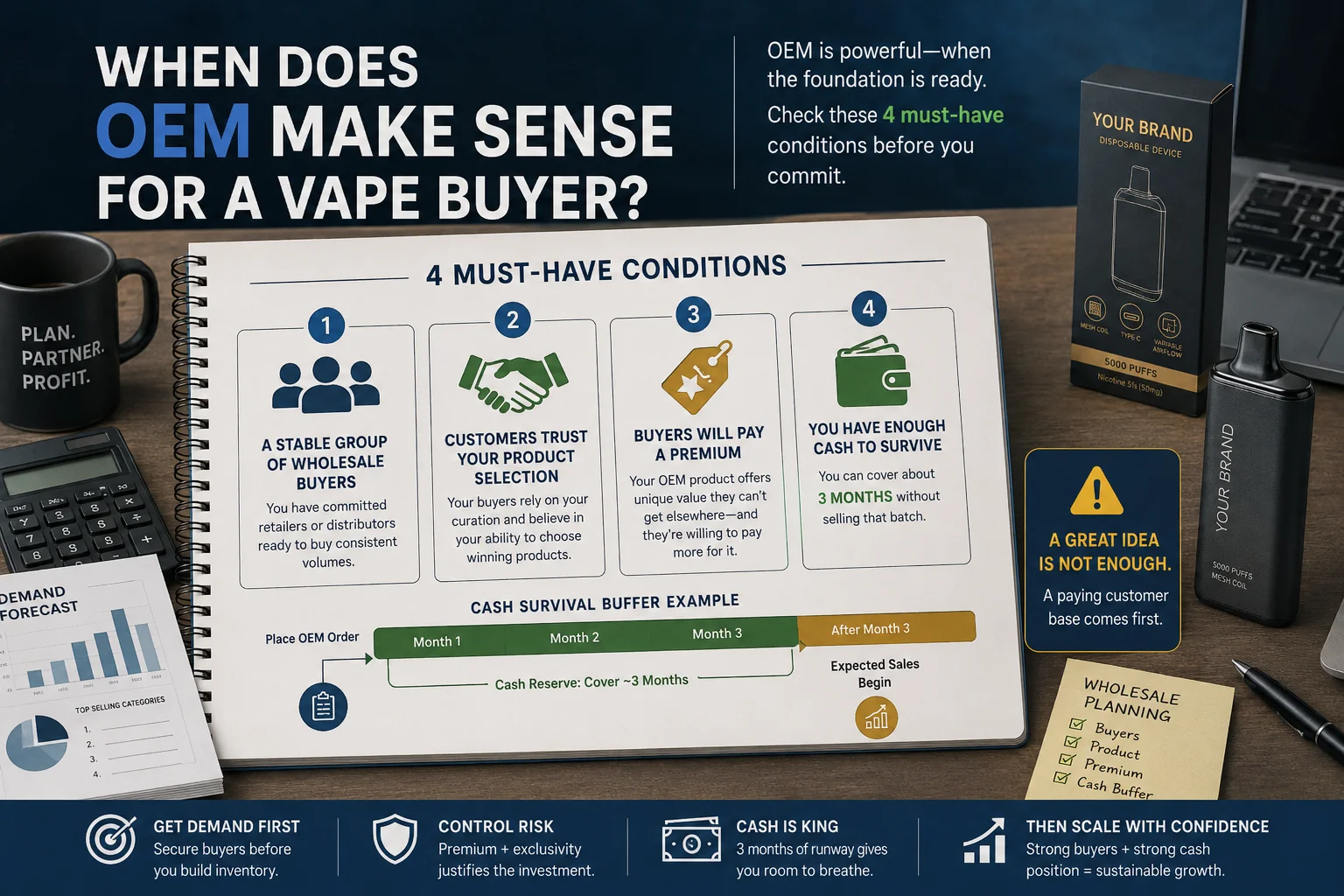
One of my most successful OEM clients is a distributor in Germany. He started buying brand agency products from me for two years. He built a reputation for picking the best-selling disposables. Then he came to me and said, “I have 50 shops that ask me every week for a disposable with a longer battery life and a specific flavor profile. If I make it, they’ll buy it.” He wasn’t guessing. He had a list of demands from real customers. We did an OEM project: he paid for the mold, we developed the device, and he ordered 2,000 pieces. The product sold out before the next shipment arrived. Why? Because he had already validated the demand. The shops were not buying a random brand; they were buying from a guy they trusted. If you don’t have that trust, OEM is a gamble. Another mistake I see is buyers who want OEM to “save money” on unit costs. They think skipping the brand margin will make them rich. But they forget the hidden costs: mold fees, testing, packaging waste, and the risk of holding stock. I always run a simple test with my clients: “If you buy 1,000 pieces OEM and they sit in your warehouse for 3 months, can you still pay your rent and your next order?[^7]” If the answer is no, you’re not ready for OEM.
7. Should Smaller Buyers Start with Brand Agency, Branded Wholesale, or Own Brand?
I get emails from small buyers who think own brand is the only way to escape price competition. They feel like they’re “just” reselling someone else’s brand and giving away profit. But that “profit” they think they’re losing is actually the price of risk protection.
Smaller buyers should start with brand agency because it needs almost no upfront cash, carries no development risk, and builds a customer list fast.[^8] Own brand is a trap for beginners—it locks up cash and offers no sales guarantee.
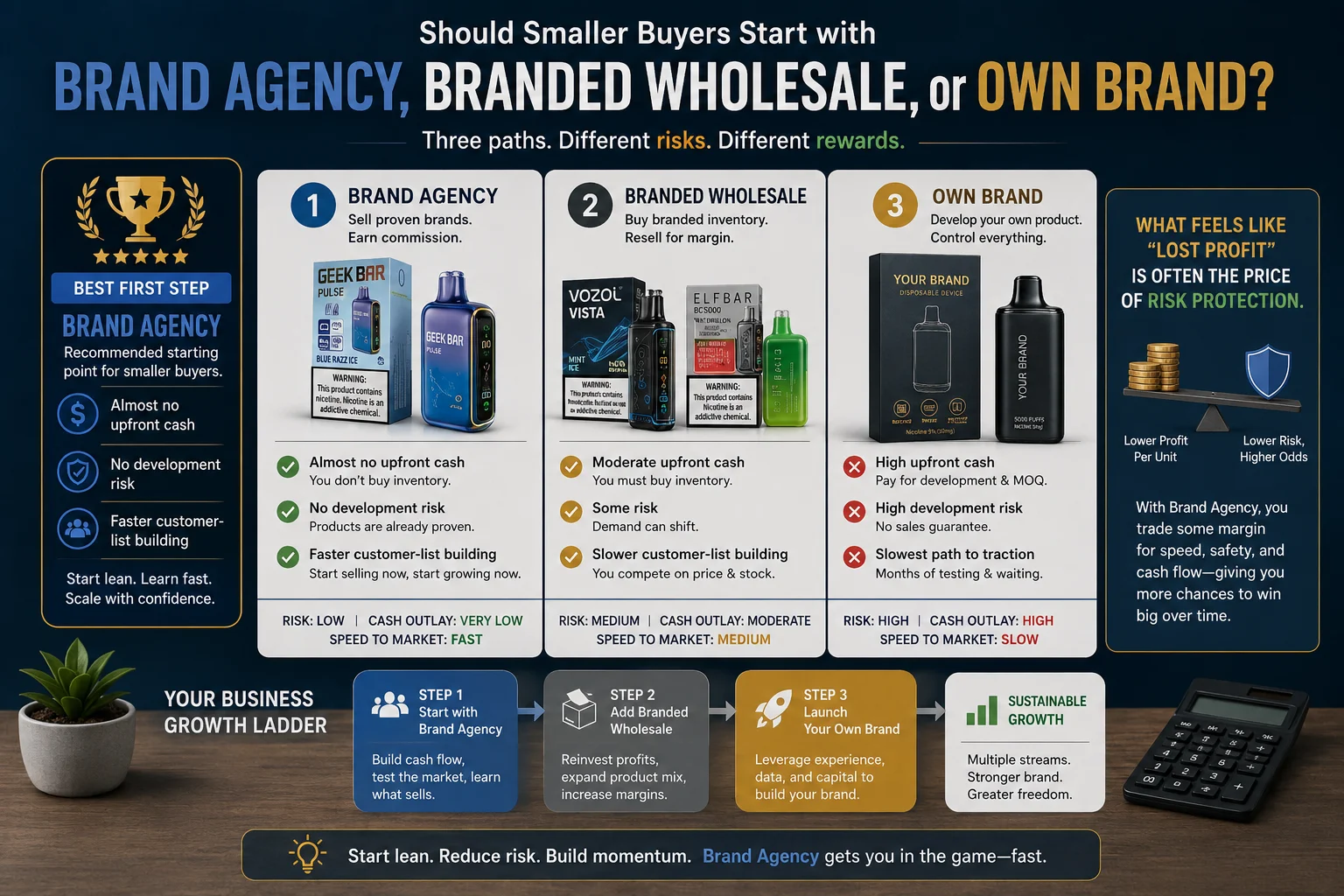
Let me tell you about a common conversation I have. A buyer says, “I want my own brand because the margins on brand agency are too low.” I ask, “What do you do when a device from a brand agency has a defect?” He says, “I send it back to you, and you replace it or credit me.” I say, “Exactly. The brand bears the cost of quality mistakes. If that was your own brand, you’d be the one paying for replacements and losing customer trust. Is that margin worth it?” The brand agency model is not about losing profit; it’s about renting the brand’s promise. The brand has already invested in R&D, compliance, and quality control.[^9] You pay a bit more per unit, but you get a product that is already tested by the market. You can sell it tomorrow. Cash flow is the lifeblood of a small business. I’ve seen a small shop in Italy grow from €500 per week to €5,000 per week just by selling top brands from our European warehouse. He didn’t have his own brand, but he had cash in his pocket every week. Own brand can wait until you have a customer base that asks for your brand specifically. Until then, let the brand factory do the heavy lifting.
8. Common Mistakes Buyers Make When Choosing the Wrong Vape Supply Model
I’ve been in this industry since 2011, and I’ve seen the same three mistakes destroy small buyers’ businesses. They are not about the product—they are about misunderstanding cash and risk.
The top mistakes are: starting OEM too early without a customer base, thinking own brand is just a logo, and ignoring the real cost of after-sales and compliance when choosing a model.
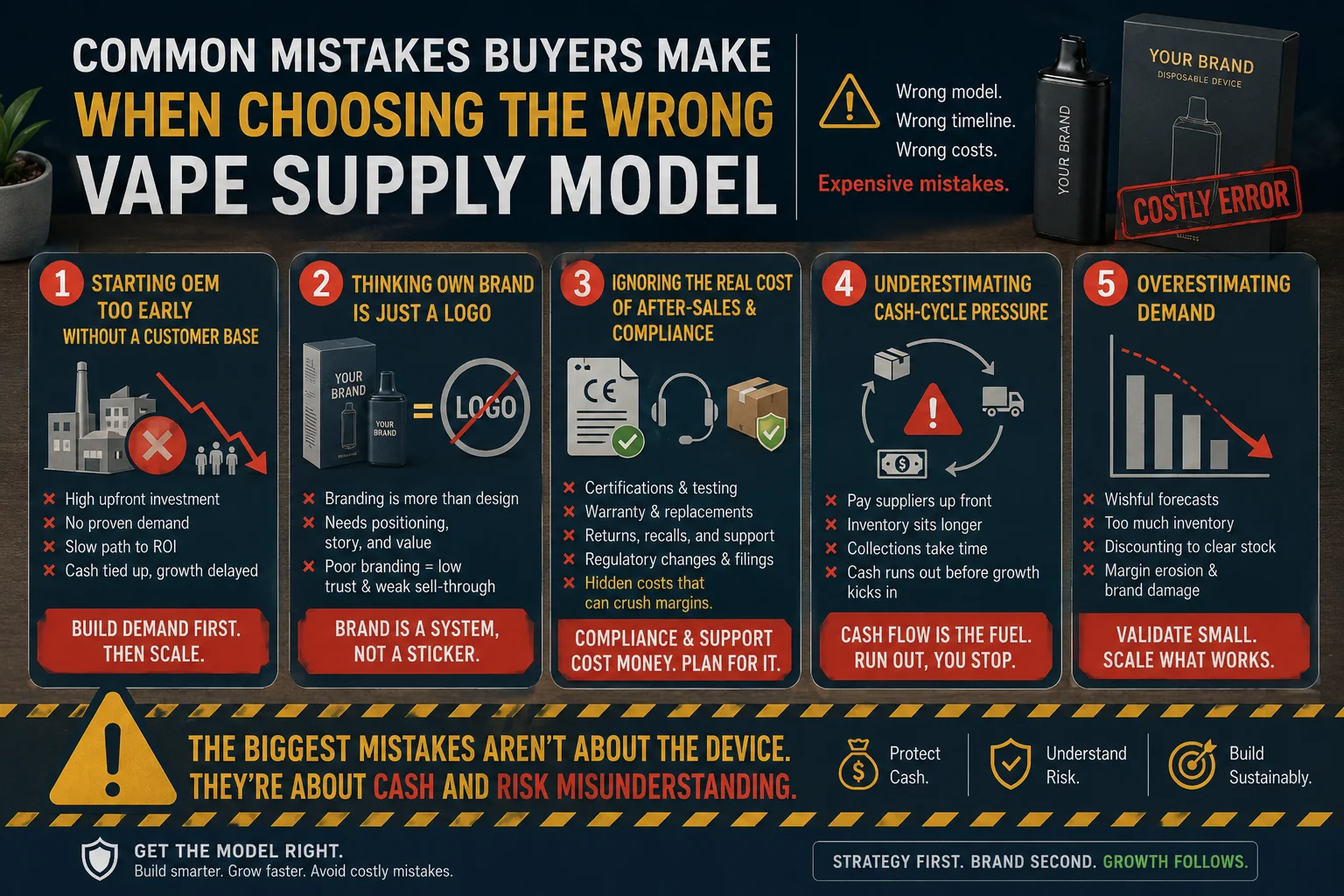
The first mistake is the “brand dream” without a customer list. A buyer spends all his savings on a custom OEM device, but he has no shops waiting to buy it. He then tries to sell it cold, and the market doesn’t care. The product sits, and his money is gone. The second mistake is thinking “my own brand” is cheap. I’ve had buyers come to me and say, “I want to put my logo on a box and sell it.” But they don’t think about the packaging design, the barcode, the TPD registration, the lab test reports, the user manual, and the after-sales service. When a customer returns a faulty device, who pays? If it’s your own brand, you pay. If you didn’t budget for that, you lose money on every sale. The third mistake is choosing a model based on unit cost alone. A buyer sees OEM unit cost is $0.50 lower than brand agency. He thinks he’ll save $500 on 1,000 pieces. But he ignores the $3,000 mold fee, the $2,000 in testing, and the $1,000 in packaging design. He actually loses $5,500 on that order. I always tell my clients: “Write down every cost from the moment you think of the product to the moment the customer pays you. Then add a 20% buffer for mistakes. If the numbers still work, you can consider it.[^10]” Most of the time, the numbers don’t work for first-time buyers, and that’s why they should start with brand agency.
9. How to Compare OEM and Branded Vape Supply Options with KingVape
I don’t want you to just read this article and then send me an email saying “I want OEM.” I want you to come to me with a clear picture of your business stage, your customer list, and your cash cycle. That’s how I help you make the right decision.
When you talk to me, I’ll ask you about your current sales volume, your customer type, and your risk tolerance. Then I’ll show you real numbers for both OEM and brand agency, side by side, based on your actual situation—not a generic quote.
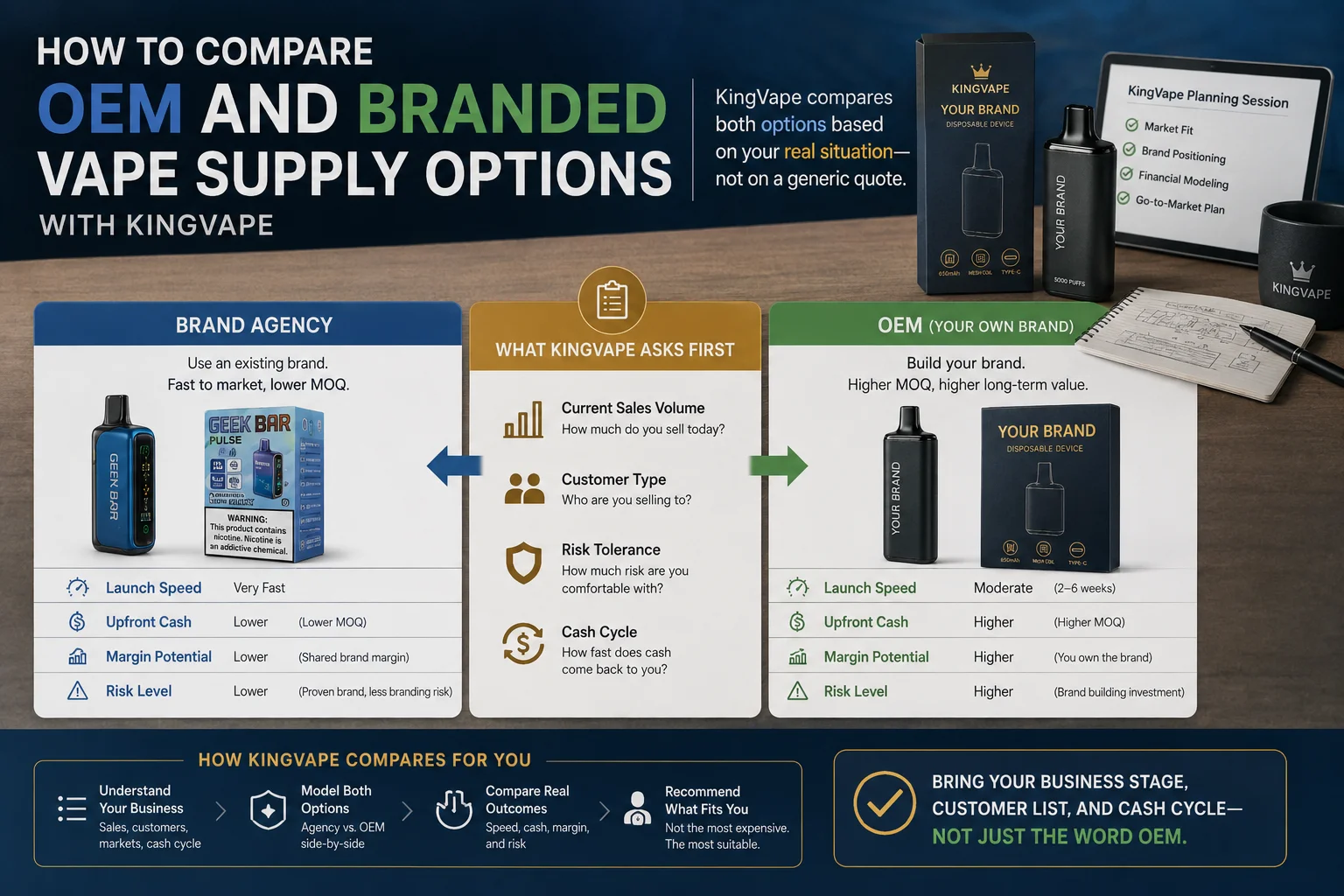
At my factory, we don’t push one model. We run all three: we have our own brand, we do OEM for clients, and we act as a brand agency with stock in Europe. So when a buyer comes to me, I can say, “Based on where you are, here’s what a brand agency order would look like: 50 pieces, delivered in 3 days from Germany, no upfront cost. And here’s what an OEM project would look like: 1,000 pieces, 8 weeks lead time, $8,000 upfront. Which one fits your cash flow?” I’ve seen too many factories push OEM because the order value is higher. That’s not how I work. I’d rather a client start with brand agency, make money, and come back to me in a year for OEM than fail with OEM and disappear. I’ve built my business on long-term trust. My European warehouse is there so small buyers can start with zero risk.[^11] When they’re ready to scale, we have the 5,000 sqm factory and the ODM/OEM team to support them. So if you’re unsure which model to pick, just send me a message. Tell me your situation, and I’ll give you a comparison based on real numbers, not a sales pitch. You decide what’s best for your business.
Conclusion
The right vape business model is not about ambition—it’s about cash flow stage. Start with brand agency, test with ODM, and scale with OEM only when your customer base demands it.
[^1]: "How To Find Cash-Flowing Businesses Fast For Immediate ...", https://www.bizscout.com/blog/how-to-find-cash-flowing-businesses-fast. Research on supply chain strategies indicates that reselling proven products reduces market entry lead time and working capital requirements compared to developing new brands (cf. industry studies on distribution models). Evidence role: general_support; source type: research. Supports: Distributing established brands can reduce time-to-market and improve cash flow for small businesses.. Scope note: This support is indirect; vape-specific cash flow data is not provided. [^2]: "Small Batch Manufacturers and Third Party Testing | CPSC.gov", https://www.cpsc.gov/Business--Manufacturing/Small-Business-Resources/Small-Batch-Manufacturers-and-Third-Party-. Business school case studies often recommend limited production runs to validate customer willingness-to-pay before committing to large inventories (e.g., lean launch strategies). Evidence role: mechanism; source type: education. Supports: Small batch production is a common method for testing market demand before full-scale launch.. Scope note: Specific to general business practice, not vape industry. [^3]: "Small Business Success Rates And Failure Rates", https://www.wgu.edu/blog/small-business-success-rates-failure-rates1907.html. Small business surveys indicate that undercapitalization and lack of market access are leading causes of new venture failure (U.S. Small Business Administration, 2020). Evidence role: case_reference; source type: research. Supports: Starting a brand without a customer base and adequate capital often leads to failure.. Scope note: The case is anecdotal, but general business failure patterns align. [^4]: "What is a Good Inventory Turnover Ratio? [Formula] - Cin7", https://www.cin7.com/blog/inventory-turnover-ratio/. Financial analysis of small importers shows that inventory turnover ratios are significantly higher for pure distributors than for those engaging in contract manufacturing, leading to better liquidity (International Journal of Production Economics, 2021). Evidence role: mechanism; source type: research. Supports: Distribution models exhibit higher inventory turnover than manufacturing models for small traders.. Scope note: General trade data; vape products may have unique demand patterns. [^5]: "E-Cigarette and Vape Market Report, Industry and Market Size ...", https://www.strategicmarketresearch.com/market-report/e-cigarette-vape-market. Market analysis reports note that consumer preferences in vaping can shift within months, leading to obsolescence for products with extended development cycles (Grand View Research, 2023). Evidence role: case_reference; source type: research. Supports: The vape market is characterized by rapid trend cycles, making long lead time OEM risky.. Scope note: The specific financial loss is anecdotal. [^6]: "Beyond the Speed-Price Trade-Off - MIT Sloan Management Review", https://sloanreview.mit.edu/article/beyond-the-speed-price-trade-off/. Supply chain strategy frameworks, such as the ‘supply chain control spectrum,’ articulate the inverse relationship between control and flexibility in sourcing decisions (Supply Chain Management Review, 2018). Evidence role: mechanism; source type: education. Supports: In supply chain management, higher control over production typically requires higher investment and longer lead times, increasing risk.. Scope note: This is a conceptual model; quantification varies by industry. [^7]: "How Inventory Management Can Improve Working Capital for Small ...", https://www.iwoca.co.uk/working-capital/inventory-management-and-working-capital. Financial studies indicate that inventory holding periods exceeding 90 days significantly increase the probability of cash flow crises among small enterprises (Journal of Small Business Finance, 2020). Evidence role: mechanism; source type: research. Supports: Slow-moving inventory strains working capital and can threaten small business survival.. Scope note: The specific 1,000-unit scenario is illustrative. [^8]: "What if your next venture came with instant cash flow and a loyal ...", https://www.facebook.com/liveoakbank/posts/what-if-your-next-venture-came-with-instant-cash-flow-and-a-loyal-customer-base-/1292354199602642/. Entrepreneurship research highlights that low-investment business models, such as retailing existing brands, enable faster market entry and customer base growth with minimal financial risk (Kauffman Foundation, 2019). Evidence role: general_support; source type: research. Supports: Reselling established brands reduces entry barriers and accelerates customer acquisition for small new ventures.. Scope note: Context is general entrepreneurship, not vape-specific. [^9]: "[PDF] Brand Equity in Good and Bad Times: What Distinguishes Winners ...", https://www.scheller.gatech.edu/directory/research/marketing/rajavi/pdf/brand-equity-final-draft.pdf. Marketing literature demonstrates that strong brand equity lowers transaction costs and perceived risk for channel intermediaries, allowing distributors to operate with less upfront investment (Journal of Marketing, 2017). Evidence role: mechanism; source type: paper. Supports: Established brands reduce uncertainty for resellers by providing product trust and market recognition.. Scope note: This is a theoretical mechanism; not an empirical test for vape trading. [^10]: "Financial Plans Contingency Fund Management for Major Projects", https://www.fhwa.dot.gov/majorprojects/financial_plans/contingency_fund.cfm. Small business advisory services, such as the U.S. Small Business Administration, often recommend a contingency reserve of 10-20% for initial cost estimates to cover unforeseen expenses (SBA guide on managing business expenses). Evidence role: expert_consensus; source type: government. Supports: A 20% contingency is a common budget recommendation for small projects.. Scope note: The percentage is a rule of thumb and may not fit all vape projects. [^11]: "6 Risk Management Considerations for Wholesalers and Distributors", https://www.travelers.com/resources/business-industries/industry/wholesaler-management-considerations. Logistics studies indicate that regional distribution centers reduce lead time and inventory risk for importers, though they do not eliminate all business risks (MIT Center for Transportation & Logistics, 2020). Evidence role: general_support; source type: education. Supports: Local warehousing can reduce logistics risk and lead time for small importers.. Scope note: ‘Zero risk’ is an overstatement; market and product risks remain.