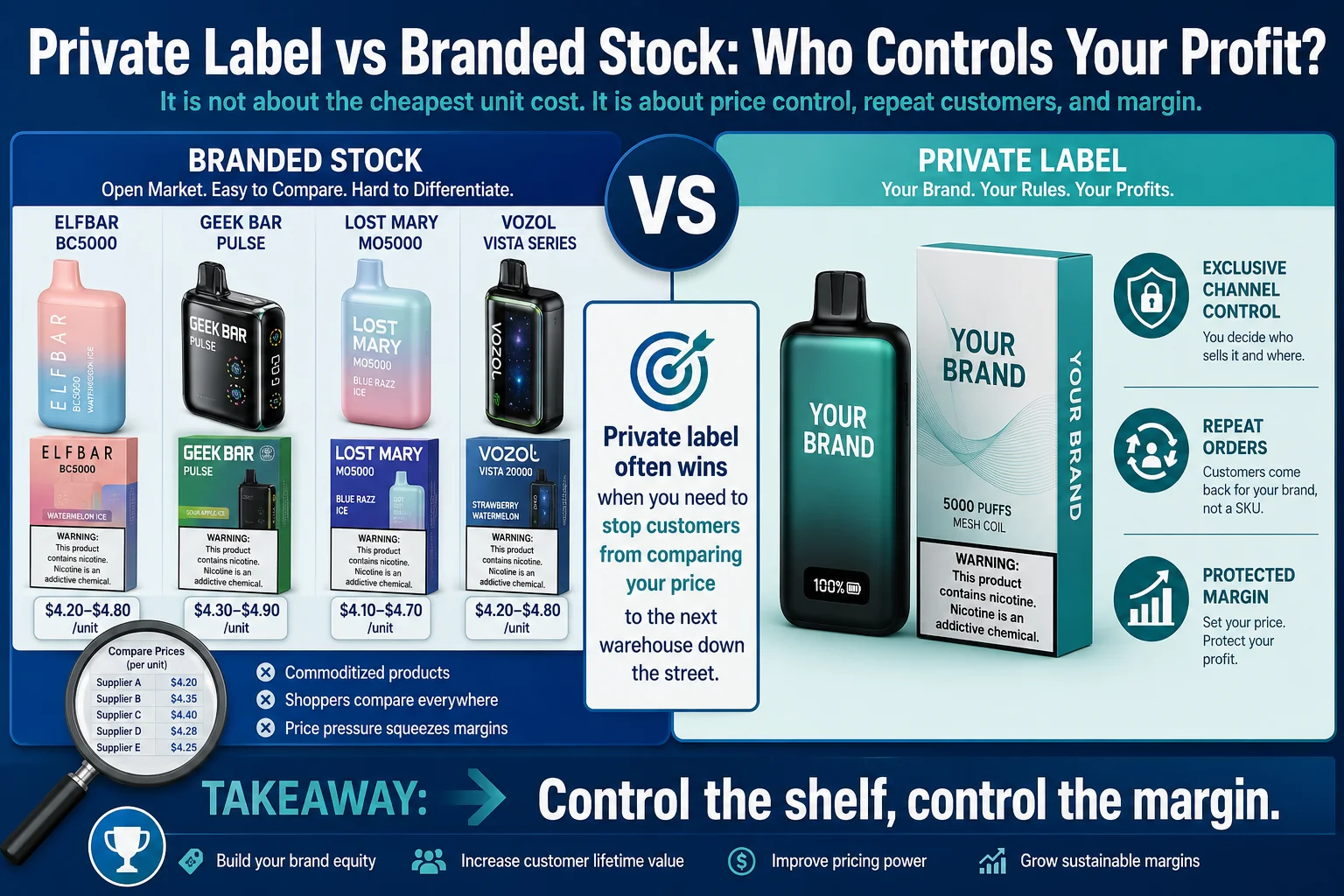
Every week, I hear the same pain from wholesalers: "My margin disappeared, but my cost didn't change." The real problem isn't the price of the vape device—it's the price war you can't escape.
Choosing between private label and branded stock is not about finding the cheapest unit cost. It's about deciding who controls your profit. Private label often wins when you need to stop your own customers from comparing your price to the next warehouse down the street.
You already know how to move product. The real question is what happens after the sale. I’m going to walk you through the eight checks I run with clients in my Shenzhen factory when they ask me this same question. My name is King, and I’ve watched this pattern repeat for over a decade.
What Does Private Label Vape Mean in the Wholesale Business?
You see "private label" on every supplier website, but most wholesalers don't know what it actually locks in place for their daily route.
Private label means you own the brand identity and supply exclusivity for that SKU in your channel.[^1] It’s not just a sticker—it’s a small wall around your local repeat business.
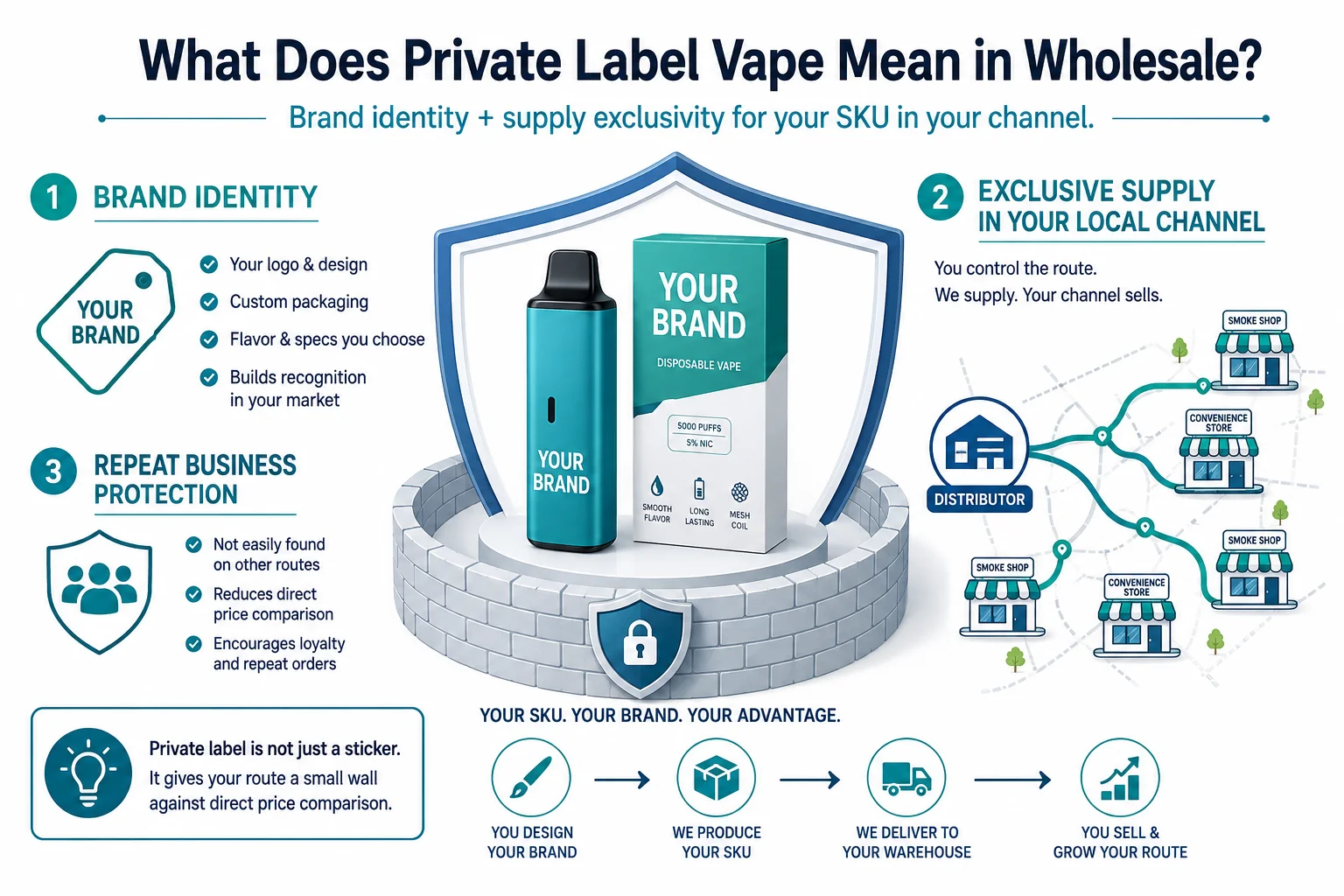
Let me break this down without any factory jargon. In your world, private label is what happens when you stop selling "Brand X 5000 puff" and start selling "Your Shop Name 5000 puff." The device comes from the same production line, but the packaging, the color, maybe the flavor name, and the barcode all belong to you. No one else in your city can list the exact same product on their shelf with the same name and undercut you the next day.
The key is the ownership of the look. When I ship branded stock to ten different wholesalers in the same region, they all get the same box. A smoke shop owner can walk into two warehouses and see the identical item, then pressure both of you on price. With a private label, that doesn't happen. The shop can't easily cross-shop because your "Coastal Mint" looks completely different from the generic "Brand X Mint." It’s a simple switch that changes who has the pricing power during a reorder call.
I’ve seen this with a client in Spain who operates in a tourist-heavy area. He was selling a popular branded disposable. He told me a neighboring wholesaler started dumping the same SKU at just a few cents above landed cost because that wholesaler needed cash flow. My client couldn't price-match without losing his own rent money. When we switched him to his own simple label, that direct comparison vanished. The shop owner couldn’t scream "Jorge sells this cheaper" because Jorge didn't sell "that" one. Jorge sold a different box. The unit cost was marginally higher, but the real profit on a full pallet was protected. That’s not a unit-price math problem; it’s a channel-control fix.
Private Label vs Branded Stock: What Is the Real Difference?
You won't see the real difference on a factory quote sheet. You'll see it three months later when your phone rings.
The gap is not the device inside the box; it’s whether your customer can force your price down by finding the exact same barcode online or in another truck.
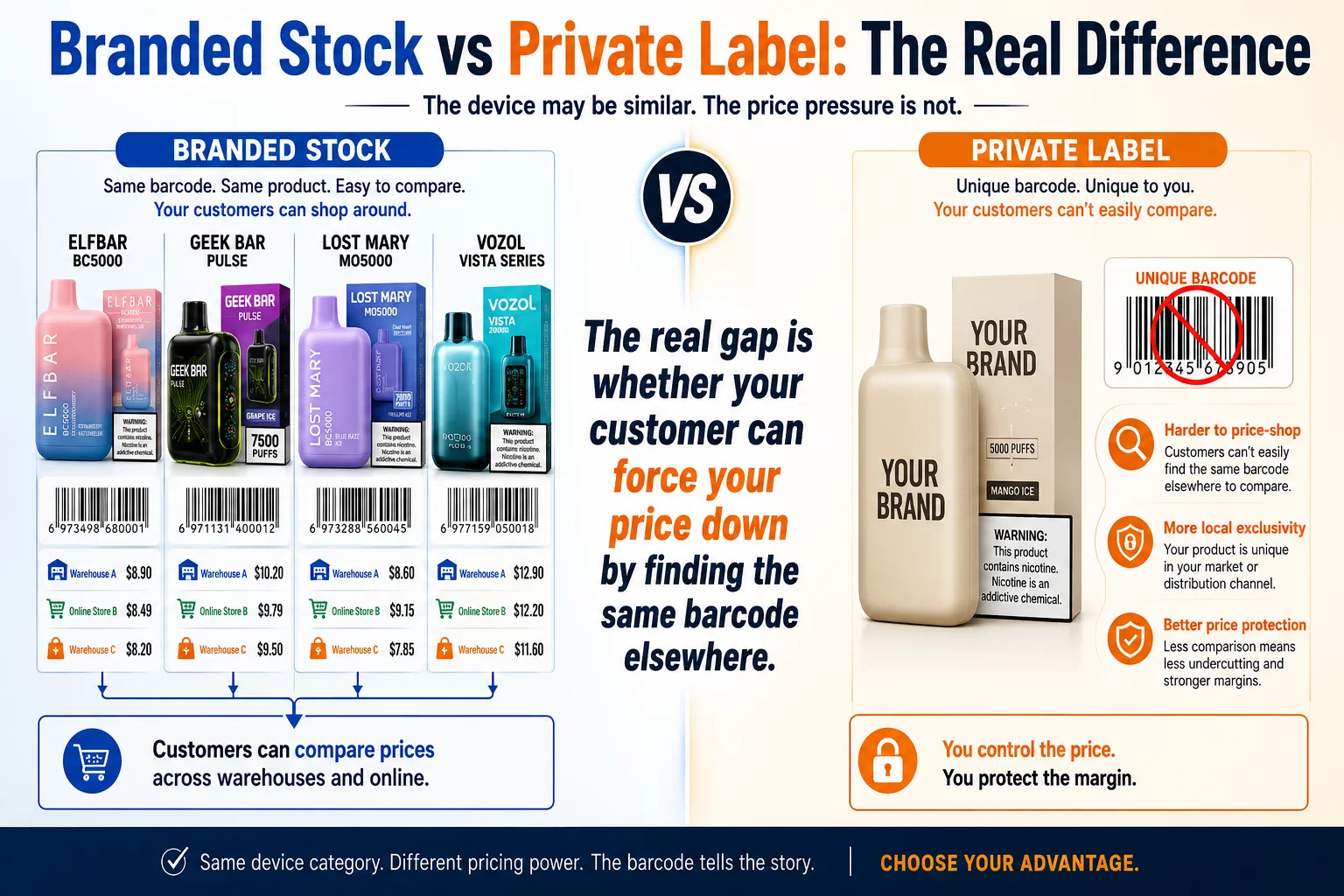
This is where the unit-price illusion hits hardest. Branded stock from any big name or even a trending mid-tier brand looks cheaper on paper. You pay a factory their wholesale rate, you get the famous packaging, you list it. Easy. The hidden cost arrives when your retail accounts start buying from five different sources at once.
When a convenience store owner can scan a barcode and see ten online listings, your margin is no longer yours.[^2] It’s set by the lowest-priced, most desperate seller in the market. I’ve watched distributors get stuck with pallets of good product they can’t move because a competitor 50 miles away decided to clear inventory at break-even. The product didn't change; the distribution did. With your own label, the barcode belongs to you. No online price comparison exists for it.[^3] The store has to buy from you or not carry that specific flavor profile, which you’ve tailored to their local taste. That’s the actual switch: you stop renting margin from a brand owner and start building it yourself.
I’m not saying branded stock is useless. If you’re a pure trend flipper who buys one shipment of a viral flavor, sells it over a weekend, and never orders it again, then a brand name helps you move it fast. That’s fine. But if you have consistent routes and the same stores every week, you need the opposite of a viral one-time hit. You need a product line that can’t be instantly commoditized.
When Does Private Label Make More Sense Than Branded Stock?
This is the one question I always answer with another question: are you building a route or just filling orders?
Private label becomes a business-decision tool the moment your repeat sales outweigh your one-time test buys. It works when your real cost is not the invoice, but the next call from a price-shopping store owner.
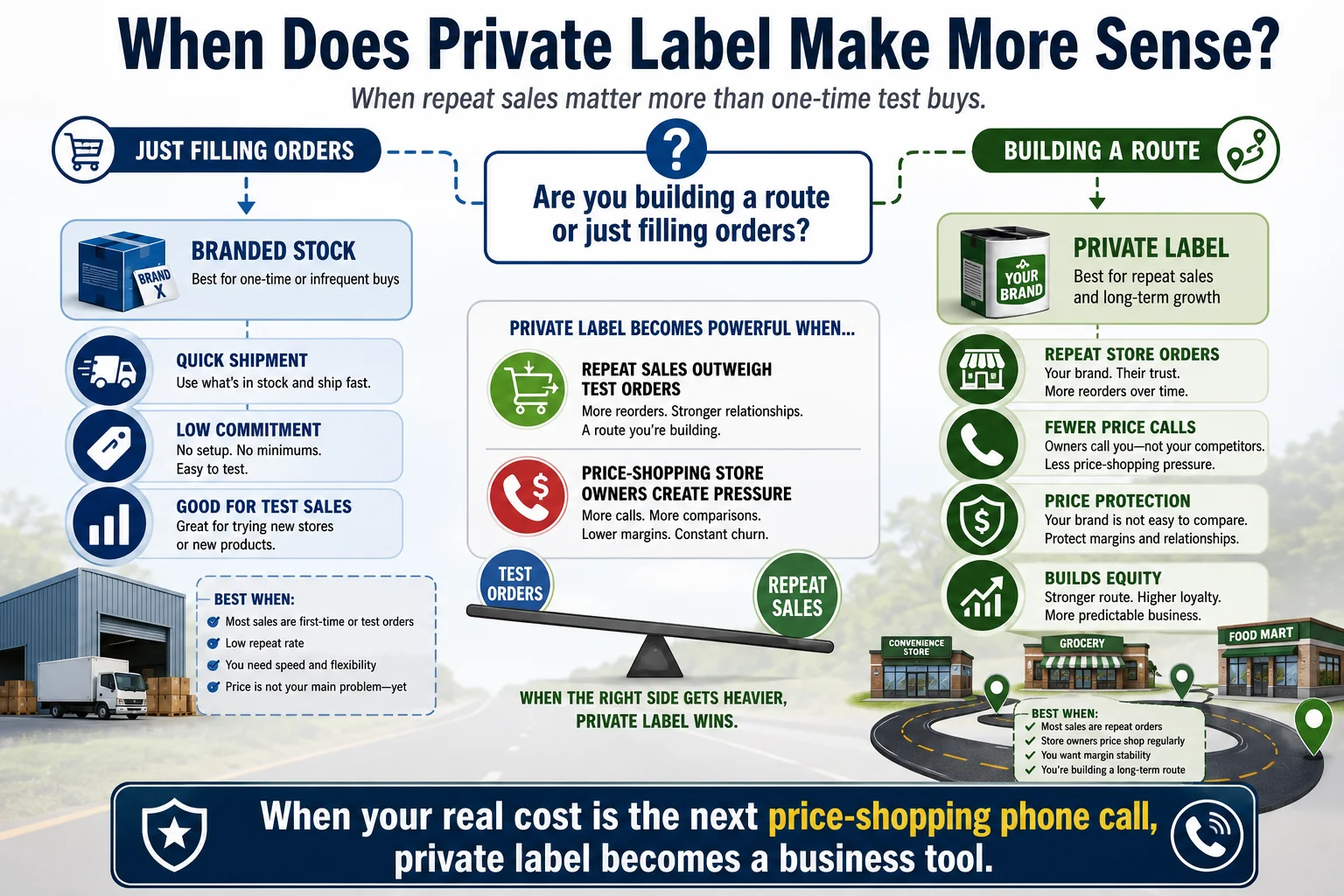
Let’s look at three clear signals I’ve learned to pick up on. First, you’re selling the same high-volume SKU month after month. If you consistently move 5,000 units of a specific flavor or strength, you’ve already proven local demand. At that point, giving that demand a generic brand box is a risk. You’re essentially training your customers to recognize a product they can buy elsewhere. Second, your margin per unit is shrinking even though your landed cost hasn’t changed. That’s price erosion from other wholesalers piling in. The brand owner might even be happy about this volume, but it’s crushing your profit. Third, your customers ask for "the same thing again" but don't care about the brand name. When a shop owner says "just give me the mango ice one," they have zero brand loyalty. That’s your cue to put your own label on it and lock in the reorder.
I have a client in the US with a cash-and-carry setup. He noticed his own employees were selling more of a competitor's private label than his own branded stock because the competitor was always in stock, always the same price, and the shops couldn't comparison shop it. He switched two of his top-performing flavors to his own label. The shops didn't blink. They just needed the product. His relationship with that store didn't weaken—it strengthened because now he was the only source. That’s the test: if your customer buys from you because they trust your delivery, not because of the logo on the box, private label will protect that trust.
MOQ, Lead Time, Packaging, Flavor Options, and Product Control Compared
Most wholesalers overestimate the minimum order quantities for private label. They think it means a full container of one flavor.
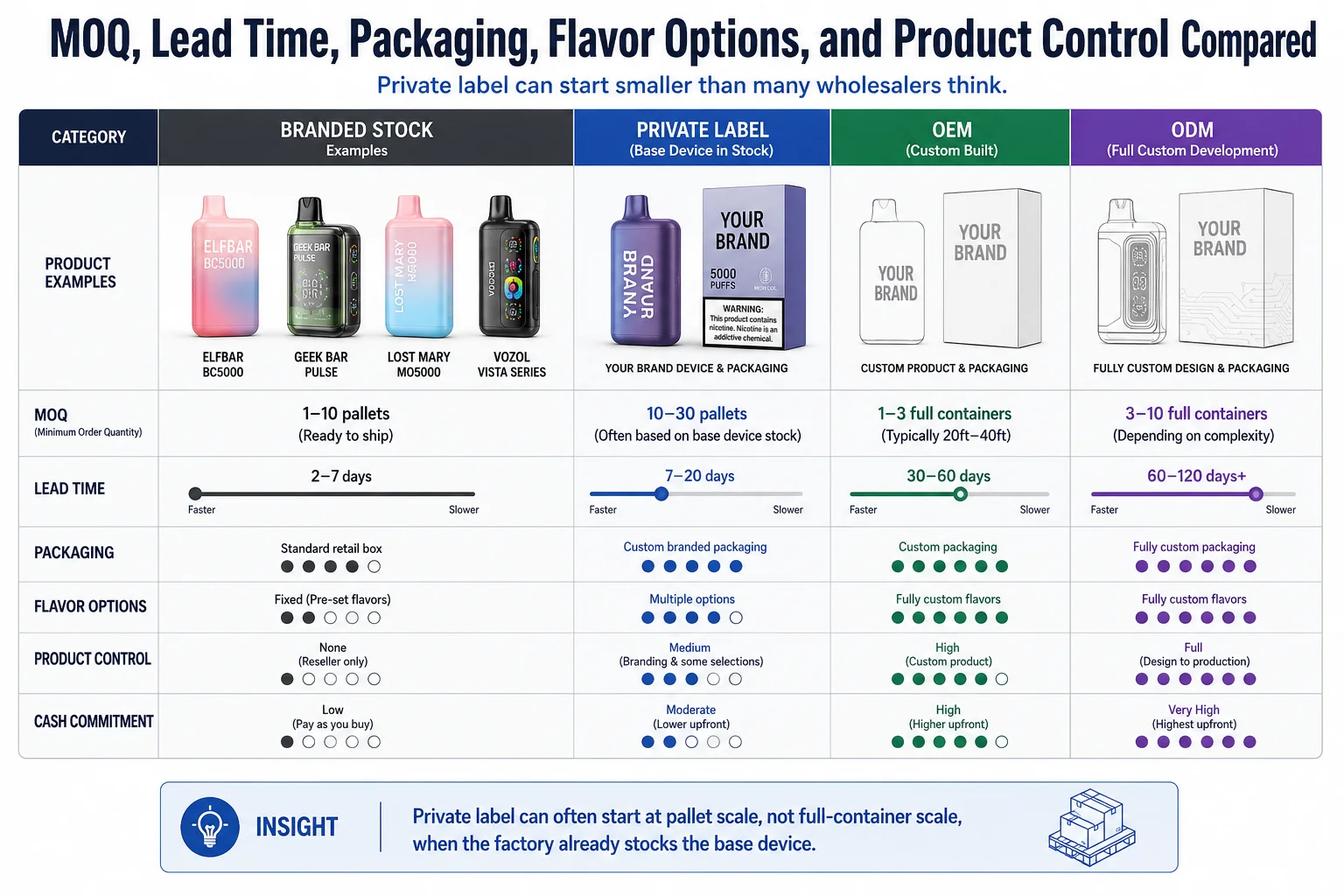
Let’s get into the details that matter for your cash flow. I’ll compare the two paths side by side.
| Branded Stock | Private Label | |
|---|---|---|
| MOQ | 50-200 pcs for small orders; no customization required. | 300-500 pcs per flavor for simple custom packaging; full custom runs are negotiated. |
| Lead Time | 1-3 days from factory stock or European warehouse. | 10-15 days for label and box production, plus shipping. |
| Packaging | You use the brand’s box design, barcode, and claims. No control. | You specify colors, logo, warning text, and barcode ownership. |
| Flavor Control | Restricted to what the brand launches. You take what’s popular. | You can name a flavor "Coastal Breeze" and keep the profile exclusive. |
| Product Stability | Can be discontinued by the brand owner with zero notice. | Product life matches your order cycle; you control phasing out. |
The big eye-opener for many clients is lead time. Branded stock feels faster because it’s on the shelf. But when a brand discontinues a best-seller, you get zero lead time to react. With private label, you plan the cycle. Yes, the first order takes longer because of artwork and sample approval. But after that, reorders are smooth. You know your volume, you know the production windows, and the factory holds your packaging components.
On the packaging point, this is not about making a fancy box. It's about compliance and confusion. Your own barcode means no customer scans it and pulls up a cheaper online listing.[^5] Your own warning text layout means it meets your specific market’s regulatory quirks without you having to slap a messy sticker on top of a generic brand box. These small operational details save phone calls and returns.
Why Brand Control, Repeat Customers, and Margin Matter for Private Label Buyers
Ask yourself: who actually owns your relationship with the store? In branded distribution, the brand does.
You don't really have repeat customers for branded stock; the brand has repeat customers, and you’re just a delivery truck.[^6] Private label switches the loyalty from a logo to your service.[^7]
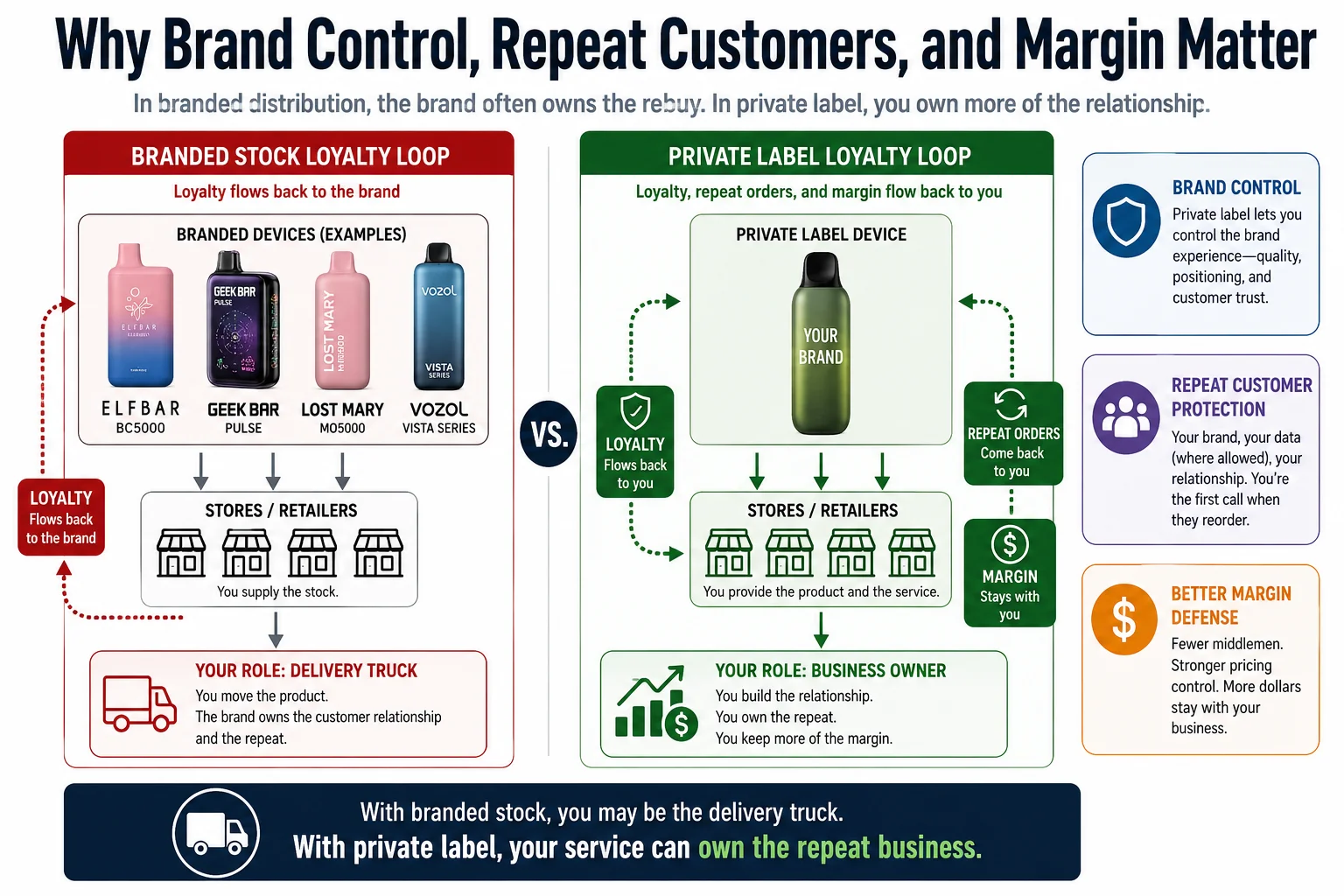
Let’s think about a typical route. You visit a vape shop every Tuesday. You've been bringing them a well-known disposable brand for six months. One Tuesday, you walk in, and the owner shows you a slightly lower price from another wholesaler who just drove by. You either match the price or lose that week’s order. The shop is loyal to the brand name, not to your truck.[^8] You delivered on time, you stocked them through a busy season, but the moment a box with the same picture appeared cheaper, your service history meant nothing.
Now picture the same route with your own brand. You bring them "Your Brand's Summer Berry." The shop can’t find that exact item anywhere else. If the shop owner wants to keep that flavor on the shelf because his customers ask for it, he must call you. The repeat buying becomes tied to the product’s availability through you alone. That’s the shift in brand control.
Margin follows that control. When you’re the only source, you’re not defending your price; you’re setting it based on value.[^9] I’m not talking about gouging. I mean you can price to cover your warehousing, your delivery, and your profit without racing a competitor to zero. One European client told me his margin on his own label is not just about a higher number; it’s about predictability. He can plan his cash flow because the price isn't dropping every month. That stability filters down to his own customers because they see a price that doesn’t jump around. They trust that the price they paid last month is the price they’ll pay next month. Consistency builds more repeat visits than a bargain spike.
When Should Buyers Choose OEM, ODM, Own Brand, or Agency Models?
Many buyers confuse these four terms. They aren't steps on a ladder; they’re different risk profiles.
A pure agency model means you don't own the customer’s rebuy. OEM and ODM put you in the driver's seat. Most wholesalers who want control start with simple OEM packaging.
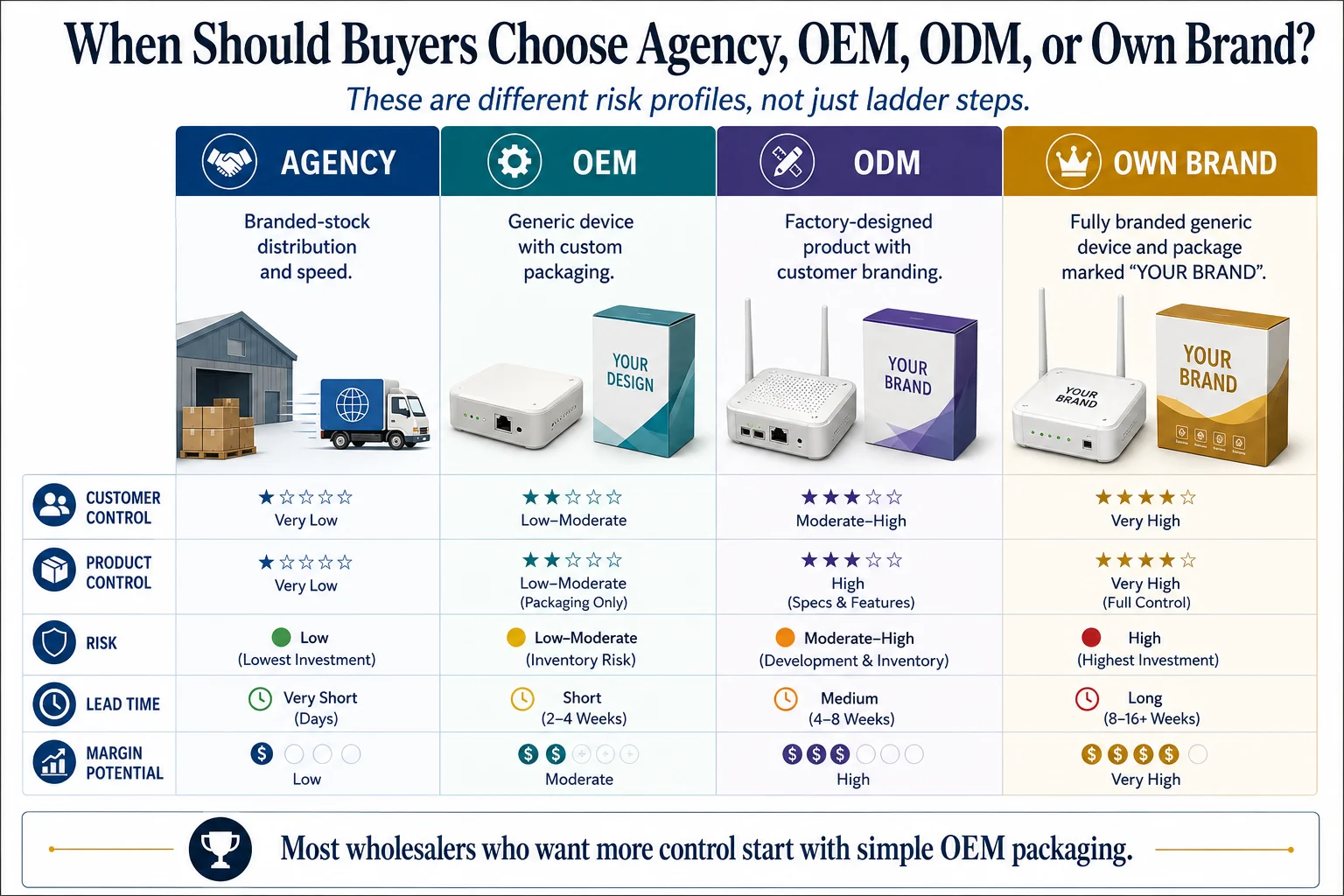
Let’s map these clearly so you can see where you fit. An agency or pure distribution model means you sell a factory’s existing brand. You have zero control over the product or its market presence. The brand’s sales team might also sell directly to a shop in your area, and you can’t stop them. This is for when you’re just testing a market with no long-term plan.
OEM (Original Equipment Manufacturing) means you take an existing device from my factory, and we change the packaging, color, and logo to yours. The product is proven; the customization is visual. This is the best starting point for 90% of private label wholesalers. You get the protected product without the cost of new mold development.
ODM (Original Design Manufacturing) goes further: we design a new shape or feature together. The investment is higher, but the product is unique. This is for when you’ve already sold thousands of units and know exactly what your customers wish was different about a device.
Own Brand is the long-term play where you handle multiple OEM and ODM SKUs under one house brand. You’re building a catalog, not just buying a box.
Common mistake: a mid-tier wholesaler jumps straight to ODM wanting a fully unique device, forgetting they haven’t sold enough OEM volume to know what unique feature matters. I guide them instead to start with OEM on three top flavors. Prove the demand. Then, once the repeat purchase pattern is solid, we discuss ODM tweaks like a new shell color or an improved mouthpiece.
Common Mistakes and Unrealistic Expectations in Private Label Vape Projects
I’ve seen more private label launches fail from overthinking the logo than from the product failing in-store.
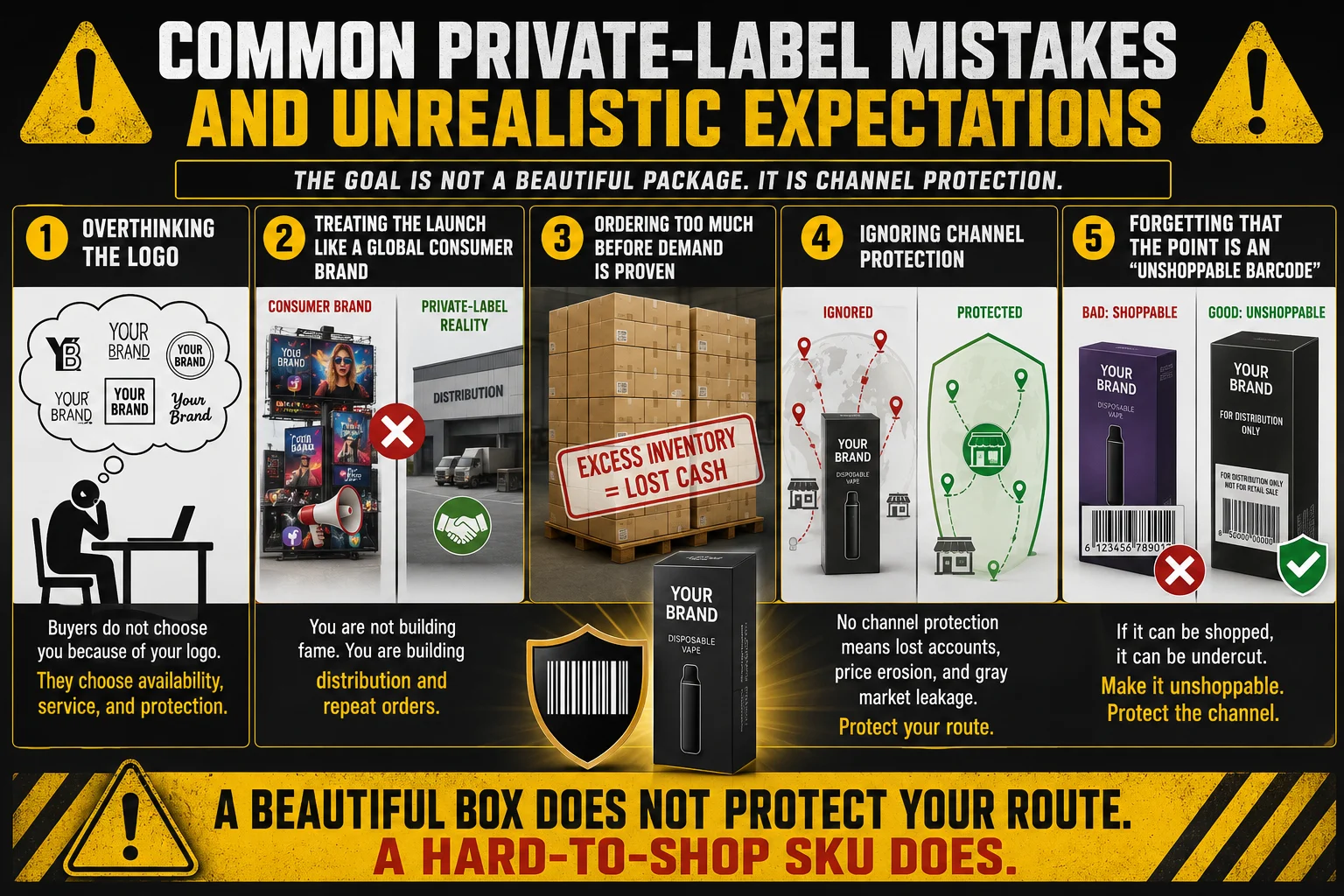
Let’s go through the traps I see. First, trying to design the box from scratch without understanding the regulatory labeling requirements. One client delayed his order by six weeks because the artwork he designed in one evening didn't fit the nicotine warning space required in his country. I had to send the design back three times. Use the factory’s template, change the logo, swap the colors, and keep the layout that already passes customs. Speed to shelf matters more than a creative award.
Second, expecting zero minimum order quantity. Yes, our European warehouse can ship branded stock at 50 units per flavor. But private label means a production run, even a small one. If you want a box with your name, a print factory needs to run a certain batch of labels. Expect to order at least 300-500 pieces of a SKU to make the setup cost reasonable. If that number scares you, your sales volume isn’t ready for private label yet. Stick with branded stock and grow your route.
Third, thinking your private label brand will create automatic loyalty in the end user. I repeat: the user in a gas station grabs what’s available and tastes right. They don’t scan social media for your brand story. Your private label’s power is logistical, not emotional. It locks the store to you.[^11] Don’t spend money on a fancy "brand identity" video until you’ve sold your first ten repeat shipments without a price war. Invest in stock depth first.
Fourth, setting the retail price too low. Because your unit cost might be slightly higher than branded, some wholesalers panic and try to match the lowest branded price. Then they earn less per unit on their own label. Price according to what solves the store’s problem: "a flavor I can’t find anywhere else." That’s worth a reasonable premium.
How to Compare OEM and Branded Vape Supply Options for Your Growth Stage
Don't ask "which is cheaper." Ask "which model matches my next twelve months of cash flow and channel risk."
Compare options by working backward from your store orders, not forward from a factory price list. If your top accounts are asking for price protection, your current model is already failing.
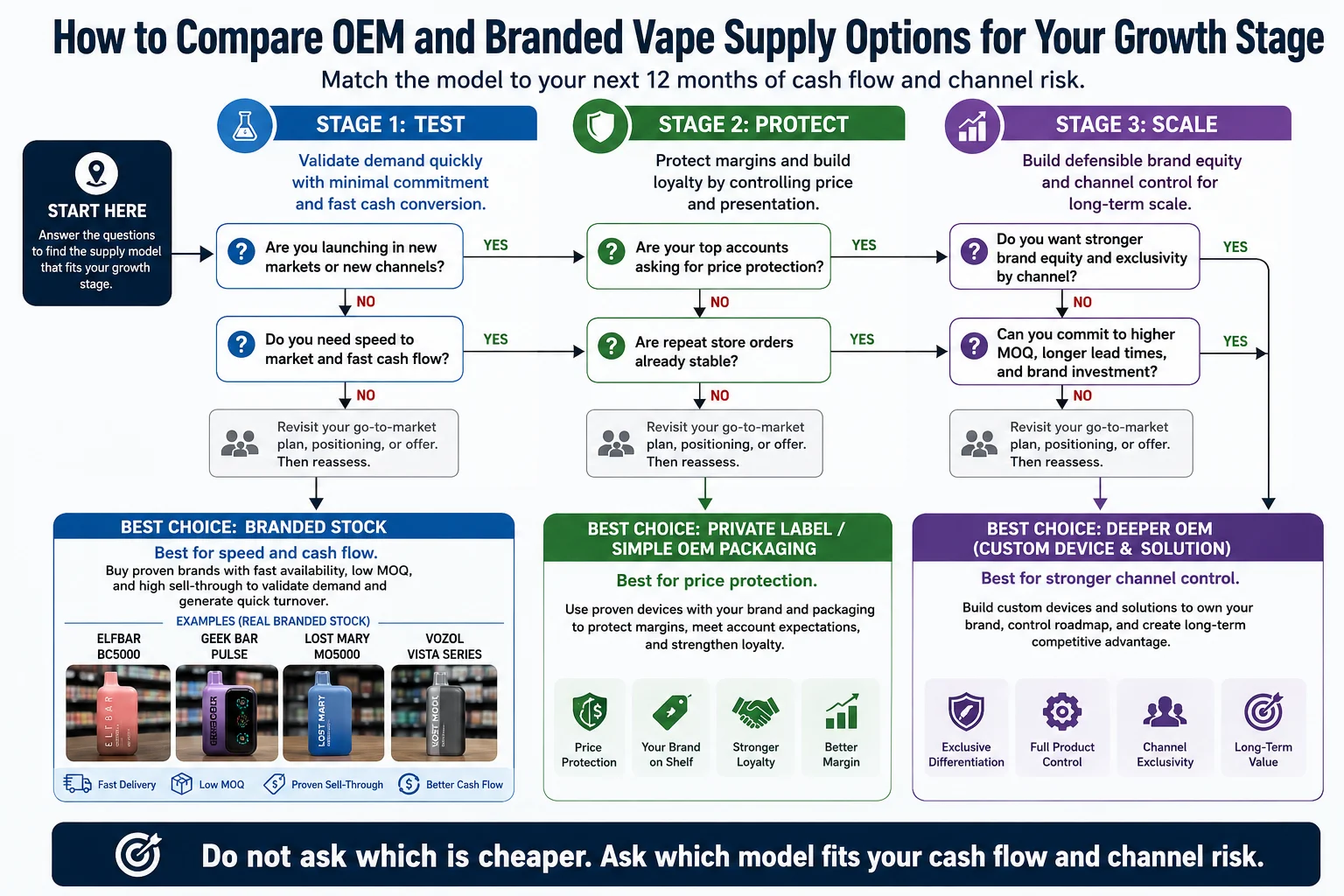
Here is my method. I sit with a client and look at their monthly reorder data. Pull out the top three SKUs by volume. Are they branded? If yes, call a competitor and pretend to be a buyer. I guarantee you'll find that same SKU listed below your cost within three calls. That’s your current risk. Now map those same three SKUs onto a simple OEM run. The unit price might be a few cents higher, but you eliminate the price-match phone call from your week.
Next, look at your customer type. If you serve gas stations who buy five different flavors each week but switch based on whatever is $2 cheaper, you need a strategy with less comparability. That’s OEM. If you serve a handful of dedicated vape shops who love to talk about the latest tech and want the newest brand, branded stock is still your ticket for those accounts. But you can run both models. Many of my steady wholesalers stock branded products for the trend-chasers and their own private label for the consistent daily staples. That dual model works best for growth.
Finally, consider your warehousing. Private label doesn't require a temperature-controlled vault. It just requires you to forecast. I’ve seen wholesalers who struggle with forecasting avoid private label because they fear being stuck with inventory. But the same thing happens with branded stock when a brand suddenly updates the device design, and you’re left with the "old version" that shops now reject. At least with OEM, you know the product life cycle, and you don't get surprised by a brand’s marketing calendar. You decide when the product changes.
I’m not here to push one path over the other for everyone. Some of my fastest-moving clients only buy branded stock from our European warehouse and flip it in days. That works because speed is their only value. But if your value to stores is consistency and availability, then owning your label is the logical step. It turns your truck from a delivery service into a product line.
Conclusion
Stop counting pennies per piece and start counting how many phone calls your margin loses. Your answer isn’t on a price list; it’s in the loyalty of your own route.
[^1]: "What Is a Private Label? Private Labeling Explained - NetSuite", https://www.netsuite.com/portal/resource/articles/erp/private-label.shtml. According to marketing literature, private label products are those owned and branded by a retailer or distributor, granting them exclusivity and control over the brand identity and supply chain within their channel. Evidence role: definition; source type: encyclopedia. Supports: Private label involves owning the brand and being the exclusive supplier for that product in a given channel.. Scope note: This definition is general; the specific SKU exclusivity in a channel depends on contractual agreements. [^2]: "[PDF] Lifting the Veil: The Benefits of Cost Transparency", https://www.hbs.edu/ris/Publication%20Files/15-017_f67df7f5-8336-47fc-a0c1-098838aa550d.pdf. Research on retail pricing shows that universal product barcodes facilitate price comparison, intensifying competition and reducing margins for sellers of identical branded goods. Evidence role: mechanism; source type: paper. Supports: Common barcodes allow quick online price comparison, transferring pricing power to the lowest-cost seller.. Scope note: This effect is more pronounced when online price comparison tools are readily available. [^3]: "Private Label Products: The Secret to Building Brand Loyalty", https://www.inflowinventory.com/blog/private-label-products/. Retail and marketing studies note that retailer-owned barcodes for private label goods create a unique product identifier, eliminating direct price-scanning comparisons by consumers. Evidence role: mechanism; source type: paper. Supports: Exclusive barcodes on private label products prevent direct price comparison across retailers.. Scope note: Competitors may still manually compare similar products if they recognize the underlying item. [^4]: "USA-based Small Batch Manufacturer - Beehive Botanicals", https://www.beehivebotanicals.net/company-news/small-batch-manufacturer. Reports on manufacturing trends indicate that flexible production technologies and digital printing have reduced minimum order quantities for private label packaging, making smaller runs feasible. Evidence role: general_support; source type: research. Supports: Advances in manufacturing allow OEM factories to accommodate smaller minimum order quantities, such as a single pallet.. Scope note: The specific MOQ can vary widely by product type and factory capabilities. [^5]: "Considerations for federal agencies tasked with improving health ...", https://chir.georgetown.edu/considerations-for-federal-agencies-tasked-with-improving-health-plan-price-transparency-data/. Research on retail technology shows that consumers frequently use barcode scanning apps to find lower prices; a unique barcode not listed in third-party databases effectively blocks such comparisons. Evidence role: mechanism; source type: paper. Supports: A retailer-exclusive barcode prevents consumers from using price comparison apps to find lower prices.. Scope note: This assumes the barcode is not registered in any public database or shared with competitors. [^6]: "Using Loyalty Programs to Attract Consumers to Value-Added ...", https://extension.psu.edu/using-loyalty-programs-to-attract-consumers-to-value-added-businesses/. Consumer behavior research distinguishes between brand loyalty and store loyalty, indicating that for branded products, repeat purchases are primarily driven by the brand, not the specific retailer or distributor. Evidence role: mechanism; source type: paper. Supports: Repeat purchases of branded goods are often attributed to brand loyalty rather than loyalty to the distributor.. Scope note: Distributors can still build loyalty through service and availability, but the product pull is brand-driven. [^7]: "Customer Preferences in Retail: Private Labels and Brand Loyalty", https://spiegel.medill.northwestern.edu/customer-preferences-in-retail-private-labels-and-brand-loyalty/. Marketing literature suggests that private labels can increase store loyalty because the product is exclusive to that retailer, making the retailer's service a key differentiator. Evidence role: mechanism; source type: paper. Supports: Private label products can foster store loyalty by tying repeat purchases to the retailer's service and availability.. Scope note: The shift in loyalty depends on the retailer's consistent service quality and product availability. [^8]: "Using Loyalty Programs to Attract Consumers to Value-Added ...", https://extension.psu.edu/using-loyalty-programs-to-attract-consumers-to-value-added-businesses/. Marketing research consistently finds that for national brands, consumer loyalty is directed toward the brand, making the retailer or distributor interchangeable if the same product is available elsewhere. Evidence role: mechanism; source type: paper. Supports: In branded product distribution, end-customer loyalty typically attaches to the brand, not the intermediary.. Scope note: Distributors can build some loyalty through superior service, but the primary pull remains the brand. [^9]: "Monopoly price - Wikipedia", https://en.wikipedia.org/wiki/Monopoly_price. Economic principles of exclusive dealing indicate that when a distributor is the sole source of a product, they gain pricing power, allowing them to set prices reflecting the value to the customer rather than competitive benchmarks. Evidence role: mechanism; source type: paper. Supports: Exclusive distribution reduces competitive pressure, enabling a distributor to set prices based on perceived value rather than matching competitors.. Scope note: This power is limited by the availability of substitute products and the customer's willingness to pay. [^10]: "Interaction between online retail platforms' private label brand ...", https://www.sciencedirect.com/science/article/abs/pii/S0969698924005046. Strategic management literature notes that private label initiatives in B2B distribution often aim to shield margins and reduce price comparability, rather than to create consumer brands. Evidence role: expert_consensus; source type: paper. Supports: Successful private label strategies for distributors often prioritize channel protection and margin defense over immediate consumer branding.. Scope note: The emphasis may shift as the distributor matures and seeks to build a consumer brand. [^11]: "[PDF] Private Label Introduction: Does it Benefit the Supply Chain?1", https://www.iese.edu/media/research/pdfs/DI-0832-E.pdf. Supply chain research indicates that exclusive products, such as private labels, increase retailer dependence on the distributor, creating a switching cost that strengthens the business relationship. Evidence role: mechanism; source type: paper. Supports: Private label products can create a logistical lock-in for retailers, as they become dependent on the exclusive supplier.. Scope note: Lock-in is effective only if the product meets consumer demand and the distributor maintains reliable service.